Article

Identification of Potential Flood-Prone Areas in the Republic of Kosovo Using GIS-Based Multi-Criteria Decision-Making and the Analytical Hierarchy Process

by
Bashkim Idrizi
1,
Agon Nimani
1,* and
Lyubka Pashova
2
1
Geodesy Department, University of Prishtina, 10000 Prishtina, Kosovo
2
National Institute of Geophysics, Geodesy and Geography—Bulgarian Academy of Sciences (NIGGG—BAS), 1113 Sofia, Bulgaria
*
Author to whom correspondence should be addressed.
Sustainability 2026, 18(1), 359; https://doi.org/10.3390/su18010359 (registering DOI)
Submission received: 10 August 2025 / Revised: 28 October 2025 / Accepted: 29 October 2025 / Published: 30 December 2025

Abstract

Floods rank among the most frequent and destructive natural hazards, threatening ecosystems, human settlements, and national economies. This study delineates flood-prone areas across Kosovo by developing a national-scale Flood Risk Database (FRDB) and a comprehensive mapping framework integrating Geographic Information Systems (GIS), Multi-Criteria Decision-Making (MCDM), and the Analytical Hierarchy Process (AHP). Eight hydrological and topographic conditioning factors—slope, elevation, flow accumulation, distance to rivers, land use/land cover, soil type, precipitation, and drainage density—were analyzed. AHP was employed to assign factor weights based on their relative influence on flood susceptibility, while MCDM aggregated these weighted spatial layers to generate a national flood risk map. Model validation, based on historical flood points, achieved an AUC of 0.909, confirming its high predictive accuracy. The resulting flood risk map classifies Kosovo’s territory into five risk levels: very high (0.56%), high (14.44%), moderate (36.68%), low (46.46%), and very low (1.88%). This research provides the first systematic national-scale FRDB for Kosovo, offering a reliable scientific basis for flood management, spatial planning, and climate resilience policy.

1. Introduction

Flooding is a natural component of the hydrological cycle; however, depending on the region, it can also lead to severe damage to infrastructure, substantial economic losses, and significant threats to human life [1]. While it is impossible to prevent floods completely, their impacts can be mitigated through effective planning and management strategies [2]. Statistically, floods rank among the most frequently occurring natural hazards, affecting over 170 million people worldwide each year [1,3,4,5]. Climate change has further intensified the frequency and severity of flooding events. According to a 2021 study cited by Lai [6], the likelihood of floods has increased as a direct consequence of changing climatic patterns. Among the leading causes of floods, particularly flash floods, is intense and excessive rainfall, along with other contributing factors.
Flood vulnerability analysis serves as a key step in the implementation of the EU Floods Directive (2007/60/EC) [7], as by identifying areas naturally prone to flooding at a national scale, responsible institutions can fulfil the Directive’s requirement to produce preliminary flood risk assessments, hazard maps, and flood risk management plans. The IPCC’s Sixth Assessment Report (AR6) [8] indicates that global warming is increasing the frequency and severity of heavy precipitation events, leading to a rise in flood susceptibility in many regions. For Europe, the AR6 highlights that risks from river, pluvial, and coastal floods are expected to increase under warming scenarios, underlining the need to incorporate information on future climate into vulnerability and risk frameworks. By aligning flood vulnerability models with the six-year cycle of the Directive and AR6 projections, national-scale analyses can bridge current physical vulnerability with future climate-driven changes, thereby improving resilience planning. When developing a national flood risk strategy in Kosovo, sensitivity mapping and management processes foreseen by the EU Directive (2007/60/EC) should be combined with the climate risk analyses of the AR6, ensuring that they are both legally compliant and scientifically sound.
Given that flood hazards exhibit strong spatial characteristics, the application of Geographic Information Systems (GIS) and Remote Sensing (RS) technologies is crucial for effective flood hazard and risk assessment [9]. The integration of multi-criteria decision-making (MCDM) with the Analytic Hierarchy Process (AHP) in GIS techniques has gained widespread popularity in flood risk management and planning. This integrated approach allows for the systematic assessment of multiple spatial and non-spatial factors that influence flood susceptibility, facilitating decision-makers to prioritize resource allocation and undertake mitigation measures [10,11,12,13].
In recent years, the Republic of Kosovo has experienced numerous flooding events, primarily triggered by heavy rainfall and the insufficient capacity of existing infrastructure to manage such weather conditions. Notable flooding occurred in January and March 2016, November 2016, August 2020, January and July 2021, September 2022, and January and March 2023 [14]. These incidents primarily impacted areas with the highest rainfall intensity. The recurrence and severity of these floods underscore the importance of this research, as each event has resulted in substantial damage to both the economy and infrastructure. Identifying and mapping regions vulnerable to rainfall-induced flooding throughout Kosovo is critically important for both natural systems and essential societal functions. This process plays a crucial role in ensuring public safety, supporting sustainable economic and environmental development, and informing spatial planning efforts at all levels.
According to the Law on Spatial Planning in the Republic of Kosovo No. 04/L-174 [15] and its corresponding administrative guidelines for implementing spatial and urban plans, five categories of spatial planning documents are defined: the Kosovo Spatial Plan, Spatial Plans for Special Areas, Municipal Development Plans, Urban Development Plans, and Urban Regulatory Plans. The first two types fall under the jurisdiction of the national-level Agency for Spatial Planning, whereas the development and regulatory plans are managed by local municipalities [16]. Identifying areas at risk of flooding is a crucial component in preparing these spatial, development, and regulatory plans, playing a vital role in guiding sustainable land use and planning decisions.
Based on the circumstances outlined above, this study aims to develop a robust flood risk assessment model capable of accurately identifying areas susceptible to flooding within the Republic of Kosovo. Once established and validated, the model will support flood risk management strategies and help mitigate potential damages associated with natural hazards. The assessment evaluates flood susceptibility using eight key contributing factors—elevation, slope, rainfall, distance from river, land use and land cover (LULC), drainage density, Topographic Wetness Index (TWI), and soil type. These parameters were selected through a comprehensive review of relevant literature and adapted to reflect the hydrological, topographical, and climatic characteristics of the study area [17].
The proposed model extends beyond a simplistic analysis of rainfall measurements over a specific time frame or precipitation-induced damage; it provides a comprehensive analytical framework for delineating flood-prone zones by integrating multiple environmental and physical parameters. A key objective of the model is its applicability in real-world flood management scenarios. Upon completion, it could be expected to assist public institutions—such as emergency services, police, and military units—in managing high-risk zones during flood alerts by identifying priority areas for evacuation or deployment. Additionally, the model serves an informative role for the general public by indicating which areas are considered safe and which should be avoided during extreme weather events.
From the outset, it is important to emphasize that the primary focus of this research is on assessing flood risk rather than on the technological platforms used for data processing. While GIS and the Multi-Criteria Decision-Making (MCDM) framework, combined with the Analytical Hierarchy Process (AHP), are utilized to support this research, these serve as methodological tools rather than ends in themselves. Alternative approaches—such as hydrological modeling, statistical analyses of historical precipitation, or community-based assessments—can also be used for flood risk evaluation. Nevertheless, GIS-based analyses employing the MCDM-AHP approach have proven particularly effective and precise in identifying flood-prone areas [18,19,20,21], owing to their ability to integrate diverse datasets and stakeholder perspectives. This methodological combination enhances the ability to integrate diverse data sources and stakeholder perspectives, making it particularly well-suited for complex spatial analyses such as national-scale flood risk assessment.
This research on flood risk assessment follows the methodology established in prior studies aimed at identifying the flood-prone zones at the municipality level. While many such studies target areas with consistently high flood recurrence [10,11,12,13], this pattern does not fully apply to Kosovo. In Kosovo, the most severe flood events tend to occur in regions where infrastructure for managing intense rainfall is underdeveloped. Consequently, a key objective of this study is to pinpoint locations where preventive and protective measures are urgently needed, particularly in anticipation of heavy precipitation. A crucial element of the analysis includes the hydrographic system of Kosovo, as areas adjacent to rivers and other water bodies are more susceptible to flooding. To effectively assess flood risks, it is necessary to examine both historical flood events and the hydrological characteristics of the country. Section 2 presents a brief description of the country’s geographical and topographic features, along with a historical overview of floods over the last two decades, including the data and methodological approach used in the present study. Based on selected factors and a weighting matrix, potential areas with a specific level of flood risk, rated on a five-point scale, are identified and presented in Section 3. The results obtained are discussed in Section 4, highlighting the limitations and potential future applications of the approach, particularly in integrating additional data sources into early warning systems for flood hazards, such as high-resolution satellite observations and the European Flood Awareness System [22]. Section 5 summarizes the main results and provides recommendations for targeted, detailed studies for the identified potentially threatened local areas in Kosovo.

2. Materials and Methods

2.1. Study Area

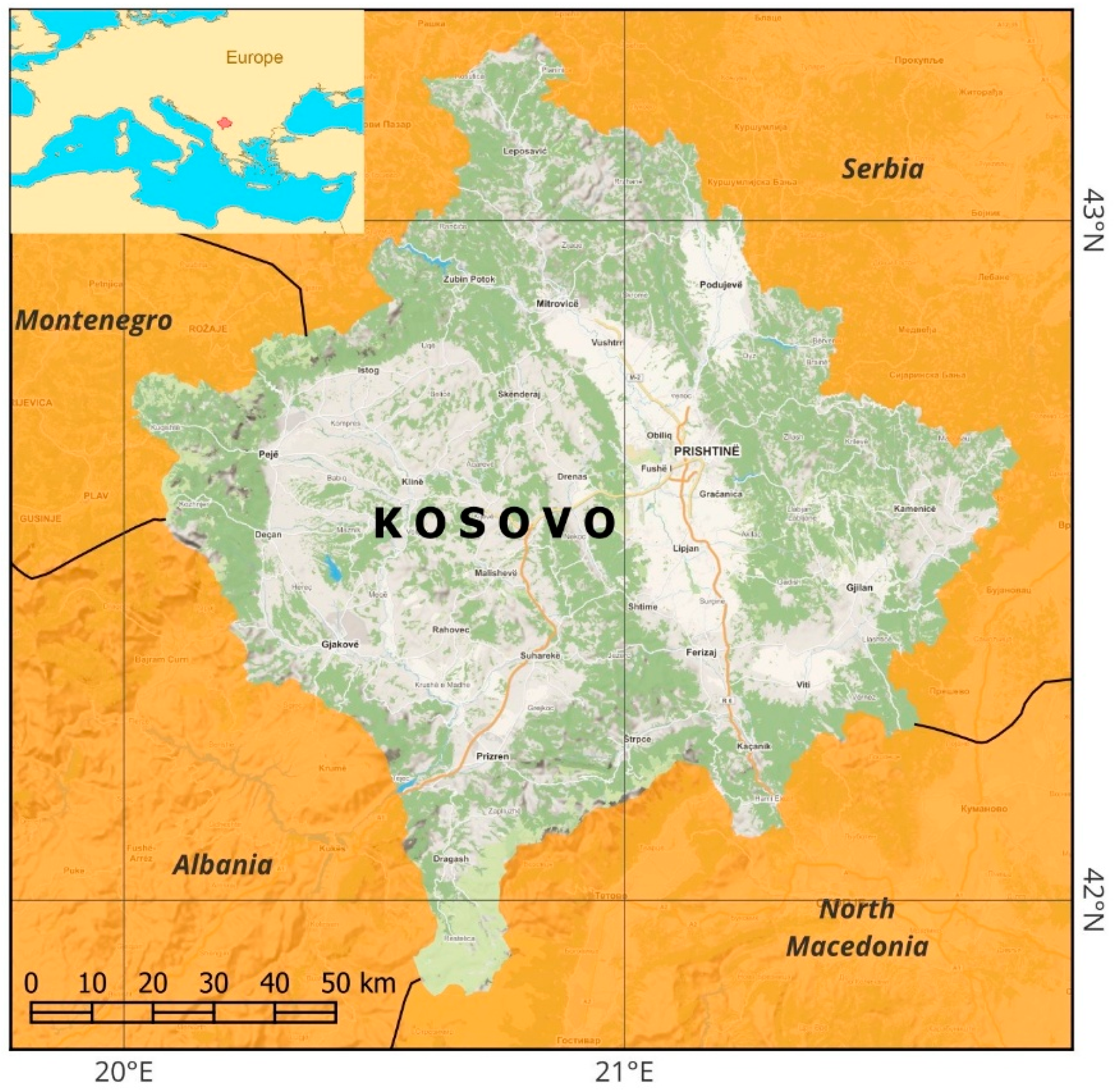
The chosen study area encompasses the entire surface of the Republic of Kosovo, situated in Southeastern Europe, with an area of 10,907 km2 [23] and a 744 km border line [24] with neighboring countries, including Albania, Montenegro, Serbia, and North Macedonia (Figure 1). Kosovo’s landscape is characterized by significant geographical and natural variation, which directly influences the shaping of both environmental and economic activities across the country. Three key physical characteristics—topography, water systems, and precipitation patterns—are particularly influential in the context of spatial, regional, and urban planning.
Kosovo features a varied terrain, primarily composed of two major basins—the Kosovo Basin and the Dukagjini Basin—encircled by the towering ranges of the Dinaric Alps and the Sharr Mountains. With an average altitude of roughly 800 m above sea level, the country is characterized mainly by hilly and mountainous landscapes. This topography plays a key role in shaping climatic zones and influencing patterns of human settlement.
The national hydrographic network is extensive, although many rivers are short and have irregular flow patterns. Kosovo is situated across three major drainage basins: the Adriatic, the Black Sea, and the Aegean. Its rivers, primarily sustained by rainfall and snowmelt, are essential for irrigation, potable water supply, and hydroelectric power generation. These same hydrological dynamics, however, also contribute to recurring floods and surface water accumulation.
Both its elevation and geographic location shape precipitation levels in Kosovo. Annual rainfall varies significantly, ranging from approximately 600 mm in the lower elevations to over 1200 mm in the highlands. Rainfall peaks during spring and autumn, increasing the risk of flood events due to river overflows and inadequate drainage capacity [25].

2.2. Floods in Kosovo

In an article published by Ekonomia Online on 21 October 2023, former Prime Minister of Kosovo, Mr. Avdullah Hoti, reported that the floods on 27 January 2023, impacted 1253 households, 214 businesses, and 582 agricultural plots, with total economic damage estimated at €23.5 million [26]. For comparison, flood-related losses in 2022 were valued at approximately €8.2 million. These figures underline the substantial economic toll flooding has taken, affecting both the state and individual households.
Kosovo has a history of experiencing floods, with notable events occurring in 2010, 2014, 2016, 2021, and 2023. These floods have affected various municipalities, caused damage to properties and infrastructure, and impacted agricultural lands. Specific Historical Flood Events in Kosovo are:
  • 2010: Flooding occurred due to heavy rainfall, impacting multiple municipalities, including Prishtina, Kamenice, Viti, Gjakova, Dragash, and Skenderaj.
  • 2014: Floods were reported in Kosovo.
  • 2016: Heavy rainfall, combined with snowmelt, caused flash floods in many municipalities.
  • 2021: January floods reached levels last seen in 1979, affecting the city of Vushtrri and surrounding areas, according to Kosovo 2.0.
  • 2023: Floods damaged Skenderaj, Mitrovica, Podujeva, Istog, and Klina.
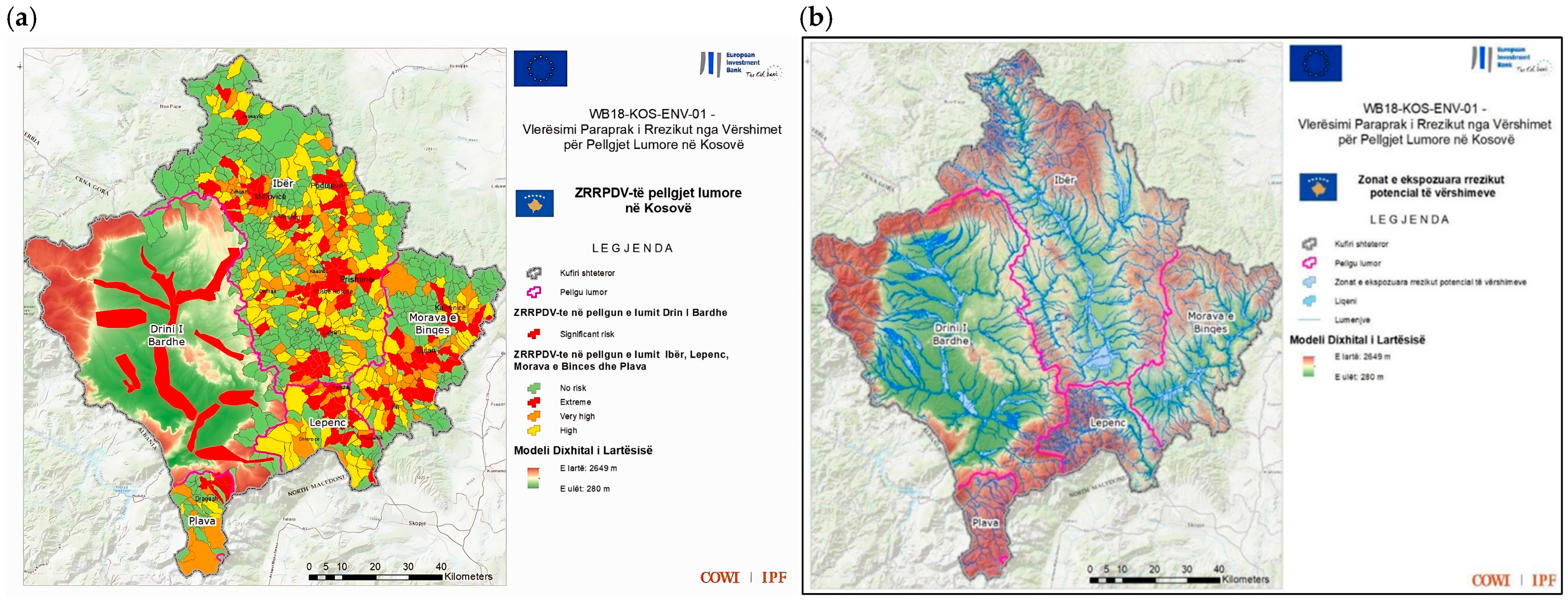
A detailed overview of the regions most impacted by flooding in Kosovo is presented in the Flood Report in Kosovo, published in 2023 by the Ministry of Environment and the River Basin District Authority [27]. This report outlines the damage caused by floods that occurred from 20 to 22 November 2022. According to a summary shared by Ndërtimi Media, the report highlights that flooding is a recurring issue in Kosovo’s flatlands, resulting in extensive economic and environmental damage. The natural landscape favors settlement expansion, industrial development, and infrastructure in the lowlands, while the adjacent steep mountain ranges accelerate runoff, contributing to rapid water flow and high peak discharges. The report also includes two maps (Figure 2) depicting the conditions during the November 2022 floods.

2.3. Methodological Approach

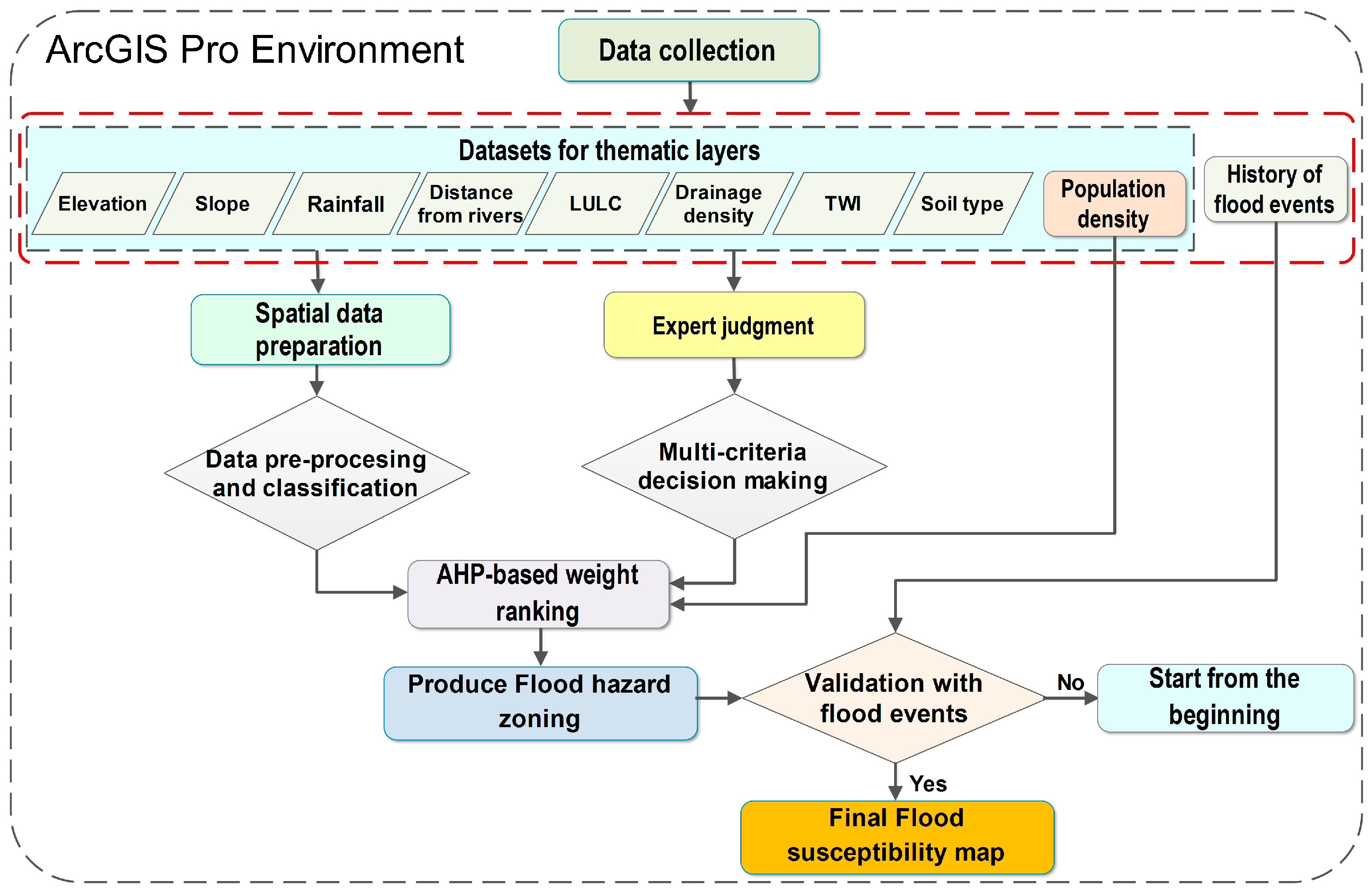
The overall methodological workflow applied in this study is illustrated in Figure 3. The process begins with the collection and preparation of spatial datasets relevant to flood susceptibility assessment. These datasets were standardized through a normalization procedure to ensure comparability among variables. The normalized criteria were then structured within the AHP framework to determine their relative importance through pairwise comparisons. The derived weights were subsequently integrated using a weighted overlay analysis in a GIS environment, producing a composite flood susceptibility map. The resulting spatial output was incorporated into the FloodRiskDatabase (FRDB), which serves as a comprehensive platform for storing, managing, and visualizing flood risk information. Finally, model validation was performed to evaluate the reliability and accuracy of the obtained results. This workflow provides a transparent and replicable structure for flood risk assessment and data integration.

2.3.1. Source Data

The primary objective of the analyses undertaken in this study was to assess the accuracy of the Flood Risk Database (FRDB) and the effectiveness of the weighting-based methodology developed for flood hazard mapping in Kosovo. Achieving reliable results necessitates access to high-quality geospatial data across all categories defined within the FRDB. Ideally, such datasets should be sourced from national institutional repositories in Kosovo and made available for non-commercial and academic use, in line with the European Union’s Directive on Open Data and the Re-use of Public Sector Information [28].
Despite this, a substantial gap remains in the availability of crucial geospatial data needed to conduct detailed flood risk assessments across the country. Due to this limitation, the study relied on publicly accessible, open-source datasets retrieved from the internet to evaluate the proposed methodology for identifying flood-prone regions in Kosovo. Although the use of such data constrains the precision and overall reliability of the outcomes, it nonetheless permits a functional demonstration and validation of the custom methodology presented in this research.
An analysis of past floods in Kosovo, presented in [14], reveals a remarkable relationship between floods and periods of intense rainfall, identifying them as a primary cause of flood hazards. Nevertheless, due to the multifaceted nature of flooding, it is essential to consider a broad range of contributing factors. This comprehensive approach is supported by previous research, such as the study by Hoque et al. [29], which incorporated sixteen different variables into its flood risk evaluation. Among the critical factors, LULC significantly influences flood behavior. Different land cover types affect flood vulnerability in various ways. In Kosovo, urban areas often face elevated flood risks due to poor stormwater management, underdeveloped drainage systems, and widespread impermeable surfaces (e.g., roads and buildings), which reduce infiltration and increase runoff. Each LULC class contributes differently to flood susceptibility.
Drainage density is another key element, representing the total length of drainage channels relative to the watershed area. Higher drainage density generally corresponds to a greater potential for surface runoff, thereby increasing flood risk.
Elevation is identified as the most significant variable in such a study. It forms the basis for computing other critical parameters, such as slope and drainage density, and for determining water movement. Lower elevations are more prone to water accumulation and, consequently, flooding.
Slope, derived from elevation data, affects the rate at which water travels across a surface. Steeper slopes enable faster runoff, reducing water pooling and lowering flood risk. In contrast, flatter terrain tends to retain water, increasing flood susceptibility [1].
The TWI assesses the impact of terrain on water accumulation and movement. The index represents a function that integrates both slope gradient and the upslope contributing area per unit width, measured orthogonally to the flow direction, specifically formulated for application in hillslope catenas. Empirical evidence shows that this index exhibits strong correlations with a range of pedological characteristics, including horizon depth, silt fraction, organic matter concentration, and phosphorus content. The wetness index is determined based on the formula TWI = ln(A/tanβ), where A represents the specific areas of the watershed, whereas β represents the terrain slope. Areas with higher TWI values are more likely to retain water, indicating a stronger sensitivity to flooding [30]. In this research, TWI was calculated for each DEM pixel using ArcGIS (https://www.arcgis.com/index.html).
Proximity to rivers and lakes is another important consideration. During periods of heavy rainfall, rising water levels can cause overflow, influencing nearby urban areas, farmland, and infrastructure.
Soil characteristics also impact flood dynamics by influencing how much water the ground can absorb. Areas with low-permeability soil have reduced infiltration rates, leading to higher surface runoff and increased flood risk.
The open-access data sources in the conventional reference system, WGS84, employed in the study included the geospatial data shown in Table 1 (accessed on 12 April 2025).
To ensure the integrative use of spatial datasets originating from heterogeneous sources, a comprehensive data harmonization and alignment procedure was implemented as a preliminary step. This process involved unifying coordinate reference systems, resampling raster datasets to a uniform spatial resolution, and adjusting vector data to a consistent topological model. By reconciling differences in reference coordinate systems, spatial resolution, and vector data scale, all datasets were systematically integrated into a unified geospatial database, FRDB, thereby enabling coherent and robust spatial analyses across multiple data types.

2.3.2. MCDM with AHP Methodology

MCDM and AHP are commonly used for flood susceptibility mapping because they can integrate multiple influencing factors, including slope, soil type, land use, rainfall, and drainage patterns. AHP, in particular, organizes complex decision-making into a hierarchical framework and determines the relative importance of each factor through pairwise comparisons, ensuring logical consistency and reflecting expert insights. When combined with GIS, these approaches enable the creation of detailed spatial maps in which each area is assessed based on the weighted contributions of all relevant criteria. The AHP method is commonly used in flood risk and hazard assessment because it offers a structured hierarchy for decomposing complex decision problems, allows qualitative and quantitative criteria to be compared through pairwise comparisons, supports stakeholder involvement, and is relatively straightforward to implement in GIS environments [31,32].
The Analytical Hierarchy Process (AHP), introduced by Saaty [33], is a widely adopted and highly effective technique within the field of Multi-Criteria Decision-Making (MCDM). This method enables the assignment of relative weights or importance to each criterion or factor under consideration. AHP has been extensively applied in flood risk studies to prioritize and weigh flood-related variables, ultimately supporting the identification and mapping of flood-prone areas [5,17,25,27,28,29,30,31,32]. Integrating MCDM with AHP in GIS for flood risk management is a modern, widely used approach that combines data from different sources [1,2,7,10,11,12,17,28,29,34,35,36,37,38]. The approach enables the systematic analysis of multiple factors, facilitates comprehensive, visually transparent, and transparent flood risk assessments, and enhances efficiency across various regional contexts [28,35,39]. Furthermore, it enhances decision-making robustness by explicitly incorporating expert judgment and stakeholder preferences [40,41].
The process begins with the construction of a pairwise comparison matrix (P), in which each factor is compared to the others based on its relative influence, presented by Equation (1). The matrix is a reciprocal matrix of order n × n , where n   is the number of elements being compared. Each element p i j expresses the relative importance (or preference intensity) of element i   compared to element j . These comparisons serve as the basis for determining each factor’s weight, reflecting its significance within the overall decision-making framework.
P = P 11 P 12 P 21 P 22 P 1 n P 2 n               P n 1 P n 2 P n n
The matrix has three key properties:
  • Diagonal values: p i i = 1 , since each element is equally important to itself.
  • Reciprocity: p i j = 1 p j i .
  • Positivity: p i j > 0 .
Then, the calculation of the normalized weight is performed using Equations (2) and (3). Each entry in the column is then divided by the column sum to yield its normalized score, following Hagos et al. [1]:
W n = G M n n = 1 n i G M n ,
where
G M n = P 1 n   P 2 n P m n i n i .
Lastly, the consistency ratio (CR) (Equations (4)–(6)) is determined through:
C R = C I R I ,
where the consistency index (CI) is as follows:
C I = λ m a x     n i n i     1
and λ m a x is the eigenvalue of the judgment matrix:
λ m a x = n = 1 n i ( P W ) n n i w n

2.3.3. Application of MCDM with AHP Methodology in ArcGIS Pro and QGIS Software

The integration of MCDM techniques with AHP is an efficient and suitable strategy for spatial analysis tasks, such as identifying areas at risk [18,19,20]. To fully leverage this analytical approach, it is crucial to incorporate the AHP-derived weights into a Geographic Information System (GIS) framework [12].
Researchers have introduced numerous models and methodologies to assess and map flood hazards [37]. Among these, the GIS-based AHP has proven particularly effective for evaluating flood risk and generating corresponding risk maps [40]. The integration of MCDM with AHP and geospatial technologies has become a widely adopted and essential approach for identifying and mapping flood-prone areas [19,34,38,40].
Flood risk assessment primarily utilizes two GIS platforms: ArcGIS Pro 3.5 and QGIS 3.44. ArcGIS plays a central role in creating thematic layers, conducting spatial analysis, transforming data formats, and generating the final flood risk maps. Meanwhile, QGIS is a helpful complementary tool, aiding data validation and cross-checking of filtering techniques. Within ArcGIS, the combination of MCDM and AHP is facilitated by the “Weighted Sum” tool. This tool enables the overlay of multiple raster datasets, each scaled by its respective weight, to generate a single aggregated output [15]. The “Weighted Sum” tool is located in the software via System Toolboxes → Spatial Analyst Tools → Overlay → Weighted Sum.

2.3.4. Determination of Factor Weights

We applied an integrative approach grounded in previous flood studies conducted in Kosovo, relevant scientific literature, and international institutional reports. The development of a flood risk assessment model is based on hazard levels, factor classification, and determining the relative impact of each category within each factor. This hybrid methodology ensures that the model reflects both the natural and socio-environmental characteristics of the study area. Three principal risk categories were considered in model construction, adapted to the country’s specific geographic and demographic context. The goal was to establish a robust spatial model capable of delivering accurate flood risk data across Kosovo’s entire territory.
The review of both scientific and technical sources, along with analyses of previous projects, facilitated the identification of critical factors contributing to floods [19]. However, the categorization and factorization processes were implemented using geostatistical methods tailored to the distributional range of data in Kosovo and the dynamics of local microregional natural processes. Each thematic data layer was reclassified into five standardized categories to ensure that the risk levels associated with each factor could be consistently assessed [17]. These categories were assigned numerical values ranging from 1 to 5, corresponding to the following levels: 1—Very Low, 2—Low, 3—Moderate, 4—High, and 5—Very High.
Due to their qualitative nature and lack of inherent numerical values, land use, land cover, and soil datasets were handled differently from continuous variables during the modeling process. These types of data are not suitable for conventional interval-based classification methods typically applied to quantitative datasets [35]. As a result, they were excluded from the standard five-class interval framework commonly used in spatial analysis. Instead, a tailored classification approach was employed, in which each category in these datasets was evaluated individually based on its specific impact on flood susceptibility. This method enabled a more nuanced and accurate representation of these categorical variables in the flood risk model, ensuring that their unique characteristics were properly accounted for in the overall assessment of flood vulnerability [34].
The assignment of factor weights was determined through a multi-step procedure that combined literature-based evidence, expert evaluation, and geostatistical validation. The categorization was established through an extensive review of the literature and preliminary research, followed by recalculations that adapted both the data and their categories to the specific spatial, hydrological, and atmospheric conditions of Kosovo’s territory. Initially, preliminary weight ranges were derived from international studies and technical reports addressing flood susceptibility in comparable geographic and climatic contexts. These ranges were then adjusted through consultation with national experts in hydrology, geomorphology, and spatial planning, who systematically assessed the relevance of each factor to the specific conditions of Kosovo. Expert ratings were structured using the AHP pairwise comparison method, yielding reciprocal comparison matrices from which normalized eigenvector values were calculated to determine the final weights. Specifically, regarding soil type, only two levels have been defined based on an assessment of their relative impact on flooding. CR were calculated to ensure coherence in expert evaluations, retaining only values within the acceptable threshold (CR < 0.1). Finally, these weights were cross-checked against the statistical distribution of historical flood events, ensuring alignment between expert-based priorities and observed flood patterns. The resulting values, presented in Table 1, represent the relative contribution of each factor to flood risk across Kosovo.
This classification aligns with the AHP methodology, enabling the quantification of each factor’s contribution at the pixel level across the national territory. Subsequently, the integrated use of these standardized layers enables the computation of a composite flood risk index for every individual pixel in 30 m spatial resolution, thereby facilitating spatially explicit flood risk mapping in Kosovo.
Table 2 presents the assigned weights for nine different data layers used in the Kosovo study area. These weights serve as fundamental inputs for conducting spatial analyses in conjunction with the MCDM-AHP methodology, which has been successfully applied in similar studies for other countries [17,19,34,37,38,41], thereby supporting the generation of flood risk maps across Kosovo.

2.3.5. Flood Risk Database

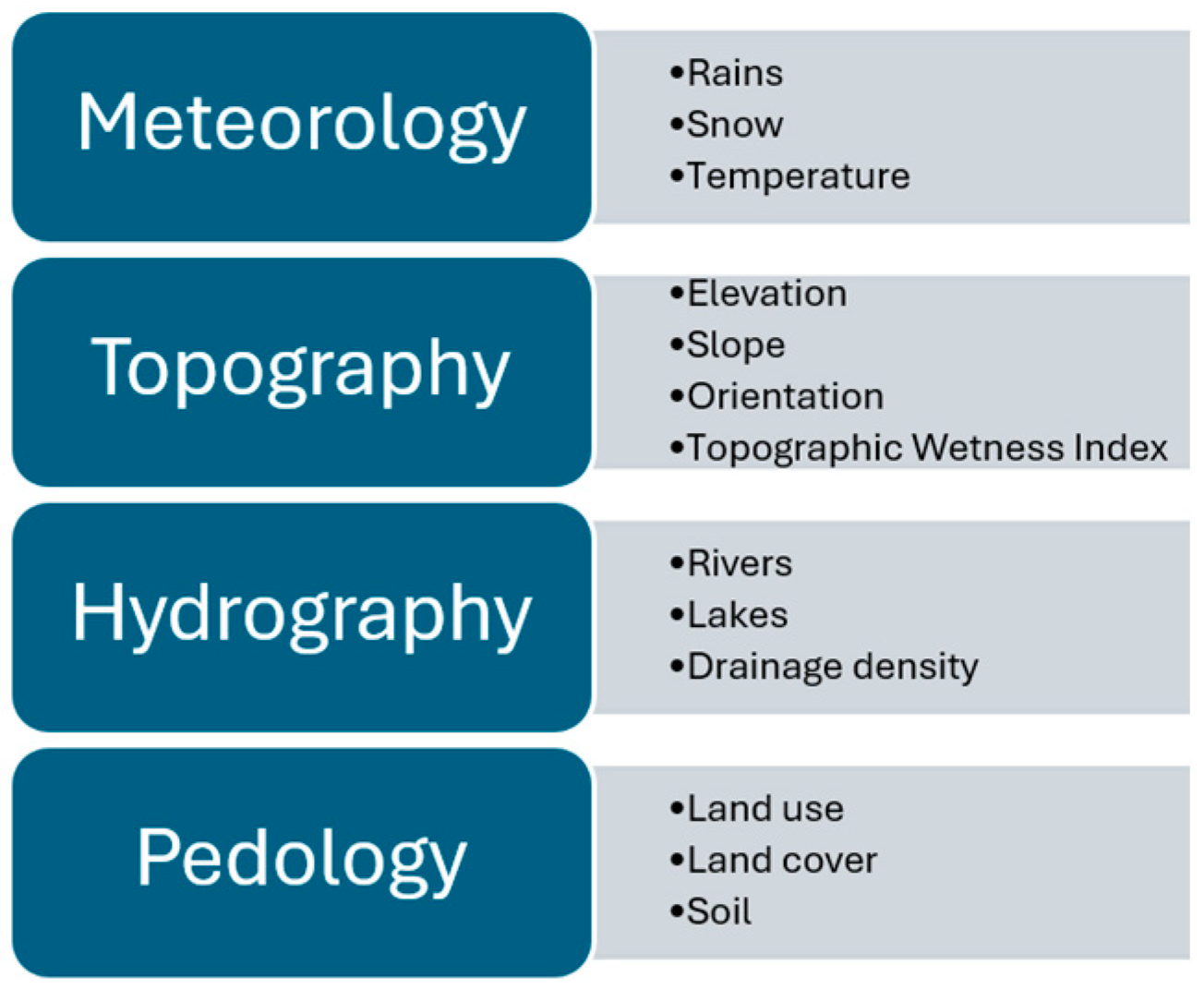
The FRDB is a geospatial database [17] developed as part of this study to support the analysis and assessment of flood hazards. Established using Model Builder within the ArcGIS environment [17,30,42], the database is organized as a geodatabase and comprises four primary categories of geospatial data: meteorological, topographic, pedologic (soil-related), and hydrographic. Its design was deliberately made flexible to accommodate flood risk evaluations in a wide range of geographic areas—not solely within the Republic of Kosovo—and across multiple spatial scales, from national to local (settlement-level) analyses. The FRDB is open and extendable [17,42,43], enabling future enhancements by incorporating additional region-specific variables that may become relevant but were beyond the scope of the current study. The accompanying figure illustrates the core framework of the database, highlighting its four primary data categories and their corresponding subcomponents (Figure 4).
Each component of the flood risk database was determined through a structured process that involved reviewing the scientific literature, comparing it with Kosovo’s hydrological and environmental conditions, and adapting it to the national context to ensure local relevance and applicability. The first step consisted of an extensive review of international and regional studies dealing with flood hazard and risk assessment. This review helped identify the key factors commonly influencing flood occurrence and impact. The purpose was to establish a theoretical foundation based on prior research and to identify which variables are consistently recognized as significant drivers of flooding. The literature review also provided guidelines for data structure, classification schemes, and spatial resolution appropriate for flood risk modeling.
After compiling potential parameters from the literature, the next step was to compare them with the natural, climatic, and socio-environmental conditions of Kosovo. Kosovo’s topography, precipitation patterns, river basin characteristics, and land management practices were analyzed to verify whether the criteria identified from global or regional contexts were applicable and representative in the national setting. This comparison ensured that only parameters directly relevant to local flood dynamics—such as slope gradients, catchment characteristics, and land cover changes—were included. It also allowed the identification of data gaps, such as where local datasets might not exist or differ in spatial resolution compared to those used in other regions.

3. Results

3.1. Development of the Pairwise Comparison Matrix

Using the weight calculation methodology described in Section 2.3.4, a pairwise comparison matrix P was generated for the eight key factors identified as influencing flood risk within the study area. This matrix was created using the conventional AHP framework, in which each factor is systematically compared with the others to assess its relative importance [29].
The results of these comparisons, which represent expert evaluations of the significance of each factor in flood hazard assessment, are summarized in Table 3.
The final step involves calculating the weights for each factor considered in the flood risk analysis. In this phase, a specific weight is assigned to each factor, reflecting its relative contribution to flood risk assessment in Kosovo. These weights, derived through the AHP methodology, serve as the basis for integrating the factors into the overall spatial risk model [29,34]. The computed weights are presented in Table 4.
As indicated in Table 4, elevation was identified as the most dominant factor, accounting for 17% of the total weight in the flood risk assessment. Slope, Precipitation, Distance to rivers, and Land use/land cover each contributed 13%, while drainage density was assigned a weight of 11%. The remaining factors, TWI and soil type, each accounted for 10% of the weight.
These weights, derived from the pairwise comparison matrix shown in Table 2, constitute the finalized values within the FRDB. They determine the proportional influence of each factor [44] during the spatial classification of flood risk zones across Kosovo.
To ensure the validity and consistency of the assigned weights, a comparative evaluation was performed against similar flood risk studies conducted in other regions [29]. The comparison revealed strong consistency, suggesting that the weighting model developed for Kosovo aligns well with established methodologies and international findings in the domain of flood hazard assessment.

3.2. Data Processing Model

The process of developing a unified model for identifying flood-prone zones in the Republic of Kosovo involved eight sequential stages, each focusing on a specific flood-related factor. In the concluding stage, these independent factor models were integrated into a composite model using the weight matrix generated through the AHP methodology [21,36,45]. This integration involved applying the assigned weights at the pixel level with 30 m spatial resolution, allowing for the computation of a detailed flood risk index for every pixel within the study area.
Following the risk classification ranges outlined in Table 2, thematic layers representing elevation, slope, precipitation, proximity to water bodies, land cover, land use, drainage density, TWI, and soil type were each processed separately to create eight raster layers. These layers were then combined into a multi-band raster database, with each band representing one of the contributing factors.
In the final analytical step (see Figure 3), the per-pixel weights from Table 3 and the standardized risk values, which range from 1 (very low) to 5 (very high) as described in Table 2, were applied to compute the final flood risk zonation for the Kosovo area [17].

3.3. Zoning Based on the Level of Risk for Each Factor

The methodology depicted in Figure 3, corresponding to the classification framework tailored to Kosovo’s geographical features (outlined in Table 1), was systematically applied to each selected flood risk factor. This step-by-step approach was designed to produce reclassified raster layers [20] based on their respective flood risk categories.
Given that the input geospatial datasets (referenced in Section 2.3) were sourced from various providers, an essential preprocessing phase was conducted to standardize and harmonize the data [42]. This step involved converting and adapting all datasets from their original formats to align with the model processing structure [12], as shown in Figure 3, and to meet the specifications of the FRDB.
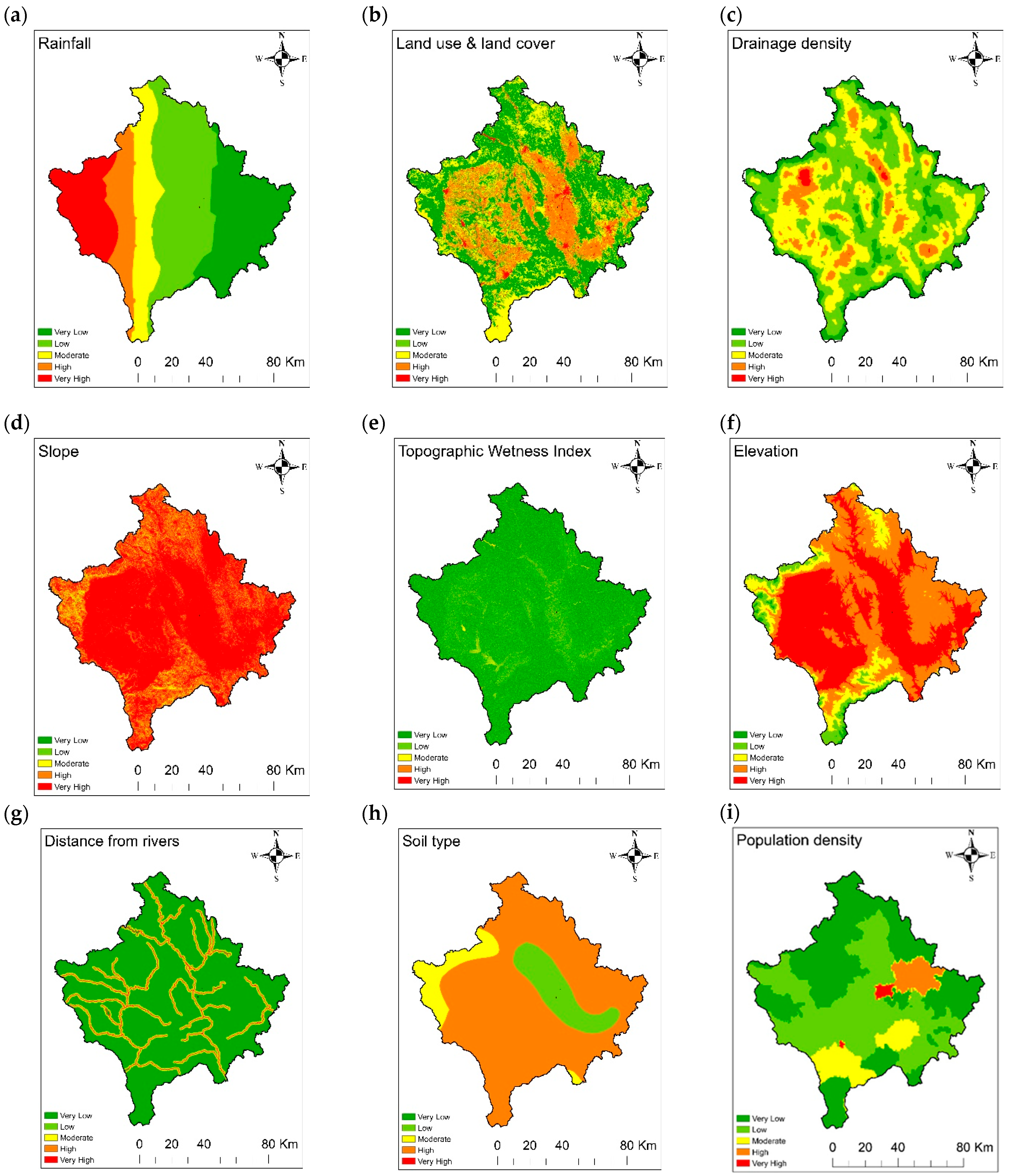
Each dataset was then reclassified by assigning a flood risk value—ranging from 1 (very low) to 5 (very high)—to individual pixels, depending on their contribution to flood vulnerability. This process resulted in eight harmonized raster layers, each corresponding to a different influencing factor, which were visualized using a consistent symbology scheme to illustrate the spatial variability of flood risk across Kosovo’s entire territory. Figure 5a–h present the visual outputs of the eight individual raster datasets, each representing a key factor in the flood risk analysis.

3.4. Flood Risk Zones Map of Kosovo

Using ArcGIS Pro and following the methodology outlined in Section 2.3, the final flood risk level for each pixel across Kosovo’s territory was calculated by integrating the weighted values of all classified flood risk factors. This process resulted in a flood risk database in which each pixel was assigned a value between 1 and 5. These values correspond to the predefined flood risk categories: Very Low, Low, Moderate, High, and Very High. The outcome is a spatially continuous, high-resolution flood risk assessment that offers a detailed representation of flood vulnerability across the entire studied region. Consequently, the final output layer illustrates the spatial distribution of flood risk levels throughout the Republic of Kosovo. This output is the result of processing eight key contributing factors, which include precipitation (measured in mm/year), LULC, classified using the Land Cover Classification System (LCCS) established by the Food and Agriculture Organization (FAO), drainage density (expressed in km/km2), slope (in degrees), TWI, elevation (in meters), proximity to water bodies (measured in meters), and soil type, categorized according to soil composition. By integrating these variables, the model produces a comprehensive, spatially detailed flood risk map that offers valuable insights for planning, risk management, and environmental protection in Kosovo.
Each of the eight primary factors discussed earlier holds a distinct level of significance in influencing flood risk. However, it is also essential to recognize the relevance of additional, secondary factors that, while not included in the core model, still warrant attention. One such factor is population density, shown in Figure 5i. Population density is an important factor in flood susceptibility assessment because it provides critical insight into the exposure of human settlements to flooding and their potential impacts. While this factor does not directly cause flooding, it is crucial for assessing flood susceptibility and risk, as it links the physical hazard with the human and socio-economic dimensions of vulnerability and exposure. Therefore, the population density is considered secondary due to both its data characteristics and temporal variability [19,35,37,38]. The flood risk model presented in this study is based on eight static environmental and topographical variables that are generally stable over time. These inputs provide a long-term, generalized assessment of flood risk across Kosovo rather than reflecting risk for a particular year or event (e.g., rainfall totals for a specific year, such as 2014).
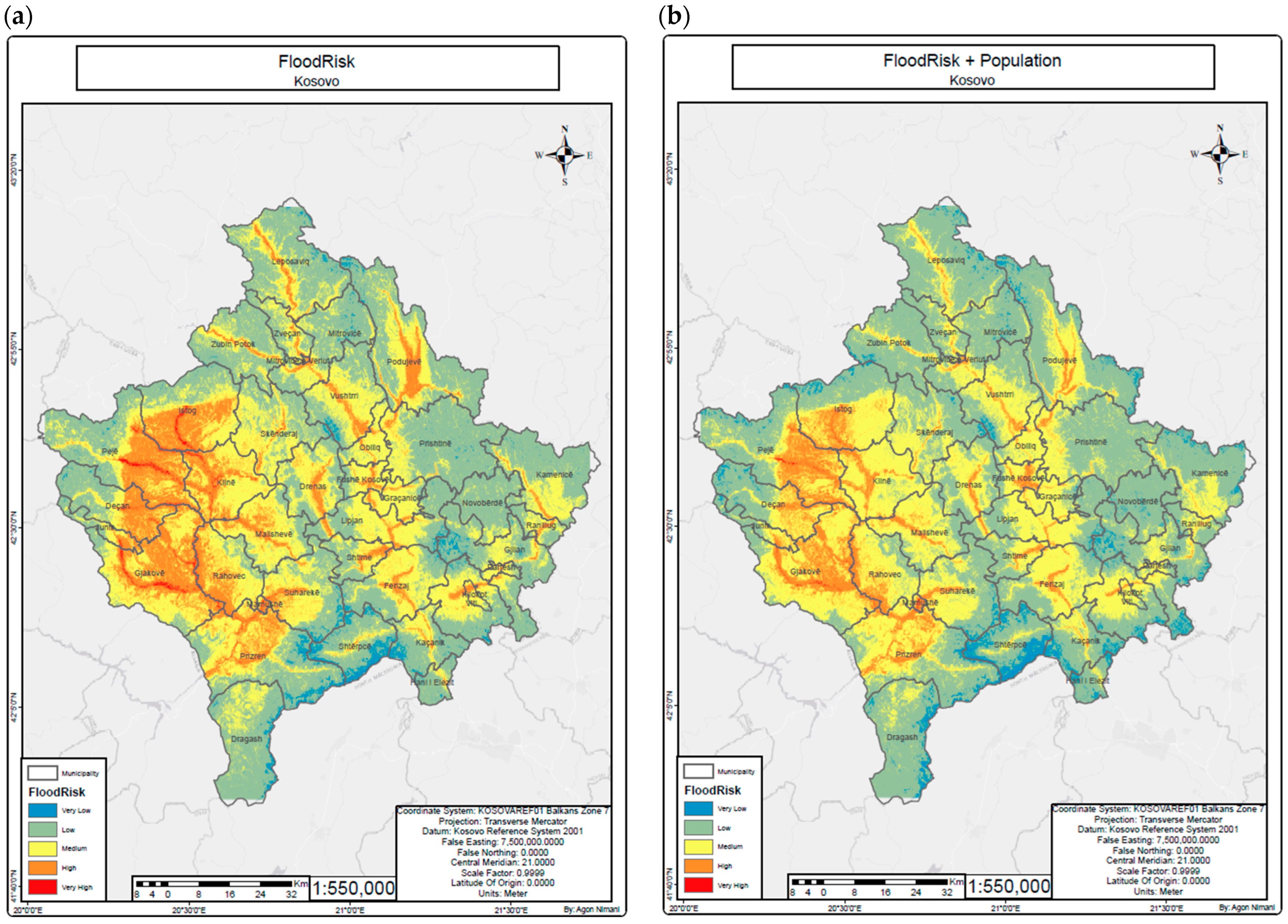
In contrast, population density is a dynamic metric that fluctuates over time. Between census periods, variations of up to 10% have been observed, making it less suitable for integration into a model designed to assess constant, non-temporal flood risk conditions. As such, it was not incorporated into the primary AHP-based analysis [36]. Nevertheless, to enhance the model’s comprehensiveness, an alternative version was developed that includes population density as a ninth factor. In this extended model, 8% of the total weight was assigned to population density, while the original eight factors each had their weights reduced proportionally by 1%. Population data were sourced from the Kosovo Agency of Statistics (KAS) and linked to municipal administrative boundaries to generate the population density layer used in the analysis performed as shown in Figure 3. Figure 6 shows the two flood susceptibility risk maps obtained without and with the use of population density.
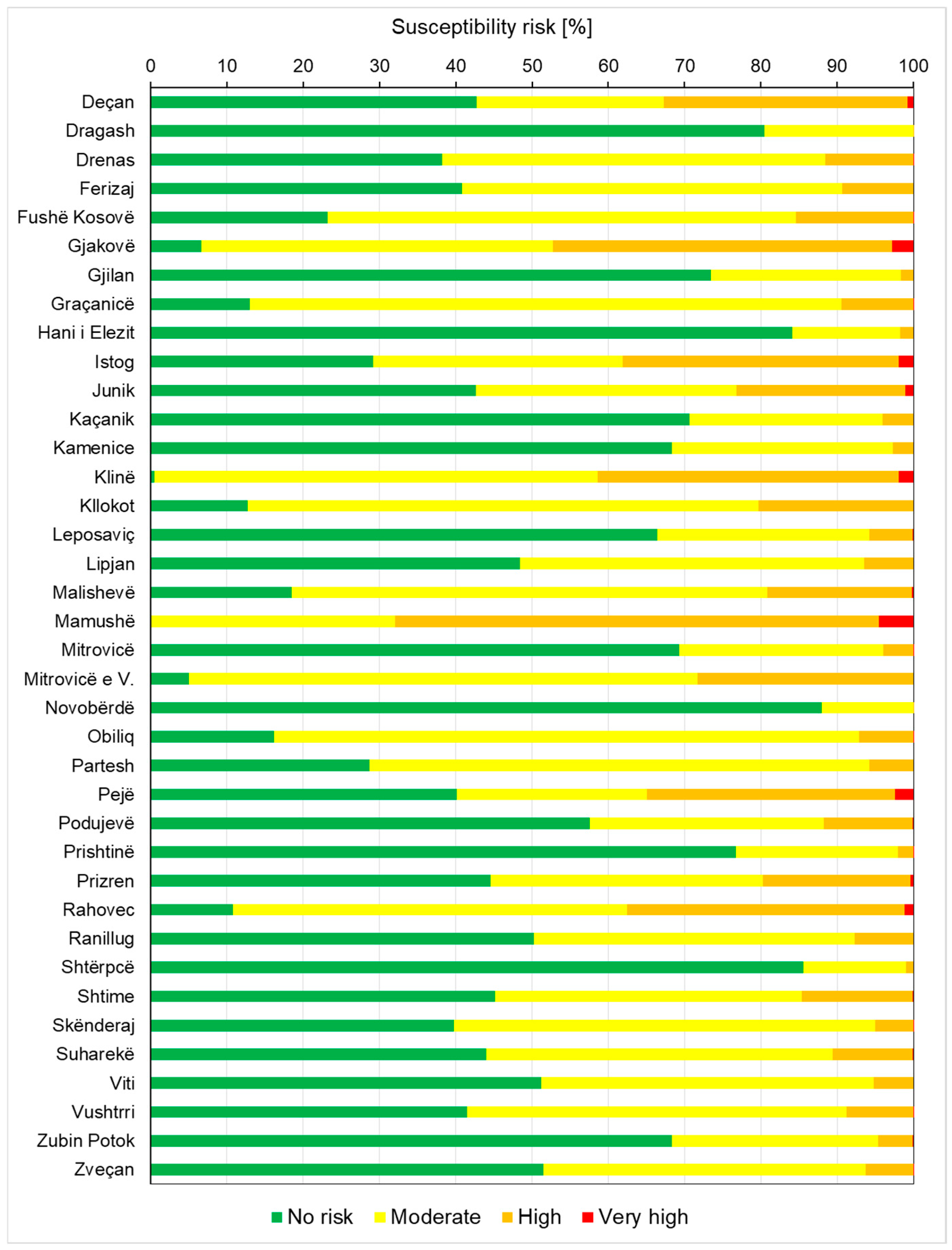
The flood risk model developed in this study was applied across the entire territory of the Republic of Kosovo. To enhance spatial detail and better identify vulnerable areas, an additional analysis was conducted at the municipal level. The analysis involves calculating the extent of flood risk within each of Kosovo’s municipalities. The findings are presented in Table 5 and Figure 7, which categorizes flood risk into five levels—Very Low, Low, Moderate, High, and Very High—as defined in the main model. For each municipality, the table provides moderate, high, and very high flood risk areas:
  • The percentage of the municipal area classified under each flood risk level.
  • The corresponding land area (in square kilometers) associated with each risk category.
This refined classification delivers a municipality-specific overview of flood exposure, offering critical information for disaster risk reduction, spatial planning, and the strategic deployment of emergency management resources.

3.5. Data Validation

Validation is a critical component of any analytical modeling process, serving to determine the extent to which the generated results accurately represent the real-world dynamics of the phenomenon under investigation. Essentially, it involves assessing the reliability and credibility of the model’s outputs. Various strategies can be employed for this purpose, including cross-referencing with empirical records, comparing with pre-existing models, conducting field-based validation, and expert assessment [45,46]. In this study, model accuracy was evaluated by correlating the findings with documented historical flood events.
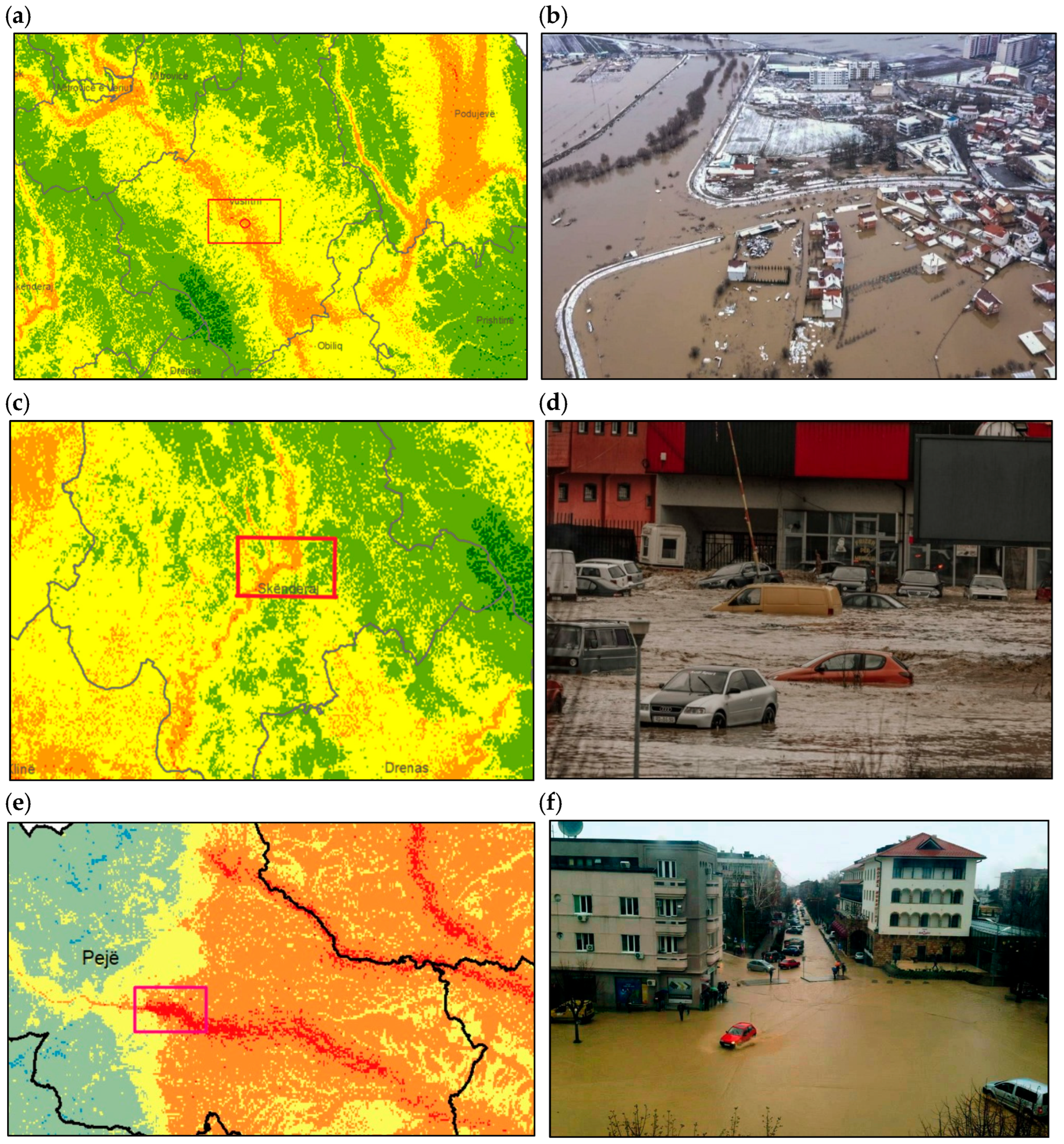
The reliability of the flood risk assessment was evaluated by comparing the model’s outputs with documented historical flood events [14,26,27]. Three key locations—Vushtri, Skenderaj, and Peja (see Figure 8)—were selected for validation due to their pronounced vulnerability to flood-related damage in recent years. Although other areas in Kosovo have also experienced flooding, these three municipalities were prioritized based on the magnitude and impact of past incidents.
The first validation site chosen for aligning the model results with historical flood occurrences is the city of Peja, particularly its central urban area. This locality has experienced nearly all significant flood events documented in Kosovo [14,26,27,46,47]. An additional notable example of flood-affected areas is the city of Vushtrri (Figure 8a,b). In January 2021, Vushtrri and its surrounding regions experienced significant flooding [14,27]. The location shown in Figure 8a corresponds to the urban zone of Vushtrri. According to the flood risk model developed for this study, this area is predominantly classified as exhibiting a high flood risk. The red-highlighted zone in Figure 8b corresponds to the area showing the urban extent of the Vushtrri municipality within the flood risk framework for the Republic of Kosovo.
In the analysis of the Skenderaj municipality using the developed flood risk model, the site depicted [14,27] is located within the flood risk zone illustrated in Figure 8c. According to the model, this area is predominantly classified as having a high flood risk. The highlighted zone in Figure 8c corresponds to the municipality’s urban residential sector, which the model identifies as mainly high risk, surrounded by adjacent areas categorized as moderate flood risk. The 2023 flood event is shown in Figure 8d.
The flood risk model classifies Peja’s city center as a zone with very high flood risk, consistent with the region’s documented flood history (Figure 8e). Flood events in this region have been particularly documented for 2013 and 2023 (Figure 8f) [14,27]. Notably, the 2023 flooding resulted not only in considerable economic losses but also in human casualties, with two people injured and two fatalities reported.
Following the identification of potential flood-risk areas, it is essential to assess the accuracy and reliability of the developed model alongside the obtained results. A practical approach for this validation involves comparing the model outputs with the historical flood inventory of Kosovo, thereby ensuring that the predictions align with observed events. This verification process can be conducted using the Receiver Operating Characteristic (ROC) method [30], a widely recognized and robust tool for evaluating the performance of spatial analysis models.
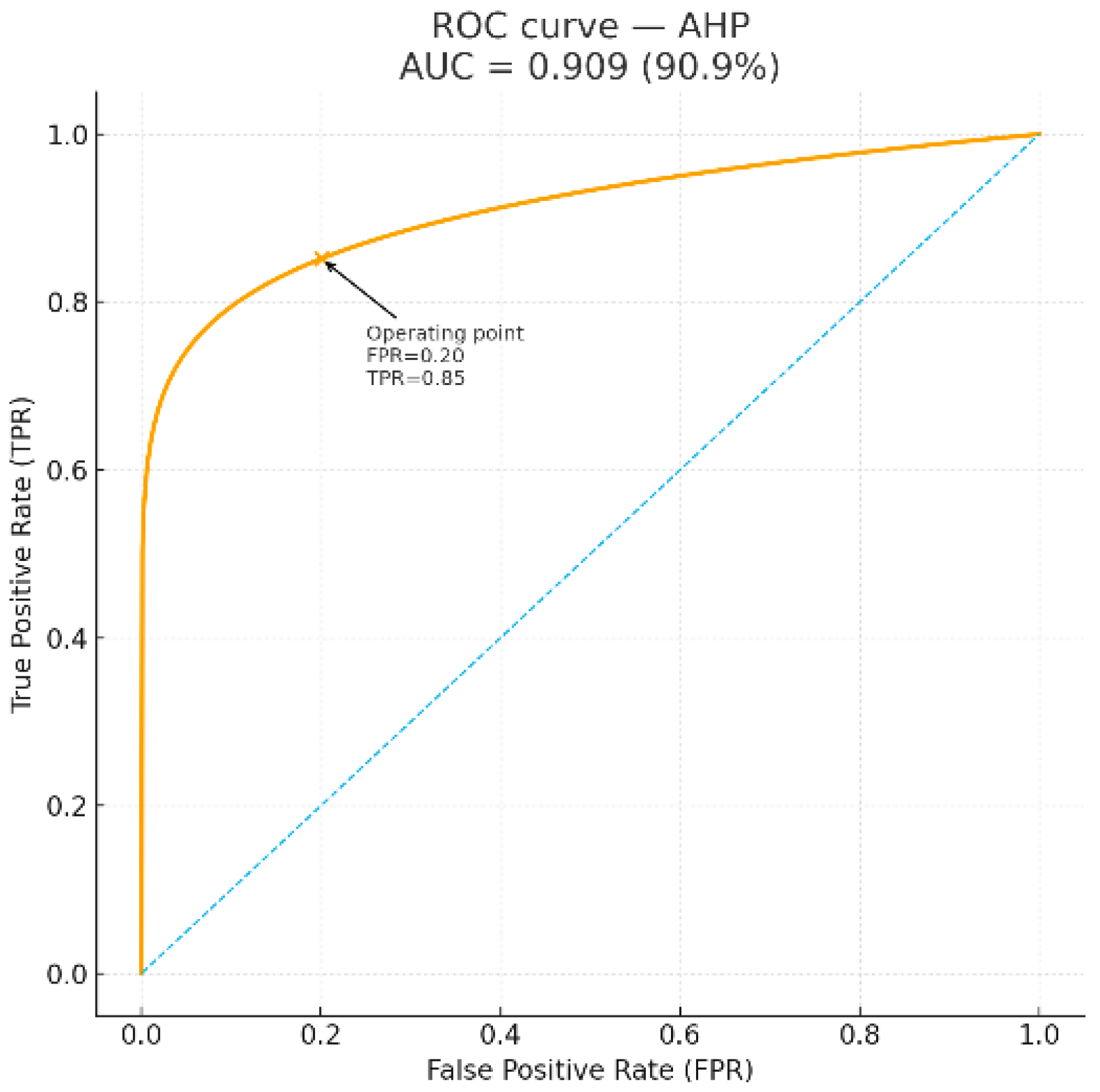
The ROC analysis conducted in this study indicates that the applied methodologies yield highly satisfactory and consistent results, demonstrating strong agreement between predicted (Figure 8) and historical flood occurrences (Figure 8). Specifically, the AHP method produced results with an Area Under the Curve (AUC) value of 0.909 (Figure 9), reflecting an exceptional level of model accuracy and confirming the reliability of the approach for flood risk spatial assessments. These findings underscore the robustness of the applied modeling framework and its suitability for guiding flood risk management and planning efforts. The comparative analysis conducted across all areas in the Republic of Kosovo reveals a high degree of spatial concordance, indicating that the FRDB and the data processing model for flood-prone areas established in this research effectively capture zones of elevated flood vulnerability.

4. Discussion

Flooding remains one of the most frequent and destructive natural hazards globally, posing significant risks to human life, infrastructure, and economic stability. In this study, we employed an integrated approach combining GIS [7,12], MCDM [37], and AHP [9] to identify and delineate flood-prone areas in the Republic of Kosovo. The primary factors influencing flood risk assessment in the study described are systematically identified and weighted using the AHP, complemented by a strong GIS-based methodology. Eight critical environmental and topographic parameters were integrated into the model: elevation, slope gradient, annual precipitation, proximity to water bodies, LULC, drainage density, TWI, and soil classification. These variables were selected according to their relevance to flood hazard dynamics, and their relative influence was determined through expert judgment refined to reflect the micro-regional characteristics of Kosovo, and validated by comparing them with historical flood events and similar international studies. While previous studies have employed various combinations of factors and risk classification schemes [1,2,5,9,10,11,12,13,40], this study tailored its methodology to the specific geospatial and hydrological conditions of the study area, ensuring relevance and applicability at the national scale.
Based on the MCDM-AHP model in a GIS environment using weighted overlay, the flood risk index was calculated at the pixel level with 30 m resolution, accounting for all factors proportionally. As in many other studies [5,18,19,20,21], the results for the Kosovo territory confirmed that elevation is the most important determinant of flood risk, as lower-lying areas are naturally prone to water accumulation. The analysis also reveals that the hydroclimatic factors, such as rainfall and the proximity of settlements to rivers, are the following most important factors that significantly influence flood exposure. Land use (LULC) plays a key role in amplifying flood risk, especially in urbanized areas of Kosovo. Soil and terrain characteristics (slope, soil type, TWI) determine how water flows and infiltrates, which are the next most important factors in assessing risk areas potentially at risk from flooding.
The model’s results indicate that 1.88% of the territory falls under very low flood risk, 46.46% under low flood risk, 36.68% under moderate flood risk, 14.44% under high flood risk, and 0.56% under very high flood risk. Areas with high to very high susceptibility are concentrated primarily in the western and southwestern parts of the country, with notable clustering in the Dukagjini region. These spatial patterns align with known flood-prone zones and hydrological features, reinforcing the model’s validity.
In the past, there has been a lack of systematic research on flood-prone areas that would enable proactive measures and better support for citizens during flood events. Reports from the International Federation’s Disaster Relief Emergency Fund (DREF) for 2010 [46] and 2011 [47] indicate that flood-prone zones were identified retrospectively, based on historical statistics, and that actions were taken only after natural flood disasters had occurred. The model developed and presented in this study addresses this methodological gap by providing a framework for identifying flood risk zones based on their risk levels, enabling preemptive action by responsible institutions to support more effective flood management and response.
The integration of GIS with MCDM and AHP proved to be a practical methodology for flood susceptibility mapping, aligning with the findings of similar studies [1,2,7,9,10,11,12,13,23,29,44,48,49]. Within this framework, GIS facilitated spatial analysis and data integration, while AHP provided a systematic approach for weighting and ranking the contributing factors. The resulting FRDB offers a structured repository of spatial data layers essential for flood risk assessment and decision support.
Two primary goals underpinned this study: (1) to develop a comprehensive and replicable methodological framework for flood hazard zonation in Kosovo, and (2) to construct a geospatial database capable of supporting both static and dynamic flood risk modeling. The workflow, implemented using ArcGIS ModelBuilder, supports automated modeling and future integration of real-time or updated data inputs. The model provides high-resolution spatial detail, making it suitable for both national and local planning purposes. The methodology aligns with international standards and exhibits high consistency with other similar flood studies. Figure 3 illustrates the data processing pipeline—from raw data acquisition to the generation of final thematic layers—highlighting the transparency and reproducibility of the methodology.
A key contribution of this study is the region-specific calibration of the model’s parameters. Unlike generalized global or continental-scale assessments, this model was specifically designed for the Kosovo context, capturing the nuanced interplay of local environmental and topographic conditions. Consequently, transferring this model to other regions would necessitate appropriate adaptation to reflect local characteristics. Model validation was performed by comparing the predicted flood-prone zones with historical flood events. The results showed strong spatial concordance, lending confidence to the model’s accuracy. Validation was further strengthened through field verification and consultations with local residents, particularly in previously affected communities, ensuring that both formal and informal knowledge sources contributed to the reliability of the analysis.
The GIS-based MCDM model, utilizing the AHP approach, offers flexibility and adaptability, allowing for the addition of new data, and has shown promising results in identifying flood risk areas. However, certain limitations, such as subjectivity in selecting factors and criteria for assigning weights, necessitate further verification of the results. The delineation of individual areas with varying degrees of flood susceptibility significantly depends on the quality and availability of data. In this case, data are not always readily available, particularly for up-to-date, high-quality spatial data or data with limited access. Furthermore, as the number of factors and the volume of spatial data increase, multi-criteria analysis can require advanced GIS and significant computational resources. Most GIS-MCDM/AHP models provide snapshots, using existing data, and often lack real-time or predictive capabilities to account for climate change, land-use dynamics, or other factors.
Nevertheless, a key limitation of the model is its current focus on natural factors, which, while relatively stable and predictable, do not fully capture the dynamic and often exacerbating influence of anthropogenic activities such as land-use changes and inadequate urban drainage systems. Future enhancements should aim to integrate socio-economic and infrastructural variables to provide a more comprehensive risk assessment.
In interpreting the findings of this study, certain methodological limitations should be recognized. The spatial data used, while comprehensive, are constrained by a spatial data resolution, which may limit the detection of localized variations in flood susceptibility, particularly in small basins or urban environments. The AHP approach, although systematic and widely accepted, inherently involves some subjectivity due to its reliance on expert judgment in assigning weights to criteria. Additionally, while model validation against historical flood events and field information supports its reliability, potential bias may persist where records are incomplete or unevenly distributed. Acknowledging these limitations provides context for the interpretation of results and highlights opportunities for refinement in future research.
Despite the limitations of integrating GIS with MCDM/AHP, there is potential to further improve flood area delineation at the local level in Kosovo. One possibility would be to integrate AHP with other MCDM techniques, such as AHP and TOPSIS [21] or entropy [20] approaches, to mitigate potential biases arising from difficulties in modeling dynamic and complex processes for determining flood hazard areas. Another direction for future research is to enhance participatory approaches to factor weights and include additional criteria, such as urban expansion, climate change, deforestation, or land conversion. Identifying potentially flood-prone areas through GIS with MCDM/AHP analysis, combined with high-resolution spatial and temporal data from the EU Copernicus program will improve the accuracy of flood hazard and risk assessment, modeling, and forecasting. Future research should focus on enhancing the model’s precision by integrating higher-resolution datasets, such as Sentinel-1/2 imagery for detailed flood mapping and ERA5-Land rainfall data for improved hydrometeorological representation. The European Flood Awareness System provides near-real-time and real-time data on weather conditions, precipitation, river levels, and ground conditions, allowing early identification of flood risks before they escalate. These opportunities can be effectively used in a subsequent detailed and comprehensive assessment of flood hazard and risk in the territory of Kosovo.
Additionally, forthcoming studies should explore advanced analytical approaches, including machine learning algorithms and hybrid methods such as AHP–Entropy or AHP–ANP, to refine local-level flood susceptibility assessments and strengthen predictive reliability.
The FloodRiskDatabase serves as a crucial decision-support tool for multiple stakeholders involved in environmental management and disaster risk reduction. For municipalities, it provides detailed spatial information that supports local land-use planning, infrastructure design, and zoning regulations by identifying areas vulnerable to flooding. The Ministry of Environment of Kosovo can utilize the database to monitor flood-prone zones, assess environmental impacts, and develop evidence-based policies for watershed management and climate adaptation. Meanwhile, civil protection agencies can use the system to enhance preparedness and emergency response, including identifying high-risk settlements, optimizing evacuation routes, and prioritizing preventive measures. Overall, the database enables more coordinated, data-driven, and timely decision-making across institutional levels, significantly improving flood resilience and risk governance.
The availability of a FloodRiskDatabase for the territory of Kosovo can be updated regularly, enabling the production of improved versions of local-level flood susceptibility assessments with high spatial and temporal resolution. Updating the flood susceptibility assessment is essential within the context of the Sendai Framework for Disaster Risk Reduction (2015–2030) [50], as it directly contributes to the Framework’s overarching goal of understanding and reducing disaster risk. By identifying and mapping areas prone to flooding, these assessments advance Priority 1 of the Framework—understanding disaster risk—by integrating environmental, hydrological, and socio-economic factors. The resulting spatial information supports evidence-based governance and land-use planning (Priority 2), guides targeted investments in prevention and mitigation measures (Priority 3), and strengthens community preparedness and recovery efforts (Priority 4). In this way, the flood susceptibility assessment for Kosovo operationalizes the Sendai Framework’s principles by transforming scientific knowledge into actionable strategies that enhance national and local resilience to flood hazards.

5. Conclusions

This study successfully developed a GIS-based Multi-Criteria Decision-Making (MCDM) model, supported by the Analytical Hierarchy Process (AHP), to identify and delineate flood-prone areas across the Republic of Kosovo. By integrating hydrological, topographical, and meteorological parameters, the model provides a comprehensive, data-driven framework for assessing flood susceptibility, marking the first application of this approach at this level of spatial detail in Kosovo. The resulting flood susceptibility map provides valuable insights for researchers, policymakers, and practitioners by supporting evidence-based urban planning, disaster risk reduction, and emergency management. The methodology and outputs of this study can inform risk mitigation, land-use planning, and early warning strategies, contributing to more resilient and adaptive flood management practices. Although further validation and periodic data updates are required to maintain model accuracy, the applied approach demonstrates strong potential for operational use in early warning systems, spatial planning, and proactive flood mitigation, thereby contributing to enhanced community resilience and sustainable territorial development.
In recent years, increasing attention has been directed toward methods that identify flooded areas using spectral indices such as the Normalized Difference Water Index (NDWI) and global Synthetic Aperture Radar (SAR) satellite datasets, which enable accurate flood delineation even under cloudy conditions. In this context, Machine Learning (ML) and Deep Learning (DL) techniques have emerged as powerful tools to complement traditional approaches such as Multi-Criteria Decision-Making (MCDM) and the Analytic Hierarchy Process (AHP). ML enhances MCDM and AHP by providing data-driven means to refine factor weights, detect nonlinear interactions among variables, and improve prediction accuracy. When large datasets from SAR, NDWI-derived products, and other geospatial layers are available, ML and DL algorithms can produce highly detailed flood-susceptibility maps by recognizing complex spatial and temporal patterns. Such an integrated approach provides a robust framework for accurate, automated flood mapping, as these models can leverage multi-temporal, multi-sensor features (e.g., NDWI, SAR backscatter, elevation) to capture complex spatiotemporal flood dynamics, reduce misclassification, and enable near-real-time flood detection and mapping over large areas. Conversely, the MCDM–AHP approach remains particularly suitable for regions with limited data, where expert knowledge and hierarchical structuring are essential. Hybrid methodologies often integrate AHP to assign initial weights and structure the decision-making process, followed by ML or DL models trained on historical flood events and remote-sensing indicators to optimize predictions and validate outcomes. This integration effectively merges expert judgment with computational intelligence, enabling more reliable and precise flood-susceptibility assessments.

Author Contributions

Conceptualization, B.I. and A.N.; methodology, B.I.; software, A.N.; validation, B.I., A.N. and L.P.; formal analysis, A.N.; investigation, B.I.; resources, L.P.; data curation, A.N.; writing—original draft preparation, B.I.; writing—review and editing, B.I. and L.P.; visualization, A.N. and L.P.; supervision, L.P.; project administration, B.I. All authors have read and agreed to the published version of the manuscript.

Funding

This research received no external funding.

Institutional Review Board Statement

Not applicable.

Informed Consent Statement

Not applicable.

Data Availability Statement

The raw data supporting the conclusions of this article will be made available by the corresponding author upon reasonable request.

Acknowledgments

The authors express their gratitude for the freely available data from the following sources the University of East Anglia’s climate data repository, the European Space Agency (ESA) WorldCover database, EarthExplorer provided by the United States Geological Survey (USGS), the digital map library hosted by the University of Texas, data sourced from the Food and Agriculture Organization (FAO) of the United Nations, and the Global Map platform. The second author conducted part of this research as part of his Master’s Thesis, which he defended at the Geodesy Department of the University of Prishtina, Kosovo.

Conflicts of Interest

The authors declare that the research was conducted in the absence of any commercial or financial relationships that could be construed as a potential conflict of interest.

Abbreviations

The following abbreviations are used in this manuscript:
AHPAnalytical Hierarchy Process
MCDMMulti-Criteria Decision-Making
GISGeographic Information System
FRDBFlood Risk Database
TWITopographic Wetness Index
LCLand Cover
LULand Use
LCLULand Cover and Land Use

References

  1. Hagos, Y.G.; Andualem, T.G.; Yibeltal, M.; Mengie, M.A. Flood hazard assessment and mapping using GIS integrated with multi-criteria decision analysis in upper Awash River basin, Ethiopia. Appl. Water Sci. 2022, 12, 148. [Google Scholar] [CrossRef]
  2. Ullah, K.; Zhang, J. GIS-based flood hazard mapping using relative frequency ratio method: A case study of Panjkora River Basin, eastern Hindu Kush, Pakistan. PLoS ONE 2020, 15, e0229153. [Google Scholar] [CrossRef]
  3. Khan, S.I.; Hong, Y.; Wang, J.; Yilmaz, K.K.; Gourley, J.J.; Adler, R.F.; Brakenridge, G.R.; Policelli, F.; Habib, S.; Irwin, D. Satellite remote sensing and hydrologic modeling for flood inundation mapping in Lake Victoria Basin: Implications for hydrologic prediction in Ungauged Basins. IEEE Trans. Geosci. Remote Sens. 2011, 49, 85–95. [Google Scholar] [CrossRef]
  4. Oxfam International. Oxfam Briefing Paper. Climate, Poverty, and Justice; Oxfam International: Oxford, UK, 2008. [Google Scholar]
  5. Ghosh, A.; Kar, S.K. Application of analytical hierarchy process (AHP) for flood risk assessment: A case study in Malda district of West Bengal, India. Nat. Hazards 2018, 94, 349–368. [Google Scholar] [CrossRef]
  6. Lai, O. What Are the Main Causes and Effects of Floods Around the World? Climate Change CRISIS—Viability of Life on Earth 2023. Available online: https://earth.org/what-are-the-main-causes-and-effects-of-floods (accessed on 8 August 2025).
  7. European Union. Directive 2007/2/EC of the European Parliament and of the Council of 14 March 2007 Establishing an Infrastructure for Spatial Information in the European Community (INSPIRE). In OJ L 108; Publications Office of the European Union: Luxembourg, 2007; pp. 1–14. Available online: https://data.europa.eu/eli/dir/2007/2/oj (accessed on 8 August 2025).
  8. IPCC. Contribution of Working Groups I, II and III to the Sixth Assessment Report of the Intergovernmental Panel on Climate Change. In Climate Change 2023: Synthesis Report; Lee, H., Romero, J., Eds.; IPCC: Geneva, Switzerland, 2023; pp. 35–115. [Google Scholar] [CrossRef]
  9. Ogato, G.; Bantider, A.; Abebe, K.; Geneletti, D. Geographic information system (GIS)-Based multi-criteria analysis of flooding hazard and risk in Ambo Town and its watershed, West Shoa Zone, Oromia Regional State, Ethiopia. J. Hydrol. Reg. Stud. 2020, 27, 100659. [Google Scholar] [CrossRef]
  10. Karymbalis, E.; Andreou, M.; Batzakis, D.-V.; Tsanakas, K.; Karalis, S. Integration of GIS-Based Multi-criteria Decision Analysis and Analytic Hierarchy Process for Flood-Hazard Assessment in the Megalo Rema River Catchment (East Attica, Greece). Sustainability 2021, 13, 10232. [Google Scholar] [CrossRef]
  11. Chen, Y. Flood hazard zone mapping incorporating geographic information system (GIS) and multi-criteria analysis (MCA) techniques. J. Hydrol. 2022, 612, 128268. [Google Scholar] [CrossRef]
  12. Negese, A.; Worku, D.; Shitaye, A.; Getnet, H. Potential flood-prone area identification and mapping using GIS-based multi-criteria decision-making and analytical hierarchy process in Dega Damot district, northwestern Ethiopia. Appl. Water Sci. 2022, 12, 255. [Google Scholar] [CrossRef]
  13. Mourato, S.; Fernandez, P.; Pereira, L.G.; Moreira, M. Assessing Vulnerability in Flood Prone Areas Using Analytic Hierarchy Process—Group Decision Making and Geographic Information System: A Case Study in Portugal. Appl. Sci. 2023, 13, 4915. [Google Scholar] [CrossRef]
  14. Baftiu, D.; Qerimagiq, K. Një Dekadë Vërshime Në Kosovë; ArcGIS: Prishtina, Kosovo, 2024; Available online: https://storymaps.arcgis.com/stories/850785b8a4664f3382fa9a88e47ed078 (accessed on 8 August 2025).
  15. Law on Spatial Planning in the Republic of Kosovo (No. 04/L-174). Available online: https://gzk.rks-gov.net/ActDetail.aspx?ActID=8865&langid=2 (accessed on 30 April 2025).
  16. Idrizi, B.; Sulejmani, V.; Zimeri, Z. Multi-scale map for three levels of spatial planning data sets for the municipality of Vitia in Kosova. In Proceedings of the 7th International Conference on Cartography and GIS, Szopol, Bulgaria, 18–23 June 2018; Available online: https://www.researchgate.net/profile/Bashkim-Idrizi/publication/326986517_MULTI-SCALE_MAP_FOR_THREE_LEVELS_OF_SPATIAL_PLANNING_DATA_SETS_FOR_THE_MUNICIPALITY_OF_VITIA_IN_KOSOVA/links/5b70be8545851546c9fc5272/MULTI-SCALE-MAP-FOR-THREE-LEVELS-OF-SPATIAL-PLANNING-DATA-SETS-FOR-THE-MUNICIPALITY-OF-VITIA-IN-KOSOVA.pdf?__cf_chl_tk=IMmiHLHA5UAVvjVTa1AyKigSkGPDC91cBBVRNop0mXg-1763002699-1.0.1.1-q0DOSZFpKKm_8YT8owFcJc7xir0q51sU0ZpmnG98aUE (accessed on 8 August 2025).
  17. Nimani, A. Determination of Flood Risk Zones within the Territory of the Republic of Kosovo. Master’s Thesis, Geodesy Department, University of Prishtina, Prishtina, Kosovo, 2025. [Google Scholar]
  18. Bhuyan, M.J.; Deka, N.; Saikia, A. Micro-spatial flood risk assessment in Nagaon district, Assam (India) using GIS-Based Multi-Criteria decision analysis (MCDA) and analytical hierarchy process(AHP). Risk Anal. 2023, 44, 817–832. [Google Scholar] [CrossRef]
  19. Gambini, J.M.; Laymito, J.A. Multiparametric AHP-based flood hazard zonation approach in northwestern Peru at basin scale. In Proceedings of the 38th IAHR World Congress, Panama, Panama, 1–6 September 2019. [Google Scholar]
  20. Wu, J.; Chen, X.; Lu, J. Assessment of long and short-term flood risk using the multi-criteria analysis model with the AHP-Entropy method in Poyang Lake basin. Int. J. Disaster Risk Reduct. 2022, 75, 102968. [Google Scholar] [CrossRef]
  21. Pathan, A.I.; Girish Agnihotri, P.; Said, S.; Patel, D. AHP and TOPSIS based flood risk assessment- a case study of the Navsari City, Gujarat, India. Environ. Monit. Assess. 2022, 194, 509. [Google Scholar] [CrossRef] [PubMed]
  22. Copernicus. European Flood Awareness System. Available online: https://emergency.copernicus.eu (accessed on 30 April 2025).
  23. Idrizi, B. Mosto common state map projections for the Republic of Kosova. In Proceedings of the International Cartographic Association, Santiago, Chile, 15–21 November 2009; Available online: https://icaci.org/files/documents/ICC_proceedings/ICC2009/html/nonref/10_2.pdf (accessed on 8 August 2025).
  24. Idrizi, B.; Meha, M.; Ismaili, F.; Nikolli, P. Calculation of the national area of the Republic of Kosova. In Proceedings of the FIG Working Week, Rome, Italy, 6–10 May 2012; Available online: http://fig.net/pub/fig2012/ppt/ts02m/TS02M_idrizi_meha_et_al_6050_ppt.pdf (accessed on 30 April 2025).
  25. Hydrometeorological Institute of Kosovo. Vjetari Hidrometeorologjik. 2022. Available online: https://ihmk-rks.net/?page=1,11 (accessed on 30 April 2025).
  26. Hoti, A. Raporti i Ministrit Murati Vërteton Që S’janë Paguar Dëmet e Vërshimeve as Në 2022 as Në 2023; Ekonomia Online: Prishtina, Kosovo, 2023; Available online: https://ekonomiaonline.com/hoti-raporti-i-ministrit-murati-verteton-qe-sjane-paguar-demet-e-vershimeve-as-ne-2022-as-ne-2023 (accessed on 8 August 2025).
  27. ARPL. Raporti i vërshimeve në Kosovë. In Ministry of Enbiroment and Spatial Planning of Kosovo; ARPL: Prishtina, Kosovo, 2023; Available online: https://mmphi.rks-gov.net/MMPHIFolder/DocumentsFiles/2023_9dcc8b4b-324f-4f44-a894-918c29d7558d.pdf?fbclid=IwAR3ExuFM15K4lOl1Kn54niuboWzqHZq1GAmq31P08kMS1Mld8wb-y6DkgjQ (accessed on 12 April 2025).
  28. EU commission. Directive on Open Data and the Re-Use of Public Sector Information. 2019. Available online: https://digital-strategy.ec.europa.eu/en/policies/legislation-open-data (accessed on 8 August 2025).
  29. Hoque, M.; Tasfia, S.; Ahmed, N.; Pradhan, B. Assessing spatial flood vulnerability at Kalapara Upazila in Bangladesh using an analytic hierarchy process. Sensors 2019, 19, 1302. [Google Scholar] [CrossRef] [PubMed]
  30. Idrizi, B.; Bajrami Lubishtani, F.; Zeqiri, E. Assessment and Zoning of Areas by Risk Level of Snow Avalanches in Sharr Mountains. Tech. J. 2024, 18, 7–16. [Google Scholar] [CrossRef]
  31. de Brito, M.M.; Evers, M. Multi-criteria decision-making for flood risk management: A survey of the current state of the art. Nat. Hazards Earth Syst. Sci. 2016, 16, 1019–1033. [Google Scholar] [CrossRef]
  32. Taoukidou, N.; Karpouzos, D.; Georgiou, P. Flood Hazard Assessment Through AHP, Fuzzy AHP, and Frequency Ratio Methods: A Comparative Analysis. Water 2025, 17, 2155. [Google Scholar] [CrossRef]
  33. Saaty, W.A. The analytic hierarchy process—What and how it is used. Math Model. 1987, 9, 161–176. [Google Scholar] [CrossRef]
  34. Aydin, M.C.; Birincioğlu, S.E. Flood risk analysis using gis-based analyti-cal hierarchy process: A case study of Bitlis Province. Appl. Water Sci. 2022, 12, 122. [Google Scholar] [CrossRef]
  35. Lisjak, J.; Tomic, H.; Roncevic, A.; Cetl, V. Developing a Spatial Analysis-Based Model for Assessing Investment Potential in Local Self-Government Using the Analytic Hierarchy Process. Int. J. Geo-Inf. 2025, 14, 81. [Google Scholar] [CrossRef]
  36. Szabo, Z.K.; Szádoczki, Z.; Bozóki, S.; Stănciulescu, G.C.; Szabo, D. An Analytic Hierarchy Process Approach for Prioritisation of Strategic Objectives of Sustainable Development. Sustainability 2021, 13, 2254. [Google Scholar] [CrossRef]
  37. Osman, S.A.; Das, J. GIS-based flood risk assessment using multi-criteria decision analysis of Shebelle River Basin in southern Somalia. SN Appl. Sci. 2023, 5, 134. [Google Scholar] [CrossRef]
  38. Wang, Y.; Hong, H.; Chen, W.; Li, S.; Pamučar, D.; Gigović, L.; Drobnjak, S.; Tien Bui, D.; Duan, H. A Hybrid GIS Multi-Criteria Decision-Making Method for Flood Susceptibility Mapping at Shangyou, China. Remote Sens. 2019, 11, 62. [Google Scholar] [CrossRef]
  39. Allafta, H.; Opp, C. GIS-based multi-criteria analysis for flood prone areas mapping in the trans-boundary Shatt Al-Arab basin, Iraq-Iran. Geomat. Nat. Haz. Risk 2021, 12, 2087–2116. [Google Scholar] [CrossRef]
  40. Dash, P.; Sar, J. Identification and validation of potential flood hazard area using GIS based multi-criteria analysis and satellite data-derived water index. J. Flood Risk Manag. 2020, 13, e12620. [Google Scholar] [CrossRef]
  41. Vignesh, K.S.; Anandakumar, I.; Ranjan, R.; Borah, D. Flood vulnerability assessment using an integrated approach of multi-criteria decision-making model and geospatial techniques. Model. Earth Syst. Environ. 2021, 7, 767–781. [Google Scholar] [CrossRef]
  42. Izeiroski, S.; Idrizi, B. Geospatial Analysis of Suitable Locations for Exploatation of Small Hydropower and Solar Energy Potentials: A Case Study of Prespa Lake Region in Macedonia. Uluslararası Doğa Mühendislik Bilim. Derg. 2018, 12, 19–25. Available online: https://www.ijnes.org/index.php/ijnes/article/view/308 (accessed on 8 August 2025).
  43. Idrizi, B. General conditions of spatial data infrastructure. Int. J. Nat. Eng. Sci. 2018, 12, 57–62. Available online: https://www.ijnes.org/index.php/ijnes/article/view/313 (accessed on 8 August 2025).
  44. Cabrera, J.S.; Lee, H.S. Flood-prone area assessment using GIS-based multi-criteria analysis: A case study in Davao Oriental, Philippines. Water 2019, 11, 2203. [Google Scholar] [CrossRef]
  45. Abdulrahman, S.; Bwambale, J. A review on flood risk assessment using multi-criteria decision making technique. World Water Policy 2021, 7, 209–221. [Google Scholar] [CrossRef]
  46. International Federation’s Disaster Relief Emergency Fund. DREF Operation. 2010. Available online: https://reliefweb.int/report/serbia/kosovo-floods-dref-operation-no-mdrkv003-final-report (accessed on 30 April 2025).
  47. International Federation’s Disaster Relief Emergency Fund. DREF Operation Final Report. 2011. Available online: https://www.ifrc.org/docs/appeals/10/MDRKV003do.pdf (accessed on 30 April 2025).
  48. Nguyen, H.N.; Fukuda, H.; Nguyen, M.N. Assessment of the Susceptibility of Urban Flooding Using GIS with an Analytical Hierarchy Process in Hanoi, Vietnam. Sustainability 2024, 16, 3934. [Google Scholar] [CrossRef]
  49. Tariq, A.; Yan, J.; Ghaffar, B.; Qin, S.; Mousa, B.G.; Sharifi, A.; Huq, M.E.; Aslam, M. Flash Flood Susceptibility Assessment and Zonation by Integrating Analytic Hierarchy Process and Frequency Ratio Model with Diverse Spatial Data. Water 2022, 14, 3069. [Google Scholar] [CrossRef]
  50. United Nations Office for Disaster Risk Reduction (UNDRR). Sendai Framework for Disaster Risk Reduction 2015–2030; United Nations: Geneva, Switzerland, 2015; Available online: https://www.undrr.org/publication/sendai-framework-disaster-risk-reduction-2015-2030 (accessed on 8 August 2025).
Figure 1. Location of the study area: Kosovo in Southeastern Europe.
Sustainability 18 00359 g001
Figure 2. Areas with significant potential flood risk (a) and areas exposed to potential flood risk (b) [27].
Sustainability 18 00359 g002
Figure 3. General workflow of the methodological approach used in the study.
Sustainability 18 00359 g003
Figure 4. Basic design of the FRDB.
Sustainability 18 00359 g004
Figure 5. Harmonized thematic layers for overlay flood risk analysis: (a) Rainfall; (b) LULC; (c) Drainage density; (d) Slope; (e) TWI; (f) Elevation; (g) Distance from rivers; (h) Soil type; (i) Population density.
Sustainability 18 00359 g005
Figure 6. Flood risk map compiled for Kosovo in this study: (a) without consideration of population density; (b) with consideration of population density.
Sustainability 18 00359 g006
Figure 7. Flood risk level at the municipality level expressed in percentage (%).
Sustainability 18 00359 g007
Figure 8. Flood events with risk map ((a,c,e)) and flooded area ((b,d,f)) in the town centers of: Vushtri (2021); Skenderaj (2023), and Peć (2023), respectively.
Sustainability 18 00359 g008
Figure 9. Chart showing the ROC and AUC for the Flood susceptibility map for the Kosovo territory based on the AHP methodology.
Sustainability 18 00359 g009
Table 1. Dataset used in this study.
IdDatasetResolution/ScaleFormatData UnitData Source
1Precipitation0.5° × 0.5°RastermmUniversity of East Anglia’s climate data repository (https://www.uea.ac.uk/)
2LULC (CORINE Land Cover 2018)100 mRasterCategoryWorldCover database (https://esa-worldcover.org/en)
3Drainage density30 mRastermEarthExplorer, provided by the United States Geological Survey (USGS) (https://earthexplorer.usgs.gov)
4Relief data (DEM and slope)30 mRastermUSGS EarthExplorer (https://earthexplorer.usgs.gov)
5TWI30 mRastermUSGS EarthExplorer (https://earthexplorer.usgs.gov)
6Hydrographic network1:100,000VectormFood and Agriculture Organization (FAO) of the United Nations (https://data.fao.org)
7Soil classification1:100,000VectorCategoryFood and Agriculture Organization (FAO) of the United Nations (https://data.fao.org)
8National borders, settlements, and road networks1:50,000VectormGlobal Map of Kosova (https://globalmaps.github.io/national.html)
Table 2. List of chosen factors, their weight, and risk level.
Risk
Level *
Rainfall
(mm/Year)
Drainage Density
(km/km2)
Elevation
(m)
Slope
(°)
TWIDistance from Rivers
1750–8550–0.212150–265858–72−9.18–−4.48>1000
2856–9600.22–0.431651–215043–57−4.47–−0.26501–1000
3961–10650.44–0.641151–165029–43−0.25–4.91251–500
41066–11700.65–0.87651–115015–284.92–9.61101–250
5>11710.88–1.07270–650<149.63–14.31<100 m
Risk
level *
Land coverRisk
level *
Soil typeRisk
Level *
Land use
1Forests4Pellic Vertisols4Agricultural Land
2Sparse Vegetation4Dystric Cambisols5Built-Up col
3Grasslands/Meadows3Rendzinas
4Degraded Vegetation2Rankers
5Water Bodies
5Herbaceous Wetlands
5Mangrove Forests
* 1–Very Low; 2–Low; 3–Moderate; 4–High; 5–Very High.
Table 3. Pairwise Comparison Matrix (P).
FactorElLULCDfRRfSlDDTWIST
El11.3331.3331.3331.3331.522
Sl0.7511111.1251.3331.333
Rf0.7511111.1251.3331.333
DfR0.7511111.1251.3331.333
LULC0.7511111.1251.3331.333
DD0.6670.8890.8890.8890.88911.1251.125
TWI0.50.750.750.750.751.12511
ST0.50.750.750.750.751.12511
Sum5.6677.7227.7227.7227.7229.2510.4610.46
Description: El = Elevation, Sl = Slope, Rf = Rainfall, DfR = Distance from River, LULC = Land Use and Land Cover, DD = Drainage Density, TWI = Topographic Wetness Index, ST = Soil Type.
Table 4. Factor weights.
FactorElLULCDfRRfSlDDTWISTWeight (Σ)Weight (%)
El0.1760.1730.1730.1730.1730.1620.1910.1910.17617
Sl0.1320.1290.1290.1290.1290.1220.1270.1270.12813
Rf0.1320.1290.1290.1290.1290.1220.1270.1270.12813
DfR0.1320.1290.1290.1290.1290.1220.1270.1270.12813
LULC0.1320.1290.1290.1290.1290.1220.1270.1270.12813
DD0.1180.1150.1150.1150.1150.1080.1080.1080.11311
TWI0.0880.0970.0970.0970.0970.1220.0960.0960.09910
ST0.0880.0970.0970.0970.0970.1220.0960.0960.09910
Sum111111111100
Table 5. Flood risk level at the municipality level.
MunicipalityFlood Risk Level
Expressed in (%)Expressed as Area (km2)
ModerateHighVery HighModerateHighVery High
Deçan24.5431.900.8272.1493.782.41
Dragash19.500.060.0084.600.260.00
Drenas50.1511.580.01138.2331.920.03
Ferizaj49.869.340.00171.8232.190.00
Fushë Kosovë61.3115.440.0251.5512.980.02
Gjakovë46.0444.442.83270.08260.7016.60
Gjilan24.861.670.0097.416.540.00
Graçanicë77.569.440.0194.9411.560.01
Hani i Elezit14.191.710.0011.791.420.00
Istog32.7036.171.95148.58164.348.86
Junik34.1722.141.0926.5717.220.85
Kaçanik25.244.080.0053.338.620.00
Kamenice28.932.710.00120.5311.290.00
Klinë58.1039.511.91179.54122.095.90
Kllokot66.9220.370.0015.654.760.00
Leposaviç27.835.660.14150.0230.510.75
Lipjan45.166.470.00152.8221.890.00
Malishevë62.3518.990.19191.0558.190.58
Mamushë31.9363.414.583.496.940.50
Mitrovicë26.713.970.0288.3313.130.07
Mitrovicë e V.66.6228.350.003.641.550.00
Novobërdë12.030.060.0024.540.120.00
Obiliq76.667.160.0180.377.510.01
Partesh65.515.760.0018.781.650.00
Pejë24.9832.502.43150.52195.8414.64
Podujevë30.7311.660.08194.3973.760.51
Prishtinë21.262.010.01111.2210.520.05
Prizren35.7319.310.40223.98121.052.51
Rahovec51.6936.331.17142.61100.233.23
Ranillug41.977.750.0032.586.020.00
Shtërpcë13.421.000.0033.242.480.00
Shtime40.1914.610.0854.0219.640.11
Skënderaj55.194.950.06206.6118.530.22
Suharekë45.4710.480.08164.1737.840.29
Viti43.625.210.00127.8415.270.00
Vushtrri49.758.720.04171.5630.070.14
Zubin Potok27.084.510.1090.5515.080.33
Zveçan42.286.210.0352.017.640.04
Source: Municipality areas and vector polygon dataset are from Kosova Cadastral Agency geoportal (https://akk.rks-gov.net/en, accessed on 12 September 2025).
Disclaimer/Publisher’s Note: The statements, opinions and data contained in all publications are solely those of the individual author(s) and contributor(s) and not of MDPI and/or the editor(s). MDPI and/or the editor(s) disclaim responsibility for any injury to people or property resulting from any ideas, methods, instructions or products referred to in the content.