Article

Identification of Regional Disparities and Obstacle Factors in Basic Elderly Care Services in China—Based on the United Nations Sustainable Development Goals
School of Business, Guilin University of Technology, Guilin 541006, China
*
Author to whom correspondence should be addressed.
These authors contributed equally to this work.
Sustainability 2026, 18(1), 312; https://doi.org/10.3390/su18010312 (registering DOI)
Submission received: 1 November 2025 / Revised: 25 December 2025 / Accepted: 26 December 2025 / Published: 28 December 2025

Abstract

Amidst the accelerating trend of population aging, addressing regional disparities in basic elderly care services (BECS for short) and identifying the key obstacles to their development have become crucial prerequisites for development. Taking urgent transformation measures is indispensable for enhancing the quality of fundamental senior care provisions and advancing the attainment of the United Nations Sustainable Development Goals (SDGs for short) by 2030. However, the extant literature does not have a sufficient understanding of the evolution of differences, spatial correlations, and sources of obstacles. Therefore, this paper takes the period from 2021 to 2023 as the investigation period and comprehensively applies the entropy weight method, Dagum Gini coefficient, kernel density estimation, Moran Index, and obstacle degree model to conduct a systematic analysis of BECS in China. Quantitative results obtained from the research demonstrate that the level of BECS in China follows the pattern of eastern > western > central > northeastern regions. The overall difference slightly increases, and the differences within and between regions vary. The kernel density estimation results are highly consistent with the current landscape of the level of BECS in China, and the spatial correlation and aggregation characteristics are obvious. It was also found that the main obstacles in the quasi-measurement layer (including the indicator layer) were concentrated in the dimension of welfare subsidies. Based on this, a policy combination proposal is put forward in terms of strengthening the construction of a multi-subject supply network, promoting the cross-regional coordinated development of human, financial, and material factors, and enhancing the government’s governance capacity, with the aim of increasing Chinese contributions to improving the level of BECS and achieving the United Nations 2030 Sustainability Goals on schedule.

1. Introduction

1.1. Research Background

Data show that by the end of 2025, the number of people aged 60 and above in China was approximately 310 million, accounting for 22.0% of the country’s total population. This indicates that China has a rapid trend of developing into a severely aging society. Meanwhile, the uneven spatial distribution of BECS caused by population aging and regional development differences has increasingly become a major issue that all sectors of society urgently need to pay attention to and actively respond to. As a major vulnerable group in society and an important component of the total population, achieving the sustainable development of the elderly population is an inherent part and a key link in realizing the overall goals of the United Nations SDGs. Grasping the regional differences of BECS in China and identifying its obstructive factors not only provides a reference basis for developing populous countries such as India, but also offers classic cases for countries with the same Confucian cultural background such as Japan, South Korea, and Vietnam [1,2,3]. Focusing on the Chinese context, on the one hand, the impact of economic and social transformation has triggered the outflow of a young-to-middle-aged labor pool in underdeveloped regions [4]. On the flip side, the weakening of traditional elderly care concepts and the insufficient intergenerational support from children have led to a decline in the supply of family-based elderly care services [5]. Meanwhile, the importance of institutional elderly care supply and diverse forms of community elderly care supply, which serve as effective supplements, has grown increasingly salient, and the multi-subject supply pattern of BECS has been continuously deepened [6].
During the 20th CPC National Congress, it was emphasized that China must actively address the challenges posed by an aging population through comprehensive national strategies. The document highlighted the need to advance both elderly care services and related industries, while improving support systems for seniors living independently, with the ultimate goal of achieving comprehensive basic elderly care services (BECS) nationwide. The policy document “Guidelines on Advancing the BECS System Development” underscores the fundamental importance of BECS in safeguarding the welfare of senior citizens. Establishing this system represents a crucial initiative in implementing national strategies for population aging and ensuring equitable access to essential public services. Furthermore, the “14th Five-Year Plan for National Aging Services and Elderly Care System Development” outlines specific measures to enhance the elderly care framework, reinforcing the government’s responsibility in meeting basic welfare requirements and establishing safety nets, while working towards equitable distribution of care resources.
The distribution of resources must be carefully managed while implementing basic elderly care services (BECS) safeguards. Research indicates that China faces significant demographic challenges, including a substantial aging population and rapid progression of this demographic shift. Additionally, disparities persist in the advancement of senior care services, with notable imbalances in service quality and availability across regions. These observations raise several critical questions: Do substantial geographical variations exist in China’s BECS provision? How has the situation changed over recent years? Are there discernible spatial patterns in service distribution? Furthermore, what constitutes the most formidable barrier to achieving equitable elderly care services nationwide?
These challenges represent the fundamental elements for improving the BECS framework, reducing geographical imbalances, addressing critical barriers, and securing long-term progress in BECS. Consequently, this study evaluates China’s BECS performance, analyzes the sources of regional variations, investigates spatial interdependence characteristics, and identifies primary limiting factors. The research objectives include advancing China’s BECS towards superior development, establishing a foundation for evidence-based policy formulation in this sector, and contributing China’s practical insights for realizing the UN Sustainable Development Goals within the BECS domain.

1.2. Literature Review

In terms of quantitative research on elderly care services, the following scholars have made the following contributions based on different research perspectives, detailed models of elderly care services, and regional investigation scopes.
First, from the perspective of research, Feng Tieying and Ma Duoduo [7] constructed an index system in two dimensions: community care and comprehensive home-based elderly care services, based on the perspective of inclusive development. The arithmetic mean method was adopted to measure the distribution of resources in each dimension of community-based home care services, and the traditional Gini coefficient and Tsui index methods were used to measure the equalization levels in single and multiple dimensions. The study by Xiong Honglin et al. [8] was based on the perspective of data elements, starting from the three dimensions of daily care, medical nursing, and mental comfort, constructed a multi-index evaluation method through the combined application of methods such as fuzzy theory, game theory, and information entropy. Taking Shanghai as the implementation object for method verification, they confirmed the feasibility of the evaluation method for the allocation plan of elderly care service resources they constructed. Feng Tieying and Hu Yuqun [9] introduced the perspective of spatial justice to construct a three-dimensional evaluation system that is fully served, balanced between metropolitan and rural areas, and optimized in structure, and analyzed its spatial imbalance using the Dagum Gini coefficient. Monika Riedela and Markus Kraus et al. [10], from the perspective of international organizations, used the text content analysis method to qualitatively classify the accessibility, basic governance structure, and basic supply characteristics of long-term care services in all member states of the European Union. However, their research lacks quantitative data support and is highly subjective.
To sum up, the research differences in the above content mainly lie in the selection and combination of models brought about by different research perspectives, as well as the construction of corresponding research index systems.
Secondly, in terms of segmented sectors of BECS, Huang Zishuo et al. [11] implemented a spatio-temporal difference analysis of the sub-sectors of community-based home care supply for elderly individuals with disabilities using four-wave data of CLHLS (Chinese Elderly Health and Longevity Follow-up Survey) from 2008 to 2018, and comprehensively applied the Theil Index and the Moran Index. It is revealed that within-region disparities constitute a key constituent of the disparities in community-based home care service provision, while inter-regional differences contribute the least to the overall differences. Li Chungen and Zhang Changzhu [12] established an evaluation indicator system grounded on the notion of the integration of medical and elderly care in the sub-field of community BECS resource allocation. The Dagum Gini coefficient was leveraged to the gradient plate differences among the east, middle, and west, and the spatial dislocation model was utilized to measure the dislocation phenomenon between the allocation of community BECS resources and economic development, as well as government financial input. It was found that the main differences originated from the imbalance among regions. D Devroey and V Van Casteren et al. [13], based on the network of sentinel practices composed of case records of 143 general practitioners in Belgium, used hypothesis testing based on the Poisson distribution. A regional difference analysis was conducted on the number of accommodations, placement capacity, and diseases in elderly care institutions. The results showed that the waiting time in the northern region was higher than that in the southern region, and the consultation frequency of family care services in the southern region was higher than that in the northern region. However, its research only provided significance measures and was unable to measure the specific values of regional differences. Joshua J. Armstrong and Mu Zhu et al. [14] took the Local Health Integration Networks (LHINs) composed of 14 regions in Ontario, Canada as the research entry point and used the hierarchical logistic regression model. A study on the home care system in the sub-sector of elderly care services revealed significant differences among elderly customers in different regions in terms of occupational therapy (OT) services and physical therapy (PT) services. However, the hierarchical logistic regression model it chose can only determine the magnitude and direction of the differences, and cannot decompose the composition of the differences (inter-group differences, intra-group differences).
To sum up, the research differences in the above content mainly lie in the granularity of the research subjects at home and abroad. In China, provinces and other regions are mainly taken as the basic research units, while in foreign countries, individual elderly customers are mainly used as the basic research units. Additionally, in China, due to the different choices of research subfields, the main sources of regional differences are also quite different.
Thirdly, Yu Lingyun et al. [15] constructed a measurement index system from the dimensions of material assistance, greeting services, and care. They selected the Theil Index to measure and analyze the equalization of BECS in the southwest region, and used the average yearly increase of the index from t-2 through t, and t year multiplied by the Taili Index in the t year to predict the Theil Index in the t + 1 year. Xiaoting Liu and Zhengzheng Shi et al. [16], using econometric empirical methods, explored how two factors, namely fiscal decentralization and transfer payments in China, affect the inequality in the utilization and accessibility of elderly care in China, and pointed out the current situation where the eastern region > the western region, and the western region > the central and northeastern regions. And it has put forward an urgent call for reform, demanding that priority be given to areas with weak elderly care and a large elderly population. Trydegard G-B and Thorslund M et al. [17] took each municipal administrative unit in Sweden as the analysis unit, used binary and multiple linear regression models to analyze the differences in elderly services and care, and proposed the cognitive judgment that Sweden should be a welfare municipal authority rather than a single welfare state. However, its research lacks the decomposition of the sources of the differences. Dimitrios Vagenas and Deirdre McLaughlin et al. [18] conducted random sampling of the Australian health insurance database and used methods such as prospective cohort studies to analyze regional differences and influencing factors in the survival rate and health status of elderly women. Their research found that the regional differences among states or territories are not obvious, but the urban–rural differences are significant. It is proposed that the limited accessibility of medical professional service personnel and backward facilities in rural areas are the main influencing factors causing the urban–rural differences.
To sum up, the above research covers a wide range of levels, examining the perspectives of counties, cities, provinces, regions, and urbanized areas and rural regions. This can deeply analyze the sources and composition of the differences in different regional scopes. The research differences mainly lie in the different research focuses or points of interest brought about by the actual problems of different countries, regions, and administrative levels.
Regarding the research methodology, the core research thread of this study is to discuss the regional differences of BECS in China. Based on the advantage of good and sufficient decomposition, selecting the Dagum Gini coefficient can productively avoid the disadvantage of the linear regression model that can only determine the magnitude and direction of the differences but cannot decompose the composition of the differences. The main limitation is that the traditional Gini coefficient and Theil Index cannot separate and quantify the differences generated by the overlapping parts of the regions [19]. In terms of its application, it is widely used in other social science research fields, such as carbon emissions [20] and the digital economy [21], and has achieved good application results. It is increasingly becoming the mainstream tool for studying regional differences in various fields. It is less applied in elderly care services and is still in its infancy. Although the Dagum Gini coefficient was harnessed for the high-quality development of BECS in China and the allocation of community BECS resources from the spatial perspective mentioned earlier, there is a significant research mismatch between its research content and the current actual situation of BECS in China, as well as the policy emphasis on BECS.
Therefore, as can be seen from the above, the existing literature has achieved in-depth research on the hierarchical distribution depiction and source identification of differences in distinct BECS subfields from multiple perspectives, various indicators, and multiple methods. However, they share a common core limitation. The lack of a research thread that simultaneously runs through the focus of macro policies, the SDGs framework, the exploration of obstacle factors, and the coordination of institutions and community elderly care makes it difficult to integrate the conclusions horizontally and implement them vertically. In response to the above issues, the author accordingly proposes the following improvement and supplementary ideas.
Firstly, there are differences in research results. For instance, although the previous text was all about the regional differences in BECS, the research results in different sub-sectors (community home elderly care supply and community elderly care service resource allocation) may be completely different. Therefore, from the macro perspective of China’s BECS (including community elderly care and institutional elderly care), while aligning with the policy focus, one can achieve the integration of results in specific fields, ensuring the macroscopic validity of the research results.
Secondly, there is a gap in the research on restrictive factors. Although the aforementioned scholars have conducted thorough analyses, prediction, and exploration of the influencing factors of different research contents from various perspectives and methodologies, the fundamental intention of their research is still to solve practical problems. Compared with previous studies, this is mainly reflected in the lack of discussion on the obstacle factors restricting BECS in China. In view of this, this article supplements the use of the obstacle degree model to fill this research gap.
Thirdly, for supplementary research methods, this paper uses kernel density estimation to cross-validate the difference in results between the BECS level measured by the entropy weight method and the Dagum Gini coefficient decomposition in a visual form, thereby enhancing the robustness of the analysis results. The Moran Index is employed to verify the possibility of cross-regional flow of BECS-related elements, laying an empirical foundation for proposing policies to reduce regional differences.
Fourth, in terms of aligning with the international SDGs concept, the SDGs are an eternal topic for human survival, and BECS is no exception. Therefore, this article introduces the SDGs concept in an attempt to fill the relevant gap.

2. Data Sources and Indicator Selection

Based on the objective needs of BECS, various BECS supply entities have emerged at the community level in China at present. Accordingly, starting from 2021, the “China Civil Affairs Statistical Yearbook” has added statistics on full-time care community elderly care service institutions, day care community elderly care service institutions, mutual aid community elderly care service institutions, and other community elderly care service institutions based on the composition nature and operation mode of the entities providing BECS. To ensure the timeliness of the research data and the completeness of the indicators, this paper selects the period from 2021 to 2023 as the sample observation period. Taking the 31 provinces (municipalities and autonomous regions) across the country, except Hong Kong, Macao, and Taiwan regions, as the basic research units, and the eastern, central, western, and northeastern regions as regional divisions, the actual situation of BECS in China is comprehensively analyzed. All of the data in this article are from the “China Civil Affairs Statistical Yearbook” and the “China Statistical Yearbook”.
In the construction of the comprehensive evaluation index system, this paper draws on existing research [22,23], guided by the tenets of indicator operability, measurability, and data attainability, and refers to the main indicators of the national aging cause development and elderly care service system during the 14th Five-Year Plan period, the national BECS list, and the United Nations SDGs.
The advancement of any matter cannot be separated from the three elements of people, finance, and materials. The interpretation of the demands for “people, finance, and materials” varies in different fields [24]. For BECS, the criterion layer of its indicator system should include elderly care service facilities, human resource security, and welfare subsidies. Within the framework of the supply side of BECS, elderly care service facilities, as the tangible carrier of BECS, the number of institutions, the number of beds, and the usable space of BECS facilities directly determine the hardware supply capacity and carrying capacity of BECS in the region, that is, how many elderly guests’ demands can be met. The human resource guarantee, as the direct subjects providing BECS, the comprehensive level of service personnel often directly determines the quality of BECS and reflects the software supply capacity of BECS in the region. It, together with BECS facilities, forms the foundation of BECS [25]. Welfare subsidies, considering the demand side of BECS, to a certain extent, directly determine the purchasing power of elderly customers. Moreover, as the subsidy amount increases, it can effectively reduce the elderly care pressure of elderly customers. The specific content of the indicator layer and the specific SDGs it reflects are shown in Table 1.
Among them, the indicator layer includes institutional elderly care in the market and community elderly care by the government and non-profit organizations. The selection of its indicators conforms to the multi-center governance theory in the theory of public service supply. In addition, all indicators adopt the measurement standard of “per thousand people”, which is in line with the principle of equalization in the allocation of public service resources and ensures the matching of supply resources with population size. We look forward to promoting the realization of indirect SDGs through the achievement of direct SDGs.

3. Research Methods

3.1. Entropy Weight Method

The entropy method determines the weights resting on the amount of information provided by the actual observed data of each indicator. It can effectively avoid the interference of subjective factors, thereby preventing the deviation of weights [26]. To avoid the occurrence of situation Pij = 0, this paper adopts the non-negative translation method to translate the standardized data, with the index translation amplitude = 0.001 [27]. Finally, the comprehensive scores of BECS levels in each region were calculated through the linear weighting method [28]. The specific content and the meanings of the mathematical symbols are presented below:
X i j = X i j min X j max X j min X j
The mathematical symbol meaning of X i j is the standardized indicator value of the data. The mathematical symbol meaning of X i j is the j finger of the i sample. The mathematical symbols of max X j and min X j , respectively, represent the maximum value of indicator j and the minimum value of indicator j .
P i j = X i j / i = 1 m X i j
Among them, the mathematical symbol of m means the number of samples.
e j = k i = 1 m ( P i j ln P i j ) , k = 1 ln m , 0 e j 1
d j = 1 e j
w j = d j / j = 1 n d j
Among them, the mathematical symbol n means the indicator number.
S i j = w j X i j
S i = j = 1 n S i j
Among them, the mathematical symbol S i means BECS level.

3.2. Dagum Gini Coefficient

The traditional Gini coefficient and Theil Index are unable to decompose the differences caused by the overlapping parts among grouped samples. To overcome the above-mentioned deficiencies, Dagum proposed the Dagum Gini coefficient, which decomposed the sample differences into three parts, intra-group differences, net differences between groups, and hypervariable density, thereby clearly and completely identifying the actual differences between regions [29,30]. The specific content and the meanings of data symbols are as follows:
G = j = 1 k h = 1 k i = 1 n j r = 1 n h | y j i y h r | / 2 n 2 y ¯
Among them, the mathematical symbols of G , y ¯ , k , and n , respectively, represent the overall Gini coefficient, the average national BECS level, the number of regional divisions, and the number of provinces. The mathematical symbols of n j ( n h ) and y j i ( y h r ) represent the number of provinces within region j ( h ) and the corresponding BECS level values of the provinces, respectively. The contents and meanings of Equations (9) and (10) are, respectively, the Gini coefficient G j j of region j and the contribution G w of the difference within the region. The contents and meanings of Equations (11)–(13) are, respectively, the Gini coefficient G j h between regions j and h , the contribution G n b of the net difference between regions, and the contribution G t of the supervariable density.
G i j = 1 2 Y j = 1 n i = 1 n | y i j y j | n j 2
G w = j = 1 k G j i p j s j
G j h = i = 1 n j i = 1 n i | y i j y h r | n j n h ( Y ¯ j + Y ¯ h )
G n b = j = 2 k h = 1 j 1 G j h ( p j s h + p h s j ) D j h
G i = j = 2 k h = 1 j 1 G j i ( p j s h + p h s j ) ( 1 D j i )
Among them, the content meaning of p j = n j Y ¯ ,   s j = n j Y ¯ j / n Y ¯ ,   j = 1 , 2 , , k ;   D j h is the relative influence of BECS levels among provinces j , h .

3.3. Kernel Density Estimation

Kernel density estimation is an important non-parametric estimation method for the “smoothing” extension of traditional histograms [31]. This paper adopts a three-dimensional kernel density map to grasp the changing trend of BECS levels in China in the time dimension and the aggregation characteristics in the spatial dimension, and selects the most common Gaussian kernel function for discussion. The specific content and the meanings of the mathematical symbols are as follows:
f ( μ ) = 1 N h i = 1 N K ( μ i μ h )
K ( μ ) = 1 2 π e x p ( μ 2 2 )
Among them, the mathematical symbols of N , μ i , and K ( μ ) , respectively, represent the number of observations, independent and identically distributed observations, and the Gaussian kernel function. The mathematical symbol meaning of h is bandwidth, which determines the smoothness of the curve. Bandwidth and the smoothness of the curve are approximately in a direct proportion [32].

3.4. Spatial Exploratory Analysis

To investigate the spatial correlation of BECS levels in China and identify the potential movement and allocation possibilities of core components exempli gratia human resources, capital, and materials. In this present work, the global Moran Index and the local Moran Index are, respectively, adopted to quantify the overall spatial autocorrelation intensity of the BECS level in China, and the aggregation characteristics in the local space are analyzed. The value range of the Moran Index is [−1,1]. When 0 < M o r a n s I 1 is significant, it indicates a positive spatial correlation in the BECS level in China. When 1 M o r a n s I < 0 is significant, it indicates a negative spatial correlation in the BECS level in China [33]. The specific content and the meanings of the mathematical symbols are as follows:
I = n i = 1 n j = 1 n w i j ( y i y ¯ ) ( y j y ¯ ) ( i = 1 n j = 1 n w i j ) i = 1 n ( y i y ¯ ) 2
I i = y i y ¯ 1 n ( y i y ¯ ) 2 j i n w i j ( y j y ¯ )
Among them, the mathematical symbol meaning of y i is the BECS level of sample i , and the mathematical symbol meanings of n , y ¯ , and w i j are, respectively, the sample size, the mean of the overall BECS level in China, and the spatial weight matrix of the model (here, the 0–1 adjacency matrix is selected [34]). Samples selected the provinces by local Moran Index, and are divided into four regional types: “high-” (“H-H”) type, “low-” (“L-L”) gathered type, “high-low” gathered type (“H-L”), and “low-high” gathered type (“L-H”).

3.5. Obstacle Degree Model

By introducing the obstacle degree model, the main obstacle factors of China’s BECS level are identified, and the direction for improvement is clarified, providing an accurate basis for the steady progress of China’s basic pension level [35]. The specific content and the meanings of the mathematical symbols are as follows:
D i j = 1 y i j
H i j = D i j w j j = 1 n ( D i j w j ) × 100 %
O i j = H i j
Among them, the mathematical symbol meaning of D i j is the deviation degree of the indicator, and the mathematical symbol meanings of O i j and H i j are the obstacle degree of the indicator and the obstacle degree of the quasi-measurement layer, respectively. The magnitude of its value denotes an approximately direct proportional relationship with the degree of barriers in BECS in China [36].

4. Empirical Results and Discussion

4.1. Entropy Weight Method

The BECS levels of 31 provinces (municipalities and autonomous regions), four major regions, and the whole country in China from 2021 to 2023 are shown in Figure 1, and the analysis is conducted from the national, regional, and provincial (municipality and autonomous region) levels.
At the provincial scale, certain regions including Beijing, Shanghai, Tianjin, and Shandong demonstrate more advanced BECS development, recording mean scores of 0.413, 0.273, 0.256, and 0.248, in that order. Conversely, areas like Sichuan, Yunnan, and Hainan exhibit comparatively lower BECS performance, with respective average figures standing at 0.065, 0.056, and 0.051.
When examining geographical distribution patterns, China’s BECS development reveals a clear hierarchy: the eastern provinces outperform their western counterparts, while the western areas maintain an advantage over central and northeastern regions. This pronounced spatial disparity in BECS advancement poses challenges to meeting SDG10 objectives focused on inequality reduction. Furthermore, these findings highlight varying levels of progress toward direct SDG targets across different geographical zones. The above results are consistent with the analysis results obtained by Xiaoting Liu and Zhengzheng Shi et al. [16] using econometric models in the literature review section, fully verifying the robustness of maintaining a high degree of consistency in the results under the background of using different models.
From a national perspective, the development level of BECS in China has risen from 0.138 in 2021 to 0.146 in 2023, indicating a steady growth trend in the development of BECS in China.

4.2. Dagum Gini Coefficient

The Dagum Gini coefficient method was employed to analyze and quantify the disparities in BECS performance indicators nationwide and within four principal geographical divisions during the period 2021–2023. The analytical outcomes are presented in annual breakdowns as detailed below.
The data presented in Table 2 reveals distinct patterns in the G level across different regions. Nationally, the G level exhibited a U-shaped trajectory, initially declining before rebounding, resulting in a net increase of 0.002. This translates to an annualized growth rate of 0.363%, suggesting a modest upward trend in national BECS disparities. Regional analysis shows contrasting developments. Coastal regions in the east demonstrated consistent annual improvements, achieving a cumulative growth of 0.07 with an impressive 14.266% yearly growth rate. Conversely, both central inland and western border regions experienced steady declines, with total reductions of 0.098 and 0.025, respectively, corresponding to annual decreases of 26.819% and 5.719%. A particularly noteworthy case is the three northeastern provinces, which, despite having the nation’s lowest GW score (0.034, substantially below the national mean of 0.273), showed remarkable growth potential with a 30.384% annual increase rate, reflecting its tendency of low starting point and high growth. The findings reveal significant regional disparities in the distribution of BECS levels across China. Analysis demonstrates distinct spatial variation patterns, with nationwide data, coastal regions in the east, and northeastern provinces exhibiting expansionary characteristics. Conversely, interior central regions and western frontier zones display contraction tendencies. These geographical differences highlight the uneven development of BECS throughout the country. The regional differences that are not conducive to the realization of SDG10 and the direct SDGs mainly come from the exclusion of other regions in the central inland and western frontier.
The data presented in Table 3 illustrate the dynamic variations in regional Gini coefficients across China. Throughout the study duration, the highest inequality measure was observed in the coastal eastern region encompassing the three northeastern provinces, registering a mean Gini coefficient of 0.419. Regional disparities followed a descending pattern from eastern-central, eastern-western, western-northeastern, to central-western areas. The lowest level of inequality was recorded in the central inland region adjacent to the three northeastern provinces, averaging 0.171.
When examining year-to-year fluctuations, three regional pairings demonstrated widening inequality gaps, western-northeastern, eastern-northeastern, and eastern-central regions, with respective annual growth rates of 10.263%, 6.111%, and 1.81%. Conversely, three other regional combinations exhibited narrowing disparities, central-northeastern, central-western, and eastern-western regions, showing annual reduction rates of 11.742%, 10.309%, and 1.073%, respectively.
The above analysis aligns with the objective reality of social economy and policy inclination. In the developed eastern regions, young labor force is attracted to pour in, diluting the elderly dependency ratio, and the BECS level has a significant advantage [16]. The population size in the western region is relatively small. The greater fiscal transfer payments and assistance efforts have enhanced the BECS level in the western region [4]. The growth rate of BECS levels in the central region is slow. The gap between Northeast China and other regions is gradually widening. It indicates that the central and northeastern regions are important focuses for bridging regional disparities and achieving both indirect and direct SDGs in the future.
The data presented in Table 4 reveal the proportional impact of various components throughout the study period. Notably, Gnb exhibits the highest influence, followed by Gw with moderate significance, while supervariable density demonstrates the least substantial effect. Nevertheless, it is crucial to highlight that supervariable density consistently maintained a significant presence, exceeding 20% across all observed years. This finding suggests that relying solely on the Theil Index for decomposing intra-group and inter-group variations would yield analytical outcomes substantially divergent from reality. Furthermore, these results strongly validate the methodological rigor and precision achieved through the application of the Dagum Gini coefficient in this analysis. The above results indicate that in the future, it is necessary to enhance the integrated development of coastal and inland regions and promote the flow of talents, capital, etc. from high-level BECS regions to low-level regions. Meanwhile, the result of a super-variable density greater than 20% indicates that there is a high degree of overlap between high-level and low-level BECS regions, suggesting that the focus of future governance lies in strengthening internal regional coordination and bridging the expansion of regional differences.

4.3. Kernel Density Estimation

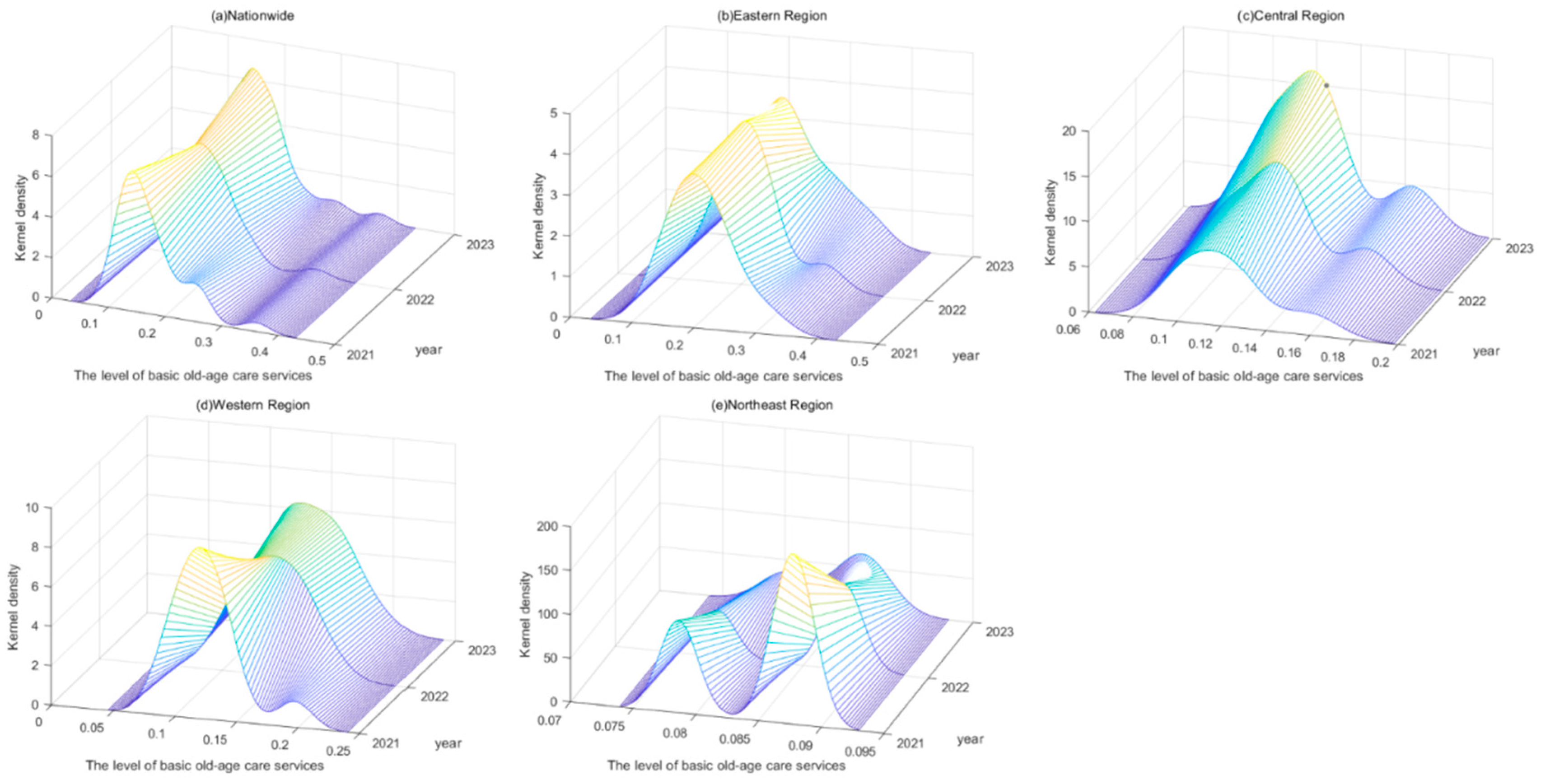
The above-mentioned research on the Dagum Gini coefficient, although it discussed the degree and composition of the gap in BECS levels in China, only identified the changing trajectory of relative differences among various regions in China and was unable to describe the spatio-temporal evolution process of absolute differences in BECS levels among different regions in China. Therefore, drawing on the main attributes of its visual data, kernel density estimation is adopted to analyze the spatio-temporal change patterns of the level of BECS development in China, as shown in Figure 2, and a detailed analysis is carried out as follows.

4.3.1. Distribution Position

From a nationwide perspective, China’s BECS performance curve has exhibited a consistent rightward movement, reflecting steady progress in enhancing the BECS framework and demonstrating preliminary successes in system optimization. When examining regional variations, the eastern, central, and western areas all display similar rightward shifts in their respective BECS development trajectories. In contrast, the northeastern part of the country presents a divergent pattern with a marginal leftward displacement of its curve, suggesting some degree of regression in BECS implementation within this particular region. This might be related to the fact that in recent years, amidst the context of the “new normal” of the economy and the structural changes in the population in the northeast region, the decline of traditional industrial sectors and their weak iterative capabilities are related to the severe urban contraction. The double outflow of external capital investment and population, as well as the double decline in economic growth and fiscal revenue, will inevitably lead to the deterioration of BECS quality and the shortage of effective service supply [37,38].

4.3.2. Peak Distribution

At the country-wide scale, the kernel density distribution pattern for BECS indicators in China exhibits an initial decline followed by subsequent growth, characterized by diminishing peak intensity and expanding distribution breadth. This phenomenon suggests a growing divergence in BECS performance across the nation, presenting challenges for meeting SDG10 targets (with corresponding implications for related sustainable development goals). When examining regional variations, the eastern and northeastern areas demonstrate particularly notable changes in their BECS kernel density profiles, with reduced peak concentrations and broader distribution ranges. These regional patterns significantly contribute to the observed national trend. In contrast, central regions display an opposite pattern of increasing peak intensity with narrowing distribution widths. While western regions show similar peak reduction and width expansion as the eastern and northeastern areas, the consolidation from multiple peaks to a single-peak distribution results in decreased regional disparities. Geographical variations are evident in the data. The analysis reveals a narrowing gap in BECS performance between central and western regions.

4.3.3. Distribution Extensibility

At the national level, there is a distinct right-tailing phenomenon, and it shows a slightly divergent trend over time, indicating that the gap between the better and poorer regions of BECS in China is gradually widening. This is not conducive to the realization of both direct and indirect SDGs. At the regional level, there is a distinct right tail line along the eastern coast, which gradually diverges. This reflects the widening gap between the provinces with better BECS and those with poorer BECS within the region, which is the main reason for the unfavorable realization of both direct and indirect SDGs. There is a right tailing and convergence in the central inland, western border, and northeastern regions, indicating that the gap between the provinces with better BECS and those with poorer BECS within their regions is gradually narrowing.

4.3.4. Number of Peaks

It shows a multi-peak distribution across the country, in the central inland areas and in the northeast region, with polarization. The eastern coastal area shows a single-peak distribution and there is no polarization. The western frontier has developed from multi-peak to single-peak, with weakened polarization and reduced regional differences.

4.4. Exploratory Spatial Analysis

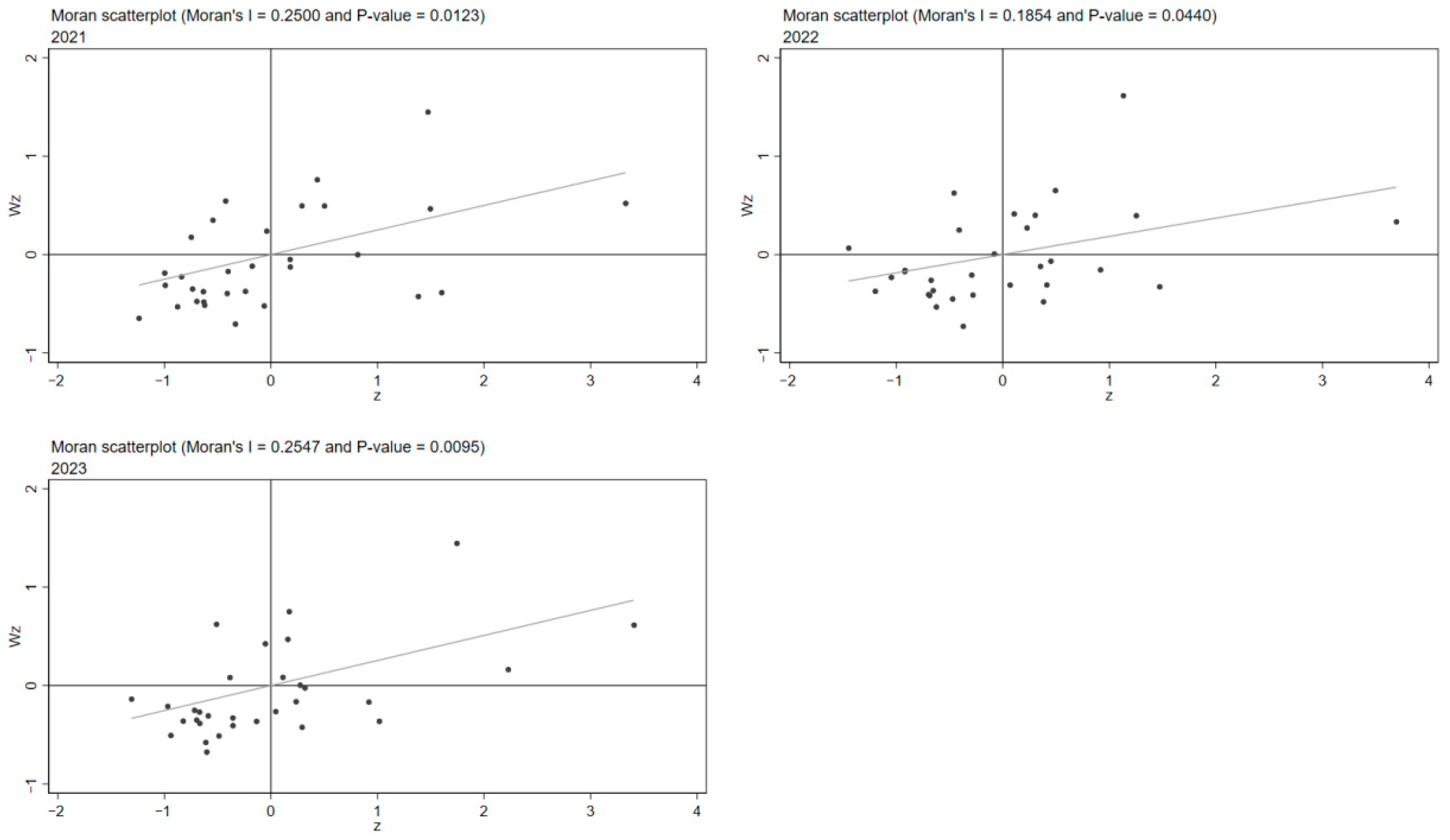
The global Moran Index was calculated to analyze the global spatial autocorrelation of the BECS level in China, as shown in Table 5. The global Moran Index is greater than 0, and it shows a fluctuating upward trend from 2021 to 2023, with Z values all greater than 2.0, which are significant at the 1%, 5%, and 1% levels, respectively. This indicates that the BECS level in China has certain spatial autocorrelation and spatial aggregation characteristics, which provides strong result support for achieving conscious regional coordination and cooperation. It indicates that cross-regional governance is not only a redistribution of resources, but also a relationship governance mechanism.
As illustrated in Figure 3, the eastern provinces and Xinjiang predominantly form high-high clustering zones, demonstrating beneficial spatial spillover impacts on neighboring regions. Conversely, central, western, and northeastern areas mainly exhibit low-low clustering patterns. These clustering types highlight the spatial autocorrelation of similar values among adjacent regions. Certain provinces, including Hebei, Anhui, and Hainan, fall into the low-high concentration category, with Hainan transitioning toward a low-low concentration pattern. This shift suggests significant outflows of essential elderly care service resources, such as workforce and financial capital, in these areas. Provinces such as Guangdong, Shandong, Inner Mongolia, Qinghai, and Jiangxi belong to high-low concentration areas. Guangdong and Shandong have developed economies, while Inner Mongolia and Qinghai have a large demand for human resources. Therefore, it has a siphoning effect on the human resources, capital, and other factors in the surrounding areas, causing the inflow of related elements. Moreover, the Gansu and Xizang regions are developing towards high- and low-concentration areas. Low-high aggregation and high-low aggregation reflect the spatial negative autocorrelation of adjacent dissimilar values.

4.5. Degree of Obstacle

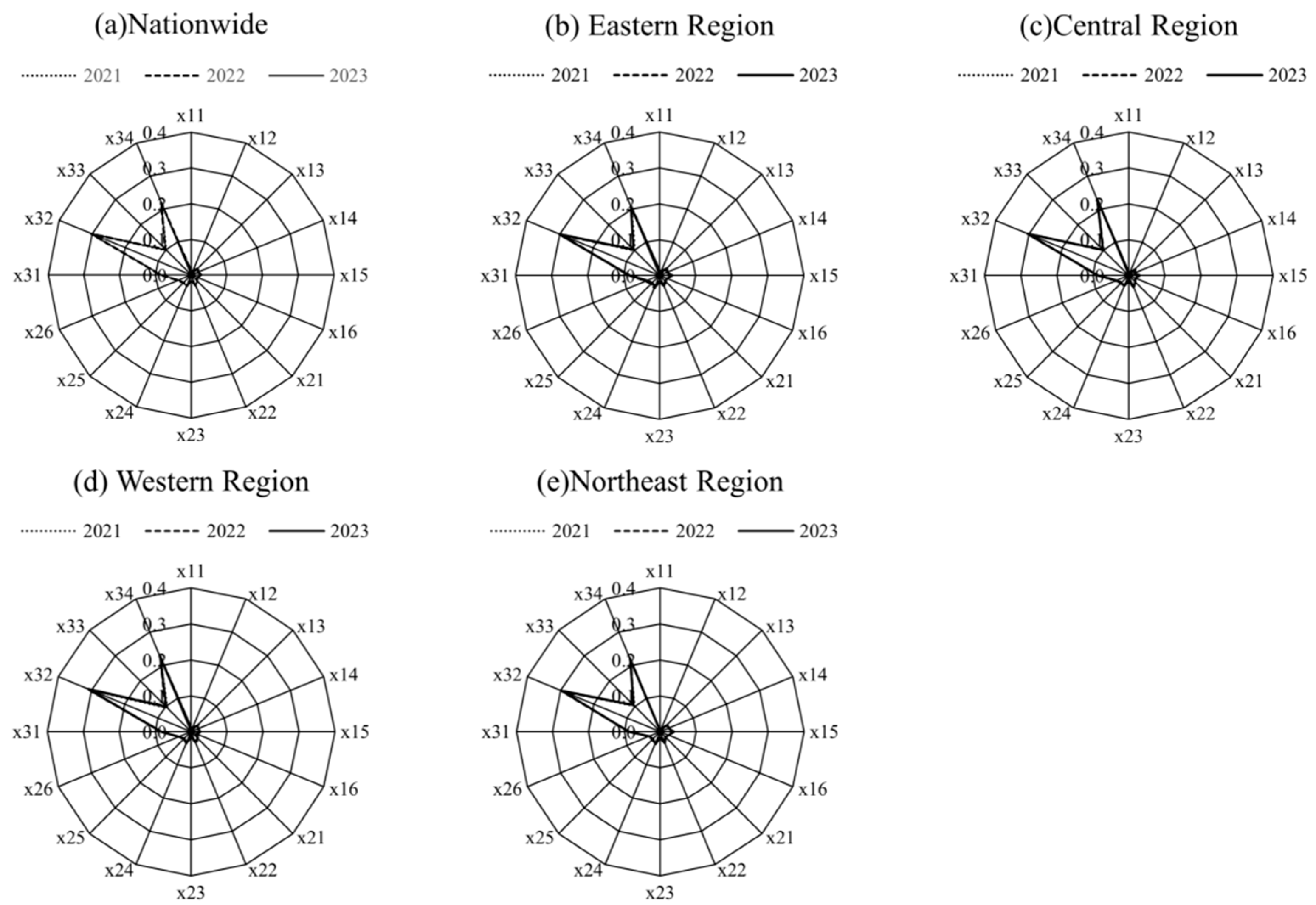
As shown in Figure 4, by calculating the criterion levels and obstacle degrees of the whole country and its major regions, it was found that during the sample investigation period, the rankings of the quasi-measurement levels and obstacle degrees in China and its major regions were highly consistent; that is, the obstacle factor of welfare subsidies > the obstacle factor of human resource security > the obstacle factor of BECS facilities. The average obstacle levels of the criteria at the national level were 70.825%, 17.153%, and 11.982%, respectively. The vital impediments restricting the advancement of BECS in China and the realization of direct and indirect SDGs come from the insufficient support of welfare subsidies. Of course, the obstacles of human resource security and BECS facilities should not be ignored either. The obstacle degrees of the indicator layers in China and the four major regions were calculated. It was found that the top four rankings of the main obstacle factors were relatively stable, and all originated from welfare subsidy obstacle factors. The order of obstacle degrees was nursing subsidies > comprehensive subsidies > elderly care service subsidies > high-age subsidies.
The above results are different from those proposed by Dimitrios Vagenas and Deirdre McLaughlin et al. [18] in the literature review section, which stated that the weak accessibility of human resources and backward facilities in Australia are the main obstacles to the urban–rural disparity. There is obvious country-specific heterogeneity. The main obstacle factor fettering the high-quality advancement of BECS in China is the insufficiency of welfare subsidies. The result of welfare subsidies as the main obstacle factor has corrected people’s stereotypes and filled the research gap in the relevant international field. Why is the obstacle to welfare benefits the greatest? For one thing, it is related to the governance process to some extent. For instance, during the governance process, there was a mistake in the selection of subsidy recipients. Direct subsidies were provided for the construction of beds on the supply side of BECS (which were relatively less scarce and had less obstacles), resulting in insufficient subsidies for the demand side of the elderly [39]. For another, the insufficient savings of the elderly population on the demand side due to the fact that the cost of raising children and the possible continuous reverse support is greater than the economic support of intergenerational support is also one of the key reasons for the greatest obstacles to welfare subsidies [40]. Through a detailed analysis of the obstacle levels at the criterion and indicator levels, it has been clarified that increasing welfare subsidies in the future is an important direction for enhancing China’s BECS level and achieving both direct and indirect SDGs.
From a global perspective, integrating the above results and discussions, it can be found that the development of BECS in China presents a compound pattern of “coexistence of gradient differentiation and polarization convergence”, and its internal connection is reflected in the closed-loop strengthening mechanism among the overall hierarchical distribution, sources of differences, spatial aggregation characteristics, and main obstacle factors. The eastern coastal areas (Beijing, Shanghai, Tianjin, and Shandong, with the average comprehensive score ranging from 0.248 to 0.413) have continuously widened the regional disparity through the positive cycle of “high subsidies-high services-high attraction” formed by the inflow of young labor force (Gnb has the largest contribution rate and an average annual growth rate of 1.81 to 6.11%). In Northeast China (with an average GW of 0.034), due to industrial decline and population outflow, it has fallen into a vicious cycle of “reverse feedback-insufficient savings-surging subsidy demand”. Its low starting point and high growth (with an average annual growth rate of 30.384%) coexist with the left shift of the nuclear density curve, highlighting that the welfare subsidy obstacle (with a welfare subsidy obstacle degree of 70.825%) is more fatal than other obstacles. The spatial autocorrelation analysis further confirmed the path dependence of the “high-high” and “low-low” aggregation areas. The essence of this is the governance deviation of the subsidy recipients, which is biased towards the western border areas in terms of region and towards the supply side in terms of supply and demand direction (the obstacle degree of elderly care service facilities is only 11.982%), leading to an imbalance in the allocation of subsidies and further solidifying its asymmetric evolution. In the future, it is urgently necessary to break this closed loop and guide the orderly flow of talents and capital from the eastern regions to the central inland areas and the three northeastern provinces. Only in this way can regional differences be transformed from a “zero-sum predicament” into a “position-sum game”, thereby systematically promoting the realization of the SDGs.

5. Conclusions and Recommendations

Founded on the fact of human, financial, and material elements and the multi-subject supply of BECS, and in line with the United Nations SDGs, this paper selects the period from 2021 to 2023 as the sample investigation period. This article comprehensively uses the entropy weight method, Dagum Gini coefficient, kernel density estimation, Moran Index, and obstacle degree model to conduct a systematic analysis of BECS in China. And answered the urgent questions raised in the introduction. The following are the main conclusions.
In China, the BECS level demonstrates a consistent growth trajectory. The spatial distribution exhibits a concave and asymmetrical configuration, with coastal regions in the east and frontier zones in the west displaying superior performance compared to central hinterland and northeastern territories. Examination of geographical disparities suggests a marginal expansion in overall variation, accompanied by fluctuating intra-regional and inter-regional differences. Regarding contribution proportions, cross-regional disparities account for the largest share at approximately 53.213%, succeeded by within-region variations at 25.884%, while trans-variation density makes the smallest contribution at 20.903%. Kernel density estimation visualization aligns substantially with findings derived from entropy weighting analysis and Dagum Gini coefficient measurements regarding BECS spatiotemporal development patterns. These methodological approaches yield mutually reinforcing evidence, demonstrating the reliability of conclusions across diverse analytical frameworks. The Moran I analysis further substantiates valuable insights for optimizing the allocation of human resources, capital investments, and material resources in BECS development, considering both spatial spillover impacts and resource attraction phenomena. Additionally, through application of the barrier analysis model, the research identifies key limiting factors and their respective influence levels affecting BECS progress. Analysis reveals that welfare subsidies constitute the most significant barrier at the criterion level, with all major obstacles at the specific indicator level being components of welfare subsidy systems. Based on this, the following policy suggestions are put forward.

5.1. Strengthen the Construction of a Multi-Subject Supply Network to Enhance the Comprehensive Efficiency of BECS

With reference to the existing status quo of BECS in China, starting from the multi-subject supply network, the collaborative governance advantages of the government at the helm and multiple subjects rowing should be brought into play [41].
In terms of specific measures, in community elderly care institutions (including full-time care service community elderly care institutions, day care community elderly care institutions, and mutual aid type community elderly care service institutions), the construction of embedded communities should be increased [42]. Optimize site selection and layout, actively carry out elderly-friendly renovations, expand the accessibility, convenience, and accessibility of BECS coverage, and comprehensively improve the BECS level of communities. In terms of institutional elderly care, we will vigorously enhance policy support. In the short term, we will lower the entry threshold, optimize the application process, implement tax reduction and benefit increase, moderately expand the scope and proportion of subsidies, and achieve strengthened operational guarantees. In the long term, it is necessary to widely attract capital participation, consolidate and optimize the existing facilities of elderly care institutions, and increase the supply of new-quality incremental infrastructure. Ultimately, it aims to promote the deep integration and functional complementarity of community elderly care and institutional elderly care in the short term, and shift the elderly care cause and industry from “fragmented development” to “coupled synergy” in the long term.
Integrate elderly care service resources (for example, by adopting methods such as shared employee training, shared digital systems, and joint funding) to continuously enhance the closeness and resilience of the multi-subject elderly care service supply network, leverage the synergy advantage of 1 + 1 > 2, improve the comprehensive efficiency of BECS, and achieve effective supply of BECS. This will effectively meet the multi-faceted, diverse, and multi-level elderly care needs of the elderly and promote the realization of SDG17.

5.2. Promote the Coordinated Development of Human, Financial, and Material Resources Across Regions and Bridge the Gap in BECS Levels

In areas experiencing a scarcity of skilled professionals in the BECS sector, at the central level, optimize the top-level design for cross-regional talent mobility, unify the mutual recognition of qualifications for elderly care service talents across the country, break down barriers to cross-regional talent mobility, and introduce supporting incentive policies for cross-regional talent mobility (such as targeted support and special subsidies). The outflow rate of regions with redundant talents and the retention rate of regions with insufficient talents should be included in the task assessment list for local governments. Guide talents to gather rationally in areas with weak elderly care resources.
At the local government level, on the one hand, efforts should be made to strengthen the construction of local vocational education for elderly care services in weak areas, increase the supply of specialized talents for designated transfer in areas with overcapacity, promote cross-regional school–enterprise cooperation, achieve effective connection between industry and education, avoid micro-mismatches in elderly care services, and ensure the precise matching of the quantity and quality of human resources. On the other hand, it is necessary to enhance the quality of supporting public services in underdeveloped areas, attract talents to stay, and reduce the continuous outflow of talents caused by the suction effect.
At the community level, increase talent subsidies in areas with underdeveloped human resources for elderly care services, establish a long-term salary and welfare security and incentive system with a tiered and differentiated approach, enhance talents’ organizational commitment and professional identity towards their target positions, and ensure their job stability. Community caregivers and other front-line workers, as key drivers of community innovation, can directly contribute to reducing the hospitalization rate of residents through professional services (corresponding to SDG03 “Good Health and Well-being”), and at the same time, it is conducive to building a supportive and inclusive elderly-friendly environment in the community (echoing SDG11 “Sustainable Cities and Communities”).
Under the close coordination and cooperation of the central and local governments, as well as communities (the actors that achieve effective cross-regional talent flow), the short-term problem of “coexistence of local shortages and idleness” will be ultimately solved, and the goal of achieving a dynamic balance in long-term cross-regional talent flow will be realized.
For regions where there is a shortage of welfare subsidies for BECS and elderly care facilities, at the central level, the actual shortcomings of both the supply and demand sides should be clearly identified (for example, the actual shortcoming of the demand side for elderly customers as clearly stated in the empirical analysis part lies in welfare subsidies, but the actual shortcoming of the supply side such as institutions and communities may lie in facilities, beds, building area, etc. [43]). Strengthen the precise supply and allocation of transfer payments to both supply and demand sides and different BECS development regions to avoid policy inclination mismatches, especially for the low-lying areas of northeast and central BECS. The improvement of elderly welfare levels should be incorporated into the national strategies for the revitalization of Northeast China and the Rise of Central Plains (SDG16).
At the same time, at the local level, based on the actual development of low-level regions, idle houses and land should be revitalized in a way that suits local conditions, and the utilization efficiency should be improved. The number of institutions with different natures of BECS, the number of beds, and the per capita space usage area should be reasonably planned. Specifically, reusing idle public buildings can enhance resource utilization efficiency (SDG12) and optimize urban compact planning (SDG11).
Establish a targeted support mechanism for elderly care services from high-level regions to underdeveloped regions, activate the positive spillover effect of space, and achieve effective allocation and accurate flow of resources through cross-regional flow of human, financial, and material elements to facilitate balanced, coordinated, and sustainable development among BECS regions in China.

5.3. Enhance the Government’s Governance Capacity and Promote the Quality and Efficiency Improvement of BECS Levels

As BECS is a quasi-public good with non-exclusivity and competitiveness, the government should adhere to the governance concept that governance is a process rather than an output [44], with the aim of proactively mitigating the risks posed by population aging.
At the institutional level, clarify the scope of government responsibilities, define the boundaries of government power, and establish and improve a BECS system that covers all elderly people, has clear rights and responsibilities, provides appropriate protection, and is sustainable. Standardize the market operation mechanism and the daily management of communities, and strengthen long-term supervision and management.
At the specific operational level, continuously and dynamically provide policy preferences and rewards to compliant enterprises and communities, punish and remove the responsible persons of bad enterprises and communities, and ensure the effectiveness of BECS supply by the government, market supply entities, and communities.
Ultimately, achieve an organic combination of a proactive government, an effective market, and a useful community, thereby promoting the formation of a good and sustainable governance ecosystem.
In the face of the industry penetration wave of artificial intelligence and the internal drive of organizational digital and intelligent transformation, the government should establish databases covering basic information and comprehensive ability assessment of the elderly population. Relying on new technologies such as artificial intelligence, it should enhance the digital and intelligent level of government service platforms, promote data sharing among departments, and accurately identify elderly service recipients with different elderly care needs. Gradually achieve the shift from “people seeking services” to “services seeking people”. It should strengthen the construction of barrier-free digital technologies, optimizing services such as policy consultation, information inquiry, and business processing, ensuring the smooth operation of offline service platforms, and being friendly and compatible with the elderly. As with digitalization, as an important theme of sustainable development, the above measures are conducive to enhancing government transparency (SDG16).
Due to the physical fragility of the elderly group, extreme temperatures are prone to cause an increase in the mortality rate of the elderly population [45]. The government should specifically reduce or exempt electricity bills for the elderly to alleviate their energy expenditure pressure. At the same time, give full rein to the superiorities of grassroots service organizations as exemplified by village committees and neighborhood committees in China. By regularly visiting and monitoring their health conditions and conducting disaster prevention and mitigation publicity and education (such as the scientific use of air conditioning equipment and the popularization of emergency self-rescue knowledge, etc.), the negative impact of extreme weather on the elderly population can be alleviated. This strategy not only demonstrates precise care for vulnerable groups, but also works in synergy with SDGs “Reducing Inequality” (SDG10), “Good Health and Well-being” (SDG03), and “Climate Action” (SDG13), highlighting China’s governance innovation in addressing climate risks and promoting the global process of healthy aging.
Population aging inevitably brings about the dual pressure of increased fiscal expenditure on pensions and reduced tax revenue. The government urgently needs to formulate long-term and systematic plans, actively respond to the negative impacts caused by aging, and thereby ensure economic sustainability. Specific measures include expanding the coverage of insurance participation, optimizing contribution incentive policies, developing a multi-level pension insurance system, and delaying the legal retirement age, etc.
It is worth noting that the above content implies issues of intergenerational equity and tax justice among different age groups. The intensification of the aging population problem has put the current pension system under sustainability pressure. The younger generation may bear a heavier contribution burden, and as the main beneficiaries of the policy, the improvement of welfare for the elderly may exacerbate financial inequality between generations. If the policy design does not fully take into account the principle of tax fairness, it may further intensify social conflicts and violate SDG 10 (Reducing Inequality). Therefore, policy-making needs to incorporate the moral dimension of intergenerational burden distribution and shared tax responsibility, and achieve cross-age balance of burden and benefit through intergenerational mutual assistance mechanisms, avoiding the unidirectional transfer of economic sustainability costs to the younger generation.

6. Research Outlook and Limitations

Although this article explores China’s BECS level under the United Nations Sustainable Development Goals based on robust empirical analysis, there may be the following limitations due to the influence of objective factors.
Firstly, it requires an extension of the time dimension. Constrained by the update of statistical indicators and the expansion of statistical scope in the “China Civil Affairs Statistical Yearbook”, to ensure the reliability of the results, this paper selects short-panel data from 2021 to 2023. However, to better observe the dynamic evolution trend, the author encourages other researchers to conduct continuous research as the years go by.
Secondly, the expansion of indicators is needed. Due to the availability of data and the granularity of the research subjects, this article only discusses 16 indicators from the aspects of human resources, finance, and materials. The author encourages other researchers to conduct discussions in other dimensions of the United Nations SDGs goals. For example, the distance between facilities and green spaces (SDG09 ”Industrial Innovation and Infrastructure“, SDG10 ”Reducing Inequality“), the proportion of renewable energy application (SDG07 ”Clean Energy“), the rate of barrier-free elevators/ramps (SDG11 ”Sustainable Cities and Communities“), and the dimensions of the governance process. For example, the mobility of caregivers, interdepartmental coordination mechanisms, and policy implementation capabilities.
Thirdly, with the continuous improvement of China’s comprehensive national strength, its per capita consumption level and basic demand for elderly care services are also constantly increasing. For instance, the elderly groups in developed regions or cities such as the eastern region, Beijing, and Shanghai analyzed in this article are no longer satisfied with the basic demand for elderly care services. Therefore, the author believes that conducting research based on higher-level elderly care service demands (such as a sense of belonging, a good aging experience, perception of community inclusiveness, and self-actualization needs, etc.) will be a future hotspot in the field of elderly care service research in China [42]. Looking to the future, the author proposes the following possibilities.
Firstly, relatively advanced spatio-temporal analysis techniques can be adopted, such as spatial machine learning methods like GeoXGBoost [46], to explore the nonlinear relationship between multi-dimensional indicators and BECS, and quantitatively analyze the dynamic evolution laws of BECS sustainability in different regions.
Secondly, it is encouraged that different cities introduce the theoretical perspective of the “doughnut economy” (as demonstrated by international practices such as Amsterdam in the Netherlands and Brussels in Belgium), which constructs a framework of a “safe and just space”. Under the premise of not exceeding the ecological threshold (with the planetary boundary as the upper limit of the Earth’s environment), a balance between human needs and ecological constraints can be achieved by meeting the minimum socio-economic standards based on the SDGs (such as the “social foundation” that guarantees the dignity and decent life of the aging population, such as elderly services, welfare subsidies, and accessibility of caregivers). Its innovation lies in incorporating fair access to services into the core of sustainability. It not only requires enhancing the level of elderly care security through the expansion of physical facilities, the renovation of idle buildings, and the deployment of digital infrastructure, but also emphasizes avoiding wasteful expansion of resources to safeguard the ecological bottom line. Through the above-mentioned methods, it is expected to conduct a more comprehensive and detailed study on BECS in China under the United Nations SDGs. It has laid the foundation for international SDG monitoring.

Author Contributions

Conceptualization, Y.C.; Methodology, Y.C.; Software, Y.C.; Validation, Y.C.; Formal analysis, Y.C.; Investigation, Y.C., K.L. and F.W.; Resources, Y.C. and H.L.; Data curation, Y.C., K.L. and F.W.; Writing—original draft, Y.C., K.L. and F.W.; Writing—review & editing, Y.C. and H.L.; Visualization, Y.C.; Supervision, H.L.; Project administration, H.L.; Funding acquisition, H.L. All authors have read and agreed to the published version of the manuscript.

Funding

This research received no external funding.

Institutional Review Board Statement

Not applicable.

Informed Consent Statement

Not applicable.

Data Availability Statement

The original data presented in the study are openly available in China Civil Affairs Statistical Yearbook at https://data.cnki.net/yearBook/single?id=N2025041014&pinyinCode=YZGMZ (accessed on 25 December 2025) and China Statistical Yearbook at https://www.stats.gov.cn/sj/ndsj/ (accessed on 25 December 2025).

Conflicts of Interest

The authors declare no conflicts of interest.

References

  1. Tanaka, K.; Johnson, N.E. The Shifting Roles of Women in Intergenerational Mutual Caregiving in Japan: The Importance of Peace, Population Growth, and Economic Expansion. J. Fam. Hist. 2008, 33, 96–120. [Google Scholar] [CrossRef]
  2. Sung, K.T. An Exploration of Actions of Filial Piety. J. Aging Stud. 1998, 12, 369–386. [Google Scholar] [CrossRef]
  3. Yamada, K.; Teerawichitchainan, B. Living Arrangements and Psychological Well-Being of the Older Adults After the Economic Transition in Vietnam. J. Gerontol. Ser. B Psychol. Sci. Soc. Sci. 2015, 70, 957–968. [Google Scholar] [CrossRef]
  4. Shi, W.; Mu, X.; Yang, W.; Gui, Q. The Spatial Mobility Network and Influencing Factors of the Higher Education Population in China. Sci. Public Policy 2024, 51, 406–420. [Google Scholar] [CrossRef]
  5. Yan, Y. Money for Time? Evidence From Intergenerational Interactions in China. J. Appl. Gerontol. 2026, 45, 63–74. [Google Scholar] [CrossRef]
  6. Ma, Y.; Wang, Q.; Huang, Y. The Influence of Intergenerational Support on the Consumption Choice of Elderly Institutions. Consum. Econ. 2021, 37, 47–56. [Google Scholar]
  7. Feng, T.; Ma, D. Evaluation on the Resource Density Distribution and Equalization of Community Home-Based Services for the Elderly from the Perspective of Inclusive Development. J. Northwest Univ. 2020, 50, 108–119. [Google Scholar]
  8. Xiong, H.; Cheng, H.; Yang, Y.; Fan, C.; Huang, N.; Huang, A. Research on the Evaluation Method of Senior Care Service Resources Allocation Scheme Based on the Perspective of Data Elements. Oper. Res. Manag. Sci. 2023, 32, 79–86. [Google Scholar]
  9. Miao, S.; Hu, Y. Measurement of New Quality Productivity Development Level and Factor Identification of Obstacle Factors Based on the Analysis of Provincial Panel Data in China. Sustainability 2025, 17, 1758. [Google Scholar] [CrossRef]
  10. Riedel, M.; Kraus, M.; Mayer, S. Organization and Supply of Long-Term Care Services for the Elderly: A Bird’s-Eye View of Old and New EU Member States. Soc. Policy Adm. 2016, 50, 824–845. [Google Scholar] [CrossRef]
  11. Huang, Z.; Xu, T.; Huang, Y.; Yang, Q.; Gui, J.; Fu, Y.; Chen, C. The Temporal and Spatial Discrepancies in the Home and Community—Based Services Supply for the Disabled Elderly in China: Evidence from the Chinese Longitudinal Healthy Longevity Survey (CLHLS), 2008—2018. Mod. Prev. Med. 2022, 49, 3535–3547. [Google Scholar]
  12. Li, C.; Zhang, C. Regional Differences, Spatial Misalignment and Equalization Paths in Resource Allocation for Community Elderly Services. Public Financ. Res. 2024, 3, 94–110. [Google Scholar]
  13. Devroey, D.; Van Casteren, V.; De Lepeleire, J. Revealing Regional Differences in the Institutionalization of Adult Patients in Homes for the Elderly and Nursing Homes: Results of the Belgian Network of Sentinel GPs. Fam. Pract. 2001, 18, 39–41. [Google Scholar] [CrossRef]
  14. Armstrong, J.J.; Zhu, M.; Hirdes, J.P.; Stolee, P. Rehabilitation Therapies for Older Clients of the Ontario Home Care System: Regional Variation and Client-Level Predictors of Service Provision. Disabil. Rehabil. 2015, 37, 625–631. [Google Scholar] [CrossRef]
  15. Yu, L.; Hu, R.; Liu, H. Measurement and Regional Disparities in Equalization of Basic Elderly Care Services in the Southwest Region. East China Econ. Manag. 2024, 38, 85–96. [Google Scholar]
  16. Liu, X.; Shi, Z.; Lyu, H. How Do Fiscal Decentralization and Transfer Payment Disparities Widen Inequities in Elderly Care Access and Utilization in China? J. Chin. Gov. 2025, 10, 607–629. [Google Scholar] [CrossRef]
  17. Trydegård, G.B.; Thorslund, M. Inequality in the Welfare State? Local Variation in Care of the Elderly: The Case of Sweden. Int. J. Soc. Welf. 2001, 10, 174–184. [Google Scholar] [CrossRef]
  18. Vagenas, D.; McLaughlin, D.; Dobson, A. Regional Variation in the Survival and Health of Older Australian Women: A Prospective Cohort Study. Aust N. Z. J. Public Health 2009, 33, 119–125. [Google Scholar] [CrossRef]
  19. Zhang, Z.; Zhang, T.; Feng, D. Study on Regional Differences, Dynamic Evolution and Convergence of Carbon Emission Intensity in China. J. Quant. Technol. Econ. 2022, 39, 67–87. [Google Scholar]
  20. Zhang, X.; Liao, K.; Zhou, X. Analysis of Regional Differences and Dynamic Mechanisms of Agricultural Carbon Emission Efficiency in China’s Seven Agricultural Regions. Environ. Sci. Pollut. Res. 2022, 29, 38258–38284. [Google Scholar] [CrossRef] [PubMed]
  21. Tong, L.; Tang, L. Regional Differences and Spatial-Temporal Evolution Characteristics of Digital Economy Development in China. Sustainability 2025, 17, 4737. [Google Scholar] [CrossRef]
  22. Jiang, Y.; Liu, Q. The spatio-temporal differentiation of basic elderly care services in China and its influencing factors. Dong Yue Trib. 2024, 45, 160–166. [Google Scholar]
  23. Li, C.; Han, Z.; Zhu, S. Research on the Supply and Demand Coupling Coordination of the Elderly Services: Based on the Perspective of Spatial Econometrics. Popul. Dev. 2024, 30, 122–134, 162. [Google Scholar]
  24. Fang, B. Improving cyberspace security situation from perspective of “Talent, Finance and Infrastructure”. Bull. Chin. Acad. Sci. 2022, 37, 53–59. [Google Scholar]
  25. Deng, J.; Song, Q.; Liu, H.; Jiang, Z.; Ge, C.; Li, D. The Coupling Coordination between Health Service Supply and Regional Economy in China: Spatio-Temporal Evolution and Convergence. Front. Public Health 2024, 12, 1352141. [Google Scholar] [CrossRef] [PubMed]
  26. Ozcan, K.A. Sustainability Ranking of Turkish Universities with Different Weighting Approaches and the TOPSIS Method. Sustainability 2023, 15, 12234. [Google Scholar] [CrossRef]
  27. He, J.; Yan, J. The Measurement of Integration Development Level of Digital Economy and Cultural Tourism Industry and Analyze of Its Spatiotemporal Differentiation Evolution. Resour. Dev. Mark. 2025, 41, 1–18. [Google Scholar]
  28. Ning, J.; Wang, G.; Meng, X.; Zhang, Q. Agricultural New-Quality Productivity in China: Statistical Measurement and Spatial-Temporal Evolution. World Surv. Res. 2025, 7, 26–39. [Google Scholar]
  29. Liu, H.; Du, G. Regional Inequality and Stochastic Convergence in China. J. Quant. Technol. Econ. 2017, 34, 43–59. [Google Scholar]
  30. Di, Y.; Lu, Y.; Razzaq, A. International Differences and Dynamic Evolution of Trade in Digitally Deliverable Services. Technol. Soc. 2025, 81, 102781. [Google Scholar] [CrossRef]
  31. Wu, G.; Gong, R.; Feng, D. Regional Differences, Dynamic Evolution and Convergence Characteristics of High-quality Development Level of Manufacturing Industry in China. Stat. Decis. 2023, 39, 84–90. [Google Scholar]
  32. Liu, H.; Guo, L.; Qiao, L. Spatial-Temporal Pattern and Dynamic Evolution of Logistics Efficiency in China. J. Quant. Technol. Econ. 2021, 38, 57–74. [Google Scholar]
  33. Gedamu, W.T.; Plank-Wiedenbeck, U.; Wodajo, B.T. A Spatial Autocorrelation Analysis of Road Traffic Crash by Severity Using Moran’s I Spatial Statistics: A Comparative Study of Addis Ababa and Berlin Cities. Accid. Anal. Prev. 2024, 200, 107535. [Google Scholar] [CrossRef]
  34. Hu, A. Analysis on Evolution of Radiation Effect of Sericulture Industry in Jiangsu. Sci. Seric. 2023, 49, 568–574. [Google Scholar]
  35. Duan, S.; Yin, F. Interaction Mechanism and Coupling Strategy of Higher Education and Innovation Capability in China Based on Interprovincial Panel Data from 2010 to 2022. Sustainability 2025, 17, 6797. [Google Scholar] [CrossRef]
  36. Zhong, Y.; Jia, J.; Liu, Y. Coupling and Coordination of Agricultural Digitalization and Green, Low-Carbon Development in China and Obstacle Factors Analysis. Environ. Sci. 2025, 1–18. [Google Scholar] [CrossRef]
  37. Ma, X.; Yan, Q.; Pan, Q.; Chen, X.; Li, G. Identification and Classification of Urban Shrinkage in Northeast China. Land 2023, 12, 1245. [Google Scholar] [CrossRef]
  38. Wu, K.; Yao, C. Exploring the Association between Shrinking Cities and the Loss of External Investment: An Intercity Network Analysis. Cities 2021, 119, 103351. [Google Scholar] [CrossRef]
  39. Ma, Y.; Wang, X.; Guo, Q.; Lin, R. Research on Optimal Subsidy Policy to Increase Effective Supply of Elderly Services. Oper. Res. Manag. Sci. 2025, 34, 30–36. [Google Scholar]
  40. Zhao, J.; Wang, J. “Reverse Feeding”, the Structure of Children and the Labor Participation of the Elderly Population. Popul. Dev. 2021, 27, 17–28. [Google Scholar]
  41. Ansell, C.; Gash, A. Collaborative Platforms as a Governance Strategy. J. Publ. Adm. Res. Theory 2018, 28, 16–32. [Google Scholar] [CrossRef]
  42. Blokland, T.; Van Eijk, G. Do People Who Like Diversity Practice Diversity in Neighbourhood Life? Neighbourhood Use and the Social Networks of ‘Diversity-Seekers’ in a Mixed Neighbourhood in the Netherlands. J. Ethn. Migr. Stud. 2010, 36, 313–332. [Google Scholar] [CrossRef]
  43. Bian, J.; Rao, K. Spatio-temporal evolution of the coordinated development of China’s pension resources alloca-tion and service utilization: Based on the hierarchical analysis framework of institutions. Chin. J. Health Policy 2022, 15, 30–40. [Google Scholar]
  44. Le Galès, P.; Vitale, T. Governing the Large Metropolis. A Res. Agenda 2024, 2, 115–134. [Google Scholar]
  45. Yao, X.; Qu, Y.; Mishra, A.K.; Mann, M.E.; Zhang, L.; Bai, C.; Li, M.; Lin, J.; Wei, J.; Yu, Q.; et al. Elderly Vulnerability to Temperature-Related Mortality Risks in China. Sci. Adv. 2025, 11, eado5499. [Google Scholar] [CrossRef]
  46. Grekousis, G. Geographical-XGBoost: A New Ensemble Model for Spatially Local Regression Based on Gradient-Boosted Trees. J. Geogr. Syst. 2025, 27, 169–195. [Google Scholar] [CrossRef]
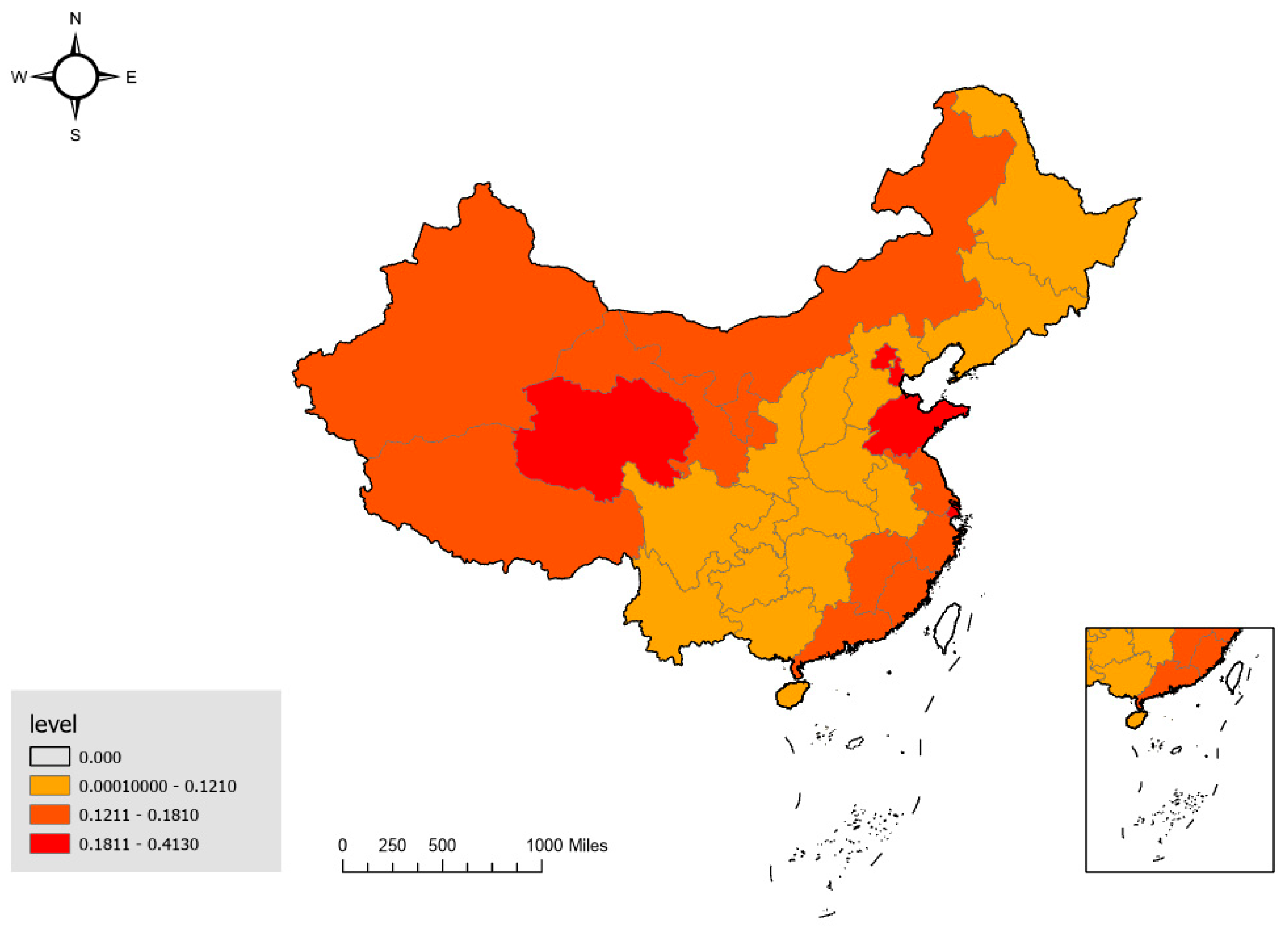
Figure 1. Comprehensive scores of BECS levels in China.
Sustainability 18 00312 g001
Figure 2. Three-dimensional KDE plot of BECS levels in China and the four major regions.
Sustainability 18 00312 g002
Figure 3. Partial Moran I scatterplot of BECS levels in China.
Sustainability 18 00312 g003
Figure 4. Radar chart of the obstacle degrees of BECS in China and four major regions.
Sustainability 18 00312 g004
Table 1. The comprehensive evaluation index system of BECS levels in China.
Criterion LayerIndicator LayerIndicator
Direction
Directly Related SDGsIndirectly
Related SDGs
Elderly
Care Facilities
x11 Number of elderly care institutions+SDG9 (Industry, Innovation and Infrastructure),
SDG11 (Sustain-able Cities and Communities)
SDG10 (Reduced Inequalities),
SDG16 (Peace, Justice and Strong Institutions),
SDG17 (Partnerships for the Goals)
x12 Number of beds in elderly care institutions at the end of the year+
x13 Building area of elderly care institutions+
x14 Number of community elderly care service institutions and facilities+
x15 Total number of beds in community elderly care services +
x16 Building area of community elderly care service institutions+
Human Resources Assurancex21 Number of employees in elderly care institutions at the end of the year+SDG4 (Quality Education),
SDG8 (Decent Work and Economic Growth)
x22 Number of employees with a bachelor’s degree or above in elderly care institutions+
x23 Number of social workers in elderly care institutions +
x24 Number of employees in community elderly care services at the end of the year+
x25 Number of employees in community elderly care services at the end of the year+
x26 Number of social workers in community elderly care services+
Welfare Subsidyx31 Subsidy for the Elderly Aged 80 and above +SDG1 (No Poverty),
SDG3 (Good Health and Well-being)
x32 Care Subsidy+
x33 Elderly Care Service Subsidy +
x34 Comprehensive Subsidy +
Note: “+” indicates a positive indicator.
Table 2. Gini coefficient within the group (BECS in China and the four major regions).
YearGGW
EasternCentralWesternNortheast
20210.2750.2290.2110.2250.020
20220.2680.2680.1500.2070.049
20230.2770.2990.1130.2000.034
Table 3. Net Gini coefficient between groups (BECS among the four major regions).
YearGnb
East-CentralEast-WestEast-NortheastCentral-WestCentral-NortheastWest-Northeast
20210.3270.3280.3890.2250.1900.190
20220.3220.2980.4300.1950.1760.248
20230.3390.3210.4380.1810.1480.231
Table 4. Gini coefficient contribution rate.
YearGt (%)
Within the RegionBetween RegionsSuper Variable Density
202124.86455.08420.052
202226.33651.39022.274
202326.45153.16620.383
Table 5. Global Moran Index of China’s BECS during 2021–2023.
YearGlobal Moran Indexp-ValueResult
20210.2500.012Significant
20220.1840.044Significant
20230.2550.009Significant
Disclaimer/Publisher’s Note: The statements, opinions and data contained in all publications are solely those of the individual author(s) and contributor(s) and not of MDPI and/or the editor(s). MDPI and/or the editor(s) disclaim responsibility for any injury to people or property resulting from any ideas, methods, instructions or products referred to in the content.