Calcination Optimisation of Corncob Ash for Sustainable Cementitious Applications: A Pathway to Low-Carbon Construction



Abstract
1. Introduction
1.1. Biogenic SCM Calcination Optimisation
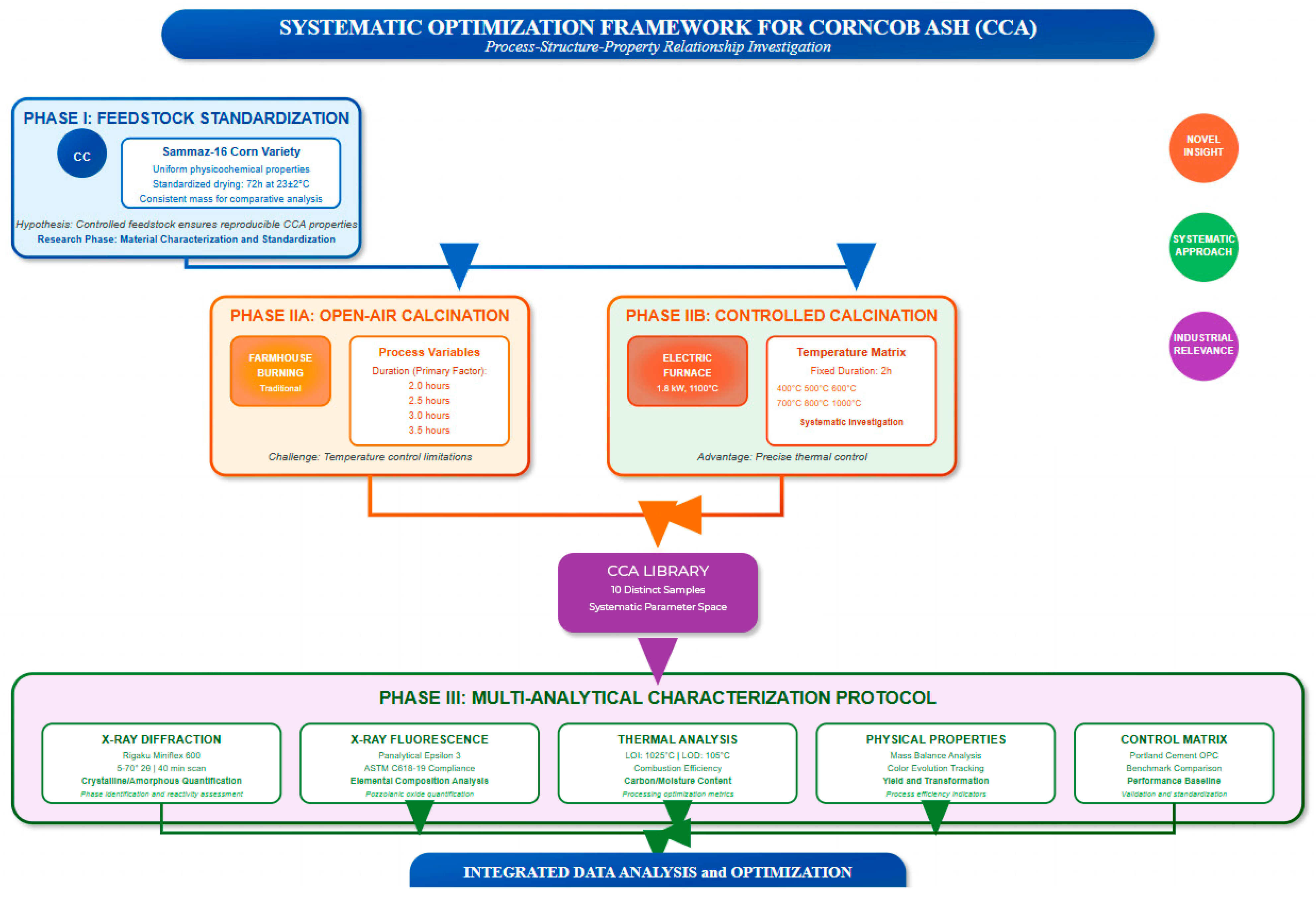
1.2. Conceptual Framework
1.3. Theoretical Framework of Surface Chemistry and the Reactivity Principle
1.3.1. SCM Reactivity and Dissolution–Precipitation Mechanisms
1.3.2. Thermodynamic and Kinetic Descriptions of Amorphous–Crystalline Transformations
1.3.3. Alkali–Silica Reaction and Durability Framework
2. Research Methodology
2.1. Preparation and Experimental Design
2.2. Analytical X-Rays
2.2.1. X-Ray Diffraction
2.2.2. X-Ray Fluorescence (XRF) Analysis
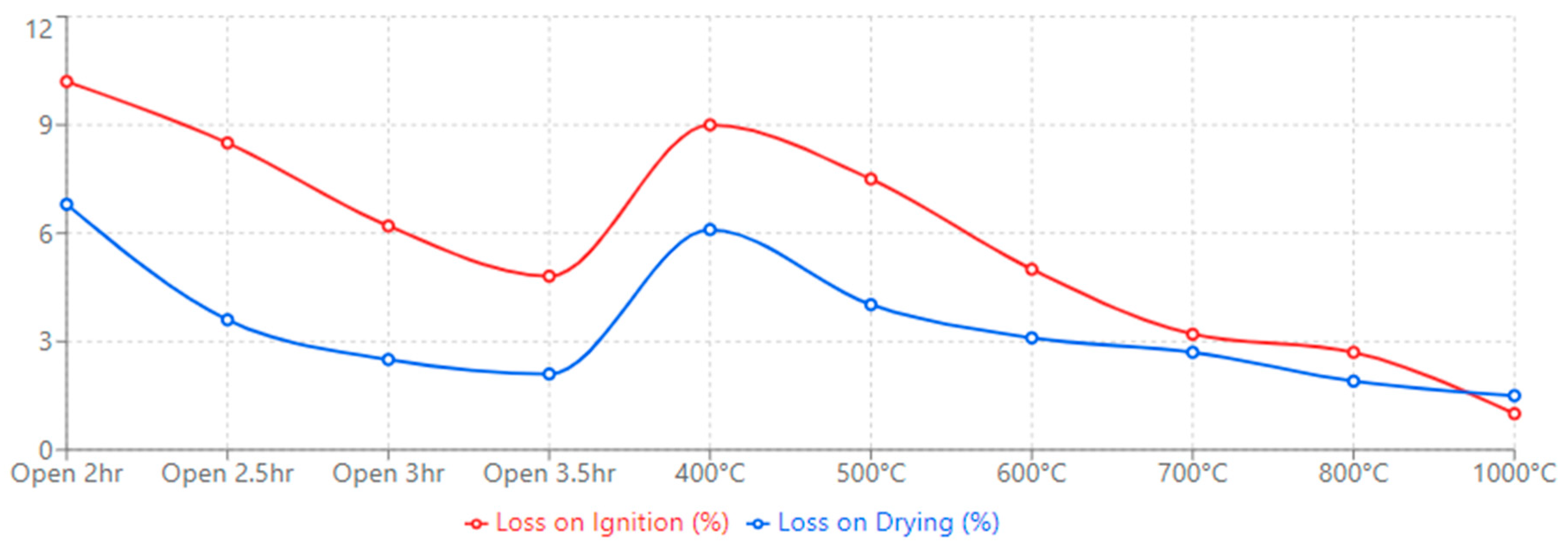
2.3. Loss on Ignition (LOI) and Loss on Drying (LOD) Determination
3. Results and Discussion
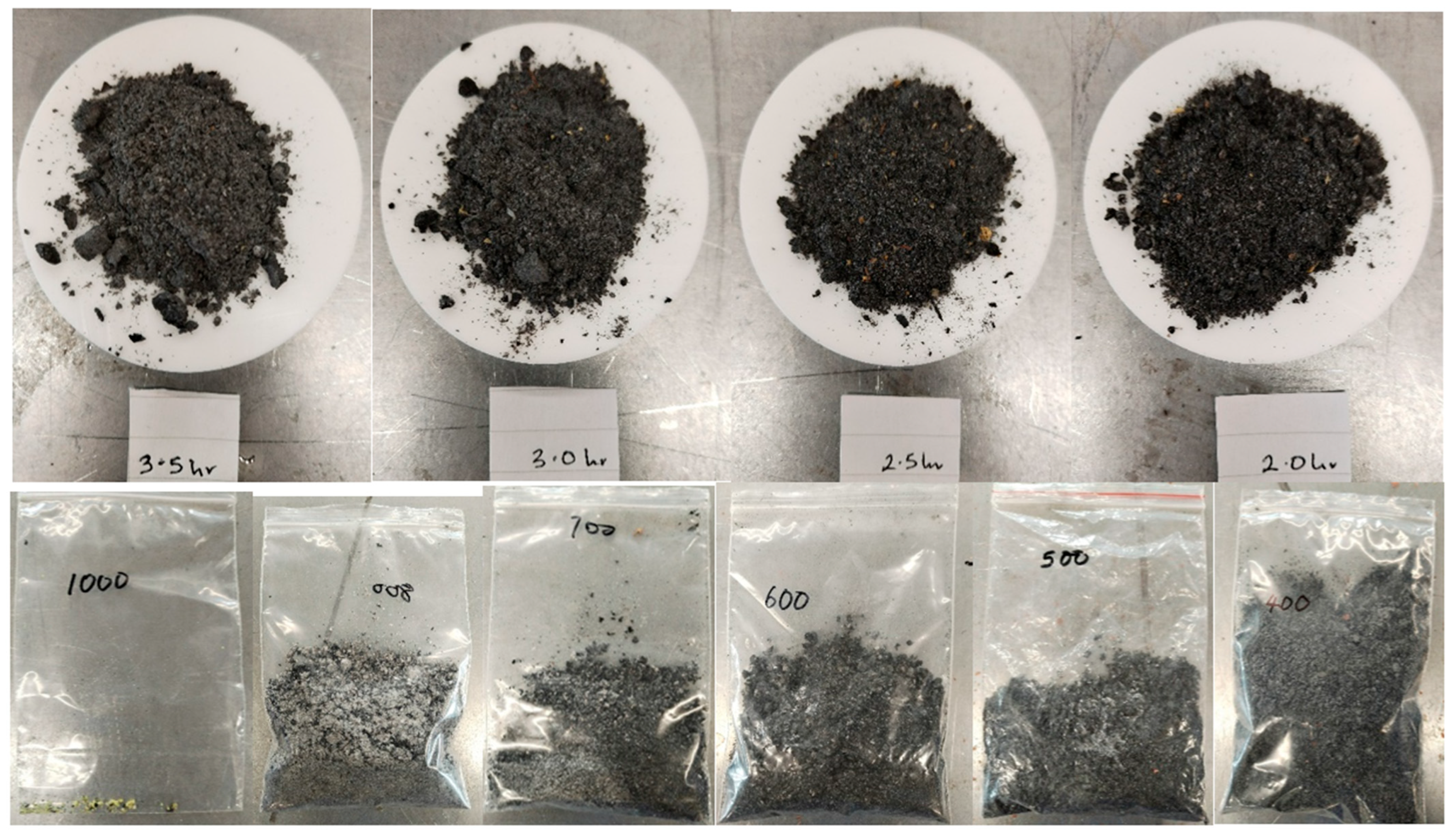
3.1. Physical Analysis
3.1.1. Open-Air Burning Using Proxy Thermal-Severity Estimates
3.1.2. Mass and Energy Balance Framework
3.2. X-Rays Analysis
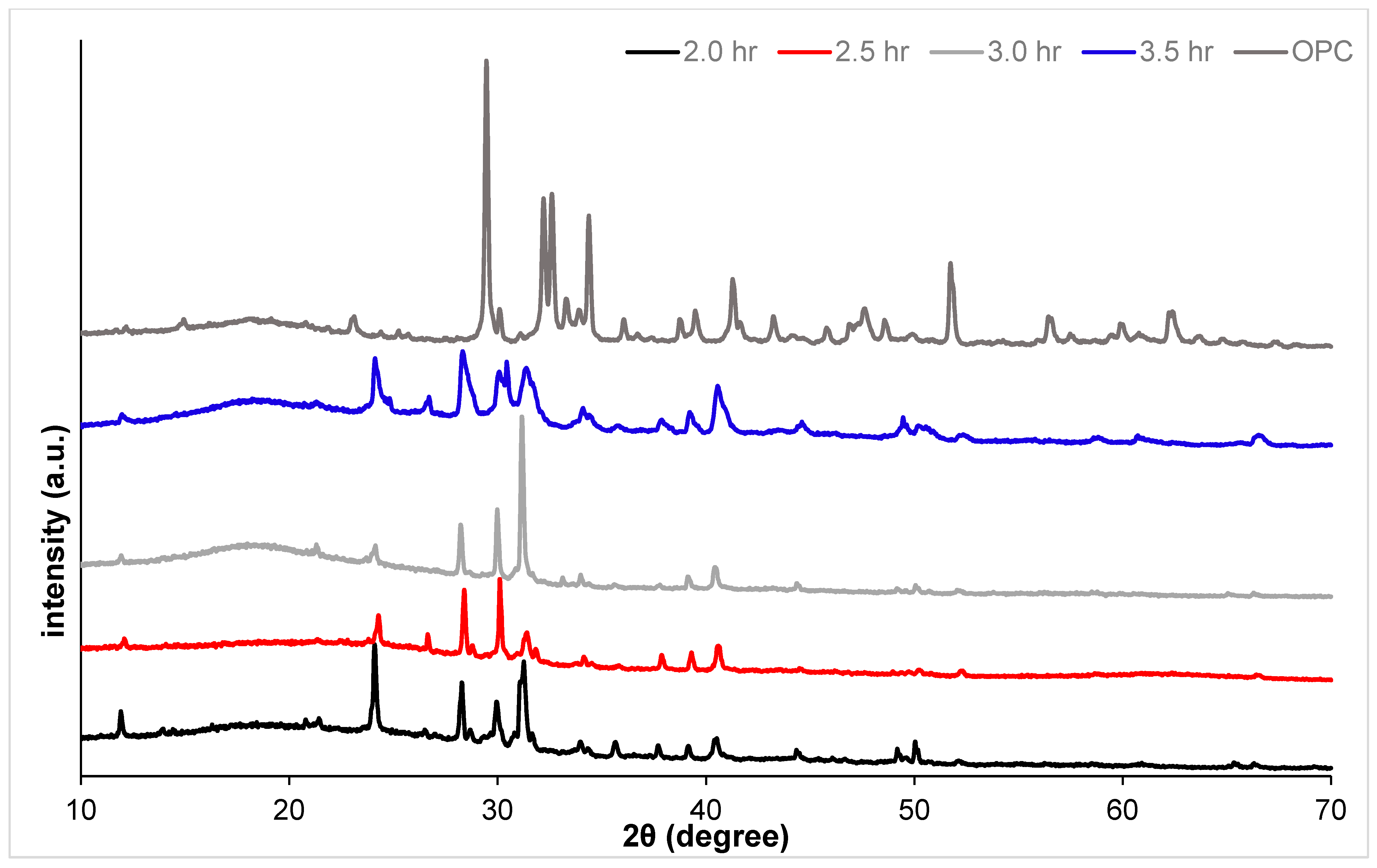
- Open air @2 h with peak pattern but slightly higher background hump.
- Open air @2.5 h with sharp, intense peaks with moderate background hump
- Open air @3 h with broad hump and distinct crystalline peaks
- Open air @3.5 h pronounced broad hump and crystalline peaks
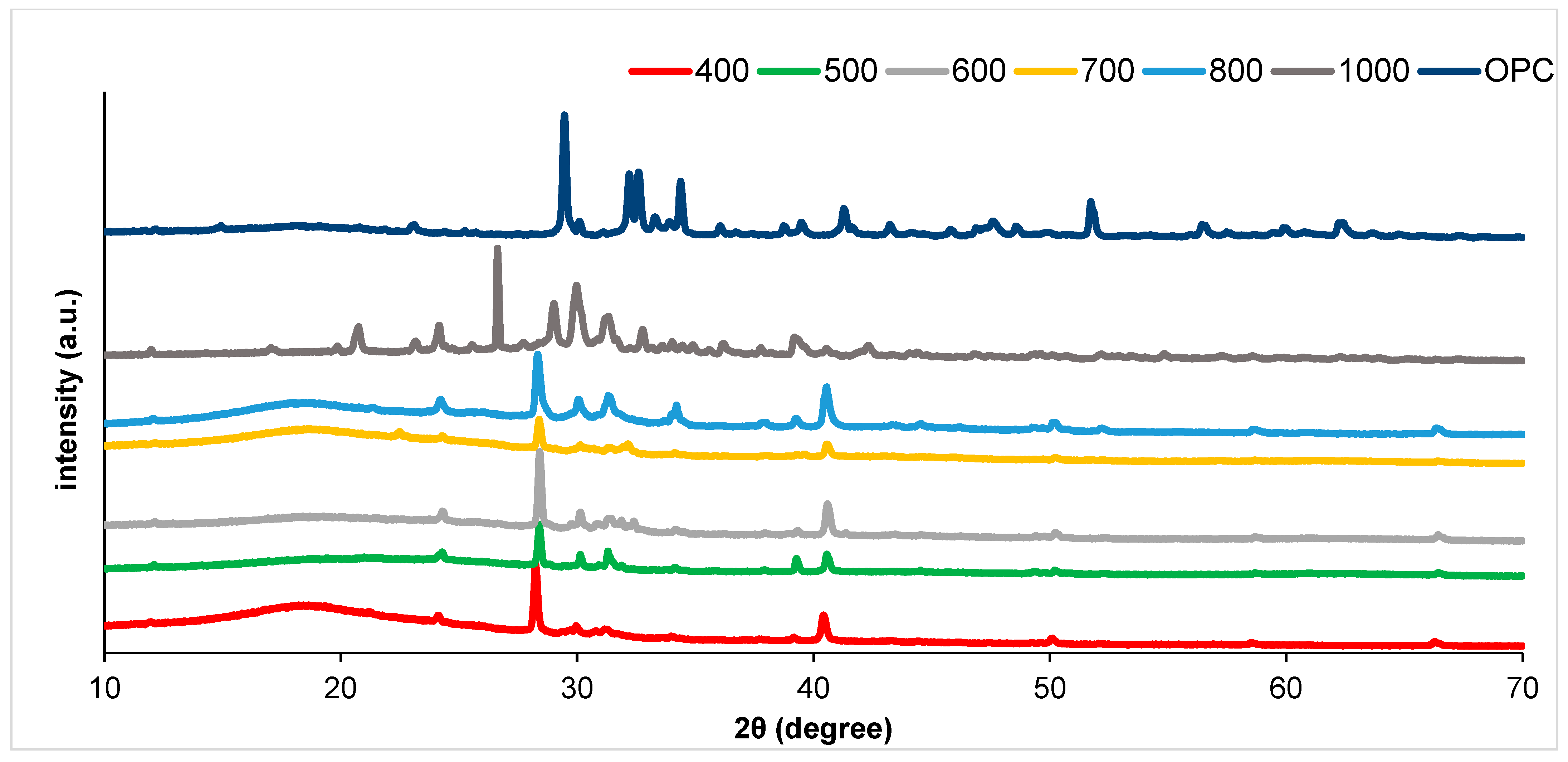
- Controlled burning 400 @2 h with much broader hump and fewer peaks
- Controlled burning 500 @2 h and moderate broad hump with distinct peaks
- Controlled burning 600 @2 h with reduced peak intensities and broader hump
- Controlled burning 700 @2 h with the most pronounced hump and fewer peaks
- Controlled burning 800 °C @2 h with increased crystallinity compared to 700 °C
- Controlled burning 1000 °C @2 h with very sharp, intense peaks and high counts (up to ~15,000)
- OPC sample with the highest crystallinity and very sharp, intense peaks
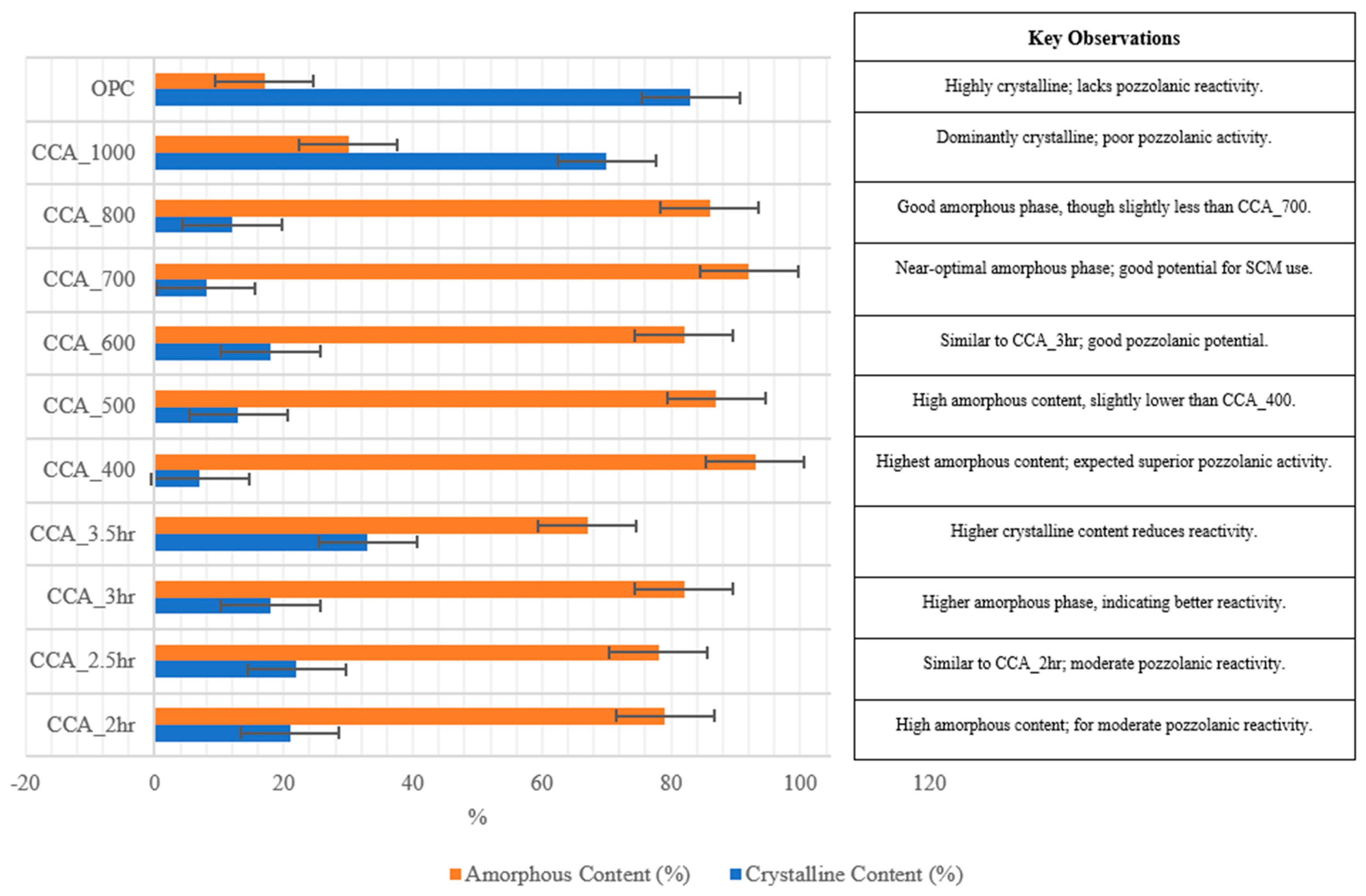
3.2.1. Analysis of Crystalline and Amorphous Content
- Thermodynamic theory of amorphous phase formation
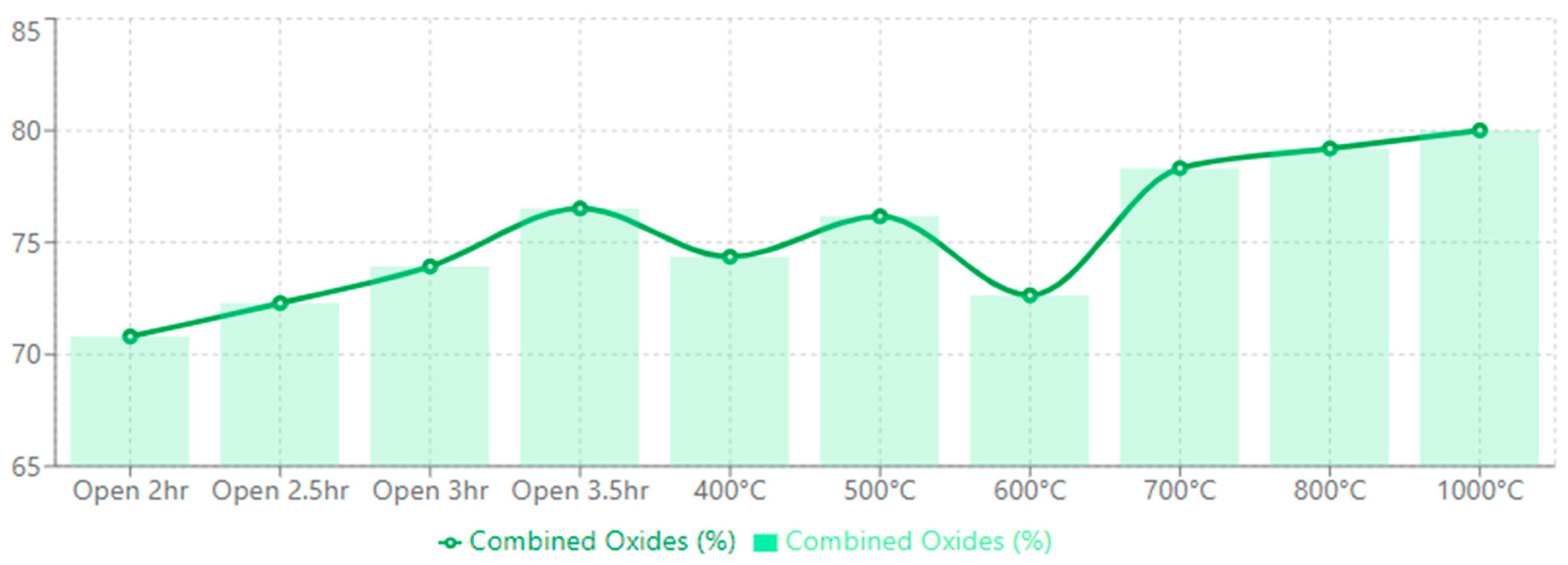
3.2.2. Chemical Composition from XRF
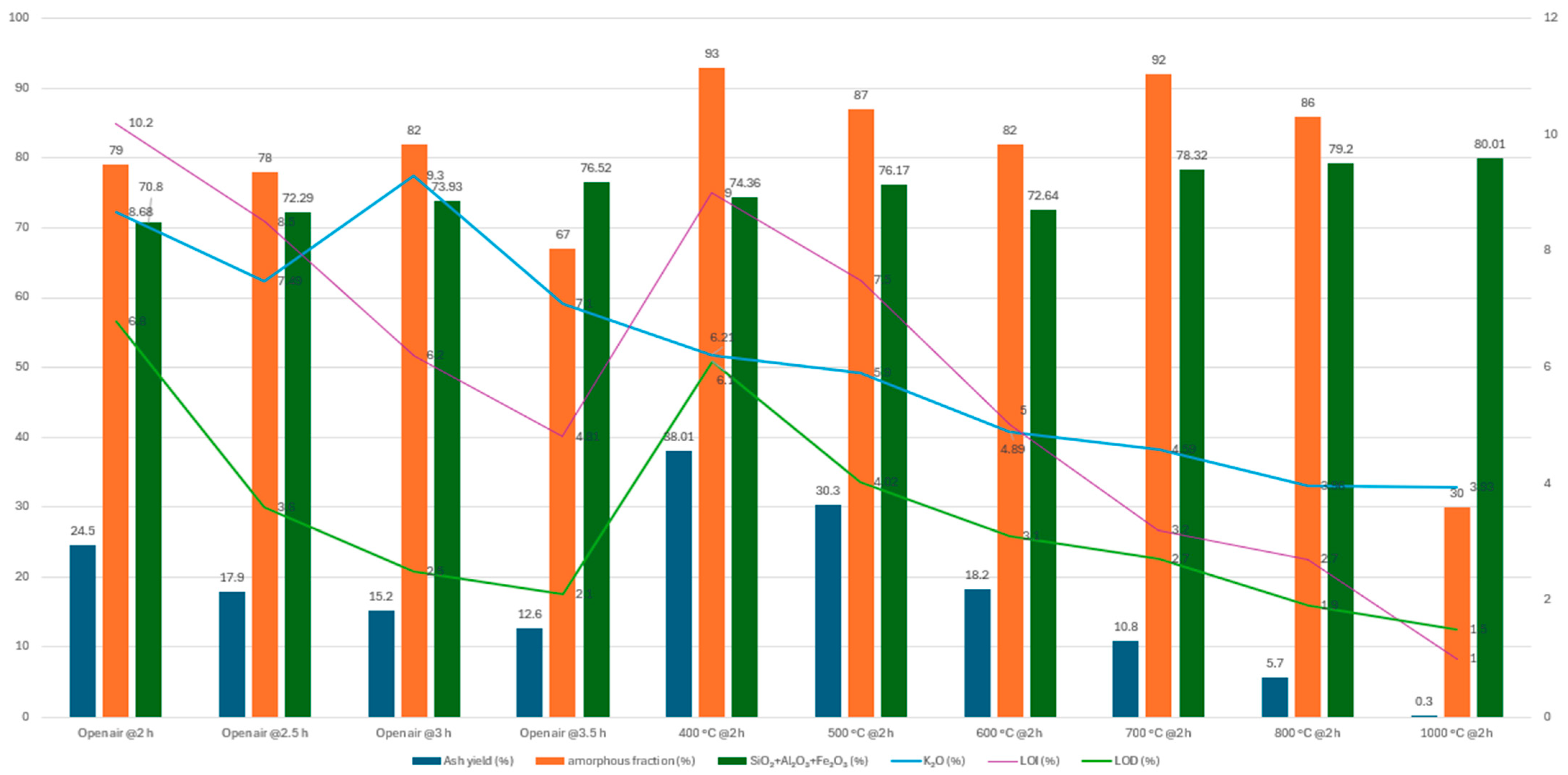
3.2.3. XRD-Based Amorphous Trends with Chemistry (XRF)
- Effect of open-air combustion time
- Effect of controlled calcination temperature
- Alkali oxides and durability
- Alkali equivalent calculations, ASR screening, and recommended replacement levels
= 0.98 + 6.1194
= 7.10% Na2Oeq
- Roles of other oxides and the normalised perspective
- Pozzolanic Thresholds
- Optimal processing window
- Comparison with OPC
3.3. Implications and UN SDG Integration
3.3.1. Circular Economy and Industrial Ecology Analysis
- Input: 1.2 billion tonne corn production annually → 180 million tonne CC waste (assuming a 15% cob-to-grain ratio) [118]
- Conversion: At 19% calcination yield, potential CCA production reaches 34 million tonnes annually
- Displacement: At 20% OPC replacement, CCA could displace 6.8 million tonne cement clinker annually, avoiding 5.8 million tonne CO2 (assuming 0.85 tCO2/t clinker).
3.3.2. Alignment with United Nations Sustainable Development Goals
- SDG 9: Industry, Innovation, and Infrastructure
- SDG 12: Responsible Consumption and Production
- SDG 13: Climate Action
- SDG 2: Zero Hunger (Indirect Contribution)
- SDG 11: Sustainable Cities and Communities
- Cross-cutting enablers: SDG 17 (Partnerships for the Goals)
4. Conclusions
Limitations and Future Study Areas
Author Contributions
Funding
Institutional Review Board Statement
Informed Consent Statement
Data Availability Statement
Acknowledgments
Conflicts of Interest
References
- United Nations Climate Change Conference. COP28 Outcomes. Session and Meeting Reports. Available online: https://unfccc.int/documents?f%5B0%5D=conference%3A4540&f%5B1%5D=document_type%3A375 (accessed on 3 August 2024).
- United Nations Framework Convention on Climate Change. The Paris Agreement. Available online: https://unfccc.int/process-and-meetings/the-paris-agreement/the-paris-agreement (accessed on 3 August 2024).
- United Nations Environment Programme (UNEP). Africa Waste Management Outlook; United Nations Environment Programme: Nairobi, Kenya, 2018; Available online: https://www.unep.org/ietc/resources/publication/africa-waste-management-outlook (accessed on 3 August 2024).
- Gag, C.R. Cement and concrete as an engineering material: An historic appraisal and case study analysis. Eng. Fail. Anal. 2014, 40, 114–140. [Google Scholar] [CrossRef]
- Supriya; Chaudhury, R.; Sharma, U.; Thapliyal, P.C.; Singh, L.P. Low-CO2 emission strategies to achieve net zero target in cement sector. J. Clean. Prod. 2023, 417, 137466. [Google Scholar] [CrossRef]
- Shah, I.; Miller, S.; Jiang, D.; Myers, R. Cement substitution with secondary materials can reduce annual global CO2 emissions by up to 1.3 gigatons. Nat. Commun. 2022, 13, 5758. [Google Scholar] [CrossRef]
- Ishak, S.; Hashim, H. Low carbon measures for cement plant—A review. J. Clean. Prod. 2015, 103, 260–274. [Google Scholar] [CrossRef]
- Ashour, T.; Korjenic, A.; Korjenic, S.; Wu, W. Thermal conductivity of unfired earth bricks reinforced by agricultural wastes with cement and gypsum. Energy Build. 2015, 104, 139–146. [Google Scholar] [CrossRef]
- Okeke, F.O.; Ahmed, A.; Imam, A.; Hassanin, H. Study on agricultural waste utilization in sustainable particleboard production. In E3S Web of Conferences; EDP Sciences: Les Ulis, France, 2024; Volume 563, p. 02007. [Google Scholar] [CrossRef]
- FAO. Food and Agriculture Organization of the United Nations Annual Corn Production; FAO: Roma, Italy, 2023; Available online: https://www.fao.org/faostat/en/#data/QCL/visualize (accessed on 3 August 2023).
- Santolini, E.; Bovo, M.; Barbaresi, A.; Torreggiani, D.; Tassinari, P. Turning agricultural wastes into biomaterials: Assessing the sustainability of scenarios of circular valorization of corn cob in a life-cycle perspective. Appl. Sci. 2021, 11, 6281. [Google Scholar] [CrossRef]
- Singh, K.; Singh, J.; Kumar, S. A sustainable environmental study on corn cob ash subjected to elevated temperature. Curr. World Environ. 2017, 13, 144–150. [Google Scholar] [CrossRef]
- Bheel, N.; Adesina, A. Influence of binary blend of corncob ash and glass powder as partial replacement of cement in concrete. Silicon 2021, 13, 1647–1654. [Google Scholar] [CrossRef]
- Onsongo, S.K.; Olukuru, J.; Munyao, O.M.; Mwabonje, O. The role of agricultural ashes (rice husk ash, coffee husk ash, sugarcane bagasse ash, palm oil fuel ash) in cement production for sustainable development in Africa. Discov. Sustain. 2025, 6, 62. [Google Scholar] [CrossRef]
- Pandey, A.; Kumar, B. Utilization of agricultural and industrial waste as replacement of cement in pavement quality concrete: A review. Environ. Sci. Pollut. Res. Int. 2022, 29, 24504–24546. [Google Scholar] [CrossRef]
- Adesanya, D.A.; Raheem, A.A. Development of corn cob ash blended cement. Constr. Build. Mater. 2009, 23, 347–352. [Google Scholar] [CrossRef]
- Zou, Y.; Fu, J.; Chen, Z.; Ren, L. The effect of microstructure on mechanical properties of corn cob. Micron 2021, 146, 103070. [Google Scholar] [CrossRef] [PubMed]
- Suwanmaneechot, P.; Nochaiya, T.; Julphunthong, P. Improvement, characterization and use of waste corn cob ash in cement-based materials. IOP Conf. Ser. Mater. Sci. Eng. 2015, 103, 012023. [Google Scholar] [CrossRef]
- Oluborode, K.D.; Olofintuyi, I.O. Strength evaluation of corn cob ash in a blended Portland cement. Int. J. Eng. Innov. Technol. 2015, 4, 14–17. [Google Scholar]
- Patel, M.; Rathod, J.; Bhatt, P.; Chaudhari, D.; Pathan, N.; Naik, S. Experimental study of corn cob ash concrete. Int. J. Innov. Res. Technol. 2020, 6, 110–112. [Google Scholar]
- Anjaneyulu, K. Partial replacement of cement concrete by waste materials. Int. J. Eng. Dev. Res. 2017, 5, 1374–1383. [Google Scholar]
- Abdul-Manan, D. Exploring the potential of alternative pozzolana cement for the Northern Savannah Ecological Zone in Ghana. Am. J. Civ. Eng. 2016, 4, 74–79. [Google Scholar] [CrossRef]
- Adesanya, D. Evaluation of blended cement mortar, concrete and stabilized earth made from ordinary Portland cement and corncob ash. Constr. Build. Mater. 1996, 10, 451–456. [Google Scholar] [CrossRef]
- Kamau, J.; Ahmed, A.; Hirst, P.; Kangwa, J. Permeability of corncob ash, anthill soils and rice husk replaced concrete. Int. J. Sci. Environ. Technol. 2017, 6, 1299–1308. [Google Scholar]
- Memon, S.A.; Khan, M.K. Ash blended cement composites: Eco-friendly and sustainable option for utilization of corncob ash. J. Clean. Prod. 2018, 175, 442–455. [Google Scholar] [CrossRef]
- Kamau, J.; Ahmed, A.; Hirst, P.; Kangwa, J. Suitability of corncob ash as a supplementary cementitious material. Int. J. Mater. Sci. Eng. 2016, 4, 215–228. [Google Scholar]
- Ahangba, A.; Michael, T. Partial replacement of cement with corn cob ash. Int. J. Innov. Res. Multidiscip. Field 2016, 2, 158–169. [Google Scholar]
- Owolabi, T.A.; Oladipo, I.O.; Popoola, O.O. Effect of corncob ash as partial substitute for cement in concrete. N. Y. Sci. J. 2015, 8, 1–4. [Google Scholar]
- Shakouri, M.; Exstrom, C.L.; Ramanathan, S.; Suraneni, P. Hydration, strength, and durability of cementitious materials incorporating untreated corn cob ash. Constr. Build. Mater. 2020, 243, 118171. [Google Scholar] [CrossRef]
- Ahmad, J.; Arbili, M.M.; Alabduljabbar, H.; Deifalla, F.A. Concrete made with partially substitution corn cob ash: A review. Case Stud. Constr. Mater. 2023, 18, e02100. [Google Scholar] [CrossRef]
- Okeke, F.; Ahmed, A.; Imam, A.; Hassanin, H. Assessment of compressive strength performance of corn cob ash blended concrete: A review. In Proceedings of the Sixth International Conference on Sustainable Construction Materials and Technologies (SCMT 6), Lyon, France, 9–14 June 2024; Volume 1, p. 606. [Google Scholar] [CrossRef]
- Sathiparan, N. A systematic review of corncob ash in construction: Current findings and future directions. Sustain. Mater. Technol. 2025, 43, e01315. [Google Scholar] [CrossRef]
- Zhen, F. Physical and chemical properties of corncob for thermal conversions. Fuel Sci. Technol. Int. 1993, 11, 1037–1045. [Google Scholar] [CrossRef]
- ASTM C109/C109M-16; Standard Test Method for Compressive Strength of Hydraulic Cement Mortars (Using 2-in. or [50-mm] Cube Specimens). ASTM International: West Conshohocken, PA, USA, 2016.
- ASTM C191-21; Standard Test Methods for Time of Setting of Hydraulic Cement by Vicat Needle. ASTM International: West Conshohocken, PA, USA, 2021.
- Zareei, S.A.; Ameri, F.; Dorostkar, F.; Ahmadi, M. Rice husk ash as a partial replacement of cement in high strength concrete containing micro silica: Evaluating durability and mechanical properties. Case Stud. Constr. Mater. 2017, 7, 73–81. [Google Scholar] [CrossRef]
- Dams, B.; Maskell, D.; Shea, A.; Allen, S.; Cascione, V.; Walker, P. Upscaling bio-based construction: Challenges and opportunities. Build. Res. Inf. 2023, 51, 764–782. [Google Scholar] [CrossRef]
- Endale, S.A.; Taffese, W.Z.; Vo, D.-H.; Yehualaw, M.D. Rice husk ash in concrete. Sustainability 2023, 15, 137. [Google Scholar] [CrossRef]
- Hasan, N.M.S.; Sobuz, M.H.R.; Khan, M.M.H.; Mim, N.J.; Meraz, M.M.; Datta, S.D.; Rana, M.J.; Saha, A.; Akid, A.S.M.; Mehedi, M.T.; et al. Integration of rice husk ash as supplementary cementitious material in the production of sustainable high-strength concrete. Materials 2022, 15, 8171. [Google Scholar] [CrossRef]
- Onyenokporo, N.C.; Taki, A.; Montalvo, L.Z.; Oyinlola, M. Thermal performance characterization of cement-based masonry blocks incorporating rice husk ash. Constr. Build. Mater. 2023, 398, 132481. [Google Scholar] [CrossRef]
- Zaffar, S.; Kumar, A.; Memon, N.A.; Kumar, R.; Saand, A. Investigating Optimum Conditions for Developing Pozzolanic Ashes from Organic Wastes as Cement Replacing Materials. Materials 2022, 15, 2320. [Google Scholar] [CrossRef]
- Bayapureddy, Y.; Muniraj, K.; Mutukuru, G.R.M.R. Sugarcane bagasse ash as mineral admixture in production of high-performance concrete. AIP Conf. Proc. 2024, 3146, 020008. [Google Scholar] [CrossRef]
- Prabhath, N.; Kumara, B.S.; Vithanage, V.; Samarathunga, A.I.; Sewwandi, N.; Damruwan, H.-G.H.; Lewangamage, S.; Koswattage, K.R. Investigation of pozzolanic properties of sugarcane bagasse ash for commercial applications. ACS Omega 2023, 8, 12052–12061. [Google Scholar] [CrossRef]
- September, L.A.; Kheswa, N.; Seroka, N.S.; Khotseng, L. Green synthesis of silica and silicon from agricultural residue sugarcane bagasse ash—A mini review. RSC Adv. 2023, 13, 1370–1380. [Google Scholar] [CrossRef]
- Memon, S.A.; Wahid, I.; Khan, M.K.; Tanoli, M.A.; Bimaganbetova, M. Environmentally Friendly Utilization of Wheat Straw Ash in Cement-Based Composites. Sustainability 2018, 10, 1322. [Google Scholar] [CrossRef]
- Memon, S.A.; Khan, S.; Wahid, I.; Shestakova, Y.; Ashraf, M. Evaluating the effect of calcination and grinding of corn stalk ash on pozzolanic potential for sustainable cement-based materials. Adv. Mater. Sci. Eng. 2020, 2020, 1619480. [Google Scholar] [CrossRef]
- Juenger, M.C.G.; Snellings, R.; Bernal, S.A. Supplementary cementitious materials: New sources, characterization, and performance insights. Cem. Concr. Res. 2019, 122, 257–273. [Google Scholar] [CrossRef]
- Skibsted, J.; Snellings, R. Reactivity of supplementary cementitious materials (SCMs) in cement blends. Cem. Concr. Res. 2019, 124, 105799. [Google Scholar] [CrossRef]
- Thomas, C.; Sainz-Aja, J.; Sosa, I.; Setién, J.; Polanco, J.A.; Cimentada, A. Physical-mechanical properties of cupola slag cement paste. Appl. Sci. 2021, 11, 7029. [Google Scholar] [CrossRef]
- Fadele, O.; Otieno, M. Utilisation of supplementary cementitious materials from agricultural wastes: A review. Proc. Inst. Civ. Eng. Constr. Mater. 2022, 175, 65–71. [Google Scholar] [CrossRef]
- Blesson, S.; Rao, A.U.; Bhandary, R.P.; Shetty, P.P.; Thomas, B.S. Comparative characteristics assessment of calcined and uncalcined agro-based waste ash with GGBS and its application in an alkali-activated binder system. Cogent Eng. 2023, 10, 2220483. [Google Scholar] [CrossRef]
- Habert, G.; Miller, S.A.; John, V.M.; Provis, J.L.; Favier, A.; Horvath, A.; Scrivener, K.L. Environmental impacts and decarbonization strategies in the cement and concrete industries. Nat. Rev. Earth Environ. 2020, 1, 559–573. [Google Scholar] [CrossRef]
- Olsson, J.A.; Miller, S.A.; Kneifel, J.D. A review of current practice for life cycle assessment of cement and concrete. Resour. Conserv. Recycl. 2024, 206, 107619. [Google Scholar] [CrossRef]
- Ige, O.E.; Moloi, K.; Kabeya, M. Sustainability assessment of cement types via integrated life cycle assessment and multi-criteria decision-making methods. Sci 2025, 7, 85. [Google Scholar] [CrossRef]
- Christian, J.W. The Theory of Transformations in Metals and Alloys, 3rd ed.; Pergamon: Oxford, UK, 2002. [Google Scholar]
- Rajabipour, F.; Giannini, E.; Dunant, C.; Ideker, J.H.; Thomas, M.D. Alkali–silica reaction: Current understanding of the reaction mechanisms and the knowledge gaps. Cem. Concr. Res. 2015, 76, 130–146. [Google Scholar] [CrossRef]
- Olajide, O.D.; Alayande, T.; Denison, O. Alkali–silica reactions: Literature review on the influence of concrete constituents. Materials 2023, 16, 141. [Google Scholar] [CrossRef]
- Aransiola, E.F.; Oyewusi, T.F.; Osunbitan, J.A.; Ogunjimi, L.A.O. Effect of binder type, binder concentration and compacting pressure on some physical properties of carbonized corncob briquette. Energy Rep. 2019, 5, 909–918. [Google Scholar] [CrossRef]
- Rebaque, V.; Ertesvåg, I.S.; Mikalsen, R.F.; Steen-Hansen, A. Experimental study of smouldering in wood pellets with and without air draft. Fuel 2020, 264, 116806. [Google Scholar] [CrossRef]
- Song, W.; He, Y.; Wu, Y.; Qu, W. Characterization of burning behaviors and particulate matter emissions of crop straws based on a cone calorimeter. Materials 2021, 14, 3407. [Google Scholar] [CrossRef]
- Vásquez, R.; Bula, A.; Fandiño, J.; Camargo-Trillos, D.; Julio, J.; Gracia, S.; Almario, Á. Modeling lignocellulosic pyrolysis: An integral approach to the thermal degradation of corn cob and product prediction. In Volume 6: Energy; American Society of Mechanical Engineers: New York, NY, USA, 2024. [Google Scholar] [CrossRef]
- Aprianti, E.; Shafigh, P.; Bahri, S.; Farahani, J.N. Supplementary cementitious materials origin from agricultural wastes—A review. Constr. Build. Mater. 2015, 74, 176–187. [Google Scholar] [CrossRef]
- Olafusi, O.S.; Olutoge, F.A. Strength properties of corn cob ash concrete. J. Emerg. Trends Eng. Appl. Sci. 2012, 3, 297–301. [Google Scholar]
- Yang, H.; Yan, R.; Chen, H.; Lee, D.H.; Zheng, C. Characteristics of hemicellulose, cellulose and lignin pyrolysis. Fuel 2007, 86, 1781–1788. [Google Scholar] [CrossRef]
- Wakudkar, H.; Jain, S. A holistic overview on corn cob biochar: A mini-review. Waste Manag. Res. 2022, 40, 1143–1155. [Google Scholar] [CrossRef]
- Sittisun, P.; Tippayawong, N.; Wattanasiriwech, D. Thermal degradation characteristics and kinetics of oxy combustion of corn residues. Adv. Mater. Sci. Eng. 2015, 2015, 304395. [Google Scholar] [CrossRef]
- Lopes, D.F.; De Oliveira, V.C.; Neves da Silva, S. Characterization of Coal Ash and Rice Husk for Use in Sustainable Constructions. J. Build. Technol. 2024, 6, 258. [Google Scholar] [CrossRef]
- Nair, D.G.; Fraaij, A.; Klaassen, A.A.; Kentgens, A.P. A structural investigation relating to the pozzolanic activity of rice husk ashes. Cem. Concr. Res. 2008, 38, 861–869. [Google Scholar] [CrossRef]
- Fastelli, M.; Cambi, C.; Zucchini, A.; Sassi, P.; Pandolfi Balbi, E.; Pioppi, L.; Cotana, F.; Cavalaglio, G.; Comodi, P. Use of Biomass Ash in Reinforced Clayey Soil: A Multiscale Analysis of Solid-State Reactions. Recycling 2023, 8, 5. [Google Scholar] [CrossRef]
- Bhagath Singh, G.V.P.; Subramaniam, K.V.L. Quantitative XRD study of amorphous phase in alkali activated low calcium siliceous fly ash. Constr. Build. Mater. 2016, 124, 139–147. [Google Scholar] [CrossRef]
- ASTM C618-19; Standard Specification for Coal Fly Ash and Raw or Calcined Natural Pozzolan for Use in Concrete. In Annual Book of ASTM Standards 2019. ASTM International: West Conshohocken, PA, USA, 2019; pp. 351–355.
- DIN EN ISO 12677:2013-02; Chemical Analysis of Refractory Products by X-ray Fluorescence (XRF)—Fused Cast-Bead Method (ISO 12677:2011). DIN Media: Berlin, Germany, 2013. [CrossRef]
- Walker, H.N.; Lane, D.S.; Stutzman, P.E. Alkali-aggregate reactions. In Petrographic Methods of Examining Hardened Concrete: A Petrographic Manual; Report No. FHWA-HRT-04-150; Federal Highway Administration, U.S. Department of Transportation: McLean, VA, USA, 2006; Chapter 10. [Google Scholar]
- Rein, G.; Garcia, J.; Simeoni, A.; Tihay, V.; Ferrat, L. Smouldering natural fires: Comparison of burning dynamics in boreal peat and Mediterranean humus. In WIT Transactions on Ecology and the Environment; WIT Press: Southampton, UK, 2008; Volume 119, pp. 183–192. [Google Scholar] [CrossRef]
- Krishnarao, R.V.; Subrahmanyam, J.; Jagadish Kumar, T. Studies on the formation of black particles in rice husk silica ash. J. Eur. Ceram. Soc. 2001, 21, 99–104. [Google Scholar] [CrossRef]
- Venkatanarayanan, H.K.; Rangaraju, P.R. Effect of grinding of low-carbon rice husk ash on the microstructure and performance properties of blended cement concrete. Cem. Concr. Compos. 2015, 55, 348–363. [Google Scholar] [CrossRef]
- Nehdi, M.; Duquette, J.; El Damatty, A. Performance of rice husk ash produced using a new technology as a mineral admixture in concrete. Cem. Concr. Res. 2003, 33, 1203–1210. [Google Scholar] [CrossRef]
- Bahurudeen, A.; Santhanam, M. Influence of different processing methods on the pozzolanic performance of sugarcane bagasse ash. Cem. Concr. Compos. 2015, 56, 32–45. [Google Scholar] [CrossRef]
- Peterson, S.; Peterson, J. The Craft and Art of Clay: A Complete Potter’s Handbook; Laurence King Publishing: London, UK, 2003. [Google Scholar]
- Vempati, R.K.; Musali, S.K.; Meeravali, N.N.; Klarup, D.; Kolarik, J.; Lawrence, D.; Sethi, V. Template free ZSM-5 from siliceous rice hull ash with varying C contents. Microporous Mesoporous Mater. 2006, 93, 134–140. [Google Scholar] [CrossRef]
- Ganesan, K.; Rajagopal, K.; Thangavel, K. Rice husk ash blended cement: Assessment of optimal level of replacement for strength and permeability properties of concrete. Constr. Build. Mater. 2008, 22, 1675–1683. [Google Scholar] [CrossRef]
- Ferraro, R.M.; Nanni, A. Effect of off-white rice husk ash on strength, porosity, conductivity and corrosion resistance of white concrete. Constr. Build. Mater. 2012, 31, 220–225. [Google Scholar] [CrossRef]
- Jaques, S.B.; Stehly, R.D.; Dunning, P.B. Processed Silica as a Natural Pozzolan for Use as a Cementitious Component in Concrete and Concrete Products. U.S. Patent 5,534,044, 9 July 1996. [Google Scholar]
- Cordeiro, G.; Toledo Filho, R.; Fairbairn, E. Effect of calcination temperature on the pozzolanic activity of sugar cane bagasse ash. Constr. Build. Mater. 2009, 23, 3301–3303. [Google Scholar] [CrossRef]
- Van Santen, R.A. The Ostwald step rule. J. Phys. Chem. 1984, 88, 5768–5769. [Google Scholar] [CrossRef]
- Affandi, S.; Setyawan, H.; Winardi, S.; Purwanto, A.; Balgis, R. A facile method for production of high-purity silica xerogels from bagasse ash. Adv. Powder Technol. 2009, 20, 468–472. [Google Scholar] [CrossRef]
- Shirzad, K.; Viney, C. Revisiting time-dependent growth and nucleation rates in the Johnson-Mehl-Avrami-Kolmogorov equation. R. Soc. Open Sci. 2025, 12, 241696. [Google Scholar] [CrossRef]
- Rajwade, B.; Netam, N. Investigation of effects of corncob ash in fly ash bricks. Mater. Today Proc. 2020, 28, 2431–2434. [Google Scholar] [CrossRef]
- Memon, S.A.; Javed, U.; Khushnood, R.A. Eco-friendly utilization of corncob ash as partial replacement of sand in concrete. Constr. Build. Mater. 2019, 195, 165–177. [Google Scholar] [CrossRef]
- Selina, R.G.; Dinesh, S.; Bharath, R.P.; Kishorenandha, S. Assessment on influence of corncob ash as a partial replacement of cement in concrete. Int. J. Innov. Technol. Explor. Eng. 2020, 9, 210–212. [Google Scholar] [CrossRef]
- Saloni; Parveen; Pham, T.M.; Lim, Y.Y.; Pradhan, S.S.; Jatin; Kumar, J. Performance of rice husk ash-based sustainable geopolymer concrete with ultra-fine slag and corn cob ash. Constr. Build. Mater. 2021, 279, 122526. [Google Scholar] [CrossRef]
- Feng, Q.; Sugita, S.; Gong, F. Removal of lead ion from aqueous solution using rice husk ash. In Frontiers on Separation Science and Technology; World Scientific: Singapore, 2004; pp. 807–813. [Google Scholar] [CrossRef]
- Siddique, R. Properties of self-compacting concrete containing class F fly ash. Mater. Des. 2011, 32, 1501–1507. [Google Scholar] [CrossRef]
- Powers, T.C.; Steinour, H.H. An interpretation of some published researches on the alkali-aggregate reaction part 1—The chemical reactions and mechanism of expansion. J. Am. Concr. Inst. 1955, 26, 497–516. [Google Scholar]
- ACI Committee 225. ACI 225.1T-20Removal of Optional Alkali Limit in Standard Specifications for Portland Cement; ACI 225.1T-20; American Concrete Institute: Farmington Hills, MI, USA, 2020. [Google Scholar]
- Sinno, N.; Shehata, M.H. Role of temperature on alkali-silica reaction and the efficacy of supplementary cementitious materials. Constr. Build. Mater. 2021, 313, 125427. [Google Scholar] [CrossRef]
- ASTM C1567-25; Standard Test Method for Determining the Potential Alkali-Silica Reactivity of Combinations of Cementitious Materials and Aggregate (Accelerated Mortar-Bar Method). ASTM International: West Conshohocken, PA, USA, 2025.
- ASTM C1293/C1293M-23ae1; Standard Test Method for Determination of Length Change of Concrete Due to Alkali-Silica Reaction (Concrete Prism Test). ASTM International: West Conshohocken, PA, USA, 2023.
- Ramsey, M.; Wood, S.; Moser, R. Residual Expansion Capacity and Degradation of Mechanical Properties in Alkali-Silica Reaction (ASR) Damaged Concrete; Technical Report; Engineer Research and Development Center (U.S.): Vicksburg, MS, USA, 2019. [Google Scholar] [CrossRef]
- Fode, T.; Jande, Y.; Kivevele, T. Effects of different supplementary cementitious materials on durability and mechanical properties of cement composite—Comprehensive review. Heliyon 2023, 9, e17924. [Google Scholar] [CrossRef]
- Alsharari, F. Utilization of industrial, agricultural, and construction waste in cementitious composites: A comprehensive review of their impact on concrete properties and sustainable construction practices. Mater. Today Sustain. 2025, 29, 101080. [Google Scholar] [CrossRef]
- Li, G.; Zhou, C.; Ahmad, W.; Usanova, K.; Karelina, M.; Mohamed, A.; Khallaf, R. Fly ash application as supplementary cementitious material: A review. Materials 2022, 15, 2664. [Google Scholar] [CrossRef]
- Siddique, R.; Klaus, J. Influence of metakaolin on the properties of mortar and concrete: A review. Appl. Clay Sci. 2009, 43, 392–400. [Google Scholar] [CrossRef]
- Rukzon, S.; Chindaprasirt, P.; Mahachai, R. Effect of grinding on chemical and physical properties of rice husk ash. Int. J. Miner. Metall. Mater. 2009, 16, 242–247. [Google Scholar] [CrossRef]
- Seo, J.; Nawaz, A.; Jang, J.; Lee, H. Modifications in hydration kinetics and characteristics of calcium aluminate cement upon blending with calcium sulfoaluminate cement. Constr. Build. Mater. 2022, 353, 127958. [Google Scholar] [CrossRef]
- Gholami, S.; Kim, Y.; Little, D.; Kwon, S.; Jung, J. Carbonation of one-part alkali-activated materials incorporated by MgO: Phase characteristics and micromechanical properties. Constr. Build. Mater. 2024, 438, 137400. [Google Scholar] [CrossRef]
- Nie, S.; Thomsen, R.; Skibsted, J. Impact of Mg substitution on the structure and pozzolanic reactivity of calcium aluminosilicate (CaO-Al2O3-SiO2) glasses. Cem. Concr. Res. 2020, 138, 106231. [Google Scholar] [CrossRef]
- Okeke, F.O.; Ahmed, A.; Imam, A.; Hassanin, H. A review of corncob-based building materials as a sustainable solution for the building and construction industry. Hybrid Adv. 2024, 6, 100269. [Google Scholar] [CrossRef]
- Cabrera-Luna, K.; Perez-Cortes, P.; García, J. Influence of quicklime and Portland cement, as alkaline activators, on the microstructure of reaction products of supersulfated pumice-based cements. Cem. Concr. Compos. 2023, 145, 105379. [Google Scholar] [CrossRef]
- Midgley, H. The determination of calcium hydroxide in set Portland cements. Cem. Concr. Res. 1979, 9, 77–82. [Google Scholar] [CrossRef]
- Desai, P.H. Experimental study on corn cob ash powder as partial replacement of cement in concrete. Int. Res. J. Eng. Technol. 2018, 5, 724–728. [Google Scholar]
- Olonade, K.A.; Jaji, M.B.; Adekitan, O.A. Experimental comparison of selected pozzolanic materials. Afr. J. Sci. Technol. Innov. Dev. 2017, 9, 381–385. [Google Scholar] [CrossRef]
- Udoeyo, F.F.; Abubakar, S.A. Maize-cob ash as filler in concrete. J. Mater. Civ. Eng. 2003, 15, 205–208. [Google Scholar] [CrossRef]
- Thomas, B.S.; Gupta, R.C.; Kalla, P.; Csetenyi, L.J.; Setién, J. Biomass ashes from agricultural wastes as supplementary cementitious materials or aggregate replacement in cement/geopolymer concrete: A comprehensive review. Renew. Sustain. Energy Rev. 2021, 144, 110955. [Google Scholar] [CrossRef]
- United Nations. Transforming Our World: The 2030 Agenda for Sustainable Development; Resolution Adopted by the General Assembly on 25 September 2015 (A/RES/70/1); United Nations: New York, NY, USA, 2015; Available online: https://sdgs.un.org/2030agenda (accessed on 20 October 2025).
- Chertow, M.R. Industrial symbiosis: Literature and taxonomy. Annu. Rev. Energy Environ. 2000, 25, 313–337. [Google Scholar] [CrossRef]
- Brunner, P.H.; Rechberger, H. Practical Handbook of Material Flow Analysis; CRC Press: Boca Raton, FL, USA, 2003. [Google Scholar] [CrossRef]
- Hong, E.; Kim, D.; Kim, J.; Kim, J.; Yoon, S.; Rhie, S.; Ha, S.; Ryu, Y. Optimization of alkaline pretreatment on corn stover for enhanced production of 1,3-propanediol and 2,3-butanediol by Klebsiella pneumoniae AJ4. Biomass Bioenergy 2015, 77, 177–185. [Google Scholar] [CrossRef]
- IEA. Cement; IEA: Paris, France, 2023; Available online: https://www.iea.org/reports/cement-3 (accessed on 20 October 2025).
- British Geological Survey. Mineral Profile: Cement Raw Materials; British Geological Survey: Nottingham, UK, 2005. [Google Scholar]
- Turakulov, Z.; Kamolov, A.; Norkobilov, A.; Variny, M.; Fallanza, M. Enhancing sustainability and energy savings in cement production via waste heat recovery. Eng. Proc. 2024, 67, 11. [Google Scholar] [CrossRef]
- Silva, J.P.; Teixeira, S.; Teixeira, J.C. Characterization of the physicochemical and thermal properties of different forest residues. Biomass Bioenergy 2023, 175, 106870. [Google Scholar] [CrossRef]
- Renne, N.; Kara De Maeijer, P.; Craeye, B.; Buyle, M.; Audenaert, A. Sustainable assessment of concrete repairs through life cycle assessment (LCA) and life cycle cost analysis (LCCA). Infrastructures 2022, 7, 128. [Google Scholar] [CrossRef]
- Alexander, M.; Beushausen, H. Durability, service life prediction, and modelling for reinforced concrete structures—Review and critique. Cem. Concr. Res. 2019, 122, 17–29. [Google Scholar] [CrossRef]
- Pinakana, S.D.; Raysoni, A.U.; Sayeed, A.; Gonzalez, J.L.; Temby, O.; Wladyka, D.; Sepielak, K.; Gupta, P. Review of agricultural biomass burning and its impact on air quality in the continental United States of America. Environ. Adv. 2024, 16, 100546. [Google Scholar] [CrossRef]
- Thola, J.; Salam, P.A.; Dhakal, S.; Winijkul, E. Sustainable options for reducing open burning of corn residues: Case study of Mae Chaem District, Thailand. Pol. J. Environ. Stud. 2022, 31, 5851–5861. [Google Scholar] [CrossRef] [PubMed]
- Jain, N.; Bhatia, A.; Pathak, H. Emission of air pollutants from crop residue burning in India. Aerosol Air Qual. Res. 2014, 14, 422–430. [Google Scholar] [CrossRef]
- Prateep Na Talang, R.; Na Sorn, W.; Polruang, S.; Sirivithayapakorn, S. Alternative crop residue management practices to mitigate the environmental and economic impacts of open burning of agricultural residues. Sci. Rep. 2024, 14, 14372. [Google Scholar] [CrossRef] [PubMed]
- Becerra-Pérez, L.A.; Rincón, L.; Posada-Duque, J.A. Logistics and costs of agricultural residues for cellulosic ethanol production. Energies 2022, 15, 4480. [Google Scholar] [CrossRef]
- Thompson, J.L.; Tyner, W.E. Corn stover for bioenergy production: Cost estimates and farmer supply response. Biomass Bioenergy 2014, 62, 166–173. [Google Scholar] [CrossRef]
- Okeke, F.O.; Ebohon, O.J.; Ahmed, A.; Zhou, J.; Hassanin, H.; Osman, A.I.; Pan, Z. Synergistic utilisation of construction demolition waste (CD&W) and agricultural residues as sustainable cement alternatives: A critical analysis of unexplored potential. Buildings 2025, 15, 4203. [Google Scholar] [CrossRef]
- Malhi, S.S.; Lemke, R.; Wang, Z.H.; Chhabra, B.S. Tillage, nitrogen and crop residue effects on crop yield, nutrient uptake, soil quality, and greenhouse gas emissions. Soil Tillage Res. 2006, 90, 171–183. [Google Scholar] [CrossRef]
- Liu, J.; Tong, D.; Zheng, Y.; Cheng, J.; Qin, X.; Shi, Q.; Yan, L.; Lei, Y.; Zhang, Q. Carbon and air pollutant emissions from China’s cement industry 1990–2015: Trends, evolution of technologies, and drivers. Atmos. Chem. Phys. 2021, 21, 1627–1647. [Google Scholar] [CrossRef]
- Department for Environment, Food and Rural Affairs. Air Quality Appraisal: Damage Cost Guidance; GOV.UK: London, UK, 2023. Available online: https://www.gov.uk/government/publications/assess-the-impact-of-air-quality/air-quality-appraisal-damage-cost-guidance (accessed on 20 October 2025).
- U.S. Environmental Protection Agency. Sector-Based PM2.5 and Ozone Benefit per Ton Estimates; U.S. EPA: Washington, DC, USA, 2023. Available online: https://www.epa.gov/benmap/sector-based-pm25-and-ozone-benefit-ton-estimates (accessed on 20 October 2025).



| Level | Main Variables in This Study | Typical Indicators Used Here | Expected Implications for CCA-Based Concrete (Conceptual) |
|---|---|---|---|
| Process | Calcination environment (furnace/open-air); peak temperature; burning duration | Residual mass fraction; colour; qualitative temperature control | Controls extent of devolatilisation and oxidation; sets boundary conditions for ash yield and basic quality. |
| Structure | Phase assemblage; degree of amorphousness; distribution of major and minor oxides | XRD patterns (amorphous hump vs. crystalline peaks); XRF oxide spectra | Determines amount of reactive silica/alumina, availability of Ca, and presence of potentially harmful alkalis. |
| Property | Pozzolanic potential; compatibility with cement; durability-related chemistry | SiO2 + Al2O3 + Fe2O3; approximate amorphous fraction; LOI and LOD; K2O and Na2O levels | Governs capacity to consume portlandite, influence on water demand, risk of alkali–silica reaction, and other durability issues. |
| Performance | Strength development; permeability; shrinkage; resistance to chemical attack | Not measured directly in this work; inferred qualitatively from chemistry and amorphous content | Anticipated effects on compressive strength, long-term durability, and service life of blended cements and concretes. |
| Sustainability | CO2 emissions; resource efficiency; waste management; economic viability | Qualitatively linked to clinker substitution potential and CC utilisation | Potential reduction in clinker-related emissions, diversion of agricultural waste from open burning, and support for low-carbon construction pathways. |
| Open-Air Condition | LOI (%) | LOD (%) | EFT from LOI (°C) | EFT from LOD (°C) | Interpretation |
|---|---|---|---|---|---|
| 2 h | 10.20 | 6.80 | <400 | <400 | Very low severity: incomplete burnout and drying; unreliable SCM quality. |
| 2.5 h | 8.50 | 3.60 | ~433 | ~546 | Moderate severity: drying improves faster than burnout; still variable. |
| 3 h | 6.20 | 2.50 | ~552 | ~725 | Mixed severity: moisture removal suggests hot episodes, but burnout remains oxygen-limited in zones. |
| 3.5 h | 4.81 | 2.10 | ~611 | ~775 | Highest severity among open-air runs: approaches low-LOI region, but still heterogeneous. |
| Burning Conditions | Weight of Crucible (g) | Weight of CC and Crucible (g) | Weight of CC Sample (g) | Weight of CCA and Crucible (g) | Weight of CCA Sample (g) | Percentage Mass After Burning |
|---|---|---|---|---|---|---|
| Open air @3.5 h | 43 | 2043 | 2000 | 295 | 252 | 12.60 |
| Open air @3 h | 43 | 1543 | 1500 | 271 | 228 | 15.20 |
| Open air @2.5 h | 43 | 1543 | 1500 | 311.50 | 268.50 | 17.90 |
| Open air @2 h | 43 | 1543 | 1500 | 410.50 | 367.50 | 24.50 |
| 400 °C @2 h | 676.93 | 1076.93 | 400 | 828.97 | 152.04 | 38.01 |
| 500 °C @2 h | 676.93 | 1076.93 | 400 | 798.13 | 121.20 | 30.30 |
| 600 °C @2 h | 676.93 | 1076.93 | 400 | 749.73 | 72.80 | 18.20 |
| 700 °C @2 h | 687.42 | 1187.42 | 500 | 730.93 | 54 | 10.80 |
| 800 °C @2 h | 687.42 | 1187.42 | 500 | 705.43 | 28.50 | 5.70 |
| 1000 °C @2 h | 687.42 | 1187.42 | 500 | 678.43 | 1.50 | 0.30 |
| Average | 19.27 |
| Sample ID | Data Type | SiO2 (%) | Al2O3 (%) | Fe2O3 (%) | CaO (%) | MgO (%) | K2O (%) | Na2O (%) | P2O5 (%) | TiO2 (%) | ZnO (%) | Other (%) | Total (%) | LOI | LOD | SiO2 + Al2O3 + Fe2O3 | Remarks |
|---|---|---|---|---|---|---|---|---|---|---|---|---|---|---|---|---|---|
| Class-N | Standard | - | - | - | - | ≤5.0 | - | - | - | - | - | - | - | ≤10 | ≤3.0 | ≥70 | ASTM C618-19 Standard requirements |
| Open Air @3.5 h | Raw XRF | 65.82 | 6.29 | 4.41 | 8.70 | 3.23 | 7.10 | 0.85 | 2.12 | 0.02 | 0.54 | 0.45 | 99.80 | 4.81 | 2.10 | 76.52 | COMPLIES: Good pozzolanic content, acceptable LOI and LOD, balanced oxides |
| Normalized | 69.30 | 6.62 | 4.64 | 9.16 | 3.40 | 7.47 | 0.89 | 2.23 | 0.02 | 0.57 | 0.47 | 100 | - | - | 80.56 | ||
| Open Air @3 h | Raw XRF | 64.52 | 6.09 | 3.32 | 8.99 | 3.40 | 9.30 | 0.98 | 2.39 | 0.03 | 0.46 | 0.51 | 99.99 | 6.20 | 2.50 | 73.93 | COMPLIES: Meets requirements, but high K2O content |
| Normalized | 68.82 | 6.50 | 3.54 | 9.59 | 3.63 | 9.93 | 1.05 | 2.55 | 0.03 | 0.49 | 0.54 | 100 | - | - | 78.86 | ||
| Open Air @2.5 h | Raw XRF | 63.26 | 5.82 | 3.21 | 9.19 | 4.56 | 7.49 | 1.03 | 3.48 | 0.15 | 0.51 | 0.99 | 99.69 | 8.50 | 3.60 | 72.29 | PARTIALLY COMPLIES: High LOD, near-limit MgO |
| Normalized | 69.38 | 6.38 | 3.52 | 10.08 | 5.00 | 8.22 | 1.13 | 3.82 | 0.16 | 0.56 | 1.09 | 100 | - | - | 79.28 | ||
| Open Air @2 h | Raw XRF | 62.19 | 5.16 | 4.19 | 9.49 | 3.74 | 8.68 | 1.81 | 2.95 | 0.02 | 0.36 | 0.75 | 99.34 | 10.20 | 6.80 | 70.80 | NON-COMPLIANT: Exceeds LOI and LOD limits |
| Normalized | 69.76 | 5.79 | 4.70 | 10.65 | 4.20 | 9.74 | 2.03 | 3.31 | 0.02 | 0.40 | 0.84 | 100 | - | - | 80.25 | ||
| 400 °C @2 h | Raw XRF | 64.87 | 6.16 | 3.33 | 10.76 | 3.32 | 6.21 | 0.97 | 3.20 | 0.06 | 0.10 | 0.53 | 99.62 | 9.00 | 6.10 | 74.36 | PARTIALLY COMPLIES: High LOD, near-limit LOI |
| Normalized | 71.58 | 6.80 | 3.67 | 11.87 | 3.66 | 6.85 | 1.07 | 3.53 | 0.07 | 0.11 | 0.58 | 100 | - | - | 82.05 | ||
| 500 °C @2 h | Raw XRF | 66.20 | 6.39 | 3.58 | 9.84 | 3.28 | 5.90 | 0.88 | 2.07 | 0.02 | 0.13 | 0.85 | 99.14 | 7.50 | 4.02 | 76.17 | PARTIALLY COMPLIES: High LOD, good pozzolanic content |
| Normalized | 72.23 | 6.97 | 3.91 | 10.74 | 3.58 | 6.44 | 0.96 | 2.26 | 0.02 | 0.14 | 0.93 | 100 | - | - | 83.11 | ||
| 600 °C @2 h | Raw XRF | 65.79 | 7.98 | 4.62 | 9.19 | 2.94 | 4.89 | 0.71 | 1.88 | 0.03 | 0.17 | 0.97 | 99.17 | 5.00 | 3.10 | 72.64 | PARTIALLY COMPLIES: Slightly high LOD |
| Normalized | 69.87 | 8.48 | 4.90 | 9.76 | 3.12 | 5.19 | 0.75 | 2.00 | 0.03 | 0.18 | 1.03 | 100 | - | - | 83.25 | ||
| 700 °C @2 h | Raw XRF | 67.09 | 7.10 | 4.13 | 10.91 | 2.76 | 4.59 | 0.69 | 1.59 | 0.01 | 0.14 | 0.55 | 99.56 | 3.20 | 2.70 | 78.32 | BEST COMPLIANCE: Optimally meets all requirements |
| Normalized | 69.62 | 7.37 | 4.29 | 11.32 | 2.86 | 4.76 | 0.72 | 1.65 | 0.01 | 0.15 | 0.57 | 100 | - | - | 81.28 | ||
| 800 °C @2 h | Raw XRF | 66.04 | 7.89 | 5.27 | 8.03 | 3.86 | 3.96 | 0.79 | 1.60 | 0.00 | 0.20 | 1.20 | 98.84 | 2.70 | 1.90 | 79.20 | COMPLIES: Excellent values but high Fe2O3 |
| Normalized | 68.71 | 8.21 | 5.48 | 8.35 | 4.02 | 4.12 | 0.82 | 1.66 | 0.00 | 0.21 | 1.25 | 100 | - | - | 82.40 | ||
| 1000 °C @2 h | Raw XRF | 66.89 | 7.43 | 5.69 | 8.29 | 3.09 | 3.93 | 0.67 | 1.90 | 0.04 | 0.10 | 2.21 | 99.04 | 1.00 | 1.50 | 80.01 | COMPLIES BUT NOT RECOMMENDED: Risk of crystallisation |
| Normalized | 68.24 | 7.58 | 5.81 | 8.46 | 3.15 | 4.01 | 0.68 | 1.94 | 0.04 | 0.10 | 2.25 | 100 | - | - | 81.63 | ||
| Control | Raw XRF | 7.54 | 1.99 | 4.51 | 80.81 | 0.29 | 0.14 | - | 0.02 | 0.31 | 0.06 | 3.48 | 99.15 | 2.22 | 0.30 | 14.04 | REFERENCE: Standard Portland cement composition |
| Normalized | 7.78 | 2.05 | 4.65 | 83.37 | 0.30 | 0.14 | 0.00 | 0.02 | 0.32 | 0.06 | 3.59 | 100 | - | - |
| Sample | Na2O (%) | K2O (%) | Na2Oeq (%) |
|---|---|---|---|
| Open air 3.5 h | 0.85 | 7.10 | 5.52 |
| Open air 3 h | 0.98 | 9.30 | 7.10 |
| Open air 2.5 h | 1.03 | 7.49 | 5.96 |
| Open air 2 h | 1.81 | 8.68 | 7.52 |
| 400 °C (2 h) | 0.97 | 6.21 | 5.06 |
| 500 °C (2 h) | 0.88 | 5.90 | 4.76 |
| 600 °C (2 h) | 0.71 | 4.89 | 3.93 |
| 700 °C (2 h) | 0.69 | 4.59 | 3.71 |
| 800 °C (2 h) | 0.79 | 3.96 | 3.40 |
| 1000 °C (2 h) | 0.67 | 3.93 | 3.26 |
| OPC control (measured) | ~0.00 | 0.14 | 0.09 |
| Route Type | Suggested Operating Window | Primary Quality Control Indicators | Suitable Contexts | Key Caveats |
|---|---|---|---|---|
| Controlled electric furnace (baseline) | 700 °C, 2 h dwell, followed by natural cooling | LOI ≤ 5%; light grey/whitish colour; SiO2 + Al2O3 + Fe2O3 > 70%; K2O in moderate range | Industrial or institutional facilities with access to programmable furnaces | Requires access to reliable electricity and furnace capacity; still needs downstream mechanical and durability validation. |
| Controlled electric furnace (upper bound) | 800 °C, 2 h dwell, followed by natural cooling | Very low LOI; high combined pozzolanic oxides; K2O typically lower than at 700 °C | As above, where slightly higher energy input is acceptable and crystallisation is monitored | Closer to onset of significant silica crystallisation; long-term reactivity should be confirmed before standard deployment. |
| Extended open-air burning | 3–3.5 h burn, small to medium, well-ventilated piles; cooling in air | Substantially reduce LOI relative to shorter burns; colour transition to lighter grey; periodic XRF where available | Rural or low-resource settings without furnaces; small-scale producers supplying local projects | Greater batch-to-batch variability; higher alkali content; likely more conservative cement replacement levels and tighter project-specific testing required. |
Disclaimer/Publisher’s Note: The statements, opinions and data contained in all publications are solely those of the individual author(s) and contributor(s) and not of MDPI and/or the editor(s). MDPI and/or the editor(s) disclaim responsibility for any injury to people or property resulting from any ideas, methods, instructions or products referred to in the content. |
© 2025 by the authors. Licensee MDPI, Basel, Switzerland. This article is an open access article distributed under the terms and conditions of the Creative Commons Attribution (CC BY) license.
Share and Cite
Okeke, F.O.; Ahmed, A.; Imam, A.; Hassanin, H. Calcination Optimisation of Corncob Ash for Sustainable Cementitious Applications: A Pathway to Low-Carbon Construction. Sustainability 2026, 18, 311. https://doi.org/10.3390/su18010311
Okeke FO, Ahmed A, Imam A, Hassanin H. Calcination Optimisation of Corncob Ash for Sustainable Cementitious Applications: A Pathway to Low-Carbon Construction. Sustainability. 2026; 18(1):311. https://doi.org/10.3390/su18010311
Chicago/Turabian StyleOkeke, Francis O., Abdullahi Ahmed, Adil Imam, and Hany Hassanin. 2026. "Calcination Optimisation of Corncob Ash for Sustainable Cementitious Applications: A Pathway to Low-Carbon Construction" Sustainability 18, no. 1: 311. https://doi.org/10.3390/su18010311
APA StyleOkeke, F. O., Ahmed, A., Imam, A., & Hassanin, H. (2026). Calcination Optimisation of Corncob Ash for Sustainable Cementitious Applications: A Pathway to Low-Carbon Construction. Sustainability, 18(1), 311. https://doi.org/10.3390/su18010311