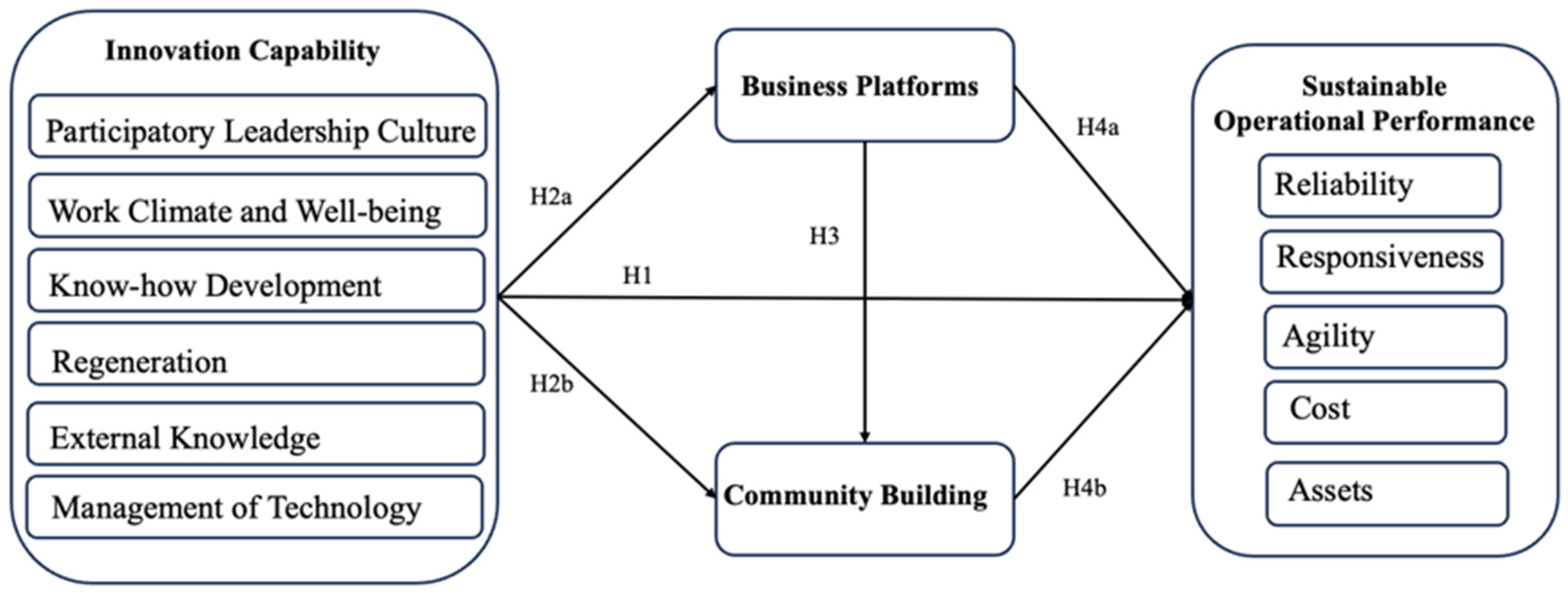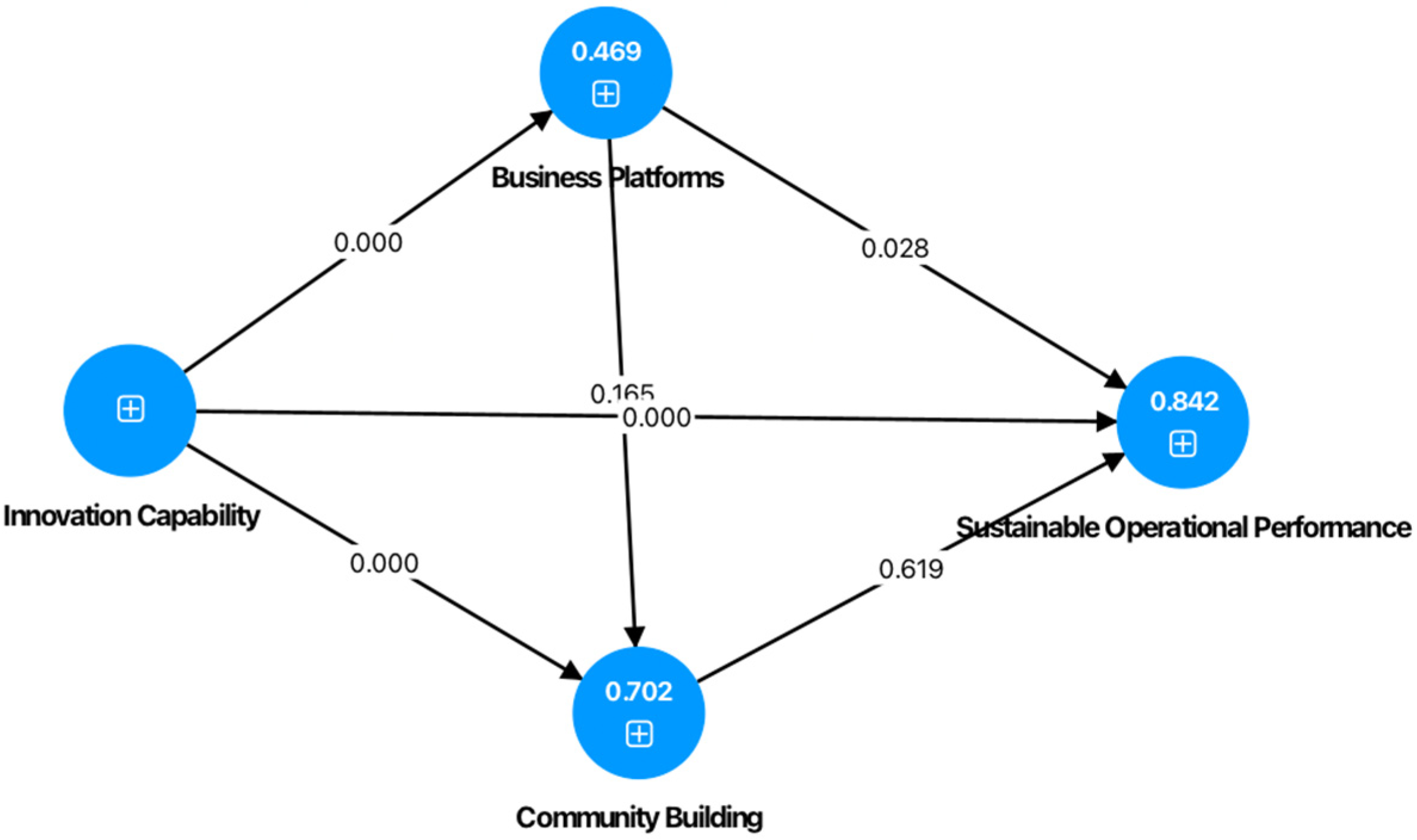

How Innovation Capability Drives Sustainable Operational Performance in Practices Within Alternative Food Networks: The Mediating Roles of Business Platforms and Community Building




Abstract
1. Introduction
2. Theoretical Background and Literature Review
2.1. Innovation Capability and Sustainable Operational Performance
2.2. Dynamic Capability Theory Perspective on Innovation Capability and Sustainable Operational Performance
2.3. Innovation Capability, Business Platforms, Community Building, and Sustainable Operational Performance
2.3.1. Innovation Capability and Business Platforms and Community Building
2.3.2. Business Platforms, Community Building and Sustainable Operational Performance
3. Method
3.1. Research Setting
3.2. Sampling and Data Collection
3.3. Measurement of Variables
3.3.1. Innovation Capability
3.3.2. Business Platforms
3.3.3. Community Building
3.3.4. Sustainable Operational Performance
4. Results and Analysis
4.1. Reliability and Validity
4.2. Common Method Bias Analysis
4.3. Hypothesis Testing
5. Discussion
5.1. Theoretical Implications
5.2. Managerial Implications
5.3. Limitations and Future Research
6. Conclusions
Author Contributions
Funding
Institutional Review Board Statement
Informed Consent Statement
Data Availability Statement
Conflicts of Interest
Appendix A. Survey Items and Confirmatory Factor Analysis Results

| Constructs and Items | Standardized Loading | |
|---|---|---|
| Innovation Capability Participatory Leadership Culture | ||
| Items | My firm ________ | |
| PCL1 | does not allow subordinates to participate in the product development process. ® | 0.950 |
| PCL2 | adopts the employees’ opinions, which could help the organization shape the innovation direction. | 0.954 |
| PCL3 | trusts that the leadership style is not merely instructive but open to collaboration. | 0.947 |
| PCL4 | considers that the leader shows support for critical ideas that aim to reform the organization. | 0.939 |
| Work Climate and Well-being (WCW) | ||
| Items | My firm________ | |
| WCW1 | trusts that integrity in working is significant for the organization. | 0.826 |
| WCW2 | considers competency in working is critical for the organization. | 0.908 |
| WCW3 | accept as true that reliability in working is not important for the organization. ® | 0.905 |
| WCW4 | have faith in that loyalty with work is significant for the organization. | 0.886 |
| Know-how Development (KHD) | ||
| Items | My firm ____________ | |
| KHD1 | thinks that the organization provides training to improve employees’ skills to understand customer’s situations. | 0.96 |
| KHD2 | gives training to improve employees’ skills to understand the emergence of new technologies. | 0.921 |
| KHD3 | never provides supplementary training to maximize employee potential. ® | 0.915 |
| KHD4 | accept as true that the organization defines success in terms of having the most innovative products and services. | 0.955 |
| KHD5 | is not a very dynamic and enterprising place. ® | 0.959 |
| Regeneration (REG) | ||
| Items | My firm ____________ | |
| REG1 | regularly assesses the effectiveness of business initiatives. | 0.846 |
| REG2 | implements changes based on the prior evaluation. | 0.818 |
| REG3 | believes that the manager never treats mistakes as a learning opportunity for employees. ® | 0.824 |
| REG4 | perceives innovation as essential. | 0.836 |
| External Knowledge (EK) | ||
| Items | My firm ____________ | |
| EK1 | collaborates with external parties. | 0.785 |
| EK2 | maintains a bad relationship with a partner with other organizations. ® | 0.767 |
| EK3 | has a good relationship with customers. | 0.743 |
| EK4 | has a bad relationship with industrial associations. ® | 0.178 |
| EK5 | has a good relationship with competitors. | 0.872 |
| Management of Technology (MT) | ||
| Items | My firm ____________ | |
| MT1 | anticipates technological needs in the future based on the development of products and market trends. | 0.975 |
| MT2 | conducts an assessment of technological needs. | 0.948 |
| MT3 | cannot create items with unique characteristics. ® | 0.943 |
| MT4 | believes that the rate at which new products are developed is adequate and competitive. | 0.936 |
| MT5 | is slower in adopting the most recent technological advancements. ® | 0.952 |
| Business Platform (BP) | ||
| Items | My firm____________ | |
| BP1 | tries to provide an online transaction process that has been re-engineered to support order manage-ment. | 0.977 |
| BP2 | is an organization where marketing policies are not shared online with consumers to support pro-motion policy management. ® | 0.944 |
| BP3 | is an organization that can provide order catalogs, which are shared online with consumers to support pricing and product launches. | 0.960 |
| BP4 | is an organization whose production schedules are not shared online with consumers to support order fulfilment. ® | 0.952 |
| BP5 | provides various online communication services to support interaction with customers. | 0.948 |
| Community Building (CB) | ||
| Items | The community building in my company is attained when ___________ | |
| CB1 | some characteristics of our company’s brand come to consumers’ minds quickly. | 0.938 |
| CB2 | our consumers would not recommend the product or service to others. ® | 0.879 |
| CB3 | in comparison to alternative brands, our products have consistent quality. | 0.930 |
| CB4 | consumers spoke of our company much more frequently than any other manufacturing company in the food industry. | 0.936 |
| CB5 | consumers are proud to say to others that they are our company’s customers. | 0.963 |
| Sustainable Operational Performance Reliability (REL) | ||
| Items | My company’s operations reliability for __________ | |
| REL1 | order entry accuracy has increased. | 0.957 |
| REL2 | forecast accuracy (demand, order, sales) has increased | 0.902 |
| REL3 | stock accuracy never increased ® | 0.927 |
| REL4 | warehouse efficiency has increased | 0.950 |
| REL5 | delivery accuracy (location and quantity) never increased. ® | 0.954 |
| Agility (AGI) | ||
| Items | My company’s operations agility to ________________ | |
| AGI1 | adapt to the new order in case the order deviates from the forecast in parallel with the changing demand (order flexibility) has increased. | 0.883 |
| AGI2 | deliver such as diversification of transport modes (transport flexibility) never increased. ® | 0.846 |
| AGI3 | align information systems architectures and systems with the organization’s changing information needs while responding to changing customer demand (information system flexibility) has increased. | 0.864 |
| AGI4 | detect and predict market changes (market flexibility) has increased. | 0.873 |
| AGI5 | deliver products to customers on time and respond quickly to changes in delivery requirements were not achieved. ® | 0.907 |
| Cost (COS) | ||
| Items | My company’s operations costs for ________________ | |
| COS1 | storage costs have been reduced. | 0.822 |
| COS2 | transport costs have increased. ® | 0.806 |
| COS3 | cost of goods sold (COGS) never decreased. ® | 0.849 |
| COS4 | reverse logistics costs have decreased. | 0.756 |
| COS5 | intangible costs (quality costs, product adaptation, performance costs coordination costs, etc.) never decreased. ® | 0.797 |
| Assets (ASS) | ||
| Items | My company’s operations efficiency for ____________ | |
| ASS1 | return on working capital has increased. | 0.966 |
| ASS2 | the cash conversion cycle (CCC) has increased. ® | 0.938 |
| ASS3 | supply chain revenue has increased. | 0.949 |
| ASS4 | the rate of recycling or reuse of materials has increased. | 0.928 |
| ASS5 | waste never decreased in the supply chain network. ® | 0.939 |
| Responsiveness (RES) | ||
| Items | My company’s operations responsiveness for _______. | |
| RES1 | warehouse cycle times (average receiving, placing, picking, preparing, and delivering) have decreased. | 0.871 |
| RES2 | transportation cycle time never decreased. ® | 0.898 |
| RES3 | production cycle time has decreased. | 0.917 |
| RES4 | order fulfillment cycle time has decreased. | 0.894 |
| RES5 | supply cycle time never decreased. ® | 0.908 |
References
- Si, Z.; Schumilas, T.; Scott, S. Characterizing alternative food networks in China. Agric. Hum. Values 2015, 32, 299–313. [Google Scholar] [CrossRef]
- Zwart, T.A.; Wertheim-Heck, S.C. Retailing local food through supermarkets: Cases from Belgium and the Netherlands. J. Clean. Prod. 2021, 300, 126948. [Google Scholar] [CrossRef]
- Li, Y.; Si, Z.; Miao, Y.; Zhou, L. How does the concept of Guanxi-circle contribute to community building in alternative food networks? Six case studies from China. Behav. Sci. 2022, 12, 432. [Google Scholar] [CrossRef]
- Zoll, F.; Specht, K.; Siebert, R. Alternative= transformative? Investigating drivers of transformation in alternative food networks in Germany. Sociol. Rural. 2021, 61, 638–659. [Google Scholar] [CrossRef]
- Brinkley, C. The small world of the alternative food network. Sustainability 2018, 10, 2921. [Google Scholar] [CrossRef]
- Kulick, R. More time in the kitchen, less time on the streets: The micropolitics of cultivating an ethic of care in alternative food networks. Local Environ. 2019, 24, 37–51. [Google Scholar] [CrossRef]
- Belda-Miquel, S. Expanding well-being by participating in grassroots innovations: Using the capability approach to explore the interest of alternative food networks for community social services. Br. J. Soc. Work. 2022, 52, 3618–3638. [Google Scholar] [CrossRef]
- Capitanio, F.; Coppola, A.; Pascucci, S. Indications for drivers of innovation in the food sector. Br. Food J. 2009, 111, 820–838. [Google Scholar] [CrossRef]
- Kafetzopoulos, D.; Vouzas, F.; Skalkos, D. Developing and validating an innovation drivers’ measurement instrument in the agri-food sector. Br. Food J. 2020, 122, 1199–1214. [Google Scholar] [CrossRef]
- Kafetzopoulos, D.; Skalkos, D. An audit of innovation drivers: Some empirical findings in Greek agri-food firms. Eur. J. Innov. Manag. 2019, 22, 361–382. [Google Scholar] [CrossRef]
- Xi, W.; Suhaiza, Z. Alternative food networks in supply Chains: A Biblio-metric analysis using RStudio and VOSViewer (1989–2024). Waste Manag. Bull. 2025, 3, 100215. [Google Scholar] [CrossRef]
- Teece, D.J. Explicating dynamic capabilities: The nature and microfoundations of (sustainable) enterprise performance. Strateg. Manag. J. 2007, 28, 1319–1350. [Google Scholar] [CrossRef]
- Teece, D.J. Business models and dynamic capabilities. Long Range Plan. 2018, 51, 40–49. [Google Scholar] [CrossRef]
- Rumanti, A.A.; Rizana, A.F.; Septiningrum, L.; Reynaldo, R.; Isnaini, M.M. Innovation capability and open innovation for small and medium enterprises (SMEs) performance: Response in dealing with the COVID-19 pandemic. Sustainability 2022, 14, 5874. [Google Scholar] [CrossRef]
- Tendall, D.; Joerin, J.; Kopainsky, B.; Edwards, P.; Shreck, A.; Le, Q.; Kruetli, P.; Grant, M.; Six, J. Food system resilience: Defining the concept. Glob. Food Secur. 2015, 6, 17–23. [Google Scholar] [CrossRef]
- Charatsari, C.; Michailidis, A.; Francescone, M.; De Rosa, M.; Aidonis, D.; Bartoli, L.; La Rocca, G.; Camanzi, L.; Lioutas, E.D. Do agricultural knowledge and innovation systems have the dynamic capabilities to guide the digital transition of short food supply chains? Information 2023, 15, 22. [Google Scholar] [CrossRef]
- Laginová, L.; Hrivnák, M.; Jarábková, J. Organizational Models of Alternative Food Networks within the Rural–Urban Interface. Adm. Sci. 2023, 13, 193. [Google Scholar] [CrossRef]
- Fainshtein, E.; Chkoniya, V.; Fiore, M.; Serova, E. An innovation potential and organizational performance: An integrative role of company’s dynamic capabilities. Agric. Food Econ. 2024, 12, 41. [Google Scholar] [CrossRef]
- Ribeiro, A.P.; Harmsen, R.; Feola, G.; Carréon, J.R.; Worrell, E. Organising alternative food networks (AFNs): Challenges and facilitating conditions of different AFN types in three EU countries. Sociol. Rural. 2021, 61, 491–517. [Google Scholar] [CrossRef]
- Hassanein, N. Practicing food democracy: A pragmatic politics of transformation. J. Rural. Stud. 2003, 19, 77–86. [Google Scholar] [CrossRef]
- Forno, F.; Paolo, R.G. Sustainable community movement organisations. J. Consum. Cult. 2014, 14, 139–157. [Google Scholar] [CrossRef]
- Wang, C.; Fu, Y.; Yin, Z. Platform-led or seller-led? Optimal ex ante information delivery strategy for online retail channels with product match uncertainty. Int. Trans. Oper. Res. 2024, 33, 1232–1268. [Google Scholar] [CrossRef]
- Vafaei-Zadeh, A.; Nikbin, D.; Danaraj, T.; Haniruzila, H. Internet of Things adoption and manufacturing firms’ performance: The role of innovation capabilities. J. Manuf. Technol. Manag. 2025, 36, 1215–1241. [Google Scholar] [CrossRef]
- Arshad, M.Z.; Arshad, D.; Lamsali, H.; Alshuaibi, A.S.I.; Alshuaibi, M.S.I.; Albashar, G.; Shakoor, A.; Chuah, L.F. Strategic resources alignment for sustainability: The impact of innovation capability and intellectual capital on SME’s performance. Moderating role of external environment. J. Clean. Prod. 2023, 417, 137884. [Google Scholar] [CrossRef]
- Iranmanesh, M.; Kumar, K.M.; Foroughi, B.; Mavi, R.K.; Min, N.H. The impacts of organizational structure on operational performance through innovation capability: Innovative culture as moderator. Rev. Manag. Sci. 2021, 15, 1885–1911. [Google Scholar] [CrossRef]
- Purwanto, U.S.; Kamaruddin, S.; Mohamad, N. The role of industrial clustering and manufacturing flexibility in achieving high innovation capability and operational performance in Indonesian manufacturing SMEs. Ind. Eng. Manag. Syst. 2015, 14, 236–247. [Google Scholar] [CrossRef]
- Nguyen, T.T.; Le-Anh, T.; Nguyen, T.X.H. Factors influencing innovation capability and operational performance: A case study of power generation fields in Vietnam. J. Asian Financ. Econ. Bus. 2022, 9, 541–552. [Google Scholar]
- Elrayah, M.; Keong, O.C. Moderating Effect of Green Technology Adoption on the Relationship of Sustainable Operations Practices and Sustainable Operational Performance. Oper. Res. Eng. Sci. Theory Appl. 2023, 6. [Google Scholar]
- Kafetzopoulos, D.; Psomas, E. The impact of innovation capability on the performance of manufacturing companies: The Greek case. J. Manuf. Technol. Manag. 2015, 26, 104–130. [Google Scholar] [CrossRef]
- Aziz, N.A.; Al Mamun, A.; Reza, M.N.H.; Naznen, F. The impact of big data analytics on innovation capability and sustainability performance of hotels: Evidence from an emerging economy. J. Enterp. Inf. Manag. 2024, 37, 1044–1068. [Google Scholar] [CrossRef]
- Ferreira, J.J.; Fernandes, C.I.; Alves, H.; Raposo, M.L. Drivers of innovation strategies: Testing the Tidd and Bessant (2009) model. J. Bus. Res. 2015, 68, 1395–1403. [Google Scholar] [CrossRef]
- Hu, B. Linking business models with technological innovation performance through organizational learning. Eur. Manag. J. 2014, 32, 587–595. [Google Scholar] [CrossRef]
- Kortmann, S.; Gelhard, C.; Zimmermann, C.; Piller, F.T. Linking strategic flexibility and operational efficiency: The mediating role of ambidextrous operational capabilities. J. Oper. Manag. 2014, 32, 475–490. [Google Scholar] [CrossRef]
- Leskovar-Spacapan, G.; Bastic, M. Differences in organizations’ innovation capability in transition economy: Internal aspect of the organizations’ strategic orientation. Technovation 2007, 27, 533–546. [Google Scholar] [CrossRef]
- Gupta, S.; Drave, V.A.; Dwivedi, Y.K.; Baabdullah, A.M.; Ismagilova, E. Achieving superior organizational performance via big data predictive analytics: A dynamic capability view. Ind. Mark. Manag. 2020, 90, 581–592. [Google Scholar] [CrossRef]
- Jin, C.; Liu, A.; Liu, H.; Gu, J.; Shao, M. How business model design drives innovation performance: The roles of product innovation capabilities and technological turbulence. Technol. Forecast. Soc. Change 2022, 178, 121591. [Google Scholar] [CrossRef]
- Chatterjee, S.; Chaudhuri, R. Supply chain sustainability during turbulent environment: Examining the role of firm capabilities and government regulation. Oper. Manag. Res. 2022, 15, 1081–1095. [Google Scholar] [CrossRef]
- Liu, A.; Liu, H.; Gu, J. Linking business model design and operational performance: The mediating role of supply chain integration. Ind. Mark. Manag. 2021, 96, 60–70. [Google Scholar] [CrossRef]
- Karna, A.; Richter, A.; Riesenkampff, E. Revisiting the role of the environment in the capabilities–financial performance relationship: A meta-analysis. Strateg. Manag. J. 2016, 37, 1154–1173. [Google Scholar] [CrossRef]
- Bekos, G.S.; Jaakkola, M.; Chari, S. Organizational agility and firm performance: The role of architectural marketing capabilities. Ind. Mark. Manag. 2025, 125, 239–253. [Google Scholar] [CrossRef]
- Nagy, G.; Jaakkola, M.; Koporcic, N. Complementarity versus substitutability of dynamic and operational capabilities in B2B firms: A configurational approach. Ind. Mark. Manag. 2019, 83, 42–58. [Google Scholar] [CrossRef]
- Coreynen, W.; Matthyssens, P.; Vanderstraeten, J.; van Witteloostuijn, A. Unravelling the internal and external drivers of digital servitization: A dynamic capabilities and contingency perspective on firm strategy. Ind. Mark. Manag. 2020, 89, 265–277. [Google Scholar] [CrossRef]
- Schilke, O.; Hu, S.; Helfat, C.E. Quo vadis, dynamic capabilities? A content-analytic review of the current state of knowledge and recommendations for future research. Acad. Manag. Ann. 2018, 12, 390–439. [Google Scholar] [CrossRef]
- Mikalef, P.; Boura, M.; Lekakos, G.; Krogstie, J. Big data analytics capabilities and innovation: The mediating role of dynamic capabilities and moderating effect of the environment. Br. J. Manag. 2019, 30, 272–298. [Google Scholar] [CrossRef]
- Winter, S.G. Understanding dynamic capabilities. Strateg. Manag. J. 2003, 24, 991–995. [Google Scholar] [CrossRef]
- Massa, L.; Tucci, C.L.; Afuah, A. A critical assessment of business model research. Acad. Manag. Ann. 2017, 11, 73–104. [Google Scholar] [CrossRef]
- Rumanti, A.A.; Wiratmadja, I.I.; Hidayat, T.P. Analysis individual tacit knowledge toward innovation. In 2012 IEEE International Conference on Industrial Engineering and Engineering Management; IEEE: Piscataway, NJ, USA, 2012; pp. 694–697. [Google Scholar]
- Serrano-Bedia, A.M.; López-Fernández, M.C.; Garcia-Piqueres, G. Analysis of the relationship between sources of knowledge and innovation performance in family firms. Innovation 2016, 18, 489–512. [Google Scholar] [CrossRef]
- Boer, H.; Gertsen, F. From continuous improvement to continuous innovation: A (retro)(per) spective. Int. J. Technol. Manag. 2003, 26, 805–827. [Google Scholar] [CrossRef]
- Ukko, J.; Saunila, M.; Parjanen, S.; Rantala, T.; Salminen, J.; Pekkola, S.; Mäkimattila, M. Effectiveness of innovation capability development methods. Innovation 2016, 18, 513–535. [Google Scholar] [CrossRef]
- Vaitoonkiat, E.; Charoensukmongkol, P. Interaction effect of entrepreneurial orientation and stakeholder orientation on the business performance of firms in the steel fabrication industry in Thailand. J. Entrep. Emerg. Econ. 2020, 12, 453–473. [Google Scholar] [CrossRef]
- Rosol, M.; Barbosa, R., Jr. Moving beyond direct marketing with new mediated models: Evolution of or departure from alternative food networks? Agric. Hum. Values 2021, 38, 1021–1039. [Google Scholar] [CrossRef]
- Cenamor, J.; Parida, V.; Wincent, J. How entrepreneurial SMEs compete through digital platforms: The roles of digital platform capability, network capability and ambidexterity. J. Bus. Res. 2019, 100, 196–206. [Google Scholar] [CrossRef]
- Lee, S.; Park, G.; Yoon, B.; Park, J. Open innovation in SMEs—An intermediated network model. Res. Policy 2010, 39, 290–300. [Google Scholar] [CrossRef]
- Chun, F.; Samiha, B.; Noureddine, D. Evolution of sustainable development strategies in Chinese SMEs. Int. J. Sci. Environ. Technol. 2014, 3, 698–707. [Google Scholar]
- Xu, X.; He, P.; Zhou, L.; Cheng, T.C.E. Coordination of a platform-based supply chain in the marketplace or reselling mode considering cross-channel effect and blockchain technology. Eur. J. Oper. Res. 2023, 309, 170–187. [Google Scholar] [CrossRef]
- Li, Y.; Xiong, Y.; Zhou, Y. Dynamic pricing strategies: Uniform or discrimination for multi-channel retailing under platform-based supply chain competition. J. Bus. Res. 2023, 166, 114087. [Google Scholar] [CrossRef]
- Menguc, B.; Auh, S. Development and return on execution of product innovation capabilities: The role of organizational structure. Ind. Mark. Manag. 2010, 39, 820–831. [Google Scholar] [CrossRef]
- Varadarajan, R. Fortune at the bottom of the innovation pyramid: The strategic logic of incremental innovations. Bus. Horiz. 2009, 52, 21–29. [Google Scholar] [CrossRef]
- Anseel, F.; Lievens, F.; Schollaert, E.; Choragwicka, B. Response rates in organizational science, 1995–2008: A meta-analytic review and guidelines for survey researchers. J. Bus. Psychol. 2010, 25, 335–349. [Google Scholar] [CrossRef]
- Cycyota, C.S.; Harrison, D.A. What (not) to expect when surveying executives: A meta-analysis of top manager response rates and techniques over time. Organ. Res. Methods 2006, 9, 133–160. [Google Scholar] [CrossRef]
- Abd, I.M.; Zuhairi, M.M.K.; Kamil, G.H. The mediating role of the participatory leadership style on the effect of job stress on job performance. J. Appl. Bus. Technol. 2023, 4, 260–270. [Google Scholar] [CrossRef]
- Minna, S. Innovation capability in achieving higher performance: Perspectives of management and employees. Technol. Anal. Strateg. Manag. 2017, 29, 903–916. [Google Scholar]
- Acevedo, J.; Diaz-Molina, I. Learning organizations in emerging economies: The effect of knowledge management on innovative culture in Chilean companies. Learn. Organ. 2023, 30, 37–54. [Google Scholar] [CrossRef]
- Khan, M.T.; Idrees, M.D.; Rauf, M.; Sami, A.; Ansari, A.; Jamil, A. Green supply chain management practices’ impact on operational performance with the mediation of technological innovation. Sustainability 2022, 14, 3362. [Google Scholar] [CrossRef]
- Oh, L.; Teo, H.; Sambamurthy, V. The effects of retail channel integration through the use of information technologies on firm performance. J. Oper. Manag. 2012, 30, 368–381. [Google Scholar] [CrossRef]
- Mishra, A.N.; Konana, P.; Barua, A. Antecedents and consequences of internet use in procurement: An empirical investigation of US manufacturing firms. Inf. Syst. Res. 2007, 18, 103–120. [Google Scholar] [CrossRef]
- Eng, T.-Y. E-customer service capability and value creation. Serv. Ind. J. 2008, 28, 1293–1306. [Google Scholar] [CrossRef]
- Park, J.-A.; Sung, J.-M.; Son, J.-M.; Na, K.; Kim, S.-K. Athletes’ brand equity, spectator satisfaction, and behavioral intentions. Asia Pac. J. Mark. Logist. 2019, 31, 541–558. [Google Scholar] [CrossRef]
- Aaker, D.A. Measuring brand equity across products and markets. Calif. Manag. Rev. 1996, 38. [Google Scholar] [CrossRef]
- Goyette, I.; Ricard, L.; Bergeron, J.; Marticotte, F. e-WOM Scale: Word-of-mouth measurement scale for e-services context. Can. J. Adm. Sci. Rev. Can. Sci. 2010, 27, 5–23. [Google Scholar] [CrossRef]
- Husnain, M.; Toor, A. The impact of social network marketing on consumer purchase intention in Pakistan: Consumer engagement as a mediator. Asian J. Bus. Account. 2017, 10, 167–199. [Google Scholar]
- Özkanlısoy, Ö.; Bulutlar, F. Measuring supply chain performance as SCOR v13. 0-based in disruptive technology era: Scale development and validation. Logistics 2023, 7, 65. [Google Scholar] [CrossRef]
- Xie, Y.; Yin, Y.; Xue, W.; Shi, H.; Chong, D. Intelligent supply chain performance measurement in Industry 4.0. Syst. Res. Behav. Sci. 2020, 37, 711–718. [Google Scholar] [CrossRef]
- Van Geest, M.; Tekinerdogan, B.; Catal, C. Design of a reference architecture for developing smart warehouses in industry 4.0. Comput. Ind. 2021, 124, 103343. [Google Scholar] [CrossRef]
- Özkanlısoy, Ö.; Akkartal, E. Digital transformation in supply chains: Current applications, contributions and challenges. Bus. Manag. Stud. Int. J. 2021, 9, 32–55. [Google Scholar] [CrossRef]
- Chan, F.T.S. Performance measurement in a supply chain. Int. J. Adv. Manuf. Technol. 2003, 21, 534–548. [Google Scholar] [CrossRef]
- Naslund, D.; Williamson, S. What is management in supply chain management?—A critical review of definitions, frameworks and terminology. J. Manag. Policy Pract. 2010, 11, 11–28. [Google Scholar]
- Zhang, M.; Tse, Y.K.; Doherty, B.; Li, S.; Akhtar, P. Sustainable supply chain management: Confirmation of a higher-order model. Resour. Conserv. Recycl. 2018, 128, 206–221. [Google Scholar] [CrossRef]
- Bag, S.; Wood, L.C.; Xu, L.; Dhamija, P.; Kayikci, Y. Big data analytics as an operational excellence approach to enhance sustainable supply chain performance. Resour. Conserv. Recycl. 2020, 153, 104559. [Google Scholar] [CrossRef]
- Habib, A.; Bao, Y.; Nabi, N.; Dulal, M.; Asha, A.A.; Islam, M. Impact of strategic orientations on the implementation of green supply chain management practices and sustainable firm performance. Sustainability 2021, 13, 340. [Google Scholar] [CrossRef]
- Thonemann, U.W.; James, R.B. The effect of product variety on supply-chain performance. Eur. J. Oper. Res. 2002, 143, 548–569. [Google Scholar] [CrossRef]
- Dev, N.K.; Shankar, R.; Qaiser, F.H. Industry 4.0 and circular economy: Operational excellence for sustainable reverse supply chain performance. Resour. Conserv. Recycl. 2020, 153, 104583. [Google Scholar] [CrossRef]
- Liu, H.; Wei, S.; Ke, W.; Wei, K.K.; Hua, Z. The configuration between supply chain integration and information technology competency: A resource orchestration perspective. J. Oper. Manag. 2016, 44, 13–29. [Google Scholar] [CrossRef]
- Henseler, J.; Christian, M.R.; Sarstedt, M. A new criterion for assessing discriminant validity in variance-based structural equation modeling. J. Acad. Mark. Sci. 2015, 43, 115–135. [Google Scholar] [CrossRef]
- Hair, J.F., Jr.; Lucy, M.M.; Ryan, L.M.; Sarstedt, M. PLS-SEM or CB-SEM: Updated guidelines on which method to use. Int. J. Multivar. Data Anal. 2017, 1, 107–123. [Google Scholar] [CrossRef]
- Claude, M. Methodological issues in new institutional economics. J. Econ. Methodol. 2001, 8, 85–92. [Google Scholar] [CrossRef]
- Javid, S. An Introduction to Statistical Learning with Applications in R; Springer: New York, NY, USA, 2021. [Google Scholar]
- Hair, J.F.; Christian, M.R.; Sarstedt, M. PLS-SEM: Indeed a silver bullet. J. Mark. Theory Pract. 2011, 19, 139–152. [Google Scholar] [CrossRef]
- Hair, J.; Joe, F.; Sarstedt, M.; Lucy, M.M.; Christian, M.R. Identifying and treating unobserved heterogeneity with FIMIX-PLS: Part I–method. Eur. Bus. Rev. 2016, 28, 63–76. [Google Scholar] [CrossRef]
- Kanuk, L.; Berenson, C. Mail surveys and response rates: A literature review. J. Mark. Res. 1975, 12, 440–453. [Google Scholar] [CrossRef]
- Podsakoff, P.M.; Scott, B.; MacKenzie, J.L.; Nathan, P.P. Common method biases in behavioral research: A critical review of the literature and recommended remedies. J. Appl. Psychol. 2003, 88, 879. [Google Scholar] [CrossRef]
- Becker, S.P.; Willcutt, E.G.; Leopold, D.R.; Fredrick, J.W.; Smith, Z.R.; Jacobson, L.A.; Burns, G.L.; Mayes, S.D.; Waschbusch, D.A.; Froehlich, T.E.; et al. Report of a work group on sluggish cognitive tempo: Key research directions and a consensus change in terminology to cognitive disengagement syndrome. J. Am. Acad. Child Adolesc. Psychiatry 2023, 62, 629–645. [Google Scholar] [CrossRef]
- Gefen, D.; Straub, D. A practical guide to factorial validity using PLS-Graph: Tutorial and annotated example. Commun. Assoc. Inf. Syst. 2005, 16, 5. [Google Scholar] [CrossRef]
- Falk, R.; Frank, N.B.M. A Primer for Soft Modeling; University of Akron Press: Akron, OH, USA, 1992. [Google Scholar]
- Chin, W.W. The partial least squares approach to structural equation modeling. In Modern Methods for Business Research; Psychology Press: Oxfordshire, UK, 1998; pp. 295–336. [Google Scholar]
- Sutherland, W.; Jarrahi, M.H. The sharing economy and digital platforms: A review and research agenda. Int. J. Inf. Manag. 2018, 43, 328–341. [Google Scholar] [CrossRef]
- Coombes, P.H.; John, D.N. Business models and their relationship with marketing: A systematic literature review. Ind. Mark. Manag. 2013, 42, 656–664. [Google Scholar] [CrossRef]
- Kim, S.K.; Min, S. Business model innovation performance: When does adding a new business model benefit an incumbent? Strateg. Entrep. J. 2015, 9, 34–57. [Google Scholar] [CrossRef]
- Aspara, J.; Hietanen, J.; Tikkanen, H. Business model innovation vs replication: Financial performance implications of strategic emphases. J. Strateg. Mark. 2010, 18, 39–56. [Google Scholar] [CrossRef]
- Kastalli, I.V.; Van Looy, B. Servitization: Disentangling the impact of service business model innovation on manufacturing firm performance. J. Oper. Manag. 2013, 31, 169–180. [Google Scholar] [CrossRef]
- Forssell, S.; Lankoski, L. The sustainability promise of alternative food networks: An examination through alternative characteristics. Agric. Hum. Values 2015, 32, 63–75. [Google Scholar] [CrossRef]
- Teece, D.J. Achieving integration of the business school curriculum using the dynamic capabilities framework. J. Manag. Dev. 2011, 30, 499–518. [Google Scholar] [CrossRef]
- Cillo, V.; Rialti, R.; Bertoldi, B.; Ciampi, F. Knowledge management and open innovation in agri-food crowdfunding. Br. Food J. 2019, 121, 242–258. [Google Scholar] [CrossRef]
- Chen, Y.-S.; Lin, M.-J.J.; Chang, C.-H. The positive effects of relationship learning and absorptive capacity on innovation performance and competitive advantage in industrial markets. Ind. Mark. Manag. 2009, 38, 152–158. [Google Scholar] [CrossRef]
- Gunday, G.; Ulusoy, G.; Kilic, K.; Alpkan, L. Effects of innovation types on firm performance. Int. J. Prod. Econ. 2011, 133, 662–676. [Google Scholar] [CrossRef]
- Daniel, E.M.; Hugh, N.W. The role of dynamic capabilities in e-business transformation. Eur. J. Inf. Syst. 2003, 12, 282–296. [Google Scholar] [CrossRef]
- Astrid Heidemann, L.; Larsen, M.S.S. Manufacturing innovation for Industry 4.0: An innovation capability perspective. J. Manuf. Technol. Manag. 2024, 36, 19–44. [Google Scholar] [CrossRef]
- Zhang, Y.; Ma, X.; Pang, J.; Xing, H.; Wang, J. The impact of digital transformation of manufacturing on corporate performance—The mediating effect of business model innovation and the moderating effect of innovation capability. Res. Int. Bus. Financ. 2023, 64, 101890. [Google Scholar] [CrossRef]
- Hong, Z.; Zhang, Q.; Xu, X.; Lyu, Z. Competition and cooperation in a platform-based business ecosystem within complementary partners. Int. J. Prod. Econ. 2024, 275, 109337. [Google Scholar] [CrossRef]
- Levidow, L.; Berardi, A.; Jung, J. How does community food growing build community bonds? Insights from grassroots visual storytelling. Local Environ. 2024, 29, 1–20. [Google Scholar] [CrossRef]
- Li, D.; Jose, M.C. Multiperiod supply chain network dynamics under investment in sustainability, externality cost, and consumers’ willingness to pay. Int. J. Prod. Econ. 2022, 247, 108441. [Google Scholar] [CrossRef]
- Xue, J.; Liu, J.; Geng, Z.; Yuan, H.; Chao, L. Why and when do paradoxical management capabilities matter to paradoxical pressure? An empirical investigation of the role of coopetition. Technovation 2023, 120, 102682. [Google Scholar] [CrossRef]


| Dimension | Indicator | Response (276) Frequency | Percentage (%) |
|---|---|---|---|
| Main Activities in Business | Fruit and vegetable processing | 186 | 67.4 |
| Jam, jelly, and preserve | 76 | 27.5 | |
| Sauce and condiment | 102 | 37.0 | |
| Pickling and fermentation | 46 | 16.7 | |
| Frozen food | 139 | 50.4 | |
| Specialty food | 36 | 13.0 | |
| Organic and natural food brands | 36 | 13.0 | |
| Dried fruit and nuts | 15 | 5.4 | |
| Juice and beverage | 77 | 27.9 | |
| Culinary and artisanal food | 87 | 31.5 | |
| Private label and contract manufacturers | 23 | 8.3 | |
| Firm Age | <5 years | 6 | 2.2 |
| 6–10 years | 20 | 7.2 | |
| 11–20 years | 65 | 23.6 | |
| 21–30 years | 113 | 40.9 | |
| >30 years | 72 | 26.1 | |
| Employee Size | <50 | 5 | 1.8 |
| 51–100 | 23 | 8.3 | |
| 101–500 | 71 | 25.7 | |
| 501–1000 | 47 | 17.0 | |
| >1000 | 130 | 47.1 | |
| Annual Revenue (RMB) | <30,000,000 | 2 | 0.7 |
| 30,000,001–50,000,000 | 23 | 8.3 | |
| 50,000,001–100,000,000 | 61 | 22.1 | |
| >100,000,000 | 190 | 68.8 | |
| Ownership Status | State-owned | 52 | 18.8 |
| Private | 203 | 73.6 | |
| Foreign invested | 15 | 5.4 | |
| Shareholding | 6 | 2.2 | |
| Firm Location | North China | 23 | 8.3 |
| East China | 107 | 38.8 | |
| Central China | 26 | 9.4 | |
| South China | 54 | 19.6 | |
| Southwest | 24 | 8.7 | |
| Northeast | 24 | 8.7 | |
| Northwest | 18 | 6.5 |
| First-Order Construct | Second-Order Construct | Cronbach α | CR (rho_c) | AVE |
|---|---|---|---|---|
| PLC | Food Innovation Capability | 0.981 | 0.984 | 0.896 |
| WCW | 0.945 | 0.955 | 0.752 | |
| KHD | 0.975 | 0.980 | 0.889 | |
| REG | 0.922 | 0.933 | 0.667 | |
| EK | 0.814 | 0.877 | 0.641 | |
| MT | 0.980 | 0.983 | 0.891 | |
| BP | 0.982 | 0.985 | 0.903 | |
| CB | 0.976 | 0.979 | 0.856 | |
| REL | Operational Performance | 0.972 | 0.977 | 0.858 |
| RES | 0.950 | 0.959 | 0.771 | |
| AGI | 0.942 | 0.950 | 0.734 | |
| COS | 0.905 | 0.927 | 0.680 | |
| ASS | 0.979 | 0.982 | 0.889 |
| AGI | ASS | BP | COS | CB | EK | KHD | MT | PLC | REG | REL | RES | WCW | |
|---|---|---|---|---|---|---|---|---|---|---|---|---|---|
| AGI | |||||||||||||
| ASS | 0.319 | ||||||||||||
| BP | 0.4 | 0.68 | |||||||||||
| COS | 0.381 | 0.624 | 0.495 | ||||||||||
| CB | 0.389 | 0.66 | 0.542 | 0.643 | |||||||||
| EK | 0.256 | 0.537 | 0.522 | 0.714 | 0.7 | ||||||||
| KHD | 0.397 | 0.636 | 0.589 | 0.654 | 0.812 | 0.769 | |||||||
| MT | 0.3 | 0.83 | 0.698 | 0.534 | 0.662 | 0.611 | 0.65 | ||||||
| PLC | 0.271 | 0.848 | 0.638 | 0.502 | 0.795 | 0.555 | 0.651 | 0.848 | |||||
| REG | 0.738 | 0.331 | 0.203 | 0.343 | 0.421 | 0.312 | 0.438 | 0.347 | 0.359 | ||||
| REL | 0.393 | 0.772 | 0.559 | 0.743 | 0.82 | 0.735 | 0.828 | 0.675 | 0.678 | 0.453 | |||
| RES | 0.258 | 0.629 | 0.559 | 0.62 | 0.563 | 0.552 | 0.563 | 0.576 | 0.551 | 0.194 | 0.651 | ||
| WCW | 0.176 | 0.782 | 0.533 | 0.578 | 0.576 | 0.476 | 0.603 | 0.642 | 0.623 | 0.159 | 0.685 | 0.829 |
| High Order Constructs | Low Order Constructs | VIF |
|---|---|---|
| Sustainable Operational Performance (SCOR model) | Reliability | 4.554 |
| Responsiveness | 2.080 | |
| Agility | 1.380 | |
| Cost | 2.209 | |
| Assets | 4.684 |
| Path Coefficients | Std.Bate | Dtd. Dev | T-Statistics | p-Value | Decision | |
|---|---|---|---|---|---|---|
| H1 | IC → -> SOP | 0.801 | 0.075 | 10.673 | 0.000 | Supported |
| H2a | IC → BP | 0.685 | 0.059 | 11.658 | 0.000 | Supported |
| H2b | IC → CB | 0.888 | 0.050 | 17.885 | 0.000 | Supported |
| H3 | BP → CB | −0.076 | 0.055 | 1.389 | 0.165 | Not Supported |
| H4a | BP → SOP | 0.110 | 0.050 | 2.203 | 0.028 | Supported |
| H4b | CB → SOP | 0.045 | 0.091 | 0.497 | 0.619 | Not Supported |
| Path Coefficients | Std.Bate | Dtd.Dev | Tstatistics | p-Value | Decision | |
|---|---|---|---|---|---|---|
| H5a | IC → BP → SOP | 0.075 | 0.037 | 2.038 | 0.042 | Supported |
| H5b | IC → BP → CB | −0.052 | 0.040 | 1.315 | 0.188 | Not Supported |
| H5c | IC → CB → SOP | 0.040 | 0.081 | 0.495 | 0.620 | Not Supported |
| H5d | BP → CB → SOP | −0.003 | 0.009 | 0.392 | 0.695 | Not Supported |
| Constructs | R2 | Q2 | ||
|---|---|---|---|---|
| Business Platforms | 0.469 > 0.25 | Weak | 0.46 > 0.35 | Large |
| Community Building | 0.702 > 0.5 | Moderate | 0.698 > 0.35 | Large |
| Sustainable Operational Performance | 0.842 > 0.5 | Moderate | 0.825 > 0.35 | Large |
Disclaimer/Publisher’s Note: The statements, opinions and data contained in all publications are solely those of the individual author(s) and contributor(s) and not of MDPI and/or the editor(s). MDPI and/or the editor(s) disclaim responsibility for any injury to people or property resulting from any ideas, methods, instructions or products referred to in the content. |
© 2025 by the authors. Licensee MDPI, Basel, Switzerland. This article is an open access article distributed under the terms and conditions of the Creative Commons Attribution (CC BY) license.
Share and Cite
Wang, X.; Yang, X.; Zailani, S.; Rejeb, A. How Innovation Capability Drives Sustainable Operational Performance in Practices Within Alternative Food Networks: The Mediating Roles of Business Platforms and Community Building. Sustainability 2026, 18, 305. https://doi.org/10.3390/su18010305
Wang X, Yang X, Zailani S, Rejeb A. How Innovation Capability Drives Sustainable Operational Performance in Practices Within Alternative Food Networks: The Mediating Roles of Business Platforms and Community Building. Sustainability. 2026; 18(1):305. https://doi.org/10.3390/su18010305
Chicago/Turabian StyleWang, Xi, Xia Yang, Suhaiza Zailani, and Abderahman Rejeb. 2026. "How Innovation Capability Drives Sustainable Operational Performance in Practices Within Alternative Food Networks: The Mediating Roles of Business Platforms and Community Building" Sustainability 18, no. 1: 305. https://doi.org/10.3390/su18010305
APA StyleWang, X., Yang, X., Zailani, S., & Rejeb, A. (2026). How Innovation Capability Drives Sustainable Operational Performance in Practices Within Alternative Food Networks: The Mediating Roles of Business Platforms and Community Building. Sustainability, 18(1), 305. https://doi.org/10.3390/su18010305