Article

Sustainability Assessment of Austrian Dairy Farms Using the Tool NEU.rind: Identifying Farm-Specific Benchmarks and Recommendations, Farm Typologies and Trade-Offs


by
Stefan Josef Hörtenhuber
1,*,
Caspar Matzhold
2,3,
Markus Herndl
4,
Franz Steininger
2,
Kristina Linke
2,
Sebastian Wieser
4 and
Christa Egger-Danner
2
1
Institute of Livestock Sciences, BOKU University, Gregor-Mendel-Straße 33/II, 1180 Vienna, Austria
2
ZuchtData EDV-Dienstleistungen GmbH, Dresdner Straße 89, 1200 Vienna, Austria
3
Complexity Science Hub, Metternichgasse 8, 1030 Vienna, Austria
4
HBLFA Raumberg-Gumpenstein, Raumberg 38, 8952 Irdning-Donnersbachtal, Austria
*
Author to whom correspondence should be addressed.
Sustainability 2026, 18(1), 303; https://doi.org/10.3390/su18010303 (registering DOI)
Submission received: 8 October 2025 / Revised: 5 December 2025 / Accepted: 24 December 2025 / Published: 27 December 2025

Abstract

The sustainable future of dairy farming will depend on how trade-offs between environmental impact, economic viability, and animal welfare are managed. Dairy production contributes significantly not only to human nutrition but also to greenhouse gas (GHG) emissions, ammonia release, and water pollution. Comprehensive sustainability assessments are essential for addressing these impacts, also in light of evolving regulations like the EU Corporate Sustainability Reporting Directive. However, existing research on sustainable dairy farming and intensification often overlooks trade-offs with other ecological aspects like biodiversity, economic viability, or animal welfare. This study evaluated the sustainability performance of Austrian dairy farms using a tool called NEU.rind, which combines life cycle assessment (LCA) with other indicators. Applied to 170 dairy farms, the tool identified four sustainability clusters across the dimensions of environmental conditions, efficiency, animal health, and sustainability: (1) Alpine farms (high cow longevity, medium-to-high emissions per kg milk), (2) efficient low-input farms (low emissions, high cow longevity), (3) high-output lowland farms (high productivity, lower animal welfare), and (4) input-intensive lowland farms (high emissions, especially per hectare; inefficient use of resources). The analysis revealed fundamental trade-offs between production intensity, environmental impact, and animal welfare, particularly when comparing product-based (per kg milk) versus hectare-based indicators. Key improvement strategies include increasing the use of regional feed and pasture as well as adapting manure management. For policymakers, these findings underline the importance of site-specific sustainability assessments and the need for region-specific incentive schemes that reward both environmental efficiency and animal health performance. In this context, NEU.rind provides farm-specific recommendations with minimal data input, making sustainability assessments practical and feasible.

1. Introduction

Due to their high-quality protein and other nutrients, cattle, particularly dairy cows, play a significant role in human nutrition: Their milk is an important and valuable food for human nutrition, representing an excellent source of both macronutrients (proteins, carbohydrates, fat) and micronutrients (minerals and vitamins) [1,2]. However, (cow) milk production is also associated with various environmental issues and accounts for 4% of total GHG emissions, measured in terms of the Global Warming Potential (GWP100), mainly due to methane (CH4) and nitrous oxide (N2O) emissions [3]. Additionally, dairy farming affects air quality, mainly through ammonia (NH3) emissions, and water quality through nutrient leaching, run-off, and erosion, including nitrates (NO3) and phosphates [4,5].
Mitigation strategies for reducing these impacts include improving dairy herd fertility, modifying diets, and optimising the use of fertilisers, such as through optimised slurry applications [4,6,7]. Such measures target key emission sources, e.g., enteric CH4 from rumen fermentation, CH4, N2O and NH3 from manure and its use as fertiliser, and ammonia volatilisation. Combining approaches that link feeding, housing, and manure handling practices is particularly effective and may offer synergies between emission reduction and resource efficiency [7]. Some studies used model farms to gain a better understanding of the systems [7]. However, little is known about how the most important sustainability trade-offs and synergies related to specific practices perform in real-world settings in European dairy production systems. With regard to Austrian dairy farming, the eco-efficiency of organic versus conventional farms as well as the environmental impacts of low-input farms have been analysed [8,9].
LCA has been extensively used to assess the environmental impacts of agricultural and livestock production, including dairy farms. Indicators that are most often evaluated include GHG emissions, fossil energy use, land occupation, and emissions contributing to acidification and eutrophication. Studies conducted in Europe or the USA have often applied LCA to determine the environmental footprints of dairy production. However, although LCA provides robust results for some impacts, a common limitation of such detailed assessments is their narrow focus on a few environmental impacts, such as especially the GWP, overlooking other crucial sustainability risks. These include biodiversity loss, soil health, animal welfare, and socio-economic resilience, which are difficult to capture within conventional LCA system boundaries and functional units [10,11,12,13,14].
An accurate and comprehensive sustainability assessment is essential for improving farm management and complying with new regulatory frameworks, such as the Corporate Sustainability Reporting Directive (CSRD; https://eur-lex.europa.eu/legal-content/EN/ALL/?uri=CELEX:32022L2464, accessed on 5 December 2025) and Product Environmental Footprints [15]. Research on ‘sustainable development’ or ‘sustainable intensification’ in dairy farming often focuses on reducing GHG but has not sufficiently explored the potential trade-offs and synergies with other sustainability aspects. There are some insights into the trade-offs with animal health [16], economic performance of farms [17], biodiversity conservation [18], or the feed-food-conflict [19,20]. However, clear pathways that guide dairy farms towards win-win situations within planetary boundaries [21], using LCAs and assessment methods for a comprehensive sustainability view, are still lacking.
Some tools for assessing impacts of dairy farming apply LCA-based approaches but are limited in their scope of impact indicators, often focusing on GWP. Examples include the Danish ARLA tool [22] and the German LfL Klimarechner [23], the latter combining farm economics (gross margin) with carbon footprinting. Other tools such as the ANCA tool [24] and the Irish sustainability measurement platform AgNav [25] cover a broader range of ecological aspects, including nutrient flows, ammonia and GHG emissions, but are still limited to the environmental dimension. Several other tools have been developed to evaluate dairy farms more comprehensively. For instance, Paçarada et al. [26] discuss tools such as SAFA and SMART, which offer multidimensional sustainability assessments that extend beyond the farm gate. These tools offer a comprehensive approach but lack full quantification, limiting their ability to identify specific measures and improvement potentials. While qualitative analyses are valuable in addressing certain details, quantitative evaluations are essential to address trade-offs between indicators and to classify the effects of measures for optimisation and conflict resolution. Some tools like ‘MOTIFS’ [27] and others described in [28] apply a mixed-method approach that combines quantitative LCA indicators with semi-quantitative indicators to integrate sustainability aspects across multiple dimensions—ecological, economic, social, animal health and welfare—within one single analysis. Similar approaches have been applied in other livestock sectors, for instance, pig farming [29], incorporating additional sustainability aspects related to biodiversity, economic resilience, workplace safety, and ethical concerns, including animal health and welfare, and the feed-food conflict. An effective tool should provide a comprehensive but sufficiently quantitative set of sustainability indicators while minimising data collection demands to ensure broad acceptance [30]. Additionally, it should enable the simulation of farm scenarios and generate optimisation recommendations [31]. Integration into established data management systems enhances user-friendliness while supporting third-party verification for potential certification purposes.
The aims of this study are (i) to evaluate the sustainability performance of Austrian dairy farms using the Digital Farm Assistant NEU.rind. This web-based tool integrates a comprehensive set of indicators including LCA approaches. Its theoretical framework is based on the concept of multidimensional sustainability assessment, linking environmental, economic, and animal-welfare dimensions via measurable indicators and data-driven analysis. Applied in a case study with future-oriented dairy farms in Austria, this approach (ii) enables the identification of trade-offs and synergies between sustainability goals, which are essential for guiding both farm management and policy design. The tool and this study address important real-world challenges in sustainable dairy farming, offering practical and policy-relevant insights. By identifying patterns in these data using statistical and machine-learning approaches, the study seeks to offer insights to propose more sustainable pathways for the dairy sector.

2. Materials and Methods

Applying the NEU.rind tool, important sustainability aspects of dairy production systems were evaluated using a set of aggregated indicators at farm level. The set of indicators (Table 1) was selected by project stakeholders during the method development phase from a list of 15 candidate indicators compiled by the research team. This selection of indicators also took into account the availability of existing data and the effort required from farmers to collect additional data. Selected indicators covered environmental impacts (e.g., GWP, fossil energy demand, biodiversity aspects), animal health issues, and economic outcomes (costs, revenues, and gross margins). An overview of the main indicators, ranked by their importance as assessed by a group of potential users and stakeholders (farmers, dairy consultants and managers, agricultural advisors), is provided in Table 1.
The NEU.rind tool uses LCA methodologies to evaluate impacts of farm-level dairy units across the functional units ‘kg of energy corrected milk’ (considering the co-products beef and sold cattle) and ‘hectare of farmland related to milk production’ (land for feed production or land related to the dairy unit via manure application). For some additional figures, the tool also uses key performance indicators (KPIs), partially per ‘cow and year’ or at farm-level. Further details on the methods are provided in [32].

2.1. LCA Core Module

Analysis was based on the LCA Core Module of the NEU.rind tool, programmed using APEX (Oracle Cooperation, version 24.2.2). The module focused on calculating various environmental impacts, including GWP100, both over a 100-year time frame and with characterisation factors from [33], which are currently used in national inventories. One aim in developing the method was to align it as closely as possible with the national (Austrian) inventory method [34] and other relevant guidelines for milk production, e.g., [35,36]. Fossil energy use was calculated using the Cumulative Energy Demand method (v1.1). GWP100 calculation included fossil CO2, methane (CH4), and di-nitrous oxide (N2O), while biogenic carbon dioxide (CO2) was considered ‘climate neutral’ and thus excluded. LCA followed Tier 2 calculation procedures described in IPCC 2019 [37] and EMEP/EEA [38] guidelines, the latter for NH3, nitrogen oxides (NOX), and nitrate (NO3) emissions. Further input-related emission factors were mainly derived from Ecoinvent version 3 [39]. Potential species losses associated with land occupation are calculated as described in [40].
System boundaries covered on-farm resource inputs (e.g., fertilisers, feed, energy) up to the farm gate (‘cradle to farm gate’), ending at milk collection (for processing in dairies). They included emissions related to:
  • Enteric fermentation
  • Feed production (on-farm and external sources, i.e., purchased feed)
  • Manure handling and application (including internal nutrient flows), fertiliser production, and application
  • Energy and material input used for dairy farming
  • Milk and growth performance of cows, biological data, animal health
  • Infrastructure (milk production-related machinery and buildings on farms)
Not included in the assessment were transportation and processing of milk beyond the farm gate, retail and consumption phases, or on-farm environmental effects that were not related to dairy production.
The following Energy-Corrected Milk (ECM) calculation formula [41] was used (Equation (1)):
kg ECM = (kg milk yield) × [0.38 × (fat %) + 0.21 × (protein %) + 1.05]/3.28
The allocation of impacts to milk and the by-product beef followed a procedure described in an IDF guideline [35], referencing [36,42]. The biophysical allocation applied an avoidance approach, comparing (i) the feed net energy required for milk production to (ii) the feed net energy required for body growth, thereby distinguishing impacts attributed to milk from those assigned to beef by-products, cull cows, and calves.

2.2. Supplementary Key Performance Indicators

Additional (non-LCA) key performance indicators (see Table 1), together with their respective evaluation methods, were used to complement the sustainability assessment:
  • Proportion of High Nature Value Farmland (HNVF) Type 1 by the method according to [43]
  • Keeping of endangered livestock species (assessed categories: yes/no; proportion)
  • Animal Health Scores for cows and calves using the Q-Check Animal Welfare Assessment, developed by [44]. The Q-Check Animal Welfare Assessment includes indicators for longevity, udder health, metabolic stability, as well as raising losses related to calves culling rates in cows.
  • Profit margins of farms according to the Federal Institute of Agricultural Economics, Rural and Mountain Research [45], accounting for direct and indirect inputs, their costs and revenues, also related to the functional unit ‘1 cow per year’ in addition to product, land and farm level.

2.3. Data Demand and Collection

We used activity data from 170 farms, the majority being sourced from existing databases, including the RDV Cattle Data Network (www.rdv-gmbh.net), IACS (Integrated Administration and Control System; in German ‘INVEKOS’) [46], and other economic data [45]. These datasets provided default values for most parameters. Where farm-specific data were unavailable, default values were applied, for example breed-based cattle body masses, but could be overwritten whenever farm-specific data became available.
Certain parameters had not previously been consistently recorded across all farms (e.g., housing system features like lying areas, walking paths, or slatted floors) and were thus not available for all farms in the RDV dataset. Additionally, data on volumes of slurry and feed stores, or details on machinery, especially their masses (subject to amortisation over multiple years), were not available for any of the farms and thus generally had to be entered manually. In the case of machinery, estimations based on default values were employed. Consequently, a complete farm dataset was drawn from a combination of automated queries and manual entries, which are grouped in Table 2.

2.4. Description of Study Farms

For an initial overview, farms were categorised into four groups based on a binary classification: farming type (conventional or organic) and geographical location (‘favoured’ or ‘alpine’ areas). The distinction between favoured and alpine farms was made using the severity score frequently applied in Austria (see IACS data), with farms having up to 90 points (out of a possible 570 points) being classified as favoured and farms above that as alpine. The distribution of the farms was as follows:
  • Conventional dairy farms in favoured areas: 70 farms
  • Conventional alpine dairy farms: 45 farms
  • Organic dairy farms in favoured areas: 29 farms
  • Organic alpine dairy farms: 26 farms
Regarding the median herd size, conventional farms in favoured areas with a median of 48 cows differed significantly from the other groups with herd sizes (medians) ranging between 26 and 35 cows. The lifetime milk production of cull cows was relatively high across all farm types, averaging 35,000 kg per cow. The annual milk yield per cow, however, varied between the groups, with conventional farms in favoured areas producing the most (Table 3). The productive lifetime of cows also varied among the different farm types. Most of the cows, across all farm types, were housed in slurry-based systems. Grazing practices varied significantly between conventional and organic farms. Conventional dairy cows were rarely allowed to graze, while organic cows spent, on average, more than one sixth of the total time per year on pasture, illustrating a clear difference in management practices concerning animal welfare and land use. In terms of feed imports, conventional farms relied more on external feed sources, importing 31% of the total nitrogen in feed, primarily in the form of (protein) concentrates. In contrast, organic farms imported less nitrogen, about 15% of the total nitrogen in feed, which underscores their greater reliance on home-grown feed sources. The data are summarised in Table 3 below.
This descriptive approach provides a clear overview of the sample based on common groupings and facilitates comparison with existing literature and political frameworks. However, it often fails to capture the complexity of farm typologies.

2.5. Data-Driven Clustering Approach

To provide an alternative perspective that goes beyond binary classification, we applied a machine learning-based clustering approach to identify farm types based on multiple features. Binary classifications (e.g., organic vs. conventional) are limited in their ability to capture the inherent heterogeneity of farming systems [47]. Hypothesis-guided clustering approaches have the potential to better capture meaningful patterns than rigid dichotomies [48], as they allow for the identification of naturally occurring gradients and trade-offs rather than forcing farms into predefined categories.
The clustering approach applied here integrates domain expertise (knowledge-driven feature selection) with unsupervised machine learning to assess environmental conditions, efficiency, animal health, and sustainability. Combining expertise-guided variable selection with data-driven pattern recognition, our approach has redefined Austrian farm typology by making latent conflicts and trade-offs explicit, providing a perspective that extends beyond binary classification.

2.6. Statistical Analysis Methods

Correlation and regression analyses were conducted using SPSS version 29.0.2.0 (SPSS Inc., Chicago, IL, USA). The statistical analyses investigated relationships between sustainability indicators (GWP, fossil energy demand, and economic performance) and explored the impact of specific farm management practices on these indicators.
To identify distinct sustainability profiles among the surveyed dairy farms, we applied an integrated clustering approach that extends previous methodologies [49] by combining knowledge-driven feature selection with unsupervised pattern discovery. Key features were systematically selected to characterise farms across the dimensions of environmental conditions, efficiency, animal health, and sustainability. Specifically, severity score (site conditions), kg ECM per cow and year (production efficiency), productive lifetime as number of lactations (animal health), and kg nitrogen balance per hectare and year (environmental sustainability) established the feature space for cluster analysis. Several multivariate approaches were explored, including PCA, similarity-based metrics (Jaccard for binary and cosine for numeric features), and the integrated UMAP–HDBSCAN clustering pipeline. In the initial large dataset (>60 features), UMAP–HDBSCAN outperformed the other approaches, capturing the nonlinear and heterogeneous structure of farm profiles most effectively. Since it delivered the most stable and interpretable results, UMAP–HDBSCAN was selected as the analytical framework and consequently applied throughout the research process. In subsequent iterations, the feature set was gradually reduced through expert-guided and statistical selection to maintain comparability and interpretability across analyses.
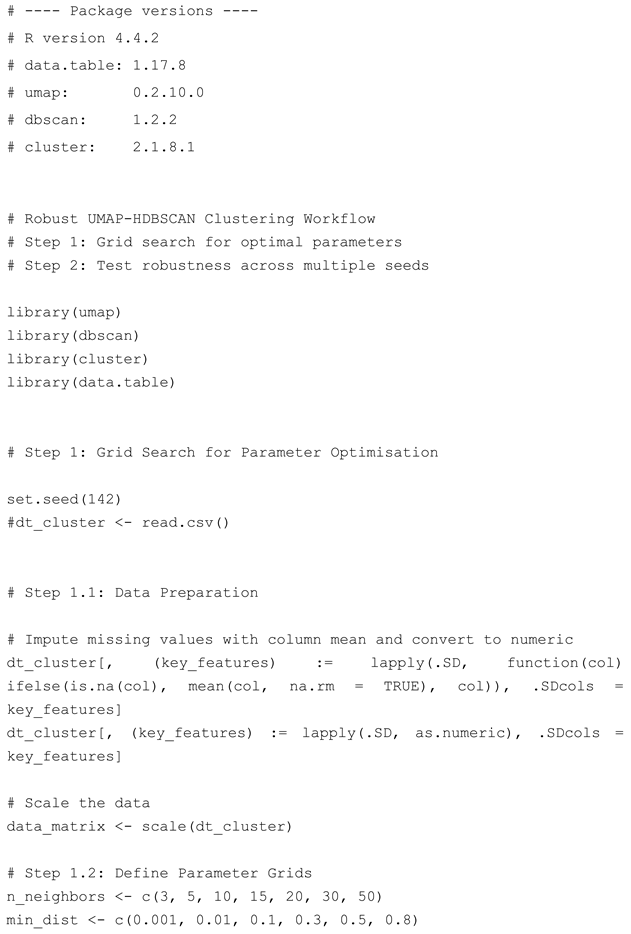
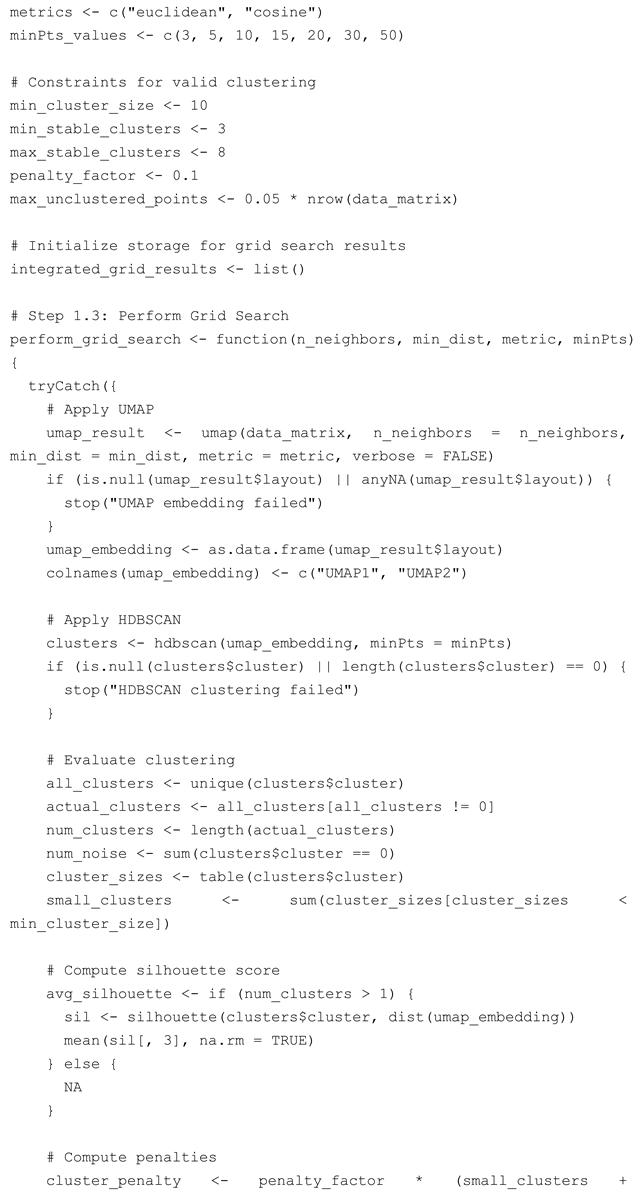
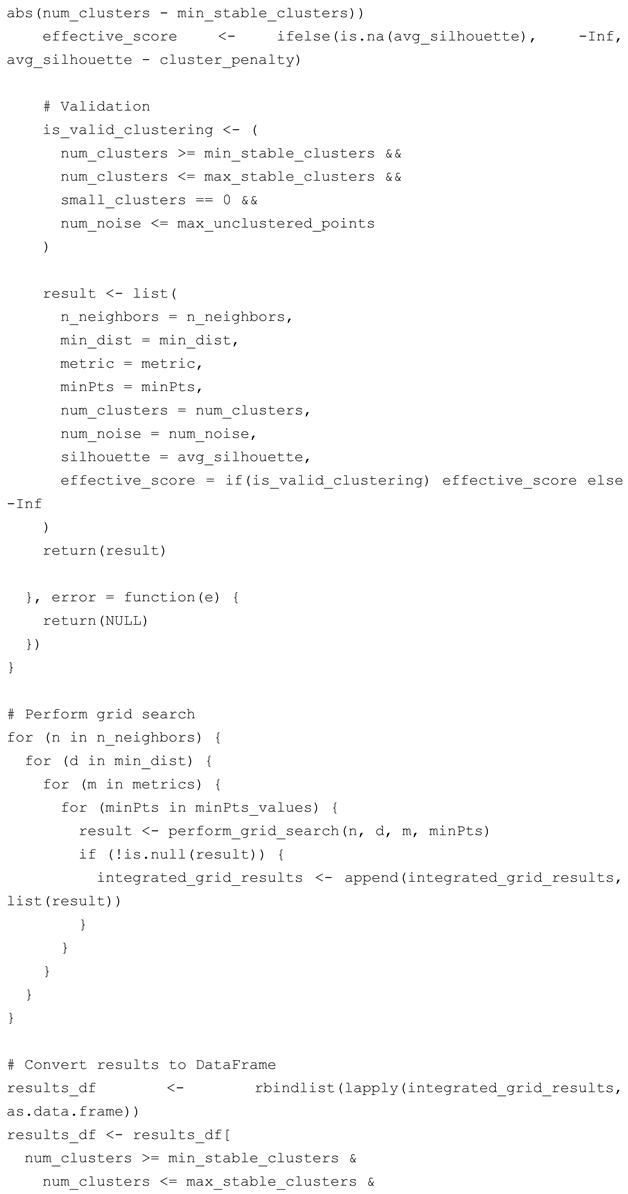
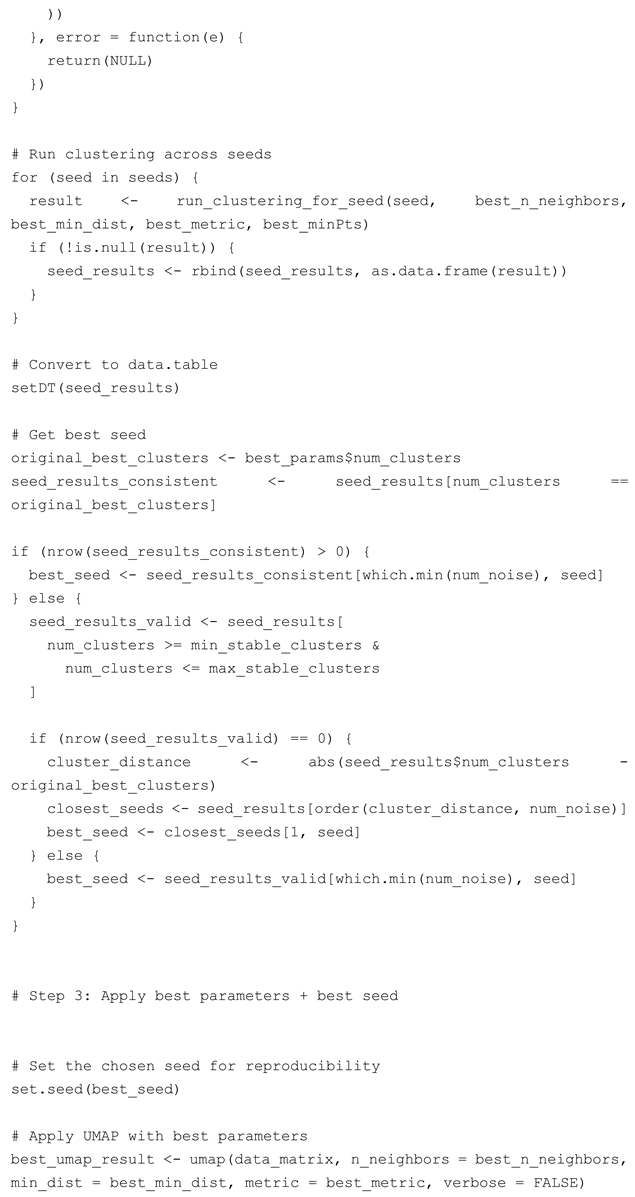
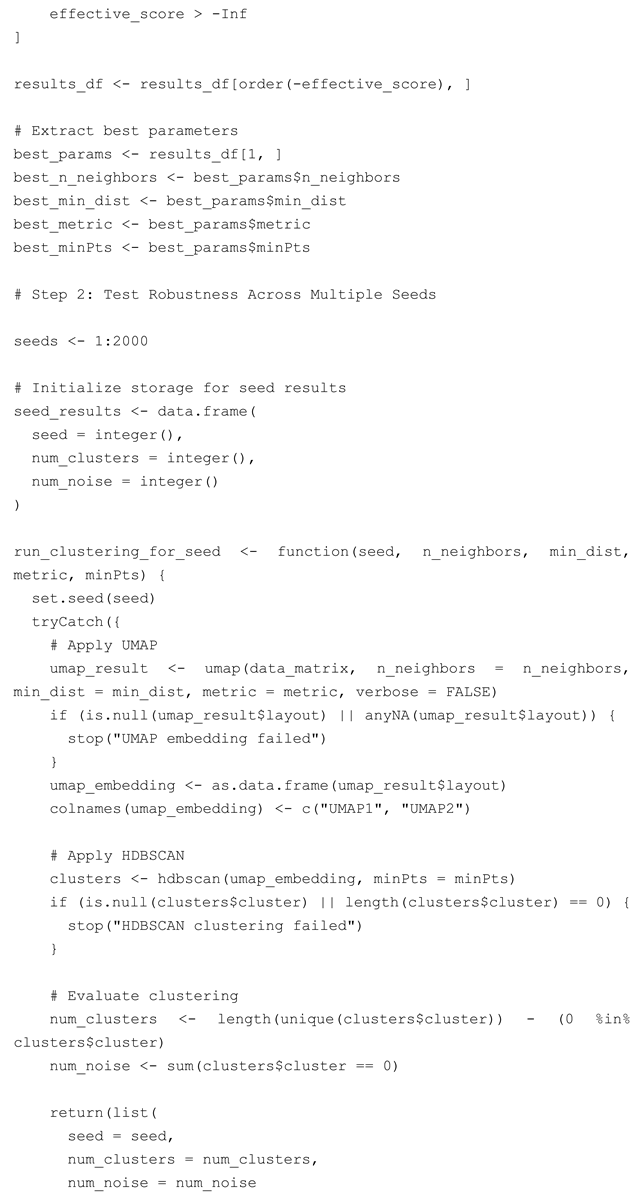
Dimensionality reduction was performed using Uniform Manifold Approximation and Projection (UMAP), followed by clustering via Hierarchical Density-Based Spatial Clustering of Applications with Noise (HDBSCAN) for threshold-free farm grouping. The methodology applied here was enhanced by penalty-based parameter optimisation, testing various constrained settings (final: 3–8 clusters, ≥10 farms/cluster, ≤5% noise), and validated across 2000 seeds for reproducibility. These variations were explored to assess the stability and interpretability of the resulting farm typologies in relation to sustainability outcomes. Cluster characterisation was conducted using z-score analysis (z = (x − μ)/σ) to identify key variables distinguishing each cluster. In addition, means and standard deviations were evaluated, along with correlations between individual features and cluster assignments. The identified structures were validated through expert evaluation to ensure relevance and interpretability. All cluster analyses were conducted in R (v4.4.2) using the umap (v0.2.10.0), dbscan (v1.1-11), and cluster (v2.1.4) packages. The R code for a clustering is provided in Appendix A.

3. Results & Discussion

This section presents and discusses the main findings of the sustainability assessment of Austrian dairy farms using the NEU.rind tool. The results derive from a cluster analysis aimed at identifying distinct farm types and their associated sustainability profiles. Moreover, key trade-offs observed between important indicators are shown, and strategies are derived to support holistic and synergistic pathways for sustainable development. The section concludes with methodological reflections on the suitability and limitations of the applied assessment approach.

3.1. Dairy Farm Clusters and Their Sustainability Profiles

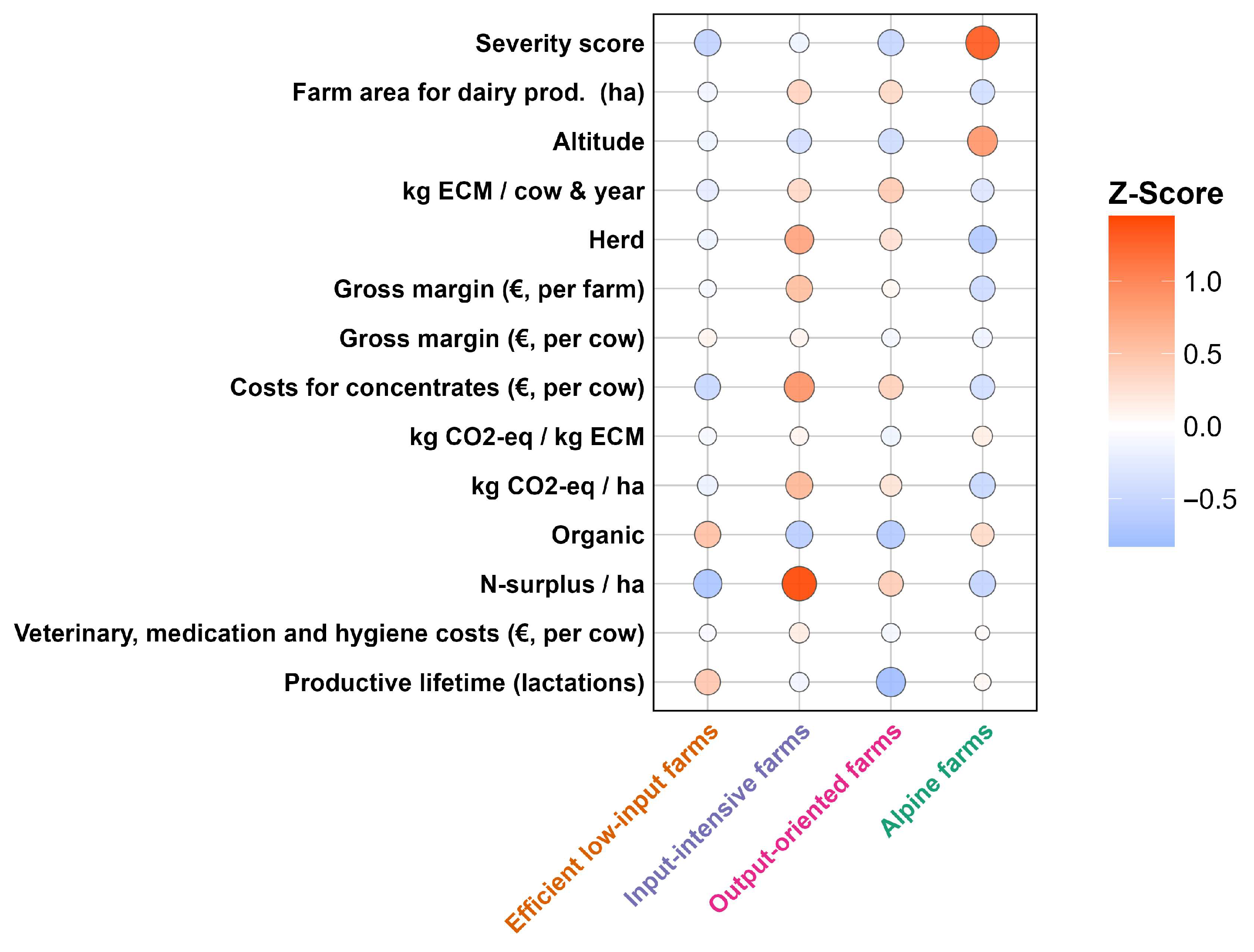
An integrated analysis of the dairy farms identified four distinct farm clusters, each characterised by specific sustainability profiles. These clusters emerged from a combination of unsupervised cluster analysis (UMAP-HDP) based on key sustainability indicators and subsequent expert interpretation. This methodological approach surpasses binary categorisations such as ‘organic vs. conventional’, translating complex data into meaningful farm typologies relevant for sustainable dairy farming (see Figure 1 and Figure 2).
The four clusters yielded the following profiles, see Table 4:
Cluster 1: Alpine farms. Farms in high altitudes with high cow longevity, average to low milk output per cow and year, characterised by low emissions per hectare, but increased CO2-eq emissions per kg of milk. However, their contribution margin per cow and year is low. This system reflects adapted small-scale milk production in the Alpine region.
Cluster 2: Efficient low-input farms. This cluster comprises farms mostly located in medium altitude regions. They are marked by rather low annual milk yields per cow and year, moderate economic returns, and quite low CO2-eq emissions, both per kg of milk and per hectare. Their cows show high longevity. These—often organic (57%)—farms combine low resource use with high efficiency and represent a sustainable approach under moderately favourable site conditions.
Cluster 3: Output-oriented lowland farms. Located in lowland areas, these farms produce the highest average milk volumes per cow and year and achieve good gross margins. While their emissions per kg of milk are low, they show rather high hectare-based emissions and the lowest cow longevity. This system maximises productivity and results in trade-offs regarding longevity and some ecological parameters.
Cluster 4: Input-intensive lowland farms. Also located in lowland regions, these farms demonstrate good production levels but show comparably high emissions per kg of milk and per hectare due to higher levels of external inputs. Their moderate gross margins and average cow longevity reflect partial inefficiencies in input resource use and environmental impact management.
The initial binary classification of farm groups into ‘organic’ and ‘conventional’ was intended primarily to describe sample characteristics and provide straightforward insights. The cluster analysis offers an alternative perspective, showing where this binary view aligns with the clustering results and where it fails to capture relevant aspects of farm heterogeneity.
Cluster 1 (Alpine extensive farms) aligns with the geographic dimension of binary classification, containing farms located in alpine regions that differ substantially from others across multiple variables including severity score, farm size (ha), number of dairy cows, altitude (m a.s.l.), and economic outcomes. This suggests that geographic-environmental constraints represent a dominant structural driver shaping farm characteristics beyond management choices alone. In contrast, Cluster 2 (efficient low-input farms) reveals a dimension missed by binary classification: environmental performance differences that transcend both conventional and organic systems, irrespective of location. In this case, management strategy emerges as the defining characteristic, rather than certification status or geography, representing a distinct form of extensification compared to that observed in alpine farms.
As an unsupervised method, the HDBSCAN clustering algorithm identifies patterns based on density and cluster stability [50,51]. In our case, the geographic location—particularly alpine conditions—emerges as the primary driver for Cluster 1, while other clusters differ primarily in production intensity and management approaches. This demonstrates that site conditions and management choices operate as separate but interacting axes of farm differentiation, which binary classifications cannot fully capture.

3.2. Identified Sustainability Trade-Offs

This study emphasises critical trade-offs between production intensity, environmental performance, and animal welfare. A prominent finding is a general contrast between product-based (per kg milk) and area-based (per hectare) environmental indicators (Table 5). High-intensity systems with a high stocking density and high feed imports (see clusters 3 and 4; Table 4, Figure 2) commonly perform better per kg of milk due to dilution of emissions over higher milk (and beef) outputs, but exert higher impacts per hectare. Conversely, extensive systems typically show favourable hectare-based indicator results but higher emissions per kg of milk, consistent with findings from other authors, e.g., [52,53,54]. For instance, ‘intensive’ farms in Clusters 3 and 4 provide more protein per hectare of farmland, but they use more potentially human-edible concentrated feed. In this respect, the net amount of protein provided does not differ significantly between the 4 farm clusters, and the conversion efficiency of producing food-grade protein in milk and beef from the protein in feed is higher on the more extensive farms.
GHG emissions per kg ECM did not differ significantly between clusters, with conventional and organic farms showing similar average performances (means: conventional milk 1.11 kg CO2-eq/kg ECM, organic milk 1.15 kg CO2-eq/kg ECM). One reason for this small difference was that conventional production with higher milk output per cow and year was better able to dilute the environmental impact of infrastructure (machines and buildings); means of conventional and organic infrastructure-related GWP impacts were 0.094 kg and 0.124 kg CO2-eq per kg ECM, respectively. The fact that the environmental impact results presented here generally include construction of infrastructure must be taken into account when comparing them with the results of other studies. Unlike GHG emissions, NH3 emissions and fossil energy use per kg of ECM were generally lower in intensive systems, reflecting their higher productivity.
Studies on northern Italian dairy farms, partly located in the alpine region [54,55], used similar (solely environmental) indicators, functional units and cluster analyses and reported comparable patterns: for example, differences in GHG intensity per kg ECM between farm clusters were small and statistically insignificant, whereas traditional (extensive) farms showed substantially lower impacts per hectare, especially in [54], or a much better feed-food conversion [55].
More intensive farms, which purchased more external concentrated feed, had higher gross margins per ha and lower gross margins per kg ECM (p < 0.05), but insignificant differences per cow and year. Additionally, the gross margin is influenced by both the revenue per kg ECM (milk price; p < 0.001) and costs, such as those for (often purchased) concentrated feed (p < 0.01). Similarly, a strong influence of concentrate feed costs on farm profitability was found in Southern Germany, leading to the conclusion that lowering concentrate feed levels can create a win-win situation for both environmental performance and economic outcomes [56]. Larger proportions of permanent grassland, such as in the farms in Clusters 1 and 2, supported higher biodiversity scores in terms of proportions of HNVF land area (p < 0.001), but showed a lower feed conversion efficiency, resulting in higher land occupation. Consequently, an increase in the proportion of permanent grassland tended to result in higher potential species losses per kg ECM (p = 0.094; see also Table 4, Figure 2).
Conflicting trade-offs occur when sustainability is specifically increased in only one dimension. For instance, increasing lactation yields and income, and reducing product-related GHG emissions may reduce impacts per unit of product in general, but can also diminish cow longevity and health, and increase, according to our data, fossil resource use and dependency (p < 0.05). We found a tendency towards a negative relationship between location disadvantages of a farm and udder health (p = 0.06), showing that lowland farms tended to have more problems with udder health. This could be due to a combination of management and genetic effects, resulting from high milk yields and larger farms. However, no other correlations with animal health could be found in the data. Poor animal health can reduce both economic profitability and ecological sustainability, whereas good health and high cow longevity positively affects both. For instance, higher longevity improved GWP-related scores, with averages of product- and hectare-related scores being shown, and increased gross margins per cow and year (p < 0.05) as well as per kg ECM (p < 0.01). This was also observed in other studies [57,58].

3.3. Strategic Pathways for Sustainable Development

The following section presents measures for improving the sustainability performance of dairy farms derived from the cluster analysis and other analyses, such as correlations.

3.3.1. General Improvement Options

Analysis revealed that a higher reliance on regionally produced forage and a reduction of external concentrate feed were consistently associated with lower GHG scores (p < 0.001) and reduced production costs per cow and year (p < 0.01), suggesting that self-sufficiency in feed contributes positively to both environmental and economic performances. Providing (more) pasture emerged as an effective optimisation measure for animal welfare and environmental sustainability. Especially when (medium to) intensively managed grazing systems allowed for reductions in concentrate use, and thus in reduced environmental burdens (e.g., p < 0.001 for both kg CO2-eq/ha and the averaged product- and hectare-related scores, or p < 0.05 for kg CO2-eq per kg ECM) and costs per cow and year (p < 0.01). In more extensive systems, pasture—particularly alpine pasture—also provided biodiversity benefits, enhancing habitat quality and the landscape conservation value. Analysis revealed that the top 10% of farms with the healthiest cattle (based on the Q-Check health score) use 20% less concentrate feed per kilogram milk (185 g/kg ECM) compared to the average NEU.rind farm (230 g/kg ECM). However, this relationship is not straightforward or one-dimensional. Although there is limited direct influence, which is often overruled by management practices, improved animal health and longer productive lifespans, which are influenced by genetics and various management factors, can contribute to reducing resource use and environmental impacts [59]. For instance, increasing the number of lactations from, for example, 3 to 5 lactations—without any other changes—resulted in a 2% reduction in GHG emissions on average across all NEU.rind farms, when accounting for co-products such as beef from culled cows and calves and not including a better health status.
Improved manure handling practices showed a clear potential to reduce NH3 emissions and support soil fertility. Farms with covered slurry stores (p < 0.05) and improved spreading techniques (such as trailing hoses, trailing shoes, and slurry injection; p < 0.001) demonstrated significantly lower acidifying emissions per kg of ECM. However, these reduction effects were not significant for kg NH3 per ha, which is mainly influenced by livestock densities (p < 0.01).

3.3.2. Cluster- and Farm-Specific Recommendations for Improvement

The most extensive farms, particularly those in Cluster 1 (alpine farms), may face negative nutrient balances. These can occur on (Austrian) organic farms, especially concerning phosphate [60], and may require adjustments in feeding strategies such as increased feed imports or targeted fertilisation of land [61]. In such cases, the use of nitrogen- and phosphorus-rich by-products from food or bioenergy industries could improve animal performance and, via manure, enhance grassland and arable land productivity and thus economic returns. Given the low or even negative nitrogen surplus in this cluster (see Figure 2), efforts should focus on fine-tuning manure distribution and timing to further improve nutrient-use efficiency and pasture quality. However, care must be taken to ensure that this intensification of nutrient cycles does not come at the expense of biodiversity [62]. Specific measures such as diversified (zoned) grassland use, staggered mowing, or retention of tall grass refuges can be implemented to actively promote biodiversity [63,64]. Additionally, if higher nitrogen throughput occurs at farm level, more attention should be paid to reducing NH3 emissions, for instance, by adapting the application of slurry with trailing hoses, trailing shoes or injection into soil [65]; this is relevant for all farms (clusters), especially those in the lowlands.
In both Clusters 1 and 2, particularly under extreme site conditions (e.g., higher altitude), and where dual-purpose genetics prevail, an integration of beef production and milk production may enable good utilisation of local resources and might thus increase economic efficiency [66]. On these farms, biodiversity and ecosystem services are comparably high, area-based and product-based environmental impacts are rather low, and animal health and longevity performances are good, while economic results are rather low. Development of and farm participation in ecosystem services and biodiversity payment schemes (e.g., for alpine pasture conservation) would offer more appropriate compensation for the ecosystem services provided by such alpine farms [67,68], thereby enhancing profitability. Although cow longevity in Clusters 1 and 2 is already good, there is still some possibility for improvement with potential synergistic economic and environmental effects (see Section 3.2 and Section 3.3.1).
Contrarily, Cluster 3 (output-oriented lowland farms) and Cluster 4 (input-intensive lowland farms) benefit from favourable site conditions. However, they should pay special attention to animal health, cow longevity, and nitrogen surpluses, especially in the case of Cluster 4 (Figure 2). These farms often maintain high stocking densities enabled by significant external feed inputs, which bring substantial nutrient loads onto the farms. As a result, hectare-based environmental impacts can be high [10,69]. Due to high concentrate feed use per kg ECM, which can reduce enteric methane emissions, farms may achieve below-average values for CO2-eq per kg ECM. However, hectare-based GHG emissions are clearly above the average (Figure 2).
Our findings underline the complexity of improving sustainability in dairy farming, which has been detected in other studies as well, e.g., in [24,56]. Multiple and sometimes conflicting factors influence sustainability indicators, and their interpretation depends heavily on the chosen reference unit (e.g., per kg milk, per hectare, per animal). Optimal solutions are therefore highly context-dependent and farm-specific, varying with production systems and site conditions. For every sustainability aspect in NEU.rind that is assessed per hectare and per kg milk, approximately a quarter of all farms show results below medians in both functional reference units. These farms are not restricted to less favourable locations. For such farms and the respective indicators, the NEU.rind tool provides tailored recommendations based on individual farm profiles, enabling targeted improvements in sustainability outcomes (see Section 3.4).

3.4. Methodological Reflections

In contrast to other tools, the digital farm assistant NEU.rind provides farm-specific recommendations for a comprehensive set of indicators, supported by numerous pre-recorded values to simplify data entry and ensure user-friendliness for routine use. By integrating powerful databases (e.g., Cattle Data Network RDV, IACS), it minimises additional manual data collection. Some tools require substantial time and effort for data collection because the analyses are highly detailed (e.g., SALCAsustain, [26]). They do not use extensive and highly effective databases such as IACS-data and especially the Cattle Data Network (RDV) containing, inter alia, milk recording data, but they often include detailed calculations in other areas such as crop production [26]. Several tools have adopted holistic frameworks to assess dairy systems, highlighting the importance of considering factors beyond CO2-eq (GWP) when addressing sustainability challenges (e.g., SAFA, SMART, SALCA-sustain, FARMLIFE or MOTIFS, see [26]). However, they either do not evaluate quantitatively, are not easy to use or complex regarding data collection, do not present easily understandable analysis results, do not provide benchmarking options with other farms, do not give clear recommendations, or do not comprehensively analyse sustainability with regard to the dimension of animal health and welfare [26]. In contrast, NEU.rind provides an on-farm assessment tool seeking compromises between these methodological trade-offs. Furthermore, its comprehensive dataset enables detailed sustainability assessments across different farm typologies. While binary classification of typologies can provide straightforward insights, clustering approaches based on such a holistic dataset offer an alternative, more exploratory perspective for identifying patterns and relationships within the data. Nevertheless, the NEU.rind tool also has limitations and has potential for improvement, for instance with respect to an integrated quantitative assessment across different scores. DEXi-Dairy, for example, includes a decision rule-based, hierarchical multi-attribute model for deriving holistic improvements, however, it has difficulties assessing actual farms and shows better performance in the evaluation of model production systems with statistical data [70]. Future developments of the NEU.rind tool should aim to tailor recommendations more specifically to farm site conditions, taking into account individual development potentials of each dairy farm and asking for farmers’ preferences. This would enable the identification of the measures with the highest improvement potential across different sustainability aspects and dimensions. Asking for preferences could enhance the implementation of high-priority measures in everyday farming practices.

4. Conclusions

The application of the NEU.rind tool on 170 farms identified four distinct farm clusters, each representing distinct locations and management strategies with trade-offs between productivity, environmental impacts, and economic performance. Alpine and efficient low-input farms (Clusters 1 and 2), for example, emphasise health and longevity, but they face economic limitations. In contrast, output-oriented and input-intensive lowland farms (Clusters 3 and 4) prioritise productivity and economic returns, achieving lower impacts per kg milk but at the expense of health and longevity. Moreover, fossil resource use and environmental loads per ha are high in these clusters. Higher dependence on regional forage, reduced concentrate feed, and increased use of pasture may improve welfare, reduce the use of resources and enhance environmental outcomes. Despite differences in production systems, the net protein output per ha of farmland was similar across all clusters, with more efficient food-grade protein conversion in extensive systems.
Strategies for sustainable development must be tailored to farm type: alpine and efficient farms (Clusters 1 & 2) provide high levels of ecosystem services, including biodiversity conservation, but lower economic performance. Output-oriented and input-intensive farms (Clusters 3 & 4) need to address nutrient surpluses or cow longevity and health issues.
The comprehensive NEU.rind dataset supports advanced analytical approaches, including farm typology classification and multidimensional clustering, which enable both benchmarking and deeper exploration of sustainability patterns across farm types. This allows stakeholders to gain additional insights into complex trade-offs and relationships that would otherwise remain hidden. While NEU.rind already provides valuable support for sustainability management, ongoing development should address current limitations, such as integrating a more quantitative assessment across sustainability aspects and further tailoring recommendations to specific farm conditions and farmer preferences. This will enhance the tool’s contribution to sector-wide and policy-relevant sustainability goals, supporting adaptive management and continuous improvement at both the farm and national levels.
Overall, improving dairy farm sustainability requires context-specific measures that enhance efficiency, economic performance, animal health and welfare, while balancing productivity and environmental impact. NEU.rind has proven to be a valuable tool for deriving tailored sustainability measures. Additionally, NEU.rind meets external reporting requirements, such as sustainability indicators demanded by dairy processors. Repeated application of NEU.rind enables consistent monitoring over time and supports alignment with frameworks such as the Science Based Targets initiative (SBTi). Its standardised multidimensional evaluation and benchmarking, based on existing farm records, make NEU.rind a practical and robust tool for guiding Austria’s dairy sector toward more sustainable practices.

Author Contributions

Conceptualisation, S.J.H. and all authors; methodology, S.J.H., M.H., F.S., S.W. and C.M.; software, F.S., C.M. and S.J.H.; validation, S.J.H., S.W., M.H. and F.S.; formal analysis, S.J.H. and C.M.; investigation, S.J.H. and M.H.; resources, F.S. and C.E.-D.; data curation, F.S., S.J.H., S.W. and M.H.; writing—original draft preparation, S.J.H. and C.M.; writing—review and editing, C.E.-D., K.L., M.H., S.J.H., C.M. and S.W.; visualisation, C.M.; supervision, C.E.-D.; project administration, K.L. and C.E.-D.; project idea for NEU.rind, C.E.-D., S.J.H. and F.S.; funding acquisition, C.E.-D., S.J.H., M.H. and K.L. All authors have read and agreed to the published version of the manuscript.

Funding

The project NEU.rind was funded by the Federal Ministry of Agriculture and Forestry, Climate and Environmental Protection, Regions and Water Management of the Republic of Austria and the European Union within the framework of the European Innovation Partnership for Agricultural Productivity and Sustainability (EIP-AGRI). The grant numbers are LE 14-20; 16.1.1-S2-46/21 and 16.2.1-S2-46/21.

Institutional Review Board Statement

Not applicable.

Informed Consent Statement

Not applicable.

Data Availability Statement

The farm-level datasets generated and analysed in this study contain confidential farm business information and personal data. In accordance with data protection regulations and confidentiality agreements with participating farmers, these data are not publicly available and cannot be shared.

Acknowledgments

The authors gratefully acknowledge the contributions of our project partners, including the Environment Agency Austria (Umweltbundesamt), the Federal Institute of Agricultural Economics, Rural and Mountain Research (Bundesanstalt für Agrarwirtschaft und Bergbauernfragen), the Federal Ministry of Agriculture and Forestry, Climate and Environmental Protection, Regions and Water Management (BMLUK), the Austrian Milk Association (MVÖ), the participating Austrian dairies, Rinderzucht AUSTRIA, LKV Austria, the Chamber of Agriculture and the six farmers in the project operational group. Special thanks are extended to the employees of LKV Austria for motivating farmers and assisting in data collection. We are especially grateful to the nearly 200 farmers who provided farm-level data essential for developing the methodology and conducting the case-study analyses. Furthermore, we would like to thank four reviewers who helped to improve the original submission of the manuscript, and we gratefully acknowledge Mag. Martina Kichler for English language editing.

Conflicts of Interest

Authors Caspar Matzhold, Franz Steininger, Kristina Linke and Christa Egger-Danner were employed by the ZuchtData EDV-Dienstleistungen GmbH. The remaining authors declare that the research was conducted in the absence of any commercial or financial relationships that could be construed as a potential conflict of interest.

Appendix A. R Code for a Clustering
Sustainability 18 00303 i001
Sustainability 18 00303 i002
Sustainability 18 00303 i003
Sustainability 18 00303 i004
Sustainability 18 00303 i005
Sustainability 18 00303 i006

References

  1. Cimmino, F.; Catapano, A.; Petrella, L.; Villano, I.; Tudisco, R.; Cavaliere, G. Role of Milk Micronutrients in Human Health. Front. Biosci. (Landmark Ed.) 2023, 28, 41. [Google Scholar] [CrossRef] [PubMed]
  2. Weaver, C.M. Role of Dairy Beverages in the Diet. Physiol. Behav. 2010, 100, 63–66. [Google Scholar] [CrossRef] [PubMed]
  3. Singaravadivelan, A.; Sachin, P.B.; Harikumar, S.; Vijayakumar, P.; Vindhya, M.V.; Farhana, F.M.B.; Rameesa, K.K.; Mathew, J. Life Cycle Assessment of Greenhouse Gas Emission from the Dairy Production System—Review. Trop. Anim. Health Prod. 2023, 55, 320. [Google Scholar] [CrossRef] [PubMed]
  4. Misselbrook, T.; del Prado, A.; Chadwick, D. Opportunities for Reducing Environmental Emissions from Foragebased Dairy Farms. Agric. Food Sci. 2013, 22, 93–107. [Google Scholar] [CrossRef]
  5. Douglas, C.; Pandey, P. Nitrate and Bacterial Loads in Dairy Cattle Drinking Water and Potential Treatment Options for Pollutants—A Review. Appl. Sci. 2025, 15, 3017. [Google Scholar] [CrossRef]
  6. Gislon, G.; Ferrero, F.; Bava, L.; Borreani, G.; Prà, A.D.; Pacchioli, M.T.; Sandrucci, A.; Zucali, M.; Tabacco, E. Forage Systems and Sustainability of Milk Production: Feed Efficiency, Environmental Impacts and Soil Carbon Stocks. J. Clean. Prod. 2020, 260, 121012. [Google Scholar] [CrossRef]
  7. Díaz De Otálora, X.; Del Prado, A.; Dragoni, F.; Balaine, L.; Pardo, G.; Winiwarter, W.; Sandrucci, A.; Ragaglini, G.; Kabelitz, T.; Kieronczyk, M.; et al. Modelling the Effect of Context-Specific Greenhouse Gas and Nitrogen Emission Mitigation Options in Key European Dairy Farming Systems. Agron. Sustain. Dev. 2024, 44, 4. [Google Scholar] [CrossRef]
  8. Grassauer, F.; Herndl, M.; Nemecek, T.; Guggenberger, T.; Fritz, C.; Steinwidder, A.; Zollitsch, W. Eco-Efficiency of Farms Considering Multiple Functions of Agriculture: Concept and Results from Austrian Farms. J. Clean. Prod. 2021, 297, 126662. [Google Scholar] [CrossRef]
  9. Grassauer, F.; Herndl, M.; Iten, L.; Gaillard, G. Environmental Assessment of Austrian Organic Dairy Farms With Closed Regional Production Cycles in a Less Favorable Production Area. Front. Sustain. Food Syst. 2022, 6, 817671. [Google Scholar] [CrossRef]
  10. Eisert, J.; Sahraei, A.; Knob, D.A.; Lambertz, C.; Zollitsch, W.; Hörtenhuber, S.; Kral, I.; Breuer, L.; Gattinger, A. Transforming the Feeding Regime towards Low-Input Increases the Environmental Impact of Organic Milk Production on a Case Study Farm in Central Germany. Int. J. Life Cycle Assess. 2025, 30, 79–92. [Google Scholar] [CrossRef]
  11. Zanon, T.; Hörtenhuber, S.; Fichter, G.; Peratoner, G.; Zollitsch, W.; Gatterer, M.; Gauly, M. Effect of Management System and Dietary Seasonal Variability on Environmental Efficiency and Human Net Food Supply of Mountain Dairy Farming Systems. J. Dairy Sci. 2025, 108, 597–610. [Google Scholar] [CrossRef]
  12. Drews, J.; Czycholl, I.; Krieter, J. A Life Cycle Assessment Study of Dairy Farms in Northern Germany—The Development of Environmental Impacts throughout a Decade. Züchtungskunde 2020, 92, 236–256. [Google Scholar]
  13. Rotz, C.A.; Stout, R.C.; Holly, M.A.; Kleinman, P.J.A. Regional Environmental Assessment of Dairy Farms. J. Dairy Sci. 2020, 103, 3275–3288. [Google Scholar] [CrossRef] [PubMed]
  14. Van Der Werf, H.M.G.; Knudsen, M.T.; Cederberg, C. Towards Better Representation of Organic Agriculture in Life Cycle Assessment. Nat. Sustain. 2020, 3, 419–425. [Google Scholar] [CrossRef]
  15. European Commission. Joint Research Centre. Understanding Product Environmental Footprint and Organisation Environmental Footprint Methods; Publications Office: Luxembourg, 2022. [Google Scholar] [CrossRef]
  16. Von Soosten, D.; Meyer, U.; Flachowsky, G.; Dänicke, S. Dairy Cow Health and Greenhouse Gas Emission Intensity. Dairy 2020, 1, 20–29. [Google Scholar] [CrossRef]
  17. O’Brien, D.; Hennessy, T.; Moran, B.; Shalloo, L. Relating the Carbon Footprint of Milk from Irish Dairy Farms to Economic Performance. J. Dairy Sci. 2015, 98, 7394–7407. [Google Scholar] [CrossRef]
  18. Balmford, A.; Amano, T.; Bartlett, H.; Chadwick, D.; Collins, A.; Edwards, D.; Field, R.; Garnsworthy, P.; Green, R.; Smith, P.; et al. Author Correction: The Environmental Costs and Benefits of High-Yield Farming. Nat. Sustain. 2019, 2, 339–341. [Google Scholar] [CrossRef]
  19. Ertl, P.; Klocker, H.; Hörtenhuber, S.; Knaus, W.; Zollitsch, W. The Net Contribution of Dairy Production to Human Food Supply: The Case of Austrian Dairy Farms. Agric. Syst. 2015, 137, 119–125. [Google Scholar] [CrossRef]
  20. Ertl, P.; Knaus, W.; Zollitsch, W. An Approach to Including Protein Quality When Assessing the Net Contribution of Livestock to Human Food Supply. Animal 2016, 10, 1883–1889. [Google Scholar] [CrossRef]
  21. Steffen, W.; Richardson, K.; Rockstrom, J.; Cornell, S.E.; Fetzer, I.; Bennett, E.M.; Biggs, R.; Carpenter, S.R.; de Vries, W.; de Wit, C.A.; et al. Planetary Boundaries: Guiding Human Development on a Changing Planet. Science 2015, 347, 1259855. [Google Scholar] [CrossRef]
  22. Schmidt, J.; Dalgaard, R. Arla Foods FarmTool V2021—Updates and Adding New Technologies; LCA Consultants: Aarhus, Denmark, 2021; p. 58. Available online: https://lca-net.com/files/FarmTool-v2021_20211221.pdf (accessed on 5 December 2025).
  23. Bayrische Landesanstalt für Landwirtschaft (LfL) Deckungsbeiträge Und Kalkulationsdaten—Milchkuhhaltung. Available online: https://www.stmelf.bayern.de/idb/milchkuhhaltung.html (accessed on 5 December 2025).
  24. Vries, d.M.; van Dijk, W.; de Boer, J.A.; de Haan, M.H.A.; Oenema, J.; Verloop, J.; Lagerwerf, L.A. Calculation Rules of the Annual Nutrient Cycling Assessment (ANCA) 2019; Background Information about Farm-Specific Environmental Performance Parameters. Report 1279; Wageningen Livestock Research: Wageningen, The Netherlands, 2020; p. 112. Available online: https://edepot.wur.nl/533905 (accessed on 5 December 2025).
  25. Herron, J.; O’Brien, D.; Jordan, S.; Shalloo, L. AgNav: The New Digital Sustainability Platform for Agriculture in Ireland. 2025. Available online: https://teagasc.ie/wp-content/uploads/2025/05/AgNav-The-new-digital-sustainability-platform-for-agriculture-in-Ireland.pdf (accessed on 5 December 2025).
  26. Paçarada, R.; Hörtenhuber, S.; Hemme, T.; Wurzinger, M.; Zollitsch, W. Sustainability Assessment Tools for Dairy Supply Chains: A Typology. Sustainability 2024, 16, 4999. [Google Scholar] [CrossRef]
  27. Meul, M.; Passel, S.; Nevens, F.; Dessein, J.; Rogge, E.; Mulier, A.; Hauwermeiren, A. MOTIFS: A Monitoring Tool for Integrated Farm Sustainability. Agron. Sustain. Dev. 2008, 28, 321–332. [Google Scholar] [CrossRef]
  28. de Otalora, X.; del Prado, A.; Dragoni, F.; Estelles, F.; Amon, B. Evaluating Three-Pillar Sustainability Modelling Approaches for Dairy Cattle Production Systems. Sustainability 2021, 13, 6332. [Google Scholar] [CrossRef]
  29. Ruckli, A.K.; Hörtenhuber, S.J.; Ferrari, P.; Guy, J.; Helmerichs, J.; Hoste, R.; Hubbard, C.; Kasperczyk, N.; Leeb, C.; Malak-Rawlikowska, A.; et al. Integrative Sustainability Analysis of European Pig Farms: Development of a Multi-Criteria Assessment Tool. Sustainability 2022, 14, 5988. [Google Scholar] [CrossRef]
  30. Triste, L.; Marchand, F.; Debruyne, L.; Meul, M.; Lauwers, L. Reflection on the Development Process of a Sustainability Assessment Tool: Learning from a Flemish Case. Ecol. Soc. 2014, 19, art47. [Google Scholar] [CrossRef]
  31. Siebrecht, N. Sustainable Agriculture and Its Implementation Gap—Overcoming Obstacles to Implementation. Sustainability 2020, 12, 3853. [Google Scholar] [CrossRef]
  32. Hörtenhuber, S.J.; Steininger, F.; Herndl, M.; Wieser, S.; Linke, K.; Egger-Danner, C. NEU.Rind-Tool—Method Description; Rinderzucht Austria: Vienna, Austria, 2022; Available online: https://www.rinderzucht.at/projekt/neu-rind.html (accessed on 5 December 2025).
  33. IPCC. Climate Change 2013: The Physical Science Basis. Contribution of Working Group I to the Fifth Assessment Report of the Intergovernmental Panel on Climate Change; Stocker, T.F., Qin, D., Plattner, G.-K., Tignor, M., Allen, S.K., Boschung, J., Nauels, A., Xia, Y., Bex, V., Midgley, P.M., Eds.; Cambridge University Press: Cambridge, UK; New York, NY, USA, 2013; ISBN 978-1-107-05799-1. [Google Scholar]
  34. Umweltbundesamt. Austria’s National Inventory Report 2023; Umweltbundesamt (Austrian Environment Agency): Vienna, Austria, 2023; p. 833. Available online: https://www.umweltbundesamt.at/fileadmin/site/publikationen/rep0852.pdf (accessed on 5 December 2025).
  35. International Dairy Federadtion (IDF). The IDF Global Carbon Footprint Standard for the Dairy Sector. Bulletin of the IDF 520(2022; The International Dairy Federation: Brussels, Belgium, 2022. Available online: https://shop.fil-idf.org/products/the-idf-global-carbon-footprint-standard-for-the-dairy-sector (accessed on 5 December 2025).
  36. Ineichen, S.; Schenker, U.; Nemecek, T.; Reidy, B. Allocation of Environmental Burdens in Dairy Systems: Expanding a Biophysical Approach for Application to Larger Meat-to-Milk Ratios. Livest. Sci. 2022, 261, 104955. [Google Scholar] [CrossRef]
  37. IPCC. 2019 Refinement to the 2006 IPCC Guidelines for National Greenhouse Gas Inventories; IPCC: Kyoto, Japan, 2019. Available online: https://www.ipcc.ch/report/2019-refinement-to-the-2006-ipcc-guidelines-for-national-greenhouse-gas-inventories/ (accessed on 5 December 2025).
  38. Amon, B.; Hutchings, N.; Dämmgen, U.; Sommer, S.; Webb, J.; Mellios, G.; Juhrich, K. EMEP/EEA Air Pollutant Emission Inventory Guidebook 2023. 2023; p. 64. Available online: https://www.eea.europa.eu/en/analysis/publications/emep-eea-guidebook-2023 (accessed on 5 December 2025).
  39. Wernet, G.; Bauer, C.; Steubing, B.; Reinhard, J.; Moreno-Ruiz, E.; Weidema, B. The Ecoinvent Database Version 3 (Part I): Overview and Methodology. Int. J. Life Cycle Assess. 2016, 21, 1218–1230. [Google Scholar] [CrossRef]
  40. Chaudhary, A.; Brooks, T.M. Land Use Intensity-Specific Global Characterization Factors to Assess Product Biodiversity Footprints. Environ. Sci. Technol. 2018, 52, 5094–5104. [Google Scholar] [CrossRef]
  41. Sjaunja, L.O.; Baevre, L.; Junkkarinen, L.; Pedersen, J.; Setälä, J. A Nordic Proposal for an Energy-Corrected Milk Standard. In Proceedings of the 11th Session of the International Committee for Recording and Use of Animal Productivity (ICAR); International Dairy Federation (IDF): Paris, France, 1990. [Google Scholar]
  42. Nemecek, T.; Thoma, G. Allocation between Milk and Meat in Dairy LCA: Critical Discussion of the International Dairy Federation’s Standard Methodology. In Proceedings of the 12th International Conference on Life Cycle Assessment of Food 2020, Berlin, Germany, 13–16 October 2020; DIL: Quakenbrück, Germany, 2020; pp. 86–89. [Google Scholar]
  43. Bartel, A.; Süßenbacher, E.; Sedy, K. Weiterentwicklung des Agrarumweltindikators “High Nature Value Farmland” für Österreich; Umweltbundesamt (Austrian Environment Agency): Wien, Austria, 2011; p. 90. Available online: https://www.umweltbundesamt.at/fileadmin/site/publikationen/rep0348.pdf (accessed on 5 December 2025).
  44. Thünen Institute. Q Check: Tierwohl Mit System—Von Der Betrieblichen Eigenkontrolle Zum Nationalen Monitoring. 2021. Available online: https://www.thuenen.de/media/publikationen/project_brief/Project_brief_2021_35.pdf (accessed on 5 December 2025).
  45. Federal Institute of Agricultural Economics, Rural and Mountain Research IDB—Interaktive Deckungsbeiträge und Kalkulationsdaten 2025. Available online: https://idb.agrarforschung.at/verfahren/konventionell/milchkuhhaltung (accessed on 5 December 2025).
  46. Bundesministerium für Land- und Forstwirtschaft, Regionen und Wasserwirtschaft (BML) Integrated Administration and Control System (IACS) Data (Integriertes Verwaltungs- und Kontrollsystem, INVEKOS). 2024. Available online: https://www.bmluk.gv.at/themen/landwirtschaft/gemeinsame-agrarpolitik-foerderungen/nationaler-strategieplan/direktzahlungen-ab-2023/invekosinvekosgis.html (accessed on 5 December 2025).
  47. Slagboom, M.; Kargo, M.; Edwards, D.; Sørensen, A.C.; Thomasen, J.R.; Hjortø, L. Organic Dairy Farmers Put More Emphasis on Production Traits than Conventional Farmers. J. Dairy Sci. 2016, 99, 9845–9856. [Google Scholar] [CrossRef]
  48. Alvarez, S.; Timler, C.J.; Michalscheck, M.; Paas, W.; Descheemaeker, K.; Tittonell, P.; Andersson, J.A.; Groot, J.C.J. Capturing Farm Diversity with Hypothesis-Based Typologies: An Innovative Methodological Framework for Farming System Typology Development. PLoS ONE 2018, 13, e0194757. [Google Scholar] [CrossRef]
  49. Matzhold, C.; Schodl, K.; Klimek, P.; Steininger, F.; Egger-Danner, C. A Key-Feature-Based Clustering Approach to Assess the Impact of Technology Integration on Cow Health in Austrian Dairy Farms. Front. Anim. Sci. 2024, 5, 1421299. [Google Scholar] [CrossRef]
  50. Campello, R.J.G.B.; Moulavi, D.; Sander, J. Density-Based Clustering Based on Hierarchical Density Estimates. In Advances in Knowledge Discovery and Data Mining; Lecture Notes in Computer Science; Pei, J., Tseng, V.S., Cao, L., Motoda, H., Xu, G., Eds.; Springer: Berlin/Heidelberg, Germany, 2013; Volume 7819, pp. 160–172. ISBN 978-3-642-37455-5. [Google Scholar]
  51. McInnes, L.; Healy, J. Accelerated Hierarchical Density Clustering. arXiv 2017. [Google Scholar] [CrossRef]
  52. Baldini, M.; Da Borso, F.; Rossi, A.; Taverna, M.; Bovolenta, S.; Piasentier, E.; Corazzin, M. Environmental Sustainability Assessment of Dairy Farms Rearing the Italian Simmental Dual-Purpose Breed. Animals 2020, 10, 296. [Google Scholar] [CrossRef] [PubMed]
  53. Mazzetto, A.M.; Falconer, S.; Edwards, P.J.; Glassey, C.B.; Neal, M.B.; Ledgard, S.F. Effects of Management and Technology Scenarios on the Carbon Footprint of Milk from Pasture-Based Dairy Farm Systems. J. Dairy Sci. 2025, 108, 12407–12420. [Google Scholar] [CrossRef]
  54. Bava, L.; Sandrucci, A.; Zucali, M.; Guerci, M.; Tamburini, A. How Can Farming Intensification Affect the Environmental Impact of Milk Production? J. Dairy Sci. 2014, 97, 4579–4593. [Google Scholar] [CrossRef]
  55. Berton, M.; Bittante, G.; Zendri, F.; Ramanzin, M.; Schiavon, S.; Sturaro, E. Environmental Impact and Efficiency of Use of Resources of Different Mountain Dairy Farming Systems. Agric. Syst. 2020, 181, 102806. [Google Scholar] [CrossRef]
  56. Mennig, P.; Szigeti, Z. Synergies and Trade-Offs between Environmental Impacts and Farm Profitability: The Case of Pasture-Based Dairy Production Systems. J. Agric. Food Res. 2025, 21, 101798. [Google Scholar] [CrossRef]
  57. Han, R.; Kok, A.; Mourits, M.; Hogeveen, H. Effects of Extending Dairy Cow Longevity by Adjusted Reproduction Management Decisions on Partial Net Return and Greenhouse Gas Emissions: A Dynamic Stochastic Herd Simulation Study. J. Dairy Sci. 2024, 107, 6902–6912. [Google Scholar] [CrossRef]
  58. Grandl, F.; Furger, M.; Kreuzer, M.; Zehetmeier, M. Impact of Longevity on Greenhouse Gas Emissions and Profitability of Individual Dairy Cows Analysed with Different System Boundaries. Animal 2019, 13, 198–208. [Google Scholar] [CrossRef]
  59. Hörtenhuber, S. Wir wirken Langlebigkeit und Tiergesundheit auf die Klima- und Umweltbilanz? In Proceedings of the Rinderzucht Austria Seminar. Nutzungsdauer—Ein traditionelles Konzept mit Zukunft? Rinderzucht Austria: Vienna, Austria, 2025. pp. 61–68. Available online: https://www.rinderzucht.at/downloads/seminarunterlagen.html?file=files/rinderzucht-austria/01-rinderzucht-austria/downloads/rza-seminar/2025-03-06-tagungsband-rinderzucht-austria-seminar-2025-web.pdf (accessed on 5 December 2025).
  60. Cooper, J.; Reed, E.Y.; Hörtenhuber, S.; Lindenthal, T.; Løes, A.-K.; Mäder, P.; Magid, J.; Oberson, A.; Kolbe, H.; Möller, K. Phosphorus Availability on Many Organically Managed Farms in Europe. Nutr. Cycl. Agroecosystems 2018, 110, 227–239. [Google Scholar] [CrossRef]
  61. Haas, G.; Deittert, C.; Köpke, U. Farm-Gate Nutrient Balance Assessment of Organic Dairy Farms at Different Intensity Levels in Germany. Renew. Agric. Food Syst. 2007, 22, 223–232. [Google Scholar] [CrossRef]
  62. Hu, Z.; Delgado-Baquerizo, M.; Fanin, N.; Chen, X.; Zhou, Y.; Du, G.; Hu, F.; Jiang, L.; Hu, S.; Liu, M. Nutrient-Induced Acidification Modulates Soil Biodiversity-Function Relationships. Nat. Commun. 2024, 15, 2858. [Google Scholar] [CrossRef] [PubMed]
  63. Parmentier, L. “Three-Strip Management”: Introducing a Novel Mowing Method in Perennial Flower Strips and Grass Margins to Increase Habitat Complexity and Attractiveness for Pollinators. J. Pollinat. Ecol. 2023, 34, 267–283. [Google Scholar] [CrossRef]
  64. Buri, P.; Humbert, J.-Y.; Arlettaz, R. Promoting Pollinating Insects in Intensive Agricultural Matrices: Field-Scale Experimental Manipulation of Hay-Meadow Mowing Regimes and Its Effects on Bees. PLoS ONE 2014, 9, e85635. [Google Scholar] [CrossRef]
  65. Aguirre-Villegas, H.A.; Besson, C.; Larson, R.A. Modeling Ammonia Emissions from Manure in Conventional, Organic, and Grazing Dairy Systems and Practices to Mitigate Emissions. J. Dairy Sci. 2024, 107, 359–382. [Google Scholar] [CrossRef]
  66. Bang, R.; Samsonstuen, S.; Hansen, B.G.; Guajardo, M.; Møller, H.; Sommerseth, J.K.; Goez, J.C.; Flaten, O. Win-Win or Lose-Win? Economic-Climatic Synergies and Trade-Offs in Dual-Purpose Cattle Systems. Agric. Syst. 2025, 222, 104189. [Google Scholar] [CrossRef]
  67. Hagemann, N.; Gerling, C.; Hölting, L.; Kernecker, M.; Markova-Nenova, N.N.; Wätzold, F.; Wendler, J.; Cord, A.F. Improving Result-Based Schemes for Nature Conservation in Agricultural Landscapes—Challenges and Best Practices from Selected European Countries. Reg. Environ. Change 2025, 25, 12. [Google Scholar] [CrossRef]
  68. Zabel, A. Biodiversity-Based Payments on Swiss Alpine Pastures. Land Use Policy 2019, 81, 153–159. [Google Scholar] [CrossRef]
  69. Guerci, M.; Knudsen, M.T.; Bava, L.; Zucali, M.; Schönbach, P.; Kristensen, T. Parameters Affecting the Environmental Impact of a Range of Dairy Farming Systems in Denmark, Germany and Italy. J. Clean. Prod. 2013, 54, 133–141. [Google Scholar] [CrossRef]
  70. Wilfart, A.; Baillet, V.; Balaine, L.; De Otálora, X.D.; Dragoni, F.; Krol, D.J.; Frątczak-Müller, J.; Rychła, A.; Rodriguez, D.G.P.; Breen, J.; et al. DEXi-Dairy: An Ex Post Multicriteria Tool to Assess the Sustainability of Dairy Production Systems in Various European Regions. Agron. Sustain. Dev. 2023, 43, 82. [Google Scholar] [CrossRef]
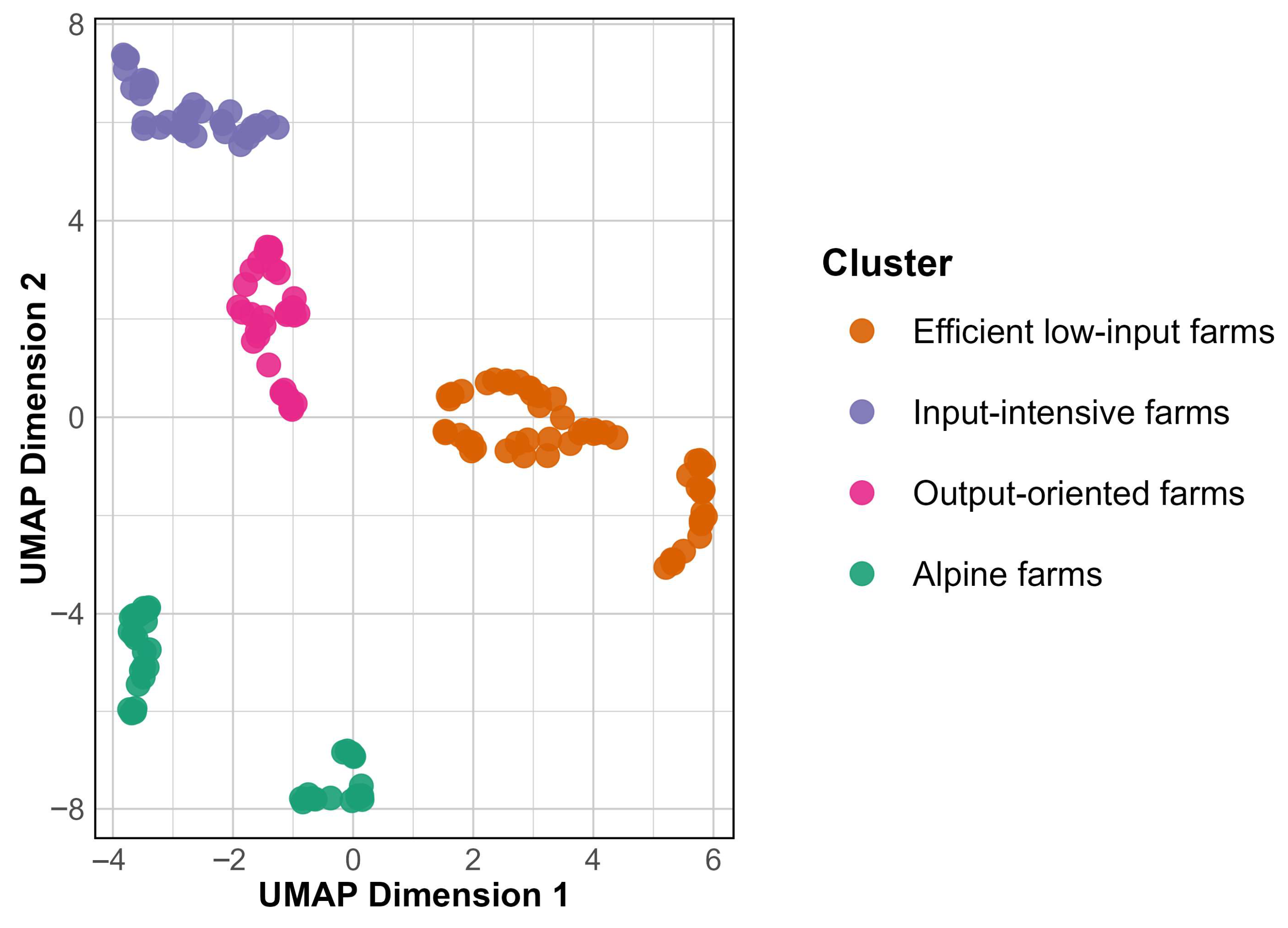
Figure 1. The second UMAP-HDP clustering distinguished between four clusters. Cluster 1 contains 60 of 170 farms (35.3%), Cluster 2 contains 36 farms (21.2%), Cluster 3 contains 33 farms (19.4%), and Cluster 4 contains 41 farms (24.1%).
Sustainability 18 00303 g001
Figure 2. Cluster characteristics based on standardised z-scores comparing each cluster mean to the overall sample mean. The z-score analysis complements the UMAP projection by quantifying how clusters differ along the main latent gradients (production intensity and environmental–management conditions). The x-axis represents farm clusters, and the y-axis shows standardised deviations from the global mean. Point size indicates the magnitude of deviation, and colour intensity reflects direction (red = above average, blue = below average).
Sustainability 18 00303 g002
Table 1. Main indicators and functional units used in the NEU.rind tool to evaluate the sustainability of milk production on dairy farms.
IndicatorsFunctional Units
‘kg ECM’ 1‘ha Farmland’ 2, ‘Farm’ and ‘Cow’
1aGlobal Warming Potential (GWP100)kg CO2-eqkg CO2-eq
1bMethane emissionskg CH4kg CH4
1cDi-nitrous
oxides emissions
kg N2Okg N2O
1dFossil carbon dioxide
emissions
kg CO2kg CO2
2Food/protein supplyHuman-edible feed conversion efficiencykg protein (net/gross)
3BiodiversityPotential species losses
(feed-dependent)
% HNVF 3 Type 1; endangered livestock breeds (y/n)
4Fossil energy demandMJGJ
5Ammonia emission and Acidification (SO2-eq)g NH3, g SO2-eqkg NH3
6Animal Health ScoresScores of cows and calves
7Profit margin
1 ECM = Energy-Corrected Milk. 2 Related to milk production. 3 High Nature Value Farmland.
Table 2. Data sources and (exemplary) parameters used for the NEU.rind sustainability assessments.
Data GroupData SourceParameters on…
Animal DataCattle Data Network (RDV)Animal arrivals and departures, milk yields and milk ingredients, reproduction characteristics, body masses and slaughter performances, health records
Housing & Manure ManagementCattle Data Network (RDV) and manual
entries
Barn systems, type of manure storage,
manure removal and treatments,
manure application
FeedingCattle Data Network (RDV) and manual
entries
Animal diets, including concentrate amounts and roughage proportions,
periods with specific diets
Land ManagementIntegrated Administration and Control
System (IACS)
Grassland and crop type areas with their intensity of use, other biodiversity-related farmland
Economic DataFederal Institute of Agricultural Economics, Rural and Mountain ResearchDefault milk and slaughter cattle prices, costs for replacement animals, costs
related to feed or energy carriers, and other farm inputs
Table 3. Characteristics of farm groups for key sustainability parameters (means ± 1 standard deviation).
Parameter/CharacteristicConventional Dairy Farms in Favoured AreasConventional Alpine Dairy FarmsOrganic Dairy Farms in Favoured AreasOrganic Alpine Dairy Farms
Farms (n)71452925
Herd size—cows (n)46 ± 2035 ± 1933 ± 2026 ± 13
Average lifetime performance (kg ECM 1 per cow)34,749 ± 11,48934,479 ± 14,32635,130 ± 14,96636,695 ± 13,934
Average herd yield
(kg ECM per cow and year)9239 ± 14978722 ± 18657300 ± 16257229 ± 1728
Average productive lifetime 2 (years)3.65 ± 1.243.52 ± 1.565.07 ± 2.264.41 ± 1.94
Proportion of annual time budget on pasture (%)2.8 ± 6.57.5 ± 13.023.4 ± 21.823.0 ± 15.7
Imported feed-nitrogen (%)31.0 ±10.331.8 ±13.215.4 ± 10.617.1 ±14.2
1 Energy-Corrected Milk. 2 For cull cows.
Table 4. Key sustainability parameters by farm cluster (means ± standard deviation).
CharacteristicAlpine
Farms
Efficient Low-input FarmsOutput-
Oriented
Farms
Input-
Intensive Farms
Number of farms (n)41603336
Altitude (m a.s.l.)846 ± 253622 ± 154554 ± 203564 ± 118
Gross margin (€)3755 ± 11853923 ± 11574009 ± 7714277 ± 987
Average lactations 1 (n)3.19 ± 0.723.50 ± 0.862.53 ± 0.303.05 ± 0.36
Average productive lifetime 2 (years)3.94 ± 1.954.45 ± 2.083.12 ± 1.184.01 ± 0.91
kg ECM/cow & year8900 ± 13508655 ± 131010,027 ± 11179819 ± 924
kg CO2/kg ECM –
incl. infrastructure
1.17 ± 0.201.10 ± 0.171.09 ± 0.131.16 ± 0.50
kg CO2/hectare –
incl. infrastructure
11,601 ± 791013,605 ± 540916,183 ± 427618,555 ± 4516
kg CO2/kg ECM –
excl. infrastructure
1.07 ± 0.151.03 ± 0.141.04 ± 0.111.11 ± 0.47
1 Average lactations of live cows at farms. 2 For cull cows.
Table 5. Significant trade-offs between paired environmental indicator results related to the different product- and area-related functional units.
Indicator PairProduct-Related UnitArea-Related Unitp-Value
Human-edible feed conversion efficiency vs.
protein yield
heFCEkg protein from milk/ha<0.001
Acidification potential kg SO2-eq/kg ECMkg SO2-eq/ha<0.001
Global warming potentialkg CO2-eq/kg ECMkg CO2-eq/ha<0.01
Gross margin (€)€/kg ECM€/kg ECM<0.001
Fossil energy demandMJ/kg ECMMJ/kg ECM<0.05
Potential species loss vs.
HNVF proportion
Pot. species losses/kg ECM% HNVF/
total farmland (ha)
<0.05
Disclaimer/Publisher’s Note: The statements, opinions and data contained in all publications are solely those of the individual author(s) and contributor(s) and not of MDPI and/or the editor(s). MDPI and/or the editor(s) disclaim responsibility for any injury to people or property resulting from any ideas, methods, instructions or products referred to in the content.