Energy-Efficient Hydraulics in Heavy Machinery: Technologies, Challenges, and Future Directions

Abstract
1. Introduction
2. Inefficiencies in Traditional Hydraulic Systems
- Throttling losses: A major source of energy waste is control valves, where excess flow is throttled to regulate actuator speed, leading to substantial pressure drops and heat generation [15].
- Leakage: Internal leakage within pumps, motors, and actuators reduces volumetric efficiency and increases energy demand [16].
- Idle losses: Even during standby or low load conditions, pumps continue to circulate fluid, consuming energy without performing useful work [17].
- Low energy recovery: Potential energy during braking or lowering operations is typically dissipated as heat rather than being recovered and reused [18].

3. Technological Innovations in Hydraulic Systems Targeting Throttling Losses
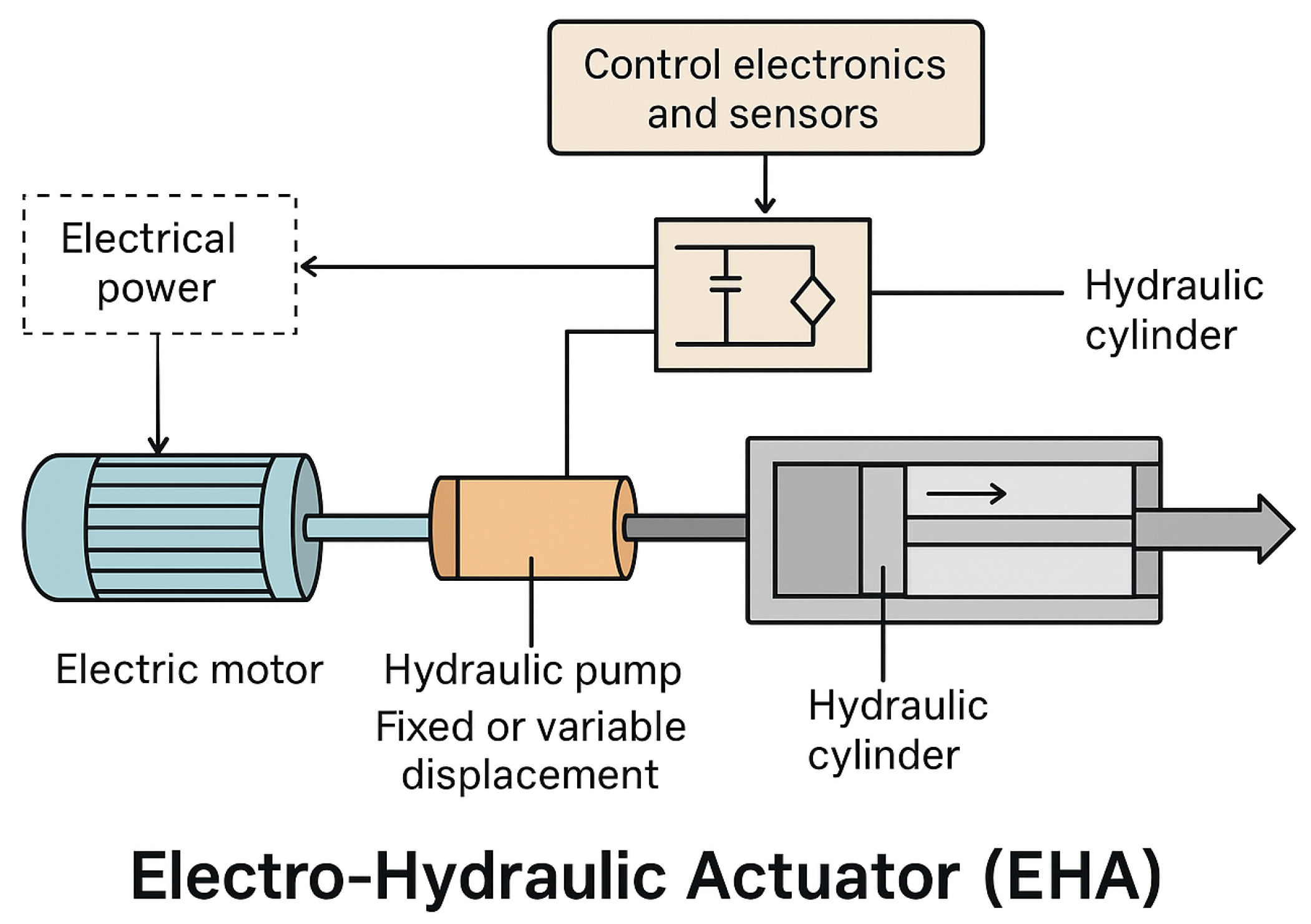
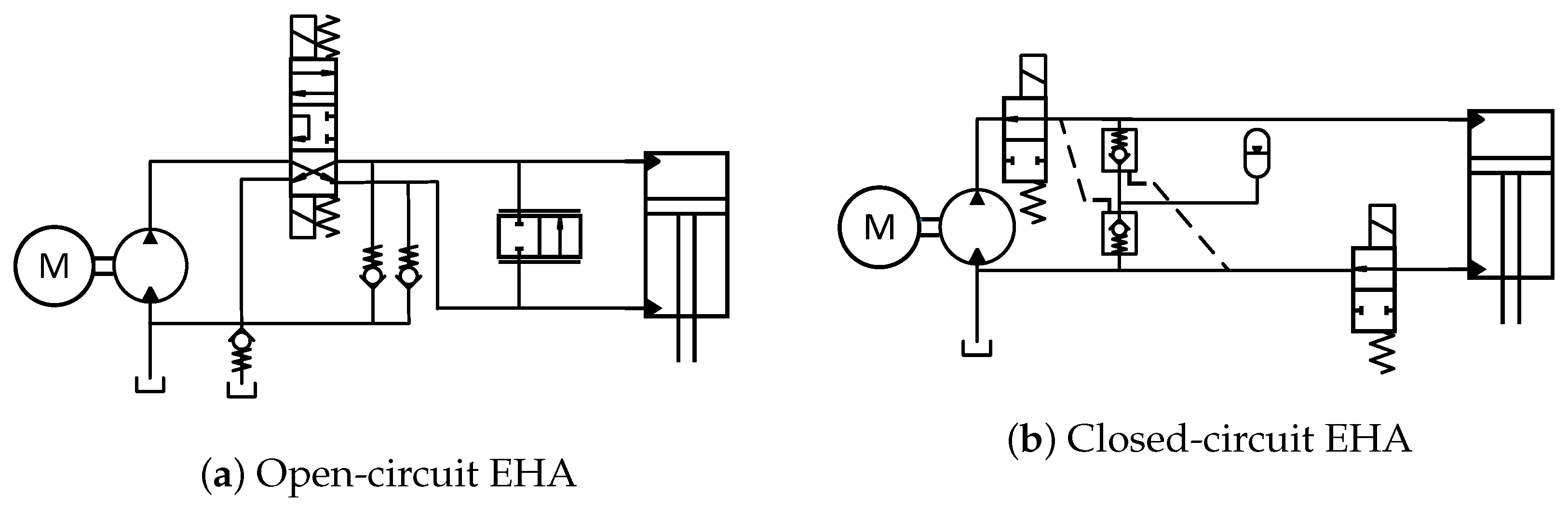
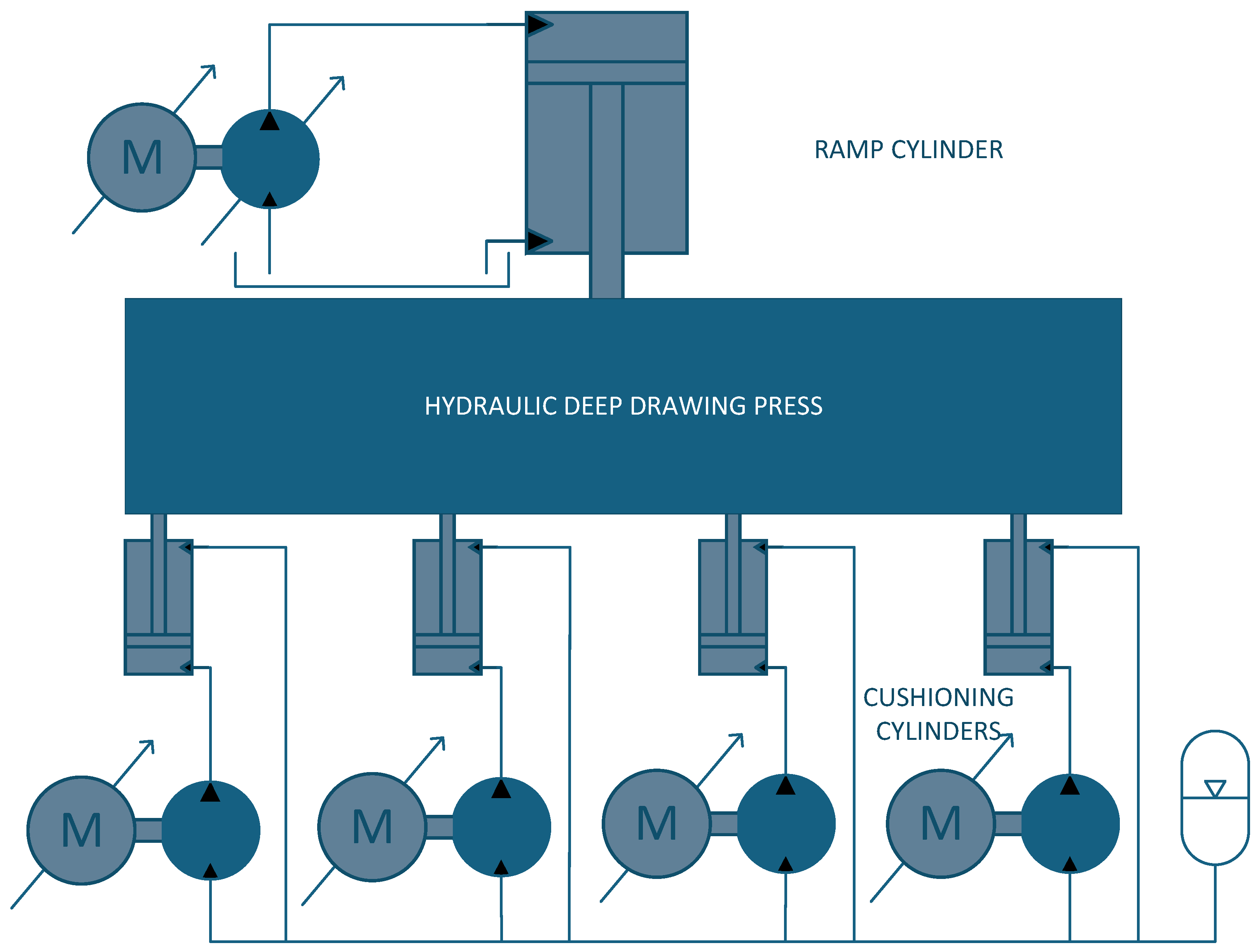
3.1. Electro-Hydraulic Actuators (EHAs)
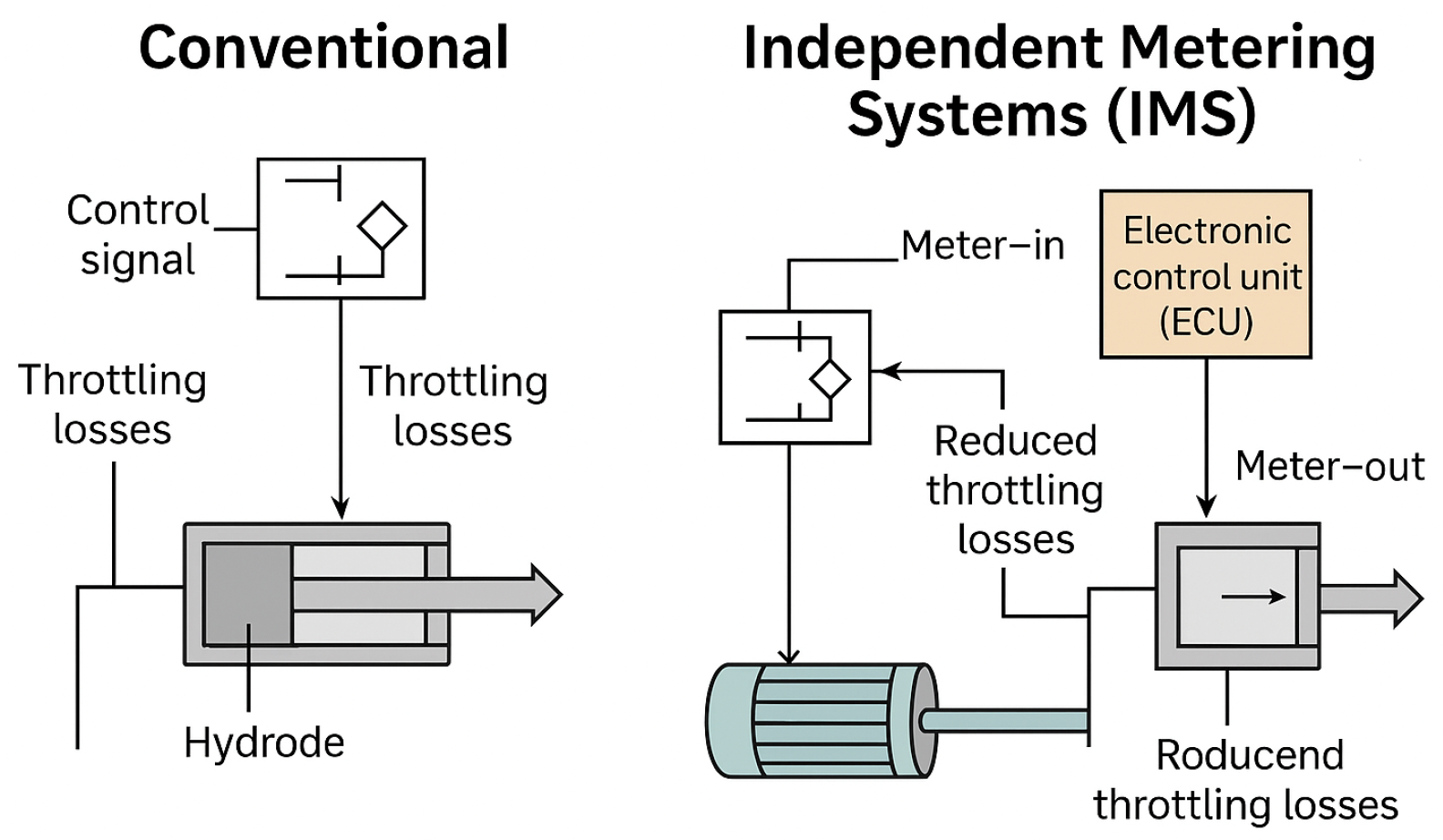
3.2. Independent Metering Systems (IMSs)
3.3. Digital Hydraulics
3.4. Tabular Comparison of Above Technologies
4. Energy Recovery and Hybridization
4.1. Hydraulic Accumulators
| Approach (Using Accumulator) | Application | Main Results / Advances | Reference |
|---|---|---|---|
| Hydraulic accumulator with flywheel integration | Excavator boom energy recovery | Fuel consumption reduced by 10%, energy efficiency improved by 13.7% | Liu et al. [65] |
| Direct hydraulic accumulator recovery | 14-ton wheeled excavator | Fuel savings of 1 liter/hour | Amrhein and Neumann [66] |
| Electro-hydraulic hybrid accumulator system | 38-ton excavator | Fuel savings of 5 liters/hour | Joo and Stangl [67] |
| Load-sensing accumulator system | Excavator boom | Energy-saving efficiency of 9% | Casoli et al. [68] |
| Parallel electro-hydraulic energy recovery system | Excavator | Throttling losses reduced by 60–75%, energy consumption lowered by 24–27% | Liang et al. [69] |
| Three-chamber hydraulic cylinder with accumulator | 76-ton excavator | Energy recovery efficiency of 71% | Hao et al. [70] |
| Independent balancing cylinder with accumulator | 6-ton excavator | Energy recovery efficiency of 50%, peak power output reduced by 64.9% | Xia et al. [71] |
| Electro-hydraulic hybrid drive with lead screw and accumulator | Boom lifting/lowering | Energy savings of 70% | Li et al. [72] |
| Accumulator balancing system with separate recovery/reuse cylinders | Excavator | Energy recovery efficiency of 65.9%, overall energy savings of 41.6% | Jun et al. [73] |
| Hydraulic accumulator with optimized parameters | Hybrid loader actuator | Energy recovery efficiency improved, fuel consumption reduced | Mu et al. [74] |
| NHESC combining air and electric storage | Mini-excavator boom | Regeneration efficiency of 55.1% vs. 41.1% for traditional accumulator | Yao et al. [75] |
| Hydraulic accumulator–motor–generator system | Hybrid hydraulic excavator | Regeneration efficiency of 45%, generator/motor power reduced by 60% | Lin and Wang [76] |
| Digital hydraulic cylinder with accumulator | Lifting/lowering device | Cylinder retraction speed of 74.3 dm/min, flow rate of 24.6 L/min | Pavel et al. [77] |
| Hydraulic accumulator in regenerative suspension | Off-road vehicles | Fuel economy improved by 29.27% | Zhou et al. [78] |
| Dual-accumulator hydraulic hybrid system | Hydraulic hybrid vehicle | Energy recovery efficiency of 43.35% vs. 22.22% for single accumulator | He et al. [79] |
4.2. Hydraulic–Electric Hybrids
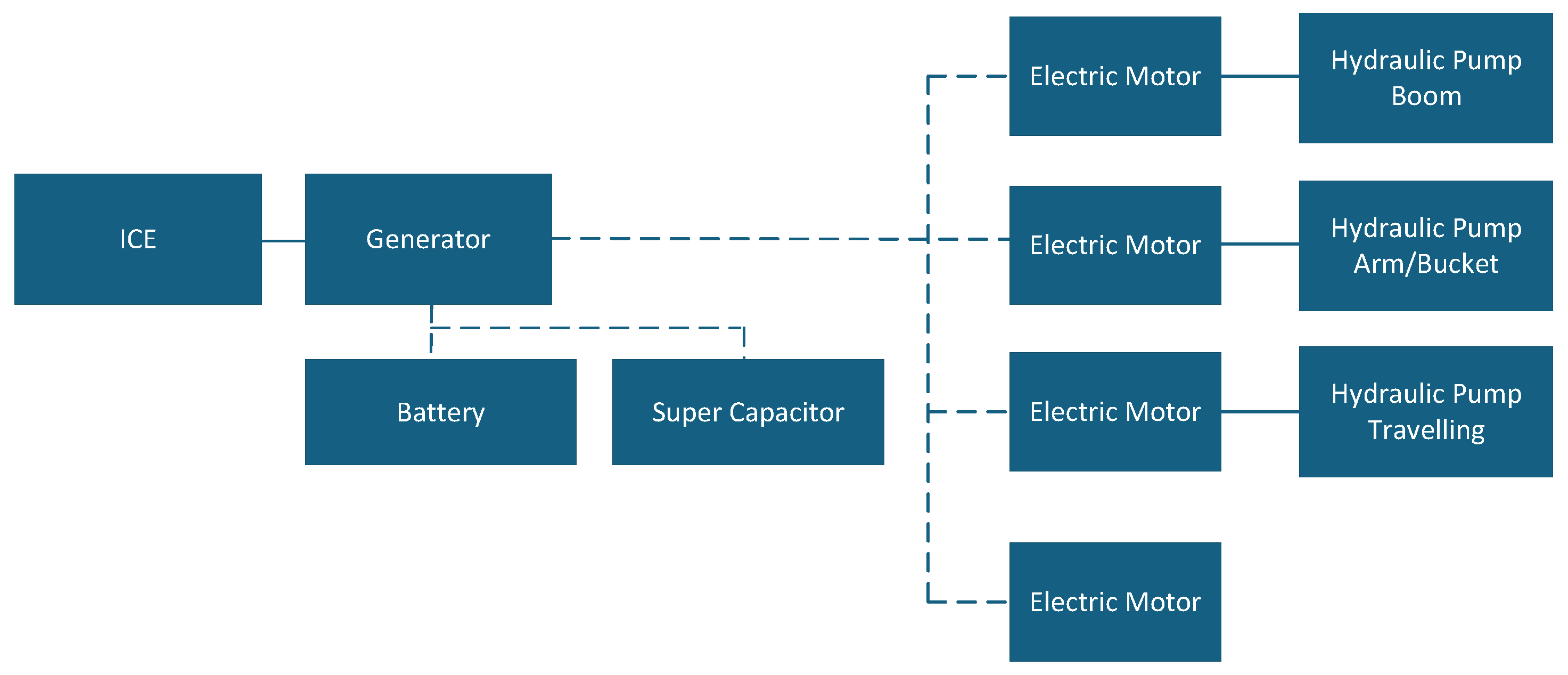
| OEM Model | Weight (ton) | Driving EM Power (kW) | Loading EM Power (kW) | ICE (kW) | HF | Fuel Reduction (%) |
|---|---|---|---|---|---|---|
| Caterpillar D7E | 26 | 2 × 60 | 0 | 176 | 0.40 | 24 |
| Volvo L220F | 32 | 50 | 50 | 259 | 0.16 | 10 |
| Mecalac 12MTX | 8.3 | 20 | 20 | 51 | 0.28 | 20 |
| John Deere 644K | 19 | 80 | 80 | 171 | 0.32 | 25 |
| Merlo TF 40.7 | 7.5 | 60 | 40 | 56 | 0.52 | 30 |
| Claas 6030 | 5.6 | 40 | 0 | 55 | 0.21 | 20 |
| Kobelco SK200H | 20 | 0 | 37 | 114 | 0 | 40 |
| Komatsu HB215 LC-1 | 21 | 20 | 90 | 104 | 0.16 | 25 |
4.3. Advanced Transmission Systems
4.3.1. Hydrostatic Transmission (HST) and Power-Split Systems
4.3.2. Hydro-Mechanical Transmission (HMT) and Variants
| Technology | Application Suitability | Energy-Saving Potential | Cost and System Complexity |
|---|---|---|---|
| Accumulator Recovery [19,53,64,113] | Highly effective in boom and swing motions with intermittent braking and cyclic load profiles common in excavators and loaders | High fuel savings (17–48%) due to 70–86% energy recovery efficiency during high-pressure bursts | Moderate cost increase; requires high-pressure components (3000–5000 PSI) and careful accumulator sizing |
| Series Hydraulic Hybrid [19,114] | Best suited for urban, stop-and-go duty cycles such as refuse trucks and compact construction equipment | Significant energy recovery (>70% regeneration) with fuel savings of 21–35% | High system complexity; requires multiple hydraulic machines and advanced control strategies |
| Parallel Electric Hybrid [115,116] | Ideal for applications with frequent load spikes such as wheel loaders and V-loading cycles | Strong fuel reduction (20–40%) with 60–80% overall system efficiency | High initial cost due to electric machines, power electronics, and energy storage integration |
| Hydrostatic Transmission (HST) [117,118] | Suitable for low-speed, highly cyclic operations requiring precise control, such as compact loaders | Moderate efficiency gains (10–20%) compared to torque converters | Relatively simple architecture but limited efficiency at higher speeds |
| Power-Split Transmission (PST) [99,119] | Well-suited for mixed operating conditions combining cyclic work and higher-speed travel | Improved efficiency (15–25%) over conventional torque converter systems | Moderate-to-high complexity due to mechanical and hydrostatic power paths |
| Hydromechanical Transmission (HMT) [120,121] | Optimal for applications requiring both high cruise speeds and cyclic work, such as agricultural tractors | High overall efficiency (up to 83%) with fuel savings of 20–30% | High design and control complexity; increased manufacturing and maintenance costs |
5. Smart Sensors and Predictive Control
| Feature | Traditional Hydraulics (References) | Smart-Controlled Hydraulics (References) | Comparison |
|---|---|---|---|
| Flow control | Valve throttling in valve-controlled circuits (spool-based metering), causing throttling losses and limited adaptability [125,126,127,128]. | Predictive/on-demand control (MPC, adaptive predictors, RL-based optimization) coordinating pump/valve/cylinder [129,130,131]. | Smart control anticipates load changes and regulates flow/pressure proactively, reducing throttling. |
| Energy recovery | Minimal native recovery; potential energy usually dissipated as heat via throttling/relief [132,133]. | Integrated recovery using accumulators, batteries/supercaps, and hybrid topologies [15,134,135]. | Smart systems capture and reuse potential/kinetic energy, lowering thermal load and power demand. |
| Idle losses | High due to constant or high stand-by pressure/flow; leakage and throttling at partial loads [130,136]. | Reduced via demand-based actuation (variable-speed pumps, digital hydraulics) [137,138]. | Demand-matching lowers stand-by and throttling losses; digital/variable-speed actuation minimizes no-load power. |
| Fault detection | Manual inspection dominates; limited real-time visibility [139,140]. | Sensor-rich monitoring, data fusion, and AI-driven predictive analytics [137,138,139]. | Smart diagnostics enable real-time fault detection, fewer failures, and condition-based maintenance. |
6. Quantitative Comparison of Emerging Actuation and Transmission Technologies
| Technology | Initial Investment | Maintenance Cost (Yearly) | Long-Term Energy Savings |
|---|---|---|---|
| Electro-hydraulic actuator | USD 80,000–100,000/unit [149] | Moderate–High [150] | High (for heavy-duty tasks) [151] |
| Electric actuator | Moderate–High [143] | Low [151] | High (energy efficient) [151] |
| Pneumatic actuator | Low [152] | Moderate [145] | Low–Moderate (typical energy loss) [150] |
| Hybrid transmission system | Moderate–High [153] | Low–Medium (AUD 500–1600/year) [154] | High (15–30% maintenance savings) [154] |
| Renewable energy systems | High [155] | Low (minimal routine) | Very high (lower operating costs; regulatory benefits) [156] |
7. Emerging Trends
| Trend | Focus | Types | Impact | Challenges |
|---|---|---|---|---|
| Fluid Power Electrification [163,164,165,166] | Shift to electric actuators and hybrid systems | Electro-mechanical actuators (EMAs), and electro-hydraulic hybrids | Energy efficiency, reduced emissions, and precise control | High initial cost, integration complexity, and thermal management. |
| Compact High-Pressure Components [167,168,169,170,171] | Reduce size and weight while maintaining energy density | Modular valves, high-strength alloys, and piezoelectric microvalves | Improved maneuverability, reduced fuel consumption, and higher precision | Manufacturing complexity, cost of advanced materials, and fatigue under ultra-high pressure. |
| Eco-Friendly Hydraulic Fluids [172,173,174,175] | Sustainability and environmental compliance | Vegetable oil-based fluids, synthetic esters, and bio-hydraulic fluids | Reduced ecological impact, compliance with ISO 15380 [176] and improved lubrication properties | Higher cost, oxidation stability, and limited temperature range. |
8. Challenges and Future Prospects
| Major Challenge | Future Work/Research Focus |
|---|---|
| Integration Cost | Development of cost-effective modular and scalable electro-hydraulic/electric architectures (common DC buses, modular power stages) and design-for-integration toolchains to reduce engineering hours and bill-of-material premiums over time [199,200]. |
| Reliability | Robust sensing and packaging (wide-bandgap power modules, high-temperature interconnects), physics-of-failure models, and fault tolerance. AI-assisted health monitoring (prognostics and predictive maintenance) validated in real-world duty cycles [201,202]. |
| Standardization | Development and harmonization of open interfaces and safety/efficiency requirements for mobile electro-hydraulics (controllers, DC links, communication, and diagnostics), aligning with international fluid-power safety standards [199,200]. |
9. Conclusions
Author Contributions
Funding
Institutional Review Board Statement
Informed Consent Statement
Data Availability Statement
Acknowledgments
Conflicts of Interest
References
- Drumea, P. Energy Losses in Hydraulic Systems. Articol Hidrolica Digitala-Iasi, FLUIDAS. 2001. Available online: https://fluidas.ro/wp-content/uploads/Articol-Hidraulica-digitala-iasi-Drumea.pdf (accessed on 16 October 2025).
- Helbig, A. Electro-Hydrostatic Actuation Proves Itself in Next-Generation Machines. Moog Industrial Newsletter. 2015. Available online: https://www.moog.com/literature/ICD/moogindustrialnewsletterissue36.pdf (accessed on 16 October 2025).
- Qu, S.; Fassbender, D.; Vacca, A.; Busquets, E. A high-efficient solution for electro-hydraulic actuators with energy regeneration capability. Energy 2021, 216, 119291. [Google Scholar] [CrossRef]
- Wang, H.; Huang, Y.; Khajepour, A.; Hu, C.; Khajepour, A. Electrification of Heavy-Duty Construction Vehicles; Springer: Cham, Switzerland, 2018. [Google Scholar]
- Hager, W.H.; Boes, R.M. Hydraulic structures: A positive outlook into the future. J. Hydraul. Res. 2014, 52, 299–310. [Google Scholar] [CrossRef]
- Chiara, F.; Canova, M. A review of energy consumption, management, and recovery in automotive systems, with considerations of future trends. Proc. Inst. Mech. Eng. Part D J. Automob. Eng. 2013, 227, 914–936. [Google Scholar] [CrossRef]
- Olson, E. Digital Transformation and AI in Energy Systems: Applications, Challenges, and the Path Forward. In Digital Sustainability: Leveraging Digital Technology to Combat Climate Change; Springer Nature: Cham, Switzerland, 2024; pp. 63–79. [Google Scholar]
- Cundiff, J.S. Fluid Power Circuits and Controls: Fundamentals and Applications; CRC Press: Boca Raton, FL, USA, 2001. [Google Scholar]
- Shen, W.; Jiang, J.; Su, X.; Karimi, H.R. Control strategy analysis of the hydraulic hybrid excavator. J. Frankl. Inst. 2015, 352, 541–561. [Google Scholar] [CrossRef]
- Lin, T.; Huang, W.; Ren, H.; Fu, S.; Liu, Q. New compound energy regeneration system and control strategy for hybrid hydraulic excavators. Autom. Constr. 2016, 68, 11–20. [Google Scholar] [CrossRef]
- Sugimura, K.; Murrenhoff, H. Hybrid load sensing—displacement controlled architecture for excavators. In Proceedings of the 14th Scandinavian International Conference on Fluid Power, Tampere, Finland, 20–22 May 2015; pp. 20–22. [Google Scholar]
- Cheng, M.; Xu, B.; Zhang, J.; Ding, R. Pump-Based Compensation for Dynamic Improvement of the Electrohydraulic Flow Matching System. IEEE Trans. Ind. Electron. 2017, 64, 2903–2913. [Google Scholar] [CrossRef]
- Wang, B. High Speed On-Off Valve Self-adapting Clamping System. J. Appl. Sci. 2014, 14, 279–284. [Google Scholar] [CrossRef]
- Shen, W.; Jiang, J. Analysis and development of the hydraulic secondary regulation system based on the CPR. In Proceedings of the 2011 International Conference on Fluid Power and Mechatronics, Beijing, China, 17–20 August 2011. [Google Scholar] [CrossRef]
- Alemdaroglu, U.; Guler, Z.; Sevim, S.; Dalkiran, F. Energy efficiency by reducing throttling losses in hydraulic systems. J. Mechatronics Artif. Intell. Eng. 2023, 4, 1–7. [Google Scholar] [CrossRef]
- Understanding Hydraulic Leaks: Causes, Impacts, Detection, and Solutions for Hydraulic Fluid Loss—SHUNTEC — shuntecpress.com. Available online: https://www.shuntecpress.com/blog/hydraulic-leak-causes-impacts-solutions/ (accessed on 22 September 2025).
- Vukovic, M.; Leifeld, R.; Murrenhoff, H. Reducing Fuel Consumption in Hydraulic Excavators—A Comprehensive Analysis. Energies 2017, 10, 687. [Google Scholar] [CrossRef]
- He, A.; Wei, L.; Lu, Q.; He, P. An Investigation of Energy Consumption Characteristics of the Pump-Control System for Electric Excavator Arms. Appl. Sci. 2024, 14, 10791. [Google Scholar] [CrossRef]
- Shen, W.; Jiang, J.; Su, X.; Karimi, H.R. Energy-Saving Analysis of Hydraulic Hybrid Excavator Based on Common Pressure Rail. Sci. World J. 2013, 2013, 560694. [Google Scholar] [CrossRef] [PubMed]
- Ge, L.; Quan, L.; Zhang, X.; Zhao, B.; Yang, J. Efficiency improvement and evaluation of electric hydraulic excavator with speed and displacement variable pump. Energy Convers. Manag. 2017, 150, 62–71. [Google Scholar] [CrossRef]
- Rydberg, K.E. Energy efficient hydraulics: System solutions for loss minimization. In Proceedings of the National Conference on Fluid Power, “Hydraulikdagar’15”, Linköping, Sweden, 16–17 March 2015. [Google Scholar]
- Schmidt, L.; van Binsbergen-Galán, M.; Knöll, R.; Riedmann, M.; Schneider, B.; Heemskerk, E. Energy Efficient Excavator Implement by Electro-Hydraulic/Mechanical Drive Network. Int. J. Fluid Power 2024, 25, 413–438. [Google Scholar] [CrossRef]
- Qiao, S.; Quan, L.; Hao, Y.; Ge, L.; Xia, L. Design and characteristic research of a novel electromechanical-hydraulic hybrid actuator with two transmission mechanisms. Front. Mech. Eng. 2023, 18, 19. [Google Scholar] [CrossRef]
- Shi, C.; Wang, W.; Wang, S.; Liu, D.; Zhao, S. Dynamic Heat Exchange Law Analysis Between the Permanent Magnet Synchronous Motor and Closed Hydraulic System of Wet Electro-hydrostatic Actuator. Arab. J. Sci. Eng. 2025, 50, 18759–18776. [Google Scholar] [CrossRef]
- Schmidt, L.; van Binsbergen-Galán, M. Electro-Hydraulic Variable-Speed Drive Network Technology—First Experimental Validation. Energies 2024, 17, 3192. [Google Scholar] [CrossRef]
- Helbig, A. Electro-Hydrostatic Actuation: An Attractive Energy-Efficient Option for Machine Builders; White Paper; Moog Inc.: Elma, NY, USA, 2014; Available online: https://www.moog.com/content/dam/moog/literature/ICD/Moog-Actuators-EHA-Whitepaper-en.pdf (accessed on 16 October 2025).
- Du, C.; Plummer, A.R.; Johnston, D.N. Performance analysis of a new energy-efficient variable supply pressure electro-hydraulic motion control method. Control Eng. Pract. 2017, 60, 87–98. [Google Scholar] [CrossRef]
- Hagen, D.; Padovani, D.; Choux, M. Enabling Energy Savings in Offshore Mechatronic Systems by using Self-Contained Cylinders. Model. Identif. Control 2019, 40, 89–108. [Google Scholar] [CrossRef]
- Chiang, M.H.; Yeh, Y.P.; Yang, F.L.; Chen, Y.N. Integrated control of clamping force and energy-saving in hydraulic injection moulding machines using decoupling fuzzy sliding-mode control. Int. J. Adv. Manuf. Technol. 2005, 27, 53–62. [Google Scholar] [CrossRef]
- Cho, S.H.; Noskievič, P. Position tracking control with load-sensing for energy-saving valve-controlled cylinder system. J. Mech. Sci. Technol. 2012, 26, 617–625. [Google Scholar] [CrossRef]
- Yoon, J.I.; Truong, D.Q.; Ahn, K.K. A generation step for an electric excavator with a control strategy and verifications of energy consumption. Int. J. Precis. Eng. Manuf. 2013, 14, 755–766. [Google Scholar] [CrossRef]
- Wang, W.; Wang, B. An energy-saving control strategy with load sensing for electro-hydraulic servo systems. Stroj. Vestnik/J. Mech. Eng. 2016, 62, 709–716. [Google Scholar] [CrossRef]
- Lovrec, D.; Kastrevc, M.; Ulaga, S. Electro-hydraulic load sensing with a speed-controlled hydraulic supply system on forming-machines. Int. J. Adv. Manuf. Technol. 2009, 41, 1066–1075. [Google Scholar] [CrossRef]
- Li, Z.; Song, J.; Huang, Y.; Li, Y.; Chen, J. Design and analysis for a new energy-saving hydraulic pumping unit. Proc. Inst. Mech. Eng. Part C J. Mech. Eng. Sci. 2018, 232, 2119–2131. [Google Scholar] [CrossRef]
- Nguyen, T.H.; Do, T.C.; Ahn, K.K. A study on a new independent metering valve for hydraulic boom excavator. Appl. Sci. 2022, 12, 605. [Google Scholar] [CrossRef]
- Liu, S.; Yao, B. Coordinate control of energy saving programmable valves. IEEE Trans. Control Syst. Technol. 2008, 16, 34–45. [Google Scholar] [CrossRef]
- Gong, J.; Zhang, D.; Liu, C.; Zhao, Y.; Hu, P.; Quan, W. Optimization of electro-hydraulic energy-savings in mobile machinery. Autom. Constr. 2019, 98, 132–145. [Google Scholar] [CrossRef]
- Wrat, G.; Das, J. Energy saving in off-road vehicles using leakage compensation technique. arXiv 2025, arXiv:2509.20926. [Google Scholar] [CrossRef]
- Axin, M.; Eriksson, B.; Krus, P. Flow versus pressure control of pumps in mobile hydraulic systems. Proc. Inst. Mech. Eng. Part I J. Syst. Control Eng. 2014, 228, 245–256. [Google Scholar] [CrossRef]
- Lu, L.; Yao, B.; Liu, Z. Energy saving control of a hydraulic manipulator using five cartridge valves and one accumulator. Ifac Proc. Vol. 2013, 46, 84–90. [Google Scholar] [CrossRef]
- Ding, R.; Zhang, J.; Xu, B.; Cheng, M.; Pan, M. Energy efficiency improvement of heavy-load mobile hydraulic manipulator with electronically tunable operating modes. Energy Convers. Manag. 2019, 188, 447–461. [Google Scholar] [CrossRef]
- Wang, H.; Feng, Z. A Review of Flow Saturation Resistant Techniques in Multi-actuators Load Sensing Hydraulic System. J. Eng. Mech. Mach. 2023, 8, 42–51. [Google Scholar] [CrossRef]
- Eriksson, B.; Palmberg, J.O. Individual metering fluid power systems: Challenges and opportunities. Proc. Inst. Mech. Eng. Part I J. Syst. Control Eng. 2011, 225, 196–211. [Google Scholar] [CrossRef]
- Heikkilä, M.; Linjama, M. Displacement control of a mobile crane using a digital hydraulic power management system. Mechatronics 2013, 23, 452–461. [Google Scholar] [CrossRef]
- Huova, M.; Aalto, A.; Linjama, M.; Huhtala, K.; Lantela, T.; Pietola, M. Digital hydraulic multi-pressure actuator–the concept, simulation study and first experimental results. Int. J. Fluid Power 2017, 18, 141–152. [Google Scholar] [CrossRef]
- Busquets, E.; Ivantysynova, M. Temperature prediction of displacement controlled multi-actuator machines. Int. J. Fluid Power 2013, 14, 25–36. [Google Scholar] [CrossRef]
- Larsson, L.V.; Lejonberg, R.; Ericson, L. Optimisation of a Pump-Controlled Hydraulic System using Digital Displacement Pumps. Int. J. Fluid Power 2022, 53–78. [Google Scholar]
- Rampen, W.; Munko, M.J.; Dubon, S.L.; Cuthill, F. Regenerative Structural Fatigue Testing with Digital Displacement Pump/Motors. Actuators 2025, 14, 103. [Google Scholar] [CrossRef]
- Choi, K.; Seo, J.; Nam, Y.; Kim, K.U. Energy-saving in excavators with application of independent metering valve. J. Mech. Sci. Technol. 2015, 29, 387–395. [Google Scholar] [CrossRef]
- Pan, M.; Plummer, A.; El Agha, A. Theoretical and experimental studies of a switched inertance hydraulic system in a four-port high-speed switching valve configuration. Energies 2017, 10, 780. [Google Scholar] [CrossRef]
- Yuan, C.; Plummer, A.; Pan, M. Switching characteristics of a high-speed rotary valve for switched inertance hydraulic converters. Proc. Inst. Mech. Eng. Part I J. Syst. Control Eng. 2022, 236, 1421–1441. [Google Scholar] [CrossRef]
- Do, T.C.; Nguyen, D.G.; Dang, T.D.; Ahn, K.K. A boom energy regeneration system of hybrid hydraulic excavator using energy conversion components. Actuators 2020, 10, 1. [Google Scholar] [CrossRef]
- Yue, D.; Gao, H.; Liu, Z.; Wei, L.; Liu, Y.; Zuo, X. Potential energy recovery and direct reuse system of hydraulic hybrid excavators based on the digital pump. Energies 2023, 16, 5229. [Google Scholar] [CrossRef]
- Li, W.; Wu, B.; Cao, B. Control strategy of a novel energy recovery system for parallel hybrid hydraulic excavator. Adv. Mech. Eng. 2015, 7, 1687814015613769. [Google Scholar] [CrossRef]
- Yu, Y.X.; Ahn, K.K. Energy regeneration and reuse of excavator swing system with hydraulic accumulator. Int. J. Precis. Eng. -Manuf.-Green Technol. 2020, 7, 859–873. [Google Scholar] [CrossRef]
- Wrat, G.; Ranjan, P.; Jose, J.T.; Kumar, R. Innovative Energy-Saving Techniques in Construction and Heavy Machinery. In AI-Driven Environmental Pollution Management; Springer: Cham, Switzerland, 2025; pp. 267–277. [Google Scholar]
- Cao, H. Kinetic energy recovery and reuse of traveling drive system of hybrid hydraulic electric loader. Adv. Mech. Eng. 2025, 17, 16878132251322027. [Google Scholar] [CrossRef]
- Macor, A.; Benato, A.; Rossetti, A.; Bettio, Z. Study and simulation of a hydraulic hybrid powertrain. Energy Procedia 2017, 126, 1131–1138. [Google Scholar] [CrossRef]
- Minav, T.; Hänninen, H.; Sinkkonen, A.; Laurila, L.; Pyrhönen, J. Electric or hydraulic energy recovery systems in a reach truck—A comparison. Stroj. Vestn./J. Mech. Eng. 2014, 60, 232–240. [Google Scholar] [CrossRef]
- Costa, G.K.; Sepehri, N. Hydraulic accumulators in energy efficient circuits. Front. Mech. Eng. 2023, 9, 1163293. [Google Scholar] [CrossRef]
- Ranjan, P.; Bhola, M.; Wrat, G.; Mishra, S.K.; Das, J. Performance enhancement of hybrid hydraulic excavator using multiple hydro-pneumatic accumulators. Proc. Inst. Mech. Eng. Part I J. Syst. Control Eng. 2020, 234, 1133–1149. [Google Scholar] [CrossRef]
- Singh, S.; Kumar, A.; Thakur, S. Development of an Accumulator-Based Energy Regenerative Technology (AERT) for the Hydraulic Swing Mechanism of an Excavator Machine. In Proceedings of the Conference on Fluid Mechanics and Fluid Power; Springer: Berlin/Heidelberg, Germany, 2023; pp. 221–232. [Google Scholar]
- Latas, W.; Stojek, J. A new type of hydrokinetic accumulator and its simulation in hydraulic lift with energy recovery system. Energy 2018, 153, 836–848. [Google Scholar] [CrossRef]
- Yang, C.; Zhou, L.; Wang, J.; Xu, T.; Yang, C.; Ye, G. Research on energy saving system of hydraulic excavator based on three-chamber accumulator. J. Energy Storage 2023, 72, 108571. [Google Scholar] [CrossRef]
- Liu, Y.; Xu, Z.; Hua, L.; Zhao, X. Analysis of energy characteristic and working performance of novel controllable hydraulic accumulator with simulation and experimental methods. Energy Convers. Manag. 2020, 221, 113196. [Google Scholar] [CrossRef]
- Amrhein, J.; Neumann, U. PRB—Regeneration of potential energy while boom-down. In Proceedings of the 8th International Fluid Power Conference, Dresden, Germany, 26–28 March 2012; Volume 2, pp. 69–72. [Google Scholar]
- Joo, C.; Stangl, M. Application of Power Regenerative Boom system to excavator. Int. Fluid Power Conf. 2016, 3, 175–184. [Google Scholar]
- Casoli, P.; Riccò, L.; Campanini, F.; Bedotti, A. Hydraulic hybrid excavator—Mathematical model validation and energy analysis. Energies 2016, 9, 1002. [Google Scholar] [CrossRef]
- Liang, T.; Quan, L.; Ge, L.; Xia, L.; Wang, C. An energy-saving scheme to reduce throttling losses in hydraulic excavators based on electro-hydraulic energy storage. IEEE Access 2024, 12, 125043–125056. [Google Scholar] [CrossRef]
- Hao, Y.; Quan, L.; Cheng, H.; Xia, L.; Ge, L.; Zhao, B. Potential energy directly conversion and utilization methods used for heavy duty lifting machinery. Energy 2018, 155, 242–251. [Google Scholar] [CrossRef]
- Xia, L.; Quan, L.; Ge, L.; Hao, Y. Energy efficiency analysis of integrated drive and energy recuperation system for hydraulic excavator boom. Energy Convers. Manag. 2018, 156, 680–687. [Google Scholar] [CrossRef]
- Li, Z.; Wang, C.; Quan, L.; Hao, Y.; Ge, L.; Xia, L. Study on energy efficiency characteristics of the heavy-duty manipulator driven by electro-hydraulic hybrid active-passive system. Autom. Constr. 2021, 125, 103646. [Google Scholar] [CrossRef]
- Jun, G.; Daqing, Z.; Yong, G.; Zhongyong, T.; Changsheng, L.; Peng, H.; Yuming, Z.; Weicai, Q.; Yongping, J. Potential energy recovery method based on alternate recovery and utilization of multiple hydraulic cylinders. Autom. Constr. 2020, 112, 103105. [Google Scholar] [CrossRef]
- Mu, H.; Luo, Y.; Luo, Y.; Chen, L. Numerical analysis of energy recovery of hybrid loader actuators based on parameters optimization. Actuators 2022, 11, 260. [Google Scholar] [CrossRef]
- Yao, J.; He, X.; Yang, Y.; Zhu, Y.; Xiao, G.; Huang, Y. Design and Analysis of a Novel Hydraulic Energy Storage Component. Machines 2025, 13, 325. [Google Scholar] [CrossRef]
- Lin, T.; Wang, Q. Hydraulic accumulator-motor-generator energy regeneration system for a hybrid hydraulic excavator. Chin. J. Mech. Eng. 2012, 25, 1121–1129. [Google Scholar] [CrossRef]
- Pavel, I.; Matache, G.; Șefu, Ș.M. Recovery of Potential Energy by Using a Digital Hydraulic Cylinder. Hidraulica 2024, 3, 74–79. [Google Scholar]
- Zhou, H.; Xu, Z.; Liu, L.; Liu, D.; Zhang, L. Modelling and Control of a Novel Hydraulic Hybrid Vehicle with Wheel Motors. In Proceedings of the 2018 IEEE International Conference on Mechatronics and Automation (ICMA), Changchun, China, 5–8 August 2018; pp. 1985–1990. [Google Scholar]
- He, X.; Liu, H.; He, S.; Hu, B.; Xiao, G. Research on the energy efficiency of energy regeneration systems for a battery-powered hydrostatic vehicle. Energy 2019, 178, 400–418. [Google Scholar] [CrossRef]
- Bender, F.A.; Bosse, T.; Sawodny, O. An investigation on the fuel savings potential of hybrid hydraulic refuse collection vehicles. Waste Manag. 2014, 34, 1577–1583. [Google Scholar] [CrossRef]
- Wang, H.; Huang, Y.; Khajepour, A.; He, H.; Cao, D. A novel energy management for hybrid off-road vehicles without future driving cycles as a priori. Energy 2017, 133, 929–940. [Google Scholar] [CrossRef]
- Beltrami, D.; Iora, P.; Tribioli, L.; Uberti, S. Electrification of compact off-highway vehicles—overview of the current state of the art and trends. Energies 2021, 14, 5565. [Google Scholar] [CrossRef]
- Journal, F.P. Electrification & Hybrid Trends in Heavy Construction Equipment—Fluidpowerjournal.com. Available online: https://fluidpowerjournal.com/electrification-hybrid-trends-in-heavy-construction-equipment/ (accessed on 1 October 2025).
- Lin, T.; Wang, Q.; Hu, B.; Gong, W. Development of hybrid powered hydraulic construction machinery. Autom. Constr. 2010, 19, 11–19. [Google Scholar] [CrossRef]
- Sprengel, M.; Bleazard, T.; Haria, H.; Ivantysynova, M. Implementation of a novel hydraulic hybrid powertrain in a sports utility vehicle. IFAC-PapersOnLine 2015, 48, 187–194. [Google Scholar] [CrossRef]
- Wang, Z.; Jiao, X.; Pu, Z.; Han, L. Energy recovery and reuse management for fuel-electric-hydraulic hybrid powertrain of a construction vehicle. IFAC-PapersOnLine 2018, 51, 390–393. [Google Scholar] [CrossRef]
- Somà, A. Trends and hybridization factor for heavy-duty working vehicles. Hybrid Electr. Veh. 2017, 3–32. [Google Scholar] [CrossRef]
- Truong, D.Q.; Marco, J.; Greenwood, D.; Harper, L.; Corrochano, D.; Yoon, J. Challenges of micro/mild hybridisation for construction machinery and applicability in UK. Renew. Sustain. Energy Rev. 2018, 91, 301–320. [Google Scholar] [CrossRef]
- Stein, G.; Fröberg, A.; Martinsson, J.; Brattberg, B.; Filla, R.; Unnebäck, J. Fuel efficiency in construction equipment-optimize the machine as one system. In Proceedings of the 7th AVL International Commercial Powertrain Conference, AVL & SAE, Graz, Austria, 22–23 May 2013; p. 8. [Google Scholar]
- Filla, R. Alternative system solutions for wheel loaders and other construction equipment. In Proceedings of the 1st CTI Forum Alternative, Electric and Hybrid Drive Trains, Berlin, Germany, 1–2 December 2008. [Google Scholar]
- Available online: https://www.machinio.com/ (accessed on 15 December 2025).
- Bertini, A.; Ceraolo, M.; Lutzemberger, G. Systematic approach in the hybridization of a hydraulic skid loader. Autom. Constr. 2015, 58, 144–154. [Google Scholar] [CrossRef]
- Bravo, R.R.S.; De Negri, V.J.; Oliveira, A.A.M. Design and analysis of a parallel hydraulic–pneumatic regenerative braking system for heavy-duty hybrid vehicles. Appl. Energy 2018, 225, 60–77. [Google Scholar] [CrossRef]
- Trajkovic, S. The Pneumatic Hybrid Vehicle-A New Concept for Fuel Consumption Reduction. 2010. Available online: https://www.lunduniversity.lu.se/lup/publication/b39e24a1-59f4-4018-8253-f60975126a03 (accessed on 16 October 2025).
- Kim, Y.J.; Filipi, Z. Simulation study of a series hydraulic hybrid propulsion system for a light truck. SAE Trans. 2007, 116, 147–161. [Google Scholar]
- Committee to Assess Fuel Economy Technologies for Medium- and Heavy-Duty Vehicles; Board on Energy and Environmental Systems; Division on Engineering and Physical Sciences; Transportation Research Board; National Research Council. Technologies and Approaches to Reducing the Fuel Consumption of Medium-and Heavy-Duty Vehicles; National Academies Press: Washington, DC, USA, 2010. [Google Scholar] [CrossRef]
- U.S. Environmental Protection Agency (EPA). Electric vehicle myths. In EPA Green Vehicle Guide; U.S. Environmental Protection Agency (EPA): Washington, DC, USA, 2025. Available online: https://www.epa.gov/greenvehicles/electric-vehicle-myths (accessed on 16 October 2025).
- Bhola, M.; Kumar, N.; Ghoshal, S. Reducing fuel consumption of Front End Loader using regenerative hydro-static drive configuration-an experimental study. Energy 2018, 162, 158–170. [Google Scholar] [CrossRef]
- Lyu, C.; Yanqing, Z.; Meng, L. Loader power-split transmission system based on a planetary gear set. Adv. Mech. Eng. 2018, 10, 1687814017747735. [Google Scholar] [CrossRef]
- Bhola, M.; Kumar, A.; Kumar, N. Energy-efficient control of hydrostatic transmission of a front-end loader machine using machine learning algorithm and its sensitivity analysis. Proc. Inst. Mech. Eng. Part D J. Automob. Eng. 2023, 237, 3031–3053. [Google Scholar] [CrossRef]
- Ghoshal, S.K.; Pandey, A.K.; Dasgupta, K.; Bhola, M. A segmental pump-motor control scheme to attain targeted speed under varying load demand of a hydraulic drive used in heavy earth movers. Mechatronics 2021, 80, 102681. [Google Scholar] [CrossRef]
- Kumar, N.; Bhola, M.; Singh, V.P. Displacement control optimization of hydro-static transmission system containing variable displacement pump and hydro-motor of a front-end loader. Proc. Inst. Mech. Eng. Part D J. Automob. Eng. 2025, 239, 6184–6204. [Google Scholar] [CrossRef]
- Gottschalk, M.; Jacobs, G.; Kramer, A. Test method for evaluating the energy efficiency of wheel loaders. Atzoffhighway Worldw. 2018, 11, 44–49. [Google Scholar] [CrossRef]
- Xiong, S.; Wilfong, G.; Lumkes, J., Jr. Components sizing and performance analysis of hydro-mechanical power split transmission applied to a wheel loader. Energies 2019, 12, 1613. [Google Scholar] [CrossRef]
- Krauss, A.; Ivantysynova, M. Power split transmissions versus hydrostatic multiple motor concepts–A comparative analysis. SAE Trans. 2004, 113, 403–414. [Google Scholar]
- Sannelius, M.; Rydberg, K.E.; Palmberg, J.O. Hydrostatic Transmissions for Wheel Loaders-An Experimental Study of Amultiple-Motor Concept. In Proceedings of the JFPS International Symposium on Fluid Power, Toyama, Japan, 15–18 September 2008; The Japan Fluid Power System Society: Tokyo, Japan, 1999; Volume 1999, pp. 499–506. [Google Scholar]
- Sun, C. Hydrostatic-Mechanical Power Split CVT. Master Thesis, Tampere University of Technology, Tampere, Finland, 2010. [Google Scholar]
- Pettersson, K. Design Automation of Complex Hydromechanical Transmissions; Linkopings Universitet: Linköping, Sweden, 2013. [Google Scholar]
- Mercati, I.S.; Panizzolo, F.; Profumo, G. Power split Hydro-mechanical Variable Transmission (HVT) for off-highway application. Int. Fluid Power Conf. 2016, 8, 69–80. [Google Scholar]
- Liu, X.; Sun, D.; Qin, D.; Liu, J. Achievement of fuel savings in wheel loader by applying hydrodynamic mechanical power split transmissions. Energies 2017, 10, 1267. [Google Scholar] [CrossRef]
- Liu, F.; Wu, W.; Hu, J.; Yuan, S. Design of multi-range hydro-mechanical transmission using modular method. Mech. Syst. Signal Process. 2019, 126, 1–20. [Google Scholar] [CrossRef]
- You, Y.; Sun, D.; Qin, D. Shift strategy of a new continuously variable transmission based wheel loader. Mech. Mach. Theory 2018, 130, 313–329. [Google Scholar] [CrossRef]
- Li, W.; Cao, B.; Zhu, Z.; Chen, G. A novel energy recovery system for parallel hybrid hydraulic excavator. Sci. World J. 2014, 2014, 184909. [Google Scholar] [CrossRef] [PubMed][Green Version]
- Board on Energy and Environmental Systems; National Academies of Sciences, Engineering, and Medicine. Reducing Fuel Consumption and Greenhouse Gas Emissions of Medium-and Heavy-Duty Vehicles, Phase Two; National Academies Press: Washington, DC, USA, 2020. [Google Scholar]
- Kakichi, Y.; Pischinger, S.; Schaub, J.; Müller, A.; Kawano, R. Parallel-Series Hybrid Powertrain Concept for a Wheel Loader. In Proceedings of the International MTZ Conference on Heavy-Duty Engines, Stuttgart, Germany, 24–25 May 2022; Springer: Berlin/Heidelberg, Germany, 2022; pp. 120–133. [Google Scholar]
- Lin, Z.; Wang, F.; Xu, B. Improving wheel loader energy efficiency with a series electric hybrid powertrain. In Proceedings of the Fluid Power Systems Technology. American Society of Mechanical Engineers, Bath, UK, 14–16 September 2022; Volume 86335, p. V001T01A019. [Google Scholar]
- Wang, X.; Wang, Z.; Xie, L.; Wang, S.; Wang, Z.; Ma, W. Research on the new hydrostatic transmission system of wheel loaders based on fuzzy sliding mode control. Energies 2024, 17, 565. [Google Scholar] [CrossRef]
- Wang, F.; Zhang, H.; Sun, D.; Xu, B. An optimal-pressure control strategy for hydrostatic wheel loader. Proc. Inst. Mech. Eng. Part I J. Syst. Control Eng. 2023, 237, 779–790. [Google Scholar] [CrossRef]
- Bertolin, M.; Vacca, A. An energy efficient power-split hybrid transmission system to drive hydraulic implements in construction machines. J. Dyn. Syst. Meas. Control 2021, 143, 101005. [Google Scholar] [CrossRef]
- Baek, S.M.; Kim, W.S.; Kim, Y.S.; Baek, S.Y.; Kim, Y.J. Design of the hydro-mechanical transmission for a 55kW-class agricultural tractor. J. Drive Control 2020, 17, 19–27. [Google Scholar]
- Zhu, Z.; Yang, Y.; Wang, D.; Cai, Y.; Lai, L. Energy saving performance of agricultural tractor equipped with mechanic-electronic-hydraulic powertrain system. Agriculture 2022, 12, 436. [Google Scholar] [CrossRef]
- Sayal, A.; N, C.; Jha, J.; Allagari, N. AI-based predictive maintenance strategies for improving the reliability of green power systems. In Digital Technologies to Implement the UN Sustainable Development Goals; Springer: Cham, Switzerland, 2024; pp. 19–46. [Google Scholar]
- Smart Sensor Technology—IEEE Digital Reality— digitalreality.ieee.org. Available online: https://digitalreality.ieee.org/publications/smart-sensor-technology (accessed on 8 October 2025).
- Ha, V.T.; Dan, B. Dual-Layer Predictive Energy Control in High-Speed Trains Using Adaptive Observers. Int. J. Automot. Technol. 2025, 1–22. [Google Scholar] [CrossRef]
- Gu, W.; Yao, J.; Yao, Z.; Zheng, J. Output feedback model predictive control of hydraulic systems with disturbances compensation. ISA Trans. 2019, 88, 216–224. [Google Scholar] [CrossRef] [PubMed]
- Wrat, G.; Jose, J.T.; Ranjan, P.; Kumar, R. Sustainable Dozer Technologies by Evaluating Servo and Hydraulic Pilot Actuated Control Systems. In AI-Driven Environmental Pollution Management; Springer: Cham, Switzerland, 2025; p. 279. [Google Scholar]
- Zhang, J.; Feng, X.; Xiong, S.; Wu, Q. Predictive function optimization control strategy of hydraulic servo system. In Proceedings of the 33rd Chinese Control Conference, Nanjing, China, 28–30 July 2014; pp. 7758–7762. [Google Scholar]
- Hagen, D.; Padovani, D.; Choux, M. A Comparison Study of a Novel Self-Contained Electro-Hydraulic Cylinder versus a Conventional Valve-Controlled Actuator—Part 1: Motion Control. Actuators 2019, 8, 79. [Google Scholar] [CrossRef]
- Liem, D.T.; Huy, N.M.; Nam, L.V.; Nu, H.T.M. An adaptive predictor-based control approach for tracking control of a hydraulic actuator system. Adv. Sci. Technol. Res. J. 2024, 18, 419–436. [Google Scholar] [CrossRef]
- Zhang, Q.; Kong, X.; Yu, B.; Ba, K.; Jin, Z.; Kang, Y. Review and development trend of digital hydraulic technology. Appl. Sci. 2020, 10, 579. [Google Scholar] [CrossRef]
- Hu, W.; Jiang, Y. Intelligent control and optimization of hydraulic systems using reinforcement learning. Neural Comput. Appl. 2025, 37, 28513–28528. [Google Scholar] [CrossRef]
- Li, R.; Zhang, Y.; Feng, Z.; Xu, J.; Wu, X.; Liu, M.; Xia, Y.; Sun, Q.; Yuan, W. Review of the progress of energy saving of hydraulic control systems. Processes 2023, 11, 3304. [Google Scholar] [CrossRef]
- Zhao, W.; Ebbesen, M.K.; Hansen, M.R.; Andersen, T.O. Experimental assessment of energy consumption: A comparative study between motor-controlled and valve-controlled cylinders in knuckle boom crane operations. Front. Mech. Eng. 2025, 11, 1535120. [Google Scholar] [CrossRef]
- Abhinandan De, I. Energy Recovery and Reuse in Fluid Power Systems: A Sustainable Engineering Perspective. J. Recent Trends Electr. Eng. 2025, 1, 20–23. [Google Scholar]
- Liu, X. A Review of Potential Energy Recovery and Reutilization Technologies for Hydraulic-Driven Manipulators In Construction Machinery. Int. J. Mechatron. Appl. Mech. 2025, 1, 59–72. [Google Scholar] [CrossRef]
- Bhagwat, P.; Ingale, A.; Jagtap, M.; Chougule, S.; Banhatti, A.; Mangave, S. Enhancing Hydraulic System Performance through Intelligent Control and Energy Efficiency. Asian Rev. Mech. Eng. 2024, 13, 17–26. [Google Scholar] [CrossRef]
- Alenany, A.; Helmi, A.M.; Nasef, B.M. Comprehensive analysis for sensor-based hydraulic system condition monitoring. Int. J. Adv. Comput. Sci. Appl. 2021, 12, 133–140. [Google Scholar] [CrossRef]
- Tao, H.; Jia, P.; Wang, X.; Wang, L. Real-time fault diagnosis for hydraulic system based on multi-sensor convolutional neural network. Sensors 2024, 24, 353. [Google Scholar] [CrossRef] [PubMed]
- Oravec, M.; JadlovskÁ, A. Sensors Fault Diagnosis Algorithm Design of a Hydraulic System. Acta Electrotech. Inform. 2017, 17, 30–37. [Google Scholar] [CrossRef]
- Hagen, D.; Padovani, D.; Choux, M. A Comparison Study of a Novel Self-Contained Electro-Hydraulic Cylinder versus a Conventional Valve-Controlled Actuator—Part 2: Energy Efficiency. Actuators 2019, 8, 78. [Google Scholar] [CrossRef]
- Dietrich, A. Electric Actuators vs. Pneumatic Cylinders: A Comparison Based on Total Cost of Ownership. 2015. Available online: https://www.tolomatic.com/info-center/resource-details/electric-actuators-vs-pneumatic-cylinders/ (accessed on 16 October 2025).
- qhh. Actuators 101: Pneumatic vs. Electric vs. Hydraulic—Janhenvalve.com. Available online: https://janhenvalve.com/pneumatic-vs-electric-vs-hydraulic-actuators-comparison/ (accessed on 2 December 2025).
- Pustavrh, J.; Hočevar, M.; Podržaj, P.; Trajkovski, A.; Majdič, F. Comparison of hydraulic, pneumatic and electric linear actuation systems. Sci. Rep. 2023, 13, 20938. [Google Scholar] [CrossRef]
- Hutchinson, T.; Burgess, S.; Herrmann, G. Current hybrid-electric powertrain architectures: Applying empirical design data to life cycle assessment and whole-life cost analysis. Appl. Energy 2014, 119, 314–329. [Google Scholar] [CrossRef]
- Editor. Electric Actuators vs. Pneumatic Cylinders: Total Cost of Ownership—linearmotiontips.com. Available online: https://www.linearmotiontips.com/electric-actuators-vs-pneumatic-cylinders-total-cost-of-ownership/ (accessed on 2 December 2025).
- Compare Hybrid SHA & Hydraulic Actuation Systems—kyntronics.com. Available online: https://kyntronics.com/brochure/kyntronics-hybrid-electro-hydraulic-actuators-sha-compared-to-hydraulic-actuation-systems-hpu/ (accessed on 2 December 2025).
- Murphy, C.; Mills, A. Hybrid Energy Systems: Opportunities for Coordinated Research; Report No. DOE/GO-102021-5447; National Renewable Energy Laborator: Golden, CO, USA, 2021.
- França, W.T.; Barros, M.V.; Salvador, R.; de Francisco, A.C.; Moreira, M.T.; Piekarski, C.M. Integrating life cycle assessment and life cycle cost: A review of environmental-economic studies. Int. J. Life Cycle Assess. 2021, 26, 244–274. [Google Scholar] [CrossRef]
- Electro-hydraulic Servo Actuator Market Size 2026|Export Chains, Trends & 2033—linkedin.com. Available online: https://www.linkedin.com/pulse/electro-hydraulic-servo-actuator-market-size-2026-export-bldnc/ (accessed on 2 December 2025).
- Hydraulic vs. Pneumatic vs. Electric Actuators|Differences—yorkpmh.com. Available online: https://yorkpmh.com/resources/hydraulic-vs-pneumatic-vs-electric-actuators/ (accessed on 2 December 2025).
- Jurvis, B. Electric Actuators: Revolutionizing Automation in Manufacturing—Accu Tech USA—accu-techusa.com. Available online: https://accu-techusa.com/electric-actuators-revolutionizing-automation-in-manufacturing/ (accessed on 2 December 2025).
- Are Pneumatic Cylinders Generally Cheaper Compared to Hydraulic or Electric Actuators?- Zhejiang Bangye Automation Technology Co., Ltd—bangye-auto.com. Available online: https://www.bangye-auto.com/news/company-news/are-pneumatic-cylinders-generally-cheaper-compared-to-hydraulic-or-electric-actuators.html (accessed on 2 December 2025).
- Hybrid Vehicle Maintenance: Info & Tips—naylorsautorepairidaho.com. Available online: https://naylorsautorepairidaho.com/blog/maintenance-tips-hybrid-vehicles (accessed on 2 December 2025).
- Propfe, B.; Redelbach, M.; Santini, D.J.; Friedrich, H. Cost analysis of plug-in hybrid electric vehicles including maintenance & repair costs and resale values. World Electr. Veh. J. 2012, 5, 886–895. [Google Scholar] [CrossRef]
- Okulich-Kazarin, V.; Artyukhov, A.; Artyukhova, N.; Wołowiec, T.; Skrzypek-Ahmed, S. Charting the Global Energy Economy Research: Trends, Gaps, and Paradigm Shifts. Energies 2025, 18, 3438. [Google Scholar] [CrossRef]
- Ma, A.; Shen, F.; Li, Z.; Peng, X.; Zhong, W. An adjustable robust optimization model under dynamic informer-based framework for industrial renewable energy systems. Process Saf. Environ. Prot. 2025, 197, 107062. [Google Scholar] [CrossRef]
- The Integration of Fluid Power and Electronics-ASME—asme.org. Available online: https://www.asme.org/topics-resources/content/the-forefront-of-electronics-fluid-power (accessed on 13 October 2025).
- Huang, H.; Jin, R.; Li, L.; Liu, Z. Improving the energy efficiency of a hydraulic press via variable-speed variable-displacement pump unit. J. Dyn. Syst. Meas. Control 2018, 140, 111006. [Google Scholar] [CrossRef]
- Ekman, A.; Börjesson, P. Life cycle assessment of mineral oil-based and vegetable oil-based hydraulic fluids including comparison of biocatalytic and conventional production methods. Int. J. Life Cycle Assess. 2011, 16, 297–305. [Google Scholar] [CrossRef]
- Yang, J.; Quan, L.; Yang, Y. Excavator energy-saving efficiency based on diesel engine cylinder deactivation technology. Chin. J. Mech. Eng. 2012, 25, 897–904. [Google Scholar] [CrossRef]
- Lin, T.; Wang, L.; Huang, W.; Ren, H.; Fu, S.; Chen, Q. Performance analysis of an automatic idle speed control system with a hydraulic accumulator for pure electric construction machinery. Autom. Constr. 2017, 84, 184–194. [Google Scholar] [CrossRef]
- Park, K.S.; Kim, S.I.; Jeong, H.J. Low Idle Control System of Construction Equipment and Automatic Control Method Thereof. U.S. Patent US20130289834A1, 31 October 2013. [Google Scholar]
- Ericson, L.; Krus, P. Advancements in Fluid Power Technology: Sustainability, Electrification, and Digitalization: Proceedings of the Global Fluid Power Society PhD Symposium 2024; Springer Nature: Cham, Switzerland, 2025. [Google Scholar]
- Patroncini, P. Electrifying Fluid Power: Advancing Smarter and More Sustainable Machines—powermotiontech.com. Available online: https://www.powermotiontech.com/hydraulics/article/55235414/zapi-group-electrifying-fluid-power-advancing-smarter-and-more-sustainable-machines (accessed on 13 October 2025).
- Schmitz, K. Digital, Reliable, Sustainable–Recent Innovations in Fluid Power. Chem. Eng. Technol. 2023, 46, 4. [Google Scholar] [CrossRef]
- Reimagining Fluid Power: Smart, Sustainable, and Ready for the Future—Design-engineering.com. Available online: https://www.design-engineering.com/features/reimagining-fluid-power-smart-sustainable-and-ready-for-the-future/ (accessed on 13 October 2025).
- Roth, D.; Jacobs, G.; Pietrzyk, T.; Schmitz, K. Decentralized compact hydraulic power supply by high speed components. Atzheavy Duty Worldw. 2019, 12, 66–71. [Google Scholar] [CrossRef]
- Journal, F.P. Compact Hydraulics Is on the Move—fluidpowerjournal.com. Available online: https://fluidpowerjournal.com/compact-hydraulics-is-on-the-move/ (accessed on 13 October 2025).
- Roberts, D.C.; Li, H.; Steyn, J.L.; Yaglioglu, O.; Spearing, S.M.; Schmidt, M.A.; Hagood, N.W. A piezoelectric microvalve for compact high-frequency, high-differential pressure hydraulic micropumping systems. J. Microelectromech. Syst. 2003, 12, 81–92. [Google Scholar] [CrossRef]
- Yao, J.; Yin, Y.; Dong, Z.; He, Y. Design of a 70 MPa two-way proportional cartridge valve for large-size hydraulic forging press. J. Beijing Inst. Technol. 2020, 29, 260–272. [Google Scholar]
- Heyden, E.; Hofmann, U.; Meboldt, M.; Krause, D. A compact adjustable hydraulic damper with symmetric high load behavior enabled by selective laser melting. J. Low Freq. Noise Vib. Act. Control 2023, 42, 1699–1717. [Google Scholar] [CrossRef]
- Olszak, A.; Osowski, K.; Musiałek, I.; Rogoś, E.; Kęsy, A.; Kęsy, Z. Application of plant oils as ecologically friendly hydraulic fluids. Appl. Sci. 2020, 10, 9086. [Google Scholar] [CrossRef]
- Sustainability in Hydraulics: Innovations Driving the Green Revolution|Hydraulics Direct—hydraulicsdirect.com. Available online: https://www.hydraulicsdirect.com/articles-hd/sustainability-in-hydraulics-innovations-driving-the-green-revolution (accessed on 13 October 2025).
- Gunawidjaja, R.; Nawani, P.; Eilers, H. High Performance Environmentally Acceptable Hydraulic Fluid. U.S. Patent 10,190,067, 29 January 2019. [Google Scholar]
- Héry, C.; Battersby, N. Development and applications of environmentally acceptable hydraulic fluids. SAE Trans. 1998, 107, 63–74. [Google Scholar]
- ISO 15380:2023; Lubricants, Industrial Oils and Related Products (Class L) — Family H (Hydraulic Systems) — Specifications for Hydraulic fluids in Categories HETG, HEPG, HEES and HEPR. ISO: Geneva, Switzerland, 2023. Available online: https://www.iso.org/standard/82967.html (accessed on 16 October 2025).
- ISO 4413:2010; Hydraulic Fluid Power — General Rules and Safety Requirements for Systems and Their Components. ISO: Geneva, Switzerland, 2010. Available online: https://www.iso.org/standard/44781.html (accessed on 8 December 2025).
- Schirn, A. ISO 13849-1:2023—Safety Of Machinery—ANSI Blog—blog.ansi.org. Available online: https://blog.ansi.org/ansi/iso-13849-1-2023-safety-of-machinery/?ad_acct=0000&gad_source=1&gad_campaignid=297602184&gbraid=0AAAAAD_gXFX-nvhEnaIuWkWM6Ym49GX-l&gclid=Cj0KCQiAi9rJBhCYARIsALyPDtuRLEJZsEG0peuP4H-TS5ynUE2BOc_NmCjscQ-1X6b0J-GfObEc_lYaAlBmEALw_wcB (accessed on 8 December 2025).
- IEC 61508 Functional Safety Services. TÜV SÜD. 2025. Available online: https://www.tuvsud.com/en-us/services/functional-safety/iec-61508 (accessed on 8 December 2025).
- ISO 1219-1:2012; Fluid Power Systems and Components—Graphical Symbols and Circuit Diagrams—Part 1: Graphical Symbols for Conventional Use and Data-processing Applications. ISO: Geneva, Switzerland, 2012. Available online: https://www.iso.org/standard/60184.html (accessed on 8 December 2025).
- ISO Cleanliness Guidelines for Hydraulic & Lube Oils|Valin—valin.com. Available online: https://www.valin.com/resources/blog/iso-cleanliness-guidelines-hydraulic-lube-oils (accessed on 8 December 2025).
- ISO 11171:2022; Hydraulic Fluid Power—Calibration of Automatic Particle Counters for Liquids. ISO: Geneva, Switzerland, 2022. Available online: https://www.iso.org/standard/82850.html (accessed on 8 December 2025).
- ISO 18752:2025; Rubber Hoses and Hose Assemblies—Wire- or Textile-Reinforced Single-Pressure Types for Hydraulic Applications—Specification. ISO: Geneva, Switzerland, 2025. Available online: https://www.iso.org/standard/89310.html (accessed on 8 December 2025).
- ISO 8434-1:2018; Metallic Tube Connections for Fluid Power and General Use—Part 1: 24° Cone Connectors. ISO: Geneva, Switzerland, 2018. Available online: https://www.iso.org/standard/62079.html (accessed on 8 December 2025).
- Rockwell Automation. IEC 62443: Ultimate OT Security Guide; Rockwell Automation: Tokyo, Japan, 2025; Available online: https://www.rockwellautomation.com/en-dk/company/news/blogs/iec-62443-security-guide.html (accessed on 8 December 2025).
- Danfoss Documentation Online-Product Documentation, Cases|Danfoss—danfoss.com. Available online: https://www.danfoss.com/en/service-and-support/documentation/ (accessed on 8 December 2025).
- Industrial Hydraulics—boschrexroth.com. Available online: https://www.boschrexroth.com/en/us/products/industrial-solutions/industrial-hydraulics/ (accessed on 8 December 2025).
- Parker Hydraulic Filter Division Europe. FDCB805UK—Parker Hydraulic Filter Division Europe (PDF). n.d. Available online: https://www.parker.com/content/dam/Parker-com/Literature/Hydraulic-Filter-Division-Europe/Websphere-Literature/FDCB805UK-.pdf (accessed on 6 December 2025).
- ISO 13849-2:2012; Safety of Machinery—Safety-Related Parts of Control Systems. Part 2: Validation. ISO: Geneva, Switzerland, 2012.
- Murru, C.; Badía-Laíño, R.; Díaz-García, M.E. Oxidative stability of vegetal oil-based lubricants. ACS Sustain. Chem. Eng. 2021, 9, 1459–1476. [Google Scholar] [CrossRef]
- Wang, Z.; Wang, J.; Li, Z.; Li, W.; Jiao, L.; Long, Y.; Hao, Y. Recent Advances in Mitigating PourPoint Limitations of Biomass-Based Lubricants. Lubricants 2025, 13, 524. [Google Scholar] [CrossRef]
- Salimon, J.; Salih, N.; Yousif, E. Improvement of pour point and oxidative stability of synthetic ester basestocks for biolubricant applications. Arab. J. Chem. 2012, 5, 193–200. [Google Scholar] [CrossRef]
- Deuster, S.; Schmitz, K. Bio-based hydraulic fluids and the influence of hydraulic oil viscosity on the efficiency of mobile machinery. Sustainability 2021, 13, 7570. [Google Scholar] [CrossRef]
- Solano, B.; Laloy, J.; Rotinat-Libersa, C. Compact and lightweight hydraulic actuation system for high performance millimeter scale robotic applications: Modeling and experiments. In Proceedings of the Smart Materials, Adaptive Structures and Intelligent Systems, Philadelphia, PA, USA, 28 September–1 October 2010; Volume 44168, pp. 405–411. [Google Scholar]
- Stosiak, M.; Towarnicki, K.; Skačkauskas, P.; Karpenko, M. Reducing Pressure Pulsation and Noise in Micro-Hydraulic Systems of Machine Equipment. Machines 2025, 13, 981. [Google Scholar] [CrossRef]
- Sam Hayford, I.; Li, J.; Tergu, C.T.; Zhang, J. Global evolution of energy efficiency fostering green growth: Knowledge gap, trends, and future prospects. A bibliometric analysis. Environ. Dev. Sustain. 2025, 1–34. [Google Scholar] [CrossRef]
- Jabbar, M.; Raoof, S.S. Applications of Machine Learning for Renewable Energy: Issues, Challenges, and Future Directions. In Handbook of Smart Energy Systems; Springer: Cham, Switzerland, 2023; pp. 735–747. [Google Scholar]
- Zakaria, P. Leveraging Artificial Intelligence for Environmental Sustainability and Energy Efficiency: Opportunities, Challenges, and Future Directions. In Tech Transformation and AI Readiness: Pioneering Paths for the Global South; Springer: Cham, Switzerland, 2025; pp. 101–112. [Google Scholar]
- Quan, Z.; Ge, L.; Wei, Z.; Li, Y.W.; Quan, L. A survey of powertrain technologies for energy-efficient heavy-duty machinery. Proc. IEEE 2021, 109, 279–308. [Google Scholar] [CrossRef]
- Khan, A.U.; Huang, L. Toward zero emission construction: A comparative life cycle impact assessment of diesel, hybrid, and electric excavators. Energies 2023, 16, 6025. [Google Scholar] [CrossRef]
- Wang, H.; Blaabjerg, F. Power electronics reliability: State of the art and outlook. IEEE J. Emerg. Sel. Top. Power Electron. 2020, 9, 6476–6493. [Google Scholar] [CrossRef]
- Hu, B.; Gonzalez, J.O.; Ran, L.; Ren, H.; Zeng, Z.; Lai, W.; Gao, B.; Alatise, O.; Lu, H.; Bailey, C.; et al. Failure and reliability analysis of a SiC power module based on stress comparison to a Si device. IEEE Trans. Device Mater. Reliab. 2017, 17, 727–737. [Google Scholar] [CrossRef]
- Filo, G. Artificial intelligence methods in hydraulic system design. Energies 2023, 16, 3320. [Google Scholar] [CrossRef]
- Talaat, M.; Tayseer, M.; Farahat, M.A.; Song, D. Artificial intelligence strategies for simulating the integrated energy systems. Artif. Intell. Rev. 2024, 57, 106. [Google Scholar] [CrossRef]




| Technology | Application Suitability | Energy-Saving Potential | Cost and System Complexity |
|---|---|---|---|
| Electro-Hydraulic Actuators (EHAs) | Suitable for long-stroke cylinders with varying load and flow demands, common in off-road machinery and industrial presses | High due to elimination of throttling losses; pump energy is directly delivered to the actuator | Higher cost and higher control complexity due to minimal inherent damping compared with throttling-valve systems |
| Independent Metering Systems (IMSs) | Similar applications to EHA; suitable for machines requiring decoupled meter-in/meter-out control | Medium to high; depends on load conditions and recuperation strategy | Moderate to high cost; increased complexity due to multi-valve coordination |
| Digital Displacement Pumps (DDPs) | Widely applicable in excavators, wheel loaders, and industrial drives requiring variable flow | Very high; pump losses significantly reduced via switch-mode operation | High initial cost; requires sophisticated electronic control and fast-switching valves |
| Electro-Mechanical Actuators (EMAs) | Suitable for precise, low-to-medium force applications; limited adoption in heavy-duty systems | High; fully eliminates hydraulic losses, particularly throttling and leakage losses | High component cost; mechanical wear increases maintenance complexity |
| Hydraulic Hybrid Systems with Accumulators | Ideal for machines with cyclic, fluctuating loads (e.g., excavators and forklifts) | Medium to high; enables regeneration of braking or lowering energy | Moderate cost; additional accumulator, valves, and safety hardware increase complexity |
| Load-Sensing Systems (LSSs) | Common in construction and agricultural machinery | Low to medium; reduces throttling losses but still limited by centralized pump control | Low additional cost; complexity moderate and well understood in industry |
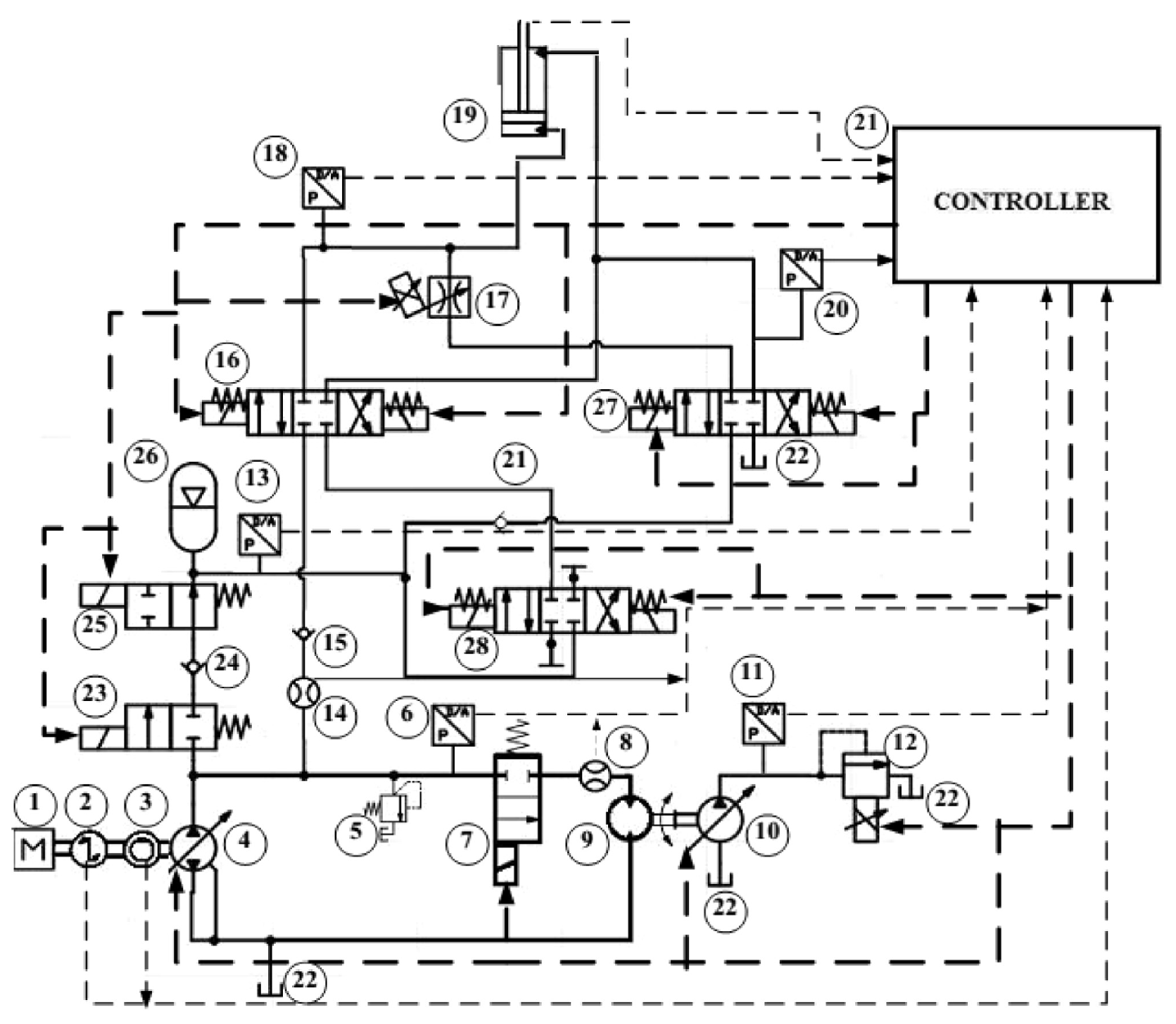
| Item No. | Item Description | Item No. | Item Description |
|---|---|---|---|
| 1 | Electric motor | 7, 23 | 2/2 directional control valve |
| 2 | Torque indicator (electric motor) | 9 | Hydro-motor |
| 3 | Speed indicator (electric motor) | 10 | Bi-directional loading pump |
| 4 | Variable displacement pump | 11 | Pressure transducer |
| 5 | Pressure relief valve | 15, 21, 24 | Check valve |
| 6 | Pressure transducer (outlet pump pressure) | 16, 27, 28 | 4/3 directional control valve |
| 8 | Flow transducer (inlet of Hydro-motor) | 17 | Proportional flow control valve (PFCV) |
| 12 | Proportional pressure relief valve (PPRV) | 19 | Hydraulic actuator |
| 13 | Pressure transducer (accumulator pressure) | 20 | Pressure transducer |
| 14 | Flow transducer (main pump outlet) | 21 | Controller |
| 18 | Pressure transducer (actuator inline) | 22 | Tank |
| 26 | Hydro-pneumatic accumulator | 25 | 2/2 directional control valve |
| OEM Model | Type of HEMM | Traction Architecture | Loading System | Energy Storage | Approx. Cost (USD) [91] |
|---|---|---|---|---|---|
| Caterpillar D7E | Dozer | Series | Conventional | None | 300,000 |
| Volvo L220F | Loader | Parallel | Parallel | Battery | 320,000 |
| Mecalac 12MTX | Articulated loader | Parallel | Parallel | Battery | 83,000 |
| John Deere 644K | Wheel Loader | Series | Parallel | None | 140,000 |
| Merlo TF 40.7 | Tele-Handler | Series | Parallel | Battery | 150,000 |
| Claas 6030 | Tele-Handler | Parallel | Conventional | Battery | 40,000 |
| Kobelco SK200H | Excavator | Conventional | Series | Battery/Capacitors | 50,000 |
| Komatsu HB215 LC-1 | Excavator | Parallel | Parallel | Supercapacitors | 40,000 |
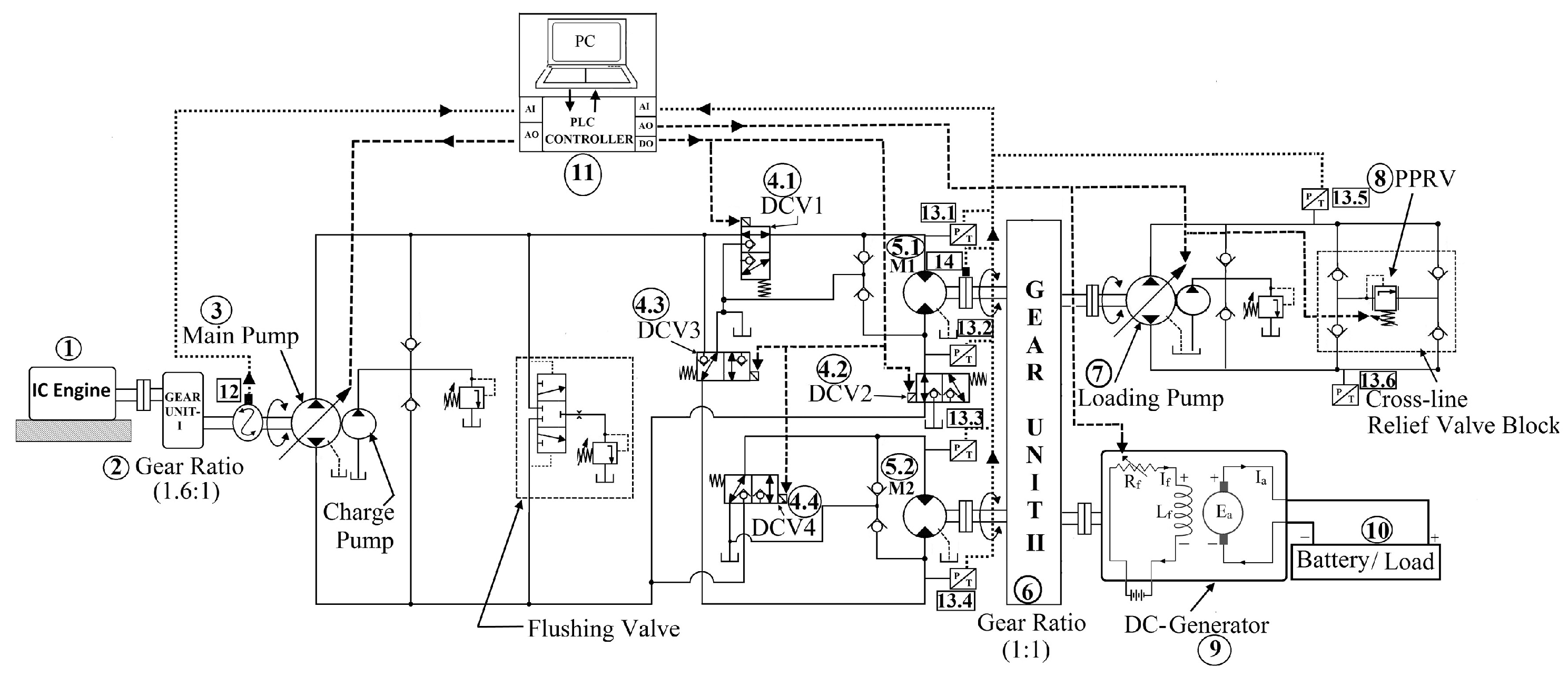
| S/n | Component/Specifications | S/n | Component/Specifications |
|---|---|---|---|
| 1 | IC engine | 8 | Proportional pressure relief valve |
| 2 | Gear Unit I | 9 | DC generator |
| 3 | Swash-plate-controlled variable displacement piston pump | 10 | Battery bank (lead), 12 V and 200 Ah |
| 4.1–4.4 | Direction control valves | 12 | Torque sensor |
| 5.1–5.2 | Bent axis fixed displacement hydro-motor | 13.1–13.6 | Pressure transducer |
| 6 | Gear Unit II | 14 | Speed sensor |
| 7 | Swash-plate-controlled variable displacement loading pump |
Disclaimer/Publisher’s Note: The statements, opinions and data contained in all publications are solely those of the individual author(s) and contributor(s) and not of MDPI and/or the editor(s). MDPI and/or the editor(s) disclaim responsibility for any injury to people or property resulting from any ideas, methods, instructions or products referred to in the content. |
© 2025 by the authors. Licensee MDPI, Basel, Switzerland. This article is an open access article distributed under the terms and conditions of the Creative Commons Attribution (CC BY) license.
Share and Cite
Bhola, M.; Wrat, G. Energy-Efficient Hydraulics in Heavy Machinery: Technologies, Challenges, and Future Directions. Sustainability 2026, 18, 302. https://doi.org/10.3390/su18010302
Bhola M, Wrat G. Energy-Efficient Hydraulics in Heavy Machinery: Technologies, Challenges, and Future Directions. Sustainability. 2026; 18(1):302. https://doi.org/10.3390/su18010302
Chicago/Turabian StyleBhola, Mohit, and Gyan Wrat. 2026. "Energy-Efficient Hydraulics in Heavy Machinery: Technologies, Challenges, and Future Directions" Sustainability 18, no. 1: 302. https://doi.org/10.3390/su18010302
APA StyleBhola, M., & Wrat, G. (2026). Energy-Efficient Hydraulics in Heavy Machinery: Technologies, Challenges, and Future Directions. Sustainability, 18(1), 302. https://doi.org/10.3390/su18010302