Strategic Approach of Reverse Logistics Management for Recyclable Waste and Transportation: A Systematic Review

 ,
,
Abstract
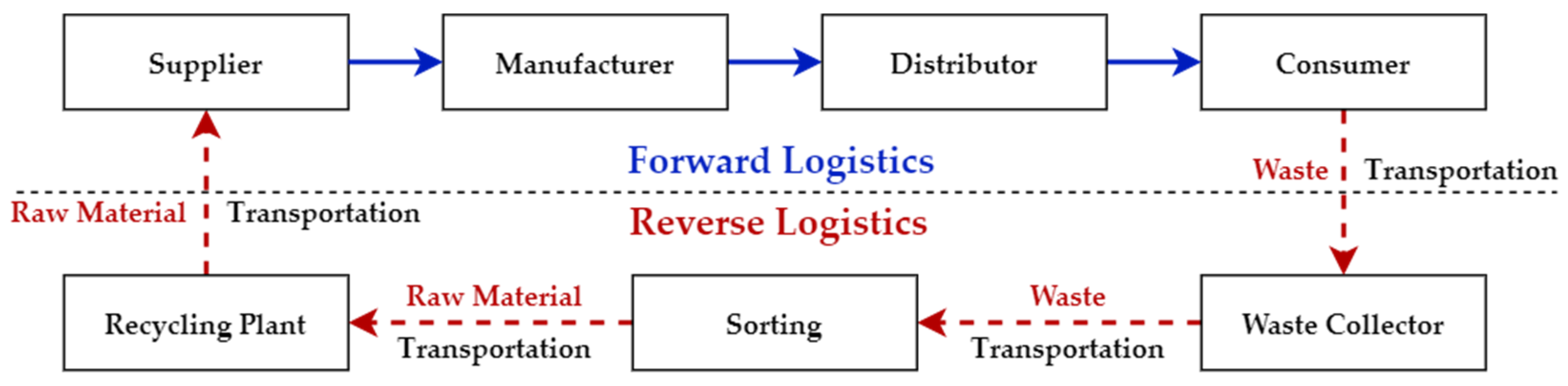
1. Introduction
2. Methodology
2.1. Database
2.2. Data Collection
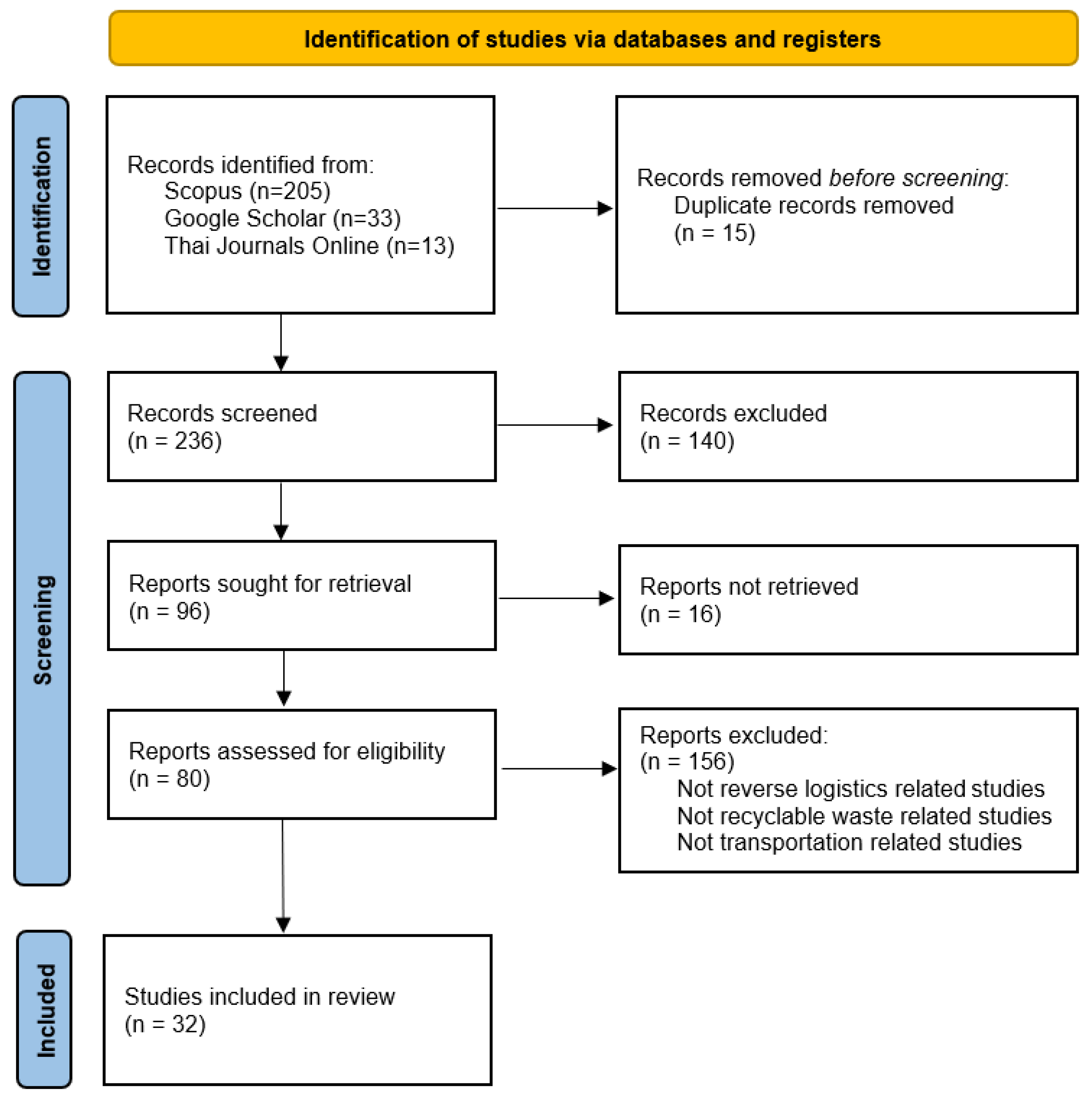
- Identification phase:
- 2.
- Screening phase:
- 3.
- Including phase:
2.3. Data Analysis
3. Results
3.1. Global Research Landscape of Reverse Logistics for Recyclable Waste and Transportation: A Bibliometric Assessment
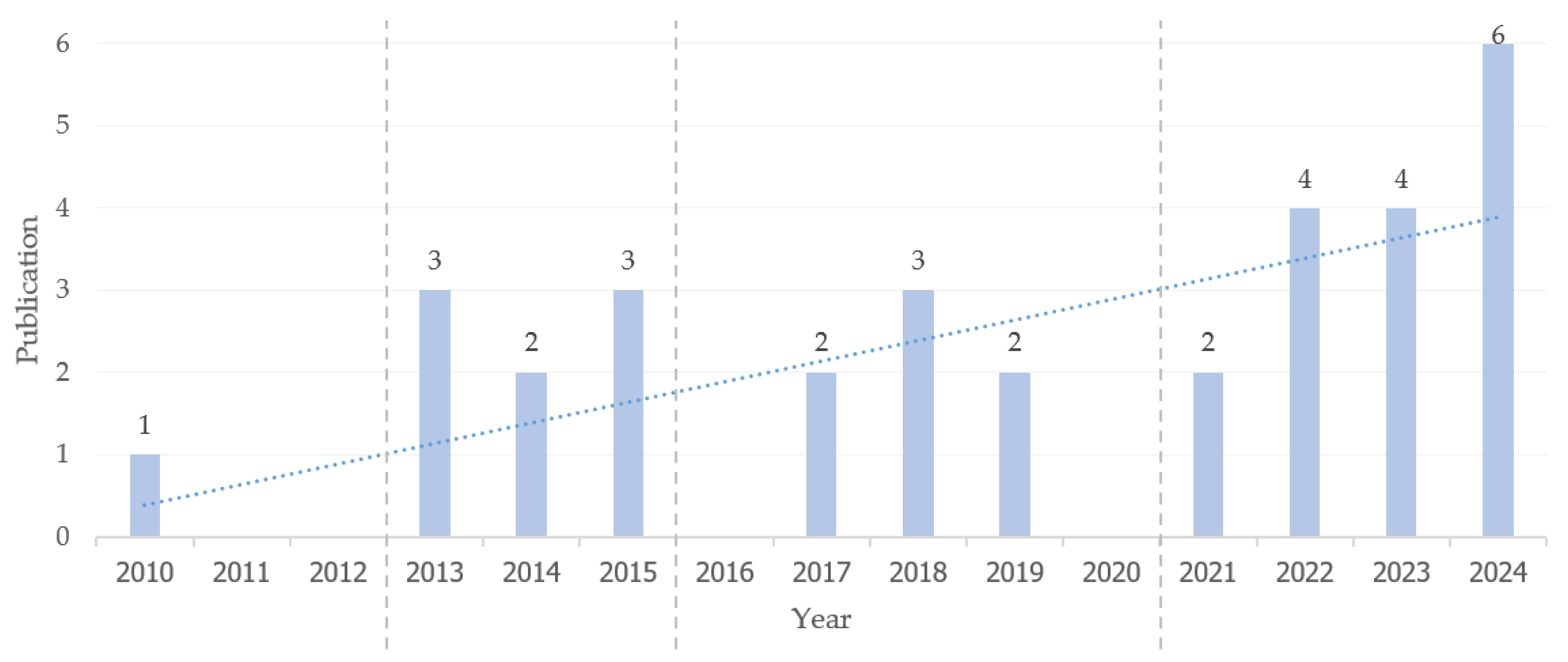
3.1.1. Publication Trends
3.1.2. Geographic Distribution of Articles
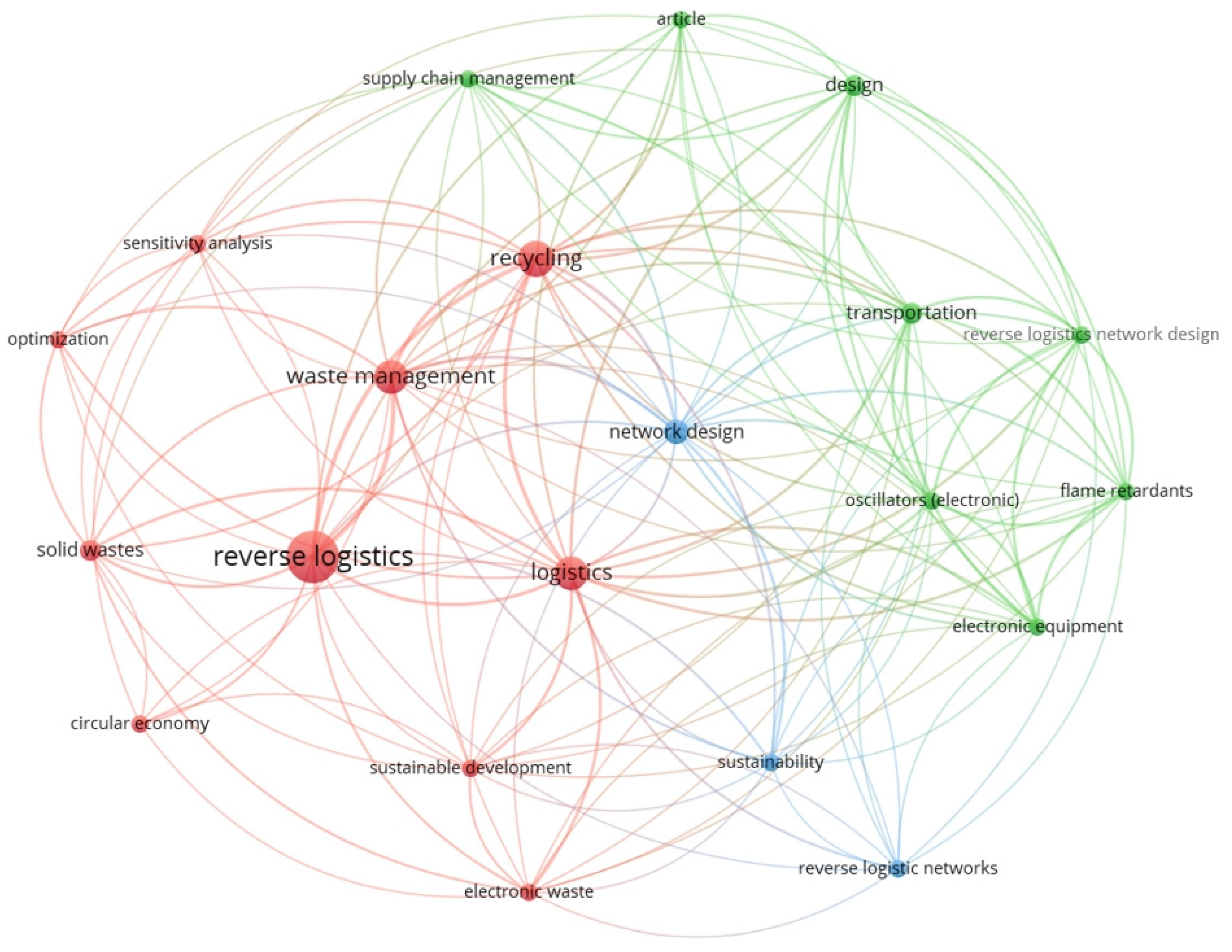
3.1.3. Keyword Co-Occurrence
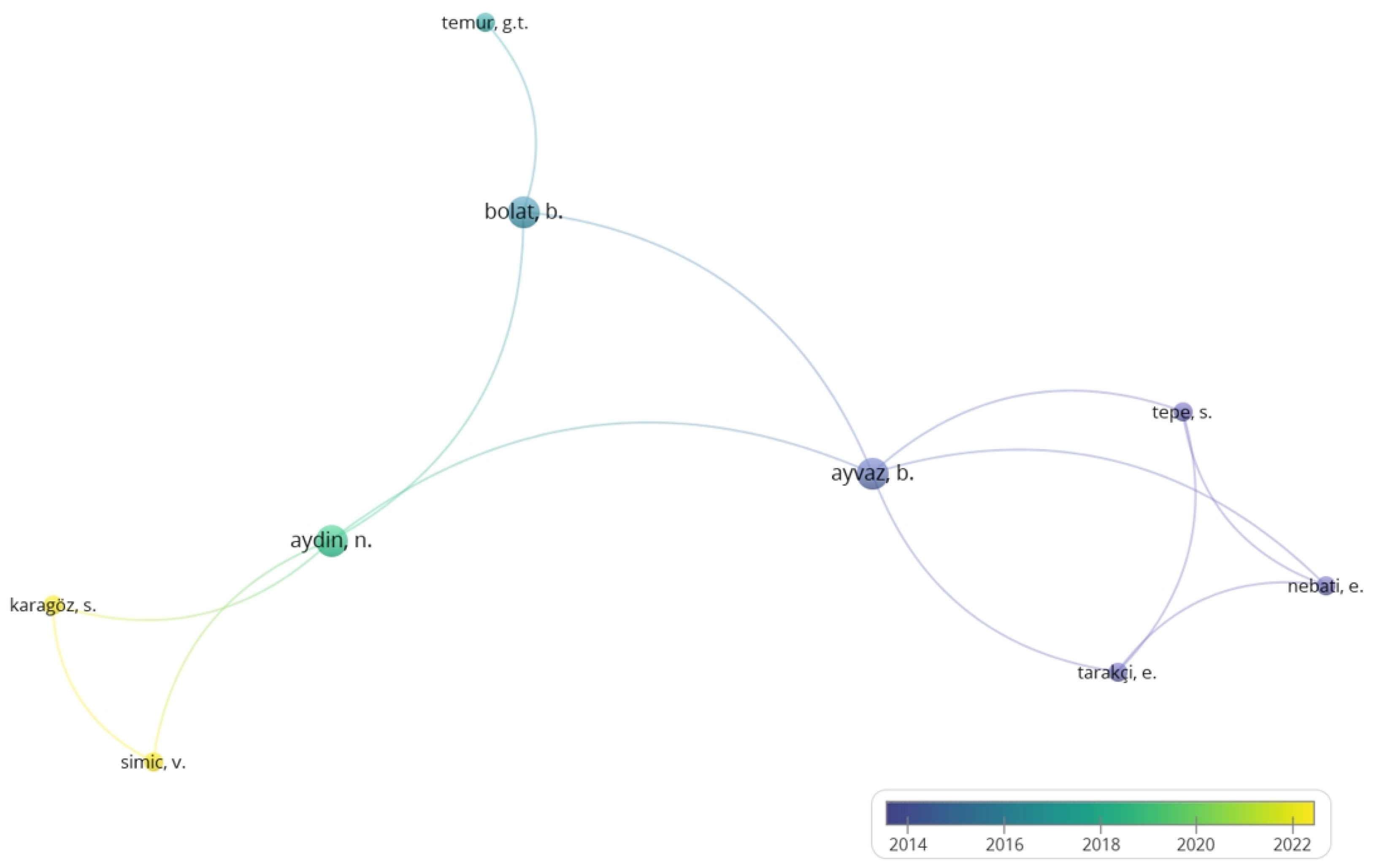
3.1.4. Co-Authorship Analysis
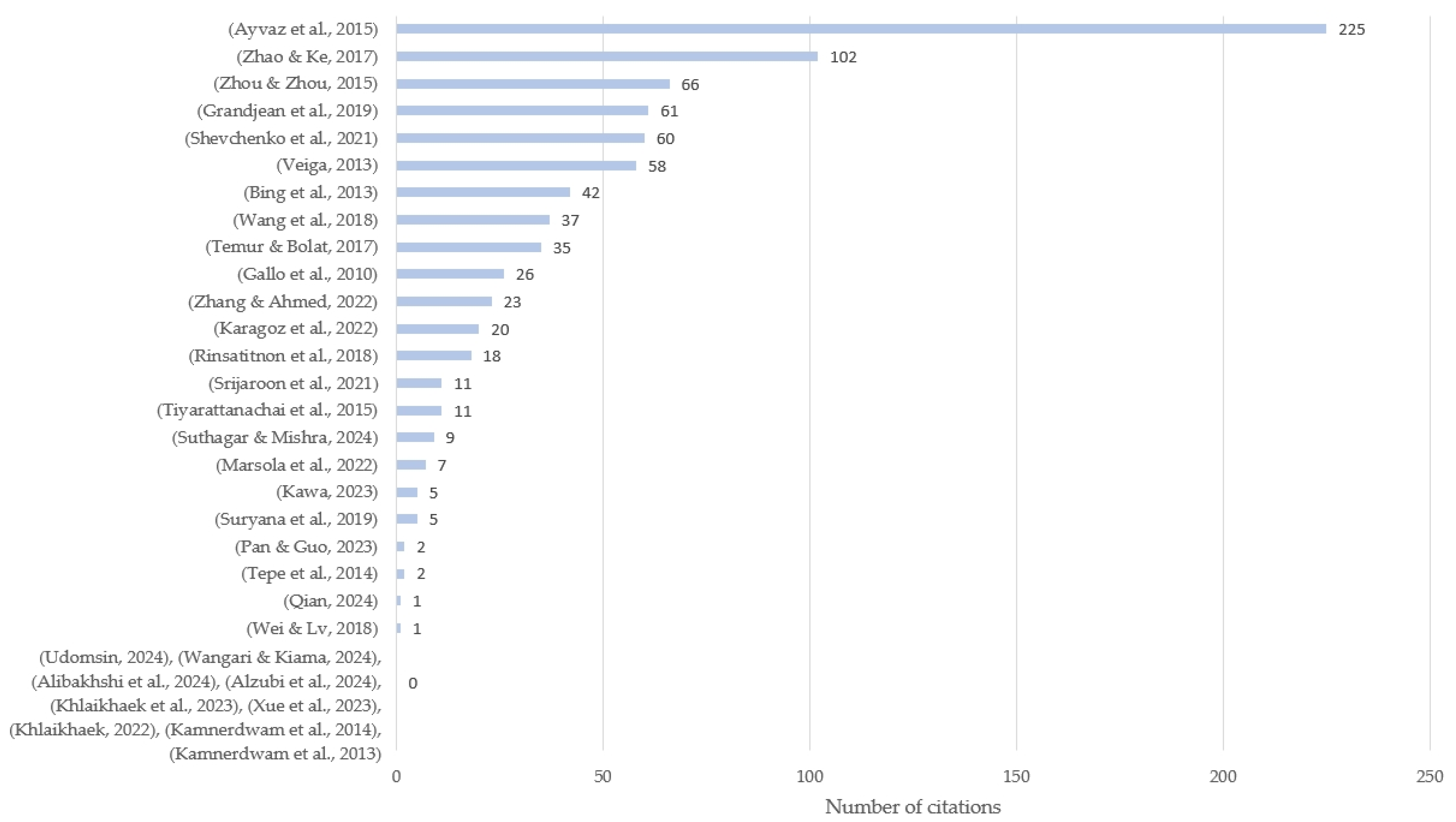
3.1.5. Number of Citations
3.1.6. Research Publishing Source
3.2. Strategic Approaches of Reverse Logistics Management for Recyclable Waste and Transportation Identified in the Literature
3.2.1. Strategic Approaches and Achievements Identified in the Literature
- 1.
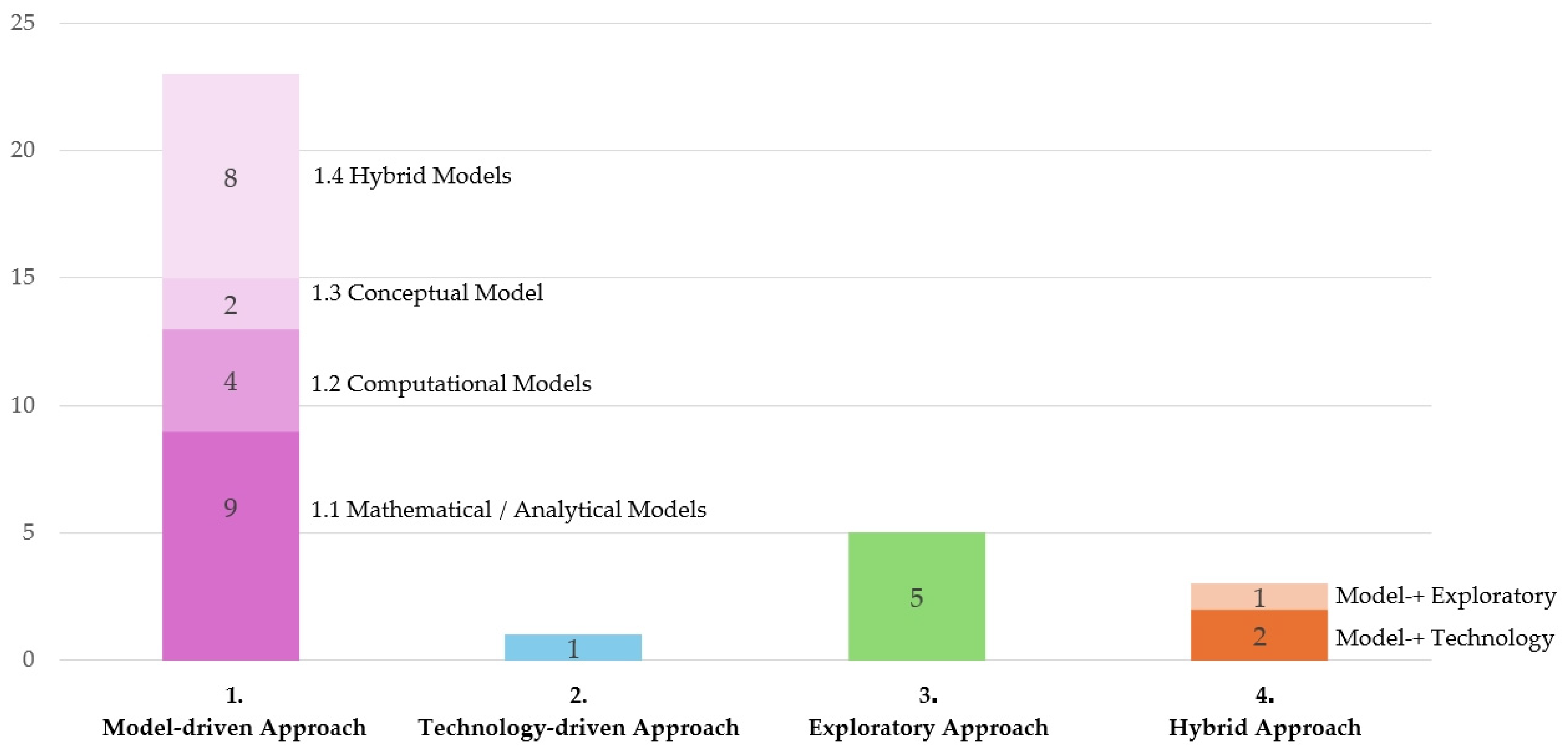
- Model-driven Approach (23 articles): The model-driven approach forms the foundation of academic inquiry into reverse logistics. These studies primarily focus on developing models to analyze and solve problems related to reverse logistics.
- 1.1
- Mathematical Models/Analytical Models (9 articles): Use mathematical equations or quantitative analysis methods to find the most suitable method, such as locating warehouses or arranging transportation routes. In the model-driven approach, mathematical models/analytical nodels in reverse logistics optimize waste collection, recycling, and transportation by minimizing costs [46,48,59,67], reducing environmental impacts [51,62,67] (e.g., a dual-objective green closed-loop supply chain model for the steel industry reduces economic costs by ~10% and overall costs by ~30% with only ~1% higher emissions [67]), supporting real-case applications [31], improving planning and cost management [63], and balancing cost and risk for safe and efficient disposal [72].
- 1.2
- Computational Models (4 articles): Use algorithms or applied computational techniques. Computational models in reverse logistics support decision-making and efficiency by evaluating the long-term feasibility and profitability of paper waste recycling worth the investment by year 9, with an IRR > 12% [56], simulating WEEE flows to enhance recovery and recycling [39], assessing workforce impacts on profit and product loss reduction [70], and optimizing the locations of collection centers and recycling plants for computer scraps [52].
- 1.3
- Conceptual Models (2 articles): Develop a concept or conceptual framework to describe or manage a reverse logistics system. Conceptual model-driven approaches in reverse logistics emphasize environmental and operational benefits by using tools like IDEF0 flow charts to streamline processes and recover resources [73], and by designing strategic systems for end-of-life computer scrap collection and recycling based on the 3Rs, EPR, and regulations to reduce environmental and human impact [55].
- 1.4
- Hybrid Models (8 articles): These combine multiple modeling approaches. Hybrid models in reverse logistics enhance circularity, cost efficiency, and sustainability by optimizing material recovery from construction [61,71] and medical waste [66]; bi-objective location-routing for explosive waste management achieved a 34% cost reduction and 57% risk reduction [47], two-echelon cooperation and profit-sharing in urban recycling networks [57], regulatory-based WEEE management and forecasting with ANN [54], advanced routing using ant colony algorithms [58], and MILP with SAL-PSO [30] for vehicle logistics.
- 2.
- Technology-driven Approach (1 articles): This approach focuses on the development and application of technologies. Cryogenic freezing safely prevents thermal runaway in damaged lithium-ion batteries, enabling safer transport and reuse with minimal impact on performance, supporting sustainability [60].
- 3.
- Exploratory Approach (5 articles): This approach explores the problems and management approaches of reverse logistics in specific contexts. The exploratory approach in reverse logistics highlights efficient supply chains, cost reduction, and sustainability through optimized woody biomass processing [65], tailored strategies for community-scale reverse logistics in Brazil [50], green procurement in motor dealerships [33], effective ELV management with legal and technological support [68], and improved PET bottle collection and quality via reverse vending machines in Thailand [53].
- 4.
- Hybrid Approach (3 articles):
3.2.2. Advantages, Challenges, and Limitations of Strategic Approaches
4. Discussion
5. Conclusions
Supplementary Materials
Author Contributions
Funding
Institutional Review Board Statement
Informed Consent Statement
Data Availability Statement
Acknowledgments
Conflicts of Interest
Appendix A

| Title | Authors | First-Author Affiliation Country | Year | Source | Country of Publication | Citations |
|---|---|---|---|---|---|---|
| The simulation of Hybrid logic in Reverse Logistic Network | Gallo et al. [49] | Italy | 2010 | System Science and Simulation Engineering | Greece | 26 |
| Analysis of efficiency of waste reverse logistics for recycling | Veiga [50] | Brazil | 2013 | Waste Management and Research | United Kingdom | 58 |
| Multimodal network design for sustainable household plastic recycling | Bing et al. [51] | Netherlands | 2013 | International Journal of Physical Distribution and Logistics Management | United Kingdom | 42 |
| Design of a callback system for computer scraps in Thailand | Kamnerdwam et al. [55] | Thailand | 2013 | KKU Research Journal | Thailand | 0 |
| Genetic Algorithms Approach for Analyzing the Location Problem in the Future Management of Computer Scraps | Kamnerdwam et al. [52] | Thailand | 2014 | The Journal of KMUTNB | Thailand | 0 |
| Reverse logistics network design for the recycling of waste of electrical and electronic equipments and an application for Turkey | Tepe et al. [31] | Turkey | 2014 | CIE44 and IMSS’14 Proceedings | Turkey | 2 |
| Stochastic reverse logistics network design for waste of electrical and electronic equipment | Ayvaz et al. [46] | Turkey | 2015 | Resources, Conservation and Recycling | Netherlands | 225 |
| Designing a multi-echelon reverse logistics operation and network: A case study of office paper in Beijing | Zhou & Zhou [48] | China | 2015 | Resources, Conservation and Recycling | Netherlands | 66 |
| Reverse Vending Machine and Its Impacts on Quantity and Quality of Recycled PET Bottles in Thailand | Tiyarattanachai et al. [53] | Thailand | 2015 | Current Applied Science and Technology | Thailand | 11 |
| Incorporating inventory risks in location-routing models for explosive waste management | Zhao & Ke [47] | China | 2017 | International Journal of Production Economics | Netherlands | 102 |
| Evaluating efforts to build sustainable WEEE reverse logistics network design: comparison of regulatory and non-regulatory approaches | Temur & Bolat [54] | Turkey | 2017 | International Journal of Sustainable Engineering | United Kingdom | 35 |
| Reverse logistics implementation in the construction industry: Paper waste focus | Rinsatitnon et al. [56] | Thailand | 2018 | Songklanakarin Journal of Science and Technology | Thailand | 18 |
| Implementation of cooperation for recycling vehicle routing optimization in two-echelon reverse logistics networks | Wang et al. [57] | China | 2018 | Sustainability | Switzerland | 37 |
| Research on VRP of Waste Household Appliances for Recycling | Wei & Lv [58] | China | 2018 | IOP Conference Series: Earth and Environmental Science | United Kingdom | 1 |
| Model Reverse Logistics System of Plastic Waste Recycling at Indonesesia | Suryana et al. [59] | Indonesia | 2019 | Journal of Physics: Conference Series | United Kingdom | 5 |
| The experimental evaluation of lithium ion batteries after flash cryogenic freezing | Grandjean et al. [60] | United Kingdom (UK) | 2019 | Journal of Energy Storage | Netherlands | 61 |
| Towards a smart E-waste system utilizing supply chain participants and interactive online maps | Shevchenko et al. [32] | Ukraine | 2021 | Recycling | Switzerland | 60 |
| Green vehicle routing problem with mixed and simultaneous pickup and delivery, time windows and road types using self-adaptive learning particle swarm optimization | Srijaroon et al. [30] | Thailand | 2021 | Engineering and applied science research | Thailand | 11 |
| A queuing system for inert construction waste management on a reverse logistics network | Zhang & Ahmed [61] | Hong Kong | 2022 | Automation in Construction | Netherlands | 23 |
| Life Cycle Assessment of reverse logistics of empty pesticide containers in Brazil: Assessment of current and previous management practices | Marsola et al. [62] | Brazil | 2022 | Production | Brazil | 7 |
| A Novel Stochastic Optimization Model for Reverse Logistics Network Design of End-of-Life Vehicles: A Case Study of Istanbul | Karagoz et al. [63] | United Kingdom (UK) | 2022 | Environmental Modeling & Assessment | Germany | 20 |
| Problems on Solar Cells Equipment Waste Management in Thailand | Khlaikhaek [64] | Thailand | 2022 | Doctor of Philosophy in Social Sciences Journal | Thailand | 0 |
| Reverse supply chain of residual wood biomass | Kawa [65] | Poland | 2023 | LogForum | Poland | 5 |
| Design of the Reverse Logistics System for Medical Waste Recycling Part II: Route Optimization with Case Study under COVID-19 Pandemic | Xue et al. [66] | China | 2023 | IEEE Conference on Intelligent Transportation Systems, Proceedings, ITSC | United States | 0 |
| Dual-objective optimization of a green closed-loop supply chain in steel industry considering quantity discount | Pan & Guo [67] | China | 2023 | Annals of Operations Research | Netherlands | 2 |
| Reverse Logistics Management for End-of-Life Vehicles (ELVs) | Khlaikhaek et al. [68] | Thailand | 2023 | Ph.D. in Social Sciences Journal | Thailand | 0 |
| Sustainable green circular economic model with controllable waste and emission in healthcare system | Suthagar & Mishra [69] | India | 2024 | Environment, Development and Sustainability | Netherlands | 9 |
| Optimizing a Closed-Loop Agricultural Supply Chain: A Case Study from Jordan | Alzubi et al. [70] | Germany | 2024 | Transformation Towards Circular Food Systems | Switzerland | 0 |
| Socio-Economical Analysis of a Green Reverse Logistics Network under Uncertainty: A Case Study of Hospital Constructions | Alibakhshi et al. [71] | Iran | 2024 | Urban Science | Switzerland | 0 |
| Green procurement practices and performance of Kenya motor dealerships, Nairobi City County, Kenya | Wangari & Kiama [33] | Kenya | 2024 | International Journal of Social Sciences Management and Entrepreneurship (IJSSME) | Kenya | 0 |
| A bi-objective location-routing problem for infectious waste reverse logistics during a pandemic | Qian [72] | China | 2024 | Frontiers in Traffic and Transportation Engineering | China | 1 |
| Application of IDEF0 flow chart in reverse logistics for supply chain management | Udomsin [73] | Thailand | 2024 | Panyapiwat Journal | Thailand | 0 |
References
- Pilapitiya, P.N.T.; Ratnayake, A.S. The world of plastic waste: A review. Clean. Mater. 2024, 11, 100220. [Google Scholar] [CrossRef]
- United Nations Environment Programme; International Solid Waste Association. Global Waste Management Outlook 2024: Beyond an Age of Waste–Turning Rubbish into a Resource; United Nations Environment Programme: Nairobi, Kenya, 2024. [Google Scholar]
- Singh, N.; Walker, T.R. Plastic recycling: A panacea or environmental pollution problem. npj Mater. Sustain. 2024, 2, 17. [Google Scholar] [CrossRef]
- Environmental Protection Agency. National Recycling Strategy; U.S. Environmental Protection Agency: Washington, DC, USA, 2025. Available online: https://www.epa.gov/circulareconomy/national-recycling-strategy (accessed on 26 October 2025).
- Hoareau, C.E.; Ahmad, N.; Nuid, M.; Rubiyatno; Khoi, D.N.; Kristanti, R.A. Sustainable technology in developed countries: Waste municipal management. Ind. Domest. Waste Manag. 2021, 1, 48–55. [Google Scholar] [CrossRef]
- Tumu, K.; Vorst, K.; Curtzwiler, G. Global plastic waste recycling and extended producer responsibility laws. J. Environ. Manag. 2023, 348, 119242. [Google Scholar] [CrossRef]
- Chuang, Y.S.; Cheng, H.P.; Cheng, C.C. Reuse of retired lithium-ion batteries (LIBs) for electric vehicles (EVs) from the perspective of extended producer responsibility (EPR) in Taiwan. World Electr. Veh. J. 2024, 15, 105. [Google Scholar] [CrossRef]
- Unii Online. Why Recycle Business? Available online: https://unii.co.th (accessed on 26 October 2025).
- Land and Houses Bank Public Company Limited. Recycling & Waste Management Business; Business Research: Bangkok, Thailand, 2024. [Google Scholar]
- Islam, M.T.; Iyer-Raniga, U.; Trewick, S. Recycling perspectives of circular business models: A review. Recycling 2022, 7, 79. [Google Scholar] [CrossRef]
- Kassab, A.; Al Nabhani, D.; Mohanty, P.; Pannier, C.; Ayoub, G.Y. Advancing plastic recycling: Challenges and opportunities in the integration of 3D printing and distributed recycling for a circular economy. Polymers 2023, 15, 3881. [Google Scholar] [CrossRef] [PubMed]
- Sonar, H.; Sarkar, B.D.; Joshi, P.; Ghag, N.; Choubey, V.; Jagtap, S. Navigating barriers to reverse logistics adoption in circular economy: An integrated approach for sustainable development. Clean. Logist. Supply Chain 2024, 12, 100165. [Google Scholar] [CrossRef]
- Wati, H.R.; Budihardjo, M.A.; Andarani, P. Waste transportation environmental impact using life cycle assessment: Bibliometric analysis and systematic review. Pol. J. Environ. Stud. 2025, 34, 563–571. [Google Scholar] [CrossRef]
- van Giezen, A.; Wiegmans, B. Spoilt-Ocean Cleanup: Alternative logistics chains to accommodate plastic waste recycling: An economic evaluation. Transp. Res. Interdiscip. Perspect. 2020, 5, 100115. [Google Scholar] [CrossRef]
- Fan, Z.; Luo, Y.; Liang, N.; Li, S. A novel sustainable reverse logistics network design for electric vehicle batteries considering multi-kind and multi-technology. Sustainability 2023, 15, 10128. [Google Scholar] [CrossRef]
- Zhou, J.; Yang, S.; Feng, H.; An, Z. Multi-echelon sustainable reverse logistics network design with incentive mechanism for eco-packages. J. Clean. Prod. 2023, 430, 139500. [Google Scholar] [CrossRef]
- He, M.; Li, Q.; Wu, X.; Han, X. A novel multi-level reverse logistics network design optimization model for waste batteries considering facility technology types. J. Clean. Prod. 2024, 467, 142966. [Google Scholar] [CrossRef]
- Kannan, D.; Solanki, R.; Darbari, J.D.; Govindan, K.; Jha, P.C. A novel bi-objective optimization model for an eco-efficient reverse logistics network design configuration. J. Clean. Prod. 2023, 394, 136357. [Google Scholar] [CrossRef]
- United Nations Department of Economic and Social Affairs (UNDESA). Global Sustainable Development Report 2023: Times of Crisis, Times of Change–Science for Accelerating Transformations to Sustainable Development; United Nations: New York, NY, USA, 2023. [Google Scholar]
- Biermann, F.; Sun, Y.; Banik, D.; Beisheim, M.; Bloomfield, M.J.; Charles, A.; Chasek, P.; Hickmann, T.; Pradhan, P.; Sénit, C.-A. Four governance reforms to strengthen the SDGs. Science 2023, 381, 1159–1160. [Google Scholar] [CrossRef]
- Wadhawan, I.B.; Rizvi, M.M. Optimizing inventory management through multiobjective reverse logistics with environmental impact. Appl. Math. Model. 2025, 146, 116166. [Google Scholar] [CrossRef]
- Alamatsaz, K.; Hussain, S.; Lai, C.; Eicker, U. Electric bus scheduling and timetabling, fast charging infrastructure planning, and their impact on the grid: A review. Energies 2022, 15, 7919. [Google Scholar] [CrossRef]
- Chanpuypetch, W.; Kritchanchai, D.; Niemsakul, S.; Niemsakul, J. Distribution logistics network optimization with a multi-distribution center considering carbon emission: A case study in the petrochemical industry in Thailand. Procedia Comput. Sci. 2025, 253, 237–246. [Google Scholar] [CrossRef]
- Yan, J.; Salman, C.A. Waste Biorefineries: Advanced Design Concepts for Integrated Waste to Energy Processes; Elsevier: Amsterdam, The Netherlands, 2023. [Google Scholar]
- Youcai, Z.; Tao, Z.; Nyankson, E.A. Resource Recovery Technology for Municipal and Rural Solid Waste: Classification, Mechanical Separation, Recycling, and Transfer; Elsevier: Amsterdam, The Netherlands, 2023. [Google Scholar]
- Santos, A.A.; da Silva, A.F.; Gouveia, A.; Caetano, N.; Felgueiras, C. Recyclable waste collection—Increasing ecopoint filling capacity to reduce energy for transportation. Energy Rep. 2022, 8, 430–436. [Google Scholar] [CrossRef]
- Kinobe, J.R.; Gebresenbet, G.; Vinnerås, B. Reverse logistics related to waste management with emphasis on developing countries—A review paper. J. Environ. Sci. Eng. B 2012, 1, 1104. [Google Scholar]
- Guarnieri, P.; Camara e Silva, L.; de Oliveira Vieira, B. How to assess reverse logistics of E-waste considering a multicriteria perspective? A model proposition. Logistics 2020, 4, 25. [Google Scholar] [CrossRef]
- Guo, S.; Shen, B.; Choi, T.M.; Jung, S. A review on supply chain contracts in reverse logistics: Supply chain structures and channel leaderships. J. Clean. Prod. 2017, 144, 387–402. [Google Scholar] [CrossRef]
- Srijaroon, N.; Sethanan, K.; Jamrus, T.; Chien, C.F. Green vehicle routing problem with mixed and simultaneous pickup and delivery, time windows and road types using self-adaptive learning particle swarm optimization. Eng. Appl. Sci. Res. 2021, 48, 657–669. [Google Scholar]
- Tepe, S.; Tarakçi, E.; Nebati, E.; Ayvaz, B. Reverse logistics network design for the recycling of waste of electrical and electronic equipments and an application for Turkey. In Proceedings of the CIE44 & IMSS’14, Istanbul, Turkey, 14–16 October 2014. [Google Scholar]
- Shevchenko, T.; Saidani, M.; Danko, Y.; Golysheva, I.; Chovancová, J.; Vavrek, R. Towards a smart E-waste system utilizing supply chain participants and interactive online maps. Recycling 2021, 6, 8. [Google Scholar] [CrossRef]
- Wangari, G.L.; Kiama, G.P. Green procurement practices and performance of Kenya motor dealerships, Nairobi City County, Kenya. Int. J. Soc. Sci. Manag. Entrep. 2024, 8, 1204–1220. [Google Scholar]
- Vummadi, J.R.; Hajarath, K.C.R. Strategic approaches to reverse logistics: Managing returns for sustainability. Turk. J. Comput. Math. Educ. 2022, 13, 1579–1586. [Google Scholar] [CrossRef]
- Hammad, F.; Sattar, F.A.; Ahmed, W.; Akram, M.A. Understanding the influence of strategic reverse logistics management on the sustainable performance of the organization. OPSEARCH 2025, 1–21. [Google Scholar] [CrossRef]
- Cai, L.; Yuen, K.F.; Xie, D.; Fang, M.; Wang, X. Consumer’s usage of logistics technologies: Integration of habit into the unified theory of acceptance and use of technology. Technol. Soc. 2021, 67, 101789. [Google Scholar] [CrossRef]
- Starostka-Patyk, M.; Grunt, P. Future ICT trends as the opportunity for reverse logistics support. Procedia Comput. Sci. 2022, 207, 4401–4408. [Google Scholar] [CrossRef]
- Sun, X.; Yu, H.; Solvang, W.D. Towards the smart and sustainable transformation of reverse logistics 4.0: A conceptualization and research agenda. Environ. Sci. Pollut. Res. 2022, 29, 69275–69293. [Google Scholar] [CrossRef]
- Yun, L.; Han, M. Reverse logistics network planning for cloud remanufacturing: Exploring additive manufacturing in the circular economy. J. Clean. Prod. 2025, 505, 145439. [Google Scholar] [CrossRef]
- Salas-Navarro, K.; Castro-García, L.; Assan-Barrios, K.; Vergara-Bujato, K.; Zamora-Musa, R. Reverse Logistics and Sustainability: A Bibliometric Analysis. Sustainability 2024, 16, 5279. [Google Scholar] [CrossRef]
- Fang, Y.; Li, X.; Ascher, S.; Li, Y.; Dai, L.; Ruan, R.; You, S. Life cycle assessment and cost benefit analysis of concentrated solar thermal gasification of biomass for continuous electricity generation. Energy 2023, 284, 128709. [Google Scholar] [CrossRef]
- Khoo, H.H. LCA of plastic waste recovery into recycled materials, energy and fuels in Singapore. Resour. Conserv. Recycl. 2019, 145, 67–77. [Google Scholar] [CrossRef]
- Costa, A.; Ferreira, A.C.; Silva, Â.M.E.; Ramos, J.; Ramos, B. Integration of Reverse Logistics and Continuous Improvement in Portuguese Industry: Perspectives from a Qualitative Survey. Sustainability 2025, 17, 4056. [Google Scholar] [CrossRef]
- Elsevier, B.V. Acceptance of SOPHIA in Scopus [Letter]; Scopus Content Selection & Advisory Board: Amsterdam, The Netherlands, 2022. Available online: https://sophia.ups.edu.ec/pdf/sophia/Acceptance%20in%20Scopus%20letter-1.pdf (accessed on 26 October 2025).
- Kamei, F.; Wiese, I.; Lima, C.; Polato, I.; Nepomuceno, V.; Ferreira, W.; Ribeiro, M.; Pena, C.; Cartaxo, B.; Pinto, G.; et al. Grey literature in software engineering: A critical review. Inf. Softw. Technol. 2021, 138, 106609. [Google Scholar] [CrossRef]
- Ayvaz, B.; Bolat, B.; Aydın, N. Stochastic reverse logistics network design for waste of electrical and electronic equipment. Resour. Conserv. Recycl. 2015, 104, 391–404. [Google Scholar] [CrossRef]
- Zhao, J.; Ke, G.Y. Incorporating inventory risks in location-routing models for explosive waste management. Int. J. Prod. Econ. 2017, 193, 123–136. [Google Scholar] [CrossRef]
- Zhou, X.; Zhou, Y. Designing a multi-echelon reverse logistics operation and network: A case study of office paper in Beijing. Resour. Conserv. Recycl. 2015, 100, 58–69. [Google Scholar] [CrossRef]
- Gallo, M.; Murino, T.; Romano, E. The simulation of hybrid logic in reverse logistics network. In Selected Topics in System Science and Simulation Engineering, Proceedings of the 9th WSEAS International Conference on System Science and Simulation in Engineering (ICOSSSE ’10), Iwate, Japan, 4–6 October 2010; WSEAS Press: Morioka, Japan, 2010; pp. 378–384. [Google Scholar]
- Veiga, M.M. Analysis of efficiency of waste reverse logistics for recycling. Waste Manag. Res. 2013, 31, 26–34. [Google Scholar] [CrossRef]
- Bing, X.; Groot, J.J.; Bloemhof-Ruwaard, J.M.; van der Vorst, J.G. Multimodal network design for sustainable household plastic recycling. Int. J. Phys. Distrib. Logist. Manag. 2013, 43, 452–477. [Google Scholar] [CrossRef]
- Kamnerdwam, A.; Rattanamanee, W.; Sinthavalai, R.; Suntiamorntut, W. Genetic algorithms approach for analyzing the location problem in the future management of computer scraps. J. KMUTNB 2014, 24, 560–573. [Google Scholar]
- Tiyarattanachai, R.; Kongsawatvoragul, I.; Anantavrasilp, I. Reverse vending machine and its impacts on quantity and quality of recycled PET bottles in Thailand. Curr. Appl. Sci. Technol. 2015, 15, 24–33. [Google Scholar]
- Temur, G.T.; Bolat, B. Evaluating efforts to build sustainable WEEE reverse logistics network design: Comparison of regulatory and non-regulatory approaches. Int. J. Sustain. Eng. 2017, 10, 358–383. [Google Scholar] [CrossRef]
- Kamnerdwam, A.; Sinthavalai, R.; Rattanamanee, W.; Suntiamorntut, W. Design of a callback system for computer scraps in Thailand. KKU Res. J. 2013, 18, 759–776. [Google Scholar]
- Rinsatitnon, N.; Dijaroen, W.; Limpiwun, T.; Suktavee, G.; Chinda, T. Reverse logistics implementation in the construction industry: Paper waste focus. Songklanakarin J. Sci. Technol. 2018, 40, 798. [Google Scholar]
- Wang, Y.; Peng, S.; Assogba, K.; Liu, Y.; Wang, H.; Xu, M.; Wang, Y. Implementation of cooperation for recycling vehicle routing optimization in two-echelon reverse logistics networks. Sustainability 2018, 10, 1358. [Google Scholar] [CrossRef]
- Wei, J.; Lv, S. Research on VRP of waste household appliances for recycling. IOP Conf. Ser. Earth Environ. Sci. 2018, 199, 042028. [Google Scholar] [CrossRef]
- Suryana, H.; Yudoko, G.; Putro, H.P.H.; Dirgahayani, P. Model reverse logistics system of plastic waste recycling at Indonesia. J. Phys. Conf. Ser. 2019, 1175, 012195. [Google Scholar] [CrossRef]
- Grandjean, T.R.; Groenewald, J.; Marco, J. The experimental evaluation of lithium ion batteries after flash cryogenic freezing. J. Energy Storage 2019, 21, 202–215. [Google Scholar] [CrossRef]
- Zhang, X.; Ahmed, R.R. A queuing system for inert construction waste management on a reverse logistics network. Autom. Constr. 2022, 137, 104221. [Google Scholar] [CrossRef]
- Marsola, K.B.; Oliveira, A.L.R.D.; Neto, B. Life cycle assessment of reverse logistics of empty pesticide containers in Brazil: Assessment of current and previous management practices. Production 2022, 32, e20210105. [Google Scholar] [CrossRef]
- Karagoz, S.; Aydin, N.; Simic, V. A novel stochastic optimization model for reverse logistics network design of end-of-life vehicles: A case study of Istanbul. Environ. Model. Assess. 2022, 27, 599–619. [Google Scholar] [CrossRef]
- Khlaikhaek, S. Problems on solar cells equipment waste management in Thailand. Dr. Philos. Soc. Sci. J. 2022, 1, 1–14. [Google Scholar]
- Kawa, A. Reverse supply chain of residual wood biomass. LogForum 2023, 19, 295–302. [Google Scholar] [CrossRef]
- Xue, C.; Dong, Y.; Liu, J.; Liao, Y.; Li, L. Design of the reverse logistics system for medical waste recycling Part II: Route optimization with case study under COVID-19 pandemic. In Proceedings of the 2023 IEEE 26th International Conference on Intelligent Transportation Systems (ITSC), Bilbao, Spain, 24–28 September 2023; IEEE: Piscataway, NJ, USA, 2023; pp. 4011–4017. [Google Scholar]
- Pan, X.; Guo, S. Dual-objective optimization of a green closed-loop supply chain in steel industry considering quantity discount. Ann. Oper. Res. 2023, 355, 1989–2018. [Google Scholar] [CrossRef]
- Khlaikhaek, S.; Ngammeesri, L.; Ngoenchan, J. Reverse logistics management for end-of-life vehicles (ELVs). Ph.D. Soc. Sci. J. 2023, 13, 571–586. [Google Scholar]
- Suthagar, K.S.; Mishra, U. Sustainable green circular economic model with controllable waste and emission in healthcare system. Environ. Dev. Sustain. 2024, 27, 8767–8809. [Google Scholar] [CrossRef]
- Alzubi, E.; Kassem, A.; Noche, B. Optimizing a closed-loop agricultural supply chain: A case study from Jordan. In Transformation Towards Circular Food Systems: Sustainable, Smart and Resilient Citrus Supply Chains in Mediterranean Areas; Springer Nature: Cham, Switzerland, 2024; pp. 231–255. [Google Scholar]
- Alibakhshi, A.; Saffarian, A.; Hassannayebi, E. Socio-economical analysis of a green reverse logistics network under uncertainty: A case study of hospital constructions. Urban Sci. 2024, 8, 171. [Google Scholar] [CrossRef]
- Qian, K. A bi-objective location-routing problem for infectious waste reverse logistics during a pandemic. Front. Traffic Transp. Eng. 2024, 4, 26–38. [Google Scholar]
- Udomsin, W. Application of IDEF0 flow chart in reverse logistics for supply chain management. Panyapiwat J. 2024, 16, 305–318. [Google Scholar]
- Desticioglu, B.; Calipinar, H.; Ozyoruk, B.; Koc, E. Model for reverse logistic problem of recycling under stochastic demand. Sustainability 2022, 14, 4640. [Google Scholar] [CrossRef]
- Diabat, A.; Kannan, D.; Kaliyan, M.; Svetinovic, D. An optimization model for product returns using genetic algorithms and artificial immune system. Resour. Conserv. Recycl. 2013, 74, 156–169. [Google Scholar] [CrossRef]
- Franzen, A.; Bahr, S. The development of global environmental concern during the last three decades. Curr. Res. Environ. Sustain. 2024, 8, 100260. [Google Scholar] [CrossRef]
- Kaza, S.; Yao, L.; Bhada-Tata, P.; Van Woerden, F. What a Waste 2.0: A Global Snapshot of Solid Waste Management to 2050; World Bank Publications: Washington, DC, USA, 2018. [Google Scholar]
- Bouckaert, S.; Pales, A.F.; McGlade, C.; Remme, U.; Wanner, B.; Varro, L.; D’Ambrosio, D.; Spencer, T. Net Zero by 2050: A Roadmap for the Global Energy Sector; International Energy Agency (IEA): Paris, France, 2021. [Google Scholar]
- Sher, F. Advanced approaches towards policymaking for net zero emissions. Curr. Opin. Green Sustain. Chem. 2024, 49, 100951. [Google Scholar] [CrossRef]
- Rana, K.; Aitken, S.J.; Chimoriya, R. Interdisciplinary approaches in doctoral and higher research education: An integrative scoping review. Educ. Sci. 2025, 15, 72. [Google Scholar] [CrossRef]
- Page, M.J.; McKenzie, J.E.; Bossuyt, P.M.; Boutron, I.; Hoffmann, T.C.; Mulrow, C.D.; Shamseer, L.; Tetzlaff, J.M.; Akl, E.A.; Brennan, S.E.; et al. The PRISMA 2020 statement: An updated guideline for reporting systematic reviews. BMJ 2021, 372, n71. [Google Scholar] [CrossRef] [PubMed]



| Country | Number of Publications | Proportion (%) |
|---|---|---|
| Thailand | 8 | 25 |
| China | 7 | 21.88 |
| Turkey | 3 | 9.38 |
| Brazil | 2 | 6.25 |
| United Kingdom | 2 | 6.25 |
| Canada | 1 | 3.13 |
| Germany | 1 | 3.13 |
| Hong Kong | 1 | 3.13 |
| India | 1 | 3.13 |
| Iran | 1 | 3.13 |
| Italy | 1 | 3.13 |
| Kenya | 1 | 3.13 |
| Netherlands | 1 | 3.13 |
| Poland | 1 | 3.13 |
| Ukraine | 1 | 3.13 |
| Word | n (Occurrences) | Total Link Strength (TLS) |
|---|---|---|
| logistics | 9 | 50 |
| recycling | 10 | 49 |
| reverse logistics | 18 | 38 |
| waste management | 9 | 38 |
| network design | 5 | 35 |
| transportation | 4 | 32 |
| electronic equipment | 3 | 28 |
| flame retardants | 3 | 28 |
| oscillators (electronic) | 3 | 28 |
| reverse logistics network design | 3 | 28 |
| design | 4 | 25 |
| article | 3 | 20 |
| electronic waste | 3 | 19 |
| solid wastes | 4 | 19 |
| supply chain management | 3 | 19 |
| sustainability | 3 | 18 |
| sustainable development | 3 | 18 |
| optimization | 3 | 13 |
| reverse logistic networks | 3 | 13 |
| sensitivity analysis | 3 | 12 |
| circular economy | 3 | 8 |
| Strategic Approaches | Ref. | Achievements | Advantages | Challenges | Limitations |
|---|---|---|---|---|---|
| 1. Model-driven Approach (23 articles) | |||||
| 1.1 Mathematical Models (9 articles) | [62] | The Campo Limpo System cuts environmental impacts in 9 of 13 categories, reducing climate change impacts by 33–44% and overall impacts by 20–79%. | Shows major reductions in environmental impacts. Confirms recycling as the best end-of-life option. | Long-distance transport increases emissions, and improper rinsing raises residual pesticide impacts. | Transport flows are modeled estimates. Hazardous waste modeled without chemical detail. |
| [46] | Presents a waste electrical and electronic equipment RLND model that identifies profit-maximizing solutions under uncertainty and offers flexible support for managerial use. | Develops a generic multi-echelon RL model. Manages uncertainty in quantity, quality, and transport cost. | High uncertainty in quality and costs. Limited adoption due to budget/capability constraints. | Focuses on a two-stage stochastic model that depends on sufficient data and needs computational methods to solve. | |
| [59] | Develops a plastic waste recycling model that minimizes the total reverse logistics cost in Indonesia, yielding approximately USD 11,773. | Develops a cost-minimizing mathematical model for LDPE and HDPE recycling. | Complex decisions involving waste quantities, capacities, and routing. | Based on Indonesia’s data. Accuracy depends on assumed costs and capacities. | |
| [31] | This study applies the MILP model to design an e-waste recycling network in Turkey. Improves recovery efficiency and reduces system cost through optimized routing and facility planning. | Develops a MILP model for the design of an e-waste RL network. Identifies optimal facility locations and capacities. | RL networks face uncertainty in waste amounts and transport costs. Multi-stage systems add operational complexity. | Deterministic models cannot handle uncertainty. More complex systems may need heuristic methods. | |
| [51] | Multimodal transport in plastic recycling reduces transportation and emissions costs by nearly 20%, enhancing sustainability and efficiency, especially on long-distance routes. | The MILP model evaluates a multi-modal plastic recycling network with full cost and emission assessments. | Network performance depends on location, distance, and transport modes, with varying channel sensitivities adding complexity. | Use fixed existing facility nodes. Municipal collection is not optimized in the model. | |
| [63] | The stochastic end-of-life vehicle (ELV) model shows that operational costs dominate, and profitability depends heavily on these costs and material selling prices. | Stochastic model improves ELV network planning under uncertainty. Accounts for variable costs and material composition. | ELV recycling faces high uncertainty and multi-actor complexity. Operational and dismantling costs are significant burdens. | Model tailored to Istanbul. Dependent on uncertain ELV return volumes. | |
| [48] | A nonlinear integer model determines the number and locations of recycling stations and plants to minimize total cost. | Strategic-alliance model with optimization for locating recycling stations and plants. | Sensitive to waste volume, capacity, and transport cost changes. | Identifies facility locations and analyzes waste volumes, capacities, and transport costs. | |
| [72] | Identifies Pareto-optimal solutions and offers a practical framework for safe, timely pandemic waste collection and transport. | Optimizes costs and risks associated with pandemic infectious waste using a bi-objective location-routing model. | Managing explosive waste growth and balancing cost–risk trade-offs increase system complexity. | Pandemic uncertainty, multi-party preferences, and objectives like carbon emissions are not included. | |
| [67] | A dual-objective green closed-loop supply chain model for steel minimizes cost and emissions, showing that quantity discounts cut economic costs by ~10% and total costs by ~30%, with minimal increase in emissions. | Dual-objective model integrates cost, carbon emissions, and quantity discounts. | Requires extensive data across multiple supply chain participants. Balancing short-term costs with long-term environmental goals is difficult. | Long computation time reduces model accuracy. Uncertainty in parameters such as demand and recovery rates is not fully accounted for. | |
| 1.2 Computational Models (4 articles) | [56] | A system dynamics model shows that reverse logistics for paper waste in Thailand’s construction industry becomes profitable after 3 years, with an IRR >12% by year 9, recommending recycling and remanufacturing to reduce landfill use. | Evaluates landfill, recycling, and remanufacturing options. Identifies economic and environmental benefits. | Profitability requires long-term implementation. Needs skilled labor and financial support. | Requires parameter changes for other contexts. |
| [39] | The simulation shows average stock time drops to 56 h, a 21% reduction from the Current State Map, and processing time decreases from 140 to 110 h, making the system more robust to rising future waste flows. | Provides hybrid optimization for WEEE routing and facility decisions and uses a push–pull system dynamics model to improve waste flow and reduce waiting time. | Traditional algorithms risk getting stuck in local optima and producing impractical routes. Managing waste flows and facility choices is complex under varying logic. | Verified only through example-based simulation. Results depend on assumed facility types, thresholds, and stock behaviors. | |
| [70] | The study shows that closed-loop strategies increase farmer profit by about 7% and reduce CO2 emissions by 29% for citrus and 26% for juice, while also creating added value through composting and upcycling. | Improves profitability and reduces CO2 emissions through recycling and upcycling in a closed-loop citrus supply chain. | Depends on accurate data processing and must balance economic and environmental outcomes. | Uses expert-estimated essential-oil data, a cold-press process, and a single Jordan case. | |
| [52] | Demonstrates Genetic Algorithms (GA)’s feasibility for designing computer-waste reverse logistics and supports future real-world applications. | GA efficiently finds low-cost locations for collection and recycling facilities. | The reverse logistics system is complex and lacks comparison with other methods. | Does not benchmark GA against alternative methods for solving location problems. | |
| 1.3 Conceptual Models (2 articles) | [73] | Presents IDEF0 as a valuable tool for modeling and improving reverse logistics, helping reduce errors, cut waste, and enhance process alignment. | Highlights the benefits of reverse logistics and clarity using IDEF0 process mapping. | Reverse logistics are complex due to many stakeholders and inefficient without precise process mapping and standardized procedures. | It depends on accurate data and well-developed sub-processes and Standard Operating Procedure (SOP). |
| [55] | Presents a new reverse logistics system that boosts computer waste return, increases recovery of valuable materials, and reduces environmental impact. | Provides a structured reverse logistics network for end-of-life computers, from return points to recycling and material recovery. | Current Thai e-waste practices are inefficient and lack clear stakeholder responsibility. | No specific legislation or dedicated recycling facilities for end-of-life computers. | |
| 1.4 Hybrid Models (8 articles) | [61] | The study integrates queuing theory, a reverse logistics network, and simulation to improve the management of inert construction waste and to assess multiple delay scenarios. | Scenario-based analysis of queuing delays. More efficient reverse logistics network design. | Collection and transport require careful planning. | Impact assessment is limited to existing parameters. Focused only on inert construction waste. |
| [47] | A bi-objective location-routing model for explosive waste using TOPSIS optimizes collection, inventory, and routes, reducing cost by 34% and risk by 57% in Southwest China. | Integrated model minimizing cost and risk. Combines location, inventory, and routing decisions. | Hazardous waste systems face uncertainty and complex operations. | Does not model time-varying waste generation. Lacks simultaneous delivery and pick-up. | |
| [57] | Cooperation in two-echelon reverse logistics, supported by the Minimum Cost-Remaining Savings (MCRS) model, improves cost efficiency, reduces emissions, and strengthens alliances. | Improves routing and cost performance. Reduces distance, emissions, and system cost. | Multi-echelon routing and alliance management are complex. | Does not model stochastic returns. No real-time traffic or vehicle-sharing stability analysis. | |
| [66] | Optimized site selection cuts medical waste handling time by 58.4% and costs by 20.8%, improving reverse logistics efficiency during COVID-19 and validating the hybrid method. | Integrates classification, site selection, and routing into a single RL system. Uses hybrid linear programming and K-means. | COVID-19 waste surges heighten system complexity and demand large-scale, real-time multisite management. | Detailed modules are not fully described due to space limits. Relies on available real-world data for verification. | |
| [54] | Regulatory WEEE reverse logistics supports long-term sustainability and profitability, with ANN improving forecast accuracy and target setting. | Compares regulatory vs. non-regulatory WEEE RL models using MILP and ANN. | High initial investment and low early return volumes hinder feasibility. | Based on one case and fixed return and capacity assumptions. | |
| [58] | The improved ant colony algorithm provides flexible, practical recycling routes that cut costs and boost logistics efficiency using existing facilities. | An improved ant colony algorithm provides flexible, practical routing solutions. | Traditional methods may find impractical optima and converge slowly. | Cost-focused model verified only by a single example. | |
| [71] | A green reverse logistics model using electric vehicles is proposed for sustainable construction and demolition (C&D) waste management and validated in the Tehran hospital case study. | Integrates sustainability, electric vehicles, fuzzy decision-making, and robust optimization for C&D waste RL. | EV use has operational limits, and RL networks are complex under uncertainty. | The NP-Hard model is complex for large-scale solving. EV battery disposal and routing are not fully included. | |
| [30] | MILP with SAL-PSO yields 2.21–7.31% improvement (average 3.25%) and provides a practical framework for lowering transport and driver costs in 3PL reverse logistics. | Improves routing efficiency with an eco-cost model and enhanced SAL-PSO performance. | The problem is NP-hard, making exact optimization slow. SAL-PSO needs more computation time than standard PSO. | Assumes constant vehicle speeds, reducing real-world accuracy. | |
| 2. Technology-driven Approach (1 article) | |||||
| [60] | Cryogenic freezing safely prevents thermal runaway in damaged lithium-ion batteries, enabling safer transport and reuse with minimal impact on performance, supporting sustainability. | Cryogenic cooling removes thermal runaway risk. Enables reuse and remanufacture with minimal performance loss. | Regulations still require costly explosion-proof containers. Cryogenic handling adds complexity. | Tested only under specific abuse conditions and two chemistries. Long-term effects beyond five freeze–thaw cycles unknown. | |
| 3. Exploratory Approach (5 articles) | |||||
| [65] | This study identifies woody biomass supply chain processes, highlighting opportunities for efficient logistics and processing, as well as challenges such as seasonality and handling requirements. | Identifies challenges and opportunities. Supports future empirical research. | Seasonal supply issues and varied handling and storage needs. High overall costs. | Based on secondary data/focus group interviews, it requires further empirical modeling. | |
| [50] | Reverse logistics works well in large areas but is inefficient in small communities, suggesting that recycling is not always optimal and that tailored, cost-effective strategies are needed. | Reveals why compulsory pesticide-packaging reverse logistics fails in small communities. | Recycling is costly and impractical in small areas, with strict hazardous-waste rules adding complexity. | Based on a single exploration case, the study limits its broad applicability. | |
| [33] | This study shows green procurement improves efficiency, reduces waste, cuts costs, and supports sustainability in motor dealerships. | Improves lead time, inventory turnover, and capacity use through reverse logistics. | Requires reliable systems, technology upgrades, and strong coordination. | Findings apply only to Nairobi dealerships; broader organizational factors were not assessed. | |
| [68] | Proposes EU-aligned ELV regulations and a comprehensive RL network for Thailand, showing resource recovery and environmental benefits. | Applies sustainability and regulatory insights to improve ELV reverse logistics. | Requires strong coordination and supportive regulations. | Findings depend on foreign models and do not align with Thai regulatory requirements. | |
| [53] | Using reverse vending machines in Thailand increased PET bottle collection by 21% and improved their quality with fewer contaminants. | Reverse Vending Machines (RVMs) increase PET collection and improve waste quality. | Machine reliability issues and difficulty reading barcodes; cannot remove labels. | Applies only to PET bottles. Results may differ with other users or waste types. | |
| 4. Hybrid Approach (5 articles) | |||||
| 1 + 2 Model + Technology (2 articles) | [32] | The smart e-waste reverse system reduces CO2 emissions by optimizing the deployment of collection vehicles. Develop a business model for the system using Business Model Canvas (BMC). | CO2 reduction via optimized routes. Digital/IT supports a circular business model. | Countries’ legislative differences. Need for special driver apps. | Collection-rate impact unknown without pilot testing. Needs more pilot tests and cost–benefit analysis. |
| [69] | This study developed an AI-drone-based circular supply system that reduces waste and emissions while optimizing medical deliveries and profits in rural healthcare. | Integrates AI, drones, and green technologies. Reduces emissions and waste and improves delivery speed and efficiency. | Emission-reduction effects need further study. Dependent on government support. | Requires advanced AI, cloud, and data systems. Zero-carbon chain and IoT/blockchain have not been achieved. | |
| 1 + 3 Model + Exploratory (1 articles) | [64] | RL-based solar-panel waste management recovers high-value materials and reduces impacts, offering policy and operational guidance for a sustainable system in Thailand. | Analyzes the whole solar panel life cycle using reverse logistics and shows value recovery and sustainability benefits. | Thailand lacks laws, clear roles, and modern recycling technology, resulting in improper waste disposal. | No dedicated recycling plants and weak policy coordination limit effective management. |
Disclaimer/Publisher’s Note: The statements, opinions and data contained in all publications are solely those of the individual author(s) and contributor(s) and not of MDPI and/or the editor(s). MDPI and/or the editor(s) disclaim responsibility for any injury to people or property resulting from any ideas, methods, instructions or products referred to in the content. |
© 2025 by the authors. Licensee MDPI, Basel, Switzerland. This article is an open access article distributed under the terms and conditions of the Creative Commons Attribution (CC BY) license.
Share and Cite
Chounchaisit, P.; Suphavarophas, P.; Bunyarittikit, S.; Nanta, P.; Khwansuwan, P.; Chairatananonda, P.; Kuisorn, W.; Moorapun, C. Strategic Approach of Reverse Logistics Management for Recyclable Waste and Transportation: A Systematic Review. Sustainability 2026, 18, 283. https://doi.org/10.3390/su18010283
Chounchaisit P, Suphavarophas P, Bunyarittikit S, Nanta P, Khwansuwan P, Chairatananonda P, Kuisorn W, Moorapun C. Strategic Approach of Reverse Logistics Management for Recyclable Waste and Transportation: A Systematic Review. Sustainability. 2026; 18(1):283. https://doi.org/10.3390/su18010283
Chicago/Turabian StyleChounchaisit, Pornarit, Phattranis Suphavarophas, Suphat Bunyarittikit, Piyarat Nanta, Poon Khwansuwan, Panayu Chairatananonda, Wirayut Kuisorn, and Chumporn Moorapun. 2026. "Strategic Approach of Reverse Logistics Management for Recyclable Waste and Transportation: A Systematic Review" Sustainability 18, no. 1: 283. https://doi.org/10.3390/su18010283
APA StyleChounchaisit, P., Suphavarophas, P., Bunyarittikit, S., Nanta, P., Khwansuwan, P., Chairatananonda, P., Kuisorn, W., & Moorapun, C. (2026). Strategic Approach of Reverse Logistics Management for Recyclable Waste and Transportation: A Systematic Review. Sustainability, 18(1), 283. https://doi.org/10.3390/su18010283