


Abstract
Predicting the sustainability of national educational systems presents a complex, multifaceted issue due to the intricate connections between education and wider societal, economic, healthcare, and technological sectors. Current educational models tend to be rigid, narrow in focus, and insufficiently responsive to these changing external factors. This research seeks to fill this void by framing education as an ecosystem and creating a methodological framework that merges systems thinking with sophisticated data-driven methods. The study’s aim is to outline, quantify, and analyze the relationships among education-related subsystems to guide the creation of an adaptive, sustainability-focused educational ecosystem. A mixed-methods approach was utilized, incorporating qualitative coding, system mapping, and natural language processing techniques (specifically Word2Vec) to uncover relational patterns within a structured literature set. These findings were integrated with quantitative metrics to assess subsystem efficacy and pinpoint leverage points. The investigation centers on five primary systems in the education ecosystem: Business, Economic, Government, Healthcare, and Sustainability. The Word2Vec analysis identified significant conceptual relationships between these systems, while the quantitative evaluation indicated strong performance across curriculum, policy, and healthcare metrics. Conversely, inclusivity and accreditation displayed weaker outcomes, indicating areas that need focused improvement. The results highlight the benefits of merging systems thinking with NLP-driven relational analysis as a methodological innovation in education research. The study offers evidence-based recommendations for prioritizing factors that can boost system efficacy and create beneficial cross-system ripple effects, aiding in the advancement of adaptive and sustainable educational ecosystems.
1. Introduction
Education is widely acknowledged as a fundamental component of national growth and societal progress. As stated in the Universal Declaration of Human Rights, education is a basic human right and essential for nurturing fair and equitable societies [1]. Despite its importance, gaps in access to high-quality education continue to exist among various regions and demographic groups. The United Nations has highlighted inclusive and equitable quality education as Sustainable Development Goal 4, signifying a global agreement on the necessity of education for promoting social advancement, economic stability, and sustainable development over the long term [2,3].
Grasping the transformative role of education necessitates recognizing its reciprocal connections with broader societal systems. Education drives economic growth [4], bolsters social cohesion [5], improves individual well-being [6], encourages innovation [7], and prepares the workforce with essential skills [8]. Conversely, educational outcomes are influenced by broader socio-economic circumstances, political contexts, technological progress, and governing structures [9]. This reciprocal relationship emphasizes the need to view education not as discrete elements, but as a dynamic ecosystem that includes interrelated internal actors (students, educators, institutions) and external systems (economy, healthcare, policy, technology).
However, conventional educational metrics such as literacy rates, enrollment numbers, or completion statistics only reflect a limited aspect of this systemic complexity [10]. While recent research advocates for more integrated analytical models, existing literature still falls short of offering comprehensive frameworks that can represent the multidimensional interactions influencing educational performance [11]. This shortcoming highlights the importance of embracing a systems-based viewpoint that specifically addresses the interdependencies within and among education-related subsystems.
This research addresses that gap by utilizing systems thinking to examine the intricate structure of the education ecosystem. Building on prior studies that identified various interconnected education subsystems, this research expands the analysis by exploring their characteristics, relational dynamics, and conceptual proximities based on a vast, systematically compiled literature corpus. The study is directed by two fundamental research questions:
- Can systems thinking be employed to represent dynamic interdependence within the education ecosystem?
- What principal characteristics and relationships define the identified education-related systems from an extensive literature analysis?
To tackle these inquiries, the study implements a mixed-methods approach grounded in systematic literature review techniques, qualitative coding, and quantitative modeling. Natural language processing methods, including Word2Vec, are subsequently used to uncover hidden conceptual connections across the ecosystem. The rest of the paper is organized as follows: Section 2 elaborates on the theoretical underpinning of education as an ecosystem; Section 4 describes the methodological framework; Section 5 shares the findings; Section 6 discusses the implications for policy and planning; and Section 7 and Section 8 concludes with suggestions for future research.
2. Literature Review
Conceptualizing education as an ecosystem that is dynamic is an understudied concept that states that education is multifaceted and interdependent on its internal and external systems. This literature review explores the foundations and methodologies that help illuminate these complex interactions, organized into three key sections to provide a comprehensive understanding of education’s role in societal and personal advancement. Education as a Dynamic Ecosystem examines studies that highlight education’s multidimensional structure and capacity for adaptation. Literature emphasizes in the Section 2.2 how crucial it is to consider outside variables that have a direct impact on the standard and accessibility of education, such as socioeconomic and political environments. Understanding the education ecosystem’s complex interactions requires diverse methodologies, which are discussed in the Section 2.3, Techniques for Understanding the Education Ecosystem. Finally, the review examines the role of Word2Vec in Education Research for their potential to deepen insights into educational data. Together, these sections contribute a comprehensive view of the education ecosystem, emphasizing the need for a holistic understanding of its dynamics and the influences that shape it. Through theoretical and practical insights, this review underscores education’s potential to drive equitable, effective, and resilient educational environments in pursuit of societal progress.
2.1. Education as a Dynamic Ecosystem
Studies increasingly argue that education functions as a complex adaptive system characterized by feedback loops, non-linearity, and emergent behaviors [12,13]. While these works highlight interdependencies across actors and institutions, many remain descriptive. For example, Koopmans [14] calls for reframing educational challenges through a dynamic lens yet does not operationalize how these dynamics can be measured. Similarly, Strokosch & Osborne [15] emphasize co-production among learners, educators, and policymakers, but offer limited insight into how such interactions propagate across the broader ecosystem. More critical work highlights that educational performance is inseparable from socio-economic, political, and health systems [16,17]. However, the literature often treats these influences as contextual variables rather than interconnected subsystems with reciprocal effects. Policy-oriented studies, such as Bilgiler et al. [18], demonstrate how systems thinking can expose inequities embedded in policy design, yet they remain country-specific and lack generalizability. This fragmentation underscores a key gap: although education is widely described as a system, there is limited empirical integration of cross-system interactions.
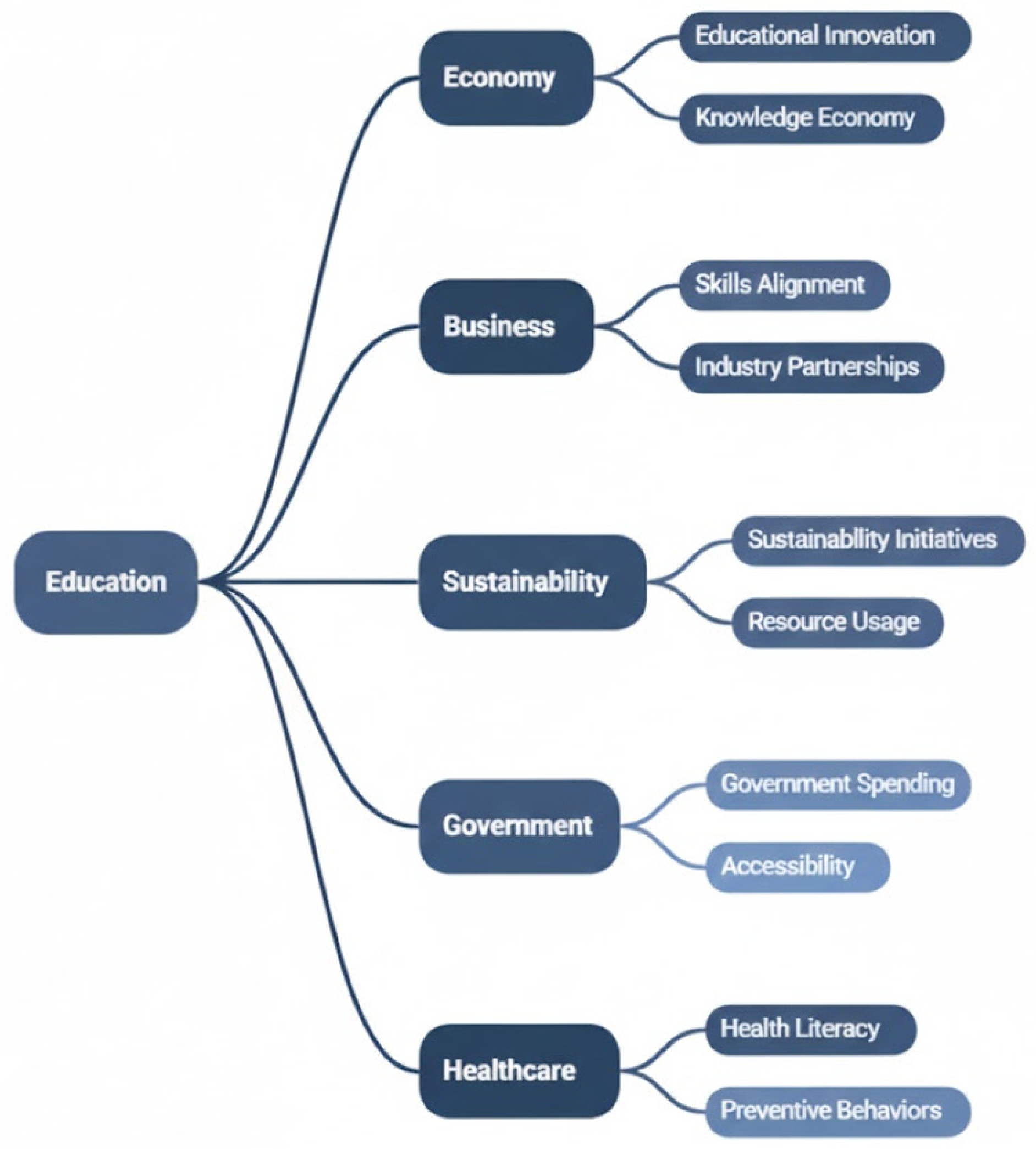
Figure 1 illustrates the education ecosystem as an interconnected network of key systems, including sustainability, economy, government, and healthcare. Each system influences and supports others through continuous feedback loops, reflecting systemic interdependence. It illustrates that education operates as a complex adaptive system, where changes in one domain such as policy, economy, or health affect the entire system. This systems thinking view emphasizes integration, feedback, and dynamic balance across all sectors shaping educational outcomes.
Figure 1.
A glimpse of a literature-informed education system.
2.2. Education Systems and External Factors
Different elements are important to understanding the impact of education. Primary education (first stage of formal education) is a foundation for skill development and learning [19]. It is recognized in the literature for its role in breaking cycles of poverty in society and helping to ensure equal opportunities for all individuals [20]. Studies also explore the roles of secondary and vocational education in providing more specialised skills for industry. These forms of education are contributing towards a diverse workforce and address skill shortages and demand [21]. This is also true for higher education, where institutions contribute to the advancement of skill acquisition and are at the forefront of research and innovation, which in turn fosters advancements in technology and economic development [8,22]. This implies that foundational competencies acquired in primary education are necessary to learn specialized expertise obtained through higher education and the literature emphasizes the direct correlation between educational attainment and the acquisition of essential skills for personal and professional growth [23].
Education does not stand in silos but has various external influences. Social influences of education include social cohesion and integration of individuals [24]. It focuses on promoting diversity in society and social justice, which promotes tolerance and inclusion [25]. Literature highlights education’s importance in developing citizens who are socially aware, knowledgeable, and engaged [26].
Education plays a significant role in economic development as well. It drives the enhancement of human capital and innovation [27]. Chalapati & Chalapati [28] emphasize that the integral role of education in promoting the economy is to provide a workforce that is well equipped for fast change in industry and global competitiveness. Roberts, 2022 [29] emphasises that a country with a youth that is not educated or skilled will be driven into a crisis in the new global economy.
Other external factors influenced by education include healthcare. From the education of healthcare professionals [30] to the health of individuals [31], an interesting relation is seen between healthcare and education. A healthy society is likely to be educated, and may demonstrate knowledge in health practices, be very aware, and have better access to healthcare. Interplay creates a reinforcing cycle where education improves health literacy, enabling individuals to make informed decisions, access resources effectively, and contribute to the well-being of the broader community [32,33]. Healthcare education has made strides in developing new ways to create a better society by including new technologies and innovations [34].
All the factors mentioned above contribute to the education ecosystem. There are mutual and reciprocal relationships between the systems indicated in the literature. Apart from the extracts above, there are other significant factors that contribute to education effectiveness with material influence on the educational ecosystem. These encompass advancements in technology, social and cultural factors, governance structures, infrastructure standards, and the development of human capital. Each of these elements interacts with fundamental systems to affect access to learning, its quality, and the outcomes achieved. This research concentrates on Sustainability, Economy, Government, and Healthcare, as they represent the key systemic pillars that facilitate and limit educational transformation. Collectively, they encompass the environmental, economic, policy, and human welfare aspects essential for establishing a resilient and adaptable educational system.
2.3. Methodological Approaches for Understanding the Education Ecosystem
To understand the dynamic nature of the education ecosystem, researchers have developed a range of models; however, many of these approaches remain constrained by methodological simplifications and narrow assumptions. Early approaches relied heavily on linear models that treat educational variables as isolated inputs and outputs. A key example is the human capital and education model, which examines the relationship between labour earnings and educational attainment [35]. While useful for measuring economic returns to schooling, the model fails to consider how external systems such as social inequality, health, or policy shifts shape educational trajectories. Its static formulation makes it ill-suited for analysing feedback loops or emergent behaviours that characterise real education environments.
Several frameworks attempt to model relational and structural dynamics more comprehensively. Social Network Analysis (SNA) is one such approach, using data mining techniques to map interactions among actors within educational contexts [36]. Studies such as Schuster, Jörgens and Kolleck [36] illustrate how SNA can reveal global policy networks by analysing social media debates on inclusive education. Although SNA successfully uncovers collaboration patterns and information flows, its limitation lies in its focus on observable relationships. It rarely incorporates non-social variables such as institutional constraints, economic forces, or cultural norms, resulting in an incomplete systems representation.
Cultural Historical Activity Theory (CHAT) offers a more socio-culturally grounded framework. Andriani et al. [37] use CHAT to analyse online learning delivery through variables such as learner management tools, communication technologies, and cultural factors. While CHAT incorporates broader socio-economic influences, its application remains uneven. The framework relies heavily on the researcher’s interpretation of “activity systems,” which can introduce bias and limit replicability. Furthermore, the model’s linear mapping of influencing factors oversimplifies complex reciprocal relationships between cultural, technological, and institutional forces.
Dynamic models attempt to capture more complexity but also face notable constraints. Multilevel Modeling (MLM), for instance, is widely used to analyse nested or clustered educational data [38]. Van Droogenbroeck et al. [39] employed MLM to explore teacher burnout and its impact on learning outcomes. While MLM recognises hierarchical structures, it still assumes stability in relationships over time and does not sufficiently capture non-linear feedback or broader systemic disruptions.
Agent-Based Modelling (ABM) has been used to simulate interactions at the student, classroom, and system levels. Vulic, Jacobson and Levin [40] apply ABM to examine socio-economic inequalities in education. Although ABM strengthens understanding of micro-level interactions, its effectiveness depends heavily on the assumptions built into agent rules. These rules often struggle to encapsulate complex human behaviour, external shocks, or cross-sector dynamics, resulting in models that approximate rather than fully represent ecosystem-level complexity.
Input-Output Models offer yet another perspective by examining flows of resources and outcomes. D’Inverno et al., 2021 [41] use this approach to assess evidence-based interventions in schools. While the model captures short-, intermediate-, and long-term outcomes, it remains narrowly focused on resource allocation and ignores broader determinants such as community engagement, home conditions, and infrastructure. This narrowness limits its value for system-level decision-making.
Collectively, these models illustrate important progress but also expose significant methodological fragmentation. Linear models neglect external drivers; relational models miss structural complexity; socio-cultural frameworks lack system-wide integration; dynamic models remain restricted by assumptions; and resource-based models overlook environmental influences. This study addresses these gaps by applying systems thinking combined with advanced Natural Language Processing (NLP) methods, particularly Word2Vec. These tools allow for the analysis of large, multidimensional literature datasets, revealing hidden thematic patterns, semantic relationships, and cross-system interdependencies. By integrating external influences and modelling complex relationships, this work provides a more holistic and nuanced framework for understanding and improving the education ecosystem.
3. Theoretical Grounding
This study is grounded in systems theory, which provides the primary lens for conceptualizing the education ecosystem as a complex arrangement of interdependent entities, processes, and feedback loops [42,43]. Systems theory emphasizes that a change in one subsystem inevitably influences others, making it an appropriate foundation for analyzing how educational policies, pedagogical practices, or economic investments propagate through micro-, meso-, and macro-level structures. Within this research, systems theory directly informs the identification of system boundaries, subsystems, and variables extracted from the SLR corpus. It also guides the decision to model the ecosystem holistically rather than in isolated thematic segments.
To capture temporal behavior and non-linear transformations, the study integrates Dynamic Systems Theory (DST). DST provides conceptual tools for understanding how educational processes evolve over time and how small initial changes can produce significant systemic shifts [44]. Methodologically, DST motivates the use of semantic proximity modelling (Word2Vec) to represent how conceptual relationships in the literature emerge, stabilize, or shift. The clustering of variables and the identification of attractor-like patterns in the semantic space reflect core DST principles such as emergence, stability, and phase transitions. DST therefore informs not only the theoretical framing but also the interpretation of similarity gradients and the dynamic behaviour inferred from the corpus.
The third pillar of the study is network science and graph theory, which support the representation of relational structures within the education ecosystem [45]. While systems theory establishes the ecosystem’s components and DST characterizes their evolution, network science provides the analytical language for mapping connections, influence pathways, clusters, and central variables. This directly shapes the methodological choices applied in the Section 5: variables derived from Word2Vec are transformed into weighted similarity networks, where edges represent semantic proximity and nodes represent system constructs. Network measures such as centrality, clustering, or density help reveal hidden structures, for example, how policy variables influence teacher collaboration networks or how resource distribution shapes institutional connectivity.
In this study, graph-based representations also align with broader educational governance analyses, where nodes represent policy, leadership, institutional interactions, or systemic drivers, and edges encode the strength of conceptual relationships found in the literature. This approach makes abstract and evolving educational interactions empirically tractable, enabling systematic evaluation of systemic behaviour and interdependence.
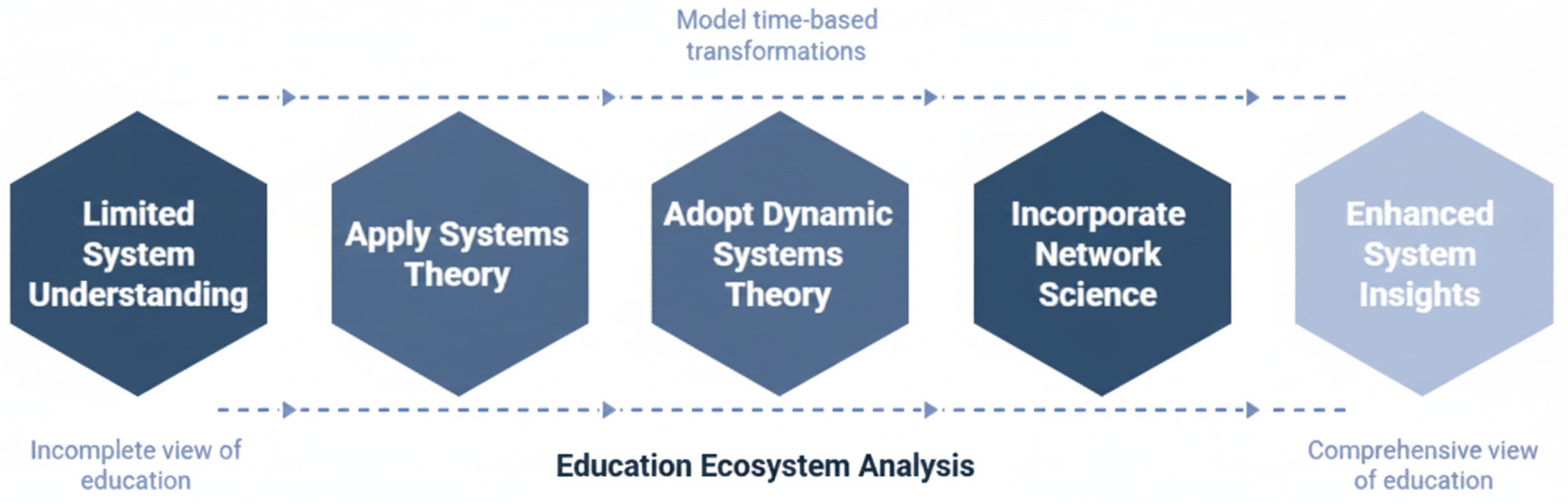
Figure 2 synthesises the theoretical–methodological alignment. It illustrates how the study progresses from:
Figure 2.
A narrow to a broader understanding of education by combining various theories. Reductionist view on the left to a broad, systemic interpretation on the right.
- Systems Theory; defining system components, boundaries, and interdependencies;
- Dynamic Systems Theory; modelling transformation, stability, and non-linear dynamics through semantic similarity patterns;
- Network Science; representing the ecosystem as a graph of weighted connections generated from Word2Vec similarity outputs.
Together, these perspectives do not function as isolated theoretical lenses; they are operationalised into the method itself. By combining systems thinking, dynamic modelling, and network analysis, the study provides a comprehensive, multi-level understanding of the education ecosystem as an adaptive, evolving, and relational structure.
4. Methodology
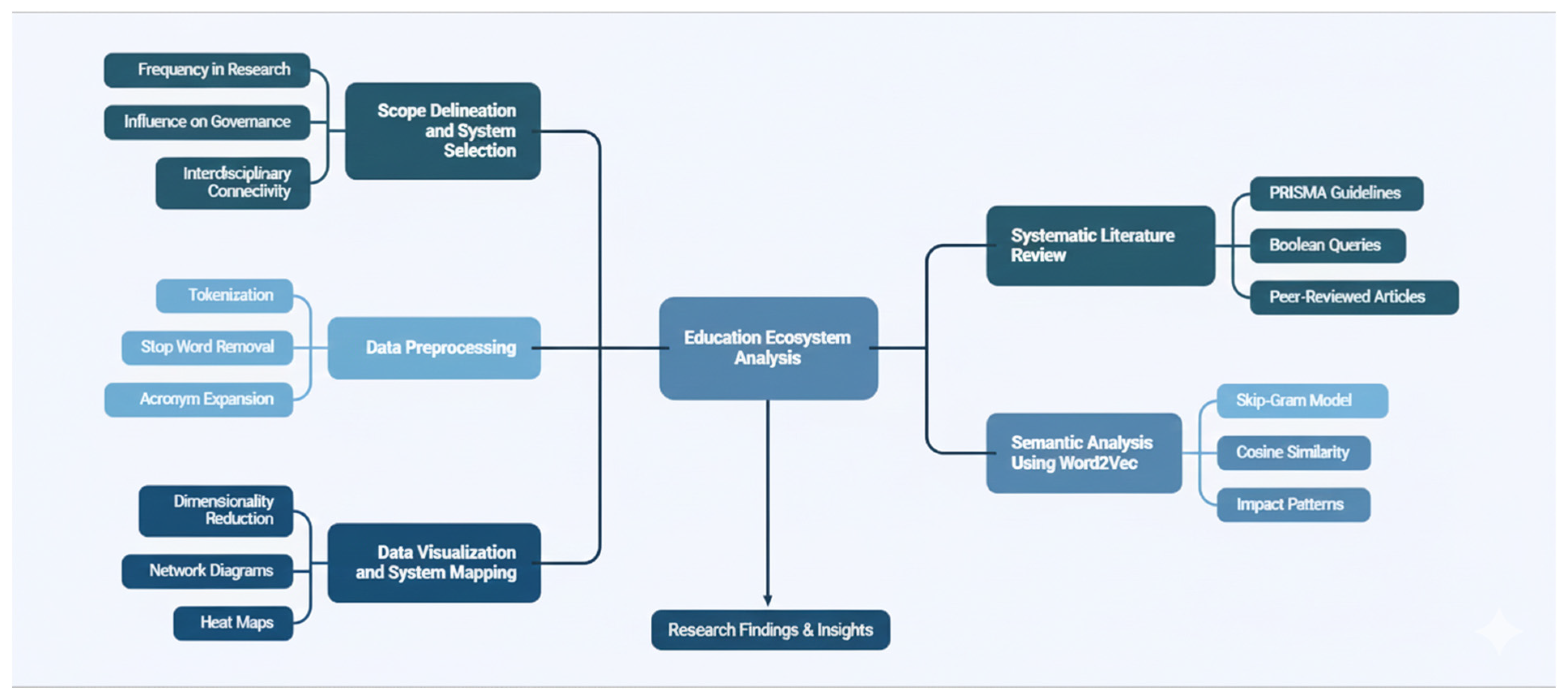
This study employs a mixed-methods research design grounded in systems theory and supported by computational text-mining techniques. The methodological workflow integrates a Systematic Literature Review (SLR), corpus construction, and Word2Vec semantic modelling (Figure 3). The sequencing follows a transparent pipeline that begins with research scoping, proceeds through structured corpus development, and concludes with modelling, and visualization. The overarching goal is to identify and quantify interdependencies within the education ecosystem using both qualitative system-thinking principles and quantitative machine-learning methods. Text processing, modeling, and analysis were carried out using Python version 3.10.12, which is developed and maintained by the Python Software Foundation based in Wilmington, DE, USA. Tasks related to natural language processing were executed utilizing the Natural Language Toolkit (NLTK) version 3.8.1, which is created by contributors to the NLTK Project and distributed by the Python Software Foundation in Wilmington, DE, USA. Semantic modeling was accomplished using Gensim version 4.3.0, developed by RaRe Technologies from Bratislava, Slovakia. For data visualization and dimensionality reduction, Scikit-learn version 1.3.0 was utilized, developed by the Scikit-learn contributors in Paris, France, alongside Matplotlib version 3.8.0, which was developed by the Matplotlib Development Team at Johns Hopkins University in Baltimore, MD, USA.
Figure 3.
Methodology Overview.
- Step 1: Scope Delineation and System Selection
The first step establishes the analytical boundaries of the education ecosystem. Although prior bibliometric work identified fifteen systems that interact with education, this study narrows the focus to five business, economic, government, healthcare, and sustainability systems. Their selection is grounded in three literature-supported criteria. First, these systems consistently appear with the highest frequency in global education research between 2014 and 2024, indicating strong scholarly consensus on their relevance. Second, extensive evidence shows that these domains exert significant influence on educational governance, equity, policy implementation, and long-term system performance. Third, Social Network Analysis (SNA) mappings show that these five systems exhibit the strongest interdisciplinary connectivity, frequently co-occurring with education constructs in prior mapping studies. Focusing on these high-impact systems allows for analytical depth while preserving the holistic integrity of the broader 15-system ecosystem.
- Step 2: Systematic Literature Review (SLR)
To construct a reliable textual corpus for semantic analysis, a Systematic Literature Review (SLR) was conducted following PRISMA guidelines. This ensured methodological transparency, rigor and replicability. Scopus was searched using tailored Boolean queries designed to retrieve studies that bridge education and each of the selected systems. Only peer-reviewed journal articles published between 2014 and 2024, written in English, and containing substantive content on the intersection of education with these five domains were included. The initial search, based on the search strings detailed in Table 1, yielded 271,950 articles, which were filtered through multiple screening stages to remove duplicates and irrelevant content. The final dataset served as the foundation for the NLP-based semantic analysis. This process not only ensured the relevance and quality of the data but also reflected the multidimensional scope of education research.
Table 1.
Search Strings for SLR.
- Step 3: Data Preprocessing
This preprocessing phase was critical for enhancing the quality of the corpus and ensuring reliable semantic vector generation in the next stage.
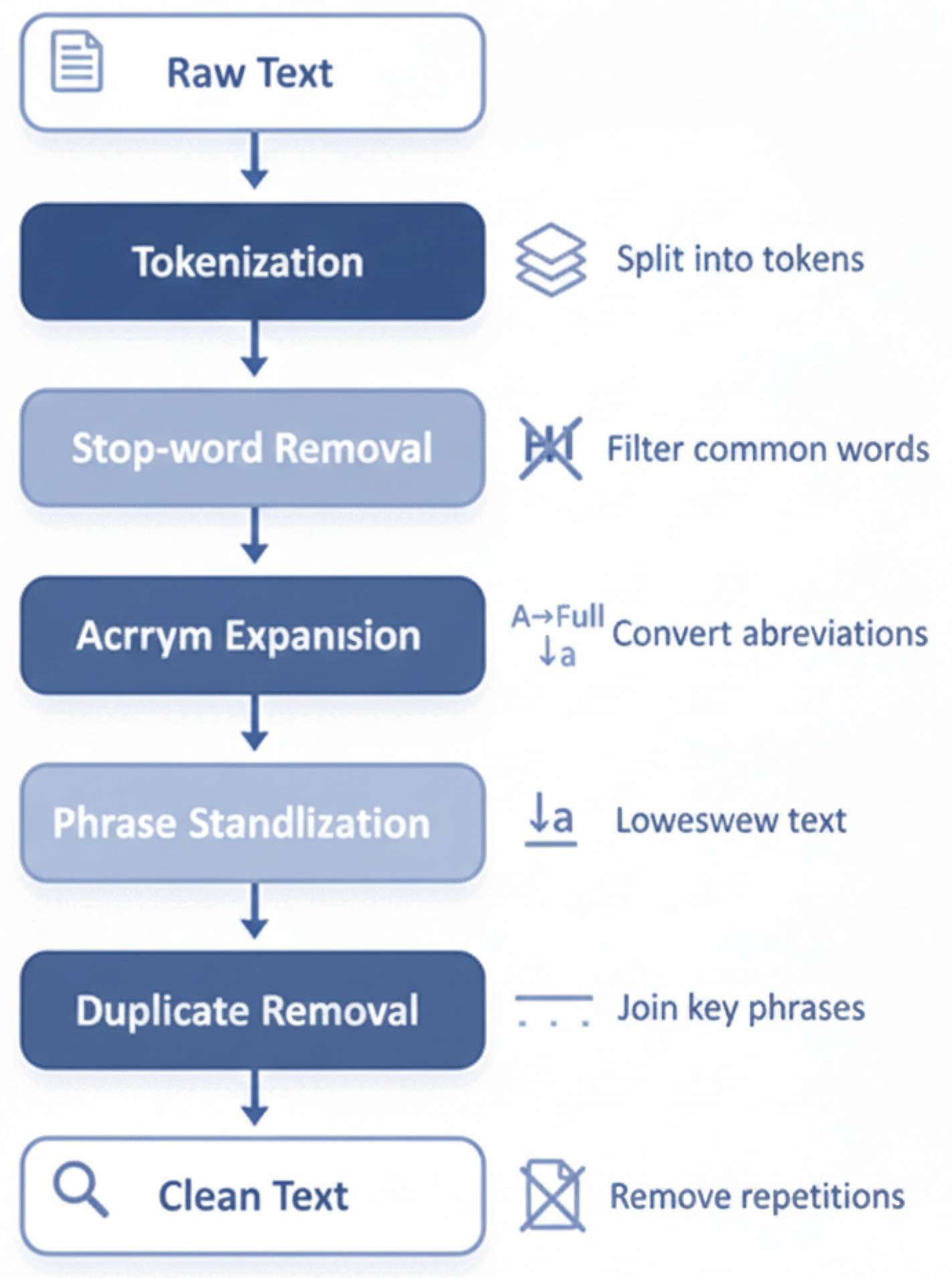
Prior to analysis, the retrieved literature was subjected to a comprehensive preprocessing pipeline using Python’s Natural Language Toolkit (NLTK) version 3.8.1, as seen in Figure 4, to ensure semantic clarity and computational tractability. The text was first tokenized into individual words, followed by the removal of common stop words (e.g., “the,” “is,” “and”) that do not contribute meaningful information. Acronyms such as “HE” were expanded to their full forms (e.g., “Higher Education”) to avoid ambiguity, and all text was lowercased to ensure consistency. Compound phrases central to the analysis, such as “higher education,” “educational policy,” and “health equity,” were normalized using underscores to preserve their semantic integrity. Duplicate fragments and sentences were removed to prevent redundancy.
Figure 4.
Semantic clarity and computational tractability.
- Step 4: Semantic Analysis Using Word2Vec
The processed corpus was analyzed using Word2Vec, a neural network-based NLP approach that represents words as dense vectors in high-dimensional space, enabling the mapping of semantic closeness and latent conceptual links across the corpus [46]. The analysis includes training a skip-gram model to anticipate word contexts inside a sliding window, creating 300-dimensional embeddings for keywords and phrases, and calculating cosine similarity to quantify semantic closeness between key concepts, such as “policy” and “ecosystem.” Vector proximity and co-occurrence trends were then used to infer impact patterns across systems, showing underlying systemic dynamics and identifying influential variables within each system. The Word2Vec model was trained with replicable parameters: skip-gram architecture, 300 vector dimensions, window size of 5, minimum word frequency of 10, negative sampling with 5 samples, 20 training epochs, learning rate of 0.025, and hierarchical softmax optimization, implemented using Gensim 4.3.
- Step 5: Data Visualization and System Mapping
To improve interpretability, various visualization techniques were used to illustrate the interactions between ecosystem components. High-dimensional word vectors were projected into two-dimensional space using dimensionality reduction approaches such as Principal Component Analysis (PCA) and t-SNE, allowing for easier visual interpretation. Network diagrams were created, with nodes representing major systems and concepts and edges reflecting the intensity and direction of their interactions. In addition, heat maps were created as color-coded matrices to show the intensity of pairwise semantic correlations across the corpus. Causal networks were also created to demonstrate directional dependencies and feedback loops, shedding light on the education ecosystem’s resilience and reactivity. Together, these visualization tools allowed for a thorough and intuitive comprehension of the systemic interconnections and dynamics uncovered by the Word2Vec study.
5. Results
The Section 5 begins by detailing the outcomes of the systematic literature review (SLR) and data analysis processes. It highlights the integration of qualitative and quantitative approaches to identify key characteristics of education systems and their interdependencies. By combining these methods, the results provide a nuanced understanding of the dynamics within and among education systems, offering insights derived from Word2Vec analysis and textual data. This synthesis underscores patterns, relationships, and emerging themes crucial for unpacking the complexities of education systems. Subsections are structured to present findings specific to each education system, guided by the methodology.
A previous systematic literature review, along with insights from experts, identified 15 essential systems within the education ecosystem. From this list, five primary systems (Business, Government, Economy, Sustainability, and Healthcare) were chosen for an in-depth semantic analysis based on their prevalence in literature, their interrelations, and their significance in relation to educational outcomes. Publications pertinent to these systems were gathered from Scopus through specific keyword searches and saved as abstracts in .txt format. Following a relevance assessment, a refined collection of 5742 publications (Table 2) was established for Word2Vec analysis, which facilitated the identification of key variables and semantic connections.
Table 2.
Corpus Metadata Overview.
5.1. Heatmap Analysis and Interpretation
The heatmap plots presented in this section visualize the interdependence between key characteristics within the systems analyzed. The variables depicted on the heatmap are determined using cosine similarity values, a widely used metric in natural language processing and data science that quantifies the degree of similarity between two characteristics. These values are derived from the Word2Vec analysis of textual data collected from relevant academic and policy sources, where each characteristic is represented as a vector in a high-dimensional space. The cosine similarity between these vectors reflects how closely related the characteristics are within the context of the education system. The color spectrum in the heatmap provides a visual representation of these cosine similarity values, with varying intensities correlating to different levels of interdependence. For example, the darker shades of the heatmap indicate stronger interdependencies, with a cosine similarity value of 1.0 representing a maximal degree of similarity between two variables. Conversely, lighter shades reflect weaker interdependencies, where a cosine similarity value closer to 0.0 suggests a minimal degree of similarity.
The heatmap legend (Figure 5) serves as a reference to interpret the strength of the relationships visualized in the plot. It is important to note that these relationships are based on the cosine similarity values, which are calculated as follows:
where A and B are vectors representing the characteristics being compared, and · denotes the dot product.
Figure 5.
The relationship strength legend showing the similarity values.
The examination recognized five interrelated systems that influence the connection between education and wider societal results. Each system was assessed with a range of indicators (such as curriculum design, student participation, research results, accessibility, and policy execution). Table 3 presents a summary of the highest and lowest cosine similarity values across each system. Although all systems show strengths in specific aspects, the performance trends indicate structural deficiencies that affect the role of education in promoting economic and social growth.
Table 3.
Summary of system performance cosine similarity values across key indicators.
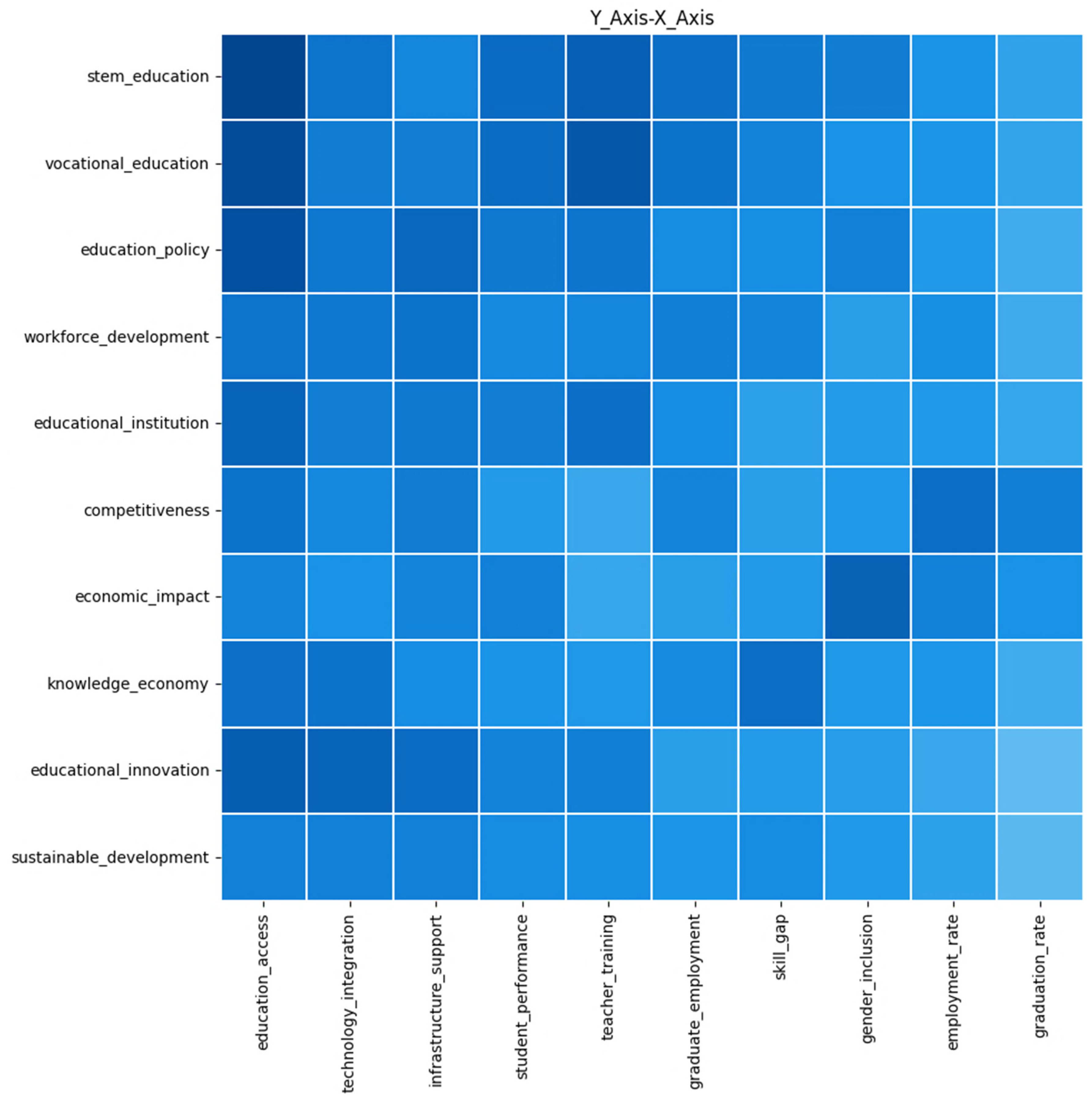
To further illustrate the findings, the “Economy and Education” system is selected as a case study. This system exemplifies the intricate connections between economic and educational factors. The characteristics of this system, as shown in Figure 6, are analyzed based on the strength of relationships indicated in the heatmap. Conversely, a lighter blue cell, with a cosine similarity of 0.3, suggests a weaker connection between “Job Market Dynamics” and “Primary Education Enrollment.” These interdependencies are further detailed in the accompanying matrix (Table 2), which presents the exact numerical cosine similarity values.
Figure 6.
The economic system of the education ecosystem.
While the heatmap legend provides a visual spectrum of similarity ranges, the exact numerical values for these interdependencies are further detailed in an extract of the matrix shown in the accompanying Table 4. This numerical depiction allows for a more granular understanding of the relationships between characteristic pairs within the system.
Table 4.
The matrix of cosine similarity values for the economy and education system.
The matrix of cosine similarity values between key characteristics of the “Economy and Education” system highlights the complex interdependencies within the system. Several significant trends emerge from the data. First, there are strong relationships in key areas, particularly between Education Access and characteristics such as Educational Innovation (0.8), Educational Institution (0.8), and STEM Education (0.9). This suggests that increasing access to education is closely linked to fostering innovation and promoting STEM initiatives, which play a crucial role in advancing educational outcomes. Furthermore, Education Policy shows a strong correlation with Education Access (0.9), emphasizing that effective policies are central to improving access to education.
The performance of students, with a minimum correlation of 0.6 across evaluated indicators, stands out as a crucial element in the educational landscape, reflecting its significant impact and vulnerability to various other influences. It exhibits moderate to high correlations (averaging between 0.6 and 0.7) with factors like educational innovation, vocational training, and workforce development, suggesting that student outcomes are influenced by a variety of systemic elements, ranging from policy frameworks to curriculum efforts. In contrast, technology integration shows slightly lower correlations (between 0.7 and 0.8) with most characteristics, underscoring its role as a vital facilitator within the educational system, yet it has a less direct impact on fundamental performance outcomes compared to student performance itself.
The matrix also reveals variability in the relationships between Skill Gap and other characteristics. The Skill Gap exhibits moderate to strong correlations with Vocational Education (0.7) and Workforce Development (0.7), underscoring the role of targeted education and skills-building initiatives in addressing labor market needs. However, its connections with broader factors such as Economic Impact and Technology Integration are weaker, indicating that tackling the skill gap requires more specific interventions beyond general economic conditions or technological advancements. Gender Inclusion and Infrastructure Support display moderate correlations with other characteristics. Gender Inclusion indicates a strong relation with Economic Impact (0.8), highlighting the importance of inclusive policies in promoting equitable economic outcomes, while Infrastructure Support plays a crucial role in facilitating educational innovation and vocational education across the system. Technologies such as VR/AR require infrastructure such as network access, with simulators requiring high processing power, all of which support educational innovation, whilst vocational education is inherently hands-on requiring access to necessary equipment such as welding machines, hydraulic tools, etc.,
For the other four systems, detailed results are provided in the appendices. Within each system, strong intra-variable relationships are evident, highlighting the key variables that drive performance. Table 5 presents the correlations across four interconnected systems: Business & Education, Government & Education, Healthcare, and Sustainability. In the Business & Education system, student engagement (similarity 0.814), research output (0.765), and industry partnership (0.800) emerge as critical variables, demonstrating how collaboration, academic performance, and engagement collectively enhance educational outcomes. These results underscore the centrality of student engagement and institutional collaboration in shaping system-level effectiveness.
Table 5.
Key Variables and Their Numerical Values Across the other five Systems of the education ecosystem.
The Government & Education system focuses on key factors such as policy support (0.947), educational outcomes (0.823), and government spending (0.809), underscoring the importance of financial resources and effective policy execution in driving significant enhancements in student achievement and accessibility. In the Healthcare & Education system, variables like healthcare access equity (0.987), mental health support (0.912), and healthcare infrastructure (0.967) stand out, demonstrating that improved health services directly enhance educational outcomes by creating healthier, more engaged students who learn more efficiently and attain superior academic results. Lastly, the Sustainability & Education system emphasizes sustainability research (0.926), curriculum revision (0.872), and sustainability education (0.860) as essential factors, highlighting the importance of interdisciplinary education and research in cultivating sustainability awareness, literacy, and its incorporation into broader learning outcomes.
These results demonstrate the interconnected nature of systems, highlighting key areas for intervention, resource allocation, and collaboration to achieve long-term development and sustainability goals. The implications of these results are to be discussed in the Section 6.
Key recurring variables include policy support, industry partnership, curriculum revision, research output, and student engagement, which play a significant role in driving development, sustainability, and collaboration across education, business, healthcare, and government systems. Inter-system relationships further reveal key connections. While these variables may exhibit lower similarity scores individually, their repeated presence across multiple systems underscores their importance as foundational variables for consideration. For instance, policy support connects educational reforms with sustainability goals, highlighting its influence across diverse contexts. Policy support links educational reforms to sustainability goals, while research output in education aligns with sustainability research to drive measurable progress. Industry partnerships appear in both education and sustainability systems, bridging academic knowledge with practical applications. Additionally, student engagement and curriculum revision connect education and sustainability, enhancing learning outcomes, awareness, and long-term development. These interconnected relationships emphasize how policies, research, and partnerships collectively advance education, healthcare, and sustainability objectives.
5.2. The Holistic Ecosystem vs. The Economy System of Education
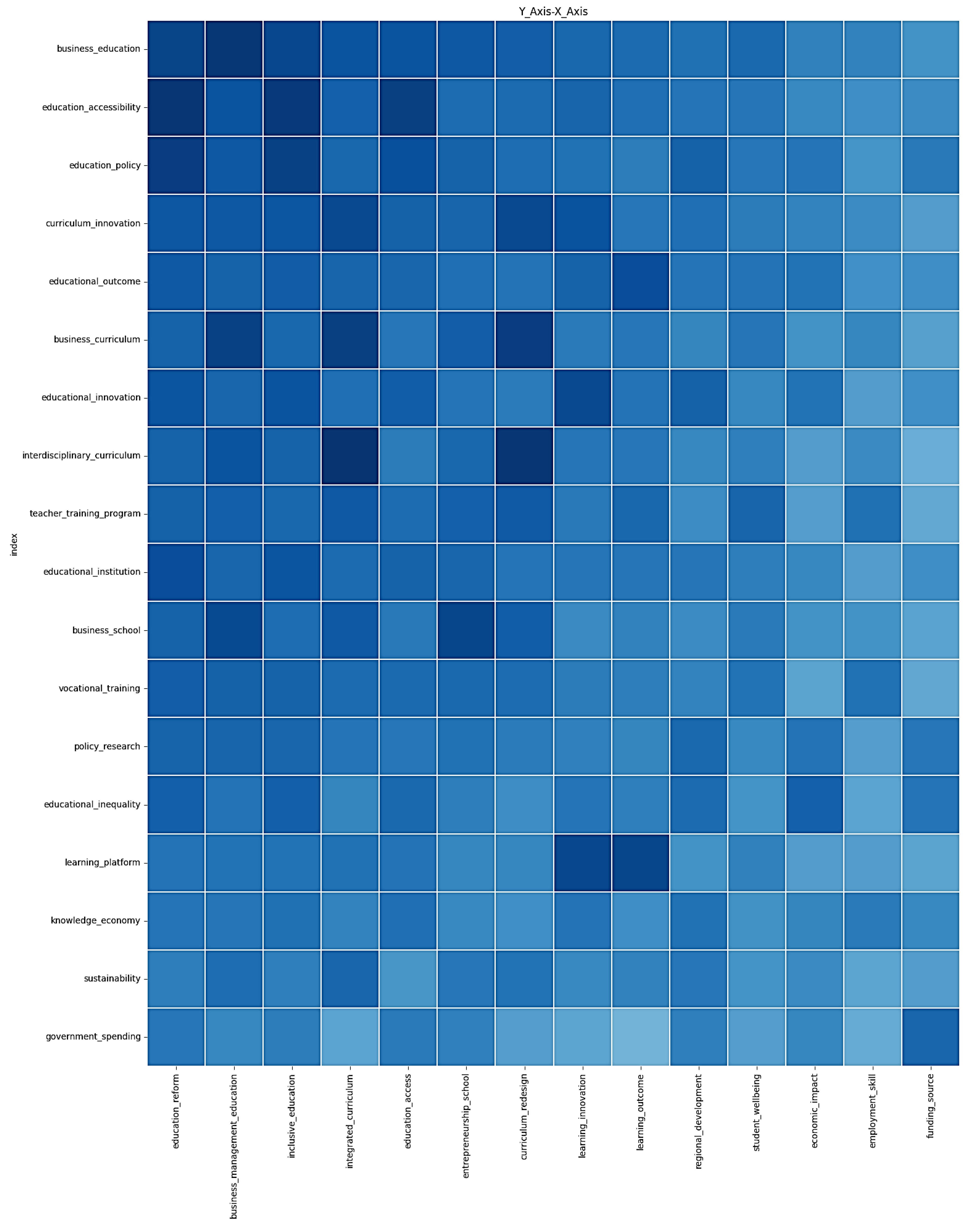
This Section 5.2 presents a comparative analysis between the holistic education ecosystem and its economy system. While the holistic ecosystem encompasses a wide range of interconnected systems such as skills, governance, health, and technology, the economic system specifically focuses on the financial and resource-related variables that directly influence education. This comparison highlights the broader interdependencies within the ecosystem while emphasizing the critical role of the economic system in shaping educational outcomes. For the holistic ecosystem, the keyword searches from 5 systems selected from the 15 systems of the initial search, such as skills, governance, health, and technology, were combined to form a comprehensive search string (“education ecosystem” OR “holistic education system” OR “education systems thinking”) AND (“business and education” OR “industry partnership” OR “workforce development”) AND (“government education policy” OR “policy support” OR “government spending”) AND (“healthcare education” OR “student well-being” OR “mental health support”) AND (“sustainability education” OR “curriculum revision” OR “sustainability research”) AND (“artificial intelligence” OR “machine learning” OR “AI” OR “Word2Vec” OR “data-driven analysis”). This integrated search allowed for a more cohesive and expansive analysis, ensuring that all relevant variables of the education ecosystem were captured. The result of this combined search is visualized in the heat map seen in Figure 7, which provides a clear representation of the frequency and relevance of the identified keywords across the education ecosystem. The legend of the heatmap (Figure 7) provides a guide for understanding the intensity of the relationships depicted in the plot. It’s essential to recognize that these associations are derived from cosine similarity values. This visualization serves to highlight key trends and relationships within the education system as a whole.
Figure 7.
Heatmap illustration of the holistic education ecosystem.
Zooming into the ecosystem and comparing it to the economic system, when comparing the Economy and Education system to the broader ecosystem, it becomes clear that both are essential components of a holistic, interdependent network. These two systems are not only tightly linked to each other but also intersect significantly with other key systems namely, Government & Education, Business & Education, Healthcare, and Sustainability. Each of these systems contributes a set of characteristic variables, which together form the foundation of the overall ecosystem diagram.
In this integrated view, variables such as economic impact, funding sources, and business management education originate from the Economy & Education system. They illustrate how economic stability and investment fuel innovation, educational reform, and the expansion of vocational training. Similarly, education access, graduation rate, and skill gap also from the economic system highlight the bidirectional influence where improved education leads to a more skilled workforce and, in turn, economic growth.
Building on the system-level similarity analysis discussed above, Table 6 presents a selected portion of the holistic ecosystem similarity matrix. The reported cosine similarity values capture the relative semantic proximity between education and the five high-impact systems, providing quantitative evidence of inter-system interdependencies.
Table 6.
A portion of the matrix showing similarity values for the holistic ecosystem. This table should be used in the point detailed above.
The overall ecosystem diagram also includes variables from other systems:
- From Business: industry partnership, student engagement, and research output.
- From Economy: economic growth, employment rates, investment in education, knowledge economy indicators.
- From Government: policy support, government spending, and educational outcomes.
- From Healthcare: mental health support, healthcare infrastructure, and access equity.
- From Sustainability: sustainability education, curriculum revision, and sustainability research.
Several variables appear across multiple systems (Table 6), reinforcing their systemic importance. Education access is a recurring variable in both Economy and Government systems, emphasizing its dual role as both a policy target and an economic driver. Technology integration is another cross-cutting variable, present in Economy & Education and Sustainability, highlighting its role in both modernizing education and supporting sustainable practices. These recurring variables are pivotal for system-wide transformation, as they act as bridges connecting otherwise distinct domains. The synergy between systems and the ecosystem, particularly between the economy and education, illustrates how economic resources can drive educational reform and innovation, while education builds human capital that strengthens the economy. This cyclical relationship is central to the sustainability of the overall ecosystem, promoting equity, innovation, and long-term societal development.
In understanding the education ecosystem, several variables emerge as key priorities based on their numerical values across different systems. Notably, education policy (0.94) stands out due to its high impact on various variables such as education access (0.91), inclusive education (0.94), and student wellbeing (0.94), making it essential for addressing systemic challenges in education. Educational innovation (0.90) and educational institution (0.89) are also highly significant, particularly in fostering learning outcomes (0.89), curriculum redesign (0.94), and vocational training (0.80). These variables suggest a strong need for innovation within educational institutions to improve the quality and accessibility of education.
Business education and business curriculum (0.94) also play a critical role, as they directly influence economic impact (0.86), employment skills (0.94), and graduation rates. These connections highlight the importance of aligning educational content with real-world industry needs to foster a competitive workforce. Lastly, education accessibility (0.97) and interdisciplinary curriculum (0.98) are crucial in ensuring equal opportunities for all students while fostering a comprehensive and inclusive approach to education. These variables indicate that enhancing access and curriculum integration should be prioritized to bridge educational gaps and improve outcomes across the system.
6. Discussion
The analysis provides a set of insights into the interdependencies across the education, healthcare, and sustainability systems, showing how specific variables consistently emerge as influential in shaping system outcomes. In the education system, variables such as education policy, education access, and inclusive education display strong semantic proximity to outcome-related concepts in the Word2Vec analysis. The recurrent appearance of these variables across similarity clusters suggests that these variables operate as high-leverage elements within the system, influencing not only teaching and learning processes but also broader institutional dynamics. Curriculum redesign and educational innovation also show high connectivity, indicating that adaptive curricular structures and pedagogical strategies are central in enabling systems to respond to technological and societal changes. Together, these findings highlight that the educational system is shaped by a relatively small but powerful set of variables that have both internal and cross-sector implications.
In the healthcare system, variables including healthcare access, mental health awareness, and immunization coverage appear prominently in semantic analysis. Their conceptual closeness to education-related variables particularly those associated with student engagement and cognitive development reflects the strong cross-system interdependencies documented in the literature. The Word2Vec clusters show that concepts related to health education, school-based health programs, and community-level interventions frequently occur alongside discussions of public health outcomes. These connections suggest that education-related variables are embedded in the conceptual framing of healthcare, reinforcing the idea that health outcomes are not only medically determined but also shaped by knowledge systems, literacy, and learning environments.
The sustainability system shows a similar pattern, with sustainability literacy, policy support, and environmental impact emerging as central variables. The semantic proximity of sustainability-related variables to educational ones reflects the emphasis in the literature on the need for contextualized, curriculum-embedded approaches to sustainability. Overall, the results indicate that education appears as a central mediating system across the three domains, with its variables frequently acting as conceptual bridges linking healthcare and sustainability themes.
These findings align closely with existing theoretical frameworks. The cross-system linkages observed through semantic similarity reflect principles found in socio-technical systems research [47], which emphasizes the relational character of system components and their reliance on coordinated change. Furthermore, the presence of feedback loops inferred from variable co-occurrence corresponds to concepts in complex adaptive systems theory [48,49], where small changes in one subsystem can produce emergent effects across others. The strong clustering around sustainability literacy is consistent with [50,51], who notes that educational environments significantly influence environmental awareness and behavior. Similarly, the associations between mental health education and broader public health outcomes support the findings of [52,53], who demonstrate that school-based mental health initiatives have measurable community-level effects. These theoretical correspondences suggest that the patterns observed in the data are not isolated or incidental but rather reflect broader system logics documented in empirical and conceptual research.
The implications of these findings extend to both policy and practice. The repeated appearance of specific variables across systems such as education policy or healthcare access indicates that certain elements serve as cross-cutting leverage points. While semantic similarity does not establish causation, the centrality of these variables suggests that interventions targeting them may influence multiple outcomes. For example, enhancing sustainability literacy through curriculum redesign may not only strengthen environmental knowledge but also affect civic participation and policy support, as suggested by the clustering of these concepts in the analysis. Similarly, integrating mental health education into school programs may reinforce public health outcomes by improving awareness and early intervention capabilities. The identification of these leverage points provides a basis for intersectoral policy alignment, where coordinated strategies across education, health, and environmental sectors can potentially produce cumulative or synergistic effects.
Despite its contributions, the analysis has several limitations. First, Word2Vec captures conceptual proximity in text rather than empirical relationships. High similarity scores indicate frequent co-occurrence in the literature, which may reflect scholarly focus rather than causal influence. Second, the variable set is dependent on the scope and representation of the literature; domains with limited academic attention may be underrepresented in the analysis. Third, while the clustering reveals patterns of association, it does not quantify the magnitude, direction, or statistical significance of these relationships. As such, the findings should be interpreted as indicative rather than definitive. Fourth, the results represent aggregated global patterns that may not apply uniformly across different geographic or institutional contexts. These limitations highlight the need for complementary empirical analysis and systems modeling to validate the conceptual connections identified here.
Nevertheless, the findings provide practical avenues for policy and system design. Prioritizing high-centrality variables such as inclusive education, healthcare access, or sustainability literacy may offer efficient entry points for improving system performance. Aligning policies across sectors may also strengthen system coherence, especially where variables appear repeatedly across domains. Finally, integrating systems thinking within educational, healthcare, and sustainability frameworks can support the identification of feedback loops and help anticipate the broader effects of targeted interventions.
7. Conclusions
This study sets out to understand how the education ecosystem can be represented as a dynamic, interdependent system, and which characteristics most strongly define it. By combining systems thinking with a structured literature review and a Word2Vec-based relational analysis, the research demonstrated that the education ecosystem can be meaningfully described through the patterns of connectivity among its core variables rather than through isolated components. This directly responds to RQ1: systems thinking becomes practical when relationships are treated as data that can be mapped, compared, and interpreted. The analysis revealed a recurring set of variables access, policy alignment, infrastructure, gender inclusion, innovation capacity, and workforce-oriented skills that consistently appear across contexts. Their clustering in the similarity model shows that these characteristics do not operate independently; they co-evolve and influence one another. This answers RQ2 by identifying not only which characteristics matter most but also how they are structurally linked. These patterns highlight that the education ecosystem is defined by dense, interacting pathways rather than linear inputs and outputs. Taken together, the findings suggest that efforts to improve educational outcomes must engage with the system’s internal architecture. Changes to one part of the ecosystem inevitably influence others, and the success of any intervention depends on whether it aligns with the relational structure of the system itself. Representing these relationships empirically provides a foundation for more coherent policy design and lays the groundwork for future modelling work that can incorporate feedback loops, delays, and system-wide responses. The contribution of this study is therefore twofold: it offers a method for transforming qualitative systems thinking into an empirical representation of interdependence, and it clarifies the key characteristics that form the backbone of the education ecosystem. This provides a basis for moving toward more predictive, integrative, and system-aware approaches in the study and design of education systems.
8. Future Work
Future Building on the identification of key variables and their interdependencies, future research will focus on formalizing these relationships into predictive and testable models. A primary avenue is the application of Structural Equation Modeling (SEM), which allows for quantifying the strength and direction of relationships among latent constructions such as policy support, education access, innovation, and workforce readiness. SEM will enable researchers to test hypotheses about how changes in one part of the system propagate through others, providing empirical validation of the system interdependencies revealed in this study. Beyond SEM, integrating these variables into dynamic systems models such as agent-based or system dynamics simulations will allow for scenario testing. For example, researchers could explore how targeted investments in vocational training or infrastructure improvements impact workforce outcomes, graduation rates, and skill gaps over time. This approach can also accommodate feedback loops and delays, capturing the non-linear effects that emerge in complex education ecosystems.
Future work will also aim to refine the operationalization of latent variables across multiple systems, incorporating cross-sectoral dependencies with the economic, healthcare, and sustainability domains. By doing so, it will be possible to explore systemic interventions that maximize positive outcomes across both education and societal indicators. The ultimate goal is to provide policymakers and education planners with actionable, model-based insights that can guide integrated reforms and investments.
Author Contributions
Conceptualization, A.T.; Methodology, M.M. and A.T.; Validation, A.T.; Formal analysis, N.G. and M.M.; Investigation, N.G.; Writing—original draft, N.G.; Writing—review and editing, M.M. and A.T.; Supervision, M.M. and A.T. All authors have read and agreed to the published version of the manuscript.
Funding
This research received no external funding.
Institutional Review Board Statement
Not applicable.
Informed Consent Statement
Not applicable.
Data Availability Statement
The original contributions presented in this study are included in the article. Further inquiries can be directed to the corresponding author.
Conflicts of Interest
The authors declare no conflicts of interest.
References
- Ramírez-Montoya, M.S. Analysis of open education in Latin America in the framework of UNESCO’s new recommendations. Rev. Interuniv. Form. Profr. 2022, 98, 93–112. [Google Scholar] [CrossRef] [Scilit]
- Ramirez-Montoya, M.-S. MOOCs and OER: Developments and Contributions for Open Education and Open Science. In Lecture Notes in Educational Technology; Springer: Berlin/Heidelberg, Germany, 2020; pp. 159–175. [Google Scholar] [CrossRef] [Scilit]
- Honorato-Errázuriz, J.; Ramírez-Montoya, M.S. Intervention model to promote reading in basic education: Contributions to public policies. In ACM International Conference Proceeding Series; Association for Computing Machinery: New York, NY, USA, 2020; pp. 299–303. [Google Scholar] [CrossRef] [Scilit]
- Bazyliuk, A.; Khomenko, V.; Ilchenko, V. World Experience of Investing and Human Capital Development. In Lecture Notes in Networks and Systems; Springer International Publishing: Cham, Switzerland, 2023; pp. 417–430. [Google Scholar] [CrossRef] [Scilit]
- Hughes, J.; Loader, R. Is academic selection in Northern Ireland a barrier to social cohesion? Res. Pap. Educ. 2022, 39, 420–438. [Google Scholar] [CrossRef] [Scilit]
- Williams, H.; Williamson, J.; Siebert, C. Exploring Perceptions Related to Teacher Retention Issues in Rural Western United States. Aust. Int. J. Rural. Educ. 2022, 32, 91–107. [Google Scholar] [CrossRef] [Scilit]
- Li, X.; Li, Y. Individualized and Innovation-Centered General Education in a Chinese STEM University. Educ. Sci. 2023, 13, 846. [Google Scholar] [CrossRef] [Scilit]
- Rodrigues, A.L.; Cerdeira, L.; Machado-Taylor, M.L.; Alves, H. Technological skills in higher education—Different needs and different uses. Educ. Sci. 2021, 11, 326. [Google Scholar] [CrossRef] [Scilit]
- Osovsky, O.; Chernetsova, E.; Kirzhaeva, V.; Maslova, E. Education-for-myself and education-for-the other: The right to freedom of education and mikhail Bakhtin’s experience. Dialogic. Pedagog. 2020, 8, SF71–SF79. [Google Scholar] [CrossRef] [Scilit]
- Kuno, C.B.; Hein, S.; Frankel, L.; Kim, H.J. Children’s schooling status: Household and individual factors associated with school enrollment, non-enrollment and dropping out among Ugandan children. Int. J. Educ. Res. Open 2021, 2, 100033. [Google Scholar] [CrossRef] [Scilit]
- Krafft, C.; Sieverding, M.; Berri, N.; Keo, C.; Sharpless, M. Education Interrupted: Enrollment, Attainment, and Dropout of Syrian Refugees in Jordan. J. Dev. Stud. 2022, 58, 1874–1892. [Google Scholar] [CrossRef] [Scilit]
- Cabrera, D.; Cabrera, L. What Is Systems Thinking? In Learning, Design, and Technology: An International Compendium of Theory, Research, Practice, and Policy; Springer International Publishing: Cham, Switzerland, 2023; pp. 1495–1522. [Google Scholar] [CrossRef] [Scilit]
- Salmon, P.; Stanton, N.A.; Walker, G.H.; Hulme, A.; Goode, N.; Thompson, J.; Read, G.J. Handbook of Systems Thinking Methods, 1st ed.; CRC Press: New York, NY, USA, 2023; Volume 1. [Google Scholar]
- Koopmans, M. Education is a Complex Dynamical System: Challenges for Research. J. Exp. Educ. 2020, 88, 358–374. [Google Scholar] [CrossRef] [Scilit]
- Strokosch, K.; Osborne, S.P. Co-experience, co-production and co-governance: An ecosystem approach to the analysis of value creation. Policy Polit. 2020, 48, 425–442. [Google Scholar] [CrossRef] [Scilit]
- Currie, J.; Goodman, J. Parental socioeconomic status, child health, and human capital. In The Economics of Education: A Comprehensive Overview; Academic Press: San Diego, CA, USA, 2020; pp. 239–248. [Google Scholar] [CrossRef] [Scilit]
- Silva-Sobrinho, R.A.; Zilly, A.; Silva, R.M.M.D.; Arcoverde, M.A.M.; Deschutter, E.J.; Palha, P.F.; Bernardi, A.S. Coping with COVID-19 in an international border region: Health and economy. Rev. Lat. Am. Enferm. 2021, 29, e3398. [Google Scholar] [CrossRef] [Scilit] [PubMed]
- Bilgiler Eğitimi Araştırmaları Dergisi, S.; Sukmayadi, V.; Yahya, A.H. Indonesian Education Landscape and the 21st Century Challenges. J. Soc. Stud. Educ. Res. 2020, 2, 219–234. [Google Scholar]
- Barlow, W.D. Primary-Secondary Transition—Building Hopes and Diminishing Fears Through Drama. Front. Educ. 2021, 5, 546243. [Google Scholar] [CrossRef] [Scilit]
- Tovar Reaños, M.A. Fuel for poverty: A model for the relationship between income and fuel poverty. Evidence from Irish microdata. Energy Policy 2021, 156, 112444. [Google Scholar] [CrossRef] [Scilit]
- Postiglione, G.; Tang, M. International experience in TVET-industry cooperation for China’s poorest province. Int. J. Train. Res. 2019, 17, 131–143. [Google Scholar] [CrossRef] [Scilit]
- Lampoltshammer, T.J.; Albrecht, V.; Raith, C. Teaching digital sustainability in higher educationfrom a transdisciplinary perspective. Sustainability 2021, 13, 12039. [Google Scholar] [CrossRef] [Scilit]
- Callender, C.; Dougherty, K.J. Student choice in higher education-reducing or reproducing social inequalities? Soc. Sci. 2018, 7, 189. [Google Scholar] [CrossRef] [Scilit]
- Panasenko, K.E.; Voloshina, L.N.; Shinkareva, L.V.; Galimskaya, O.G. Socialization-individualization of preschool children with speech disorders in motor activity. J. Med. Chem. Sci. 2021, 4, 538–545. [Google Scholar] [CrossRef]
- Richardson, E.V.; Nagata, S.; Hall, C.; Akimoto, S.; Barber, L.; Sawae, Y. Developing a Socially-Just Research Agenda for Inclusive Physical Education in Japan. Quest 2023, 75, 361–378. [Google Scholar] [CrossRef] [Scilit]
- Servant-Miklos, V.; Noordegraaf-Eelens, L. Toward social-transformative education: An ontological critique of self-directed learning. Crit. Stud. Educ. 2021, 62, 147–163. [Google Scholar] [CrossRef] [Scilit]
- Zavyalova, E.; Alsufyev, A.; Krakovetskaya, I.; Lijun, W.; Li, J. Personnel development in Chinese innovation-active companies. Foresight STI Gov. 2018, 12, 43–52. [Google Scholar] [CrossRef] [Scilit]
- Chalapati, N.; Chalapati, S. Building a skilled workforce: Public discourses on vocational education in Thailand. Int. J. Res. Vocat. Educ. Train. 2020, 7, 67–90. [Google Scholar] [CrossRef]
- Roberts, K. Integrating Young People into the Workforce: England’s Twenty-First Century Solutions. Societies 2022, 12, 38. [Google Scholar] [CrossRef] [Scilit]
- Walsh, K. Artificial intelligence and healthcare professional education: Superhuman resources for health? Postgrad Med. J. 2020, 96, 121–122. [Google Scholar] [CrossRef] [Scilit] [PubMed]
- Quennerstedt, M. Healthying physical education—On the possibility of learning health. Phys. Educ. Sport Pedagog. 2019, 24, 1–15. [Google Scholar] [CrossRef] [Scilit]
- Li, X.; Yang, H.; Wang, H.; Liu, X. Effect of health education on healthcare-seeking behavior of migrant workers in China. Int. J. Env. Res. Public Health 2020, 17, 2344. [Google Scholar] [CrossRef] [Scilit] [PubMed]
- Ruin, S.; Stibbe, G. Health-oriented ‘Bildung’ or an obligation to a healthy lifestyle? A critical analysis of current PE curricula in Germany. Curric. J. 2021, 32, 136–151. [Google Scholar] [CrossRef] [Scilit]
- Álvarez-García, C.; López-Medina, I.M.; Sanz-Martos, S.; Álvarez-Nieto, C. Planetary health: Education for sustainable healthcare. Educ. Medica. 2021, 22, 352–357. [Google Scholar] [CrossRef] [Scilit]
- Carbonaro, A.; Kuzelka, J.A.M.B.; Piccinini, F. A new digital divide threatening resilience: Exploring the need for educational, firm-based, and societal investments in ICT human capital. J. E-Learn. Knowl. Soc. 2022, 18, 66–73. [Google Scholar] [CrossRef]
- Froehlich, D.E.; Van Waes, S.; Schäfer, H. Linking Quantitative and Qualitative Network Approaches: A Review of Mixed Methods Social Network Analysis in Education Research. Rev. Res. Educ. 2020, 44, 244–268. [Google Scholar] [CrossRef] [Scilit]
- Andriani, E.; Priskananda, A.A.; Budiraharjo, M. A Cultural-Historical Activity Theory (CHAT) Analysis on Educational Psychology Class: The Challenges in Delivering a Fully Online Classroom Environment. J. Foreign Lang. Teach. Learn. 2022, 7, 41–60. [Google Scholar] [CrossRef] [Scilit]
- Yaremych, H.E.; Preacher, K.J.; Hedeker, D. Centering Categorical Predictors in Multilevel Models: Best Practices and Interpretation. Psychol. Methods 2021, 28, 613–630. [Google Scholar] [CrossRef] [Scilit]
- Van Droogenbroeck, F.; Spruyt, B.; Quittre, V.; Lafontaine, D. Does the School Context Really Matter for Teacher Burnout? Review of Existing Multilevel Teacher Burnout Research and Results from the Teaching and Learning International Survey 2018 in the Flemish- and French-Speaking Communities of Belgium. Educ. Res. 2021, 50, 290–305. [Google Scholar] [CrossRef] [Scilit]
- Vulic, J.; Jacobson, M.J.; Levin, J.A. Exploring Education as a Complex System: Computational Educational Research with Multi-Level Agent-Based Modeling. Educ. Sci. 2024, 14, 551. [Google Scholar] [CrossRef] [Scilit]
- D’Inverno, G.; Smet, M.; De Witte, K. Impact evaluation in a multi-input multi-output setting: Evidence on the effect of additional resources for schools. Eur. J. Oper. Res. 2021, 290, 1111–1124. [Google Scholar] [CrossRef] [Scilit]
- Grieshaber, S.; Hunkin, E. Complexifying quality: Educator examples. Front. Educ. 2023, 8, 1161107. [Google Scholar] [CrossRef] [Scilit]
- Hossain, N.U.I.; Dayarathna, V.L.; Nagahi, M.; Jaradat, R. Systems thinking: A review and bibliometric analysis. Systems 2020, 8, 23. [Google Scholar] [CrossRef] [Scilit]
- Chaaban, Y.; Al-Thani, H.; Du, X. A systems-thinking approach to evaluating a university professional development programme. Prof. Dev. Educ. 2023, 50, 296–314. [Google Scholar] [CrossRef] [Scilit]
- Dughi, T.; Rad, D.; Runcan, R.; Chiș, R.; Vancu, G.; Maier, R.; Costin, A.; Rad, G.; Chiș, S.; Uleanya, C.; et al. A Network Analysis-Driven Sequential Mediation Analysis of Students’ Perceived Classroom Comfort and Perceived Faculty Support on the Relationship between Teachers’ Cognitive Presence and Students’ Grit—A Holistic Learning Approach. Behav. Sci. 2023, 13, 147. [Google Scholar] [CrossRef] [Scilit]
- Mikolov, T.; Chen, K.; Corrado, G.; Dean, J. Efficient Estimation of Word Representations in Vector Space. arXiv 2013, arXiv:1301.3781. [Google Scholar] [CrossRef] [Scilit]
- DeWaters, J.; Kotla, B. Using an open-ended socio-technical design challenge for entrepreneurship education in a first-year engineering course. Front. Educ. 2023, 8, 1198161. [Google Scholar] [CrossRef] [Scilit]
- Abbott, R.; Hadžikadić, M. Complex Adaptive Systems, Systems Thinking, and Agent-Based Modeling. In Lecture Notes in Networks and Systems; Springer International Publishing: Cham, Switzerland, 2017; Volume 3, pp. 1–8. [Google Scholar] [CrossRef] [Scilit]
- Phillips, M.A.; Ritala, P. A complex adaptive systems agenda for ecosystem research methodology. Technol. Forecast. Soc. Change 2019, 148, 119739. [Google Scholar] [CrossRef] [Scilit]
- Casey, C.; Asamoah, L. Education and sustainability: Reinvigorating adult education’s role in transformation, justice and development. Int. J. Lifelong Educ. 2016, 35, 590–606. [Google Scholar] [CrossRef] [Scilit]
- Finnveden, G.; Schneider, A. Sustainable Development in Higher Education—What Sustainability Skills Do Industry Need? Sustainability 2023, 15, 4044. [Google Scholar] [CrossRef] [Scilit]
- Rincon, E.; Rodriguez-Guidonet, I.; Andrade-Pino, P.; Monfort-Vinuesa, C. Mixed Reality in Undergraduate Mental Health Education: A Systematic Review. Electronics 2023, 12, 1019. [Google Scholar] [CrossRef] [Scilit]
- Jiang, Y.; Zilioli, S.; Balzarini, R.N.; Zoppolat, G.; Slatcher, R.B. Education, Financial Stress, and Trajectory of Mental Health During the COVID-19 Pandemic. Clin. Psychol. Sci. 2022, 10, 662–674. [Google Scholar] [CrossRef] [Scilit]



Disclaimer/Publisher’s Note: The statements, opinions and data contained in all publications are solely those of the individual author(s) and contributor(s) and not of MDPI and/or the editor(s). MDPI and/or the editor(s) disclaim responsibility for any injury to people or property resulting from any ideas, methods, instructions or products referred to in the content. |
© 2025 by the authors. Licensee MDPI, Basel, Switzerland. This article is an open access article distributed under the terms and conditions of the Creative Commons Attribution (CC BY) license.