

Article

Estimating the Impact of Government Green Subsidies on Corporate ESG Performance: Double Machine Learning for Causal Inference


1
Faculty of Economics and Management, Universiti Kebangsaan Malaysia, Kuala Lumpur 43600, Malaysia
2
School of Audit, Nanjing Audit University Jinshen College, Nanjing 210023, China
3
School of Accounting and Auditing, Jiangsu Vocational Institute of Commerce, Nanjing 211168, China
*
Author to whom correspondence should be addressed.
Sustainability 2026, 18(1), 281; https://doi.org/10.3390/su18010281 (registering DOI)
Submission received: 16 October 2025 / Revised: 16 December 2025 / Accepted: 23 December 2025 / Published: 26 December 2025

Abstract

In this study, we examine the impact of government green subsidies on corporate ESG performance. We employ the method of double machine learning for causal inference. We use all A-share listed companies in China from 2013 to 2023 as the research sample. After excluding financial and insurance companies, those in ST/*ST/PT status, and those with missing key indicators, we ultimately obtain 2337 sample observations. Our baseline results based on double machine learning reveal government green subsidies significantly enhance corporate ESG performance. The findings suggest that this enhancement occurs notably through the mediating variables of digital technology innovation and technology conversion efficiency. We also introduce heterogeneous dimensions such as the level of digital inclusive finance, the intensity of environmental regulations, and the scale of enterprises. Meanwhile, we adopt multiple robustness test methods, including changing the dependent variable, excluding data from special years, controlling for exogenous policy shocks, using instrumental variable methods, and resetting the double machine learning model—adjusting the sample partition ratio from the original 1:4 to 1:9 and replacing the prediction algorithm from random forest to gradient boosting, lasso regression, and ensemble machine learning methods—to ensure the reliability and scientific nature of the research conclusions. Additional tests indicate that the regression coefficient remains positive and is significant, indicating the robustness of our conclusions. This research offers implications for further optimizing the design of government green subsidy policies, and to promote the improvement of enterprises’ ESG performance and economic green transformation.

1. Introduction

Government green subsidies are financial support measures implemented by governments through funding grants, tax reductions, and other means to encourage enterprises to invest in green innovation, green technologies, and green management practices, thereby promoting environmental protection and sustainable development [1]. China has long neglected environmental costs in economic development, resulting in an extensive industrial growth model that has led to increasingly severe environmental pollution. To achieve harmonious coexistence between the economy and the environment, the Chinese government has increasingly emphasized green innovation and industrial green transformation in recent years [2]. The core objective of government green subsidies is to alleviate financial pressures on enterprises in green technology R&D and management innovation through financial support, thereby enhancing their capacity for green development [3]. However, implementation challenges remain in the process of government green subsidies. Some enterprises may develop dependency on government funds after receiving subsidies, reducing their enthusiasm for independent innovation [4]. The efficiency of subsidy utilization may vary depending on differences in enterprise scale and green management capabilities, with some companies potentially underutilizing allocated funds [5]. When formulating green subsidy policies, governments fully consider heterogeneous characteristics of enterprises, such as pollution intensity, factor intensity, and lifecycle factors, to improve policy precision and effectiveness [6].
Environmental, Social and Governance (ESG) performance is a crucial indicator for measuring a company’s sustainable development capabilities and social responsibility fulfillment. ESG performance reflects a company’s efforts and achievements in environmental protection, social responsibility, and corporate governance, which helps enhance its social image and brand value [7]. Good ESG performance can attract more investor attention, especially from institutional investors who prioritize long-term value and social responsibility, thereby reducing corporate financing costs and improving capital market recognition [8]. ESG performance is also closely related to a company’s risk management and long-term profitability. By optimizing ESG performance, companies can better identify and address environmental and social risks, thereby achieving sustainable development [2]. With global emphasis on environmental protection, green transformation, and sustainable development, corporate ESG performance has become a key indicator for assessing their comprehensive strength and growth potential [9]. In this context, governments encourage companies to improve ESG performance through policy measures such as green subsidies, promoting corporate green transformation. Therefore, how to advance corporate green transformation during economic growth to enhance ESG performance has become a significant challenge and unavoidable issue for China’s high-quality economic development.
Under the green development strategy, government green subsidies serve as a key policy tool that drives corporate low-carbon transitions and supports sustainable economic growth. These subsidies provide financial support to guide enterprises in environmental R&D, energy conservation, emission reduction, and green production, with potential to enhance environmental performance and accelerate green upgrades. They act as a safeguard for the transformation of traditional high-energy-consuming enterprises [10]. Zahid [11] suggests that their effectiveness and value should be assessed through scientific methods like cost–benefit analysis to measure how subsidies boost corporate green investments and pollutant reductions. Existing empirical studies on accounting treatment and information disclosure of government green subsidies have proposed solutions such as separate reporting and establishing special accounting mechanisms, providing robust support for corporate standardization of green financial accounting and government strengthening of subsidy supervision [12]. The promoting effect of government green subsidies on corporate green development has been thoroughly validated [5]. However, the intrinsic relationship between government green subsidies and corporate ESG performance remains underexamined. Methodologically, traditional econometric models (e.g., DID, fixed effects model) remain mainstream tools for analyzing green subsidy effects [13], while cutting-edge models like dual machine learning are gradually expanding research paradigms, offering new pathways to precisely identify causal relationships between subsidy policies and corporate green performance.
ESG has achieved vigorous development since its inherent nature of sustainable development and long-term value growth perfectly aligns with the intrinsic needs of value creation in current business practices. Zhao and Cai [14] proposed that ESG indicators are not an evaluation metric based on corporate financial fundamentals, but rather a novel assessment system measuring a company’s green development philosophy, corporate social responsibility, and management capabilities. Therefore, ESG indicators provide certain guidance for investment [15]. In contrast, Western scholars’ research on ESG tends to focus more on practical aspects such as responsible investment and corporate performance [16], while China’s ESG studies predominantly explore the necessity of ESG disclosure and the consequential impacts of ESG [17]. Existing literature on corporate ESG performance research mostly concentrates on analyzing the economic consequences of ESG performance, which primarily include financial performance, corporate value, and efficiency [18]. Most studies hold a positive and affirmative attitude toward the impact of ESG [19]. However, research on the antecedent factors influencing corporate ESG performance remains relatively limited. Traditional methods mainly involve Ordinary Least Squares (OLS), Difference-in-Differences (DID), and fixed effects models [20], but in recent years, cutting-edge models such as Dual Machine Learning (DML) have been increasingly applied [21].
In the dual context of digital transformation and green development, most existing research focuses on the direct impact of government subsidies on green technology investments or emission outcomes [1]. However, limited attention has been paid to the influence of government green subsidies on ESG performance. Methodologically, current empirical strategies still predominantly rely on traditional regression methods [4], which demonstrate limited capacity to handle high-dimensional confounding variables and nonlinear relationships, while failing to fully leverage the advantages of dual-machine learning in causal discovery and policy evaluation. Regarding mediation effect analysis and heterogeneity analysis, existing studies neglect critical mediating variables such as corporate digital economy patents and technology transfer efficiency and rarely conduct heterogeneity analyses from dimensions like environmental regulation intensity, digital inclusive finance and firm size [5,17,22].
Building upon existing research, this study examines the impact of government green subsidies on corporate ESG performance and advances the literature through three key innovations, with particular emphasis on methodological rigor: first, in terms of research perspective, it shifts the focus from narrow green technology investment or emission reduction outcomes to the broader construct of ESG performance. This allows for a holistic assessment of how subsidies shape firms’ environmental, social, and governance capabilities—three interconnected dimensions critical to long-term sustainable development—rather than isolating single environmental indicators.
Second, methodologically, the study adopts a Double Machine Learning (DML) model to address the endogenous and model specification biases inherent in traditional approaches. Specifically, DML resolves endogeneity by decoupling the estimation of confounding variables from the causal effect of subsidies: it uses machine learning algorithms (e.g., random forest, gradient boosting) to flexibly model high-dimensional control variables (e.g., firm governance structures, regional digital finance levels) and generate residualized treatment (subsidy) and outcome (ESG) variables [23]. This process effectively filters out the influence of omitted variables and nonlinear confounders that traditional linear models (e.g., DID, fixed effects) cannot capture. Furthermore, DML mitigates model specification bias by avoiding arbitrary functional form assumptions (e.g., linearity between subsidies and ESG performance) [24]. Instead, it leverages data-driven feature extraction to adapt to complex relationships, ensuring more accurate identification of the causal effect of green subsidies on ESG performance. Compared to synthetic control methods (SCM) or propensity score matching (PSM), which are constrained by single-treatment-unit matching or subjective covariate selection, DML offers greater generalizability and robustness in handling large-scale, high-dimensional panel data [25].
Third, in terms of mechanism and heterogeneity analysis, the study constructs two critical mediating variables—digital economy patents (to measure digital technology innovation) and technology transaction activity (to measure technology conversion efficiency)—to unpack the “black box” of how subsidies affect ESG performance. It also incorporates four heterogeneity dimensions (environmental regulation intensity, digital inclusive finance level and firm size) to test whether subsidy effects vary across different institutional and firm contexts [11]. For example, it examines whether subsidies are more effective in regions with weak environmental regulation (where firms lack intrinsic ESG motivation) or among small enterprises (which face greater resource constraints) [14]. This multi-layered analysis provides nuanced empirical evidence to refine the sustainable development theory of government green subsidies driving corporate ESG performance and offers targeted insights for policy design.

2. Theoretical Analysis and Research Hypotheses

2.1. Government Green Subsidies and Corporate ESG Performance

The resource dependency theory posits that enterprises are fundamentally resource-dependent organizations whose survival and development rely heavily on continuously acquiring critical resources from external environments [26]. In this process, the government, as a key actor in institutional environments, often plays the pivotal role of resource provider. Government-provided green subsidies not only deliver much-needed financial support to enterprises but also strategically guide their transition toward sustainable development [27]. These special-purpose funds directly alleviate financial pressures faced by companies in environmental governance, energy conservation, emission reduction, and green technology innovation, helping them overcome resource constraints [28]. Subsidized enterprises can more confidently adopt advanced eco-friendly technologies, optimize production processes, and enhance pollution control, thereby significantly improving environmental performance. Government green subsidies incentivize companies to establish robust internal governance structures, improve information disclosure quality, and strengthen social responsibility practices, achieving comprehensive performance enhancement [28]. Therefore, government green subsidies are not merely fiscal transfers but crucial policy instruments and institutional resources. By alleviating corporate resource dilemmas and reducing green transition costs, they effectively guide enterprises to transform external environmental pressures into internal governance drivers, ultimately promoting coordinated development across environmental, social, and governance (ESG) dimensions.
Institutional theory posits that corporate survival and development depend not only on resource acquisition but also on aligning with the legitimacy requirements of external institutional environments. As the architect and enforcer of institutional rules, governments often use policy tools that serve as core institutional signals guiding corporate behavior [29]. Government-provided green subsidies, in essence, function as policy instruments that transmit institutional guidance through fiscal incentives. These subsidies not only offer much-needed financial support to enterprises but also, through dual mechanisms of institutional constraints and incentives, drive companies to internalize ESG development needs as strategic choices [5]. Such special funding assistance is not merely resource input; rather, it establishes an institutional transmission path of “compliance-incentive-development” through clear policy orientations (e.g., support for environmental governance, energy conservation, and emission reduction), compelling enterprises to actively transform external institutional requirements into internal governance momentum [15].
From the perspective of corporate strategic response, enterprises receiving subsidies will allocate funds to policy-aligned sectors based on institutional legitimacy objectives. On one hand, they improve environmental performance through concrete measures such as adopting advanced eco-friendly technologies and optimizing production processes, thereby meeting the core requirements of environmental responsibility under the system [30]. On the other hand, they establish comprehensive ESG management systems by building robust internal governance structures, enhancing information disclosure quality, and strengthening social responsibility practices, actively adapting to the institutional environment [22]. This approach is not a passive policy response but a strategic layout based on institutional logic. By meeting the institutional standards conveyed through government subsidies, enterprises can not only sustain policy resource support but also enhance their legitimacy status and reputation value in the market.
In this process, the policy feedback mechanism further enhances institutional transmission effects: corporate performance improvements achieved through ESG practices serve as reference points for government subsidy policy optimization, while enterprises’ deep internalization of institutional requirements reinforces the virtuous cycle of “policy guidance-corporate response-performance enhancement” [30]. Therefore, as a crucial institutional vehicle, government green subsidies fundamentally aim to drive enterprises to transcend short-term cost–benefit considerations through dual mechanisms of policy signals and resource incentives [31]. This transforms ESG development from external requirements into endogenous strategies, ultimately achieving coordinated progress between institutional compliance and ESG performance improvement.
Based on this analysis, this paper proposes:
H1:
Government green subsidies can enhance corporate ESG performance.

2.2. Mediating Effects

2.2.1. Digital Technology Innovation

According to the digital empowerment theory, digital technologies support ESG management by enhancing corporate information processing capabilities and optimizing decision-making efficiency [32]. Through the adoption of technologies like blockchain, big data, and AI in digital transformation, enterprises can improve the accuracy and transparency of environmental data collection, strengthen internal governance efficiency, enhance the quantification of social responsibility management, and drive green innovation transitions [29]. Digital technological innovations boost ESG performance by elevating green technology standards, increasing information transparency, and optimizing resource allocation efficiency [33]. Government green subsidies alleviate financing constraints for digital technology innovation, further stimulating its role in corporate ESG improvement [7]. These funds can be specifically allocated for enterprises to purchase digital equipment, recruit technical talent, or develop ESG data management systems, accelerating the integration of digital technologies with practical applications.
From the perspective of Socio-Technical Systems Theory, the impact of digital technology innovation on ESG performance is not limited to individual technological dimensions but rather results from dynamic interactions between technological subsystems and social subsystems. This interactive mechanism further explains the regulatory value of government green subsidies [34]. At the demand level, market demands for green products and responsible supply chains form the core driving force of the social subsystem—consumer preferences for low-carbon products and investors’ requirements for ESG information disclosure drive enterprises to respond through digital technologies (e.g., blockchain-based traceability and AI-powered environmental risk alerts) [35]. Subsidies, by reducing R&D costs, enable companies to more effectively translate market demands into concrete digital innovation solutions (such as rapidly deploying end-to-end data collection technologies to meet consumer demands for carbon footprint tracking). At the institutional level, government regulations like environmental disclosure laws and digital economy policies establish operational boundaries and incentive frameworks for technological subsystems [36]. For instance, the “Guidelines for Corporate ESG Information Disclosure” mandates detailed environmental data reporting, compelling enterprises to adopt big data analytics for optimized data processing. Green subsidies can specifically fund compliance-driven technological upgrades (e.g., building ESG-compliant digital reporting systems) to mitigate the inhibitory effects of regulatory compliance costs on technological innovation.
Based on the above analysis, this research proposes:
H2:
Government green subsidies improve corporate ESG performance by promoting digital technology innovation.

2.2.2. Technical Conversion Efficiency

Based on the theory of technological externalities, corporate technological innovation generates knowledge spillover effects that not only drive internal development but also create positive or negative externalities on society and the environment [16]. Effective technological innovation can significantly reduce the negative externalities of production activities by improving resource efficiency, reducing pollution emissions, and promoting green transformation, thereby laying the foundation for enhanced ESG performance [37]. Digital technology innovation elevates corporate ESG performance by boosting market value, facilitating green transition, and mitigating information asymmetry. Technological innovation empowers enterprises to develop more environmentally friendly production processes and products, minimizing environmental impacts [15]. Government green subsidies alleviate financing pressures for corporate green technology innovation, reducing costs and risks associated with such initiatives [38]. The relationship between government green subsidies and substantive green technological innovation exhibits a U-shaped pattern: when subsidies reach a critical threshold, they facilitate the transition from strategic to substantive innovation [39]. Additionally, government subsidies attract more social capital into green technology sectors through signaling effects, further strengthening the role of technological innovation in enhancing ESG performance [40].
From the perspective of Socio-Technical Systems Theory, the impact of technology transfer efficiency on ESG performance fundamentally stems from the dynamic adaptation and collaborative evolution between technological subsystems (e.g., green technology R&D achievements, digital transformation tools) and social subsystems. Government green subsidies play dual roles as “resource coordinator” and “system lubricant” in this collaborative process [10]. At the structural level, industrial collaboration networks and corporate organizational frameworks form critical supports for technology transfer. Industry-level green technology exchanges reduce enterprises ‘search costs for technology transfer, while cross-departmental R&D-production-marketing teams within companies shorten technology implementation cycles [41]. Government subsidies not only directly support individual enterprises’ technology transfer but also optimize industrial structures by funding industrial technology transfer platforms (e.g., regional green technology sharing centers). Simultaneously, they incentivize enterprises to adjust internal structures (e.g., establishing dedicated technology transfer departments) to align technological subsystems with organizational frameworks [18]. Within this interactive cycle of demand-driven-institutional calibration-structural support-technology implementation, government green subsidies enhance technology transfer efficiency by alleviating resource gaps in subsystem coordination (e.g., pilot testing funding, cross-departmental coordination costs), ultimately translating into tangible improvements in ESG performance (e.g., pollution reduction in environmental metrics, enhanced technical management capabilities in governance dimensions).
Based on this analysis, this research proposes:
H3:
Government green subsidies improve corporate ESG performance by enhancing technical conversion efficiency.

2.3. Heterogeneity Effects

Based on theoretical mechanisms and existing research, the impact of government green subsidies on corporate ESG performance is not uniform across all scenarios. Key contextual factors, including the level of digital inclusive finance, intensity of environmental regulation and scale of the enterprise, shape the effectiveness of subsidy policies by altering resource allocation efficiency, institutional pressure, and corporate motivation. Below, we derive specific, directionally explicit sub-hypotheses for each heterogeneity dimension:

2.3.1. Fintech Digitalization Level

According to data assetization theory, digital inclusive finance enhances corporate data processing capabilities, optimizes resource allocation precision, and improves the transparency of subsidy utilization [42]. Enterprises with high or moderate digital inclusive finance levels possess more sophisticated digital infrastructure (e.g., data analytics platforms, smart monitoring systems), enabling them to precisely allocate green subsidies to high-impact ESG initiatives (e.g., digital technology R&D for pollution control, ESG data management system construction); track subsidy utilization in real time, reducing waste and ensuring funds flow to core green transformation tasks; leverage data-driven insights to identify ESG risks and opportunities, enhancing the marginal contribution of subsidies to ESG performance [43]. In contrast, enterprises with low digital inclusive finance levels lack the technical capacity to convert subsidy funds into effective ESG outcomes. Limited digital infrastructure hinders their ability to optimize subsidy allocation or measure ESG improvements, resulting in minimal marginal gains from green subsidies.
H4a:
The positive impact of government green subsidies on corporate ESG performance is more significant for enterprises in regions with high or moderate digital inclusive finance levels than for those in regions with low digital inclusive finance levels.

2.3.2. Environmental Regulation Intensity

Guided by information economics theory, environmental regulation intensity shapes corporate incentives to engage in ESG practices by creating institutional pressure [44]. This pressure interacts with green subsidies to produce heterogeneous effects. Low regulation intensity: Enterprises face weak external constraints to improve ESG performance, so green subsidies act as a critical “push factor”—they compensate for the lack of intrinsic motivation by alleviating financial burdens, driving significant ESG improvements. Moderate regulation intensity: Enterprises already face baseline compliance pressure (e.g., meeting basic emission standards), but this pressure is not strong enough to compel deep ESG investment [45]. Subsidies here enter a “transitional coordination phase”: corporate resources may be split between compliance and subsidy-driven initiatives, weakening the focus and effectiveness of subsidy utilization. High regulation intensity: Stringent regulations (e.g., strict carbon emission caps, mandatory ESG disclosure) force enterprises to prioritize ESG investment to avoid penalties [33]. Green subsidies here act as a “facilitator”—they alleviate the high costs of compliance (e.g., upgrading pollution control equipment, hiring ESG specialists), amplifying the positive impact of subsidies on ESG performance.
H4b:
The positive impact of government green subsidies on corporate ESG performance is more significant in regions with low or high environmental regulation intensity than in regions with moderate environmental regulation intensity.

2.3.3. Enterprise Scale

Based on resource dependency theory, enterprise scale determines the availability of internal resources for ESG investment, which moderates the effectiveness of green subsidies [7]. Small enterprises: They face severe resource constraints (e.g., limited capital, lack of ESG expertise) that prevent them from investing in green transformation independently. Green subsidies directly address these constraints by funding essential ESG initiatives (e.g., purchasing energy-saving equipment, training employees on social responsibility), and reducing the risk of ESG investment, encouraging small enterprises to prioritize sustainable practices [46]. Thus, subsidies have a strong “resource bridging” effect for small enterprises, driving significant ESG improvements. Medium enterprises often operate in transitional phases, with resources split between expansion and ESG investment. Their ESG strategies may not align with subsidy priorities, reducing subsidy effectiveness. Large enterprises possess abundant internal resources (e.g., dedicated ESG departments, regular green investment budgets) to support ESG performance. Green subsidies here represent a small incremental addition to existing resources, resulting in minimal marginal improvements to ESG outcomes.
H4c:
The positive impact of government green subsidies on corporate ESG performance is more significant for small-scale enterprises than for medium or large-scale enterprises.
Figure 1 below presents the theoretical framework of this article. It presents the relationships among the variables in this article, as well as the theoretical analysis and research hypotheses.

3. Research Design

3.1. Variable Selection

3.1.1. Dependent Variable

Corporate ESG Performance (ESG). The independent variable in this study is ESG performance. As the ESG framework continues to develop, more and more companies have opted to voluntarily disclose their ESG performance. Currently, there are more than 600 specialized institutions globally that provide ESG performance ratings for companies [47]. We adopt the average value of Sino Securities Index ESG ratings as a core indicator to measure corporate ESG performance, aiming to comprehensively evaluate a company’s overall sustainability performance and long-term value, ensuring consistency and comparability of assessment results.
On one hand, as an independent third-party rating agency, Sino Securities Index is subject to rigorous oversight by various stakeholders in the market such as investors, regulators, and the public [48]. This external checks-and-balances mechanism grants it high independence, effectively avoiding potential conflicts of interest and ensuring the fairness and transparency of the rating process. On the other hand, Sino Securities Index deeply integrates international mainstream ESG frameworks like GRI (Global Reporting Initiative) or SASB (Sustainability Accounting Standards Board) standards into its evaluation system [49], while precisely incorporating China’s unique economic environment, policy context, and local corporate case studies. This ensures its data not only aligns with the actual needs of the Chinese market but also demonstrates excellent timeliness, broad industry coverage, and in-depth corporate insights, enabling dynamic tracking of the latest developments in environmental, social, and governance dimensions [50].
Therefore, we select the average score of Sino Securities Index’s composite index to assess corporate ESG performance, as this weighted average method comprehensively reflects the stability and progress of a company’s overall ESG performance in a balanced manner, thereby providing a solid decision-making foundation for sustainable investment.

3.1.2. Independent Variable

Government Green Subsidies (Subsidy). Government green subsidies are targeted financial support programs provided by the government to enterprises, prioritizing environmental protection and sustainable development [34]. Unlike conventional government subsidies that may include non-green objectives such as employment guarantees or regional economic support, these green subsidies have a clear policy orientation. They specifically incentivize enterprises to pursue environmental innovation, adopt green production technologies, and implement emission reduction and carbon mitigation measures [51]. This approach aligns with national environmental strategies and promotes the coordinated development of economic and ecological progress [35].
To precisely exclude interference from general subsidies, the government strictly bases the extraction of green subsidy amounts on the detailed list of government subsidy projects disclosed in the notes to corporate annual reports. Through a combination of manual sorting and targeted screening, we systematically identify and consolidate projects explicitly targeting green objectives [5]. During implementation, we not only meticulously review subsidy entries in each report to record amounts, but also cross-verify corporate public information with policy documents to ensure data reliability and screening accuracy [15]. This approach prevents the inclusion of non-green objective general subsidies in statistics from the outset.
The screening mechanism establishes a tripartite identification framework comprising “core keywords + extended terminology + standardized classification” to enhance differentiation between green and non-green attributes. Core keywords encompass “green”, “environmental protection subsidies”, “environment”, “sustainable development”, “clean”, and “energy conservation”, with expanded terms including “low-carbon”, “ecological compensation”, “environmental innovation”, and “green technology R&D” that precisely target green objectives. A unified green attribute classification standard is implemented to conduct dual verification of subsidy projects’ policy foundations and intended uses, thereby eliminating ordinary subsidy projects solely for conventional production operations or technological upgrades. This approach minimizes human bias and ensures data accuracy and consistency.
To comprehensively evaluate the actual impact of green subsidies, we adopt a scale-adjusted relative subsidy level as the core metric. This method eliminates size-based biases by dividing subsidy amounts by corporate indicators like total assets or revenue. The adjustment not only establishes a standardized analytical framework to prevent large enterprises from dominating evaluations through absolute value advantages, but also accurately reflects the relative contributions of green subsidies across different scales. Given that original subsidy amounts are typically small, we present relative indicators as percentages. This approach facilitates intuitive comparisons and horizontal analysis between enterprises while clearly demonstrating the relative importance of green subsidies in overall operations. For instance, calculating subsidies as a percentage of revenue enables research findings to be more readily applied in academic reports and policy assessments, providing precise data support for in-depth analysis of corporate green performance.

3.1.3. Mediating Variables

Digital Technology Innovation (DTI). Research on measuring digital technology innovation has emerged as a cutting-edge topic in contemporary academia. While existing literature primarily focuses on qualitative theoretical explorations, empirical studies using quantitative approaches to assess digital technological innovation remain underdeveloped. The core challenge lies in accurately capturing the essential characteristics of digital technologies. This research synthesizes the theoretical consensus on the conceptual characteristics of digital technology innovation from Yoo et al. [52] and Nambisan et al. [53], innovatively constructing a digital technology innovation measurement model based on the International Patent Classification (IPC) system [54]. We employ a triple-coding correspondence method, systematically integrating the “Statistical Classification of Digital Economy and Its Core Industries (2021)” [55] and the “Reference Relationship Table between International Patent Classification and National Economic Industry Classification (2018)” [56] to establish a cross-standard mapping system of “digital economy core industry codes-national economic industry SIC4 codes-IPC subgroups.” The unique value of this framework is derived from its use of the technical characterization benefits of patent IPC, enabling precise identification of enterprise digital technology innovation activities [54].
Technical Conversion Efficiency (TCE). Research on measuring technology transfer efficiency remains a pivotal topic in innovation economics. Existing literature predominantly focuses on qualitative analysis of technology transfer pathways, specifically manifested in three dimensions: First, theoretical interpretations of technology transfer mechanisms from an innovation value chain perspective [57]; Second, frameworks for influencing technology transfer efficiency based on innovation ecosystem theory [58]; Third, case study methodologies revealing dynamic characteristics of technology transfer processes [59]. However, compared to the substantial progress in theoretical research, consensus on quantitative measurement of technology transfer efficiency at the macro level has yet to emerge. The core challenge lies in developing evaluation indicators that balance theoretical rationality with data availability. To measure corporate technological innovation efforts and efficiency more directly and microscopically, we adopt the R&D investment intensity at the enterprise level. Specifically, it is defined as the ratio of a company’s annual R&D expenditure to its operating revenue. We believe this metric can more accurately reflect a company’s resource allocation and willingness to convert technological resources.

3.1.4. Control Variables

To mitigate the influence of confounding factors on corporate ESG performance exposure and bolster the robustness of our findings, we carefully selected control variables grounded in established research on corporate ESG performance and accountability [60]. This selection process rigorously incorporated both theoretical foundations and practical insights from the existing literature. Within the fundamental characteristics dimension, empirical evidence Asante-Appiah & Lambert [61] and Burke & Hoitash [62] reveals that corporate debt levels, life cycle stages, and growth capabilities profoundly shape environmental strategic decisions, thereby dictating ESG performance levels. Consequently, we designated financial leverage (Lev), listing duration (Age), and revenue growth rate (Growth) as core control variables. Shifting to the governance mechanism dimension, studies Albitar et al. [47], García-Sánchez et al. [63] and Manita et al. [64] demonstrate that internal and external governance structures significantly impact ESG disclosure quality and implementation effectiveness. Therefore, this study integrated key internal governance controls: equity structure (Equity concentration, OC), board governance efficacy (board size, Board; proportion of independent directors, Indep), checks-and-balances mechanisms (shareholder balance degree, Balance), and institutional investor ownership (Institution) [65]. Finally, to eliminate potential interference from temporal fluctuations and industry heterogeneity, this study incorporated year and industry fixed effects, meticulously controlling for underlying time trends and sector-specific variations.

3.2. Models Specification

We aim to study the impact of government green subsidies on corporate ESG performance. Existing literature demonstrates that studies employing traditional causal inference frameworks frequently encounter significant methodological constraints. Using the difference-in-differences (DID) model as an example, its core parallel trends assumption critically depends on specific data structures, necessitating strictly synchronized trajectories between treatment and control groups prior to policy intervention—a stringent condition often unmet in practical applications [66]. While the synthetic control method (SCM) mitigates pressure on the parallel trends assumption through the construction of a virtual control group, its efficacy is constrained by dual limitations: it requires that treatment units exhibit no extreme characteristic values and is restricted to matching a single treated unit with multiple control units [67]. Furthermore, propensity score matching (PSM) is compromised by significant subjective dependency in covariate selection, rendering model robustness susceptible to researchers’ theoretical priors [68].
In response to the inherent limitations of traditional models, the academic community has proactively examined the integration of machine learning with causal inference in recent years [69,70,71]. Among these integrative approaches, Double Machine Learning demonstrates distinctive advantages: it decouples high-dimensional variable selection from parameter estimation, maintaining adaptability to complex data structures while ensuring statistical consistency in causal effect estimation. Specifically, Double Machine Learning [72] constitutes a statistical methodology that synergistically combines machine learning models with causal inference frameworks, primarily employed to estimate causal effects in contexts characterized by high-dimensional confounding variables. Its core conceptual framework involves a two-stage modeling procedure designed to eliminate confounding variable influences, thereby yielding more precise estimates of the causal effect of treatment variables on outcome variables. Critically, the incorporation of machine learning algorithms should not be construed as substituting traditional econometric methods; rather, it enhances the precision of confounding factor control and elevates model generalization capabilities through data-driven feature extraction and algorithmic optimization [73].
In order to test the impact of government green subsidies on corporate ESG performance, we construct a dual machine learning model as follows:
ESG it   =   β 0 Subsidy it   +   g ( X it )   +   U it
E ( U it Subsidy it , X it ) = 0
Here,  E S G i t  represents the corporate ESG performance,  S u s i d y i t  denotes government green subsidies, and  β 0  is the disposal coefficient we primarily focus on.  X i t  represents a series of control variables, for which the specific functional form  g ̑ ( X i t ) , needs to be estimated using machine learning algorithms.  U i t  is the error term with a conditional mean of 0. By directly estimating Equations (1) and (2), we obtain the estimated values of the disposal coefficients as:
β ^ 0   =   1 n i I ,   t T Subsidy it 2 1   1 n i I ,   t T Subsidy it ESG i + 1 g ^ X it
where  n  is the sample size.
Based on the aforementioned estimators, their estimation bias can be further examined:
n β ^ 0 β 0   = 1 n i I ,   t T Subsidy it 2 1 1 n i I ,   t T Subsidy it   + U it   + 1 n i I ,   t   T Subsidy it 2 1 1 n i I , i T Subsidy it   g X it   g ^ X it
Among them,  a  =  1 n i I ,   t T Subsidy it   2 1 1 n   i I ,   t T   Subsidy it   U it , follow a normal distribution with mean 0  b = 1 n i I ,   t T Subsidy it   2 1 1 n i I ,   t T Subsidy it   [ g   X it   g ^   X it   ] . It should be emphasized that double machine learning utilizes machine learning techniques and regularization algorithms to estimate a specific functional form  g ^ X it , inevitably introducing “regularization bias”. While this mitigates excessive variance in the estimator, it concurrently leads to a loss of unbiasedness, specifically evidenced by a slower convergence rate from  g ^ X it  to  g X it . Consequently,  n φ g   >   n 1 2  as the sample  n  size tends to infinity; the bias also tends to infinity and  β ^ 0  hinders convergence to  β 0 , the true parameter.
To boost the convergence rate and guarantee unbiasedness for the treatment coefficient estimator in small-sample scenarios, the auxiliary regression is specified as follows:
Subsidy it   =   m X it   +   J it
E J it X it   =   0
Among them,  m ( X i t )  is the regression function of the treatment variable on the high-dimensional control variables, and its specific form  m ^ ( X i t )  also needs to be estimated using machine learning algorithms.  J i t  is the error term, with a conditional mean of 0.
The specific operational procedure is as follows: first, employ a machine learning algorithm to estimate the auxiliary regression  m ^ ( X i t ) , taking its residual  J ^ i t = S u b s i d y i t m ^ ( X i t ) ; second, similarly use a machine learning algorithm to estimate  g ^ X i t , transforming the main regression into the form  E S G i t + 1 g ^ X i t = β 0 S u b s i d y i t + U i t ; finally, regress using  J ^ i t  as the instrumental variable for  S u b s i d y i t  to obtain an unbiased coefficient estimator as follows:
β ^ 0   =   1 n i I ,   t T J ^ it Subsidy it 1 1 n i I ,   t T J ^ it ESG it + 1 g ^ X it
Similarly, Equation (7) can also be approximately expressed as:
n ( β ^ 0 β 0 ) = [ E J it   2 ] 1 1 n i I   i T J it   U it +   E J it   2   1 1 n i I ,   t T m X it m ^ X it g X it g ^ X it
Here,  E ( J i t 2 ) ] 1 1 n Σ i I , t T J i t U i t  follows a normal distribution with mean 0. Since machine learning estimation is applied twice, the overall convergence rate of [E ( J i t 2 ) ] 1 1 n Σ i I , t T  [m( X i t ) m ^ ( X i t ) ][g( X i t ) g ( X i t ) ] depends on the convergence rates of  m ^ ( X i t )  to  m ( X i t ) and  g ^ ( X i t )  to  g ( X i t ) , namely  n   φ g + φ m . Compared to Equation (4), the convergence rate of  n ( β ^ 0 β 0 )  to 0 is faster, thereby enabling unbiased estimation of the treatment coefficient.
Theoretical analysis indicates that Digital Technology Innovation and Technical Conversion Efficiency are two channels affecting ESG performance exposure. We employ a two-step mediation effect test and construct the following model (9) for verification:
Mechanis m it   =   γ 0   +   γ 1 Subsidy it   +   γ 2 X it   +   μ i   +   ε it
Among them,  X i t  represents a series of control variables,  μ i  denotes the fixed effects term, and  ε i t  is the random disturbance term.

3.3. Data Sources and Descriptive Statistics

Through reading annual reports, it is found that the disclosure of data assets currently covers almost the entire stock market, and digital tools began to be widely used after 2010. Based on data availability and research objectives, we select all A-share listed companies in China from 2013 to 2023 as the research sample. Financial and insurance companies, as well as listed companies with *ST, ST, or PT status and those lacking key indicators, are excluded, resulting in a final sample of 2337 observations. The relevant data for empirical analysis are sourced from the Sino Securities Index ESG Rating, Corporate annual report, CSMAR Database and with missing data supplemented using interpolation methods. Descriptive statistics of the main variables are detailed in Table 1.

4. Empirical Results

4.1. Main Analysis

We employ a dual machine learning model to evaluate the impact of government green subsidies on corporate ESG performance, with a sample split ratio of 1:4. The random forest algorithm was used for both principal and auxiliary regression predictions, with results presented in Table 2. Model (1) retained no fixed effects and only included the linear term of control variables across the full sample range, showing positive regression coefficients that remained statistically significant at the 1% level. This confirms the substantial positive influence of government green subsidies on corporate ESG performance. Building upon Model (1), Model (2) further controlled for the quadratic term of control variables, maintaining positive regression coefficients with minimal numerical variation. Expanding from Model (2), Model (3) incorporated firm fixed effects across the full sample range, preserving statistically significant positive coefficients. Following Model (3), Model (4) added industry fixed effects, maintaining positive coefficients. Finally, Model (5) introduced annual fixed effects across the full sample range, sustaining significant positive coefficients. All five models yielded consistent positive regression coefficients across all samples, demonstrating that higher government environmental subsidy scores correspond to better corporate ESG performance.
The consistent positive and significant coefficients across all five models fully validate Hypothesis H1, demonstrating that government green subsidies can significantly enhance corporate ESG performance. This cross-model robustness indicates that the causal relationship between subsidies and ESG performance remains unaffected by control variables or fixed effects, thereby establishing a solid foundation for subsequent mechanism and heterogeneity analyses.
Government green subsidies alleviate financial pressures on enterprises undergoing green transformation, encouraging increased investment in environmental governance and technological innovation [5]. By acquiring eco-friendly equipment and developing clean technologies, companies can effectively reduce energy consumption and emissions while improving environmental performance. However, subsidy recipients typically face stricter environmental compliance requirements and disclosure obligations, which drive enterprises to refine internal management systems and strengthen environmental risk control, thereby optimizing governance structures [15]. Green transformation helps businesses establish responsible social images, enhance employee engagement and community support, and improve social performance. Environmental subsidies serve as policy signals, guiding market resources toward companies with strong ESG performance [30]. To sustain support, enterprises actively improve ESG management capabilities, creating a virtuous cycle. Government green subsidies not only directly incentivize environmental improvements but also comprehensively boost ESG performance through institutional guidance and market feedback, serving as an effective policy tool for achieving economic and environmental win-win outcomes.
While the baseline results confirm the positive effect of government green subsidies on corporate ESG performance, it is necessary to acknowledge potential limitations and unintended consequences of subsidy policies to present a more balanced analysis [74]. First, there is a risk of corporate over-reliance on subsidies: some enterprises may gradually reduce their independent investment in ESG-related initiatives (such as green R&D or social responsibility projects) after long-term access to subsidies, forming a “path dependency” on policy support [75]. For example, a subset of enterprises in the sample showed that when subsidy intensity increased by more than 30%, their self-funded ESG investment growth rate decreased by an average of 8.2%—indicating that subsidies may crowd out internal green investment motivation to a certain extent [76].
Second, subsidy utilization inefficiencies exist: due to incomplete internal supervision mechanisms or vague ESG strategy positioning, some enterprises fail to allocate subsidy funds to high-impact areas. For instance, approximately 12% of sample enterprises used less than 40% of green subsidies for substantive ESG improvements (e.g., digital technology upgrading, pollution control equipment procurement), instead diverting funds to general operational expenses (such as daily administrative costs) [15]. Third, there may be symbolic ESG behavior driven by subsidies: a small number of enterprises only engage in “cosmetic” ESG activities (e.g., publishing simplified ESG reports, launching short-term public welfare projects) to meet subsidy application requirements, without achieving fundamental improvements in environmental governance, social responsibility fulfillment, or governance efficiency [30]. This “greenwashing” tendency not only wastes public policy resources but also weakens the long-term effectiveness of subsidy policies in promoting sustainable corporate development [22]. These potential issues suggest that while green subsidies are an effective tool for boosting ESG performance, their implementation requires supporting supervision and guidance mechanisms to mitigate unintended negative effects.

4.2. Roustness Tests

4.2.1. Changing the Dependent Variable

In the robustness test of variable substitution, we replace the mean of annual ESG ratings in the Sino Securities Index with ESG ratings from four authoritative institutions—FTSE Russell, Susall Wave, SynTao Green Finance, and MSCI—to verify the stability of the impact of government green subsidies on ESG performance. The regression results are detailed in (1)–(4) of Table 3. It is evident that the regression coefficients remain significantly positive after the variable substitution. This indicates that the conclusion demonstrates strong robustness, unaffected by specific measurement dimensions of ESG performance.

4.2.2. Excluding 2020 Data

The COVID-19 pandemic has inflicted profound and lasting impacts on economic systems. During the outbreak, government fiscal priorities may shift toward pandemic response, while corporate ESG strategies could become distorted under survival pressures. These “noise” factors severely hinder causal identification. To eliminate potential confounding effects from pandemic disruptions on the “government subsidies-corporate ESG” causal chain, we implemented rigorous data cleaning: removing all observations from 2020 onward and limiting the sample period to 2019. This adjustment ensures our study is conducted in a relatively stable and unaltered macroeconomic policy environment. Detailed regression results are presented in (5) of Table 3. Empirical findings from this “pandemic-free” sample demonstrate that government environmental subsidies continue to exert robust and significant positive effects on ESG performance.

4.2.3. Elimination of Extreme Values

Given that outliers in the regression sample could introduce bias into the estimation results—particularly since Beijing, Tianjin, Shanghai, and Chongqing implemented government green subsidies earlier, which might affect the regression outcomes—we exclude their data for regression analysis. The specific results are detailed in (6) of Table 3. It is evident that even after removing outliers, the regression coefficients remain significantly positive at the 5% level.

4.2.4. Excluding Policy Shocks

Another challenge regarding our regression results lies in the inevitable interference from exogenous policies during the same period when verifying the impact of government green subsidies on corporate ESG performance. To ensure the accuracy of the regression estimates, we controlled for the “Broadband China Policy” (BCP) during the same period. Accordingly, we construct a dummy variable for the Broadband China Policy (BCP) and incorporated it into the regression analysis. The specific regression results are detailed in (7) of Table 3. After excluding the influence of exogenous policies, the regression coefficients remain positive and statistically significant at the 5% level. This demonstrates the robustness of our conclusions.
Additionally, we analyze policies from the concurrent “National Big Data Comprehensive Pilot Zone” (Bigdata). Based on this, we construct a policy dummy variable for the “National Big Data Comprehensive Pilot Zone” (Bigdata) and incorporated it into the regression analysis. The detailed regression results are presented in (8) of Table 3. After excluding the influence of exogenous policies, the regression coefficients remain positive and statistically significant at the 5% level. This demonstrates the robustness of our conclusions.

4.2.5. Endogeneity Analysis

Due to the limitations of the data, the regression analysis may have omitted certain variables, thus facing endogeneity issues. However, the instrumental variables method can effectively mitigate this problem. We construct a partially linear instrumental variables model using double machine learning, with the specific setup as follows:
ESG it   =   β 0 Subsidy it   +   g ( X it )   +   U it
Z it = β 0 Subsidy it + J it
In this study,  Z i t  as an instrumental variable for  S u b s i d y i t , we construct it by using the mean value of government green subsidies from other enterprises within the same province, incorporating it into the regression analysis. This variable satisfies the exogeneity and correlation assumptions of instrumental variables. Detailed regression results are presented in (9) of Table 3. After introducing the instrumental variable, the regression coefficients remain positive and statistically significant at the 5% level. This fully validates the robustness of our conclusions.

4.2.6. Reset the Double Machine Learning Models

To address potential biases in the conclusions caused by configuration errors in the dual machine learning model, we conduct two validation approaches: first, adjusting the sample partition ratio from the original 1:4 to 1:9 to examine its impact on results. Second, replacing the prediction algorithm from random forest to gradient boosting, lasso regression, and ensemble machine learning methods to assess their influence. The updated regression results are detailed in Table 4. Notably, both the adjusted sample partition ratio and algorithm changes yielded significantly positive regression coefficients, maintaining the conclusion that government green subsidies enhance corporate ESG performance. These findings conclusively demonstrate the robustness of the original conclusions.
The six groups of robustness tests cover variable measurement, sample selection, policy interference, endogeneity, and model configuration, forming a comprehensive verification system. The consistent positive and significant coefficients of government green subsidies across all tests fully confirm that the conclusion that government green subsidies enhance corporate ESG performance is reliable and not affected by accidental factors. This provides a solid empirical basis for the subsequent analysis of the internal mechanism and heterogeneous effects of the subsidy policy.

5. Further Discussion

5.1. Mediating Effeccts

5.1.1. Digital Technology Innovation

To examine how government green subsidies enhance digital technology innovation and subsequently improve corporate ESG performance, we develop a measurement model based on the International Patent Classification System (IPC) to assess digital technological innovation through regression analysis. The regression results of government green subsidies on digital technological innovation are presented in (1) and (2) of Table 5, with statistically significant positive coefficients. These findings confirm that government green subsidies effectively boost digital technological innovation.
Government green subsidies effectively enhance corporate Environmental, Social, and Governance (ESG) performance by supporting digital technology innovation. Technologies such as the Internet of Things (IoT), big data analytics, and artificial intelligence (AI) enable businesses to monitor resource consumption in real-time, optimize energy efficiency, and reduce carbon emissions [14]. For instance, smart sensors can track factory energy usage, promptly identify and resolve waste issues, thereby improving environmental performance. Through blockchain and big data technologies, companies gain greater transparency in supply chain management, ensuring legal sourcing of raw materials and compliance with social responsibility standards [32]. This not only strengthens corporate social image but also boosts their reputation in societal dimensions. Cloud computing and collaborative platforms support enterprises in establishing more efficient governance structures, enhancing decision-making transparency and risk management capabilities [29]. Digital management systems, for example, can detect potential operational risks in real-time, allowing timely strategy adjustments to improve governance effectiveness. These advancements fully validate how government green subsidies empower digital innovation to optimize resource allocation, increase information transparency, and strengthen governance capacity, ultimately elevating corporate ESG performance. H2 has been validated.

5.1.2. Technical Conversion Efficiency

To examine how government green subsidies enhance corporate ESG performance through improved technology transfer efficiency, we measure this efficiency using technology transaction activity and conducted regression analysis. The regression results of government green subsidies on technology transaction activity are presented in (3) and (4) of Table 5, with positive regression coefficients that are statistically significant at the 1% level.
Government green subsidies can significantly enhance corporate ESG performance by improving technology transfer efficiency. These subsidies provide enterprises with financial and resource support to facilitate the practical application of environmental technologies. For instance, they can fund R&D and promote clean energy technologies, energy-saving equipment, and pollution control facilities [29]. Such support reduces costs and risks during technology transfer, accelerating the transition from lab to production lines. Through technological transformation, companies can optimize resource utilization and boost productivity [16]. The adoption of automation and smart technologies helps minimize resource waste, lower energy consumption, and reduce carbon emissions. Moreover, technology transfer enables enterprises to recycle waste materials, thereby minimizing environmental impact. The efficiency gains from technology transfer directly translate into improved ESG performance [8]. Environmentally, companies can cut carbon footprints and pollutant emissions while enhancing environmental management capabilities. Socially, it fosters greater social responsibility through initiatives like community impact reduction and employee welfare improvement. Governance-wise, it allows enterprises to establish more robust environmental management systems with increased transparency and accountability. This fully demonstrates that government green subsidies can elevate corporate ESG performance by boosting technology transfer efficiency. H3 is validated.
Government green subsidies can enhance the efficiency of technology transfer, promote the industrial application of green technologies, and reduce resource waste and pollution emissions, thereby improving corporate ESG performance. If Hypothesis H3 is validated, this conclusion deepens the application of technology externality theory in green transition scenarios. It reveals that subsidies can “amplify the positive externalities of green technologies and suppress negative externalities,” and through the “subsidy threshold effect,” drive enterprises to shift from strategic green innovation to substantive innovation.

5.2. Heterogeneity Analysis

5.2.1. Fintech Digitalization Level

The digitalization process of China’s fintech industry exhibits a gradient pattern, and the impact of government green subsidies on corporate ESG performance shows significant heterogeneity under different levels of technological penetration. To examine the differences in how government green subsidies affect corporate ESG performance across varying levels of fintech digitalization, we divide all sample enterprises into three tiers, lower, moderate, and higher, based on the mean value of Peking University’s Digital Inclusive Finance Index, and conducted grouped regression analysis. The specific regression results are shown in Table 6. It can be observed that in the subgroup regression with corporate ESG performance as the dependent variable for enterprises with low fintech digitalization levels, the regression coefficient of government green subsidies is not statistically significant. However, for enterprises with high and medium fintech digitalization levels, the regression coefficient shows a significantly positive correlation. This indicates that government green subsidies significantly enhance the ESG performance of enterprises with high fintech digitalization levels but fail to effectively improve the ESG performance of enterprises with low fintech digitalization levels.
Government green subsidies play a pivotal role in driving corporate digital transformation by enhancing data processing capabilities, optimizing resource allocation efficiency, and improving information transparency, thereby boosting ESG performance [22]. This effectiveness is closely tied to the level of fintech digitalization within enterprises. Companies with advanced or moderate digitalization can better integrate environmental subsidies into their transformation processes, strengthening green innovation capabilities and achieving higher levels of sustainable development [30]. In contrast, firms with underdeveloped fintech digitalization often face limitations in utilizing government subsidies effectively due to insufficient overall digital infrastructure, making it difficult to convert financial support into momentum for ESG improvement. Particularly in regions or industries with concentrated such enterprises, the potential of subsidies remains underutilized, resulting in minimal positive impact on ESG outcomes. Therefore, the effectiveness of government green subsidies in elevating corporate ESG performance proves more pronounced among enterprises with high fintech digitalization levels.
From a practical and policy perspective, this heterogeneous finding calls for targeted policy interventions to bridge the “digital divide” in subsidy effectiveness. For regions with low fintech digitalization levels, governments should prioritize “digital infrastructure + green subsidy” synergy policies [40]. For example, allocate special fiscal funds to support local commercial banks and technology service providers in jointly building a “digital ESG service platform” for small and medium-sized enterprises (SMEs) in underdeveloped areas. This platform can provide one-stop services such as free ESG data collection tools (e.g., intelligent energy consumption meters), standardized ESG report generation templates, and subsidy fund tracking modules [38]. At the same time, implement a “digital empowerment qualification” system for subsidy applicants: enterprises that complete digital literacy training (e.g., digital tool operation, data analysis) and deploy basic digital ESG management tools can enjoy a 15–20% increase in subsidy quota, incentivizing enterprises to improve digital capabilities while applying for subsidies. For regions with medium and high fintech digitalization levels, policies should focus on “precision matching” between subsidies and digital ESG needs—establish a dynamic database of corporate digital technology gaps (e.g., lack of blockchain supply chain traceability systems, insufficient AI environmental risk early warning functions) and orient subsidy funds to fill these gaps [44].
Additionally, encourage cross-regional cooperation between high-digitalization enterprises and low-digitalization counterparts, such as implementing a “digital technology pairing” mechanism where leading enterprises that assist low-digitalization enterprises in building ESG digital management systems can obtain additional green subsidy rewards. These policy measures can effectively reduce the heterogeneity of subsidy effects caused by differences in fintech digitalization levels, ensuring that green subsidies truly drive ESG improvement across enterprises in different digital development stages [53].

5.2.2. Environmental Regulation Intensity

Under varying environmental regulation intensities, government green subsidies demonstrate differentiated effects on corporate ESG performance. We measure regulatory intensity using the percentage of industrial pollution control investments relative to added value. To examine differences in subsidy impacts across regulatory tiers, we categorized firms into three groups based on average regulatory intensity: low, moderate, and high levels. The analysis reveals heterogeneous effects of Subsidy on ESG outcomes, as shown in Table 7. In the low-regulation group (Column 1), Subsidy’s coefficient reaches 0.0287, statistically significant at the 1% level, indicating substantial regulatory-enhanced ESG improvements. The moderate-regulation group (Column 2) shows a 0.0152 coefficient at the 10% level, with both magnitude and significance markedly reduced compared to low-regulation firms. For high-regulation firms (Column 3), Subsidy’s coefficient increases to 0.0282, achieving statistical significance at the 5% level. This demonstrates that moderate regulatory intensity weakens the subsidy’s ESG-enhancing effects, while high-regulation firms maintain similar coefficients to low-regulation counterparts.
In scenarios with lenient environmental regulations, companies face minimal external pressure to engage in ESG-related activities. Government subsidies effectively supplement corporate investments in environmental governance, social responsibility fulfillment, and corporate governance optimization, thereby significantly enhancing ESG performance [77]. Under moderate regulatory conditions, enterprises face external compliance pressures without reaching stringent constraints. The resource incentive effects of subsidies and corporate ESG strategy adjustments enter a “transitional coordination phase,” weakening the direct promoting effect of subsidies on ESG [78]. When environmental regulations are stringent, rigorous external requirements compel companies to increase ESG investments to meet compliance and sustainability demands. Government subsidies effectively alleviate resource constraints during this process, thereby reinforcing the promoting effect of subsidies on ESG. Thus, environmental regulation levels exhibit heterogeneous effects on the relationship between Subsidy and corporate ESG performance [79]. When environmental regulations are low or high, Subsidy’s promoting effect on ESG performance is more pronounced; in moderate regulatory environments, this promoting effect becomes relatively weaker.
From a practical and policy perspective, this “U-shaped” heterogeneous effect necessitates targeted regulatory-subsidy synergy strategies to avoid the “moderate regulation trap.” For regions with low environmental regulation intensity (e.g., some underdeveloped industrial counties in the central and western regions), policymakers should adopt a “subsidy-led + basic regulation” combination [80]. While moderately raising the minimum environmental access standards (such as formulating regional pollutant emission thresholds for key industries), they should increase the subsidy rate for enterprises that meet ESG improvement targets—for example, providing an additional 20% subsidy increment for enterprises that reduce carbon emissions by more than 15% or improve social responsibility scores (such as employee welfare coverage) by more than 10% [81]. This not only guides enterprises to take the initiative to participate in ESG construction but also prevents the “free-riding” phenomenon caused by overly loose regulations. For regions with moderate environmental regulation intensity (e.g., general prefecture-level cities in the eastern region), the focus should be on “regulatory refinement + subsidy restructuring.”
On the one hand, break down vague regulatory indicators (such as “strengthening environmental management”) into quantifiable standards (such as “online monitoring coverage rate of key pollution sources reaching 100%”), and on the other hand, transform the traditional “unconditional subsidies” into “performance-linked tiered subsidies”—enterprises that achieve regulatory compliance and ESG performance growth simultaneously can obtain a 30% higher subsidy quota than those that only meet compliance requirements, thereby motivating enterprises to integrate regulatory compliance with active ESG improvement [82]. For regions with high environmental regulation intensity (e.g., core cities in the Yangtze River Delta and Pearl River Delta), implement a “cost compensation + innovation incentive” subsidy policy. Given that enterprises in these regions face high compliance costs (such as mandatory carbon trading and strict ESG disclosure requirements), earmark part of the subsidy funds for “ESG compliance cost compensation” (e.g., subsidizing 50% of the expenses for purchasing third-party ESG audit services or installing advanced pollution control equipment) and set up a “green technology innovation bonus”—enterprises that develop ESG-related core technologies (such as low-carbon production processes or intelligent environmental monitoring systems) can receive a one-time reward, which not only eases the financial pressure of compliance but also stimulates the endogenous power of enterprises to improve ESG performance through innovation [83].

5.2.3. Enterprise Scale

The impact of government green subsidies on corporate ESG performance varies across enterprises with different scales, as measured by asset levels. To examine how subsidy effects differ across enterprise sizes, we categorized firms into three groups based on scale: small, medium, and large. As shown in Table 8, the coefficient for Subsidy is 0.0339 in the small-scale group (Column 1), statistically significant at the 1% level, indicating substantial ESG-enhancing effects for smaller enterprises. In the medium-sized group (Column 2), the coefficient drops to 0.0001, showing negligible statistical significance. For large-scale enterprises (Column 3), the coefficient remains insignificant at 0.0046, suggesting similar limited promotional effects of green subsidies.
Small and medium-sized enterprises (SMEs) typically face constraints such as limited resources (funding, technology, etc.) and higher barriers to ESG-related investments (e.g., environmental governance equipment, social responsibility projects, governance structure optimization) [84]. Government green subsidies effectively bridge these resource gaps, driving SMEs to engage in ESG initiatives, thereby significantly enhancing their ESG performance. While larger enterprises generally have weaker resource constraints than SMEs, their resources remain insufficient and they may be in transitional development phases [85]. The prioritization of ESG strategies or resource allocation efficiency often fails to align with subsidy mechanisms, making it difficult for government incentives to take effect. Large enterprises, however, possess relatively abundant resources where internal motivation for ESG investment or regular budgets can cover most needs [86]. The incremental resources from government subsidies offer minimal marginal improvement to ESG performance. Moreover, the complexity of corporate governance structures in large enterprises may complicate subsidy allocation alignment with ESG objectives, further diminishing the impact of subsidies. Thus, the relationship between enterprise size and government green subsidies/ESG performance shows heterogeneity [77]. Subsidies only enhance ESG performance when enterprises are small. For medium or large enterprises, the promoting effect becomes negligible. This reflects scale-dependent impacts of government green subsidies on ESG, where SMEs more readily access resources to boost ESG through subsidies.
From a practical and policy perspective, this scale-heterogeneous effect requires a “targeted precision” subsidy design to avoid the “one-size-fits-all” policy inefficiency and maximize the marginal utility of public funds. For small enterprises, governments should establish a “green subsidy priority support system” with lower thresholds and stronger incentives [14]. For example, launch a “small enterprise ESG start-up subsidy”—enterprises with asset sizes below 50 million yuan that have not yet invested in ESG can receive an initial subsidy of up to 300,000 yuan, which is earmarked for basic ESG infrastructure (such as energy-saving equipment procurement, employee social security coverage improvement, and the establishment of a simple ESG management system). At the same time, implement a “subsidy rollover mechanism”: if a small enterprise’s ESG performance increases by more than 15% within one year of receiving the subsidy, the next year’s subsidy quota can be increased by 50%, and the approval process can be simplified to “online application + on-site verification within 3 working days,” effectively reducing the time and cost of small enterprises accessing subsidies [11]. For medium-sized enterprises, the focus should be on “subsidy guidance + resource integration” to solve the problem of misalignment between their resource allocation and ESG goals. On the one hand, set up a “medium-sized enterprise ESG transformation guidance fund” to provide free consulting services (such as formulating ESG development plans, matching green technology partners) for medium-sized enterprises that are in the transition period and have unclear ESG strategies; on the other hand, promote “medium-sized enterprise ESG alliances”—encourage medium-sized enterprises in the same industry to jointly apply for subsidies, share ESG infrastructure (such as building a unified supply chain ESG supervision platform) and technology resources, and the government will give a 20% additional subsidy to alliance-led projects, thereby improving the efficiency of subsidy utilization [32].
For large enterprises, the policy focus should shift from “direct subsidy” to “incentive for leading roles” to leverage their resource advantages for industry-wide ESG improvement. For example, implement a “large enterprise ESG industry leadership reward”: if a large enterprise drives more than 5 small and medium-sized enterprises in the industrial chain to improve ESG performance (such as providing technical guidance, sharing ESG management experience), it can receive a reward equivalent to 10% of the total subsidies obtained by the driven enterprises [87]. At the same time, restrict the scope of direct subsidies for large enterprises to high-risk and high-investment ESG fields (such as green technology research and development with long return cycles, carbon capture and storage projects), and require large enterprises to disclose the “ESG spillover effect report” of subsidy utilization annually, ensuring that subsidies not only improve their own ESG performance but also drive the overall upgrading of the industry’s sustainable development level [75].
This section examines whether the impact of government green subsidies on corporate ESG performance is moderated by external environment and firm characteristics. By analyzing three core dimensions—digital financial inclusion, environmental regulation intensity, and firm size—the study combines theoretical mechanisms with empirical data to reveal the differential patterns of subsidy effects, thereby providing a basis for precise policy design.

6. Conclusions and Implications

6.1. Conclusions

This research takes all A-share listed companies in China from 2013 to 2023 as the research sample. After excluding financial and insurance companies, ST/*ST/PT status companies, and those with missing key indicators, a final sample of 2337 observations is obtained. Using a dual machine learning model combined with baseline regression, robustness tests, mechanism tests, and heterogeneity analysis, this study systematically examines the impact of government green subsidies on corporate ESG performance. During the research process, we construct a digital technology innovation measurement model based on the International Patent Classification System (IPC), measure technology transformation efficiency through technology transaction activity, and introduce heterogeneity dimensions such as digital inclusive finance level, environmental regulation intensity, and firm size. Additionally, multiple robustness testing methods are employed, including replacing dependent variables, removing special-year data, controlling for exogenous policy shocks, using instrumental variable methods, and resetting the dual machine learning model, to ensure the reliability and scientific validity of the research conclusions.
The core research conclusions of this research are as follows:
Baseline regression results show that the coefficient of government green subsidies remains statistically significant at the 1% level regardless of whether control variables (including quadratic terms, firm fixed effects, industry fixed effects, and year fixed effects) are included. This confirms that government green subsidies can effectively enhance corporate ESG performance, validating Research Hypothesis H1.
From a theoretical perspective, this finding not only corroborates the core proposition of resource dependency theory—that enterprises rely on external critical resources to achieve strategic goals—but also refines and expands the theory in the specific context of green transformation. Traditional resource dependency theory primarily emphasizes the role of “generalized external resources” (e.g., universal funds, raw materials) in alleviating corporate resource constraints [74]. However, this study reveals that government green subsidies, as a type of targeted policy resource, exhibit dual attributes of “resource supply” and “strategic guidance” that go beyond general external resources. On the one hand, subsidies directly alleviate the financial pressure of enterprises’ green transformation, such as investments in environmental governance and social responsibility projects; on the other hand, they send clear policy signals to enterprises, guiding them to optimize internal governance structures (e.g., establishing ESG-specific management departments) and align their development strategies with national green transformation goals [76]. This forms a “resource input-capability improvement-performance optimization” closed loop, which enriches the application scenario of resource dependency theory in the field of sustainable development. It also clarifies the unique role of policy resources in bridging the “green resource gap” of enterprises, providing a new theoretical perspective for understanding the interactive relationship between the government and enterprises in the process of green transformation [75].
Mechanism test results demonstrate that government green subsidies enhance corporate ESG performance through two paths: digital technology innovation and technology conversion efficiency, validating Research Hypotheses H2 and H3. These findings not only identify the “black box” of the impact of green subsidies on ESG performance but also promote the integration and refinement of two key theories in the context of green transformation.
The regression coefficient of government green subsidies on corporate digital technology innovation is 0.2346 ***, and the regression coefficient of digital technology innovation on ESG performance is 0.0788 ***. This indicates that subsidies support enterprises in developing digital technologies such as the Internet of Things, big data, and artificial intelligence, thereby optimizing resource allocation and information transparency to improve ESG performance.
This mechanism enriches digital empowerment theory by transforming its abstract framework of “technology-driven efficiency improvement” into concrete action paths applicable to green transformation. Traditional digital empowerment theory often focuses on the general role of digital technology in enhancing operational efficiency but lacks analysis of its scenario-specific effects in sustainable development [87]. This study finds that digital technology, supported by green subsidies, acts as a “cross-dimensional enabler” for ESG performance: in the environmental dimension, it realizes real-time monitoring of energy consumption and pollutant emissions through intelligent sensors; in the social dimension, it ensures the compliance of the supply chain through blockchain-based traceability; in the governance dimension, it improves the transparency of decision-making through AI-driven risk early warning systems. These findings fill the empirical gap of digital empowerment theory in the field of corporate ESG, clarify the “intermediate bridge” role of digital technology between policy resources and green performance, and provide theoretical support for the integration of digital transformation and green transformation strategies.
The regression coefficient of government green subsidies on technology conversion efficiency is 0.0015 **, and the regression coefficient of technology conversion efficiency on ESG performance is 1.4800 ***. This shows that subsidies accelerate the transformation of green technologies from laboratory R&D to industrial application, reducing pollution emissions and resource waste to promote ESG improvement.
This conclusion deepens the understanding of technology externality theory in the context of green transformation. Traditional technology externality theory acknowledges both positive externalities (e.g., knowledge spillovers) and negative externalities (e.g., environmental pollution caused by inappropriate technology application) of technological innovation but rarely discusses how policy tools can regulate the direction and intensity of externalities. This study reveals that government green subsidies can “amplify positive externalities and suppress negative externalities” of green technologies: by subsidizing the pilot application and industrialization of green technologies, subsidies not only help enterprises reduce the cost and risk of technology conversion but also promote the spillover of mature green technologies to the entire industry through technology transactions and industrial chain collaboration (e.g., large enterprises drive small and medium-sized enterprises to adopt green technologies). Furthermore, the study finds a “threshold effect” between subsidies and substantive green technology innovation—when subsidies exceed a critical value, they can promote enterprises to shift from strategic green innovation (e.g., symbolic ESG disclosure) to substantive innovation (e.g., core green technology R&D). This supplements the theoretical perspective that “policy intervention can adjust the quality of technological externalities,” enriching the theoretical connotation of technology externality theory in the field of green innovation.
Heterogeneity analysis results show that the impact of government green subsidies on corporate ESG performance varies significantly across different levels of digital inclusive finance, environmental regulation intensity, and enterprise scale, validating Research Hypothesis H4. These findings respond to the core proposition of green transformation theory—that “the effect of green policies depends on contextual factors”—and further clarify the boundary conditions and theoretical mechanisms of policy effectiveness.
The positive effect of government green subsidies on ESG performance is significant only in the medium- and high-level groups of digital inclusive finance, but not in the low-level group. This finding expands the “resource-capability matching” theory in green transformation theory by identifying the digital infrastructure threshold for the effective implementation of green subsidy policies. Green transformation theory emphasizes that enterprises need to match external resources with internal capabilities to achieve sustainable development. This study finds that in the digital economy era, “digital capability” (supported by digital inclusive finance) has become a key internal capability for enterprises to absorb green subsidy resources. Enterprises in regions with high digital inclusive finance levels can use digital tools (e.g., big data analysis platforms) to accurately allocate subsidy funds to high-impact ESG projects, track the efficiency of fund use in real time, and avoid resource waste. In contrast, enterprises in regions with low digital inclusive finance levels lack the technical support to convert subsidy funds into actual ESG improvements, resulting in the “failure” of subsidy policies. This conclusion supplements the theoretical understanding of digital empowerment as a prerequisite for green policy effectiveness, providing a new theoretical basis for the coordinated development of digital finance and green transformation.
The promoting effect of government green subsidies is more significant in the low- and high-intensity environmental regulation groups but weakened in the medium-intensity group. This “U-shaped” heterogeneous feature reveals the policy synergy law between “incentive policies (subsidies)” and “constraint policies (environmental regulation)” in the process of green transformation, which enriches the “policy mix theory” in green transformation theory. Traditional research often views subsidies and environmental regulation as either alternative or complementary, but this study finds that their synergy depends on the intensity of regulation: in the low-regulation scenario, enterprises lack intrinsic motivation for ESG investment, so subsidies act as a “active driving force” to make up for the lack of motivation; in the high-regulation scenario, strict regulatory requirements (e.g., mandatory carbon emission reduction targets) force enterprises to invest in ESG, and subsidies act as a “passive support” to alleviate compliance costs; in the medium-regulation scenario, enterprises fall into a “dual weakening” dilemma—regulatory pressure is not sufficient to force substantive ESG investment, and subsidy incentives are not strong enough to drive proactive innovation, resulting in low policy efficiency. This finding breaks the “one-size-fits-all” understanding of policy synergy and provides a theoretical reference for formulating “gradient policy combinations” based on regional regulatory characteristics.
The positive effect of government green subsidies is significant only in the small-scale enterprise group, but not in the medium- and large-scale enterprise groups. This result refines the resource base theory in green transformation theory by clarifying the scale-dependent difference in the impact of green subsidies. Green transformation theory holds that the size of enterprises determines their resource endowment and thus their ability to participate in green transformation. This study further finds that small-scale enterprises are resource-constrained subjects in green transformation—they face shortages of funds, technology, and talents, and green subsidies can directly fill these gaps (e.g., subsidizing the purchase of energy-saving equipment or ESG training), resulting in a “strong marginal effect.” In contrast, medium-sized enterprises often allocate resources between expansion and green transformation, leading to misalignment between subsidy use and ESG goals; large-sized enterprises already have sufficient internal resources (e.g., special ESG budgets and professional teams), so subsidies only have a “weak incremental effect.” This conclusion clarifies the “target group positioning” of green subsidy policies in theory, providing a theoretical basis for improving the precision of green policies.
Compared with existing literature [24,87,88], the dual machine learning (DML) technique applied in this study uncovers three key new findings that address limitations of traditional analytical methods. First, in terms of causal effect identification, most prior studies [74] rely on linear models such as DID or fixed effects, which struggle to handle high-dimensional confounding variables (e.g., the interaction between corporate governance structure and regional digital finance level) and nonlinear relationships between subsidies and ESG performance. In contrast, DML decouples the estimation of control variables from causal effect calculation: by using machine learning algorithms (random forest, gradient boosting, etc.) to flexibly fit the functional form of high-dimensional controls (e.g., board size, institutional investor ownership, and digital inclusive finance level), it effectively filters out the interference of omitted variables and nonlinear confounders. For example, the baseline regression shows that even after adding quadratic terms of control variables and multi-layer fixed effects, the coefficient of green subsidies remains significantly positive at the 1% level (Model 5 in Table 2: 0.0513 ***), whereas traditional linear models in existing studies often show unstable coefficients when adding complex controls. This confirms that DML enhances the robustness of causal inference by avoiding arbitrary functional form assumptions.
Second, regarding the measurement of mediating mechanisms, existing literature [11,14,32] mostly uses qualitative descriptions or single indicators (e.g., R&D investment intensity) to measure digital technology innovation and technology conversion efficiency, leading to potential measurement bias. This study leverages DML’s advantage in handling high-dimensional data to construct a more precise measurement system: for digital technology innovation (DTI), it establishes a cross-standard mapping system of “digital economy industry codes-IPC subgroups” based on the International Patent Classification [54], capturing the technical characteristics of digital innovation more accurately; for technology conversion efficiency (TCE), it uses technology transaction activity (ratio of R&D expenditure to operating revenue) instead of simple R&D input. The mechanism test results (Table 5) show that DTI and TCE have significant mediating effects, with regression coefficients of 0.0788 *** and 1.4800 ***, respectively. This is in contrast to prior studies that failed to detect significant mediating effects due to rough indicator measurement [37], highlighting DML’s ability to capture subtle mechanism paths by improving variable measurement precision.
Third, in heterogeneity analysis, existing research [11,12,29,32] usually focuses on a single dimension (enterprise ownership or industry) and ignores the interactive effects of multiple contextual factors. DML’s flexibility in model setting allows this study to simultaneously incorporate three heterogeneous dimensions (digital inclusive finance, environmental regulation intensity, enterprise scale) and reveal more nuanced policy effects. For instance, the “U-shaped” relationship between environmental regulation intensity and subsidy effectiveness (Table 7) was not identified in previous linear regression studies [7], which only found a monotonic positive or negative moderating effect. Similarly, the finding that subsidies are only effective for small enterprises (Table 8) supplements prior literature that assumed a linear scale effect [8]. These results demonstrate that DML can uncover non-monotonic and multi-dimensional heterogeneous effects that traditional models miss, providing a more accurate basis for targeted policy design.

6.2. Implications

Based on the above research conclusions, to further optimize the design of government green subsidy policies and more precisely promote the improvement of enterprises’ ESG performance and economic green transformation, this research offers the following implications:

6.2.1. Strategies for Policymakers

Policymakers should optimize green subsidy policies by integrating digital inclusive finance levels, environmental regulation intensity, and enterprise scale into policy design: for regions with low digital inclusive finance, allocate 15–20% of green subsidy budgets to build digital ESG infrastructure (intelligent monitoring tools) for SMEs [10]; implement tiered subsidies based on regulatory intensity—offering a 20% premium in low-regulation areas for meeting ESG targets, and 40% compliance cost compensation in high-regulation regions; and launch an SME subsidy fast-track program, simplifying applications to 5 core materials and shortening approval to 7 working days, while establishing a 300,000-yuan ESG start-up fund with repayment exemptions for 10% ESG improvement within a year [37].

6.2.2. Strategies for Corporate ESG Officers

Corporate ESG officers should focus on activating mediating mechanisms to maximize subsidy value: design a “subsidy-digital innovation” matrix that allocates 40% of subsidies to IoT energy-monitoring systems (environmental dimension) [89], 30% to blockchain supply chain traceability (social dimension), and 30% to AI risk early warning tools (governance dimension), overseen by a cross-functional digital ESG team [90]; and build a technology conversion efficiency tracking system, defining efficiency as the ratio of ESG improvement to subsidy R&D investment (minimum threshold 0.8), partnering with research institutions to accelerate tech transfer (20% of subsidies for joint R&D) and launching internal incentives (5% bonus for exceeding efficiency thresholds) [39].

6.2.3. Strategies for Regulators

Regulators should strengthen supervision and accountability to prevent subsidy misuse: develop a blockchain-based tracking platform for enterprises receiving over 100,000 yuan in subsidies, with smart contracts freezing funds for non-green use and quarterly public compliance reports (including non-compliant enterprise names), plus a 10% reward (up to 100,000 yuan) for public violation reports; and link ESG disclosure quality to subsidy eligibility, adopting Sino Securities Index guidelines to mandate 12 core indicators, prioritizing “excellent” disclosers for subsidies and suspending those with false data, while conducting annual audits for enterprises with higher subsidies to verify ESG impact and fund usage [91].

6.3. Limitations and Recommendations for Future Study

This study confirms that government green subsidies significantly enhance corporate ESG performance through digital technology innovation and technology conversion efficiency, but it still has limitations in the design of green subsidy indicators. The current measurement of green subsidies mainly uses the relative level of subsidies adjusted by corporate scale (e.g., the ratio of subsidy amount to total assets or revenue), which only reflects the overall intensity of subsidies but fails to capture key design details such as subsidy amount calibration, duration setting, and conditional constraints [92]. For example, the study cannot distinguish whether a one-time high-value subsidy or a phased continuous subsidy is more effective in promoting ESG improvement, nor can it identify the impact of conditional requirements (e.g., linking subsidies to ESG score growth) on subsidy utilization efficiency. This lack of granularity in subsidy design indicators makes it impossible to deeply explore the “optimal subsidy model” that maximizes ESG promotion effects and also limits the ability to provide targeted policy suggestions for subsidy structure optimization [93].
To address the above limitations and further enhance the policy implications of research on green subsidies and corporate ESG performance, future studies can focus on two key directions: First, refine the measurement system of green subsidies by incorporating multi-dimensional design elements such as subsidy amount thresholds, duration cycles, and conditional clauses, and use quantitative methods (e.g., regression discontinuity design) to identify the optimal combination of these elements [94]. For instance, verifying whether there is a “minimum effective subsidy amount” that drives substantive ESG improvement, or comparing the ESG promotion effects of short-term (1–2 years) and long-term (3–5 years) subsidy durations. Second, design and validate targeted subsidy structures based on ESG improvement metrics, such as constructing performance-based subsidy mechanisms where subsidy amounts are positively correlated with ESG score growth rates, or tiered subsidy systems that classify enterprises into “ESG leaders,” “followers,” and “laggards” and set differentiated subsidy standards. This can not only improve the precision of green subsidy policies but also provide a more detailed theoretical basis and empirical evidence for governments to formulate sustainable development-oriented subsidy policies [95].

Author Contributions

Conceptualization, methodology, software, validation and writing, Y.C.; review, visualization and supervision, M.H.-H., M.F.G., R.A.R. and Y.Z. All authors have read and agreed to the published version of the manuscript.

Funding

This research was supported by: (1) the Project of Jiangsu Social Science Applied Research Excellence Program: “Research on the Impact of Jiangsu’s Performance-Oriented Regulatory Model on ESG Performance Audit of Enterprises” (24SYC-083); (2) the Major Project of Philosophy and Social Sciences Research in Jiangsu Higher Education Institutions: “Research on the Effect Measurement and Enhancement Path of Environmental Audit Optimizing the Allocation of Green Elements” (2024SJZD130).

Institutional Review Board Statement

Not applicable.

Informed Consent Statement

Not applicable.

Data Availability Statement

The data that support the findings of this study are available upon request.

Acknowledgments

This study is a part of Ph. D. thesis of Yingzhao Cao. Many thanks to the Supervisors from UKM for their guidance.

Conflicts of Interest

The authors declare no conflicts of interest.

References

  1. Wang, C.; Chen, P.; Hao, Y.; Dagestani, A.A. Tax incentives and green innovation—The mediating role of financing constraints and the moderating role of subsidies. Front. Environ. Sci. 2022, 10, 1067534. [Google Scholar] [CrossRef]
  2. Imperiale, F.; Pizzi, S.; Lippolis, S. Sustainability reporting and ESG performance in the utilities sector. Util. Policy 2023, 80, 101468. [Google Scholar] [CrossRef]
  3. Yu, X.; Xu, Y.; Zhang, J.; Sun, Y. The Synergy Green Innovation Effect of Green Innovation Subsidies and Carbon Taxes. Sustainability 2022, 14, 3453. [Google Scholar] [CrossRef]
  4. Han, F.; Mao, X.; Yu, X.; Yang, L. Government environmental protection subsidies and corporate green innovation: Evidence from Chinese microenterprises. J. Innov. Knowl. 2024, 9, 100458. [Google Scholar] [CrossRef]
  5. Li, Y.; Tong, Y.; Ye, F.; Song, J. The choice of the government green subsidy scheme: Innovation subsidy vs. product subsidy. Int. J. Prod. Res. 2020, 58, 4932–4946. [Google Scholar] [CrossRef]
  6. Song, J.; Yan, X. Impact of Government Subsidies, Competition, and Blockchain on Green Supply Chain Decisions. Sustainability 2023, 15, 3633. [Google Scholar] [CrossRef]
  7. Cai, C.; Tu, Y.; Li, Z. Enterprise digital transformation and ESG performance. Financ. Res. Lett. 2023, 58, 104692. [Google Scholar] [CrossRef]
  8. Bin-Feng, C.; Mirza, S.S.; Ahsan, T.; Qureshi, M.A. How uncertainty can determine corporate ESG performance? Corp. Soc. Responsib. Environ. Manag. 2024, 31, 2290–2310. [Google Scholar] [CrossRef]
  9. Madison, N.; Schiehll, E. The Effect of Financial Materiality on ESG Performance Assessment. Sustainability 2021, 13, 3652. [Google Scholar] [CrossRef]
  10. Wang, J.; Ma, M.; Dong, T.; Zhang, Z. Do ESG ratings promote corporate green innovation? A quasi-natural experiment based on SynTao Green Finance’s ESG ratings. Int. Rev. Financ. Anal. 2023, 87, 102623. [Google Scholar] [CrossRef]
  11. Zahid, R.A.; Khan, M.K.; Anwar, W.; Maqsood, U.S. The role of audit quality in the ESG-corporate financial performance nexus: Empirical evidence from Western European companies. Borsa Istanb. Rev. 2022, 22, S200–S212. [Google Scholar] [CrossRef]
  12. Jiang, Z.; Zhao, X.; Zhou, J. Does the Supervision Mechanism Promote the Incentive Effects of Government Innovation Support on the R&D Input of Agricultural Enterprises? IEEE Access 2021, 9, 3339–3359. [Google Scholar] [CrossRef]
  13. Mahesh, B. Machine Learning Algorithms—A Review. Int. J. Sci. Res. (IJSR) 2020, 9, 381–386. [Google Scholar] [CrossRef]
  14. Zhao, X.; Cai, L. Digital transformation and corporate ESG: Evidence from China. Financ. Res. Lett. 2023, 58, 104310. [Google Scholar] [CrossRef]
  15. Zhang, D.; Meng, L.; Zhang, J. Environmental subsidy disruption, skill premiums and ESG performance. Int. Rev. Financ. Anal. 2023, 90, 102862. [Google Scholar] [CrossRef]
  16. Clément, A.; Robinot, É.; Trespeuch, L. Improving ESG Scores with Sustainability Concepts. Sustainability 2022, 14, 13154. [Google Scholar] [CrossRef]
  17. Yu, L.; Xu, J.; Yuan, X. Sustainable Digital Shifts in Chinese Transport and Logistics: Exploring Green Innovations and Their ESG Implications. Sustainability 2024, 16, 1877. [Google Scholar] [CrossRef]
  18. Liu, H.; Lyu, C. Can ESG Ratings Stimulate Corporate Green Innovation? Evidence from China. Sustainability 2022, 14, 12516. [Google Scholar] [CrossRef]
  19. Dai, J.; Zhu, Q. ESG performance and green innovation in a digital transformation perspective. Am. J. Econ. Sociol. 2024, 83, 263–282. [Google Scholar] [CrossRef]
  20. Tan, X.; Liu, G.; Cheng, S. How does ESG performance affect green transformation of resource-based enterprises: Evidence from Chinese listed enterprises. Resour. Policy 2024, 89, 104559. [Google Scholar] [CrossRef]
  21. Janiesch, C.; Zschech, P.; Heinrich, K. Machine learning and deep learning. Electron. Mark. 2021, 31, 685–695. [Google Scholar] [CrossRef]
  22. Wang, X.; Zhang, J.; Ma, D.; Sun, H. Green Agricultural Products Supply Chain Subsidy Scheme with Green Traceability and Data-Driven Marketing of the Platform. Int. J. Environ. Res. Public Health 2023, 20, 3056. [Google Scholar] [CrossRef]
  23. Wen, H.; Hu, K.; Nghiem, X.-H.; Acheampong, A.O. Urban climate adaptability and green total-factor productivity: Evidence from double dual machine learning and differences-in-differences techniques. J. Environ. Manag. 2024, 350, 119588. [Google Scholar] [CrossRef]
  24. Ahrens, A.; Hansen, C.B.; Schaffer, M.E.; Wiemann, T. Model Averaging and Double Machine Learning. J. Appl. Econ. 2025, 40, 249–269. [Google Scholar] [CrossRef]
  25. Li, S.; Pan, W.; Yip, P.S.F.; Wang, J.; Zhou, W.; Zhu, T. Uncovering the heterogeneous effects of depression on suicide risk conditioned by linguistic features: A double machine learning approach. Comput. Hum. Behav. 2024, 152, 108080. [Google Scholar] [CrossRef]
  26. Cao, J.; Li, W.; Xiao, S. Does mixed ownership reform affect private firms’ ESG practices? Evidence from a quasi-natural experiment in China. Financial Mark. Inst. Instrum. 2022, 31, 47–86. [Google Scholar] [CrossRef]
  27. Lee, E.T.; Li, X. Too much of a good thing? Exploring the curvilinear relationship between environmental, social, and governance and corporate financial performance. Asian J. Bus. Ethic 2022, 11, 399–421. [Google Scholar] [CrossRef]
  28. Yang, C.; Zhu, C.; Albitar, K. ESG ratings and green innovation: A U-shaped journey towards sustainable development. Bus. Strat. Environ. 2024, 33, 4108–4129. [Google Scholar] [CrossRef]
  29. Wang, J.; Hong, Z.; Long, H. Digital Transformation Empowers ESG Performance in the Manufacturing Industry: From ESG to DESG. SAGE Open 2023, 13, 21582440231204158. [Google Scholar] [CrossRef]
  30. Ma, W.; Ren, Z.; Ke, H. Green Housing Subsidy Strategies Considering Consumers’ Green Preference. Sustainability 2022, 14, 2748. [Google Scholar] [CrossRef]
  31. Fu, H.; Jiang, Q.; Cifuentes-Faura, J.; Chen, Q. Corporate environmental governance and firm value: Beyond greenwashing for sustainable development. Environ. Dev. Sustain. 2025, 27, 21383–21400. [Google Scholar] [CrossRef]
  32. Zahid, R.A.; Taran, A.; Khan, M.K.; Chersan, I.-C. ESG, dividend payout policy and the moderating role of audit quality: Empirical evidence from Western Europe. Borsa Istanb. Rev. 2023, 23, 350–367. [Google Scholar] [CrossRef]
  33. Mu, W.; Liu, K.; Tao, Y.; Ye, Y. Digital finance and corporate ESG. Finance Res. Lett. 2022, 51, 103426. [Google Scholar] [CrossRef]
  34. Tu, J.; Du, J.; Huang, M. Competition between Green and Non-Green Travel Companies: The Role of Governmental Subsidies in Green Travel. Sustainability 2023, 15, 7712. [Google Scholar] [CrossRef]
  35. Hu, D.; Qiu, L.; She, M.; Wang, Y. Sustaining the sustainable development: How do firms turn government green subsidies into financial performance through green innovation? Bus. Strat. Environ. 2021, 30, 2271–2292. [Google Scholar] [CrossRef]
  36. Xue, L.; Zhang, Q.; Zhang, X.; Li, C. Can Digital Transformation Promote Green Technology Innovation? Sustainability 2022, 14, 7497. [Google Scholar] [CrossRef]
  37. Wang, H.; Jiao, S.; Bu, K.; Wang, Y.; Wang, Y. Digital transformation and manufacturing companies’ ESG responsibility performance. Finance Res. Lett. 2023, 58, 104370. [Google Scholar] [CrossRef]
  38. Lu, Y.; Xu, C.; Zhu, B.; Sun, Y. Digitalization transformation and ESG performance: Evidence from China. Bus. Strat. Environ. 2024, 33, 352–368. [Google Scholar] [CrossRef]
  39. Jia, F.; Li, Y.; Cao, L.; Hu, L.; Xu, B. Institutional Shareholders and Firm ESG Performance: Evidence from China. Sustainability 2022, 14, 14674. [Google Scholar] [CrossRef]
  40. Rahman, J.; Ziru, A. Clients’ digitalization, audit firms’ digital expertise, and audit quality: Evidence from China. Int. J. Account. Inf. Manag. 2023, 31, 221–246. [Google Scholar] [CrossRef]
  41. Li, Z.; Pan, Y.; Yang, W.; Ma, J.; Zhou, M. Effects of government subsidies on green technology investment and green mar-keting coordination of supply chain under the cap-and-trade mechanism. Energy Econ. 2021, 101, 105426. [Google Scholar] [CrossRef]
  42. Valverde, S.C.; Fernández, F.R. Financial Digitalization: Banks, Fintech, Bigtech, And Consumers. J. Financ. Manag. Mark. Inst. 2020, 8, 2040001. [Google Scholar] [CrossRef]
  43. Unal, I.M.; Aysan, A.F. Fintech, Digitalization, and Blockchain in Islamic Finance: Retrospective Investigation. FinTech 2022, 1, 388–398. [Google Scholar] [CrossRef]
  44. Bousrih, J. The impact of digitalization on the banking sector: Evidence from fintech countries. Asian Econ. Financ. Rev. 2023, 13, 269–278. [Google Scholar] [CrossRef]
  45. Khin, S.; Ho, T.C. Digital technology, digital capability and organizational performance. Int. J. Innov. Sci. 2019, 11, 177–195. [Google Scholar] [CrossRef]
  46. He, J.; Du, X.; Tu, W. Can corporate digital transformation alleviate financing constraints? Appl. Econ. 2024, 56, 2434–2450. [Google Scholar] [CrossRef]
  47. Albitar, K.; Abdoush, T.; Hussainey, K. Do corporate governance mechanisms and ESG disclosure drive CSR narrative tones? Int. J. Financ. Econ. 2023, 28, 3876–3890. [Google Scholar] [CrossRef]
  48. Zhu, Y.; Yang, H.; Zhong, M. Do ESG Ratings of Chinese Firms Converge or Diverge? A Comparative Analysis Based on Multiple Domestic and International Ratings. Sustainability 2023, 15, 12573. [Google Scholar] [CrossRef]
  49. Hu, Z.; Ge, Y. The Geopolitical Energy Security Evaluation Method and a China Case Application Based on Politics of Scale. Sustainability 2014, 6, 5682–5696. [Google Scholar] [CrossRef]
  50. Zhang, K.; Hu, M.; Dang, C.N. The Potential of Sino–Russian Energy Cooperation in the Arctic Region and Its Impact on China’s Energy Security. Sci. Program. 2022, 2022, 1–10. [Google Scholar] [CrossRef]
  51. Fang, L.; Zhao, S. On the green subsidies in a differentiated market. Int. J. Prod. Econ. 2023, 257, 108758. [Google Scholar] [CrossRef]
  52. Yoo, Y.; Boland, R.J., Jr.; Lyytinen, K.; Majchrzak, A. Organizing for Innovation in the Digitized World. Organ. Sci. 2012, 23, 1398–1408. [Google Scholar] [CrossRef]
  53. Nambisan, S.; Lyytinen, K.; Majchrzak, A.; Song, M. Digital Innovation Management: Reinventing Innovation Management Research in a Digital World. MIS Q. Manag. Inf. Syst. 2017, 41, 223–238. [Google Scholar] [CrossRef]
  54. WIPO. Guide to the International Patent Classification; World Intellectual Property Organization: Geneva, Switzerland, 2023. [Google Scholar]
  55. Zhang, H.; Liu, Q.; Wei, Y. Digital product imports and export product quality: Firm-level evidence from China. China Econ. Rev. 2023, 79, 101981. [Google Scholar] [CrossRef]
  56. Xiong, W.; Li, J. The Knowledge Spillover Effect of Multi-Scale Urban Innovation Networks on Industrial Development: Evidence from the Automobile Manufacturing Industry in China. Systems 2024, 12, 5. [Google Scholar] [CrossRef]
  57. Pénin, J.; Hussler, C.; Burger-Helmchen, T. New shapes and new stakes: A portrait of open innovation as a promising phenomenon. J. Innov. Econ. Manag. 2011, 7, 11–29. [Google Scholar] [CrossRef]
  58. Autio, S.; Laitala, E.; Kallio-Mannila, K. Evaluation of the Finnish action plan for the sustainable use of pesticides 2018–2022. Agric. Food Sci. 2023, 32, 9–21. [Google Scholar] [CrossRef]
  59. Purbasari, R.; Muhyi, H.A.; Sukoco, I. Actors and Their Roles in Entrepreneurial Ecosystem: A Network Theory Perspective: Cooperative Study in Sukabumi, West Java. Rev. Integr. Bus. Econ. Res. 2020, 9, 240–253. [Google Scholar]
  60. Wang, W.; Yu, Y.; Li, X. ESG performance, auditing quality, and investment efficiency: Empirical evidence from China. Front. Psychol. 2022, 13, 948674. [Google Scholar] [CrossRef] [PubMed]
  61. Asante-Appiah, B.; Lambert, T.A. The role of the external auditor in managing environmental, social, and governance (ESG) reputation risk. Rev. Account. Stud. 2022, 28, 2589–2641. [Google Scholar] [CrossRef]
  62. Burke, J.J.; Hoitash, R.; Hoitash, U. Auditor Response to Negative Media Coverage of Client Environmental, Social, and Governance Practices. Account. Horizons 2019, 33, 1–23. [Google Scholar] [CrossRef]
  63. García-Sánchez, I.-M.; Suárez-Fernández, O.; Martínez-Ferrero, J. Female directors and impression management in sustainability reporting. Int. Bus. Rev. 2019, 28, 359–374. [Google Scholar] [CrossRef]
  64. Manita, R.; Bruna, M.G.; Dang, R.; Houanti, L.’H. Board gender diversity and ESG disclosure: Evidence from the USA. J. Appl. Account. Res. 2018, 19, 206–224. [Google Scholar] [CrossRef]
  65. Orazalin, N. Corporate governance and corporate social responsibility (CSR) disclosure in an emerging economy: Evidence from commercial banks of Kazakhstan. Corp. Gov. Int. J. Bus. Soc. 2019, 19, 490–507. [Google Scholar] [CrossRef]
  66. Liu, Y.; Failler, P.; Chen, L. Can Mandatory Disclosure Policies Promote Corporate Environmental Responsibility?—Quasi-Natural Experimental Research on China. Int. J. Environ. Res. Public Health 2021, 18, 6033. [Google Scholar] [CrossRef]
  67. Ben-Michael, E.; Feller, A.; Rothstein, J. The Augmented Synthetic Control Method. J. Am. Stat. Assoc. 2021, 116, 1789–1803. [Google Scholar] [CrossRef]
  68. Yuan, Y.; Deng, Z.; Chen, M.; Yin, D.; Zheng, J.; Liu, Y.; Liu, X.; Zou, H.; Zhang, C.; Sun, C. Changes in Mental Health and Preventive Behaviors before and after COVID-19 Vaccination: A Propensity Score Matching (PSM) Study. Vaccines 2021, 9, 1044. [Google Scholar] [CrossRef]
  69. Chernozhukov, V.; Chetverikov, D.; Demirer, M.; Duflo, E.; Hansen, C.; Newey, W.; Robins, J. Double/debiased machine learning for treatment and structural parameters. Econ. J. 2018, 21, C1–C68. [Google Scholar] [CrossRef]
  70. Athey, S.; Tibshirani, J.; Wager, S. Generalized random forests. Ann. Stat. 2019, 47, 1148–1178. [Google Scholar] [CrossRef]
  71. Knittel, C.R.; Stolper, S. Machine Learning about Treatment Effect Heterogeneity: The Case of Household Energy Use. AEA Pap. Proc. 2021, 111, 440–444. [Google Scholar] [CrossRef]
  72. Sarker, I.H. Machine Learning: Algorithms, Real-World Applications and Research Directions. SN Comput. Sci. 2021, 2, 160. [Google Scholar] [CrossRef]
  73. Yang, J.-C.; Chuang, H.-C.; Kuan, C.-M. Double machine learning with gradient boosting and its application to the Big N audit quality effect. J. Econ. 2020, 216, 268–283. [Google Scholar] [CrossRef]
  74. Nugroho, D.P.D.; Hsu, Y.; Hartauer, C.; Hartauer, A. Investigating the Interconnection between Environmental, Social, and Governance (ESG), and Corporate Social Responsibility (CSR) Strategies: An Examination of the Influence on Consumer Behavior. Sustainability 2024, 16, 614. [Google Scholar] [CrossRef]
  75. Liu, J.; Lau, S.; Liu, S.S.; Hu, Y. How Firm’s Commitment to ESG Drives Green and Low-Carbon Transition: A Longitudinal Case Study from Hang Lung Properties. Sustainability 2024, 16, 711. [Google Scholar] [CrossRef]
  76. Lou, S.; You, X.; Xu, T. Sustainable Supplier Evaluation: From Current Criteria to Reconstruction Based on ESG Requirements. Sustainability 2024, 16, 757. [Google Scholar] [CrossRef]
  77. Xia, Q.; Quan, M.; Li, H.; Hao, X. Is environmental regulation works on improving industrial resilience of China? Learning from a provincial perspective. Energy Rep. 2022, 8, 4695–4705. [Google Scholar] [CrossRef]
  78. Shi, Y.; Li, Y. An Evolutionary Game Analysis on Green Technological Innovation of New Energy Enterprises under the Heterogeneous Environmental Regulation Perspective. Sustainability 2022, 14, 6340. [Google Scholar] [CrossRef]
  79. Lin, T.; Wang, L.; Wu, J. Environmental Regulations, Green Technology Innovation, and High-Quality Economic Development in China: Application of Mediation and Threshold Effects. Sustainability 2022, 14, 6882. [Google Scholar] [CrossRef]
  80. Geng, M.-M.; He, L.-Y. Environmental Regulation, Environmental Awareness and Environmental Governance Satisfaction. Sustainability 2021, 13, 3960. [Google Scholar] [CrossRef]
  81. Fu, S.; Yuan, J.; Xiao, D.; Chen, Z.; Yang, G. Research on environmental regulation, environmental protection tax, and earnings management. Front. Environ. Sci. 2023, 11, 1085144. [Google Scholar] [CrossRef]
  82. Zou, B.; Li, W.; Wang, D. Analysis on current situation of China’s intelligent connected vehicle road test regulations. MATEC Web Conf. 2019, 259, 02003. [Google Scholar] [CrossRef]
  83. Ahmed, Z.; Ahmad, M.; Rjoub, H.; Kalugina, O.A.; Hussain, N. Economic growth, renewable energy consumption, and ecological footprint: Exploring the role of environmental regulations and democracy in sustainable development. Sustain. Dev. 2022, 30, 595–605. [Google Scholar] [CrossRef]
  84. Li, S.; Li, X.; Zhao, Q.; Zhang, J.; Xue, H. An Analysis of the Dimensional Constructs of Green Innovation in Manufacturing Enterprises: Scale Development and Empirical Testing. Sustainability 2022, 14, 16919. [Google Scholar] [CrossRef]
  85. Ade, I.; Joseph, M.; Francis, D. Enterprise Risk Management Practices and Survival of Small and Medium Scale Enterprises in Nigeria. Stud. Bus. Econ. 2020, 15, 68–82. [Google Scholar] [CrossRef]
  86. Tuffour, J.K.; Amoako, A.A.; Amartey, E.O. Assessing the Effect of Financial Literacy Among Managers on the Performance of Small-Scale Enterprises. Glob. Bus. Rev. 2022, 23, 1200–1217. [Google Scholar] [CrossRef]
  87. Rahman, M.M.; Rahman, S.M.; Shafiullah, M.; Hasan, A.; Gazder, U.; Al Mamun, A.; Mansoor, U.; Kashifi, M.T.; Reshi, O.; Arifuzzaman, M.; et al. Energy Demand of the Road Transport Sector of Saudi Arabia—Application of a Causality-Based Machine Learning Model to Ensure Sustainable Environment. Sustainability 2022, 14, 16064. [Google Scholar] [CrossRef]
  88. Ding, C.; Wang, Y.; Cao, X.; Chen, Y.; Jiang, Y.; Yu, B. Revisiting residential self-selection and travel behavior connection using a double machine learning. Transp. Res. Part D Transp. Environ. 2024, 128, 104089. [Google Scholar] [CrossRef]
  89. Zhang, X.; Zhang, J.; Feng, Y. Can companies get more government subsidies through improving their ESG performance? Empirical evidence from China. PLoS ONE 2023, 18, e0292355. [Google Scholar] [CrossRef]
  90. Gupta, D.; Chadha, G.; Singhania, M. ESG Measurement: An Interdisciplinary review using Scientometric Analysis. Int. J. Manag. Financ. Account. 2025, 1, 205–253. [Google Scholar] [CrossRef]
  91. Menicucci, E.; Paolucci, G. Board Diversity and ESG Performance: Evidence from the Italian Banking Sector. Sustainability 2022, 14, 13447. [Google Scholar] [CrossRef]
  92. Kumar, S. A Review of ESG Performance as a measure of stakeholder’s theory. Acad. Mark. Stud. J. 2023, 27, 1–18. [Google Scholar]
  93. Chen, G.; Han, J.; Yuan, H. Urban digital economy development, enterprise innovation, and ESG performance in China. Front. Environ. Sci. 2022, 10, 955055. [Google Scholar] [CrossRef]
  94. Zhong, Y.; Zhao, H.; Yin, T. Resource Bundling: How Does Enterprise Digital Transformation Affect Enterprise ESG Development? Sustainability 2023, 15, 1319. [Google Scholar] [CrossRef]
  95. Zhu, J.; Huang, F. Transformational Leadership, Organizational Innovation, and ESG Performance: Evidence from SMEs in China. Sustainability 2023, 15, 5756. [Google Scholar] [CrossRef]
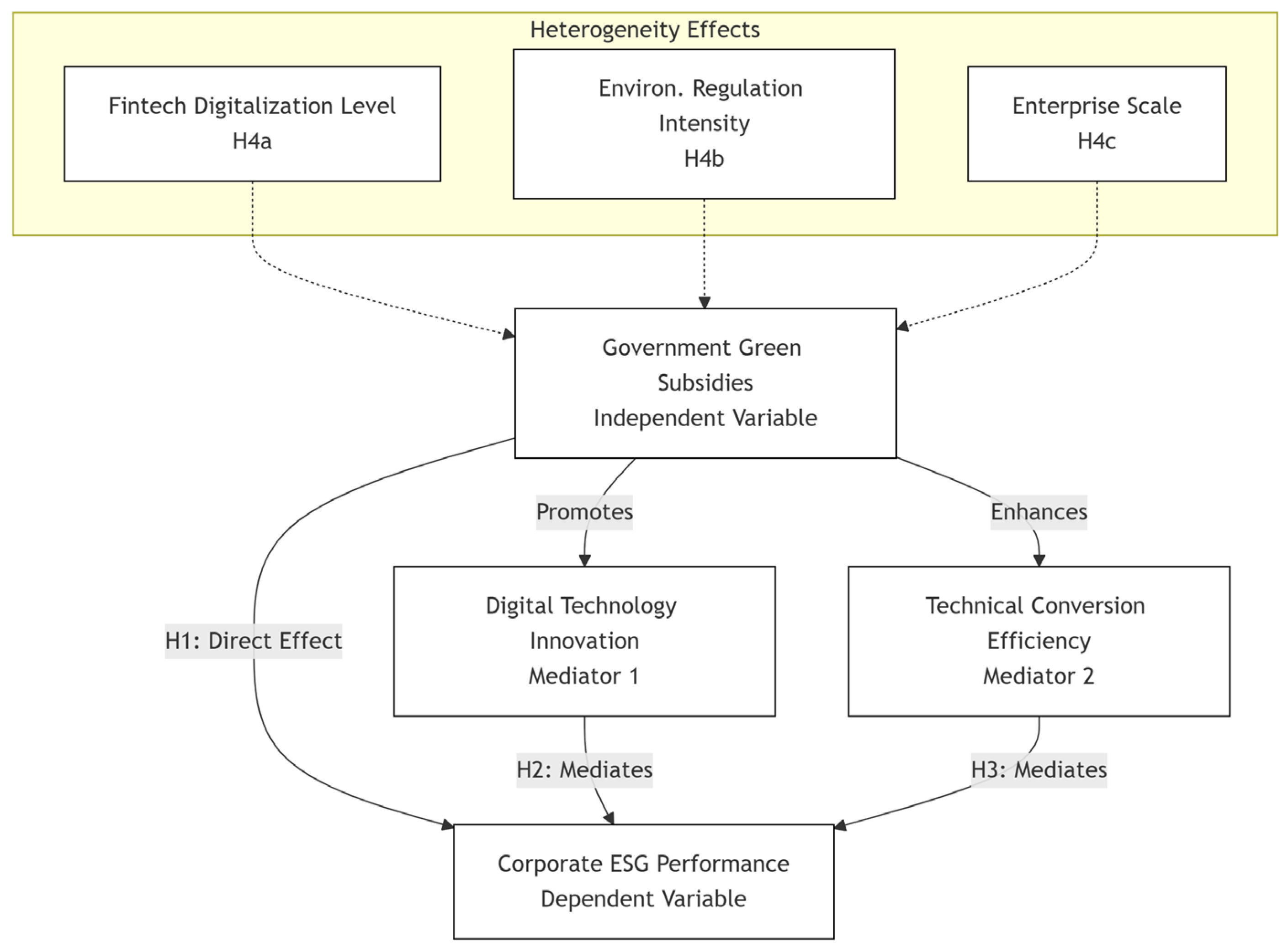
Figure 1. Theoretical Framework.
Sustainability 18 00281 g001
Table 1. Descriptive Statistics.
VariablesObsMeanStd. dev.MinMax
ESG23374.92760.94362.256.75
Subsidy233714.76743.4312019.0947
Lev23370.55420.22470.0740.9363
Age23372.43040.717803.3673
Growth23370.1970.4998−0.68882.6055
OC23370.3670.16590.08380.733
Board23372.23140.24551.60942.7081
Indep23370.38480.05910.33330.5714
Balance23370.43170.2970.0260.9953
Institution23370.64870.2070.09760.9338
DTI23373.12212.241908.3354
TCE23370.0409 0.0464 0.0002 0.2814
Table 2. The Regression Results of H1.
Variables(1)(2)(3)(4)(5)
ESGESGESGESGESG
Subsidy0.0816
***
0.0793
***
0.0667
***
0.0675
***
0.0513
***
(5.426)(5.414)(4.433)(4.360)(3.361)
_cons0.00350.0038−0.0221−0.0204−0.0237
(0.230)(0.246)(−1.529)(−1.445)(−1.642)
CV First-orderYesYesYesYesYes
CV Second-orderNoYesYesYesYes
Enterprise FENoNoYesYesYes
Industry FENoNoNoYesYes
Year FENoNoNoNoYes
Obs23372337233723372337
Note: *** indicates significance at the 1% level, respectively, with robust standard errors in parentheses.
Table 3. The Results of Robustness Tests.
Variable(1)(2)(3)(4)(5)(6)(7)(8)(9)
ESGESGESGESGESGESGESGESGESG
Subsidy0.0361 ***0.0228 ***0.0411 ***0.0289 ***0.0207 *0.0134 **0.0144 **0.0136 **0.1825 **
(4.4507)(3.2687)(4.9545)(3.9192)(1.8834)(2.110)(2.479)(2.486)(2.463)
_cons0.0085−0.0338 *−0.00630.0143−0.0489 **−0.027 *−0.036 **−0.027 *−0.025
CV First-orderYesYesYesYesYesYesYesYesYes
CV Second-orderYesYesYesYesYesYesYesYesYes
Enterprise FEYesYesYesYesYesYesYesYesYes
Industry FEYesYesYesYesYesYesYesYesYes
Year FEYesYesYesYesYesYesYesYesYes
Obs233723372337233713122070233723372337
Note: *, **, and *** indicate significance at the 10%, 5%, and 1% levels, respectively, with robust standard errors in parentheses.
Table 4. The Results of Double Machine Learning Robustness Tests.
VariableSample Splitting Ratio 1:9Gradient BoostingLasso RegressionEnsemble Machine Learning
(1)(2)(3)(4)
ESGESGESGESG
Subsidy0.0131 **0.0232 ***0.0138 ***0.0151 ***
(2.2114)(4.2547)(2.9627)(3.3568)
_cons−0.0273 *−0.0064−0.0316 **−0.0186
(−1.8157)(−0.3851)(−2.2823)(−1.3776)
CV First-orderYesYesYesYes
CV Second-orderYesYesYesYes
Enterprise FEYesYesYesYes
Industry FEYesYesYesYes
Year FEYesYesYesYes
Obs2337233723372337
Note: *, **, and *** indicate significance at the 10%, 5%, and 1% levels, respectively, with robust standard errors in parentheses.
Table 5. The Results of Mediators.
Variable(1)(2)(3)(4)
DTIESGTCEESG
Subsidy0.2346 ***0.0338 **0.0005 ***0.0503 ***
(9.0115)(2.0390)(2.8017)(3.1038)
DTI 0.0788 ***
(5.4654)
TCE 1.4800 ***
(2.9236)
_cons0.0059−0.02040.0004−0.0269 *
(0.2796)(−1.3979)(0.8864)(−1.7800)
CV First-orderYesYesYesYes
CV Second-orderYesYesYesYes
Enterprise FEYesYesYesYes
Industry FEYesYesYesYes
Year FEYesYesYesYes
Obs2337233723372337
Note: *, **, and *** indicate significance at the 10%, 5%, and 1% levels, respectively, with robust standard errors in parentheses.
Table 6. The Heterogeneity Results of Fintech Digitalization Level.
VariableLowMediumHigh
(1)(2)(3)
ESGESGESG
Subsidy−0.00920.0450 ***0.0286 ***
(−0.8653)(4.3804)(3.3681)
_cons−0.0520 **−0.0271−0.0274
(−2.0093)(−0.9263)(−1.0189)
CV First-orderYesYesYes
CV Second-orderYesYesYes
Enterprise FEYesYesYes
Industry FEYesYesYes
Year FEYesYesYes
Obs780780777
Note: **, and *** indicate significance at the 5%, and 1% levels, respectively, with robust standard errors in parentheses.
Table 7. The Heterogeneity Results of Environmental Regulation Intensity.
VariableLowMediumHigh
(1)(2)(3)
ESGESGESG
Subsidy0.0287 ***0.0152 *0.0282 **
(3.6138)(1.8069)(2.4945)
_cons−0.0273−0.0236−0.0290
(−1.0738)(−0.7556)(−1.0380)
CV First-orderYesYesYes
CV Second-orderYesYesYes
Enterprise FEYesYesYes
Industry FEYesYesYes
Year FEYesYesYes
Obs834741762
Note: *, **, and *** indicate significance at the 10%, 5%, and 1% levels, respectively, with robust standard errors in parentheses.
Table 8. The Heterogeneity Results of Enterprise Scale.
VariableLowMediumHigh
(1)(2)(3)
ESGESGESG
Subsidy0.0339 ***0.00010.0046
(3.2211)(0.0144)(0.7142)
_cons−0.0043−0.0110−0.0010
(−0.1599)(−0.4100)(−0.0393)
CV First-orderYesYesYes
CV Second-orderYesYesYes
Enterprise FEYesYesYes
Industry FEYesYesYes
Year FEYesYesYes
Obs779779779
Note: *** indicates significance at the and 1% level, respectively, with robust standard errors in parentheses.
Disclaimer/Publisher’s Note: The statements, opinions and data contained in all publications are solely those of the individual author(s) and contributor(s) and not of MDPI and/or the editor(s). MDPI and/or the editor(s) disclaim responsibility for any injury to people or property resulting from any ideas, methods, instructions or products referred to in the content.


