Article

The Impact of GAPPs on the Production Efficiency of Family Farms

College of Economics and Management, Zhejiang A&F University, Hangzhou 311300, China
*
Author to whom correspondence should be addressed.
Sustainability 2026, 18(1), 228; https://doi.org/10.3390/su18010228 (registering DOI)
Submission received: 18 November 2025 / Revised: 13 December 2025 / Accepted: 22 December 2025 / Published: 25 December 2025

Abstract

The establishment of Green Agricultural Development Pilot Programs (GAPPs) is a strategic initiative aimed at advancing agricultural green transformation in China. It plays a crucial role in transitioning the production methods of family farms to more sustainable practices and facilitating their high-quality development. China Academy Agri-Research Database (CCAD) has been used to assess the production efficiency of family farms in this study. Furthermore, the study examines the impact mechanisms and effects of establishing GAPPs on the production efficiency of family farms. The results show the following: (i) The average production efficiency of family farms in China is 0.424, indicating that further improvements are required. (ii) The GAPPs significantly enhance the production efficiency of family farms through three synergistic mechanisms: technological integration, institutional innovation, and demonstration-driven effects. This finding is statistically confirmed by endogeneity tests and robustness checks. (iii) The heterogeneity analysis indicates that the establishment of GAPPs makes a more pronounced effect on enhancing the production efficiency of family farms in the western region, where internet penetration remains relatively low. Overall, the findings demonstrate that implementing GAPPs contributes significantly to improving the productivity of family farms. So, it is necessary to continue improving the pilot policies to promote the sustainable development of agriculture in China.

1. Introduction

The sustainable development of agriculture is a key to achieving high-quality rural revitalization. Against the backdrop of global climate change and growing resource constraints, traditional agricultural practices that rely on high inputs and high emissions are under significant pressure to transform [1]. As the world’s largest agricultural producer, China faces an urgent need for institutional innovation to facilitate this transition. In parallel, the advancement of ecological civilization has accelerated the green transformation of agriculture [2]. In September 2017, China issued the first official document, titled “Opinions on Adopting Innovative Systems and Mechanisms and Promoting Green Agricultural Development”, which called for an agricultural framework harmonized with resource-environmental carrying capacities, integrating production, livelihood, and ecological sustainability. This is the first policy guidance for the country’s green agricultural development. In 2018, China further advanced this agenda by announcing a special document titled the Administrative Measures on National Pilot Demonstration Zone of Sustainable Agricultural Development, that is the Green Agricultural Development Pilot Programs (GAPPs).
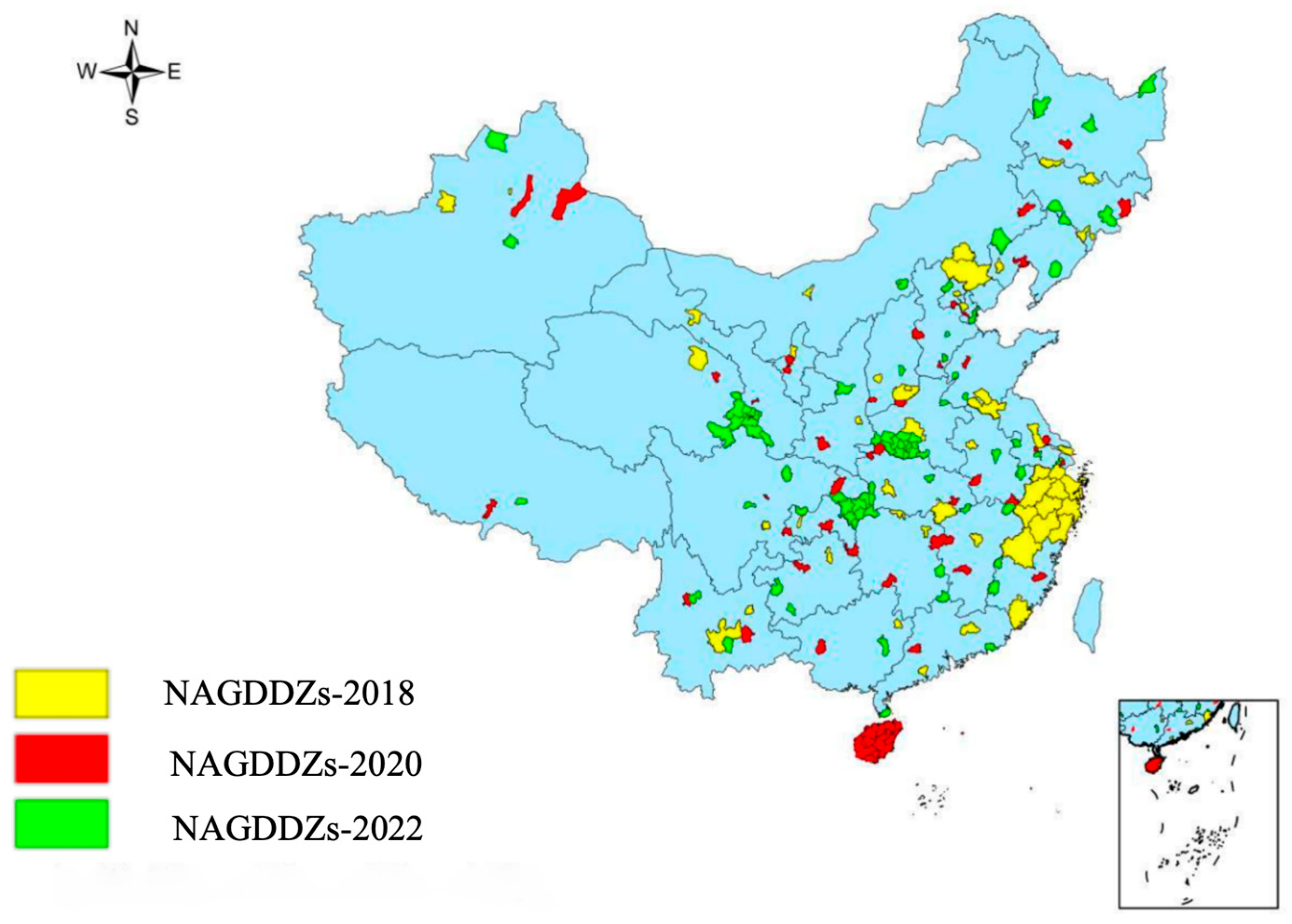
GAPPs are pivotal initiatives designed to advance agricultural modernization with Chinese characteristics. The primary objective is to reconcile agricultural production with ecological conservation by integrating technological innovations and supportive policy frameworks. They aim to explore feasible pathways for the intensive utilization of agricultural resources and the internalization of environmental externalities in specific regions. In practice, the programs actively promote the transformation of resource use patterns—shifting from carbon-intensive practices to greener ones. This transition entails a systematic transformation of resource management paradigms, contributing to sustainable agricultural development. Furthermore, integrating digital technologies improves precision and scalability, thereby improving both the operational efficiency and long-term sustainability of agricultural systems. Moreover, market-based policy tools such as ecological service compensation and carbon credit trading are developed, fostering a coordinated mechanism driven by “technology, policy, and markets”. Since 2018, China has sequentially launched three batches of GAPPs, including 40 programs in the first batch (2018), 41 in the second (2020), and 49 in the third (2022). The locations of all pilot sites are illustrated in Figure 1. Subsequently, in late 2022, the Ministry of Agriculture and Rural Affairs released an implementation plan that identified key tasks, including promoting green technologies and cultivating green agricultural entities. The importance of these efforts was further emphasized by the 2023 Central No. 1 Document, which highlighted the programs as a critical strategy for green agricultural development.
Green agricultural development has been a key focus of academic research. Scholars have investigated various aspects of this topic, including the characteristics of agricultural green development, the factors influencing the adoption of green production technologies, the evaluation of green production performance, and the pathways and institutional arrangements for green transformation. Research has been conducted at both the macroregional level and microlevel, with a focus on individual farmers [3,4,5,6]. As research has deepened, new agricultural business entities have increasingly come into focus. Their role in promoting agricultural green development has become increasingly evident [7,8].
Although previous studies have explored the impact of green development on agriculture, most have focused on areas such as resource recycling, agricultural ecological protection mechanisms, and green technology innovation [9,10]. Few studies have addressed the specific mechanisms by which green development affects family farms’ production efficiency. As a critical force in advancing agricultural green development, family farms play an important role in rural revitalization strategies in China [11]. Since the joint release of the “Guiding Opinions on Implementing the Family Farm Cultivation Plan” by 11 central ministries in 2019, family farms have entered a period of rapid growth and upgrading. More than 3.8 million family farms are registered and recognized nationwide, and green production is becoming an increasingly prominent trend. The success of green agricultural development policies depends mainly on the green production practices and performance levels of family farms [12,13]. As a key vehicle for policy implementation, green agricultural development is actively reshaping the production decision-making systems and efficiency generation mechanisms of family farms. Evaluating the impact of the construction of GAPPs on the production efficiency of family farms in a scientific way is essential for improving green agricultural development policies and promoting the high-quality development of family farms.
Therefore, this research proposes a theoretical model to examine the relationship between GAPPs and family farm production efficiency. Using the CCAD national family farm data, the study calculates farm efficiency and empirically analyze the effect of GAPPs. The findings will contribute to understanding both the extent of GAPPs’ impact and the specific mechanisms of action. Compared to the previous literature, which has mainly focused on macro-level and regional evaluations, this paper centers specifically on family farms—a new agricultural business entity, and provides the first systematic of the impact of GAPPs implementation on family farms’ productivity. This enriches the theoretical research on the high-quality development of family farms and also provides empirical evidence from the micro-level for evaluating the effectiveness of GAPPs policy implementation. The research findings will provide critical empirical evidence to inform policy formulation and optimization in green agricultural development governance.

2. Theoretical Analysis Framework and Research Hypotheses

2.1. Establishment of GAPPs and Family Farm Production Efficiency

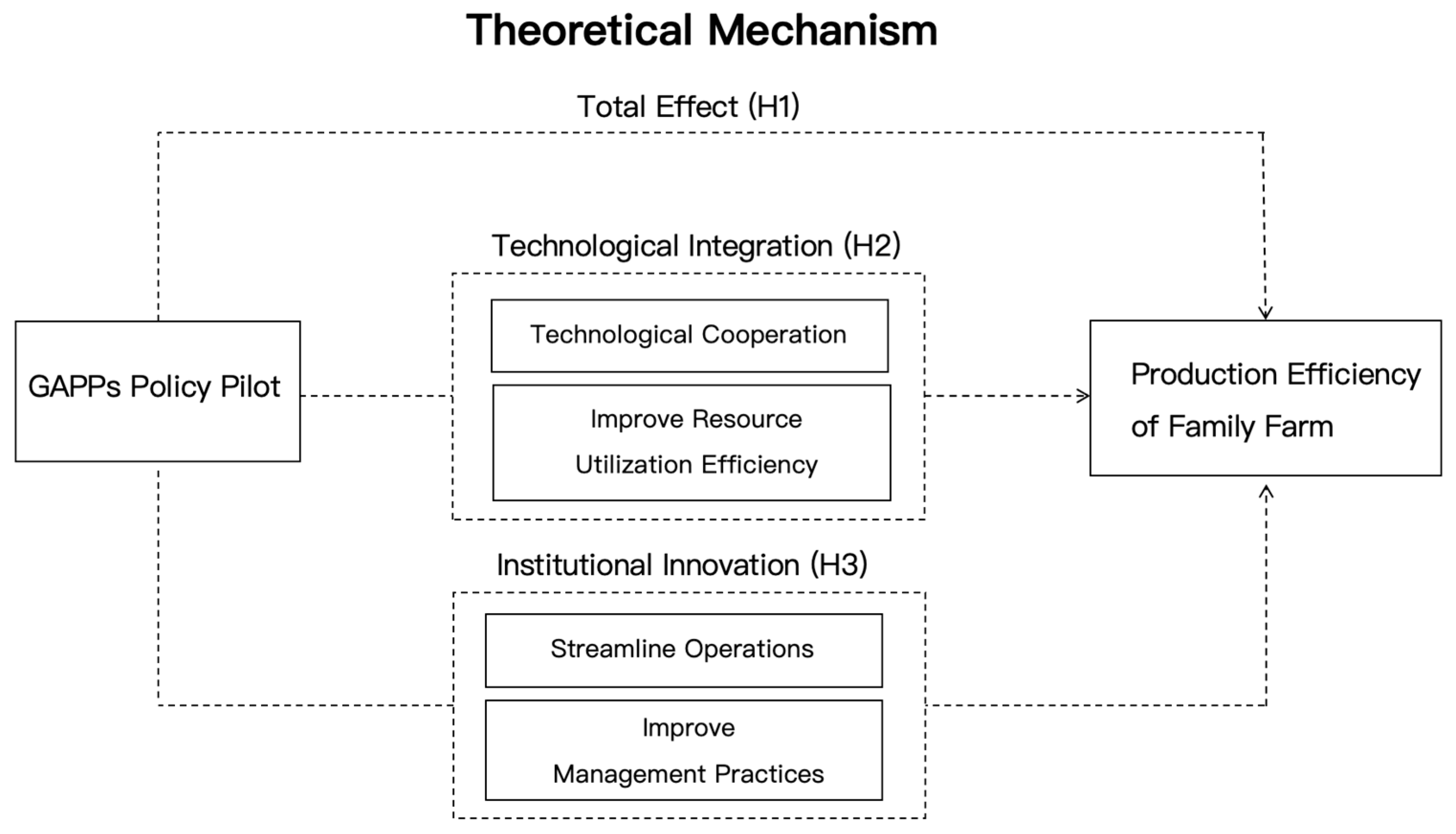
One major role of the GAPPs is to actively carry out innovations in technology research, production methods, management approaches, and policy systems. Through these efforts, they aim to create experience-based models that can be replicated and scaled up. Summarizing and promoting these models is essential for facilitating technology diffusion and encouraging institutional innovation [14,15,16]. Family farms are key participants in agricultural demonstration systems and have been officially included in the promotion plans of pilot programs. This inclusion provides them with practical benefits in three main areas: quicker adoption of new technologies, improved farming practices, and early access to policy support. These advantages contribute to higher productivity levels than traditional farms do [17]. On the basis of this analysis, we propose Hypothesis 1 to explore how participation in these systems enhances farm efficiency.
H1. 
The establishment of GAPPs has a positive effect on improving the production efficiency of family farms.

2.2. Green Technology Integration and Family Farm Production Efficiency

Technology integration serves as a vital driver of enterprise development. It directly enhances technological innovation capabilities. This capacity differential emerges as the primary source of performance variation. Ultimately, such disparities create measurable efficiency gaps between business entities [18,19,20]. In GAPPs, integrating and promoting green production technologies are essential for increasing production efficiency. By adopting suitable green technologies, family farms can achieve technological cooperation and improve resource utilization efficiency, leading to a significant increase in production efficiency [21].
H2. 
The establishment of GAPPs can increase family farm production efficiency through technology integration.

2.3. Green Institutional Innovation and Family Farm Production Efficiency

Agricultural modernization encompasses not only technology but also the necessity for policy reforms that drive progress. Changes in rural land systems increase the efficiency of resource utilization. Concurrently, farming practices are evolving. New methods of organizing farms facilitate better collaboration among groups, while improved management practices streamline operations. These various changes collectively contribute to the advancement of agriculture [22,23]. Institutional innovation plays a crucial role in enhancing productivity and can significantly increase agricultural production efficiency [24,25]. Strengthening the institutional framework for green agricultural development is a major task in the construction of GAPPs. By implementing pilot programs in specific regions, the government can overcome current limitations, thus greatly enhancing agricultural production efficiency (Figure 2). On this basis, the following research H3 is proposed:
H3. 
The establishment of GAPPs can improve family farm production efficiency through institutional innovation.

3. Research Methodology

3.1. Data Sources

The data used in this paper come from two primary sources. The family farm data were obtained from the China Academy for Rural Development-Qiyan China Agri-research Database (CCAD), which covers the operational status of family farms across 32 provinces (autonomous regions and municipalities) in China from 2013 to 2020. The key statistical indicators include input–output data, business scope, establishment time, registered capital, and assets and liabilities. After the data were cleaned and samples with missing key information were removed, 58,814 valid family farm samples remained.
The Ministry of Agriculture and Rural Affairs provides data on GAPPs. In 2018, 2020, and 2022, the Ministry published three batches of GAPP pilot lists. Considering the timeframe of the family farm data, this paper selects the first batch of GAPP regions from 2018, which includes 40 regions classified as the experimental group. The samples from non-GAPP regions serve as the control group. This paper subsequently quantifies the impact of the establishment of GAPPs on the production efficiency of family farms.

3.2. Model Setting

3.2.1. Model for Measuring the Production Efficiency of Family Farms

Methods for measuring production efficiency can be categorized into two primary types: nonparametric methods, such as data envelopment analysis (DEA), and parametric methods, such as stochastic frontier analysis (SFA). The SFA method requires specifying the form of the production function and assuming the distribution of the inefficiency term, which introduces significant uncertainty. Compared with SFA, DEA constructs the production frontier through linear programming, allowing for the direct measurement of the relative efficiency of decision-making units under conditions of multiple inputs and multiple outputs [26,27]. The DEA model is simpler to calculate, particularly suitable when the sample size is large and no explicit production function assumption is available. Therefore, this study employs the DEA method to measure the production efficiency of family farms. The DEA method includes constant returns to scale models, such as the CCR model, as well as variable returns to scale models, such as the BCC model, and there are certain differences in their applications. The BCC model measures pure technical efficiency (PTE), whereas the CCR model measures overall technical efficiency (TE), which includes the component of scale efficiency (SE). TE = PTE × SE. In this study, technical efficiency is used to analyze production efficiency, as it can more comprehensively reflect the heterogeneity of family farms in terms of technological improvement and scale improvement. With the CRS and output orientation assumed, the DEA model takes the following form.
max ϕ , λ ϕ  
s . t .    j = 1 n λ j X j X i  
j = 1 n λ j Y j ϕ Y i  
λ j 0 ,     j = 1 ,   2 ,   3 , , n  
In these equations, X i represents the input vector, Y i represents the output vector. λ j is the intensity variable, ϕ is the output expansion factor.
In general, agricultural production involves input factors such as labor, land, fertilizers, and pesticides, but considering the following three reasons, the study does not include farmland area as a factor input. First, the original data do not contain this variable. Second, land can essentially be regarded as a type of fixed capital and is therefore incorporated into the broader measurement of capital input [28,29]. Finally, the operational models of family farms are highly diversified—their production functions not only cover crop cultivation but also extend to livestock breeding, aquaculture, agricultural product marketing, and even leisure services [30]. Thus, using farmland area alone as a proxy variable cannot accurately reflect the real input structure and may result in significant model specification bias. The reason why inputs such as fertilizers, water use, and energy are not included among the input variables is mainly due to data availability. The dataset does not contain records for these specific items; instead, they are uniformly incorporated into the measure of capital input. So, the input variables in this paper include capital and labor, while the output variable is total farm income.

3.2.2. Estimation Model of Efficiency-Influencing Factors

To analyze the impact of the establishment of GAPPs on the productivity of family farms, this paper combines the pilot policy of pilot program establishment with the difference-in-differences (DID) method for causal identification. Pilot regions may have been selected because they already had a relatively strong foundation for green development. However, for family farms, the assignment of this policy is essentially random. Whether the policy is implemented in a given area does not depend on the green development level of individual family farms. Therefore, the policy can be regarded as an exogenous shock. Family farms in the 40 regions that are assigned to the pilot program are taken as the experimental group. Family farms that are not transferred to the pilot program are taken as the control group to obtain the net benefit of the policy in which the establishment of the pilot program affects the production efficiency of family farms by comparing the differences between different groups of farms before and after the implementation of the pilot program, policy. In this paper, we choose the classical DID model that controls for individual fixed effects and time fixed effects, and the model is set as follows:
E f f i c i e n c y i t = β 0 + β 1 t r e a t i × p e r i o d t + β x Z i t + ϑ t + μ j + ε i t  
In the equation, the dependent variable is the efficiency and the variable represents the regional grouping indicator, which takes a value of 1 if the region is part of the green pilot demonstration zone, and 0 otherwise. The variable refers to the time of policy implementation. The first batch of GAPPs was established in 2017 on the basis of agricultural sustainable development demonstration zones selected by ministries, including the Ministry of Agriculture, the National Development and Reform Commission, and the Ministry of Science and Technology. Therefore, 2017 serves as the reference year for the policy implementation, with a value of 0 for the period before and 1 for the period after. The variable Z i t represents the control variables, capturing the individual and production characteristics of family farms. ϑ t represents the time fixed effect, used to control for time variations. μ j denotes the regional fixed effect and is used to control for regional variations.

3.3. Variable Selection

Explained variable: Efficiency of family farms.
Explanatory variable: The establishment of GAPPs. According to the document, Notice on Launching the First Group of National Agricultural Sustainable Development Pilot Demonstration Zones to Advance Pioneering and Green Agricultural Development Pilot Programs, issued by the Ministry of Agriculture and Rural Affairs, the family farms within the 40 green agricultural development pilot programs identified in 2018 should be classified into the treatment group ( t r e a t i ), with a value of 1. The farms outside of these pilot programs are classified into the control group, with a value of 0 throughout the study period, both before and after 2018. The year 2018 is the time of implementation of the policy ( p e r i o d t ). Before 2018, both the treatment and control groups have values of 0. After 2018, the treatment group is assigned a value of 1, whereas the control group remains at 0 since they are outside the scope of the intervention. This ensures that the treatment and control groups are correctly defined according to the policy’s timeline.
Control variables: The control variables related to the status of family farm operations include the registered capital, establishment time, whether they have other investments, whether they have online shops, whether they have abnormal operations, whether they have been punished, and whether they have trademarks. Innovation intensity is measured by the number of patents held. The green production status is characterized by the number of certifications the family farm holds. The descriptive statistics of the control variables are specified in Table 1.

4. Empirical Results and Analysis

4.1. Distribution Characteristics of Family Farm Production Efficiency

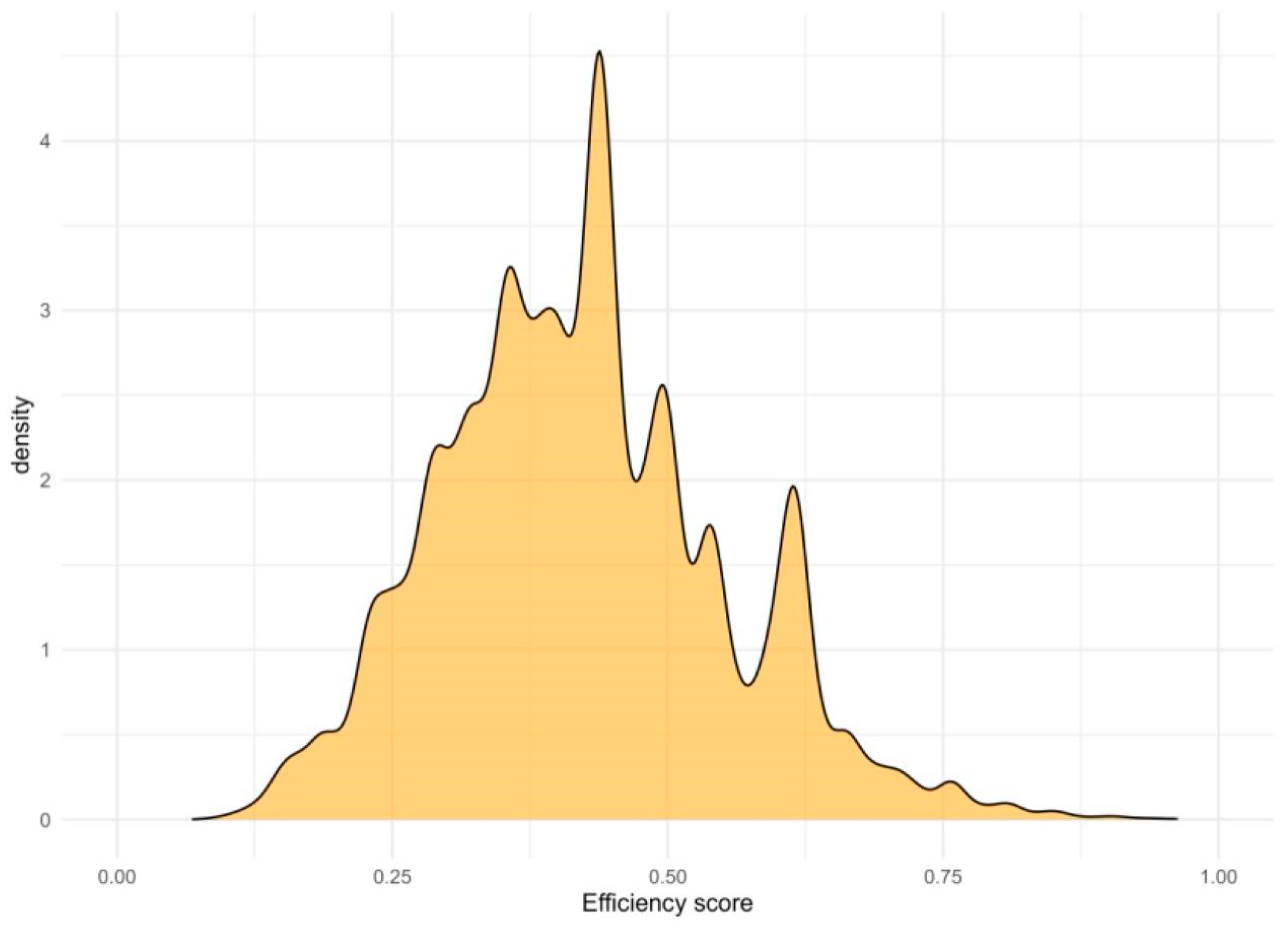
The efficiency of family farms is calculated using Equations (1)–(3), with the distribution characteristics shown in Figure 3. The average efficiency is 0.424, indicating relatively low overall performance. Significant variations exist across different farms. Compared with the potential output, an improvement of approximately 57.6% remains possible.
Table 2 shows the comparison of the efficiency of family farms before and after the implementation of the policy. Table 2 shows that the average efficiency of family farms within the pilot zone is greater than that outside the pilot zone before the implementation of the policy. After the implementation of the policy, the average efficiency of family farms outside the pilot zone decreased slightly, whereas the average efficiency within the pilot zone significantly improved.

4.2. Benchmark Regression Results

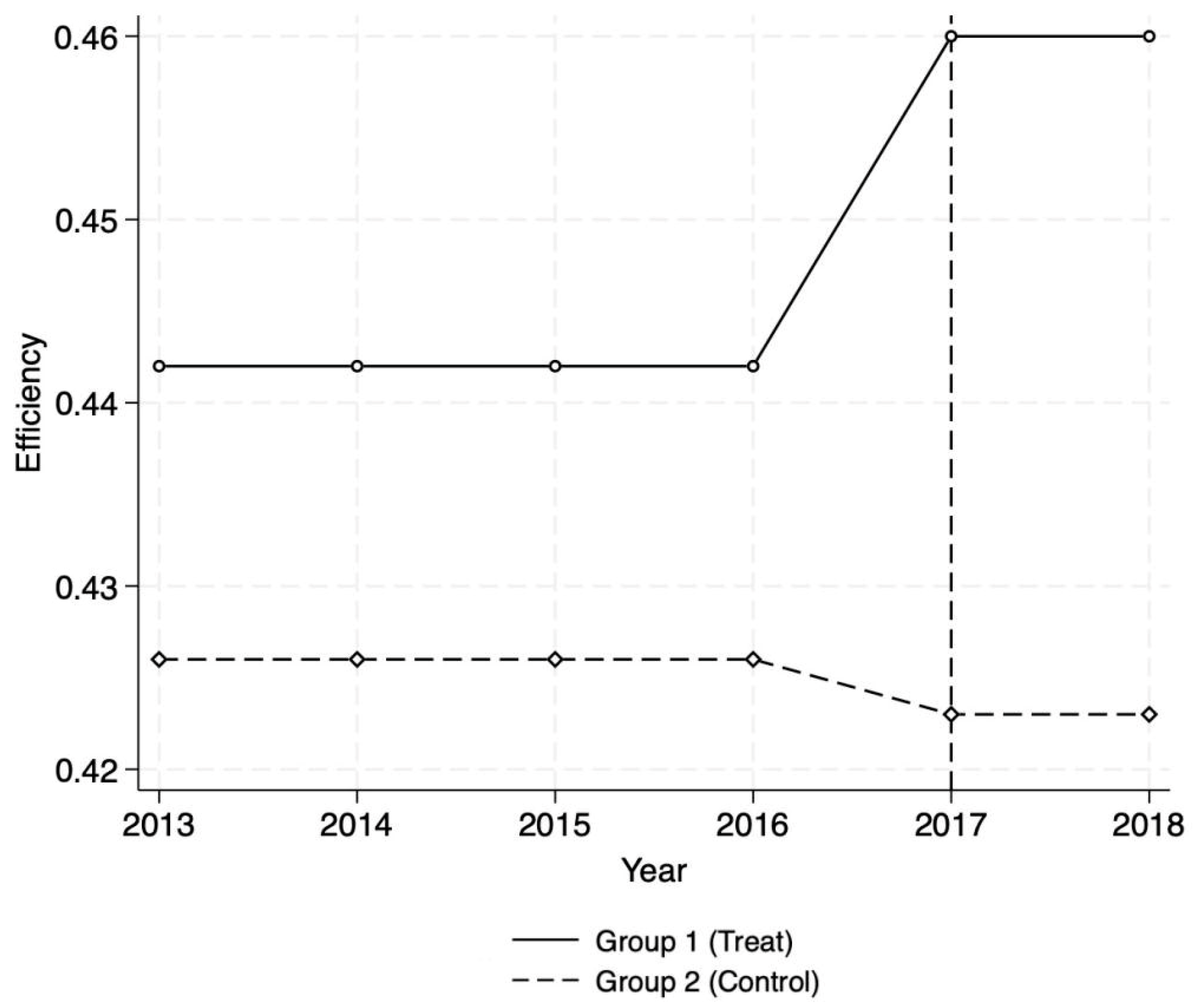
This study employs the DID method. A key prerequisite for DID estimation of policy effectiveness is that the treatment and control groups share parallel growth trends prior to the policy intervention. Before applying the DID method to estimate the impact of establishing GAPPs on the production efficiency of family farms, a parallel trend test was conducted, with the results shown in Figure 4. Before the policy implementation, the efficiency trends of the treatment and control groups were nearly identical. However, after the policy took effect, the efficiency of the treatment group increased significantly. Thus, the data in this study satisfy the parallel trend assumption, making the DID method suitable for estimation.
In Table 3, Models 1 to 3 employ fixed effects, whereas Model 4 uses random effects. First, in Model 1, only the interaction term between the policy dummy variable and the time dummy variable (treat × period) is included. On the basis of Model 1, Models 2 to 4 incrementally incorporate additional variables such as the number of certifications and patents and other control variables into the regression analysis.
All the estimation results show that the statistical test of the coefficient of treat × period is significant at the 1% level, with a positive coefficient sign, regardless of whether the control variables are added. This finding indicates that the establishment of a pilot zone has a significant positive effect on the efficiency of family farms in all the cases. In Models 2 to 4, the regression coefficients for green certification are positive and statistically significant at least at the 10% level, indicating that green certification positively contributes to improving the production efficiency of family farms. In contrast, the coefficient for patents is significantly negative, suggesting a negative correlation with production efficiency. Moreover, the coefficients of trademarks and online shops are significant at the 1% level, with positive associations with family farm efficiency. Additionally, operational irregularities exert a statistically significant negative effect on production efficiency.

4.3. Robustness Test

To examine the policy effects of GAPPs, this study conducts a robustness test to verify the reliability of the baseline regression results, which are presented in Table 4. Improving agricultural production efficiency is the basis for increasing farmers’ income [31]. Therefore, this paper uses the variable substitution method by replacing the explanatory variable from efficiency to operating income in Model 5 for robustness testing. In addition, since only province fixed effects and year fixed effects were controlled for in the previous benchmark regression section, to avoid omitting important variables that do not change over time at the industry level, industry fixed effects were further added to Model 6, whereas the year and province fixed effects were retained. In Model 7, to exclude the impact of other policies on green agricultural development, this study systematically reviews relevant policies and constructs a policy dummy variable. The variable is set to 0 for provinces before their first policy implementation and switches to 1 afterward. Finally, in Model 8, considering the impact of confounding factors such as digital infrastructure, institutional support, and agricultural history on efficiency, the PSM-DID method is used for estimation. The 1:1 nearest neighbor matching method without replacement was used for matching, and unmatched sample data were deleted. The estimation was then performed again based on the matched data. As seen from the robustness test results in Table 4, the key explanatory variable (treat × period) is consistently positive and statistically significant at the 1% level. Both the sign and the significance of the coefficients align with earlier findings, indicating that the regression results are robust. This consistency confirms Hypothesis H1, which states that the establishment of GAPPs directly enhances the production efficiency of family farms.

4.4. Placebo Test

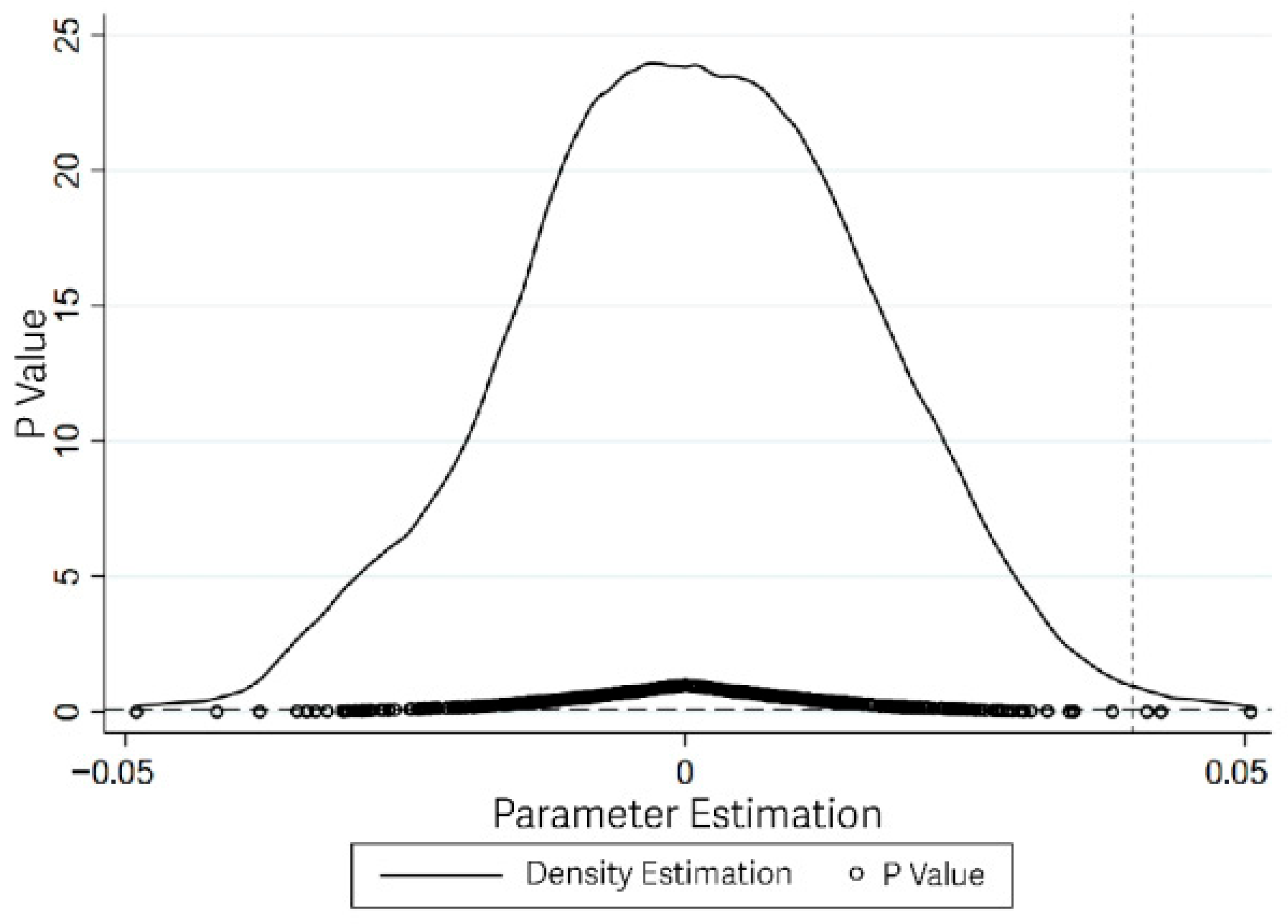
This study randomly selects a virtual experimental group and a control group for the placebo test. The experimental group is generated randomly, and a pseudopolicy dummy variable is set. Using Model 3500 regression simulations were performed. Figure 5 displays the distribution of coefficient estimates and p values for the impact of the policy on the production efficiency of family farms. The results show that the estimates of the pseudopolicy dummy variables are centrally distributed around 0 and that most of them are not significant at the 10% level, indicating that the empirical results of this paper are relatively robust and that other unobservable factors do not interfere with the impact of GAPPs on the efficiency of family farms.

4.5. Heterogeneity Test

This study considers regional differences in family farm production as well as variations across the agriculture, forestry, animal husbandry, and fisheries sectors. A heterogeneity analysis is conducted by region and industry, with the results presented in Table 5. Models 8 to 10 represent regional heterogeneity, whereas Models 11 to 14 examine industry heterogeneity.
On the basis of the Regional Classification Method for Eastern, Central, Western, and Northeastern China issued by the National Bureau of Statistics of China, this study evaluates policy effects by region. The regression coefficients of the key explanatory variables treat × period in Model 8 and Model 10 are significant and positive at the 1% level, which indicates that the GAPPs policy significantly increases the efficiency of the family farms in the eastern region and the western region. The establishment of the pilot zone does not significantly improve the efficiency of family farms in the central region. This may be because the green agricultural development in the central region of China is in a long-term imbalance, resulting in the policy not having a significant effect on improving its efficiency.
In the data used in this paper, the number of family farms in the plantation industry is the largest, with a total of 21,556; the numbers of family farms engaged in forestry, animal husbandry, and fishery are 5825, 10,371, and 9838, respectively. In terms of input indicators, forestry family farms present the highest levels of both labor and capital inputs, whereas animal husbandry family farms present the lowest labor inputs. Conversely, plantation family farms rank lowest in capital inputs. This highlights distinct resource allocation patterns across different agricultural sectors. With respect to the output indicators, fishery family farms are the largest, and plantation and livestock family farms are the smallest. Forestry family farms are the largest, but their efficiency is lower than that of other types of family farms. This paper further analyzes industry heterogeneity. The establishment of GAPPs has a significant effect on the efficiency of different types of family farms. Among them, the establishment of the pilot zones has a more obvious effect on the efficiency of plantation and fishery family farms, and the regression coefficients of the key explanatory variables are significantly positive at the 1% level.

5. Mechanism of Action Analysis

The results of the previous analysis indicate that the construction of GAPPs can significantly improve the production efficiency of family farms. However, the specific mechanisms through which family farms included in GAPPs enhance their production efficiency remain unclear. To test the underlying mechanisms further, the dependent variable in the baseline regression is replaced with variables representing technology integration and institutional innovation for regression analysis. The number of patents is used as a proxy for technology integration, and green certification is a proxy for institutional innovation. The patents are owned by the family farm, including both self-application and licensed use. The rationale for choosing these proxies is that the number of patents is a common indicator of technological innovation, and family farms with higher innovation levels are more likely to achieve technology integration [32,33]. Green certification falls within the scope of institutional innovation in agricultural product production management. It is a system that evaluates and certifies agricultural products in accordance with specific national standards and procedures, covering all stages including production, processing, packaging, transportation, and sales. Family farms with green certification have a more significant advantage in institutional innovation [34].
The results of the mechanism tests are presented in Table 6. After controlling for both annual and provincial fixed effects, the empirical analysis shows that the construction of GAPPs significantly boosts technology integration and institutional innovation. These effects remain significant even after introducing control variables. This confirms that green agricultural development improves the production efficiency of family farms through technology integration and institutional innovation, thereby supporting Hypotheses H2 and H3.

6. Conclusions and Discussion

This paper theoretically explores the potential impact of GAPPs on the production efficiency of family farms. It examines the impact mechanisms of GAPPs on family farm production efficiency through the integration of green production technologies and institutional innovation. This study applies two analytical approaches: data envelopment analysis (DEA) and the difference-in-differences (DID) method. Empirical data are sourced from the Zhejiang University China Academy for Rural Development-Qiyan China Agri-research Database (CCAD). The combined methodology quantifies the causal effects of GAPPs on family farms’ production efficiency. The main findings are as follows:
First, family farms exhibit low average efficiency (0.424), indicating a substantial 57.6% loss. Inter-sectoral heterogeneity is evident, ranging from 0.44 in fisheries to 0.40 in forestry. Overall, there is considerable potential for improving efficiency of family farms in China.
Second, the establishment of GAPPs can directly improve the production efficiency of family farms, on average 0.02 higher. Additionally, the advantages of GAPPs in terms of institutional support, new technology adoption, and changes in production and management methods enable them to enhance their production efficiency through green technology integration and institutional innovation, promoting agricultural modernization.
Third, the policy effects of GAPPs are assessed using the difference-in-differences method. The estimation results show that the construction of GAPPs significantly enhances family farm production efficiency.
Fourth, further analysis of regional and industry heterogeneity reveals that GAPPs have a more significant effect on improving family farm production efficiency in central and western China. Additionally, they significantly improve the production efficiency of family farms across the agriculture, forestry, animal husbandry, and fishery sectors, with the most significant improvements seen in crop and fishery farming, increased by 0.014 and 0.013, respectively.
Considering the prevalent challenges of low efficiency and uneven development among family farms, it is critical to translate the experiences of pilot zones into executable policy tools. Establishing adaptable, long-term mechanisms for green development that accommodate diverse regional characteristics and industrial profiles requires urgent attention. Therefore, this study proposes a tripartite policy framework encompassing efficiency enhancement, institutional optimization, and spatial governance innovation. These recommendations aim to provide performable pathways for agricultural sustainability transitions.
First, the development of family farms should prioritize “quality” by focusing on improving production efficiency. The government needs to strengthen support for family farms, particularly by promoting policy innovations related to family farms and enhancing their ability to apply new technologies. Additionally, the role of digital technologies in improving family farm production efficiency should be emphasized, particularly through initiatives such as “Internet + Agriculture”.
Second, green development policies and evaluation mechanisms should be enhanced. As green agricultural development continues to evolve, there is a need to refine supporting policies and improve assessment management systems. To be specific, a multi-tiered subsidy system should be established to rewards family farms which achieved environmental benefits and efficiency gains through green practices. Regarding the assessment management systems, a dynamic “entry and exit” mechanism for GAPPs should be introduced. To accelerate the recognition process and expand scope, the government should establish a “green channel” for high-efficiency family farms to reduce administrative approval costs, thereby creating an institutional environment that encourages technological integration and innovation.
Third, development should consider regional differences and implement tailored policies for each region. China has large differences in agricultural resources across regions due to its vast size, which requires green development policies tailored to each region. This is especially important in central and western areas, where farming conditions and green development are less advanced. Therefore, policy support should be intensified. Local green technology and institutional innovations should be promoted to improve the production efficiency of family farms in these areas.
Compared with existing studies, this study focuses on the impact of GAPPs on the productivity of family farms, examines the two mechanisms of technological innovation and institutional innovation The findings provide empirical insights for enhancing the production efficiency of family farms. At present, academic research on agricultural production efficiency mainly concentrates on the macro-regional level [35,36] and the micro-farm level [37,38], while research on family farms as a new type of agricultural business entity is somewhat insufficient [39], and lacks large-scale sample analysis based on the whole country. Based on a large-scale national sample analysis, this study’s findings are more universally applicable. Furthermore, this study identifies two pathways to improve family farm productivity: technological innovation and institutional innovation, which provide a more comprehensive and in-depth perspective on understanding the relationship between green agricultural development and agricultural productivity, enriching the existing literature and expanding and supplementing the theory of green agricultural development.
Furthermore, this study also has certain limitations. For example, the data are only up to 2020, does not consider climatic factors, and does not include input usage. Future research could update the data to consider the combined impact of factors such as digital rural development and climate change on agricultural production efficiency. Simultaneously, when selecting input–output variables, more input variables such as fertilizers, machinery, and land should be included to better characterize input and output and improve the accuracy of production efficiency measurement.

Author Contributions

Conceptualization, X.L.; Methodology, X.L.; Formal analysis, X.L. and X.Y.; Investigation, X.L. and X.Y.; Resources, X.Y.; Writing—original draft, X.Y.; Writing—review & editing, X.L. and X.Y.; Supervision, Q.L.; Project administration, Q.L.; Funding acquisition, Q.L. All authors have read and agreed to the published version of the manuscript.

Funding

This study is supported by the Youth Project of National Social Science Foundation of China (No. 21CGL028) and National Higher Education Undergraduate Innovation and Entrepreneurship Training Program (No. 202410341064).

Institutional Review Board Statement

Not applicable.

Informed Consent Statement

Not applicable.

Data Availability Statement

The data presented in this study are available on request from the corresponding author.

Conflicts of Interest

The authors declare no conflict of interest.

References

  1. Chandio, A.A.; Akram, W.; Du, A.M.; Ahmad, F.; Tang, X. Agricultural transformation: Exploring the impact of digitalization, technological innovation and climate change on food production. Res. Int. Bus. Financ. 2025, 75, 102755. [Google Scholar] [CrossRef]
  2. Marandola, D.; Belliggiano, A.; Romagnoli, L.; Ievoli, C. The spread of no-till in conservation agriculture systems in Italy: Indications for rural development policy-making. Agric. Food Econ. 2019, 7, 7. [Google Scholar] [CrossRef]
  3. Xu, L.; Jiang, J.; Du, J. The dual effects of environmental regulation and financial support for agriculture on agricultural green development: Spatial spillover effects and spatio-temporal heterogeneity. Appl. Sci. 2022, 12, 11609. [Google Scholar] [CrossRef]
  4. Perlatti, B.; Forim, M.R.; Zuin, V.G. Green chemistry, sustainable agriculture and processing systems: A Brazilian overview. Chem. Biol. Technol. Agric. 2014, 1, 5. [Google Scholar] [CrossRef]
  5. Dong, F.; Zhang, Y.; Huang, J.; Liu, Y.; Chen, Y. Nonlinear impact of the coordination of IFDI and OFDI on green total factor productivity in the context of “Dual Circulation”. Financ. Innov. 2025, 11, 99. [Google Scholar] [CrossRef]
  6. Qiao, Z.; Wang, M.; Liu, T.; Cao, G. Does the Different Recipients of Land Fertility Protection Subsidy Influence the Scale and Efficiency of Village Land Circulation? Evidence from a Chinese Agricultural City. Agric. Rural Stud. 2025, 3, 15. [Google Scholar] [CrossRef]
  7. Zheng, L. Big hands holding small hands: The role of new agricultural operating entities in farmland abandonment. Food Policy 2024, 123, 102605. [Google Scholar] [CrossRef]
  8. Karbo, R.; Frewer, L.; Areal, F.J.; Boaitey, A.; Jones, G.; Garrod, G. Investigating Farmers’ Intention to Adopt Renewable Energy Technology for Farming: Determinants of Decision Making in Northern Ghana. Agric. Rural Stud. 2025, 3, 25. [Google Scholar] [CrossRef]
  9. Fan, S.; Zhu, Y.; Fang, X. Big Food Vision and Food Security in China. Agric. Rural Stud. 2023, 1, 7. [Google Scholar] [CrossRef]
  10. Li, J.; Lin, Q. Threshold effects of green technology application on sustainable grain production: Evidence from China. Front. Plant Sci. 2023, 14, 1107970. [Google Scholar] [CrossRef] [PubMed]
  11. Zhang, Z.; Wang, X.; Yi, X.; Hu, L. The impact of farmers’ participation in green cooperative production on green performance—A study based on the moderating effect of environmental regulation. Sci. Rep. 2024, 14, 16733. [Google Scholar] [CrossRef]
  12. Dogliotti, S.; García, M.C.; Peluffo, S.; Dieste, J.P.; Pedemonte, A.J.; Bacigalupe, G.F.; Rossing, W.A.H. Co-innovation of family farm systems: A systems approach to sustainable agriculture. Agric. Syst. 2014, 126, 76–86. [Google Scholar] [CrossRef]
  13. Chen, N.; Yang, X.; Shadbolt, N. The balanced scorecard as a tool evaluating the sustainable performance of Chinese emerging family farms—Evidence from Jilin province in China. Sustainability 2020, 12, 6793. [Google Scholar] [CrossRef]
  14. Tirkaso, W.; Hailu, A. Does neighborhood matter? Spatial proximity and farmers’ technical efficiency. Agric. Econ. 2022, 53, 374–386. [Google Scholar] [CrossRef]
  15. Ren, C.; Liu, S.; Van Grinsven, H.; Reis, S.; Jin, S.; Liu, H.; Gu, B. The impact of farm size on agricultural sustainability. J. Clean. Prod. 2019, 220, 357–367. [Google Scholar] [CrossRef]
  16. Huang, Z.; Wang, T.; Li, N. Reciprocal and Symbiotic: Family Farms’ Operational Performance and Long-Term Cooperation of Entities in the Agricultural Industrial Chain—From the Evidence of Xinjiang in China. Sustainability 2022, 15, 349. [Google Scholar] [CrossRef]
  17. Fornasin, A.; Breschi, M.; Manfredini, M. Peasant families and farm size in Fascist Italy. Genus 2024, 80, 5. [Google Scholar] [CrossRef]
  18. Yunis, M.; Tarhini, A.; Kassar, A. The role of ICT and innovation in enhancing organizational performance: The catalysing effect of corporate entrepreneurship. J. Bus. Res. 2018, 88, 344–356. [Google Scholar] [CrossRef]
  19. Huang, K.E.; Wu, J.H.; Lu, S.Y.; Lin, Y.C. Innovation and technology creation effects on organizational performance. J. Bus. Res. 2016, 69, 2187–2192. [Google Scholar] [CrossRef]
  20. Iansiti, M. Technology integration: Managing technological evolution in a complex environment. Res. Policy 1995, 24, 521–542. [Google Scholar] [CrossRef]
  21. Lee, D.R. Agricultural sustainability and technology adoption: Issues and policies for developing countries. Am. J. Agric. Econ. 2005, 87, 1325–1334. [Google Scholar] [CrossRef]
  22. Zou, B.; Mishra, A.K. Modernizing smallholder agriculture and achieving food security: An exploration in machinery services and labor reallocation in China. Appl. Econ. Perspect. Policy 2024, 46, 1662–1691. [Google Scholar] [CrossRef]
  23. Xu, T.; Zhao, M.; Yao, L.; Qiao, D. Agricultural production and management form selection: Scale, organization, and efficiency—A case study of farmers in the Shiyang River Basin of the Northwest Arid Region. J. Agrotech. Econ. 2016, 2, 23–31. [Google Scholar] [CrossRef]
  24. Lin, J.Y. Rural reforms and agricultural growth in China. Am. Econ. Rev. 1992, 82, 34–51. Available online: https://www.jstor.org/stable/2117601 (accessed on 3 October 2025).
  25. Röling, N. Pathways for impact: Scientists’ different perspectives on agricultural innovation. Int. J. Agric. Sustain. 2009, 7, 83–94. [Google Scholar] [CrossRef]
  26. Hjalmarsson, L.; Kumbhakar, S.C.; Heshmati, A. DEA, DFA and SFA: A comparison. J. Product. Anal. 1996, 7, 303–327. [Google Scholar] [CrossRef]
  27. Chen, Y.; Cook, W.D.; Li, N.; Zhu, J. Additive efficiency decomposition in two-stage DEA. Eur. J. Oper. Res. 2009, 196, 1170–1176. [Google Scholar] [CrossRef]
  28. Smith, R.E. Land tenure, fixed investment, and farm productivity: Evidence from Zambia’s Southern Province. World Dev. 2004, 32, 1641–1661. [Google Scholar] [CrossRef]
  29. Butzer, R.; Mundlak, Y.; Larson, D.F. Measures of fixed capital in agriculture. In Productivity Growth in Agriculture: An International Perspective; CABI: Wallingford, UK, 2012; pp. 313–334. [Google Scholar] [CrossRef]
  30. Brandth, B.; Haugen, M.S. Farm diversification into tourism–implications for social identity? J. Rural Stud. 2011, 27, 35–44. [Google Scholar] [CrossRef]
  31. Peng, J.; Zhao, Z.; Liu, D. Impact of agricultural mechanization on agricultural production, income, and mechanism: Evidence from Hubei province, China. Front. Environ. Sci. 2022, 10, 838686. [Google Scholar] [CrossRef]
  32. Hu, X.; Rousseau, R.; Chen, J. A new approach for measuring the value of patents based on structural indicators for ego patent citation networks. J. Am. Soc. Inf. Sci. Technol. 2012, 63, 1834–1842. [Google Scholar] [CrossRef]
  33. Cheng, J.; Dai, J.; Liu, Y.; Zhao, W. The impact of agricultural trade on green technological innovation in China’s agricultural sector. Iscience 2024, 27, 111101. [Google Scholar] [CrossRef]
  34. Fiore, V.; Borrello, M.; Carlucci, D.; Giannoccaro, G.; Russo, S.; Stempfle, S.; Roselli, L. The socio-economic issues of agroecology: A scoping review. Agric. Food Econ. 2024, 12, 16. [Google Scholar] [CrossRef]
  35. Ma, L.; Long, H.; Tang, L.; Zhang, Y.; Qu, Y. Analysis of the spatial variations of determinants of agricultural production efficiency in China. Comput. Electron. Agric. 2021, 180, 105890. [Google Scholar] [CrossRef]
  36. Guo, H.; Xia, Y.; Jin, J.; Pan, C. The impact of climate change on the efficiency of agricultural production in the world’s main agricultural regions. Environ. Impact Assess. Rev. 2022, 97, 106891. [Google Scholar] [CrossRef]
  37. Li, C.; Shi, Y.; Khan, S.U.; Zhao, M. Research on the impact of agricultural green production on farmers’ technical efficiency: Evidence from China. Environ. Sci. Pollut. Res. 2021, 28, 38535–38551. [Google Scholar] [CrossRef]
  38. Aragón, F.M.; Restuccia, D.; Rud, J.P. Are small farms really more productive than large farms? Food Policy 2022, 106, 102168. [Google Scholar] [CrossRef]
  39. Abdul-Rahaman, A.; Issahaku, G.; Zereyesus, Y.A. Improved rice variety adoption and farm production efficiency: Accounting for unobservable selection bias and technology gaps among smallholder farmers in Ghana. Technol. Soc. 2021, 64, 101471. [Google Scholar] [CrossRef]
Figure 1. Distribution of pilot areas for GAPPs.
Sustainability 18 00228 g001
Figure 2. Theoretical mechanism.
Sustainability 18 00228 g002
Figure 3. Distributional characteristics of the efficiency of family farms.
Sustainability 18 00228 g003
Figure 4. Sample parallel trend test.
Sustainability 18 00228 g004
Figure 5. Placebo test.
Sustainability 18 00228 g005
Table 1. Descriptive Statistics of the Variables.
VariableDefinition/UnitMeanSDMinMax
Input variables
Total assetsTen thousand yuan (CNY), logarithmic form3.6451.4320.6936.965
Number of farm employeesPersons, logarithmic form1.4970.4940.6933.178
Output Variables
Total incomeTen thousand yuan (CNY), logarithmic form3.4531.6611.0007.397
Efficiency
EfficiencyUnitless DEA efficiency score (0–1 range)0.4240.1310.0680.965
Key explanatory variables
Pilot Zone establishmentPilot areas during the pilot period = 1, others = 00.0170.1300.0001.000
Control Variables
No. of patentsPieces0.0200.6460.00067.000
No. of certificationsPieces0.0030.0990.0007.000
Registered capitalTen thousand yuan (CNY), logarithmic form4.1601.1770.00019.000
Whether they have other investmentsDummy variable (1 = Yes, 0 = No)0.0210.14401
Whether they have online shopsDummy variable (1 = Yes, 0 = No)0.0180.13301
Whether they have abnormal operationsDummy variable (1 = Yes, 0 = No)0.1090.31201
Whether they have been punishedDummy variable (1 = Yes, 0 = No)0.0100.10201
Whether they have trademarksDummy variable (1 = Yes, 0 = No)0.0260.15801
Establishment timeYears since establishment4.0271.37149
Table 2. Differences in the productivity of family farms before and after policy implementation.
Before
Implementation
After
Implementation
Difference
Inside Pilot Zone0.4360.4550.019 **
Outside Pilot Zone0.4210.4180.003 ***
Difference0.015 ***0.017 ***0.018 ***
Note: *** and ** indicate significance at the 1% and 5% levels, respectively.
Table 3. Benchmark regression results.
Variable NameModel 1Model 2Model 3Model 4
Treat × Period0.036 ***0.036 ***0.039 ***0.038 ***
(0.006)(0.006)(0.006)(0.006)
No. of patents −0.004 ***−0.003 **−0.002
(0.001)(0.001)(0.001)
No. of certifications 0.014 *0.016 **0.022 ***
(0.008)(0.008)(0.008)
Registered capital −0.019 ***−0.017 ***
(0.001)(0.001)
Whether they have other investments −0.011 *0.002
(0.006)(0.006)
Whether they have online shops 0.020 ***0.026 ***
(0.007)(0.007)
Whether they abnormal operations −0.019 ***−0.013 ***
(0.002)(0.002)
Whether they have been punished 0.0020.005
(0.007)(0.008)
Whether they have trademarks 0.014 ***0.020 ***
(0.005)(0.005)
Establishment time −0.002 ***−0.003 ***
(0.001)(0.001)
Constant item0.395 ***0.395 ***3.806 ***5.687 ***
(0.001)(0.001)(1.148)(1.133)
N58,81458,81458,81458,814
Note: Robust standard errors in parentheses; ***, **, and * indicate significance at the 1%, 5%, and 10% levels, respectively.
Table 4. Model robustness test.
Model 5Model 6Model 7Model 8
VariableOperating
Earnings
EfficiencyEfficiencyEfficiency
Treat × Time0.284 ***0.041 ***0.042 ***0.035 ***
(0.054)(0.006)(0.006)(0.005)
Other policies 0.020 ***
(0.003)
Control variablesYesYesYesYes
Year fixed effectYesYesYesYes
Province fixed effectsYesYesYesYes
Industry fixed effectsYesYesYes
Constant term163.690 ***8.565 ***8.622 ***15.840 ***
(14.258)(1.836)(1.837)(2.513)
N58,81458,81458,81449,665
Note: Robust standard errors in parentheses; *** indicates significance at the 1% level.
Table 5. Heterogeneity analysis.
Model 8Model 9Model 10Model 11Model 12Model 13Model 14
VariableEastern RegionCentral RegionWestern RegionPlantationsForestryLivestockFisheries
Treat × Time0.045 ***0.0110.102 ***0.048 ***0.030 *0.034 **0.044 ***
(0.009)(0.012)(0.019)(0.010)(0.016)(0.014)(0.012)
Control variableYesYesYesYesYesYesYes
Annual fixed effectsYesYesYesYesYesYesYes
Province fixed effectsYesYesYesYesYesYesYes
N13,79834,54210,47425,184646016,49815,157
Note: Robust standard errors in parentheses; ***, **, and * indicate significance at the 1%, 5%, and 10% levels, respectively.
Table 6. Mechanism of action tests.
Model 15Model 16Model 17Model 18
VariableTechnology IntegrationInstitutional Innovation
Treat × Time0.003 ***0.002 ***0.002 **0.002 ***
(0.000)(0.000)(0.001)(0.000)
Control variableYes
Annual fixed effectsYesYesYesYes
Province fixed effectsYesYesYesYes
N58,81458,81458,81458,814
Note: Robust standard errors in parentheses; *** and ** indicate significance at the 1% and 5% levels, respectively.
Disclaimer/Publisher’s Note: The statements, opinions and data contained in all publications are solely those of the individual author(s) and contributor(s) and not of MDPI and/or the editor(s). MDPI and/or the editor(s) disclaim responsibility for any injury to people or property resulting from any ideas, methods, instructions or products referred to in the content.