Article

Agronomic Potential of Pyrochar and Hydrochar from Sewage Sludge: Effects of Carbonization Conditions


by
Libardo Mendoza-Geney
1,*,
Santiago Fonseca
1,
Fredy Bermudez-Aguilar
2,
María Martinez-Cordón
2,
Alexánder Gómez-Mejía
1 and
Sonia Rincón-Prat
1
1
Grupo de Investigación en Biomasa y Optimización Térmica de Procesos-BIOT, Departamento de Ingeniería Mecánica y Mecatrónica, Universidad Nacional de Colombia, Bogotá 110911, Colombia
2
Grupo de Investigación en Residualidad y Destino Ambiental de Plaguicidas en Sistemas Agrícolas, Departamento de Química, Universidad Nacional de Colombia, Bogotá 110911, Colombia
*
Author to whom correspondence should be addressed.
Sustainability 2026, 18(1), 223; https://doi.org/10.3390/su18010223 (registering DOI)
Submission received: 12 November 2025 / Revised: 12 December 2025 / Accepted: 17 December 2025 / Published: 25 December 2025

Abstract

Thermochemical treatments such as pyrolysis and hydrothermal carbonization (HTC) are increasingly used to convert municipal sewage sludge into solid products, offering benefits in contaminant reduction, pathogen sanitization, and nutrient recovery. This study assesses the agronomic potential of pyrochars and hydrochars produced under varying temperatures and residence times. Pyrolysis was performed at 250–520 °C for 20 and 60 min, while HTC was conducted at 180–300 °C for 30–120 min. Proximate and ultimate analyses revealed that pyrochars exhibit higher thermal stability and fixed carbon content, whereas hydrochars contain less condensed aromatic structures, indicating greater chemical reactivity but lower long-term stability. Surface area measurements showed meso- and macropore development in both materials, with hydrochars ranging from 14.7 to 86.0 m2·g−1 and pyrochars from 12.7 to 41.7 m2·g−1. Pyrochars tend to have a near-neutral pH, while hydrochars are slightly acidic. Hydrochars also retain higher levels of available nutrients (N, P, and S), particularly at lower temperatures, making them promising for agricultural applications. Agronomic evaluation confirmed greater N-NH4+ and phosphorus availability in hydrochars compared to pyrochars, suggesting their potential as soil amendments or fertilizer additives. However, the mobility of heavy metals requires further assessment to ensure environmental safety.

1. Introduction

The growth of the world population and economic development have led to increased demand for water resources and the need for wastewater treatment from agricultural, industrial, and urban sources. A water resource management policy with a focus on the circular economy is essential to ensuring access to clean water for human consumption and activities. It also helps protect diverse ecosystems and facilitates the recovery of nutrients, energy, and the creation of value-added products [1,2]. An important byproduct of wastewater treatment plants (WWTPs) is sewage sludge (SS), which represents approximately 1–2% of the volume of treated water [3]. SS consists of high levels of water, organic matter, inorganic solids, pathogenic microorganisms, heavy metals, and other constituents [3]. Improper use or disposal can cause significant negative environmental impacts and pose a potential threat to public health [4,5]. The most common methods for SS use or disposal include incineration, composting, landfilling, and agricultural reuse. However, direct use is restricted due to the high biological risks involved [6,7]. Thermochemical processing by pyrolysis or hydrothermal carbonization (HTC) offers potential alternative routes for the disposal or use of this material. These methods primarily transform SS into solid products, known as pyrochar and hydrochar, along with smaller amounts of liquid and gaseous byproducts. They provide advantages for SS management by reducing contaminants, sanitizing biological pollutants through the use of high temperatures, and generating value-added products such as biofuels, adsorbents, and agricultural fertilizers [8].
The pyrolysis of SS involves the thermal decomposition of organic matter under inert conditions to produce solids (pyrochars), liquids, and gaseous products. The yields and composition of these products depend mainly on factors such as temperature, heating rate, and feedstock characteristics. Pyrolysis usually occurs within a temperature range of 300–550 °C, with pyrochar yields often ranging from 30% to 70% on a dry basis, depending on the process parameters. In a previous study [9], SS was pyrolyzed in a fixed-bed reactor at temperatures up to 520 °C, resulting in a pyrochar yield of approximately 64% (dry basis), primarily composed of ashes. The high inorganic content lowers the heating value of the product and, consequently, its possible use as a fuel, while increasing the potential to utilize valuable components and improving the structural characteristics of these products for agricultural applications. Mitzia et al. [10] identified the ability of pyrochar to remove metal(loid)s from aqueous solutions and its potential as a soil amendment. Several researchers have also examined the impact of using pyrochar as a soil amendment on soil properties and plant yields. An increase in the production of Lycopersicon esculentum [11], Panicum miliaceum L. [12], and Lactuca sativa L. [13] has been reported when SS pyrochar was applied to soil under greenhouse conditions. These results were attributed to increased soil pH values and the availability of nutrients such as nitrogen and phosphorus. Regarding nutrient content, the potassium (K), sodium (Na), and phosphorus (P) levels are higher in pyrochar compared to SS [14,15,16]. These nutrient levels increased with increasing pyrolysis temperature, indicating that P, K, and Na in sewage sludge are primarily present in the inorganic fraction. This trend suggests that higher pyrolysis temperatures promote the concentration of these minerals in the resulting pyrochar, potentially enhancing its nutrient profile [15]. Li et al. [17] concluded that during SS pyrolysis at temperatures below 300 °C, most of the initial nitrogen in SS is distributed in the char, with only small fractions transferred to the liquid and gas streams. At temperatures between 300 and 500 °C, the nitrogen content in the char decreases sharply as a large fraction is converted into volatile products due to protein decomposition and ammonia volatilization. Figueiredo et al. [14] found low amounts of sulfur in pyrochar due to its high volatilization during pyrolysis. Huang et al. [8] reported that sulfur retention was around 36% at a pyrolysis temperature of 250 °C, but decreased to approximately 10% at 600 °C.
HTC is a technology under development that operates at moderate temperatures between 180 and 300 °C and above the water saturation pressure. The main product of this process is hydrochar, with yields of approximately 60% to 80%, along with process water [18]. Hydrochar derived from SS exhibits functional properties that enable its use in various environmental applications. It can serve as a solid biofuel due to its high carbon content and energy density [19]. Its porous surface and surface functional groups also make it effective as an adsorbent for removing contaminants from aqueous and gaseous streams [20]. In addition, HTC has been confirmed as a suitable pathway for the immobilization of heavy hydrocarbons and heavy metals in the hydrochar matrix, enhancing its potential use in soil remediation [21]. Regarding nutrient composition, the total phosphorus concentration in hydrochar increases with higher HTC temperature as a result of organic matter volatilization and the low volatilization characteristics of P compounds. However, most of this phosphorus is present in inorganic form [22]. Additionally, the bioavailability of nutrients in hydrochar is reduced due to the precipitation of phosphorus with elements such as iron and calcium in SS [23]. During the HTC process, the nitrogen present in SS is mainly transferred to the liquid phase and is found in the hydrochar as amines derived from proteins [24,25,26]. The sulfur content in hydrochar is relatively low because approximately 70% of the sulfur present in SS migrates to the liquid phase during HTC [26,27].
In accordance with the above, the nutrient content of pyrochar and hydrochar presents an opportunity for their use in agronomic applications. Although in several studies, phosphorus, nitrogen, potassium, and heavy metal contents are commonly reported as total contents [15,28,29], it would be more appropriate to determine their available levels when these materials are applied to soils. Few studies have simultaneously assessed the availability of key nutrients, such as phosphorus, nitrogen, potassium, and sulfur, together with the relevant physicochemical properties of biochar and hydrochar derived from SS. This knowledge gap limits the understanding of their agronomic potential and the influence of process conditions on their functional characteristics. A comparative evaluation is therefore essential to identify suitable materials for soil application and to support the selection of appropriate thermochemical treatment strategies. This type of analysis also contributes to optimizing operational parameters, which ultimately determine the agricultural performance and environmental safety of pyrochar and hydrochar. The novelty of this study lies in its integrated assessment of HTC and pyrolysis as valorization routes for sewage sludge, with a focus on the agronomic quality of the resulting hydrochar and pyrochar and a specific emphasis on comparing their nutrient bioavailability. This comparative perspective highlights how different carbonization pathways influence the potential of the final solid product for sustainable agricultural use.
In this context, linking sludge carbonization to sustainability is essential. Converting sewage sludge into pyrochar or hydrochar aligns with circular economy principles by transforming environmental liability into a value-added product that can be reintegrated into productive cycles. These pathways support sustainable water-cycle management by reducing disposal-related impacts, recovering nutrients, and improving the safe handling of sludge. Moreover, the agronomic use of these materials enhances resource efficiency and reduces reliance on synthetic fertilizers, contributing to pollution reduction and more sustainable agricultural practices.

2. Materials and Methods

2.1. Raw Material

SS was collected from the municipal WWTP Salitre in Bogotá, Colombia, with an initial moisture content of 77.4%. The SS was first subjected to partial drying in a greenhouse drier for 30 days, and then it was further dried to the final moisture content for further analysis in a forced convection oven at 105 °C for 10 h. The dried SS was subsequently quartered and ground to achieve a particle size between 0.5 mm and 1.0 mm. The physicochemical characteristics of the dried SS are presented in Table 1.

2.2. Pyrochar and Hydrochar Production

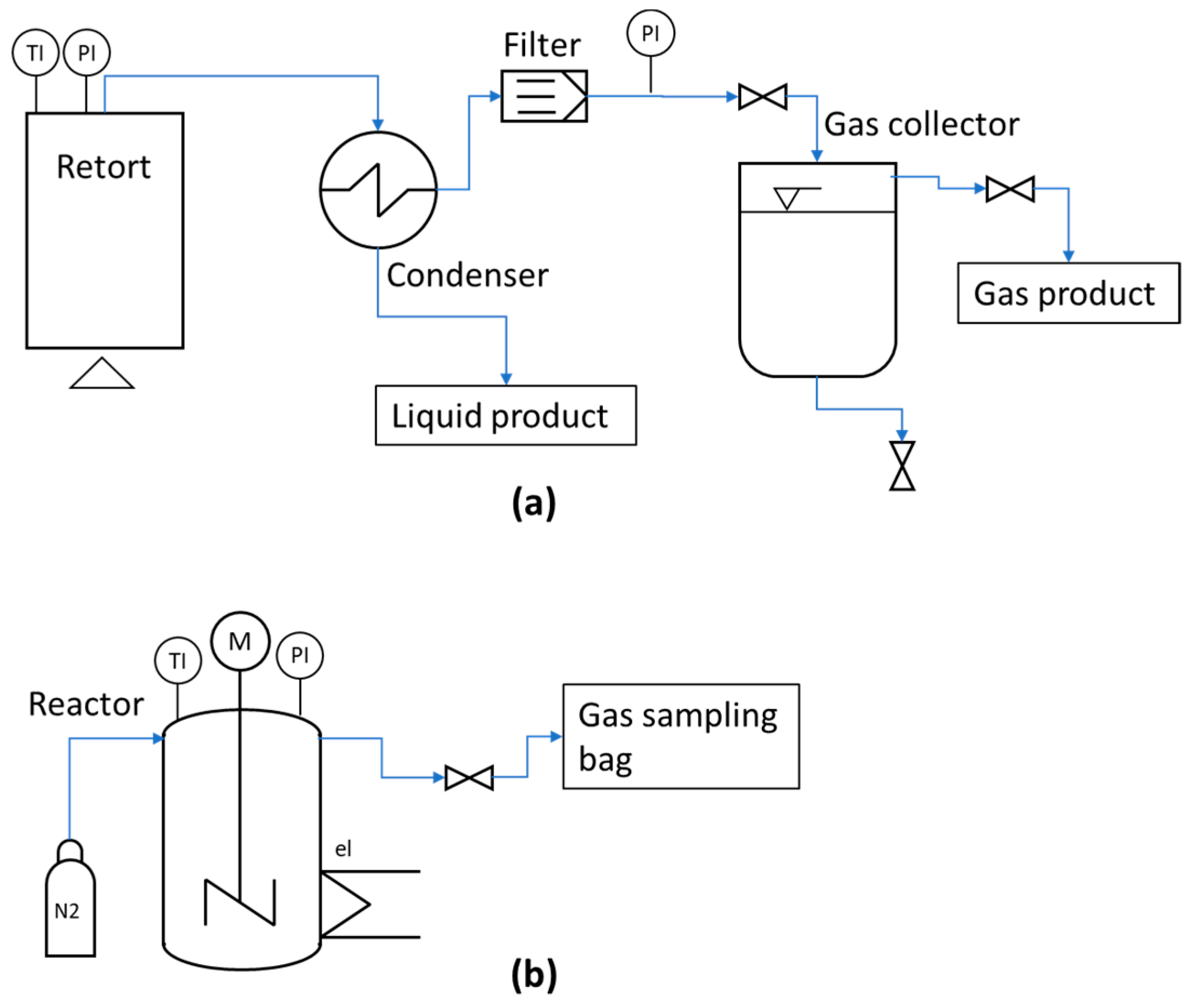
Pyrochar was produced through the pyrolysis of SS using the experimental setup described elsewhere and is presented in Figure 1a [9,30,31]. The setup includes a standard retort based on ISO 647 [32], a condenser system for collecting liquid products, and a gas collection system. A mass of 50 g of SS sample was loaded into the retort and heated to the final pyrolysis temperature at a fixed heating rate of 3.5 K·min−1 using Bunsen burners. This temperature was maintained according to the specified residence time. Volatile phases produced during pyrolysis were evacuated from the retort while maintaining a slightly negative pressure in the system by means of a water tank and a pressure control valve. As the volatile phase evolved, it was extracted from the retort by manually adjusting the outlet water flow using the pressure control valve to maintain negative pressure, which was measured with a U-tube manometer. Liquid products were collected in the condenser system, which consisted of an Erlenmeyer flask placed in a cold-water bath. Subsequently, non-condensable gases were collected in the water tank for further characterization. The selected pyrolysis temperatures for the experimental plan were 250, 350, 430, and 520 °C, with a residence time of 20 min (pyrochars P250-20, P350-20, P430-20, and P520-20). To analyze the effect of residence time at the pyrolysis temperature, one experimental run used a holding time of 60 min at 520 °C (pyrochar P520-60). The temperature profile for each pyrolysis experiment is presented in the Supplementary Material (Section S1).
Hydrochar was produced using a 250 mL stainless steel stirred reactor (Parr 4576 B, Parr Instrument Company, Moline, IL, USA) equipped with an electric heater and a magnetic stirrer, as presented in Figure 1b. The reactor was charged with a mixture containing 15 wt. % of dried SS in deionized water. The reactor interior was purged with nitrogen grade 5.0 to create an inert atmosphere with an initial pressure of 1 MPa. Hydrochars were produced at final temperatures of 180, 200, 250, and 300 °C, each with a residence time of 60 min (hydrochars H180-60, H200-60, H250-60, and H300-60). Additionally, the residence time was varied from 200 °C to 30 min and 120 min and from 250 °C to 20 min (hydrochars H200-30, H200-120, and H250-20). The sample was heated at a heating rate of 1 K·min−1 and stirred at 200 r·min−1 to ensure homogeneous heating. Pressure was generated autogenously and continuously monitored during all experimental runs. The T–p–t curves for each HTC experiment are presented in the Supplementary Material (Section S2). After completion of HTC, the reactor was rapidly cooled to 20 °C using an internal cold-water refrigeration loop. The gaseous product was then collected in a gas bag for analysis. The resulting slurry was removed from the reactor and vacuum-filtered to separate the wet hydrochar from the process water. Finally, the hydrochar was dried at 105 °C overnight for further analysis and characterization.
The heating rates selected for pyrolysis (3.5 K·min−1) and HTC (1.0 K·min−1) correspond to the minimum rates required to ensure homogeneous and stable heating conditions within each reactor system, reflecting the inherent operational characteristics and limitations of the respective equipment.

2.3. Physicochemical Characterization

Moisture (M), ash (A), and volatile matter (V) contents were determined according to ISO 18134-1:2022 [33], ISO 18122:2022 [34], and ISO 18123:2023 [35], respectively. Fixed carbon (Cfix) was determined by difference. Ultimate analysis was conducted using a Thermo Fisher Flash 2000 analyzer (Thermo Fisher Scientific, Waltham, MA, USA) to determine the carbon (C), hydrogen (H), nitrogen (N), and sulfur (S) contents. Oxygen (O) content was calculated by difference. The results were obtained as the average of three replicated analyses.
A Philips MagixPro PW-2440 (Philips, Eindhoven, the Netherlands) X-ray fluorescence spectrometer (WDXRF) equipped with a rhodium tube was used to determine the mineral composition of SS, hydrochar, and biochar. Additionally, the total heavy metal contents of arsenic (As), cadmium (Cd), zinc (Zn), copper (Cu), chromium (Cr), mercury (Hg), nickel (Ni), lead (Pb), and selenium (Se) were determined by digesting SS, biochar, and hydrochar samples in a nitric acid solution and subsequently analyzed using an inductively coupled plasma atomic emission spectrometer (ICP-AES), following EPA 3051A and EPA 6010C.
The Brunauer–Emmett–Teller (BET) and Barret–Joyner–Halenda (BJH) specific surface areas, as well as the pore volume according to the BJH of biochar and hydrochar samples, were obtained from the nitrogen adsorption isotherm at 77 K measured in an Autosorb-iQ analyzer. The functional groups of pyrochar and hydrochar were determined by Fourier transform infrared (FTIR) spectroscopy using a FT-IR Nicolet iS10 Spectrometer (Thermo Fisher Scientific, Waltham, MA, USA) and KBr pellets over a wavenumber range of 500–4000 cm−1.

2.4. Agronomic Properties

Although the speciation of P and S in hydrochars and pyrochars may be valuable for future studies, in the present work we evaluated only the bioavailable forms of S and P (specifically sulfates and phosphates), with the aim of determining their plant-available fractions [36,37,38]. Pyrochar and hydrochar nutrient availability was estimated using soil analysis methods. All experiments were conducted in triplicate, and the average concentration values were reported on a dry basis. Ammoniacal nitrogen (N–NH4+) was determined by 2 M KCl extraction (1:5 w/v char:water ratio, 1 h agitation) and quantified by micro-Kjeldahl distillation–titration. The available sulfur and phosphorus were determined by turbidimetric and Bray II methods, respectively [39]. Pyrochar and hydrochar pH values were measured in a 1:5 (w/v char:water ratio) mixture. The samples were shaken on a reciprocal shaker for 1.5 h and then allowed to settle for 1 h [40]. After pH measurement, the supernatants were filtered through 0.20 µm pore-size filters to quantify nitrate nitrogen (N–NO3), and an aliquot was injected into an ion chromatograph (Shimadzu Prominence model, Nishinokyo-Kuwabara-cho, Nakagyo-ku, Kyoto, Japan) equipped with an HPLC inert pump LC-20Ai, a current suppression system ICDS-40A, a conductivity detector CDD-10Avp, and a Shodex IC SI-90 4E column (250 mm × 4.0 mm, 9 µm). The mobile phase consisted of a 1.7 mM NaHCO3/1.8 mM Na2CO3 solution, with a flow rate of 1.2 mL·min−1 and an injection volume of 20 µL. Under these conditions, the retention time for nitrate was 6.58 min, and its limits of detection and quantification (LOD and LOQ) were 0.50 and 0.70 mg·kg−1, respectively.
Quantification was performed by external calibration using a certified nitrate standard solution traceable to NIST SRM NaNO3 in H2O, 1000 mg·L−1, NO3 Certipur®. The calibration range was 0.02–10 mg·L−1, with excellent linearity (R2 = 0.9993). Method repeatability, expressed as the relative standard deviation (RSD) of six replicate injections of a 5 mg·L−1 standard, was 3.84%, which is consistent with commonly accepted performance criteria (<5%) for suppressed ion chromatography methods [41].
The unit conversion from mg·L−1 measured in the extract to mg·kg−1 dry sample was performed according to Equation (1), including blank subtraction:
C sample = C IC C blank × V extract × DF × 14 m dry × 62
where
  • CIC (mg N-NO3 kg−1) is the concentration obtained from ion chromatography,
  • Cblank (mg NO3 L−1) is the nitrate concentration measured in the reagent blank,
  • Vextract (L) is the extraction solution volume,
  • DF is the dilution factor,
  • mdry (kg) is the dry-weight equivalent of the sample,
  • 14 (mg) is the atomic weight of nitrogen,
  • and 62 (mg) is the molecular weight of the nitrate ion (NO3).
The evaluation of measurement uncertainty was carried out in accordance with the recommendations of the Guide to the Expression of Uncertainty in Measurement (GUM). The combined standard uncertainty Uc was obtained by identifying and quantifying all relevant sources of uncertainty and propagating them using the law of propagation of uncertainty, as described in the GUM [42]. The expanded uncertainty U was then calculated as U = k·Uc, where a coverage factor k = 2 was applied, corresponding to an approximate confidence level of 95%.

2.5. Data Analysis and Calculations

2.5.1. Yield Calculation

The char yield (%) was calculated as the ratio of the dry mass of the obtained solid product (pyrochar or hydrochar) to the initial dry mass of the SS feedstock, according to Equation (2):
y = dry mass of solid product dry mass of SS × 100 [ % kg kg 1 ]
The distribution of heavy metals and the mineral composition of the char samples were calculated based on the dry mass of SS. Equation (3) was used to determine the concentration of each element relative to the initial dry mass of SS, allowing for standardized comparisons across treatments:
W = dry mass of element in the solid product dry mass of solid product × y 100 × 100 [ % kg kg 1 ]

2.5.2. Statistical Analysis

Statistical analyses were performed to verify that the data met the assumptions required for parametric testing. Normality of the residuals was assessed using the Shapiro–Wilk test, which evaluates deviations from a normal distribution; no violation of this assumption was detected (p > 0.001). The homogeneity of variances across groups was examined using the Levene test, which assesses the equality of group variances, and the results confirmed that this assumption was also satisfied.
Differences among treatments were evaluated using analysis of variance (ANOVA). The F statistic was calculated as the ratio of the mean square of the factor to the mean square of the residuals and evaluated at a significance level of α = 0.05. Significant differences among treatments were detected (p < 0.05).

3. Results and Discussion

3.1. Pyrochar and Hydrochar Yields

Pyrochar and hydrochar yields obtained after pyrolysis and HTC on a dry basis, according to Section 2.2, are presented in Table 1. The values range between 73.29 wt.% and 62.26 wt.% for hydrochars and between 91.04 wt.% and 57.51 wt.% for pyrochars. Temperature has a greater influence on yield than residence time; therefore, the lower pyrochar yields are attributed to the higher temperatures used during processing. Regarding pyrolysis, the decrease in pyrochar yield is caused by primary pyrolysis decomposition reactions of extractive compounds and hemicellulose at lower temperatures (between 110 °C and 380 °C), as well as cellulose, lignin, protein, lipid, and plastic fractions at higher temperatures (between 350 °C and 600 °C) [43]. Residence time variations at 520 °C between 20 min and 60 min did not result in significant changes in pyrochar yields, mainly because at this temperature almost complete decomposition of the organic material has already taken place. Moreover, the experimental setup promotes rapid evacuation of the volatile phase, which prevents the occurrence of secondary recondensation reactions in the solid phase. Therefore, the mass loss obtained at 520 °C during pyrolysis (42.49 wt.%) is indicative of the highest mass loss associated with primary thermal decomposition of the SS sample used in this work. The minimum hydrochar yield obtained at 300 °C corresponds to a mass loss of 37.33 wt.%, or approximately 80% of the maximum mass loss achievable during pyrolysis. Despite differences in process conditions, the pyrolysis and HTC of SS involve several similar reaction pathways. During HTC, hemicelluloses undergo decomposition between 180 and 200 °C, while most lignin components degrade within the range of 180–220 °C, and cellulose decomposition occurs predominantly above approximately 220 °C [44]. During these transformations, hydrochar formation is largely governed by recondensation reactions [45].

3.2. Physicochemical Characterization

3.2.1. Proximate and Ultimate Analyses

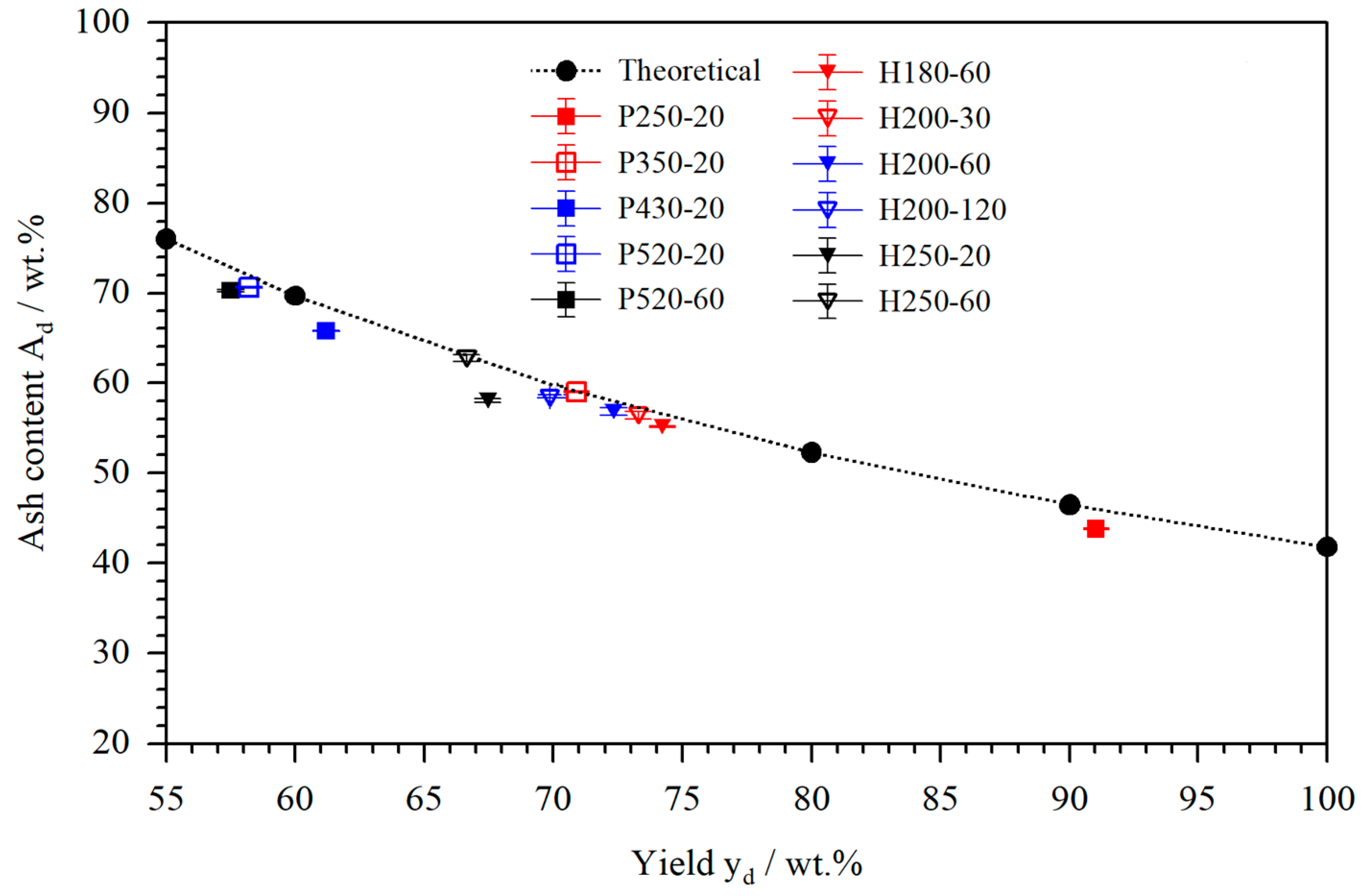
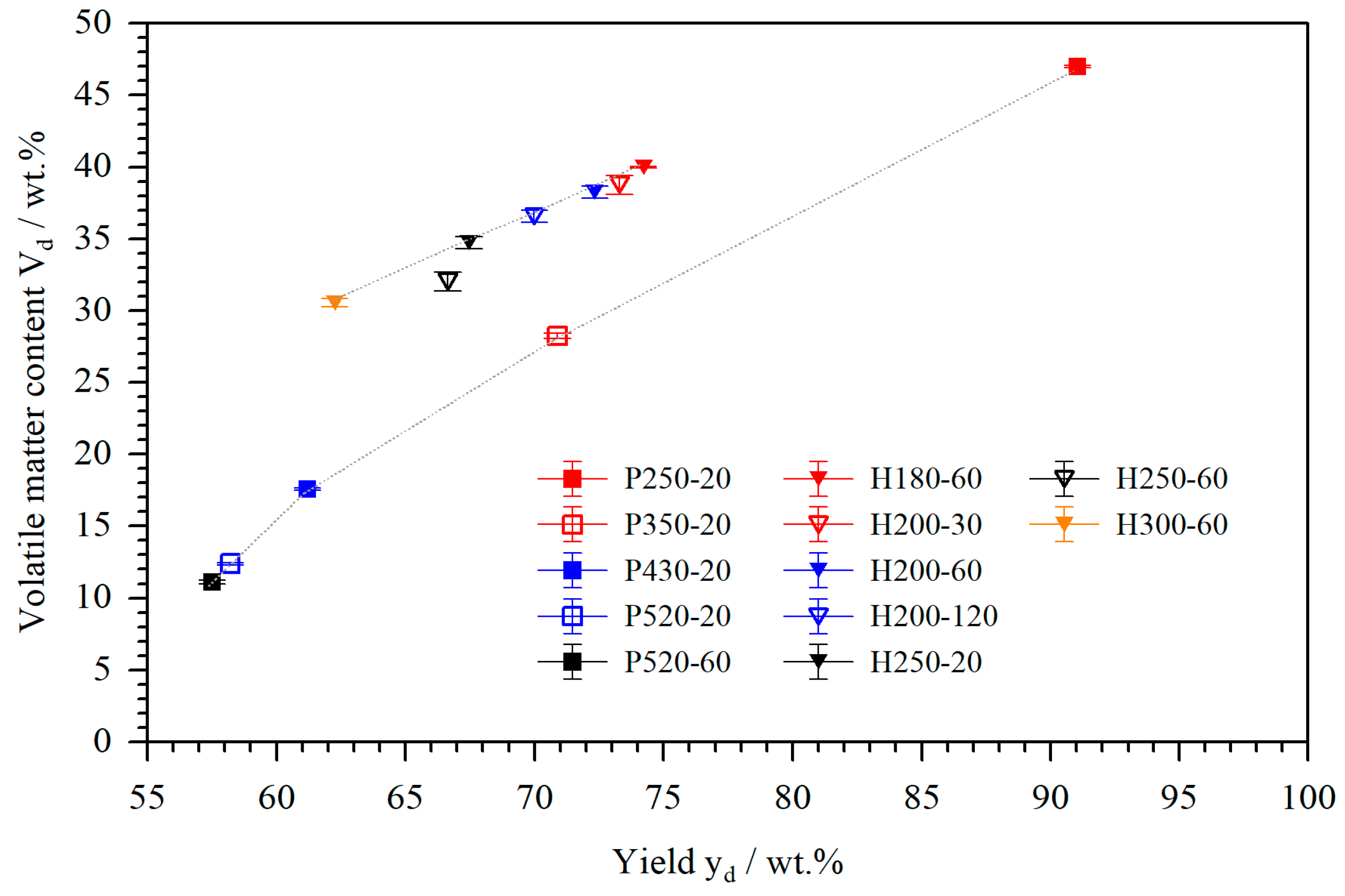
The proximate and ultimate analyses of SS, pyrochars, and hydrochars obtained in this study are presented in Table 1. SS exhibits a high ash content (Ad = 41.82%) compared to other organic materials such as biomass, which typically range between 2% and 10% [46]. However, this value is within the typical range for sewage sludge from WWTPs [47]. Figure 2 shows the relationship between ash content and yield for the obtained pyrochars and hydrochars. The theoretical variation in ash content with yield (symbols and dotted line in the figure) corresponds to the value obtained by assuming that the initial ash mass in SS remains constant during processing. As shown in the figure, the relationship between ash content and yield for both pyrochar and hydrochar samples closely follows this theoretical behavior, indicating that the mass of ash originally present in SS remains constant during both processing routes. The variation in volatile matter content (Vd) with pyrochar and hydrochar yields is presented in Figure 3. Unlike ash content, Vd shows different behaviors with respect to the yield of pyrochar and hydrochar. Hydrochars exhibit higher volatile matter contents than pyrochars at comparable yields, indicating that the reaction mechanisms of each process play a defining role in determining the organic composition of pyrochars and hydrochars. Both the pyrolysis and HTC of SS involve several comparable reaction pathways, including dehydration, decarboxylation, and polymerization [45]. However, the main difference lies in the fact that HTC primarily starts with the hydrolysis of biomacromolecules, leading to hydrolysis fragments in the aqueous phase. Hydrochar is mainly formed through the recondensation of these hydrolysis fragments, resulting in a less stable structure with a higher Vd than pyrochar [45]. This is consistent with the results obtained in this study, indicating that chars produced by both processes contain organic compound structures that are arranged differently. For instance, when comparing the H200-120 and P350-20 runs, as well as the H300-60 and P430-20 runs, the yield and ash content are similar in magnitude; however, the volatile matter and fixed carbon contents differ significantly. The lower fixed carbon content and the higher proportion of easily degradable carbon compounds in hydrochar are characteristics that may promote higher mobility of their components during soil application compared to pyrochar. This may result in hydrochars exhibiting a more efficient release of organic compounds and nutrients into the soil, as well as other compounds, including heavy metals. On the other hand, hydrochars have a lower potential for carbon sequestration than pyrochars, primarily due to their lower fixed carbon content, which limits their structural stability and persistence in soil over long periods.
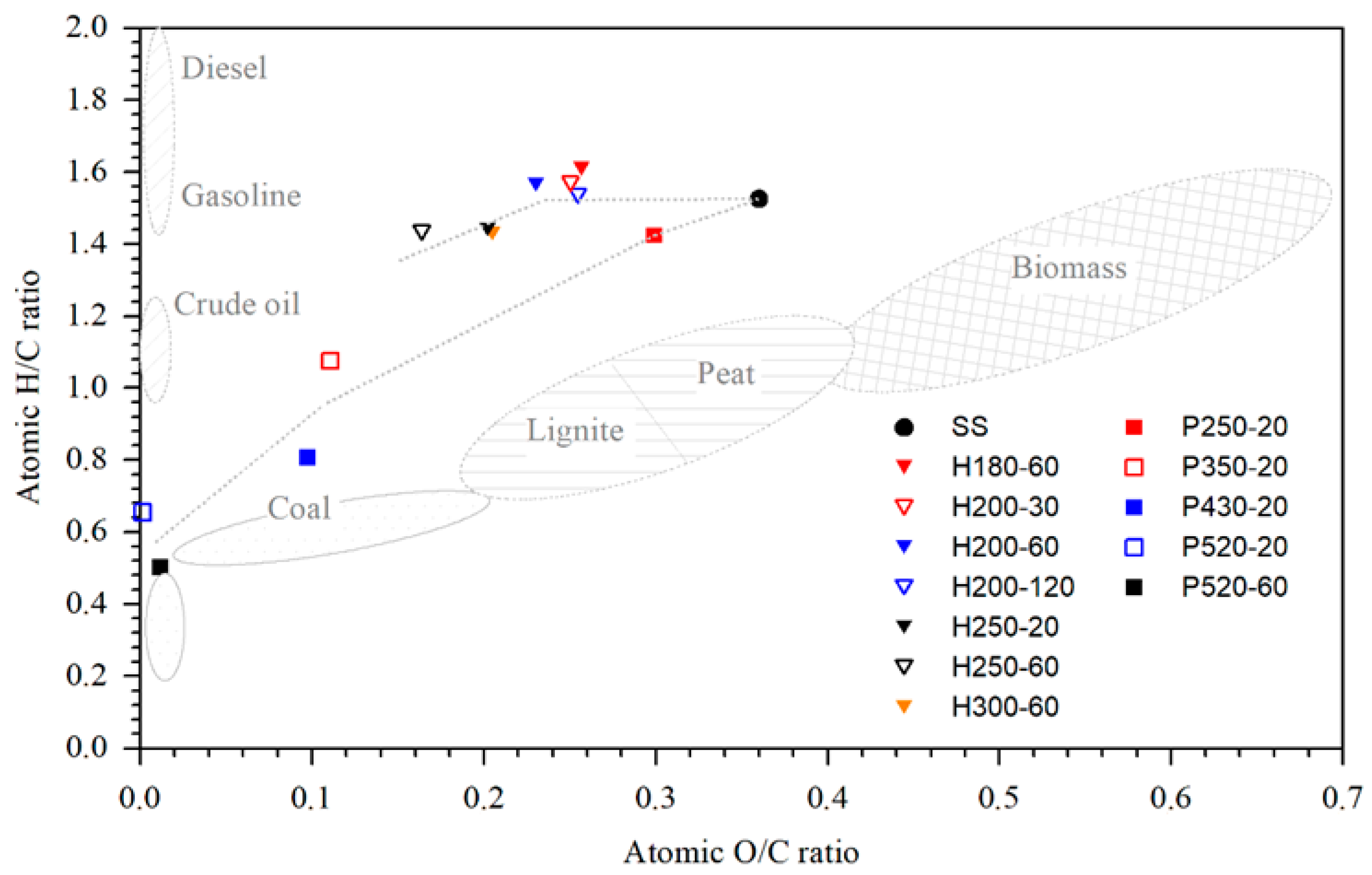
The degree of carbonization was evaluated using the Van Krevelen diagram, as shown in Figure 4. Pyrochars exhibit lower H/C and O/C ratios than SS, whereas hydrochars show only a slight reduction in the H/C ratio relative to SS when the O/C ratio falls below 0.24 (Figure 4). These changes are attributable to the release of H2O and CO2 during dehydration and decarboxylation reactions. Nevertheless, hydrochars exhibit higher H/C and O/C ratios than pyrochars, suggesting that in HTC, the relative rate of decarboxylation to dehydration reactions is greater than in pyrolysis [48].
All hydrochars present H/C atomic ratios greater than 1, indicating a low-condensation aromatic structure [49]. This type of structure contains a higher proportion of aliphatic and functionalized carbons and is therefore more chemically reactive [49]. Consequently, hydrochars have a lower potential for long-term carbon sequestration in soils compared to more aromatic, condensed carbon materials, as their less stable molecular framework is more prone to mineralization [50]. In contrast, pyrochars produced at temperatures of 430–520 °C exhibit H/C ratios between 0.5 and 0.8, which are typical of highly condensed aromatic structures with an average of six fused benzene rings [49]. Such condensed polyaromatic networks confer high chemical stability and resistance to biodegradation, resulting in a greater capacity for persistent carbon storage in soils [50]. These results are consistent with the fixed carbon values obtained for the pyrochars, which are higher than those obtained for the hydrochars. When comparing the H200-120 and P350-20 runs, as well as the H300-60 and P430-20 runs, the pyrochars exhibit lower H/C and O/C ratios in both cases, despite having similar yields. This difference is primarily due to the higher degree of carbonization in pyrochars, which results in a greater proportion of fixed carbon and more condensed aromatic structures, thereby reducing the relative hydrogen and oxygen contents compared to hydrochars. The O/C ratio also partially indicates the surface hydrophilicity of chars. Hydrochars show higher O/C ratios, which may indicate a higher abundance of polar groups on the char surface that act as water adsorption centers, resulting in higher surface hydrophilicity [51].

3.2.2. Elemental Composition (XRF Analysis) and Heavy Metal Total Content

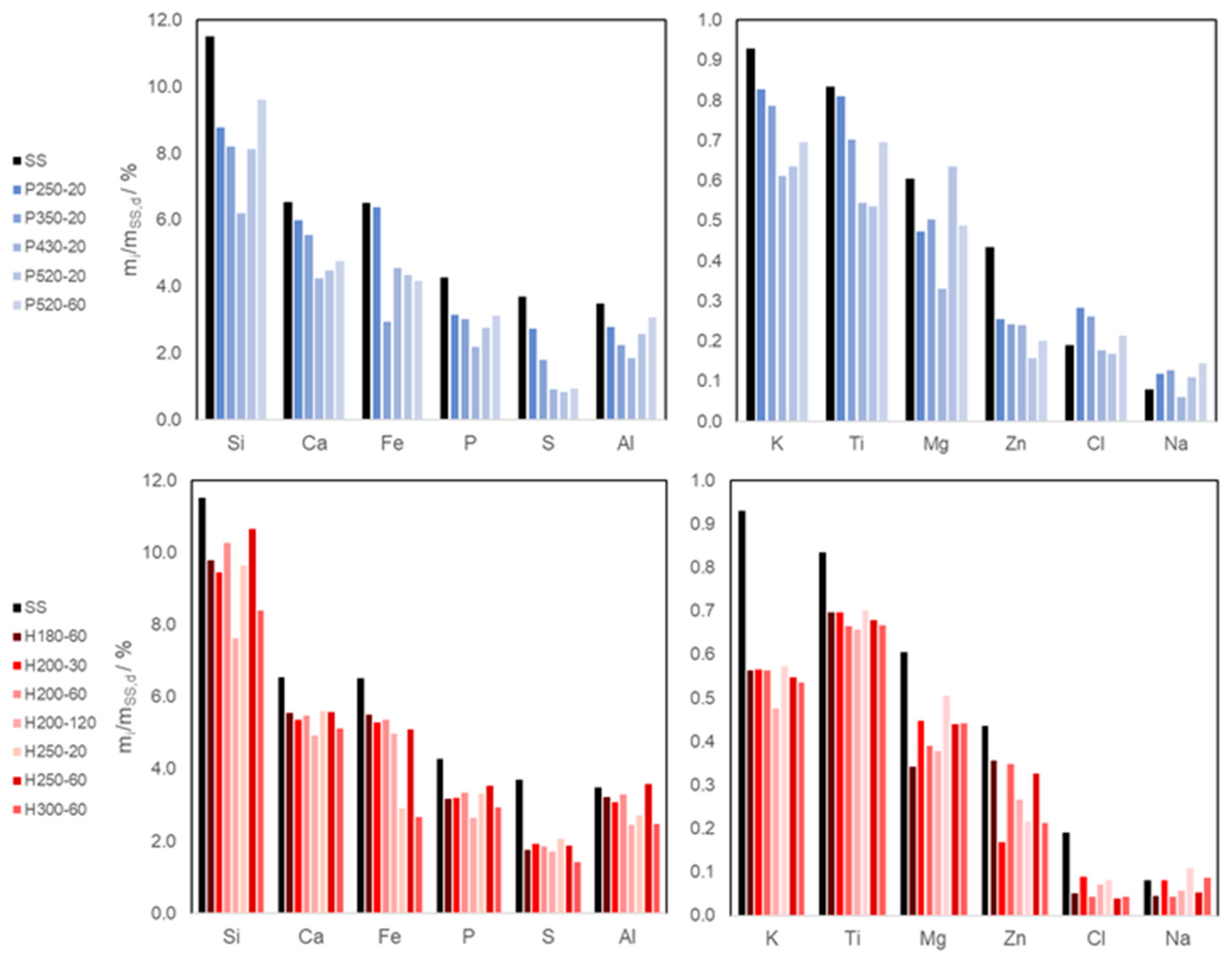
Figure 5 illustrates the inorganic material content determined by XRF analysis in SS, pyrochar, and hydrochar. The results are reported on a dry basis and normalized to the initial mass of SS according to Equation (3). The main components of SS on a dry basis are silicon (11.52%), calcium, iron (6.53%), phosphorus (4.28%), sulfur (3.70%), and aluminum (3.48%), and, in lower proportions, potassium (0.93%), titanium (0.84%), magnesium (0.61%), zinc (0.44%), chlorine (0.19%), and sodium (0.08%). In the case of pyrolysis, the concentrations of these elements remain predominantly within the pyrochar matrix due to their low volatility under the evaluated operating conditions. At the same time, pyrolysis has a strong effect on sulfur volatilization, as also reported in the literature [52]. The increase in pyrolysis temperature also promotes volatilization by entrainment of inorganic compounds such as calcium, iron, and potassium compounds. On the other hand, the HTC of SS significantly affects the elemental composition of hydrochar due to the transport of components to the liquid phase. In addition to the decrease in sulfur observed when comparing SS and hydrochars, a pronounced decrease in potassium, chlorine, phosphorus, and sodium contents was detected, as also reported by Wilk et al. [53]. Additionally, there is no strong relationship between increasing HTC temperature and the solubilization of metals such as iron, calcium, aluminum, and zinc.
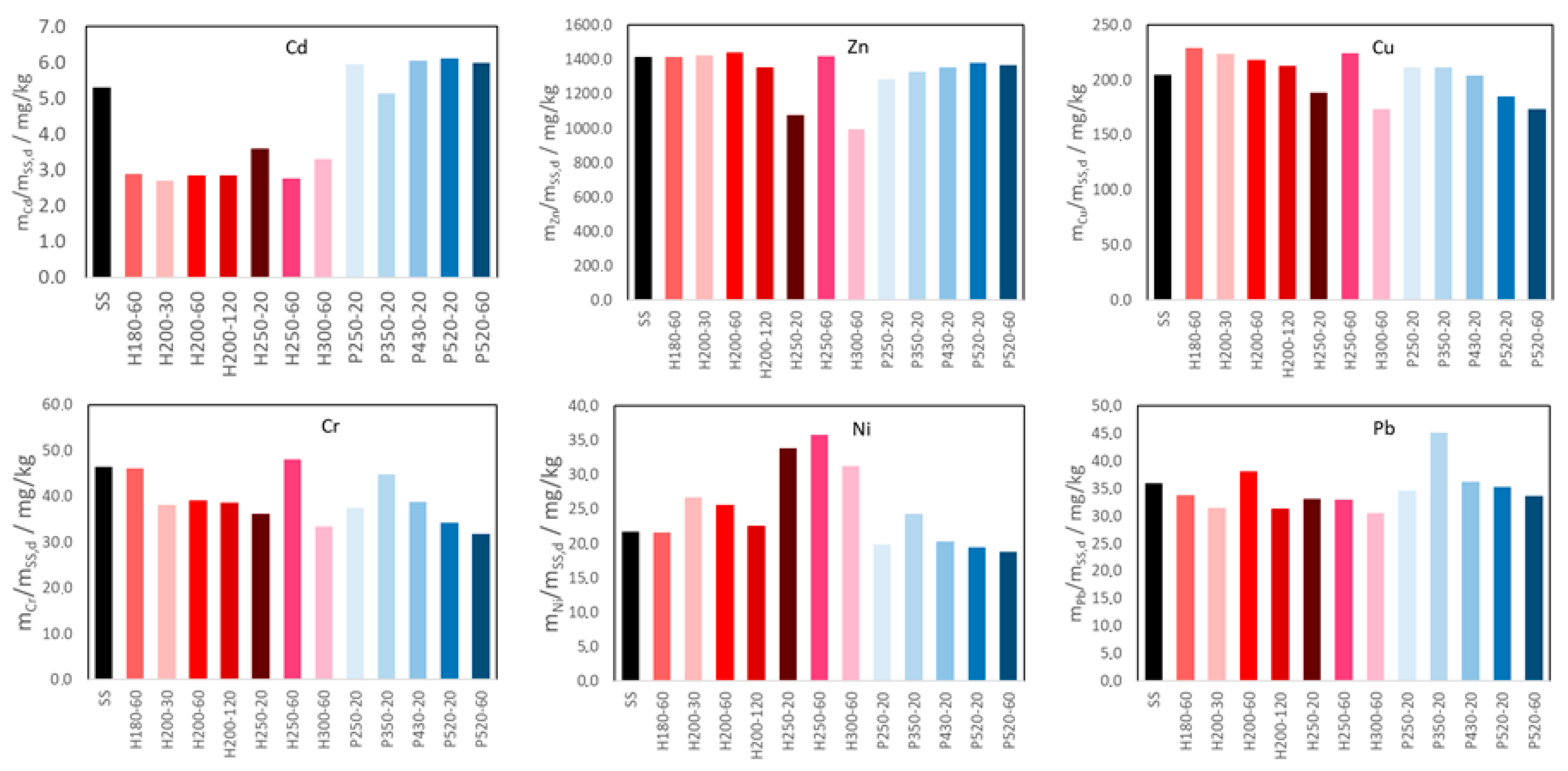
Figure 6 comparatively shows the heavy metal composition of SS, pyrochar, and hydrochar for six of the nine metals analyzed by ICP-AES. Consistent with the elemental composition presented in Figure 5, the concentrations of heavy metals are expressed on a dry basis relative to the initial mass of SS to facilitate a comparative analysis of their distribution during thermochemical processing. Arsenic, mercury, and selenium were not detected in SS, pyrochar, or hydrochar samples because their concentrations were below the detection limits of the method (14.7 mg·kg−1, 5.07 mg·kg−1, and 11.40 mg·kg−1, respectively). The contents of lead, copper, nickel, zinc, and chromium tend to be retained and concentrated in hydrochars, as reported by Hämäläinen et al. [54]. Cadmium in hydrochar exhibits behavior different from that of other heavy metals: the cadmium content in hydrochar consistently decreases at 180 °C and remains stable across the range of evaluated HTC conditions, mainly due to its solubilization into the aqueous phase during the HTC process.
Concerning pyrolysis, the contents of cadmium, zinc, nickel, and lead remain relatively constant in all pyrochar samples, indicating limited volatilization or transformation under the evaluated conditions. However, at higher pyrolysis temperatures (above 430 °C), a noticeable volatilization effect is observed for chromium and, to a lesser extent, copper, leading to a reduction in their concentrations in the resulting solid products. These trends in heavy metal concentrations in pyrochar follow the same behavior as reported by Yuan et al. [47].

3.3. Surface Properties

As shown in Table 1, the specific surface area of all chars produced in this study ranges between 12.7 and 96.5 m2·g−1 when determined by the BET method and between 11.74 and 79.17 m2·g−1 when determined by the BJH method. These relatively low values indicate an incipient development of porosity. This observation is corroborated by the nitrogen sorption isotherms at 77 K presented in Figure S1 of the Supplementary Material (Section S4). Low values of the amount adsorbed (i.e., pore volume) at low relative pressures, together with the slope observed at relative pressures up to approximately 0.9 and the presence of a hysteresis loop, indicate the predominance of mesoporosity. For both hydrothermal carbonization and pyrolysis processes, similar trends are observed, as shown in Figure S2 of the Supplementary Material. An increase in specific surface area and mesopore volume with increasing final processing temperature is observed (Figure 1a,c and Figures S2a,c), whereas a decrease in these parameters occurs with increasing residence time (Figures S1b,d and S2b,d). These effects are more pronounced in the case of hydrothermal carbonization. The reduction in porosity with increasing residence time may be associated with structural transformations of the chars that occur without significant variations in yield or chemical composition. Additionally, Figure S1c shows a decrease in specific surface area and pore volume at 550 °C compared with the values obtained at 430 °C, which may be attributed to the loss of porosity due to volatilization of the pyrolyzed material at higher temperatures. Moreover, the SBET values obtained in this study are consistent with those reported in the literature for pyrochars and hydrochars produced from SS [55,56,57].
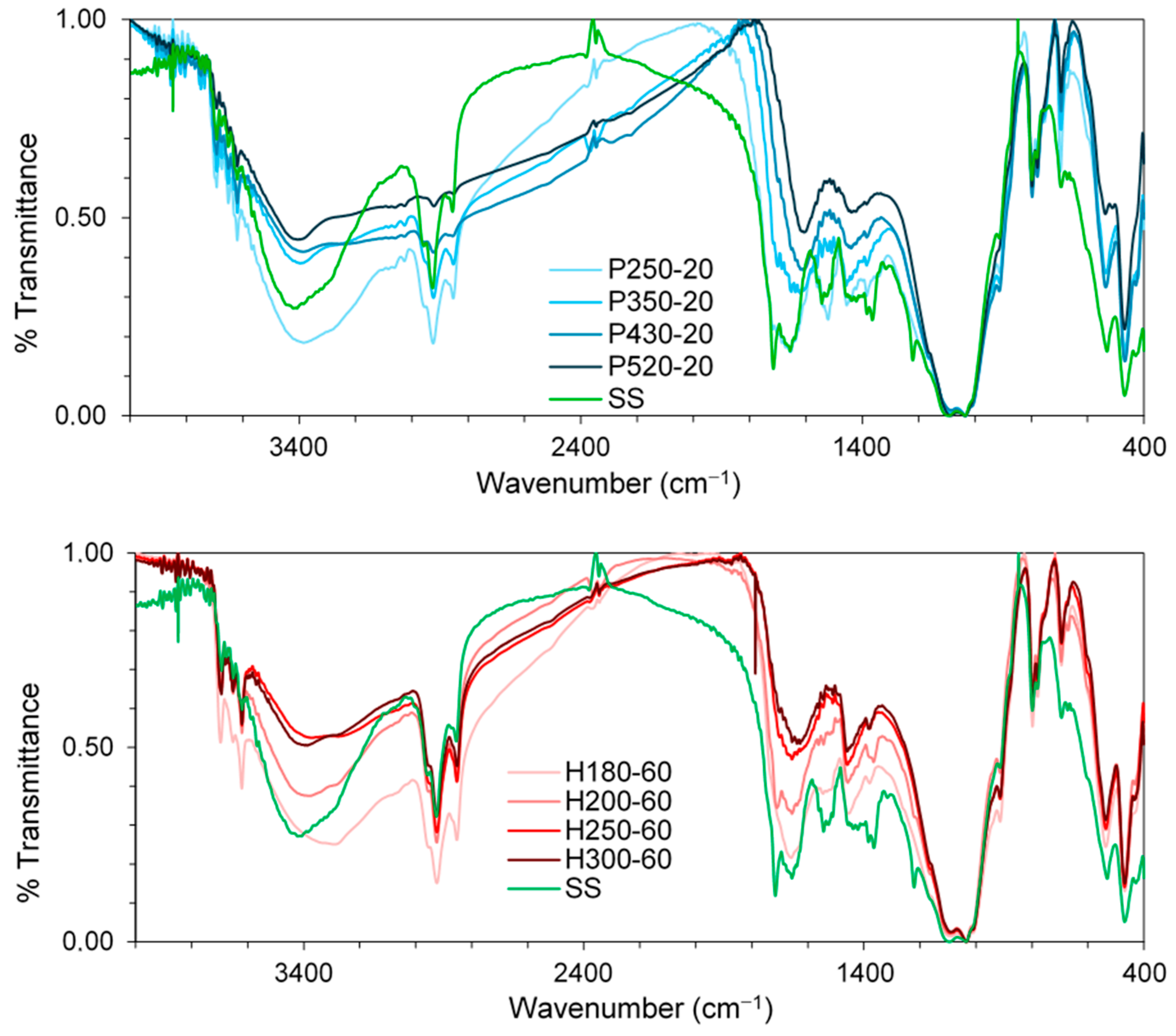
The FTIR spectra of pyrochars and hydrochars are compared in Figure 7. The sharp peaks at approximately 3700 cm−1 and 3600 cm−1 have been associated with vibrations of O–H bonds in mineral components such as gibbsite (γ-Al(OH)3) [29,58]. Bands around 3400 cm−1 correspond to O–H and N–H bond vibrations in organic matter. These bands exhibit lower intensity at higher temperatures, suggesting a reduction in hydroxyl and carboxyl groups as temperature increases. This behavior is consistent with the reduction in intensity observed for bands around 1600–1700 cm−1, corresponding to C=O bond vibrations in carbonyl groups. Two peaks at approximately 2900 and 2800 cm−1 correspond to the asymmetric and symmetric stretching vibrations of C–H bonds in methylene groups, respectively, indicating the presence of aliphatic structures. The significant decrease in intensity observed in these bands for pyrochars P430-20 and P520-20 suggests that the decomposition of aliphatic C–H bonds becomes more pronounced at temperatures exceeding 400 °C [59], which is also confirmed by the reduction in the H–C–H scissoring vibration band at around 1450 cm−1 [58]. This trend is further supported by the decrease in the H/C ratio observed in both types of chars (Figure 2), indicating a shift toward the formation of more aromatic carbon structures at higher temperatures. The broad N–H band around 3400 cm−1 and the C–N–H bending vibration at 1530 cm−1 are observed only in SS, H180-60, and P250-20. This may indicate the decomposition of nitrogen-containing organic structures, such as amines and amides, at temperatures above 250 °C [29,58]. On the other hand, bands between 1000 and 400 cm−1 show changes only between the raw material SS and both char types. However, no significant differences among temperatures were observed for each char type, suggesting that these bands are mainly associated with inorganic components. The band around 1000–1100 cm−1 can be associated with Si–O bonds [29], which is representative of the presence of quartz and aluminosilicates (Figure 7). Finally, weak bands at approximately 850 and 700 cm−1 can be attributed to the presence of CaCO3, according to previous literature [59]. Bands below 600 cm−1 correspond to M–X stretching vibrations in halogenated compounds (M-metal, X-halogen) [58].

3.4. Agronomical Properties

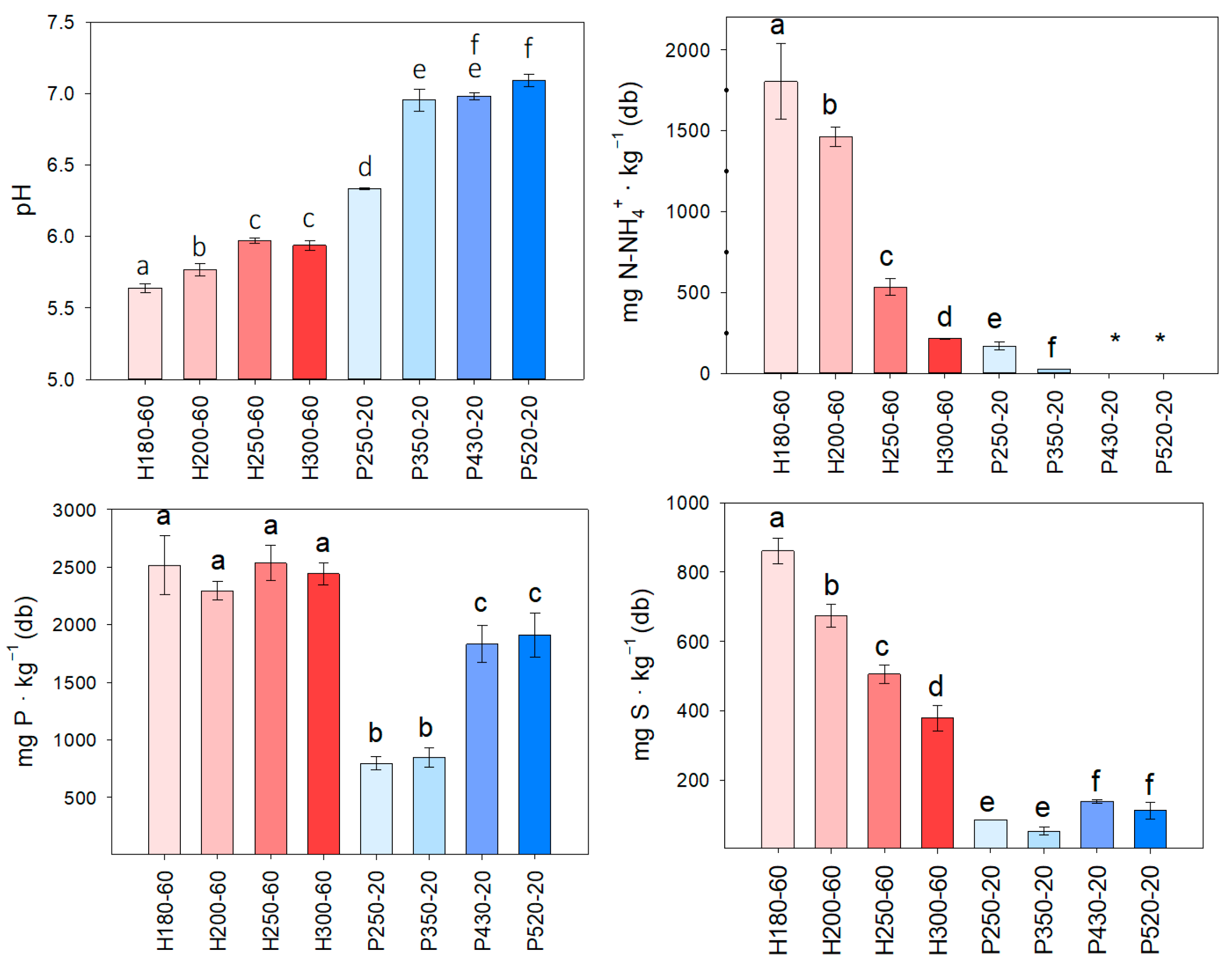
The bioavailable nutrient content and pH of hydrochar and pyrochar obtained at different temperatures were determined. The effect of residence time was not studied, as no notable differences were observed in the proximate and ultimate analyses of the chars (Table 1). Nevertheless, residence time may still influence agronomic traits such as N–NH4+, P, and S availability, as well as pH. For this reason, the discussion is focused on temperature, which showed a substantially stronger effect on material transformation, while recognizing that residence time could exert a secondary influence beyond the scope of the present analysis. The estimation of measurement uncertainty following the GUM guidelines [42] is presented in Tables S1–S5 of the Supplementary Material. All datasets fulfilled the assumptions required for ANOVA. Normality was confirmed by the Shapiro–Wilk test (p < 0.001), and homogeneity of variances was verified using the Levene test. The ANOVA results showed statistically significant differences among treatments (p < 0.05). Figure 8 presents the bioavailable nutrient content and pH of the pyrochar and hydrochar samples. As shown in Figure 8, significant differences in pH were observed between hydrochars and pyrochars. Hydrochar pH values are slightly acidic, whereas pyrochar pH values are close to neutrality. Hydrochar pH increased slightly from 5.64 to 5.94 as the temperature rose from 180 to 300 °C, while pyrochar pH values increased from 6.33 to 7.09 between 250 and 520 °C. This behavior can be explained by an increase in the amount of alkaline oxide species in the char ashes and by a greater decomposition of organic acids as the processing temperature increases [29,60]. These results are consistent with the reduction in the intensity of the carbonyl and hydroxyl bands shown in Figure 7. Similar results have been reported in previous studies; for example, pyrochar pH values range between 5.3 and 6.7 (slightly acidic) at 300 °C [47,58], between 7.1 and 9.1 (neutral to alkaline) at 500 °C [47,58,59,60], and between 12.0 and 13.0 (strongly alkaline) at 700 °C [57]. These results suggest that hydrochars generated at lower temperatures may be more suitable for alkaline soils, whereas pyrochars produced at higher temperatures may be more appropriate for acidic soils, which are predominantly found in tropical regions. However, the choice between hydrochar and pyrochar should be guided by soil pH, cation-exchange capacity, and application rate, and must ultimately be validated through pot- or field-scale trials.
Nitric and ammoniacal nitrogen (N–NO3 and N–NH4+), which are the main bioavailable nitrogen species for plants, were quantified. Very low N–NO3 concentrations were found in all samples, falling below the quantification limit (0.5 mg·kg−1) in most cases. Only H180-60 and H200-60 (2.2 ± 0.2 and 1.3 ± 0.2 mg·kg−1, respectively) showed quantifiable concentrations. N–NO3 concentrations below 1.3 mg·kg−1 for pyrochars produced at temperatures between 300 and 700 °C have also been reported elsewhere [53,61,62]. Regarding ammoniacal nitrogen, hydrochars show significantly higher content than pyrochars, as presented in Figure 8. Moreover, for both char types, a strong decrease in ammoniacal nitrogen content with increasing processing temperature is observed (p < 0.05). These results can be explained by enhanced protein decomposition (and other nitrogen-containing organic compounds) and the volatilization of ammonia, hydrocyanic acid, and nitrogen oxides as temperature increases. In addition, a gradual transformation of nitrogen into pyrrole-type and pyridine-like structures occurs at higher temperatures [58]. The decrease in available N is consistent with the reduction in total nitrogen with increasing temperature, as shown in Table 1. Differences in processing conditions other than temperature also influence the N–NH4+ content, as evidenced by the comparison between H250-60 and P250-20 (534 ± 51 mg·kg−1 vs. 171 ± 27 mg·kg−1).
This variation is mainly attributed to the presence of a liquid phase and the longer residence time in HTC, which promote the hydrolysis of organic nitrogen compounds and their subsequent conversion into ammonium ions [24]. Consequently, hydrochars may be more suitable as a source of nitrogen than pyrochars due to their higher concentrations of N–NH4+.
A notable difference was observed in the available phosphorus (P) content between the two char types. Hydrochars exhibited values as high as 2500 mg·kg−1, with no apparent dependence on temperature. Conversely, in pyrochars, the available P content increased significantly (p < 0.05) as the temperature rose from 350 °C (846 mg·kg−1) to 430 °C (1831 mg·kg−1), whereas total phosphorus tended to increase with temperature, as presented in Table 1. Variations in the amount of available P observed in this work are consistent with findings from previous studies, in which the available P content in pyrochars has been reported to increase up to around 450 °C and then decrease at higher temperatures [58,59,63]. It has been documented that P in SS and SS-derived pyrochar primarily exists as orthophosphate (PO43−) and pyrophosphate (P2O74−). In addition, organic phosphorus forms are also present, such as orthophosphate monoesters and orthophosphate diesters, in molecules including proteins, adenosine triphosphate, and nucleic acids. Li et al. [16] found that while total P increases with pyrolysis temperature, the organic P fraction decreases continuously from 300 to 500 °C due to the decomposition of organic P, which is transformed into orthophosphate. Moreover, previous findings suggest that temperature also influences the speciation of inorganic phosphorus. Specifically, higher temperatures decrease phosphorus bound to iron, manganese, aluminum, sodium oxides, and their hydroxides, which are highly insoluble compounds, while phosphorus bound to calcium and magnesium—considered the most readily absorbed forms by plants—increases [16].
Sulfate (SO42−) is the available species of S for plants [35]; therefore, its availability in pyrochars is related to the presence of water-soluble sulfates. As shown in Figure 7, the concentration of available S was significantly higher in hydrochars than in pyrochars (p < 0.05), exhibiting a behavior overall similar to that observed for P. For hydrochars, a decrease in available S was observed as the temperature increased, whereas for pyrochars, the opposite trend was found, with a significant increase when the temperature rose from 350 °C (54 mg·kg−1) to 430 °C (140 mg·kg−1). In contrast, total S showed a decrease with increasing temperature in both char types, according to the elemental analysis presented in Table 1. This behavior in both chars is related to the increased production of S-containing gaseous species with increasing temperatures [8,27].
In SS, sulfur is present as organic S, including mercaptan structures, disulfides, sulfonates, aliphatic-S, and aromatic-S, as well as inorganic S, such as metal sulfides and sulfates. Their transformations during thermal treatments involve multiple processes and reactions of oxidation and hydrolysis cyclization that have been studied for hydrothermal carbonization and pyrolysis. A decrease in aliphatic-S species (such as thiols, organic sulfides, and cysteine) and sulfonates, along with a slight increase in sulfate abundance in chars, has been reported as the temperature rises [8,27]. A decrease in aliphatic-S species (such as thiols, organic sulfides, and cysteine) and sulfonates, together with a slight increase in sulfate abundance in chars, has been reported with increasing temperature [8,27].
In hydrochars, the observed decrease in available S with increasing process severity is consistent with the higher moisture environment and relatively lower reaction temperatures of hydrothermal carbonization, which favor the formation of reduced S species such as metal sulfides or organosulfur complexes that are less soluble. Although this mechanism cannot be fully confirmed with the data available in this study, it is consistent with previous findings reporting the stabilization of S into reduced or mineral-bound forms under hydrothermal conditions [8]. In pyrochars, the higher availability of S observed at P430-20 and P520-20 compared to lower temperatures may be related to the thermal decomposition of organically bound S and the concurrent concentration effect caused by mass loss during pyrolysis. At temperatures below 500 °C, preferential fragmentation and volatilization of aliphatic-S species, as well as oxidation of sulfonates into sulfates, have been reported [8]. At higher temperatures, sulfur incorporated into organic matrices is partially released and transformed into more oxidized and soluble forms, such as sulfate, thereby increasing extractable S [8].

4. Conclusions

This study evaluated the feasibility of SS valorization through the production of pyrochars and hydrochars at different temperatures and residence times for agricultural and soil applications, based on a comparative analysis of physicochemical properties. The results provide key insights into the effects of HTC and pyrolysis on sewage sludge and the resulting char properties. The study compared the physicochemical, surface, and agronomic properties, including pH and the bioavailability of nutrients such as nitrogen, phosphorus, and sulfur, and of pyrochars and hydrochars derived from sewage sludge. Temperature was identified as the main factor influencing the properties analyzed in both pyrolysis and HTC processes, whereas residence time showed no significant influence on the properties of the solid products. A higher degree of carbonization was observed in pyrochars than in hydrochars, resulting in lower H/C ratios and indicating higher aromaticity. At higher temperatures, hydrochars exhibited lower carbon ratios compared to pyrochars. The liquid medium in HTC facilitated the solubilization of elemental components, particularly at higher temperatures, resulting in hydrochars with reduced concentrations of contaminants such as heavy metals. Regarding surface properties, both pyrochars and hydrochars exhibited low SBET values, with no appreciable differences between them. FTIR analysis showed a decrease in the C–H and C=O functional groups in pyrochars and a reduction in the O–H, N–H, and C=O groups in hydrochars with increasing temperature. Finally, the bioavailable nutrient contents of N, P, and S were higher in hydrochars than in pyrochars, particularly in materials produced at lower temperatures, suggesting that hydrochars may be more suitable for use as nutrient sources or as complements to conventional fertilizers. Future research should include greenhouse and field trials to validate the agronomic performance of these materials under realistic soil conditions.

Supplementary Materials

The following supporting information can be downloaded at https://www.mdpi.com/article/10.3390/su18010223/s1: Section S1: Temperature profiles of the pyrolysis experiments; Section S2: T–p–t profiles of the HTC experiments; Table S1: uncertainty values for N-NH4+: uA (mg kg−1) is the uncertainty of the measurand; uC, rel (%) is the combined relative uncertainty; uC (mg kg−1) is the total combined uncertainty. U (k = 2) is the expanded uncertainty calculated using a coverage factor k = 2 (95% confidence); Table S2: uncertainty values for N-NO3: uA (mg kg−1) is the uncertainty of the measurand; uC, rel (%) is the combined relative uncertainty; uC (mg kg−1) is the total combined uncertainty. U (k = 2) is the expanded uncertainty calculated using a coverage factor k = 2 (95% confidence); Table S3: uncertainty values for S: uA (mg kg−1) is the uncertainty of the measurand; uC, rel (%) is the combined relative uncertainty; uC (mg kg−1) is the total combined uncertainty. U (k = 2) is the expanded uncertainty calculated using a coverage factor k = 2 (95% confidence); Table S4: uncertainty values for P: uA (mg kg−1) is the uncertainty of the measurand; uC, rel (%) is the combined relative uncertainty; uC (mg kg−1) is the total combined uncertainty. U (k = 2) is the expanded uncertainty calculated using a coverage factor k = 2 (95% confidence); Table S5: uncertainty values for pH: uA is the uncertainty of the measurand; uC, rel (%) is the combined relative uncertainty; uC is the total combined uncertainty. U (k = 2) is the expanded uncertainty calculated using a coverage factor k = 2 (95% confidence); Figure S1: Nitrogen sorption isotherms at 77 K. (a) Hydrochars produced at different temperatures with a residence time of 60 min; (b) hydrochars produced at 200 °C with residence times of 20 min and 60 min; (c) pyrochars produced at different temperatures with a residence time of 20 min; and (d) pyrochars produced at a final temperature of 520 °C with residence times of 20 min and 60 min. AD: adsorption; DE: desorption; Figure S2: Specific surface area determined by the BET and BJH methods and pore volume determined by the BJH method for the hydrochars and pyrochars produced in this study. (a) Effect of final processing temperature for hydrochars; (b) effect of residence time for hydrochars; (c) effect of final processing temperature for pyrochars; and (d) effect of residence time for pyrochars.

Author Contributions

Conceptualization, L.M.-G., S.R.-P., M.M.-C. and A.G.-M.; methodology, S.F., F.B.-A., S.R.-P., M.M.-C. and A.G.-M.; formal analysis, S.F., F.B.-A. and L.M.-G.; funding acquisition, S.R.-P., L.M.-G. and A.G.-M.; investigation, S.F., F.B.-A. and L.M.-G.; resources, S.R.-P., M.M.-C. and A.G.-M.; data curation, S.F. and F.B.-A.; writing—original draft preparation, S.F. and F.B.-A.; writing—review and editing, L.M.-G., S.R.-P. and M.M.-C.; visualization, S.F., F.B.-A. and L.M.-G.; supervision, S.R.-P., M.M.-C. and A.G.-M.; project administration, S.R.-P. and A.G.-M. All authors have read and agreed to the published version of the manuscript.

Funding

This research was funded by the Ministry of Science, Technology and Innovation and the Sistema General de Regalías-SGR (BPIN 2020000100469) and Empresa de Acueducto y Alcantarillado de Bogotá–EAAB ESP: 9-99-26200-1281-2023.

Institutional Review Board Statement

Not applicable.

Informed Consent Statement

Not applicable.

Data Availability Statement

The original contributions presented in this study are included in the article. Further inquiries can be directed to the corresponding author.

Conflicts of Interest

The authors declare no conflicts of interest.

References

  1. Rodriguez, D.J.; Serrano, H.A.; Delgado, A.; Saltiel, D.N.Y.G. From Waste to Resource: Shifting Paradigms for Smarter Wastewater Interventions in Latin America and the Caribbean; World Bank: Washington, DC, USA, 2020. [Google Scholar]
  2. Korhonen, J.; Honkasalo, A.; Seppälä, J. Circular Economy: The Concept and its Limitations. Ecol. Econ. 2018, 143, 37–46. [Google Scholar] [CrossRef]
  3. Zhao, Y.; Zhen, G. Chapter One—Sewage Sludge Generation and Characteristics. In de Pollution Control and Resource Recovery for Sewage Sludge; Elsevier Science: Amsterdam, The Netherlands, 2017; pp. 1–11. [Google Scholar]
  4. Li, Z.; Dong, H.; Wang, Y.; Men, J.; Wang, J.; Zhao, X.; Zou, S. Valorization of Alkali–Thermal Activated Red Mud for High-Performance Geopolymer: Performance Evaluation and Environmental Effects. Buildings 2025, 15, 2471. [Google Scholar] [CrossRef]
  5. Ding, A.; Zhang, R.; Ngo, H.H.; He, X.; Ma, J.; Nan, J.; Li, G. Life cycle assessment of sewage sludge treatment and disposal based on nutrient and energy recovery: A review. Sci. Total Environ. 2021, 769, 144451. [Google Scholar] [CrossRef] [PubMed]
  6. Ferrentino, R.; Langone, M.; Fiori, L.; Andreottola, G. Full-Scale Sewage Sludge Reduction Technologies: A Review with a Focus on Energy Consumption. Water 2023, 15, 615. [Google Scholar] [CrossRef]
  7. Kominko, H.; Gorazda, K.; Wzorek, Z. Sewage sludge: A review of its risks and circular raw material potential. J. Water Process. Eng. 2024, 63, 105522. [Google Scholar] [CrossRef]
  8. Huang, R.; Tang, Y.; Luo, L. Thermochemistry of sulfur during pyrolysis and hydrothermal carbonization of sewage sludges. Waste Manag. 2021, 121, 276–285. [Google Scholar] [CrossRef]
  9. Rincon, L.S.; Mendoza, Y.A.G. Tratamiento Térmico de Biosólidos Para Aplicaciones Energéticas. Pirólisis y Conversión de Sus alquitranes; Kassel University Press: Kassel, Germany, 2019. [Google Scholar]
  10. Mitzia, A.; Hudcová, B.B.; Vítková, M.; Kunteová, B.; Hernandez, D.C.; Moško, J.; Pohořelý, M.; Grasserová, A.; Cajthaml, T.; Komárek, M. Pyrolysed sewage sludge for metal(loid) removal and immobilisation in contrasting soils: Exploring variety of risk elements across contamination levels. Sci. Total Environ. 2024, 918, 170572. [Google Scholar] [CrossRef]
  11. Hossain, M.K.; Strezov, V.; Chan, K.Y.; Nelson, P.F. Agronomic properties of wastewater sludge biochar and bioavailability of metals in production of cherry tomato (Lycopersicon esculentum). Chemosphere 2010, 78, 1167–1171. [Google Scholar] [CrossRef]
  12. Paz-Ferreiro, J.; Fu, S.; Méndez, A.; Gascó, G. Interactive effects of biochar and the earthworm Pontoscolex corethrurus on plant productivity and soil enzyme activities. J. Soils Sediments 2014, 14, 483–494. [Google Scholar] [CrossRef]
  13. Liu, Q.; Huang, L.; Chen, Z.; Wen, Z.; Ma, L.; Xu, S.; Wu, Y.; Liu, Y.; Feng, Y. Biochar and its combination with inorganic or organic amendment on growth, uptake and accumulation of cadmium on lettuce. J. Clean. Prod. 2022, 370, 133610. [Google Scholar] [CrossRef]
  14. de Figueiredo, C.C.; Reis, A.d.S.P.J.; de Araujo, A.S.; Blum, L.E.B.; Shah, K.; Paz-Ferreiro, J. Assessing the potential of sewage sludge-derived biochar as a novel phosphorus fertilizer: Influence of extractant solutions and pyrolysis temperatures. Waste Manag. 2021, 124, 144–153. [Google Scholar] [CrossRef]
  15. Khanmohammadi, Z.; Afyuni, M.; Mosaddeghi, M.R. Effect of pyrolysis temperature on chemical and physical properties of sewage sludge biochar. Waste Manag. Res. 2015, 33, 275–283. [Google Scholar] [CrossRef]
  16. Li, J.; Li, Y.; Liu, F.; Zhang, X.; Song, M.; Li, R. Pyrolysis of sewage sludge to biochar: Transformation mechanism of phosphorus. J. Anal. Appl. Pyrolysis 2023, 173, 106065. [Google Scholar] [CrossRef]
  17. Li, H.; Li, M.; Wang, H.; Tan, M.; Zhang, G.; Huang, Z.; Yuan, X. A review on migration and transformation of nitrogen during sewage sludge thermochemical treatment: Focusing on pyrolysis, gasification and combustion. Fuel Process. Technol. 2023, 240, 107562. [Google Scholar] [CrossRef]
  18. Kossińska, N.; Krzyżyńska, R.; Ghazal, H.; Jouhara, H. Hydrothermal carbonisation of sewage sludge and resulting biofuels as a sustainable energy source. Energy 2023, 275, 127337. [Google Scholar] [CrossRef]
  19. Rathika, K.; Kumar, S.; Yadav, B.R. Enhanced energy and nutrient recovery via hydrothermal carbonisation of sewage sludge: Effect of process parameters. Sci. Total Environ. 2024, 906, 167828. [Google Scholar] [CrossRef] [PubMed]
  20. Stefanelli, E.; Vitolo, S.; Di Fidio, N.; Puccini, M. Tailoring the porosity of chemically activated carbons derived from the HTC treatment of sewage sludge for the removal of pollutants from gaseous and aqueous phases. J. Environ. Manag. 2023, 345, 118887. [Google Scholar] [CrossRef] [PubMed]
  21. Tasca, A.L.; Vitolo, S.; Gori, R.; Mannarino, G.; Galletti, A.M.R.; Puccini, M. Hydrothermal carbonization of digested sewage sludge: The fate of heavy metals, PAHs, PCBs, dioxins and pesticides. Chemosphere 2022, 307, 135997. [Google Scholar] [CrossRef]
  22. Dou, R.; Gao, F.; Tan, Y.; Xiong, H.-R.; Xu, Z.-X.; Osman, S.M.; Zheng, L.-J.; Luque, R. Phosphorus species transformation and recovery in deep eutectic solvent-assisted hydrothermal carbonization of sewage sludge. Sustain. Chem. Pharm. 2024, 37, 101408. [Google Scholar] [CrossRef]
  23. Liu, H.; Hu, G.; Basar, I.A.; Li, J.; Lyczko, N.; Nzihou, A.; Eskicioglu, C. Phosphorus recovery from municipal sludge-derived ash and hydrochar through wet-chemical technology: A review towards sustainable waste management. Chem. Eng. J. 2021, 417, 129300. [Google Scholar] [CrossRef]
  24. Chen, Y.; Tian, L.; Liu, T.; Liu, Z.; Huang, Z.; Yang, H.; Tian, L.; Huang, Q.; Li, W.; Gao, Y.; et al. Speciation and transformation of nitrogen for sewage sludge hydrothermal carbonization-influence of temperature and carbonization time. Waste Manag. 2013, 162, 8–17. [Google Scholar] [CrossRef] [PubMed]
  25. Zhuang, X.; Huang, Y.; Song, Y.; Zhan, H.; Yin, X.; Wu, C. The transformation pathways of nitrogen in sewage sludge during hydrothermal treatment. Bioresour. Technol. 2017, 245, 463–470. [Google Scholar] [CrossRef]
  26. Ma, J.; Chen, M.; Yang, T.; Liu, Z.; Jiao, W.; Li, D.; Gai, C. Gasification performance of the hydrochar derived from co-hydrothermal carbonization of sewage sludge and sawdust. Energy 2019, 173, 732–739. [Google Scholar] [CrossRef]
  27. Wang, Z.; Huang, J.; Hu, W.; Xie, D.; Xu, M.; Qiao, Y. In-depth study of the sulfur migration and transformation during hydrothermal carbonization of sewage sludge. Proc. Combust. Inst. 2023, 39, 3419–3427. [Google Scholar] [CrossRef]
  28. Gwenzi, W.; Muzava, M.; Mapanda, F.; Tauro, T.P. Comparative short-term effects of sewage sludge and its biochar on soil properties, maize growth and uptake of nutrients on a tropical clay soil in Zimbabwe. J. Integr. Agric. 2016, 15, 1395–1406. [Google Scholar] [CrossRef]
  29. Figueiredo, C.; Lopes, H.; Coser, T.; Vale, A.; Busato, J.; Aguiar, N.; Novotny, E.; Canellas, L. Influence of pyrolysis temperature on chemical and physical properties of biochar from sewage sludge. Arch. Agron. Soil Sci. 2017, 64, 881–889. [Google Scholar] [CrossRef]
  30. Gómez, W.A.; Klose, Y.S.R. Pirólisis de Biomasa. Cuesco de Palmade Aceite; Kassel University Press: Kassel, Germany, 2008. [Google Scholar]
  31. Talero, G.; Rincón, S.; Gómez, A. Biomass torrefaction in a standard retort: A study on oil palm solid residues. Fuel 2019, 244, 366–378. [Google Scholar] [CrossRef]
  32. ISO 647; Brown Coals and Lignites—Determination of the Yields of Tar, Water, Gas and Coke Residue by Low Temperature Distillation. ISO—International Organization for Standardization: Geneve, Switzerland, 1974.
  33. ISO 18134-1:2022; Solid Biofuels—Determination of Moisture Content. ISO—International Organization for Standardization: Geneve, Switzerland, 2022.
  34. ISO 18122-1:2022; Solid Biofuels—Determination of Ash Content. ISO—International Organization for Standardization: Geneve, Switzerland, 2022.
  35. ISO 18123-1:2023; Solid Biofuels—Determination of Volatile Matter. ISO—International Organization for Standardization: Geneve, Switzerland, 2023.
  36. Mimura, T.; Reid, R. Phosphate environment and phosphate uptake studies: Past and future. J. Plant Res. 2024, 137, 307–314. [Google Scholar] [CrossRef]
  37. Amadou, I.; Faucon, M.-P.; Houben, D. Role of soil minerals on organic phosphorus availability and phosphorus uptake by plants. Geoderma 2022, 428, 116125. [Google Scholar] [CrossRef]
  38. Narayan, O.P.; Kumar, P.; Yadav, B.; Dua, M.; Johri, A.K. Sulfur nutrition and its role in plant growth and development. Plant Signal. Behav. 2023, 18, 2030082. [Google Scholar] [CrossRef]
  39. Instituto Geografico Agustin Codazzi (IGAC). Métodos Analíticos del Laboratorio de Suelos, 6th ed.; IGAC, Imprenta Nacional de Colombia: Bogotá, Colombia, 2006.
  40. Gonzaga, M.I.S.; Mackowiak, C.L.; Comerford, N.B.; Moline, E.F.d.V.; Shirley, J.P.; Guimaraes, D.V. Pyrolysis methods impact biosolids-derived biochar composition, maize growth and nutrition. Soil Tillage Res. 2017, 165, 59–69. [Google Scholar] [CrossRef]
  41. ISO 10304-1:2022; Water Quality—Determination of Dissolved Anions by Liquid Chromatography of Ions—Part 1: Determination of Bromide, Chloride, Fluoride, Nitrate, Nitrite, Phosphate and Sulfate. ISO—International Organization for Standardization: Geneva, Switzerland, 2022.
  42. JCGM 104:2009; Evaluation of Measurement Data—An Introduction to the “Guide to the Expression of Uncertainty in Measurement” and Related Documents. Joint Committee for Guides in Metrology—JCGM: Sèvres, France, 2009.
  43. Mendoza-Geney, L.; Prat, S.R.; Gómez, A. A comprehensive study of the high temperature pyrolysis of sewage sludge: Kinetics, energy analysis and products formation. Glob. Nest J. 2024, 24, 16–28. [Google Scholar]
  44. Zhang, Y.; Lu, P.; Chen, D.; Song, T. Effect of operation conditions on fuel characteristics of hydrochar via hydrothermal carbonization of agroforestry biomass. Biomass Conv. Bioref. 2023, 13, 11891–11903. [Google Scholar] [CrossRef]
  45. Libra, J.A.; Ro, K.S.; Kammann, C.; Funke, A.; Berge, N.D.; Neubauer, Y.; Titirici, M.-M.; Fühner, C.; Bens, O.; Kern, J.; et al. Hydrothermal carbonization of biomass residuals: A comparative review of the chemistry, processes and applications of wet and dry pyrolysis. Biofuels 2011, 2, 71–106. [Google Scholar] [CrossRef]
  46. Basu, P.; Kaushal, P. Chapter 4—Biomass characteristics. In de Biomass Gasification, Pyrolysis, and Torrefaction, 4th ed.; Academic Press: Cambridge, MA, USA, 2024; pp. 63–105. [Google Scholar]
  47. Yuan, H.; Lu, T.; Huang, H.; Zhao, D.; Kobayashi, N.; Chen, Y. Influence of pyrolysis temperature on physical and chemical properties of biochar made from sewage sludge. J. Anal. Appl. Pyrolysis 2015, 112, 284–289. [Google Scholar] [CrossRef]
  48. Fei, Y.-H.; Zhao, D.; Liu, Y.; Zhang, W.; Tang, Y.-Y.; Huang, X.; Wu, Q.; Wang, Y.-X.; Xiao, T.; Liu, C. Feasibility of sewage sludge derived hydrochars for agricultural application: Nutrients (N, P, K) and potentially toxic elements (Zn, Cu, Pb, Ni, Cd). Chemosphere 2019, 236, 124841. [Google Scholar] [CrossRef] [PubMed]
  49. Wiedemeier, D.B.; Abiven, S.; Hockaday, W.C.; Keiluweit, M.; Kleber, M.; Masiello, C.A.; McBeath, A.V.; Nico, P.S.; Pyle, L.A.; Schneider, M.P.; et al. Aromaticity and degree of aromatic condensation of char. Org. Geochem 2015, 78, 135–143. [Google Scholar] [CrossRef]
  50. Yang, Y.; Sun, K.; Han, L.; Chen, Y.; Liu, J.; Xing, B. Biochar stability and impact on soil organic carbon mineralization depend on biochar processing, aging and soil clay content. Soil Biol. Biochem. 2022, 169, 108657. [Google Scholar] [CrossRef]
  51. Chun, Y.; Shen, G.; Chiou, K.T.; Xing, B. Compositions and sorptive properties of crop residue-derived chars. Environ. Sci. Technol. 2004, 38, 4649–4655. [Google Scholar] [CrossRef]
  52. Lee, Y.-E.; Kim, I.-T.; Yoo, Y.-S. Stabilization of High-Organic-Content Water Treatment Sludge by Pyrolysis. Energies 2018, 11, 3292. [Google Scholar] [CrossRef]
  53. Wilk, M.; Czerwińska, K.; Śliz, M.; Imbierowicz, M. Hydrothermal carbonization of sewage sludge: Hydrochar properties and processing water treatment by distillation and wet oxidation. Energy Rep. 2023, 9, 39–58. [Google Scholar] [CrossRef]
  54. Hämäläinen, A.; Kokko, M.; Kinnunen, V.; Hilli, T.; Rintala, J. Hydrothermal carbonisation of mechanically dewatered digested sewage sludge—Energy and nutrient recovery in centralised biogas plant. Water Res. 2021, 201, 117284. [Google Scholar] [CrossRef]
  55. Řimnáčová, D.; Bičáková, O.; Moško, J.; Straka, P.; Čimová, N. The effect of carbonization temperature on textural properties of sewage sludge-derived biochars as potential adsorbents. J. Environ. Manag. 2024, 359, 120947. [Google Scholar] [CrossRef]
  56. Chen, Q.; Fu, X.; Wang, J.; Zhao, Y.; Wang, W.; Memon, A.G.; Zhang, H.; Wen, Y. Characteristics of advanced anaerobic digestion sludge-based biochar and its application for sewage sludge conditioning. Bioresour. Technol. 2024, 402, 130833. [Google Scholar] [CrossRef]
  57. Yang, X.; Wang, B.; Guo, Y.; Yang, F.; Cheng, F. Insights into the structure evolution of sewage sludge during hydrothermal carbonization under different temperatures. J. Anal. Appl. Pyrolysis 2023, 169, 105839. [Google Scholar] [CrossRef]
  58. Hossain, M.K.; Strezov, V.; Chan, K.Y.; Ziolkowski, A.; Nelson, P.F. Influence of pyrolysis temperature on production and nutrient properties of wastewater sludge biochar. J. Environ. Manag. 2011, 92, 223–228. [Google Scholar] [CrossRef]
  59. Song, X.; Xue, X.; Chen, D.; He, P.; Dai, X. Application of biochar from sewage sludge to plant cultivation: Influence of pyrolysis temperature and biochar-to-soil ratio on yield and heavy metal accumulation. Chemosphere 2014, 109, 213–220. [Google Scholar] [CrossRef]
  60. Zielińska, A.; Oleszczuk, P. The conversion of sewage sludge into biochar reduces polycyclic aromatic hydrocarbon content and ecotoxicity but increases trace metal content. Biomass Bioenergy 2015, 75, 235–244. [Google Scholar] [CrossRef]
  61. Kim, D.; Lee, K.; Park, K.Y. Hydrothermal carbonization of anaerobically digested sludge for solid fuel production and energy recovery. Fuel 2014, 130, 120–125. [Google Scholar] [CrossRef]
  62. Roslan, S.Z.; Zainudin, S.F.; Aris, A.M.; Chin, K.B.; Musa, M.; Daud, A.R.M.; Hassan, S.S.A.S. Hydrothermal Carbonization of Sewage Sludge into Solid Biofuel: Influences of Process Conditions on the Energetic Properties of Hydrochar. Energies 2023, 16, 2483. [Google Scholar] [CrossRef]
  63. Roberts, D.A.; Cole, A.J.; Whelan, A.; de Nys, R.; Paul, N.A. Slow pyrolysis enhances the recovery and reuse of phosphorus and reduces metal leaching from biosolids. Waste Manag. 2017, 64, 133–139. [Google Scholar] [CrossRef] [PubMed]
Figure 1. (a) Experimental facility for SS pyrolysis and (b) high-temperature and high-pressure batch reactor facility for SS hydrothermal carbonization.
Sustainability 18 00223 g001
Figure 2. Ash content vs. yields of pyrochar and hydrochar under different operational conditions.
Sustainability 18 00223 g002
Figure 3. Volatile matter contents vs. yields of pyrochar and hydrochar under different operational conditions.
Sustainability 18 00223 g003
Figure 4. Van Krevelen diagram for SS, pyrochar, and hydrochar produced in this study.
Sustainability 18 00223 g004
Figure 5. Elemental composition by weight of SS, pyrochar, and hydrochar samples by XFR.
Sustainability 18 00223 g005
Figure 6. Heavy metal content in SS, pyrochar, and hydrochar samples.
Sustainability 18 00223 g006
Figure 7. FTIR spectra of SS, pyrochar, and hydrochar samples prepared at different temperatures.
Sustainability 18 00223 g007
Figure 8. Bioavailable nutrient content and pH of pyrochar and hydrochar samples. * Ammoniacal nitrogen not detected. Different letters indicate statistically significant differences among treatments (p < 0.05).
Sustainability 18 00223 g008
Table 1. Yields, proximate and ultimate analyses, and specific surface area of SS, pyrochars, and hydrochars obtained in this study. The reported standard deviations are calculated using three experimental replications. Values in dry basis (d).
SampleYield yd/wt.%Proximate Analysis/wt.% Ultimate Analysis/wt.% SBET,d
/m2·g−1
SBJH,d
/m2·g−1
Vp,d
/cm3·g−1
AdVdCfix 1CdHdNdSdOd 1
SS10041.82 ± 0.1251.94 ± 0.226.23 ± 0.2532.02 ± 0.394.10 ± 0.125.52 ± 0.141.19 ± 0.0215.35 ± 0.45n.d.n.d.n.d.
H180-6074.22 ± 0.3655.12 ± 0.0739.99 ± 0.044.89 ± 0.0827.11 ± 0.643.66 ± 0.053.82 ± 0.641.02 ± 0.029.28 ± 0.9114.711.70.0156
H200-3073.29 ± 1.3156.41 ± 0.4038.76 ± 0.644.83 ± 0.7527.45 ± 1.413.61 ± 0.202.33 ± 0.191.05 ± 0.099.15 ± 1.4986.067.60.0793
H200-6072.33 ± 1.6956.80 ± 0.3938.25 ± 0.054.95 ± 0.3927.03 ± 1.303.55 ± 0.163.21 ± 0.091.12 ± 0.178.29 ± 1.3839.834.80.0458
H200-12069.99 ± 1.0158.05 ± 0.1436.59 ± 0.415.36 ± 0.4326.24 ± 0.873.38 ± 0.132.00 ± 0.070.98 ± 0.039.35 ± 0.8960.119.10.0234
H250-2067.46 ± 0.6658.02 ± 0.2134.75 ± 0.427.24 ± 0.4727.87 ± 0.093.37 ± 0.012.30 ± 0.010.94 ± 0.007.50 ± 0.23---
H250-6066.64 ± 0.7262.71 ± 0.4032.04 ± 0.645.25 ± 0.7525.22 ± 1.133.03 ± 0.192.62 ± 0.690.92 ± 0.055.49 ± 1.4096.579.20.0886
H300-6062.26 ± 0.3863.23 ± 0.2030.56 ± 0.306.21 ± 0.3624.59 ± 0.032.95 ± 0.011.74 ± 0.010.78 ± 0.006.72 ± 0.20---
P250-2091.04 ± 0.1543.79 ± 0.0646.98 ± 0.069.23 ± 0.0832.97 ± 0.143.94 ± 0.024.99 ± 0.021.18 ± 0.0013.13 ± 0.1512.710.40.0132
P350-2070.89 ± 0.1059.00 ± 0.0728.21 ± 0.1912.78 ± 0.2029.17 ± 0.042.63 ± 0.013.97 ± 0.010.93 ± 0.004.29 ± 0.0820.120.20.0257
P430-2061.20 ± 0.4365.75 ± 0.0717.56 ± 0.0916.68 ± 0.1125.12 ± 0.041.70 ± 0.013.38 ± 0.010.79 ± 0.003.26 ± 0.0838.431.80.0426
P520-2058.21 ± 0.3070.65 ± 0.0712.38 ± 0.0716.97 ± 0.1024.25 ± 0.051.33 ± 0.013.03 ± 0.010.69 ± 0.000.05 ± 0.0933.634.70.0343
P520-6057.51 ± 0.4370.27 ± 0.1511.10 ± 0.1418.64 ± 0.2124.50 ± 0.071.03 ± 0.013.17 ± 0.020.65 ± 0.000.38 ± 0.1712.712.10.0123
1 Determined by difference.
Disclaimer/Publisher’s Note: The statements, opinions and data contained in all publications are solely those of the individual author(s) and contributor(s) and not of MDPI and/or the editor(s). MDPI and/or the editor(s) disclaim responsibility for any injury to people or property resulting from any ideas, methods, instructions or products referred to in the content.