


Abstract
Political trust is essential for implementing the United Nations 2030 Agenda, particularly Sustainable Development Goal (SDG) 16 on building effective, accountable and inclusive institutions. At the same time, there has been a long-standing decline in political trust within democratic countries, which presents a considerable obstacle to the enactment of sustainable development policies. Although prior research has explored the relationship between economic conditions and political trust, evidence on how different dimensions of inequality jointly shape trust remains limited. This study addresses this gap by analysing how economic inequality, regional economic disparities, and subjective income perceptions affect political trust. Using data from the European Social Survey (Round 9), we estimate multilevel models that account for both individual- and country-level factors. The results demonstrate a negative relationship between individual income and political trust, while lower economic inequality strengthens this negative relationship. Our findings highlight that reducing economic inequality is crucial for enhancing political trust, suggesting that governments should prioritize equitable resource distribution and address regional disparities to foster trust in institutions. By integrating subjective well-being with objective economic indicators, this research offers a comprehensive view of how inequality affects political trust across the EU countries and outlines institutional and distributive conditions that support progress toward the SDGs.
1. Introduction
A principal objective of sustainable development is the collective attainment of economic prosperity, social equality, and environmental integrity, which is often referred to as the ‘triple bottom line’ [1]. In the context of the 2030 Agenda for Sustainable Development, this triad is reflected in several SDGs. These include SDG 8 (Decent Work and Economic Growth), SDG 10 (Reduced Inequalities), and SDG 16 (Peace, Justice, and Strong Institutions), which is crucial for this paper. The objective of sustainable development thus presents a trilemma [2], namely, how might prosperity, equality and environmental integrity be attained in a simultaneous and mutually reinforcing way?
The extant empirical evidence indicates that governments thus far have been unable to identify a solution to this trilemma [2]. But the practical implementation of the sustainable development agenda is associated with the implementation of government policies that are not always perceived positively by society. The level of political trust is a significant determinant of the ability to achieve SDGs [3], because individuals who trust the government are more likely to believe that it guards their interests [4]. Empirical evidence indicates that a high level of political trust is associated with greater support for and compliance with environmental policies [5,6] and facilitates negotiations on sustainable development policies [7], thereby creating enabling conditions for achieving SDG 13 and other environment-related SDGs.
For this reason, the examination of the relationship between individual well-being (prosperity), economic inequality (equality) and trust, which influences the implementation of environmental policies (environmental stewardship), will facilitate a more comprehensive understanding of the means to resolve the ‘sustainability trilemma’ and to identify pathways through which SDG 10 and SDG 16 can be advanced in parallel.
In recent decades, many democracies have experienced a long-term decline in citizens’ trust in political institutions [8,9]. While economic performance [10,11,12,13,14] and institutional effectiveness [10,15,16] are widely regarded as key drivers of political trust, existing research has struggled to account for the full range of factors, especially the nuanced relationship between economic inequality and trust in institutions. Understanding these mechanisms is directly relevant to the SDG agenda. Economic inequality is central to SDG 10, while citizens’ attitudes toward political institutions are central to SDG 16.
Trust in political institutions is a complex social phenomenon, which is influenced both by the results of the activity of the object of trust—by political institutions—and by the subjective perception of these outcomes through the prism of individual values, expectations and preferences. Changes in the objective indicators of institutional performance affect political trust, and this influence largely depends on citizens’ subjective perception of the impact of changes on their individual well-being. The fact that such a subjective assessment is largely determined by social and cultural factors greatly complicates obtaining reliable results in comparative studies, including using data from different periods of time in the same regions [17,18]. Individuals focus “not only on the ‘what’ citizens receive from government, but also on the ‘how’” [19].
The subjective perception of the performance of political institutions depends on the personal expectations of an individual who decides to trust or not to trust this or that institution (egotropic perception), which largely depend on the expectations of other members of society with whom this individual interacts (sociotropic perception) [20,21]. Therefore, the relationship between indicators of economic performance, which can to some extent serve as indicators of quality of governance [22], will be conditioned by the nature of the political regime, values, cultural traditions, and historical experience of this society [18,21].
How does economic inequality affect political trust in contemporary democracies, and how do subjective perceptions of individual income influence this relationship? This study addresses the above question by exploring the short-term impact of economic inequality on political trust across EU countries. We look at the impact of income inequality across the population and inequality in the economic development of territorial units on trust in political institutions in countries with a high short-term level of prosperity. We also account for the subjective assessment of individual income on the relationship between economic inequality and political trust. The study is designed to minimize the number of factors that lead to the distortion of the impact of economic inequality on political trust. To minimize the errors caused by the influence of subjective judgments of individuals we used a sample of 23 EU countries with a high level of well-being. We also account for inequality of regional economic development in the models to consider the impact of the difference in the economic development of the territorial unit in which an individual lives on their trust in government institutions. Consequently, the study offers insights into distributive and territorial patterns that are directly associated with SDG 10 and that influence the societal support necessary for the implementation of the broader SDG agenda.
We argue that economic inequality negatively affects political trust, but given the objective nature of indicators of economic inequality, the mechanism of influence of the latter will differ depending on the cultural and social characteristics of society, which affect the subjective perception of the consequences of economic inequality both at the individual level and at the level of the territorial unit where an individual citizen resides. At the same time, the decrease in economic inequality strengthens the negative impact of subjective assessment of individual income on political trust. By identifying these mechanisms, our study contributes to the understanding of how reduction in inequality can reinforce institutional trust and thus create more favourable conditions for achieving multiple SDGs, especially SDG 10 and SDG 16.
Our study is structured as follows: Section 2 reviews the theoretical foundations and empirical findings on political trust, economic inequality, and regional disparities, and introduces the hypotheses. In Section 3, we present the data, variables, and multilevel modelling strategy. Section 4 demonstrates the results of the descriptive analysis and multilevel models. Section 5 discusses the implications of the findings in light of the SDG framework, taking into account the study’s limitations. Section 6 concludes by summarising the main contributions and outlining directions for future research.
2. Literature Review
Political trust primarily contributes to the development of institutions, including by strengthening the legitimacy of government [23,24], increasing citizens’ predisposition to support and comply with governmental policies [25], enhancing civic engagement in democratic processes [26,27], reducing corruption levels [28,29], and fostering overall well-being [30,31]. On the other hand, political trust is also one of the key drivers of the implementation of public policies [25,32], including those aimed at achieving the SDGs [33,34].
To date, two principal theoretical approaches have been used to explain the origins of institutional trust. The cultural perspective views trust in institutions as an extension of interpersonal trust—formed through socialisation and subsequently projected onto political institutions [35]. In contrast, the institutional approach argues that trust emerges from the perceived performance and responsiveness of institutions, suggesting that shifts in institutional outcomes lead to corresponding changes in citizens’ trust levels [36,37,38].
Some combine institutional and cultural traditions, indicating that sources of political support are based on short-term utility, long-term utility and norms/values [39]. When short-term utility (providing short-term satisfaction) is a source of specific support, trust in authorities is formed at the expense of long-term utility [40]. Here, macroeconomic indicators are crucial [41,42,43,44]. On the other hand, the ambiguity of the influence of macroeconomic indicators on the well-being of citizens, the lack of understanding of which aspects of the economy citizens find important, and the insufficient awareness of citizens about the economic performance [44] create obstacles for an unambiguous interpretation of their influence on trust in political institutions.
Economic inequality refers to the uneven distribution of economic resources across members of society. It serves both as a normative benchmark and as a substantive policy outcome through which citizens assess government performance [45]. Reducing economic inequality is one of the key SDGs (SDG 10—“Reduced Inequalities”), particularly given that progress on this goal is closely linked to the achievement of other SDGs, including poverty reduction (SDG 1) [46,47,48], health (SDG 3) [49,50], economic growth (SDG 8) [46,47,51,52,53,54,55], and climate action (SDG 13) [56,57].
From the perspective of institutional trust theory, a high level of economic inequality is associated with a low level of political trust and weaker support for democratic governance [58]. Rising inequality tends to marginalize economically disadvantaged groups, limiting their participation in political life [59,60] and, as a result, a decrease in citizens’ trust in democratic institutions [61].
The “trust-as-evaluation” perspective [42] posits that elevated economic inequality has a deleterious effect on trust in public institutions. This is due to the fact that inequality stems from an ineffective government policy of resource redistribution, which can result in the diminution of crucial instruments such as market regulation, provision of social protection, tax policy, and educational and health services. In this context, the perception of economic development is not a societal phenomenon in itself; rather, it is the influence of government policy on individual well-being, or rather the outcomes of the government’s implementation of policies designed to mitigate the adverse effects of inequality, as a salient factor in citizens’ assessments of the legitimacy of their political institutions [62], particularly among economically vulnerable groups [63].
Although the literature largely agrees on the theoretical mechanism linking economic inequality to political trust, empirical findings across the world’s regions remain inconsistent. Several studies report a negative association between inequality and trust, including evidence from the EU [64], 18 Latin American countries [62], or the USA [65].
A study on Sweden found that only the 50/10-quotient measure of inequality based on gross income and the 90/10-quotient measure of inequality based on disposable income negatively and significantly impact political trust [66]. At the same time, a study of 14 Asian countries indicates a positive relationship between economic inequality and political trust [42]. Using the data from 42 European countries, van der Meer and Hakhverdian [18] found no significant relationship between political trust and economic inequality but reported a significant relationship between economic inequality and satisfaction with democracy. The discrepancies in the results of empirical studies can be explained by several factors. Political trust is influenced by baseline income [67], rather than by objective measures of economic inequality. Cultural differences also play a significant role in determining the level of trust in political institutions [35,39].
Considering the above, we formulated the following hypothesis:
H1.
A higher level of economic inequality negatively affects the level of political trust.
At the same time, individual perception of economic equality depends not only on the assessment of one’s own well-being in comparison with others but also on assessing the possibilities of achieving this well-being in comparison with persons living in other territories. Poorer regions are characterized by the spatial concentration of economic ‘losers’ and, as a result, the deterioration of living conditions compared to richer regions. Sociotropic perception of the regional disadvantages will strengthen negative attitudes towards national or, in the case of EU countries, supranational political institutions [64] and will have a negative impact on political trust. Evidence for this phenomenon can be found in the difference in trust in government between residents of rural, usually poorer, and urban, usually wealthier areas [68,69]. Partial empirical evidence of the negative impact of regional disadvantages on trust was found in the case of EU countries for trust in national governments [20] and in the European Parliament [64]. Thus, we hypothesize the following:
H2.
Regional disadvantage affects political trust; specifically, levels of political trust are lower in poorer regions than in wealthier ones.
The simplest explanation of the connection between the standard of living and political trust can be found in Inglehart’s statement: “If democracy is accompanied by rising standards of living and an improved quality of life, then subjective well-being will increase, which tends to legitimize democratic institutions” [70]. The influence of individual-level perceptions of economic conditions is stronger than a change in aggregated macroeconomic indicators because “perceptions are a reality when explaining individual citizen behaviour” [8]. The level of well-being of an individual, according to the institutional theory, has a positive effect on the level of trust in political institutions [17], although the strength of such influence will be determined by cultural, social and political factors in the society [18,21]. In this way, we formulated the following hypothesis:
H3.
The level of subjective well-being assessment has a positive effect on political trust.
Subjective individual characteristics will strengthen or weaken their assessment of objective macroeconomic indicators, which was demonstrated by the example of the mutual influence of left–right ideology [18,71], the level of education [18] or economic inequality on the level of trust in political institutions. Arguably, subjective well-being will also have an indirect effect on the relationship between economic inequality and political trust. Socio-economically disadvantaged groups in more unequal societies will experience higher levels of insecurity and vulnerability in relation to more privileged groups, than the disadvantaged groups in societies with a more equitable distribution of income. In this way, we formulated the following hypotheses:
H4.
Subjective assessment of individual income will strengthen the negative effect of economic inequality on political trust.
H5.
Subjective assessment of individual income will strengthen the negative effect of regional disadvantage on political trust.
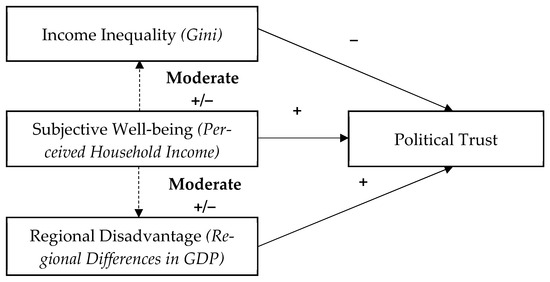
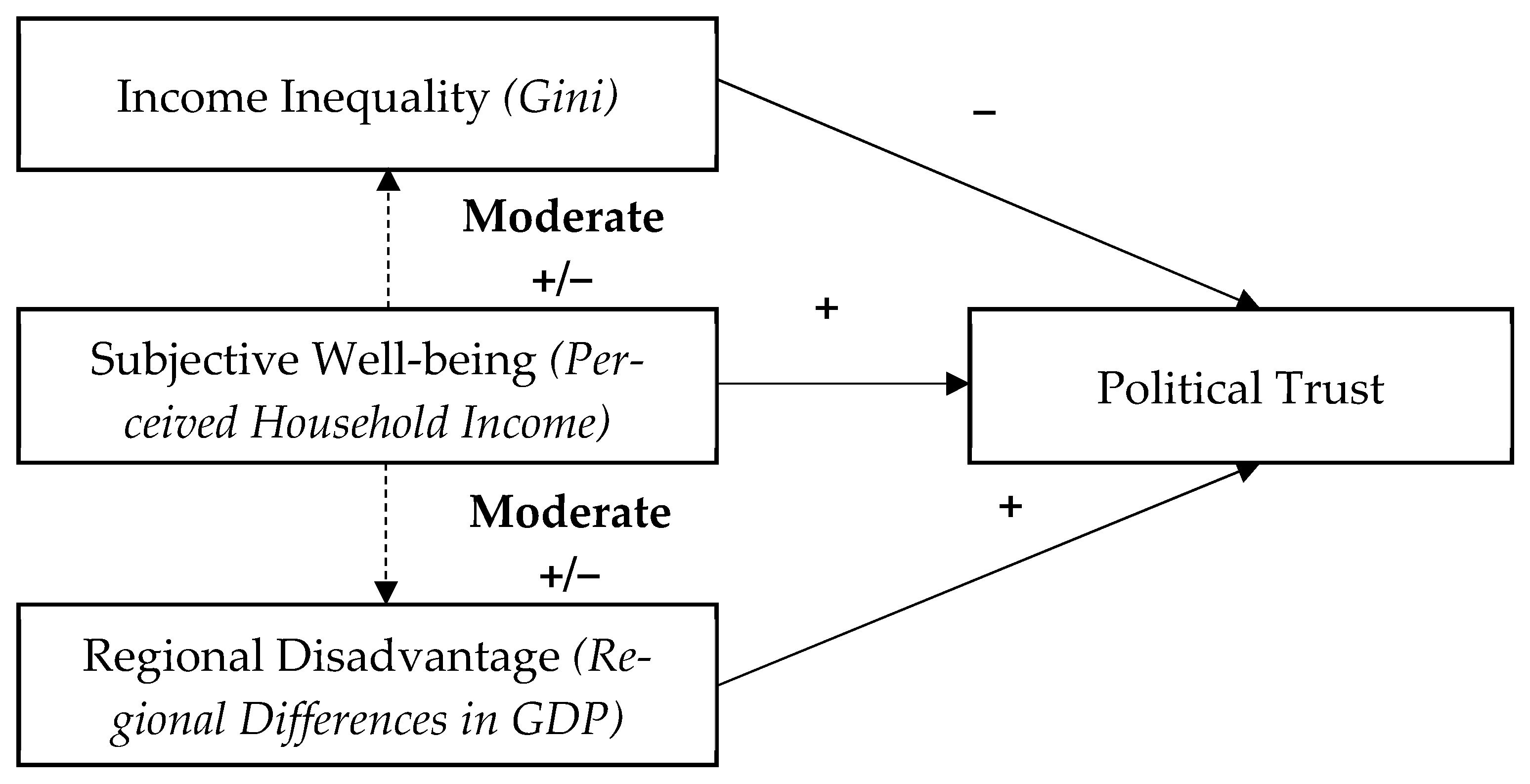
To enhance the clarity and fortify the theoretical framework connecting the hypotheses to the empirical methodology, we put forth a conceptual model that encapsulates the anticipated relationships between the primary constructs. Figure 1 depicts the model, illustrating the interconnections between economic inequality, regional disadvantage, subjective income assessment, and political trust.
Figure 1.
Model for the Hypotheses.
3. Materials and Methods
The analysis uses data from the European Social Survey Round 9, which was fielded in 2018–2019, for 23 EU countries (Austria, Belgium, Bulgaria, Croatia, Cyprus, Czechia, Denmark, Estonia, Finland, France, Germany, Hungary, Ireland, Italy, Latvia, Lithuania, The Netherlands, Poland, Portugal, Slovakia, Slovenia, Spain, Sweden) [72]. We used a series of two-level models, where the individual characteristics of the respondent were used at the first level and the country’s macroeconomic indicators at the second level.
Variables at the individual level were cluster-mean centered to take into account the influence of independent variables on political trust within each country. Descriptive statistics for the dependent and independent variables are shown in Table 1.
Table 1.
Descriptive statistics of all variables.
Dependent variable: To assess political trust, we constructed an index by averaging respondents’ valid answers to questions regarding their trust in national parliament, national politicians, and national political parties. This method follows the assumption that citizens tend to develop a generalised, overarching attitude toward political institutions [73,74]. Given the critiques of this approach [75], the principal component analysis (PCA) was applied to verify whether institutional trust is empirically one-dimensional in the EU context. The results of PCA indicated that the level of confidence in the national parliament, national politicians, and national political parties loaded on a single dimension, which accounted for 85.5% of the total variance and had an eigenvalue of 2.57.
Independent variables: Perceived household income is the main independent variable at the individual level, which characterizes the respondent’s income level. Put this way, the variable characterizes the respondent’s subjective assessment of their income depending on their own needs. To assess the respondent’s level of perceived household income, we calculated the inverse of the cluster-mean centered value of the answer to the question “Which of the descriptions on this card comes closest to how you feel about your household’s income nowadays?”.
Generalized trust, referring to trust in most people, is another important control variable at the individual level. Generalized trust increases the level of individual political trust [76,77], while this relationship depends more on political factors (record of the party in power) than macroeconomic factors [78]. The general trust variable was constructed as a cluster-mean centered value of the answer to the question “Most people can be trusted or you can’t be too careful in dealing with people?”.
Other individual-level control variables are age, gender of the respondent and type of economic activity for the last seven days.
Country-level independent variables are indicators of economic inequality and the level of regional disadvantages. To assess economic inequality, we used the Gini index as of 2019, which characterizes the level of income inequality of households. To assess the level of regional disadvantages, we referred to the indicator of regional differences in GDP per capita for major socio-economic regions, calculated as the ratio of GDP at current market prices per capita to the EU average.
It must also be noted that there may be potential endogeneity between the dependent variable (political trust) and independent variables (economic indicators). The employment of multilevel models enables the partial mitigation of this issue by distinguishing between within-country and between-country variance and by accounting for unobserved heterogeneity at the country level through random effects. Consequently, the findings should be interpreted as associative rather than causal.
4. Results
4.1. Descriptive Evidence
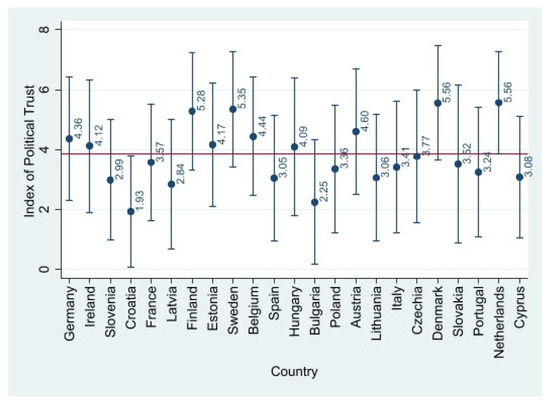
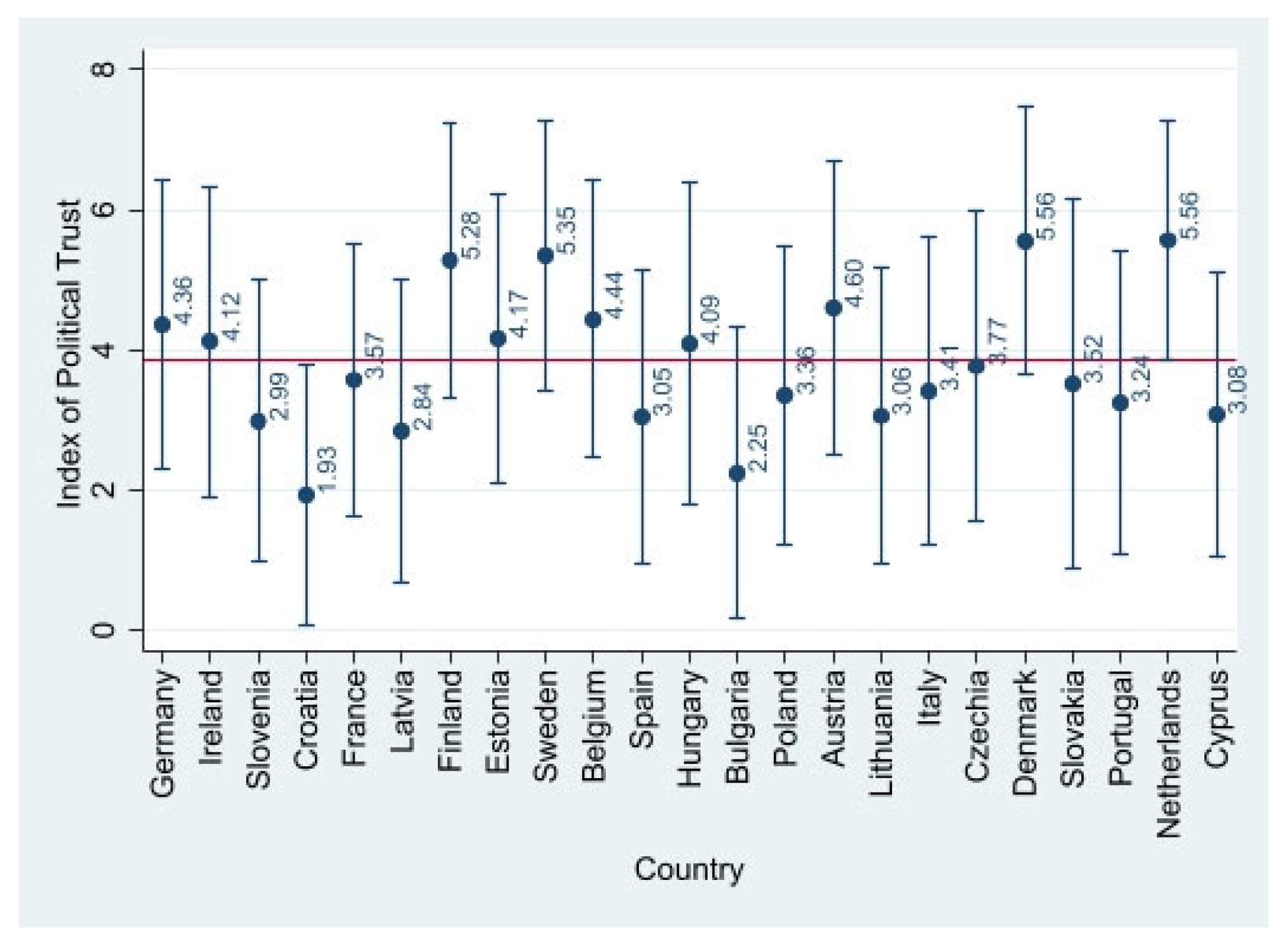
When analyzing the dependent variable, it is important to note that the average value of the indicator of trust in political institutions is 3.92, with a standard deviation of 2.29, on a scale from 0 (no trust at all) and 10 (complete trust) (see Table 1). The average level of political trust varies substantially across countries (see Figure 2). The highest level of the average indicator of political trust is characteristic of The Netherlands (5.56), Denmark (5.56), Sweden (5.35) and Finland (5.28). Similarly, the average level of trust in parliament, politicians and political parties is the highest for the countries mentioned above. The lowest average indicators of the level of political trust are characteristic of Croatia (1.93) and Bulgaria (2.25).
Figure 2.
Political trust in the EU—descriptive statistics.
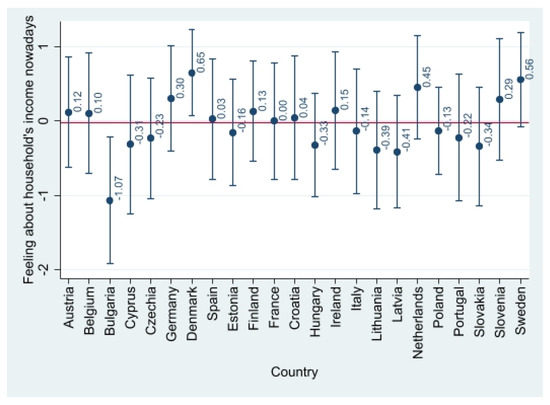
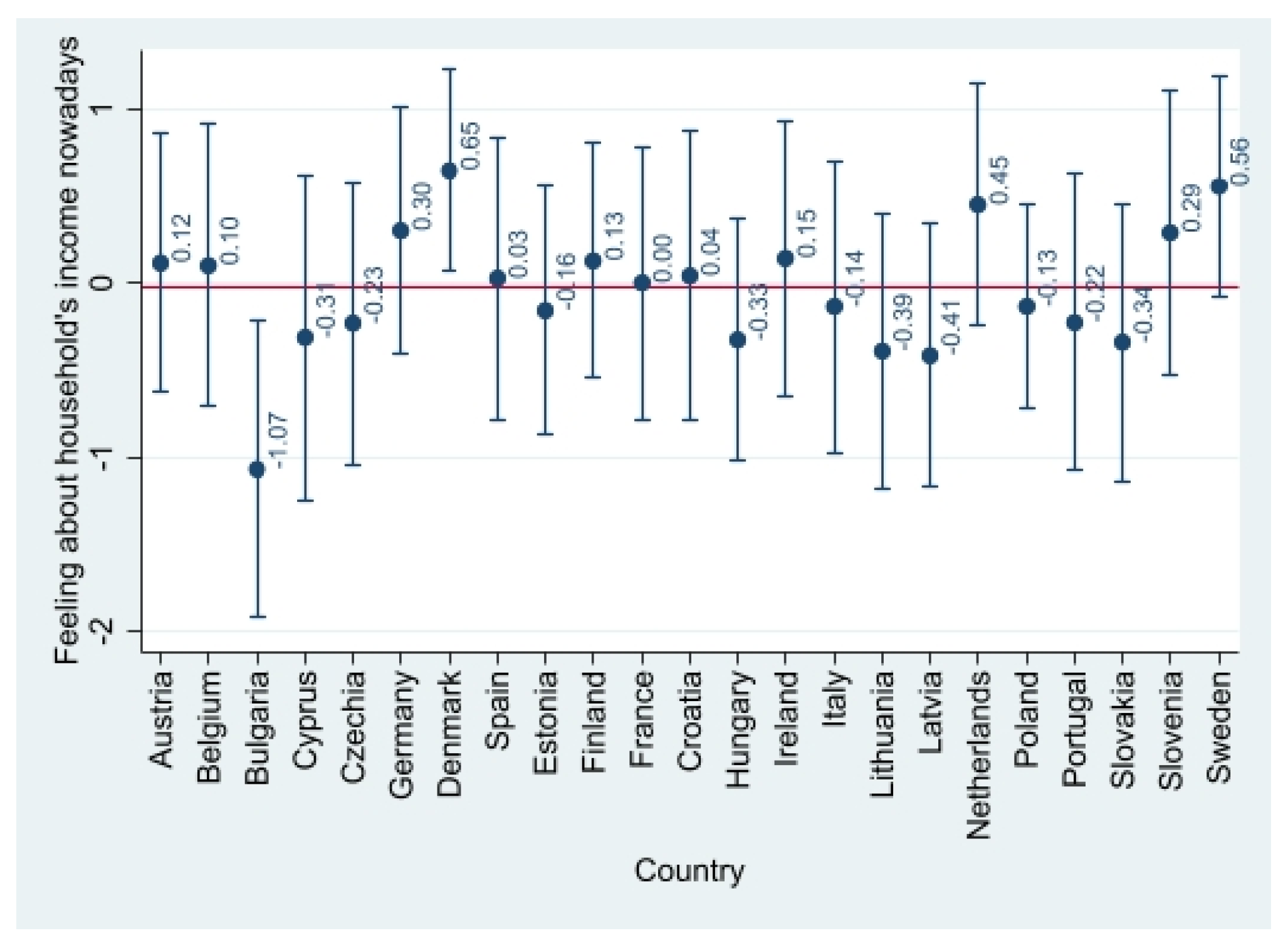
For independent variables at the individual level, there is a group of countries with the highest perceived household income (Figure 3)—Denmark, Sweden, and The Netherlands. On the other hand, respondents from Bulgaria rated their income the lowest, and the confidence interval in the case of Bulgaria is lower than the general mean.
Figure 3.
Perceived household’s income in the EU—descriptive statistics.
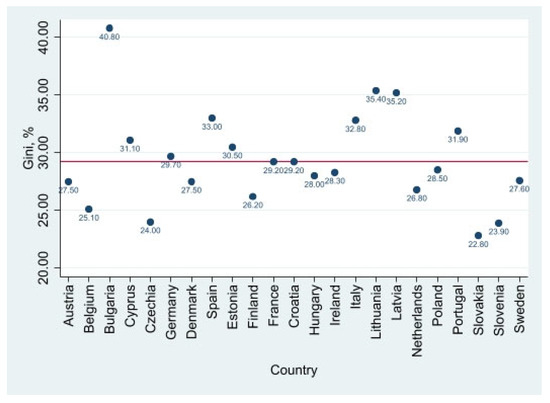
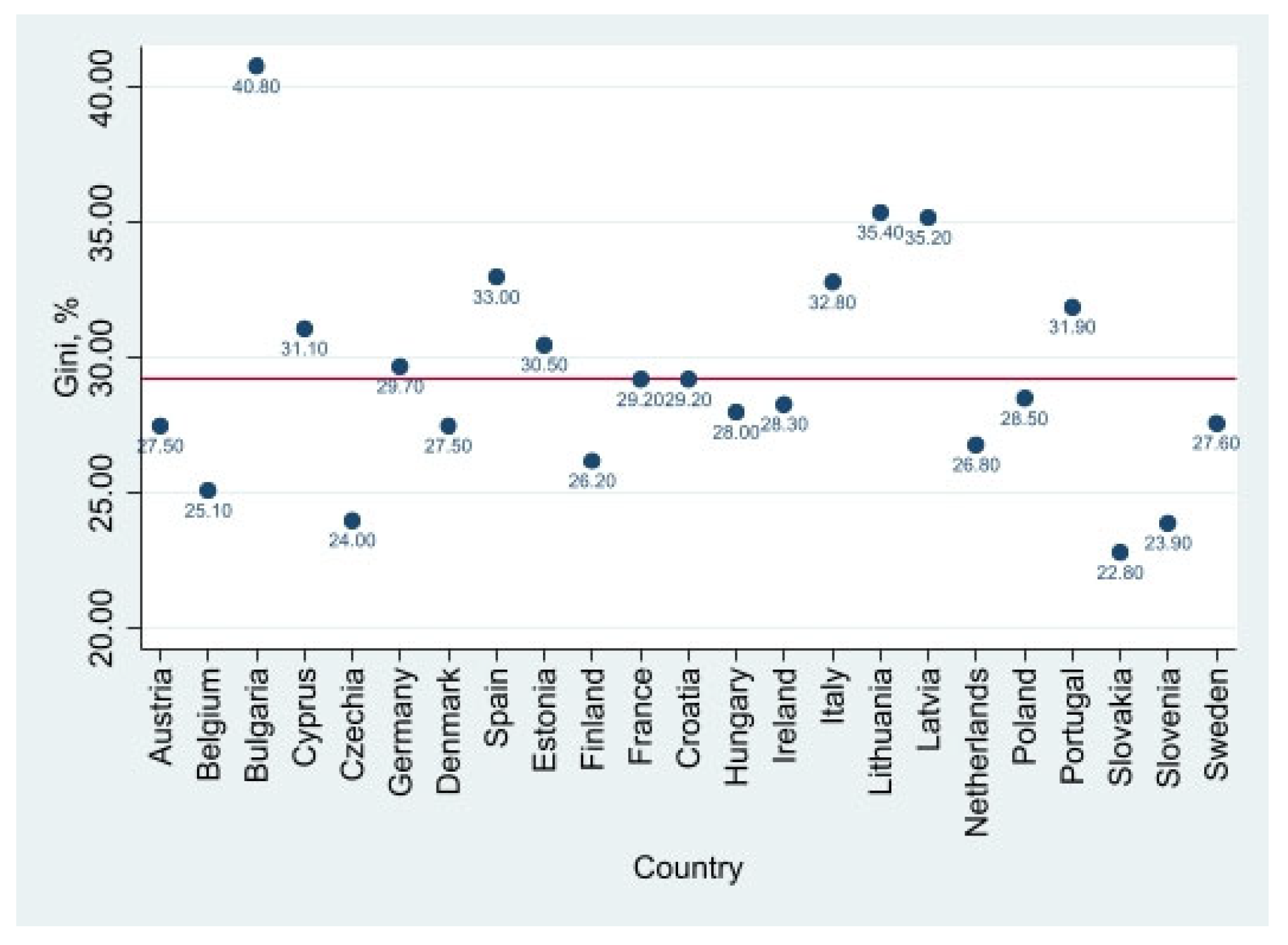
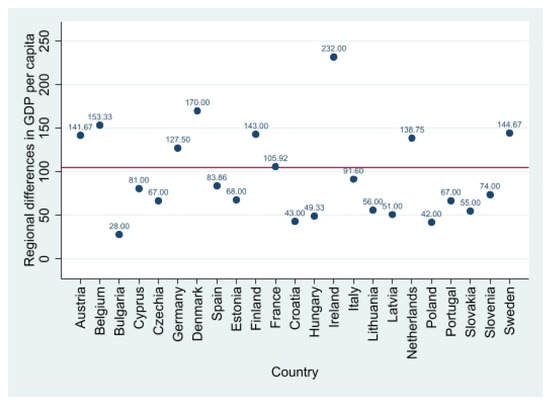
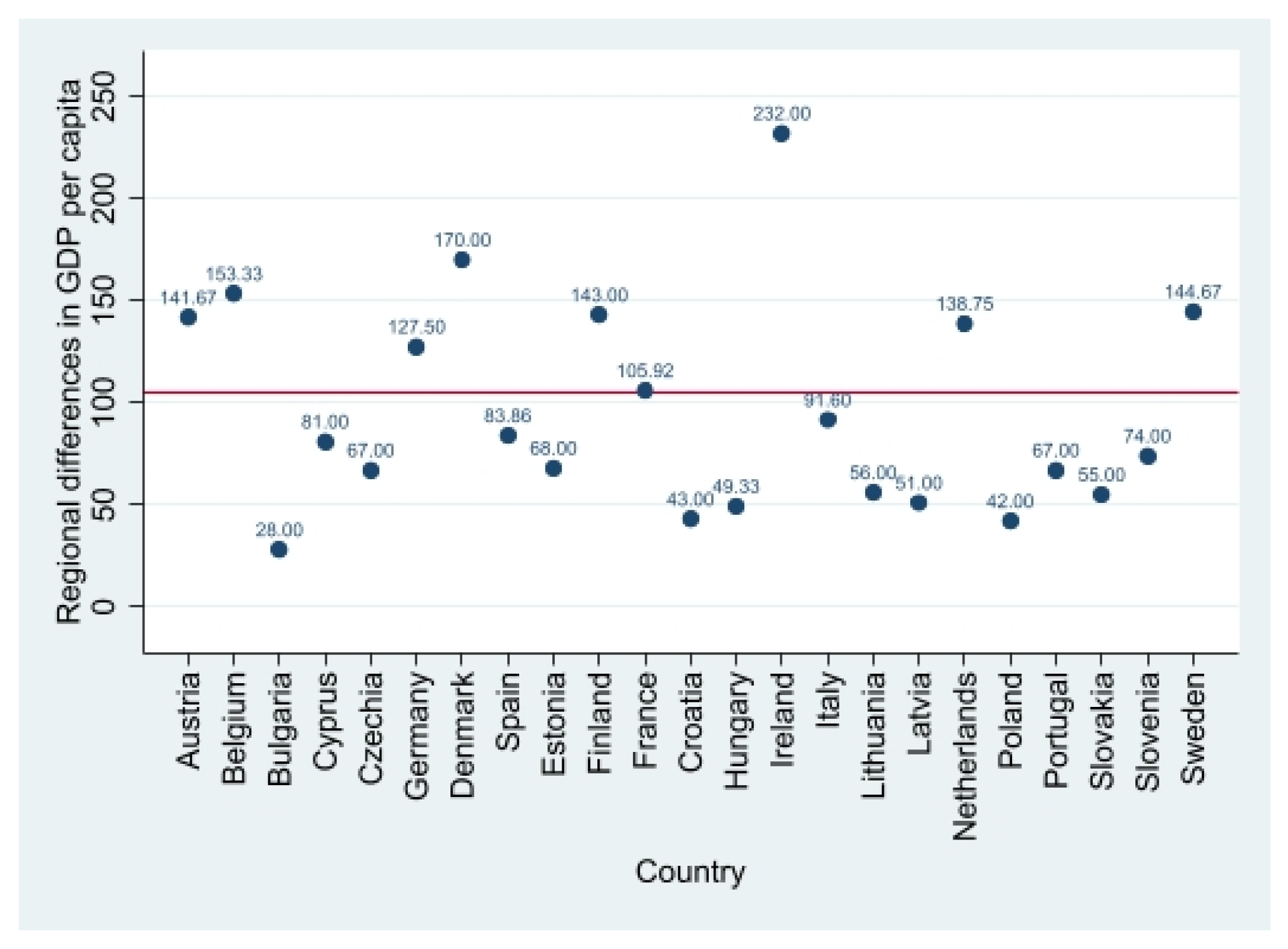
Regarding independent variables at the country level, both the highest and the lowest levels of economic inequality are characteristic of post-socialist countries (Figure 4). The Gini index varies from 22.8% in Slovakia to 40.8% in Bulgaria, with an average value of 29.3%. The average value of the level of regional inequality ranges from 28% in Bulgaria to 232% in Ireland (Figure 5). On the one hand, it should be noted that in Ireland, Denmark and Belgium, GDP per capita is more than 50% higher than the average level in the EU. In other countries, GDP per capita is less than 56% of the average EU level in 2000 (in Lithuania, Slovakia, Latvia, Hungary, Poland, Croatia, and Bulgaria).
Figure 4.
Economic inequality in the EU—descriptive statistics.
Figure 5.
Level of regional disadvantage in the EU—descriptive statistics.
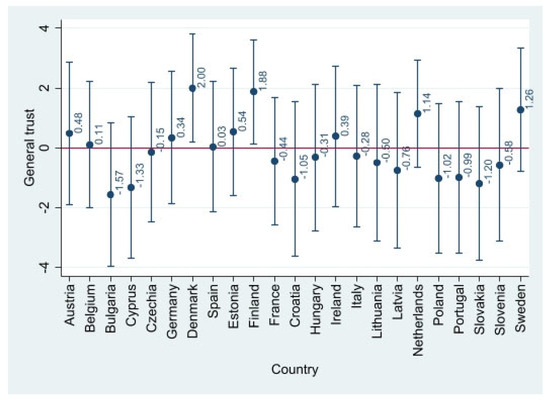
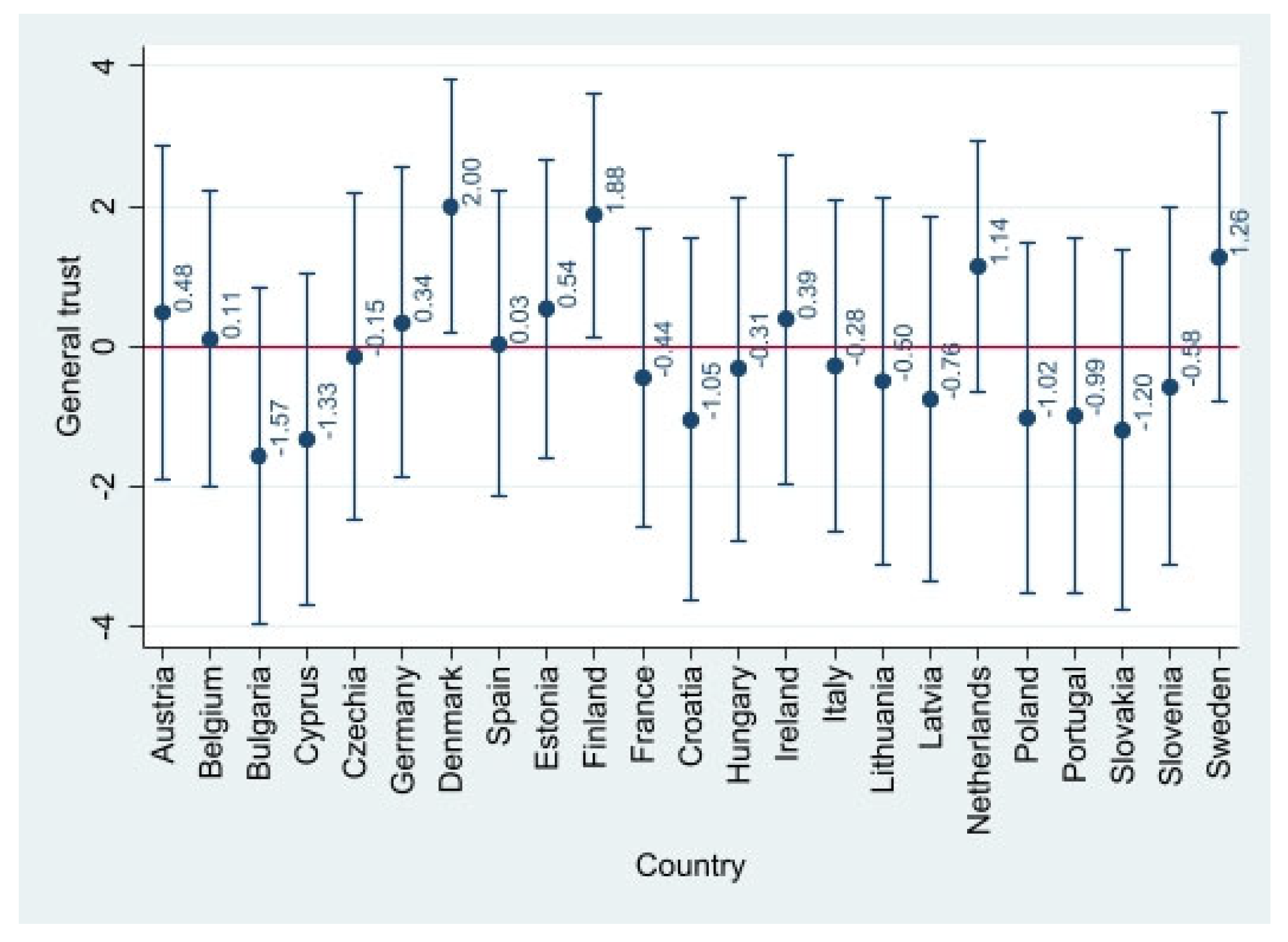
Denmark and Finland have the highest average indicator of general trust by country, and their confidence interval is above the average value of all respondents’ answers (Figure 6). Slovakia, Cyprus, and Bulgaria have the lowest perceived household’s income and level of general trust in the EU.
Figure 6.
Level of general trust in the EU—descriptive statistics.
Appendix A shows the results of the correlation analysis of the average value of the political trust index and the average value of the independent variables for the analyzed countries. The relationship between the Gini coefficient and the mean of the political trust is negative (r = −0.5583) and statistically significant, as shown in Figure A1 of Appendix A, which confirms hypothesis H1. A group of countries (The Netherlands, Denmark, Sweden and Finland) with a higher level of association and Slovenia with a lower level of association between economic inequality and level of political trust should be noted.
The relationship between the indicator of regional differences in GDP per capita (mean) and political trust (mean) is positive (r = 0.7148) and statistically significant (Figure A2 of Appendix A), which confirms hypothesis H2. The Netherlands, Denmark, Sweden and Finland are characterized by a higher association between the indicator of regional differences in GDP per capita and the level of political trust, while Ireland and Croatia are characterized by a lower level of association between the aforementioned indicators.
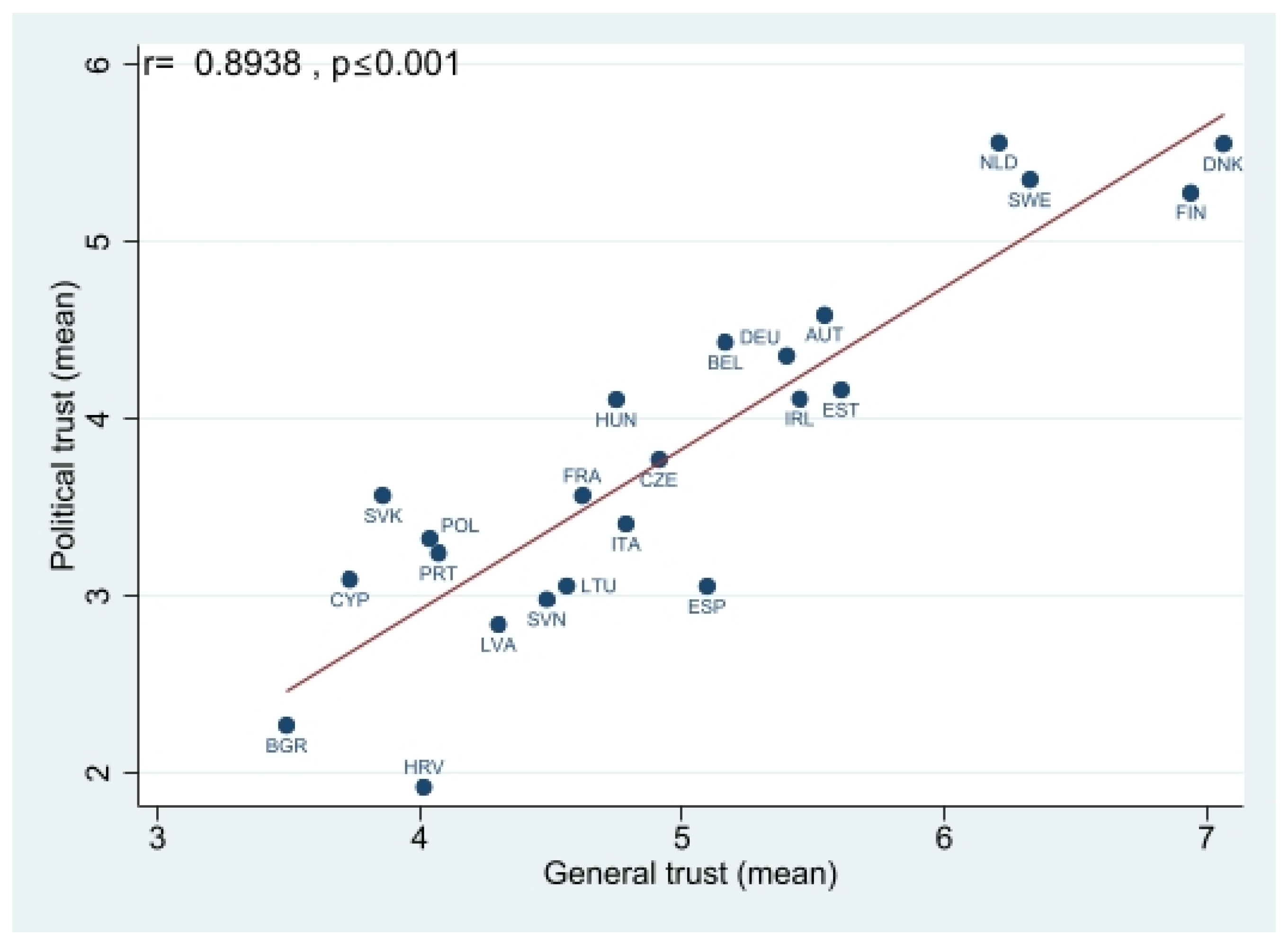
The correlation coefficient between the mean level of political trust and the mean feeling about the household’s income is r = 0.4216 and is significant (Figure A3 of Appendix A), which confirms hypothesis H3. The low level of association between feeling about household’s income and level of political trust in the case of Croatia and Bulgaria should be noted. Figure A4 of Appendix A shows the correlation between the level of political trust (mean) and the level of general trust (mean). The correlation coefficient is positive (r = 0.8974) and statistically significant. At the same time, there is a low association between the level of general trust and trust in political institutions in Croatia.
4.2. Evidence from Multilevel Models
The full results of multilevel regression models are presented in Appendix A. During model construction, a hierarchical approach was employed, with the models tested through the stepwise inclusion of independent variables: Gini (model 1), Income (model 2), regional differences in GDP (model 3), General trust (model 4), a group of control variables (model 5), interaction Income × Gini (model 6), interaction term Income × regional differences in GDP (model 7), random slope effects for Income for the last three models (models 8, 9 and 10). A comparison of models was conducted using likelihood ratio testing, which confirmed that each more parsimonious specification is properly nested within the corresponding more complex model. For all models, the ICC ranges from 0.05 to 0.20.
4.2.1. The Unconditional Random Intercept Model
In the first stage, an empty two-level model (Model 0) with no predictors was built (Appendix B). The Intraclass Correlation Coefficient (ICC) was calculated (ICC = 0.18), which indicates a medium level of within-cluster homogeneity, meaning that 82% of the variance in the index of political trust can be attributed to within-country differences. The estimated design effect (DEFF) equals 300.2 (DEFF > 2), indicating that multilevel modeling is more appropriate than conventional regression approaches [79].
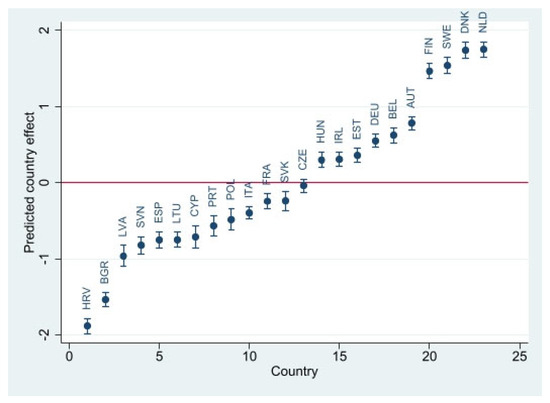
Figure 7 presents country (two-level) residuals for the unconditional random intercept model, demonstrating between-country differences across countries. Only for the Czech Republic does the confidence interval intersect zero (which represents the average level of political trust across countries). For all other countries, the residuals differ significantly from the overall mean at the 5% significance level.
Figure 7.
Country (two-level) residuals for unconditional random intercept model.
4.2.2. The Two-Level Random Intercept Model
The next stage was the construction of two-level random intercept models (Appendix A, models 1–7) with predictors, which were successively added to the model. At each step, model fit was evaluated using the likelihood ratio test. The appendix shows the results of model calculations using robust standard errors.
Model 1 estimates the effect of the Gini coefficient on political trust without controlling for individual or country-level characteristics. The coefficient for Gini is negative and statistically significant (p < 0.001), which confirms H1. Further, we successively added indicators of perceived household income, regional differences in GDP, and level of general trust according to models 2, 3, and 4. All these indicators have a positive and statistically significant (p < 0.001) effect on political trust. This suggests that individuals tend to trust more in political institutions if their individual well-being is higher. At the same time, an important factor is the assessment of general well-being in the territorial unit (region) where an individual lives, compared to other regions. It should be noted that individuals with a higher level of general trust are more inclined to trust political institutions. These findings confirm Hypotheses 1, 2 and 3.
Table 2 shows the results of the final models. Model A included individual-level control variables, which, in turn, did not affect the significance level and direction of influence of any of the independent indicators. The influence of age and gender on the level of political trust is not statistically significant. On the other hand, the level of trust in political institutions is lower at a statistically significant level for employed individuals, unemployed actively looking for work, and people with disabilities. Students trust political institutions more at a statistically significant level (Appendix A, model 6).
Table 2.
Results of multilevel analysis.
To assess the mutual influence of the indicator of economic inequality and individual income and regional differences in GDP and individual income, the interaction between Gini and Income (model B) and the interaction between regional differences in GDP and Income (model C) were included in the models. First, it should be noted that in the resulting models, the independent variables remain significant and do not change the nature of the impact. In the case of model C, the interaction between Gini and Income has a negative effect and is statistically significant (p < 0.05). In countries with lower income inequality, political trust is more sensitive to changes in income, whereas in countries with higher income inequality, political trust shows a weaker response to income levels. This finding confirms H4. Interaction between Gini and regional differences in GDP (model 3) has a positive and statistically significant (p < 0.01) impact on political trust. A reinforcing effect of regional differences in GDP suggests that for regions with a lower level of GDP, political trust is more inelastic to the income level and vice versa, which confirms H5.
The nature of the influence of regressors has not changed and remains statistically significant for all the above models, which confirms Hypotheses 1–3. Comparing the models without interaction (models A and D), one should note the change in the Gini coefficient ranges from −0.0652 to −0.0411, which once again indicates the existence of a stronger dependence between income and political trust, the strength of which is determined by within-country factors. The interaction term Income × Gini becomes non-significant because the random slope accounts for the cross-country variation in the effect of income on political trust. In this case, the fixed interaction term explains less residual variance and therefore does not reach conventional levels of statistical significance. The Akaike Information Criterion (AIC) value for Model B (random intercept effects only) is slightly higher than for Model E (random intercept and random slope effects), 157,542 versus 157,478, indicating an improvement in model fit after the inclusion of random slopes. Thus, these models can partially confirm the above conclusion and will not be considered in the subsequent analysis.
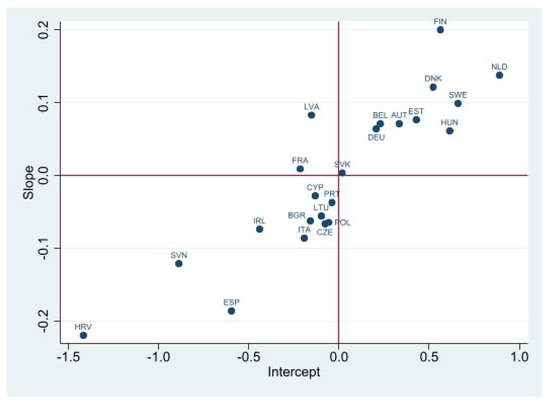
The interaction between Regional disadvantage and Income (model F) is positive and statistically significant (* p < 0.05), which confirms H5. Figure 8 shows the residuals of slopes and intercepts of the model F. In the lower-left corner is Croatia, partially destroyed by the war in the 1990s, which joined the EU in 2013 and is characterized by both a low level of political trust and a low elasticity of political trust to changes in individual income. Instead, in the upper right corner are Finland and The Netherlands, which are characterized by both a high level of trust and a greater elasticity of political trust to changes in individual income.
Figure 8.
Random intercept effects and random slope effects for the model with the intersection between perceived income and regional disadvantages.
5. Discussion
The contradiction between the principle of equality, fundamental in the democratic theory, and economic inequality, which is the result of the laws of the market economy, creates tensions in society, which necessarily affect the relationship between political institutions and citizens. Because the governments of democratic countries have an arsenal of tools that allow them to influence the level of economic inequality in society, it would seem that economic inequality should have a negative impact on the level of political trust [42,62]. On the other hand, the results of empirical studies in EU do not provide unequivocal evidence of a negative relationship between economic inequality and political trust [18]. In our opinion, this is primarily related to the difference in individuals’ subjective perception of objective indicators, which depends on cultural, social and historical factors. Using the results of one ESS wave and accounting for those EU member states whose legal norms are harmonized regarding rules and principles of political institutions, we minimized the risks of subjective assessments. At the same time, using multilevel models made it possible to partially consider the deviations caused by the local context.
The value of economic equality for democratic societies [80] is undermined by the fact that a number of analyzed countries (Slovenia, Slovakia, the Czech Republic and Croatia) are characterized by both a low level of economic inequality and a low level of political trust. On the other hand, as a result of the application of two-level models, we obtained evidence of a strong negative relationship between economic inequality and political trust. Arguably, such a discrepancy can be caused by the difficulty of an individual’s subjective perception of the level of economic inequality and, most importantly, the impact of inequality on individual well-being. These findings suggest that policy-makers should prioritise redistributive measures that reduce economic inequality (progressive taxation, targeted social transfers, and expanded access to high-quality public services, among others) for achieving SDGs.
A more straightforward objective indicator for an individual may be the difference in the level of economic well-being of the territory where the individual lives and other regions. Consistent with the findings of previous studies [20,64], we recorded a positive association between the level of regional disadvantages, calculated as the ratio of GDP at current market prices per capita to the EU average, and political trust and a significant positive relationship in all the proposed models. This finding highlights the importance of regional cohesion policies as a part of the implementation of SDGs. Investments in lagging regions may not only improve the economic situation in these regions but also strengthen perceived fairness that undermines political trust.
At the same time, Inglehart’s [70] claim that the subjective assessment of individual income positively affects the level of political trust, was further reinforced in a nuanced manner. Our analysis suggests that the reinforcing effect of individual income level on the negative relationship between economic inequality and political trust and on the positive relationship between the level of regional development and political trust. Because subjective income moderates the impact of inequality, governments should complement macroeconomic interventions with policies aimed at improving households’ perceived well-being.
Although the obtained results demonstrate the negative impact of economic inequality on trust in political institutions in democratic societies, the subjective assessment of one’s well-being is an important factor that significantly strengthens the impact of the level of economic inequality on trust in political institutions. This study confirms the assumptions of the institutional theory of the formation of trust in political institutions depending on the assessment of these institutions’ ability to ensure citizens’ welfare [70]. At the same time, including the indicator of the level of general trust and the type of economic activity of the respondents in the models made it possible to check the obtained results for compliance with the cultural theory [39,40,41].
It can be argued that a balanced sustainable government policy which takes into consideration economic inequality and the growth of population welfare, facilitated by a rise in political trust, can assist in the implementation of complex policies. The findings indicate that the reduction in economic inequality (SDG 10) is not solely an economic objective but also a prerequisite for the enhancement of institutional legitimacy (SDG 16). Policies that narrow income gaps and mitigate territorial imbalances therefore generate a dual benefit: they promote social cohesion while simultaneously increasing public support for long-term sustainability reforms.
We admit multiple limitations of this study. First and foremost, as mentioned before, we limited the analysis to only one wave of the ESS to reduce the impact of socio-cultural factors that can create additional deviations and distort the results. Moreover, other objective macroeconomic indicators, such as the level of GDP, rates of economic growth, inflation or unemployment, which usually characterize the efficiency of the economy, were not included in the models proposed in the study.
6. Conclusions
This study makes a significant contribution to the extant literature by providing new empirical evidence on how different dimensions of inequality—individual income inequality, regional economic disparities, and subjective income assessments—jointly shape political trust in EU countries. The analysis employs multilevel modeling to examine a harmonized dataset, focusing on a group of relatively prosperous democracies. This approach enables the isolation of short-term mechanisms through which both objective and perceived economic conditions influence political trust.
The findings contribute to existing scholarship in several ways. Our study revealed that the effects of prosperity and equality on political trust are significant. The findings align with the predictions of institutional theory, indicating that economic inequality has a detrimental impact on political trust, particularly among individuals with lower perceived income levels. Regional economic disparities independently and significantly impact political trust. As a result, citizens from disadvantaged regions are showing less trust compared to those in wealthier areas. Furthermore, it has been demonstrated that subjective well-being directly increases political trust and moderates the effects of economic inequality. This lends further credence to the notion that individual perceptions play a significant role in shaping political trust.
In consideration of the findings, it can be posited that the reduction in economic inequality (SDG 10) serves as a prerequisite for the enhancement of legitimacy and the fortification of institutions (SDG 16). Concurrently, from the perspective of effective implementation of sustainable development policies, it is insufficient for governments to prioritize the achievement of macroeconomic indicators exclusively. It is imperative to recognize the significance of policies that are designed to enhance the subjective well-being of households and to address territorial imbalances. These policies serve as crucial indirect mechanisms in ensuring the attainment of public support for the implementation of complex sustainable development policies.
Author Contributions
Conceptualization, Y.R. and O.Z.; methodology, Y.R. and O.Z.; formal analysis, Y.R.; investigation, Y.R. and O.Z.; data curation, Y.R.; writing—original draft preparation, Y.R. and O.Z.; writing—review and editing, O.Z.; visualization, Y.R. All authors have read and agreed to the published version of the manuscript.
Funding
This research received no external funding.
Institutional Review Board Statement
Not applicable.
Informed Consent Statement
Not applicable.
Data Availability Statement
The original data presented in the study are openly available in the European Social Survey Round 9 at https://doi.org/10.21338/NSD-ESS9-2018.
Conflicts of Interest
The authors declare no conflicts of interest.
Abbreviations
The following abbreviations are used in this manuscript:
| GDP | Gross domestic product |
| EU | European Union |
| PCA | Principal component analysis |
| ESS | European Social Survey |
| ICC | Intraclass Correlation Coefficient |
| DEFF | Estimated Design Effect |
| SDG | Sustainable Development Goal |
| AIC | Akaike Information Criterion |
| BIC | Bayesian Information Criterion |
Appendix A. Results of the Correlation Analysis
Figure A1.
Relationship Between Gini Coefficient and the Mean of the Political Trust.
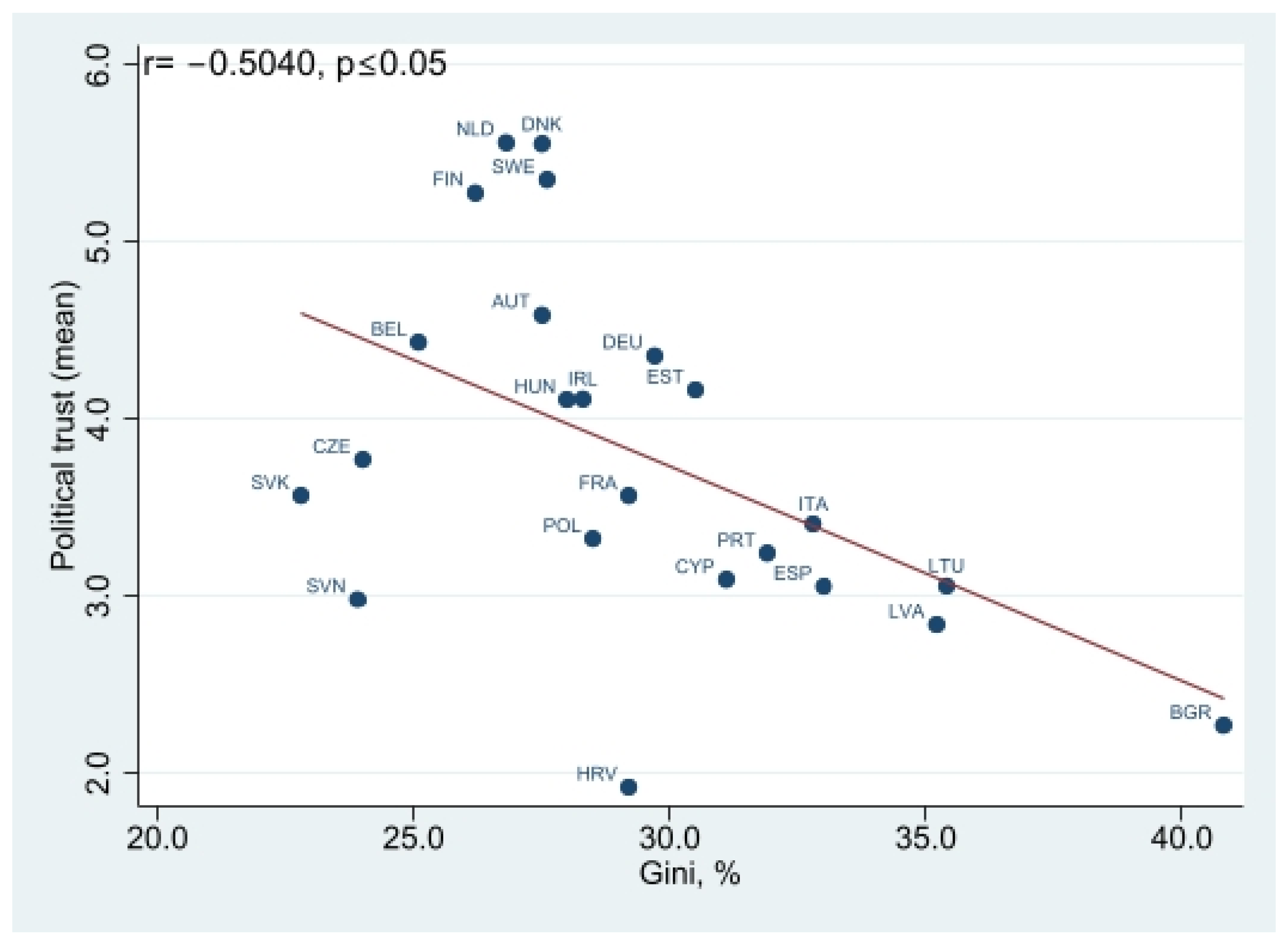
Figure A2.
Relationship Between Regional Differences in GDP per capita and the Mean of the Political Trust.
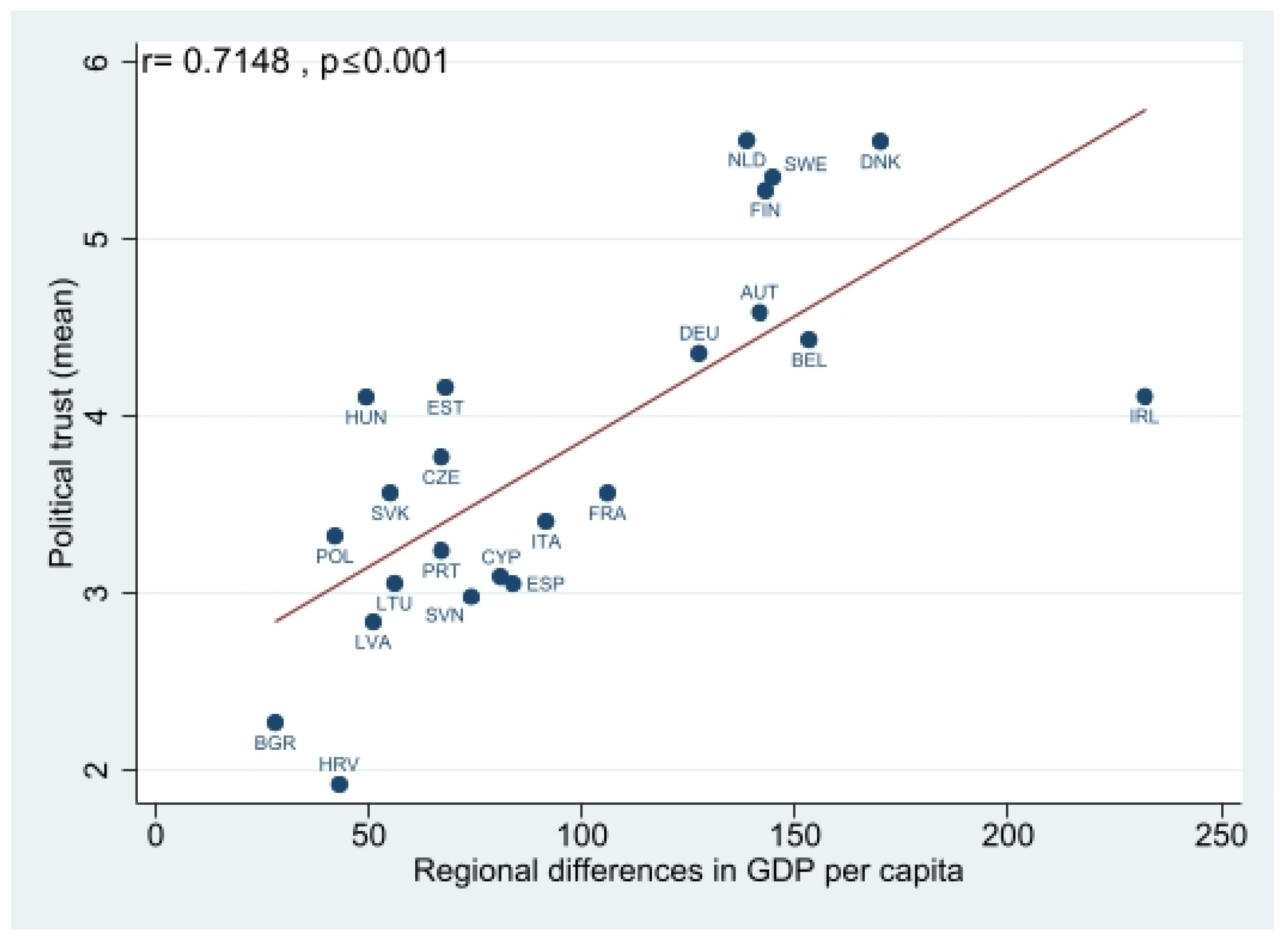
Figure A3.
Relationship Between Feeling About the Household’s Income and the Mean of the Political Trust.
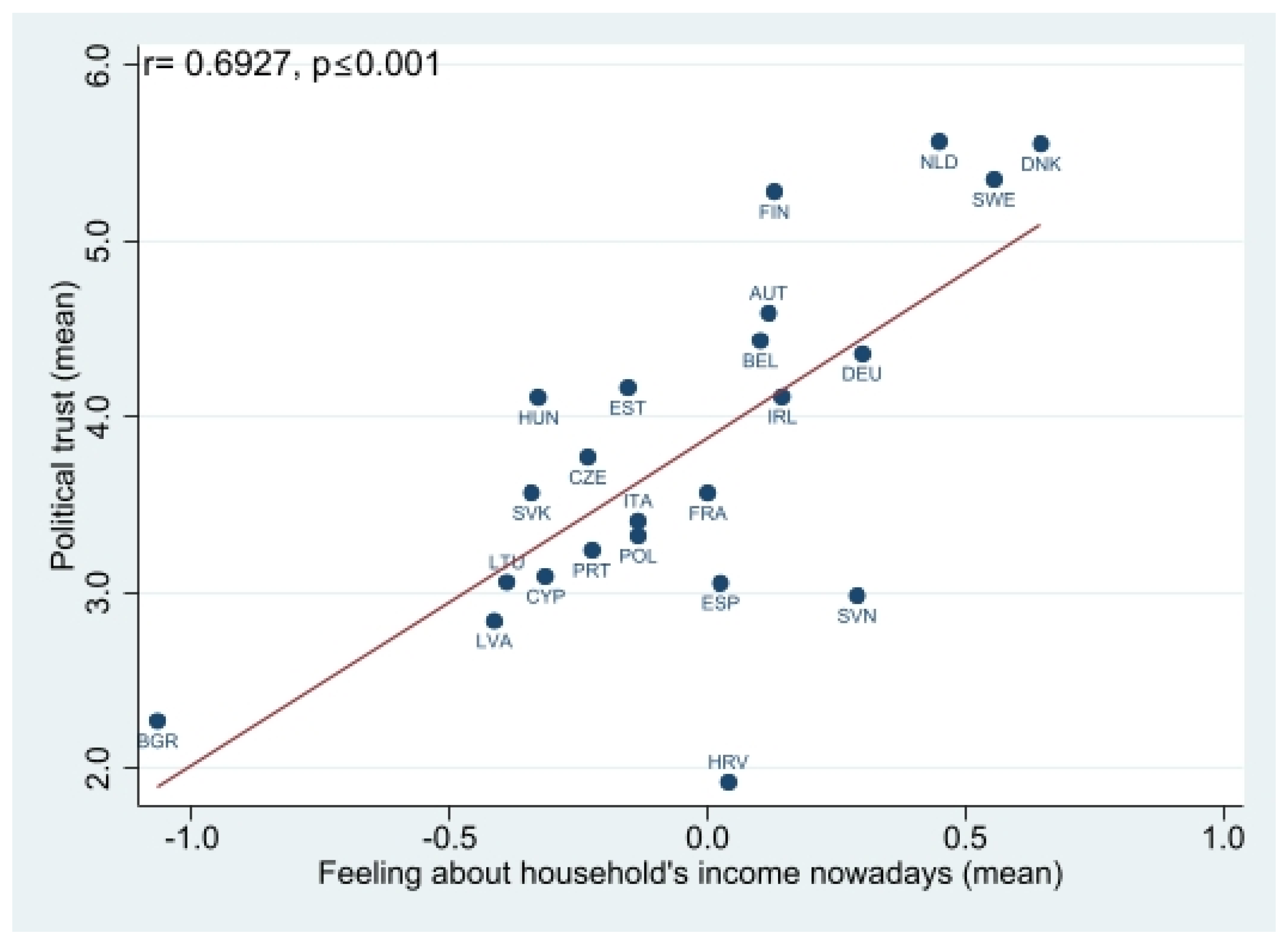
Figure A4.
Relationship Between General Trust and the Mean of the Political Trust.
Appendix B. Results of Multilevel Analysis
| Variables | Models | ||||||||||
| 0 | 1 | 2 | 3 | 4 | 5 | 6 | 7 | 8 | 9 | 10 | |
| Country Level | |||||||||||
| Gini | −0.12 *** (0.03) | −0.09 ** (0.03) | −0.07 ** (0.02) | −0.07 *** (0.02) | −0.07 ** (0.02) | −0.07 *** (0.02) | −0.07 *** (0.02) | −0.04 * (0.02) | −0.07 ** (0.03) | −0.05 * (0.02) | |
| GDP_diff | 0.01 *** (0.00) | 0.01 *** (0.00) | 0.01 *** (0.00) | 0.01 *** (0.00) | 0.01 *** (0.00) | 0.01 *** (0.00) | 0.01 *** (0.00) | 0.01 *** (0.00) | |||
| Individual Level | |||||||||||
| Income | 0.42 *** (0.03) | 0.42 *** (0.04) | 0.30 *** (0.03) | 0.30 *** (0.03) | 0.65 *** (0.18) | 0.15 ** (0.05) | 0.32 *** (0.03) | 0.65 ** (0.22) | 0.23 *** (0.04) | ||
| G_trust | 0.26 *** (0.02) | 0.26 *** (0.02) | 0.26 *** (0.02) | 0.26 *** (0.02) | 0.26 *** (0.01) | 0.26 *** (0.01) | 0.26 *** (0.01) | ||||
| Gender | −0.01 (0.03) | −0.02 (0.03) | −0.01 (0.03) | −0.01 (0.02) | −0.01 (0.02) | −0.01 (0.02) | |||||
| Age | 0.00 (0.00) | 0.00 (0.00) | −0.00 (0.00) | −0.00 (0.00) | −0.00 (0.00) | −0.00 (0.00) | |||||
| P_work | −0.20 *** (0.06) | −0.20 *** (0.06) | −0.20 *** (0.05) | −0.20 *** (0.04) | −0.20 *** (0.04) | −0.20 *** (0.04) | |||||
| Unempl_a | −0.20 ** (0.07) | −0.20 ** (0.07) | −0.20 ** (0.07) | −0.21 ** (0.07) | −0.21 ** (0.07) | −0.21 ** (0.07) | |||||
| Educ | 0.42 *** (0.05) | 0.42 *** (0.05) | 0.42 *** (0.05) | 0.43 *** (0.05) | 0.43 *** (0.05) | 0.43 *** (0.05) | |||||
| Housework | −0.08 (0.04) | −0.08 (0.04) | −0.08 (0.04) | −0.08 ** (0.03) | −0.08 ** (0.03) | −0.08 ** (0.03) | |||||
| Unempl_n | −0.12 (0.11) | −0.12 (0.11) | −0.12 (0.11) | −0.12 (0.08) | −0.12 (0.08) | −0.12 (0.08) | |||||
| Disabled | −0.37 *** (0.06) | −0.37 *** (0.06) | −0.37 *** (0.06) | −0.34 *** (0.06) | −0.34 *** (0.06) | −0.34 *** (0.06) | |||||
| Retired | −0.01 (0.06) | −0.01 (0.06) | −0.01 (0.06) | −0.01 (0.05) | −0.01 (0.05) | −0.01 (0.05) | |||||
| Cm_serv | −0.26 (0.23) | −0.27 (0.23) | −0.27 (0.23) | −0.27 (0.32) | −0.27 (0.32) | −0.27 (0.32) | |||||
| Other | −0.12 (0.08) | −0.12 (0.08) | −0.11 (0.08) | −0.10 (0.08) | −0.10 (0.08) | −0.10 (0.08) | |||||
| Intersections | |||||||||||
| Income × Gini | −0.01 * (0.01) | −0.01 (0.01) | |||||||||
| Income × GDP_diff | 0.01 ** (0.00) | 0.01 * (0.00) | |||||||||
| Constants | |||||||||||
| Constant | 3.81 *** (0.21) | 7.36 *** (1.15) | 6.71 *** (1.01) | 5.56 *** (0.83) | 5.37 *** (0.66) | 5.48 *** (0.68) | 5.61 *** (0.72) | 5.56 *** (0.68) | 4.79 *** (0.59) | 5.59 *** (0.79) | 4.89 *** (0.57) |
| lns1_1_1 | |||||||||||
| Constant | −0.02 (0.12) | −0.16 (0.15) | −0.24 (0.16) | −0.42 ** (0.16) | −0.64 *** (0.19) | −0.63 *** (0.18) | −0.64 *** (0.19) | −0.65 *** (0.19) | −1.96 *** (0.18) | −2.03 *** (0.19) | −2.18 *** (0.22) |
| lnsig_e | |||||||||||
| Constant | 0.73 *** (0.02) | 0.73 *** (0.02) | 0.72 *** (0.02) | 0.72 *** (0.02) | 0.68 *** (0.02) | 0.67 *** (0.02) | 0.67 *** (0.02) | 0.67 *** (0.02) | 0.67 *** (0.00) | 0.67 *** (0.00) | 0.67 *** (0.00) |
| lns1_1_2 | |||||||||||
| Constant | −0.65 *** (0.15) | −0.67 *** (0.15) | −0.66 *** (0.15) | ||||||||
| atr1_1_1_2 | |||||||||||
| Constant | 0.99 *** (0.29) | 0.99 *** (0.28) | 1.13 ** (0.35) | ||||||||
| ICC | 0.1829 | 0.1428 | 0.1273 | 0.0937 | 0.0671 | 0.0687 | 0.0678 | 0.0668 | 0.0661 | 0.0671 | 0.06 |
| DEF | 300.15 | 234.67 | 209.30 | 154.17 | 110.66 | 113.30 | 111.95 | 108.32 | 109.10 | 110.74 | 106.39 |
| N | 37,638 | 37,638 | 37,638 | 37,638 | 37,638 | 37,638 | 37,638 | 37,638 | 37,638 | 37,638 | 37,638 |
| Standard errors in parentheses. * p < 0.05, ** p < 0.01, *** p < 0.001. | |||||||||||
References
- Sachs, J.D. The Age of Sustainable Development; Columbia University Press: New York, NY, USA, 2015; ISBN 978-0-231-17315-5. [Google Scholar]
- Wu, T.; Rocha, J.C.; Berry, K.; Chaigneau, T.; Hamann, M.; Lindkvist, E.; Qiu, J.; Schill, C.; Shepon, A.; Crépin, A.-S.; et al. Triple Bottom Line or Trilemma? Global Tradeoffs Between Prosperity, Inequality, and the Environment. World Dev. 2024, 178, 106595. [Google Scholar] [CrossRef] [Scilit]
- Weymouth, R.; Hartz-Karp, J.; Marinova, D. Repairing Political Trust for Practical Sustainability. Sustainability 2020, 12, 7055. [Google Scholar] [CrossRef] [Scilit]
- Brechin, S.; Kempton, W. Global Environmentalism: A Challenge to the Postmaterialism Thesis? Soc. Sci. Q. 1994, 75, 245–269. [Google Scholar]
- Fairbrother, M.; Arrhenius, G.; Bykvist, K.; Campbell, T. Governing for Future Generations: How Political Trust Shapes Attitudes towards Climate and Debt Policies. Front. Political Sci. 2021, 3, 656053. [Google Scholar] [CrossRef] [Scilit]
- Zhao, T.; Zhang, Y. Government Institutional Trust and Sustainable Environment: Evidence from BRICS Economies. Econ. Res.-Ekon. Istraživanja 2023, 36, 2164032. [Google Scholar] [CrossRef] [Scilit]
- Banik, D. Democracy and Sustainable Development. Anthr. Sci. 2022, 1, 233–245. [Google Scholar] [CrossRef] [Scilit]
- Dalton, R.J. Democratic Challenges, Democratic Choices: The Erosion of Political Support in Advanced Industrial Democracies; Oxford University Press: Oxford, UK, 2004; ISBN 978-0-19-170857-2. [Google Scholar]
- Kestilä-Kekkonen, E.; Söderlund, P. Political Trust, Individual-Level Characteristics and Institutional Performance: Evidence from Finland, 2004–2013. Scand. Political Stud. 2016, 39, 138–160. [Google Scholar] [CrossRef] [Scilit]
- Aghion, P.; Caroli, E.; García-Peñalosa, C. Inequality and Economic Growth: The Perspective of the New Growth Theories. J. Econ. Lit. 1999, 37, 1615–1660. [Google Scholar] [CrossRef] [Scilit]
- Alkire, S.; Foster, J.; Seth, S.; Santos, M.E.; Roche, J.M.; Ballón, P. Multidimensional Poverty Measurement and Analysis; Oxford University Press: Oxford, UK, 2015. [Google Scholar]
- Hellier, J.; Chusseau, N. (Eds.) Growing Income Inequalities: Economic Analyses; Palgrave Macmillan: London, UK, 2013; ISBN 978-0-230-30342-3. [Google Scholar]
- Jenkins, S.P.; Kerm, P.V. The Measurement of Economic Inequality. Available online: https://www.oxfordhandbooks.com/view/10.1093/oxfordhb/9780199606061.001.0001/oxfordhb-9780199606061-e-3 (accessed on 27 November 2020).
- Ravallion, M. The Economics of Poverty: History, Measurement, and Policy; Oxford University Press: Oxford, UK, 2016; ISBN 978-0-19-021276-6. [Google Scholar]
- Lewis-Beck, M.S.; Paldam, M. Economic Voting: An Introduction. Elect. Stud. 2000, 19, 113–121. [Google Scholar] [CrossRef] [Scilit]
- McAllister, I. The Economic Performance of Governments. In Critical Citizens: Global Support for Democratic Government; Norris, P., Ed.; Oxford University Press: Oxford, UK, 1999; pp. 188–203. ISBN 978-0-19-829568-6. [Google Scholar]
- Catterberg, G.; Moreno, A. The Individual Bases of Political Trust: Trends in New and Established Democracies. Int. J. Public Opin. Res. 2006, 18, 31–48. [Google Scholar] [CrossRef] [Scilit]
- van der Meer, T.; Hakhverdian, A. Political Trust as the Evaluation of Process and Performance: A Cross-National Study of 42 European Countries. Political Stud. 2017, 65, 81–102. [Google Scholar] [CrossRef] [Scilit]
- Magalhães, P.C. Economic Outcomes, Quality of Governance, and Satisfaction with Democracy. In Myth and Reality of the Legitimacy Crisis: Explaining Trends and Cross-National Differences in Established Democracies; van Ham, C., Thomassen, J., Aarts, K., Andeweg, R., Eds.; Oxford University Press: Oxford, UK, 2017; ISBN 978-0-19-879371-7. [Google Scholar]
- Dellmuth, L. Regional Inequalities and Political Trust in a Global Context. J. Eur. Public Policy 2023, 31, 1516–1535. [Google Scholar] [CrossRef] [Scilit]
- Van der Meer, T.M.G. Economic Performance and Political Trust. In The Oxford Handbook of Social and Political Trust; Uslaner, E.M., Ed.; Oxford Handbooks; Oxford University Press: Oxford, UK, 2018; pp. 599–611. ISBN 978-0-19-027480-1. [Google Scholar]
- Anderson, C.J.; Tverdova, Y.V. Corruption, Political Allegiances, and Attitudes Toward Government in Contemporary Democracies. Am. J. Political Sci. 2003, 47, 91–109. [Google Scholar] [CrossRef]
- Sabbi, M.; Osei, A.; Wigmore-Shepherd, D.; Ahlin, E. Minding the Local Slot: Municipalities as Drivers of Trust in Public Institutions. Can. J. Afr. Stud. Rev. Can. Des Études Afr. 2024, 58, 301–325. [Google Scholar] [CrossRef] [Scilit]
- Braithwaite, V.A.; Levi, M. (Eds.) Trust and Governance; Russell Sage Foundation: New York, NY, USA, 1998. [Google Scholar]
- Ji, C.; Jiang, J.; Zhang, Y. Political Trust and Government Performance in the Time of COVID-19. World Dev. 2024, 176, 106499. [Google Scholar] [CrossRef] [Scilit]
- Li, Y.; Yu, X. Trust, Political Knowledge and Institutionalized Political Participation: Evidence from China. Curr. Psychol. 2023, 42, 15019–15029. [Google Scholar] [CrossRef] [Scilit]
- Stals, L.; Isac, M.M.; Claes, E. Political Trust in Early Adolescence and Its Association with Intended Political Participation: A Cross-Sectional Study Situated in Flanders. Young 2022, 30, 377–399. [Google Scholar] [CrossRef] [Scilit]
- Tu, W. Trust and Corruption: How Different Forms of Trust Interact with Formal Institutions. Glob. Public Policy Gov. GPPG 2023, 3, 160–179. [Google Scholar] [CrossRef] [Scilit]
- Bauhr, M.; Charron, N. Corruption and Political Trust: How the Effect of Societal Cleavages on Trust Depend on the Corruption Context. In Handbook on Trust in Public Governance; Edward Elgar Publishing: Cheltenham, UK, 2025; pp. 292–307. ISBN 978-1-80220-140-6. [Google Scholar]
- Dolan, P.; Peasgood, T.; White, M. Do We Really Know What Makes Us Happy? A Review of the Economic Literature on the Factors Associated with Subjective Well-Being. J. Econ. Psychol. 2008, 29, 94–122. [Google Scholar] [CrossRef] [Scilit]
- Danish, M.H.; Nawaz, S.M.N. Does Institutional Trust and Governance Matter for Multidimensional Well-Being? Insights from Pakistan. World Dev. Perspect. 2022, 25, 100369. [Google Scholar] [CrossRef] [Scilit]
- Berliani, A.D.; Violita, E.S. The Role of Governance in SDG through Public Trust in Government: Study in Selected OIC Member States. IOP Conf. Ser. Earth Environ. Sci. 2021, 716, 012100. [Google Scholar] [CrossRef] [Scilit]
- Thinyane, M. Engaging Citizens for Sustainable Development: A Data Perspective; United Nations University: Tokyo, Japan, 2018. [Google Scholar]
- Budanov, K.; Vereshchak, V.; Kudriavtsev, V.; Mokliak, S.; Rubel, K. Peace and Development: A Strategy for Global Engagement. Rev. Cercet. Si Interv. Soc. RCIS 2025, 20, 48–60. [Google Scholar] [CrossRef] [Scilit]
- Mishler, W.; Rose, R. What Are the Origins of Political Trust?: Testing Institutional and Cultural Theories in Post-Communist Societies. Comp. Political Stud. 2001, 34, 30–62. [Google Scholar] [CrossRef] [Scilit]
- Coleman, J.S. Foundations of Social Theory; Belknap Press of Harvard University Press: Cambridge, MA, USA, 1990; ISBN 978-0-674-31225-8. [Google Scholar]
- Hetherington, M.J. The Political Relevance of Political Trust. Am. Political Sci. Rev. 1998, 92, 791–808. [Google Scholar] [CrossRef] [Scilit]
- Vallier, K. Trust in a Polarized Age; Oxford University Press: Oxford, UK, 2020; ISBN 978-0-19-088722-3. [Google Scholar]
- Easton, D. A Re-Assessment of the Concept of Political Support. Br. J. Political Sci. 1975, 5, 435–457. [Google Scholar] [CrossRef] [Scilit]
- Thomassen, J.; Andeweg, R.; Ham, C. van Political Trust and the Decline of Legitimacy Debate: A Theoretical and Empirical Investigation into Their Interrelationship. In Handbook on Political Trust; Edward Elgar Publishing: Cheltenham, UK, 2017; pp. 509–525. ISBN 978-1-78254-511-8. [Google Scholar]
- Anderson, C. Institutional Change, Economic Conditions and Confidence in Government: Evidence from Belgium. Acta Politica 2009, 44, 28–49. [Google Scholar] [CrossRef] [Scilit]
- Lee, D.; Chang, C.Y.; Hur, H. Economic Performance, Income Inequality and Political Trust: New Evidence from a Cross-National Study of 14 Asian Countries. Asia Pac. J. Public Adm. 2020, 42, 66–88. [Google Scholar] [CrossRef] [Scilit]
- Miller, A.; Listhaug, O. Political Performance and Institutional Trust. In Critical Citizens: Global Support for Democratic Government; Norris, P., Ed.; Oxford University Press: Oxford, UK, 1999; ISBN 978-0-19-829568-6. [Google Scholar]
- Van Erkel, P.F.A.; van der Meer, T.W.G. Macro-Economic Performance, Political Trust, and the Great Recession: A Multilevel Analysis of the Effects of within-Country Fluctuations in Macroeconomic Performance on Political Trust in 15 EU Countries, 1999-2011. Eur. J. Political Res. 2016, 55, 177–197. [Google Scholar] [CrossRef] [Scilit]
- Bergbauer, S.; Giovannini, A.; Hernborg, N. Economic Inequality and Public Trust in the European Central Bank. Econ. Bull. Artic. 2022, 3, 1671843. [Google Scholar]
- Adeleye, B.N.; Gershon, O.; Ogundipe, A.; Owolabi, O.; Ogunrinola, I.; Adediran, O. Comparative Investigation of the Growth-Poverty-Inequality Trilemma in Sub-Saharan Africa and Latin American and Caribbean Countries. Heliyon 2020, 6, e05631. [Google Scholar] [CrossRef] [Scilit]
- Kuznets, S. Economic Growth and Income Inequality. Am. Econ. Rev. 1955, 45, 1–28. [Google Scholar]
- Amponsah, M.; Agbola, F.W.; Mahmood, A. The Relationship between Poverty, Income Inequality and Inclusive Growth in Sub-Saharan Africa. Econ. Model. 2023, 126, 106415. [Google Scholar] [CrossRef] [Scilit]
- Victora, C.G.; Hartwig, F.P.; Vidaletti, L.P.; Martorell, R.; Osmond, C.; Richter, L.M.; Stein, A.D.; Barros, A.J.D.; Adair, L.S.; Barros, F.C.; et al. Effects of Early-Life Poverty on Health and Human Capital in Children and Adolescents: Analyses of National Surveys and Birth Cohort Studies in LMICs. Lancet 2022, 399, 1741–1752. [Google Scholar] [CrossRef] [Scilit]
- Zhao, J.; Yang, W.; Zhao, K. The Impact of Income Inequality on Health Levels: Empirical Evidence from China: 2002–2016. Soc. Work. Public Health 2024, 39, 335–351. [Google Scholar] [CrossRef] [Scilit] [PubMed]
- Barro, R.J. Inequality and Growth in a Panel of Countries. J. Econ. Growth 2000, 5, 5–32. [Google Scholar] [CrossRef] [Scilit]
- Tamasauskiene, Z.; Dilius, A. The Impact of Income Inequality on Economic Growth Through Channels in the European Union. In Eurasian Economic Perspectives; Springer: Cham, Switzerland, 2020; pp. 315–330. ISBN 978-3-030-40375-1. [Google Scholar]
- Alesina, A.; Perotti, R. Income Distribution, Political Instability, and Investment. Eur. Econ. Rev. 1996, 40, 1203–1228. [Google Scholar] [CrossRef] [Scilit]
- Jianu, I.; Dinu, M.; Huru, D.; Bodislav, A. Examining the Relationship between Income Inequality and Growth from the Perspective of EU Member States’ Stage of Development. Sustainability 2021, 13, 5204. [Google Scholar] [CrossRef] [Scilit]
- Policardo, L.; Sanchez Carrera, E.J. Wealth Inequality and Economic Growth: Evidence from the US and France. Socio-Econ. Plan. Sci. 2024, 92, 101804. [Google Scholar] [CrossRef] [Scilit]
- Khan, S.; Yahong, W.; Zeeshan, A. Impact of Poverty and Income Inequality on the Ecological Footprint in Asian Developing Economies: Assessment of Sustainable Development Goals. Energy Rep. 2022, 8, 670–679. [Google Scholar] [CrossRef] [Scilit]
- Zhao, J.; Dong, K.; Ren, X. Would Narrowing the Income Gap Help Mitigate the Greenhouse Effect? Fresh Insights from Spatial and Mediating Effects Analysis. Energy Ecol. Environ. 2024, 9, 241–255. [Google Scholar] [CrossRef] [Scilit]
- Andersen, R. Support for Democracy in Cross-National Perspective: The Detrimental Effect of Economic Inequality. Res. Soc. Stratif. Mobil. 2012, 30, 389–402. [Google Scholar] [CrossRef] [Scilit]
- Elsässer, L.; Schäfer, A. Political Inequality in Rich Democracies. Annu. Rev. Political Sci. 2023, 26, 469–487. [Google Scholar] [CrossRef] [Scilit]
- Solt, F. Economic Inequality and Democratic Political Engagement. Am. J. Political Sci. 2008, 52, 48–60. [Google Scholar] [CrossRef] [Scilit]
- Bienstman, S. Does Inequality Erode Political Trust? Front. Political Sci. 2023, 5, 1197317. [Google Scholar]
- Zmerli, S.; Castillo, J.C. Income Inequality, Distributive Fairness and Political Trust in Latin America. Soc. Sci. Res. 2015, 52, 179–192. [Google Scholar] [CrossRef] [Scilit]
- Goubin, S.; Hooghe, M. The Effect of Inequality on the Relation Between Socioeconomic Stratification and Political Trust in Europe. Soc. Just Res. 2020, 33, 219–247. [Google Scholar] [CrossRef] [Scilit]
- Lipps, J.; Schraff, D. Regional Inequality and Institutional Trust in Europe. Eur. J. Political Res. 2021, 60, 892–913. [Google Scholar] [CrossRef] [Scilit]
- Gould, E.; Hijzen, A. Growing Apart, Losing Trust? The Impact of Inequality on Social Capital; IMF Working Paper; International Monetary Fund: Washington, DC, USA, 2016; p. 46. [Google Scholar]
- Gustavsson, M.; Jordahl, H. Inequality and Trust in Sweden: Some Inequalities Are More Harmful than Others. J. Public Econ. 2008, 92, 348–365. [Google Scholar] [CrossRef] [Scilit]
- Foster, C.; Frieden, J. Crisis of Trust: Socio-Economic Determinants of Europeans’ Confidence in Government. Eur. Union Politics 2017, 18, 511–535. [Google Scholar] [CrossRef] [Scilit]
- Hutchison, M.L.; Xu, P. Trust in China? The Impact of Development, Inequality, and Openness on Political Trust across China’s Provinces, 2001–2012. Asian J. Comp. Politics 2017, 2, 176–195. [Google Scholar] [CrossRef] [Scilit]
- McKay, L.; Jennings, W.; Stoker, G. What Is the Geography of Trust? The Urban-Rural Trust Gap in Global Perspective. Political Geogr. 2023, 102, 102863. [Google Scholar] [CrossRef] [Scilit]
- Inglehart, R. Trust, Well-Being and Democracy. In Democracy and Trust; Cambridge University Press: Cambridge, UK, 1999; pp. 88–120. [Google Scholar]
- Anderson, C.J.; Singer, M.M. The Sensitive Left and the Impervious Right: Multilevel Models and the Politics of Inequality, Ideology, and Legitimacy in Europe. Comp. Political Stud. 2008, 41, 564–599. [Google Scholar] [CrossRef] [Scilit]
- ESS Round 9: European Social Survey Round 9 Data 2018.
- Hooghe, M. Why There Is Basically Only One Form of Political Trust. Br. J. Politics Int. Relat. 2011, 13, 269–275. [Google Scholar] [CrossRef] [Scilit]
- Marien, S. The Effect of Electoral Outcomes on Political Trust: A Multi–Level Analysis of 23 Countries. Elect. Stud. 2011, 30, 712–726. [Google Scholar] [CrossRef] [Scilit]
- Fisher, R.; Maritz, A.; Lobo, A. Evaluating Entrepreneurs’ Perception of Success: Development of a Measurement Scale. Int. J. Entrep. Behav. Res. 2014, 20, 478–492. [Google Scholar] [CrossRef] [Scilit]
- Uslaner, E.M. The Moral Foundations of Trust; Cambridge University Press: Cambridge, UK, 2002; ISBN 978-0-521-81213-9. [Google Scholar]
- Zmerli, S.; Newton, K. Social Trust and Attitudes Toward Democracy. Public Opin. Q. 2008, 72, 706–724. [Google Scholar] [CrossRef] [Scilit]
- Newton, K. Social and Political Trust in Established Democracies. In Critical Citizens: Global Support for Democratic Government; Norris, P., Ed.; Oxford University Press: Oxford, UK, 1999; pp. 169–187. ISBN 978-0-19-829568-6. [Google Scholar]
- Peugh, J.L. A Practical Guide to Multilevel Modeling. J. Sch. Psychol. 2010, 48, 85–112. [Google Scholar] [CrossRef] [Scilit] [PubMed]
- Dahl, R.A. On Political Equality; Yale University Press: New Haven, CT, USA, 2007; ISBN 978-0-300-12687-7. [Google Scholar]

Disclaimer/Publisher’s Note: The statements, opinions and data contained in all publications are solely those of the individual author(s) and contributor(s) and not of MDPI and/or the editor(s). MDPI and/or the editor(s) disclaim responsibility for any injury to people or property resulting from any ideas, methods, instructions or products referred to in the content. |
© 2025 by the authors. Licensee MDPI, Basel, Switzerland. This article is an open access article distributed under the terms and conditions of the Creative Commons Attribution (CC BY) license.