


Assessing the Contribution of Ecotourism and Community-Based Ecotourism to Community Resilience in the Pamirs

Abstract
1. Introduction
2. Study Area
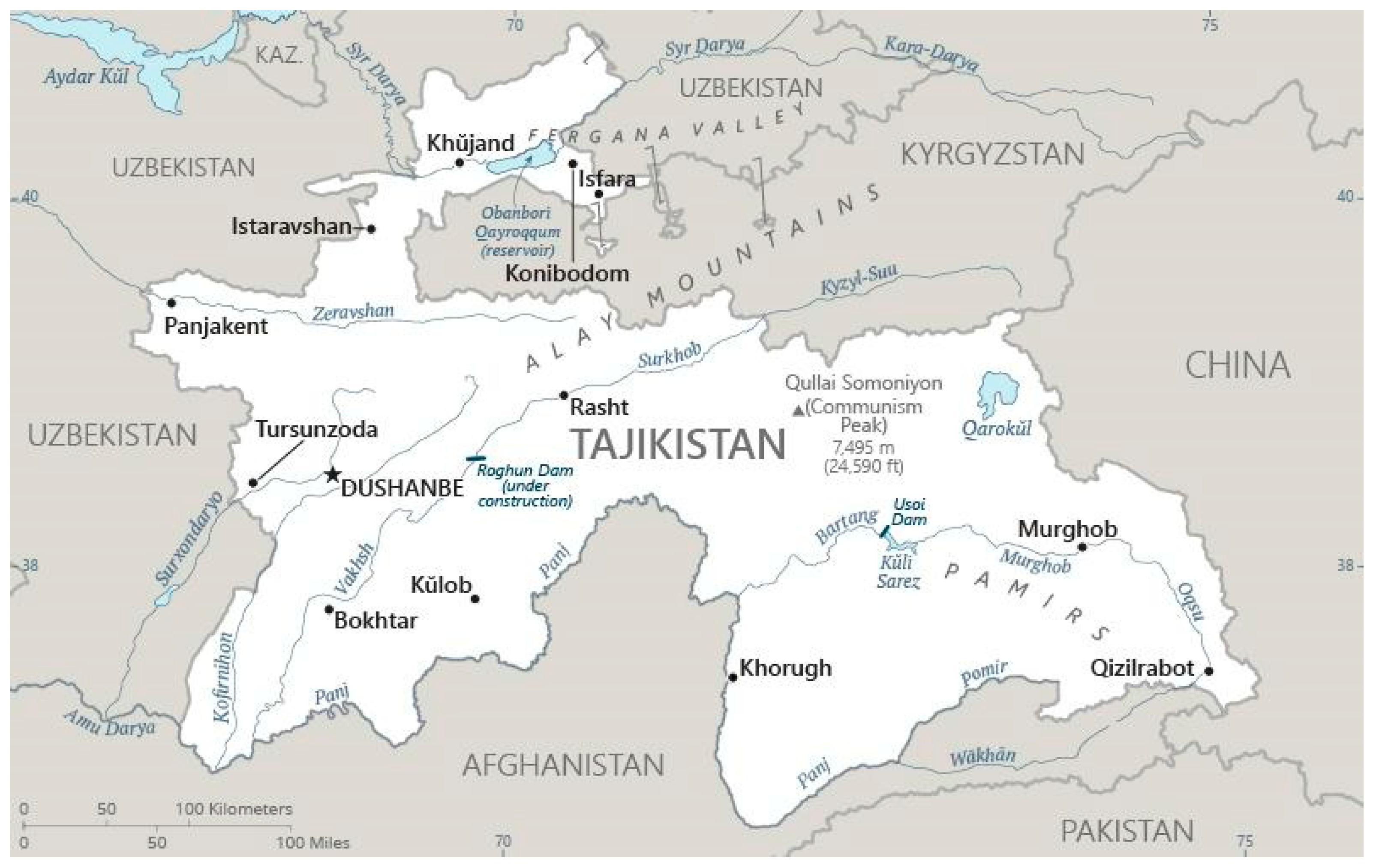
2.1. Administrative and Physical Landscape
2.2. Distinct Attributes of Pamiri Culture
2.3. Pamir’s Legacy of Soviet Control
3. Traditional Tourism in the Pamirs
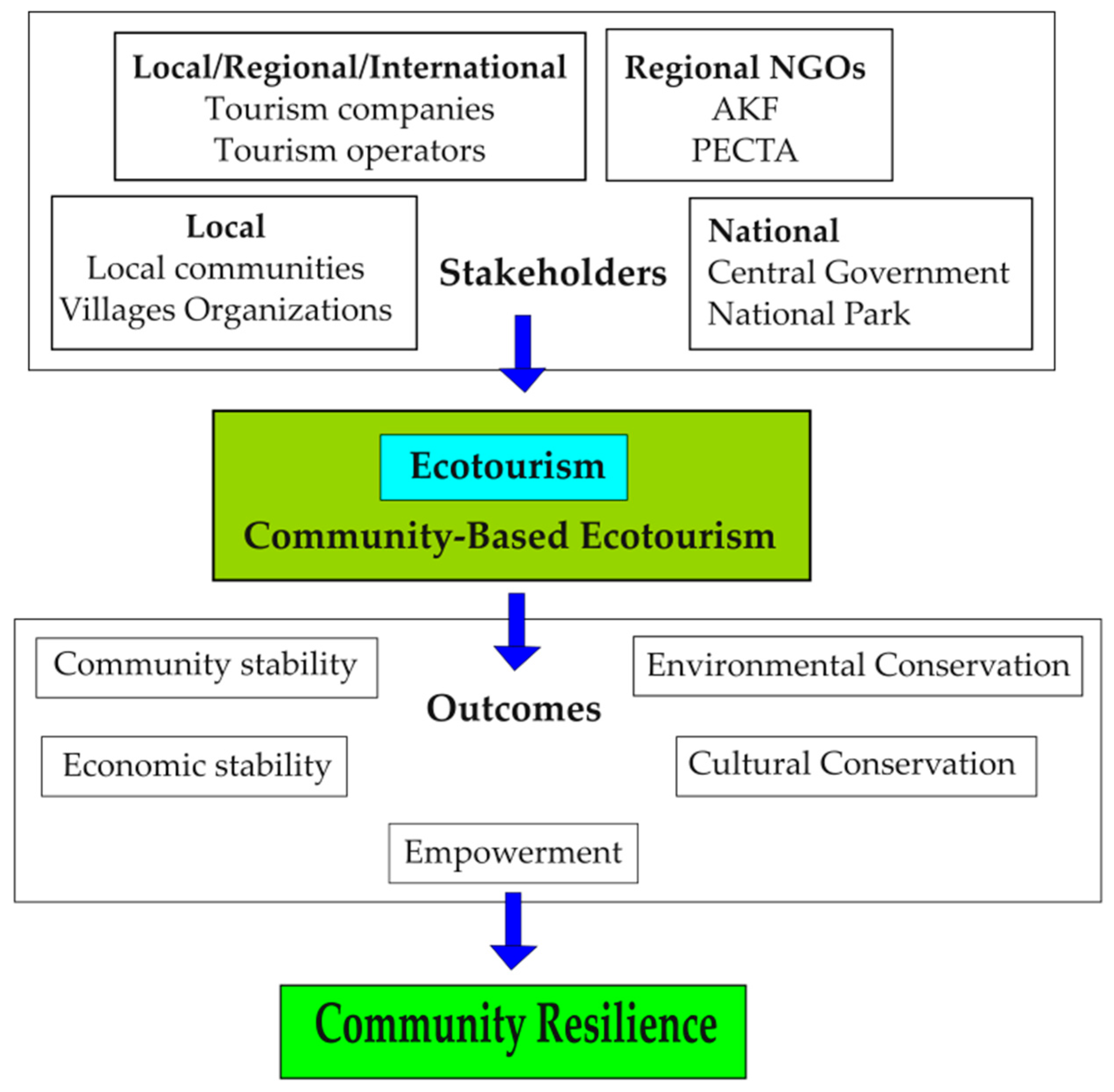
4. Conceptual Framework
5. Methods
6. Results
6.1. Ecotourism Fostering Community Resilience
6.1.1. Definition of Ecotourism
“Ecotourism that includes sustainability, traveling to a remote area to be in closer [in] connection with the wild nature and not harming the environment.”(2 July 2022)
“Ecotourism is not tourism or type of tourism, but rather an ecological approach to tourism. All the tours happening in the Pamirs should have an ecological approach, including the jeep tours, trekking, cultural tours, etc.”(2 July 2022)
6.1.2. Ecotourism Building Community Resilience
6.2. Community-Based Incorporating Ecotourism
Promoting Pamiri Community-Based Ecotourism
“A chain that helps to unite local communities’ services to boost their businesses through ecotourism. Its main purpose is that the capital can go directly to the local communities. The services CBE’s members can provide are tour operating, guiding, homestay management, porter, etc.”(5 July 2022)
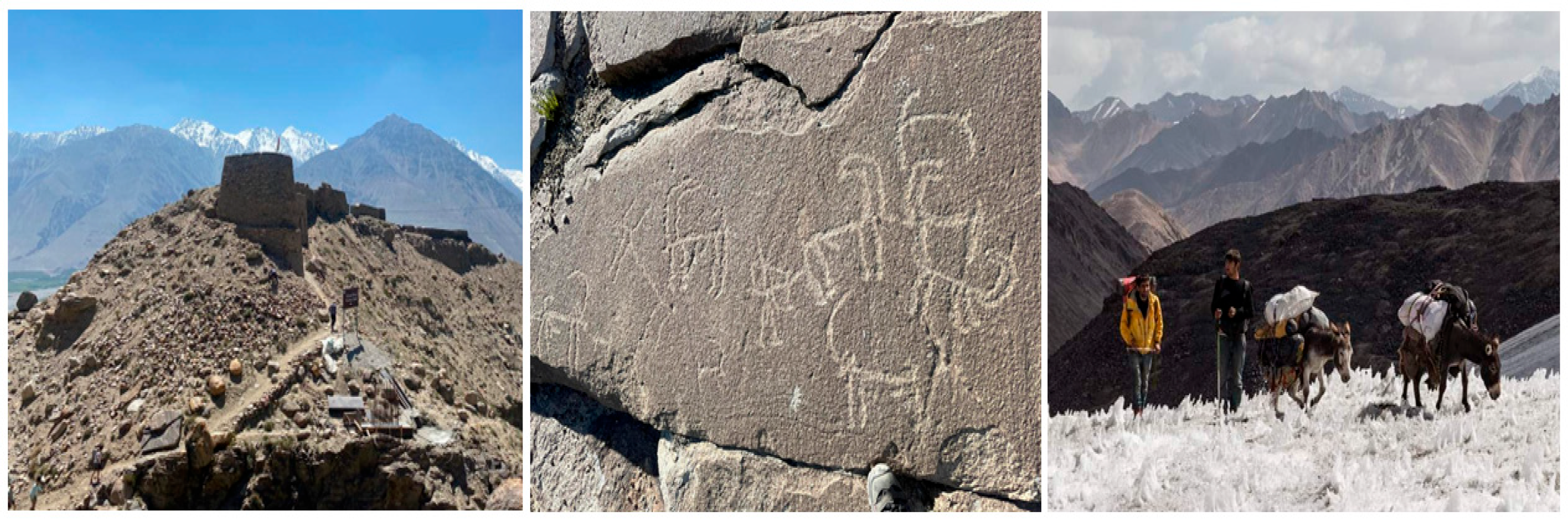
“It is fascinating for tourists to reveal the Solar Calendar and the old meteorite site in the middle of nowhere, making it an exceptional experience.”(5 July 2022)
6.3. Extent of Pamiri Community-Based Ecotourism
6.4. Community-Based Ecotourism: Economic and Environmental Drivers of Community Resilience
6.4.1. Financial Benefit of CBE
“Bachor village in Ghund Valley is a good example of CBE, where almost 90% of the population are involved in ecotourism; some successfully run the homestay business, some provide guiding and donkeyman services, cook, etc. They additionally have developed horse riding in their village and throughout the trekking. Those horses are accustomed to going through the rocky trails in the mountains. Also, the CBE is managed so that other people could indirectly benefit from it; some people give their donkeys for a seven-day trip without joining them and get 300 dollars a week. This is a good income in Bachor, considered one of the most remote places in the Pamirs. There is a big demand for donkeys for carrying tourists loads throughout the trekking,” He also noncommittally smiled and said, “donkey’s service costs more than human.”(20 July 2022)
“Those working in tourism must visit the ITB; without this experience, they would not understand the meaning of tourism and how to deal with it.”(2 September 2022)

| Type of Service | Daily Income | Monthly Income | Income Per Group/ Number of People | Annual Income |
|---|---|---|---|---|
| Porters/ Donkeyman | 30 | 720 | 3750 | |
| Guides | 30–40 | 840–960 | 3750–5000 | |
| Cook | 30 | 720–840 | 4000–5000 | |
| Homestay | 15 | 4500–5000 | 10 people/150 | 22,500 |
| Drivers | 2800 | 700 | 8000 | |
| Hotels | 50 | 10,000–15,000 | 10 people/500 | 75,000 |
| Tour operator | 15,000–200,000 | 8 people/5000 | 50,000–60,000 |
6.4.2. Increasing Environmental Awareness
“As a result, in general very little refuse can be seen along the roads/trails. Clean-ups campaigns are being promoted, and at the military checkpoints, tour operators have trained the soldiers to keep their spots clean, hence they began to control littering in their areas. The experts of tourism think that another focus of tourism stakeholders is promoting awareness through their actions. One example is a teacher of tourism, who over the last decade, began collecting garbage at checkpoints which made people think about the importance of their environment.”(3 September 2022)
6.5. Role of Government and Impact of Geopolitical Shifts on Ecotourism
6.5.1. Government Involvement
“Until 2000, government officials were involved in illegal hunting with the Russian army resulting in catastrophic decreases in certain species numbers. We were part of a smaller conservancies team working on the ground in remote areas with locals to protect the area’s wildlife by conducting awareness-raising training on the importance of wildlife protection. Our area is a large territory of the Tajik National Park”.(30 July 2022)
“I remember going hunting with a Kalashnikov automatic rifle, which allowed me to kill a large number of ungulates just in a matter of minute. However, I am taking significant measures currently to protect those species with my organization. In addition, I cooperate with national and international organizations to protect those species at large scale. For example, we had very effective projects with the American organization “Panther””.(3 August 2022)
6.5.2. Impact of Geopolitical Changes on Ecotourism
“During the Soviet era, many people from the region went abroad to study and always returned home. Education was central to life here—most people became teachers, and the population was deeply dedicated to learning. However, industries were underdeveloped, and the economy remained weak. When the Soviet Union collapsed, opportunities opened up for the private sector. During the Soviet period, there was no private sector at all. The first private enterprise was established on 1 July 1984. I was appointed as the director of the Bureau of Travel and Excursions, as it was called”.(3 September 2022)
After the collapse of the Soviet Union, we quickly turned to tourism because people in the region were well educated and many spoke English. Local residents began building guesthouses and small hotels once they realized the financial benefits of tourism. The education system played a vital role in this transformation. The MSDSP also implemented projects that trained local people to produce handicrafts for tourists, creating new income opportunities.(3 September 2022)
Our people are very educated—about 99.9 percent of the population here is educated —and they recognized that tourism could be a great opportunity to make a living, since there were few other options. Still, I wouldn’t say we have a large number of visitors. Only a small fraction of all foreign tourists coming to Tajikistan visit the Pamirs, but that also depends on the population—not many people live in this region. The main challenge is the distance between destinations: from Dushanbe to Khorog, the center of the Pamirs, it’s about 600 km, and a tourist needs at least eight days to see everything properly. In some remote areas, homestays still offer very basic accommodation.(3 September 2022)
6.6. Obstacles to Ecotourism in the Pamirs
7. Discussion
7.1. Importance of Definition
7.2. Extent of CBE in the Pamirs
7.3. CBE as Driver of Economic Development and Environmental Preservation
7.4. Sustainability of Community-Based Ecotourism
7.5. Local Governance and Empowerment in Community-Based Ecotourism
7.6. Shifts in Geopolitics and Pamiri Ecotourism
7.7. Building Community Resilience Through Ecotourism
7.8. Limitations of Study
8. Conclusions
- Policy Reform: There is a pressing need for updated government policies focused on environmental protection. These policies should be informed by the best available scientific evidence and incorporate meaningful stakeholder input.
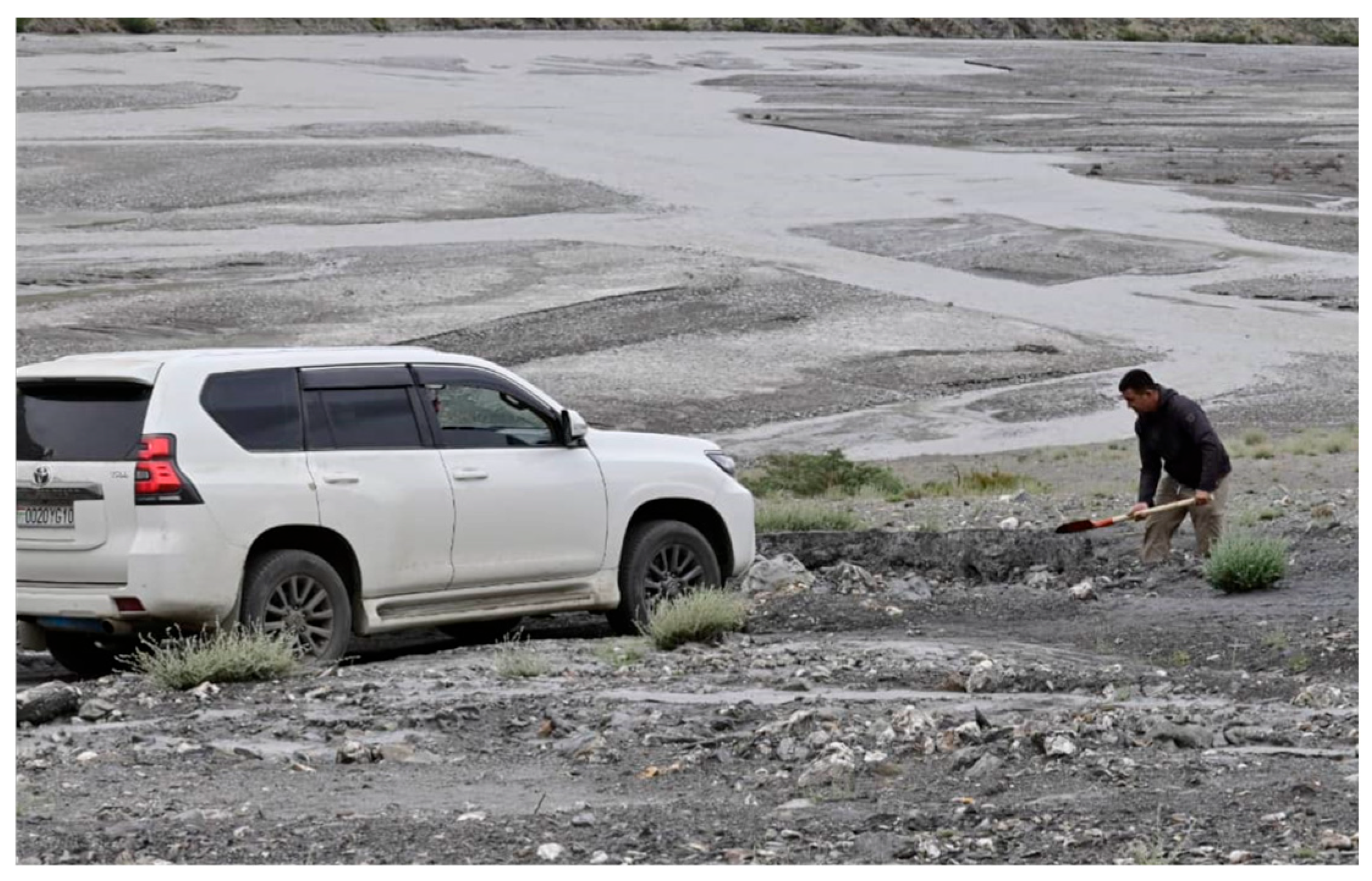
- Infrastructure Investment: The Tajik government must prioritize infrastructure development in the region. Current road conditions are severely inadequate, and access to air travel remains extremely limited, posing significant barriers to tourism growth.
- Global Visibility: The Pamirs suffer from limited global visibility. Strategic government investment in marketing the region, highlighting its distinctive environmental and cultural attributes, could enhance its visibility and attract ecotourism.
- Support for Tajik National Park (TNP): The TNP represents a critical resource for ecotourism but is currently understaffed. Adequate staffing would not only help mitigate poaching but also improve safety and visitors’ experience within the park.
- Public–Private Partnerships: The development of public–private partnerships modeled after Kazakhstan’s Integrated Ecotourism Development Model [115] could be adopted. Kazakhstan faces similar challenges, and its approach may provide valuable lessons for the Pamirs.
Supplementary Materials
Author Contributions
Funding
Institutional Review Board Statement
Informed Consent Statement
Data Availability Statement
Acknowledgments
Conflicts of Interest
References
- Anandaraj, M.; Phil, M. Ecotourism: Origin and Development. Int. J. Manag. Humanit. 2015, 2, 1–3. [Google Scholar]
- Machnik, A. Ecotourism as a Core of Sustainability in Tourism. In Handbook of Sustainable Development and Leisure Services; Lubowiecki-Vikuk, A., de Sousa, B.M.B., Đerčan, B.M., Leal Filho, W., Eds.; Springer: Cham, Switzerland, 2021; pp. 1–15. [Google Scholar] [CrossRef] [Scilit]
- Coria, J.; Calfucura, E. Ecotourism and the Development of Indigenous Communities: The Good, the Bad, and the Ugly. Ecol. Econ. 2012, 73, 47–55. [Google Scholar] [CrossRef] [Scilit]
- Kia, Z. Ecotourism in Indonesia: Local Community Involvement and the Affecting Factors. J. Gov. Public Policy 2021, 8, 93–105. [Google Scholar] [CrossRef] [Scilit]
- Salman, A.; Jaafar, M.; Mohamad, D.; Ebekozien, A.; Rasul, T. The Multi-Stakeholder Role in Asian Sustainable Ecotourism: A Systematic Review. PSU Res. Rev. 2024, 8, 940–958. [Google Scholar] [CrossRef] [Scilit]
- Yeboah, T. Dynamics of Ecotourism Benefits Distribution. Tour. Plan. Dev. 2024, 21, 122–137. [Google Scholar] [CrossRef] [Scilit]
- Cresco, S.; Querini, G. The Role of Tourism in Sustainable Economic Development. Eur. Reg. Sci. Assoc. 2003, 1, 1–13. [Google Scholar]
- Hunt, C.A.; Harbor, L.C. Pro-environmental Tourism: Lessons from Adventure, Wellness and Ecotourism (AWE) in Costa Rica. J. Outdoor Recreat. Tour. 2019, 28, 100233. [Google Scholar] [CrossRef] [Scilit]
- Guerrero-Moreno, M.A.; Oliveira-Junior, J.M.B. Approaches, Trends, and Gaps in Community-Based Ecotourism Research: A Bibliometric Analysis of Publications between 2002 and 2022. Sustainability 2024, 16, 2639. [Google Scholar] [CrossRef] [Scilit]
- Kunjuraman, V.; Hussin, R.; Che Aziz, R. Community-Based Ecotourism as a Social Transformation Tool for Rural Community: A Victory or a Quagmire? J. Outdoor Recreat. Tour. 2022, 39, 100524. [Google Scholar] [CrossRef] [Scilit]
- Erwin, E.; Rahim, A.; Dwipatn, I.M.J.A.; Nugraha, P.A.D. Revitalizing Village-Owned Enterprises (Bumdes) Through BUMDES Management Training for Sustainable Tourism Development: A Case Study of Rinding Allo Village, Rongkong District. Soc. J. Pengabdi. Masy. 2025, 4, 814–824. [Google Scholar] [CrossRef] [Scilit]
- Hafezi, F.; Bijani, M.; Gholamrezai, S.; Savari, M.; Panzer-Krause, S. Towards Sustainable Community-Based Ecotourism: A Qualitative Content Analysis. Sci. Total Environ. 2023, 891, 164411. [Google Scholar] [CrossRef] [Scilit]
- Darwis, H.; Duli, A.D.; Mulyadi, Y.; Rasyidi, E.S.; Mappasomba, Z.M.; Rudi, R. Collaborative Governance in Community-Based Mangrove Ecotourism: A Longitudinal Case Study of Banua Pangka, Luwu Timur (2015–2025). J. Multidiscip. Res. Innov. 2025, 1, 317–325. [Google Scholar]
- Nurhasanah, I.S.; Hudalah, D.; Van den Broeck, P. Systematic Literature Review on Alternative Governance Arrangements for Resource Deficient Situations: Small Island Community-Based Ecotourism. Isl. Stud. J. 2024, 19, 214–237. [Google Scholar] [CrossRef] [Scilit]
- Hasan, M.N.; Syaputra, Y. Social and Economic Impacts of Ecotourism Development on Local Communities in Coastal Tourism Areas. Bima Cendikia J. Community Engagem. Empower. 2025, 2, 41–63. [Google Scholar] [CrossRef] [Scilit]
- Prarthana, P.; Rathnayakalage, K. An Analysis of the Challenges and Opportunities in Promoting Sustainable Community-Based Homestay Tourism in Galle, Sri Lanka. Master’s Thesis, Umeå University, Umeå, Sweden, 2025. [Google Scholar]
- Teshome, E.; Shita, F.; Abebe, F. Current Community-Based Ecotourism Practices in Menz Guassa Community Conservation Area, Ethiopia. GeoJournal 2021, 86, 2135–2147. [Google Scholar] [CrossRef] [Scilit]
- Shoo, R.A.; Songorwa, A.N. Contribution of Ecotourism to Nature Conservation and Improvement of Livelihoods around Amani Nature Reserve, Tanzania. J. Ecotour. 2013, 12, 75–89. [Google Scholar] [CrossRef] [Scilit]
- He, G.; Chen, X.; Liu, W.; Bearer, S.; Zhou, S.; Cheng, L.Y.; Liu, J. Distribution of Economic Benefits from Ecotourism: A Case Study of Wolong Nature Reserve for Giant Pandas in China. Environ. Manag. 2008, 42, 1017–1025. [Google Scholar] [CrossRef] [Scilit]
- Irawan, D.; Istiqomah, Y. Strengthening Coastal Community Resilience through Marine Ecotourism in Pangandaran, West Java. Bima Cendikia J. Community Engagem. Empower. 2024, 1, 175–212. [Google Scholar]
- Tang, S. Capacity Building of Community-Based Ecotourism in Developing Nations: A Case of Mei Zhou, China. In Proceedings of the 1st International Conference on Business, Economics, Management Science (BEMS 2019), Hangzhou, China, 20–21 April 2019; pp. 582–605. [Google Scholar]
- Magis, K. Community Resilience: An Indicator of Social Sustainability. Soc. Nat. Resour. 2010, 23, 401–416. [Google Scholar] [CrossRef] [Scilit]
- Cutter, S.L.; Barnes, L.; Berry, M.; Burton, C.; Evans, E.; Tate, E.; Webb, J. A Place-Based Model for Understanding Community Resilience to Natural Disasters. Glob. Environ. Change 2008, 18, 598–606. [Google Scholar] [CrossRef] [Scilit]
- Herbers, H. Transformation in the Tajik Pamirs: Gornyi-Badakhshan-an example of successful restructuring? Cent. Asian Surv. 2001, 20, 367–381. [Google Scholar] [CrossRef] [Scilit]
- Hanif, H.; Maulida, A.; Kamal, M.; Oktari, R.S. Empowerment and Development of Kajhu Village as a Disaster Resilient Village Based on Factorization and Ecotourism. J. Pengabdi. Kpd. Masy. (Indones. J. Community Engag.) 2023, 9, 68. [Google Scholar]
- Uddin, M.M.; Schneider, P.; Asif, M.R.I.; Rahman, M.S.; Mozumder, M.M.H. Fishery-Based Ecotourism in Developing Countries Can Enhance the Social-Ecological Resilience of Coastal Fishers—A Case Study of Bangladesh. Water 2021, 13, 292. [Google Scholar] [CrossRef] [Scilit]
- Lin, Y.; Kelemen, M.; Kiyomiya, T. Bridging Community Resilience and Sustainable Tourism Development via Post-Disaster Education Tourism in Rural Japan. J. Organ. Discourse 2021, 2, 32–44. [Google Scholar] [CrossRef] [Scilit] [PubMed]
- Bliss, F. Social and Economic Change in the Pamirs (Gorno-Badakhshan, Tajikistan); Pacult, N., Guss, S., Trans.; Routledge: London, UK, 2006. [Google Scholar]
- Scarborough, I. (Over)Determining Social Disorder: Tajikistan and the Economic Collapse of Perestroika. Cent. Asian Surv. 2016, 35, 439–463. [Google Scholar] [CrossRef] [Scilit]
- Herbers, H. Vom Proletariat zum Bauerntum. Transformation im tadshikischen Pamir. Geogr. Rundsch. 2001, 53, 16–22. [Google Scholar]
- Breu, T.; Maselli, D.; Hurni, H. Knowledge for Sustainable Development in the Tajik Pamir Mountains. Mt. Res. Dev. 2005, 25, 139–146. [Google Scholar] [CrossRef] [Scilit]
- Kalandarov, T. The Pamirian Languages: Between Past and Future (the Case of the Shughni Language). Cult. Herit. Humanit. Unit UCA Res. Pap. 2020, 5, 1–32. [Google Scholar]
- Goibnazarov, C. Qasīda-khonī: A Musical Expression of Identities in Badakhshan, Tajikistan—Tradition, Continuity, and Change. Ph.D. Thesis, University of Berlin, Berlin, Germany, 2019. [Google Scholar]
- Dörre, A. Shifting Foodscapes in the Pamirs of Tajikistan. Cent. Asian Aff. 2023, 10, 293–332. [Google Scholar] [CrossRef] [Scilit]
- Kraudzun, T. Sovereignty as a Resource: Performing Securitised Borders in Tajikistan’s Pamirs. Geopolitics 2017, 22, 837–862. [Google Scholar] [CrossRef] [Scilit]
- Casas, C. Chid/Avalanche: Vernacular Domestic Architecture in the Pamirs, Its Cosmological and Magical Dimensions and Its Transposition into an Audiovisual Project. Vesper J. Archit. Arts Theory 2022, 6, 34–45. [Google Scholar]
- Haider, L.J.; Boonstra, W.J.; Akobirshoeva, A.; Schlüter, M. Effects of Development Interventions on Biocultural Diversity: A Case Study from the Pamir Mountains. Agric. Hum. Values 2020, 37, 683–697. [Google Scholar] [CrossRef] [Scilit]
- Middleton, R. History of the Development of the Pamir Region of Tajikistan (Gorno-Badakhshan). In Mapping Transition in the Pamirs: Changing Human-Environmental Landscapes; Springer: Cham, Switzerland, 2016; pp. 245–265. [Google Scholar]
- Kraudzun, T. External Support and Local Agency: Uncertain Transformations of Livelihoods in the Pamirian Borderland of Tajikistan. In Mapping Transition in the Pamirs: Changing Human-Environmental Landscapes; Springer: Cham, Switzerland, 2016; pp. 159–179. [Google Scholar]
- Hill, J. A Post-Area Studies Approach to the Study of Hill Irrigation across the Alai-Pamir-Himalaya. In Crossroads Asia Working Paper Series No. 3; Competence Network Crossroads Asia, Conflict—Migration—Development: Bonn, Germany, 2012. [Google Scholar]
- National Geographic. The Silk Road; National Geographic Society: Washington, DC, USA, 2019. [Google Scholar]
- Bekhradnia, S. The Tajik Case for a Zoroastrian Identity. Relig. State Soc. 1994, 22, 109–121. [Google Scholar] [CrossRef] [Scilit]
- Leventon, J.; Fleskens, L.; Claringbould, H.; Schwilch, G.; Hessel, R. An Applied Methodology for Stakeholder Identification in Transdisciplinary Research. Sustain. Sci. 2016, 11, 763–775. [Google Scholar] [CrossRef] [Scilit] [PubMed]
- Elkady, S.; Mehryar, S.; Hernantes, J.; Labaka, L. Prioritizing Stakeholder Interactions in Disaster Management: A TOPSIS-Based Decision Support Tool for Enhancing Community Resilience. Prog. Disaster Sci. 2024, 22, 100320. [Google Scholar] [CrossRef] [Scilit]
- Akbar, I.; Myrzaliyeva, Z.K.; Tazhekova, A.Z.; Saulembayev, A.T.; Kenzhebay, R.N. Evaluation of the Community-Based Ecotourism Development Status in the Aksu-Jabagly Nature Reserve, Kazakhstan. Geoj. Tour. Geosites 2021, 35, 381–389. [Google Scholar] [CrossRef] [Scilit]
- Choi, H.C.; Sirakaya, E. Sustainability Indicators for Managing Community Tourism. Tour. Manag. 2006, 27, 1274–1289. [Google Scholar] [CrossRef] [Scilit]
- Nguyen, T.D.; Hoang, H.D.; Nguyen, T.Q.; Fumikazu, U.; Vo, T.P.T.; Nguyen, C.V. A Multicriteria Approach to Assessing the Sustainability of Community-Based Ecotourism in Central Vietnam. APN Sci. Bull. 2022, 12, 123–140. [Google Scholar] [CrossRef] [Scilit]
- Baloch, Q.B.; Shah, S.N.; Iqbal, N.; Sheeraz, M.; Asadullah, M.; Mahar, S.; Khan, A.U. Impact of Tourism Development upon Environmental Sustainability: A Suggested Framework for Sustainable Ecotourism. Environ. Sci. Pollut. Res. 2023, 30, 5917–5930. [Google Scholar] [CrossRef] [Scilit]
- Wani, M.D.; Dada, Z.A.; Bhat, W.A.; Shah, S.A. Community-Driven Ecotourism in the Trans Himalayan Region: A Sustainable Model for Cultural and Environmental Preservation. Community Dev. 2025, 56, 560–582. [Google Scholar] [CrossRef] [Scilit]
- Thomas, B. Ecotourism: A Sustainable Development Connect to Nature and A Strategy for Balancing Economic Growth, Socio-Cultural Development and Conservation. Asia Pac. J. Adv. Educ. Technol. 2022, 1, 64–72. [Google Scholar] [CrossRef] [Scilit]
- Wiyono, S.H.; Subianto, A.; Nuhman, N. Sustainable Ecotourism Development and Community Empowerment: A Case Study of the Center for Environmental Education in Seloliman Village, Indonesia. Society 2023, 11, 310–328. [Google Scholar] [CrossRef] [Scilit]
- Carr, E.C.; Worth, A. The Use of the Telephone Interview for Research. NT Res. 2001, 6, 511–524. [Google Scholar] [CrossRef] [Scilit]
- Muellmann, S.; Brand, T.; Jürgens, D.; Gansefort, D.; Zeeb, H. How Many Key Informants Are Enough? Analysing the Validity of the Community Readiness Assessment. BMC Res. Notes 2021, 14, 85. [Google Scholar] [CrossRef] [Scilit] [PubMed]
- Subedi, K.R. Determining the Sample in Qualitative Research. Online Submiss. 2021, 4, 1–13. [Google Scholar] [CrossRef] [Scilit]
- Sturges, J.E.; Hanrahan, K.J. Comparing Telephone and Face-to-Face Qualitative Interviewing: A Research Note. Qual. Res. 2004, 4, 107–118. [Google Scholar] [CrossRef] [Scilit]
- Singh, C.; Patil, S.; Poonacha, P.; Koduganti, M.; Sharma, S. When the “Field” Moves Online: Reflections on Virtual Data Collection During COVID-19. Ecol. Econ. Soc. INSEE J. 2021, 4, 149–157. [Google Scholar] [CrossRef] [Scilit]
- Cresswell, J.W.; Plano Clark, V.L. Designing and Conducting Mixed Methods Research, 2nd ed.; Sage Publications Inc.: Thousand Oaks, CA, USA, 2011. [Google Scholar]
- Eatough, V.; Smith, J.A. Interpretative Phenomenological Analysis. In The SAGE Handbook of Qualitative Research in Psychology; Willig, C., Rogers, W.S., Eds.; SAGE: London, UK, 2017; pp. 193–209. [Google Scholar]
- Morgan, H. Understanding Thematic Analysis and the Debates Involving Its Use. Qual. Rep. 2022, 27, 2079–2090. [Google Scholar] [CrossRef] [Scilit]
- Nguyen-Trung, K. ChatGPT in Thematic Analysis: Can AI Become a Research Assistant in Qualitative Research? Qual. Quant. 2025, 59, 4945–4978. [Google Scholar] [CrossRef] [Scilit]
- Zhang, H.; Wu, C.; Xie, J.; Lyu, Y.; Cai, J.; Carroll, J.M. Redefining Qualitative Analysis in the AI Era: Utilizing ChatGPT for Efficient Thematic Analysis. arXiv 2023, arXiv:2309.10771. [Google Scholar] [CrossRef] [Scilit]
- Boo, E. Ecotourism: A Tool for Conservation and Development. In Ecotourism and Resource Conservation: A Collection of Papers; Kusler, J.A., Ed.; Omnipress: Madison, WI, USA, 1991; Volume 1, pp. 54–60. [Google Scholar]
- Ceballos-Lascurain, H. Tourism, Ecotourism, and Protected Areas: The State of Nature-Based Tourism Around the World and Guidelines for Its Development; IUCN: Gland, Switzerland, 1996; 301p. [Google Scholar]
- Ryan, C. Saltwater Crocodiles as Tourist Attractions. J. Sustain. Tour. 1998, 6, 314–327. [Google Scholar] [CrossRef] [Scilit]
- Goodwin, R.D.; Chaudhary, S.K. Ecotourism Dimensions and Directions in India: An Empirical Study of Andhra Pradesh. J. Commer. Manag. Thought 2017, 8, 436–451. [Google Scholar] [CrossRef] [Scilit]
- Higgins-Desbiolles, F. Indigenous Ecotourism’s Role in Transforming Ecological Consciousness. J. Ecotour. 2009, 8, 144–160. [Google Scholar] [CrossRef] [Scilit]
- Ma, B.; Yin, R.; Zheng, J.; Wen, Y.; Hou, Y. Estimating the Social and Ecological Impact of Community-Based Ecotourism in Giant Panda Habitats. J. Environ. Manag. 2019, 250, 109506. [Google Scholar] [CrossRef] [Scilit]
- Masud, M.M.; Adakhil, A.M.; Nassani, A.A.; Azam, M.N. Community-Based Ecotourism Management for Sustainable Development of Marine Protected Areas in Malaysia. Ocean Coast. Manag. 2017, 136, 104–112. [Google Scholar] [CrossRef] [Scilit]
- Formozov, N.; Kupriyanova, I.; Popov, V.; Shcherbakov, A.; Shvarts, Y.; Stepanitsky, V.; Vedenin, Y.; Zabelin, S.; Zimenko, A.; Biodiversity Conservation Center. Nature Reserves and National Parks; Biodiversity Conservation Center: Parramatta, Australia, 2003. [Google Scholar]
- Michel, S.; Rosen, T. Hunting of Prey Species: A Review of Lessons, Success, and Pitfalls—Experiences from Kyrgyzstan and Tajikistan. In Snow Leopards: Biodiversity of the World: Conservation from Genes to Landscapes; McCarthy, T., Mallon, D., Nyhus, P.J., Eds.; Academic Press: London, UK, 2016; pp. 236–244. [Google Scholar]
- Salas, E.A.L.; Valdez, R.; Michel, S.; Boykin, K.G. Habitat Assessment of Marco Polo Sheep (Ovis ammon polii) in Eastern Tajikistan: Modeling the Effects of Climate Change. Ecol. Evol. 2018, 8, 5124–5138. [Google Scholar] [CrossRef] [Scilit]
- Shokirov, Q.; Backhaus, N.; Bartmess, J. Community Perceptions of Co-Managing Tajik National Park. Cent. Asian Surv. 2021, 40, 420–437. [Google Scholar] [CrossRef] [Scilit]
- Shokirov, Q.; Abdykadyrova, A.; Dear, C.; Nowrojee, S. Mountain Tourism and Sustainability in Kyrgyzstan and Tajikistan: A Research Review; University of Central Asia: Bishkek, Kyrgyzstan, 2014. [Google Scholar]
- Cunha, S.F. Perestroika to Parkland: The Evolution of Land Protection in the Pamir Mountains of Tajikistan. In Mountains: Physical, Human-Environmental, and Sociocultural Dynamics; Routledge: London, UK, 2018; pp. 228–242. [Google Scholar]
- UNESCO. Decisions Adopted by the World Heritage Committee at Its 37th Session (Phnom Penh, Cambodia, June 2013); UNESCO World Heritage Committee: Paris, France, 2013. [Google Scholar]
- Parpiev, Z. Are Public–Private Partnerships a Solution to the Lagging Infrastructure of Tajikistan? In Developing Infrastructure in Central Asia; Asian Development Bank Institute: Tokyo, Japan, 2021; p. 231. [Google Scholar]
- Palmer, N.J. Economic Transition and the Struggle for Local Control in Ecotourism Development: The Case of Kyrgyzstan. J. Ecotourism 2006, 5, 40–61. [Google Scholar] [CrossRef] [Scilit]
- Giampiccoli, A.; Saayman, M. Community-Based Tourism: From a Local to a Global Push. Acta Commer. 2016, 16, 10. [Google Scholar] [CrossRef] [Scilit]
- Fennell, D.A. A Content Analysis Ecotourism Definitions. Curr. Issues Tour. 2001, 4, 403–421. [Google Scholar] [CrossRef] [Scilit]
- Mtapuri, O.; Giampiccoli, A. Tourism, Community-Based Tourism and Ecotourism: A Definitional Problematic. S. Afr. Geogr. J. 2019, 101, 22–35. [Google Scholar] [CrossRef] [Scilit]
- Cater, E. Ecotourism: Theory and Practice. In A Companion to Tourism; John Wiley & Sons: Hoboken, NJ, USA, 2004; pp. 484–597. [Google Scholar]
- Alam, R.; Nayak, D. Developing Local Support for Wildlife Conservation Through Community-Based Ecotourism: A Study of Jim Corbett Tiger Reserve, India. Tour. Plan. Dev. 2025, 22, 182–206. [Google Scholar] [CrossRef] [Scilit]
- Elbaramelgy, M.; Gammaz, S.A.; Emara, M.S. Community-Based Ecotourism Strategies: Key Indicators for Successful Practices in Developing Countries. J. Urban Res. 2019, 31, 103–122. [Google Scholar] [CrossRef] [Scilit]
- Ntshona, Z.M.; Lahiff, E. Community-Based Ecotourism on the Wild Coast, South Africa: The Case of the Amadiba Trail; University of Sussex, Institute of Development Studies: Brighton and Hove, UK, 2003. [Google Scholar]
- Ávila-Foucat, V.S.; Revollo-Fernández, D.; Navarrete, C. Determinants of Livelihood Diversification: The Case of Community-Based Ecotourism in Oaxaca, Mexico. Sustainability 2021, 13, 11371. [Google Scholar] [CrossRef] [Scilit]
- Leksakundilok, A.; Hirsch, P. Community-Based Ecotourism in Thailand. In Tourism at the Grassroots: Villagers and Visitors in the Asia-Pacific; Routledge: London, UK, 2008; p. 214. [Google Scholar]
- Acharya, B.P.; Halpenny, E.A. Homestays as an Alternative Tourism Product for Sustainable Community Development: A Case Study of Women-Managed Tourism Product in Rural Nepal. Tour. Plan. Dev. 2013, 10, 367–387. [Google Scholar] [CrossRef] [Scilit]
- Knight, D.W.; Cottrell, S.P. Evaluating Tourism-Linked Empowerment in Cuzco, Peru. Ann. Tour. Res. 2016, 56, 32–47. [Google Scholar] [CrossRef] [Scilit]
- Tran, L.; Walter, P. Ecotourism, Gender and Development in Northern Vietnam. Ann. Tour. Res. 2014, 44, 116–130. [Google Scholar] [CrossRef] [Scilit]
- Yulianeu, A.; Ferdinand, A.T.; Purnomo, R. Transformational Leadership and Energizing Organizational Learning: Empirical Model for Improving Community-Based Ecotourism Performance in Indonesia. Geoj. Tour. Geosites 2021, 38, 1135–1142. [Google Scholar] [CrossRef] [Scilit]
- Park, E.; Phandanouvong, T.; Xaysena, P.; Kim, S. Empowerment, Participation and Barriers: Ethnic Minority Community-Based Ecotourism Development in Lao PDR. In Tourism and Ethnodevelopment; Routledge: London, UK, 2017; pp. 139–152. [Google Scholar]
- Dey, T.; Kamruzzaman, M.; Islam, M.A.; Bachar, B.K.; Pitol, M.N.S. Attitudes of Local People Towards Community-Based Ecotourism in the Sundarbans. Int. J. Bus. Manag. Soc. Res. 2020, 9, 528–535. [Google Scholar] [CrossRef] [Scilit]
- Salam, M.A.; Lindsay, G.R.; Beveridge, M.C. Ecotourism to Protect the Reserve Mangrove Forest the Sundarbans and Its Flora and Fauna. Anatolia 2000, 11, 56–66. [Google Scholar] [CrossRef] [Scilit]
- Lonn, P.; Mizoue, N.; Ota, T.; Kajisa, T.; Yoshida, S. Evaluating the Contribution of Community-Based Ecotourism (CBE) to Household Income and Livelihood Changes: A Case Study of the Chambok CBE Program in Cambodia. Ecol. Econ. 2018, 151, 62–69. [Google Scholar] [CrossRef] [Scilit]
- Foucat, V.A. Community-Based Ecotourism Management Moving Towards Sustainability, in Ventanilla, Oaxaca, Mexico. Ocean Coast. Manag. 2002, 45, 511–529. [Google Scholar] [CrossRef] [Scilit]
- Jugmohan, S.; Spencer, J.P.; Steyn, J.N. Local Natural and Cultural Heritage Assets and Community-Based Tourism: Challenges and Opportunities. Afr. J. Phys. Act. Health Sci. 2016, 22, 306–317. [Google Scholar]
- Efani, A.; Tiarantika, R.; Manzilati, A.; Sambah, A.B.; Riza, M.F. Key Variables for Successful Community-Based Ecotourism Management in East Java, Indonesia. Evergr. Jt. J. Nov. Carbon Resour. Sci. Green Asia Strategy 2024, 11, 2831–2847. [Google Scholar]
- Kim, M.; Xie, Y.; Cirella, G.T. Sustainable Transformative Economy: Community-Based Ecotourism. Sustainability 2019, 11, 4977. [Google Scholar] [CrossRef] [Scilit]
- Bhalla, P.; Coghlan, A.; Bhattacharya, P. Homestays’ Contribution to Community-Based Ecotourism in the Himalayan Region of India. Tour. Recreat. Res. 2016, 41, 213–228. [Google Scholar] [CrossRef] [Scilit]
- Palmer, N.J.; Chuamuangphan, N. Governance and Local Participation in Ecotourism: Community-Level Ecotourism Stakeholders in Chiang Rai Province, Thailand. In Stakeholders Management and Ecotourism; Routledge: London, UK, 2021; pp. 118–135. [Google Scholar]
- Forje, G.W.; Awazi, N.P.; Kimengsi, J.N. Ecotourism Governance in Sub-Saharan Africa: A Systematic Review. Environ. Res. Commun. 2022, 4, 042002. [Google Scholar] [CrossRef] [Scilit]
- Duong, M.-P.T.; de Bruyn, L.L.; Kristiansen, P.; Marshall, G.R.; Wilkes, J. Community-Based Ecotourism and the Challenges of Local Participation: Insights from an Ecotourism Venture in Cat Tien National Park, Vietnam. J. Environ. Plan. Manag. 2024, 1–27. [Google Scholar] [CrossRef] [Scilit]
- Kreczi, F. Vulnerabilities in the Eastern Pamirs. In Berlin Geographical Papers; Centre for Development Studies (ZELF), Institute of Geographical Sciences, Freie Universität Berlin: Berlin, Germany, 2011; Volume 39. [Google Scholar]
- Kasymov, S. Regional Fragmentation in Tajikistan: The Shift of Powers Between Different Identity Groups. Asian Geogr. 2013, 30, 1–20. [Google Scholar] [CrossRef] [Scilit]
- Park, A. Russia, the Former Soviet Republics, and Europe since 1989: Transformation and Tragedy. Eurasian Geogr. Econ. 2020, 61, 543–567. [Google Scholar] [CrossRef] [Scilit]
- Breslauer, G.W. The Long Shadow: Immediate and Downstream Consequences of the Collapse of the USSR. Brown J. World Aff. 2021, 28, 9–22. [Google Scholar]
- Usmonova, G.; Alieva, D.; León, C.J. Yurt Invited: Combining Tourists and Stakeholders’ Perceptions of Sustainable Community-Based Tourism in Central Asia. Sustainability 2022, 14, 7540. [Google Scholar] [CrossRef] [Scilit]
- Zada, M.; Khan, S.; Zada, S.; Dhar, B.K.; Marcão, R. Harnessing Social Media and NGO Collaboration for Advancing Sustainable Ecotourism Policy: A Pathway to Sustainable Tourism Development. Sustain. Dev. 2025, 33, 4702–4717. [Google Scholar] [CrossRef] [Scilit]
- Pathmasiri, E.H.G.C.; Nimalasiri, L.K.D.C.H.; Bandara, T.W.M.T.W. Mitigating Ecotourism Challenges through Effective Stakeholder Engagement: Insights from Udawalawa National Park in Sri Lanka. J. Asian Geogr. 2025, 4, 32–43. [Google Scholar] [CrossRef] [Scilit]
- Pyke, J.; Law, A.; Jiang, M.; de Lacy, T. Learning from the Locals: The Role of Stakeholder Engagement in Building Tourism and Community Resilience. In Stakeholders Management and Ecotourism; Routledge: London, UK, 2021; pp. 4–17. [Google Scholar]
- Bhuiyan, M.A.H.; Siwar, C.; Ismail, S.M.; Islam, R. The Role of Government for Ecotourism Development: Focusing on East Coast Economic Region. J. Soc. Sci. 2011, 7, 557–564. [Google Scholar] [CrossRef] [Scilit]
- Miller, A.B.; Cox, C.; Morse, W.C. Ecotourism, Wildlife Conservation, and Agriculture in Costa Rica through a Social-Ecological Systems Lens. Front. Sustain. Tour. 2023, 2, 1179887. [Google Scholar] [CrossRef] [Scilit]
- Zingi, G.K.; Mpofu, A.; Chitongo, L.; Museva, T.; Chivhenge, E.; Ndongwe, M.R. Ecotourism as a Vehicle for Local Economic Development: A Case of Tsholotsho District, Zimbabwe. Cogent Soc. Sci. 2022, 8, 2035047. [Google Scholar] [CrossRef] [Scilit]
- Jarjou, A.; Walther, B.A. Ecotourism for Sustainable Development: A Case Study about Ecotourism Management in Bwiam Village–The Gambia. Int. J. Creat. Res. Thoughts 2021, 9, 615–622. [Google Scholar]
- Almukhambetova, B.; Yrza, B.; Baibosynova, G.; Kalganbayev, N. Formation of a Sustainable Ecotourism Model in Kazakhstan Through International Experience and Local Practice. Bull. Int. Univ. Tour. Hosp. 2025, 2, 127–145. [Google Scholar] [CrossRef] [Scilit]
| Research Question | Component Questions |
|---|---|
| RQ 1. Ecotourism building community resilience | Define ecotourism. |
| Do you believe ecotourism is important and deserves greater attention, or do you think tourism can develop successfully without it? | |
| What example of ecotourism have you experienced in the region? | |
| Have you seen the direct impact of ecotourism in the region and what are they? | |
| What do you think about the future of ecotourism in Pamirs? | |
| Do you believe that ecotourism can help local communities to sustain their lives? | |
| In your opinion, can ecotourism help increase the awareness of environmental protection, and in what ways? | |
| RQ 2a. Integration of CBE in ecotourism (PECTA) | How can community-based ecotourism become more sustainable? |
| How can you involve more people in CBE so that they can also financially benefit from ecotourism? | |
| How are the importance and benefits of ecotourism explained to local communities? | |
| RQ 2b. Integration of CBE in ecotourism (participants) | Have you decided to be part of CBE? If so, why? |
| How much is your income? | |
| Do you think it is enough to live from for the year? | |
| RQ 3. Collapse of Soviet Union and development of ecotourism | How did the collapse of the Soviet Union impact the people of the Pamirs? |
| How did the Pamirs connection with the Soviet Union impact the development of ecotourism? |
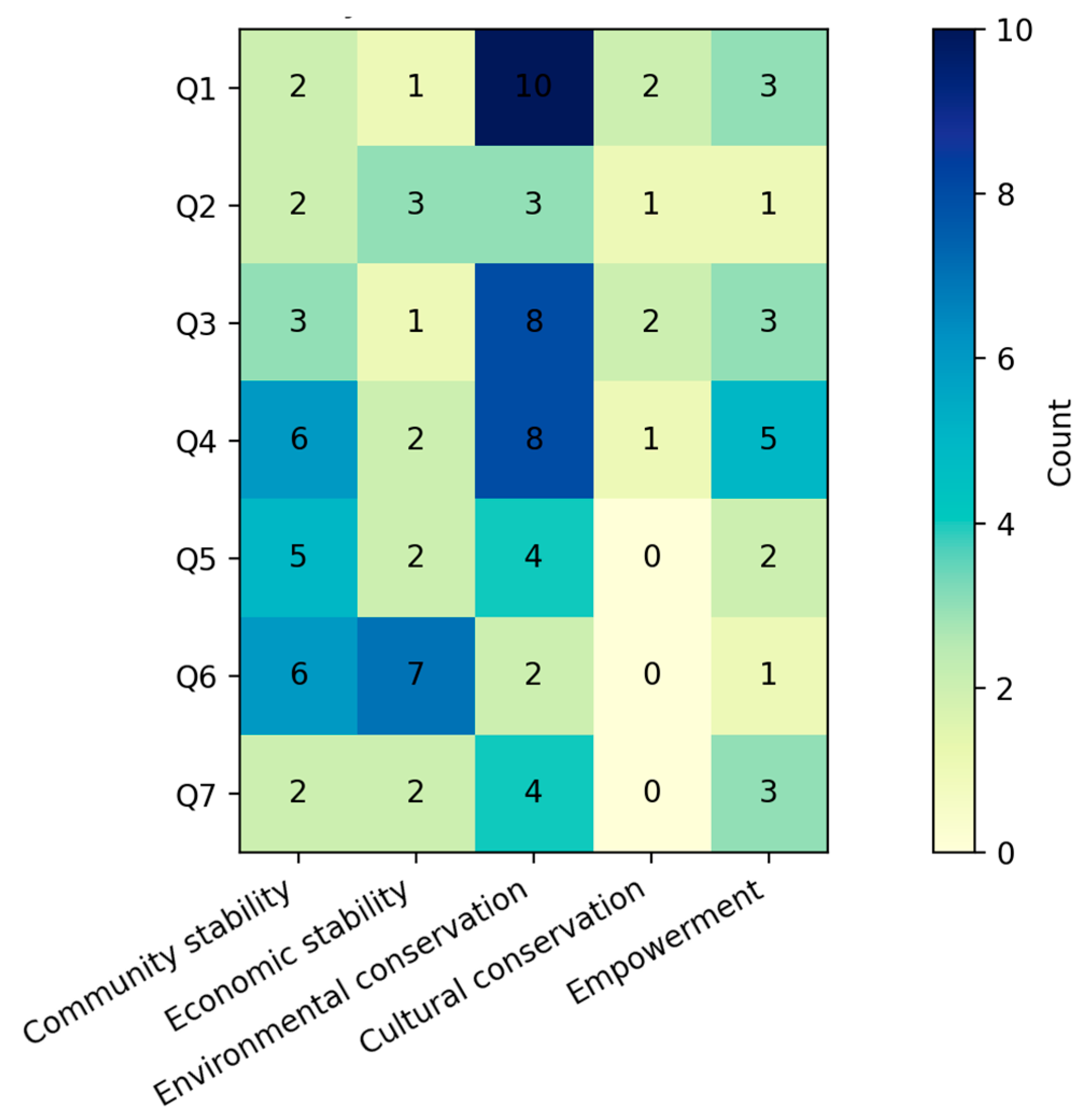
| Theme | Distribution * | What Participants Said (Illustrative Extracts) |
|---|---|---|
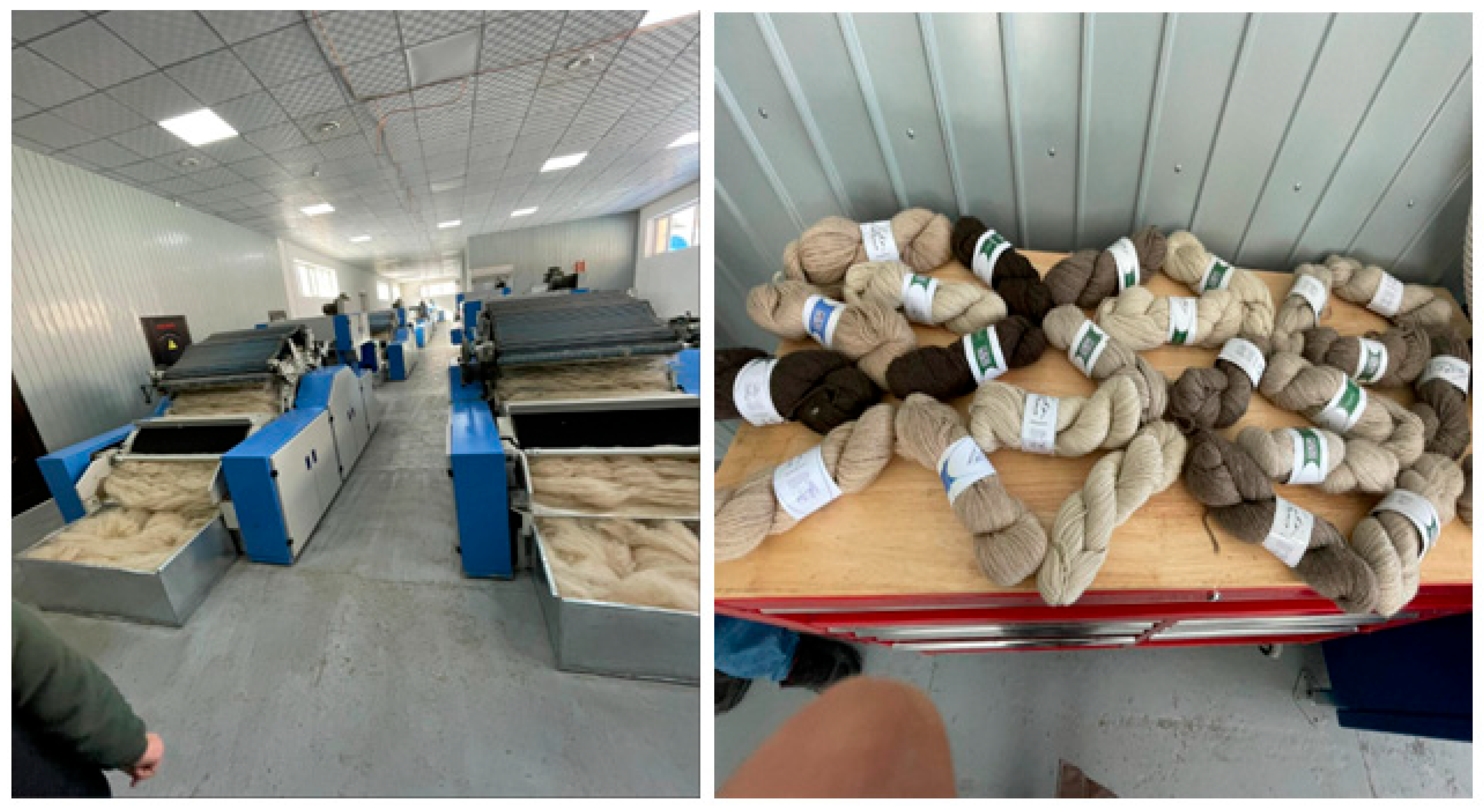
| Community stability | 39 | • “The main purpose of establishing the association was to bring more people together and preserve the nature and culture of local people.” (Q1) • “Awareness sessions on tourism development… people started to think about making business… from 53 homestays (2008) to 200 homestays… also 150 handicraft people.” (Q4) • Ecotourism is “the best principle for creating seasonal and permanent jobs for local people.” (Q2) |
| Economic stability | 26 | • “…from 53 to 200 homestays… 3–4 jobs per homestay during season… 150 handicraft producers using local wool.” (Q4) • “Financial benefits… helped drivers, trekking helped many locals; hotels and homestays created jobs.” (Q6) • Ecotourism is “the best principle for creating seasonal and permanent jobs for local people.” (Q2) |
| Environmental conservation | 18 | • Ecotourism is travel that does not harm the environment, with “minimum to zero impact.” (Q1) • Jizev: no car road (to avoid pollution) + green energy projects via UNDP. (Q3) • Tree-planting projects (Camp Tabiat, GIZ), park creation (World Bank), and a shift from wildlife decline to wildlife increasing. (Q4) • Caution: “If mass tourism happens this will impact the environment.” (Q7) • National Park information centers “give information about the park” while caring for it. (Q7) |
| Cultural conservation | 18 | • Aim to “preserve the nature and culture of local people.” (Q1) • Stakeholders focus on “preserving nature, culture, historical places.” (Q2) • “150 handicraft people are using local wools.” (Q4) |
| Empowerment | 6 | • “Training of conservancies… involve people… how homestays should be performed… guide responsibilities… cooks, food safety.” (Q3) • “Awareness sessions (since 2006)… people started to think about (decision) making business.” (Q4) • “Education campaign… people’s mindsets transformed.” (Q5) |
| Outcomes | Success | Evidence |
|---|---|---|
| Community Stability | Yes | Increased employment opportunities |
| Economic stability | Yes | 1. New income streams 2. Sharing of economic benefits amongst individual operators within communities |
| Empowerment | Yes | 1. Tourist operators involved in marketing products 2. Stakeholder engagement develop new products 3. Village organizations defined needs of their communities and enabled support of enterprises |
| Environmental conservation | Yes | 1. Growing awareness of need for protection of income stream 2. Addressing issues of poaching and overgrazing |
| Cultural conservation | Yes | 1. Most significant component of homestay industry 2. Restoration of cultural sites |
Disclaimer/Publisher’s Note: The statements, opinions and data contained in all publications are solely those of the individual author(s) and contributor(s) and not of MDPI and/or the editor(s). MDPI and/or the editor(s) disclaim responsibility for any injury to people or property resulting from any ideas, methods, instructions or products referred to in the content. |
© 2025 by the authors. Licensee MDPI, Basel, Switzerland. This article is an open access article distributed under the terms and conditions of the Creative Commons Attribution (CC BY) license.
Share and Cite
Shakarmamadova, F.; van Beynen, P.E.; Akiwumi, F.A. Assessing the Contribution of Ecotourism and Community-Based Ecotourism to Community Resilience in the Pamirs. Sustainability 2026, 18, 207. https://doi.org/10.3390/su18010207
Shakarmamadova F, van Beynen PE, Akiwumi FA. Assessing the Contribution of Ecotourism and Community-Based Ecotourism to Community Resilience in the Pamirs. Sustainability. 2026; 18(1):207. https://doi.org/10.3390/su18010207
Chicago/Turabian StyleShakarmamadova, Furough, Philip E. van Beynen, and Fenda A. Akiwumi. 2026. "Assessing the Contribution of Ecotourism and Community-Based Ecotourism to Community Resilience in the Pamirs" Sustainability 18, no. 1: 207. https://doi.org/10.3390/su18010207
APA StyleShakarmamadova, F., van Beynen, P. E., & Akiwumi, F. A. (2026). Assessing the Contribution of Ecotourism and Community-Based Ecotourism to Community Resilience in the Pamirs. Sustainability, 18(1), 207. https://doi.org/10.3390/su18010207

