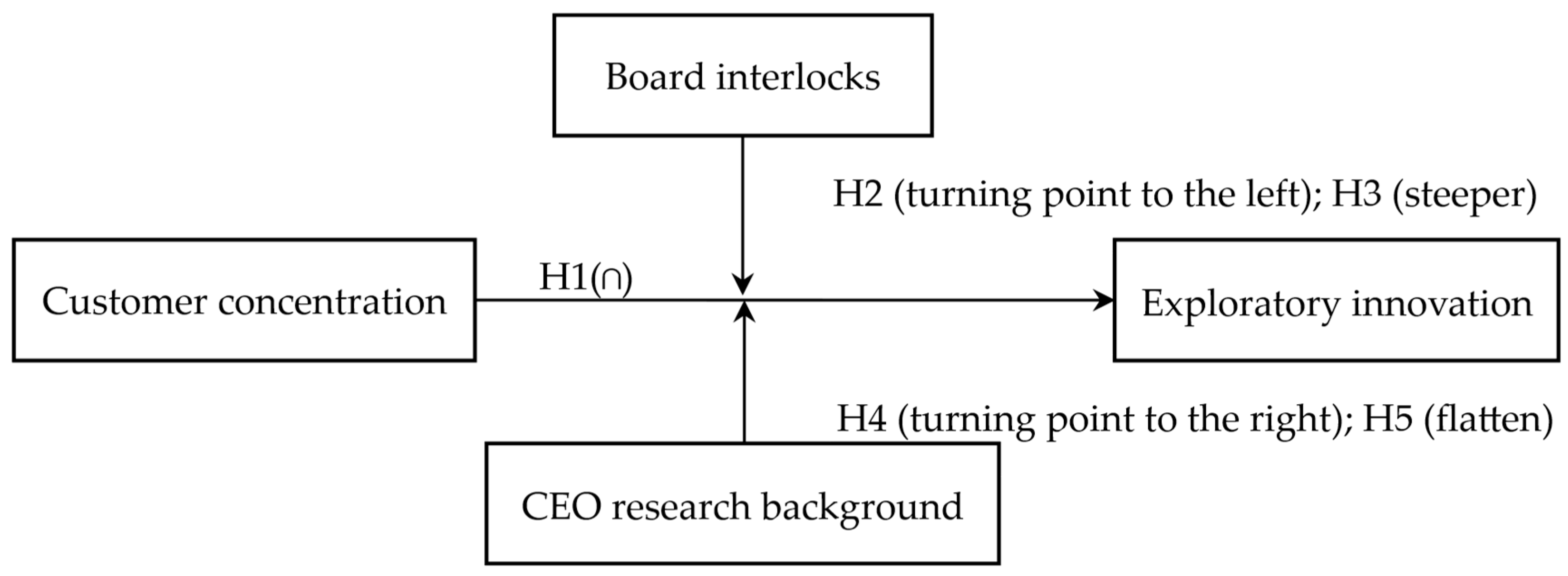
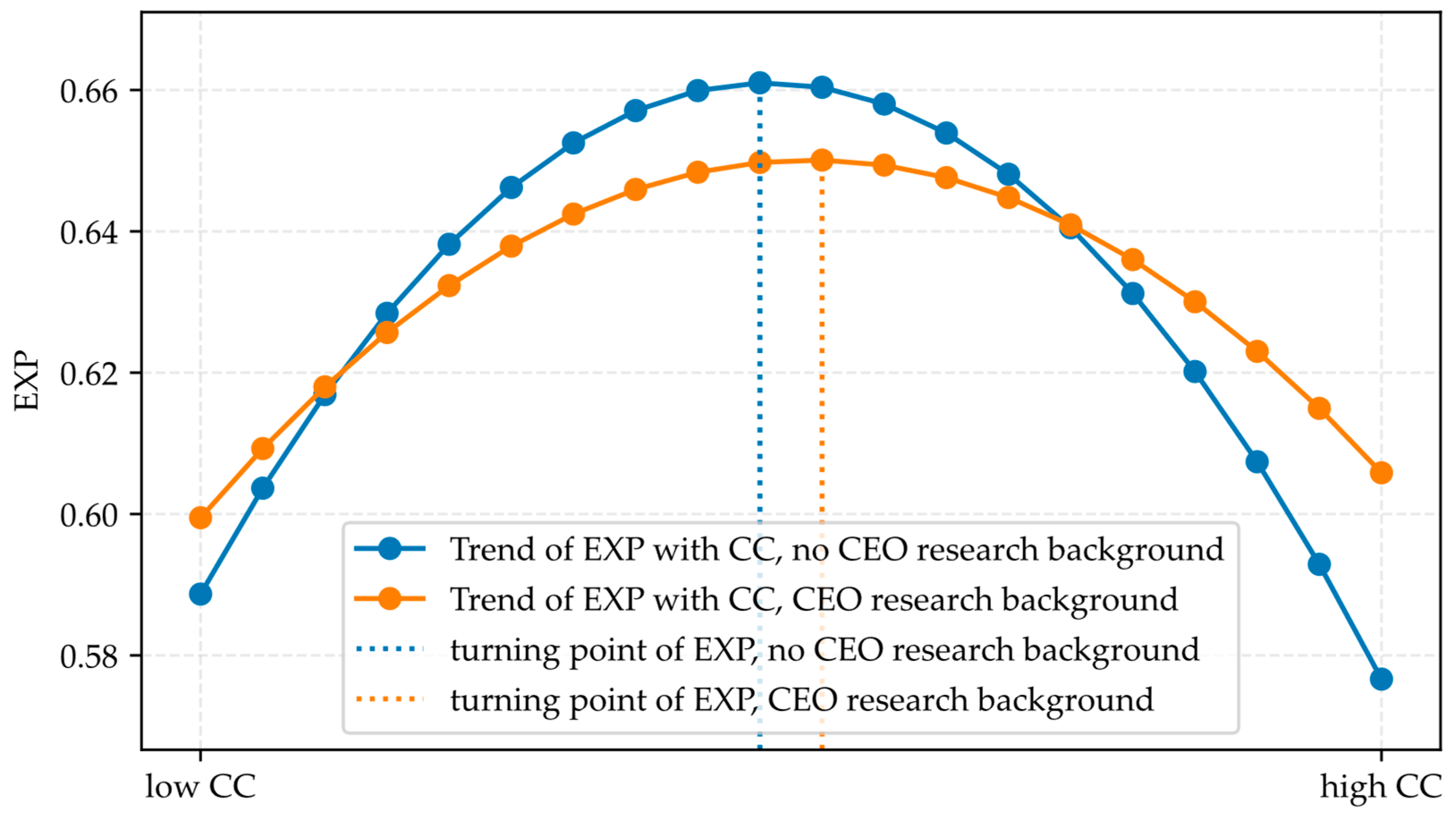
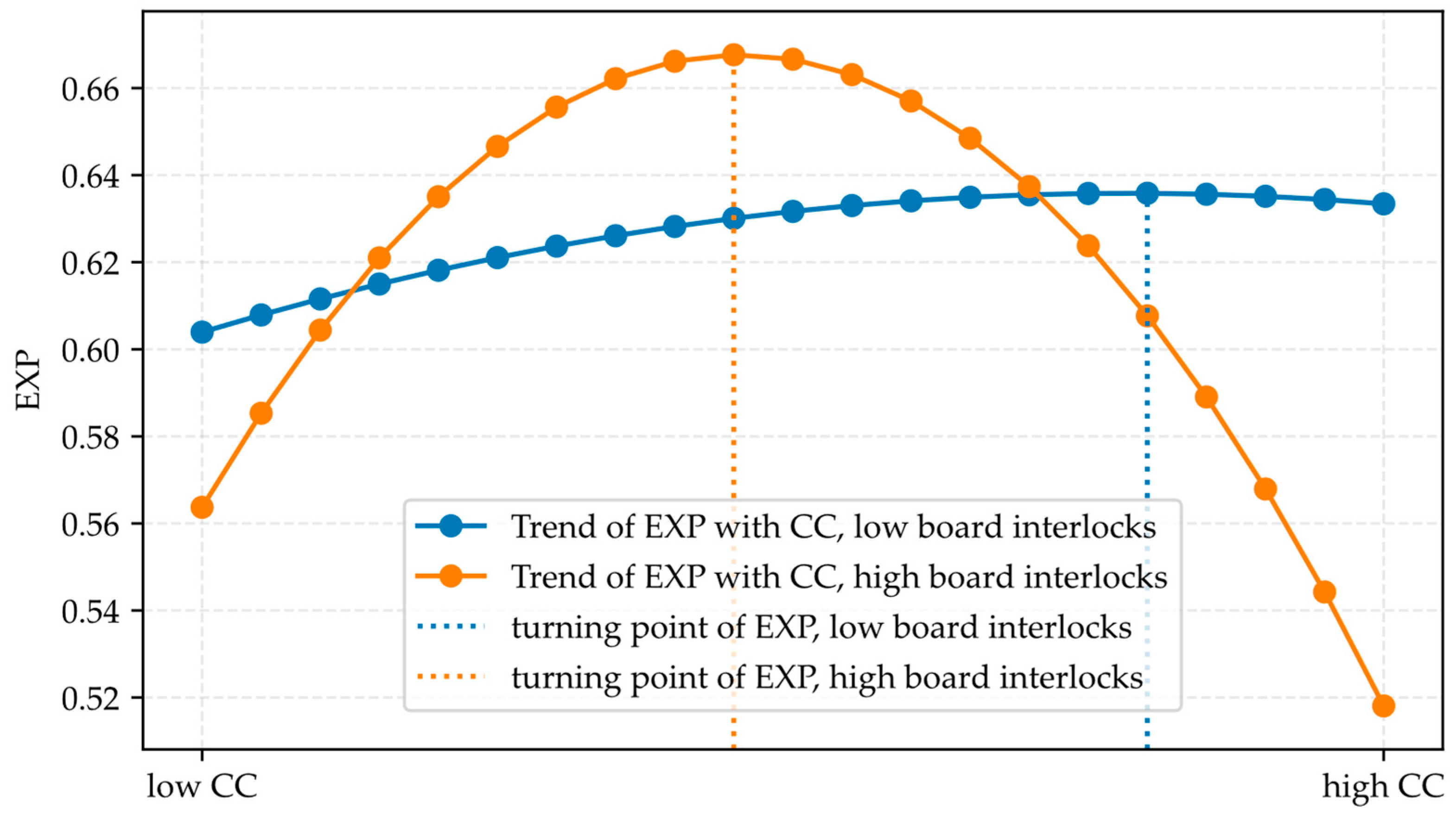
Does Customer Concentration Matter in Exploratory Innovation? The Moderating Effect of Board Interlocks and CEO Research Background


Abstract
1. Introduction
- RQ1: What is the effect of customer concentration on firms’ exploratory innovation?
- RQ2: How do board interlocks moderate the relationship between customer concentration and exploratory innovation?
- RQ3: How does the CEO’s research background moderate the relationship between customer concentration and exploratory innovation?
2. Hypothesis Development
2.1. Influence of Customer Concentration on Exploratory Innovation
2.2. The Moderating Effect of Board Interlocks
2.3. Moderating Effect of the CEO’s Research Background
3. Methodology
3.1. Data Source
3.2. Measurement of Variables
3.2.1. Dependent Variable: Exploratory Innovation
3.2.2. Independent Variable: Customer Concentration
3.2.3. Moderate Variables: Board Interlocks/CEO’s Research Background
3.2.4. Control Variables
3.3. Model Specification
4. Results
4.1. Descriptive Statistics
4.2. Result of Regression
4.3. Robustness Check
4.4. Endogeneity and Identification
5. Discussion
5.1. Theoretical Contributions
5.2. Managerial Implications
5.3. Limitations and Further Research
Supplementary Materials
Author Contributions
Funding
Institutional Review Board Statement
Informed Consent Statement
Data Availability Statement
Conflicts of Interest
References
- Schumpeter, J.A. The Theory of Economic Development: An Inquiry into Profits, Capital, Credit, Interest, and the Business Cycle; Harvard University Press: Cambridge, MA, USA, 1934. [Google Scholar]
- March, J.G. Exploration and Exploitation in Organizational Learning. Organ. Sci. 1991, 2, 71–87. [Google Scholar] [CrossRef]
- Benner, M.J.; Michael, T.L. Exploitation, Exploration, and Process Management: The Productivity Dilemma Revisited. Acad. Manag. Rev. 2003, 28, 238–256. [Google Scholar] [CrossRef]
- Jansen, J.J.P.; Van Den Bosch, F.A.J.; Volberda, H.W. Exploratory Innovation, Exploitative Innovation, and Performance: Effects of Organizational Antecedents and Environmental Moderators. Manag. Sci. 2006, 52, 1661–1674. [Google Scholar] [CrossRef]
- He, Z.-L.; Wong, P.-K. Exploration vs. Exploitation: An Empirical Test of the Ambidexterity Hypothesis. Organ. Sci. 2004, 15, 481–494. [Google Scholar] [CrossRef]
- Rosenkopf, L.; Nerkar, A. Beyond Local Search: Boundary-Spanning, Exploration, and Impact in the Optical Disk Industry. Strateg. Manag. J. 2001, 22, 287–306. [Google Scholar] [CrossRef]
- Sidhu, J.S.; Commandeur, H.R.; Volberda, H.W. The Multifaceted Nature of Exploration and Exploitation: Value of Supply, Demand, and Spatial Search for Innovation. Organ. Sci. 2007, 18, 20–38. [Google Scholar] [CrossRef]
- Markman, G.D.; Gianiodis, P.T.; Phan, P.H. Supply-Side Innovation and Technology Commercialization. J. Manag. Stud. 2009, 46, 625–649. [Google Scholar] [CrossRef]
- Kalcheva, I.; McLemore, P.; Pant, S. Innovation: The Interplay between Demand-Side Shock and Supply-Side Environment. Res. Policy 2018, 47, 440–461. [Google Scholar] [CrossRef]
- Yi, J.; Murphree, M.; Meng, S.; Li, S. The More the Merrier? Chinese Government R&D Subsidies, Dependence, and Firm Innovation Performance. J. Prod. Innov. Manag. 2021, 38, 289–310. [Google Scholar] [CrossRef]
- Priem, R.L.; Li, S.; Carr, J.C. Insights and New Directions from Demand-Side Approaches to Technology Innovation, Entrepreneurship, and Strategic Management Research. J. Manag. 2012, 38, 346–374. [Google Scholar] [CrossRef]
- Baldwin, C.; Hienerth, C.; Von Hippel, E. How User Innovations Become Commercial Products: A Theoretical Investigation and Case Study. Res. Policy 2006, 35, 1291–1313. [Google Scholar] [CrossRef]
- Ghasemzadeh, K.; Bortoluzzi, G.; Yordanova, Z. Collaborating with Users to Innovate: A Systematic Literature Review. Technovation 2022, 116, 102487. [Google Scholar] [CrossRef]
- Dhaliwal, D.; Judd, J.S.; Serfling, M.; Shaikh, S. Customer Concentration Risk and the Cost of Equity Capital. J. Account. Econ. 2016, 61, 23–48. [Google Scholar] [CrossRef]
- Huang, H.H.; Lobo, G.J.; Wang, C.; Xie, H. Customer Concentration and Corporate Tax Avoidance. J. Bank. Financ. 2016, 72, 184–200. [Google Scholar] [CrossRef]
- Korcan, A.B.; Patatoukas, P.N. Customer-Base Concentration and Inventory Efficiencies: Evidence from the Manufacturing Sector. Prod. Oper. Manag. 2016, 25, 258–272. [Google Scholar] [CrossRef]
- Campello, M.; Gao, J. Customer Concentration and Loan Contract Terms. J. Financ. Econ. 2017, 123, 108–136. [Google Scholar] [CrossRef]
- Hui, K.W.; Liang, C.; Yeung, P.E. The Effect of Major Customer Concentration on Firm Profitability: Competitive or Collaborative? Rev. Account. Stud. 2019, 24, 189–229. [Google Scholar] [CrossRef]
- Zhong, W.; Ma, Z.; Tong, T.W.; Zhang, Y.; Xie, L. Customer Concentration, Executive Attention, and Firm Search Behavior. Acad. Manag. J. 2021, 64, 1625–1647. [Google Scholar] [CrossRef]
- Saboo, A.R.; Kumar, V.; Anand, A. Assessing the Impact of Customer Concentration on Initial Public Offering and Balance Sheet–Based Outcomes. J. Mark. 2017, 81, 42–61. [Google Scholar] [CrossRef]
- Hui, K.W. Corporate Suppliers and Customers and Accounting Conservatism. J. Account. Econ. 2012, 53, 115–135. [Google Scholar] [CrossRef]
- Casalin, F.; Pang, G.; Maioli, S.; Cao, T. Inventories and the Concentration of Suppliers and Customers: Evidence from the Chinese Manufacturing Sector. Int. J. Prod. Econ. 2017, 193, 148–159. [Google Scholar] [CrossRef]
- Wang, J. Do Firms’ Relationships with Principal Customers/Suppliers Affect Shareholders’ Income? J. Corp. Financ. 2012, 18, 860–878. [Google Scholar] [CrossRef]
- Kaminski, J.; Hopp, C.; Tykvová, T. New Technology Assessment in Entrepreneurial Financing—Does Crowdfunding Predict Venture Capital Investments? Technol. Forecast. Soc. Change 2019, 139, 287–302. [Google Scholar] [CrossRef]
- Dong, Y.; Li, C.; Li, H. Customer Concentration and M&A Performance. J. Corp. Financ. 2021, 69, 102021. [Google Scholar] [CrossRef]
- Christensen, C.M.; Bower, J.L. Customer Power, Strategic Investment, and the Failure of Leading Firms. Strateg. Manag. J. 1996, 17, 197–218. [Google Scholar] [CrossRef]
- Corso, M.; Martini, A.; Pellegrini, L. Innovation at the Intersection between Exploration, Exploitation and Discontinuity. Int. J. Learn. Intellect. Cap. 2009, 6, 324–340. [Google Scholar] [CrossRef]
- Pan, J.; Yu, M.; Liu, J.; Fan, R. Customer Concentration and Corporate Innovation: Evidence from China. N. Am. J. Econ. Financ. 2020, 54, 101284. [Google Scholar] [CrossRef]
- Krolikowski, M.; Yuan, X. Friend or Foe: Customer-Supplier Relationships and Innovation. J. Bus. Res. 2017, 78, 53–68. [Google Scholar] [CrossRef]
- Hambrick, D.; Mason, P. Upper Echelons: The Organization as a Reflection of Its Top Managers. Acad. Manag. Rev. 1984, 9, 193–206. [Google Scholar] [CrossRef]
- Davis, G.F. The Significance of Board Interlocks for Corporate Governance. Corp. Gov. 1996, 4, 154–159. [Google Scholar] [CrossRef]
- Li, M. Diversity of Board Interlocks and the Impact on Technological Exploration: A Longitudinal Study. J. Prod. Innov. Manag. 2019, 36, 490–512. [Google Scholar] [CrossRef]
- Ye, P.; O’Brien, J.; Carnes, C.M.; Hasan, I. The Influence of Bondholder Concentration and Temporal Orientation on Investments in R&D. J. Manag. 2021, 47, 683–715. [Google Scholar] [CrossRef]
- Daft, R.L.; Weick, K.E. Toward a Model of Organizations as Interpretation Systems. Acad. Manag. Rev. 1984, 9, 284–295. [Google Scholar] [CrossRef]
- Zhao, W.; Wang, C.; Wan, L.; Wang, Q.; Luo, B. Customer Concentration and Exploratory Innovation: The Mediating Effect of Perceived Performance-Reducing Threats. J. Bus. Econ. Manag. 2021, 22, 940–957. [Google Scholar] [CrossRef]
- Hollebeek, L.D.; Kumar, V.; Srivastava, R.K.; Lim, W.M.; Urbonavicius, S. Guidelines for Theory Selection: The IMPACT Framework. Psychol. Mark. 2025, 42, 2789–2806. [Google Scholar] [CrossRef]
- Öberg, C. Customer Roles in Innovations. Int. J. Innov. Manag. 2010, 14, 989–1011. [Google Scholar] [CrossRef]
- Pfeffer, J.; Salancik, G.R. The External Control of Organizations: A Resource Dependence Perspective; Harper & Row: New York, NY, USA, 1978. [Google Scholar]
- Kapoor, R. Coordinating and Competing in Ecosystems: How Organizational Forms Shape New Technology Investments. Strateg. Manag. J. 2013, 34, 274–296. [Google Scholar] [CrossRef]
- Ceccagnoli, M.; Forman, C.; Huang, P.; Wu, D.J. Cocreation of Value in a Platform Ecosystem: The Case of Enterprise Software. MIS Q. 2012, 36, 263–290. [Google Scholar] [CrossRef]
- Payne, A.; Frow, P. A Strategic Framework for Customer Relationship Management. J. Mark. 2005, 69, 167–176. [Google Scholar] [CrossRef]
- Lin, F.; Huang, S.; Lin, S. Effects of Information Sharing on Supply Chain Performance in Electronic Commerce. IEEE Trans. Eng. Manage. 2002, 49, 258–268. [Google Scholar] [CrossRef]
- Tejeiro Koller, M.R. Exploring Adaptability in Organizations: Where Adaptive Advantage Comes from and What It Is Based Upon. J. Organ. Chang. Manag. 2016, 29, 837–854. [Google Scholar] [CrossRef]
- Patatoukas, P.N. Customer-Base Concentration: Implications for Firm Performance and Capital Markets. Account. Rev. 2012, 87, 363–392. [Google Scholar] [CrossRef]
- Reeves, M.; Deimler, M.; Nicol, R. Adaptive Advantage: Winning Strategies for Uncertain Times; The Boston Consulting Group Inc.: Boston, MA, USA, 2010. [Google Scholar]
- Manfredi Latilla, V.; Frattini, F.; Messeni Petruzzelli, A.; Berner, M. Knowledge Management, Knowledge Transfer and Organizational Performance in the Arts and Crafts Industry: A Literature Review. J. Knowl. Manag. 2018, 22, 1310–1331. [Google Scholar] [CrossRef]
- Homburg, C.; Workman, J.P. Fundamental Changes in Marketing Organization: The Movement toward a Customer-Focused Organizational Structure. J. Acad. Mark. Sci. 2000, 28, 459–478. [Google Scholar] [CrossRef]
- Covello, V.T.; Mumpower, J. Risk Analysis and Risk Management: An Historical Perspective. Risk Anal. 1985, 5, 103–120. [Google Scholar] [CrossRef]
- Wiersema, M.F. Top Management Team Demography and Corporate Strategic Change. Acad. Manag. J. 1992, 35, 91–121. [Google Scholar] [CrossRef]
- Srivastava, A.; Lee, H. Predicting Order and Timing of New Product Moves: The Role of Top Management in Corporate Entrepreneurship. J. Bus. Ventur. 2005, 20, 459–481. [Google Scholar] [CrossRef]
- Ling, Y.; Simsek, Z.; Lubatkin, M.H.; Veiga, J.F. Transformational Leadership’s Role in Promoting Corporate Entrepreneurship: Examining the CEO-TMT Interface. Acad. Manag. J. 2008, 51, 557–576. [Google Scholar] [CrossRef]
- Cannella, A.A.; Park, J.H.; Lee, H.U. Top Management Team Functional Background Diversity and Firm Performance: Examining the Roles of Team Member Colocation and Environmental Uncertainty. Acad. Manag. J. 2008, 51, 768–784. [Google Scholar] [CrossRef]
- Cai, L.; Liu, Q.; Yu, X. Effects of Top Management Team Heterogeneous Background and Behavioural Attributes on the Performance of New Ventures: TMT Heterogeneity and Behavioural Attributes on the Performance. Syst. Res. 2013, 30, 354–366. [Google Scholar] [CrossRef]
- Li, M. Exploring Novel Technologies through Board Interlocks: Spillover vs. Broad Exploration. Res. Policy 2021, 50, 104337. [Google Scholar] [CrossRef]
- Zona, F.; Gomez-Mejia, L.R.; Withers, M.C. Board Interlocks and Firm Performance: Toward a Combined Agency–Resource Dependence Perspective. J. Manag. 2018, 44, 589–618. [Google Scholar] [CrossRef]
- Xie, X.; Han, Y.; Hoang, T.T. Can Green Process Innovation Improve Both Financial and Environmental Performance? The Roles of TMT Heterogeneity and Ownership. Technol. Forecast. Soc. Change 2022, 184, 122018. [Google Scholar] [CrossRef]
- Zhong, X.; Song, T.; Chen, W. Persistent Innovation Underperformance and Firms’ R&D Internationalization: The Moderating Effects of Multidimensional TMT Human Capital. Ind. Mark. Manag. 2022, 102, 576–587. [Google Scholar] [CrossRef]
- Boon, W.; Edler, J. Demand, Challenges, and Innovation. Making Sense of New Trends in Innovation Policy. Sci. Public Policy 2018, 45, 435–447. [Google Scholar] [CrossRef]
- Qian, C.; Wang, H.; Geng, X.; Yu, Y. Rent Appropriation of Knowledge-Based Assets and Firm Performance When Institutions Are Weak: A Study of Chinese Publicly Listed Firms: Rent Appropriation of Knowledge-Based Assets and Firm Performance. Strateg. Manag. J. 2017, 38, 892–911. [Google Scholar] [CrossRef]
- Zhu, M.; Yeung, A.C.L.; Zhou, H. Diversify or Concentrate: The Impact of Customer Concentration on Corporate Social Responsibility. Int. J. Prod. Econ. 2021, 240, 108214. [Google Scholar] [CrossRef]
- Funk, R.J.; Hirschman, D. Derivatives and Deregulation: Financial Innovation and the Demise of Glass–Steagall. Adm. Sci. Q. 2014, 59, 669–704. [Google Scholar] [CrossRef]
- Duysters, G.; Lavie, D.; Sabidussi, A.; Stettner, U. What Drives Exploration? Convergence and Divergence of Exploration Tendencies among Alliance Partners and Competitors. Acad. Manag. J. 2020, 63, 1425–1454. [Google Scholar] [CrossRef]
- Gao, Y.; Hu, Y.; Liu, X.; Zhang, H. Can Public R&D Subsidy Facilitate Firms’ Exploratory Innovation? The Heterogeneous Effects between Central and Local Subsidy Programs. Res. Policy 2021, 50, 104221. [Google Scholar] [CrossRef]
- Jia, N.; Huang, K.G.; Zhang, C. Public Governance, Corporate Governance, and Firm Innovation: An Examination of State-Owned Enterprises. Acad. Manag. J. 2019, 62, 220–247. [Google Scholar] [CrossRef]
- Zhou, K.Z.; Wu, F. Technological Capability, Strategic Flexibility, and Product Innovation. Strateg. Manag. J. 2009, 31, 547–561. [Google Scholar] [CrossRef]
- Zhou, N.; Park, S.H. Growth or Profit? Strategic Orientations and Long-term Performance in China. Strateg. Manag. J. 2020, 41, 2050–2071. [Google Scholar] [CrossRef]
- Hausman, J.A. Specification Tests in Econometrics. Econom. J. Econom. Soc. 1978, 46, 1251–1271. [Google Scholar] [CrossRef]
- Lind, J.T.; Mehlum, H. With or without U? The Appropriate Test for a U-Shaped Relationship. Oxf. Bull. Econ. Stat. 2010, 72, 109–118. [Google Scholar] [CrossRef]
- Haans, R.F.J.; Pieters, C.; He, Z. Thinking about U: Theorizing and Testing U- and Inverted U-Shaped Relationships in Strategy Research: Theorizing and Testing U-Shaped Relationships. Strateg. Manag. J. 2016, 37, 1177–1195. [Google Scholar] [CrossRef]
- Qian, G.; Khoury, T.A.; Peng, M.W.; Qian, Z. The Performance Implications of Intra- and Inter-Regional Geographic Diversification. Strateg. Manag. J. 2010, 31, 1018–1030. [Google Scholar] [CrossRef]
- Kale, J.R.; Shahrur, H. Corporate Capital Structure and the Characteristics of Suppliers and Customers. J. Financ. Econ. 2007, 83, 321–365. [Google Scholar] [CrossRef]
- Adner, R.; Zemsky, P. A Demand-Based Perspective on Sustainable Competitive Advantage. Strateg. Manag. J. 2006, 27, 215–239. [Google Scholar] [CrossRef]
- Dodgson, M. Organizational Learning: A Review of Some Literatures. Organ. Stud. 1993, 14, 375–394. [Google Scholar] [CrossRef]
- Levinthal, D.A.; March, J.G. The Myopia of Learning. Strateg. Manag. J. 1993, 14, 95–112. [Google Scholar] [CrossRef]
- Osabutey, E.L.C.; Jin, Z. Factors Influencing Technology and Knowledge Transfer: Configurational Recipes for Sub-Saharan Africa. J. Bus. Res. 2016, 69, 5390–5395. [Google Scholar] [CrossRef]
- Huber, G.P. Organizational Learning: The Contributing Processes and the Literatures. Organ. Sci. 1991, 2, 88–115. [Google Scholar] [CrossRef]
- Crossan, M.M.; Lane, H.W.; White, R.E.; Djurfeldt, L. Organizational Learning: Dimensions for a Theory. Int. J. Organ. Anal. 1995, 3, 337–360. [Google Scholar] [CrossRef]
- Yadav, M.S.; Prabhu, J.C.; Chandy, R.K. Managing the Future: CEO Attention and Innovation Outcomes. J. Mark. 2007, 71, 84–101. [Google Scholar] [CrossRef]
- Bellstam, G.; Bhagat, S.; Cookson, J.A. A Text-Based Analysis of Corporate Innovation. Manag. Sci. 2021, 67, 4004–4031. [Google Scholar] [CrossRef]
- Aghion, P.; Van Reenen, J.; Zingales, L. Innovation and Institutional Ownership. Am. Econ. Rev. 2013, 103, 277–304. [Google Scholar] [CrossRef]
- He, J.; Tian, X. The Dark Side of Analyst Coverage: The Case of Innovation. J. Financ. Econ. 2013, 109, 856–878. [Google Scholar] [CrossRef]
- Poppo, L.; Zenger, T. Do Formal Contracts and Relational Governance Function as Substitutes or Complements? Strateg. Manag. J. 2002, 23, 707–725. [Google Scholar] [CrossRef]
- Dyer, J.H.; Singh, H. The Relational View: Cooperative Strategy and Sources of Interorganizational Competitive Advantage. Acad. Manag. Rev. 1998, 23, 660–679. [Google Scholar] [CrossRef]
- Chen, Z. Supplier Innovation in the Presence of Buyer Power. Int. Econ. Rev. 2019, 60, 329–353. [Google Scholar] [CrossRef]
- Ragatz, G.L.; Handfield, R.B.; Petersen, K.J. Benefits Associated with Supplier Integration into New Product Development under Conditions of Technology Uncertainty. J. Bus. Res. 2002, 55, 389–400. [Google Scholar] [CrossRef]



| Variables | Definition/Measurement | Data Source |
|---|---|---|
| EXP | Exploration innovation level | Incopat Database |
| CC | Customer concentration measured by Herfindahl-Hirschman Index | CSMAR Database |
| INT | Total amount of interlocks | CSMAR Database |
| CEOR | Whether the CEO has an R&D background | CSMAR Database |
| EST | Age of the firm since its establishment | CSMAR Database |
| EM | The number of employees | CSMAR Database |
| RD | Research and development spending ratio | CSMAR Database |
| ROA | Return on assets | CSMAR Database |
| FINL | Financial leverage ratio | CSMAR Database |
| TAN | Tangible asset ratio | CSMAR Database |
| Variables | EXP | CC | INT | CEOR | EST | EM | RD | ROA | CR | FINL | TAN |
|---|---|---|---|---|---|---|---|---|---|---|---|
| EXP | 1.000 | ||||||||||
| CC | 0.099 * | 1.000 | |||||||||
| INT | −0.005 | −0.050 * | 1.000 | ||||||||
| CEOR | −0.020 | 0.072 * | −0.025 * | 1.000 | |||||||
| EST | −0.018 | −0.064 * | 0.019 | −0.046 * | 1.000 | ||||||
| EM | −0.032 * | −0.089 * | 0.081 * | −0.021 * | 0.001 | 1.000 | |||||
| RD | −0.121 * | 0.039 * | −0.035 * | 0.122 * | −0.075 * | −0.115 * | 1.000 | ||||
| ROA | −0.044 * | −0.076 * | −0.001 | 0.010 | −0.041 * | 0.004 | −0.029 * | 1.000 | |||
| CR | 0.129 * | 0.057 * | −0.013 | −0.075 * | −0.025 * | 0.154 * | −0.268 * | −0.064 * | 1.000 | ||
| FINL | 0.027 * | −0.017 | 0.035 * | −0.067 * | 0.099 * | 0.257 * | −0.285 * | −0.346 * | 0.179 * | 1.000 | |
| TAN | −0.011 | 0.039 * | −0.000 | −0.017 | 0.001 | 0.039 * | −0.101 * | 0.031 * | 0.037 * | 0.097 * | 1.000 |
| Count | 9123 | 9123 | 9123 | 9123 | 9123 | 9123 | 9123 | 9123 | 9123 | 9123 | 9123 |
| Mean | 0.31 | 0.29 | 0.03 | 0.3 | 17.82 | 0.66 | 0.05 | 0.04 | 0.49 | 0.41 | 0.92 |
| S.D. | 0.34 | 0.19 | 0.18 | 0.46 | 5.36 | 1.83 | 0.05 | 0.07 | 0.19 | 0.19 | 0.09 |
| Min | 0 | 0 | 0 | 0 | 2 | 0.01 | 0 | −0.84 | 0.14 | 0.01 | 0.29 |
| Max | 1 | 1 | 3 | 1 | 64 | 33.5 | 0.89 | 0.38 | 1 | 1.26 | 1 |
| Variables | Model (1) | Model (2) | Model (3) | Model (4) | Model (5) |
|---|---|---|---|---|---|
| CC | 0.044 | 0.275 ** | 0.251 ** | 0.408 *** | 0.378 *** |
| (0.04) | (0.12) | (0.12) | (0.13) | (0.13) | |
| CC2 | −0.291 ** | −0.260 * | −0.469 *** | −0.430 *** | |
| (0.14) | (0.14) | (0.16) | (0.16) | ||
| INT | −0.118 * | −0.116 * | |||
| (0.06) | (0.06) | ||||
| CEOR | 0.039 | 0.037 | |||
| (0.03) | (0.03) | ||||
| CC * INT | 1.112 *** | 1.087 *** | |||
| (0.41) | (0.41) | ||||
| CC2 & INT | −1.366 *** | −1.327 *** | |||
| (0.51) | (0.51) | ||||
| CC * CEOR | −0.402 ** | −0.384 ** | |||
| (0.18) | (0.18) | ||||
| CC2 * CEOR | 0.509 ** | 0.485 ** | |||
| (0.21) | (0.21) | ||||
| EST | −0.015 *** | −0.015 *** | −0.015 *** | −0.015 *** | −0.015 *** |
| (0.00) | (0.00) | (0.00) | (0.00) | (0.00) | |
| EM | −0.004 | −0.003 | −0.004 | −0.002 | −0.003 |
| (0.01) | (0.01) | (0.01) | (0.01) | (0.01) | |
| RD | −0.099 | −0.086 | −0.087 | −0.078 | −0.080 |
| (0.15) | (0.15) | (0.15) | (0.15) | (0.15) | |
| ROA | 0.104 | 0.110 * | 0.112 * | 0.115 * | 0.117 * |
| (0.07) | (0.07) | (0.07) | (0.07) | (0.07) | |
| CR | 0.002 | 0.001 | 0.004 | 0.004 | 0.008 |
| (0.06) | (0.06) | (0.06) | (0.06) | (0.06) | |
| FINL | −0.041 | −0.039 | −0.037 | −0.040 | −0.039 |
| (0.04) | (0.04) | (0.04) | (0.04) | (0.04) | |
| TAN | −0.047 | −0.042 | −0.038 | −0.044 | −0.040 |
| (0.07) | (0.07) | (0.07) | (0.07) | (0.07) | |
| CONS | 0.628 *** | 0.589 *** | 0.586 *** | 0.580 *** | 0.578 *** |
| (0.08) | (0.08) | (0.08) | (0.08) | (0.08) | |
| R2 | 0.020 | 0.021 | 0.022 | 0.022 | 0.023 |
| F | 17.650 | 16.195 | 12.941 | 12.781 | 10.831 |
| N | 9123 | 9123 | 9123 | 9123 | 9123 |
| U-Test Indicators | EXP |
|---|---|
| Test of joint significance of CC and CC2 (p-value) | 0.0364 |
| Lower bound slope | 0.2746 |
| Upper bound slope | −0.3066 |
| Estimated extreme point | 0.473 |
| 95% Fieller interval for extreme point | (0.3057, 1.5358) |
| Variables | Model (1) | Model (2) | Model (3) | Model (4) | Model (5) |
|---|---|---|---|---|---|
| CC | 0.050 | 0.142 ** | −0.177 * | 0.341 *** | 0.350 *** |
| (0.25) | (0.07) | (0.10) | (0.11) | (0.13) | |
| CC2 | 0.336 | −0.398 *** | −0.398 *** | ||
| (0.63) | (0.12) | (0.15) | |||
| CC3 | −0.482 | ||||
| (0.47) | |||||
| EST | −0.015 *** | −0.013 *** | −0.027 *** | −0.012 *** | −0.014 *** |
| (0.00) | (0.00) | (0.00) | (0.00) | (0.00) | |
| EM | −0.003 | −0.002 | −0.012 | −0.007 | −0.007 |
| (0.01) | (0.01) | (0.02) | (0.01) | (0.01) | |
| RD | −0.078 | −0.055 | −0.009 | −0.192 | 0.086 |
| (0.15) | (0.21) | (0.25) | (0.14) | (0.17) | |
| ROA | 0.109 | 0.129 | 0.127 | 0.084 | 0.115 |
| (0.07) | (0.08) | (0.14) | (0.06) | (0.07) | |
| CR | 0.001 | −0.040 | 0.077 | 0.030 | 0.002 |
| (0.06) | (0.07) | (0.15) | (0.05) | (0.07) | |
| FINL | −0.039 | −0.033 | 0.044 | −0.049 | −0.027 |
| (0.04) | (0.05) | (0.10) | (0.04) | (0.05) | |
| TAN | −0.043 | −0.078 | 0.138 | −0.021 | −0.060 |
| (0.07) | (0.08) | (0.17) | (0.06) | (0.08) | |
| CONS | 0.611 *** | 0.594 *** | 0.745 *** | 0.863 *** | 0.544 *** |
| (0.08) | (0.09) | (0.21) | (0.07) | (0.09) | |
| R2 | 0.021 | 0.015 | 0.046 | 0.019 | 0.018 |
| F | 14.680 | 10.216 | 7.598 | 14.535 | 11.589 |
| N | 9123 | 7086 | 2037 | 9123 | 7469 |
Disclaimer/Publisher’s Note: The statements, opinions and data contained in all publications are solely those of the individual author(s) and contributor(s) and not of MDPI and/or the editor(s). MDPI and/or the editor(s) disclaim responsibility for any injury to people or property resulting from any ideas, methods, instructions or products referred to in the content. |
© 2025 by the authors. Licensee MDPI, Basel, Switzerland. This article is an open access article distributed under the terms and conditions of the Creative Commons Attribution (CC BY) license.
Share and Cite
Cui, F.; Tang, F.; Dong, C.; Zhang, Y. Does Customer Concentration Matter in Exploratory Innovation? The Moderating Effect of Board Interlocks and CEO Research Background. Sustainability 2026, 18, 203. https://doi.org/10.3390/su18010203
Cui F, Tang F, Dong C, Zhang Y. Does Customer Concentration Matter in Exploratory Innovation? The Moderating Effect of Board Interlocks and CEO Research Background. Sustainability. 2026; 18(1):203. https://doi.org/10.3390/su18010203
Chicago/Turabian StyleCui, Fushang, Fangcheng Tang, Caiting Dong, and Yushu Zhang. 2026. "Does Customer Concentration Matter in Exploratory Innovation? The Moderating Effect of Board Interlocks and CEO Research Background" Sustainability 18, no. 1: 203. https://doi.org/10.3390/su18010203
APA StyleCui, F., Tang, F., Dong, C., & Zhang, Y. (2026). Does Customer Concentration Matter in Exploratory Innovation? The Moderating Effect of Board Interlocks and CEO Research Background. Sustainability, 18(1), 203. https://doi.org/10.3390/su18010203