
Article

Comparison of the Water Absorbability of Rocks and Composite-Cement Stones for Optimal Characterization of Sustainable Building Materials


1
Strata Mechanics Research Institute, Polish Academy of Sciences, Reymonta 27, 30-059 Kraków, Poland
2
Department of Physics and Chemistry, Faculty of Materials and Environmental Engineering, Technical University of Cluj-Napoca, 400114 Cluj-Napoca, Romania
3
National Institute of Research and Development for Isotopic and Molecular Technologies, 400293 Cluj-Napoca, Romania
*
Author to whom correspondence should be addressed.
Sustainability 2026, 18(1), 198; https://doi.org/10.3390/su18010198
Submission received: 9 December 2025 / Revised: 18 December 2025 / Accepted: 22 December 2025 / Published: 24 December 2025
(This article belongs to the Section Sustainable Materials)

Abstract

The aim of this study was to analyze properties of natural and waste-containing porous materials intended for use in construction. Experiments using the hydrostatic buoyancy method were conducted to assess the fundamental characteristics of studied samples that include bulk density, porosity, and water absorption. The investigation focused on the behavior of both natural and laboratory-prepared porous materials subjected to water absorbability measurement. The time required for complete saturation process with water was determined, together with the minimum saturation time that still ensured satisfactory measurement accuracy. For composite-cement stones, the results of bulk density measurements and the characterization of pore space, including total, open, and isolated porosity, were analyzed. Based on the findings, practical recommendations were proposed regarding the displacement procedure and the interpretation of results obtained during the determination of absorbability of materials with complex internal structures. The conclusions drawn from the research conducted are crucial for environmental protection, as they contribute to better characterization and assessment of the quality of products with a smaller negative impact on the planet.

1. Introduction

One of the strategies within the circular economy framework is the implementation of sustainable construction materials that provide significant environmental benefits. The production process of sustainable materials enables the utilization of waste such as process ashes and recycled construction and demolition waste [1,2]. The potential use of waste materials in the construction industry can offer a wide range of advantages and contributes to minimizing the amount of waste directed to landfills [3]. Sustainable construction materials are manufactured with a reduced demand for natural resources, which considerably lowers CO2 emissions [4,5]. The potential use of recycled raw materials as a substitute for natural aggregates [6] or cements [7,8] ensures that the production process of sustainable materials is more environmentally friendly and energy efficient.
Traditional construction materials are characterized by numerous properties which can be classified as physical, mechanical, chemical, and performance related. The fundamental classification of construction materials is based on physical parameters including density, water absorption, and porosity [9,10]. Knowledge of these parameters is essential for assessing the performance of the material with respect to its ability to absorb water under atmospheric pressure conditions (water absorption), mechanical behavior (bulk density), or thermal conductivity (porosity). The properties of porous materials intended for construction applications enable the characterization of new products and are closely related to their strength, permeability, and frost resistance. A comprehensive material characterization is necessary for the development of suitable mix designs that allow the production of sustainable materials and the selection of the most appropriate applications.
Natural materials such as sandstone or limestone are widely used for the production of construction materials, structural elements, and finishing components. They are durable and resistant to environmental conditions. Natural materials are used as aggregates, subbase layers, raw materials for cement production, and prefabricated elements. Research focused on the development of sustainable construction materials incorporating waste is gaining increasing importance [11,12,13,14,15,16,17,18]. The use of natural waste materials (sand from stamps) and synthetic waste materials (waste plastic) in mixtures intended for the repair of asphalt surfaces and small paved squares and paths is also an important area of interest, which was also discussed recently [19].
Determining density is a fundamental test that allows for the assessment of the structure and properties of rocks and sustainable materials. The bulk density of a sample (commonly denoted as ρ) is expressed as the ratio of the dried sample’s mass to its total volume. The total volume of the sample is the sum of the volume of its skeleton—i.e., the solid phase—and the volume of its pore space. Knowledge of the bulk density of a medium, combined with the knowledge of its so-called specific density ρs—which represents the density of its solid phase—allows for the calculation of the medium’s porosity σ using the well-known formula:
σ = 1 ρ · ρ s 1
It should be noted that, depending on the method used to determine the density ρs, one may encounter either open porosity (which considers only the pores accessible from the outside and is responsible for fluid movement within the pore space of the medium) or total porosity, which accounts for the entire pore volume of the medium. Bulk density and open porosity are parameters that are often measured as mandatory indicators when studying the physical properties of a medium. This is particularly the case in fields such as rock mechanics, soil mechanics, and the production of construction materials. In the case of rock materials, bulk density is closely linked to porosity, strength, deformability, permeability, and frost resistance. These properties are essential in geomechanics, geotechnics, mining, and petrophysics.
Depending on the type of material being studied, its bulk density can be measured in various ways [11,20]. If the samples have an irregular shape, determining bulk density requires an accurate measurement of the sample’s volume, understood as the volume of the space enclosed by its outer surface. This volume must be measured in a way that accounts for all voids within the sample (cavities), which, in the case of materials with pronounced porosity, is not a trivial task. One such method, which is relatively simple and low-cost, is the hydrostatic method, based on Archimedes’ principle (see [21,22,23]). This same method was also chosen for implementation by the authors of the so-called Eurocodes, the standards regulating bulk density determination procedures within the European Union (EN-1936 2008 [24]; EN ISO 10545-3 2018 [25]). The essence of this method lies in measuring the difference in the sample’s weight in air and in liquid. This difference can then be easily converted into the volume of the object. This approach was also used in the work of the previously cited Abzalov [26].
Common methods for determining bulk density include the quasi-liquid pycnometric technique using the Micromeritics GeoPyc 1360 with DryFlo powder, as well as mercury porosimetry (see, e.g., Giesche [27]; Serway and Jewett [28]; Smithwick [29]). These methods are not free from limitations. Recently, new instrumental solutions have been developed to improve the accuracy and repeatability of displacement-based measurements. An example is the hydrostatic measurement of density using a spring balance, which has been successfully applied for determining the density of metal blocks and porous sandstones [30]. An additional advantage of this method is that it allows for the measurement of the dynamics of liquid absorption by the sample, if changes in the sample weight during soaking can be recorded as a function of time. The buoyancy-based bulk density measurement method also enables the determination of water absorption, a key parameter for porous construction materials describing their capacity to take up water. This property depends primarily on porosity, chemical composition, and environmental conditions such as temperature [31].
The objective of this study was to evaluate the properties of natural and sustainable porous materials intended for construction applications, including bulk density, porosity, and water absorption. The investigation focused on (i) the type of porous material, (ii) the duration of water saturation, and (iii) the behavior of materials with different pore structures, including typical sedimentary rocks (natural stone) and sustainable composite-cement materials produced using waste-based mixtures.
New observations regarding waste-based composite cementitious materials in comparison to rocks were made possible by a new, highly accurate inductive spring balance. The hydrostatic buoyancy method, which utilizes a precise spring balance, enabled the complementary characterization of natural and engineered materials in a single test, including assessment of bulk density, porosity, and water absorption.
This work contributes to sustainable waste management by demonstrating reliable characterization approaches for innovative construction materials such as composite-cement stones, in which a portion of cement was replaced with powdered waste. This was achieved through a comparative analysis of density and porosity between natural porous rocks and sustainable composites.

Background

Density is defined as the mass contained within a given volume. Owing to the heterogeneous structure of materials, density can be calculated in several different ways. Many natural and synthetic materials contain voids that contribute to either open or isolated porosity. Three principal density types are distinguished: skeletal, bulk, and absolute (see Figure 1).
Skeletal density is calculated based on the volume of a material sample while excluding pores accessible from the external surface. If the sample contains closed pores within its structure, they are included in the skeletal volume and therefore contribute to the skeletal density. If the material contains no closed pores inaccessible from the external surface, this value corresponds to the so-called absolute density. Bulk density differs fundamentally from skeletal density because it refers to the mass of the sample relative to its total external volume, which includes the solid material as well as open pores and isolated intraparticle voids (closed pores). In laboratory practice, tapped density is also measured. It is obtained after mechanically compacting a layer consisting of the tested sample embedded in a powder that uniformly surrounds the sample. Tapped density is considered as an increased bulk density.
For the determination of skeletal density, helium pycnometry is used since helium allows precise, nondestructive measurement of the skeletal volume of the sample. Bulk density is measured using a graduated cylinder in which the sample is placed together with a measurement powder [11]. Consolidation of the powder layer without the sample and then with the sample embedded in the powder enables the determination of the volume occupied by a sample of known mass. Measurements of closed, that is isolated, pores can be performed by comparing the density of an intact rock fragment with the density of a crushed subsample analyzed using a helium pycnometer, which yields the specific or absolute density.
Water absorption or absorbability describes the capability of a material to take up water when immersed in it. This property is determined by the mass of water absorbed under full saturation relative to the dry mass of the sample [25]:
W a = m s h m d m d
where Wa is the mass water absorption (%); msa is the mass of the water-saturated sample (g); md is the dry mass of the sample (g).
Absorbability is determined using different procedures, depending on the material type. For most construction materials, the ASTM D570-22 [32] standard is applied, where the dry sample is weighed, then immersed and saturated in water for 24 h, followed by weighing in the saturated state to determine the percentage of absorbed water. Density and absorption are interrelated, as materials with lower bulk density tend to exhibit stronger hygroscopic behavior [31].

2. Materials and Methods

2.1. Samples

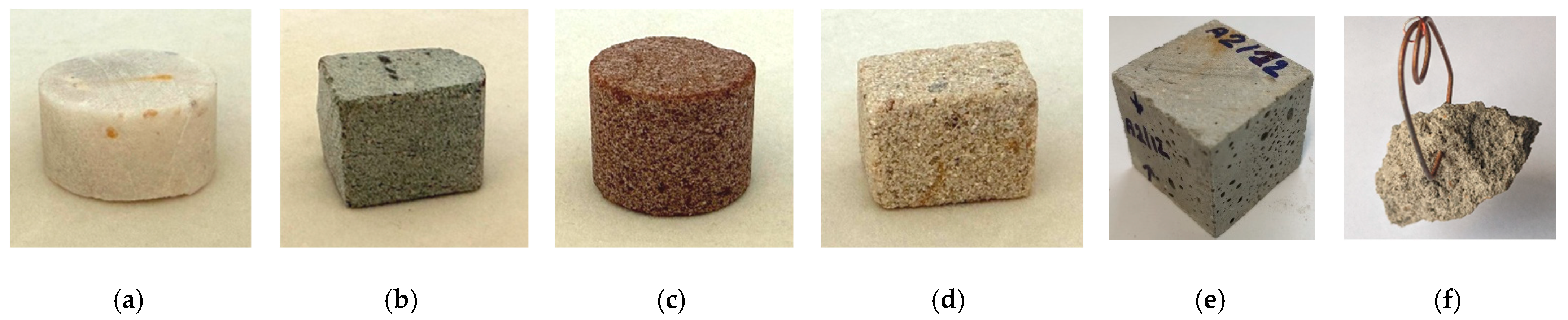
The study included natural material (rocks) and produced in laboratory composite-cement stones. The rock samples were represented by two types of natural stone: sandstone and limestone. A limestone sample from Czatkowice and sandstone samples from Brenna, Tumlin, and Radków were prepared in the form of pieces with different shapes (see Figure 2a–f). These rocks contain pores and fractures that enable the accumulation of reservoir fluids in the form of gases and liquids [11].
Table 1 presents the general characteristics of the examined rocks and the grain-skeleton composition of the Brenna and Tumlin sandstones.
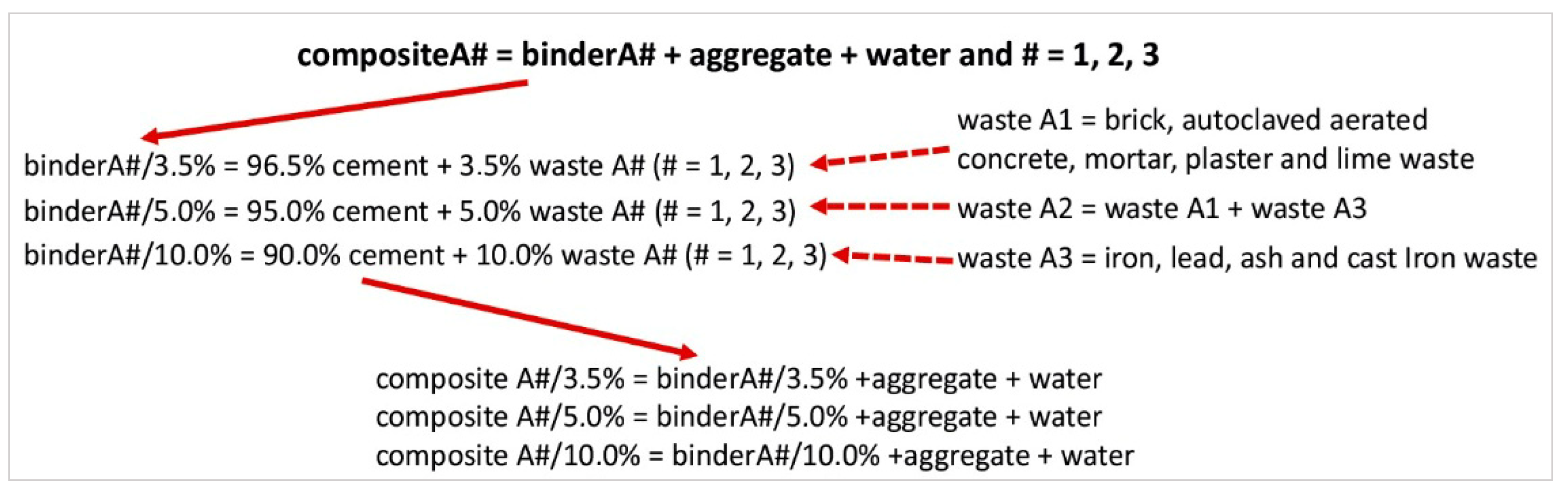
In this work, we use the term composite-cement stones to describe sustainable building materials that were a mixture of cement, aggregate, water, and powdered waste, which partially replaced Portland cement. Ten samples were obtained from a cement mortar containing various waste-material mixtures. The fabrication process of the composite-cement stones (called later as composites) is presented in Figure 3.
Waste mixture A1 contained bricks, autoclaved aerated concrete, masonry mortar, gypsum, and limestone waste. Waste mixture A3 contained iron, lead, ash, and cast-iron residues. Finally, waste A2 contained all nine listed wastes and therefore represented the combined composition of A1 and A3. Cement was partially replaced by waste A1, A2, or A3. The percentage content of waste substituting cement in the composite was 3.5%, 5%, and 10% by weight, respectively. Figure 2e shows an example composite-cement stone removed from the cubic mold after 28 days of curing required to achieve constant poro-mechanical properties. Each of the 10 composites was broken into fragments of sizes comparable to those of the tested rock samples (see Figure 2f). The porous composite samples had a mass of approximately 7 g, because the spring balance was calibrated to a specific sample size limited by the measuring range.

2.2. Hydrostatic Displacement Method

2.2.1. Experimental Setup for Bulk Density Measurement

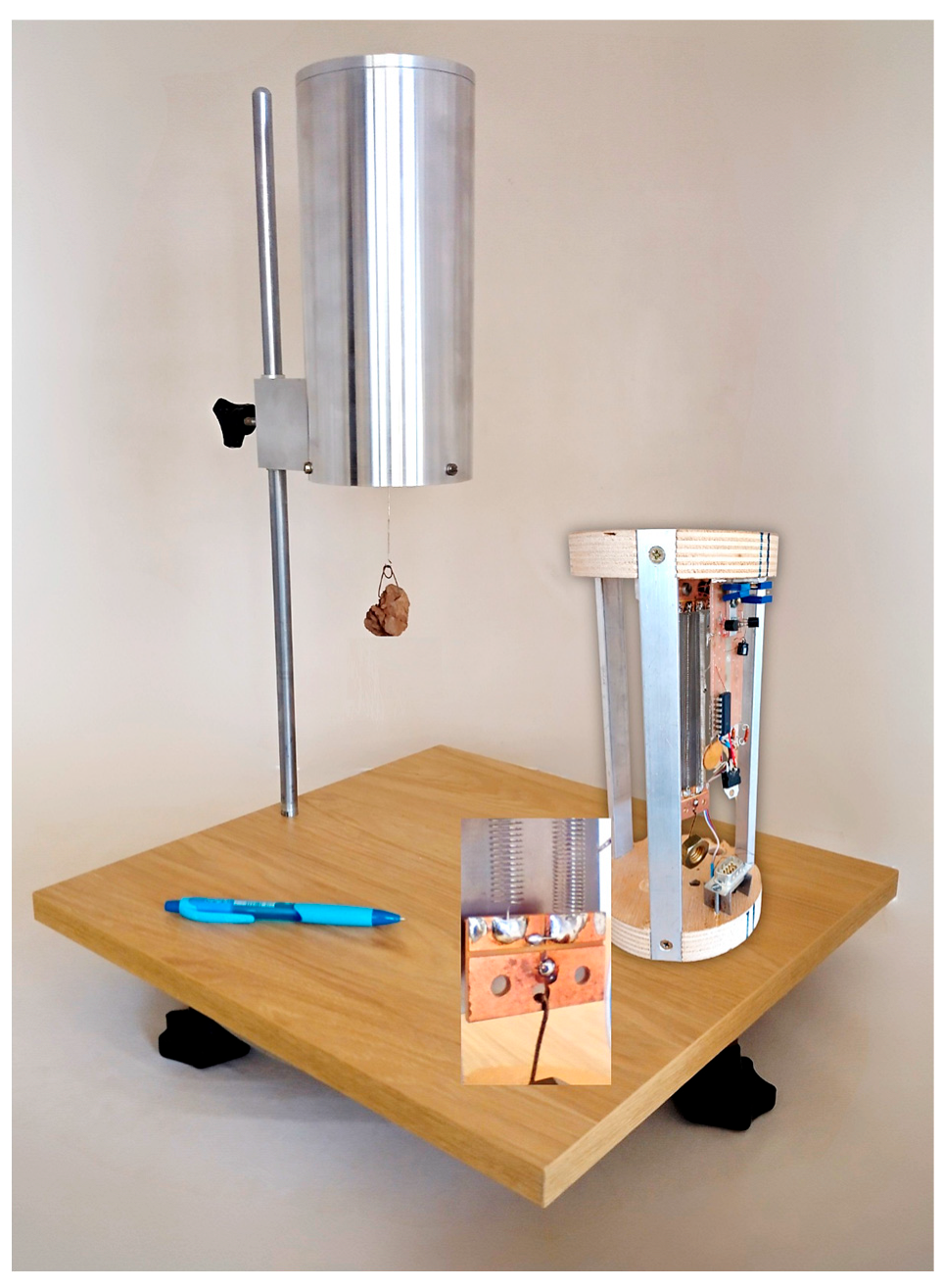
Measurement of bulk density was carried out using the hydrostatic buoyancy method with a high-sensitivity spring balance, as described in detail in the study [30]. The device employed a weight-to-frequency LC-oscillator transducer. In this transducer, the springs served simultaneously as the mechanical sensing element and as the inductive component of the LC resonant circuit. Variations in inductance caused by changes in spring elongation under the load of the suspended object resulted in a change in oscillation frequency. Figure 4 shows the experimental setup with the sample suspended on the inductive spring balance. Determination of the bulk density was based on measuring the difference between the weight of the object in the air and its weight in the liquid.
The measuring range of a balance depends on the springs used, allowing measurements from several grams to kilograms with a relative resolution of 10−5. In Archimedes’ method of volume measurement, the container containing the liquid cannot load the balance, as only the sample is being weighed. The advantage of a spring balance is that the weight is suspended below the balance, so the sample can be easily immersed in and removed from the liquid. In a traditional balance, the weight is at the top of the balance, making it difficult to place the container containing the liquid outside the balance while weighing the sample immersed in the liquid.
From the perspective of the buoyancy method, the following types of materials should be distinguished:
Well absorbing the buoyancy liquid (e.g., sandstone, concrete);
Slightly absorbing the liquid (e.g., limestone, basalt);
Soluble in the liquid (e.g., salt in water) or materials that disintegrate in the liquid (e.g., clay in water);
Insoluble or slightly soluble in the liquid (e.g., limestone, marble).

2.2.2. Procedure

Bulk density measurements of the rock and composite samples were carried out according to the procedure for determining bulk density using the buoyancy method, recommended by the European Union standards (PN-88/B-04481 [33], EN-1936 2008 [24]; EN ISO 10545-3 2018 [25]), as well as suggested by the International Society for Rock Mechanics [34] as a standard testing method. The dried samples were suspended on the balance linkage and saturated in the water until complete filling of the pores.
The determination of bulk density by the buoyancy method is straightforward for materials that do not absorb the measuring liquid. In contrast, for materials that absorb the liquid, the procedure becomes more complex. In the former case, it is sufficient to measure the weight of the dry sample and the weight of the sample submerged in the liquid. The bulk density ρ of the sample is then calculated using Archimedes’ principle according to the following formula:
ρ = ρ r h m d m d m h
where ρrh is the density of the buoyancy liquid, and md and mh are the dry mass and submerged in the liquid mass of the sample, respectively. For a material that absorbs the buoyancy liquid, the sample must first be weighed in the dry state and then saturated with the liquid. After saturation, the sample is weighed in the air and in the liquid. In this case, the density ρ is given by:
ρ = ρ r h m d m s a m s h
in which msa and msh are the masses of the saturated sample measured in the air and in the liquid, respectively.
When a sample is immersed in a liquid, air bubbles are created by the displacement of gas from pores and/or entrapment of air in sample irregularities. They accumulate, particularly on its lower surface. The error caused by air bubbles can be significant. If water is used as the buoyancy liquid, it is crucial to ensure that no air bubbles remain on the surface of the sample during weighing in water. Even if the sample does not absorb water, bubbles may attach to its surface when submerged. This issue is particularly important for small samples (below 10 cm3) or flat samples, due to their high surface-to-volume ratio. Based on the conducted trials and tests, it was demonstrated that inserting the sample into the measuring liquid twice removes the air bubbles that adhere to the sample surface during the first immersion. In this study, the bulk density determined using the inductive spring balance was obtained with a measurement uncertainty of 1.67∙10−3 [30].
The research consisted of two stages. The first stage involved analyzing the absorbability of porous natural stones represented by rocks of various origin and internal structures. The second stage focused on sustainable building materials produced according to different preparation procedures (composites).

2.3. Additional Methods

The obtained results were evaluated against the readings of a laboratory balance and high-precision pycnometers. The helium pycnometry method was used, enabling an accurate determination of the skeletal density (ρₛ), and the quasi-liquid method was used to determine bulk density performed on an AccuPyc 1340 and a GeoPyc 1360 instrument (Micromeritics Instrument Corporation, Norcross, GA, USA). In the calculations, the density of water was assumed to be 0.998 g/cm3. The samples were weighed on an AXIS® (Gdańsk, Poland) analytical laboratory balance.

3. Results

3.1. Water Saturation of Porous Sample Absorbing the Buoyancy Liquid

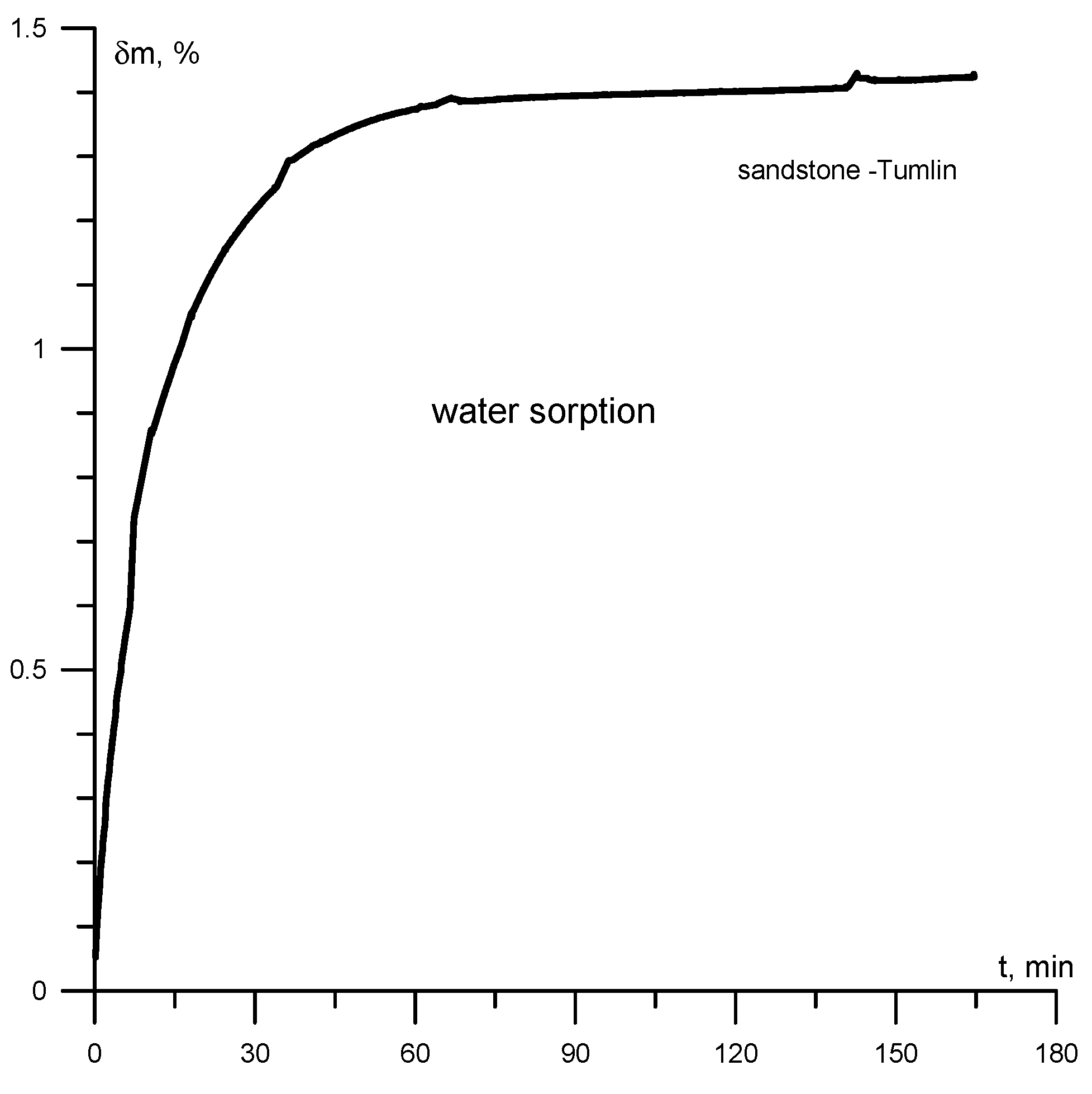
In the investigation of rocks, density measurements were difficult due to the absorption of the measuring liquid by the porous sample. The tests concerned bulk density measurements; therefore, the helium method could not be applied because it is suitable only for determining skeletal density. For water absorbing samples, after weighing the dry material (md), the sample was fully saturated with the liquid, and the temporal course of the saturation process was recorded (Figure 5).
For the Tumlin sandstone, water saturation was complete after 180 min. An intensive increase in sample mass was observed during the first 40 min, resulting from the saturation of the accessible pore space. As shown in previous studies, the Tumlin sandstone exhibits a medium-grained texture and a porosity of approximately 11.9% [35]. The sample is dominated by intergranular open porosity, which allows water uptake sufficient to achieve full saturation within roughly 60 min. The Tumlin sandstone absorbed water amounting to 1.4% of its mass.
Once saturation was complete, which may take from several dozen minutes to several hours, the sample was removed from the water and weighed. The sample was then re-submerged in water and subsequently weighed again.
Saturation of the sample with water, which consists of filling the open pore space, involves displacing the air contained within the pores. Because the density of air is lower than the density of water, saturation of the sample becomes feasible. Since no preliminary evacuation of the pores is performed—as is the case in skeletal density measurements, where saturation follows prior degassing—achieving 100% saturation and thus reaching the skeletal volume would also be theoretically possible without vacuum. However, such a process requires considerable time, which poses a significant limitation in laboratory measurements.

3.2. Studies of Porous Rock Samples

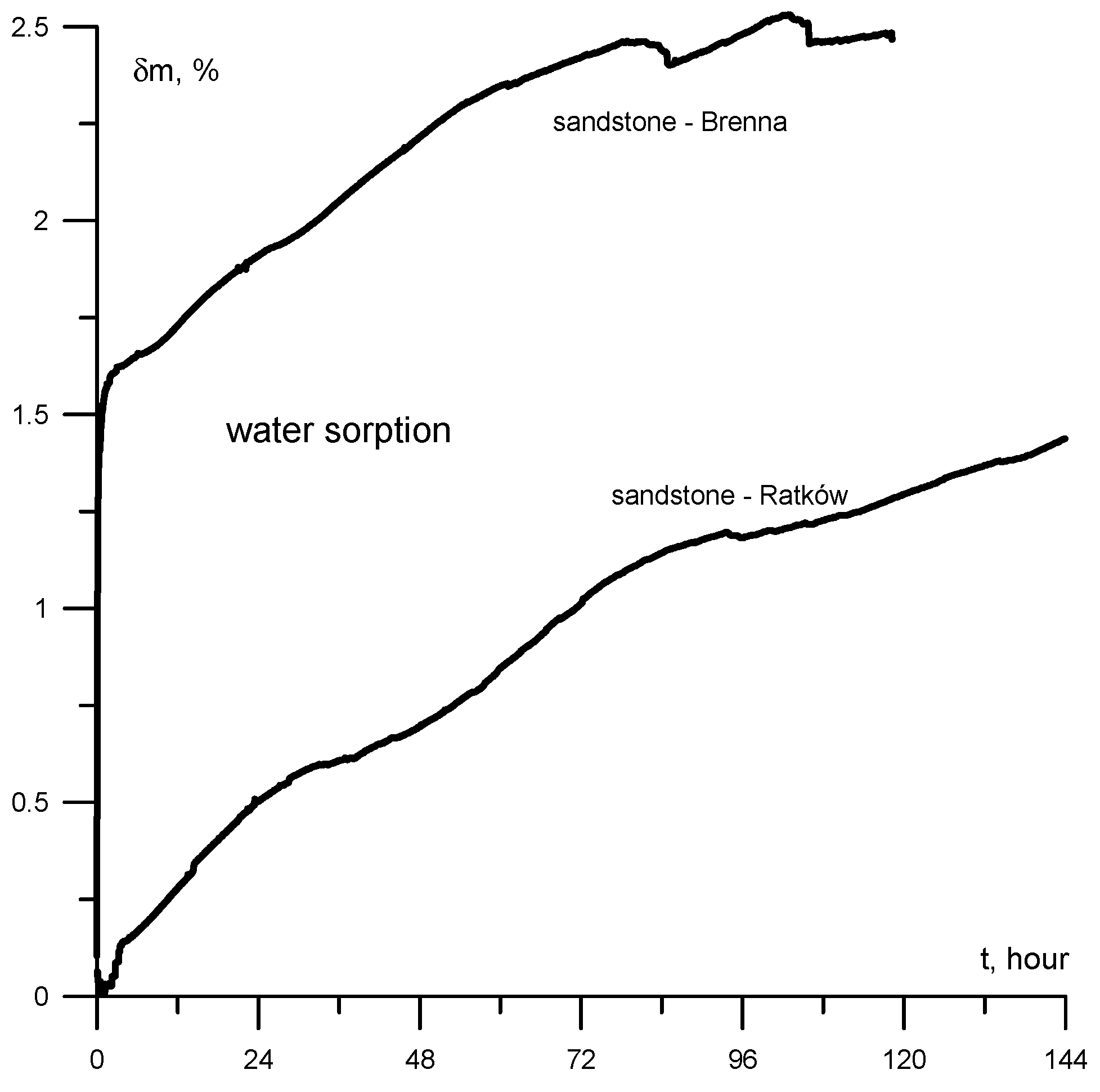
This stage of the study involved determining the bulk density of rocks with different porosity levels, either weakly or strongly absorbing the measuring liquid (water). Observations were carried out after immersing each sample in the liquid and during the waiting period required for full saturation of the pore space. Figure 6 presents long-term saturation curves for porous sandstone samples, Brenna and Radków, covering between 6 and 7.5 days of observation.
In the case of the Radków sandstone, which had the highest porosity among the tested rocks, the saturation kinetics were still incomplete after 144 h. The Radków sandstone is coarse-grained with a heterogeneous grain-size distribution. The stepped character of the saturation curve (see Figure 6) resulted from the slow detachment of air bubbles from the sample, followed by water uptake as the displaced air escaped from the porous structure. As a result, this distinctly porous sample was highly susceptible to water saturation, which may be relevant for the performance of products derived from this rock. High water absorption may contribute to frost and mechanical damage. After six days, the Radków sandstone had absorbed 1.5% of its mass. Full saturation would require further monitoring of the process until the skeletal volume was reached.
The saturation behavior of the Brenna sandstone differed from that of the Radków sample. The Brenna sandstone is fine-grained and exhibits open porosity of both intergranular and intragranular type [35]. As it may be seen in Figure 6, during the first minutes of saturation, a rapid increase in absorbed water was observed. After approximately one hour, the sample absorbed water equal to 1.6% of its mass, and the subsequent course of the process was slower and comparable to the Radków sandstone (similar slope of the kinetic curves). After about 120 h of saturation, the Brenna sandstone absorbed more than 2.5% of its mass.
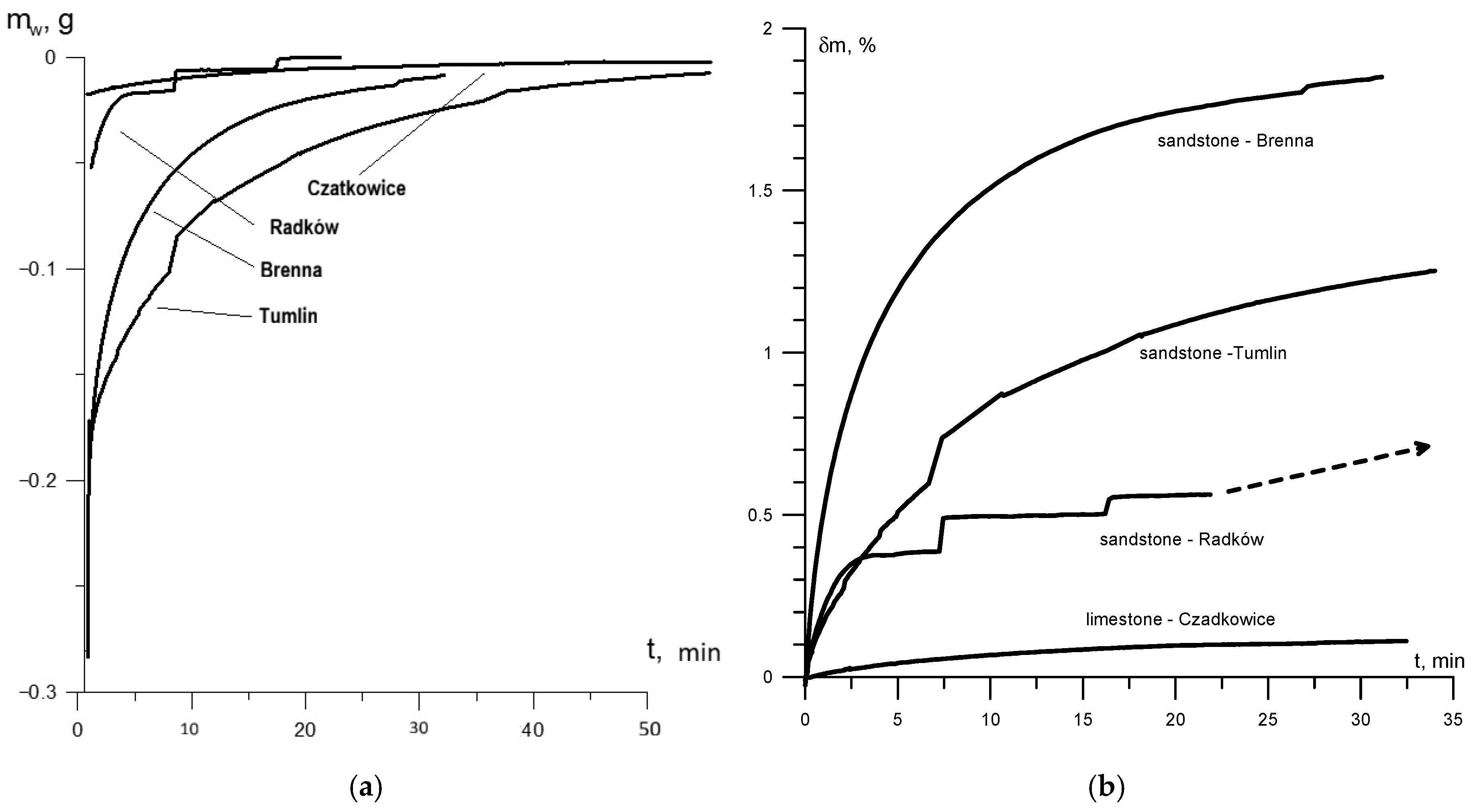
Figure 7 compares the initial water saturation curves of the tested rocks. To highlight the differences between samples, the plots in Figure 7a were shifted so that the y-axis origin corresponds to the asymptotic value representing the filling of open pores during the initial stage (up to 30 min). As seen in Figure 7a, the Radków sandstone absorbed 0.051 g of the water, corresponding to a mass increase of 0.55% (see Figure 7b). For the remaining samples, the following mass increases were obtained: limestone 0.020 g (0.16%), Tumlin sandstone 0.28 g (2.3%), and Brenna sandstone 0.18 g (1.87%). For the sandstones, the initial saturation period covering the first two minutes was highly dynamic (see Figure 7a). In contrast, the Czatkowice limestone exhibited no such rapid change, which is consistent with its structure. This limestone is a nearly monomineralic rock composed of calcite with numerous fine intergranular pores [35]. Its porosity is low, equal to 0.7% [36].
From the saturation curves shown in Figure 7b, it is evident that after 30 min only, the limestone sample reached a state close to saturation. The time was insufficient to fully saturate the sandstones. The Radków sandstone, with a porosity of 15.1%, continued to absorb water; the Tumlin sandstone also showed ongoing saturation, and although the Brenna sandstone (porosity 7.5%) appeared close to saturation, it still absorbed water.
The results of the bulk density measurements and absorbability for the studied rock samples are summarized in Table 2, where the mass increase δm [%] is the water absorption value obtained in 20 min of the water absorption measurement, while water absorption data [%] is the value in the fully saturated state (equilibrium absorption value).

3.3. Porous Samples Absorbing Liquids—Composites

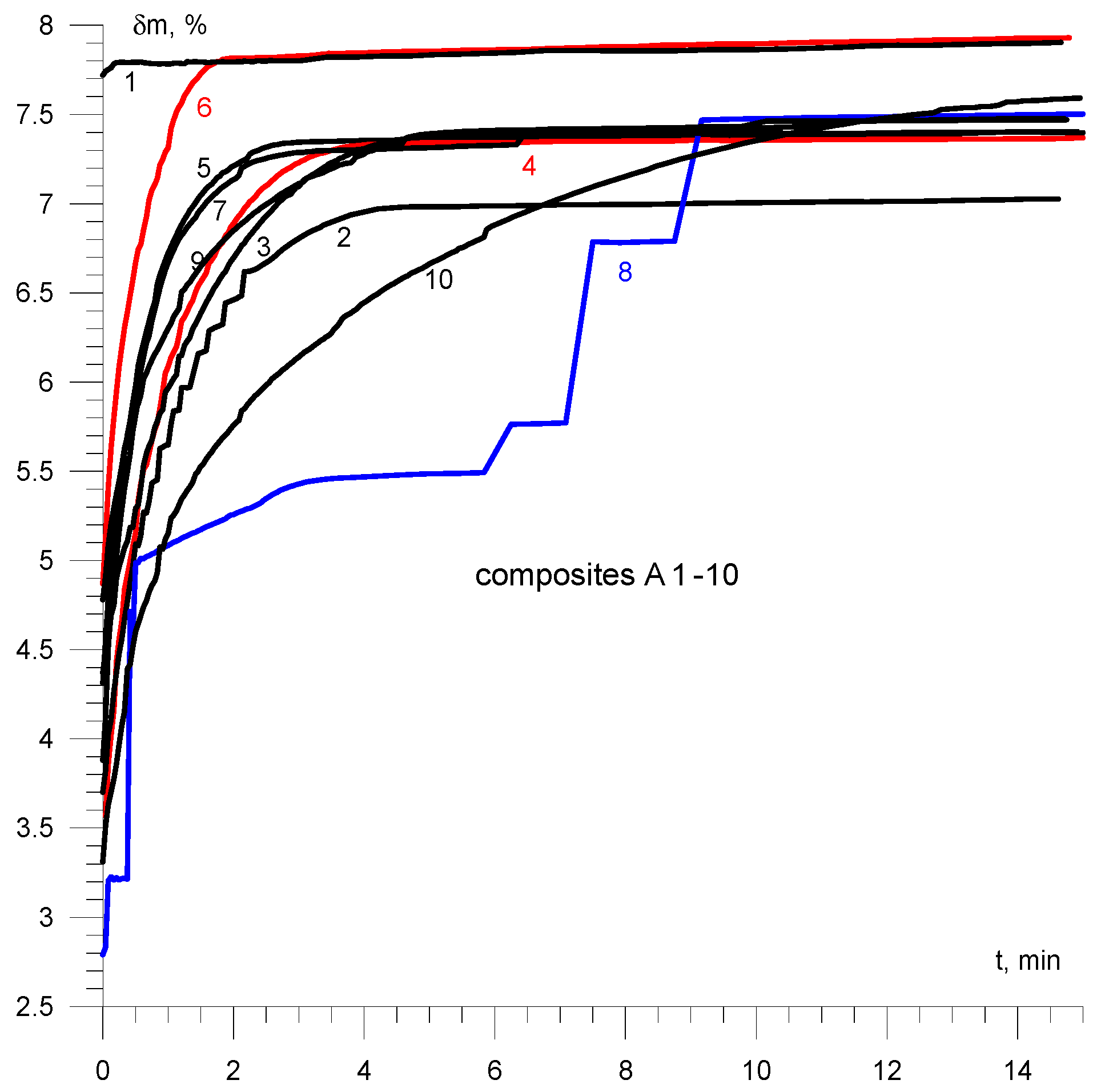
This stage of the research focused on determining the bulk density and porosity of composite-cement stones produced using waste-based constituents. The properties of the tested samples are summarized in Table 3. Similarly to the rock samples, the pore space saturation process was performed composite samples prepared according to Figure 3. The water absorption behavior of the composite samples is shown in Figure 8. As illustrated in Figure 8, saturation with water progressed at different rates, although the required time to complete the process generally did not exceed 15 min. After the measurement was completed, the samples were dried and tested on pycnometers—a helium pycnometer AccuPyc to determine the skeletal density and a quasi-liquid GeoPyc pycnometer to determine the bulk density (see Table 3). Such measurements enabled us to compare the results obtained using the buoyancy method and those obtained with commonly used commercial devices.
As it may be seen from Figure 8, for most samples (9 out of 10), full saturation was achieved in approximately 5 min, which was significantly shorter than in the case of porous rocks. Sample A10 required a considerably longer observation period to reach near-complete pore water filling. After several minutes of measurement, a condition close to full saturation was observed. This duration was comparable to the time required to complete ten consolidation cycles of the DryFlo layer in the GeoPyc pycnometer.
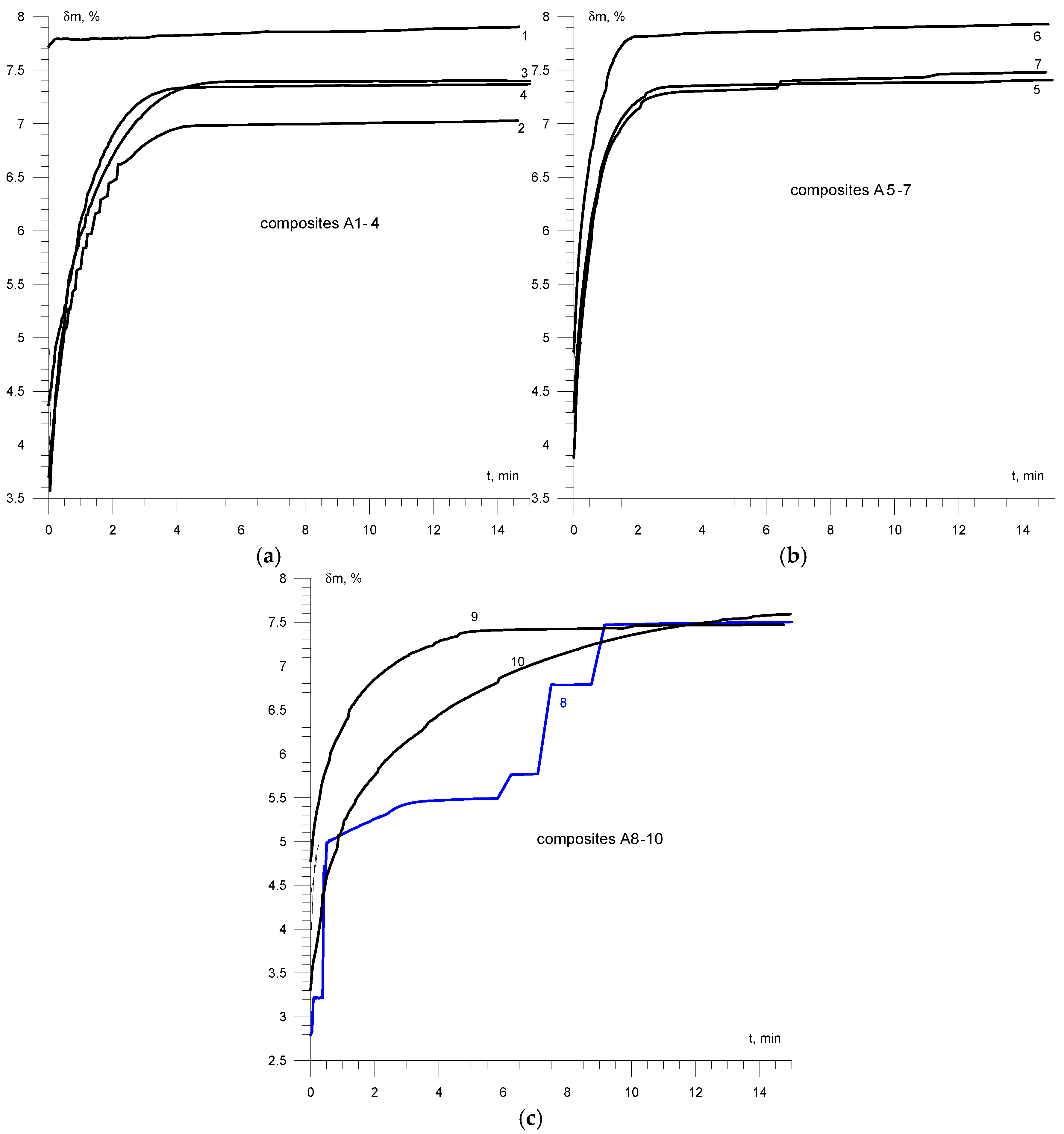
Based on Figure 9, saturation of composite-cement stones produced from different mixtures resulted in a noticeable variation in the saturation behavior. For pure cement (sample A1), a continuous percentage increase in mass due to water uptake was observed. After 60 min of testing, the pure cement sample still exhibited ongoing saturation. In the case of composites modified with waste A1 (samples A2–A4), saturation was completed within 10 min, and the samples reached a constant absorption level (see also Figure 9a). The bulk density of composite A2 determined by hydrostatic weighing was 2.011 g/cm3, while samples A3 and A4 exhibited nearly identical values of 1.994 g/cm3. These values corresponded to the bulk density of the pure cement sample A1. The total porosity of composites A1–A4 (see Table 3) was 22.5%, and the increasing waste A1 content led to a slight increase in total porosity. Sample A2 exhibited the highest open porosity and simultaneously the lowest closed porosity (0.51%) among the composites containing waste A1 (see Table 3).
For the composites presented in Figure 9b, it is evident that the saturation kinetics of materials incorporating waste A2 did not reach a constant saturation level even after 60 min of measurement. The trend of the curves indicated that water penetration into the pore structure was continued. Increasing the content of waste A2 in the cement resulted in a rise in the total porosity of the composite from 22.06% for sample A5 to 24.20% for sample A7. Additionally, sample A7 exhibited the highest open porosity (23.85%) and simultaneously the lowest closed porosity (0.35%) among the composites modified with waste A2 (see Table 3).
As shown in Figure 9c, the saturation kinetics of composites containing waste A3 exhibited the greatest variability. Samples A8 and A9 reached a constant absorption level after 10 min and showed similar total porosity values of 22.77% for A8 and 22.54% for A9.

4. Discussion

Water absorption measurements conducted for natural stone (limestone and sandstones) have shown that the 24 h measurement procedure recommended by standards may not provide an overall result, and sample absorbability may be underestimated. The process of sample preparation undoubtedly has a significant impact on the time required for complete absorption of the available pore space. It appears that the skeletal density measurement procedure, which recommends degassing the sample under vacuum, will accelerate the water absorption and produce a result that is closer to the actual value after 24 h of soaking.
In the case of composite-cement stones, which were prepared with an admixture of recycled waste, the saturation process was completed within a few minutes. This is incomparably faster than the water saturation for natural rocks.
The pore structure in rocks such as sandstones is complex and irregular. The network of channels connecting quartz grains and minerals varies from microscopic to larger pores. This was evident in the obtained water saturation kinetics, which encompassed a long-term process, lasting up to several days. As can be seen in Figure 5, the water saturation kinetics is characterized by two stages, indicating the heterogeneity of the pore structure. The first stage, lasting about 24 h, indicates the filling of large spaces, while the second, slower stage is associated with the filling of fine pores, which require time for water to penetrate. However, the Tumlin sandstone is characterized by a medium-grained, macroporous texture, in contrast to the heterogeneously porous Brenna and Radków sandstones. As discussed in Section 3.2, the Radków sandstone is coarse-grained and characterized by a heterogeneous grain size distribution. It also exhibits a diverse pore structure.
Composite-cement stones were more homogeneous and did not possess the extensive pore network of natural rocks. The complete saturation process did not exceed 20 min, and the composition of the cement admixture influenced the nature of the saturation curve. Based on the conducted observations, it is clear that the internal structure and pore space of the rocks are more extensive and complex. Their absorbability characteristics require achieving a state of full saturation (equilibrium absorption), which requires long-term testing.
When analyzing the bulk density results from Table 3, it is important to note the values obtained using the GeoPyc pycnometer and those obtained by the hydrostatic buoyancy method on a spring balance. As can be seen from Table 3, changing the A1, A2, or A3 waste content in the composite resulted in subtle changes in the bulk density determined on the spring balance (piece). These changes were subtle enough to capture the impact of a minor percentage change in Portland cement substitute on changes in bulk density and also the porosity. With the commercial device GeoPyc, detecting the impact of those minor changes in cement composition for the prepared composites was not possible. The manufacturer’s declared repeatability 1.1% and insufficient accuracy, which is sufficient for rocks, may not be suitable for testing sustainable materials, especially when selecting appropriate cement mixtures composition. It turned out that our inductive spring balance enabled the detection of small changes in sample density, and consequently, their porosity, which could not be achieved with the commonly used method using DryFlo powder. The hydrostatic buoyancy method, which utilizes a precise spring balance, enabled the complementary characterization of natural and engineered materials in a single test, including assessment of bulk density, porosity, and water absorption.
The hydrostatic buoyancy method, modified by Nurkowski et al. [30], is suitable for testing composite-cement stones. The high accuracy of the results obtained from water saturation and bulk density testing enables reliable testing of waste-based materials. This is especially important because the characterization of sustainable materials is closely related to their strength, permeability, and frost resistance. Accurate determination of these properties is essential for developing appropriate mixture compositions for obtaining sustainable materials as well as for selecting their best applications.

5. Conclusions

This study demonstrates that commonly used methods for bulk density measurement, which are effective for natural stone characterization, may not be sufficient for a reliable assessment of sustainable composites (cementitious mixtures containing recycled waste) in terms of assessing porosity. The hydrostatic buoyancy method using the inductive spring balance enabled the detection of small changes in sample bulk density, and consequently, their porosity, which could not be achieved with the commonly used method using DryFlo powder. The method is useful to study the impact of slight compositional changes in sustainable cements on key performance characteristics such as mechanical strength or frost resistance.
The 24 h standard method for measuring water absorption proved to be adequate for testing composite-cement stones, but for rocks such as sandstone and limestone, it resulted in an underestimation of the absorbability. To assess the water absorption of rocks, it was necessary to soak the rock with water until it was fully saturated, thus obtaining an equilibrium absorbability value. The 24 h method proved to be too long for composite-cement stones, and the absorbability value was obtained after 30 min.
The hydrostatic buoyancy method, which utilizes a precise spring balance, enabled the complementary characterization of natural and engineered materials in a single test, including the assessment of bulk density, porosity, and water absorption.
The findings are relevant from an environmental perspective, as they contribute to improved characterization and quality assessment of products with a reduced environmental impact. The findings presented in this paper can be considered in a broader context and can help prevent fault water inflow in coal mines, based on analyses of seepage in fractured rock mass [37]. The observations presented in this work can also contribute to the assessment of crack propagation leading to coal destruction [38].

Author Contributions

Conceptualization, B.D. and J.N.; methodology, J.N. and S.R.; software, J.N.; validation, B.D., M.T., S.R. and J.N.; formal analysis, M.T.; investigation, B.D.; resources, B.D. and S.R.; data curation, S.R. and J.N.; writing—original draft preparation, B.D.; writing—review and editing, J.N.; visualization, J.N.; supervision, B.D.; project administration, B.D.; funding acquisition, B.D. All authors have read and agreed to the published version of the manuscript.

Funding

This work was supported by the Ministry of Science and Higher Education in Poland. The funding concerned a project entitled “Station for measuring bulk density and moisture sorption using a high-sensitivity spring balance” [grant number FBW/D/2023–2024/02/2024], financed from the Scientific Research Fund of the Strata Mechanics Research Institute of the Polish Academy of Sciences.

Institutional Review Board Statement

Not applicable.

Informed Consent Statement

Not applicable.

Data Availability Statement

All data used to create the article are available from the authors.

Acknowledgments

This work was prepared as a part of the joint Polish–Romanian project “Macro and micro strength tests on composite-cement stones” under the agreement on scientific cooperation between the Polish Academy of Sciences and the Romanian Academy. The authors would like to thank Simona Rada for providing the research material and necessary information regarding the wastes used.

Conflicts of Interest

The authors declare no conflicts of interest.

References

  1. Tang, Z.; Li, W.; Tam, V.W.; Xue, C. Advanced progress in recycling municipal and construction solid wastes for manufacturing sustainable construction materials. Resour. Conserv. Recycl. X 2020, 6, 100036. [Google Scholar] [CrossRef]
  2. Rao, A.; Jha, K.N.; Misra, S. Use of aggregates from recycled construction and demolition waste in concrete. Resour. Conserv. Recycl. 2007, 50, 71–81. [Google Scholar] [CrossRef]
  3. Dutka, B.; Rada, S.; Godyń, K.; Moldovan, D.; Chelcea, R.I.; Tram, M. Structural and Textural Characteristics of Municipal Solid Waste Incineration Bottom Ash Subjected to Periodic Seasoning. Sustainability 2024, 16, 9597. [Google Scholar] [CrossRef]
  4. Wu, J.; Ye, X.; Cui, H. Recycled Materials in Construction: Trends, Status, and Future of Research. Sustainability 2025, 17, 2636. [Google Scholar] [CrossRef]
  5. Chen, L.; Yang, M.; Chen, Z.; Xie, Z.; Huang, L.; Osman, A.I.; Farghali, M.; Sandanayake, M.; Liu, E.; Ahn, Y.H.; et al. Conversion of waste into sustainable construction materials: A review of recent developments and prospects. Mater. Today Sustain. 2024, 27, 100930. [Google Scholar] [CrossRef]
  6. Safiuddin, M.; Alengaram, U.J.; Rahman, M.M.; Salam, M.A.; Jumaat, M.Z. Use of recycled concrete aggregate in concrete: A review. J. Civ. Eng. Manag. 2013, 19, 796–810. [Google Scholar] [CrossRef]
  7. Rada, R.; Manea, D.L.; Chelcea, R.; Rada, S. Nanocomposites as Substituent of Cement: Structure and Mechanical Properties. Materials 2023, 16, 2398. [Google Scholar] [CrossRef]
  8. Tram, M.; Sułkowska, K.; Jarosz, A.; Nowakowski, A. Mechanical Properties of Composite Made from Bottom Ash Fractions of Municipal Waste Incineration Plant Products. Materials 2025, 18, 5302. [Google Scholar] [CrossRef] [PubMed]
  9. Ahammed, M.R.; Mia, M.B.; Raihan, M.A.; Hossain, M.N.; Hossen, M.; Md Hasan, S. An Overview of Conventional Construction Materials And Their Characteristics. N. Am. Acad. Res. 2024, 7, 1–13. [Google Scholar] [CrossRef]
  10. Ortiz-Marqués, A.; Caldevilla, P.; Goldmann, E.; Safuta, M.; Fernández-Raga, M.; Górski, M. Porosity and Permeability in Construction Materials as Key Parameters for Their Durability and Performance: A Review. Buildings 2025, 15, 3422. [Google Scholar] [CrossRef]
  11. Zhao, C.; Zhou, W.; Hu, Q.H.; Xu, H.; Zhang, C. Porosity Measurement of Granular Rock Samples by Modified Bulk Density Analyses with Particle Envelopment. Mar. Pet. Geol. 2021, 133, 105273. [Google Scholar] [CrossRef]
  12. Mindaugas, A.; Karolis, B.; Dobilaitė, V.; Jucienė, M.; Artūras, S. Towards sustainable construction: Methodology for wood content assessment in buildings. Case Stud. Constr. Mater. 2025, 23, e05528. [Google Scholar] [CrossRef]
  13. Tiu, E.S.K.; Ha, J.X.X.; Arashpour, M.; Raman, S.N. Hydration mechanism of cement-based composites incorporating ground pond ash: Towards sustainable building and infrastructure solutions. J. Build. Eng. 2025, 112, 113804. [Google Scholar] [CrossRef]
  14. Xu, M.; Takasu, K.; Wang, Y.; Liu, Z.; Suyama, H. Synergistic effects of mixed biomass fly ashes on cement mortar performance: A strategy for sustainable and low-carbon building materials. J. Build. Eng. 2025, 112, 113691. [Google Scholar] [CrossRef]
  15. Oyebisi, S.; Alomayri, T. Revolutionizing eco-friendly concrete: Unleashing pulverized oyster shell and corncob ash as cement alternatives for sustainable building. Constr. Build. Mater. 2025, 484, 141776. [Google Scholar] [CrossRef]
  16. Firoozi, A.A.; Firoozi, A.A.; Oyejobi, D.O.; Avudaiappan, S.; Flores, E.S. Emerging trends in sustainable building materials: Technological innovations, enhanced performance, and future directions. Results Eng. 2024, 24, 103521. [Google Scholar] [CrossRef]
  17. Carmona-Ramirez, J.D.; Bedoya-Henao, C.A.; Cabrera-Poloche, F.D.; Taborda-Llano, I.; Viana-Casas, G.A.; Restrepo-Baena, O.J.; Tobon, J.I. Exploring sustainable construction: A case study on the potential of municipal solid waste incineration ashes as building materials in San Andres island. Case Stud. Constr. Mater. 2025, 22, e04351. [Google Scholar] [CrossRef]
  18. Singh, S.; Dalbehera, M.M.; Maiti, S.; Bisht, R.S.; Balam, N.B.; Panigrahi, S.K. Investigation of agro-forestry and construction demolition wastes in alkali-activated fly ash bricks as sustainable building materials. Waste Manag. 2023, 159, 114–124. [Google Scholar] [CrossRef] [PubMed]
  19. Jin, D.; Meyer, T.K.; Chen, S.; Boateng, K.A.; Pearce, J.M.; You, Z. Evaluation of lab performance of stamp sand and acrylonitrile styrene acrylate waste composites without asphalt as road surface materials. Constr. Build. Mater. 2022, 338, 127569. [Google Scholar] [CrossRef]
  20. Qiu, J.; Khalloufi, S.; Martynenko, A.; Van Dalen, G.; Schutyser, M.; Almeida-Rivera, C. Porosity, Bulk Density, and Volume Reduction During Drying: Review of Measurement Methods and Coefficient Determinations. Dry. Technol. 2015, 33, 1681–1699. [Google Scholar] [CrossRef]
  21. Agrawal, S. Simplified Measurement of Density of Irregular Shaped Composites Material Using Archimedes Principle by Mixing Two Fluids Having Different Densities. Int. Res. J. Eng. Technol. 2021, 8, 1005–1009. [Google Scholar]
  22. Ledwaba, T.; Mbuyisa, B.; Blakey-Milner, B.; Steenkamp, C.; Du Plessis, A. X-Ray Computed Tomography vs Archimedes Method: A Head-to-Head Comparison. In MATEC Web of Conferences; Preez, W., Ed.; EDP Sciences: Les Ulis, France, 2023; Volume 388, p. 08002. [Google Scholar] [CrossRef]
  23. Mohazzab, P. Archimedes’ Principle Revisited. J. Appl. Math. Phys. 2017, 05, 836–843. [Google Scholar] [CrossRef]
  24. EN 1936:2008; Natural Stone Test Methods Determination of Real Density and Bulk Density, and of Total and Open Porosity. European Committee for Standardization: Brussels, Belgium, 2008.
  25. EN ISO 10545-3:2018; Ceramic Tiles—Part 3: Determination of Water Absorption, Bulk Porosity, Bulk Relative Density and Bulk Density. International Organization for Standardization: Geneva, Switzerland, 2018.
  26. Abzalov, M.Z. Measuring and Modelling of Dry Bulk Rock Density for Mineral Resource Estimation. Appl. Earth Sci. 2013, 122, 16–29. [Google Scholar] [CrossRef]
  27. Giesche, H. Mercury Porosimetry: A General (Practical) Overview. Part. Part. Syst. Charact. 2006, 23, 9–19. [Google Scholar] [CrossRef]
  28. Serway, R.; Jewett, J. Physics for Scientists and Engineers with Modern Physics; Thomson Higher Education: Belmont, CA, USA, 2008. [Google Scholar]
  29. Smithwick, R.W. A Generalized Analysis for Mercury Porosimetry. Powder Technol. 1982, 33, 201–209. [Google Scholar] [CrossRef]
  30. Nurkowski, J.; Tram, M.; Dutka, B. Measurement of bulk density using the Archimedes method with an inductive spring balance. Metrol. Meas. Syst. 2025, 32, 1–13. [Google Scholar] [CrossRef]
  31. Li, Y.; Ren, S. (Eds.) Chapter 2—Basic Properties of Building Decorative Materials. In Building Decorative Materials; Woodhead Publishing Series in Civil and Structural Engineering; Woodhead Publishing: Cambridge, UK, 2011; pp. 10–24. [Google Scholar] [CrossRef]
  32. ASTM D570-22; Standard Test Method for Water Absorption of Plastics. American Society for Testing and Materials: West Conshohocken, PA, USA, 1995.
  33. PN-88-B-04481; Grunty Budowlane. Badanie Próbek Gruntu. Badanie Wilgotności OPTYMALNEJ i Maksymalnej Gęstości Objętościowej Szkieletu Gruntowego. Polish Committee for Standardization: Warsaw, Poland, 1988.
  34. Ulusay, R.; Hudson, J.A. The Complete ISRM Suggested Methods for Rock Characterisation, Testing and Monitoring: 1974–2006; ISRM Turkish National Group: Ankara, Turkey, 2007; pp. 83–98. [Google Scholar]
  35. Godyń, K.; Dutka, B.; Tram, M. Application of Petrographic and Stereological Analyses to Describe the Pore Space of Rocks as a Standard for the Characterization of Pores in Slags and Ashes Generated after the Combustion of Municipal Waste. Materials 2023, 16, 7706. [Google Scholar] [CrossRef]
  36. Lech, R. Properties of the limestones and of the product of their thermal dissociation Part I. The limestones. Cem.-Wapno-Beton=Cem. Lime Concr. 2011, 16, 148–160. [Google Scholar]
  37. Yunlong, J.; Zhengzheng, C.; Zhenhua, L.; Feng, D.; Cunhan, H.; Haixiao, L.; Wenqiang, W.; Minglei, Z. Nonlinear evolution characteristics and seepage mechanical model of fluids in broken rock mass based on the bifurcation theory. Sci. Rep. 2024, 14, 10982. [Google Scholar] [CrossRef]
  38. Lin, H.; Zhang, W.; Guo, S.; Zhang, X.; Wang, L.; Zhang, J. Study on the energy evolution mechanism and fractal characteristics of coal failure under dynamic loading. ACS Omega 2025, 10, 54710−54719. [Google Scholar] [CrossRef]
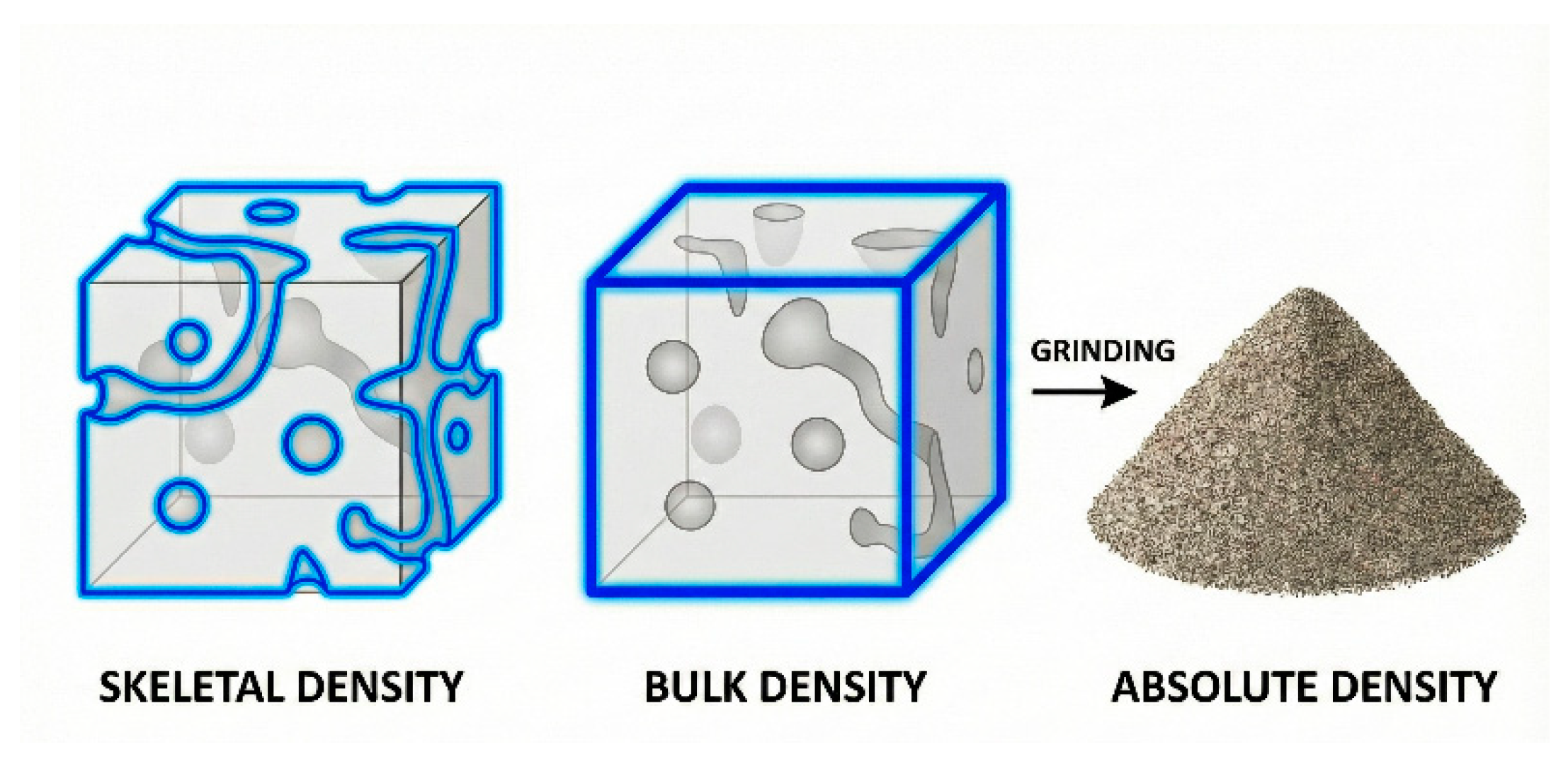
Figure 1. Types of density for porous materials.
Sustainability 18 00198 g001
Figure 2. Rock samples and waste-based composites prepared for the study. (a) Czatkowice limestone; (b) Brenna sandstone; (c) Tumlin sandstone; (d) Tumlin sandstone; (e) composite after 28 days of curing; (f) crushed composite.
Sustainability 18 00198 g002
Figure 3. Preparation of porous composite-cement stones.
Sustainability 18 00198 g003
Figure 4. Experimental setup with the sample suspended on the inductive spring balance.
Sustainability 18 00198 g004
Figure 5. Saturation of Tumlin sandstone.
Sustainability 18 00198 g005
Figure 6. Long-term water saturation of sandstones Brenna and Radków.
Sustainability 18 00198 g006
Figure 7. Kinetics of rock saturation with water as (a) mass and (b) percentage changes.
Sustainability 18 00198 g007
Figure 8. Saturation of composite-cement stones presented for all samples.
Sustainability 18 00198 g008
Figure 9. Saturation of composite-cement stones produced from (a) waste A1—composites A2–A4 and pure cement (sample A1); (b) waste A2—composites A5–A7; (c) waste A3—composites A8–A10.
Sustainability 18 00198 g009
Table 1. Properties of the rock samples.
ParameterQuartzFeldsparsRock FragmentsCalcite
Czatkowice Limestone---96%
Tumlin Sandstone90.72.8%6.4%-
Brenna Sandstone73%18.9%7.9%-
Radków Sandstone89%11%1%-
Table 2. Density, porosity, and water absorption of the tested rocks.
Sample/ParameterMass [g]Skeletal
Density ρₛ
Mass
Increase
δm [%]
Bulk Density [g/cm3]Measured Porosity
[%]
Porosity
Data [%]
Water Absorption
Data [%]
Czatkowice limestone12.3812.72380.020/12.381 = 0.16%2.69071.220.7 low
Tumlin sandstone12.2842.66650.28/12.284 = 2.3%2.42409.0911.92.50%
Brenna sandstone9.642.63350.18/9.64 = 1.87%2.46606.367.52.53%
Radków sandstone9.152.53680.051/9 = 0.55%2.201113.2315.14.45%
Table 3. Composite properties obtained from density measurements using pycnometric and hydrostatic buoyancy methods.
Sample DesignationWaste TypeWaste A Content [%]Mass [g]Skeletal Density Accupyc 1340 (Piece) [cm3/g]Skeletal Density (Powder) [cm3/g]Bulk Density Geopyc 1360 (Piece) [cm3/g]Bulk Density Spring Balance (Piece) [cm3/g]Picnometric Porosity [%] (Piece)Spring Balance Open Porosity [%] (Piece)Spring Balance Total Porosity [%] (Powder)Spring Balance Closed Porosity [%] (Powder)
A1ST07.032.53792.57722.0031.997221.0821.3122.511.20
A2A13.57.632.5782.5951.7582.011431.8121.9822.490.51
A357.122.5262.5831.9481.994422.8821.0522.791.74
A4107.112.5502.5852.0311.994120.3521.8022.861.06
A5A23.57.772.5662.5972.0422.024020.4221.1222.060.94
A657.162.5312.5952.0321.973219.7222.0423.961.92
A7107.052.6152.6271.8081.991230.8623.8524.200.35
A8A33.57.492.5942.5941.9672.003324.1722.7722.770.00
A957.622.5722.6021.992.015522.6321.6422.540.90
A10107.182.5962.6211.9222.065225.9620.4521.210.76
Disclaimer/Publisher’s Note: The statements, opinions and data contained in all publications are solely those of the individual author(s) and contributor(s) and not of MDPI and/or the editor(s). MDPI and/or the editor(s) disclaim responsibility for any injury to people or property resulting from any ideas, methods, instructions or products referred to in the content.