Article

Electric Vehicle Adoption: Japanese Consumer Attitudes, Inter-Vehicle Transitions, and Effects on Well-Being

1
Faculty of Humanities and Social Sciences, Iwate University, 3-18-34 Ueda, Morioka 020-8550, Iwate, Japan
2
Faculty of Economics, Musashino University, 3-3-3 Ariake, Koto-ku, Tokyo 135-8181, Japan
3
School of Economics and Management, Yanbian University, Yanji 133002, China
*
Authors to whom correspondence should be addressed.
Sustainability 2026, 18(1), 195; https://doi.org/10.3390/su18010195
Submission received: 6 October 2025 / Revised: 11 December 2025 / Accepted: 15 December 2025 / Published: 24 December 2025
(This article belongs to the Section Sustainable Engineering and Science)

Abstract

The use of full-battery electric vehicles is an essential strategy for reducing greenhouse gas emissions and mitigating climate change. This study examined the transition to full-battery electric vehicles by conducting a cross-sectional household survey in 2023 that collected information on vehicle preferences, evaluations, purchase intentions, environmental attitudes, and socioeconomic and demographic characteristics. The results show that among households using a vehicle as their primary mode of transportation, approximately 89% relied on fossil fuel vehicles, whereas only 6% used electric vehicles. The study further finds that acceptance of vehicles during inter-vehicle transitions is closely linked to energy type: households currently owning fossil fuel vehicles exhibited a high likelihood of repurchasing a fossil fuel vehicle, while electric vehicle owners were more inclined to choose another electric vehicle across cities and areas of different sizes. Households that own electric vehicles tend to report higher levels of well-being compared with those that own fossil fuel vehicles. In addition, sufficient charging infrastructure, stronger knowledge of environmental issues, participation in altruistic donation activities, and cooperative behavior positively influenced electric vehicle adoption. These findings suggest several policy implications, including the expansion of charging stations for business and public use, setting reasonable vehicle prices, improving charging speed, developing electric vehicles suitable for large families, and encouraging individuals to gain initial driving experience with electric vehicles to promote adoption.

1. Introduction

Climate change, global warming, and biological loss have contributed to rapid changes in the natural environment. According to a report by the Intergovernmental Panel on Climate Change, since the Industrial Revolution, global economic activities have resulted in massive greenhouse gas emissions due to energy usage drawn from fossil fuels, coal, gasoline, and natural gas [1]. In response to such circumstances, the Paris Agreement in 2015 was signed, through which countries across the world set targets to achieve carbon neutrality by the 2050s [2]. Along the same lines, Japan aimed to reduce 46% of its carbon dioxide emissions by 2030 compared to its emissions in 2013 and to achieve a carbon-neutral society by the 2050s [3]. More specifically, the Japanese government has targeted a 66% carbon dioxide emission reduction in the household sector by 2030 [3]. However, to facilitate the achievement of carbon neutrality, investigations into households’ decisions and evaluation of no-emission energy resources are crucial. Notably, among the 17 sustainable development goals proposed by the United Nations [2] to enhance human well-being, the first goal relates to eradicating poverty, the third goal focuses on maintaining good health and well-being, and the thirteenth goal is climate action.
On the one hand, the widespread use of full-battery electric vehicles powered by electricity generated from renewable energy or nuclear power has been considered a crucial step toward mitigating carbon emissions [4,5,6,7]. It has already been established that the transportation sector contributes to a significant amount of carbon dioxide emissions, and this share is expected to increase by 50% by 2035 [7]. Under such circumstances, the transition from fossil fuel vehicles to electric vehicles is being encouraged to reduce carbon emissions. For instance, the Chinese government encourages the purchase of electric or clean energy vehicles by implementing measures to improve the share of new energy vehicles and to increase their demand in the automobile industry [8,9,10]. In this context, by 2040, electric vehicles will account for 11% to 28% of global road transportation, leading to an increase in electricity needs [11]. Therefore, the researchers highlighted the need for massive governmental support for the development of electricity storage technology to ensure “green” electricity.
On the other hand, the market is still riddled with uncertainties pertaining to, for instance, consumers’ adoption of electric vehicles and their driving patterns [12]. Previous studies have examined the factors influencing individuals’ decision-making regarding the adoption of electric vehicles, thereby contributing to our understanding of public acceptance in terms of infrastructure and financial incentives, sociodemographic characteristics, and psychological and environmental factors [12,13,14,15,16,17,18,19,20,21,22,23,24,25,26,27,28,29,30,31,32,33,34,35,36,37,38,39,40,41,42,43,44,45]. The American vehicle market has shifted toward electric vehicles in economic and technical areas [16]. Furthermore, although the current capacities of electric vehicles cover 87% of the daily needs of households, their current range fails to meet consumers’ high-energy-need days, indicating that future advancements in technology should attempt to enlarge the range capacity required for addressing high-energy needs [17]. Furthermore, Mersky [18] investigated the impact of demographic characteristics and policy on the public adoption of electric vehicles in Norway to find that the availability of public charging stations and economic incentives have had a significant effect in this respect. Sierzchula [19], who analyzed data collected from 30 countries in 2012, also concluded that financial incentives for electric vehicles and the availability of sufficient charging infrastructure motivate public adoption, further arguing that income and education have no significant influence in this regard. Additionally, researchers have demonstrated that the price of electric vehicles influences consumers’ choices [20,21] and that concerns about battery size and range capacity affect consumers’ adoption of electric vehicles [22,23,24].
As noted in the literature, some of the factors that influence consumers’ acceptance of electric vehicles include the households’ age, gender, education level, professional knowledge, environmental conservation awareness and attitudes [25,26,27,28,29,30,31,32,33,34,35,36,37,38,39,40,41,42,43,44,45]. On the contrary, some studies have concluded that household income and education level do not have a statistically significant association with households’ adoption of electric vehicles [19,35]. Moreover, increasing population density has been found to have a statistically significant influence on households’ adoption of electric vehicles [31].
In the case of attitudes toward the environment, individuals exhibiting pro-environmental behavior and personal norms tend to pay more attention to electric vehicles and are more likely to adopt them [30,37,39]. Furthermore, prior experience driving electric vehicles positively affects individuals’ purchase behavior [22]. The role of attitude as a having strong mediating influence on the adoption of electric vehicles has also been observed in India [32] (see Singh [12] for more detail). To enhance public acceptance of electric vehicles, user satisfaction should be considered a critical factor [44].
Theoretically, households’ decisions to transition toward electric vehicles can be explained by goal-framing theory [46] and the theory of planned behavior [47], which together help clarify the mechanisms underlying household acceptance of electric vehicles. Purchasing an electric vehicle represents a form of pro-environmental behavior, as it contributes to carbon dioxide reduction by relying on electricity that is not sourced from fossil fuels, thereby supporting environmental conservation. Households’ attitudes play a crucial role in determining their acceptance of electric vehicles. Furthermore, factors such as hedonic experience, the pursuit of normative goals, and potential financial gains from adopting electric vehicles are believed to be important determinants of this decision.
While an increasing number of studies have examined public acceptance of electric vehicles, research focusing specifically on citizens’ acceptance across different residential contexts—such as large cities, regional cities, and depopulated areas—remains limited. Furthermore, there is a scarcity of studies that analyze public acceptance of electric vehicles across different generations, mobility capacities, and demographic and socioeconomic backgrounds using recent Japanese household data. This study aims to fill these knowledge gaps in the literature.
Moreover, to reduce carbon emissions and support the achievement of carbon neutrality by 2050, both scholars and policymakers have emphasized the importance of implementing effective measures to expand the adoption and use of battery electric vehicles powered by electricity generated from renewable or nuclear energy rather than fossil fuels. Notably, the share of electric vehicles in the automobile market still requires significant improvement. Given these circumstances, studies examining the factors that influence consumers’ adoption of electric vehicles are especially valuable.
The aims of this study are as follows: First, we explore households’ adoption of electric vehicles by comparing individuals’ decisions to purchase electric vehicles versus fossil fuel-based vehicles, drawing on the theory of planned behavior and goal-framing theory. The different characteristics considered by individuals and their decision-making processes for purchasing vehicles are examined by analyzing the data gathered from a large-scale survey comprising 10,000 valid observations conducted in Japan in 2023. In addition to socioeconomic and demographic characteristics that have been explored in previous studies, this study also examines households’ replacement behavior with regard to the purchase of vehicles and their altruism toward the natural environment to demonstrate their dynamic behavior toward their future vehicle preferences. Second, this study examines the relationship between the type of vehicle and users’ life-evaluated satisfaction, happiness, and emotional well-being with regard to feelings of stress, joy, depression, anxiety, and anger, referring to goal-framing theory.
This study makes several contributions to the existing literature. First, by examining citizens’ acceptance of electric vehicles in large cities, regional cities, and depopulated areas, it provides a deeper understanding of how residents in different environments evaluate electric vehicles. Second, it investigates electric vehicle replacement behavior to determine whether consumers prefer to choose vehicles powered by the same type of energy—electric or fossil fuel—while recognizing that adopting a new vehicle technology may require learning new technical skills. Third, this study explores how households’ altruistic behavior toward the natural environment and society influences electric vehicle adoption, thereby assessing the effects of environmental knowledge and cooperative attitudes on purchase decisions. Fourth, building on prior research, it examines how individuals’ socioeconomic characteristics and demographic backgrounds in Japan affect electric vehicle adoption, using survey data that may assist policymakers in designing effective environmental conservation strategies. Finally, the study investigates the subjective well-being of electric vehicle users compared with fossil fuel vehicle users to identify whether significant differences exist between the two groups, thereby providing valuable empirical evidence on potential well-being improvements associated with electric vehicle use.
This paper is organized as follows: Section 2 outlines the data and variables considered in this study, Section 3 presents the empirical modeling strategy employed, Section 4 presents the results, and Section 5 presents a discussion of the findings of this study. Section 6 concludes the study.

2. Materials and Methods

2.1. Data Description

To investigate the role of the increasing use of electric vehicles in achieving natural environment conservation, this study conducted an original, large-scale, internet-based cross-sectional survey in Japan through a third-party company. The third-party company has an extensive participant panel, allowing the collected sample to match the required population characteristics in terms of regional and age distributions. The targeted respondents were selected through a two-step random sampling process designed to satisfy these distributional requirements.
The stratified sampling method—a two-step sampling procedure—was applied in this survey to ensure that the collected sample aligned with the population’s age and regional distribution. In the first step, a set of cells was created by cross-classifying the 47 prefectures with 5-year age groups from ages 15 to 99, along with the targeted sample size for each cell. These targets were determined using population data disclosed by the Ministry of Health, Labour and Welfare of Japan. The target number of individuals in each cell was set to match the actual population structure. In the second step, individuals registered with the third-party company were randomly selected within each cell, and the questionnaire was distributed to them. The survey was conducted from 30 January to 8 February 2023 and collected 10,000 valid responses from individuals aged 15 or older across all 47 prefectures. The final sample was confirmed to match the population’s age and regional distributions.
Because older internet users are relatively scarce, the next-youngest group of internet users was included as target respondents to mitigate potential sample selection issues. Furthermore, to reduce survey dropouts, the options “do not know” and “refuse to answer” were included in the questionnaire design.
For the original cross-sectional internet survey through a third-party company (Rakuten Insight) in 2023, the study design followed the appropriate guidelines of the legal and ethics requirements of Iwate University. The data were collected with informed consent from participants, according to the legal and ethical guidelines of Iwate University. All the methods were in accordance with ethical guidelines of Iwate University and Kyushu University (committee number 23000007, registered in the Ministry of Health, Labour and Welfare, Japan). Ethical approval was not required for this research as the survey questionnaire had been approved on its own.

2.2. Variables and Measures

The main dependent variables are defined as follows. Owning an electric vehicle was considered the dummy variable—therefore, respondents answering that they possessed an electric vehicle were marked as 1; otherwise, they were marked as 0. Owning a fossil fuel vehicle was measured in the same manner; those that possessed a fossil fuel vehicle were marked as 1; otherwise, they were marked as 0.
Vehicle types were measured by a set of variables—planning to purchase an electric vehicle, planning to purchase a fossil fuel vehicle, and planning to purchase a hydrogen vehicle. Planning to purchase a fossil fuel vehicle was considered a dummy variable—a respondent planning to purchase a fossil fuel vehicle was given the value 1; otherwise, they were marked as 0. Planning to purchase a hydrogen vehicle was also a dummy variable, meaning that a respondent planning to purchase a hydrogen vehicle was marked as 1, or 0 otherwise.
Donation activity, the altruistic behavior of individuals based on their donation activity, was a dummy variable, meaning that if a respondent had donated some of their income to natural environment conservation or social and government programs, a value of 1 was adjudged; otherwise, they were assigned 0. In this context, the need to lower the price of electric vehicles, increase charging speed, expand the number of charging spots, and extend the cruising range were the considered variables. The choices and their corresponding values were as follows: agreed = 3, neither agree nor disagree = 2, and disagree = 1. Furthermore, to estimate carbon-neutral behavior, the respondents were asked to select items regarding their current use of electric vehicles and possible improvements in the future.
Knowledge of natural environmental issues was measured as follows: The knowledge levels were evaluated with regard to ten kinds of nature-related issues—natural disasters (typhoons, tsunamis, earthquakes), forest conservation and afforestation, global warming, depletion of the ozone layer, biodiversity loss (e.g., animal protection), air pollution, water pollution, energy sustainability, pollution and landscape conservation (oceans, mountains, rivers, lakes, etc.), and climate change. In the questionnaire, a very knowledgeable response was given a value of 5, a little knowledge response was marked as 4, not very knowledgeable was given a value of 3, not very knowledgeable was equivalent to 2, and no knowledge was valued as 1. Knowledge level, considered an independent variable in this study, was calculated as the aggregated unweighted average of the responses to these ten factors.
Control variables, which could potentially influence both the main independent variable and the dependent variables, were selected. They were as follows: (1) family structure, with six types of structures considered to estimate household members’ relationships—single household, married couple/partner only household, two-generation (parent + child) household, three-generation (grandparent + parent + child) household, four- or more-generation household, others (boarding house, households including non-relatives, etc.); (2) schooling years; (3) housing type, assessing whether the respondent lived in an owner-occupied house, detached house, owner-occupied condominium or apartment, single-family rental house, rental condominium or apartment, company housing/dormitory/government housing, or any other type of housing; (4) age; (5) occupation, categorized as full-time employee, part-time job, company owner, government employee or civil servant, self-employment, other types of occupation, or unemployment; (6) number of children aged less than six years—number of children in primary or secondary school; and (7) family size—number of household members in a family.
Individuals’ overall well-being was measured as follows. For life satisfaction, following the OECD guidelines, respondents were asked the following: “Please imagine a ladder with steps ranging from 0 at the bottom to 10 at the top. The top of the ladder (=10) represents the best possible life you can imagine, and the bottom (=0) represents the worst possible life you can imagine. On which step of the ladder do you feel you currently stand?” For emotional well-being, respondents were asked the following: “In the last two weeks, how often have you experienced the following feelings and behaviors?” The items included stress, depression, joy, anxiety, and anger. Response frequencies were coded as following: often = 4, sometimes = 3, rarely = 2, and not at all = 1. Please see Table 1.
The missing values were removed during the initial data-cleaning process conducted by the third-party company. Because the online questionnaire system did not allow respondents to submit the survey with unanswered mandatory items, missing data were minimal. In our dataset, only a small number of respondents selected options such as “e.g., do not answer”; therefore, those observations were excluded from the analysis.

3. Methodology

The relationship between households’ decision to purchase electric or fossil fuel vehicles and its various determinant characteristics in relation to sustainability was investigated by conducting an original online cross-sectional survey based in Japan in 2023. In Equation (1), the dependent variable Si is the dummy variable, referring to whether the household owns an electric vehicle or a fossil fuel vehicle. Since the dependent variable is the dummy variable, a logit or probit model was considered appropriate for use in this regard [48,49]. The results derived from the logit model are displayed in the main results, while those from the probit model analysis were employed in the robustness check [48,49]. Although the probit model and the linear probability model are both appropriate, the logit model is used in this study because it produces predicted probabilities within the appropriate range and offers advantages in solving the objective function optimization problem.
S i = α 0 + Z i a 1 + X i b
where S i = l n ( p i 1 p i ) and pi is the probability that an individual owns an electric vehicle or a fossil fuel vehicle. Zi is individual i’s plans to purchase their next vehicle—an electric, fossil fuel, or a hydrogen vehicle; the individual’s evaluation of the electric vehicle industry, including price, charging spot availability, charging speed, and cruising range; and the individual’s donation activity toward sustainability. X denotes the individual’s knowledge level about the natural environment and socioeconomic characteristics, including the individual’s family structure, housing status, individual income, occupation status, age, etc. Meanwhile, α 0 is the estimated parameters, a 1 and vector b are a set of the estimated parameters. The logit model is estimated using the maximum likelihood method. As with logit or probit models, marginal effects provide valuable insights; therefore, the marginal effects at the means are estimated using the delta method.
Furthermore, the relationship between the well-being of vehicle-dependent households and the type of vehicle they own—electric or fossil fuel vehicle—was investigated by an ordered logit model using data from the original cross-sectional survey. As the dependent variables, self-evaluated life satisfaction, happiness, and emotions such as joy, stress, anxiety, and anger, are scaled variables, an ordered logit model or an ordered probit model was considered appropriate for use [48,49].
S W B i * = α 0 + Z i α 1 + X i α 2 + ε i S W B i = j   i f   σ j 1 < S W B i σ j ,
where SWBi denotes individual i’s single latent variable, which is unobservable until it crosses the threshold and denotes subjective well-being based on life-evaluated life satisfaction, happiness, and emotional well-being pertaining to the emotions of joy, anger, depression, stress, and anxiety. Furthermore, Z indicates whether the individual owns an electric vehicle or a fossil fuel vehicle, and X denotes the individual’s knowledge about the aforementioned 10 kinds of natural environmental issues, evaluation of the electric vehicle service industry, altruistic participation in sustainability, and household socioeconomic characteristics, including the individual’s family structure, housing status, individual income, occupation status, age, education, etc. α 0 is a constant term, while α 1 and α 2 are the vectors of the estimated parameters and ε i is the error term.
Regarding multicollinearity, the variance inflation factor (VIF) test is employed. For robustness checks, the main results are re-estimated using a probit model, an ordered probit model, a linear probability model, and an OLS model. With respect to goodness-of-fit, the likelihood ratio (LR) test and pseudo-R-squared measures are reported for all main results across the tables.

4. Results

Figure 1 presents the share of electric and fossil fuel vehicle users among the survey respondents, indicating that 65% used fossil fuel vehicles, while only 4% used electric vehicles. This highlights a substantial disparity between the number of households choosing fossil fuel vehicles and those choosing electric vehicles. Among households that reported using a vehicle as their primary mode of transportation, approximately 89% used fossil fuel vehicles, whereas only 6% used electric vehicles. With respect to generational differences, younger individuals showed a preference for electric vehicles compared with middle-aged and older generations. Regarding regional differences, although residents of smaller cities tend to rely more heavily on vehicles for mobility, fossil fuel vehicles still serve as the primary mode of transportation across all region types. The overall share of electric vehicles remains relatively small. One possible explanation is that domestic traditional automobile manufacturers continue to concentrate on improving the energy efficiency of fossil fuel vehicles rather than prioritizing the development of electric vehicles.
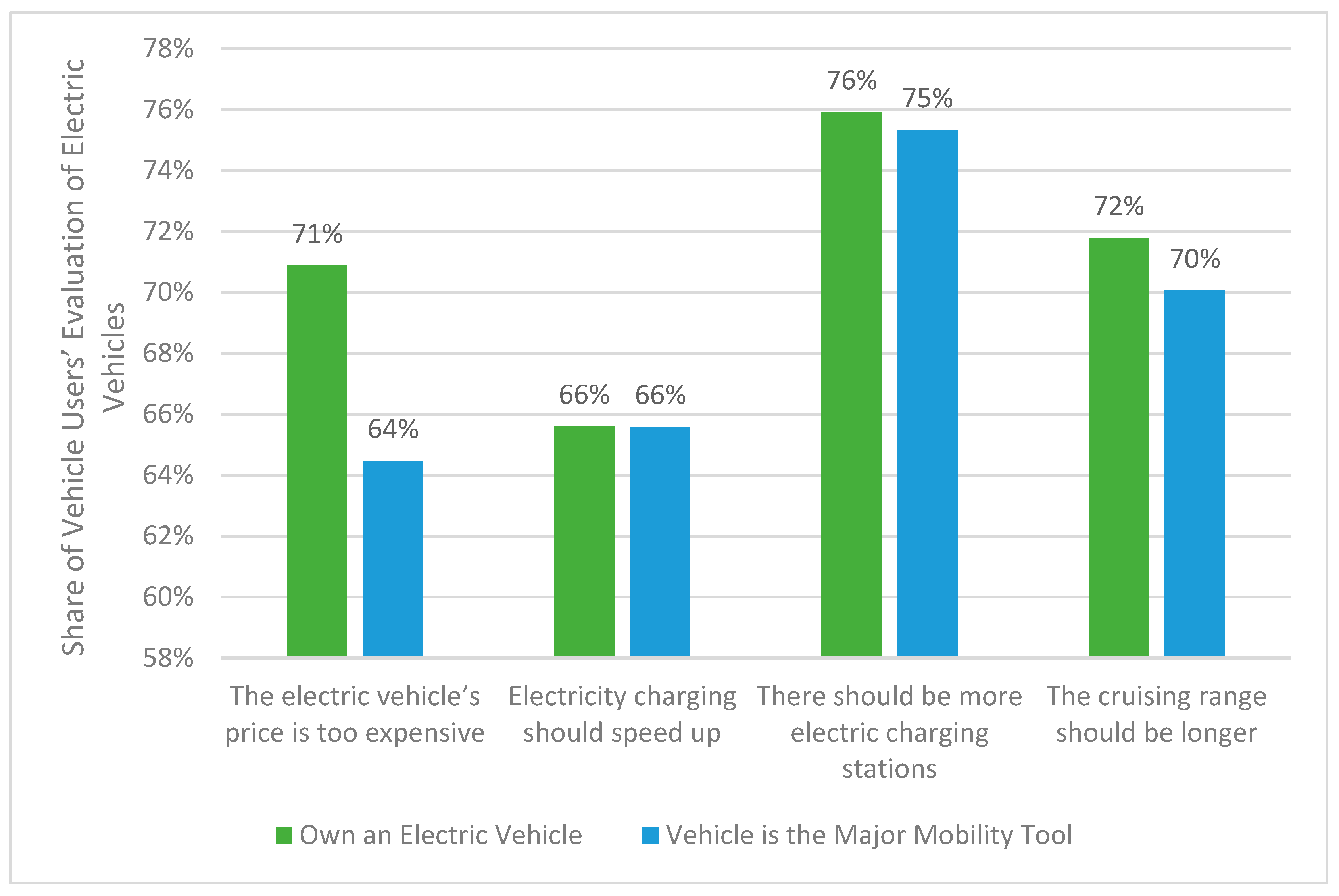
Figure 2 presents the evaluation results for services related to electric vehicles, comparing households that rely on a vehicle as their primary mode of transportation with households that own an electric vehicle. The findings indicate that the electric vehicle service industry requires substantial improvement. Approximately 71% of electric vehicle users and 64% of vehicle-dependent households reported that electric vehicles are expensive, while 66% of households stated that charging speeds need to be increased. Furthermore, 76% of electric vehicle users and 75% of vehicle-dependent households believed that the availability of charging stations should be expanded. Additionally, more than 70% of households expressed that the cruising range of electric vehicles should be extended. Overall, these results suggest that significant enhancements in electric vehicle-related services are necessary if the industry is to effectively contribute to reducing greenhouse gas emissions.

5. The Choice Between Electric Vehicles and Fossil Fuel Vehicles

Table 2 presents the relationship between households’ decisions to purchase electric vehicles or fossil fuel vehicles, based on an analysis of the original survey data using a logit model. Column 1 reports the marginal effects of the determinant factors on households’ intention to purchase electric vehicles, while Column 2 presents the corresponding effects for fossil fuel vehicle purchases.
Households’ altruistic behavior toward environmental sustainability and their level of knowledge about environmental issues are closely associated with the likelihood of purchasing an electric vehicle. Table 2 shows that the coefficient for knowledge about natural environmental issues is positive for electric vehicle purchases and negative for fossil fuel vehicle purchases, both statistically significant at the 1% level. This suggests that greater environmental knowledge is positively associated with choosing an electric vehicle and reduces the likelihood of purchasing a fossil fuel vehicle. Similarly, participation in donation activities related to environmental conservation or to social or governmental programs is positively associated with electric vehicle adoption and negatively associated with fossil fuel vehicle purchases, with the latter showing a 3.7% lower likelihood than its counterpart.
Individuals that own electric vehicles and those that own fossil fuel vehicles exhibited different tendencies in vehicle acceptance, influenced by determinants such as the availability of charging stations, cruising range, plans to purchase various types of vehicles, knowledge of environmental issues, altruistic behavior (donations), and age. For instance, while the intention to purchase a fossil fuel vehicle had a marginal effect of −0.009 among electric vehicle owners, it had a positive value of 0.339 among fossil fuel vehicle owners. This indicates that households owning a fossil fuel vehicle are more likely to purchase another fossil fuel vehicle as their next vehicle. A similar pattern appears among electric vehicle owners, who show a stronger intention to purchase another electric vehicle. Taken together, these results suggest that households tend to choose the same type of vehicle they currently own, regardless of whether it is a fossil fuel vehicle or a clean energy vehicle. Regarding hydrogen vehicles, preferences among hydrogen vehicle owners aligned more closely with those of electric vehicle owners, while fossil fuel vehicle owners were less likely to purchase a hydrogen vehicle.
Notably, charging speed was not significantly associated with households’ choices of fuel type for their next vehicle. However, the price of electric vehicles played a crucial role in household decision-making. The coefficient for the variable indicating high electric vehicle prices was negative for both electric vehicle owners and fossil fuel vehicle owners, suggesting that the high cost of electric vehicles reduces the likelihood of purchasing one. Additionally, the expansion of charging stations and longer cruising ranges for electric vehicles were negatively associated with plans to purchase a fossil fuel vehicle.
Generational differences also played a significant role in choosing the type of energy for subsequent vehicle purchases. The coefficient for age was negative for electric vehicles and positive for fossil fuel vehicles, indicating that older individuals are less likely to purchase an electric vehicle and more likely to choose a traditional fuel vehicle with which they are more familiar.
Furthermore, family structure and household size were significantly associated with the decision to purchase fossil fuel or electric vehicles. The coefficients for married couple/partner-only households, two-generation households (parent + child), three-generation households (grandparent + parent + child), and households with four or more generations were all positive and statistically significant at the 1% level. This suggests that, compared with single-person households, multi-member households are roughly 10% to 19% more likely to purchase fossil fuel vehicles. Similarly, larger family size was positively associated with choosing a fossil fuel vehicle, likely because such vehicles better accommodate the needs of larger households.

6. The Choice Between Electric Vehicles and Fossil Fuel Vehicles—Subsamples

Table 3 presents the relationship between households’ purchasing decisions regarding electric vehicles or fossil fuel vehicles and the relevant determinant, socioeconomic, and demographic factors, based on various subsamples. The subsamples include households that use a vehicle as their primary mode of transportation (Columns 1 and 2 of Table 3a), as well as young, middle-aged, and older vehicle users (Columns 3 to 8 of Table 3a). Table 3b reports the results for households located in Tokyo’s 23 wards and ordinance-designated cities, as well as cities with a population of 500,000 or more (excluding Tokyo’s 23 wards and government-designated cities), 100,000 or more but less than 500,000, 50,000 or more but less than 100,000, and less than 50,000.
The results of the subsample analysis are consistent with the main findings reported in Table 3. Across generations, younger individuals are more likely to accept electric vehicles than middle-aged and older individuals. Regarding population size, residents of smaller cities tend to be more accepting of electric vehicles compared with those in larger cities. First, the coefficient for knowledge about natural environmental issues is positive and statistically significant for households planning to purchase an electric vehicle across multiple subgroups, including vehicle-dependent households, the younger generation, and residents of various regions. These findings suggest that knowledge of environmental issues is an important determinant of electric vehicle adoption.
Second, households tend to choose the same energy type for their next vehicle as the one they currently own. The coefficients for planning to purchase a fossil fuel vehicle are positive and significant for households already owning fossil fuel vehicles, indicating that such households are more likely to repurchase a fossil fuel vehicle. Similar results appear among electric vehicle households: the coefficients for planning to purchase an electric vehicle are positive and statistically significant for vehicle-dependent households, as well as across different generations and regions. These findings imply that households generally prefer to purchase a subsequent vehicle powered by the same energy type. As shown in Table 4, among vehicle-dependent households owning a fossil fuel vehicle, 75% intended to purchase another fossil fuel vehicle, whereas 29% and 8% expressed preferences for electric or hydrogen vehicles, respectively. Conversely, among households owning an electric vehicle, approximately 73% planned to purchase another electric vehicle, while 38% and 25% expressed interest in fossil fuel and hydrogen vehicles, respectively. The relatively small share of electric vehicles among all vehicle users may be attributed to domestic vehicle manufacturers’ continued emphasis on improving the energy efficiency of fossil fuel vehicles.
Third, the expansion of charging stations was found to enhance convenience for electric vehicle users. The survey results emphasize that convenience is a crucial factor for increasing the market share of electric vehicles. The coefficients for charging station availability were negative and statistically significant, indicating that insufficient charging infrastructure reduces households’ likelihood of purchasing an electric vehicle.

Well-Being and Types of Vehicles

Table 5 presents the association between owning vehicles powered by different fuel types and household well-being, based on ordered logit analyses that control for respondents’ socioeconomic and demographic characteristics. The analysis uses original survey data drawn from households that rely on a vehicle as their primary mobility tool, with dependent variables including self-evaluated life satisfaction, happiness, and emotional states such as joy, anger, depression, and stress.
Households that own electric vehicles tend to report higher levels of life satisfaction and happiness compared with those that own fossil fuel vehicles. The coefficient for owning an electric vehicle is positive and statistically significant at the 1% level for life satisfaction, happiness, and joy, indicating that households with electric vehicles are generally happier and experience more positive emotional states. In contrast, the coefficient for owning a fossil fuel vehicle is positive for stress, anxiety, anger, and joy, suggesting that such households are more likely to experience negative emotions—including stress, anxiety, and anger—alongside joy. Overall, compared with fossil fuel vehicle owners, electric vehicle owners exhibit stronger associations with happiness and positive emotions and weaker associations with negative emotions. One possible explanation is that households owning electric vehicles may be more inclined toward cooperative behavior and may possess more favorable social and economic conditions.
Environmental perspectives also influence overall well-being. Individuals with greater knowledge of environmental issues and those who engage in donation activities tend to experience enhanced positive emotions and reduced negative emotions. The coefficient for knowledge of natural environmental issues is positive and statistically significant at the 10% and 1% levels for life satisfaction, indicating that individuals with stronger environmental knowledge are more likely to experience positive emotional states and less likely to experience negative ones. Moreover, participation in donation activities related to building a sustainable society is positively associated with overall happiness and emotional well-being. The coefficient for donation activities is positive for life satisfaction, happiness, and joy and negative for stress, with statistical significance at the 10% or 1% level. These results indicate that households’ altruistic and pro-environmental behavior is closely linked to higher levels of subjective well-being.
Table 6 presents the robustness results derived from the probit model and the linear probability model using the original data. Columns 1 and 2 show the relationships between the determinants and residents’ selection of electric vehicles, while Columns 3 and 4 present the corresponding relationships for residents’ choice of fossil fuel vehicles. These findings confirm that the results are consistent with the main results reported in Table 2. Furthermore, the VIF test is employed to assess multicollinearity among the independent variables, and the results indicate that the variables generally pass the multicollinearity checks.

7. Discussion

It is well known that the transition from fossil fuel vehicles to electric vehicles is a crucial step toward achieving carbon neutrality, which is closely related to the need to respond to climate change. The rapid deterioration of the natural environment in recent times has further exacerbated the need for more appropriate policies directed at reducing carbon dioxide emissions from industries. In Japan, the government has aimed to reduce 66% of carbon dioxide emissions from the household sector in 2013 by 2030 [3,50]. Drawing on these circumstances, this study investigated the spread of clean energy vehicles and users’ satisfaction with them by conducting a large-scale original survey based in Japan in 2023.
The analyses conducted in this study produced several noteworthy findings. First, regarding households’ repurchase intentions, the results indicate that households exhibit a strong preference for vehicles powered by the same energy type they currently use. In other words, households tend to repurchase vehicles with an identical energy source and are less inclined to transition to vehicles powered by different types of energy. This pattern may reflect the effort required to learn and adapt to a new vehicle type. From a policy perspective, this suggests that governments should support households in purchasing their first electric vehicle, as providing assistance at the initial stage may promote broader adoption.
These findings differ from evidence in China, where existing electric vehicle owners show a lower likelihood of repurchasing an electric vehicle [42]. Such cross-country differences may reflect variations in transition burden—the perceived difficulty and effort associated with switching to a new vehicle technology. Although our study does not explicitly analyze transition burden, prior research shows that it can substantially influence consumers’ willingness to transition to electric vehicles, particularly in culturally distinct markets such as China and Malaysia [51]. Because transition burden is shaped by cultural, social, and institutional contexts, further empirical research focusing specifically on Japan would provide valuable insights into how these contextual factors affect consumer behavior in the electric vehicle purchase decision process [42,51].
Third, the empirical results highlight that age is negatively associated with electric vehicle use—elderly households are less likely to purchase electric vehicles. In contrast, closely related to altruistic purposes, the younger generation is more likely to use electric vehicles and exhibits a strong willingness for the expansion of charging spots. This trend can be attributed to the older generation facing difficulties in familiarizing themselves with vehicles using a new type of energy. At the same time, while small family-sized households were observed to be more familiar with electric vehicles, such vehicles did not suit the mobility needs of large families. These findings may be a result of the superior cruising range capacity, ample availability of charging spots, and high charging speed of fossil fuel vehicles. Furthermore, along with improvements in charging speed and cruising range capacity, the households expressed a strong need for expanding electricity charging spots. Notably, these results are consistent with the findings of several previous studies [22,23,24,25].
Second, households that demonstrate altruistic behavior toward sustainability—such as participating in donation activities or possessing greater knowledge of the natural environment—are more likely to purchase electric or hydrogen vehicles and less likely to purchase fossil fuel vehicles. These results are consistent with findings from previous studies [16,17,18,19,20,21]. Furthermore, households consistently expressed a strong need for expanded charging infrastructure, alongside improvements in charging speed and cruising range. These findings align with the results of several prior studies [22,23,24,25].
Third, younger individuals—who tend to hold stronger altruistic and pro-environmental values—are more inclined to use electric vehicles and express stronger support for the expansion of charging infrastructure. Additionally, while households with smaller family sizes appear to be more comfortable with electric vehicles, such vehicles do not fully meet the mobility needs of larger families. This may be related to the superior cruising range, wider availability of fueling stations, and faster refueling times associated with fossil fuel vehicles.
The relationship between users’ well-being and the type of vehicle they use reveals that electric vehicle users exhibit stronger positive emotions, higher self-evaluated happiness, and greater life satisfaction, as well as lower levels of negative emotions—such as anger, anxiety, depression, and stress—compared with fossil fuel vehicle users. This indicates that the overall subjective well-being of electric vehicle users is higher than that of fossil fuel vehicle users. One possible explanation is that electric vehicles are perceived as a symbol of clean energy, giving owners a sense of contributing to environmental conservation. Their enhanced well-being may also reflect both their altruistic tendencies and their financial ability to afford electric vehicles. These findings are consistent with those of [29], who reported that environmental awareness positively influences individuals’ evaluations of electric vehicles, which in turn enhances post-purchase satisfaction.
The policy implications derived from this study are as follows. First, because both fossil fuel vehicle users and electric vehicle users tend to choose the same type of vehicle for their next purchase, policymakers in government and industry should encourage consumers to adopt electric vehicles at the initial stage of vehicle ownership. For example, driving schools typically use fossil fuel vehicles; therefore, offering driving lessons with electric vehicles and educating learners about appropriate charging practices could increase the likelihood that new drivers will choose electric vehicles. Since drivers often prefer to continue with familiar vehicle types, government policies should also focus on supporting new learners, as shifting different generations’ perceptions of electric vehicles may require additional effort.
Second, expanding the availability of charging stations for both business and public use would further promote electric vehicle adoption. Governments could, for instance, establish 24 h charging facilities at city halls or other public buildings. Additionally, developing electric vehicles that meet the needs of large families, while simultaneously enhancing individuals’ knowledge of environmental issues and their ability to use electric energy vehicles, would further support adoption.
Third, by examining citizens’ acceptance of electric vehicles across large cities, regional cities, and depopulated areas—including the 23 wards of Tokyo, ordinance-designated cities, and cities with populations above or below 500,000—we identify similar patterns in the likelihood that electric vehicle users and fossil fuel users will transition to a similar type of vehicle in their next purchase. These findings provide empirical evidence suggesting that nationwide policies may be broadly suitable for users across different regions.

8. Conclusions

Public acceptance of fully battery electric vehicles is considered a crucial strategy for reducing carbon dioxide emissions. This study investigated Japanese households’ acceptance of electric vehicles by conducting an original cross-sectional survey in 2023. The analysis examined households’ preferences, evaluations, and intentions regarding the purchase of electric vehicles, as well as individuals’ environmental perspectives.
The results showed that 89% of households relied on vehicles as their primary means of mobility, while only 6% used electric vehicles. Regarding vehicle transition, households currently owning fossil fuel vehicles demonstrated a high likelihood of purchasing another fossil fuel vehicle, whereas electric vehicle users were more likely to choose another electric vehicle as their next mode of transportation. Furthermore, households with better access to charging infrastructure, less concern for vehicle purchase price, stronger knowledge of environmental issues, and higher levels of altruistic behavior—such as donations and cooperative actions—were more likely to accept electric vehicles.
Although this study is the first to investigate the share of electric vehicles in the automobile industry, the related determinants for their expansive use, and the improvements necessary for users’ satisfaction with mobility, there are a few limitations that must be acknowledged. The targeted respondents in this study were internet users. In this context, it is well known that elderly female internet users are scarce and that internet users are more likely to be well-educated. As a result, the sample analyzed in this study may have a potential sample selection bias. Therefore, future research investigating this issue must focus on analyzing a more comprehensive dataset to address potential sample selection bias.

Author Contributions

X.P. conducted the analysis, prepared the primary manuscript, and participated in the revision of the manuscript. A.N. participated in the revision of the manuscript. S.L. participated in the revision of the manuscript. All authors have read and agreed to the published version of the manuscript.

Funding

This research is funded by JSPS KAKENHI (Grant Number 23K17082.). This research is supported by the Tohoku Initiative for Fostering Global Researchers for Interdisciplinary Sciences (TI-FRIS). This Research is supported by Takahashi Industrial and Economic Research Foundation, Grant number J220000023.

Institutional Review Board Statement

Ethical review and approval were waived for this study by the Institution Committee due to Legal Regulations: https://www.iwate-u.ac.jp/about/disclosure/files/regulations/20101050.pdf, accessed on 3 December 2025 and https://www.mhlw.go.jp/web/t_doc?dataId=00012250&dataType=0&pageNo=1, accessed on 3 December 2025.

Informed Consent Statement

Informed consent was obtained from all subjects involved in the study.

Data Availability Statement

The data presented in this study are available on request from the corresponding author.

Conflicts of Interest

The authors declare no conflicts of interest.

References

  1. IPCC. Climate Change 2023 Synthesis Report. 2023. Available online: https://www.ipcc.ch/report/ar6/syr/downloads/report/IPCC_AR6_SYR_SPM.pdf (accessed on 10 November 2023).
  2. United Nations. Climate Action. 2015. Available online: https://www.un.org/en/climatechange/net-zero-coalition (accessed on 10 November 2023).
  3. MOE. The Global Warming Countermeasures. 2021. Available online: https://www.env.go.jp/earth/ondanka/keikaku/211022.html (accessed on 15 August 2025).
  4. Helmers, E.; Weiss, M. Advances and Critical Aspects in the Life-Cycle Assessment of Battery Electric Cars. Energy Emiss. Control. Technol. 2017, 5, 1–18. [Google Scholar] [CrossRef]
  5. Baumann, M.; Salzinger, M.; Remppis, S.; Schober, B.; Held, M.; Graf, R. Reducing the Environmental Impacts of Electric Vehicles and Electricity Supply: How Hourly Defined Life Cycle Assessment and Smart Charging Can Contribute. World Electr. Veh. J. 2019, 10, 13. [Google Scholar] [CrossRef]
  6. De Rubens, G.Z.; Noel, L.; Sovacool, B.K. Dismissive and Deceptive Car Dealerships Create Barriers to Electric Vehicle Adoption at the Point of Sale. Nat. Energy 2018, 3, 501–507. [Google Scholar] [CrossRef]
  7. McCollum, D.L.; Wilson, C.; Bevione, M.; Carrara, S.; Edelenbosch, O.Y.; Emmerling, J. Interaction of Consumer Preferences and Climate Policies in the Global Transition to Low-Carbon Vehicles. Nat. Energy 2018, 3, 664–673. [Google Scholar] [CrossRef]
  8. Yuan, X.; Liu, X.; Zuo, J. The Development of New Energy Vehicles for a Sustainable Future: A Review. Renew. Sustain. Energy Rev. 2015, 42, 298–305. [Google Scholar] [CrossRef]
  9. Huangfu, J.; Wei, W.; Yu, L.; Li, G. The Impact of Environmental Policy Stringency and Oil Prices on Innovation: Evidence from the New Energy Vehicle Industry in China. Econ. Anal. Policy 2025, 85, 979–996. [Google Scholar] [CrossRef]
  10. Zhang, X.; Liang, Y.; Yu, E.; Rao, R.; Xie, J. Review of Electric Vehicle Policies in China: Content Summary and Effect Analysis. Renew. Sustain. Energy Rev. 2017, 70, 698–714. [Google Scholar] [CrossRef]
  11. Kapustin, N.O.; Grushevenko, D.A. Long-Term Electric Vehicles Outlook and Their Potential Impact on Electric Grid. Energy Policy 2020, 137, 111103. [Google Scholar] [CrossRef]
  12. Singh, V.; Singh, V.; Vaibhav, S. A Review and Simple Meta-Analysis of Factors Influencing Adoption of Electric Vehicles. Transp. Res. Part D 2020, 86, 102436. [Google Scholar] [CrossRef]
  13. Liu, J.C.-E.; Chao, C.-W. Equal Rights for Gasoline and Electricity? The Dismantling of Fossil Fuel Vehicle Phase-Out Policy in Taiwan. Energy Res. Soc. Sci. 2022, 89, 102571. [Google Scholar] [CrossRef]
  14. Bonilla, D.; Soberon, H.A.; Galarza, O.U. Electric Vehicle Deployment & Fossil Fuel Tax Revenue in Mexico to 2050. Energy Policy 2022, 171, 113276. [Google Scholar] [CrossRef]
  15. Asgarian, F.; Hejazi, S.R.; Khosroshahi, H. Investigating the Impact of Government Policies to Develop Sustainable Transportation and Promote Electric Cars, Considering Fossil Fuel Subsidies Elimination: A Case of Norway. Appl. Energy 2023, 347, 121434. [Google Scholar] [CrossRef]
  16. Debnath, R.; Bardhan, R.; Reiner, D.M.; Miller, J.R. Political, Economic, Social, Technological, Legal and Environmental Dimensions of Electric Vehicle Adoption in the United States: A Social-Media Interaction Analysis. Renew. Sustain. Energy Rev. 2021, 152, 111707. [Google Scholar] [CrossRef]
  17. Needell, Z.A.; McNerney, J.; Chang, M.T.; Trancik, J.E. Potential for Widespread Electrification of Personal Vehicle Travel in the United States. Nat. Energy 2016, 1, 16112. [Google Scholar] [CrossRef]
  18. Mersky, A.C.; Sprei, F.; Samaras, C.; Qian, Z.S. Effectiveness of Incentives on Electric Vehicle Adoption in Norway. Transp. Res. Part D 2016, 46, 56–68. [Google Scholar] [CrossRef]
  19. Sierzchula, W.; Bakker, S.; Maat, K.; Van Wee, B. The Influence of Financial Incentives and Other Socio-Economic Factors on Electric Vehicle Adoption. Energy Policy 2014, 68, 183–194. [Google Scholar] [CrossRef]
  20. He, X.; Zhan, W.; Hu, Y. Consumer Purchase Intention of Electric Vehicles in China: The Roles of Perception and Personality. J. Clean. Prod. 2018, 204, 1060–1069. [Google Scholar] [CrossRef]
  21. O’Neill, E.; Moore, D.; Kelleher, L.; Brereton, F. Barriers to Electric Vehicle Uptake in Ireland: Perspectives of Car-Dealers and Policy-Makers. Case Stud. Transp. Policy 2019, 7, 118–127. [Google Scholar] [CrossRef]
  22. Kim, J.H.; Lee, G.; Park, J.Y.; Hong, J.; Park, J. Consumer Intentions to Purchase Battery Electric Vehicles in Korea. Energy Policy 2019, 132, 736–743. [Google Scholar] [CrossRef]
  23. Park, E.; Lim, J.; Cho, Y. Understanding the Emergence and Social Acceptance of Electric Vehicles as Next-Generation Models for the Automobile Industry. Sustainability 2018, 10, 662. [Google Scholar] [CrossRef]
  24. Thananusak, T.; Rakthin, S.; Tavewatanaphan, T.; Punnakitikashem, P. Factors Affecting the Intention to Buy Electric Vehicles: Empirical Evidence from Thailand. Int. J. Electr. Hybrid Veh. 2017, 9, 361–381. [Google Scholar] [CrossRef]
  25. Jenn, A.; Laberteaux, K.; Clewlow, R. New Mobility Service Users’ Perceptions on Electric Vehicle Adoption. Int. J. Sustain. Transp. 2018, 12, 8318. [Google Scholar] [CrossRef]
  26. Mustafa, S.; Shi, Y.; Adan, D.; Luo, W.; Al Humdan, E. Role of Environmental Awareness & Self-Identification Expressiveness in Electric-Vehicle Adoption. Transportation 2024. [Google Scholar] [CrossRef]
  27. Bhat, F.A.; Verma, A. Consumer Intention to Accept Electric Two-Wheelers in India: A Valence Theory Approach to Unveil the Role of Identity and Utility. Transportation 2023, 52, 537–577. [Google Scholar] [CrossRef]
  28. Rahman, M.; Thill, J.-C. Who Is Inclined to Buy an Autonomous Vehicle? Empirical Evidence from California. Transportation 2024. [Google Scholar] [CrossRef]
  29. Okada, T.; Tamaki, T.; Managi, S. Effect of Environmental Awareness on Purchase Intention and Satisfaction Pertaining to Electric Vehicles in Japan. Transp. Res. Part D 2019, 67, 503–513. [Google Scholar] [CrossRef]
  30. Jansson, J. Consumer Eco-Innovation Adoption: Assessing Attitudinal Factors and Perceived Product Characteristics. Bus. Strateg. Environ. 2011, 20, 192–210. [Google Scholar] [CrossRef]
  31. Javid, R.J.; Nejat, A. A Comprehensive Model of Regional Electric Vehicle Adoption and Penetration. Transp. Policy 2017, 54, 30–42. [Google Scholar] [CrossRef]
  32. Singh, A.; Kumar, V.R.; Sidhpuria, M. A Study on the Adoption of Electric Vehicles in India: The Mediating Role of Attitude. Vis. J. Bus. Perspect. 2019, 24, 23–34. [Google Scholar] [CrossRef]
  33. Kim, M.K.; Oh, J.; Park, J.H.; Joo, C. Perceived Value and Adoption Intention for Electric Vehicles in Korea: Moderating Effects of Environmental Traits and Government Supports. Energy 2018, 159, 799–809. [Google Scholar] [CrossRef]
  34. Sierzchula, W. Factors Influencing Fleet Manager Adoption of Electric Vehicles. Transp. Res. Part D 2014, 31, 126–134. [Google Scholar] [CrossRef]
  35. Mohamed, M.; Higgins, C.D.; Ferguson, M.; Réquia, W.J. The Influence of Vehicle Body Type in Shaping Behavioral Intention to Acquire Electric Vehicles: A Multi-Group Structural Equation Approach. Transp. Res. Part A 2018, 116, 54–72. [Google Scholar] [CrossRef]
  36. Erdem, C.; Senturk, I.; Simsek, T. Identifying the Factors Affecting the Willingness to Pay for Fuel-Efficient Vehicles in Turkey: A Case of Hybrids. Energy Policy 2010, 38, 3038–3043. [Google Scholar] [CrossRef]
  37. Rezvani, Z.; Jansson, J.; Bodin, J. Advances in Consumer Electric Vehicle Adoption Research: A Review and Research Agenda. Transp. Res. Part D 2015, 34, 122–136. [Google Scholar] [CrossRef]
  38. Habich-Sobiegalla, S.; Kostka, G.; Anzinger, N. Electric Vehicle Purchase Intentions of Chinese, Russian and Brazilian Citizens: An International Comparative Study. J. Clean. Prod. 2018, 205, 188–200. [Google Scholar] [CrossRef]
  39. Thøgersen, J.; Ebsen, J.V. Perceptual and Motivational Reasons for the Low Adoption of Electric Cars in Denmark. Transp. Res. Part F 2019, 65, 89–106. [Google Scholar] [CrossRef]
  40. Tran, M.; Banister, D.; Bishop, J.D.; McCulloch, M.D. Realizing the Electric-Vehicle Revolution. Nat. Clim. Change 2012, 2, 328–333. [Google Scholar] [CrossRef]
  41. Will, C.; Lehmann, N.; Baumgartner, N.; Feurer, S.; Jochem, P.; Fichtner, W. Consumer Understanding and Evaluation of Carbon-Neutral Electric Vehicle Charging Services. Appl. Energy 2022, 313, 118799. [Google Scholar] [CrossRef]
  42. Kim, E.-J.; Dua, R.; Bansal, P. Why Chinese Car Owners May Not Repurchase Electric Vehicles? Transp. Res. Part D 2025, 139, 104557. [Google Scholar] [CrossRef]
  43. Mashrur, S.M.; Mohamed, M. Uncovering Factors Affecting Consumers’ Decisions for Pre-Owned Electric Vehicles. Transp. Res. Part D 2025, 139, 104555. [Google Scholar] [CrossRef]
  44. Hasan, S. Assessment of Electric Vehicle Repurchase Intention: A Survey-Based Study on the Norwegian EV Market. Transp. Res. Interdiscip. Perspect. 2021, 11, 100439. [Google Scholar] [CrossRef]
  45. Piao, X.; Managi, S. Altruistic Behavior for Environmental Conservation and Life Satisfaction: Evidence from 37 Nations. Environ. Dev. Sustain. 2025, 1–27. [Google Scholar] [CrossRef]
  46. Steg, L.; Bolderdijk, J.W.; Keizer, K.; Perlaviciute, G. An Integrated Framework for Encouraging Pro-Environmental Behaviour: The Role of Values, Situational Factors and Goals. J. Environ. Psychol. 2014, 38, 104–115. [Google Scholar] [CrossRef]
  47. Ajzen, I. The Theory of Planned Behavior. Organ. Behav. Hum. Decis. Process. 1991, 50, 179–211. [Google Scholar] [CrossRef]
  48. Greene, W.H. Econometric Analysis; Pearson: New York, NY, USA, 2012. [Google Scholar]
  49. Wooldridge, J. Econometric Analysis of Cross Section and Panel Data; MIT Press: Cambridge, MA, USA, 2010. [Google Scholar]
  50. Ministry of Environment Zeb Portal. 2021. Available online: https://www.env.go.jp/earth/zeb/detail/02.html (accessed on 7 November 2025).
  51. Yu, T.; Teoh, A.P.; Liao, J.; Wang, C. Determinants of Switching Intention to Adopt Electric Vehicles: A Comparative Analysis of China and Malaysia. Technol. Soc. 2025, 82, 102949. [Google Scholar] [CrossRef]
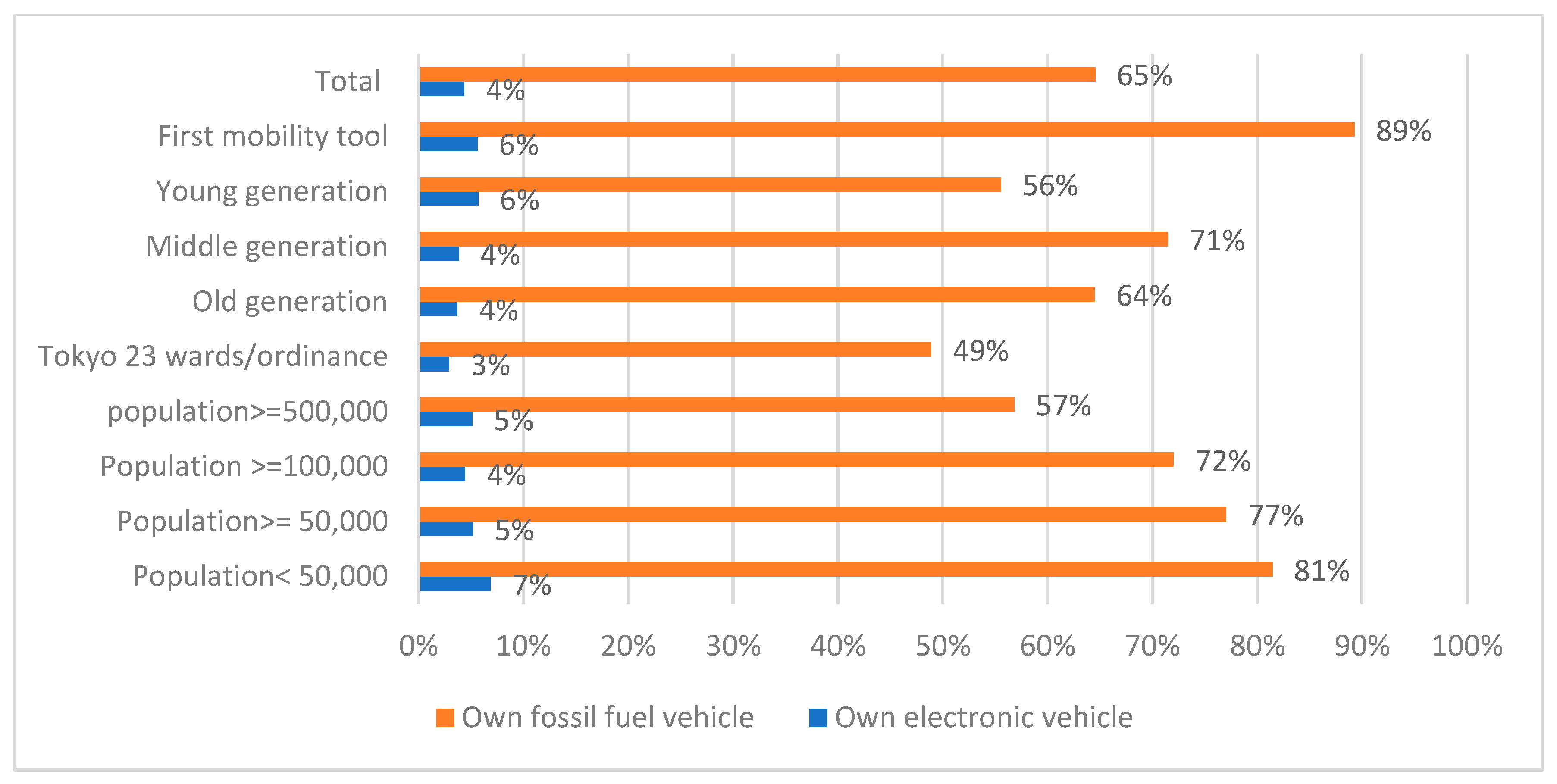
Figure 1. Patterns of vehicle use and the limited adoption of electric vehicles among households in 2023. Note: Data source: original 2023 survey. The percentages shown in the figures are unweighted. The Tokyo 23 wards refer to the central, urbanized core of Tokyo. An ordinance-designated city (often called a designated city) is a large city in Japan that has been granted special administrative authority by the national government. The term “population” refers to the size of the city based on the number of inhabitants. The young generation includes individuals younger than 40; the middle generation includes those aged 41 to 65; and the older generation includes individuals aged 66 and above.
Sustainability 18 00195 g001
Figure 2. Assessing consumer perceptions of electric vehicle price, charging infrastructure, and performance in 2023. Data source: Original survey conducted in 2023. The percentages shown in the figures are unweighted. ‘Own an electric vehicle’ refers to households that own an electric vehicle, while ‘Vehicle is the major mobility tool’ denotes individuals whose primary mode of transportation is a vehicle—whether fossil fuel-, electric-, or hydrogen-powered.
Sustainability 18 00195 g002
Table 1. List of variables and their descriptions.
VariablesDescription
Dependent variables
Owning an electric vehicleEquals one if the individual owns a fully battery electric vehicle; otherwise, equals zero.
Owning a fossil fuel vehicleEquals one if the individual owns a fossil fuel vehicle; otherwise, equals zero.
Life satisfactionPlease imagine a ladder with steps ranging from 0 at the bottom to 10 at the top. The top of the ladder (=10) represents the best possible life you can imagine, and the bottom (=0) represents the worst possible life you can imagine. On which step of the ladder do you feel you currently stand?
Happiness“In the last two weeks, how often have you felt happiness?” often = 4, sometimes = 3, rarely = 2, and not at all = 1.
Stress“In the last two weeks, how often have you felt stress?” often = 4, sometimes = 3, rarely = 2, and not at all = 1.
Depress“In the last two weeks, how often have you felt depression?” often = 4, sometimes = 3, rarely = 2, and not at all = 1.
Joyful“In the last two weeks, how often have you felt joyful?” often = 4, sometimes = 3, rarely = 2, and not at all = 1.
Anxiety“In the last two weeks, how often have you felt anxiety?” often = 4, sometimes = 3, rarely = 2, and not at all = 1.
Anger“In the last two weeks, how often have you felt anger?” often = 4, sometimes = 3, rarely = 2, and not at all = 1.
Independent variables
Knowledge of natural environmental issuesThe knowledge levels with regard to ten kinds of nature-related issues—natural disasters (typhoons, tsunamis, earthquakes), forest conservation and afforestation, global warming, depletion of the ozone layer, biodiversity loss (e.g., animal protection), air pollution, water pollution, energy sustainability, pollution and landscape conservation (oceans, mountains, rivers, lakes, etc.), and climate change. In the questionnaire, a very knowledgeable response was given a value of 5, a little knowledge response was marked 4, not very knowledgeable was equal to 3, not very knowledgeable was equal to 2, and no knowledge was valued as 1. Knowledge level, considered an independent variable in this study, was calculated as the aggregated unweighted average of the responses to these ten factors.
High price of electric vehicles“Electric vehicles are currently priced high, considering their present usage and potential future improvements.” (agree = 3, neither agree nor disagree = 2, disagree = 1)
Plan to purchase a fossil fuel vehicleA dummy variable that equals one if the individual plans to plan to purchase a fossil fuel vehicle
Plan to purchase an electric vehicleA dummy variable that equals one if the individual plans to purchase an electric vehicle
Plan to purchase a hydrogen vehicleA dummy variable that equals one if the individual plans to purchase a hydrogen vehicle.
Slow charging speed“the slow charging speed should be improved regarding the current usage of electric vehicles and potential future improvements.”
(agree = 3, neither agree nor disagree = 2, disagree = 1)
Extensive charging spots “extensive charging spots concerning the current usage of electric vehicles and potential future improvements.”
(agree = 3, neither agree nor disagree = 2, disagree = 1)
Long cruising range“long cruising range concerning the current usage of electric vehicles and potential future improvements.”
(agree = 3, neither agree nor disagree = 2, disagree = 1)
Altruistic behavior (donations)The altruistic behavior of individuals based on their donation activity was a dummy variable, meaning that if a respondent had donated some of their income to natural environment conservation or social and government programs, a value of 1 was adjudged, or 0 otherwise.
Control variables
AgeIndividual’s age
Years of schoolingIndividual’s total years of education from primary school through their highest level of completed education.
Single householdTakes the value of one if the household is a single household and zero otherwise.
Married couple/partner-only householdTakes the value of one if the household is a married couple/partner-only household and zero otherwise.
Two-generation (parent + child) householdTakes the value of one if the household is a 2-generation (parent + child) household and zero otherwise.
Three-generation (grandparent + parent + child) householdTakes the value of one if the household is a 3-generation (grandparent + parent + child) household and zero otherwise.
Four- or more-generation householdsTakes the value of one if the household is a 4- or more-generation household and zero otherwise.
Others (boarding house, households including non-relatives, etc.)Takes the value of one if the household is another type of household (boarding house, households including non-relatives, etc.) and zero otherwise.
Family size Number of household members in a family
OccupationRepresented by a set of dummy variables, including dummies for full-time employee, part-time employee, company owner, government employee/civil servant, self-employed, other occupation types, and unemployed.
Table 2. Relationship between the purchased vehicle and its determinant characteristics.
(1)(2)
VariablesElectric VehicleFossil Fuel Vehicle
ME. (S.E.)ME. (S.E.)
High price of electric vehicles−0.009 ***−0.097 ***
(0.003)(0.010)
Plan to purchase a fossil fuel vehicle−0.009 **0.339 ***
(0.004)(0.020)
Plan to purchase an electric vehicle0.044 ***−0.041 *
(0.004)(0.023)
Plan to purchase a hydrogen vehicle0.031 ***−0.088 ***
(0.006)(0.034)
Slow charging speed0.001−0.007
(0.004)(0.013)
Extensive charging spots 0.001−0.098 ***
(0.004)(0.014)
Long cruising range−0.002−0.046 ***
(0.004)(0.012)
Knowledge of natural environmental issues0.011 ***−0.015 **
(0.002)(0.007)
Altruistic behavior (donations)0.008 **−0.037 ***
(0.003)(0.012)
Age−0.000 ***0.002 ***
(0.000)(0.000)
Years of schooling−0.0010.004 *
(0.001)(0.002)
Single household (Ref.)
Married couple/Partner-only household−0.0050.151 ***
(0.005)(0.016)
2-generation (parent + child) household−0.010 *0.159 ***
(0.005)(0.021)
3-generation (grandparent + parent + child) household−0.0100.189 ***
(0.007)(0.028)
4- or more-generation households−0.033 ***0.104 ***
(0.010)(0.039)
Others (boarding house, households including non-relatives, etc.)−0.0000.029
(0.012)(0.057)
Family size 0.0010.018 **
(0.002)(0.008)
LR chi2(31)433.653098.40
Prob > chi2<0.0001<0.0001
Pseudo R20.12100.2383
Log likelihood−1575.383 −4952.08
Observations10,00010,000
Note: Delta method. Standard errors are in parentheses. *** p < 0.01, ** p < 0.05, * p < 0.1. The marginal effects (MEs) at the means are displayed in the tables. Other control variables include occupations.
Table 3. (a) Relationship between households’ purchasing decisions regarding electric vehicles or fossil fuel vehicles and the different subsamples.
(a)
(1) (2) (3) (4) (5) (6) (7) (8)
Variables Electric Vehicle Fossil Fuel Vehicle Electric Vehicle Fossil Fuel Vehicle Electric Vehicle Fossil Fuel Vehicle Electric Vehicle Fossil Fuel Vehicle
MEMEMEMEMEMEMEME
High price of electric vehicles−0.017 ***−0.012 *−0.005−0.071 ***−0.006−0.095 ***−0.014 **−0.120 ***
(0.006)(0.007)(0.005)(0.017)(0.004)(0.013)(0.006)(0.020)
Slow charging speed0.011−0.003−0.0050.0080.008−0.0120.0010.008
(0.007)(0.010)(0.006)(0.021)(0.005)(0.019)(0.007)(0.028)
Extensive charging spots 0.008−0.037 ***0.012 *−0.109 ***−0.016 **−0.065 ***−0.001−0.109 ***
(0.009)(0.011)(0.007)(0.023)(0.007)(0.021)(0.009)(0.031)
Long cruising range−0.007−0.010−0.006−0.040 *0.007−0.028−0.003−0.059 **
(0.007)(0.009)(0.006)(0.021)(0.005)(0.018)(0.007)(0.025)
Plan to purchase fossil fuel vehicle−0.022 ***0.118 ***−0.0050.322 ***−0.011 *0.307 ***−0.0080.531 ***
(0.008)(0.014)(0.007)(0.031)(0.006)(0.027)(0.010)(0.072)
Plan to purchase electric vehicle0.053 ***−0.041 ***0.048 ***−0.0430.040 ***−0.0320.035 ***0.019
(0.007)(0.013)(0.008)(0.039)(0.006)(0.033)(0.007)(0.046)
Plan to purchase hydrogen vehicle0.042 ***−0.072 ***0.037 ***−0.0510.026 ***−0.132 ***0.027 ***−0.070
(0.011)(0.019)(0.010)(0.060)(0.009)(0.050)(0.010)(0.067)
Knowledge of natural environmental issues0.014 ***−0.0080.015 ***−0.0150.009 ***−0.0020.006−0.007
(0.004)(0.005)(0.004)(0.013)(0.003)(0.010)(0.004)(0.014)
LR chi2(31)178.63293.83222.52831.08167.301172.98104.621177.29
Prob > chi2<0.0001<0.0001<0.0001<0.0001<0.0001<0.0001<0.0001<0.0001
Pseudo R20.08660.09050.17160.20410.13080.25080.10550.2895
Log likelihood−942.15 −1476.21−536.9124−1620.7604−555.79324 −1752.03−443.56−1444.498
Household typePrimary mobility toolYoungMiddleOld
Observations47624762296429643911391131253125
(b)
(1)(2)(3)(4)(5)(6)(7)(8)(9)(10)
VariablesElectric vehicleFossil fuel vehicleElectric vehicleFossil fuel vehicleElectric vehicleFossil fuel vehicleElectric vehicleFossil fuel vehicleElectric vehicleFossil fuel vehicle
MEMEMEMEMEMEMEMEMEME
High price of electric vehicles0.001−0.137 ***−0.017 **−0.093 ***−0.010−0.084 ***−0.002−0.057 ***−0.018−0.041 **
(0.003)(0.022)(0.008)(0.031)(0.006)(0.015)(0.040)(0.021)(0.013)(0.020)
Slow charging speed−0.007−0.026−0.001−0.023−0.0000.0250.004−0.048 *−0.006−0.004
(0.004)(0.031)(0.010)(0.042)(0.007)(0.021)(0.077)(0.027)(0.013)(0.025)
Extensive charging spots 0.004−0.106 ***−0.012−0.165 ***0.005−0.085 ***0.012−0.0170.012−0.059 **
(0.004)(0.036)(0.011)(0.046)(0.009)(0.023)(0.223)(0.031)(0.018)(0.027)
Long cruising range−0.001−0.0310.021 **−0.043−0.003−0.051 ***−0.027−0.044−0.021−0.028
(0.004)(0.030)(0.009)(0.042)(0.008)(0.019)(0.503)(0.028)(0.015)(0.023)
Plan to purchase fossil fuel vehicle−0.0050.399 ***−0.0080.408 ***−0.023 **0.294 ***0.0000.143 ***−0.0140.194 ***
(0.004)(0.047)(0.014)(0.069)(0.009)(0.031)(0.012)(0.038)(0.014)(0.038)
Plan to purchase electric vehicle0.021 ***−0.0850.043 ***−0.0280.042 ***0.0070.033−0.0490.077 ***−0.093 **
(0.005)(0.058)(0.013)(0.074)(0.008)(0.035)(0.611)(0.044)(0.016)(0.039)
Plan to purchase hydrogen vehicle0.0080.0490.015−0.1500.039 ***−0.113 **0.038−0.122 *0.053 **−0.025
(0.005)(0.082)(0.017)(0.110)(0.011)(0.050)(0.707)(0.071)(0.025)(0.068)
Knowledge of natural environmental issues0.008 ***0.0070.014 **−0.0340.009 **−0.0170.0080.0060.019 **−0.016
(0.002)(0.018)(0.006)(0.025)(0.004)(0.011)(0.144)(0.016)(0.007)(0.013)
LR chi2(31)167.82904.5479.19381.99125.00749.6749.98250.82105.28227.29
Prob > chi2<0.0001<0.0001<0.0001<0.0001<0.0001<0.00010.0091<0.0001<0.0001<0.0001
Pseudo R20.27320.28100.1857 0.26050.11620.21290.10650.20100.19870.2231
Log likelihood−223.199−1157.35 −173.61 −542.086 −475.26−1385.67−209.63−498.66 −212.24 −395.72
RegionTokyo 23 wards and ordinance-designated citiesCities with population of 500,000 or morePopulation of 100,000 or more/less than 500,000Population 50,000 or more/less than 100,000Population less than 50,000
Observations2323232310041072292129701132115810481062
Note. Delta method. Standard errors are in parentheses. *** p < 0.01, ** p < 0.05, * p < 0.1. The marginal effects (MEs) at the means are displayed in the tables. Other control variables are included.
Table 4. Households’ preferences regarding their vehicle transition.
VariableMean
Have vehicle77%
Have fossil fuel vehicle (total)65%
Have electric vehicle (total)4%
Vehicle is the primary mobility tool (obs = 4762)
Own electric vehicle and vehicle is the primary mobility tool 6%
Own fossil fuel vehicle and vehicle is the primary mobility tool89%
Have fossil fuel vehicle (vehicle is the primary mobility tool and have a plan to purchase their next vehicle) (obs = 1190)
Plan to purchase fossil fuel vehicle75%
Plan to purchase electric vehicle29%
Plan to purchase hydrogen vehicle8%
Have electric vehicle (vehicle is the primary mobility tool and have a plan to purchase the next vehicle) (obs = 106)
Plan to purchase fossil fuel vehicle38%
Plan to purchase electric vehicle73%
Plan to purchase hydrogen vehicle25%
Table 5. Relationship between individuals’ well-being and the type of vehicle.
(1)(2)(3)(4)(5)(6)(7)
VariablesLife SatisfactionHappinessStressDepressionJoyAnxietyAnger
Coeff.Coeff.Coeff.Coeff.Coeff.Coeff.Coeff.
Owning a fossil fuel vehicle−0.0010.0930.378 ***0.1040.271 ***0.190 **0.243 ***
(0.088)(0.095)(0.091)(0.089)(0.094)(0.090)(0.090)
Owning an electric vehicle0.478 ***0.540 ***−0.0600.0430.204 *0.0280.164
(0.117)(0.132)(0.122)(0.119)(0.124)(0.120)(0.119)
Knowledge of natural
environmental issues
0.302 ***0.355 ***−0.119 ***−0.113 ***0.277 ***−0.162 ***−0.065 *
(0.036)(0.040)(0.037)(0.036)(0.038)(0.037)(0.037)
Donation activities0.355 ***0.301 ***−0.109 *−0.0610.165 ***−0.020−0.091
(0.057)(0.065)(0.060)(0.059)(0.061)(0.059)(0.060)
Age0.004 *0.005 **−0.024 ***−0.020 ***−0.015 ***−0.025 ***−0.028 ***
(0.002)(0.002)(0.002)(0.002)(0.002)(0.002)(0.002)
Vehicle is the major mobility toolYESYESYESYESYESYESYES
Control variablesYESYESYESYESYESYESYES
LR chi2(30)444.02403.76625.38271.59296.31385.97536.89
Prob > chi2<0.0001<0.0001<0.0001<0.0001<0.0001<0.0001<0.0001
Pseudo R20.0220.03480.05230.02160.02620.03130.045
Log likelihood−9430.5016−5469.5104 −5691.0904−6179.0633 −5371.2473 −5947.7304−5704.4888
Observations4762476247624762476247624762
Note. Standard errors in parentheses. *** p < 0.01, ** p < 0.05, * p < 0.1. The definitions and scales of the variables follow those used in previous studies [44,45]. Reverse coding is not required for these items, as higher values indicate higher levels or frequencies of well-being experiences.
Table 6. Robustness analyses and multicollinearity checks.
Variables(1)(2)(3)(4)(5)(6)
Electric VehicleFossil Fuel Vehicle
MECoeff.MECoeff.VIF1/VIF
High price of electric vehicles−0.009 ***−0.009 **−0.097 ***−0.084 ***2.560.390122
(0.003)(0.004)(0.009)(0.008)
Plan to purchase a fossil fuel vehicle−0.013 **−0.015 **0.314 ***0.210 ***1.060.943005
(0.005)(0.006)(0.018)(0.012)
Plan to purchase an electric vehicle0.053 ***0.133 ***−0.039 *−0.0281.120.892795
(0.005)(0.008)(0.022)(0.017)
Plan to purchase a hydrogen vehicle0.041 ***0.123 ***−0.084 **−0.064 **1.090.921461
(0.007)(0.013)(0.033)(0.026)
Slow charging speed0.0010.002−0.006−0.0054.020.248457
(0.004)(0.005)(0.012)(0.010)
Extensive charging spots 0.0000.002−0.099 ***−0.096 ***5.090.196562
(0.005)(0.006)(0.014)(0.012)
Long cruising range−0.002−0.002−0.045 ***−0.043 ***3.850.260051
(0.004)(0.005)(0.012)(0.010)
Knowledge of natural environmental issues0.011 ***0.014 ***−0.015 **−0.012 **1.140.879388
(0.002)(0.003)(0.007)(0.005)
Altruistic behavior (donations)0.013 ***0.016 ***−0.036 ***−0.026 ***1.090.913547
(0.004)(0.004)(0.011)(0.009)
Age−0.000 ***−0.001 ***0.002 ***0.001 ***1.810.551096
(0.000)(0.000)(0.000)(0.000)
Years of schooling−0.001−0.0010.0030.0021.110.900812
(0.001)(0.001)(0.002)(0.002)
Single household (Ref.)
Married couple/partner-only household−0.004−0.0070.148 ***0.137 ***2.10.47633
(0.005)(0.006)(0.015)(0.012)
Two-generation (parent + child) household−0.011 *−0.016 **0.154 ***0.139 ***2.530.395505
(0.006)(0.008)(0.021)(0.016)
Three-generation (grandparent + parent + child) household−0.011−0.0140.180 ***0.155 ***3.070.325233
(0.007)(0.010)(0.028)(0.021)
Four- or more-generation households−0.033 ***−0.046 ***0.104 ***0.095 ***2.450.408624
(0.011)(0.014)(0.038)(0.029)
Others (boarding house, households including non-relatives, etc.)0.0010.0070.0250.0321.710.584606
(0.014)(0.021)(0.056)(0.043)
Family size 0.0020.0030.019 **0.016 **4.180.23927
(0.002)(0.003)(0.008)(0.006)
ModelProbit modelLinear probability modelProbit modelLinear probability modelVIF1/VIF
Observations10,00010,00010,00010,000
Note. Delta method. Standard errors are in parentheses. *** p < 0.01, ** p < 0.05, * p < 0.1. The marginal effects (MEs) at the means for the probit model are displayed in the tables. Other control variables are included. VIF is the variance inflation factor.
Disclaimer/Publisher’s Note: The statements, opinions and data contained in all publications are solely those of the individual author(s) and contributor(s) and not of MDPI and/or the editor(s). MDPI and/or the editor(s) disclaim responsibility for any injury to people or property resulting from any ideas, methods, instructions or products referred to in the content.