Industry 4.0 Enabled Sustainable Manufacturing



Abstract
1. Introduction
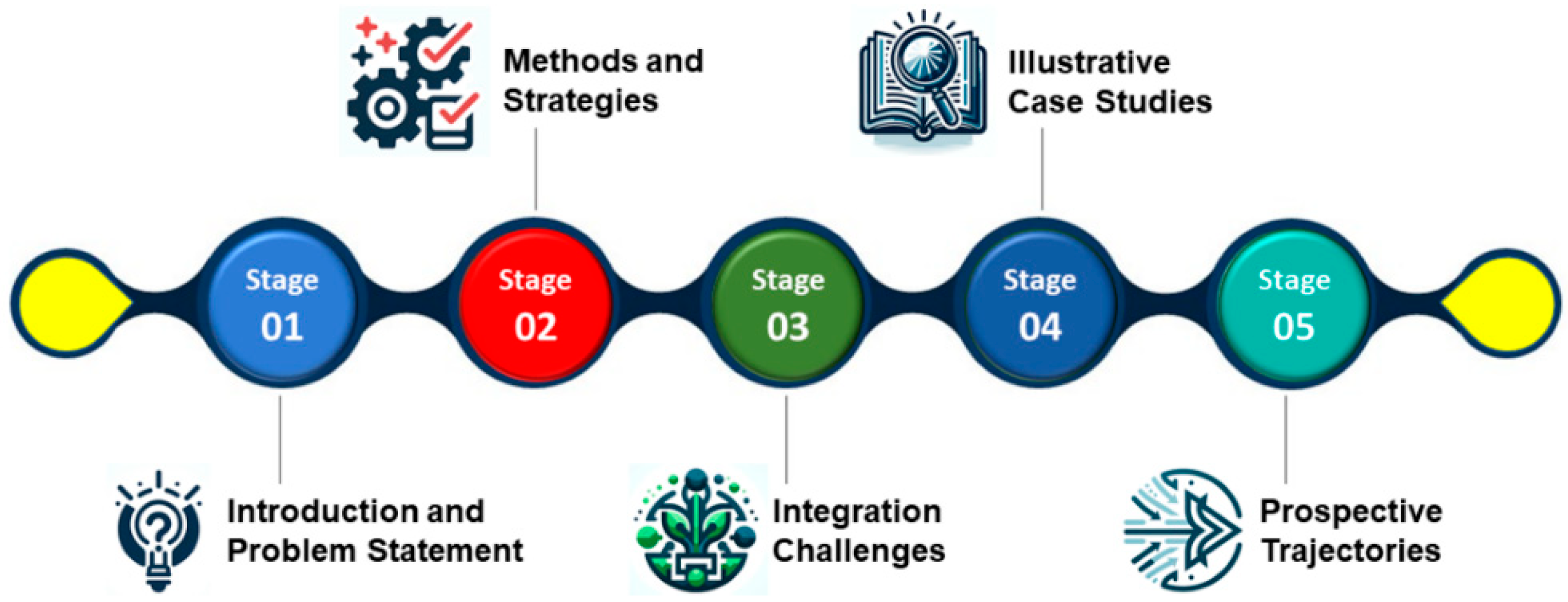
- Examine and categorize practical methods through which sustainable manufacturing and Industry 4.0 technologies have been integrated, based on real-world case studies and documented industrial experiences.
- Assess organizational and technological strategies demonstrated in these case studies that support sustainability improvements and operational efficiency.
- Identify common challenges and barriers encountered in implementation and summarize corresponding approaches used to address them.
- Synthesize key insights and lessons learned from the case studies to highlight effective practices and recurring success factors.
- Outline emerging directions and technologies that can further strengthen the integration of sustainability and digital transformation in manufacturing systems.
2. Methods for Converging Sustainability and Industry 4.0 in Manufacturing
2.1. Digital Twin (DT) for Optimized Manufacturing Processes
2.2. IoT Ecosystems for Real-Time Monitoring and Adaptive Manufacturing
2.3. Data-Driven Insights Through Advanced Analytics and AI Techniques
2.4. Cloud-Enabled Platforms for Collaborative Supply Chain Sustainability
2.5. Key Supporting Industry 4.0 Technologies
3. Strategies for Seamless Integration in Manufacturing
3.1. Cross-Functional Collaboration
3.2. Customized Cloud-Enabled Software Solutions
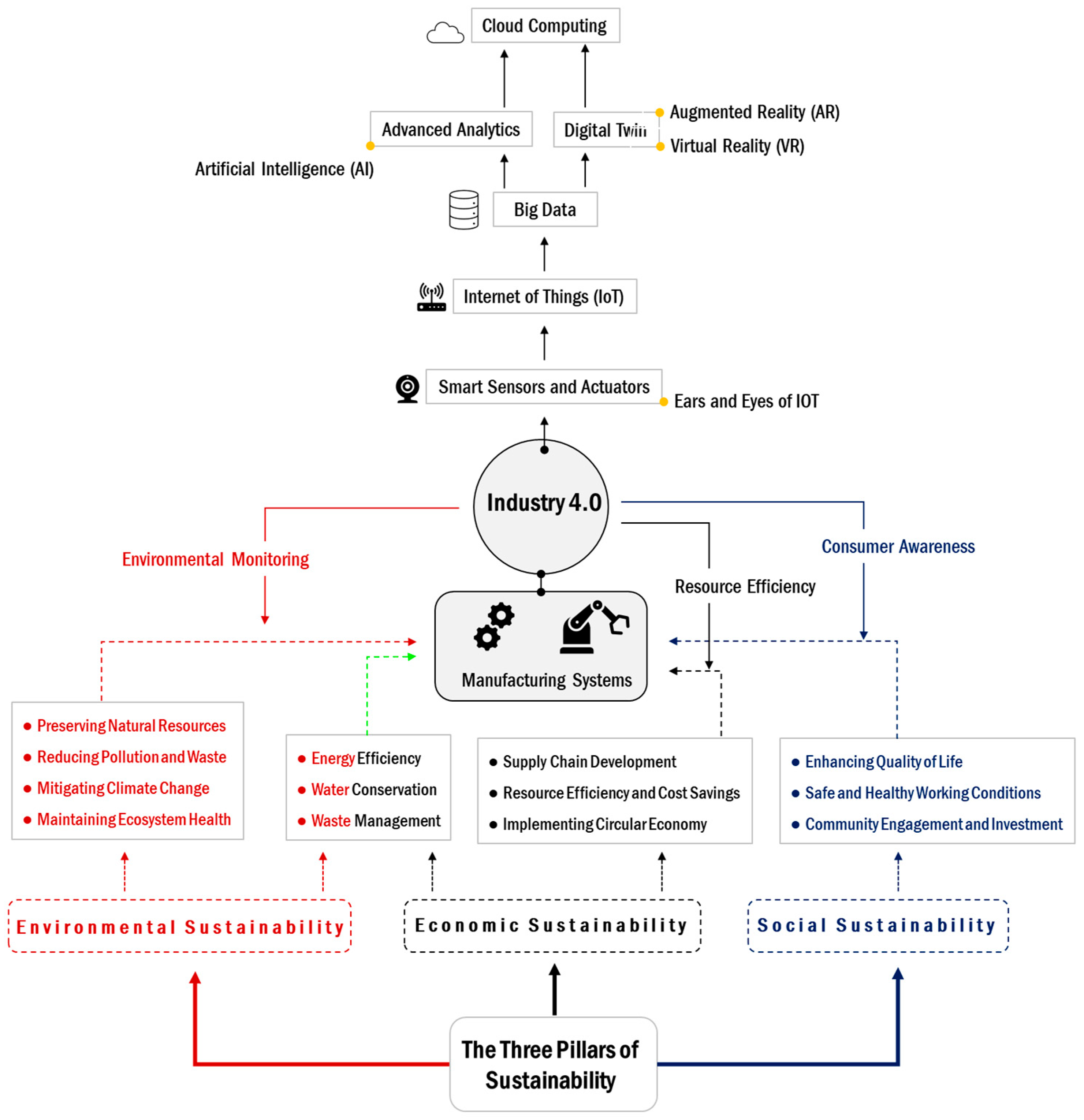
- Sensors and connected devices gather continuous data from machines and processes to identify inefficiencies.
- Algorithms and machine learning dynamically improve efficiency, reducing energy use and material waste.
- Anticipating equipment failure prevents downtime and avoids resource-intensive repairs.
- Software is adapted to specific manufacturing processes, ensuring seamless integration (Customization and Configuration).
- Dashboards provide actionable insights into energy, emissions, and waste reductions.
- Employees are equipped to use software effectively, embedding sustainability into daily operations (Training and Change Management).
- The software evolves with regulatory changes and operational insights to maintain long-term sustainability (Continuous Improvement) [35].
3.3. Energy-Efficient Machinery and Smart Sensors
3.4. Industry-Specific Dual-Focus Metrics
3.5. Economic Implications
3.6. Economic Efficiency and Risk Assessment
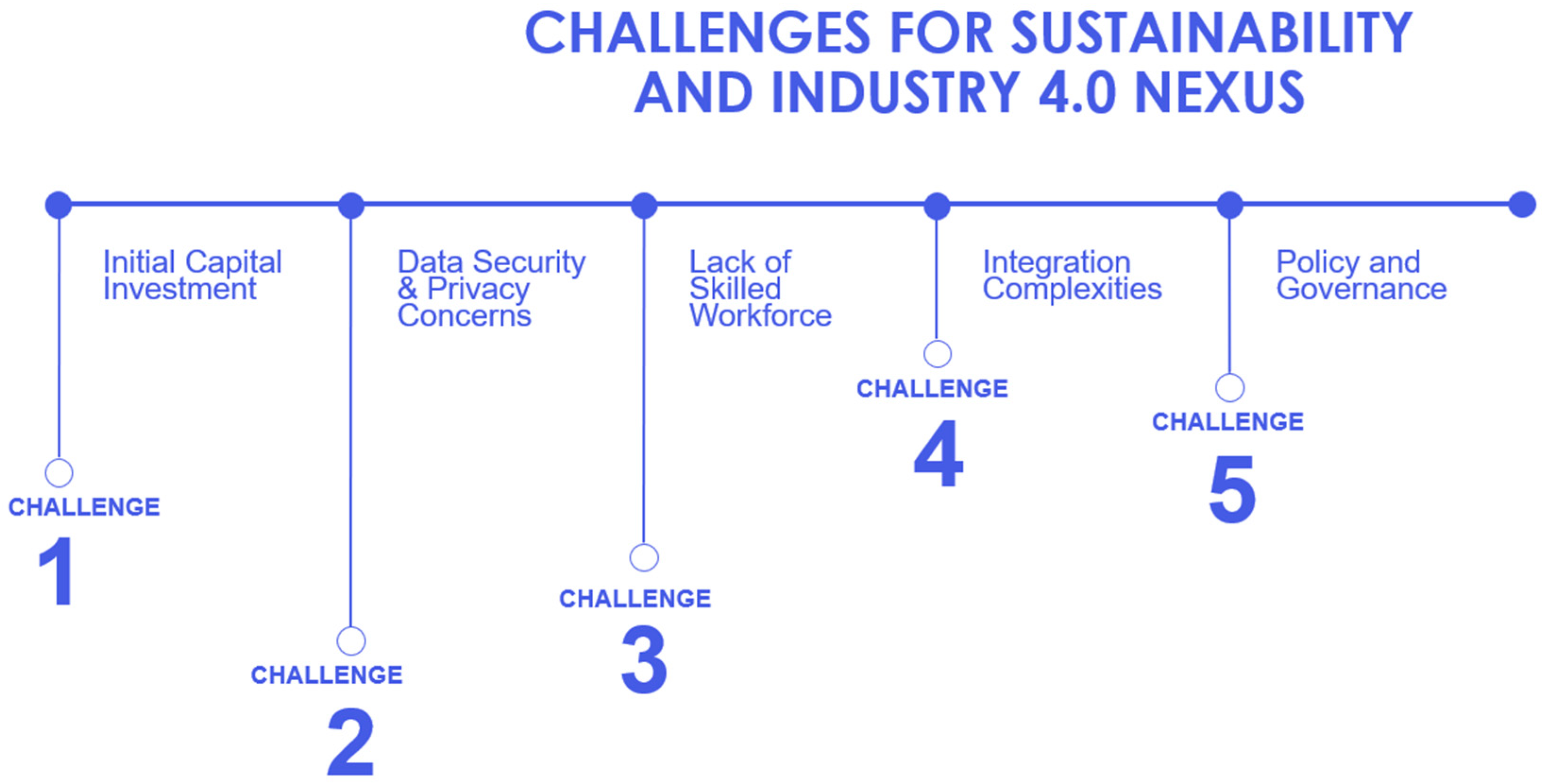
4. Challenges in Harmonizing Sustainable Manufacturing with Industry 4.0
- Procurement and deployment of IoT devices, automation machinery, and robotics, along with upgrading IT systems.
- Custom applications for process automation, predictive analytics, and sustainability reporting.
- Programs to ensure employees can operate and maintain advanced technologies.
- Fees for external experts to facilitate the smooth implementation of Industry 4.0 solutions.
- Investments in cybersecurity protocols to protect operational and sustainability data.
- Costs associated with guiding organizations through digital transformation initiatives.
- Siemens claimed that the implementation of predictive maintenance systems using IoT sensors and analytics, reducing unplanned downtime and maintenance costs, can lead to 250% ROI. However, success is dependent on the quality of the data [44].
- Pfizer integrated Industry 4.0 principles in pharmaceutical production, improving product quality and reducing errors [45].
- Technical challenges:
- ○
- Complexity of integrating data from heterogeneous sources.
- ○
- Maintaining data quality, integrity, and real-time accessibility.
- ○
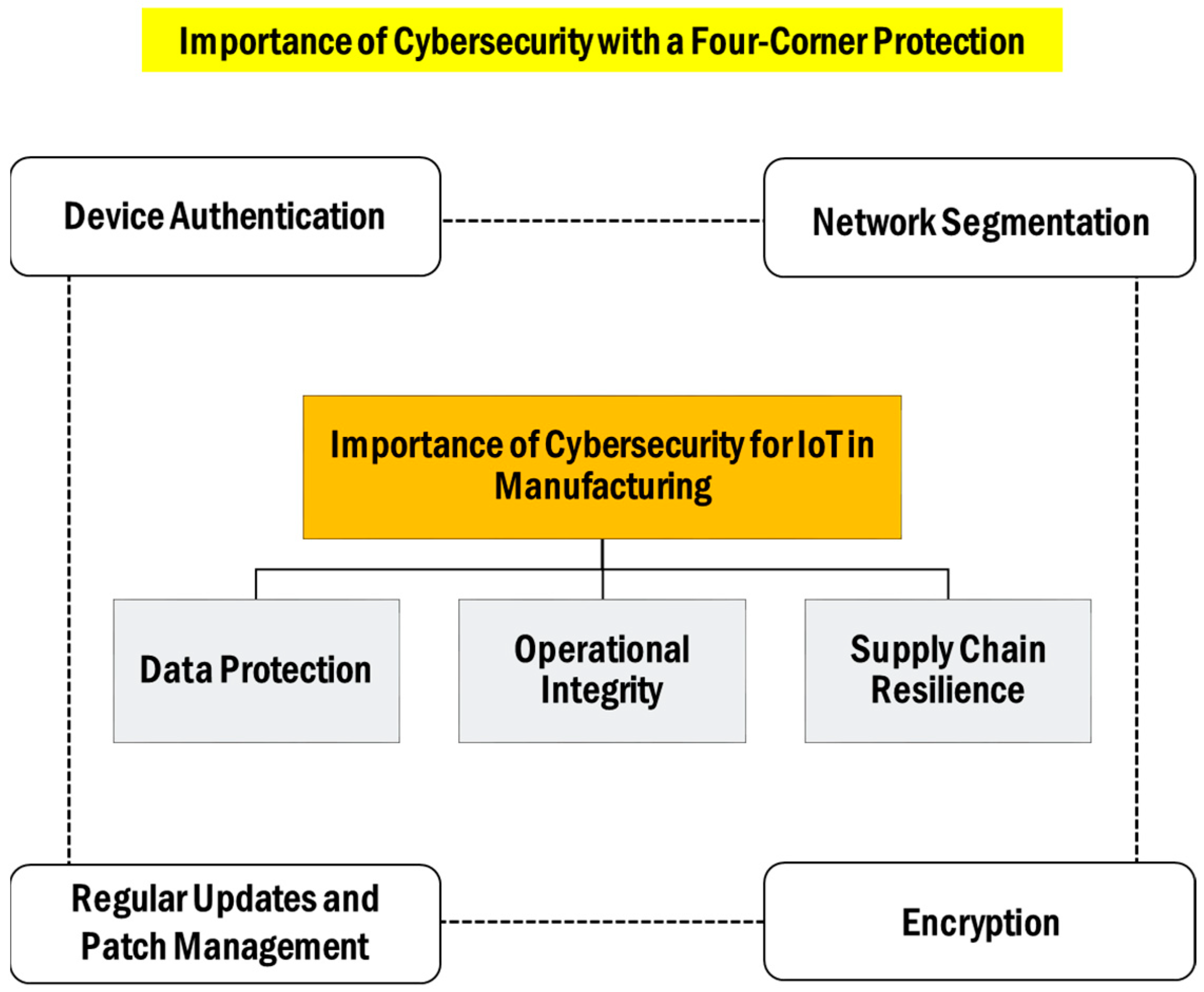
- Securing cloud storage and IoT devices against cyber threats.
- ○
- Protecting sensitive supply chain and operational data.
- Regulatory challenges:
- ○
- Compliance with general data protection regulation (GDPR) in the European Union, California consumer privacy act (CCPA) in the U.S., and other data privacy laws.
- ○
- Standardization of sustainability reporting across sectors.
- ○
- Cross-border data transfer regulations.
- ○
- Verification and auditing of sustainability metrics.
- Identifying skills gaps through assessments and collaboration with educational institutions [48].
- Tailored training programs emphasizing data analytics, cybersecurity, and advanced manufacturing technologies.
- Immersive learning technologies: virtual reality (VR) and augmented reality (AR) simulations, e-learning platforms, and micro-credentialing.
- Public–private partnerships to standardize training programs and share resources.
- Career pathing and progression: structured development plans, mentorship, and coaching. Brilliant Learning Program for digital upskilling is one of the successful examples in this matter.
- Comprehensive training and development programs emphasize lean manufacturing and skill enhancement.
- Collaborations with community colleges to develop curricula aligned with sustainable production practices.
- Centralized IoT infrastructures enable real-time data collection and machine-learning-based failure predictions.
- Ensures synchronization of production orders, material requirements, and real-time operational data.
- Platforms allowing suppliers to share inventory, production, and shipping data, reducing lead times [50].
- European Union: Circular Economy Action Plan and Emissions Trading System.
- Collaborative industrial symbiosis: Denmark’s Kalundborg Symbiosis exemplifies resource sharing and energy optimization [52].
- Incentives for clean technology adoption: Subsidies for energy-efficient equipment and electric vehicles, supporting companies like Tesla in the U.S. [53].
- Performance standards: Japan’s Top Runner Program and China’s “Made in China 2025” promote efficiency and sustainability improvements.
5. Case Studies on Integrating Sustainability with Industry 4.0
5.1. BOSCH Industry 4.0
- AI-driven fault detection, reducing resource waste and improving production reliability.
- NEXEED IoT software, one of the first solutions to connect over 22,000 machines and 200,000 devices in a single ecosystem [56].
- Measurable outcomes: 15% reduction in maintenance costs and a 25% increase in machine availability.
5.2. Toyota Case Study
- Environmental impact reduction-streamlining energy consumption, minimizing waste, and promoting sustainable material use [58].
- Social impact-creation of new jobs, enhanced worker safety, and more affordable products [59].
- Economic impact-reduced production costs through economies of scale and high-quality output.
5.3. Walmart Case Study
- Monitor inventory levels in real time, minimizing overstock and reducing waste.
- Autonomous delivery vehicles-piloted for last-mile delivery, increasing efficiency and potentially reducing emissions [63].
- VR-based employee training ensures the workforce is skilled in new procedures and technologies [62].
- Blockchain technology enhances supply chain transparency and traceability, supporting sustainable sourcing and product tracking [63].
6. Prospective Trajectories for Sustainable Manufacturing and Industry 4.0 Integration
- Optimization of complex supply chains, enabling configurations that traditional algorithms struggle to handle.
- Enhanced inventory management, reducing costs and improving customer satisfaction.
- Advanced production scheduling, allowing manufacturers to forecast production attributes and outcomes before costly physical trials [66].
- Performance metrics aligned with circular economy objectives.
- Comprehensive waste management and material flow analyses to monitor and optimize industrial processes.
- Educational initiatives, such as project-based learning, to teach industrial engineering students how to integrate circular economy methodologies into product design [68].
- Team collaboration and stakeholder engagement, ensuring cultural sustainability is embedded across new service and product development [69].
- Holistic product lifecycle management, from raw material extraction to end-of-life disposal, improving energy efficiency, material flow, and environmental performance.
- Innovation also drives sustainability in specific industries. For instance:
- IT hardware: balancing exploration and exploitation enables more sustainable product and process advancements [70].
- Automotive sector: use of tailor-welded blanks and lightweight materials reduces structural weight and fuel consumption, mitigating environmental impact.
- Early-stage performance-based design
- Life-cycle assessments and computational simulations
- Large-scale prototyping
- Collaborative, cross-sector approaches, including the Design-Build project delivery method [71]
7. Summary and Future Work
Author Contributions
Funding
Institutional Review Board Statement
Informed Consent Statement
Data Availability Statement
Acknowledgments
Conflicts of Interest
References
- Quttainah, M.A.; Ayadi, I. The impact of digital integration on corporate sustainability: Emissions reduction, environmental innovation, and resource efficiency in the European. J. Innov. Knowl. 2024, 9, 100525. [Google Scholar] [CrossRef]
- Mady, K.; Anwar, I.; Abdelkareem, R.S. Nexus between regulatory pressure, eco-friendly product demand and sustainable competitive advantage of manufacturing small and medium-sized enterprises: The mediating role of eco-innovation. Environ. Dev. Sustain. 2024, 26. [Google Scholar] [CrossRef]
- Soori, M.; Arezoo, B.; Dastres, R. Internet of Things for Smart Factories in Industry 4.0, a Review. Internet Things Cyber-Phys. Syst. 2023, 3, 192–204. [Google Scholar] [CrossRef]
- Ramadan, M.N.; Ali, M.A.; Khoo, S.Y.; Alkhedher, M.; Alherbawi, M. Real-time IoT-powered AI system for monitoring and forecasting of air pollution in industrial environment. Ecotoxicol. Environ. Saf. 2024, 283, 116856. [Google Scholar] [CrossRef] [PubMed]
- Vajda, D.L.; Van Do, T.; Bérczes, T.; Farkas, K. Machine learning-based real-time anomaly detection using data pre-processing in the telemetry of server farms. Sci. Rep. 2024, 14, 23288. [Google Scholar] [CrossRef]
- Stahmann, P.; Nebel, M.; Janiesch, C. AI-based real-time anomaly detection in industrial engineering: A structured literature review, taxonomy, and research agenda. Comput. Ind. Eng. 2025, 207, 111236. [Google Scholar] [CrossRef]
- PwC. Consumers Willing to Pay 9.7% Sustainability Premium, Even as Cost-of-Living and Inflationary Concerns Weigh: PwC 2024 Voice of the Consumer Survey. 2024. Available online: https://www.pwc.com/gx/en/news-room/press-releases/2024/pwc-2024-voice-of-consumer-survey.html (accessed on 15 May 2024).
- Masa’deh, R.; Jaber, M.; Sharabati, A.-A.A.; Nasereddin, A.Y.; Marei, A. The Blockchain Effect on Courier Supply Chains Digitalization and Its Contribution to Industry 4.0 within the Circular Economy. Sustainability 2024, 16, 7218. [Google Scholar] [CrossRef]
- Hassanein, A.; Bani-Mustafa, A.; Nimer, K. A country’s culture and reporting of sustainability practices in energy industries: Does a corporate sustainability committee matter? Humanit. Soc. Sci. Commun. 2024, 11, 1140. [Google Scholar] [CrossRef]
- Gezgin, A.Y.; Arıcıoğlu, M.A. Industry 4.0 and Management 4.0: Examining the Impact of Environmental, Cultural, and Technological Changes. Sustainability 2025, 17, 3601. [Google Scholar] [CrossRef]
- Li, Q.; Tang, W.; Li, Z. Leveraging Industry 4.0 for Sustainable Manufacturing: A Quantitative Analysis Using FI-RST. Appl. Sci. 2024, 14, 9545. [Google Scholar] [CrossRef]
- ElMaraghy, H.; Monostori, L.; Schuh, G.; ElMaraghy, W. Evolution and future of manufacturing systems. CIRP Ann. 2021, 70, 635–658. [Google Scholar] [CrossRef]
- Turan, E.; Konuşkan, Y.; Yıldırım, N.; Tunçalp, D.; InAn, M.; Yasin, O.; Turan, B.; Kerimoğlu, V. Digital twin modelling for optimizing the material consumption: A case study on sustainability improvement of thermoforming process. Sustain. Comput. Inform. Syst. 2022, 35, 100655. [Google Scholar] [CrossRef]
- Su, C.; Tang, X.; Jiang, Q.; Han, Y.; Wang, T.; Jiang, D. Digital twin system for manufacturing processes based on a multi-layer knowledge graph model. Sci. Rep. 2025, 15, 12835. [Google Scholar] [CrossRef]
- Yang, J.; Zheng, Y.; Wu, J.; Wang, Y.; He, J.; Tang, L. Enhancing Manufacturing Excellence with Digital-Twin-Enabled Operational Monitoring and Intelligent Scheduling. Appl. Sci. 2024, 14, 6622. [Google Scholar] [CrossRef]
- Zhong, R.Y.; Xu, X.; Klotz, E.; Newman, S.T. Intelligent Manufacturing in the Context of Industry 4.0: A Review. Engineering 2017, 3, 616–630. [Google Scholar] [CrossRef]
- Hou, L.; Bergmann, N.W. Novel Industrial Wireless Sensor Networks for Machine Condition Monitoring and Fault Diagnosis. IEEE Trans. Instrum. Meas. 2012, 61, 2787–2798. [Google Scholar] [CrossRef]
- Metin, B.; Özhan, F.G.; Wynn, M. Digitalisation and Cybersecurity: Towards an Operational Framework. Electronics 2024, 13, 4226. [Google Scholar] [CrossRef]
- Arinez, J.F.; Chang, Q.; Gao, R.X.; Xu, C.; Zhang, J. Artificial Intelligence in Advanced Manufacturing: Current Status and Future Outlook. J. Manuf. Sci. Eng. 2020, 142, 110804. [Google Scholar] [CrossRef]
- Kraft, E.M. The air force digital thread/digital twin-life cycle integration and use of computational and experimental knowledge. In Proceedings of the 54th AIAA Aerospace Sciences Meeting, San Diego, CA, USA, 4–8 January 2016; p. 0897. [Google Scholar] [CrossRef]
- Giachetti, R.E. A decision support system for material and manufacturing process selection. J. Intell. Manuf. 1998, 9, 265–276. [Google Scholar] [CrossRef]
- Santos, R.; Piqueiro, H.; Dias, R.; Rocha, C.D. Transitioning trends into action: A simulation-based Digital Twin architecture for enhanced strategic and operational decision-making. Comput. Ind. Eng. 2024, 198, 110616. [Google Scholar] [CrossRef]
- Liu, S.; Bao, J.; Lu, Y.; Li, J.; Lu, S.; Sun, X. Digital twin modeling method based on biomimicry for machining aerospace components. J. Manuf. Syst. 2021, 58, 180–195. [Google Scholar] [CrossRef]
- Hao, X.; Demir, E.; Eyers, D. Beyond human-in-the-loop: Sensemaking between artificial intelligence and human intelligence collaboration. Sustain. Futur. 2025, 10, 101152. [Google Scholar] [CrossRef]
- Patil, M. Cloud Computing for Industry 5.0; Springer: Berlin/Heidelberg, Germany, 2025; pp. 119–154. [Google Scholar] [CrossRef]
- Tian, Z.; Qiu, L.; Wang, L. Drivers and influencers of blockchain and cloud-based business sustainability accounting in China: Enhancing practices and promoting adoption. PLoS ONE 2024, 19, e0295802. [Google Scholar] [CrossRef] [PubMed]
- Oks, S.J.; Jalowski, M.; Lechner, M.; Mirschberger, S.; Merklein, M.; Vogel-Heuser, B.; Möslein, K.M. Cyber-Physical Systems in the Context of Industry 4.0: A Review, Categorization and Outlook. Inf. Syst. Front. 2024, 26, 1731–1772. [Google Scholar] [CrossRef]
- Fernández-Moyano, J.A.; Remolar, I.; Gómez-Cambronero, Á. Augmented Reality’s Impact in Industry—A Scoping Review. Appl. Sci. 2025, 15, 2415. [Google Scholar] [CrossRef]
- Hegab, H.; Khanna, N.; Monib, N.; Salem, A. Design for sustainable additive manufacturing: A review. Sustain. Mater. Technol. 2023, 35, e00576. [Google Scholar] [CrossRef]
- Dixit, A.; Jakhar, S.K.; Kumar, P. Does lean and sustainable manufacturing lead to Industry 4.0 adoption: The mediating role of ambidextrous innovation capabilities. Technol. Forecast. Soc. Change 2021, 175, 121328. [Google Scholar] [CrossRef]
- Tao, F.; Fan, T.; Lai, K.K.; Li, L. Impact of RFID technology on inventory control policy. J. Oper. Res. Soc. 2017, 68, 207–220. [Google Scholar] [CrossRef]
- Annanth, V.K.; Abinash, M.; Rao, L.B. Intelligent Manufacturing in the Context of Industry 4.0: A Case Study of Siemens Industry. J. Phys. Conf. Ser. 2021, 1969, 012019. [Google Scholar] [CrossRef]
- Srivastava, P.; Verma, G.; Kakar, V.K. Analysis of Different Case Studies Based on Industry 4.0. In Proceedings of the 2021 7th International Conference on Signal Processing and Communication (ICSC), Noida, India, 25–27 November 2021; pp. 296–301. [Google Scholar]
- Ghobakhloo, M. Industry 4.0, digitization, and opportunities for sustainability. J. Clean. Prod. 2020, 252, 119869. [Google Scholar] [CrossRef]
- Aziz, M.; Rahaman, M.; Bhuiyan, M.M.R.; Islam, R. Integrating Sustainable IT Solutions for Long-Term Business Growth and Development. J. Bus. Manag. Stud. 2023, 5, 152–159. [Google Scholar] [CrossRef]
- Konash, A.; Nasr, N. The circular economy and resource use reduction: A case study of long-term resource efficiency measures in a medium manufacturing company. Clean. Prod. Lett. 2022, 3, 100025. [Google Scholar] [CrossRef]
- Guidotti, D.; Pandolfo, L.; Pulina, L. A Systematic Literature Review of Supervised Machine Learning Techniques for Predictive Maintenance in Industry 4.0. IEEE Access 2025, 13, 102479–102504. [Google Scholar] [CrossRef]
- Liu, J.; Liu, H.; Liu, Y. A Sustainability-Oriented Framework for Life Cycle Environmental Cost Accounting and Carbon Financial Optimization in Prefabricated Steel Structures. Sustainability 2025, 17, 4296. [Google Scholar] [CrossRef]
- Rastogi, S.; Pandita, D. From code to collaboration: Influence of artificial intelligence on workforce dynamics. Int. J. Organ. Theory Behav. 2025. [Google Scholar] [CrossRef]
- Rahman, M. Data Analytics for Strategic Business Development: A Systematic Review Analyzing Its Role in Informing Decisions, Optimizing Processes, And Driving Growth. J. Sustain. Dev. Policy 2025, 1, 285–314. [Google Scholar] [CrossRef]
- Zhong, D.; Um, K.-H. How customer integration drives green innovation: Exploring the influence of regulatory pressures and market changes. J. Manuf. Technol. Manag. 2025, 36, 731–754. [Google Scholar] [CrossRef]
- Senna, P.P.; Ferreira, L.M.D.; Barros, A.C.; Roca, J.B.; Magalhães, V. Prioritizing barriers for the adoption of Industry 4.0 technologies. Comput. Ind. Eng. 2022, 171, 108428. [Google Scholar] [CrossRef]
- Oostveen, A.-M.; Eimontaite, I.; Fletcher, S. Human factors in digital manufacturing technology adoption: A workforce perspective. Int. J. Adv. Manuf. Technol. 2025, 105, 6575–6593. [Google Scholar] [CrossRef]
- Siemens, A.G. SENSESY Predictive Maintenance: Maximising Your ROI with Scalable, Predictive Maintenance. 2023. Available online: https://assets.new.siemens.com/siemens/assets/api/uuid:854533af-0f63-46d2-8534-324cf0bbb161/ROI-Report_original.pdf#:~:text=Predictive%20maintenance%20can%20significantly%20boost%20ROI%2C%20with,leading%20to%20informed%20decision-making%20and%20optimized%20ROI (accessed on 10 September 2025).
- Phiri, V.J.; Battas, I.; Semmar, A.; Medromi, H.; Moutaouakkil, F. Towards enterprise-wide pharma 4.0 adoption. Sci. Afr. 2025, 28, e02771. [Google Scholar] [CrossRef]
- Aoun, A.; Ilinca, A.; Ghandour, M.; Ibrahim, H. A review of Industry 4.0 characteristics and challenges, with potential improvements using blockchain technology. Comput. Ind. Eng. 2021, 162, 107746. [Google Scholar] [CrossRef]
- Ozkan-Ozen, Y.D.; Kazancoglu, Y. Analysing workforce development challenges in the Industry 4.0. Int. J. Manpow. 2021, 43, 310–333. [Google Scholar] [CrossRef]
- P, V.; Pinto, P.; D’sOuza, R.; Souza, R.D.R. Framework for identification of curriculum gaps: A systematic approach. J. Eng. Educ. Transform. 2022, 35, 61–68. [Google Scholar] [CrossRef]
- Mourtzis, D.; Doukas, M. Decentralized Manufacturing Systems Review: Challenges and Outlook; Springer: Berlin/Heidelberg, Germany, 2012; pp. 355–369. [Google Scholar]
- Ziari, M.; Taleizadeh, A.A. Integrated Data-Driven and Artificial Intelligence Framework to Develop Digital Twins in Distribution System of Supply Chains: A Real Industrial Case. Int. J. Prod. Econ. 2025, 289, 109743. [Google Scholar] [CrossRef]
- Abubakr, M.; Abbas, A.T.; Tomaz, I.; Soliman, M.S.; Luqman, M.; Hegab, H. Sustainable and Smart Manufacturing: An Integrated Approach. Sustainability 2020, 12, 2280. [Google Scholar] [CrossRef]
- Valentine, S.V. Kalundborg Symbiosis: Fostering progressive innovation in environmental networks. J. Clean. Prod. 2016, 118, 65–77. [Google Scholar] [CrossRef]
- Dwivedi, C. Influence of Production and Investment Tax Credit on Renewable Energy Growth and Power Grid. In Proceedings of the 2018 IEEE Green Technologies Conference (GreenTech), Austin, TX, USA, 4–6 April 2018; pp. 149–154. [Google Scholar]
- Culot, G.; Nassimbeni, G.; Orzes, G.; Sartor, M. Behind the definition of Industry 4.0: Analysis and open questions. Int. J. Prod. Econ. 2020, 226, 107617. [Google Scholar] [CrossRef]
- Christmann, D. Ten Years of Industry 4.0: Bosch Sales Reach Four Billion Euros. Bosch Media Service. Available online: https://www.bosch-presse.de/pressportal/de/en/ten-years-of-industry-4-0-bosch-sales-reach-four-billion-euros-227200.html (accessed on 8 April 2021).
- Robert Bosch Manufacturing Solutions GmbH. Bosch Connected Industry—Industry 4.0 Software from a Single Source. Available online: https://assets.bosch.com/media/en/global/products_and_solutions/connected_products_and_services/industy_40/bosch-connected-industry-brochure.pdf (accessed on 2 September 2025).
- Bosch Rexroth. Smart Factory: Revolutionizing the Manufacturing Industry. Bosch Rexroth. Available online: https://www.boschrexroth.com/en/de/digital-information-services/what-is-a-smart-factory (accessed on 1 October 2023).
- Kagermann, H.; Wahlster, W.; Helbig, J. Recommendations for Implementing the Strategic Initiative INDUSTRIE 4.0 Securing the Future of German Manufacturing Industry Final Report of the Industrie 4.0 Working Group. 2013. Available online: https://www.din.de/resource/blob/76902/e8cac883f42bf28536e7e8165993f1fd/recommendations-for-implementing-industry-4-0-data.pdf (accessed on 2 September 2025).
- Toyota Motor Cooperation. TOYOTA Social Contribution Activities. TOYOTA Corporate Citizenship Division. 2023. Available online: https://global.toyota/en/sustainability/esg/social-contribution (accessed on 9 September 2025).
- Toyota Motor Cooperation. TOYOTA Financial Results. TOYOTA Motor Corporation. Available online: https://global.toyota/en/ir/financial-results/ (accessed on 22 August 2025).
- Toyota Motor Cooperation. TOYOTA Sustainability Data Book. 2023. Available online: https://global.toyota/pages/global_toyota/sustainability/report/sdb/sdb23_en.pdf (accessed on 15 September 2023).
- Insights, W. Walmart Expands Its Use of VR for Training and Recruitment. Available online: https://hrretail.wbresearch.com/blog/walmart-vr-training-recruitment-strategy#:~:text=It%20was%20way%20back%20in,ever%20leaving%20the%20training%20room (accessed on 19 September 2025).
- Sristy, A. Blockchain in the Food Supply Chain—What Does the Future Look Like? 2025. Available online: https://tech.walmart.com/content/walmart-global-tech/en_us/news/articles/blockchain-in-the-food-supply-chain.html (accessed on 15 August 2025).
- Walmart. Walmart 2023 Annual Report. 2023. Available online: https://stock.walmart.com/financials/annual-reports/default.aspx (accessed on 2 November 2024).
- Kuys, B.; Koch, C.; Renda, G. The Priority Given to Sustainability by Industrial Designers within an Industry 4.0 Paradigm. Sustainability 2021, 14, 76. [Google Scholar] [CrossRef]
- Chiang, D.; Guo, R.-S.; Chen, A.; Cheng, M.-T.; Chen, C.-B. Optimal supply chain configurations in semiconductor manufacturing. Int. J. Prod. Res. 2007, 45, 631–651. [Google Scholar] [CrossRef]
- Haupt, M.; Vadenbo, C.; Hellweg, S. Do We Have the Right Performance Indicators for the Circular Economy? Insight into the Swiss Waste Management System. J. Ind. Ecol. 2016, 21, 615–627. [Google Scholar] [CrossRef]
- González-Domínguez, J.; Sánchez-Barroso, G.; Zamora-Polo, F.; García-Sanz-Calcedo, J. Application of Circular Economy Techniques for Design and Development of Products through Collaborative Project-Based Learning for Industrial Engineer Teaching. Sustainability 2020, 12, 4368. [Google Scholar] [CrossRef]
- Medhat, R.; A E Othman, A.; O Alamoudy, F. Risks of Innovation in the Architectural Design Process in Egypt: An Investigative Study. IOP Conf. Ser. Earth Environ. Sci. 2022, 1056, 012003. [Google Scholar] [CrossRef]
- Michelino, F.; Cammarano, A.; Celone, A.; Caputo, M. The Linkage between Sustainability and Innovation Performance in IT Hardware Sector. Sustainability 2019, 11, 4275. [Google Scholar] [CrossRef]
- Hosseini, S.; Frank, L.; Fridgen, G.; Heger, S. Do Not Forget About Smart Towns. Bus. Inf. Syst. Eng. 2018, 60, 243–257. [Google Scholar] [CrossRef]
- Arefin, A.A.; Meraj, S.T.; Lipu, M.H.; Rahman, S.; Rahman, T.; Hasan, K.; Sarker, M.R.; Muttaqi, K.M. Societal, environmental, and economic impacts of electric vehicles towards achieving sustainable development goals. Results Eng. 2025, 27, 107060. [Google Scholar] [CrossRef]



| Stage | Key Actions | Expected Output | * KPIs/Indicators |
|---|---|---|---|
| Define Goals & Baseline | • Identify sustainability goals (environmental, economic, social). • Benchmark current resource use, emissions, and efficiency. | Clear KPI dashboard & baseline report | Energy (kWh/unit), CO2 per unit, scrap%, OEE, LTIR (illustrative; enterprises may select additional or alternative KPIs aligned with specific goals) |
| Instrumentation | • Install sensors & actuators on key assets. • Calibrate for energy, temperature, vibration, quality. | Connected smart assets | %assets instrumented, sensor uptime (adaptable based on asset type and measurement priorities) |
| IoT Connectivity | • Build secure IoT network using OPC UA/MQTT. • Enable real-time data transfer. | Operational IoT platform | Latency level, packet loss percentage (indicative; may vary by network configuration and enterprise requirements) |
| Data & Analytics Layer | • Set up data lake & analytics pipelines. • Develop dashboards & anomaly detection. | Central data hub | Data completeness%, alert accuracy (KPIs illustrate data quality monitoring; enterprises may define additional analytics KPIs) |
| AI & Digital Twin | • Use AI for predictive maintenance, scheduling. • Build a digital twin for simulation & optimization. | Predictive decision-support tools | MTBF, downtime, ROI from AI (models are enterprise-specific; KPIs guide validation of AI/digital twin effectiveness) |
| Cloud Integration | • Migrate analytics & historical data to the cloud. • Enable cross-site comparison. | Scalable infrastructure | Compute cost per dataset, cross-site KPIs (adjustable depending on enterprise scale and architecture) |
| Workforce Enablement | • Introduce AR/VR training & safety modules. • Build data-driven culture. | Skilled digital workforce | Training hours/employee, incident rate (KPIs reflect workforce engagement and safety; enterprises may expand to other competency measures) |
| Environmental Levers | • Implement energy efficiency & waste reduction. • Automate environmental monitoring. | Reduced environmental impact | CO2, waste, energy/unit (KPIs are illustrative; other environmental metrics may be included per enterprise objectives) |
| Economic Levers | • Optimize supply chain, resource use, circular economy loops. | Cost & resource savings | Cost, inventory turns, material reuse% (enterprises may include additional financial or circular economy metrics) |
| Social Levers | • Improve safety, working conditions, & community engagement. | Enhanced workforce well-being | Absenteeism, safety score, CSR index (KPIs are examples; can be tailored to organizational social priorities) |
| Governance & Security | • Establish cross-functional committee. • Enforce cybersecurity & change management. | Secure, compliant operations | Policy adherence%, incident count (KPIs illustrate governance and security; can be expanded per enterprise policy requirements) |
| Continuous Improvement (PDCA) | • Review KPIs monthly; update models & procedures. • Share best practices across sites. | Sustainable continuous-improvement cycle | KPI variance trend, benefits realized (KPIs track progress and guide iterative improvement; enterprises can define additional success measures) |
Disclaimer/Publisher’s Note: The statements, opinions and data contained in all publications are solely those of the individual author(s) and contributor(s) and not of MDPI and/or the editor(s). MDPI and/or the editor(s) disclaim responsibility for any injury to people or property resulting from any ideas, methods, instructions or products referred to in the content. |
© 2025 by the authors. Licensee MDPI, Basel, Switzerland. This article is an open access article distributed under the terms and conditions of the Creative Commons Attribution (CC BY) license.
Share and Cite
Shaban, I.A.; Ajaj, R.; Elshimy, H.; Hegab, H. Industry 4.0 Enabled Sustainable Manufacturing. Sustainability 2026, 18, 156. https://doi.org/10.3390/su18010156
Shaban IA, Ajaj R, Elshimy H, Hegab H. Industry 4.0 Enabled Sustainable Manufacturing. Sustainability. 2026; 18(1):156. https://doi.org/10.3390/su18010156
Chicago/Turabian StyleShaban, Ibrahim Abdelfadeel, Rahaf Ajaj, Haitham Elshimy, and Hussien Hegab. 2026. "Industry 4.0 Enabled Sustainable Manufacturing" Sustainability 18, no. 1: 156. https://doi.org/10.3390/su18010156
APA StyleShaban, I. A., Ajaj, R., Elshimy, H., & Hegab, H. (2026). Industry 4.0 Enabled Sustainable Manufacturing. Sustainability, 18(1), 156. https://doi.org/10.3390/su18010156