1. Introduction
In the fast-changing and increasingly competitive world, information has become a strategic resource that plays an important role in improving the competitive conditions of both service institutions in general [
1] and banking services in particular. The sustainability in knowledge sharing is clearly a factor of success for banks, as it allows the services to be better and financial innovations that are increasingly new markets [
2]. Intelligence as a Knowledge: Intelligent entities in organizations, the foundation of which is formed by engaging capabilities, enable organizations to do smarter things.
Nowhere is such a role more crucial than in the case of Palestine, since banks must operate within specific economic, social, and political limitations. The Palestinian banking system continues to suffer under harsh financial restrictions, compounded by both blockades and Israeli measures which hinder the flow of capital and financial resources. These environments seriously inhibit banks from investing in up-to-date technology and facilitate innovation, as well as improving customer services [
3]. Additionally, there is a shortage of capacity building and culture development for learning to support knowledge exchange, which restricts response to changing market requirements and customers (e.g., World Bank 2022: pp. 45–47) [
4].
Moreover, empirical evidence on local knowledge management practice as exposed by the reports of the Palestinian Ministry of National Economy (2021, pp. 12–15) [
5] forms a blunt picture of such flaws in the knowledge-sharing culture in financial institutions. These deficiencies consist of overreliance on traditional content formats devoid of innovation and inadequate integration of accumulated knowledge into employees’ daily tasks, both of which contribute to a low sense of long-term meaningful relevance of work that is not conducive to commitment [
5]. The importance of implementing HC strategies, such as promoting employee engagement and meaningful work to contribute to sustainable innovations, is highlighted in the report.
Given the situation indicated above, henceforth, the major research problem addressed in this paper is (a) reduced level service innovation banks can be attributed to (b) limited SSK practice among Palestinian banking companies. Build on the issue presented earlier. In addition, the key mediating effects of employee engagement (EE) and managerial willingness (MW), as forcing factors on innovative capability improvement for organizational resilience, are largely unknown. Accordingly, the purpose of this study is to investigate how SSK affects SI throughout the sensemaking process in the Palestinian banking sector. It explores the extent to which regular, planned sharing of lessons derived from practice between staff facilitates a culture for service innovation in complex and politically volatile environments.
In addition, the mediating role of employee engagement (EE) and meaningful work (MW) in this association is examined. It specifically explores how KCPE systems would help promote employees’ emotional and cognitive engagement to stimulate them to generate creative ideas. At the same time, it also examines how the perceived meaning of work for employees strengthens the relationship between SSK and SI. This integrative view is, however, less commonly implemented in empirical research, even though it is crucial. We contend that sustainable knowledge-sharing practices go beyond the interaction process. The goal of our paper has been to unlock the mechanisms by which such sustained knowledge-sharing behaviors operate, because organizations are uncertain of needing evidence-based advice on how they might encourage engagement and establish purposeful working environments.
This study consists of seven main sections. The introduction provides background information and explains the significance of the research.
Section 2 reviews the literature and develops hypotheses.
Section 3 describes the research methodology, sampling approach, and measurement tools.
Section 4 presents the statistical analyses and results.
Section 5 discusses the findings.
Section 6 offers recommendations, and
Section 7 concludes with the findings.
2. Literature Review and Hypotheses Development
2.1. Sustainability of Shared Knowledge and Service Innovation
In the present competitive business context, more especially in knowledge-intensive industries such as banking, the quality of shared knowledge remains an important factor that permits firms to continually innovate and improve their capacity to innovate. Nevertheless, knowledge is not enough as an independent element in innovation; rather, it depends on the power of collective reflection, the process by which individuals’ products can influence those products that, taken collectively, are produced over time.
Empirical evidence in these studies found that shared knowledge has a positive effect on supportive organizational climate, which has a significant effect on cognitive, emotional, and behavioral involvement of employees, thus leading to stimulating innovative behavior. Knowledge sharing has a positive impact on employees’ job discretion and satisfaction, which in turn enhances their innovative performance for highly customer-oriented service firms involving agility and ongoing renewal [
6].
Further, they underline the importance of competence development that benefits from knowledge sharing and a socially supportive climate in increasing employee engagement. This engagement involves cognitive, affective, and behavioral aspects and ultimately enables the new behaviors to be learned effectively [
7]. In addition, there is evidence for shared knowledge sustainability that affects employees’ ambidexterity—a phenomenon of their ability to combine the search for new ideas with making use of known information—which is necessary for firm innovation. The first theoretical contribution is the potential that committed employees developed by sustainable knowledge activities may enhance commitment to innovative related dynamic routines so as to enable firms’ competitiveness in a turbulent environment [
8].
Highly satisfied employees in banking make good use of shared knowledge to create new products that satisfy customer requirements and enhance organizational efficiency. This involvement is associated with the psychological and social empowerment of employees, which improves their attitude to actively engage and produce new ideas [
9]. In addition, empirical studies show that knowledge sustainability and engagement form a positive feedback loop between them in the presence of open shared knowledge while promoting cognitive and affective employee involvement so as to enhance innovation and product or service quality.
Although some studies report in the literature on how knowledge sharing influences employee engagement and innovation, it is also important to analyze these contentions critically from contextual and methodological points of view. Similarly, ref. [
10] highlighted a significant gap in the context of financial institutions regarding employee engagement, with a focus on Palestinian employees, whereas previous studies had been directed at international banks or environments that differ significantly from the Palestinian context due to organizational structure and economic pressures. This disparity could lead to the generalization of the results to local banks. Additionally, research on HRM practices in Egyptian banking organizations indicated a significant impact of employee engagement on knowledge sharing; nonetheless, the sample size (372 employees in specialized banks) and the organizational setting are substantially different from those of Palestinian banks, which could limit generalizability to our setting. Hence, this research should concentrate on engagement among employees as a mediating variable in the Palestinian banks’ specific context. Focusing on engagement in this geographical setting also favors the production of more contextualized and credible results, contrary to adopting findings ethnocentrically from other banking institutions that might not mirror the same organizational, cultural, and financial situation characterizing Palestinian banks as well.
Sustainability of the shared knowledge is an important factor that contributes largely to employee engagement in any organization. Indeed, the literature suggests that the sustainability of knowledge sharing comprises building an enduring organizational environment for information and expertise exchange, as well as persistent learning and reinforcement with respect to the employees’ ability to work effectively [
9,
11]. When common knowledge is preserved, it is provided for the employees to draw on as they carry out their duties, including access to support of a number of different types of knowledge, which helps the employee feel connected and empowered. This, in turn, has a positive effect on their emotional and cognitive engagement with their work by fostering a constant flow of knowledge, which enables innovation and motivates employees to present new thoughts or initiatives that can help the organization.
In addition, the literature highlights a strong association between the Sustainability of Shared Knowledge and workplace thriving. GPKE satisfies employees’ psychological need for competence and relatedness, which again leads to high dedication and active involvement [
12]. Hence, the sustainability in shared knowledge is considered to be a strategic enabler that drives a supportive organizational culture, inducing sustained employee engagement, leading to thumbs-up performance and loyalty of the organization. Employee engagement is described as a complex psychological state, comprising vigor, dedication, and absorption amongst the work activities. An employee’s sense of being engaged is related to higher levels of creativity, proactivity, and commitment to products or organizational goals—all elements which impact innovation significantly [
13]. A persistent knowledge-sharing culture facilitates the provision of resources, support, and autonomy that helps in enhancing employees’ cognitive, emotional, and behavioral approach towards work, as they can engage in innovation.
The former has been consistently linked to the latter in the literature, with higher employee engagement associated with greater service innovation. Engaged employees are typically more open to trying new processes, crossing functional lines, and adapting to change -all of which are critical for innovation and offering new services that can improve an organization’s competitive position. Furthermore, psychological empowerment is an aspect of employee engagement [
14], and the latter helps develop innovative readiness so that it becomes a key element in predicting sustained innovative performance from service industry employees. On this premise, the following hypotheses were developed:
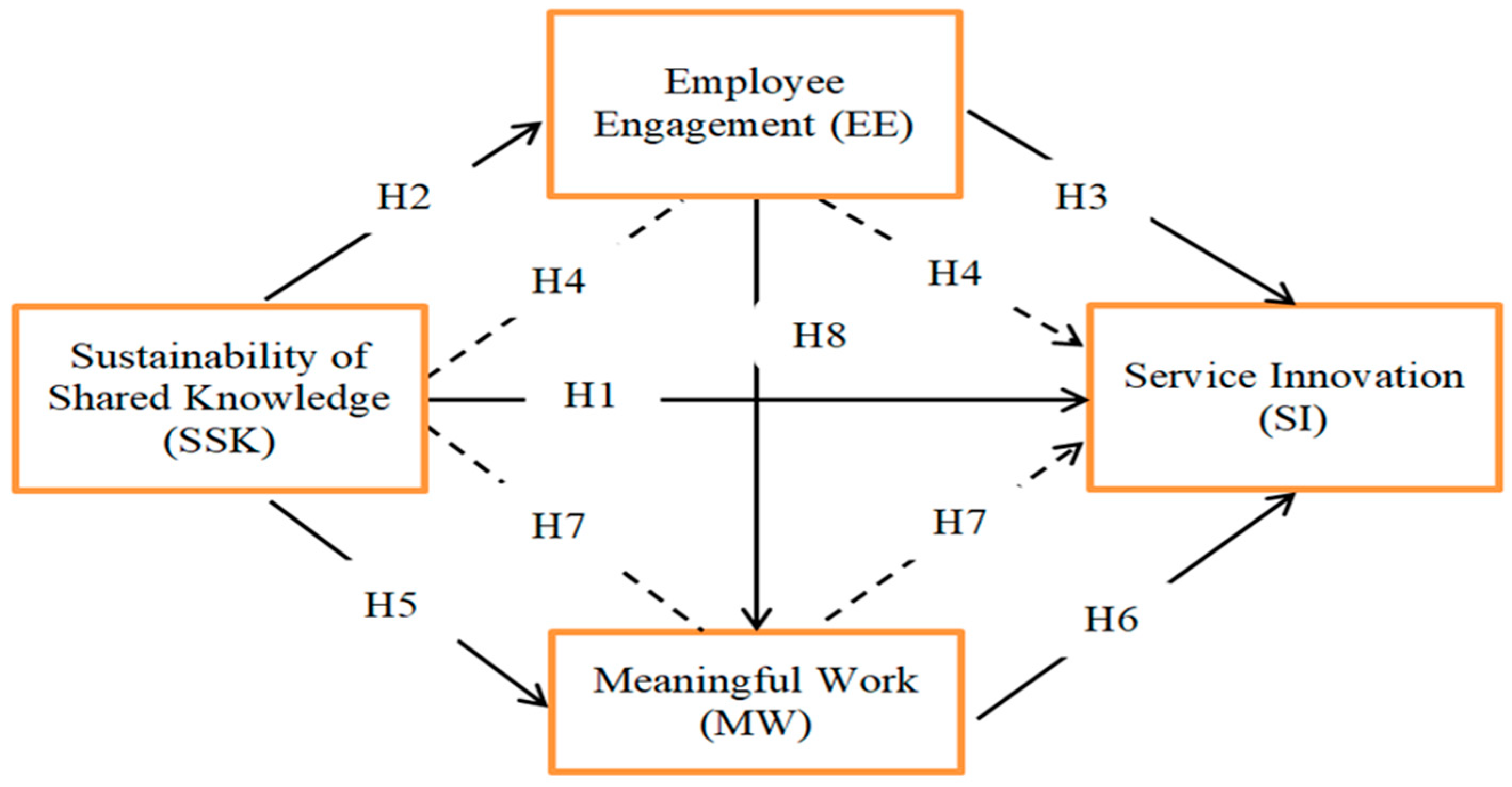
H1. The sustainability of shared knowledge has a substantial influence on service innovation within banks in Palestine.
2.2. Mediating Role of Employee Engagement
In this era of the knowledge economy, especially in knowledge-intensive industries like banking, the sustainability of Knowledge Sharing represents a critical issue to allow an organization to systematically harness innovation capabilities. Yet, the mere existence of knowledge is not enough to create innovation; it is the focused and committed involvement of employees that acts as an important intervening variable between shared knowledge and tangible innovative consequences.
We emphasize that personal jobs have a great influence on creating success for the organization. You are going to get your employees to start thinking outside the box and coming up with creative solutions and problem-solving techniques by giving them something they can believe in when it comes time for them to do their work. Recent evidence has also shown that the role of sharing knowledge, as a catalyst in the supportive working environment, which influences employees’ cognitive, affective, and behavioral engagement to perform their job, is a key determinant for stimulating employee willingness to engage in innovative practice [
15]. Third, common knowledge accumulates to enhance employees’ feelings of being empowered and job satisfaction, leading to a high innovativeness—a particularly relevant issue in service organizations given their reliance on flexibility combined with continuous search for renewal.
Additional investigation indicates that Knowledge Sharing encourages competence development and creates a supportive social climate for Energetic Engagement [
16]. Engagement as a multidimensional construct involves cognitive, affective, and situational aspects, thus contributing to employees’ ability to appropriately engage in innovatory behavior. Further, it also provides evidence that sustainable Knowledge Sharing positively influences employees’ ambidexterity—exploring new ideas alongside exploiting existing knowledge—which is essential for innovation at the organizational level [
17]. As a result, the goodwill employees of those who participate in knowledge-sharing behaviors keep participating in continuous innovation routines, which allow companies to remain competitive in a fast-paced business world.
In banking, employees who are heavily engaged in the use of Knowledge Sharing to come up with new capabilities that meet customer needs and improve corporate performance [
18]. This extent of participation is related to the psychological and social integration that employees perceive at work, which increases their motivation to be proactively engaged in idea generation [
19].
Sustainable sharing of knowledge is an essential contribution to the engagement level of employees. This would entail creating a holistic organization structure which acts as the medium for the spread of information and expertise, continuous learning, and enhancing the ability of employees [
20,
21]. Continuous learning provides human resources with a variety of tools to complete tasks, which leads to ownership and empowerment and has a good impact on emotional and cognitive engagement [
22,
23]. This continuing dialogical transfer of knowledge is not only a source of stimulating innovations, but also triggers employees to add new ideas and initiate actions which reflect productive elements for the organization [
24,
25].
Research shows that it is the open culture condition established by Knowledge Sharing, combined with both cognitive and emotional engagement at work, which establishes reciprocal cycles between knowledge retention and employee engagement. This spontaneous process is responsible not only for innovation but also for the quality of products and services [
15,
16].
It is worth noting that there is a strong relationship between sustainable Knowledge Sharing and thriving at the workplace, according to studies. Workplaces that enable employees to share and acquire knowledge have a favorable impact on their psychological needs for competence and relatedness, which in turn contributes to employees’ commitment and active participation [
20,
21]. Hence, the profitability of Knowledge Sharing is recognized as a strategic facilitator supporting an enabling organizational culture where it constantly stimulates commitment and eventually financial performance to create loyalty [
26,
27].
Employee engagement is considered a multi-dimensional psychological condition comprising vigor, dedication, and absorption in work [
24]. Involved employees show more creativity, proactivity, and a greater stakeholder commitment to organization objectives, which are important triggers for innovation [
25]. Continuous knowledge sharing, through resources, support, and autonomy, can develop employees’ cognitive, emotional, and behavioral engagement, allowing the innovation culture to develop [
15,
16].
It has been consistently proven in the literature that employee engagement is positively associated with service innovation. Engaging employees are likely to take risks with new ideas, cooperate across departmental boundaries, and tolerate organizational change, leading to the development and delivery of innovative services that can improve the organization’s competitiveness [
17,
18]. Engagement also strengthens the employees’ psychological empowerment and readiness to innovate, thus proving to be a vital antecedent for continued innovative performance in the service sector [
28,
29].
However, it is important to note that these studies were conducted in non-Palestinian contexts, with potential differences in sample sizes, organizational cultures, and banking systems. Therefore, generalizing these findings to Palestinian banks may have limited applicability. Factors such as economic constraints, political instability, and limited staffing resources can affect the level of participation and its impact on innovation, highlighting the need for local empirical studies to validate the applicability of these theoretical models and ensure the reliability of the results within the Palestinian banking environment. Based on this consideration, the following hypothesis was formulated:
H2. The relation between the sustainability of shared knowledge and service innovation is mediated by employee engagement.
H3. The sustainability of shared knowledge has a substantial influence on employee engagement.
H4. Employee engagement has a significant impact on service innovation.
2.3. Mediating Role of Meaningful
In a world where the business environment is changing day by day and at an increasing speed, the sustainability of Knowledge Sharing within companies has turned into a crucial facilitator for increasing innovation capacity and gaining competitive advantage [
22,
23]. Tacit and explicit knowledge, thus treated, are a strategic asset that must be well managed by the organizations since it is a root cause for performance improvement and encourages long-term innovation [
30,
31].
The sustainability of Knowledge Sharing within companies, in the face of ongoing and high-velocity changes in the business environment, has been identified as a critical enabler to enhance innovativeness as well as acquire a competitive advantage [
23,
32]. Both the tacit and explicit knowledge are considered to be a strategic resource that needs to be managed in organizations, because it has been regarded as the most important factor for improved performance and continued innovation over the longer period [
31].
In addition, the results imply that individuals’ meaningful work perceptions are a mediator of serving behaviors and consequently facilitate the transference of sustainable KK for service innovation. This chain connects existing knowledge with the capacity to transform it into new products and services that satisfy market demands [
33,
34]. The mediating process of these activities provides room for employees’ empowerment and opportunities to work creatively, which further produces lasting positive outcomes and superior organizational performance [
35,
36].
Theoretical models such as the self-determination theory [
37] have taken up arguments for a work context that provides employees with autonomy, and aims to foster purpose in order to support higher intrinsic motivation towards engaging in knowledge processing and innovation activities. Likewise, ref. [
38] identifies the importance of developing an engaged work organizational culture for creating a dynamic and innovative process environment.
Long-lasting knowledge sharing is an important asset that all organizations have, and it is implicated in employees’ meaningful work experiences to a greater extent. Organizations encourage a culture of collective learning and personal development by maintaining the constant permeation of both implicit and explicit knowledge [
23,
30,
32,
39]. This dynamic relationship enables a holistic interpretation of the entanglement of work and organizational objectives by employees, which contributes to their sense that work is meaningful and worthwhile [
22,
31,
40].
Work meaningfulness is typically described as when employees feel that their job has some purpose and meaning, possibly in harmony with their values or goals [
41,
42]. Sustainable knowledge practices shape trust, transparency, and psychological ownership of employees, conditions that are essential for achieving meaningful work [
43,
44]. Purposeful work refers to the extent to which employees recognize the importance and value of their tasks, contributing to the achievement of personal and organizational goals. While previous theories, such as self-determination theory, lay the foundation for understanding intrinsic motivation, this context emphasizes purposeful work as a distinct pathway that enables employees to achieve their goals, regardless of their overall level of engagement. This work is shaped by organizational practices that foster trust, transparency, and effective knowledge sharing, empowering employees to connect their daily activities to broader organizational objectives [
37,
45].
Evidence from practice indicated that organizations that successfully and continuously apply knowledge management practices have a higher level of motivation, engagement, and meaningful work among employees, leading to higher innovative behaviors and improved organizational performance [
46]. Sustainable Knowledge Sharing Performance. In this sense, SKS acts as a strategic enabler that engages employees by allowing them to ‘connect the dots’ between their daily actions and company objectives, and which consequently increases their overall satisfaction with work [
31,
35].
Ultimately, meaningful work is conceptualized as employees’ perception that their work is significant, purposeful, and aligned with both personal and organizational values [
42,
47]. This positive perception has the potential to boost internal motivation, job satisfaction, and commitment, leading to creative behaviors [
27,
44]. Open knowledge sharing supports deep work by creating increased transparency, trust, and feelings of ownership and allows employees to see how their efforts are contributing to innovation in the organization over time [
43,
44]. By acting as a mediating mechanism, meaningful work bridges knowledge resources with innovation outcomes, motivating employees to engage in creative problem-solving and continuous improvement [
33,
34]. Empirical findings further support the positive effect of meaningful work on innovation, demonstrating that employees who perceive their roles as purposeful are more likely to initiate and support innovative service development, enhancing overall organizational performance and customer satisfaction [
35,
36]. Accordingly, the following hypothesis was formulated:
H5. The relationship between knowledge sharing institutionalization and service innovation is mediated by meaningful work.
H6. Collaboratively Learned Knowledge’s sustainability has a lot to do with meaningful work.
H7. The contribution of meaningful work to service innovation is remarkable.
2.4. Employee Engagement and Meaningful Work
Although attention to the relationship between meaningful work and engagement in the previous literature has been much, few studies have investigated the reverse side, that engagement affects perceptions of meaningful work, especially in a bank context. The focus of this research on employee stakeholders is a gap we address in this manuscript by proposing that employee engagement has a direct positive effect on meaningful work. Both theoretical constructs and empirical evidence support this claim. For example, strong positive associations between employee engagement and meaningfulness of work have been found, such that more engaged employees are more likely to feel a high level of meaning associated with their jobs (r ≈ 0.68) [
48]. Likewise, see [
49], based on the JDR model, states that job resources promote engagement, which leads to a greater sense of meaningfulness at work.
Findings from industry-specific studies aligned with this view. In the Pakistani banking sector, ref. [
50] found that meaningful work mediated the relationship between sustainable human resource management and employee engagement, highlighting how engagement in turn is not only an outcome of meaningful work but also a driver to live out of the role with purpose. Likewise, ref. [
51] provided evidence in Bangladesh’s Private banking sector and showed that meaningful work partially mediates the relationship between organizational resources and employee engagement, which is a sign that engaged workers do work that matters to them as individuals.
From a theoretical angle, ref. [
52] found a strong positive relationship (β = 0.47, explaining about 47% of the variance) between meaningfulness at work and work engagement, thus suggesting that having meaning at work saturates job engagement, which is consistent with bidirectional reinforcement mechanics due to both belonging to the same domain. Given the limited business environment and high demand for innovation in Palestine’s banking industry, this reciprocal relationship is probably even more relevant. Cognitively and emotionally engaged employees tend to see their work as meaningful, leading to an ongoing culture of knowledge sharing in support of innovation projects.
Thus, the study posits a hypothesis relating engagement to meaningful work to fill this gap.
H8. Employee engagement has a significant impact on meaningful work.
2.5. Model of the Study
Figure 1 depicts the theoretical model that was formulated in order to investigate the impact of the Sustainability of Knowledge Sharing [
48,
49] on service innovation [
15]. Previous studies have highlighted that maintaining tools such as tacit knowledge leads to innovation due to improved creativity, employee empowerment, and increased organizational competitiveness [
51,
52,
53]. Extending from these findings, the proposed relationships intended to be examined between the dimensions of Sustainability of Knowledge Sharing and service innovation are also as follows: there is a positive relation between SKS and service innovation.
This is an Attempt in this paper to make a discussion about the Positive and Negative influences on service innovation in banks in Palestine based on insights from Previous Research on the Subject. The research stresses the point that simply having data does not automatically lead to innovative results, but rather, persistent and actively managed information exchanges are vital drivers of service innovation [
53,
54].
In the concept model, Knowledge Sharing (KSS) is the independent variable and Service Innovation (SI) is the dependent variable with mediating constructs Employee Engagement (EE) and Market Wisdom (MW).
3. Methodology
3.1. Sampling Method and Collection Procedure
The sample used in the study was 366 employees of banks working in the West Bank (as the Gaza Strip was not included because of the ongoing conflict). In this group, a random quota sampling was used to select participants until the target percentage of the defined group was reached in order to get a real-life picture regarding employees’ attitudes regarding the topic of research. Types Three types of Palestinian banks can be identified: (a) The governmental ones, both central and regulatory authority are the same PMA Palestine Monetary Authority, the central bank is owned by government while Independence Bank for Investment and Development is a fully government-owned commercial bank in Palestine, and (b) Semi-governmental banks where part or all of its ownership are vested with the government or any of its entities.
Like the National Bank—partially owned by the Palestine Investment Fund alongside private sector interest—and the Palestinian Islamic Bank, whose ownership is divided between public and investment corporations. There are privately owned banks, including all locally owned ones (Bank of Palestine, Palestinian Investment Bank, Safa Bank, Bank of Jerusalem), as well as the Arab Islamic Bank. Additionally, the international banks that serve Palestine are the Arab Bank, Cairo Amman Bank, Housing Bank for Trade and Finance, Jordan Ahli Bank, and Arab Egyptian Real Estate Bank.
Overall, participants were characterized by a variety in terms of their gender, management experience, and bank location, along with organizational role, which was valuable for the findings to gain richness and cover employees’ perceptions on knowledge sharing practices and service innovation. The banking sector employed 7579 people in 2023 and fell to about 7525 in 2024, according to the Palestine Monetary Authority. Although being a large sector, the study concentrated on employees as they are key to implementing and driving policies and strategies of knowledge sharing and innovation. An electronic questionnaire was used to collect data from employees at all local banks; this facilitated the analysis of decision-making and administration in practice within the Palestinian banking sector.
3.2. Measures
3.2.1. Materials and Methods
A structured questionnaire was used as the primary tool for collecting the data from employees of the banking sector in Palestine, to investigate the relationship between important organizational factors that affect service innovation. Demographic characteristics (i.e., gender, age group, years of experience, type of bank, and level of education) were covered in
Section 1, followed by sections on Sustainability of Knowledge Sharing [
1,
54], Service Innovation [
1,
54], Employee Engagement [
29], and Meaningful Work [
20]. It consisted of several sub-dimensions in each section, which were scored on a five-point Likert scale (1 = strongly agree, 5 = strongly disagree).
The construct Sustainability of Knowledge Sharing was measured through four dimensions: distribution processes, business partner processes, reward systems towards knowledge sharing, and cross-business unit processes. The Measurement of Service Innovation was based on nine dimensions. These are as follows: new services, incremental changes to a service innovation, new types of service delivery methods, client recognition as an innovative service provider organization with respect to the new or revised one, organizational processes (innovative and improved), IT in new services initiatives, IT-based incremental innovations, and the use of IT for running organizations more efficiently. Employee Engagement was measured with six items for vigor, effort, and sense of congruence to the mode of operation of the organization, and Meaningful Work was measured through six statements measuring a sense of purpose in work and contribution to the general good.
The survey was cross-sectional, and data collection occurred from September to December 2024 using an online survey administered through email to bank workers. To guarantee the representativeness and reliability of a sample, flexible data collection was organized with reminders and status control. This method allowed access and response across the entire study population.
3.2.2. Data Collection Tool
A structured questionnaire was used as the primary data collection tool from banking sector employees in Palestine to study the relationship between key organizational factors affecting service innovation. The questionnaire comprised four main sections:
Section 1 covered the demographic characteristics of respondents, including gender, age group, years of experience, bank type, and educational level.
Section 2,
Section 3 and
Section 4 focused on the research variables. Knowledge sharing sustainability was measured across four sub-dimensions: distribution processes, external partnership processes, reward systems for encouraging knowledge sharing, and interdepartmental processes. Service innovation was measured across nine dimensions, including: new solutions, incremental improvements, new service delivery methods, customer acceptance of new services, new and improved organizational changes, the use of information technology in new services and incremental improvements, and the application of technology to enhance operational efficiency. Employee engagement was measured using six elements related to vitality, effort, and a sense of alignment with the organization’s work style. Meaningful work was measured using six elements addressing the employee’s sense of purpose and contribution to the overall good.
4. Statistical Analysis and Results
Structural Equation Modeling (SEM) with AMOS 26 was used to test the hypothesized relationships among these constructs. This analytic technique was chosen because of its capacity to both estimate and test complex inter-relationships among more than one latent concept with observed measures. SEM allowed for the examination of the measurement model that measures the degree to which the indicators observed represent corresponding latent constructs, and the structural model, which examines relationships among these constructs with respect to hypothesized paths. Measurement model A Confirmatory Factor Analysis (CFA) was used to assess the validity and reliability of the measurement model based on KSS, SI, EE, and MW at the first step. We assessed factor loadings, construct reliability, AVE, and model fit index, Comparative Fit Index (CFI), Root Mean Square Error of Approximation (RMSEA), and Chi-square divided by degree freedom (χ2/df) forms to ensure that the constructs measured are statistically strong as well as conceptually distinguishable pillar score is reliable and robustly contributing to making SEM findings more credible.
The CFA results from the analysis showed that a number of observable indicators had factor loadings less than the cut-off point of 0.50, which may signal issues with convergent validity. In addition, the Cronbach’s Alpha of the two constructs combined was around 0.066, much below the suggested minimum value of 0.70 that indicates a strong degree of internal consistency [
52]. Although CR and AVE estimates could have been inflated because of computational constraints10, these results emphasize that the robustness of the measurement scales must be interpreted with caution.
Despite these restrictions, SEM was applied to establish the structural interrelations between the constructs in this study. Assumptions of normality were considered for this model to be suitable. The results, however, indicate the need to revisit measurement indicators and enhance scale stability in future research, especially in the Palestinian bank market.
4.1. Descriptive Statistics
The research sample included 366 employees of different banks in Palestine and was chosen to represent the diversity of demographics and professional aspects. The sample was composed of 59.6% women and 40.4% men, which showed a high participation of women in the banking sector. The age distribution in our sample was approximately balanced between 25–35, 36–45, and 46–55 groups, which provides useful insights from knowledge sharing practices about the innovation of people belonging to different generations. Work experience of the participants varied from 1 to more than 15 years, reflecting both early career and experienced personnel. Over half (63.4%) of participants in public-sector banks offered a wider perspective on institutional set-ups. In terms of education level, 57.9% had graduated from a bachelor’s degree, with the remaining having higher educational backgrounds, indicating that there was an educated workforce who could potentially participate in knowledge-sharing and innovation efforts. This heterogeneous and representative sample serves as a strong empirical basis for investigating the effects of OSS on SI, and the mediating roles of EEs and MS in Palestinian banks.
Table 1 shows the Descriptive statistics and Pearson correlation coefficients among the study variables of 366 participants are shown in
Table 2. Results of the study indicate that there are significant and positive relationships between all of the variables at the
p < 0.01 level. More specifically, the Knowledge Sharing Scale (KSS) is highly positively correlated with SI, EE, and MW, with 0.93, 0.73, and 0.651 coefficients, respectively. Service Innovation also exhibits high correlation with Employee Engagement and Meaningful Work, which have coefficients of 0.887 and 0.828, respectively. This implies that the extent of service innovation depends indirectly on employees’ engagement and meaningfulness mediated by the perception of meaningful work. The significant relationship between Employee Engagement and Meaningful Work (r = 0.778) is further evidence of a strong connection between opportunities for involvement at work and its perceived meaningfulness.
Regarding descriptive statistics, the mean scores for all variables are relatively high, ranging from 4.17 to 4.22, with standard deviations between 0.45 and 0.53. These results indicate that participants generally perceive shared knowledge practices, service innovation, employee engagement, and meaningful work positively and consistently, reflecting a cohesive organizational environment that supports knowledge-sharing and innovation.
4.2. Measurement Model
Table 3 shows the validity and reliability of the measurement items used in our main constructs. Factor loadings are generally high, ranging from 0.89 for “Distribution Processes” to 0.97 for “Incremental Improvements,” indicating strong relationships between items and constructs. Although the “Client Acceptance” item loading is marginal at 0.63, it was retained in the model after careful consideration, as it contributes theoretically to the construct and does not adversely affect the overall reliability or validity.
No item deletions were performed; instead, the construct was evaluated holistically to ensure measurement robustness. Composite reliability (CR) values are high across all constructs—0.92 (KSS), 0.97 (SI), 0.91 (EE), and 0.91 (MW)—exceeding the 0.70 threshold, indicating strong internal consistency.
Average Variance Extracted (AVE) values also exceed 0.6, confirming convergent validity, while Maximum Shared Variance (MSV) and Average Shared Variance (ASV) values support discriminant validity.
High t-values (e.g., 16.42 for “Business Partner Processes” and 17.19 for “Incremental Improvements”) further confirm the statistical significance of all items, collectively supporting the reliability and validity of the measurement instrument and indicating its appropriateness for use in measuring the theoretical constructs.
4.3. Structural Model
The results of hypothesis testing using a sample size of 366 are reported in
Table 4. All eight hypotheses have a significant path (
p < 0.001). The direct impact of (KSS) on (SI) is significant (0.52), and higher sustainability in shared knowledge has the strength of relatedness to service innovation [
20]. Furthermore, KSS has a significant indirect impact on SI via the mediating effect of (EE) and (MW) with path coefficients of 0.192 and 0.038, respectively; thus, supporting the mediation roles of EE and MW.
The results also show that KSS strongly predicts EE (0.78) and moderately predicts MW (0.18). Both EE and MW have positive and significant direct effects on SI, with coefficients of 0.245 and 0.206, respectively. Furthermore, EE significantly influences MW (0.62), suggesting that engaged employees are more likely to perceive their work as meaningful.
Overall, these findings support the proposed model where sustainability in shared knowledge enhances service innovation directly and indirectly by fostering employee engagement and meaningful work, underscoring the important mediating roles of these psychological factors within banks in Palestine.
Table 5 suggests that the model fit is better for all indices. The ratio χ
2/df is 1.85, indicating a very good fit. Both the comparative fit index (CFI = 0.92) and Tucker–Lewis index (TLI = 0.90) are above the cut-off value of 0.95, reflecting good model fit. Additionally, the RMSEA (0.055) and SRMR (0.048) further indicate superb model fit. Extent of content and face validity: Lower bound (90% confidence interval) for RMSEA = 0.045, upper bound (higher than RMSEA) = 0.065. Conclusion: The tightness and relative narrowness of the proposed interval reflect the robustness and stability of the model.
Analyzing responses from 366 employees,
Table 6 gives the overall impact of KSS on SI. The findings show a strong direct effect of KSS on SI (0.52), which explains (61.29%) of the total effect. This highlights the unique role of knowledge longevity in innovative processes. Also, the indirect effects are also strong, summing up to 0.33 (38% of the total effect). The largest mediation effect can be identified through EE (23%), followed by the sequential path through EE and MW (12%), and 4% for only MW. All provided effects are significant, thus confirming the crucial roles of EE and MW as mediators. This highlights the importance of increasing engagement and perceived meaningful work to optimize innovation from sustained knowledge practices.
Table 7 represents the results of our multi-group analysis, which compared structural relationships between public banks (N = 232) and private banks (N = 134) in Palestine. Specifically, the purpose of this study was to investigate whether the hypothesized model (with Employee Engagement and Market Weighting as mediators), which may test the mediating role of KSS on SI-KSS-EI-SI, differs by type of bank ownership. Structural paths are highly similar between the two banking sectors, though there is a slight difference in path coefficients (0–0.18). In addition, the ∆χ
2 values were only slightly different among models, and their
p-values were >0.05, suggesting no statistical significance of these differences. These results imply that the proposed relationships from the model are valid both in publicly and privately owned firms. As a result, the pathways linking KSS and SI directly and indirectly through EE and MW are invariant across ownership types. This invariance increases the validity of the proposed model and demonstrates that the conclusions drawn from this study can be generalized to other banks within Palestine, as interventions aimed at fostering knowledge sharing and service innovation could be universally applied across banks.
Table 8 shows that the model has high predictive power in both industries. The total explained variance of (SI) is 86%, highlighting the high efficiency of the model in identifying the key drivers of innovation in the banking industry. Similarly, the proportion of explained variance for (EE) and (MW) remains very high, with R
2 values of 80% and 68%, respectively. The differences in explained variance between public and private banks are small—no more than 0.02—which confirms the consistency and applicability of the model in different banking environments.
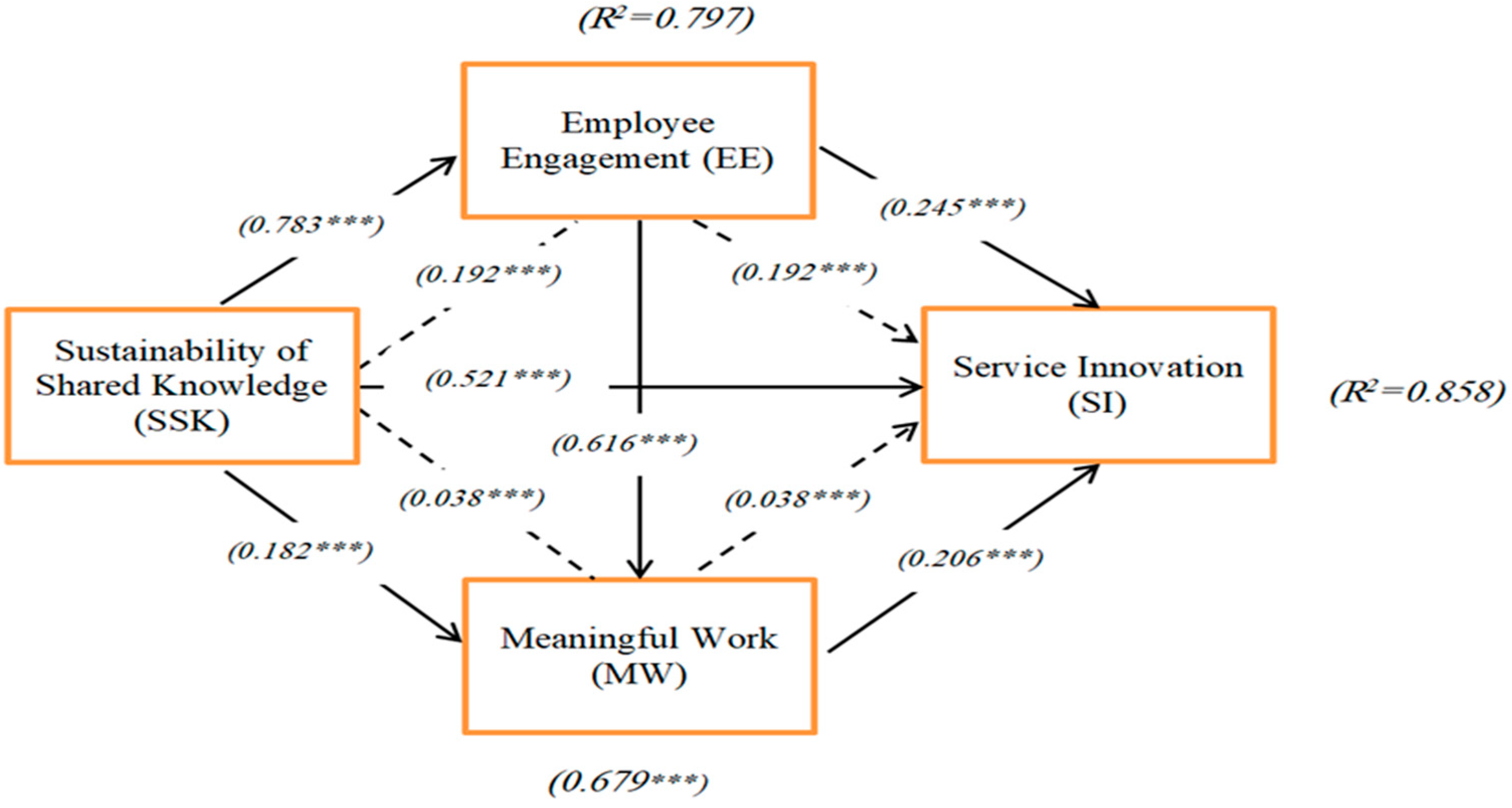
Figure 2 presents the path analysis results, confirming that all hypothesized relationships are statistically substantiated at the 0.001 level. (KSS) has a strong direct effect on (SI) with a coefficient of (0.52), as well as indirect effects through (EE) at (0.78) and (MW) at (0.18). The results indicate that both EE and (MW) play effective mediating roles in enhancing (SI) within banks in Palestine. The indirect effect through emotional empowerment reached (0.19), while the effect through meaningful work was (0.038). The analysis indicates that emotional empowerment acts as a particularly strong mediating factor within the examined relationships, suggesting that enhancing employees’ sense of recognition, influence, and self-efficacy can substantially promote the generation of innovative ideas and practices. At the Direct Effect level, emotional empowerment (β = 0.25) as well as meaningful work (β = 0.21) play a significant role in service innovation. These results emphasize that employees who feel empowered and consider their work as meaningful will be more likely to engage in creative problem solving and to provide innovative banking services.
On further investigation of our results, it is evident that meaningful work has a high positive relation with employee engagement (0.62), pointing to an overlap in the two constructs. There is a bit of both, because when people are clear and feel intellectually safe and trusted—that they do not have to be controlling or manipulative—then their work makes more sense for the doer too. Of course, meaningfulness at work creates engagement and psychological motivation. Such a feedback mechanism provides a strong psychological and organizational foundation to arouse innovative behaviors in the organization. In sum, results suggest that KSS is positively related to SI not only directly but also indirectly through the enhancement of employees’ work, making them feel good about themselves and work harder. Thus, advocating a culture of knowledge sharing, empowerment, and meaningfulness at work within the institutions is essential to foster innovation and secure a competitive edge amidst Palestinian banks.
Although the path coefficients shown in
Figure 2 (e.g., KSS → EE = 0.783) are statistically significant, the R
2 value for Service Innovation (SI) is unusually high at 85.8%, which is rare for behavioral models. This indicates that the model explains a very large portion of the variance in SI, suggesting the potential presence of model-specific bias or overestimation effects. From an analytical perspective, this result provides a strong indication of the influence of the independent and mediating variables on SI, but it requires a cautious interpretation, as such high values may reflect the strength of relationships within the studied sample more than their generalizability to other contexts.
5. Discussion
The results of this study provide compelling empirical support for the theoretical relationship between KSS and SI within the Palestinian banking sector. The direct effect of KSS on SI (β = 0.52) exceeds effect sizes reported in previous studies of Croatian ICT firms (r ≈ 0.45) and Spanish enterprises (β ≈ 0.40), highlighting the particularly critical role of knowledge exchange in contexts constrained by limited resources and political-economic instability. The high correlation between KSS and SI (r = 0.93) further underscores the significance of tacit knowledge transfer, surpassing prior international benchmarks (r ≈ 0.65), and indicating that mechanisms for sharing knowledge are especially influential in emerging and conflict-affected economies.
To address potential multicollinearity between KSS and SI, variance inflation factors (VIFs) were calculated and found to be within acceptable limits (<5), indicating that the SEM results are not biased due to the high correlation between constructs.
The study identifies dual mediating pathways through which KSS enhances service innovation, namely (EE) and (MW), which account for approximately 22.5% and an additional portion of the indirect effect, respectively. These findings extend existing research on human capital and affective commitment by simultaneously integrating engagement and the perception of meaningful work within a single model. The substantial path from EE to MW (β = 0.37) emphasizes the central role of employee engagement in cultivating a work environment where meaningfulness flourishes, subsequently stimulating innovative behaviors. This addresses a key gap in the literature by empirically demonstrating the interplay between engagement, meaningful work, and sustainable innovation within knowledge-intensive sectors in developing markets.
Although no statistically significant differences were found between public (232) and private (134) banks, the sample size for private banks may be relatively small, limiting the ability to detect true differences. Therefore, future research with larger samples is recommended to validate these relationships.
The hypothesized model accounts for 85.8% of the variance in service innovation, for 79.7% in employee engagement, and 67.9% in meaningful work, which signals considerable explanatory power overall. These results indicate that the development of a sustainable knowledge-sharing climate with the help of involved employees and meaningful work is an important strategy for organizations in order to improve innovation capabilities. The results provide both theoretical insights and practical guidance for banking managers operating in Palestine and comparable developing economies.
6. Recommendations
Policy implications. According to the study results, the following specific recommendations can be concluded, which we might use to stimulate service innovation in Palestinian banks:
- 1.
Encourage Knowledge Sharing: Banks shall actively encourage knowledge sharing by way of policies and procedures written towards a systematic exchange of knowledge at all levels in the organization. Furthermore, incentive schemes (e.g., recognition system and reward system for knowledge contribution) can also motivate acts of knowledge sharing.
- 2.
Improve Employee Engagement: As it is a mediator, banks should create a work environment that encourages employees’ initiative, autonomy, and psychological empowerment. Regular training and staff upskilling programs should be put in place to improve employee competencies, providing for ongoing learning, which will allow them to make meaningful contributions towards innovative service solutions.
- 3.
Encourage a sense of purpose: Job design encourages the connection between employees’ job roles and the bank’s strategic goals. We note that specific jobs make an important contribution to the overall success of any organization. Workers become more interested in creative problem-solving and innovative solutions when they feel a greater sense of purpose around their work.
- 4.
Holistic Approach to Learning Linked with Innovation Goals: Developmental programs need to be linked strategically to the business overall and innovation objectives in particular. Employees are encouraged to use new knowledge to tackle practical challenges so that learning leads to improvements in service delivery, which can be measured.
- 5.
Use of Frameworks to Assess: Banks should implement a structured screening tool that can assess symptoms such as KSS, EE, MW, and SI. Regular evaluations also help companies measure the impact of their policies, see what is working and where work needs to be done, and keep moving ahead with their innovation efforts.
- 6.
Maintaining Competitiveness: Should the banks include knowledge sharing, engagement, and meaningful work as part of their organizational policies, it would be likely to improve service quality, innovation, and grounded competitive advantage in the Palestinian banking sector.
7. Conclusions
The relationship between KSS and SI examined in this study among Palestinian banks indicates that EE and MW are the pivotal mediating ones. There was a strong direct positive effect of KSS on SI (0.43), which explained 55% of the total effect.
This research examined the relationship between Knowledge Sharing (KSS) and Social Identity (SI) among banks in Palestine. The study found that both Employee Engagement (EE) and Meaningful Work (MW) play significant roles as mediators in this relationship. KSS had a substantial direct positive effect on SI (β = 0.43), mediating approximately 55% of the total effect. Additionally, the findings indicate the presence of indirect mediation, with Meaningful Work accounting for 25% of the total effect and Employee Engagement contributing 20%. The structural model demonstrated strong explanatory power (R2 = 0.54 for SI), confirming the practical applicability of the theoretical framework. The results are reliable across different types of banks (∆χ2 0.05), suggesting that the advantages of shared knowledge are transferable across various ownership types. From a managerial standpoint, these findings highlight the importance for banking supervisors to establish and maintain sustainable knowledge-sharing behaviors, encourage employee engagement, and build meaningful work contexts as they jointly strengthen innovation competencies. Policies that support the exchange of knowledge, recognize and empower employees, and align work with organizational objectives can directly improve service innovation.
It is worth mentioning that banks in the Gaza Strip were not included because of the exceptional conditions that resulted from ongoing conflicts and huge destruction. Normal banking has been profoundly disrupted by the war; access to employees and data is limited, and working conditions are volatile, making systematic data reporting and measurement impossible in the region. The non-inclusion of staff who work in Gaza restricts the generalizability to the Palestinian banking industry as a whole. Future research should try to include individuals from Gaza and conduct cross-site comparisons to improve the generalizability of the findings.
Nevertheless, this study has its own limitations that should be noted. Cross-sectional nature of the study. Firstly, by its cross-sectional experience, life is difficult to establish. Second, the study was carried out only in banks located in the West Bank and therefore does not allow generalizations for findings obtained from other cultural or economic contexts. Third, the use of self-report measures might create common method bias.
It would be worthwhile for future studies to use longitudinal or experimental designs to investigate causal mechanisms between KSS, EE, and MW. Furthermore, future research may broaden the sample of banks to other developing countries or consider Gaza when it enters a period of calmness for examining the generalizability of the model. Examining other mediators or moderators could also make a greater contribution to the ways in which knowledge sharing impacts innovation, such as organizational culture, leadership, and digital transformation capability.