Article

Incentives and Constraints: The Dual Effects of Climate Risk on Green Bond Issuance in China

School of Economics, Guangdong University of Technology, Guangzhou 510006, China
*
Author to whom correspondence should be addressed.
Sustainability 2026, 18(1), 125; https://doi.org/10.3390/su18010125
Submission received: 4 November 2025 / Revised: 15 December 2025 / Accepted: 16 December 2025 / Published: 22 December 2025

Abstract

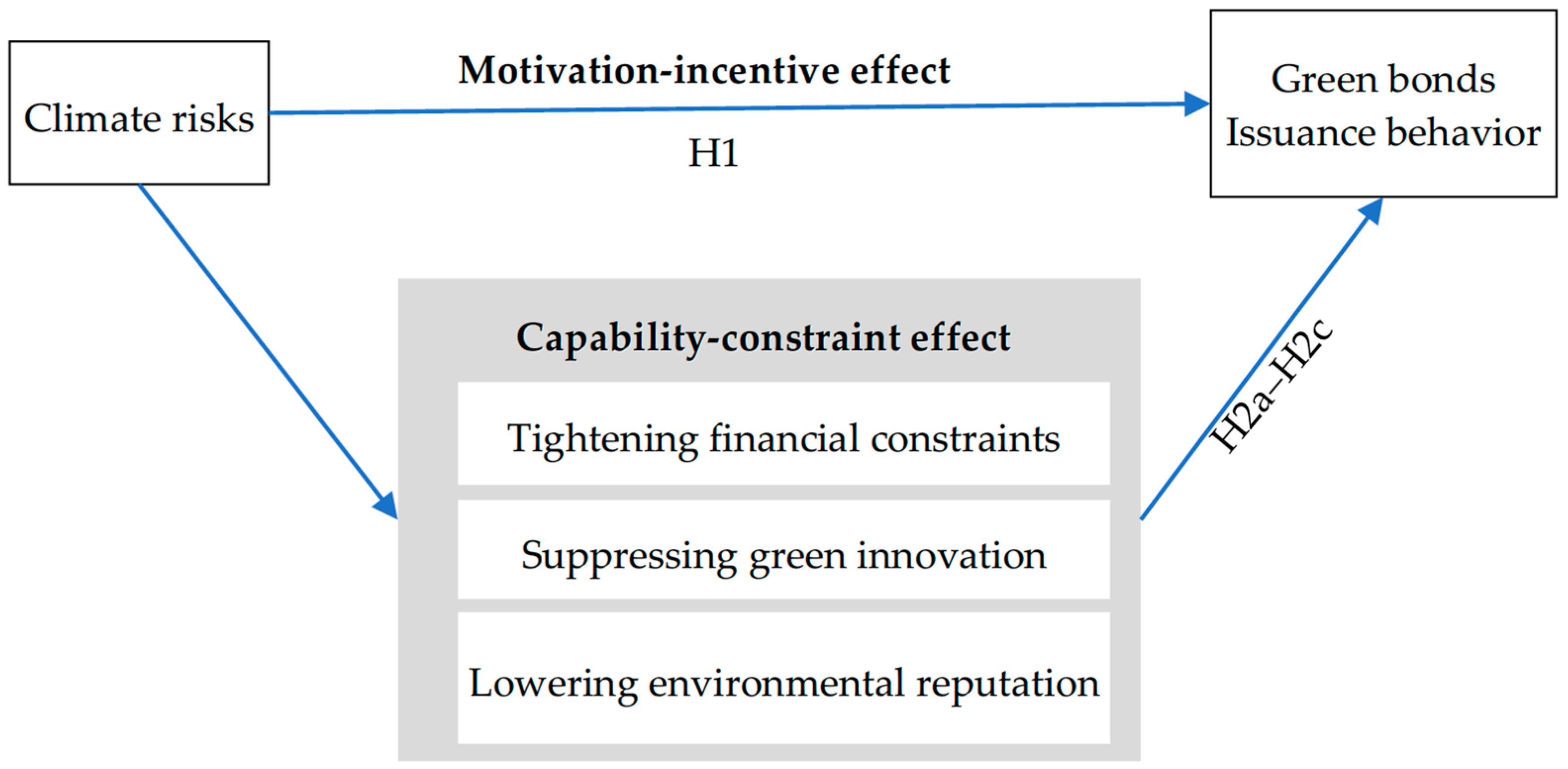
Against intensifying climate risks, a paradox persists in green finance: high corporate awareness yet low green bond issuance. This study examines the impact of climate risk on green bond issuance using a final sample of 5958 bond issuances, which were issued by 469 unique A-share non-financial listed companies in China between 2016 and 2023. By integrating the Fogg Behavior Model (FBM) into a Motivation–Capability–Triggers framework and employing Logit and Karlson–Holm–Breen (KHB) methods, we investigate the underlying mechanisms. The baseline results show a positive link between climate risk and issuance likelihood, confirming a motivation-incentive effect. Mechanism analyses reveal significant negative mediation through financing constraints, green innovation, and environmental reputation, highlighting a capability-constraint effect. Heterogeneity analysis finds a stronger effect in non-state-owned firms, non-heavily polluting industries, and firms in pilot zones or central/western China, indicating that policy signals and resource endowments act as key triggers to synergize motivation and capability. Our findings offer valuable insights for policymakers in designing motivation-stimulating and capability-compensating intervention strategies to help firms balance economic and environmental objectives.
Keywords: dual effects; climate risk; Fogg behavior model; capability-constraint; motivation-incentive; KHB method dual effects; climate risk; Fogg behavior model; capability-constraint; motivation-incentive; KHB method