Article

Medium-to-Long-Term Electricity Load Forecasting for Newly Constructed Canals Based on Navigation Traffic Volume Cascade Mapping
1
China Energy Engineering Group Guangxi Electric Power Design and Research Institute Co., Ltd., Nanning 530006, China
2
Key Laboratory of Power System Optimization and Energy Saving Technology, Guangxi University, Nanning 530004, China
*
Author to whom correspondence should be addressed.
Sustainability 2026, 18(1), 109; https://doi.org/10.3390/su18010109
Submission received: 25 November 2025 / Revised: 13 December 2025 / Accepted: 18 December 2025 / Published: 22 December 2025

Abstract

Addressing the data scarcity and complex consumption characteristics in mid-to-long-term electricity load forecasting for new canals, this study proposes a novel model based on navigation traffic volume cascade mapping. A multidimensional feature matrix integrating economic indicators, meteorological factors, and facility constraints is established, with canal similarity quantified via integrated constraint optimization weighting to derive multisource fusion weights. These enable freight volume prediction through feature migration using comprehensive transportation sharing. The “freight volume–lockage volume–electricity consumption” cascade then applies tonnage-based mapping to capture vessel evolution trends, generating lockage volume forecasts. Core consumption components are predicted through a mechanistic-data hybrid model for ship lock operations and a three-layer “Node–Behavior–Energy” framework for shore power system characterization, integrated with auxiliary consumption to produce the operational mid-to-long-term load forecast. Case analysis of the Pinglu Canal (2027–2050) reveals an overall “rapid-growth-then-stabilization” electricity consumption trend, where shore power’s proportion surges from 24.1% (2027) to 67.8% (2050)—confirming its decarbonization centrality—while lock system consumption declines from 28.6% to 17.2% reflecting efficiency gains from vessel upsizing and strict adherence to navigation intensity constraints.The model provides foundations for green canal energy deployment, proving essential for establishing eco-friendly waterborne logistics.

1. Introduction

The waterborne transport exhibits prominent advantages in low cost and energy consumption [1]. Since the 14th Five-Year Plan period, multiple national strategic initiatives have prioritized the development of the “Four Vertical, Four Horizontal, and Two Network” high-grade waterway network [2,3,4]. Among these, electricity load forecasting serves as a core basis for supporting grid planning and designing green electricity supply pathways for canals.
Domestic and international experts have identified two main approaches for mid-to-long-term electricity load forecasting. The first approach involves extracting intrinsic patterns from historical load data through techniques such as decomposition, fitting, denoising, and reconstruction. These methods then use statistical analysis [5,6], machine learning models [7,8,9], or deep learning algorithms [10] for time-series prediction. In Reference [11], the authors propose a power prediction method aimed at learning time-shared features and trend features of power curves, effectively mitigating prediction errors caused by power decoupling. However, this model requires trend indicators and a set of similar curves as inputs, and its practical applicability is limited. In Reference [12], the authors proposed a multiperiod decomposition and bidirectional hybrid forecasting mechanism, incorporating residual distribution fitting and t-distribution sampling to enhance the quantification of long-term load prediction uncertainties. However, this method struggles with capturing nonstationary abrupt changes and has limited applicability in underdeveloped regions. In Reference [13], the authors used variable-weight buffering operators to preprocess data, employing a multivariate gray model with differential evolution algorithms to improve prediction accuracy in small-sample systems. However, this method suffers from long computational times. The second approach integrates external factors such as weather, holidays, and economics to directly construct data-driven models, such as recurrent neural networks (RNNs), Transformers, and tree models [14]. In Reference [15], the authors developed an industry-related deep learning model that effectively incorporates economic factors but does not include weather factors. In Reference [16], Wang Jidong et al. proposed a medium-to-long-term electricity load forecasting model based on fully adaptive noise ensemble empirical mode decomposition and double decomposition using BiLSTM. This model deeply mines load patterns and improves accuracy through exogenous corrections but does not differentiate seasonal characteristics. In Reference [17], a hybrid model combining empirical mode decomposition (EMD), Isomap, and AdaBoost (EMDIA) was proposed, which decomposes load and its meteorological and economic factors to extract key features, achieving separate predictions and stacking results. This model significantly improves prediction accuracy compared to single models but has higher computational costs due to its three-tier structure. Given the long-term cumulative uncertainty of influencing factors, making point predictions unreliable, Reference [18] simultaneously models the joint probability distribution of peak load and driving variables. This model uses a self-organizing mixture network (SOMN) and accelerates convergence with a neighborhood contraction strategy, significantly enhancing the accuracy of long-term peak load probability predictions. However, the model’s convergence is sensitive to initial values. Due to the systematic inclusion of load drivers, the second approach generally demonstrates superior prediction accuracy [16].
While existing mid-to-long-term load forecasting methods perform effectively in grid scenarios, their intrinsic reliance on temporal extrapolation necessitates stable economic conditions and substantial historical data [19]. These methods inherently face three critical limitations when applied to newly constructed canals: First, the mismatch stemming from composite loads—combining waterway transport and logistics—challenges conventional assumptions. Current models presume load curves driven by stationary variables (e.g., GDP/temperature), whereas canal loads result from the tight coupling of electromechanical control and shipping logistics, generating nonstationary dynamic hybrids that data-driven sequential models fail to capture under mechanistic constraints. Second, forecasting failure arises from long-term temporal variations in new canals; models dependent on historical fluctuations become inapplicable in zero-sample contexts. Third, they cannot address spatial decoupling demands. Canal electricity-consuming facilities (e.g., ship locks, service zones) distribute discretely along hundreds of kilometers, with nodal loads subject to heterogeneous constraints from watershed meteorology, vessel flow patterns, and hub topology. This spatial coupling induces uncontrollable errors in current centralized forecasting models. Consequently, existing methods prove infeasible for new canals, while the proposed navigation traffic volume cascade mapping-based model effectively resolves these issues.
Additionally, single-source analogical transfer—which predicts consumption for a single similar waterway before migrating to a data-scarce target canal—suffers from incomplete feature spaces and uncontrolled uncertainty propagation. Thus, this study introduces a “feature transfer learning + multisource fusion” framework to comprehensively cover the target canal’s energy characteristics using multiple source canals, enhancing scientific rigor, interpretability, and plausibility of predictions.
This navigation-based cascading mapping model for mid-to-long-term power load forecasting supports energy infrastructure planning along the canal, facilitates lifecycle green power supply design, and critically enhances national port upgrades and carbon-neutral waterborne transport systems establishment.The core logic of the proposed model manifests as a sequential conversion process: economic demand–freight volume–lock transit frequency–electrical load. Its innovations primarily consist of two key aspects.
  • A multisource feature transfer framework is proposed to construct a six-dimensional feature matrix that includes economic, meteorological, and facility constraints. This framework transforms load forecasting into a prediction of ship transit volumes/cargo volumes. The independence of features and their correlation with cargo volumes are verified through correlation analysis. Feature weights are calculated using a comprehensive constrained optimization weighting method, and the canal-to-canal similarity index is quantified using weighted Euclidean distance to generate multisource fusion weights, achieving the cross-project transfer of cargo volumes.
  • An cascaded prediction chain of “cargo volume–transit volume–electricity consumption” is established: First, the cargo volume for the target canal is predicted by integrating the logistic saturation correction method and the comprehensive transportation sharing method. Then, a tonnage-ship number dynamic mapping model is developed to convert cargo volumes into transit volumes based on the trend of ship gigantization. Finally, a ship lock electricity consumption mechanism-data hybrid model and a three-layer “Node–Behavior–Energy” (NBE) prediction framework for shore power are constructed based on the core variables of transit volumes to collaboratively predict the electricity consumption across the entire process.

2. Multisource Data Migration Architecture for Electricity Consumption Forecasting of a Newly Constructed Canal

2.1. Analysis of Typical Electricity Consumption Scenarios for Canals

Based on functional positioning and electricity consumption characteristics, the main electricity consumption scenarios during the operation of canals can be categorized into hydropower hub electricity usage, service area electricity usage, and shore power system electricity usage (Figure 1).
Generator self-consumption is typically closely related to hydrometeorological conditions [20] and must be discussed separately for three operational scenarios: flood periods, normal periods, and low-water periods. In contrast, plant public electricity consumption, which includes systems such as air compressors and secondary systems, is relatively stable and can be handled using fixed benchmark values.
Electricity consumption for ship lock operation is composed of work gates, valve actuators, and control systems, and is directly related to the number of times the lock gates are operated, which in turn is positively correlated with the number of ships passing through.
Waterway service areas fulfill fundamental functions like waterway management, vessel services, living supplies, and environmental services, along with extended functions including public education, healthcare, and recreation [21]. Their electricity consumption is divided into five components: service building usage is driven by daily average service users (proportional to vessel docking frequency); the power distribution room, operating constantly as a baseload facility, exhibits relatively fixed energy consumption; electricity intensity in the boiler room and pump house depends on the frequency of water supply/drainage operations (proportional to vessel docking frequency); maintenance building usage varies dynamically with repair workload; and the equipment room features significant seasonal air conditioning energy consumption fluctuations due to the requirement for constant temperature and humidity control.
Electricity demand for the shore power system is fundamentally determined by ship charging requirements [22]. Its scale hinges on two key variables: vessel throughput (/lock transit frequency) and electric vessel penetration rate.
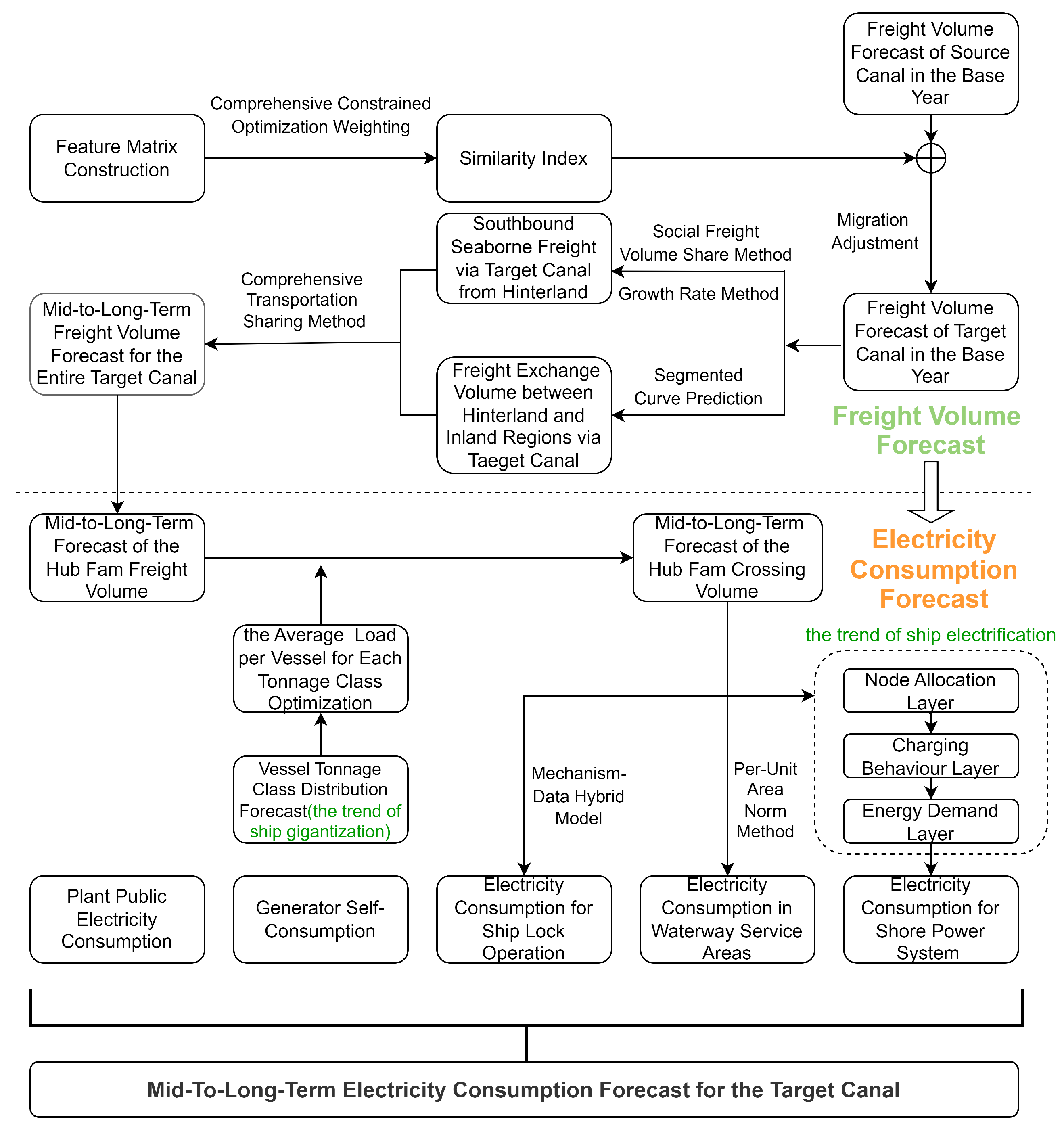
Consequently, vessel lock transit frequency serves as the pivotal linkage running through the entire electricity consumption chain. It directly determines the lock system’s energy consumption and also indirectly regulates variable loads by influencing vessel berthing levels, thereby shaping the electricity demand for both the service area and shore power. Thus, medium-to-long-term throughput forecasting becomes the primary task for electricity demand modeling. Figure 2 presents the technological framework for medium-to-long-term electricity demand forecasting on the new canal.

2.2. Analysis of Driving Factors and Feature Extraction for Electricity Consumption Characteristics

To ensure the scientific validity of multisource fusion transfer forecasting, candidate source canals were selected based on the following principles. (a) Representativeness in hydraulic morphology, requiring alignment in critical hydraulic engineering indicators (e.g., structure types, design loads) with the target canal; (b) economic proximity, necessitating high similarity in core hinterland economic attributes; and (c) data integrity, mandating accessible, high-quality long-term operational datasets. Canals satisfying criterion (c) while concurrently meeting either (a) or (b) were deemed qualified source candidates.
In characterizing electricity consumption drivers for newly constructed canals, this study addresses the inherent challenges of fragmented and scarce electricity data across multiple administrative regions within watersheds. Consequently, vessel traffic volume can be selected as an alternative, core indicator characterizing the operation of the navigation system, as its dynamic process exhibits a strong correlation mechanism with electrical load. Specifically: First, due to homology in the driving mechanism, vessel activities like navigation, docking, and lock transit directly drive key energy-consuming processes (shore power facilities, service area power supply, lock gate operation). Second, there is synchronicity in temporal variation, meaning that fluctuations in traffic volume explain variations in electrical load to a certain degree. Third, system state equivalence exists, where the distribution characteristics of traffic data inherently reflect the intensity and patterns of electricity consumption. Thus, analyzing the characteristics of vessel traffic volume/lock transit volume/freight volume enables indirect assessment of electricity consumption characteristics.

2.2.1. Characteristic Driving Factor Analysis and Feature Matrix Construction

Differences exist between the characteristics of various source canals and the target canal. The primary focus of this section is to analyze the driving factors, construct a feature matrix, and effectively quantify the differences in these features.
A feature matrix comprising six core features influencing freight volume is constructed: F = [ G , C , B , M , E , T ] .
1. Freight demand economic indicator G:
G = Δ G D P i · G D P i G D P i
G D P i and Δ G D P i represent the gross domestic product (GDP) and year-on-year GDP increment of economic hinterland province i in the base year, respectively (in CNY billion).
The defining function of a canal is to fulfill the cargo flow demands of its economic hinterland. The level of regional economic development directly determines the baseline volume generating water transport demand. G quantifies the driving effect of provincial hinterland economic growth on water freight demand and serves as the most fundamental factor influencing freight volume.
2. Inland industry proportion C:
C = ( A i % · G D P i ) G D P i
A i % represents the proportion represented by the tertiary industry in the GDP of economic hinterland province i in the base year.
Different industrial structures exert a significant influence on both the intensity of demand for water transport and the resulting transportation modes. C effectively explains why actual freight volumes differ between canal hinterlands with similar GDP levels and is an important mediating variable. Furthermore, applying GDP-weighted calculations provides a better explanation of how industrial structure influences waterway freight volume. For instance, provinces with higher GDPs typically function as regional economic cores, and their industrial structure exerts a more direct impact on the freight demand for that specific waterway.
3. Composition characteristics of goods B:
B = k = 1 n U k log 8 U k
n represents the number of cargo types, and U k represents the proportion of the k-th cargo type.
The cargo composition characteristic is defined as the proportion of each cargo category. The diversity of cargo type distribution is quantified using Shannon entropy. Its maximum value depends on the number of cargo types. Water transport cargo is classified into seven categories: coal, ore, cement, grain, mineral building materials, containers, and other goods. Consequently, the entropy value should range between 0 and 0.94. B influences the structural sources of freight volume Z and its historical fluctuation patterns. It is a crucial dimension for characterizing freight transport characteristics and helps explain differences in the volume change patterns between canals.
4. Climatic constraint degree M:
M = α · D e f f D y e a r + β · I d i f f
I d i f f = c 1 · V f l o o d _ a v g V a v g + c 2 · V d r y _ a v g V a v g + c 3 · V f l o o d _ m a x V d r y _ m i n V a v g
In Equation (4), α + β = 1 is the weight coefficient; D y e a r is the total number of days in a year (in days); D e f f is the average number of days of downtime in a year (in days); I d i f f indicates the precipitation difference between the dry and flood seasons, reflecting the seasonal distribution characteristics (in mm). In Equation (5), c 1 + c 2 + c 3 = 1 is the weight coefficient, and V f l o o d _ a v g , V a v g , V d r y _ a v g , V f l o o d _ m a x , V d r y _ m i n , respectively, represent the average annual precipitation during the flood season, the average annual precipitation, the average annual precipitation during the dry season, the average maximum precipitation during the flood season, and the average minimum precipitation during the dry season (all in mm). The weights are determined using the Delphi method and the analytic hierarchy process.
Climate conditions are the core external constraints for the shipping industry: insufficient water during the dry season, downtime during the flood season, and foggy weather can directly reduce the effective navigation days each year, limiting the canal’s capacity and, thus, lowering the actual maximum annual freight volume Z. The composite index M quantifies the intensity of climate-related negative impacts on a specific canal.
5. Lock throughput capacity E: The calculation of lock capacity is expressed as the designed annual unidirectional capacity [23], a fixed static value excluded from correlation analysis. E serves as a key indicator for canal scale grade and long-term development potential. Even with high economic demand G, a low E inevitably constrains Z—an effect more pronounced in short-term forecasts.
6. Lock transit efficiency T:
T = 60 T e a c h
T e a c h is the average time per one-way single lockage, in minutes.
Locks are the critical bottlenecks of canals. T determines the maximum theoretical throughput capacity per unit time (day/year), which is associated with, but distinct from, E. A higher T value enables a lock to pass more vessels, thereby increasing the actual throughput Z. Furthermore, lock efficiency directly affects vessel queuing time, which in turn influences vessel turnover rate and overall logistics/shipping efficiency, indirectly impacting long-term attractiveness and freight volume growth.

2.2.2. Feature Driver Correlation Analysis

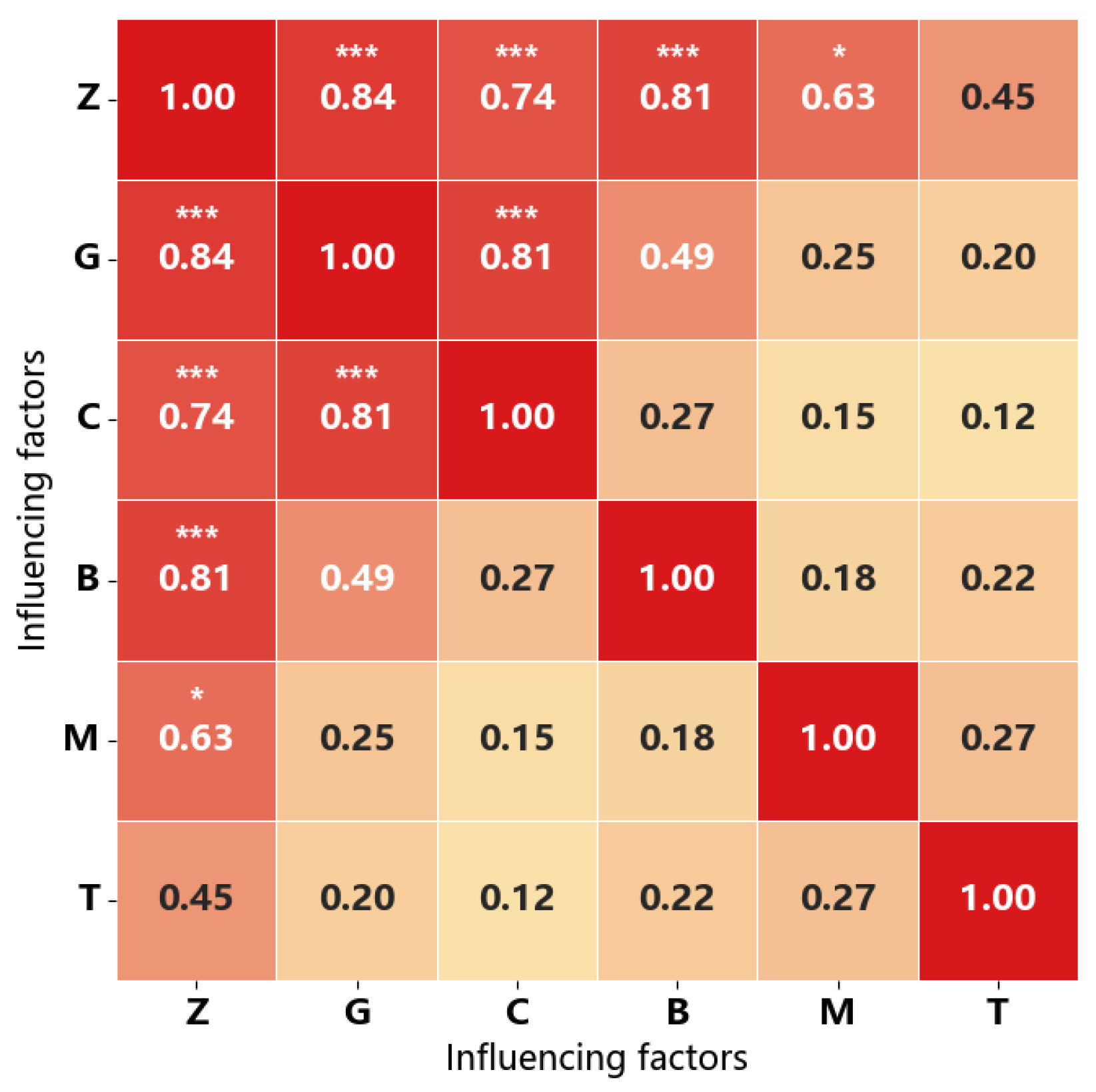
Using the Changzhou Lock’s historical data (2008–2024), we calculated Pearson correlation coefficients for G, C, B, M, T, and Z (Figure 3), examining statistical associations between Z (annual cargo volume) and interannual-variable features.
Results demonstrate that the economic indicator (G) exerts the most significant influence on cargo demand, exhibiting a peak correlation coefficient of 0.84 with annual cargo volume (Z). This positions it as a core driver of the transportation system. The inland industry proportion (C), identified as the second key factor, also maintains a significant positive correlation (r = 0.74) with Z, confirming the sustained contribution of industrial structure optimization to freight demand. A strong synergistic effect exists between G and industrial layout (C) (r = 0.81), reflecting a beneficial mutual feedback mechanism between economic growth and industrial upgrading. Given that the hinterland’s economic development fundamentally shapes waterborne freight demand, both G and C are essential as feature vectors. Furthermore, the high correlation (r = 0.81) between cargo diversity (B) and Z highlights the role of multicategory transport in boosting overall volume. Its moderate correlation with G (r = 0.49) indicates that diversification primarily stems from supply chain characteristics. Climatic and hydrological factors (M) exert a distinct constraining effect on Z (r = 0.63), yet exhibit correlations below 0.3 with all other vectors—consistent with independent mechanisms attributable to natural conditions. Likewise, lock efficiency (T), as an operational variable, affects daily/monthly throughput, but has relatively weak impact on annual volume (Z). Its correlations with all other features remain nonsignificant (|r| < 0.25). Based on this analysis, the feature matrix (comprising G-C-B-M-T) demonstrates empirical relevance. Its applicability derives from systematic coupling coexisting with reasonable independence across three dimensions (economic–structural–environmental), satisfying the data structure criteria for transferable modeling.

2.3. Feature Transfer Based on Similarity

To ensure the prioritization of canal operation characteristics in conjunction with the data-driven approach, comprehensive constrained optimization weighting (CCOW) is applied to objectively determine similarity weights. Based on the feature matrix, CRITIC objective weights are calculated, forming the following objective function:
min ω j = 1 n ω j CRITIC · ln ( ω j )
ω j denotes the weight of the j-th characteristic value, ω j CRITIC is the normalized CRITIC weight, and n is the number of indicators exclusive of the j index.
The constraints are specified as follows, in order: the weight normalization constraint, the monotonically decreasing constraint, and the nonnegativity constraint:
j = 1 n ω j = 1 ω 1 ω 2 + δ , ω 2 ω 3 + δ , , ω n 1 ω n + δ ω j > 0 , j
δ denotes the allowable minimum interval. The above model is solved via numerical optimization, ensuring the optimized weights strictly comply with the constraints. Subsequently, the weighted Euclidean distance is calculated, converted into a similarity index using Equation (9), and then the multisource fusion weights are determined by Equation (10).
S = 1 1 + D ω
D ω represents the weighted Euclidean distance determined based on the optimized weights and the feature matrix.
O i = S i i = 1 m S i
m denotes the number of source canals.

3. Electricity Load Forecasting Based on Navigation Traffic Volume Cascade Mapping

3.1. Mid-to-Long-Term Navigation Traffic Volume Forecasting Model

3.1.1. Mid-to-Long-Term Freight Volume Forecasting

Given that ship gate-crossing volume inherently synthesizes freight demand and vessel operations characteristics, a cascade modeling pathway from freight demand to navigation traffic is constructed. This converts medium-to-long-term ship gate-crossing volume forecasting into medium-to-long-term freight volume forecasting, which possesses stronger long-term predictability and economic relevance.
Initially, the freight volume data of source canals are analyzed to fit their respective freight volume curves, with saturation corrections applied using the logistic curve. Subsequently, to represent the progressive growth pattern characteristic of a canal’s initial development phase, an initial-stage adjustment coefficient ϖ 0 is introduced for calculating the target canal’s freight volume in its inaugural year (baseline year) of operation:
y t a r t 0 = ϖ 0 · i = 1 m S i · y i t 0 i = 1 m S i
In the formula, y i t 0 represents the freight volume (10,000 tonnes) of source canal i during the baseline year t 0 . ϖ 0 denotes the empirical adjustment coefficient for the inaugural year’s freight volume, serving as a baseline scaling factor for forecasting the new canal’s first-year freight throughput. This coefficient is derived as a constant parameter through calculations based on the canal similarity index.
Finally, medium-to-long-term freight volume projections for the target canal are generated by integrating the comprehensive transportation sharing method, followed by analytical extrapolation to derive mid-to-long-term ship gate-crossing volume forecasts Z t .

3.1.2. Mid-to-Long-Term Ship Gate-Crossing Volume Forecasting

Based on the mid-to-long-term lock-crossing freight volume projections Z t , this study integrates the actual distribution proportions of vessel types in current domestic inland waterway shipping with their average certified deadweight capacities. Weighted averaging yields the composite average deadweight per vessel. Utilizing the fundamental relationship where freight volume is the product of average deadweight and lockage volume, the total freight volume is allocated across discrete vessel tonnage clusters. This establishes a quantitative mapping between “tonnage and vessel count”, forming a forecasting model for mid-to-long-term ship gate-crossing volume at the hub.
1. Establish a dynamic model for vessel tonnage class distribution.
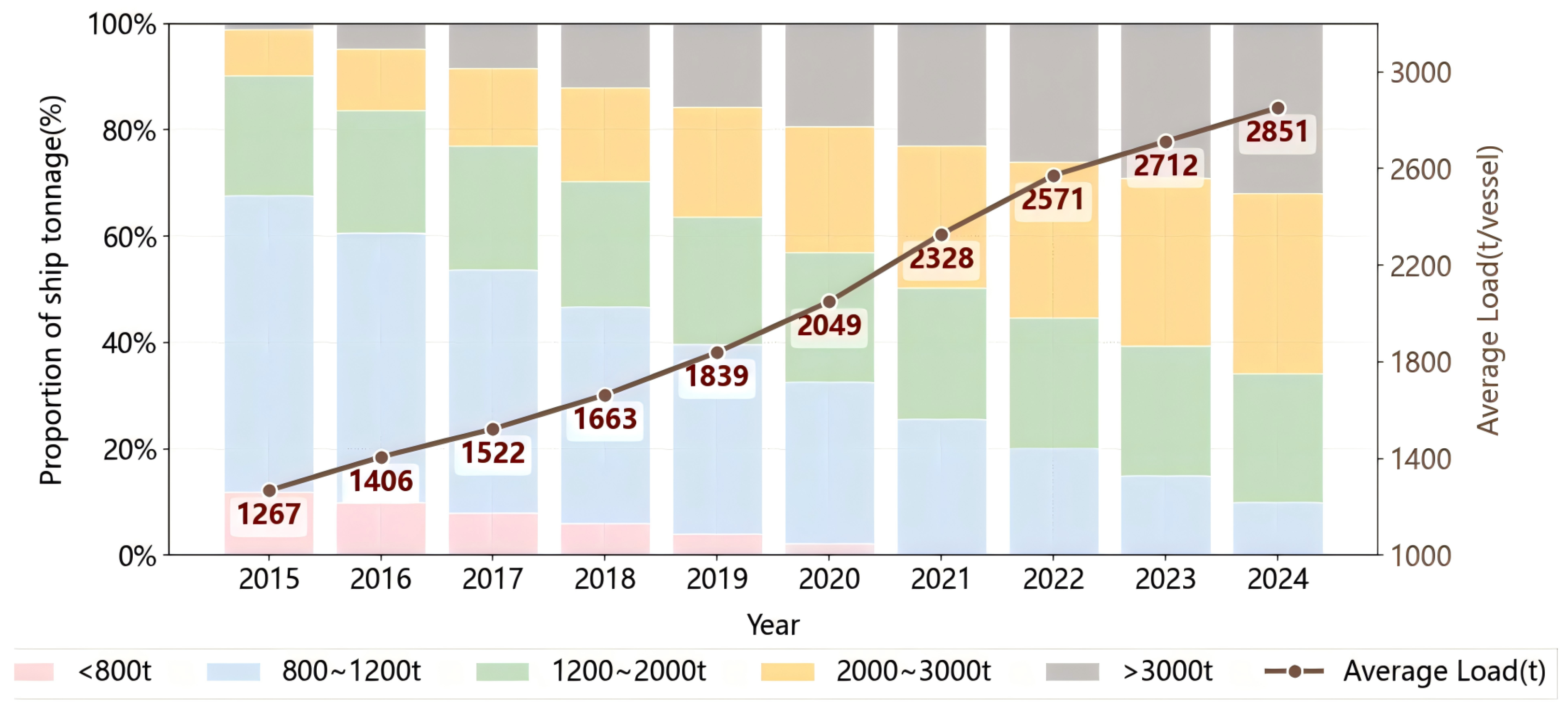
Given the continuing trend towards larger vessels in the current domestic inland fleet, vessels are categorized into i tonnage classes (for i = 1–5, corresponding to <800 t, 800–1200 t, 1200–2000 t, 2000–3000 t, and >3000 t, respectively) based on rated deadweight tonnage (DWT). Historical data from Chinese inland waterways enable extrapolation-based forecasts of mid-to-long-term tonnage-class distributions and vessel average deadweight (partial results are shown in Figure 4).
2. Determine the average load per vessel for each tonnage class.
For the average design load D W T t (tonnes/vessel) of domestic inland vessels in year t, it satisfies the following equation:
D W T t = i = 1 5 P i t W i
P i t is proportion of vessels in tonnage class i in year t; W i is the average design load for tonnage class i (assumed constant throughout the forecast period), tonnes/vessel.
3. Convert freight volume to vessel lock-crossings.
Accounting for vessel payload occupancy ratios (i.e., the proportion of actual cargo weight to rated deadweight), the relationship between the theoretical annual ship lockage volume and freight volume in year t is expressed as follows:
N t = Z t λ · D W T t
N t is the annual ship gate-crossing volume in year t, in vessel trips; Z t is the annual freight volume, in tonnes; λ is payload occupancy ratio, reflecting cargo utilization efficiency (typically <1).

3.2. Mid-to-Long-Term Electricity Demand Forecasting Model

3.2.1. Mid-to-Long-Term Electricity Use for Water Control Projects

1. Plant public electricity consumption
As the power systems for the lock control, communication, signaling, and building operations run continuously for 24 h a day, based on past experience in shipping projects, the annual electricity consumption for the entire plant’s public power is estimated.
2. Generator self-consumption
According to the hydrological characteristics of the area where the target canal is located, the operation is divided into three periods: flood season, flow rate at 95% of the guaranteed level; normal season, flow rate at 85% to 95% of the annual average; drought season, flow rate below the drought standard. Considering the unpredictability of the canal’s flow rate and generator output, the equivalent generation assumption is used: (1) Flood season: Full generation, self-consumption rate is 1% of the power generated. (2) Normal season: Half load operation, self-consumption rate is proportionally reduced. (3) Drought season: No generation, primarily for navigation. The self-electricity consumption is calculated using the following formula:
E self = μ · P n · T d · N d · k w o r k
μ = 0.01 (self-consumption rate); P n is single generator capacity (kW); T d = 24 h; N d = 30 days; k w o r k is operating condition coefficient (1 for flood season, 0.5 for normal season, 0 for drought season).
3. Electricity consumption for ship lock operation
Based on the predicted lock-crossing volumes at the kth hub point of the target canal, a mechanism-data hybrid model is established to reflect the relationship between the electricity consumption of the lock and its generators and the lock-crossing volumes:
E g a t e = N k δ · E b a s e × ( 1 + χ · Δ Z ) + ϵ N N
χ = i = 1 m ω i χ i s r c · K s a v e t a r K s a v e s r c
Δ Z = Z p r e d Z d e s i g n Z d e s i g n
In Equation (15), N k δ · E b a s e denotes the mechanism-based benchmark term, ( 1 + χ · Δ Z ) represents the elasticity correction term, and ϵ N N signifies the data-driven correction term. Here, N k is the ship lockage volume at the k-th hub (vessels/times); δ is the average vessels per lockage (vessels/time), calculated as the product of the maximum vessel capacity of the target canal’s lock chamber and the lock chamber utilization rate transferred from source canals; E b a s e denotes the benchmark energy consumption per lockage (kWh); χ is the cargo throughput–energy consumption elasticity coefficient; χ i s r c indicates the cargo throughput–energy consumption elasticity coefficient for the i-th source canal; m signifies the number of source domains; K s a v e is the energy-saving coefficient of water-saving ship locks; Δ Z represents the cargo throughput variation rate (tonnes); Z p r e d refers to the forecasted cargo throughput of the target canal (tonnes); Z d e s i g n is designed navigation capacity; ϵ N N is the neural network correction term, compensating for complex factors neglected by the mechanistic model.
Considering potential data scarcity regarding benchmark energy consumption per lock operation for water-saving ship locks in target canals, the computational baseline is established based on the Water Transport Engineering Ship Lock Design Code [23]:
E b a s e = E c r a n e + E v a l v e + E w a t e r + E a u x
E c r a n e = 2 · P c r a n e · t o p e n + t c l o s e 60 · N c y c l e E v a l v e = N v a l v e · P v a l v e · t f + t e 60 E w a t e r = ρ g V m Δ H 3.6 · 10 6 · ϑ = ρ g L · B · Δ H 2 3.6 · 10 6 ϑ
E c r a n e , E v a l v e , E w a t e r , and E a u x represent the energy consumption of miter gate operation, filling/emptying valve operation, water conveyance system, and ancillary systems (fixed reference values), respectively (kWh). P c r a n e , P v a l v e denote the power of single-leaf gate hoist and driving power of filling/emptying valves (kW); t o p e n , t c l o s e , t f , and t e indicate the gate opening time, gate closing time, valve filling time, and valve emptying time (min); N c y c l e is the number of gate operation cycles per lock transit; N v a l v e represents the number of valves per ship lock; L, B, and Δ H signify the lock chamber length, lock chamber width, and water level difference across the hub; ϑ is the potential energy conversion efficiency, defined as the proportion of water level change utilized by the conveyance system during chamber filling/emptying to the total level variation.

3.2.2. Mid-to-Long-Term Electricity Consumption in Waterway Service Areas

1. Electricity forecast for waterway service areas
First, monthly loads in the baseline year are calculated using the per-unit area norm method and electricity consumption characteristics [24]:
L m = L var , m + L f i x , m + L e q , m L var , m = i = 1 3 S i · β i L f i x , m = S f L e q , m = S e q · β 4 · 1 + γ m
L var , m is variable load (service building usage/boiler room and pump house/maintenance buildings, monthly value); L f i x , m is fixed load (the power distribution room, monthly value); L e q , m is equipment room load (monthly value); S i denotes functional unit floor area (m2); β i represents monthly electricity consumption per unit area (kWh/m2); γ m means monthly climate additive factor.
Second, an annual load correction coefficient is determined using data-driven methods to forecast yearly consumption. Let the baseline-year vessel traffic volume be D 0 , and the target volume in year i be D i . Then,
L i , y = L var , m · D i D 0 + L f i x , m + L e q , m
Similarly, monthly load decomposition is performed to construct the load calculation formula for integrated service areas:
L i , m = L var , m · D i D 0 + L f i x , m + L e q , m
2. Power analysis and forecast for waterway management center
The electricity load of waterway management centers primarily consists of office and domestic consumption. Lighting and air conditioning exhibit seasonal dependencies, while information and equipment control systems operate continuously as baseload, uncorrelated with ship lock throughput. Based on historical operational data from navigation project management zones, the baseline annual electricity consumption is determined. Monthly allocation schemes reference typical office park load profiles within the target canal’s geographical region.

3.2.3. Mid-to-Long-Term Electricity Consumption in Shore Power Systems

Based on mid-to-long-term navigation volume forecasts, a three-tier theoretical framework NBE integrating vessel traffic characteristics and charging behaviors is developed to enable electricity consumption forecasting for new inland waterway shore power projects.
1. Node allocation layer
The docking charging probability α j for node j is defined based on vessel flow patterns (probability a vessel charges at the node per journey). For simplification, α j is assumed identical and independent for upbound/downbound vessels at each node. The average berthing time T j _ d o c k per node is determined by its functional role, calculated as a weighted average for multifunctional terminals.
2. Charging behavior layer
Vessel classification underpins charging behavior calculation. Cargo ship power consumption accounts for EV penetration rate and tonnage distribution, the forecast target in this study. Passenger ships are treated as 100% electric with fixed tonnage distribution, yielding constant consumption. As EVs utilize electricity for propulsion while non-EVs use shore power to charge batteries (for engine start, communication, navigation systems, etc.), charging times differ substantially and are addressed separately [25,26]. The annual effective charging vessels at node j for electric cargo ships ( Q j , y e ) and nonelectric cargo ships ( Q j , y n e ) are
Q j , y e t = D j , y t · α j · d c t
Q j , y n e t = D j , y t · α j · [ 1 d c t ] · u c t
where D j , y ( t ) represents navigation volume at node j in year t (vessels); d c t is electric cargo ship penetration rate, year t; u c t denotes shore power utilization rate for nonelectric cargo ships in year t.
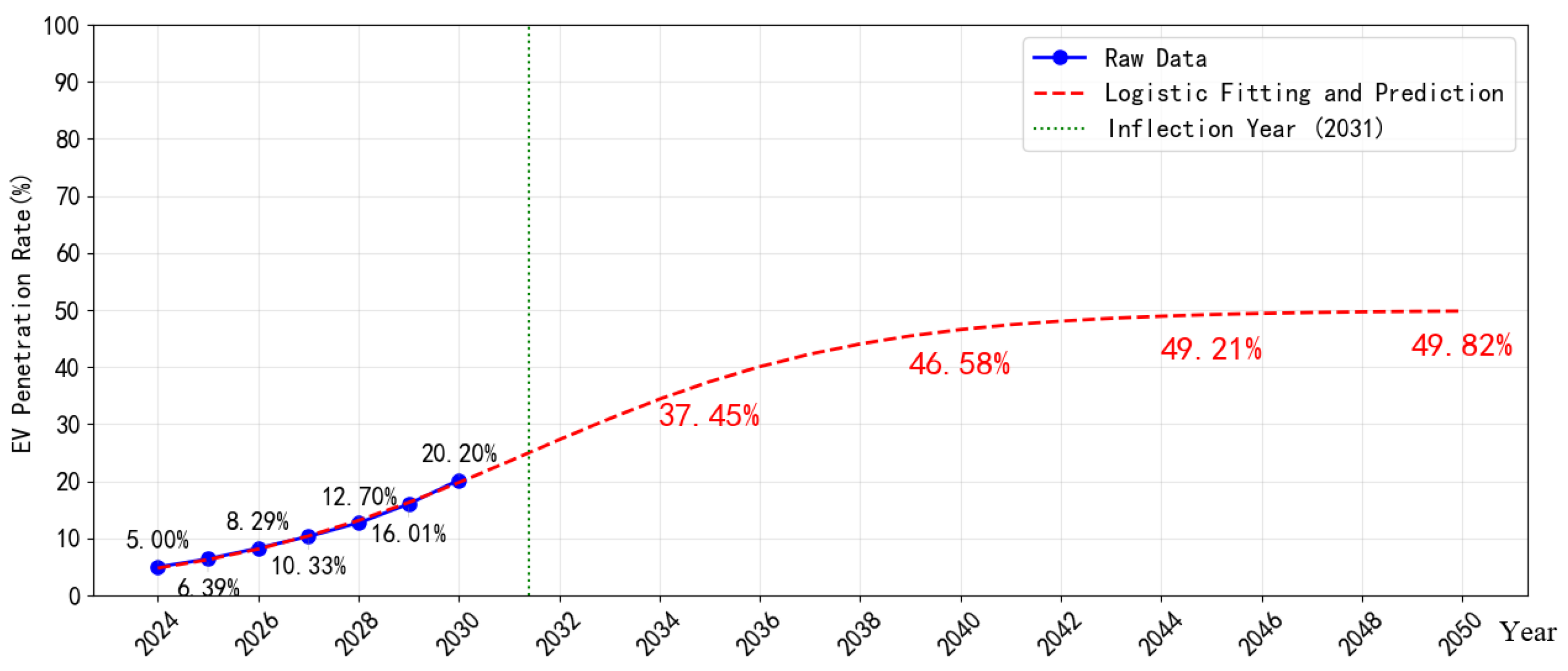
A reasonable assumption sets u c t at 10% for 2027 [27], thereafter increasing annually at 3%. As nonelectric vessels require shore power only for accommodation loads (requiring brief charging periods) and predominantly utilize renewable sources like solar panels, shore power utilization remains low. Under extreme scenario testing (annual growth rate elevated to 50%), the shore power demand forecast maintains its trajectory with fluctuations of <0.3% demonstrating the model’s low sensitivity to this parameter. Therefore, the 3% annual growth rate for u c t is empirically justified.
The penetration rate d c t is forecasted using a logistic model, validated against domestic inland waterway EV market data (Figure 5). The model demonstrates high goodness-of-fit (R2 = 0.9969).
Additionally, electric vessels are classified into three types: battery electric vessels (BEVs), hybrid electric vessels (HEVs), and fuel cell vessels (NEVs) [28]. Integrating the distribution ratio of large vessels (>2000 tonnes) with typical battery capacity configurations of BEVs and HEVs (referencing CATL’s technical parameters for typical electric vessels, Table 1), the theoretical charging times for electric ( T e t ) and nonelectric vessels ( T ne t ) in year t can be derived.
After applying node-type constraints, the average charging time (hours) for electric and nonelectric vessels at node j is determined as follows:
T j e t = min T e t , T j _ d o c k T j n e t = min T n e t , T j _ d o c k
Conservative assumption: Without power capacity upgrades to shore charging piles along the new canal, the total annual charging time at node j is constrained by the number of charging piles:
T j , y ( t ) = MIN 365 · 24 · n j , Q j , y e ( t ) · T j e ( t ) + Q j , y n e ( t ) · T j n e ( t )
In the formula, n j represents the number of charging piles at node j.
Based on the current ratio of purely electric vessels to hybrid vessels in China (approximately 3:7), the average annual theoretical charging times T e (for electric vessels) and T n e (for nonelectric vessels) along the target canal can be predicted. The weighted average charging time at each node is then calculated accordingly.
3. Energy demand layer
The annual electricity consumption (in 10,000 kWh) at node j is determined by the total annual charging duration (h) and the energy consumption per charging pile P E V (kW):
E j , y t = T j t · P E V 10000 · η j
η j is the system efficiency factor accounting for charging pile efficiency and energy losses.
Subsequently, the total annual electricity consumption of the target canal’s shore power system in year t is calculated via Equation (28):
E P L , y t = j = 1 E j , y t + E t
where E t represents the benchmark electricity consumption for passenger vessels, a constant (reference: CATL’s technical parameters for inland sightseeing vessels).
Finally, an operational intensity analysis and annual charging duration validation check are performed at each node:
U j t = min T j , y t 365 · 24 · n j , 1

3.3. Monthly Electricity Consumption Decomposition Based on Lock-Through Traffic Volume Impact

Recognizing lock-through traffic volume as the key control variable influencing both the electricity consumption of the lock operation and the shore power system, it is established as the primary decomposition criterion for monthly electricity consumption. The monthly allocation coefficient m i ( i = 1 , 2 , , 12 ) is defined as the time-averaged weighting factor representing the proportion of a given month’s lock-through volume relative to the annual total. Based on source canal historical data, this coefficient is calculated and projected to the target canal system through similarity indices, with its values simultaneously optimized in accordance with seasonal lock-through characteristics. The mathematical formulation of this model is as follows:
D t , m i = D t , y · m i
D t , m i denotes monthly navigation volume of month i in year t, and D t , y is annual navigation volume in year t.
Using this monthly allocation coefficient, we decompose the target canal system’s navigation volume, and shore power system and lock operation monthly electricity consumption for all months of year t.

4. Case Analysis

The under-construction Pinglu Canal is selected as the forecast target, with the Xijiang Shipping Canal and the Sanxia project serving as source canals. The Xijiang trunk line shares geographical homology with the Pinglu Canal, including watershed hydrological features and shared freight hinterland resources, exhibiting high economic locational similarity. Upon completion, the Pinglu Canal will directly integrate with the Xijiang inland waterway system for coordinated dispatch [29,30]. The Sanxia navigation system, similar to Pinglu, features integrated water service zones combining shore power supply and intelligent maintenance [31]. The selected source canals comprehensively cover all energy consumption profiles of the Pinglu Canal, demonstrating engineering feasibility. Per Section 2.2.2, the cargo throughput characteristics of the Xijiang’s representative Changzhou Lock are analyzed as an example. This methodology can be similarly applied to the Sanxia Lock to predict the Pinglu Canal’s throughput characteristics. This approach effectively captures the core mechanisms driving annual freight volume fluctuations: economic foundation factors (G, C) dominate demand generation; logistics structure factors (B) modulate capacity scale; environmental and operational factors (M, T) impose boundary constraints. This aligns with the hierarchical mechanism of water transport systems, thereby enhancing understanding of navigation volume (or lock-through volume) variation dynamics.

4.1. Similarity Calculation Between Pinglu Canal and Source Canals

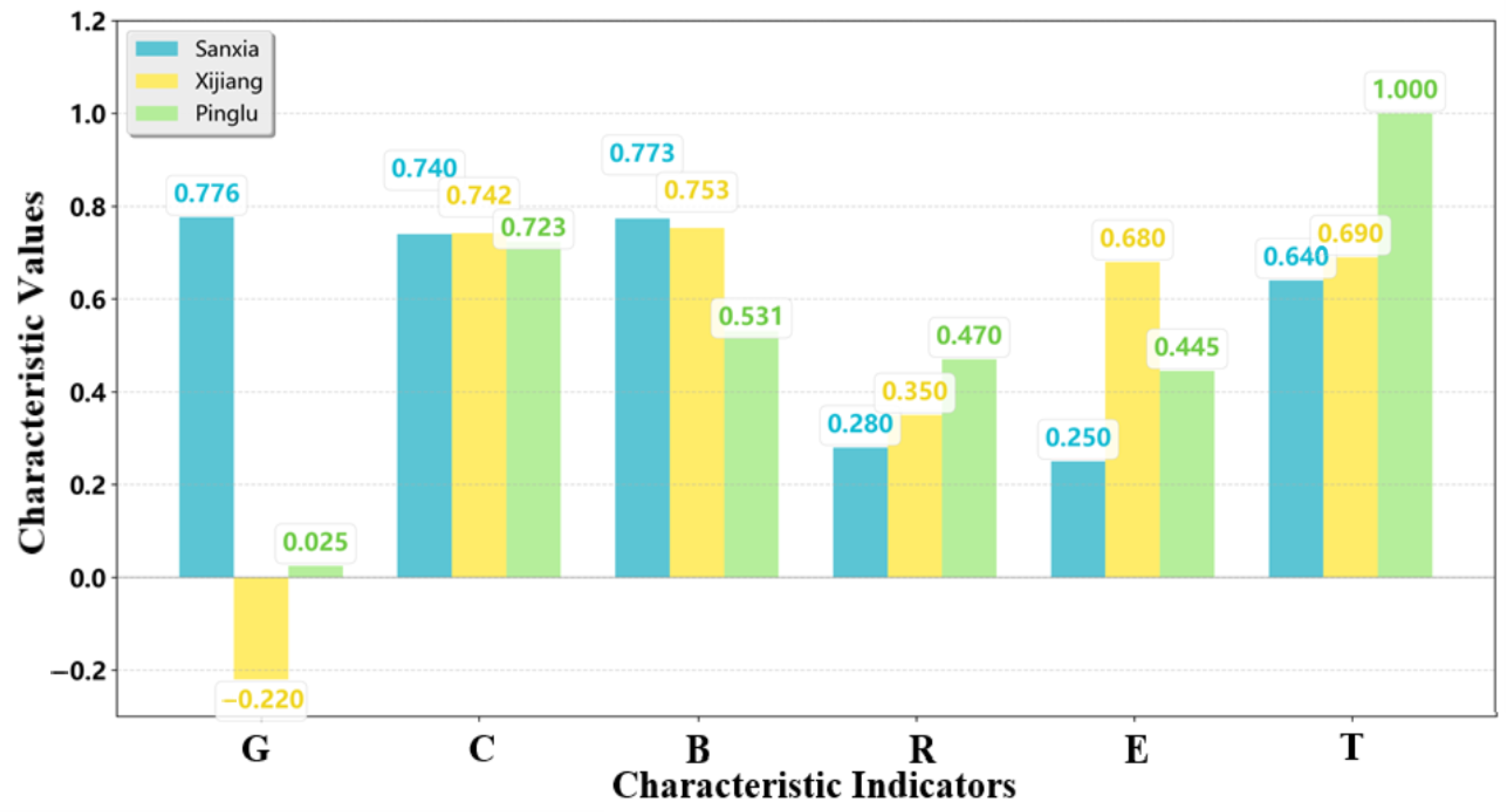
Based on the literature [32,33], navigation administration websites, provincial statistical yearbooks, and the Pinglu Canal engineering feasibility study report [34], characteristic matrix values for the source canals and target canal were calculated and normalized (Figure 6):
Using the CCOW method, the optimized weights were determined as ω G = 0.323 , ω C = 0.203 , ω B = 0.153 , ω R = 0.123 , ω E = 0.103 , ω T = 0.093 . The resulting similarity indices between Sanxia Lock, Xijiang Shipping, and Pinglu Canal are S S X = 0.39 , S X J = 0.43 , respectively. The higher similarity index between Xijiang Shipping and Pinglu Canal is primarily driven by the contribution of shipping freight demand (G) and their spatial economic linkage. The two share highly overlapping economic hinterlands with similarities in freight demand, industrial structure, and cargo composition. However, most bulk goods like ores and construction materials carried by Xijiang Shipping in recent years are destined for Guangdong Province supporting the Guangdong–Hong Kong–Macao Greater Bay Area development, not transferring to Pinglu Canal [34]. This explains why the similarity does not significantly surpass that of Sanxia Lock. This further validates the rationality and superiority of employing both Sanxia and Xijiang as dual-source canals for predicting the Pinglu Canal, transcending the limitations of traditional single-source models.

4.2. Mid-to-Long-Term Navigation Volume Forecast for Pinglu Canal

4.2.1. Mid-to-Long-Term Freight Volume Forecast

1. Freight volume forecast for the opening year
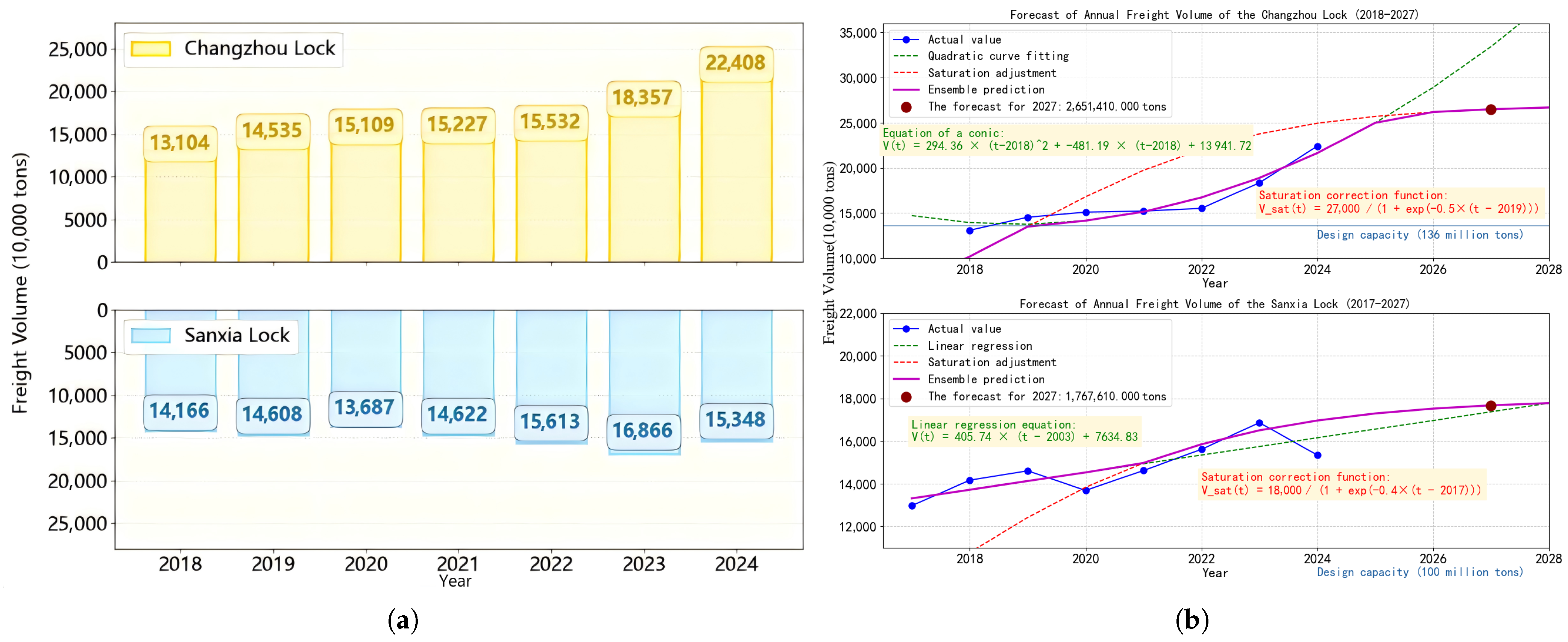
Analysis of source canal freight volume data (Figure 7) reveals accelerated annual growth at the Changzhou Ship Lock in recent years, with particularly notable increases in 2023 and 2024. Given that its 2024 actual annual cargo throughput (224 million tonnes) exceeded the designed annual capacity of 136 million tonnes (four-lane system), we project Changzhou’s 2027 freight volume using quadratic curve fitting with logistic growth boundary constraints. Aligned with planning targets and development trends, the saturation threshold for Changzhou Lock is set at 270 million tonnes. For the Sanxia Lock, annual freight volumes exhibit fluctuations—peaking in 2023 before moderating in 2024—yet maintain an overall upward trajectory at a 2.8% CAGR. Considering that its dual-lane system has consistently exceeded the original designed annual capacity (100 million tonnes as originally designed for 2030) over 13 consecutive years, growth potential is limited despite enhanced throughput via operational optimizations. We, therefore, apply logistic curve saturation correction based on ultimate capacity limits to forecast its 2027 freight volume. Historical growth patterns and known expansion potential inform the saturation cap setting of 180 million tonnes (near 2023’s peak). As illustrated in Figure 7, Changzhou Lock’s 2027 projected freight volume reaches 265.14 million tonnes, sustaining accelerated growth while progressively approaching saturation capacity. Sanxia Lock’s forecast stands at 176.76 million tonnes, maintaining overall growth amidst fluctuations while simultaneously nearing throughput saturation thresholds.
Given that the inaugural full-year freight volumes were 98.795 million tonnes for the Changzhou Ship Lock (2017) and 60.565 million tonnes for the Sanxia Lock (2007), the Pinglu Canal’s 2027 annual freight volume is mathematically inferred to be 44.6292 million tonnes through similarity index-based transfer computation ( ϖ 0 = 0.2). This includes approximately 6.69 million tonnes of transport demand generated along the canal corridor.
2. Freight forecast based on comprehensive transportation sharing method
(1) Southbound seaborne freight via Pinglu Canal from hinterland
In 2020, the four hinterland provinces/regions (Guangxi, Yunnan, Guizhou, Hunan) recorded total freight volume of 6.06 billion tonnes, of which southbound seaborne freight was 178 million tonnes [34].
a. Social freight volume share method
Assuming annual hinterland freight growth rates of 3.0% (2020–2025) and 1.5% (2025–2050), and projecting southbound seaborne shares to reach 3.2% (2035) and 3.5% (2050) of total freight [34], the forecasted shares for 2027–2050 are shown in Table 2.
Further, annual southbound hinterland freight volumes were thus derived.
b. Growth rate method
Southbound hinterland freight growth rates are projected at 2.0% (2020–2035) and 1.0% (2035–2050) [34]. The weighted averaging method yielded integrated forecasts.
Considering regional transport advantages, the Beibu Gulf–Pinglu Canal river–sea corridor’s market share was estimated at 20–25% (2027–2029), 25–30% (2030–2034), and 30–35% (2035–2050) [34], and Pinglu Canal’s share of southbound hinterland freight was then calculated.
(2) Freight exchange volume between hinterland and inland regions via Pinglu Canal
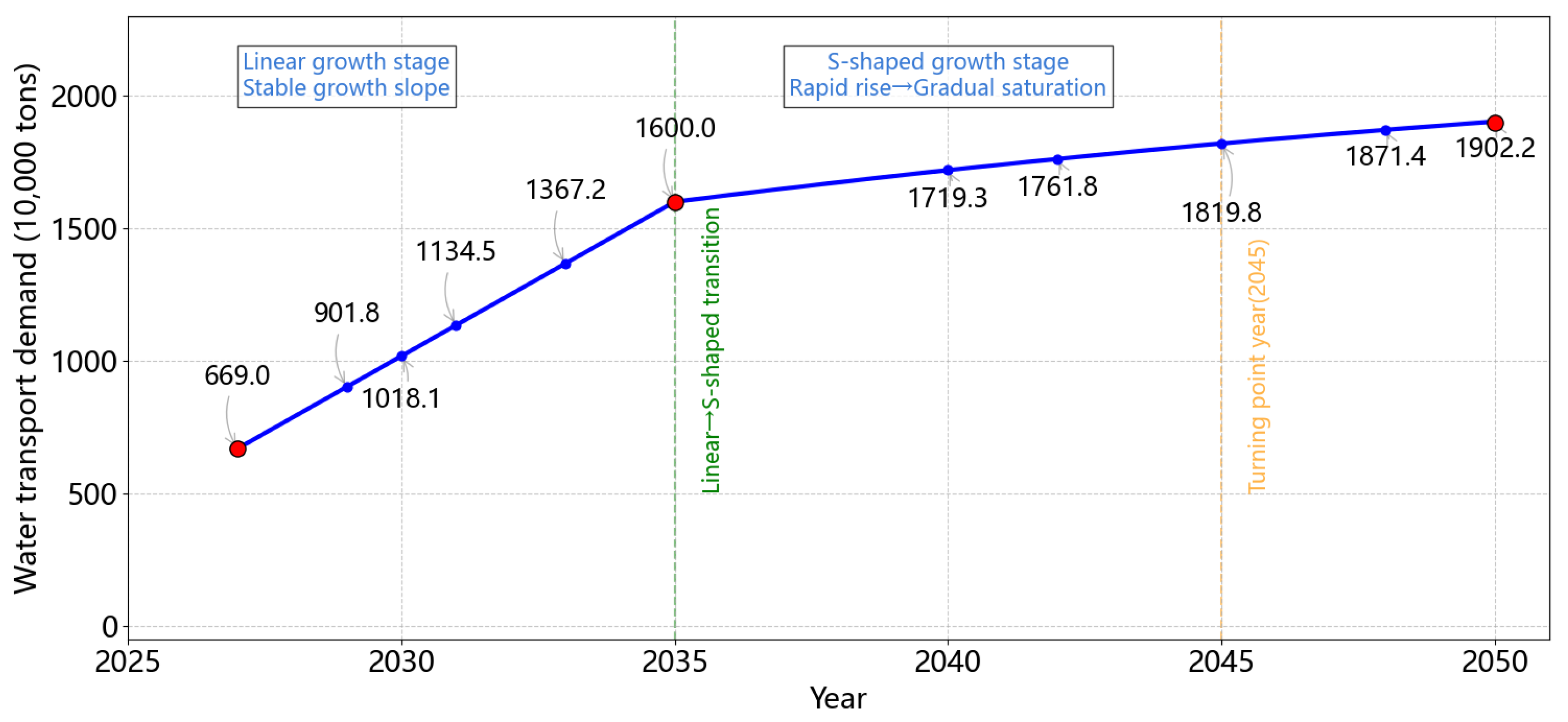
Quantitative and qualitative analysis of material/product demand along the route suggests that regional waterborne volumes will reach 16 million tonnes (2035) and 19 million tonnes (2050) [34]. Annual volumes were simulated for 2027–2050 (Figure 8). The demand evolution exhibits phased patterns governed by dual industrial–infrastructural constraints rather than simplistic numerical growth.
Linear growth phase (2025–2035) demand ascends at a stable trajectory (8.2% average annual increase) from 6.69 million tonnes (2025) to 16.00 million tonnes (2035). This corresponds to the supply–demand dynamics of industrial incubation: progressive commissioning of initial industries enables linear capacity expansion, while nascent canal infrastructure (with abundant navigational channels and terminal resources) supports linearly synchronized transport-demand growth.
Linear-to-sigmoidal transition (–2035) emerges as an acceleration–deceleration inflection point. Post-linear demand transitions to sigmoid-shaped rapid ascent before growth moderation (demand rising from 16.00 to 18.20 million tonnes at a 1.2% average annual increase during 2035–2045). This shift is propelled by tightening dual constraints: industrial maturation reduces capacity expansion momentum; canal infrastructure (navigation capacity, terminal throughput) approaches design thresholds; and transport demand, thus, evolves from industrial-expansion-driven to capacity-constrained saturation growth—exemplifying the sigmoid curve’s hallmark “rapid escalation–asymptotic saturation” behavior.
In the saturation growth phase (post-2045), 2045 marks a saturation tipping point, with growth narrowing to <0.9% annually (demand rising from 18.198 to 19.022 million tonnes during 2045–2050). This phase aligns with industrial structural optimization: industries shift focus from scale expansion to efficiency upgrading, and transport demand derives primarily from product renewal and supply-chain reconfiguration. Meanwhile, canal throughput capacity nears saturation thresholds, inducing demand plateaus.This equilibrium reflects long-term stabilization between transport demand and infrastructural carrying capacity.
Combined with preceding forecasts, the comprehensive transportation sharing method generated Pinglu Canal’s annual freight demand for 2027–2050.
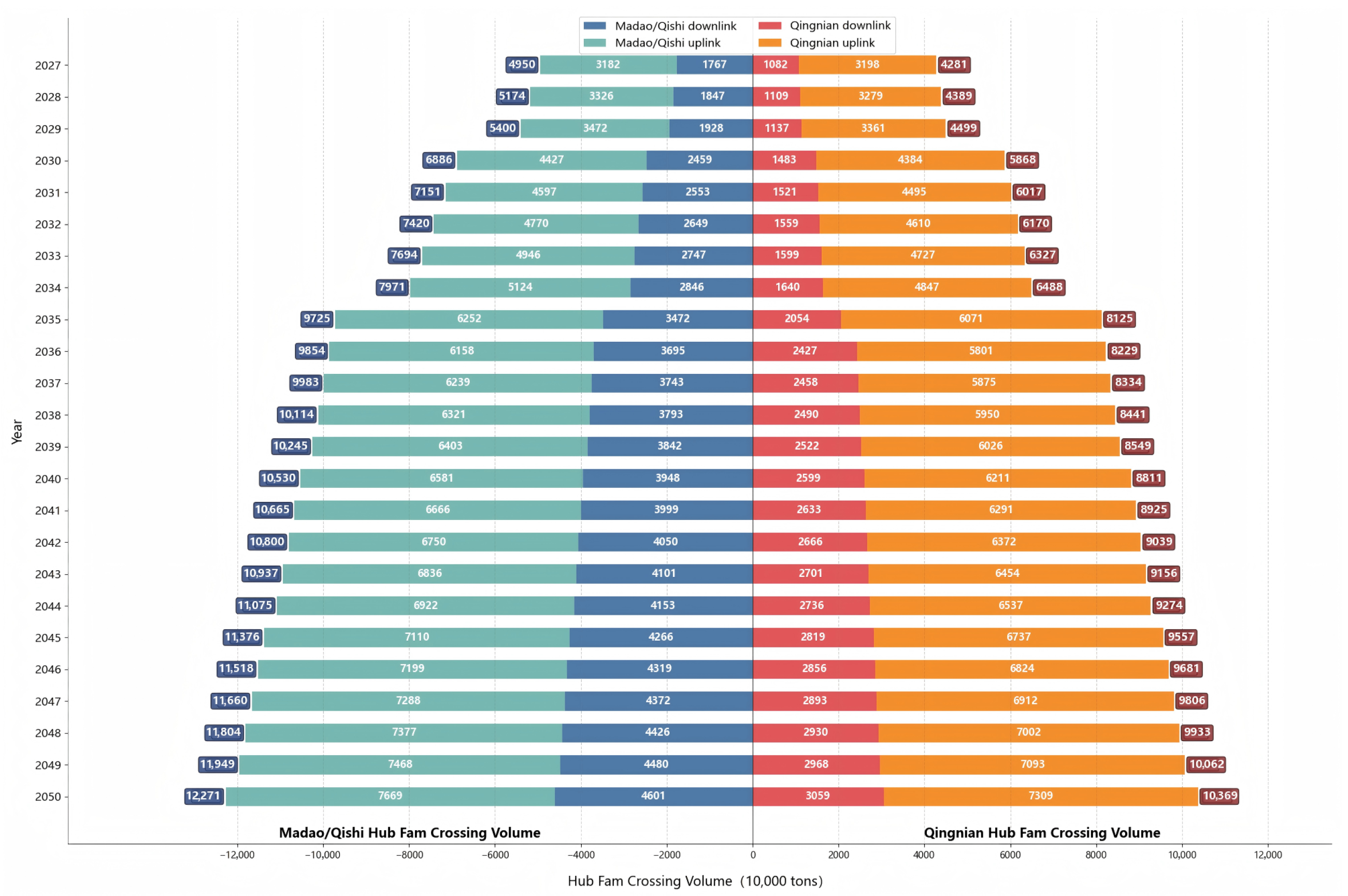
Most Pinglu Canal freight involves river–sea intermodal transport passing through all three hubs. Madao and Qishi Hubs—near the Pinglu–Xijiang junction—handle all intermodal and hinterland–inland freight, thus matching the canal’s total volume. Meanwhile, Qingnian Hub—adjacent to seaports and local terminals—handles only southbound seaborne freight [34], as land–water transfer lacks economic advantage over direct land transport to Beibu Gulf ports. Hub-specific forecasts are shown in Figure 9.

4.2.2. Mid-to-Long-Term Lock Transit Volume Forecast for Pinglu Canal

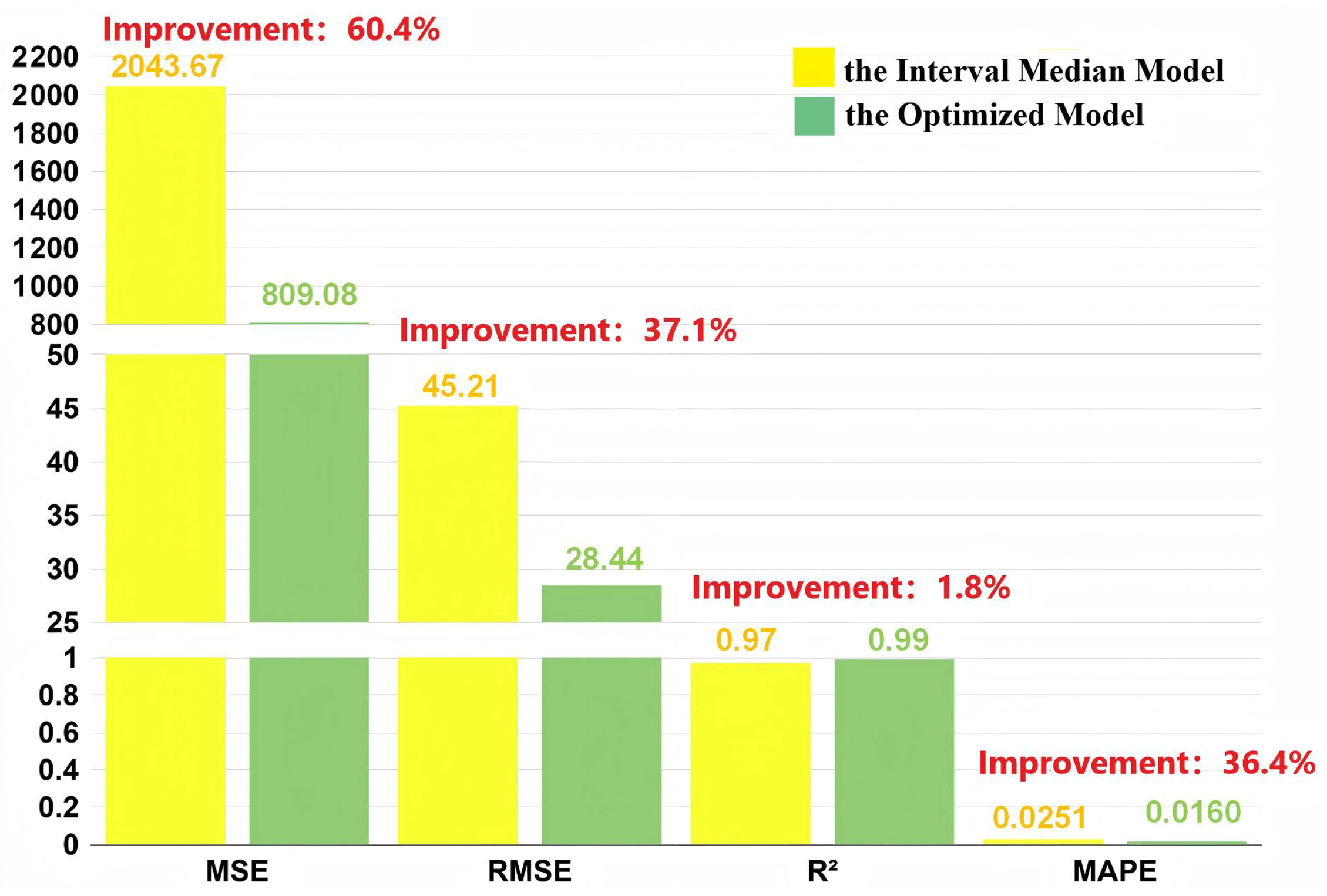
Taking the Changzhou Lock as a typical example of inland waterway transportation, based on the average verified loading capacity y R 10 and tonnage distribution matrix X R 10 × 5 of the Changzhou Lock (2015–2024), a least-squares problem was formulated: min W XW y 2 2 . The optimized average tonnage loadings were solved as W o p t = 106 , 1012 , 1813 , 2523 , 3395 T (tonnes/vessel), forming the optimized model. To validate its effectiveness, the interval median model (using mean tonnage loads 400 , 1000 , 1600 , 2500 , 4000 T tonnes/vessel) was employed. A comparative evaluation using indicator sets demonstrated the superiority of the optimization scheme (Figure 10).
The optimized model exhibits overall better performance than the interval median model, enhancing forecast accuracy across all indicators and better accommodating the actual ship gigantization trend.
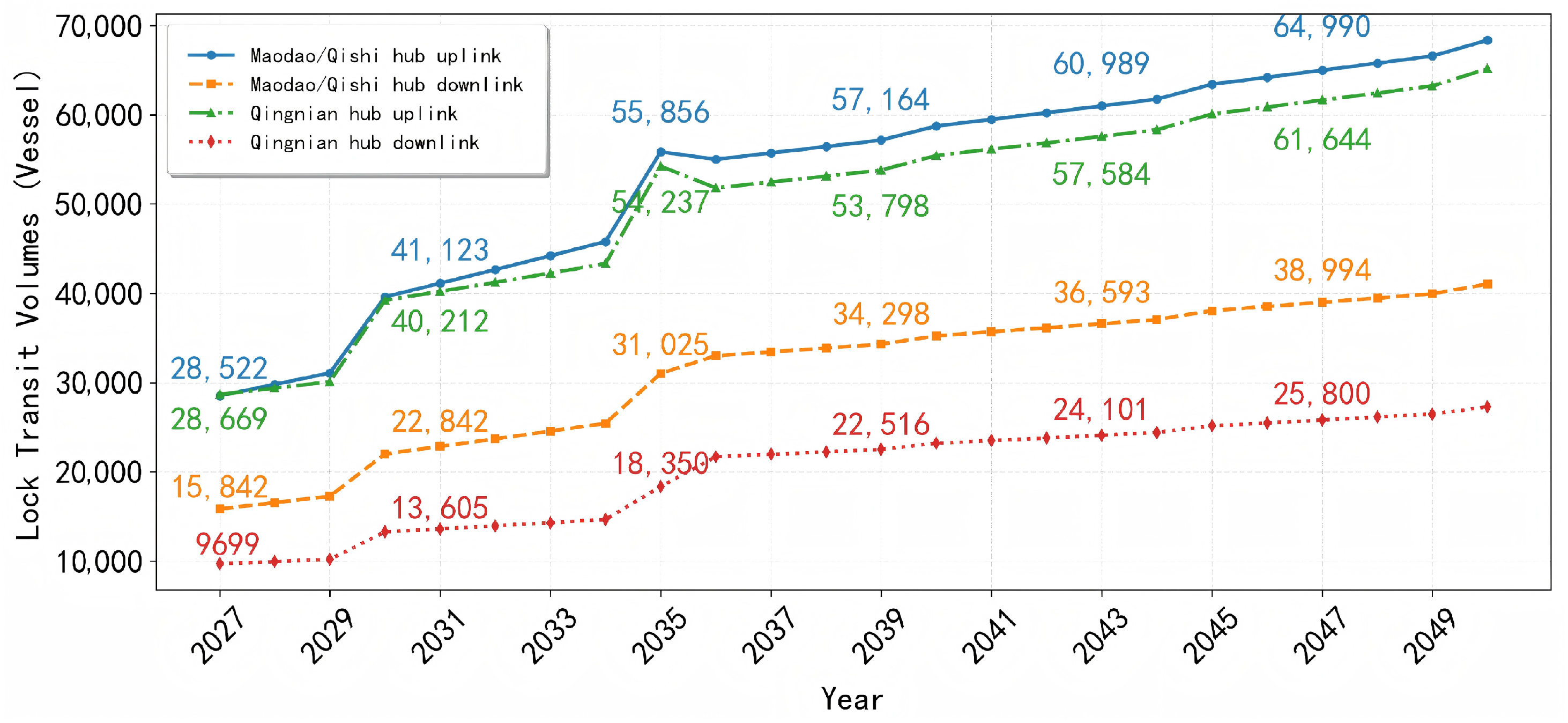
Further, given the Pinglu Canal’s connectivity between the Xi River and Beibu Gulf with significant hinterland economic overlap, the vessel actual loading rate λ is standardized at 0.53 (due to Sanxia Lock’s inclusion of multimodal transport components (ship lifts, RO–RO transshipment), its freight data is unsuitable for cargo-lock volume conversion; thus, solely the 2021–2024 mean capacity utilization rate from the regionally comparable Changzhou Lock is adopted). Through lockage volume conversion, projected lock transits for the three critical hubs during 2027–2050 are generated (Figure 11). Analysis reveals that Madao and Qishi Hubs, serving dual flows of river–sea intermodal cargo and inland interchange freight, exhibit both the largest scale and steepest growth trajectory. Aggregate lockage volumes surge from 44,364 transits (2027) to 109,397 transits (2050) at a 4.0% average annual rate. In addition, Qingnian Hub, exclusively handling southbound seaborne cargo flows, shows moderated growth at 3.7% annually.

4.3. Mid-to-Long-Term Power Demand Forecast for Pinglu Canal

4.3.1. Hydropower Hub Electricity Usage

1. Plant-wide utility power
Annual electricity consumption for office, residential, and control systems in the three hub management zones is estimated at approximately 4.34, 4.11, and 4.21 GWh, respectively [34]. Monthly consumption is allocated proportionally.
2. Qingnian Hub generator self-consumption
Qingnian Hub employs two 1600 kW shaft tubular propeller turbine-generator units. Annual auxiliary consumption is calculated as 132.5 MWh based on Southern Guangxi’s hydrological periods: flood (May–September), normal (April, October–November), and drought season (December–March). This includes monthly averages of 23 MWh (wet period) and 5.8 MWh (normal period), factored into the plant’s internal consumption.
3. Electricity consumption for ship lock operation
Annual power demands for locks and associated equipment at all three hubs are forecasted using parameters in Table A1 within a hybrid mechanistic-data model. Inputs include predicted annual lock transits and cargo volumes. Monthly values are derived using Section 2.3’s decomposition method, optimized with historical coefficients from Xijiang Shipping and Sanxia Hub.

4.3.2. Service Area Power Demand

1. Qinzhou and Xinfu water service areas
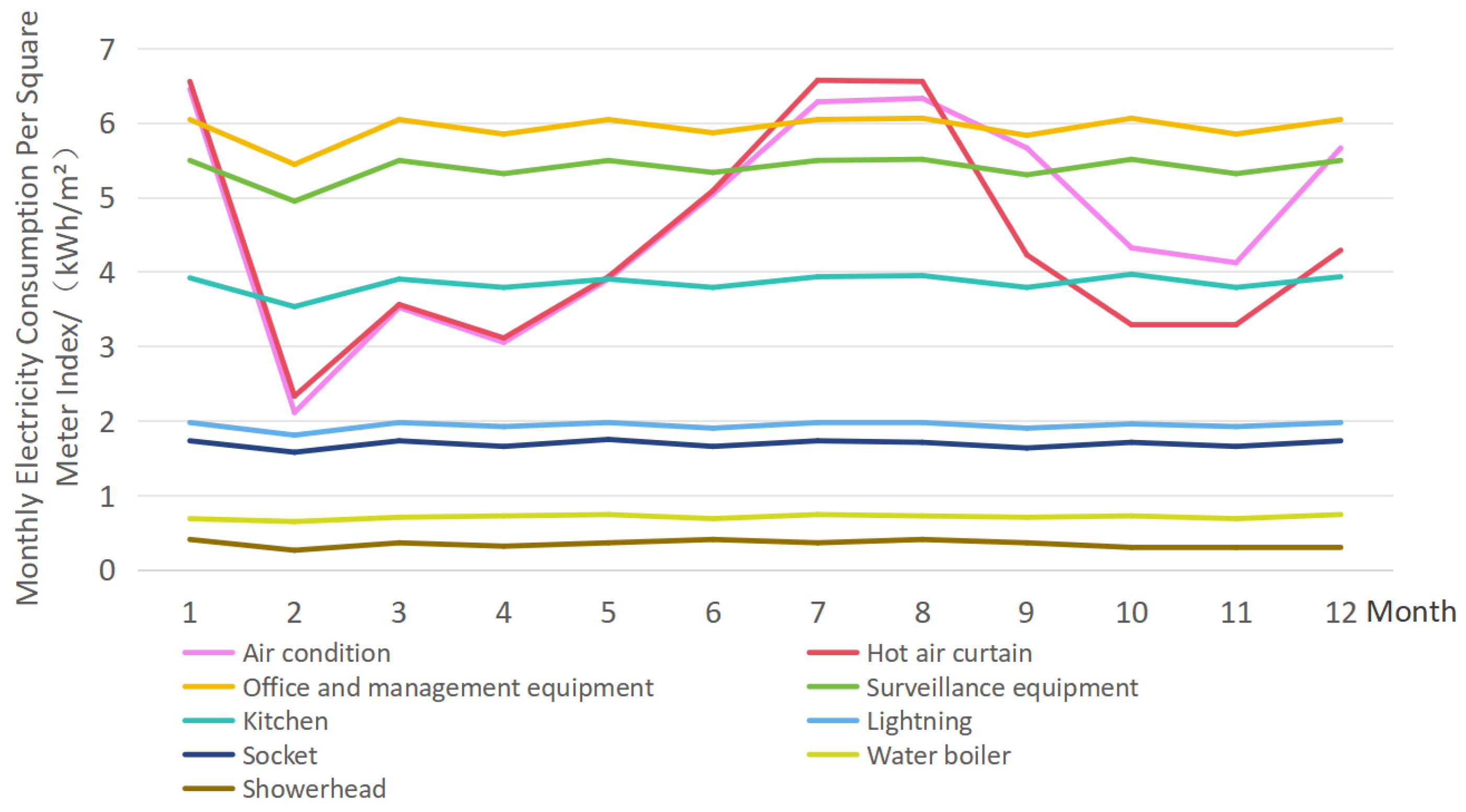
A highway service area with analogous load characteristics served as reference (Figure 12 illustrates service building consumption).
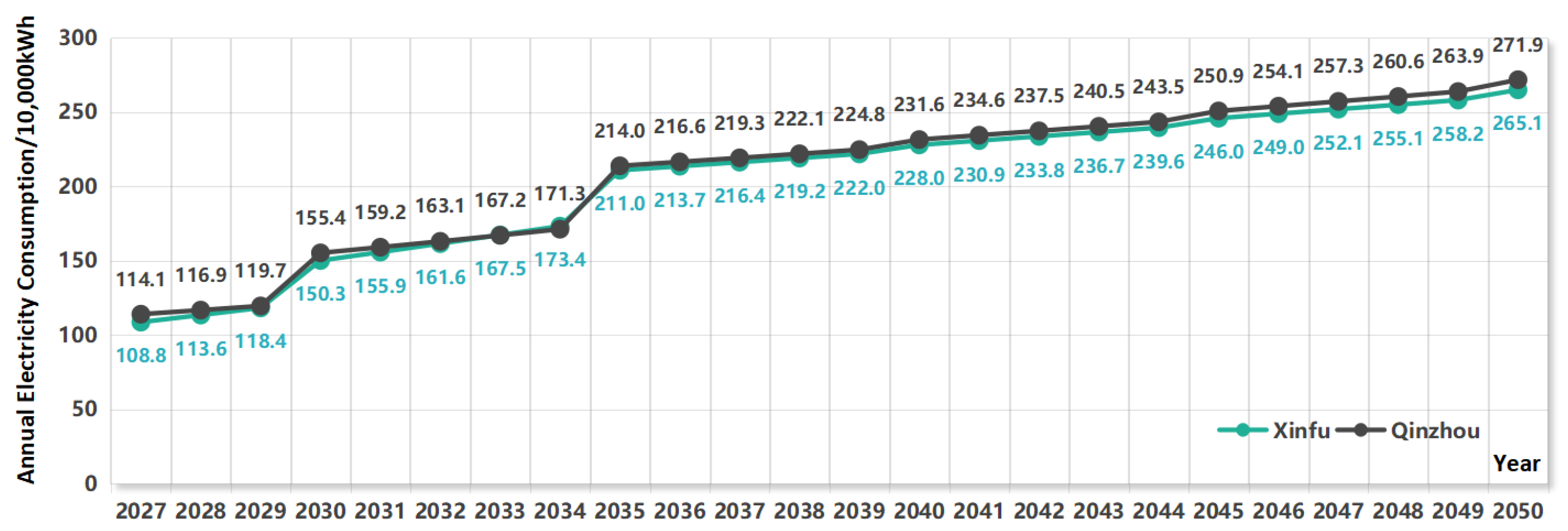
The per-unit area norm method forecasts 2027 monthly consumption. Considering enhanced cooling/dehumidification in equipment rooms during flood seasons, monthly climate adjustment factors are applied: +30% (main flood period: May–August; heavy rain season: April), +10% (September), baseline (October–March). Monthly and annual forecasts for both service areas are derived accordingly (Figure 13).
2. Navigation management center power analysis and forecast
After accounting for transformer losses, the center’s baseline annual consumption is 1.844 GWh [34]. Monthly allocation references typical office park load curves in Southern Guangxi (Figure A1).

4.3.3. Shore Power System Power Demand

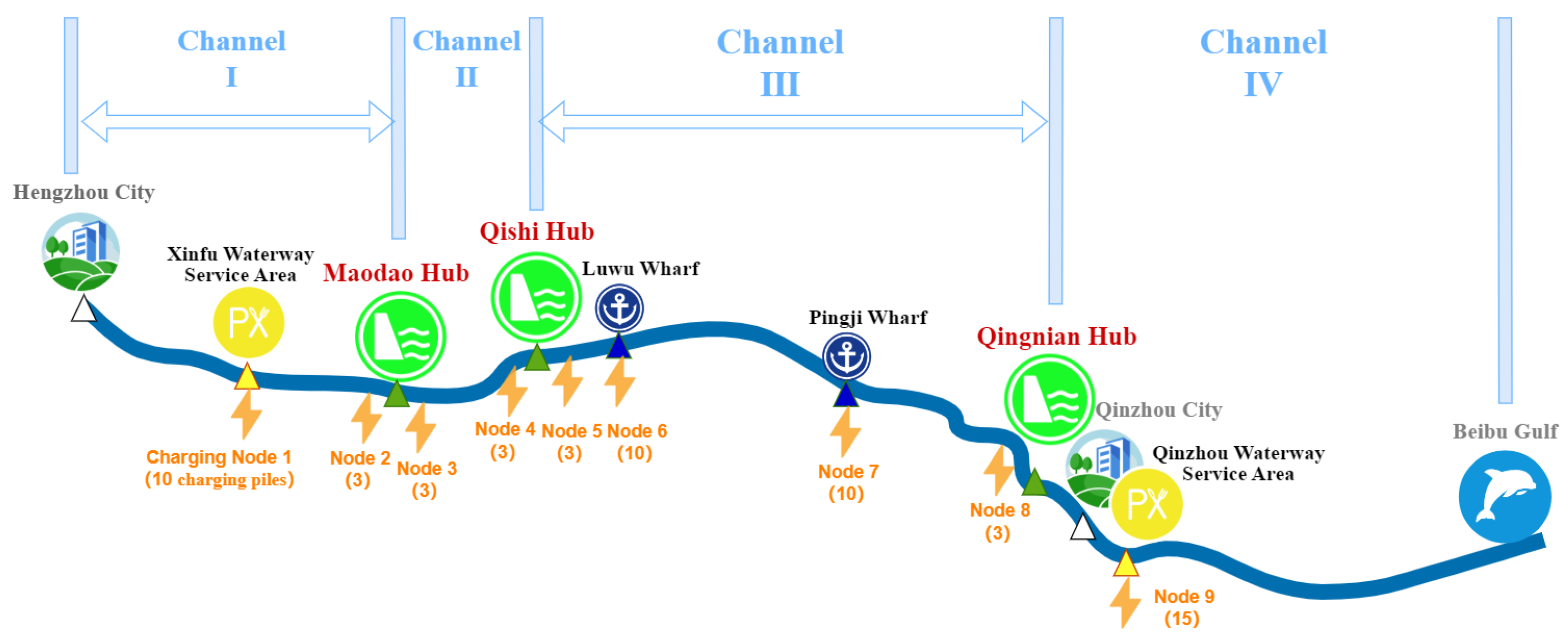
To facilitate research, charging nodes for the Pinglu Canal were established, as shown in Figure A2, with parameters listed in Table 3.
The shore power utilization rate for nonelectric cargo vessels was set at 10% in the baseline year (2027), increasing annually by 3%. Then, we calculated the average theoretical charging time for both nonelectric and electric vessels along the canal from 2027 to 2050, yielding per-node average charging times. The total shore power demand was then computed and annual charging durations per node were validated. Final results are presented in Figure A2.

4.4. Analysis of Forecast Results

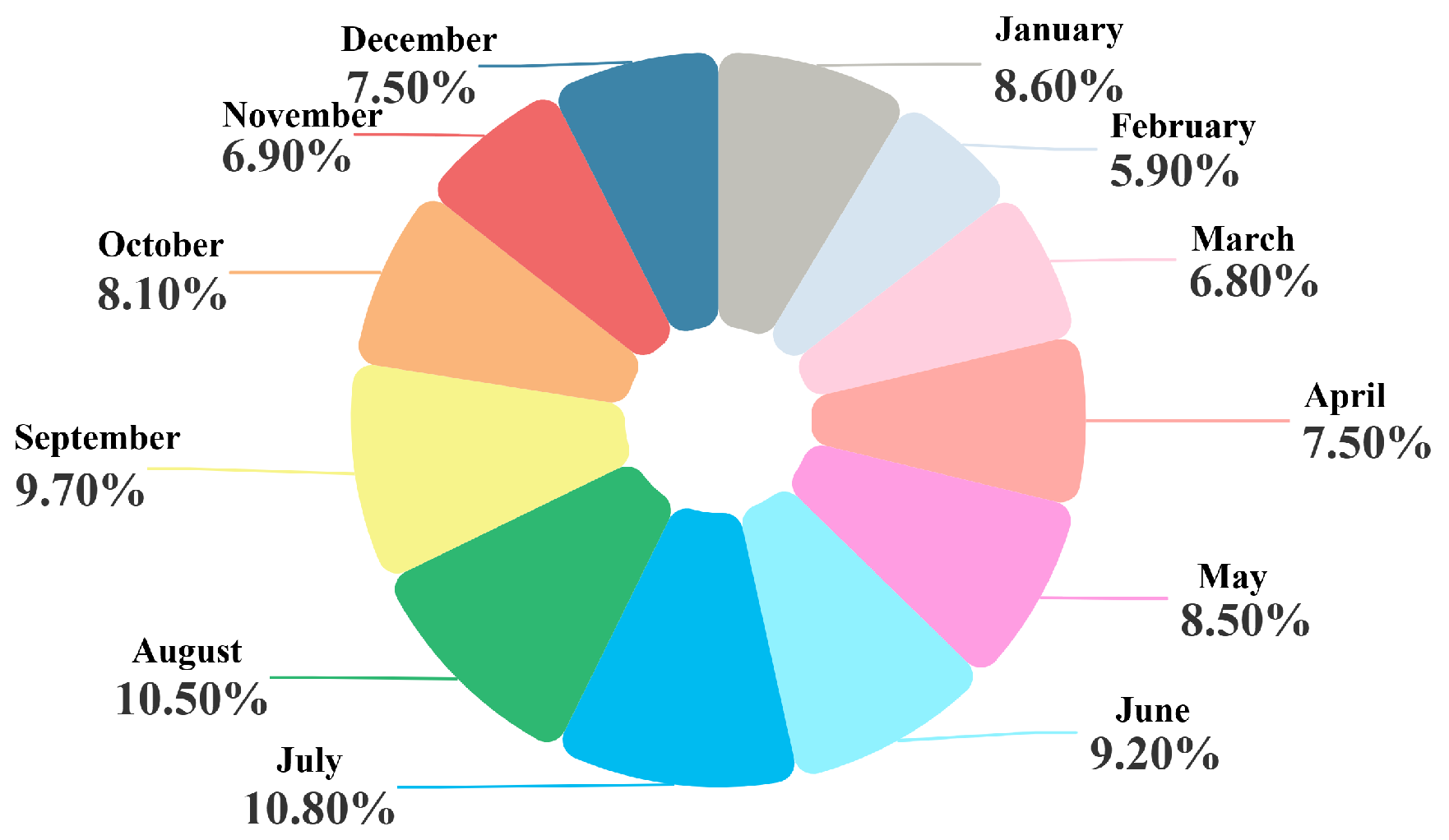
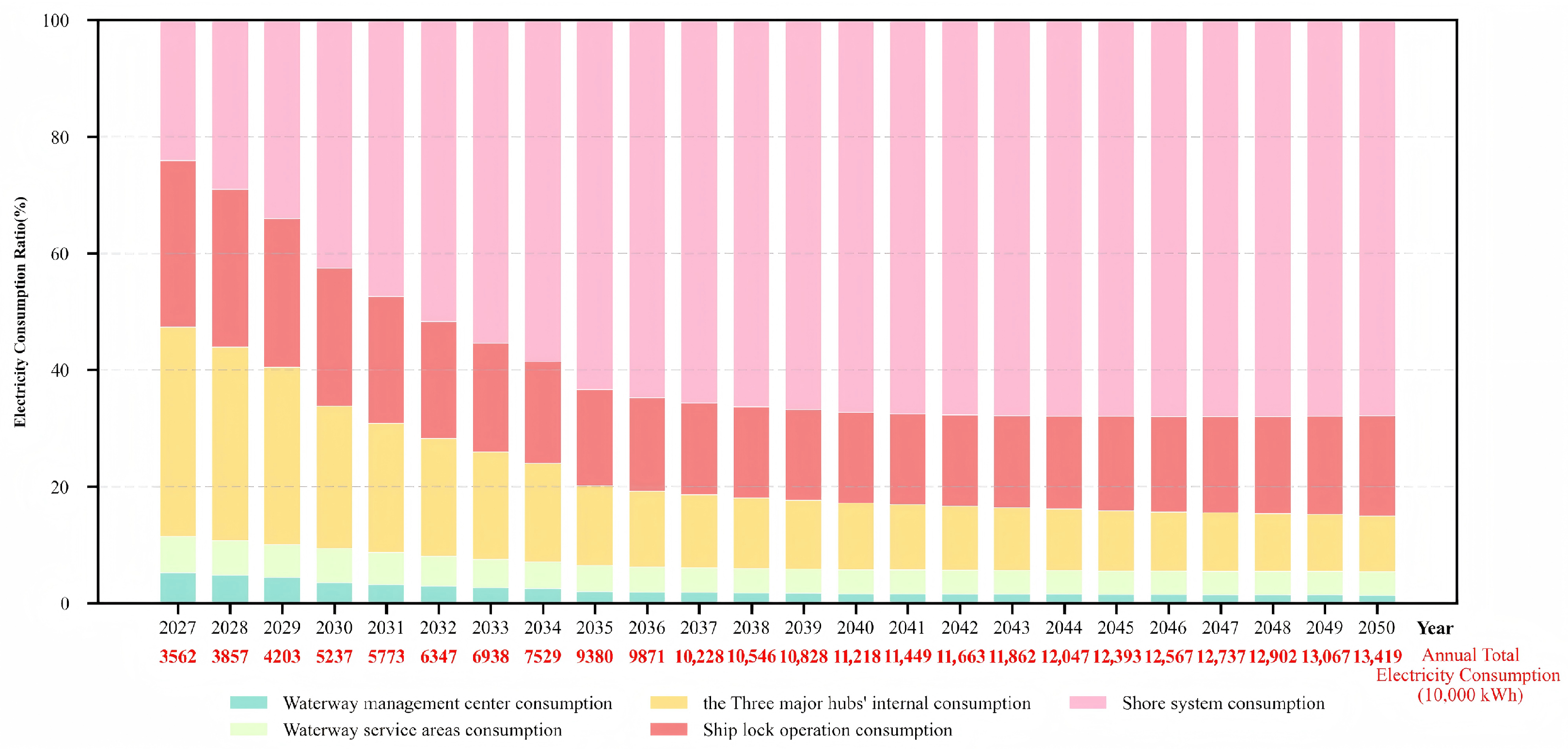
Figure 14 demonstrates consistent growth in the Pinglu Canal’s system-wide electricity consumption from 2027 to 2050. Total usage escalates from 35.62 million kWh (2027) to 134.19 million kWh (2050) at an annualized growth rate of 5.9%, exhibiting triphasic characteristics: accelerated growth, peak surge, and steady-state development. During the 2027–2030 transition period, consumption grew at 13.7% annually, primarily driven by exponential shore power expansion (37.5% growth) and initial lock operational loads. By 2028, shore system consumption reached 11.18 million kWh, surpassing ship lock operation consumption (10.45 million kWh) as the primary load—evidencing successful energy transition. A stage-specific peak occurred in 2035 (93.80 million kWh, annual growth rate of 24.6%), predominantly fueled by shore power systems (59.39 million kWh, 63.3% share). Post-2040, growth moderated to 1.8% annually (dipping to 1.3% in 2049), reflecting dual effects of freight saturation (1.5% annual cargo growth post-2040) and energy efficiency optimization (2.7% annual reduction in energy intensity per throughput unit).
Shore power systems consumption manifested an irreversible trend of “accelerating structural dominance with expanding decarbonization impact” throughout the cycle. Its consumption share surged from 24.1% (8.576 million kWh, 2027) to 67.8% (91.045 million kWh, 2050), crossing two milestones: the 2028 inflection point, where it overtook lock consumption, establishing primacy; and the 2035 growth explosion, where it contributed 82.6% of system-wide incremental demand (1.529 million kWh of 1.851 million kWh total increase). Shore power’s 2035 leap stemmed from three structural catalysts: 84,462 cumulative charging hours at hubs, 37.5% electric vessel penetration rate, and vessel-upsizing extending average charging duration to 6.7 h. At 0.7 kg C O 2 /kWh reduction factor, shore power achieved 64,000 t C O 2 emission reductions by 2050.
Ship lock operation consumption progressed through distinct phases. During rapid ascent (2027–2034), usage increased 28.7% (10.18 → 13.10 million kWh), strongly correlating with initial navigation volume growth (R2 = 0.97). The 2035 inflection saw usage jump to 15.53 million kWh due to accelerating vessel-upsizing. During slow growth (2035–2050), consumption rose 49% to 23.14 million kWh, but energy intensity per throughput unit decreased 11.8%, revealing vessel-upsizing’s “weak decarbonization effect”. Service zone electricity grew at 4.1% annually—slower than system demand—with its share declining from 11.4% (2028) to 5.4% (2050), indicating diminishing structural influence.
System evolution reveals three critical signatures. (1) Shore power’s dominance was secured early (2028), cementing its role as the core decarbonization vector (67.8% contribution by 2050); (2) lock energy maintains rigid correlation with navigation intensity; (3) tripartite load ratios (shore power: lock: others) evolved through 63:17:20 (2035), 67:16:17 (2040), and 68:17:15 (2050), marking phased completion of energy transition.
This research pioneers full-cycle energy trajectory quantification for new canals, establishing shore power as the essential decarbonization pathway while exposing navigation intensity’s binding constraint on lock energy consumption.

5. Conclusions

This study proposes a mid-to-long-term electricity load forecasting framework integrating feature transfer mechanisms and navigation traffic volume cascade mapping to address historical data scarcity in new canal projects. Concurrently, a three-tier NBE theoretical architecture is established to model shore power systems consumption. Empirical analysis of Pinglu Canal’s 2027–2050 electricity consumption reveals three core findings. (1) Shore power’s share rises from 24.1% in the initial operational phase to 67.8% in the steady-state period, demonstrating a triphasic “inflection–explosion–steady” evolution pattern that affirms its strategic role as the core decarbonization vector. (2) A 2% increase in average vessel tonnage reduces energy intensity per throughput unit by 11.8%, quantifying the weak decarbonization effect of vessel-upsizing on lock energy. (3) A three-phase energy transition criterion is established: <40% shore power share indicates a lock/service-zone-dominated initiation phase; 40–65% signifies structural restructuring with shore power dominance; >65% represents steady-state convergence with completed transition. Furthermore, the NBE framework enables systematic shore power forecasting by integrating spatial charging node planning with vessel-specific electricity demand patterns and charging behaviors under green shipping imperatives. These findings provide theoretical and practical paradigms for lock expansion energy assessment, proactive shore power infrastructure deployment, and a shift in energy optimization focus from locks to shore power in low-carbon planning.
While demonstrating robust engineering applicability in data-scarce scenarios, the proposed framework exhibits limitations. First, the simplified generator self-consumption modeling (due to minimal self-consumption share) inadequately addresses extreme weather sensitivity. Second, the lack of long-term uncertainty quantification prevents probabilistic modeling of exogenous variables like freight demand volatility (e.g., geopolitical-triggered throughput shocks) or energy policy shifts (e.g., shore power subsidy phase-out rates). Third, there is exposure to macroeconomic risks: global recessions or abrupt trade policy changes could trigger output contraction in hinterland economies → volatility in southbound seaborne cargo → amplified cascading navigation mapping responses, inducing nonlinear forecasting error escalation.
To address these constraints, future research will prioritize developing joint uncertainty probability models to generate multimodal probabilistic forecast trajectories and quantify load vulnerabilities across scenarios. Meanwhile, reinforcement-learning-enabled dynamic decision engines can be deployed to enhance real-time responsiveness in complex action spaces [35], optimizing canal load-renewables matching. Additionally, economic resilience factors can be established to mitigate macroeconomically-induced decision risks. Furthermore, flexible load coordination mechanisms leveraging dispatchable resources (pumping stations, storage-integrated charging) via load migration can be created to increase renewable accommodation [36], ensuring green and efficient canal operation aligned with modern power systems.

Author Contributions

Conceptualization, J.F., L.G. and X.L.; methodology, B.C. and M.L.; validation, J.F., L.G. and X.L.; formal analysis, N.W.; investigation, M.L.; resources, J.F., L.G. and X.L.; data curation, B.C.; writing—original draft preparation, M.L.; writing—review and editing, B.C. and N.W.; visualization, J.F.; supervision, L.G. and X.L.; project administration, J.F.; funding acquisition, B.C. All authors have read and agreed to the published version of the manuscript.

Funding

This work was supported by the National Natural Science Foundation of China (grant number 52467005) and the Guangxi Special for Innovation-Driven Development (grant number AA19254034).

Institutional Review Board Statement

Not applicable.

Informed Consent Statement

Not applicable.

Data Availability Statement

The data used in the manuscript were downloaded from public access and are open-source data. Economic data were downloaded from https://data.stats.gov.cn/index.htm (accessed on 1 July 2025). Weather data were downloaded from https://www.noaa.gov/ (accessed on 1 July 2025). Sanxia Lock data were downloaded from https://sxth.mot.gov.cn/ (accessed on 1 July 2025). Changzhou Lock data were downloaded from https://zjhy.mot.gov.cn/index.html (accessed on 1 July 2025).

Acknowledgments

The authors have reviewed and edited the output and take full responsibility for the content of this publication.

Conflicts of Interest

Authors Jing Fu, Li Gong, Xiang Li were employed by the company China Energy Engineering Group Guangxi Electric Power Design and Research Institute Co., Ltd. The remaining authors declare that the research was conducted in the absence of any commercial or financial relationships that could be construed as a potential conflict of interest.

Appendix A

Table A1. Mechanism data mixing model parameters.
ParameterValueParameterValue
P c r a n e 75 kW P v a l v e 25 kW
t o p e n 1 min t c l o s e 0.5 min
t f 14.7 min t e 15.6 min
N c y c l e 2 N v a l v e 16 doors
L280 mB34 m
Δ H Madao: 27.3 × 0.3 m
Qishi: 26.3 × 0.3 m
Qingnian: 10.0 × 0.3 m
ϑ 0.1
δ 6 × 0.95 0
ω i Sanxia: 0.39; Xijiang: 0.43 χ i s r c Sanxia: 1.5; Xijiang: 1.2
K s a v e s r c Sanxia/Xijiang: 0.25 K s a v e t a r Pinglu: 0.60
Q d e s i g n 8900 tonnes ϵ N N Monthly: 2.35 kW
Annual: 25.2 kW

Appendix B

Figure A1. Monthly electricity consumption decomposition of Pinglu Canal Waterway Management Center.
Sustainability 18 00109 g0a1
Figure A2. Pinglu Canal channel division and charging node distribution map.
Sustainability 18 00109 g0a2

References

  1. Zhu, M.Z. Current Situation Analysis and Development Countermeasures of Inland Waterway Logistics System. China Shipp. Wkly. 2023, 31, 43–45. [Google Scholar]
  2. State Council. Outline for the National Comprehensive Three-Dimensional Transportation Network Plan; State Council: Beijing, China, 2021.
  3. State Council. The 14th Five-Year Plan for a Modern Integrated Transportation System; State Council: Beijing, China, 2021.
  4. Xing, P.X.; Pan, H.T. Canal Strategy in the New Era and Construction Practice of Pinglu Canal. Port Waterw. Eng. 2024, 9, 1–6. [Google Scholar]
  5. Zhang, F.F.; Shen, J.Y. Medium-to-Long Term Load Forecasting Based on Least Squares State Estimation and Fuzzy Neural Network. Electr. Autom. 2024, 46, 56–59. [Google Scholar]
  6. Long, Y.; Ruan, W.J.; Liu, M.; Zhou, Y.Q. Research on Mid-Long Term Probabilistic Load Forecasting Method Based on Data Fusion. Power Demand Side Manag. 2024, 26, 9–15. [Google Scholar]
  7. Cai, Y.Q. Research on Medium-Long Term Power Load Forecasting in Ningxia Based on Coupled PSO-GPR Model. Master’s Thesis, North China Electric Power University, Beijing, China, 2020. [Google Scholar]
  8. Sun, Q.C.; Li, J.L.; Jiang, W.L.; Wang, R.Y.; Li, Z.P. Data-Driven Spatiotemporal Network for Urban Mid-Long Term Power Load Forecasting. Electr. Power 2025, 58, 168–174. [Google Scholar]
  9. Zhao, X.; Shen, B.; Lin, L.; Liu, D.; Yan, M.; Li, G. Residential Electricity Load Forecasting Based on Fuzzy Cluster Analysis and LSSVM with Optimization by the Fireworks Algorithm. Sustainability 2022, 14, 1312. [Google Scholar] [CrossRef]
  10. Wang, D. Research on Power Load Forecasting Based on Deep Learning. Master’s Thesis, Anhui University of Science and Technology, Hefei, China, 2025. [Google Scholar]
  11. Chen, B.; Xu, Q.; Zhao, Z.; Guo, X.; Zhang, Y.; Chi, J.; Li, C. A Prosumer Power Prediction Method Based on Dynamic Segmented Curve Matching and Trend Feature Perception. Sustainability 2023, 15, 3376. [Google Scholar] [CrossRef]
  12. Qi, C.; Shi, J.; Cheng, S.W. A decomposable multi-period mixing algorithm for long-term load forecasting. Int. J. Electr. Power Energy Syst. 2025, 170, 110888. [Google Scholar]
  13. Li, Y.X. Application of Differential Grey Model in Medium-Long Term Power Load Forecasting. Master’s Thesis, North China Electric Power University, Beijing, China, 2019. [Google Scholar]
  14. Yang, Y. Research and Application of Medium-Long Term Power Load Forecasting Technology. Master’s Thesis, University of Chinese Academy of Sciences, Beijing, China, 2021. [Google Scholar]
  15. Jiang, Y.X.; Huang, Q.Q.; Zhang, K.M.; Lin, Z.A.; Zhang, T.H.; Hu, X.T.; Liu, S.Y.; Jiang, C.X.; Yang, L.; Lin, Z.Z. Medium-long term load forecasting method considering industry correlation for power management. Energy Rep. 2021, 7, 1231–1238. [Google Scholar] [CrossRef]
  16. Wang, J.D.; Yu, J.Y.; Kong, X.Y. Mid-Long Term Load Forecasting Model Based on Dual Decomposition and Bidirectional LSTM. Power Syst. Technol. 2024, 48, 3418–3426. [Google Scholar]
  17. Han, X.; Su, J.; Hong, Y.; Gong, P.; Zhu, D. Mid-to Long-Term Electric Load Forecasting Based on the EMD–Isomap–Adaboost Model. Sustainability 2022, 14, 7608. [Google Scholar] [CrossRef]
  18. Kaheh, Z.; Shabanzadeh, M. The effect of driver variables on the estimation of bivariate probability density of peak loads in long-term horizon. J. Big Data 2021, 8, 15. [Google Scholar] [CrossRef]
  19. Wu, M.K. Research on Medium-Long Term Power Load Analysis and Forecasting Methods Under the New Normal. Master’s Thesis, North China Electric Power University (Beijing), Beijing, China, 2018. [Google Scholar]
  20. Ruan, Q.R.; Sun, F. Selection and Layout of Electrical Equipment in Hydropower Stations, 1st ed.; China Water & Power Press: Beijing, China, 2013. [Google Scholar]
  21. Qi, K.R.; Li, C.; Wang, Z.J. Construction of Green Comprehensive Service Zones Along the Jiangsu Section of Yangtze River. Shipp. Manag. 2023, 45, 19–26. [Google Scholar]
  22. Lin, J.Y.; Cheng, L.; Lin, Y.; Wu, S.J.; Sun, C.P.; Gao, N. Planning Method for Charging Stations in Inland Ports Serving All-Electric Vessels. J. Shanghai Marit. Univ. 2025, 46, 44–51. [Google Scholar]
  23. Ministry of Transport. General Design Code for Navigation Locks: JTS 180-2021; Ministry of Transport: Beijing, China, 2021.
  24. Mao, M. Configuration of Photovoltaic Systems for Expressway Service Areas Based on Electricity Load Analysis. Autom. Appl. 2023, 64, 200–203. [Google Scholar]
  25. Li, X.; Zeng, M.L.; Xu, X.J. Development Status and Prospects of Electric-Powered Vessels in China. Shipp. Manag. 2025, 47, 11–14. [Google Scholar]
  26. Liu, C.G.; Yuan, C.Q.; Zhai, H.; Yan, X.P. Development Status and Future Trends of Fujian’s Electric-Powered Vessel Industry. Strait Sci. 2024, 2, 143–148. [Google Scholar]
  27. Hu, Z.W. Research on Construction Strategy of Shore Power System for Ships in Inland Ports. Master’s Thesis, South China University of Technology, Guangzhou, China, 2021. [Google Scholar]
  28. Dang, R.N. Collaborative Optimization of Charging Station Location and Distribution Path for Electric Cargo Ships. Master’s Thesis, North China Electric Power University (Beijing), Beijing, China, 2022. [Google Scholar]
  29. Liu, N. Water Transport System and Intermodal Pattern of the New Western Land-Sea Corridor Anchored by Pinglu Canal. Hydro-Sci. Eng. 2025, 1, 1–15. [Google Scholar]
  30. Zhang, Y. Historical Logic, Practical Significance, and Development Path of Industrial Growth in Pinglu Canal Economic Belt. Soc. Sci. 2024, 5, 129–134. [Google Scholar]
  31. Xu, P.H.; Dong, H.Y.; Zhao, Z.; Xie, R.J.; Cao, L. Thoughts on Accelerating the Construction of Green Maritime Comprehensive Service Zones Along the Yangtze River Trunk Line. Technol. Econ. Chang. 2020, 4, 71–74. [Google Scholar]
  32. Fu, X.N. Analysis of Navigation Obstruction and Research on Lock Toll-Based Congestion Mitigation at Three Gorges Hub. Master’s Thesis, Chongqing Jiaotong University, Chongqing, China, 2019. [Google Scholar]
  33. Huang, S.W.; Wang, Q.; Yu, J.Y. Countermeasures for Alleviating Ship Congestion at Three Gorges Hub. China Water Transp. 2024, 21, 72–74. [Google Scholar]
  34. CCCC Water Transportation Consultants. Feasibility Study Report of Pinglu Canal Project; CCCC Water Transportation Consultants: Beijing, China, 2022. [Google Scholar]
  35. Kaloev, M.; Krastev, G. Comprehensive Review of Benefits from the Use of Sparse Updates Techniques in Reinforcement Learning: Experimental Simulations in Complex Action Space Environments. In Proceedings of the 2023 4th International Conference on Communications, Information, Electronic and Energy Systems (CIEES), Plovdiv, Bulgaria, 23–25 November 2023; pp. 1–7. [Google Scholar]
  36. Du, Z.; Yin, H.; Zhang, X.; Hu, H.; Liu, T.; Hou, M.; Giannelos, S.; Strbac, G. Decarbonisation of Data Centre Networks through Computing Power Migration. In Proceedings of the 2025 IEEE 5th International Conference on Computer Communication and Artificial Intelligence (CCAI), Haikou, China, 23–25 May 2025; pp. 871–876. [Google Scholar]
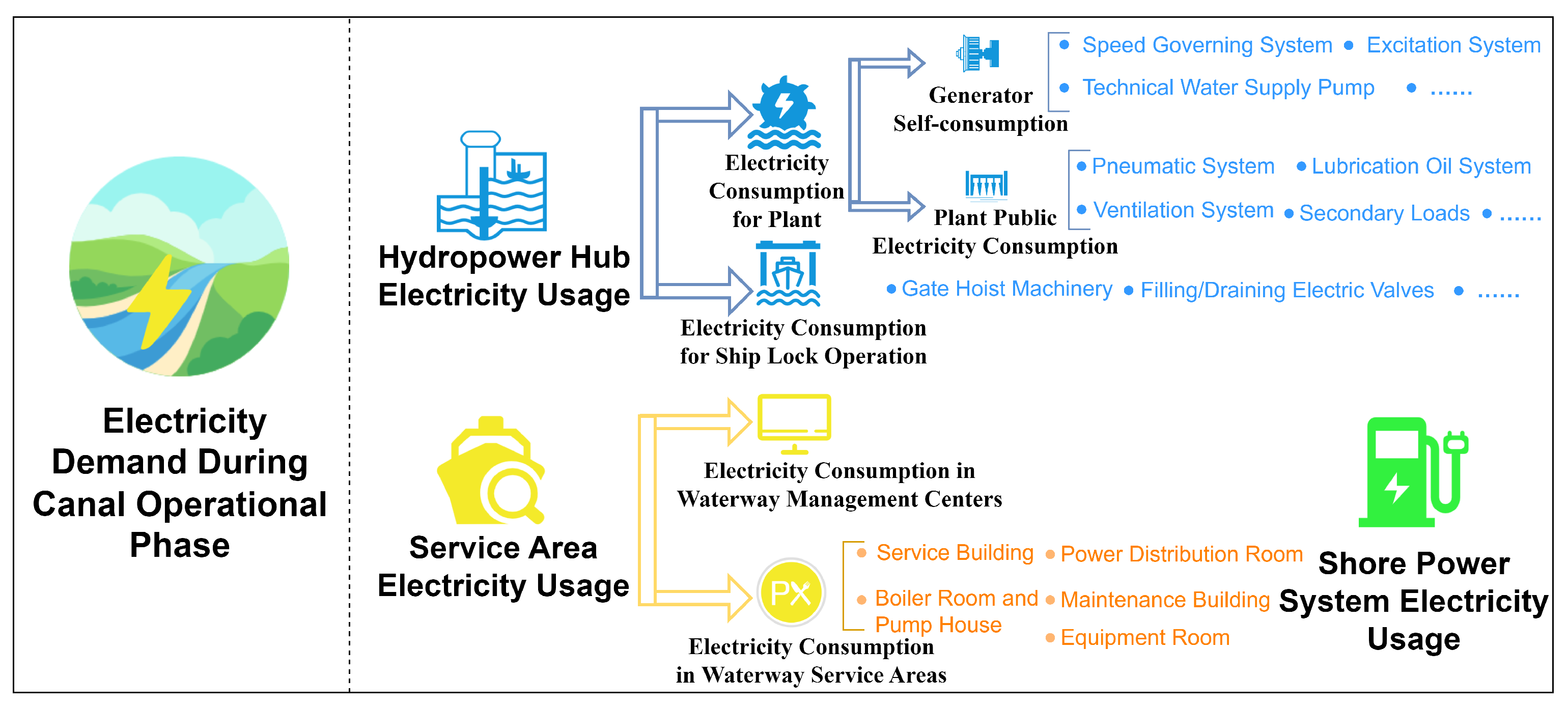
Figure 1. A diagram of the electricity consumption link during the operation period of the canal.
Sustainability 18 00109 g001
Figure 2. Medium-to-long-term electricity consumption forecast technical architecture diagram during the operation period of the canal under construction.
Sustainability 18 00109 g002
Figure 3. Feature vector correlation analysis of Changzhou Lock (* indicates a significant correlation, and *** indicates a strongly significant correlation).
Sustainability 18 00109 g003
Figure 4. The proportion of tonnage and average nuclear load of inland river-crossing ships in 2015–2024.
Sustainability 18 00109 g004
Figure 5. Electric ship penetration forecast 2024–2050.
Sustainability 18 00109 g005
Figure 6. Characteristic values of the Sanxia, Xijiang Shipping, and Pinglu Canal.
Sustainability 18 00109 g006
Figure 7. Annual cargo volume of Changzhou Lock and Sanxia Lock (10,000 tonnes): (a) Historical data from 2018 to 2024. (b) Forecast results for 2027.
Sustainability 18 00109 g007
Figure 8. Forecast results of water transport demand along the Pinglu Canal from 2027 to 2050.
Sustainability 18 00109 g008
Figure 9. Forecast results of the hub fam crossing volume of Pinglu Canal from 2027 to 2050.
Sustainability 18 00109 g009
Figure 10. Comparison of the effects of the average tonnage nuclear load prediction model.
Sustainability 18 00109 g010
Figure 11. Forecast results of annual ship passage by hub of Pinglu Canal (2027–2050).
Sustainability 18 00109 g011
Figure 12. Monthly electricity consumption per square meter index of service rooms in the water comprehensive service area.
Sustainability 18 00109 g012
Figure 13. Xinfu and Qinzhou water comprehensive service area annual electricity consumption forecast results from 2027 to 2050.
Sustainability 18 00109 g013
Figure 14. Medium- and long-term electricity consumption forecast results of Pinglu Canal (annual).
Sustainability 18 00109 g014
Table 1. Ship battery capacity parameter reference table (kWh).
Type Tonnes<2000 t>2000 t
BEVs24008700
HEVs13502400
NEVs1030
Table 2. The proportion of southbound overseas freight volume in the provinces and regions of the Pinglu Canal hinterland from 2027 to 2050.
Year2027–20302030–20352035–20402040–20452045–20502050
Proportion3.0%3.1%3.2%3.3%3.4%3.5%
Table 3. Charging-node-related parameter settings.
Node j12–56–789_ up9_ down
α j 0.35%0.10%0.15%0.2%0.5%0.55%
T j _ d o c k /h4%10%8%10%4.6%10%
Disclaimer/Publisher’s Note: The statements, opinions and data contained in all publications are solely those of the individual author(s) and contributor(s) and not of MDPI and/or the editor(s). MDPI and/or the editor(s) disclaim responsibility for any injury to people or property resulting from any ideas, methods, instructions or products referred to in the content.