



Engagement, Citizenship Behavior, Burnout, and Intention to Quit: Mechanisms Fostering Sustainable Well-Being and Driving Retention Among Thai Frontline Bank Employees


Abstract
1. Introduction
2. Literature Review and Hypotheses Development
2.1. Theoretical Underpinnings
2.2. Employee Engagement and Organizational Citizenship Behavior
2.3. Employee Engagement and Burnout
2.4. Organizational Citizenship Behaviors and Burnout
2.5. Mediating Effects of Organizational Citizenship Behaviors
2.6. Burnout and Intention to Quit
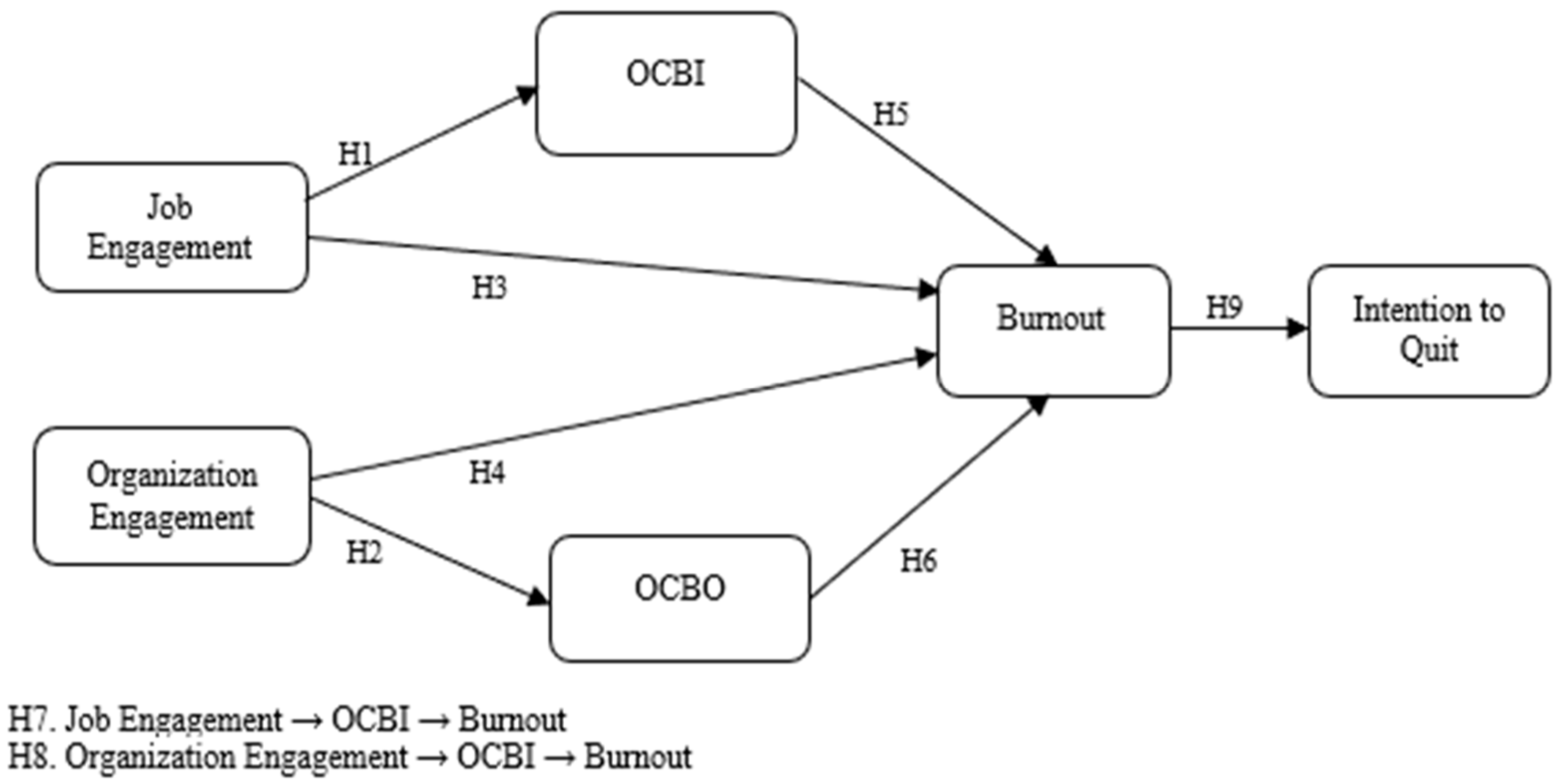
2.7. Conceptual Framework
3. Methods
3.1. Sample and Data Collection
3.2. Research Instruments
3.3. Estimation Method
4. Results
4.1. Measurement Model Assessment
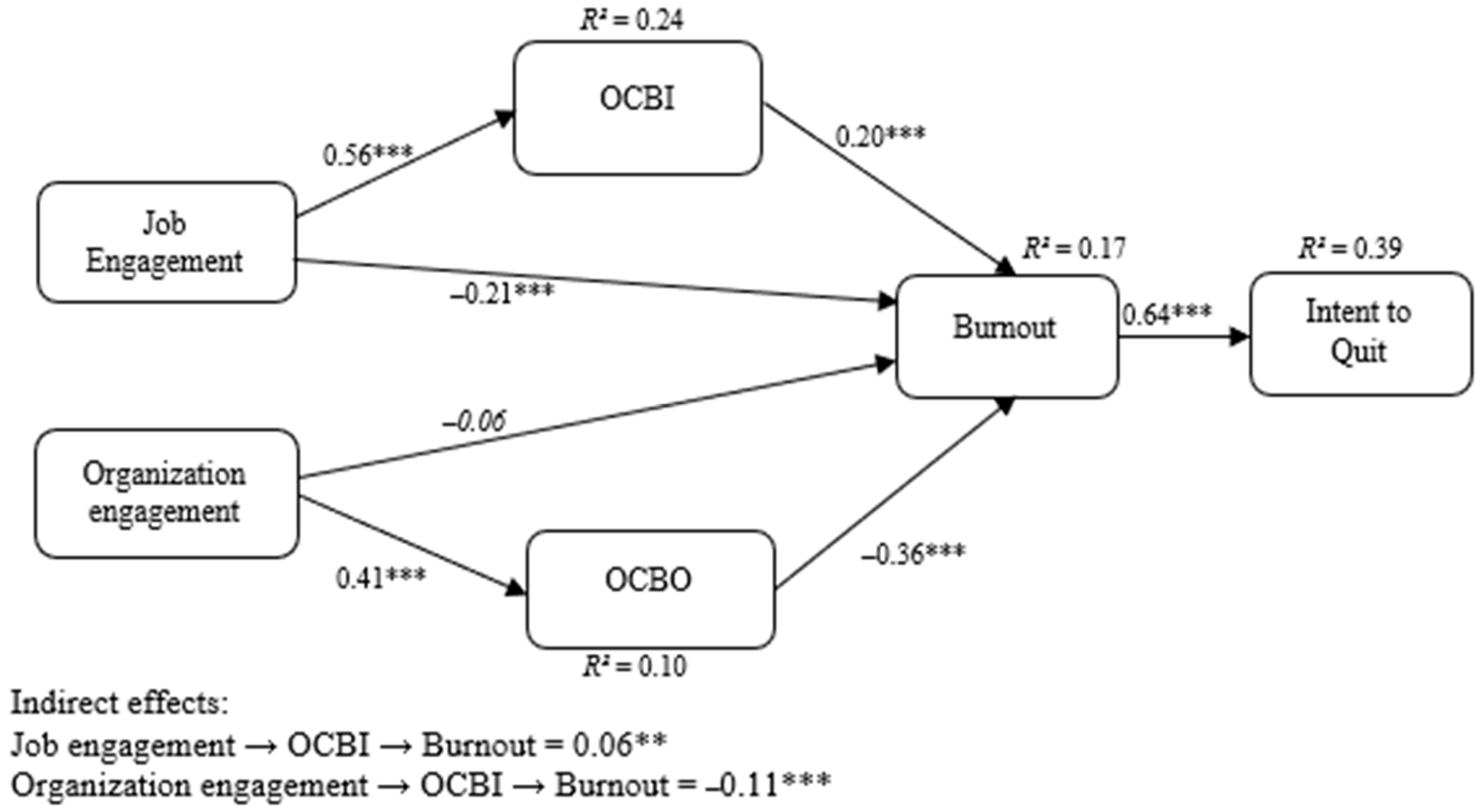
4.2. Structural Model Assessment and Hypotheses Testing
5. Discussion
5.1. Theoretical Contributions
5.2. Managerial Implications
5.3. Limitations and Directions for Future Research
6. Conclusions
Author Contributions
Funding
Institutional Review Board Statement
Informed Consent Statement
Data Availability Statement
Acknowledgments
Conflicts of Interest
Abbreviations
| OCBI | Organizational Citizenship Behavior directed toward Individuals |
| OCBO | Organizational Citizenship Behavior directed toward the Organization |
| JD–R | Job Demands–Resources |
| SET | Social Exchange Theory: |
| COR | Conservation of Resources |
| CB-SEM | Covariance-Based Structural Equation Modeling |
| CFA | Confirmatory factor analysis |
| CR | Composite reliability |
| JE | Job Engagement |
| OE | Organization Engagement |
| BO | Burnout |
| ITQ | Intention to Quit |
References
- Ciba, K. Banking in Thailand. Statista. 7 August 2025. Available online: https://www.statista.com/topics/8709/banking-in-thailand/#topicOverview (accessed on 29 October 2025).
- Long, K. The Banker’s Top 30 ASEAN Banks 2024. The Banker. 24 May 2024. Available online: https://www.thebanker.com/content/92ca91f8-a0df-5fc7-969d-fcd07b4aee9d (accessed on 29 November 2025).
- Uppathampracha, R.; Anwar, M. The mediating role of hope and cognitive crafting in the relationship between authentic leadership and innovative employee behavior. Banks Bank Syst. 2023, 18, 163–173. [Google Scholar] [CrossRef]
- Srisawang, W.; Aujirapongpan, S. Enhancing the adaptation of bank employees to support the digital transformation era: Case study of a Thai bank in Nakhon Si Thammarat, Thailand. J. Public Adm. Manag. 2023, 2, 1–8. [Google Scholar]
- Boonparn, C.; Rurkwararuk, W.; Pooncharoen, N.; Leamprecha, N. The relationship of internal marketing and organizational citizenship behavior and brand citizenship behavior on credit card issuers’ call-center staff in Thailand. J. Community Dev. Res. Humanit. Soc. Sci. 2020, 13, 55–68. [Google Scholar]
- Peng, B.; Potipiroon, W. The effect of job insecurity on bank employees’ job stress and job burnout during COVID-19: A moderated mediation model. ABAC J. 2022, 42, 38–56. [Google Scholar]
- Yaodam, P.; Silphiphat, K. Factors related to burnout of employees in government bank. J. Soc. Sci. Humanit. Res. Asia 2024, 30, 71–90. [Google Scholar]
- Afshan, G.; Kashif, M.; Sattayawaksakul, D.; Cheewaprakobkit, P.; Wijenayake, S. Abusive supervision, supervisor undermining, and turnover intentions: Mediation of quiescent silence and desire to seek revenge among Thai banking frontliners. Manag. Res. Rev. 2022, 45, 1479–1502. [Google Scholar] [CrossRef]
- Soythong, K. Influence of transformational leadership on the relationship among organizational commitment, intention to leave, and innovation capability among bank employees in Nakhon Phanom Province, Thailand. J. Roi Kaensarn Acad. 2023, 8, 467–483. [Google Scholar]
- Saks, A.M. Caring human resources management and employee engagement. Hum. Resour. Manag. Rev. 2022, 32, 100835. [Google Scholar] [CrossRef]
- Bai, Y.; Zhou, J.; He, W. How employee job burnout, work engagement, and turnover intention relate to career plateau during the epidemic. Soc. Sci. 2023, 12, 394. [Google Scholar] [CrossRef]
- Heyns, M.M.; McCallaghan, S.; de Wet, E.H. The role of supervisor support and basic psychological needs in predicting work engagement, burnout and turnover intentions in a medical contract research service setting. Res. Soc. Adm. Pharm. 2022, 18, 2981–2988. [Google Scholar] [CrossRef] [PubMed]
- Nguyen, T.D.; Luu, N.; Gregory, G.; Nguyen, H.; Nguyen, H.M. Too much of a good thing? The impact of organizational citizenship behaviors on emotional exhaustion and next-day work engagement. Australas. Mark. J. 2025, 2025, 14413582251349557. [Google Scholar] [CrossRef]
- Parayitam, S.; Usman, S.A.; D’Souza, G.S.; Rajakumar, C.S.C.; Kannan, B. Unfolding the relationship between emotional intelligence and performance: Organizational citizenship behavior as a mediator and emotional exhaustion as a moderator. Int. J. Educ. Manag. 2025, 39, 1342–1365. [Google Scholar] [CrossRef]
- Zhong, M.; Wayne, S.J.; Michel, E.J. When the past and the present collide: Contrast effect of sequential psychological contract breaches on employee outcomes. J. Manag. 2023, 49, 913–943. [Google Scholar]
- Gümüştaş, C.; Karataş Gümüştaş, N. How and for whom abusive supervision influences organizational citizenship behavior: The roles of burnout and workplace friendship. Int. J. Confl. Manag. 2025, 36, 70–93. [Google Scholar] [CrossRef]
- Blau, P.M. Justice in social exchange. Sociol. Inq. 1964, 34, 193–206. [Google Scholar] [CrossRef]
- Cropanzano, R.; Mitchell, M.S. Social exchange theory: An interdisciplinary review. J. Manag. 2005, 31, 874–900. [Google Scholar] [CrossRef]
- Bakker, A.B.; Demerouti, E. The job demands-resources model: State of the art. J. Manag. Psychol. 2007, 22, 309–328. [Google Scholar] [CrossRef]
- Hobfoll, S.E. The influence of culture, community, and the nested-self in the stress process: Advancing conservation of resources theory. Appl. Psychol. 2001, 50, 337–421. [Google Scholar] [CrossRef]
- Jabutay, F.A.; Rungruang, P. Turnover intent of new workers: Social exchange perspectives. Asia Pac. J. Bus. Adm. 2021, 13, 60–79. [Google Scholar] [CrossRef]
- Nuchpramool, K.; Hsu, R.L.W.; Yeh, S.P. Rethinking leadership influence: The moderating role of transformational leadership in the relationships among perceived organizational support, psychological mechanisms, and extra-role behavior in Thailand’s luxury hotel sector. Sustainability 2025, 17, 9179. [Google Scholar] [CrossRef]
- Williams, L.J.; Anderson, S.E. Job satisfaction and organizational commitment as predictors of organizational citizenship and in-role behaviors. J. Manag. 1991, 17, 601–617. [Google Scholar] [CrossRef]
- Saks, A.M. Antecedents and consequences of employee engagement. J. Manag. Psychol. 2006, 21, 600–619. [Google Scholar] [CrossRef]
- Hermanto, Y.B.; Srimulyani, V.A. The effects of organizational justice on employee performance using dimension of organizational citizenship behavior as mediation. Sustainability 2022, 14, 13322. [Google Scholar] [CrossRef]
- Maslach, C.; Jackson, S.E.; Leiter, M.P. Maslach Burnout Inventory; Scarecrow Education: Lanham, MD, USA, 1997. [Google Scholar]
- Urbini, F.; Chirumbolo, A.; Callea, A. Promoting individual and organizational OCBs: The mediating role of work engagement. Behav. Sci. 2020, 10, 138. [Google Scholar] [CrossRef] [PubMed]
- Young, S.F.; Steelman, L.A.; Pita, M.D.; Gallo, J. Role-based engagement: Scale development and validation. J. Manag. Organ. 2024, 30, 248–268. [Google Scholar] [CrossRef]
- Ashfaq, B.; Hamid, A. Person–organization fit and organization citizenship behavior: Modeling the work engagement as a mediator. Asia Pac. J. Bus. Adm. 2021, 13, 19–39. [Google Scholar] [CrossRef]
- Ma, W.; Li, R.Y.M.; Manta, O.; Alzuman, A. Balancing wellbeing and responsibility: CSR’s role in mitigating burnout in hospitality under UN-SDGs. Sustainability 2024, 16, 3374. [Google Scholar] [CrossRef]
- Malta, G.; Plescia, F.; Zerbo, S.; Verso, M.G.; Matera, S.; Skerjanc, A.; Cannizzaro, E. Work and environmental factors on job burnout: A cross-sectional study for sustainable work. Sustainability 2024, 16, 3228. [Google Scholar] [CrossRef]
- Vinarski-Peretz, H.; Mashiach-Eizenberg, M.; Halperin, D. Workforce sustainability in our aging society: Exploring how the burden–burnout mechanism exacerbates the turnover intentions of employees who combine work and informal eldercare. Sustainability 2024, 16, 7553. [Google Scholar] [CrossRef]
- Houle, S.A.; Rich, B.L.; Comeau, C.A.; Blais, A.R.; Morin, A.J. The job engagement scale: Development and validation of a short form in English and French. J. Bus. Psychol. 2022, 37, 877–896. [Google Scholar] [CrossRef]
- Mendoza-Llanos, R.; Acuña-Hormazábal, Á.; Pons-Peregort, O. We need engaged workers! A structural equation modeling study from the positive organizational psychology in times of COVID-19 in Chile. Int. J. Environ. Res. Public Health 2022, 19, 7700. [Google Scholar] [CrossRef]
- Apaydin, E.A.; Rose, D.E.; McClean, M.R.; Mohr, D.C.; Yano, E.M.; Shekelle, P.G.; Stockdale, S.E. Burnout, employee engagement, and changing organizational contexts in VA primary care during the early COVID-19 pandemic. BMC Health Serv. Res. 2023, 23, 1306. [Google Scholar] [CrossRef]
- Ramaci, T.; Santisi, G.; Curatolo, K.; Barattucci, M. Perceived organizational support moderates the effect of job demands on outcomes: Testing the JD-R model in Italian oncology nurses. Palliat. Support Care 2024, 22, 1338–1346. [Google Scholar]
- Yanbei, R.; Dongdong, M.; Yun, L.; Ning, W.; Fengping, Q. Does perceived organization support moderate the relationships between work frustration and burnout among intensive care unit nurses? A cross-sectional survey. BMC Nurs. 2023, 22, 22. [Google Scholar] [CrossRef]
- Ekowati, D.; Kasman, S.; Sulistiawan, J. Organizational citizenship behavior and emotional exhaustion: Examining the role of work-family conflict. J. Manag. Teor. Dan Terap. 2023, 16, 196–205. [Google Scholar]
- Tett, R.P.; Meyer, J.P. Job satisfaction, organizational commitment, turnover intention, and turnover: Path analyses based on meta-analytic findings. Pers. Psychol. 1993, 46, 259–293. [Google Scholar] [CrossRef]
- Jabutay, F.A.; Suwandee, S.; Jabutay, J.A. Testing the stress–strain–outcome model in Philippines-based call centers. J. Asia Bus. Stud. 2023, 17, 404–423. [Google Scholar] [CrossRef]
- Memon, M.A.; Thurasamy, R.; Cheah, J.H.; Ting, H.; Chuah, F.; Cham, T.H. Addressing common method bias, operationalization, sampling, and data collection issues in quantitative research: Review and recommendations. J. Appl. Struct. Equ. Model. 2023, 7, i–xiv. [Google Scholar] [CrossRef] [PubMed]
- Jabutay, F.; Novio, E.B.; Verbal, X.F. Strategic deception in call centers: Impacts on well-being, cognition, and work motivation. J. Gen. Psychol. 2024, 151, 597–623. [Google Scholar] [CrossRef] [PubMed]
- Bryman, A. Social Research Methods; Oxford University Press: Oxford, UK, 2016. [Google Scholar]
- Hair, J.F.; Anderson, R.E.; Babin, B.J.; Black, W.C. Multivariate Data Analysis: A Global Perspective, 7th ed.; Pearson: Upper Saddle River, NJ, USA, 2010. [Google Scholar]
- Hinkin, T.R. A review of scale development practices in the study of organizations. J. Manag. 1995, 21, 967–988. [Google Scholar] [CrossRef]
- Lee, K.; Allen, N.J. Organizational citizenship behavior and workplace deviance: The role of affect and cognitions. J. Appl. Psychol. 2002, 87, 131–142. [Google Scholar] [CrossRef] [PubMed]
- Shirom, A.; Melamed, S. A comparison of the construct validity of two burnout measures in two groups of professionals. Int. J. Stress Manag. 2006, 13, 176. [Google Scholar] [CrossRef]
- Mobley, W.H.; Horner, S.O.; Hollingsworth, A.T. An evaluation of precursors of hospital employee turnover. J. Appl. Psychol. 1978, 63, 408–414. [Google Scholar] [CrossRef]
- Anderson, J.C.; Gerbing, D.W. Structural equation modeling in practice: A review and recommended two-step approach. Psychol. Bull. 1988, 103, 411–423. [Google Scholar] [CrossRef]
- Fornell, C.; Larcker, D.F. Evaluating structural equation models with unobservable variables and measurement error. J. Mark. Res. 1981, 18, 39–50. [Google Scholar]
- Hu, L.T.; Bentler, P.M. Cutoff criteria for fit indexes in covariance structure analysis: Conventional criteria versus new alternatives. Struct. Equ. Model. 1999, 6, 1–55. [Google Scholar] [CrossRef]
- Espina-Romero, L. Ceniiac–An open window to applied knowledge. Ceniiac 2025, 1, e0001. [Google Scholar]
- Dubey, A.; Varma, A.; Riasudeen, S. Exploring the role of organizational identification in the nexus of psychological capital and organizational-oriented citizenship behaviors: Evidence from healthcare professionals in India. J. Health Organ. Manag. 2025, 39, 1217–1235. [Google Scholar]
- Halder, D.; Chatterjee, I. Work–life balance and OCB: A review of existing literature. In Organizational Citizenship Behaviour (OCB) in India: Emerging Trends and Future Directions; Springer: Berlin/Heidelberg, Germany, 2024; pp. 59–73. [Google Scholar]
- Gilbert, S.; Laschinger, H.K.; Leiter, M. The mediating effect of burnout on the relationship between structural empowerment and organizational citizenship behaviours. J. Nurs. Manag. 2010, 18, 339–348. [Google Scholar] [CrossRef]
- Saks, A.M.; Gruman, J.A.; Zhang, Q. Organization engagement: A review and comparison to job engagement. J. Organ. Eff. People Perform. 2022, 9, 20–49. [Google Scholar]
- Menardo, E.; Di Marco, D.; Ramos, S.; Brondino, M.; Arenas, A.; Costa, P.; Pasini, M. Nature and mindfulness to cope with work-related stress: A narrative review. Int. J. Environ. Res. Public Health 2022, 19, 5948. [Google Scholar]
- Shifrin, N.V.; Michel, J.S. Flexible work arrangements and employee health: A meta-analytic review. Work Stress 2022, 36, 60–85. [Google Scholar]
- Levin, K.A. Study design III: Cross-sectional studies. Evid. Based Dent. 2006, 7, 24–25. [Google Scholar]
- Frank, K.A. Impact of a confounding variable on a regression coefficient. Sociol. Methods Res. 2000, 29, 147–194. [Google Scholar] [CrossRef]

| Construct | Item | Factor Loading | CR | AVE |
|---|---|---|---|---|
| Job Engagement | 0.83 | 0.62 | ||
| JE1 | 0.847 | |||
| JE2 | 0.701 | |||
| JE3 | 0.803 | |||
| Organization Engagement | 0.80 | 0.57 | ||
| OE1 | 0.763 | |||
| OE2 | 0.769 | |||
| OE3 | 0.730 | |||
| OCBI | 0.86 | 0.68 | ||
| OCBI1 | 0.722 | |||
| OCBI2 | 0.874 | |||
| OCBI3 | 0.869 | |||
| OCBO | 0.94 | 0.72 | ||
| OCBO1 | 0.728 | |||
| OCBO1 | 0.846 | |||
| OCBO2 | 0.801 | |||
| OCBO4 | 0.885 | |||
| OCBO5 | 0.891 | |||
| OCBO6 | 0.925 | |||
| Burnout | 0.96 | 0.77 | ||
| BO1 | 0.782 | |||
| BO2 | 0.884 | |||
| BO3 | 0.909 | |||
| BO4 | 0.879 | |||
| BO5 | 0.946 | |||
| BO6 | 0.913 | |||
| BO7 | 0.798 | |||
| Intention to Quit | 0.91 | 0.78 | ||
| ITQ1 | 0.823 | |||
| ITQ2 | 0.929 | |||
| ITQ3 | 0.892 |
| Construct | JE | OE | OCBI | OCBO | BO | ITQ |
|---|---|---|---|---|---|---|
| Job engagement (JE) | 0.79 | |||||
| Organization engagement (OE) | 0.23 *** | 0.75 | ||||
| OCBI | 0.56 *** | 0.14 *** | 0.82 | |||
| OCBO | 0.64 *** | 0.37 *** | 0.63 *** | 0.85 | ||
| Burnout (BO) | −0.33 *** | −0.21 *** | −0.14 ** | −0.39 *** | 0.88 | |
| Intention to quit (ITQ) | −0.35 *** | −0.22 *** | −0.11 * | −0.35 *** | 0.63 *** | 0.88 |
| Hypothesis | Path | Coefficient β | p-Value | Decision |
|---|---|---|---|---|
| H1 | JE → OCBI | 0.56 | <0.001 | Supported |
| H2 | OE → OCBO | 0.41 | <0.001 | Supported |
| H3 | JE → BO | −0.21 | <0.001 | Supported |
| H4 | OE → BO | −0.06 | >0.05 | Not Supported |
| H5 | OCBI → BO | 0.20 | <0.001 | Supported |
| H6 | OCBO → BO | −0.36 | <0.001 | Not Supported (Opposite Direction) |
| H7 | JE → OCBI → BO | 0.06 | <0.01 | Supported |
| H8 | OE → OCBO → BO | −0.11 | <0.001 | Not Supported (Opposite Direction) |
| H9 | BO → ITQ | 0.64 | <0.001 | Supported |
Disclaimer/Publisher’s Note: The statements, opinions and data contained in all publications are solely those of the individual author(s) and contributor(s) and not of MDPI and/or the editor(s). MDPI and/or the editor(s) disclaim responsibility for any injury to people or property resulting from any ideas, methods, instructions or products referred to in the content. |
© 2025 by the authors. Licensee MDPI, Basel, Switzerland. This article is an open access article distributed under the terms and conditions of the Creative Commons Attribution (CC BY) license.
Share and Cite
Ramdeja, K.; Rungruang, P. Engagement, Citizenship Behavior, Burnout, and Intention to Quit: Mechanisms Fostering Sustainable Well-Being and Driving Retention Among Thai Frontline Bank Employees. Sustainability 2026, 18, 107. https://doi.org/10.3390/su18010107
Ramdeja K, Rungruang P. Engagement, Citizenship Behavior, Burnout, and Intention to Quit: Mechanisms Fostering Sustainable Well-Being and Driving Retention Among Thai Frontline Bank Employees. Sustainability. 2026; 18(1):107. https://doi.org/10.3390/su18010107
Chicago/Turabian StyleRamdeja, Kamonwon, and Parisa Rungruang. 2026. "Engagement, Citizenship Behavior, Burnout, and Intention to Quit: Mechanisms Fostering Sustainable Well-Being and Driving Retention Among Thai Frontline Bank Employees" Sustainability 18, no. 1: 107. https://doi.org/10.3390/su18010107
APA StyleRamdeja, K., & Rungruang, P. (2026). Engagement, Citizenship Behavior, Burnout, and Intention to Quit: Mechanisms Fostering Sustainable Well-Being and Driving Retention Among Thai Frontline Bank Employees. Sustainability, 18(1), 107. https://doi.org/10.3390/su18010107


