Article

Digital Transformation and Corporate Carbon Emissions: Evidence from China’s Listed Companies

1
School of Accounting, Hunan University of Technology and Business, Changsha 410205, China
2
School of Business Administration, Hunan University of Technology and Business, Changsha 410205, China
3
School of Economics and Management, Changsha University, Changsha 410022, China
*
Author to whom correspondence should be addressed.
Sustainability 2025, 17(9), 3944; https://doi.org/10.3390/su17093944
Submission received: 28 November 2024 / Revised: 20 March 2025 / Accepted: 15 April 2025 / Published: 27 April 2025

Abstract

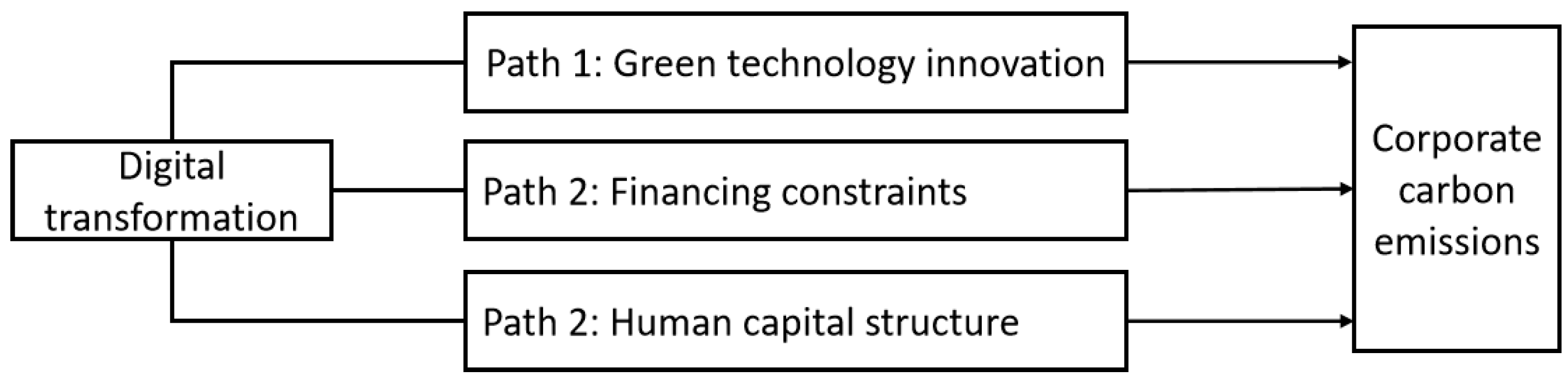
Digital transformation is a crucial engine empowering enterprises for green, low-carbon development and a key pathway towards achieving China’s dual carbon goals. To investigate the carbon-emission reduction effects and mechanisms of corporate digital transformation, the panel data of China’s A-share listed companies from 2010 to 2021 were utilized to empirically examine the impact and mechanisms of digital transformation on corporate carbon emissions in this study, based on the dynamic capability and resource-based theory. The results show that the following: (1) Digital transformation demonstrates significant potential in reducing corporate carbon emissions; (2) The emission reduction effects are primarily achieved through the three key mechanisms of enhancing green innovation capabilities, alleviating financing constraints, and optimizing human capital structures; (3) The effect of digital transformation on carbon emission reductions demonstrates significant heterogeneity across enterprise characteristics and geographical locations, with particularly notable impacts observed in high-tech firms, state-owned enterprises, carbon-intensive industries, and companies located in eastern China. Therefore, we should vigorously promote the process of digital transformation of enterprises and implement targeted policy measures to support corporate green innovation, enhance financing accessibility, and optimize human capital structure. Simultaneously, we should develop differentiated emission reduction mechanisms that account for enterprise-specific characteristics, thereby maximizing the effectiveness of digital transformation in achieving dual-carbon objectives.
Keywords: digital transformation; corporate carbon emissions; influence mechanism; dual carbon target digital transformation; corporate carbon emissions; influence mechanism; dual carbon target