Article

A Sustainable Monitoring and Predicting Method for Coal Failure Using Acoustic Emission Event Complex Networks


1
Key Laboratory of Gas Control in Coal Mines National Mine Safety Administration, Anhui University of Science and Technology, Huainan 232001, China
2
Key Laboratory of Safety and High-Efficiency Coal Mining, Ministry of Education, Anhui University of Science and Technology, Huainan 232001, China
3
School of Resource and Safety Engineering, University of Science and Technology Beijing, Beijing 100083, China
*
Author to whom correspondence should be addressed.
Sustainability 2025, 17(24), 11349; https://doi.org/10.3390/su172411349
Submission received: 23 October 2025 / Revised: 5 December 2025 / Accepted: 11 December 2025 / Published: 18 December 2025
(This article belongs to the Topic Advances in Coal Mine Disaster Prevention Technology)

Abstract

Prediction of coal and rock dynamic disasters is essential for ensuring the safety, efficiency, and long-term sustainability of deep mining operations. To improve the accuracy of acoustic methods for forecasting coal instability, acoustic emission (AE) source localization experiments are conducted on coal samples under uniaxial compression, and the multidimensional correlations among AE events together with the evolution characteristics of the corresponding complex network are investigated. The results show that the temporal correlations of AE events exhibit nonlinear decay with increasing time intervals, the spatial correlations display fractal clustering that transcends Euclidean geometry, and the energetic correlations reveal hierarchical transitions controlled by intrinsic material properties. To capture these interactions, a multidimensional correlation calculation method is developed to quantitatively characterize these multidimensional coupled relationships of AE events, and a complex network of AE events is constructed. The network evolution from sparse to highly interconnected is quantified using three parameters: average degree, clustering coefficient, and modularity. A rapid rise in the first two metrics, accompanied by a sharp decline in the latter, indicates the rapid strengthening of AE event correlations, the aggregation of local microcrack clusters, and their transition into a global fracture network, thereby providing a clear early warning of impending compressive failure of the coal sample. The study establishes a mechanistic link between microcrack evolution and macroscopic failure, offering a robust real-time monitoring tool that supports sustainable mining by reducing disaster risk, improving resource extraction stability, and minimizing socio-economic and environmental losses associated with dynamic failures in deep underground coal operations.

1. Introduction

With the rapid development of China’s social economy, energy demand has been steadily increasing. According to Chinese statistics, coal consumption accounted for 53.2% of the country’s total energy consumption in 2024, and coal is expected to remain a crucial primary energy source in China for the foreseeable future [1]. As shallow coal resources become increasingly depleted, deep coal mining has become an inevitable trend. In deep underground environments, both the stress conditions and the physical and mechanical properties of coal change significantly, leading to a marked increase in the risk of coal and rock dynamic disasters [2,3]. These hazards pose serious threats to the lives, health, and property of underground workers. Therefore, advancing research on the mechanism and early warning of dynamic disasters in deep mining operations is of great importance for ensuring the safety and efficient production of coal mines in China.
Currently, methods for predicting dynamic disasters in the coal mine can be broadly categorized into two types. The one is the geological survey method, which predicts the risk of such disasters by directly or indirectly measuring stress levels [4,5,6]. The other is the geophysical method, which assesses the stability of coal masses by detecting various types of energy signals emitted during their damage and failure processes, including electromagnetic radiation [7], direct current method [8], infrared radiation [9]. Among these methods, AE monitoring technology has been widely applied in the lab and field due to its rich signal sources, strong resistance to interference, and the large amount of information it provides. Many studies have conducted experiments to investigate the AE response of coal under different stress paths. Several fundamental AE parameters have been analyzed and utilized, including AE count, energy, rise time, maximum amplitude, RA value, AF value, peak frequency, central frequency [10,11,12].
Compared with other geophysical monitoring methods, the greatest advantage of AE monitoring technology is its ability to directly locate fracture sources within coal masses, accurately capturing the time, position, and energy of fractures at various scales. This capability enables direct reflection of the dynamic spatiotemporal damage evolution in the coal under external loading, facilitates tracking of the main crack’s position, and aids in deducing the failure pattern [13,14,15]. Based on observation results, the previous studies have introduced fractal theory, b-value, cross-correlation analysis and cluster analysis to study spatial, temporal and energy distribution characteristics of AE events to reveal mechanical behavior and structural damage of rock materials. The analysis results showed that there was good relationship between evolution characteristics of AE events and stress level [16,17,18]. However, the research focuses on single-dimension parameter or localized information, making it difficult to comprehensively capture the complex interrelationships among AE events. This limitation constrains the accuracy and reliability of coal mass stability predictions using AE technology [19]. An urgent challenge is how to thoroughly investigate AE events and their correlations to reveal the nonlinear coupling, global topological features, and dynamic evolution patterns, thereby providing a more accurate and comprehensive reflection of the complexity and progression of the coal fracture process.
A complex network is a multidimensional structure composed of numerous nodes and their intricate interrelationships. Its highly complex topological features make it particularly well-suited for characterizing the heterogeneity of the research object [20,21,22]. It is evident that the interconnected behaviors of AE events can be modeled as dynamic propagation on a complex network, which offers distinct advantages over conventional regular or random network models [23,24]. Therefore, applying complex network theory to investigate the evolutionary characteristics of the multidimensional correlations among AE events facilitates a deeper understanding of the causal mechanisms underlying damage and fracture in coal samples, which is crucial for predicting the instability and failure of coal masses. To this end, the present study focuses on AE events generated during the damage and fracture of coal samples, studies the coupled behavior of event occurrence time, spatial location, and energy level, and further constructs the complex network structure of AE events. Through comprehensive qualitative and quantitative analyses, the evolution of correlations among AE events is clarified, revealing the underlying physical mechanisms of coal-sample damage and providing an effective early warning method for failure. It can offer significant theoretical insights for predicting coal and rock dynamic disasters in deep mining environments, thereby supporting safer, more stable, and sustainable mining operations.

2. Materials and Methods

The experimental system consisted of a loading system and an AE location system. The loading system applied external loads using an electric-hydraulic servo press machine, while the AE location system determined the occurrence time, location, and energy of AE events through a 24-channel AE acquisition device and high-precision AE sensors. The entire experiment was conducted in a shielded room with the shielding efficiency exceeding 85 dB to minimize interference from the external environment and ensure the accuracy of the results.
The coal samples used in this study were collected from coal mines in Shanxi Province, Hebei Province, and the Inner Mongolia Autonomous Region, which are characterized by a high risk of mine pressure. The blocks were prepared into standard cylindrical specimens (Φ 50 × 100 mm), and the macroscopic parameters were determined and are presented in Table 1.
The experimental program involved performing uniaxial compression tests on the coal samples under force control with a loading rate of 500 N/s. For the coal sample from every production area, five replicate experiments were performed to ensure the reliability and reproducibility of the experimental results.
To determine the spatiotemporal parameters of AE events, six AE sensors were employed in each experiment, and their spatial coordinates are shown in Figure 1 and Table 2. Prior to testing, the P-wave velocity of each sample was measured using an ultrasonic waveform generation system to obtain the velocity parameters required for the AE localization system. The acquisition parameters were configured as shown in Table 3 to ensure accurate collection of AE signals.
Before the formal experiment, the parameters of the AE localization system were fine-tuned based on the results of the pencil lead break (PLB) test. Subsequently, the AE localization system and the loading system were activated sequentially to record AE event parameters throughout the entire damage process of coal sample.

3. Experimental Results

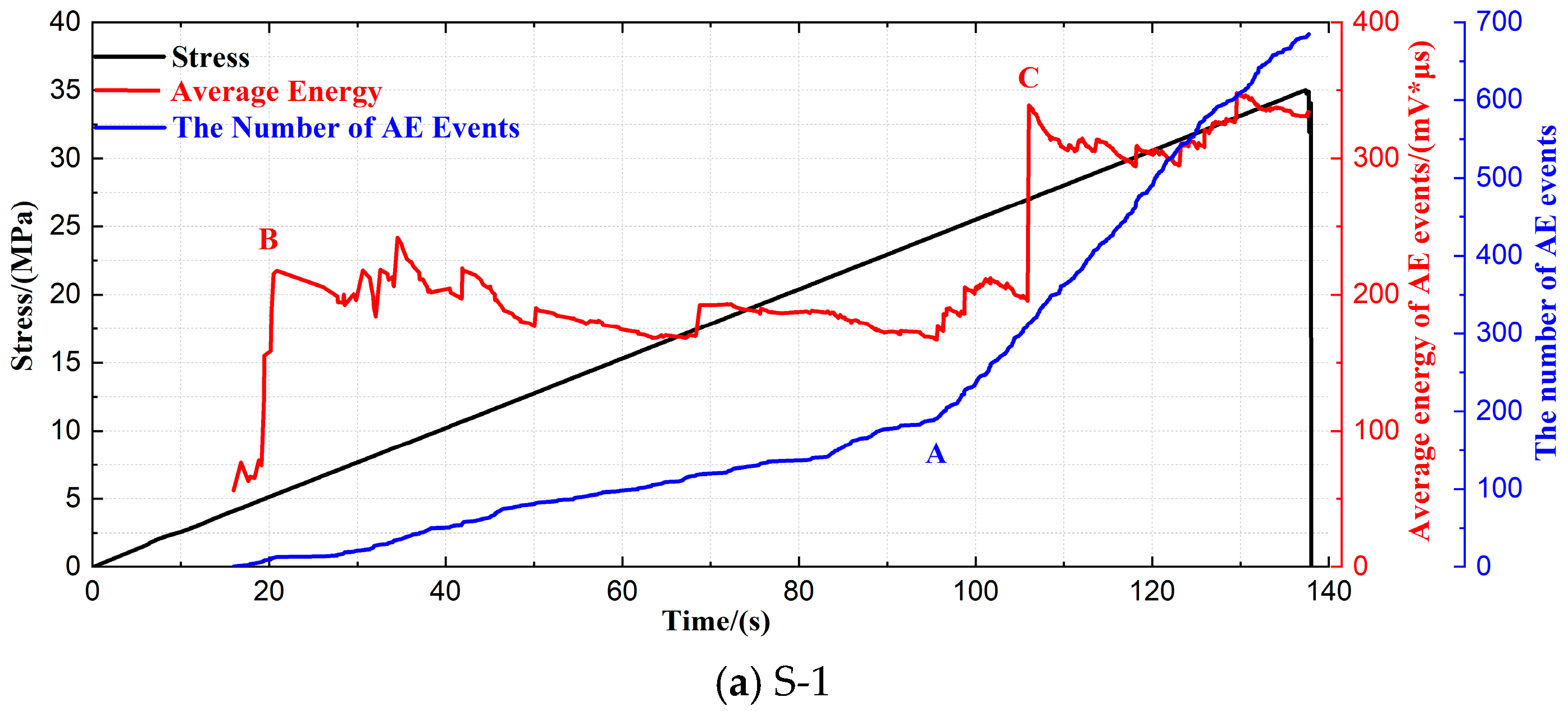
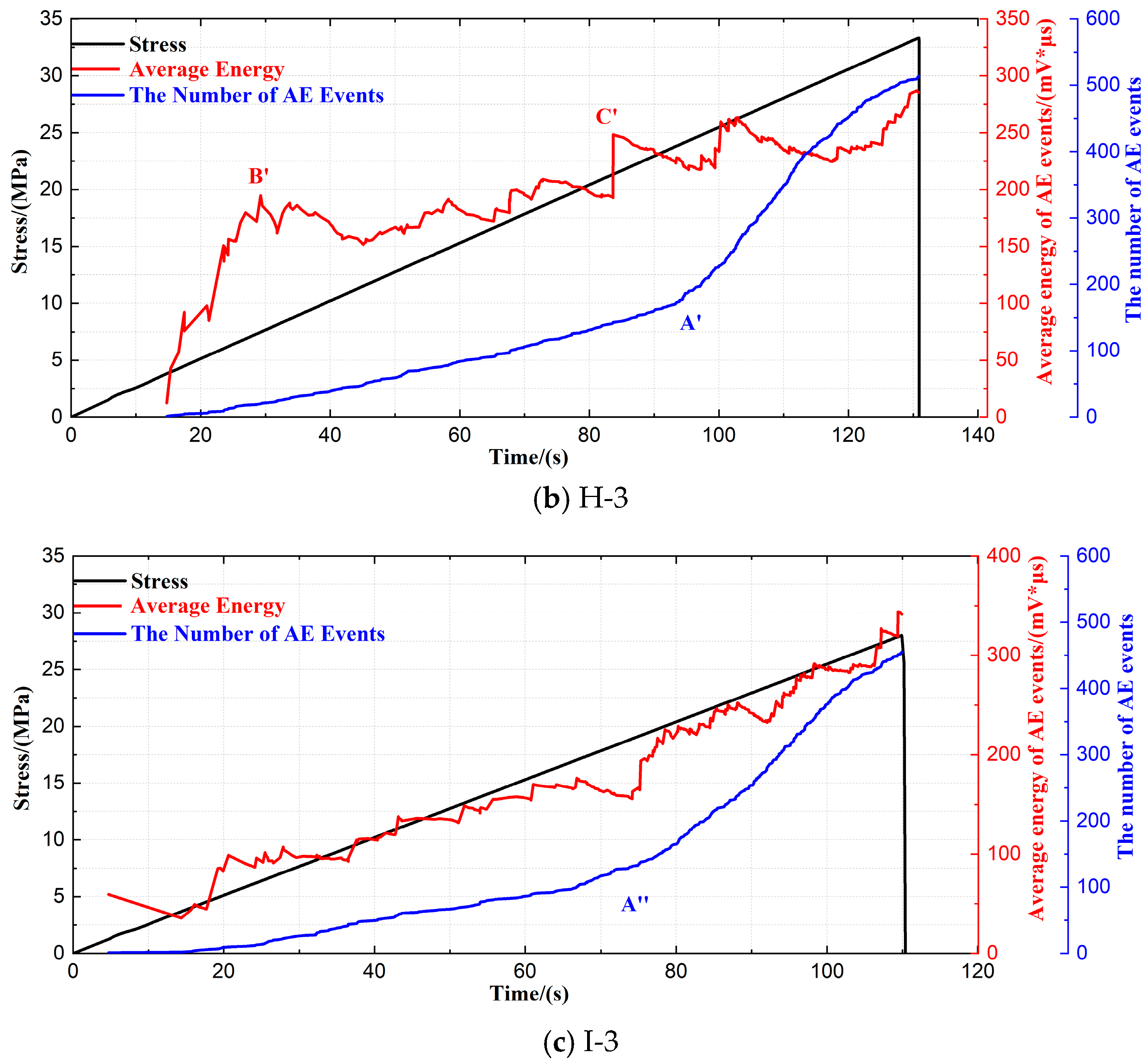
According to the experimental results, the AE responses of the coal samples from the same production areas exhibit clear similarities. Due to space limitations, one representative sample from each production area is randomly selected and presented in the paper. The serial numbers of these representative samples are S-1, H-3, and I-3, corresponding to the No. 1 coal sample from Shanxi Province, the No. 3 coal sample from Hebei Province, and the No. 3 coal sample from the Inner Mongolia Autonomous Region, respectively. As shown in Figure 2, all three samples display a two-stage increase in the number of AE events, consisting of a slow growth phase followed by a rapid growth phase, with transition points at approximately 70% (Point A, A’ and A’’) of the peak stress. The average energy of AE events generally increases with loading. Samples S-1 and H-3 exhibit step-like energy jumps at points B and C, and at points B’ and C’, respectively. Notably, the energy increase in H-3 is more gradual and includes an additional minor jump after point C′. By contrast, Sample I-3 shows a continuous and gradual trend without clear step-like features. From these variations, it can be inferred that the coal samples selected from Shanxi have a strong tendency for energy accumulation in this study. When the internal pressure reaches the critical level, the stored energy is released suddenly. In contrast, the coal samples from Inner Mongolia show the weakest tendency for concentrated energy storage, with its energy being released continuously. The physical characteristics of the coal samples from Hebei fall between those of the Shanxi and Inner Mongolia samples.
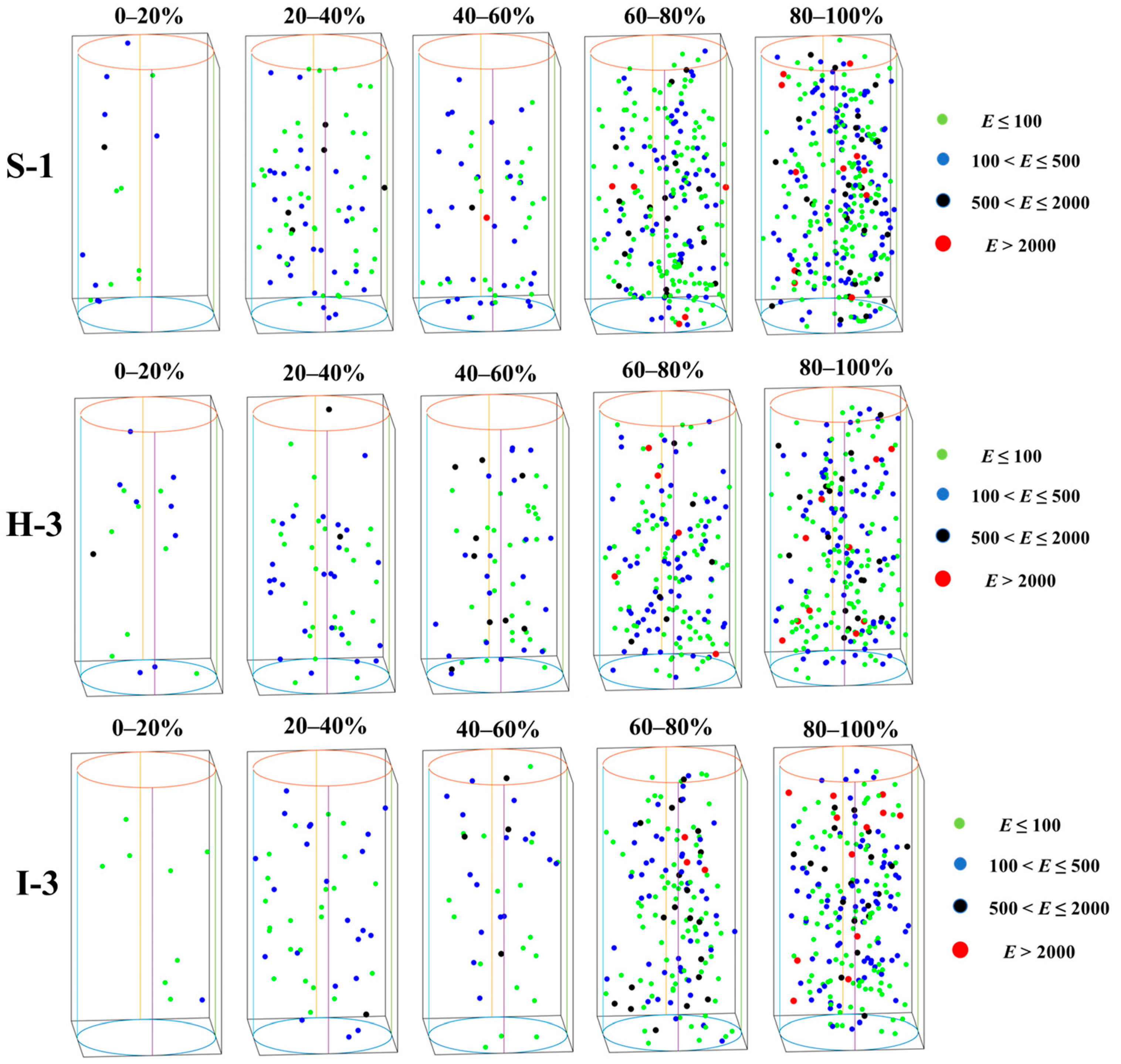
Furthermore, the distribution characteristics of AE events in Samples S-1, H-3, and I-3 at different stress stages are illustrated in Figure 3. The results clearly indicate a gradual increase in the total number of AE events with the stress increasing, accompanied by a particularly significant rise in large-energy AE events across all samples. At the initial loading stage, primary microcracks gradually close, and the friction between mineral particles together with relative sliding along microcrack surfaces produces predominantly small-energy AE events. As the external load increases, the stress concentration at the microcrack tips exceeds the local strength of the coal matrix, initiating microcrack propagation. Consequently, the number of AE events increases and large-energy AE events begin to emerge. With continued loading, microcrack growth and interactions intensify, leading to a pronounced increase in both the frequency and energy of AE events, ultimately culminating in the compressive failure of the coal specimens.

4. Construction of a Complex Network Based on Multidimensional Correlation of AE Events

4.1. Quantitative Characterization of Multidimensional Correlation of AE Events

It is evident that analyzing the variations in the number and energy of AE events can theoretically provide insight into the damage process of the coal sample and enable prediction of its instability and failure. However, since the accuracy and reliability of this qualitative method cannot always be guaranteed in engineering applications, further quantitative research is of greater practical importance.
The primary cause of the coal sample failure is the expansion, interaction, and coalescence of small-scale microcracks under external stress to form larger-scale microcracks until the crack reaches the macroscopic scale of the coal sample, which is a multi-scale dynamic transformation process. AE events directly reflect the formation and growth of microcracks with various scales for the coal sample [25,26]. Therefore, a further study of the complex correlation characteristics among AE events is crucial for understanding the damage and failure processes of coal samples and serves as an important path for accurately predicting instability and failure of the coal.
Generally, AE events primarily contain information in three dimensions: time, location, and energy. Among them, AE events occur at non-uniform intervals along the time axis throughout the entire loading process. Hence, the time difference of AE events can be calculated using Equation (1).
τ = t i t j
Here, the parameters ti and tj represent the occurrence time of the ith and the jth AE events, respectively, and the parameter τ denotes the time difference between the two AE events.
It can be inferred that the temporal correlation of AE events is closely related to their time difference and exhibits nonlinear behavior, gradually decaying at a slower rate as the time difference increases. Accordingly, the temporal correlation Ct can be expressed as Equation (2).
C t = e τ m t
Here, e denotes the base of the natural logarithm, and mt is a control parameter in temporal dimension, corresponding to the timescale of the research object. It is evident that the value of Ct ranges from 0 to 1, and that a smaller the time difference τ between AE events corresponds to a stronger temporal correlation.
Compared to the one-dimensional temporal sequence of AE events, the three-dimensional spatial distribution is much more complex. The most direct method for calculating the spatial distance between AE events is the Euclidean distance. For uniformly distributed AE events, employing the Euclidean distance to represent spatial correlation is appropriate. However, as shown in Figure 3, the spatial distribution of AE events during the damage process of the coal sample exhibits clear self-similarity and multiscale clustering characteristics. Relying solely on Euclidean distance often overlooks these nonlinear spatial characteristics, leading to significant errors in estimating the spatial distance between AE events.
Previous studies have demonstrated that fractal methods are effective for describing the degree of space-filling and complexity of point sets [27,28,29]. The application of fractal measures to the distances between AE events in the coal sample enables more accurate characterization of the spatial distribution of AE events. Based on fractal principles, the spatial distance of AE events can be expressed as shown in Equation (3).
d i s t = x i x j 2 + y i y j 2 + z i z j 2 D 2
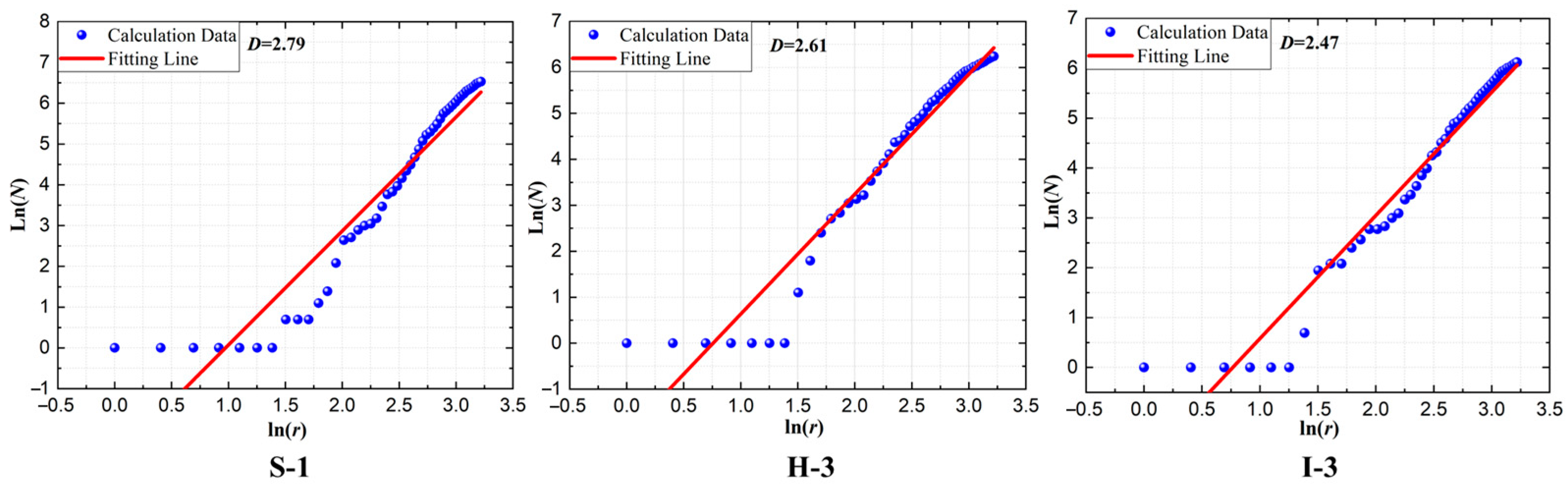
Here, the parameter dist represents spatial distance of the AE events, and (x, y, z) denotes the three-dimensional coordinates of the AE events. The parameter D is the fractal measure of the AE event spatial distribution, which can be calculated by column covering method [30,31,32], as expressed in Equation (4).
ln N = D ln r + c o n s t
Here, the parameters r and N denote the radius of the box covering the AE events and the number of AE events contained within the box, respectively.
Consistent with the temporal correlation analysis, the spatial correlation of AE events is intrinsically related to their spatial distance. Due to the inherent properties of the coal material and the characteristics of the propagation path, the spatial correlation Cs exhibits pronounced nonlinear behavior with respect to spatial distance, which can be calculated using Equation (5).
C s = e d i s t m s
Here, ms is a control parameter in spatial dimension, corresponding to the actual physical size of the research object. It can be inferred that AE events exhibiting clustering characteristics have shorter spatial distances, corresponding to higher spatial correlation. Conversely, as AE events become more dispersed, their spatial distances increase exponentially, resulting in a marked decrease in spatial correlation.
In addition to the spatiotemporal correlation of AE events, their energy correlation constitutes a critical aspect for consideration. Generally, small-energy AE events serve as the foundation for larger-energy AE events, which subsequently give rise to even higher-energy events. Both the energy propagation dynamics of AE events and the hierarchical transitions across different energy levels exhibit nonlinear characteristics. Accordingly, the following formula is employed to quantitatively assess the energy difference of AE events.
Δ E = lg E i lg E j b
Here, the parameter ΔE represents the energy difference between AE events, with Ei and Ej denoting the energies of the ith and jth AE events, respectively. The constant b serves as energy difference parameter.
Generally, coal samples that are relatively dense and hard possess greater energy storage capacity, and the energy range of their AE events becomes larger. Consequently, parameter b should be assigned to be larger value. Conversely, coal samples with lower strength exhibit weaker energy storage capacity, and energy differences of AE events become smaller. Thus, the parameter b should be assigned a smaller value.
In this study, the value of b can be calculated by the Gutenberg-Richter (G-R) relationship [33], as expressed in Equation (7).
lg N = a b M
Here, M denotes the AE event magnitude, which can be calculated according to AE event energy E using Equation (8), and N represents the number of AE event within the magnitude interval (M ± ΔM).
M = 2 3 lg E
Based on the preceding analysis, the energy correlation CE of AE events can be expressed as follows.
C E = e Δ E m E
Here, mE is a control parameter in energy dimension, corresponding to the maximum energy released by the research subject.
On this basis, it can be inferred that AE events exhibit both independence and interdependence across the three dimensions of time, space, and energy. Accordingly, the multidimensional correlation R between AE events can be expressed as follows equation.
R = C τ × C s × C E = e τ m τ + d i s t m s + Δ E m E

4.2. Construction of Complex Network for the AE Events

According to the above analysis, it is evident that five parameters must be determined before building the complex network for the AE events, including the fractal measure D, energy difference parameter b, and corresponding control parameters in three dimensions (mτ, ms, mE).
The determination of control parameters in three dimensions is directly guided by the physical characteristics of the coal samples. All samples are cylindrical, with a diameter of 50 mm and a height of 100 mm, subject to minor measurement errors. The loading duration ranges from 101 s to 143 s, and the maximum AE event energy released during loading varied between 20,000 and 60,000 mV·μs. Accordingly, the temporal control parameter is set based on the order of magnitude of the loading duration, that is, mτ is equal to 100. The spatial control parameter is determined by the order of magnitude of the specimen geometry, and ms is equal to 100. The energy control parameter (mE) is defined as the logarithm of the maximum energy scale, yielding a value of 4.
According to Equation (4), the fractal measure D is calculated using the graphical method, as illustrated in Figure 4, and the results for all samples are summarized in Table 4. It is evident that the average fractal measure across all samples is 2.51, which is defined as the value of spatial fractal measure D.
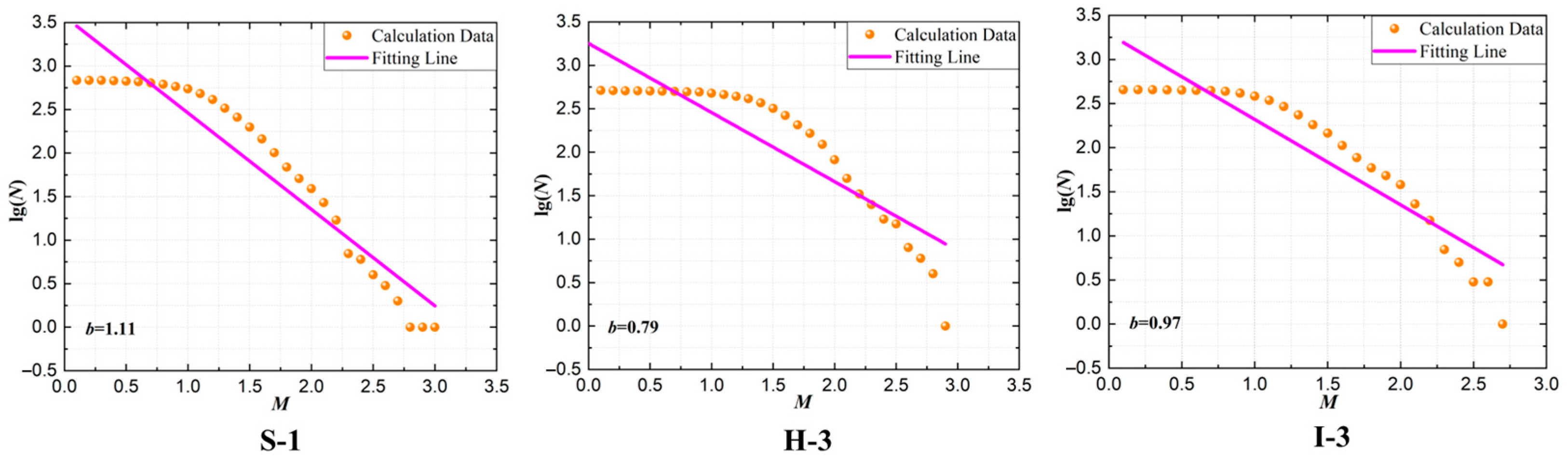
Based on Equation (7), the calculation values of energy difference parameter b for representative coal samples are shown in Figure 5, and the results for all samples are listed in Table 5. The mean value is 0.93, which is taken as the value of energy difference parameter b.
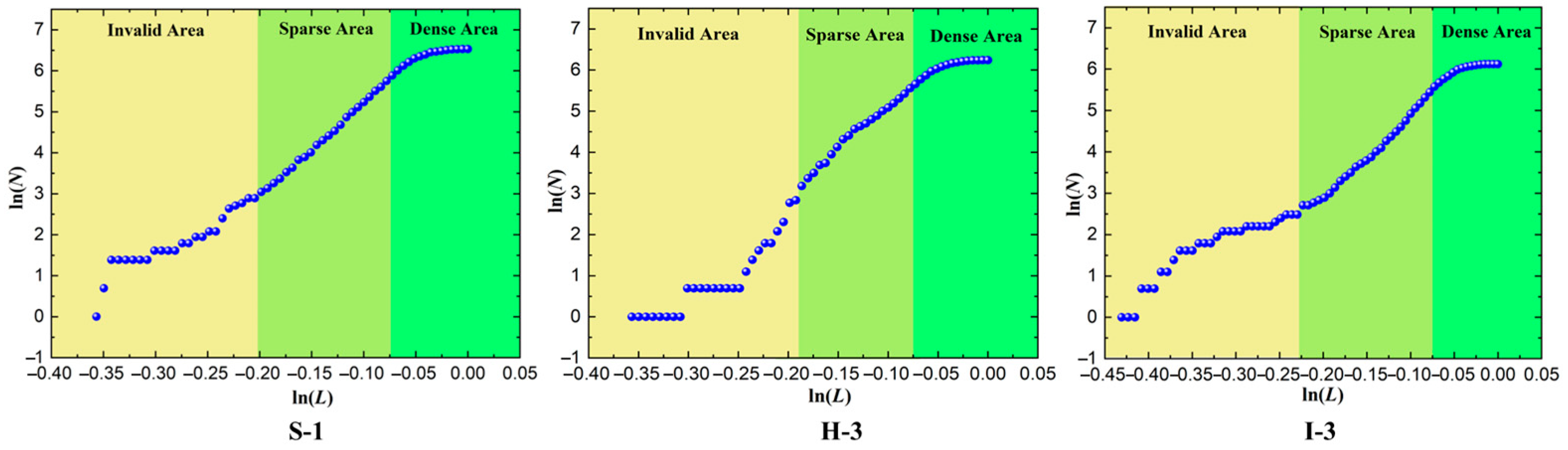
Determining the connection threshold between AE events is a crucial step in constructing the complex network. In this study, a single-link cluster structure of AE events is constructed according to the approach detailed in References [34,35]. It is worth noting that the single-link length needs to be calculated using the multidimensional correlation method for AE events described in Equation (10). Then, the distribution of link lengths in the single-link cluster network is analyzed and plotted, with lnN (the logarithm of the number of single links shorter than a given link length) on the ordinate and lnL (the logarithm of the link length) on the abscissa, and the distribution results for Samples S-1, H-3, and I-3 are shown in Figure 6.
It can be observed that all single-link distribution images exhibit three distinct regions: a dense region, a sparse region, and an invalid region. The dense region reflects strong correlations among AE events within the coal sample, indicating close interrelationships between these events. The sparse region corresponds to weak correlations, where AE events may occur independently at different stages and in various spatial locations. The invalid region represents a disordered state caused by random AE events and background noise. The gradual transition among these regions signifies the dynamic evolution of AE event correlations from strong to weak and eventually to none. Therefore, the corresponding bond length value at the boundary between the dense and sparse regions can be regarded as the threshold for constructing the complex network, The statistical data for all the coal samples is shown in Table 6, and their average value is 0.93, representing the critical correlation between AE events.
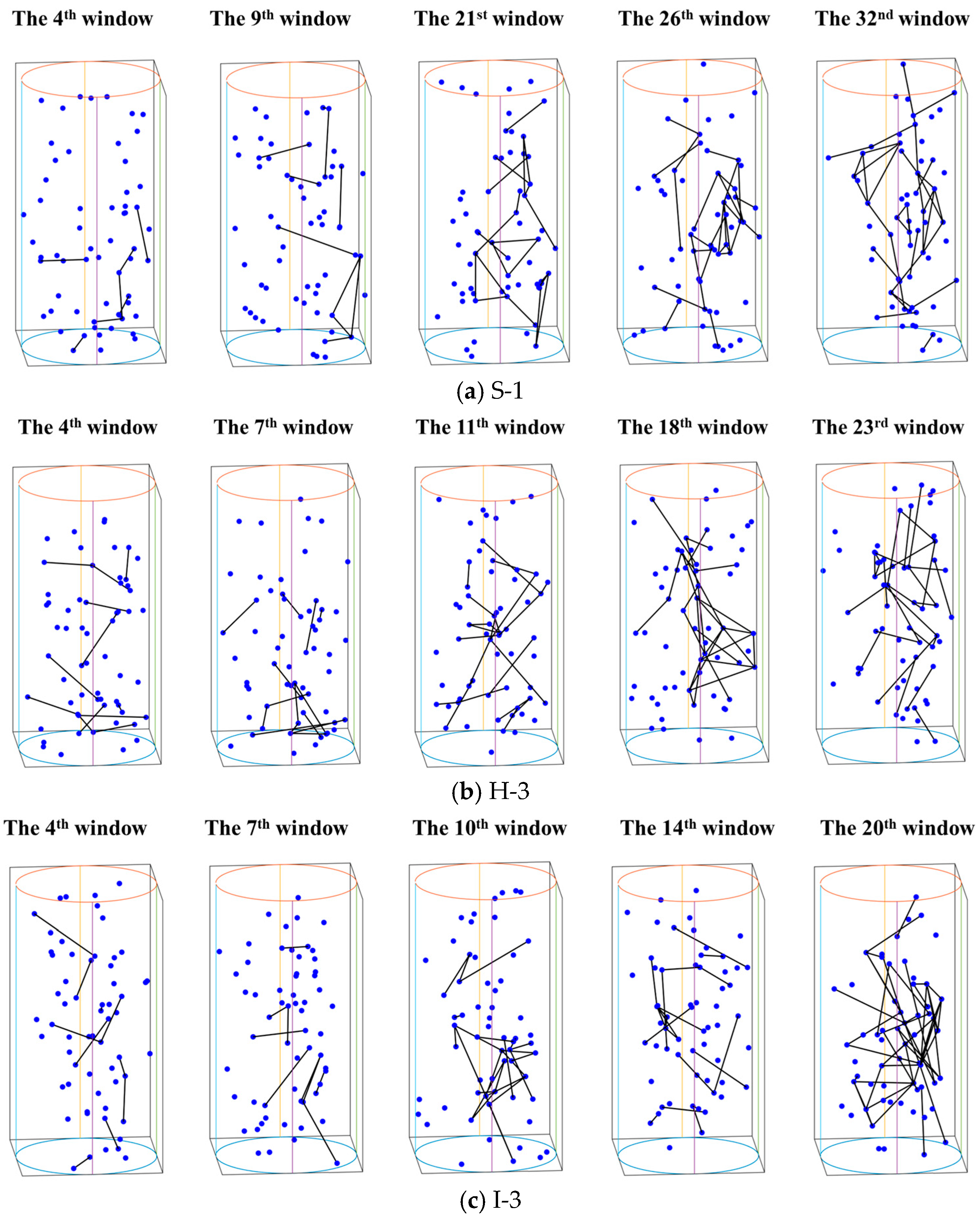
Subsequently, the complex network of AE events is constructed [36,37,38]. To thoroughly investigate the evolution of AE events throughout the entire loading process of the coal samples and thereby elucidate the dynamic process of coal sample damage and fracture, the sliding event window method is employed. Each event window contains 60 AE events, with a sliding step of 20 AE events. The occurrence time of the 30th AE event within each window is used to represent the time of the corresponding window. For the AE events within each sliding window, the correlation value between events is calculated using Equation (10), and all AE events with correlation values greater than or equal to 0.93 are connected. This process yields the complex network structure of AE events within each window, as illustrated in Figure 7.
For coal samples from different production regions, the complex networks exhibit similar patterns of variation throughout the loading process. At the initial stage, the AE event network is relatively simple, with only a few events showing strong correlations and connections. As the stress increases, more AE events become interconnected, and the network gradually evolves into a more complex structure, reflecting stronger correlations among events within the sliding window. At the final stage, nearly all AE events are interconnected, and certain events occupy distinctly central positions, signifying the imminent failure of the coal samples.

5. Quantitative Analysis of the Complex Network

To quantitatively analyze the evolutionary characteristics of the complex network further, three characterization parameters in different scales are introduced: average degree, average clustering coefficient, and modularity.
In a complex network, the degree of a node represents the number of connections it has with other nodes, and the average degree is the mean value of the degrees of all nodes, as expressed in Equation (11). An increase in the average degree indicates stronger interconnections among nodes in the complex network. Conversely, a decrease in the average degree signifies weakened interconnections among the nodes. The average degree reflects the evolution characteristics of individual AE events within the network.
k = 1 n i = 1 n k i
Here, the parameter ki denotes the degree of the node i, and <k> represents the average degree.
In a local region, the average clustering coefficient is a key parameter for quantifying the degree of connectivity among a node’s neighbors and can be calculated using Equation (12).
C = 1 n i = 1 n 2 δ i k i k i 1
Here, the parameter <C> denotes the average clustering coefficient; δi represents the actual number of edges among the neighbors of node i. Generally, a higher average clustering coefficient indicates stronger correlations within the localized network.
Meanwhile, the overall structure of a complex network can be characterized by the modularity. Generally, it is calculated using a greedy algorithm [39,40] and involves the following steps.
(1) Initialize each node as an independent community, where the degree of each node is k, and the total number of edges in the network is m.
(2) Traverse all nodes and attempt to move each node to the community of its neighboring nodes. Calculate the change in modularity ΔQ using the following equation.
Δ Q = A i n + k i , i n 2 m A t o t + k i 2 m 2 A i n 2 m A t o t 2 m 2 k i 2 m 2
Here, Ain denotes the number of edges within the community, Atot represents the sum of degrees of all nodes in the community, and ki,in signifies the number of edges connecting node i to nodes within the community.
(3) If the calculated ΔQ is positive, move the node to the new community; otherwise, retain the node in its original community. Repeat this process for all nodes until no further movement can increase the modularity Q.
(4) Once the current community division is finalized, treat each community as a new node and repeat steps (2) and (3) until the modularity Q no longer increases.
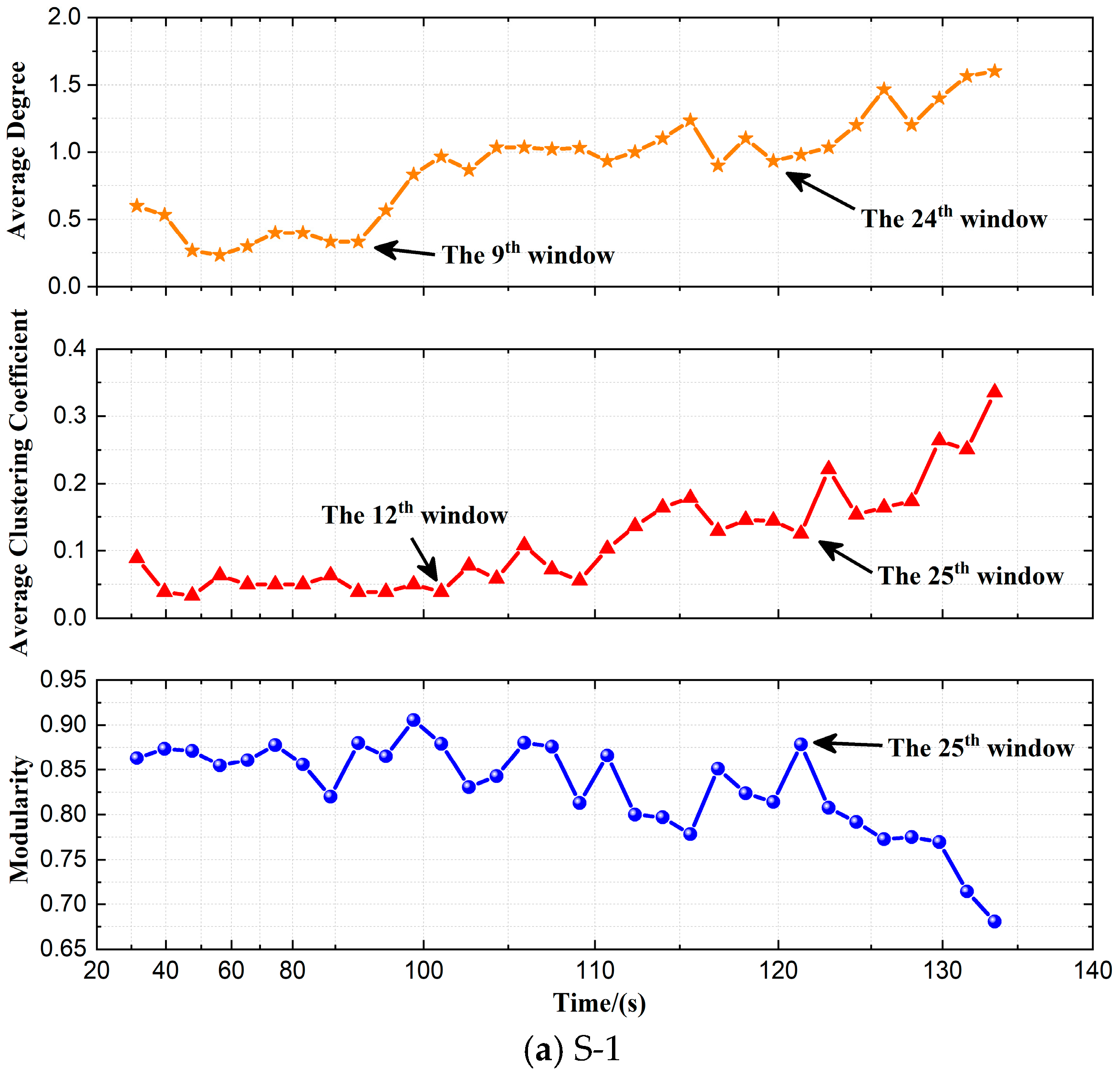
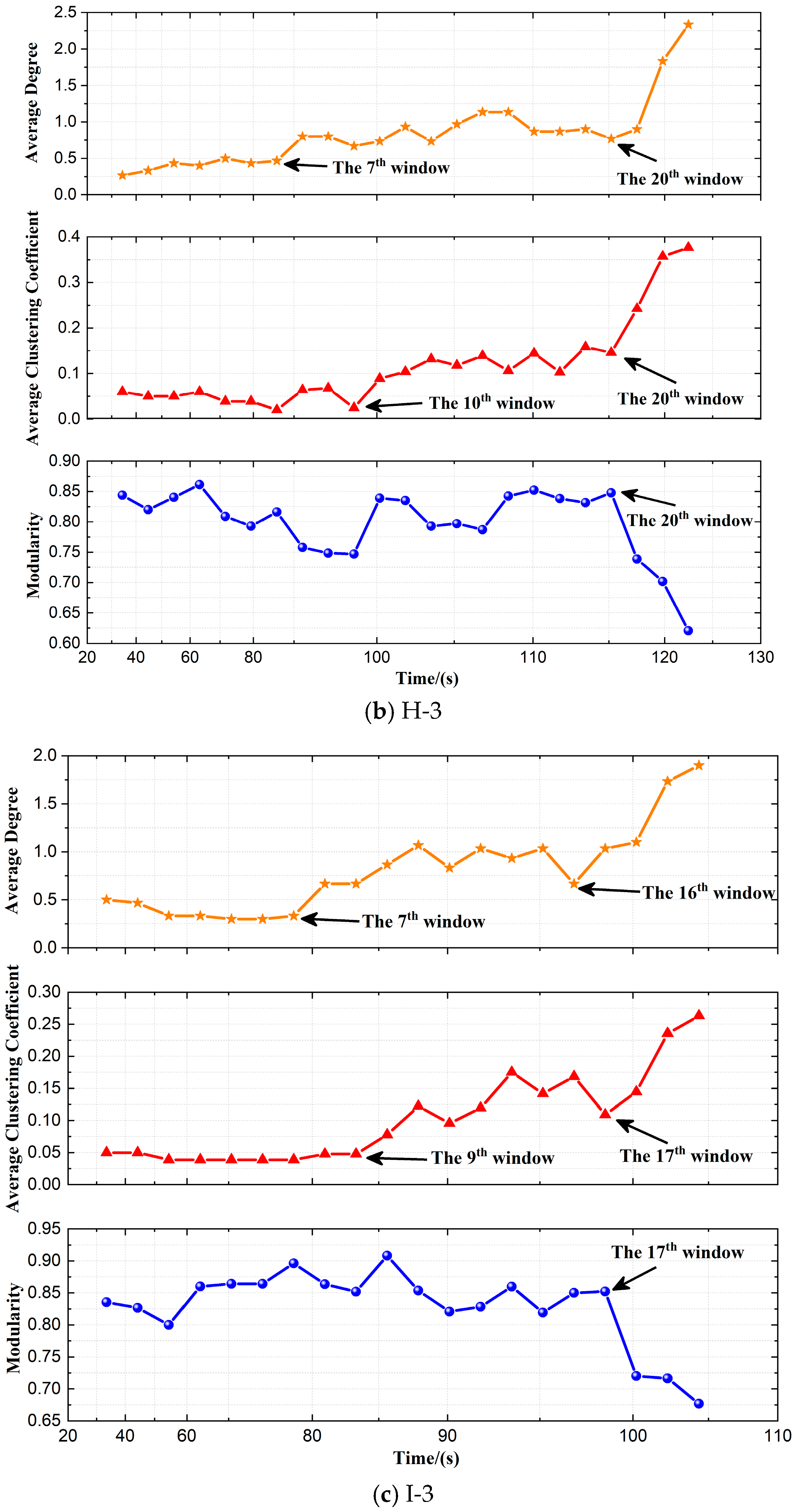
Based on the above calculation method, the evolution of the three characterization parameters for Samples S-1, H-3, and I-3 is shown in Figure 8, and their trends exhibit clear similarities. Both the average degree and average clustering coefficient display an overall upward trend following initial fluctuations, whereas the modularity exhibits a fluctuating pattern followed by a decline. At the early stage, the average degree and clustering coefficient fluctuate around the low levels, while the modularity oscillates around a high level, indicating relatively weak correlations among AE events within the event window. Subsequently, the average degree begins to increase gradually at approximately 70% of the peak stress, followed by a steady increase in the clustering coefficient at around 80% of the peak stress. This progression reflects the strengthening of correlations among individual AE events, which enhances local correlations but exerts limited influence on the overall network. With further loading, the average degree shifts from a slow to a rapid increase as the stress approaches 90% of the peak value. This transition further leads to a sharp rise in the clustering coefficient and a significant decline in the modularity, which continues until compressive failure occurs.
These changes indicate a continuous intensification of correlations among individual AE events would lead to aggregation and transformation in both local and global network structures and thus provide clear precursors of impending failure. Therefore, it can be concluded that gradual increases in both the average degree and clustering coefficient represent the accumulation of failure risk, while the rapid rise in these two parameters combined with the decline of the modularity constitutes a critical early warning signal of coal sample compressive failure.

6. Discussion

Based on the observation and analysis of Figure 8, it can be concluded that complex network metrics derived from AE events effectively capture the underlying fracture processes that govern the damage and failure of coal samples. In essence, the evolution of these metrics reflects the progressive development of microcracks, while AE events serve as their observable manifestations. Specifically, the average degree, average clustering coefficient, and modularity characterize, respectively, the connectivity among microcracks, the local aggregation of fracture zones, and the global structural evolution of the crack network. These indicators reveal the multiscale transformation from microcrack initiation, through local clustering, to macroscopic failure.
At the initial stage, microcracks mainly undergo closure, frictional sliding, and minor propagation. The associated AE events are scattered across isolated zones and exhibit weak interactions. Consequently, the average degree and clustering coefficient remain low, while the modularity is high, reflecting limited crack interactions. As the external stress approaches about 70% of the peak stress, microcrack initiation and extension intensify, causing AE events to become increasingly concentrated in both time and space. This microcrack interaction leads to a steady rise in the average degree, followed by a gradual increase in the clustering coefficient, indicating enhanced local correlations.
When the stress level approaches the fracture critical stage, rapid crack propagation and coalescence give rise to dense clusters of AE events, accompanied by a sharp increase in both the average degree and clustering coefficient. Meanwhile, the boundaries between different crack communities become blurred as local clusters merge into a dominant fracture band. This process drives the transition from localized damage to global fracture, leading to a significant decline in the modularity, which eventually reaches its minimum at the point of compressive failure.
In summary, variations in complex network metrics are fundamentally governed by microcrack evolution, reflecting that coal damage and failure proceed through a progressive multi-scale and multi-level transformation. The multi-scale process involves the initiation of small microcracks, their local aggregation into larger fracture zones, and the eventual formation of macroscopic cracks at the sample scale. The multi-level process encompasses interactions at the scales of individual microcracks, local crack clusters, and the global crack network. These processes are recursive and nested, with feedback and regulation across scales jointly driving the failure evolution.
According to the above analysis, complex network metrics can be regarded as effective early warning indicators because they capture the complex evolution and transformation of microcracks. A gradual increase in both the average degree and the clustering coefficient indicates the damage accumulation and serves as a low-level early warning signal. As loading progresses, the rapid rise in these two metrics, accompanied by a sharp decline in the modularity, marks the critical transition from local microcrack interactions to the formation of a global fracture network, serving as a critical warning of imminent failure.
Compared with traditional research that uses single-dimensional information for analysis, this study explores the multidimensional correlations among AE events and corresponding complex network, enabling a more comprehensive characterization of the microcrack evolution process and capturing complex precursory features of coal sample failure. This multidimensional framework enhances the stability and accuracy of early warning. The findings provide significant scientific and engineering guidance for the precise prediction of coal and rock dynamic disasters in coal mines and contribute to improve safety risk management.
From the perspective of sustainable development, the proposed early warning method based on AE event complex network offers substantial value for the long-term safety and efficiency of deep mining operations. Accurate prediction of coal and rock dynamic disasters enables mining enterprises to optimize extraction schedules, reduce unplanned downtime, and enhance resource utilization efficiency, thereby lowering overall energy consumption and operational waste. At the same time, preventing catastrophic failures protects workers’ health and safety and mitigates the large-scale economic and environmental losses that often accompany rock burst, roof disaster and related geohazards. By providing a scientific and quantitative monitoring tool, this study contributes to the development of intelligent, low-risk, and sustainable mining systems, fully supporting the social, economic, and technological dimensions of sustainability.

7. Conclusions

This study obtained AE events throughout the entire damage and failure process of coal samples under uniaxial compression and investigates multidimensional correlations among AE events as well as the evolution characteristics of corresponding complex network. The main conclusions are as follows:
(1) During uniaxial compression, the number of AE events exhibits a slow growth phase followed by rapid escalation, while the average energy of the AE event increases overall with occasional significant jumps. Spatially, AE events evolve from scattered distributions with few large-energy events to progressively clustered patterns accompanied by frequent large-energy events.
(2) Temporal correlation of the AE events decay nonlinearly with increasing time intervals, reflecting temporal dependence of microcrack activity at different stages. Spatial correlations exhibit fractal clustering that transcends conventional Euclidean interpretations, revealing the self-organizing characteristics of microcracks. Energy correlations show hierarchical transitions governed by material properties, indicating the presence of complex triggering mechanisms among events of different energy levels. On this basis, a multidimensional correlation calculation method is proposed to quantitatively characterize the multidimensional coupled relationships of AE events.
(3) As stress increases, the complex network constructed from AE events evolves from an initially sparse structure into a highly interconnected topology. The average degree, average clustering coefficient, and modularity effectively and quantitatively characterize this network evolution. When the average degree and average clustering coefficient exhibit a rapid increase, accompanied by a significant decline in modularity, the network presents the critical characteristics of a transition from local interactions to global instability, thereby providing an early warning signal of compressive failure.
(4) The evolution of complex network metrics reveals the multiscale and multilevel developmental characteristics of microcracks during damage accumulation. The recursive and nested patterns of microcrack activity are quantitatively captured by these metrics, establishing a mechanistic connection between microcrack evolution and macroscopic instability. This understanding provides an important scientific basis for real-time monitoring and early warning of coal and rock dynamic disasters during mining operations, thereby supporting safer, more stable, and sustainable deep mining practices.

Author Contributions

Conceptualization, Z.Z. and Y.M.; software, J.S.; validation, Z.Z. and J.W.; formal analysis, J.W. and J.S.; investigation, Z.Z.; resources, Z.Z.; data curation, J.S.; writing—original draft preparation, Z.Z. and J.S.; writing—review and editing, Z.Z. and Y.M.; supervision, Y.M.; project administration, Z.Z.; funding acquisition, Z.Z. All authors have read and agreed to the published version of the manuscript.

Funding

This research was funded by National Natural Science Foundation of China (52204199), Open Research Grant of Key Laboratory of Gas Control in Coal Mines National Mine Safety Administration (KLGCNMSA2024002) and the Research Fund for Key Laboratory of Safety and High-efficiency Coal Mining, Ministry of Education (Anhui University of Science and Technology) (JYBSYS2021207).

Institutional Review Board Statement

Not applicable.

Informed Consent Statement

Not applicable.

Data Availability Statement

Dataset available on request from the authors.

Acknowledgments

We sincerely thank the reviewers and editors for their valuable assistance and support throughout the publication process.

Conflicts of Interest

The authors declare no conflicts of interest.

References

  1. Wang, Y.; Zhang, J.; Song, X.; Wang, A.; Li, J. Spatiotemporal air pollutant and carbon footprints of China’s coal sector and their synergetic mitigation pathway towards 2035. Resour. Conserv. Recycl. 2026, 224, 108563. [Google Scholar] [CrossRef]
  2. Du, K.; Bi, R.; Khandelwal, M.; Li, G.; Zhou, J. Occurrence mechanism and prevention technology of rockburst, coal bump and mine earthquake in deep mining. Geomech. Geophys. Geo-Energy Geo-Resour. 2024, 10, 98. [Google Scholar] [CrossRef]
  3. Lai, X.; Xu, H.; Shan, P.; Hu, Q.; Ding, W.; Yang, S.; Yan, Z. Research on the mechanism of rockburst induced by mined coal-rock linkage of sharply inclined coal seams. Int. J. Miner. Met. Mater. 2024, 31, 929–942. [Google Scholar] [CrossRef]
  4. Kang, H.; Gao, F.; Xu, G.; Ren, H. Mechanical behaviors of coal measures and ground control technologies for China’s deep coal mines-A review. J. Rock Mech. Geotech. Eng. 2023, 15, 37–65. [Google Scholar] [CrossRef]
  5. Xu, C.; Ma, S.; Wang, K.; Yang, G.; Zhou, X.; Zhou, A.; Shu, L. Stress and permeability evolution of high-gassy coal seams for repeated mining. Energy 2023, 284, 128601. [Google Scholar] [CrossRef]
  6. Wang, H.; Shi, R.; Song, J.; Tian, Z.; Deng, D.; Jiang, Y. Mechanical model for the calculation of stress distribution on fault surface during the underground coal seam mining. Int. J. Rock Mech. Min. Sci. 2021, 144, 104765. [Google Scholar] [CrossRef]
  7. Li, X.; Chen, S.; Wang, E.; Li, Z. Rockburst mechanism in coal rock with structural surface and the microseismic (MS) and electromagnetic radiation (EMR) response. Eng. Fail. Anal. 2021, 124, 105396. [Google Scholar] [CrossRef]
  8. Li, S.; Liu, B.; Nie, L.; Liu, Z.; Tian, M.; Wang, S.; Su, M.; Guo, Q. Detecting and monitoring of water inrush in tunnels and coal mines using direct current resistivity method: A review. J. Rock Mech. Geotech. Eng. 2015, 7, 469–478. [Google Scholar] [CrossRef]
  9. Hao, T.; Li, F.; Tang, Y.; Wang, Z.; Zhao, L. Infrared radiation characterization of damaged coal rupture based on stress distribution and energy. ACS Omega 2022, 7, 28545–28555. [Google Scholar] [CrossRef] [PubMed]
  10. Vishal, V.; Ranjith, P.G.; Singh, T.N. An experimental investigation on behaviour of coal under fluid saturation, using acoustic emission. J. Nat. Gas Sci. Eng. 2015, 22, 428–436. [Google Scholar] [CrossRef]
  11. Li, X.-L.; Chen, S.-J.; Liu, S.-M.; Li, Z.-H. AE waveform characteristics of rock mass under uniaxial loading based on Hilbert-Huang transform. J. Cent. South Univ. 2021, 28, 1843–1856. [Google Scholar] [CrossRef]
  12. Jia, Z.; Xie, H.; Zhang, R.; Li, C.; Wang, M.; Gao, M.; Zhang, Z.; Zhang, Z. Acoustic emission characteristics and damage evolution of coal at different depths under triaxial compression. Rock Mech. Rock Eng. 2020, 53, 2063–2076. [Google Scholar] [CrossRef]
  13. Zhou, X.; Liu, X.; Wang, X.; Liu, Y.; Xie, H.; Du, P. Acoustic emission characteristics of coal failure under triaxial loading and unloading disturbance. Rock Mech. Rock Eng. 2023, 56, 1043–1061. [Google Scholar] [CrossRef]
  14. Goszczynska, B.; Swit, G.; Trąmpczynski, W.; Krampikowska, A.; Tworzewska, J.; Tworzewski, P. Experimental validation of concrete crack identification and location with acoustic emission method. Arch. Civ. Mech. Eng. 2012, 12, 23–28. [Google Scholar] [CrossRef]
  15. Wang, Z.; Wang, J.; Yang, S.; Li, L.; Li, M. Failure behaviour and acoustic emission characteristics of different rocks under uniaxial compression. J. Geophys. Eng. 2020, 17, 76–88. [Google Scholar] [CrossRef]
  16. Bondarenko, V.; Kovalevska, I.; Krasnyk, V.; Chernyak, V.; Haidai, O.; Sachko, R.; Vivcharenko, I. Methodical principles of experimental-analytical research into the influence of pre-drilled wells on the intensity of gas-dynamic phenomena manifestations. Min. Miner. Depos. 2024, 18, 67–81. [Google Scholar] [CrossRef]
  17. Zhang, R.; Dai, F.; Gao, M.; Xu, N.; Zhang, C. Fractal analysis of acoustic emission during uniaxial and triaxial loading of rock. Int. J. Rock Mech. Min. Sci. 2015, 79, 241–249. [Google Scholar] [CrossRef]
  18. Zhang, Z.; Liu, X.; Zhang, Y.; Qin, X.; Khan, M. Comparative study on fracture characteristics of coal and rock samples based on acoustic emission technology. Theor. Appl. Fract. Mech. 2021, 111, 102851. [Google Scholar] [CrossRef]
  19. Lei, X. Evolution of b-value and fractal dimension of acoustic emission events during shear rupture of an immature fault in granite. Appl. Sci. 2019, 9, 2498. [Google Scholar] [CrossRef]
  20. Gao, Z.K.; Small, M.; Kurths, J. Complex network analysis of time series. Europhys. Lett. 2017, 116, 50001. [Google Scholar] [CrossRef]
  21. Li, M.; Liu, R.-R.; Lü, L.; Hu, M.-B.; Xu, S.; Zhang, Y.-C. Percolation on complex networks: Theory and application. Phys. Rep. 2021, 907, 1–68. [Google Scholar] [CrossRef]
  22. Baiesi, M.; Paczuski, M. Complex networks of earthquakes and aftershocks. Nonlinear Process. Geophys. 2005, 12, 1–11. [Google Scholar] [CrossRef]
  23. Leon, D.; Valdivia, J.; Bucheli, V. A revision of seismicity models based on complex systems and earthquake networks. J. Seismol. 2022, 26, 137–145. [Google Scholar] [CrossRef]
  24. Ghaffari, H.O.; Thompson, B.D.; Young, R.P. Complex networks and waveforms from acoustic emissions in laboratory earthquakes. Nonlinear Process. Geophys. 2014, 21, 763–775. [Google Scholar] [CrossRef]
  25. Wang, X.; Wu, S.; Ge, H.; Sun, Y.; Zhang, Q. The complexity of the fracture network in failure rock under cyclic loading and its characteristics in acoustic emission monitoring. J. Geophys. Eng. 2018, 15, 2091–2103. [Google Scholar] [CrossRef]
  26. Wu, S.; Ge, H.; Wang, X.; Meng, F. Shale failure processes and spatial distribution of fractures obtained by AE monitoring. J. Nat. Gas Sci. Eng. 2017, 41, 82–92. [Google Scholar] [CrossRef]
  27. Zhang, Z.; Wang, E.; Li, N. Fractal characteristics of acoustic emission events based on single-link cluster method during uniaxial loading of rock. Chaos Solitons Fractals 2017, 104, 298–306. [Google Scholar] [CrossRef]
  28. Ai, T.; Zhang, R.; Zhou, H.; Pei, J. Box-counting methods to directly estimate the fractal dimension of a rock surface. Appl. Surf. Sci. 2014, 314, 610–621. [Google Scholar] [CrossRef]
  29. Panigrahy, C.; Seal, A.; Mahato, N.K.; Bhattacharjee, D. Differential box counting methods for estimating fractal dimension of gray-scale images: A survey. Chaos Solitons Fractals 2019, 126, 178–202. [Google Scholar] [CrossRef]
  30. Zhou, Z.; Zhao, C.; Cai, X.; Huang, Y. Three-dimensional modeling and analysis of fractal characteristics of rupture source combined acoustic emission and fractal theory. Chaos Solitons Fractals 2022, 160, 112308. [Google Scholar] [CrossRef]
  31. Zhang, Z.; Wang, E.; Li, N.; Zhang, H.; Bai, Z.; Zhang, Y. Research on macroscopic mechanical properties and microscopic evolution characteristic of sandstone in thermal environment. Constr. Build. Mater. 2023, 366, 130152. [Google Scholar] [CrossRef]
  32. Xie, H.P.; Liu, J.F.; Ju, Y.; Li, J.G.; Xie, L.Z. Fractal property of spatial distribution of acoustic emissions during the failure process of bedded rock salt. Int. J. Rock Mech. Min. Sci. 2011, 48, 1344–1351. [Google Scholar] [CrossRef]
  33. Gutenberg, B.; Richter, C.F. Frequency of earthquakes in California. Bull. Seismol. Soc. Am. 1944, 34, 185–188. [Google Scholar] [CrossRef]
  34. Ma, Y.L.; Zhou, H.L. Temporal and Spatial Statistical Characteristics of Earthquakes in China by Single-Link Cluster Method. Chin. J. Geophys. 2000, 43, 200–206. [Google Scholar]
  35. Zhang, Z.; Wang, E.; Li, N.; Li, X.; Wang, X.; Li, Z. Damage evolution analysis of coal samples under cyclic loading based on single-link cluster method. J. Appl. Geophys. 2018, 152, 56–64. [Google Scholar] [CrossRef]
  36. Liu, C.; Xu, F.; Gao, C.; Wang, Z.; Li, Y.; Gao, J. Deep learning resilience inference for complex networked systems. Nat. Commun. 2024, 15, 9203. [Google Scholar] [CrossRef]
  37. Chen, Y.; Zhao, Q.; Xiang, J.; Peng, Y. Complex Network Modeling and Analysis of Microfracture Activity in Rock Mechanics. Appl. Sci. 2025, 15, 5242. [Google Scholar] [CrossRef]
  38. Ullah, A.; Wang, B.; Sheng, J.; Long, J.; Khan, N.; Sun, Z. Identifying vital nodes from local and global perspectives in complex networks. Expert Syst. Appl. 2021, 186, 115778. [Google Scholar] [CrossRef]
  39. García, A. Greedy algorithms: A review and open problems. J. Inequalities Appl. 2025, 2025, 11. [Google Scholar] [CrossRef]
  40. Favorskaya, A.V.; Khokhlov, N.I.; Podlesnykh, D.A. A Modification of Adaptive Greedy Algorithm for Solving Problems of Fractured Media Geophysics. Supercomput. Front. Innov. 2024, 11, 40–53. [Google Scholar] [CrossRef]
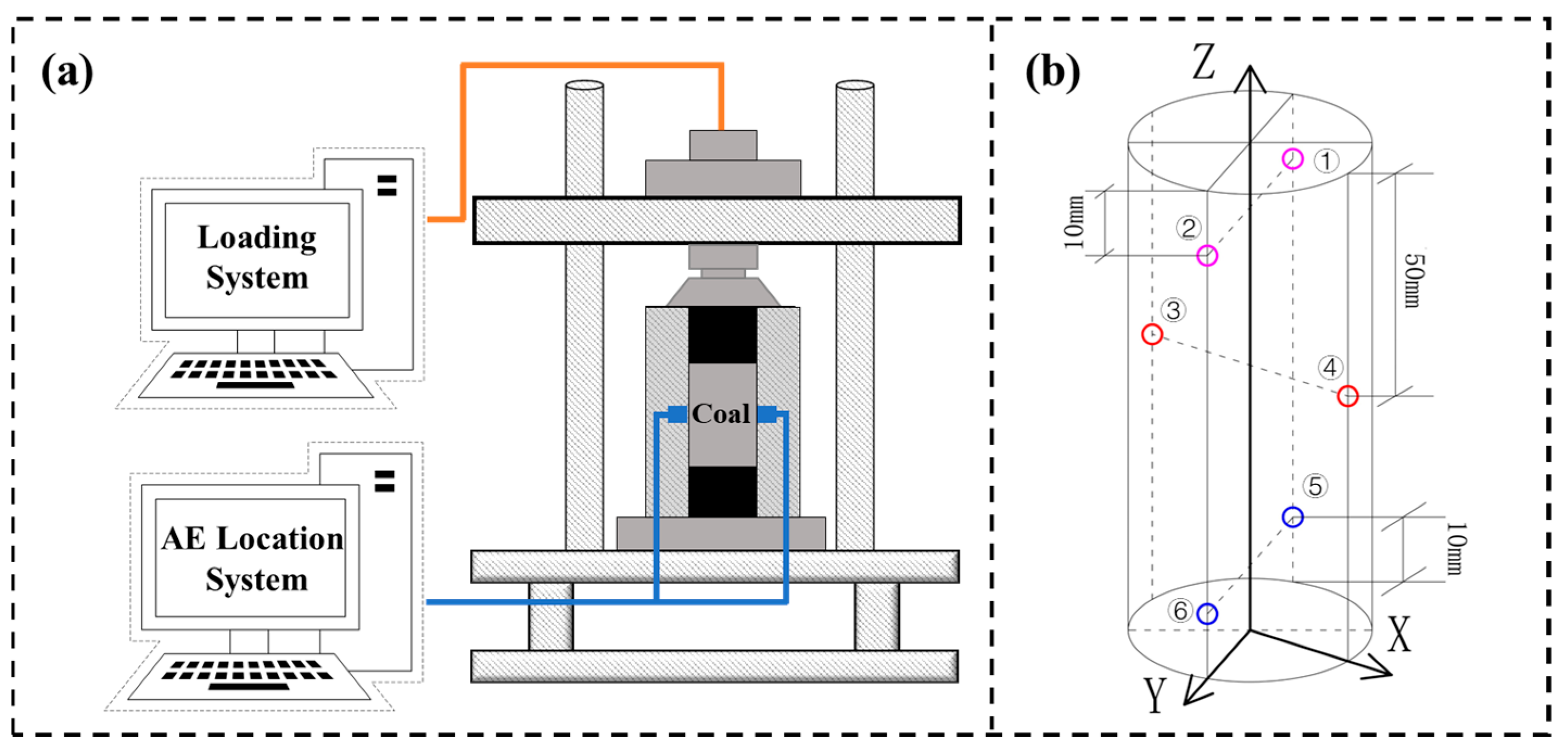
Figure 1. Schematic diagram of the experimental system (a) and AE sensor layout (b).
Sustainability 17 11349 g001
Figure 2. The AE event evolution law of the coal sample during the whole loading process.
Sustainability 17 11349 g002aSustainability 17 11349 g002b
Figure 3. The distribution characteristics of AE events at different stress stages.
Sustainability 17 11349 g003
Figure 4. Fractal measure D of the coal samples determined by the graphical method.
Sustainability 17 11349 g004
Figure 5. Calculation results of b value.
Sustainability 17 11349 g005
Figure 6. The distribution characteristics of link lengths in the single-link cluster structure.
Sustainability 17 11349 g006
Figure 7. The complex network of AE events in different event window (blue dots denote AE events within the window, and black lines indicate the corresponding complex network).
Sustainability 17 11349 g007
Figure 8. The evolution characteristics of complex network metrics derived from AE events.
Sustainability 17 11349 g008aSustainability 17 11349 g008b
Table 1. The physical parameters of the coal samples.
Production RegionsAbbreviationTypeAverage Compressive Strength (MPa)Average Density
(g/cm3)
ShanxiSAnthracite36.621.78
HebeiHAnthracite31.151.56
Inner MongoliaIAnthracite27.781.62
Table 2. The coordinates of AE sensors.
NumberNo.1No.2No.3No.4No.5No.6
X (mm)00−252500
Y (mm)−252500−2525
Z (mm)909050501010
Table 3. The acquisition parameters of AE location system.
Sampling RateThresholdResonant FrequencyPDTHDTHLT
5 MSPS40 dB300 kHz220 μs800 μs1000 μs
Table 4. The fractal measure D of all the coal samples.
Number 12345
Code
S2.792.532.612.462.58
H2.552.572.612.422.53
I2.462.442.472.292.38
Table 5. The energy difference parameter b of all the coal samples.
Number12345
Code
S1.110.980.820.981.16
H1.020.940.790.660.92
I0.920.900.970.890.87
Table 6. The critical value between the dense and sparse regions of all the coal sample.
Number 12345
Code
S0.930.920.930.930.92
H0.930.910.930.940.93
I0.920.930.930.910.93
Disclaimer/Publisher’s Note: The statements, opinions and data contained in all publications are solely those of the individual author(s) and contributor(s) and not of MDPI and/or the editor(s). MDPI and/or the editor(s) disclaim responsibility for any injury to people or property resulting from any ideas, methods, instructions or products referred to in the content.