Understanding the Drivers of Temporary Agency Work in Slovenia: Implications for Sustainable Labor Practices
Abstract
1. Introduction
- R1:
- What specific labor market imbalances have client organizations sought to address through the adoption of TAW arrangements?
- R2:
- To what extent, and in what ways, have flexibility in work arrangements within TAW been balanced with considerations of job security and social protection of agency workers?
- R3:
- To what extent do implemented TAW arrangements promote decent work—through job creation, adequate social protection, respect for rights and equal treatment, and stronger worker voice and representation—and thereby advance social sustainability, and what indicative environmental co-benefits and risks are associated with these arrangements in terms of their sectoral placement and commuting/mobility patterns?
1.1. Previous Research on Motivations for Implementing TAW in Organizational Contexts
1.2. The TAW in the Slovenian Labour Market
2. Materials and Methods
2.1. Sampling
- TAW agencies (agencies): to inform service models, market positioning, and the operational mechanisms through which client demand is met.
- Client organizations (users): to specify organizational drivers for adopting TAW (e.g., volatility, skills shortages, headcount controls) and to trace internal workforce strategies.
- Agency workers: to surface lived experiences with job quality, equal treatment, mobility/skills, and representation.
- Trade-union representatives: included due to Phase-1 evidence of low union inclusion among agency workers and indications of untapped potential of social dialogue at sectoral/organizational level.
- State administrative body representatives (work/residence permits for foreign workers): included because a notable segment of agency workers in Slovenia are foreign nationals (predominantly from Bosnia and Herzegovina) in lower-skilled roles; these officials have direct insight into procedural dynamics around permit extensions, denials, and employer transfers, and how regulation operates in practice.
2.2. Data Collection
2.3. Data Analysis
2.4. Ethical Considerations
3. Results
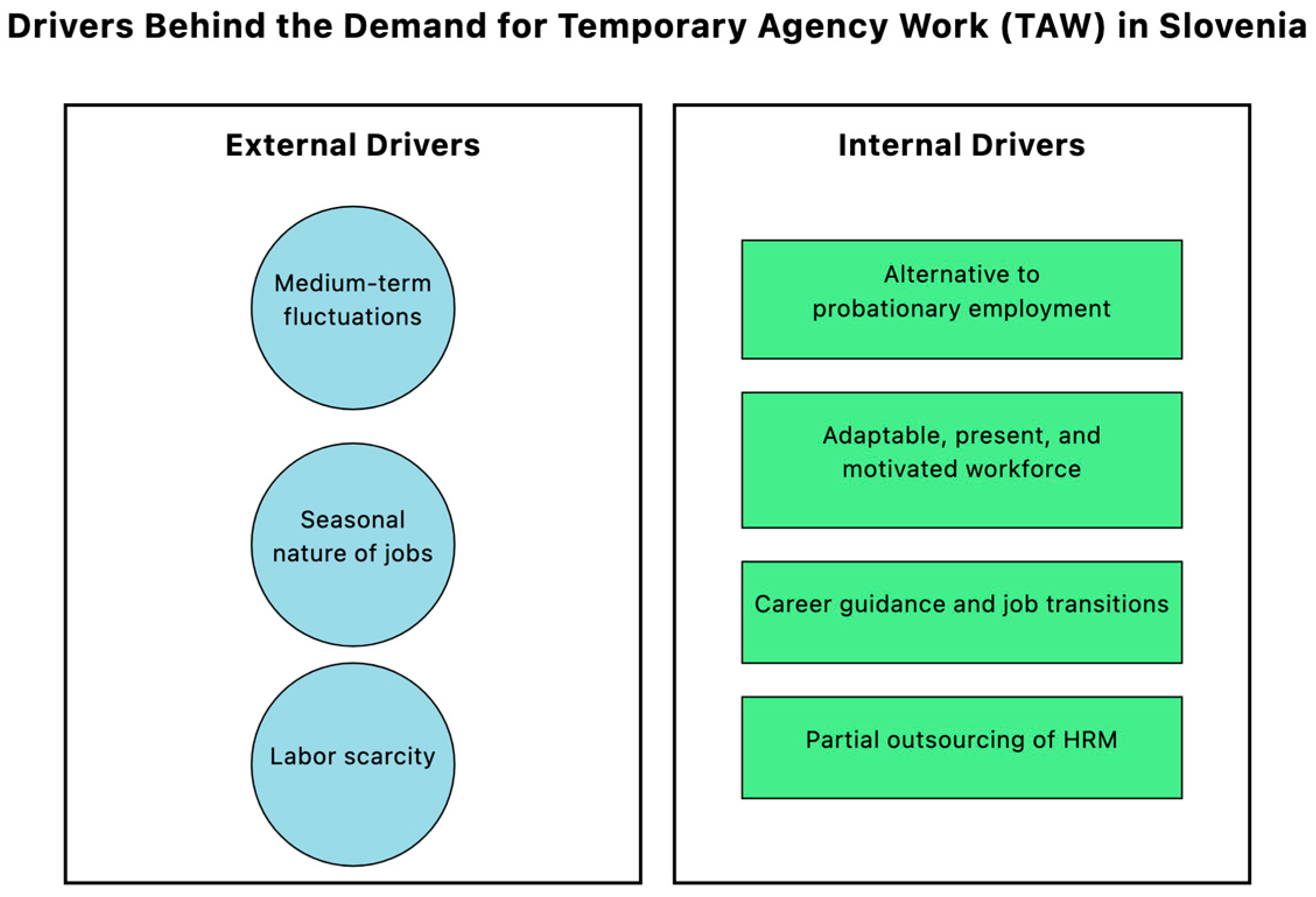
3.1. Drivers of Temporary Agency Work Engagement in Slovenia (R1)
3.1.1. Medium-Term Fluctuations Necessitating Partial Labour Flexibility
‘Larger companies certainly integrate us [agencies] into their processes, aiming to have a certain workforce flexibility, allowing them to adapt through multiple mechanisms to the changing needs for labour that may arise’.(A2)
‘As an agency, we always encourage companies to think ambitiously. The fact that they can call us on a Friday and have 15 new workers by Monday has definitely allowed companies to think bigger, knowing they can get the workforce they need exactly when they need it’.(A2)
‘Unlike traditional layoffs involving a larger group of directly employed workers, when there is a reduced need for agency workers, the client organization and the agency are not legally required to establish or adhere to specific criteria for selecting surplus agency workers. They can make decisions based on their mutual interests. Moreover, agency workers and trade unions have no influence or involvement in this process.’(T1)
3.1.2. Addressing Seasonality in Labour Demands
‘Our vertical employment model serves [names one of the Slovenian airports] and [names one of the Slovenian ski resorts]. The ski resort requires more staff in winter and less in summer, while the airport’s needs are reversed. We send the same employees to the airport in summer and to the ski resort in winter, enabling year-round employment. Without this approach, both companies would employ only short-term contracts, leading to multiple temporary contracts for employees’.(A1)
‘Given that the company has a longstanding tradition of employing agency workers and considering the realistic increase in seasonal needs, as well as the fact that regular employees are happy about the arrival of new workers (and must accept them for the work process to flow), there is no noticeable difference between the workers. We never even discuss who is an agency worker, although I often talk with other employees’.(W2)
3.1.3. Addressing Labour Scarcity
‘The third model, which is becoming stronger in Slovenia, is known as the specialized staff model. It pertains to roles for people with skills that are in short supply. These jobs are usually better paid by agencies than by clients working directly. For example, at the moment, it is challenging for a retailer to recruit a butcher, as many butchers are employed by agencies, which offer them higher wages and better working conditions’.(A1)
‘We approach them and initiate conversations, attempting to persuade them to consider a change in employment. The most desirable professions are butchers, salespeople, technical staff, production workers, and warehouse workers. The situation with these in-demand roles is such that we must hire the candidate immediately, as by the next day, they may already have three new offers’.(A4)
‘If one client no longer needs such specialized staff, we are obligated to pay the employee 70% of their salary (or more but no less than 70%) [now 80%] during the waiting period at home. This applies to hard-to-find profiles where it makes more financial sense for us to pay for their “downtime” or “waiting at home” rather than letting such a person enter the labour market’.(A2)
3.1.4. A Substitute for Probationary Work or a Fixed-Term Employment Contract
‘You always know that eventually, you will lose a worker. You can’t keep them there indefinitely. I see this as a positive thing, as it means that the client was satisfied with your service. The worker will also be content if they find direct employment there. That’s really the essence of our job’.(A5)
3.1.5. Ensuring a More Flexible, Present, and Motivated Workforce
‘I can confidently say that sick leave is three times lower for agency workers at our company, as people genuinely strive to prove themselves. Our experience last year with hiring agency workers directly revealed that this approach was not satisfactory, resulting in less motivation and increased sick leave. Therefore, we have halted the current rehiring process’.(C1)
‘Over 80% of our workforce demands are for less-educated workers, who often perform monotonous tasks such as shifting products from one box to another for decades. Such roles are typically underpaid, and the pool of willing workers is decreasing. Our agency prioritizes these workers, offering an extra degree of care and ensuring they feel valued’.(A1)
3.1.6. Providing Career Guidance and Facilitating Transitions to More Suitable Working Conditions, Ensuring a Good Fit Between Client and Worker
‘We’ve had instances where workers we placed returned to us after 2–3 years because something had changed in the company or because the job did not meet their expectations. The career path is a highly intriguing experience, and in today’s times, every individual, regardless of the position they hold, needs a broad array of competencies if they wish to succeed on their upwards career path’.(A2)
3.1.7. Partial Outsourcing of the HRM Function and Managing Workers’ Quotas
‘Imagine working in a manufacturing company with 100 employees. The HR department would be swamped with tasks if it needed to address every concern. Now, think of us as that HR department, constantly communicating with those 100 individuals daily, or as needed. On an agency worker’s first day, we check in by asking the following: How do they feel? Did they receive all the necessary equipment? Were they adequately informed during their trial period? We also get feedback from the client about their initial impressions’.(A7)
4. Discussion
4.1. Balancing Job Security and Social Protection Across Identified Labour Market Imbalances (R2)
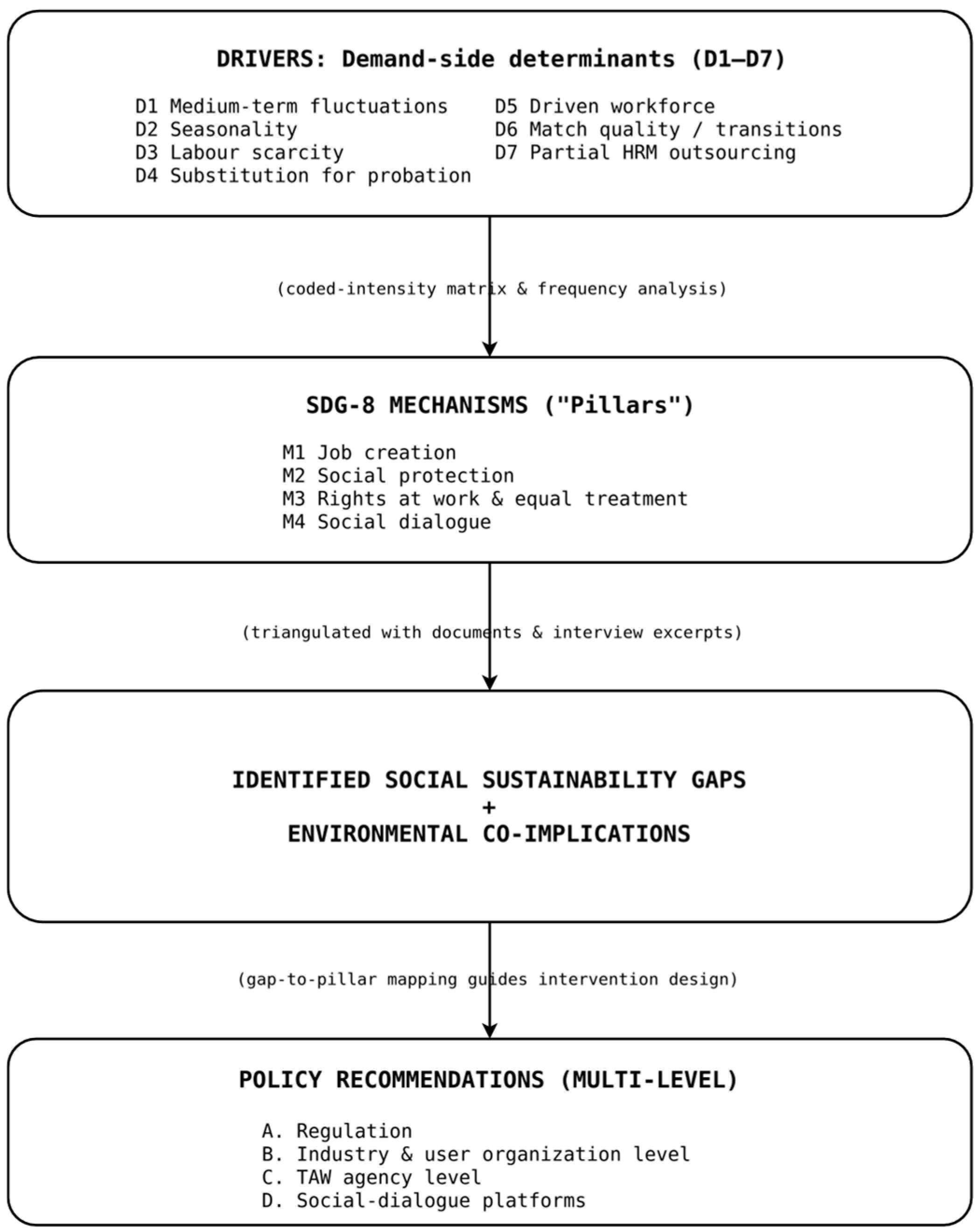
4.2. Assessment of Decent Work (SDG-8) Outcomes, Social-Sustainability Gaps and Environmental Co-Implications (R3)
4.2.1. Employment Creation
4.2.2. Equality of Rights at Work
- Uncertainty and Constant Pressure: Agency workers are often subjected to a persistent state of uncertainty and pressure to prove their worth daily. They face additional benchmarks to demonstrate their value, encountering more obstacles when seeking promotions, higher pay, or more challenging roles. These hurdles are particularly evident during transitions between clients and after assignments end, when clients may consider agency workers for direct employment.
- Career Obstacles: The inability to retain promotions and benefits earned at one client organization poses a significant career obstacle for agency workers. This study highlights how such limitations can hinder their long-term professional growth.
- Prolonged Path to Permanent Employment: Agency workers frequently receive multiple fixed-term contracts, particularly during transitions to direct employment with a client at the end of a task. This practice prolongs their path to securing a permanent position and may keep them in a precarious employment situation.
- Financial Barriers to Direct Employment: Client organizations are often required to pay a commission to the agency for early contract termination if they wish to directly employ an agency worker before the assignment ends. The study suggests that to avoid these additional financial obligations, clients may continue to use agency workers rather than offer them direct employment. This commission effectively binds the agency worker to the agency, limiting their opportunities for direct employment with the client.
- Strategic Use of Agency Work: Especially in multinational companies, client organizations may use agency work strategically to reduce the number of directly employed workers or manage worker quotas, as directed by their headquarters. As a result, agency workers often find themselves ‘locked into’ various temporary arrangements before they can secure a permanent position within the company.
- Market Monopolization by Agencies: Agencies may also seek to establish a (partial) monopoly in high-demand professions. While this strategy might temporarily improve conditions for agency workers, it also risks creating new labor market segments that do not necessarily support long-term, decent work conditions.
4.2.3. Social Protection
- Avoidance of Liability for Workplace Harm: An increasing number of legal disputes highlight the challenge of holding agencies and client organizations accountable for workplace injuries sustained by agency workers. Court cases [71] indicate that both agencies and clients often deny responsibility, leaving agency workers in precarious positions without clear recourse for compensation or protection.
- Pressure to Perform and Always Be Available: Agency workers, already facing significant career obstacles, are particularly vulnerable to exploitation. Clients may take advantage of their willingness to work under less favorable conditions—such as night shifts or high-pressure environments—driven by fears of job loss or contract nonrenewal. The study indicates lower rates of health-related absenteeism among agency workers, suggesting that they may avoid taking sick leave to maintain their positions.
- Extended Trial Periods: Agencies often serve as a preliminary screening tool for client organizations, allowing clients to assess workers before committing to permanent employment. This practice is particularly common in semi-public organizations, where agency workers are initially hired for a trial period, effectively replacing the traditional probation period. If deemed suitable, these workers may then transition to permanent positions, sometimes facing yet another trial period.
- Vulnerability During Market Crises: The study found that agency workers are disproportionately affected during market crises, such as the COVID-19 pandemic or resource shortages linked to the Ukraine conflict. They are often the first to lose their jobs when client assignments are terminated early. If agencies cannot secure a new assignment within four weeks, these workers are typically let go.
- Lack of Objective Criteria for Surplus Selection: In the event of mass early terminations of agency workers at client organizations, there are no objective, transparent, or predefined criteria for selecting surplus workers. This lack of regulation exposes agency workers to potential unequal treatment, as decisions are made based on the client’s discretion rather than clear, fair standards.
4.2.4. Social Dialogue
4.2.5. Environmental Co-Implications of TAW
5. Conclusions
5.1. Policy Recommendations, Addressing the Social and Environmental Sustainability Gaps
5.2. Original Contribution of the Study
5.3. Research Study Limitations and Further Research
Supplementary Materials
Funding
Institutional Review Board Statement
Informed Consent Statement
Data Availability Statement
Conflicts of Interest
References
- Forde, C.; Slater, G. Temporary agency work: Evolution, regulation and implications for performance. J. Organ. Eff. 2016, 3, 312–322. [Google Scholar] [CrossRef]
- International Labour Organization—ILO. Non-Standard Forms of Employment in Selected Countries in Central and Eastern Europe. A Critical Glance into Regulation and Implementation. ILO Decent Work Technical Support Team and Country Office for Central and Eastern Europe. 2021. Available online: https://www.ilo.org/wcmsp5/groups/public/---europe/---ro-geneva/---sro-budapest/documents/publication/wcms_793096.pdf (accessed on 29 October 2025).
- International Labour Organization—ILO. Non-Standard Employment Around the World: Understanding Challenges, Shaping Prospects. International Labour Office, Geneva, 2016. Available online: https://www.ilo.org/sites/default/files/wcmsp5/groups/public/%40dgreports/%40dcomm/%40publ/documents/publication/wcms_534326.pdf (accessed on 29 October 2025).
- Eurofound. New Forms of Employment–2020 Update; Publications Office of the European Union: Luxembourg, 2020; Available online: https://data.europa.eu/doi/10.2806/278670 (accessed on 29 October 2025).
- Spattini, S. Agency Work: A Comparative Analysis. E-J. Int. Comp. Labour Stud. 2012, 1, 169–210. [Google Scholar]
- Sartori, A. Temporary Agency Work in Europe: Degree of Convergence following Directive 2008/104/EU. Eur. Labour Law J. 2016, 7, 109–125. [Google Scholar] [CrossRef]
- Alsos, K.; Evans, C. Temporary work agencies: Triangular disorganization or multilevel regulation? Eur. J. Ind. Relat. 2018, 24, 391–407. [Google Scholar] [CrossRef]
- Voss, E.; Vitols, K.; Farvaque, N.; Broughton, A.; Behling, F.; Dota, F.; Leonardi, S.; Naedenoen, F. The Role of Temporary Agency Work and Labour Market Transition in Europe; Final Report for the Joint Eurociett/UNI Europa Project; Eurociett: Hamburg, Germany, 2013; pp. 1–167. Available online: https://www.weceurope.org/uploads/2019/07/2013_WECEU_Study-TAW-Role-Labour-Transitions.pdf (accessed on 29 October 2025).
- International Labour Organization—ILO. Decent Work and the 2030 Agenda for Sustainable Development. International Labour Organization. 2017. Available online: https://ilo.org/wcmsp5/groups/public/---dgreports/---dcomm/documents/publication/wcms_436923.pdf (accessed on 29 October 2025).
- Eurofound. Temporary Agency Work and Collective Bargaining in the EU; Eurofound: Dublin, Ireland, 2009. Available online: https://assets.eurofound.europa.eu/f/279033/8f15d95c92/ef0899en.pdf (accessed on 29 October 2025).
- van Oorschot, S. Digitalisation and Temporary Agencies: Impact on the Business Model and Internal Organisation. Res. Hosp. Manag. 2021, 11, 241–248. [Google Scholar] [CrossRef]
- Potocka-Sionek, N. The Changing Nature of Labour Intermediation: Do Algorithms Redefine Temporary Agency Work? In New Forms of Employment: Current Problems and Future Challenges; Wratny, J., Ludera-Ruszel, A., Eds.; Springer Fachmedien: Wiesbaden, Germany, 2020; pp. 169–190. [Google Scholar] [CrossRef]
- You, C.; Qiu, H.; Pi, Z.; Yu, M. Sustainable Enterprise Development in the Manufacturing Sector: Flexible Employment and Innovation in China. Sustainability 2023, 15, 8180. [Google Scholar] [CrossRef]
- World Employment Confederation—WEC-Europe. Making Better Matches: How the Private Employment Services Industry Helps to Reduce Labour and Skills Shortages in Europe. A World Employment Confederation-Europe Strategic Issue Paper. 30 August 2022. Available online: https://weceurope.org/publication-post/making-better-matches-how-the-private-employment-services-industry-helps-to-reduce-labour-and-skills-shortages-in-europe/ (accessed on 29 October 2025).
- World Employment Confederation—WEC-Europe. COVID-19: The Road to Recovery: Private Employment Services Stand Ready to Play Their Part. World Employment Confederation-Europe. 2020. Available online: https://wecglobal.org/uploads/2020/07/WEC-Policy-Paper-Covid-19-The-road-to-recovery-FINAL.pdf (accessed on 29 October 2025).
- Baiocco, S.; de Groen, W.P.; Kilhoffer, Z.; Lenaerts, K. Social Innovation in the Temporary Agency Work Industry. Centre for European Policy Studies (CEPS) and the Research Institute for Work and Society (HIVA) at KU Leuven. 2020. Available online: https://www.weceurope.org/uploads/2020/12/20201201_CEPS-HIVA_Social-innovation-TAW-research-report.pdf (accessed on 29 October 2025).
- International Labour Organization—ILO. The Impact of the COVID-19 Pandemic on Jobs and Incomes in G20 Economies. International Labour Organization. 2020. Available online: https://www.ilo.org/wcmsp5/groups/public/---dgreports/---cabinet/documents/publication/wcms_756331.pdf (accessed on 29 October 2025).
- Möhring, K.; Naumann, E.; Reifenscheid, M.; Wenz, A.; Retttig, T.; Krieger, U.; Friedel, S.; Finkel, M.; Cornesse, C.; Blom, A.G. The COVID-19 pandemic and subjective well-being: Longitudinal evidence on satisfaction with work and family. Eur. Soc. 2021, 23, S601–S617. [Google Scholar] [CrossRef]
- Nieuwenhuis, R.; Yerkes, M.A. Workers’ well-being in the context of the first year of the COVID-19 pandemic. Community Work Fam. 2021, 24, 226–235. [Google Scholar] [CrossRef]
- Wu, Q. Employment Precarity, COVID-19 Risk, and Workers’ Well-Being During the Pandemic in Europe. Work Occup. 2023, 50, 188–211. [Google Scholar] [CrossRef]
- Cajander, N.; Reiman, A. High performance work practices and well-being at restaurant work. Eur. J. Tour. Hosp. Recreat. 2019, 9, 38–48. [Google Scholar] [CrossRef]
- Akkerman, A.; Sluiter, R.; Jansen, G. Temporary work and deviant behavior: The role of workplace cohesion. Sociol. Q. 2020, 61, 678–702. [Google Scholar] [CrossRef]
- Strauss-Raats, P. Temporary safety: Regulating working conditions in temporary agency work. Saf. Sci. 2019, 112, 213–222. [Google Scholar] [CrossRef]
- Knox, A. Regulatory avoidance in the temporary work agency industry: Evidence from Australia. Econ. Labour Relat. Rev. 2018, 29, 190–206. [Google Scholar] [CrossRef]
- Fostervold, K.I.; Koren, P.C.; Nilsen, O.V. Defining sustainable and “decent” work for human factors and ergonomics. In Ergonomics and Human Factors for a Sustainable Future—Current Research and Future Possibilities; Thatcher, A., Yeow, P.H.P., Eds.; Palgrave Macmillan: Singapore, 2018; pp. 47–76. [Google Scholar] [CrossRef]
- Tangian, A. European flexicurity: Concepts, methodology and policies. Transf. Eur. Rev. Labour Res. 2007, 13, 551–573. [Google Scholar] [CrossRef]
- European Commission—EC. Report from the Commission to the European Parliament, the Council, the European Economic and Social Committee, and the Committee of the Regions on the Application of Directive 2008/104/EC on Temporary Agency work, COM(2014) 176 Final. Available online: http://ec.europa.eu/social/BlobServlet?docId=11459&langId=en (accessed on 29 October 2025).
- United Nations—UN. Transforming Our World: The 2030 Agenda for Sustainable Development. United Nations, Department of Economic and Social Affairs, New York, 2015. Available online: https://sdgs.un.org/2030agenda (accessed on 29 October 2025).
- Eizenberg, E.; Jabareen, Y. Social Sustainability: A New Conceptual Framework. Sustainability 2017, 9, 68. [Google Scholar] [CrossRef]
- Cajander, N.; Reiman, A.; Kärkkäinen, R.; Ylikarhi, K. Corporate Social Responsibility in Temporary Agency Work: A Study of Restaurant Work in Finland. Employ. Respons. Rights J. 2023, 35, 267–286. [Google Scholar] [CrossRef]
- Robinson, R.N.; Martins, A.; Solnet, D.; Baum, T. Sustaining precarity: Critically examining tourism and employment. J. Sustain. Tour. 2019, 27, 1008–1025. [Google Scholar] [CrossRef]
- Chambel, M.J.; Sobral, F. When temporary agency work is not so temporary. Econ. Ind. Democr. 2019, 40, 238–256. [Google Scholar] [CrossRef]
- Chambel, M.J.; Lopes, S.; Batista, J. The effects of temporary agency work contract transitions on well-being. Int. Arch. Occup. Environ. Health 2016, 89, 1215–1228. [Google Scholar] [CrossRef]
- Grimshaw, D.; Cartwright, J.; Keizer, A.; Rubery, J. Market Exposure and the Labour Process: The Contradictory Dynamics in Managing Subcontracted Services Work. Work Employ. Soc. 2019, 33, 76–95. [Google Scholar] [CrossRef]
- Creswell, J.W.; Plano Clark, V.L. Designing and Conducting Mixed Methods Research, 3rd ed.; Sage Publications, Inc.: Thousand Oaks, CA, USA, 2017. [Google Scholar]
- Yin, R.K. Case Study Research and Applications: Design and Methods, 6th ed.; Sage Publication, Inc.: Thousand Oaks, CA, USA, 2018; p. 319. [Google Scholar]
- Krapež, K. Regulation of temporary agency work and the modern labor market: A case study of Slovenia. Stanovnistvo 2024, 62, 127–151. [Google Scholar] [CrossRef]
- Farquhar, J.; Michels, N.; Robson, J. Triangulation in industrial qualitative case study research: Widening the scope. Ind. Mark. Manag. 2020, 87, 160–170. [Google Scholar] [CrossRef]
- Voudouris, I. The use of flexible employment arrangements: Some new evidence from Greek firms. Int. J. Hum. Resour. Manag. 2004, 15, 131–146. [Google Scholar] [CrossRef]
- Garen, J. Use of employees and alternative work arrangements in the United States: A law, economics, and organizations perspective. Labour Econ. 2006, 13, 107–141. [Google Scholar] [CrossRef]
- Abraham, K.G.; Taylor, S.K. Firms’ use of outside contractors: Theory and evidence. J. Labor Econ. 1996, 14, 394–424. [Google Scholar] [CrossRef]
- Houseman, S.N. Why employers use flexible staffing arrangements: Evidence from an establishment survey. ILR Rev. 2001, 55, 149–170. [Google Scholar] [CrossRef]
- Thommes, K.; Weiland, K. Explanatory factors for firms’ use of temporary agency work in Germany. Eur. Manag. J. 2010, 28, 55–67. [Google Scholar] [CrossRef]
- Whitley, R. Business Systems and Organizational Capabilities: The Institutional Structuring of Competitive Competences; Oxford University Press: Oxford, UK, 2007. [Google Scholar]
- Alewell, D.; Baehring, K.; Canis, A.; Hauff, S.; Thommes, K. Outsourcing HR Functions: Development of an Explanatory Approach to Firms’ (Non-Existent) Demand for Personnel Services. Int. Rev. Manag. Stud. 2007, 18, 271–292. [Google Scholar] [CrossRef]
- Allen, M.M.C.; Liu, J.; Allen, M.L.; Imran Saqib, S. Establishments’ use of temporary agency workers: The influence of institutions and establishments’ employment strategies. Int. J. Hum. Resour. Manag. 2017, 28, 2570–2593. [Google Scholar] [CrossRef]
- Stanworth, C.; Druker, J. Human resource solutions? Pers. Rev. 2006, 35, 175–190. [Google Scholar] [CrossRef]
- Coe, N.M.; Johns, J.; Ward, K. Flexibility in Action: The Temporary Staffing Industry in the Czech Republic and Poland. Environ. Plan. A 2008, 40, 1391–1415. [Google Scholar] [CrossRef]
- Holst, H.; Nachtwey, O.; Dorre, K. The Strategic Use of Temporary Agency Work: Functional Change of a Non-Standard Form of Employment. Int. J. Action Res. 2010, 6, 108–138. [Google Scholar]
- Enright, B. (Re)considering New Agents: A Review of Labour Market Intermediaries within Labour Geography. Geogr. Compass 2013, 7, 287–299. [Google Scholar] [CrossRef]
- Ferreira, J. The German temporary staffing industry: Growth, development, scandal and resistance. Ind. Relat. J. 2016, 47, 117–143. [Google Scholar] [CrossRef]
- Atkinson, J. Manpower Strategies for Flexible Organisation. Pers. Manag. 1984, 16, 28–31. [Google Scholar]
- Gramm, C.L.; Schnell, J.F. The use of flexible staffing arrangements in core production jobs. ILR Rev. 2001, 54, 245–258. [Google Scholar] [CrossRef]
- Kalleberg, A.L.; Reynolds, J.; Marsden, P.V. Externalizing employment: Flexible staffing arrangements in US organizations. Soc. Sci. Res. 2003, 32, 525–552. [Google Scholar] [CrossRef]
- OECD. The OECD Indicators of Employment Protection Legislation. Organisation for Economic Co-Operation and Development, Last Update February 2024. Available online: https://www.oecd.org/en/data/datasets/oecd-indicators-of-employment-protection.html (accessed on 29 October 2025).
- Eurostat. Temporary Employment Agency Workers by Sex, Age and NACE Rev. 2 Activity. 2023. Available online: https://ec.europa.eu/eurostat/databrowser/view/LFSA_QOE_4A6R2__custom_89620/bookmark/table?lang=en&bookmarkId=3b52ebd8-7b16-4e64-9613-83f8412d2ff1 (accessed on 29 October 2025).
- Statistical Office of the Republic of Slovenia—SiStat. Labour Force Survey Results, 2022. 2023. Available online: https://www.stat.si/StatWeb/en/News/Index/11047 (accessed on 27 July 2023).
- Kozjek, T.; Ferjan, M.; Žnidaršič, A. The Perception of Job Security—Empirical Evidence from Slovenia. J. East Eur. Manag. Stud. 2017, 22, 287–314. [Google Scholar] [CrossRef]
- Kozjek, T.; Ferjan, M. Organizational Flexibility, Employee Security, and Organizational Efficiency: A Case Study of Slovenian Public and Private Sector Organizations. Organizacija 2015, 48, 3–22. [Google Scholar] [CrossRef]
- Ministry of Labour, Family, Social Affairs, and Equal Opportunities. Register of Domestic Legal and Natural Persons for the Activity of Providing the Work of Workers to the User. 2024. Available online: https://podatki.gov.si/dataset/register-domacih-pravnih-in-fizicnih-oseb-za-zagotavljanje-dela-delavcev-uporabniku (accessed on 29 October 2025).
- Ministry of Labour, Family, Social Affairs, and Equal Opportunities. Records of Foreign Legal and Natural Persons for the Performance of the Activity of Providing the Work of Workers to the User. 2024. Available online: https://podatki.gov.si/dataset/evidenca-tujih-pravnih-in-fizicnih-oseb-za-opravljanje-dejavnosti-zagotavljanja-dela-delavcev-uporab# (accessed on 27 July 2023).
- Redek, T.; Bavdaž, M.; Cepec, J.; Domadenik, P.; Godnov, U.; Kostevc, Č. Vpliv Zasebnih Agencij za Zaposlovanje na trg Dela v Sloveniji (The Impact of Private Employment Agencies on the Labor Market in Slovenia); Zavod RS za Zaposlovanje (Employment Service of Slovenia—ESS): Ljubljana, Slovenia, 2017. Available online: https://www.ess.gov.si/fileadmin/user_upload/Trg_dela/Dokumenti_TD/Analize/Vpliv_zasebnih_agencij_za_zaposlovanje_na_trg_dela_v_Sloveniji.pdf (accessed on 29 October 2025).
- Labor Inspectorate of the Republic of Slovenia (Inšpektorat RS za delo). Poročilo o delu Inšpektorata RS za delo za leto 2020. GOVSI. 2020. Available online: https://www.gov.si/assets/organi-v-sestavi/IRSD/LETNA-POROCILA-IRSD/LP_IRSD_2020_www_skupno.pdf (accessed on 29 October 2025).
- Kuralt, T. Kritični Pogled na Opravljanje Dejavnosti Zagotavljanja dela Delavcev Uporabniku (A Critical View on the TAW Model). Podjetje Delo 2016, 3, 615–623. [Google Scholar]
- Kresal Šoltes, K. Razmejitev obveznosti med agencijo in podjetjem uporabnikom ter načelo enakega obravnavanja–je lahko model tudi za druge nestandardne oblike dela? Delav. Delodajalci 2017, 2, 199–220. [Google Scholar]
- Senčur-Peček, D. Izzivi delovnega prava v času prekarnega dela. Podjet. Delo 2019, 6–7, 1033. [Google Scholar]
- Senčur Peček, D. Navidezni samozaposleni in prikrita delovna razmerja (Ostensibly self-employed and concealed employment relationships). In Prekarno Delo: Multidisciplinarna Analiza; Kresal Šoltes, K., Strban, G., Domadenik, P., Eds.; Elektronska izdaja Zbirka Maksima: Ljubljana, Slovenia, 2020; pp. 46–66. Available online: https://institut-delo.com/DOC22/Prekarno_delo.pdf?LV=1 (accessed on 29 October 2025).
- Kresal, B. Prikrita delovna razmerja–nevarno izigravanje zakonodaje (Concealed Employment Relationships–Perilous Evasion of Legislation). Delav. Delodajalci 2014, 14, 177–200. [Google Scholar]
- Kresal Šoltes, K. Začasno agencijsko delo (Temporary agency work). In Prekarno Delo: Multidisciplinarna Analiza; Kresal Šoltes, K., Strban, G., Domadenik, P., Eds.; Elektronska izdaja Zbirka Maksima: Ljubljana, Slovenia, 2020; pp. 46–66. Available online: https://institut-delo.com/DOC22/Prekarno_delo.pdf?LV=1 (accessed on 29 October 2025).
- Breznik, M.; Čehovin Zajc, J. Prekarizacija standardnega in nestandardnega zaposlovanja v Sloveniji (2005–2019) (Precarization of Standard and Non-Standard Employment in Slovenia (2005–2019)). Teor. Praksa 2021, 58, 28–48. [Google Scholar] [CrossRef]
- Pustovrh Pirnat, T. Sodna praksa glede odgovornosti zaposlitvene agencije za škodo, ki jo utrpi delavec pri delu (Case law regarding the liability of the temporary employment agency for damage suffered by a posted worker at work). Delav. Delodajalci 2013, 1, 79. [Google Scholar]
- Palinkas, L.A.; Horwitz, S.M.; Green, C.A.; Wisdom, J.P.; Duan, N.; Hoagwood, K. Purposeful Sampling for Qualitative Data Collection and Analysis in Mixed Method Implementation Research. Adm. Policy Ment. Health Ment. Health Serv. Res. 2015, 42, 533–544. [Google Scholar] [CrossRef]
- Atkinson, R.; Flint, J. Accessing Hidden and Hard-to-Reach Populations: Snowball Research Strategies. Soc. Res. Updat. 2001, 33. [Google Scholar]
- Malterud, K.; Siersma, V.D.; Guassora, A.D. Sample Size in Qualitative Interview Studies: Guided by Information Power. Qual. Health Res. 2016, 26, 1753–1760. [Google Scholar] [CrossRef]
- Vasileiou, K.; Barnett, J.; Thorpe, S.; Young, T. Characterising and Justifying Sample Size Sufficiency in Interview-Based Studies: Systematic Analysis of Qualitative Health Research over a 15-Year Period. BMC Med. Res. Methodol. 2018, 18, 148. [Google Scholar] [CrossRef]
- OECD. The New OECD Employment Protection Legislation Indicators for Temporary Contracts. Organisation for Economic Co-Operation and Development, 2021. Available online: https://www.oecd.org/content/dam/oecd/en/data/datasets/indicators-of-employment-protection/OECD-EPLIndicators-TemporaryContracts.pdf (accessed on 29 October 2025).
- Labour Inspectorate of the Republic of Slovenia (Inšpektorat RS za delo RS). Poročilo o Delu Inšpektorata RS za Delo za Leto 2022. GOVSI. 2023. Available online: https://www.gov.si/assets/organi-v-sestavi/IRSD/LETNA-POROCILA-IRSD/Letno-porocilo-o-delu-IRSD-za-leto-2022.pdf (accessed on 29 October 2025).
- Hopkins, B. Explaining variations in absence rates: Temporary and agency workers in the food manufacturing sector. Hum. Resour. Manag. J. 2012, 24, 227–240. [Google Scholar] [CrossRef]
- García Mainar, I.; Green, C.P.; Navarro Paniagua, M. The Effect of Permanent Employment on Absenteeism: Evidence from Labor Reform in Spain. ILR Rev. 2018, 71, 525–549. [Google Scholar] [CrossRef]
- ETUI. Worker Participation in the EU: Slovenia. 2024. Available online: https://worker-participation.eu/national-industrial-relations/countries/slovenia (accessed on 29 October 2025).



| Criterion | Description |
|---|---|
| Gender | Female, male |
| Experience with temporary agency work | Up to 3 years, 3–10 years, more than 10 years |
| Type of stakeholder | Temporary work agency, agency worker, client organization, trade union, administrative body |
| Size of temporary work agency | Four biggest agencies, other agencies (micro, small, medium-sized) |
| Membership of temporary work agency in an Employment Agencies Association | No, yes |
| Branch of client organization | Branches with the highest prevalence of TAW, other branches |
| Criterion | Description |
|---|---|
| Gender | Female (n = 7), male (n = 12) |
| Experience with temporary agency work | Up to 3 years (n = 3), 3–10 years (n = 8,), more than 10 years (n = 8) |
| Type of stakeholder | Temporary work agency—A* (n = 7), agency worker—W (n = 4), client organization—C (n = 5), administrative body/regulator—R (n = 1), trade union representative—T (n = 2) |
| Size of agency (n = 7) | Four biggest agencies (n = 4) (A1–A4), other agencies (micro, small, medium-sized; n = 3) (A5-A7) |
| Membership of agency in The Employment Agencies Association (n = 7) | Yes (n = 6) (A1–A6), no (n = 1) (A7) |
| Industry branch of client organization | Manufacturing (n = 3) (C1, C3, C5), tourism (n = 1) (C2), construction (n = 1) (C4) (all are branches with the highest prevalence of TAW in Slovenia) |
| Drivers\Stakeholders | Agencies | Client Organizations | Agency Workers | Trade Unions | State Authority |
|---|---|---|---|---|---|
| D1 Medium-term fluctuations | 3 | 3 | 3 | 3 | 3 |
| D2 Seasonality | 2 | 1 | 1 | 2 | 2 |
| D3 Labour scarcity | 3 | 3 | 3 | 3 | 3 |
| D4 Substitution for probation | 1 | 2 | 2 | 1 | 0 |
| D5 Driven workforce | 2 | 3 | 2 | 1 | 0 |
| D6 Match quality & transitions | 2 | 2 | 2 | 0 | 0 |
| D7 Partial HRM outsourcing | 2 | 2 | 1 | 1 | 0 |
Disclaimer/Publisher’s Note: The statements, opinions and data contained in all publications are solely those of the individual author(s) and contributor(s) and not of MDPI and/or the editor(s). MDPI and/or the editor(s) disclaim responsibility for any injury to people or property resulting from any ideas, methods, instructions or products referred to in the content. |
© 2025 by the author. Licensee MDPI, Basel, Switzerland. This article is an open access article distributed under the terms and conditions of the Creative Commons Attribution (CC BY) license (https://creativecommons.org/licenses/by/4.0/).
Share and Cite
Krapež, K. Understanding the Drivers of Temporary Agency Work in Slovenia: Implications for Sustainable Labor Practices. Sustainability 2025, 17, 11261. https://doi.org/10.3390/su172411261
Krapež K. Understanding the Drivers of Temporary Agency Work in Slovenia: Implications for Sustainable Labor Practices. Sustainability. 2025; 17(24):11261. https://doi.org/10.3390/su172411261
Chicago/Turabian StyleKrapež, Katarina. 2025. "Understanding the Drivers of Temporary Agency Work in Slovenia: Implications for Sustainable Labor Practices" Sustainability 17, no. 24: 11261. https://doi.org/10.3390/su172411261
APA StyleKrapež, K. (2025). Understanding the Drivers of Temporary Agency Work in Slovenia: Implications for Sustainable Labor Practices. Sustainability, 17(24), 11261. https://doi.org/10.3390/su172411261