1. Introduction
Urban metro systems have become a cornerstone of sustainable urban mobility, offering a high-capacity, energy-efficient, and environmentally friendly transportation mode that alleviates road congestion and reduces carbon emissions. As urban populations continue to expand, metro networks serve as a key driver for achieving the United Nations’ 2030 Agenda—particularly Sustainable Development Goal (SDG) 11, which emphasizes inclusive, accessible, and sustainable cities [
1]. Within this broader sustainability and accessibility framework, enhancing metro service quality is essential not only for operational efficiency but also for promoting equitable mobility among diverse user groups, including older adults and passengers with special accessibility needs [
2,
3]. Ensuring accessible and user-friendly metro environments has been widely recognized as a core requirement for advancing sustainable public transportation systems [
4,
5]. Passenger experience, therefore, has become a crucial indicator shaping user satisfaction, ridership loyalty, and the long-term sustainability of urban transit systems [
6,
7].
Although extensive research has examined metro service experience, most studies have focused on perceptual dimensions such as visual comfort, acoustic quality, and spatial ambience [
8,
9,
10]. These evaluations largely rely on questionnaires and environmental measurements to capture passengers’ subjective impressions [
11,
12,
13]. Yet metro travel is not solely a sensory experience. It is an action-oriented process in which passengers continuously navigate spaces and interact with physical and digital touchpoints [
14,
15]. Therefore, perception-based assessments alone cannot capture the inherent complexity, temporal variability, and contextual dependencies that characterize real-world metro environments.
Recent interdisciplinary work in design and transportation studies has increasingly highlighted behavioral experience as a central component of metro service quality. This line of research examines how passengers perceive their surroundings, interpret informational cues, and take action within complex mobility environments [
16,
17]. Existing studies tend to explore behavioral experience from two primary perspectives. The first perspective focuses on the one-way behavioral experience. This refers to autonomous navigation activities such as walking, route selection, directional decisions, and spatial adaptation. Research in this area investigates how passengers choose paths, maintain movement stability, and respond to spatial constraints within station environments [
18,
19,
20,
21]. The second perspective examines the interactive behavioral experience. This involves passengers’ engagement with service facilities and digital or physical interfaces, including ticket vending machines, fare gates, and information displays. Studies in this area analyze how users interpret system feedback, cope with interaction uncertainty, and allocate cognitive effort while completing operational tasks [
22,
23,
24,
25]. Together, these two behavioral dimensions offer complementary perspectives on how passengers experience metro services through both movement and interaction.
At the methodological level, recent studies have employed a diverse range of approaches to examine behavioral experience in metro environments. The first category includes subjective self-report methods, such as questionnaires and interviews, which capture passengers’ perceived comfort, cognitive load, and satisfaction during travel [
26,
27,
28]. The second category involves behavioral observation and spatiotemporal tracking. These methods rely on continuous video recordings or trajectory analyses to examine movement patterns, hesitation points, and adaptive behaviors within real station environments [
29,
30,
31]. The third category employs task-based experiments and usability evaluations. These studies use performance indicators such as task completion rates, operational errors, and response times to assess the clarity, efficiency, and ease of interactions with metro service touchpoints [
32,
33]. Together, these methodological approaches provide complementary perspectives for understanding how passengers perceive, decide, and act throughout their metro journeys.
Despite this progress, two major research gaps remain. First, prior studies have tended to investigate single-dimensional or isolated behaviors, such as spatial wayfinding or interface usability, without systematically integrating one-way navigation behaviors and interactive operational behaviors into a unified analytical framework [
34,
35]. Second, methodological approaches remain predominantly fragmented, often separating perceptual surveys from behavioral observation and usability testing, and thus lack integrated, multi-source validation of the intrinsic relationship between behavioral efficiency and experiential quality [
36,
37,
38]. Consequently, a systematic, data-driven framework that combines subjective and objective evidence is required to comprehensively and quantitatively assess behavioral experience.
To address these limitations, this study proposes the Bi-directional Service Behavioral Experience Model (BSBEM), a dual-dimensional framework designed to evaluate metro service experience from both one-way behaviors (navigation, movement, and spatial adaptation) and interactive behaviors (operations with facilities and service interfaces). The study adopts the People–Touchpoints–Environments–Messages–Services–Time–Emotion (POEMSTI) observation framework, integrating video-based behavioral coding and usability testing to collect multi-source data from real-world contexts. An empirical case study was conducted at Beidajie Station on Xi’an Metro Line 2, involving three representative passenger groups—high-frequency commuters, urban leisure travelers, and special-care passengers. Comparative analyses were performed on behavioral efficiency, task execution, and interaction performance to reveal distinctive behavioral patterns and experiential differences among user types.
The novelty of this research lies in three interconnected contributions. Theoretically, it broadens the conceptual scope of metro service experience research by incorporating behavioral experience into service evaluation and thereby bridging the gap between perception-oriented and behavior-oriented approaches. Methodologically, it introduces the BSBEM as a replicable analytical framework that combines behavioral observation and usability testing to achieve a holistic assessment of passenger experience. Practically, it provides empirical insights and design implications for optimizing metro service touchpoints, improving facility layouts, and enhancing accessibility for diverse user groups. Collectively, these contributions advance the understanding of passenger behavior and support the development of more sustainable, inclusive, and user-centered metro service systems.
2. Research Methods
2.1. Framework of Behavioral Experience Research
2.1.1. POEMSTI Behavioral Observation Framework
To ensure targeted and systematic observation of metro passenger behavior, this study adopted and extended the POEMS framework, a widely used field observation tool in user experience and service design research [
39,
40,
41]. Originally developed by Patrick Whitney and Vijay Kumar, the POEMS framework captures user–environment interactions through five dimensions: People, Objects, Environments, Messages, and Services [
42]. Its analytical advantage lies in its multidimensional and multilayered structure, which enables researchers to interpret user experience comprehensively and identify critical factors influencing service quality.
Building upon this foundation, the present study introduces the POEMSTI framework, an expanded version tailored to metro travel contexts. The framework incorporates seven dimensions: People, Touchpoints, Environments, Messages, Services, Time, and Emotion. Specifically, the original “Objects” dimension was redefined as “Touchpoints” to better capture interactions between passengers and service facilities or interfaces. Meanwhile, two new dimensions—“Time” and “Emotion”—were added to reflect the continuity of passenger behavior and the affective changes that occur during the travel process.
To clarify the operational architecture of the POEMSTI framework, this study specifies how each dimension was applied in the behavioral observation process. “People” identifies the attributes and travel intentions of passengers involved in each task. “Touchpoints” records all service facilities and interaction interfaces encountered during the journey. “Environment” captures spatial layout, crowding level, and contextual factors that influence behavioral execution. “Message” documents the informational cues available at each decision point, including signs, screens, and auditory announcements. “Service” focuses on the procedural content of each task and the system responses triggered during interaction. “Time” logs the duration, rhythm, and temporal segmentation of passenger behavior. “Emotion” encompasses observable affective reactions, including hesitation, confusion, or frustration. By integrating these seven dimensions into a unified observational map, the POEMSTI framework provides a structured architecture for tracing how passengers perceive, interpret, and act within metro service environments. This structural clarity ensures that the framework functions not only as a conceptual model but also as a practical tool for systematic data collection on behavioral aspects in the present study.
As illustrated in
Figure 1, the POEMSTI framework offers a methodologically consistent structure for capturing metro passenger behavior from both participatory and non-participatory perspectives. It systematically identifies behavioral and experiential components throughout the metro journey and provides a solid theoretical foundation for subsequent indicator construction and quantitative analysis.
2.1.2. Establishment of Evaluation Dimensions
Based on the POEMSTI behavioral observation framework, this study further refined a set of quantifiable evaluation dimensions to systematically interpret the behavioral characteristics of metro passengers during travel. Drawing upon theories of transportation behavior, usability evaluation, and service experience assessment—such as the SERVQUAL service quality model (SERVQUAL) [
43], the System Usability Scale (SUS) [
44], ISO 9241-11 [
45], and the HEART (Happiness, Engagement, Adoption, Retention, and Task Success) framework [
46]—a dual-layer indicator structure was established, linking objective behavioral observation with subjective experiential perception. These well-established instruments have been widely applied in service quality and human–computer interaction studies [
47,
48,
49], and their methodological principles provide a robust foundation for constructing the behavioral and experiential dimensions used in the present research.
As summarized in
Table 1, the evaluation framework consists of two behavioral categories—one-way behaviors and interactive behaviors—each comprising multiple analytical dimensions. The one-way behavioral dimensions focus on the temporal, spatial, and efficiency aspects of passenger movement, reflecting the rationality and fluency of travel processes. The interactive behavioral dimensions emphasize usability, efficiency, and satisfaction, capturing user engagement and emotional responses to touchpoints during task execution. This integrated indicator system provides a foundation for correlating behavioral data with experiential outcomes, allowing the study to quantify performance differences among passenger types and extract key determinants of behavioral fluency and usability.
By constructing this hierarchical indicator system, the study enables comprehensive behavioral and experiential assessment from both observational and perceptual perspectives. This multidimensional framework serves as the methodological basis for developing the BSBEM in subsequent sections, providing quantitative support for understanding passenger behavior and optimizing metro service experience.
2.1.3. Construction of the Evaluation Model
To systematically investigate and quantify metro service behavioral experience, this study proposes the BSBEM. The model integrates both one-way and interactive behavioral characteristics into a unified analytical framework, focusing on the usability and fluency of passenger interactions within metro stations. Building on established practices in transportation behavior research and usability evaluation—such as video-based behavioral analysis [
50], temporal–spatial metrics [
51], and task-level performance indicators [
52]—the BSBEM employs behavioral analysis as its foundation to enable comprehensive evaluation of behavioral performance and interaction efficiency, thereby constructing a holistic behavioral experience assessment system (
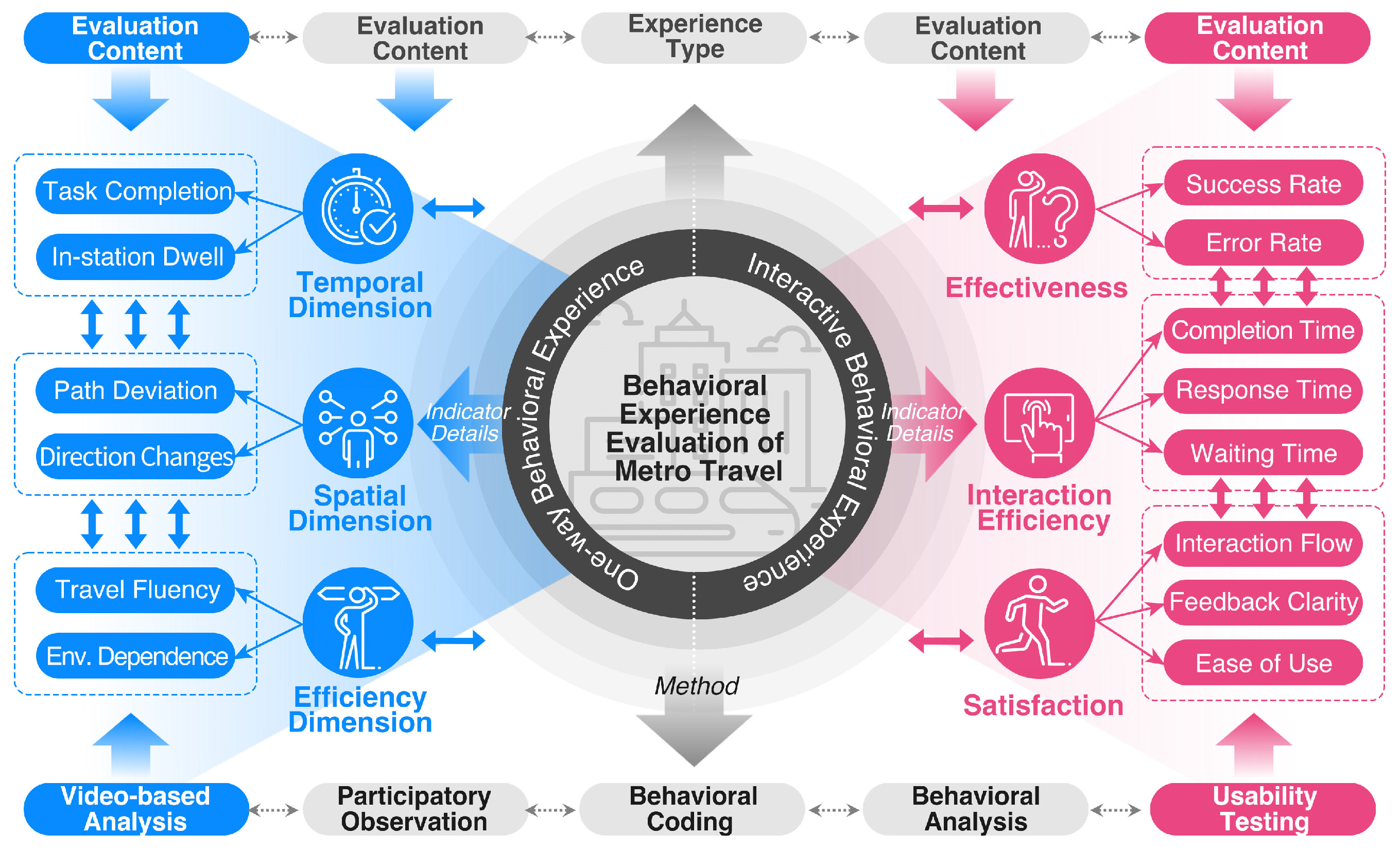
Figure 2).
As shown in
Figure 2, the BSBEM framework organizes metro passenger behavior into two complementary behavioral pathways supported by an integrative analytical core. The following paragraphs describe the functional roles of each component.
The left half of the framework represents the one-way behavioral pathway, consisting of three dimensions—temporal, spatial, and behavioral efficiency—which correspond to passengers’ autonomous movement patterns during metro travel. These indicators are derived from video-based behavioral observation, trajectory tracking, and temporal–spatial metrics, and quantify task duration, path deviation, direction changes, and movement fluency.
In contrast, the right half of the framework represents the interactive behavioral pathway, incorporating three complementary dimensions—effectiveness, interaction efficiency, and satisfaction. These indicators originate from usability testing and interaction-level performance logs, measuring task completion rate, error rate, response time, waiting time, and subjective feedback related to clarity and ease of use.
At the center of the framework, the two pathways converge through an integrative behavioral analysis process that links physical navigation behaviors with interaction tasks and system feedback. This analytical core enables the BSBEM to capture both autonomous travel behaviors and interaction-level operational behaviors within a single evaluative structure. The bottom layer of the framework further illustrates the methodological workflow—from participatory and non-participatory observation to behavioral coding, indicator extraction, and quantitative evaluation—showing how raw behavioral events are transformed into structured assessment outputs.
Through this dual-path and integrative structure, the BSBEM framework bridges behavioral observation with experiential measurement, enabling the identification of task-level inefficiencies and systemic interaction issues that influence overall user experience. This structural clarity provides a quantitative foundation for subsequent experimental validation and the development of behavioral optimization strategies.
To further clarify the methodological contribution of this study, the proposed BSBEM differs substantively from existing multidimensional behavioral evaluation frameworks. Traditional evaluation models—such as SERVQUAL, SUS, ISO 9241-11, and the HEART framework—primarily emphasize subjective perception, usability outcomes, or isolated interaction tasks, and thus offer limited capability for capturing continuous behavioral processes in complex transportation environments. Similarly, conventional behavioral observation approaches typically focus either on navigation trajectories or on discrete interaction behaviors, without integrating both behavior paths into a coherent analytical structure.
In contrast, the BSBEM incorporates a dual-path behavioral structure that simultaneously represents one-way navigation behaviors and interactive operational behaviors within a single analytical framework. This is complemented by a touchpoint–behavior coupling mechanism that links physical facilities, signage, interfaces, and interpersonal elements to observable behavioral outcomes. Furthermore, BSBEM adopts a process-oriented and multi-source evaluation approach, integrating objective behavioral metrics (e.g., time, deviation, steps) with subjective experiential assessments. Together, these features enable a more comprehensive, dynamic, and context-sensitive understanding of passenger behavior, offering explanatory depth that surpasses the capabilities of existing evaluation models.
2.2. Classification of Metro Travel Users
As a form of high-density public transportation, metro travel involves diverse user groups whose behaviors vary significantly in travel purpose, frequency, route choice, interaction with facilities, and information processing. These behavioral differences not only reflect variations in passengers’ habits and travel patterns but also shape the efficiency and satisfaction of their overall service experience. Therefore, classifying metro users according to their behavioral characteristics is crucial for uncovering group-based differences in behavioral patterns and experiential regularities. Such classification provides an empirical foundation for targeted experimental design and ensures the scientific validity and representativeness of subsequent model analysis.
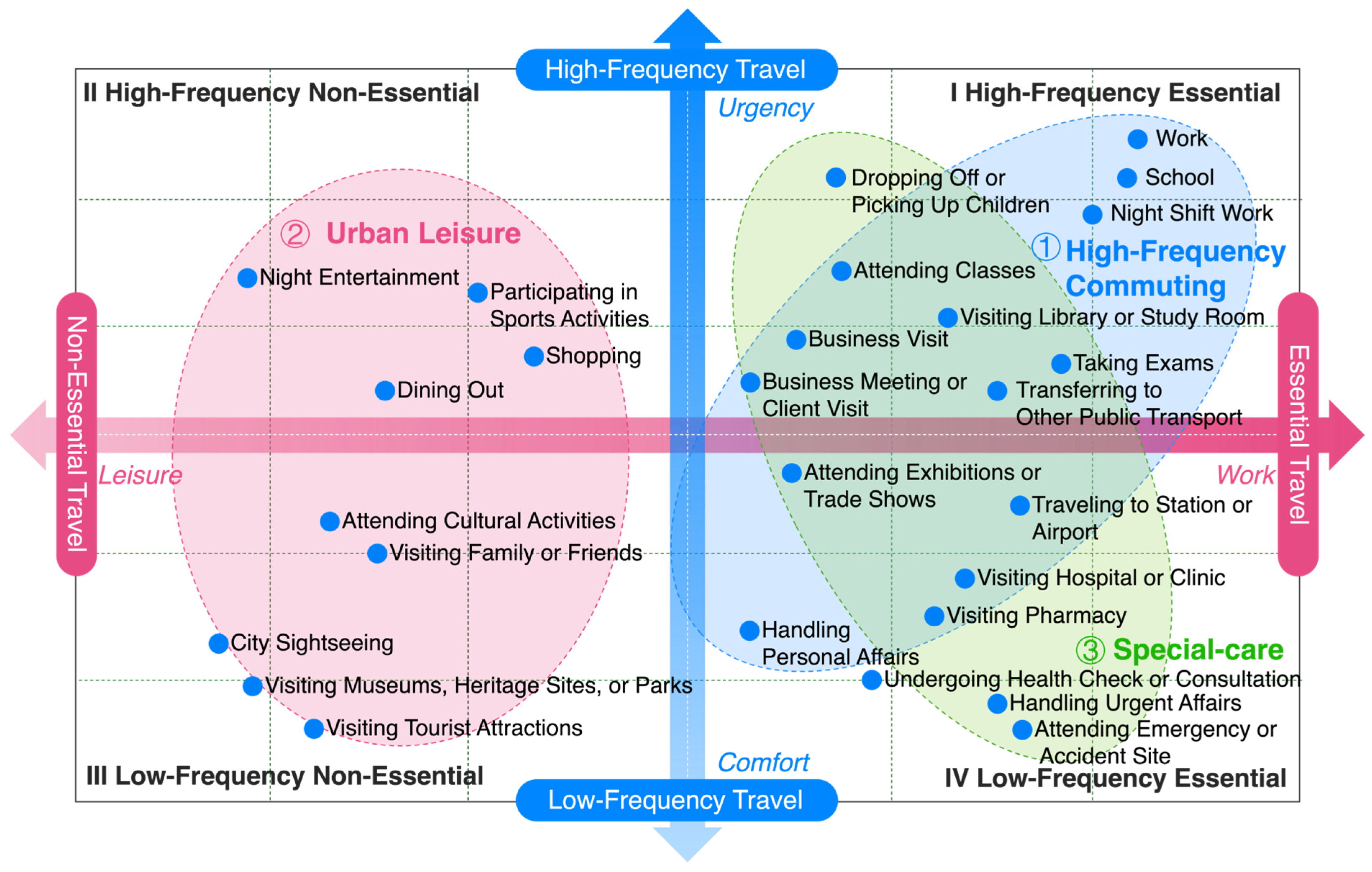
To develop a systematic classification framework, this study adopts a mixed approach combining theoretical induction, empirical data collection, and cluster analysis. Travel purpose and frequency were selected as the core variables, guided by the categorical principles defined in the Comprehensive Transportation Behavior Dictionary and supplemented by recent domestic and international studies on public transit behavior and passenger experience [
53,
54,
55]. Questionnaire surveys and on-site observations were conducted to collect data on passengers’ travel frequency, purpose, and behavioral preferences. Subsequently, an affinity-based clustering analysis was employed to visualize user categories by mapping behavioral attributes along two axes: travel necessity (horizontal) and travel frequency (vertical).
As shown in
Figure 3, passengers were classified into three representative user groups.
The first group comprises high-frequency commuters, who primarily consist of daily metro users traveling during peak hours. Their behavior emphasizes efficiency and spatial fluency, reflecting strong temporal regularity and a low tolerance for delays. These passengers tend to exhibit concise navigation patterns, high information sensitivity, and a preference for streamlined interactions with service facilities.
The second group consists of urban leisure travelers, who typically use the metro for social, recreational, or entertainment purposes such as shopping, dining, or attending cultural events. Their travel behavior is characterized by temporal flexibility, environmental awareness, and aesthetic sensitivity. Compared with commuters, they tend to have longer dwell times and demonstrate more exploratory interaction behaviors with station environments and information systems.
The third group includes special-care passengers, such as older adults, individuals with mobility limitations, and passengers traveling with children or luggage. Their behavior patterns are strongly dependent on environmental cues and spatial guidance information. They are more likely to encounter accessibility and usability barriers, often exhibiting higher rates of route adjustments, interaction challenges, and prolonged task completion times.
This classification framework captures the heterogeneity of passenger behaviors in terms of efficiency orientation, environmental adaptation, and interaction characteristics. It provides a robust behavioral foundation for the subsequent experimental design and evaluation procedures, ensuring that the BSBEM framework accommodates both mainstream and special-care passenger groups in real-world metro environments.
3. Behavioral Experience Experiment Design
3.1. Overall Experimental Framework
To validate the scientific rigor and applicability of the BSBEM, this study established a comprehensive experimental framework integrating multi-touchpoint observations and multi-source data collection. The experiment was designed to capture passengers’ behavioral patterns in real metro environments, focusing on task execution, route decision-making, touchpoint interactions, and operational efficiency. By comparing behavioral differences across user categories, the experiment aimed to verify the model’s explanatory capacity and its stability in characterizing group-level behavioral patterns.
From a methodological perspective, the experimental design followed a systematic logic that aligns theoretical modeling with empirical validation. The process consisted of five progressive stages: theoretical modeling, user classification, task design, data collection, and model verification.
Based on the previously developed BSBEM and the user classification results, representative participant groups were identified as the experimental targets.
Typical behavioral scenarios were selected along the metro travel chain, covering both one-way navigation tasks and interactive operation tasks.
The POEMSTI behavioral observation framework was applied to record user behaviors, integrating quantitative indicators such as time, spatial deviation, and operational efficiency.
Both subjective and objective data were collected synchronously, combining video-based behavioral tracking with task-level usability data.
Finally, integrated analytical methods—including behavioral coding and statistical correlation testing—were applied to examine the variations across one-way and interactive behavioral dimensions.
This design enables a comprehensive comparison of behavioral experience differences among passenger types, bridging perceptual evaluation with quantitative analysis. The overall experimental framework is illustrated in
Figure 4, which delineates the theoretical–empirical pathway linking model construction with behavioral validation.
3.2. Experimental Scenario and Task Design
The experiment was conducted at Beidajie Station on Xi’an Metro Line 2, a major interchange hub that connects Line 1 and Line 2 in the city center. The station features a mixed functional layout integrating commuting- and leisure-oriented passenger flows, with dense traffic, diverse service touchpoints, and complex spatial configurations. These attributes make it an ideal site for capturing representative behavioral characteristics of passengers in real-world metro environments. The experiment was carried out during off-peak hours on weekday afternoons to minimize external disturbances while maintaining comparable environmental conditions such as noise level, illumination, and temperature.
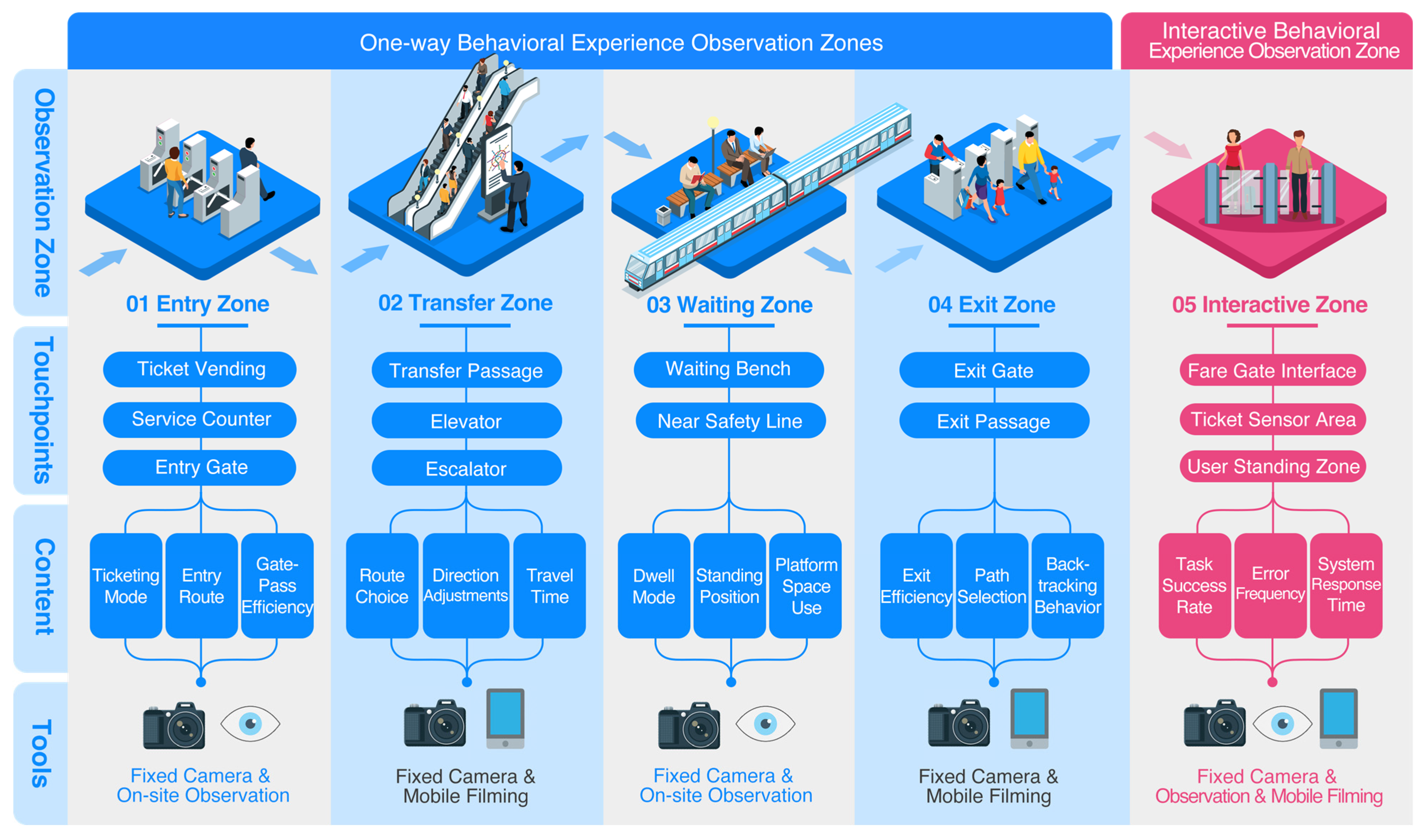
Following the dual-path logic of the BSBEM, experimental tasks were classified into two categories—one-way behavioral tasks and interactive behavioral tasks—to ensure consistency in behavioral scope and comparability across participants. The experimental scenario design is illustrated in
Figure 5.
This task focused on evaluating passengers’ navigation behaviors within metro spaces, emphasizing their decision-making, spatial movement, and route fluency. The observation covered three consecutive nodes—entrance, transfer, and exit areas—recording behavioral performance such as task completion time, path deviation, and frequency of directional adjustments. These indicators reflected participants’ spatial adaptability and route efficiency. To ensure task consistency, all participants were instructed to complete the same wayfinding task under identical starting and ending conditions, following standardized verbal prompts.
- 2.
Interactive Behavioral Task
This task examined passengers’ operational behaviors when interacting with metro service touchpoints. The focus was on ticket vending machines and fare gates, which represent key interactive nodes in the metro journey. The experiment measured behavioral indicators including task success rate, operational error frequency, and system response time. Data were collected through video tracking and POEMSTI-based observational logging, supported by synchronized usability testing records. Participants’ experiences were further supplemented by subjective feedback on interaction smoothness and interface clarity.
To ensure experimental consistency and data reliability, all participants received standardized task instructions before testing. During the experiment, multi-source data—including video recordings, sensor logs, and behavioral annotations—were collected synchronously for both one-way and interactive tasks. Upon task completion, brief post-task interviews were conducted to capture participants’ immediate feedback on usability and interaction quality. All procedures were supervised by the research team to ensure the reproducibility and integrity of the experimental process.
3.3. Experimental Subjects and Data Processing
3.3.1. Composition of Experimental Subjects
Participant recruitment was designed to ensure both representativeness and methodological rigor. The experiment involved actual passengers at Beidajie Station on Xi’an Metro Line 2, a key interchange hub that connects Lines 1 and 2. The station’s dense passenger flow, diverse spatial configurations, and mixed commuting–leisure functions provided an ideal context for observing authentic behavioral variations under complex metro conditions. Such environmental diversity also ensured that the behavioral data reflected the range of user experiences encountered in daily travel.
Based on the user typology developed in
Section 2.2, participants were divided into three distinct categories—high-frequency commuters, urban leisure travelers, and special-care passengers—each representing a different set of behavioral characteristics and experiential priorities. The composition of experimental subjects is summarized in
Table 2.
A total of 30 participants were recruited and evenly distributed across the three user groups to ensure balanced representation. Within the special-care group, participants occasionally traveled with companions (e.g., family caregivers), and thus each pair was counted as a single behavioral unit. The recruitment process combined random sampling and targeted screening to achieve both diversity and representativeness. Prior to participation, individuals completed a pre-screening questionnaire to confirm eligibility and user classification based on their typical metro travel behaviors.
All participants received standardized task briefings before data collection to ensure a consistent understanding of task requirements. Written informed consent was obtained from each participant in accordance with ethical research protocols. The balanced composition and controlled recruitment process provided a reliable empirical foundation for analyzing behavioral and experiential variations across user categories.
3.3.2. Behavioral Data Collection Process
Passenger behaviors during metro travel were systematically recorded through a combination of on-site observation and video documentation. This mixed approach established an integrated data acquisition framework encompassing both one-way navigation and interactive operational behaviors. Guided by the POEMSTI observation framework and the BSBEM evaluation model, the process captured passengers’ temporal–spatial movements and task-based interactions within the metro environment.
Data collection was conducted at Beidajie Station on Xi’an Metro Line 2, a representative interchange hub offering high passenger density and diverse service touchpoints. The observation covered four sequential zones—entry, transfer, waiting, and exit—each corresponding to typical behavioral touchpoints such as ticketing machines, escalators, platforms, and fare gates. Within each zone, behaviors were documented in terms of route decision-making, movement fluency, interaction efficiency, and system feedback.
As illustrated in
Figure 6, fixed cameras and handheld recorders were employed to obtain both static and dynamic visual data. This ensured synchronized observation of multiple behavioral dimensions while maintaining ecological validity under real travel conditions. The collected dataset provides the empirical basis for subsequent behavioral coding, quantitative analysis, and multi-source data fusion.
3.3.3. Data Analysis Methods
To ensure the scientific rigor and comparability of the experimental data, a systematic multi-step analysis was conducted on the collected video recordings and usability testing results. The analytical process comprised three key stages: behavioral video coding, interactive usability analysis, and inter-group difference testing.
Video data were obtained from four observation zones at Beidajie Station, recorded through both fixed and mobile cameras. The research team first synchronized all footage temporally and conducted event tagging to demarcate the start and end of each task. Guided by the logic of the POEMSTI observation method and the BSBEM evaluation framework, passenger behaviors were categorized into temporal, spatial, and efficiency dimensions.
The temporal dimension included indicators such as task completion time and waiting duration, capturing the time-related characteristics of passenger navigation behaviors.
The spatial dimension involved measures such as route deviation rate and the frequency of directional adjustments, reflecting passengers’ path stability and spatial decision-making processes.
The efficiency dimension captured movement fluency and environmental adaptability, indicating how effectively passengers interacted with the station environment under different behavioral demands.
Video annotation and quantitative measurement were performed using ErgoLAB behavioral analysis software (Version 3.0), and all coding was independently verified by multiple researchers to ensure inter-rater reliability. The behavioral coding framework is summarized in
Table 3.
- 2.
Interactive Usability Analysis
Interaction data were derived from ticketing machine experiments and analyzed following ISO 9241-11 and the HEART framework. The analysis focused on three indicators—effectiveness, interaction efficiency, and user satisfaction.
Effectiveness was evaluated through task completion rate and error frequency, capturing users’ ability to accomplish required actions accurately and reliably.
Interaction efficiency was determined by metrics such as task completion time, system response delay, and queue-waiting duration, reflecting the operational fluency and responsiveness of the interface.
Satisfaction encompassed users’ perceived fluency, operational comfort, and subjective ratings of convenience, obtained through post-task questionnaires and real-time observational feedback.
All usability-related data were recorded through screen-capture and real-time observation, and post-task questionnaires were administered to gather perceptual feedback on usability and interface design quality.
- 3.
Inter-Group Difference Analysis
Behavioral and interaction data were aggregated by user category, and both descriptive statistics and inferential analyses were conducted to examine between-group differences. Specifically, one-way Analysis of Variance (ANOVA) was applied to evaluate whether key behavioral indicators—such as task completion time, walking time, observation duration, and dwell-time measures—differed significantly among the three user groups.
When significant main effects were detected, Tukey’s Honestly Significant Difference (HSD) post hoc tests were performed to determine pairwise differences between groups. Effect sizes, expressed as partial eta squared (η
2), were reported to assess the magnitude of group effects. Statistical significance was set at
p < 0.05, and all analyses were conducted using IBM SPSS Statistics 26.0. This combined use of ANOVA and post hoc multiple comparisons is consistent with prior studies examining behavioral and usability differences across user groups in metro and public-space environments [
56,
57].
4. Results and Discussion
4.1. Experimental Results of One-Way Behavioral Experience Evaluation
4.1.1. Overall Behavioral Characteristics
To examine the behavioral patterns of different passenger groups during metro travel, this section analyzes the coded behavioral data obtained from the one-way behavioral experience experiments. A total of 30 behavioral video samples were collected, encompassing ten participants from each user group: high-frequency commuters, urban leisure travelers, and special-care passengers. Across all recordings, 612 behavioral events were identified, of which 476 valid task segments were coded, accounting for 77.8% of the total dataset. This level of coverage adequately captures the representative behavioral patterns of each user group. The summarized results of behavioral coding are presented in
Table 4.
The results indicate significant differences among the three user groups in terms of task completion time, route selection stability, and stopping behavior patterns. High-frequency commuters exhibited the most streamlined behavioral sequences, characterized by high efficiency, stable route decisions, and minimal pauses, reflecting their habitual navigation proficiency and task-oriented focus. In contrast, urban leisure travelers demonstrated longer travel durations and more frequent directional adjustments and observation pauses, reflecting a dual concern for spatial guidance and environmental adaptation. Their movement patterns were comparatively stable, but they exhibited periodic hesitations when processing wayfinding information or engaging with the station environment.
The special-care group, including elderly passengers and those accompanying dependents, showed the highest levels of behavioral uncertainty and redundancy, with frequent verification pauses and dependence on spatial cues such as signage and staff interaction. Their travel patterns revealed pronounced sensitivity to environmental complexity and accessibility conditions. These findings empirically confirm that behavioral efficiency and stability vary systematically across passenger categories, validating the presence of distinct one-way behavioral experience profiles among user groups. This differentiation establishes the analytical foundation for subsequent investigation of interactive behavioral experiences.
4.1.2. Temporal Characteristics Analysis
To reveal the temporal distribution patterns and behavioral rhythm variations among different passenger types during metro travel, this study compared task completion time, normal walking duration, observation pause duration, and key-point stop time across three user groups—high-frequency commuters, urban leisure travelers, and special-care passengers. The comparative results are presented in
Figure 7.
The overall results demonstrate distinct temporal differences among the three user groups. The high-frequency commuter group achieved the shortest average task completion time (129.5 s), significantly lower than that of the urban leisure group (166.7 s) and the special-care group (184.3 s). This finding indicates that frequent commuters exhibit greater efficiency and behavioral continuity, reflecting high familiarity with spatial layouts and rapid adaptability to navigational information. Their behaviors showed clear goal orientation, minimal pause duration, and streamlined movement patterns, suggesting a well-established procedural fluency in wayfinding tasks.
Urban leisure travelers, with an average task completion time of 166.7 s, displayed intermediate behavioral characteristics between efficiency and exploration. Their travel patterns revealed frequent short pauses and key-point stops, highlighting a stronger inclination toward environmental awareness and experiential observation. These users demonstrated a flexible behavioral rhythm, often pausing at directional signs, transfer corridors, or information displays to verify orientation or engage with environmental cues. Such behaviors emphasize perceptual engagement and situational adjustment within the metro environment.
The special-care group recorded the longest average task completion time (184.3 s), indicating higher levels of path uncertainty and environmental dependence. This group exhibited prolonged pause durations—particularly near escalators, ticket gates, and barrier-free passages—mainly for route confirmation and safety assessment. Their travel patterns were marked by redundant verification behavior and fragmented navigation sequences, underscoring greater reliance on auxiliary information and environmental support.
4.1.3. Spatial Pathway Analysis
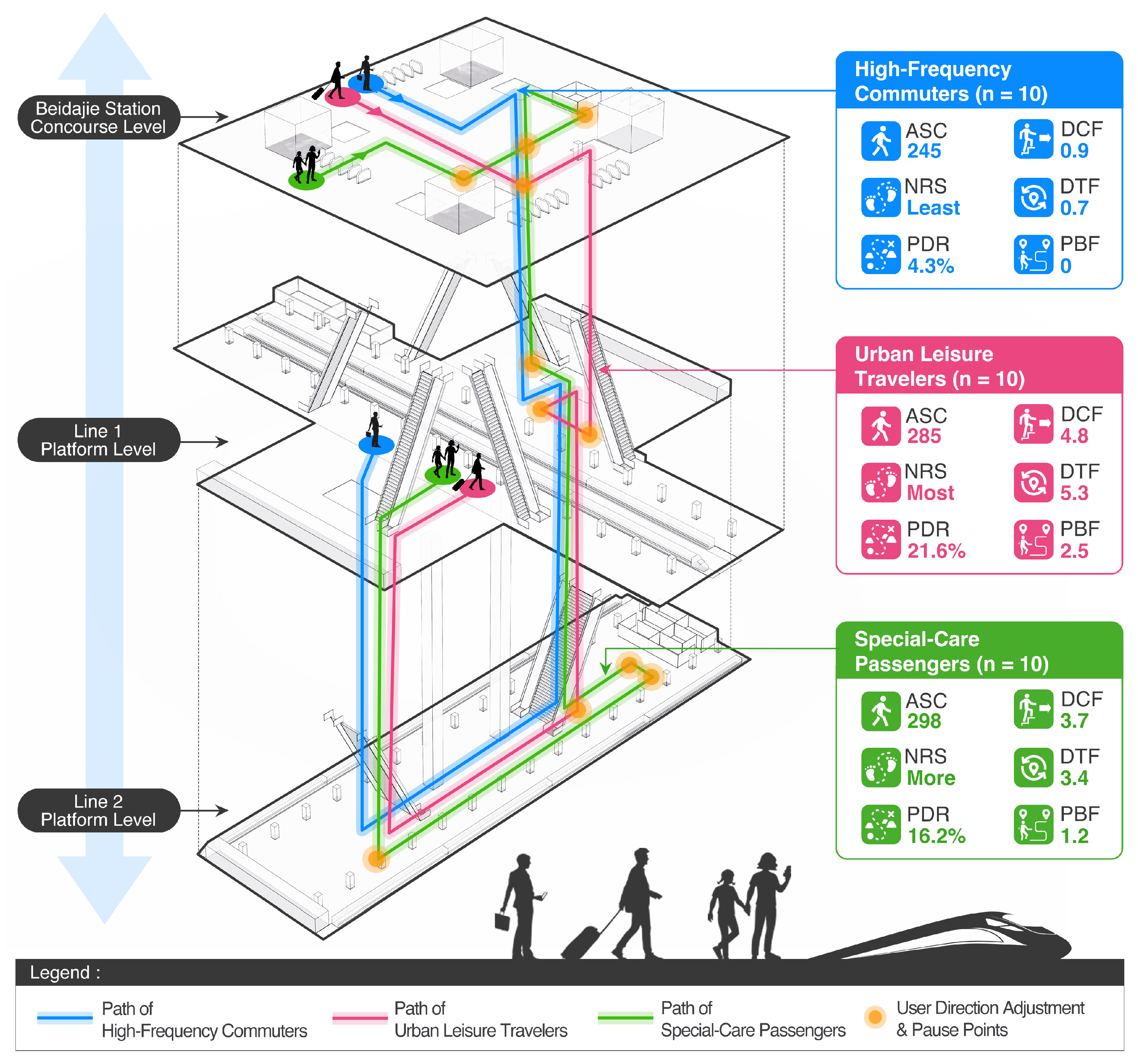
Differences in passengers’ route selection strategies and wayfinding stability across user groups were examined through comparative analysis of path length, complexity, deviation rate, and directional correction frequency. The results are illustrated in
Figure 8.
The spatial trajectory data reveal notable distinctions in path planning and execution behavior among the three passenger categories. The high-frequency commuter group exhibited the shortest and most optimized paths, averaging 245 steps with the smallest number of route segments. Their path deviation rate was only 4.3%, and the mean number of corrections was less than one per trip. Such performance indicates a high level of spatial familiarity and behavioral stability, suggesting habitual route optimization developed through frequent commuting experience.
The urban leisure traveler group demonstrated more exploratory and adaptive navigation behavior, with an average of 285 steps and the largest number of route segments. Their path deviation rate reached 21.6%, accompanied by 5.3 directional adjustments per trip, reflecting moderate uncertainty and frequent verification behaviors. This group often alternated between movement and brief observation, engaging in a “move–pause–navigate” cycle that emphasizes situational awareness and environmental exploration.
The special-care passenger group followed the longest routes, averaging 298 steps, with a path deviation rate of 16.2% and 3.4 directional corrections. Their navigation patterns were more cautious and context-dependent, particularly near escalators, elevators, and barrier-free corridors. These users frequently combined assistance-seeking behaviors with safety validation actions, displaying a higher reliance on environmental guidance and spatial cues.
4.1.4. Behavioral Efficiency Analysis
Based on the experimental data, this section compares behavioral efficiency across the three passenger groups through two core dimensions—travel fluency and environmental dependence—to identify variations in route stability and environmental adaptability. The results are presented in
Table 5.
The results indicate clear behavioral distinctions in execution continuity and environmental reliance during metro travel. The high-frequency commuter group demonstrated the highest travel fluency score (91.5%), significantly outperforming the urban leisure (80.6%) and special-care groups (78.7%). Their performance reflects superior behavioral stability and operational efficiency, characterized by minimal interruption and strong procedural continuity. This group relied primarily on route memory and habitual strategies to complete navigation tasks with minimal environmental reference.
The urban leisure traveler group exhibited moderate travel fluency and greater environmental engagement. Frequent short pauses and prolonged key-point stops suggest heightened sensitivity to visual cues and ambient information. This behavior pattern emphasizes perceptual exploration and information verification, indicating that environmental awareness plays an active role in their task execution.
The special-care group recorded the lowest travel fluency and the longest pause durations. Their route execution was notably affected by spatial complexity, high passenger density, and the accessibility of auxiliary facilities. The fragmented movement patterns and extended reaction times reflect a strong dependence on external environmental information and safety cues, underscoring their cautious and adaptive behavioral tendencies within complex spatial settings.
4.1.5. Statistical Validation
To verify whether the observed behavioral differences among the three user groups are statistically robust, one-way ANOVA and Tukey HSD post hoc tests were performed on key behavioral indicators. The results are summarized in
Table 6.
The ANOVA results indicate significant group effects across all behavioral indicators (all p < 0.001), with partial η2 values ranging from 0.918 to 0.980, suggesting large effect sizes and robust between-group differences.
Tukey HSD post hoc comparisons further revealed a consistent directional pattern: high-frequency commuters < urban leisure travelers < special-care passengers. Although differences between urban leisure and special-care passengers were statistically significant for key-point dwell time (p = 0.012) and aimless dwell time (p = 0.015), their magnitudes were smaller compared with other pairwise contrasts.
These statistical findings validate the behavioral distinctions identified in previous subsections and provide a solid empirical basis for subsequent integration into the multidimensional behavioral experience model.
4.2. Experimental Results of Interaction Behavior Experience Evaluation
4.2.1. Interaction Effectiveness Analysis
Interaction effectiveness reflects users’ ability to successfully achieve intended goals during human–machine interaction tasks. In this study, task effectiveness was evaluated through the Task Completion Rate (TCR) and Error Rate (ER), which together provide an integrated measure of users’ task performance. The calculation formula is as follows:
where
Nsuccess represents the number of completed interaction tasks, and
Ntotal denotes the total number of interaction attempts within the metro environment. The comparative results among user groups are summarized in
Table 7.
As shown in
Table 7, high-frequency commuters achieved the highest completion rate (95%), with almost no task failures. Their superior performance can be attributed to accumulated commuting experience, operational proficiency, and strong familiarity with metro ticketing interfaces and spatial layouts.
In comparison, urban leisure travelers exhibited a moderate completion rate of 90%. Most errors arose from inadequate recognition of Quick Response (QR) codes, system delays, and repeated confirmation actions, reflecting their lower operational confidence and less frequent exposure to ticketing devices.
The special-care group demonstrated the lowest completion rate (80%), often failing due to mismatched equipment recognition zones or insufficiently accessible interface design. Prolonged operation time and reliance on visual cues indicate difficulties in system adaptability and environmental coordination. These findings suggest that accessibility limitations and interface complexity present significant challenges for this group’s interaction effectiveness within metro environments.
4.2.2. Interaction Efficiency Analysis
Interaction efficiency measures both the fluency of user operations and the system’s responsiveness during task execution. Three key indicators—task completion time, system response time, and waiting time—were analyzed to evaluate the overall smoothness and responsiveness of metro service interactions. The results are illustrated in
Figure 9.
As shown in
Figure 9, clear variations were observed in interaction efficiency among the three user groups. The high-frequency commuter group exhibited the best overall performance, with an average task completion time of 4.5 s, a system response time of 1.2 s, and a waiting time of 0.5 s. This indicates that frequent commuters benefit from habitual familiarity and procedural automation, which together lead to fluent, low-effort interactions with minimal cognitive delay. The urban leisure traveler group demonstrated moderate performance, completing tasks in an average of 6.6 s, with a system response time of 2.4 s and a waiting time of 1.4 s. The extended interaction time suggests intermittent pauses for information verification and posture adjustment during ticketing operations, revealing a less stable interaction flow compared to commuters.
In contrast, the special-care passenger group showed the longest task completion time (9.0 s) and the slowest average system response (2.8 s), with an average waiting time of 2.2 s. These results reflect the compounded influence of physical limitations and environmental accessibility challenges. The higher variability in operation time suggests that this group experiences greater dependence on external assistance and environmental cues when performing interaction tasks.
4.2.3. Interaction Performance Analysis
To further elucidate the behavioral mechanisms underlying efficiency differences, this study conducted a qualitative analysis based on video observations. Three representative behavioral patterns were identified across user types during gate interactions, as illustrated in
Figure 10.
The high-frequency commuter group displayed fast, stable, and highly automated interaction behaviors. Their ticketing process was characterized by rapid completion with almost no pauses or observable hesitation. These users typically prepared their QR codes in advance and maintained well-structured spatial movement, indicating strong spatial familiarity and cognitive anticipation of the interaction sequence. However, occasional brief visual confirmation behaviors were observed when scanning, reflecting momentary verification needs rather than task uncertainty.
The urban leisure traveler group exhibited more frequent interruptions and a higher degree of information dependence during interaction. Users often rechecked on-screen prompts or adjusted posture to scan tickets, especially when carrying personal items. These repeated micro-corrections prolonged interaction time and revealed a higher reliance on visual cues and textual feedback. Consequently, their behavior indicated less procedural fluency and a moderate cognitive load during task execution.
The special-care passenger group showed the most complex and fragmented interaction patterns. Wheelchair users and individuals with mobility challenges frequently paused to align with recognition zones, while accompanying users with children tended to overshoot or re-enter scanning areas. Older passengers demonstrated delayed responses and repeated scanning attempts, suggesting insufficient interface accessibility and extended response time. These difficulties highlight that non-barrier-free configurations and inconsistent sensor calibration remain critical constraints affecting inclusive interaction performance in metro systems.
Overall, the comparative analysis reveals that user interaction performance is shaped by the synergy of three factors—habitual familiarity, environmental adaptability, and interface accessibility. These findings provide essential empirical evidence for refining universal service design, emphasizing the need to optimize feedback visibility, ergonomic layout, and multimodal interaction cues in future metro service systems.
4.3. Comprehensive Analysis of Experimental Findings
Building upon the experimental findings from both one-way travel and interaction behavior analyses, this section synthesizes the behavioral patterns observed across different user groups, emphasizing the relationships among familiarity, information dependency, environmental adaptability, and behavioral efficiency. The integrated analysis reveals that user experience in metro travel is shaped not merely by isolated actions but by the dynamic coupling between perception, cognition, and environmental response. These results provide a theoretical foundation for refining touchpoint design and constructing a multidimensional behavioral experience model.
To further justify the adequacy of the sample size, it should be noted that the experiment generated a substantial volume of analyzable behavioral data. Across the 30 participants, more than 600 valid behavioral events were coded from continuous video observations, complemented by multi-source indicators such as task duration, spatial deviation, interaction logs, and usability metrics. These multidimensional datasets provided sufficient analytical resolution for identifying behavioral differences, even under controlled participant numbers. The sample size is consistent with prior metro and public-space behavioral studies, where mixed-method designs typically involve 20–40 participants [
56,
58,
59]. All behavioral events were independently annotated and cross-checked by two trained coders to ensure the reliability and consistency of the behavioral dataset.
Although the sample size is limited, the aim of this study was to characterize behavioral patterns and interaction mechanisms rather than to derive population-level estimations, ensuring that the analytical depth remains aligned with the nature of behavioral research.
High-frequency commuters demonstrated the strongest spatial memory and operational proficiency across both experimental contexts. Their behavior reflected procedural automatization, characterized by short task completion time (129.5 s), high interaction success rate (95%), and minimal deviation during route selection (4.3%). Such proficiency suggests that extensive experiential exposure fosters internalized interaction schemas, enabling users to navigate and interact with minimal cognitive demand.
However, the video observations revealed that high familiarity occasionally led to perceptual under-engagement, as some commuters overlooked visual cues and paused briefly when unexpected interface feedback occurred. This finding underscores that even highly experienced users remain susceptible to perceptual complacency under conditions of repetitive automation, highlighting the design importance of “rapid feedback visibility” to maintain situational awareness.
- 2.
Adaptive adjustment among information-dependent users.
Urban leisure travelers exhibited moderate efficiency but pronounced adaptive behavioral patterns. Their average task duration (166.7 s) and route deviation rate (21.6%) reflected a continuous adjustment loop—frequent micro-pauses, visual scanning of signs, and iterative posture corrections. This adaptive search behavior indicates an elevated dependence on external cues to reduce uncertainty in decision-making.
Such reliance aligns with the “information-foraging” mechanism observed in dynamic public environments, where users compensate for limited spatial knowledge through iterative information validation. Accordingly, optimizing multimodal feedback channels—such as synchronized visual and auditory prompts—can effectively mitigate cognitive interruptions and enhance flow continuity in user interactions.
- 3.
Compensatory behavior and assistive needs among environmentally sensitive users.
Special-care passengers demonstrated the most fragmented behavioral patterns, with the longest task completion time (184.3 s) and the lowest interaction success rate (80%). Their behaviors—frequent pauses, repeated scanning, and route realignment—reflected a compensatory adaptation mechanism driven by physical or perceptual constraints.
Wheelchair users frequently experienced misalignment with recognition areas, while elderly passengers displayed delayed response and repeated confirmation attempts. These behaviors reveal that accessibility barriers are not solely physical but also cognitive and perceptual. Hence, future metro touchpoint design should prioritize dual optimization: enhancing spatial reachability and cognitive comprehensibility through multimodal feedback and ergonomic adaptation.
- 4.
Correlation between one-way and interactive behavior patterns.
The comparative analysis across the two experimental dimensions demonstrates a positive correlation between spatial-cognitive complexity and interaction latency. In essence, the more cognitively demanding the route execution, the longer the response and waiting times during interaction tasks. For instance, leisure travelers—who exhibited frequent directional adjustments in navigation—also showed prolonged confirmation behaviors during interaction.
Conversely, commuters with consistent route schemas maintained higher system fluency and shorter waiting intervals. This relationship highlights that behavioral performance at metro touchpoints is not an isolated phenomenon but a continuous chain of cognitive actions within the travel journey. Therefore, optimizing metro service design should extend beyond single touchpoint performance to achieve seamless cognitive continuity across the entire travel process—linking perception, action, and feedback into a coherent behavioral flow.
5. Discussion and Optimization Strategies
5.1. Key Research Findings
High-frequency commuters exhibit stable spatial memory and proficient interaction skills, completing tasks within the shortest duration while maintaining the highest level of operational fluency. Urban leisure travelers rely heavily on visual signage and cue-based decision-making, which often leads to route readjustments and temporary pauses. In contrast, the behavioral efficiency of special-care passengers is strongly affected by the reachability of accessible facilities and the clarity of environmental guidance.
- 2.
Spatial-cognitive complexity is positively correlated with interaction efficiency.
Users who perform frequent route adjustments or detours during navigation tend to show prolonged reaction and waiting times at interactive touchpoints. High-frequency commuters maintain consistency between spatial route planning and task execution, sustaining behavioral continuity between “navigation” and “interaction,” whereas information-dependent and special-care passengers experience accumulated delays and higher error rates due to cognitive fragmentation.
- 3.
Information feedback quality and environmental continuity are critical determinants of overall experience.
Discontinuities within the current guidance system—such as fragmented visual cues and incomplete accessibility interfaces—lead to insufficient information acquisition and response delays. Hence, the legibility and reachability of touchpoint design constitute pivotal factors influencing overall travel experience across diverse user groups.
5.2. Design Strategies
Building upon the experimental findings and identified behavioral bottlenecks, this study proposes three strategic pathways for optimizing metro touchpoint design, focusing on improving information legibility, interaction adaptability, and inclusive intelligent services.
A coherent and readable information environment is essential for ensuring rapid user orientation and reducing behavioral interruptions. The visual clarity and semantic consistency of signage should be strengthened by integrating dynamic LED cues, auditory prompts, and multimodal indicator systems. This holistic approach facilitates efficient information retrieval at key nodes—such as transfer corridors, exits, and escalator zones—thereby minimizing hesitation, navigation errors, and redundant detours.
- 2.
Optimize spatial configuration and interaction feedback mechanisms.
The spatial layout of metro environments should support both intuitive navigation and responsive interaction. Introducing intelligent routing feedback and adaptive prompt systems within transfer or gate zones can enhance users’ situational awareness and error tolerance. Real-time projection cues, gradient lighting, and multi-level accessible guidance interfaces can dynamically adapt to passenger density and context, strengthening the continuity of behavioral flow and improving interaction fluency.
- 3.
Construct inclusive and intelligent touchpoint experiences.
To address the diverse needs of passengers—particularly those with mobility or sensory limitations—metro touchpoints should integrate smart-sensing technologies and adaptive guidance. Mobile-based augmented reality (AR) prompts, voice-assisted interaction, and environmental sensing can collectively establish a context-aware guidance network that supports differentiated user experiences. This approach contributes to developing a human-centered intelligent mobility ecosystem, extending accessibility from physical space to perceptual and cognitive dimensions.
5.3. Operational Implications
The behavioral mechanisms identified in this study demonstrate how user performance is influenced not only by individual characteristics but also by operational conditions such as passenger flow intensity and train headways. Although these variables were not manipulated experimentally, the BSBEM findings enable a grounded interpretation of how real metro environments may shape—or amplify—the behavioral tendencies observed under controlled conditions. Three major implications for operational environments are summarized below.
High-density passenger flow increases visual occlusion, restricts maneuvering space, and elevates competition for spatial resources at critical nodes such as gate areas, escalator interfaces, and decision-making intersections. Under such conditions, the behavioral tendencies identified in urban leisure travelers and special-care passengers—frequent route reassessment, slower decision transitions, and heightened sensitivity to spatial uncertainty—are likely to become more pronounced. High-frequency commuters, by contrast, exhibit stronger spatial continuity and are less affected by crowding-related pressures.
To mitigate these effects, enhancing the real-time visibility, placement continuity, and redundancy of wayfinding cues at congestion-prone locations can help reduce navigation hesitation and improve stability for visually dependent users.
- 2.
Headway intervals and temporal clustering of behavioral load.
Train headways shape the temporal rhythm of passenger surges. Longer headways generate large, simultaneous arrivals, which elevate queuing pressure at gates and increase synchronized delays in interaction tasks. In contrast, short headways reduce sustained crowding but lead to more frequent corridor pulses, which may disrupt the behavioral continuity of users who rely heavily on environmental cues.
Improving the responsiveness and error tolerance of gate interfaces—particularly during short-interval surges—can support smoother interaction flows for diverse user groups and reduce delay accumulation.
- 3.
Behavior–operation coupling and system robustness.
The dual-path structure of behavior identified in this study reveals that high-frequency commuters maintain stable task continuity, whereas urban leisure travelers and special-care passengers are more vulnerable to environmental instability such as local bottlenecks, directional flow imbalances, or micro-crowding. These sensitivities may lead to interruptions along both navigation and interaction pathways when operational loads fluctuate.
Strengthening the reachability, clarity, and continuity of accessible pathways can help prevent mobility conflicts and improve behavioral robustness for users with mobility or perceptual limitations.
Taken together, these implications translate the experimental findings into actionable insights for real-world metro operations without overstating variables not tested in the study. Recognizing how flow intensity, headway rhythms, and localized environmental instability interact with the behavioral mechanisms revealed in the BSBEM enables operators to anticipate user-specific vulnerabilities. By reinforcing guidance visibility during peak flows, improving gate-system responsiveness under short headways, and prioritizing barrier-free access in stations serving larger proportions of special-care passengers, metro systems can enhance behavioral continuity, operational resilience, and overall user experience.
6. Conclusions
This study investigates the behavioral characteristics of metro passengers in real travel contexts and proposes a dual-path behavioral experience evaluation framework—the Bi-directional Service Behavioral Experience Model (BSBEM)—built upon the POEMSTI behavioral observation approach. The framework integrates one-way and interactive behavioral data to empirically examine temporal, spatial, and efficiency-related characteristics across different user groups.
The results demonstrate that user type significantly influences the temporal patterns and interaction behaviors observed during metro travel. Route familiarity, cognitive load, and feedback response are shown to interact dynamically, while the continuity of information cues and environmental legibility emerges as a critical factor constraining behavioral efficiency. High-frequency commuters benefit from procedural automatization, urban leisure travelers rely heavily on visual guidance and exploratory pauses, and special-care passengers face disproportionate behavioral burdens linked to accessibility and system feedback. These findings provide a quantitative basis for data-driven optimization of metro services and validate the necessity of approaching public transportation experience from an integrated “behavior–interaction–touchpoint” perspective.
On a practical level, the study proposes a systematic set of design and operational strategies focused on enhancing information legibility, improving interaction feedback, and strengthening inclusive service provision. By explicitly revealing where and how special-care passengers encounter disproportionate behavioral effort, the BSBEM framework offers a tool for identifying structural disadvantages in existing metro environments and for prioritizing interventions at critical touchpoints. In this way, the behavioral evidence generated in this study supports the development of fairer and more inclusive metro services and contributes to more sustainable urban mobility by improving the attractiveness and usability of public transportation for diverse passenger groups.
Despite these contributions, several limitations should be acknowledged. Although 30 participants yielded over 600 valid behavioral events complemented by multi-source indicators (task duration, spatial deviation, interaction logs, and usability metrics), the sample size and non-probability recruitment strategy limit the generalizability of the findings. This is particularly relevant for interaction-related indicators, whose statistical precision can benefit from larger participant pools. Furthermore, all data were collected at a single interchange station in Xi’an under off-peak conditions, restricting the spatial, operational, and cultural diversity reflected in the results. Passenger behavior may vary in metropolitan systems with different settlement structures, network typologies, peak-hour crowding patterns, and accessibility coverage levels. Additionally, the experiments focused primarily on selected physical touchpoints and did not include remote digital services or multimodal transfer scenarios. Finally, while the study draws implications for fairness, inclusiveness, and sustainable mobility, it did not directly measure equity-oriented or sustainability-related indicators.
Future research should expand the participant pool and incorporate multi-station and multi-city case studies across varied demand levels, including peak and off-peak periods, to strengthen cross-context applicability. Incorporating contextual parameters such as urban density, network topology, interchange typology, and accessibility coverage into the BSBEM framework would further improve its generalizability and enable cross-city comparative analysis. Integrating multimodal data sources—such as eye-tracking, speech interaction logs, longitudinal smart-card records, and environmental performance indicators—will facilitate the development of predictive and scalable behavioral evaluation models. Such advancements will enable more precise assessment of distributional impacts on different user groups and ultimately contribute to the creation of intelligent, inclusive, and sustainable metro systems.