
The Impact of ESG Controversies on Abnormal ESG Performance: Evidence from China


Abstract
1. Introduction
- -
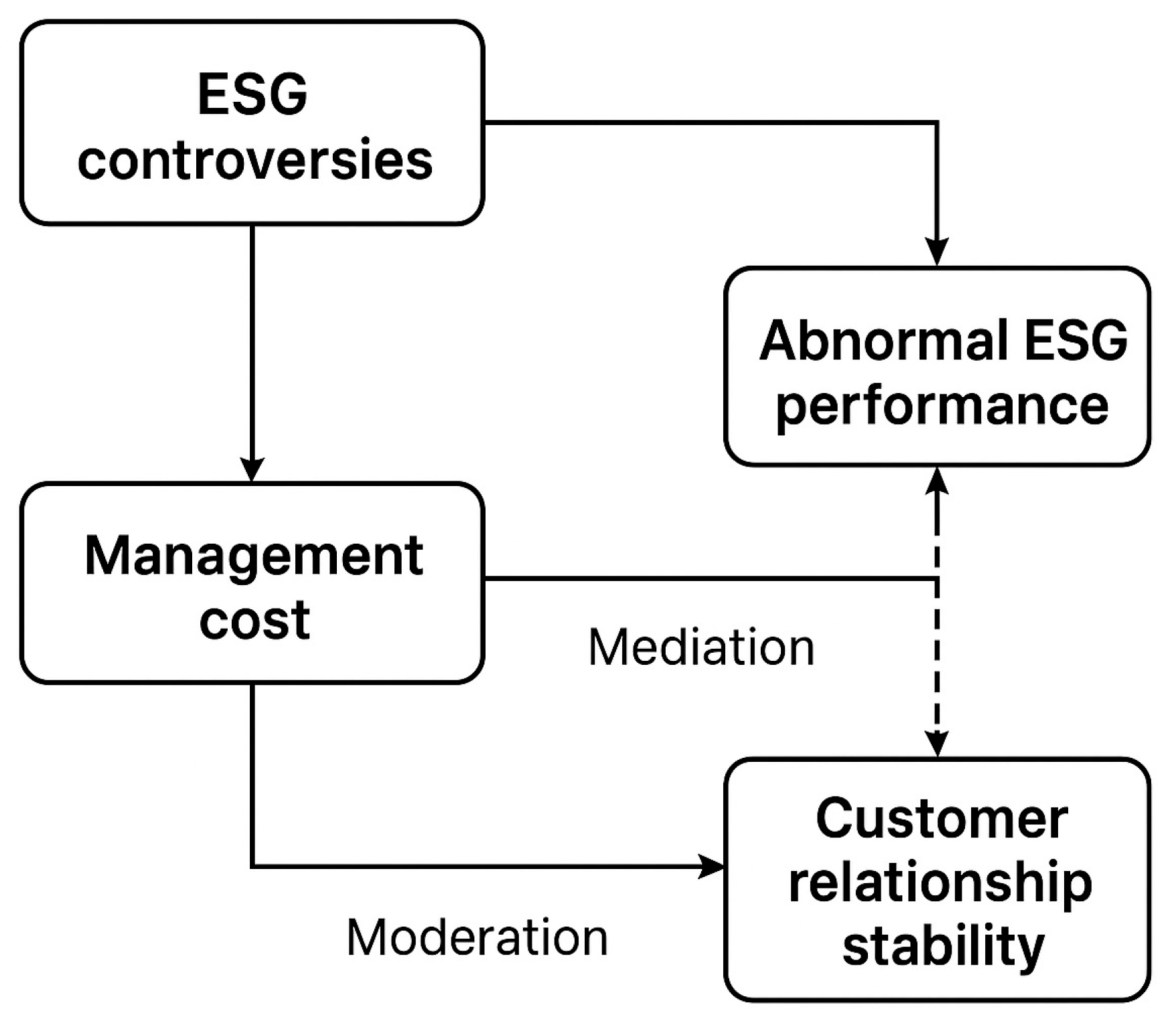
- How do ESG controversies, as reflected in rating divergences among different agencies, influence firms’ abnormal ESG performance in China?
- -
- Through what mechanisms (particularly management cost) do ESG controversies affect firms’ ESG outcomes?
- -
- Do firm-level characteristics such as financial efficiency and customer stability moderate the impact of ESG controversies on abnormal ESG performance?
- -
- What are the broader economic consequences (e.g., profitability volatility, asset utilization, credit access) of ESG rating divergence, and how are these effects shaped by analyst and investor attention?
2. Literature Review and Hypotheses
2.1. Literature Review
2.2. Conceptual Framework and Mechanisms
2.3. The Impact of ESG Controversies on Abnormal ESG Performance
2.4. The Impact of ESG Controversies on ESG Under-Performance and ESG Outperformance
- CFO (operating cash flow): Net cash flow from operating activities scaled by total assets:
- Management Cost: Administrative expenses divided by operating revenue:
- Profit volatility: Three-year rolling standard deviation of ROA (net income/total assets) computed over
- Credit availability: Net new debt issuance scaled by total assets: , where .
- Green_aware (executive green cognition): Binary indicator equal to 1 if at least one top executive (CEO, Chair, or top 3 executives by compensation) has prior role/degree/credential in environmental, sustainability, renewable energy, ecology, climate, or related fields as detected by keyword parsing of executive bios. The source is annual report executive biographies and the CSMAR executive database. We manually validated ambiguous cases for the top 5% of matches.
3. Data and Methodology
3.1. Variables
3.1.1. Abnormal ESG
3.1.2. ESG Controversies
3.1.3. Constructing the Leave-One-out City Instrument (City_ESG_contro_LOO)
3.1.4. Control Variables
3.2. Empirical Model
3.3. Data
3.3.1. Data Source and Pretreatment
3.3.2. Descriptive Statistics
4. Results and Discussions
4.1. Baseline Results
4.2. Robustness Tests
4.3. Heterogeneity Tests
4.4. Moderation Analysis of Financial Efficiency and Supply Chain Customer Stability
4.5. Economic Consequences
5. Conclusions and Policy Implications
Author Contributions
Funding
Institutional Review Board Statement
Informed Consent Statement
Data Availability Statement
Conflicts of Interest
Appendix A. Variable Definitions
| Variables: | Definitions: | Source: |
| Abs_ESG_resid | Absolute deviation of ESG performance from expected ESG value | SynTao Green Finance |
| ESG_contro | It refers to the variation or inconsistency in ESG scores or ratings assigned to the same firm by different ESG rating agencies or providers | Huazheng, WIND, SynTao Green Finance, and Menglang |
| City_ESG_contro_LOO | It refers the leave-one-out (LOO) city mean of other firms’ ESG_contro in the same year: . Observations with Nc,t = 1 are excluded from IV estimation. | Huazheng, WIND, SynTao Green Finance, and Menglang |
| Size | Natural logarithm of total assets | CSMAR |
| Log_employee | Natural logarithm of the number of employees | CSMAR |
| ROA | Ratio of net income to total assets | CSMAR |
| Tobinq | Market-to-book ratio, calculated as the market value of assets divided by the book value of assets | CSMAR |
| Age | The years that a firm has survived | CSMAR |
| Independ | Ratio of independent director number to total director number | CSMAR |
| CFO | It is consistently defined as operating cash flow/sales | CSMAR |
| State_owned | It is a binary variable that takes the value of 1 if a firm is state-owned and 0 otherwise | CSMAR |
| Tangibility | The ratio of property, plant, and equipment to total assets | CSMAR |
| Financial efficiency | It refers to the relative ability of firms to raise and utilize funds. This paper constructs an evaluation system encompassing input and output indicators and applies data envelopment analysis (DEA) to measure and evaluate financing efficiency. Input indicators include total owner’s equity, total liabilities, and cash outflow from financing activities, reflecting the efficiency of capital utilization and financing costs. Output indicators include operating income, net profit, and increase in operating income, reflecting the efficiency of capital utilization, profitability, and growth. | CSMAR |
| Cust_stability | It is calculated as the number of the top five customers from the previous year divided by 5; the higher the value, the more stable the firm’s major customers are. | CSMAR |
| Profit volatility | It measures the three-year rolling standard deviation of annual ROA (net income/total assets) | CSMAR |
| Fixed asset turnover | It measures how efficiently a firm utilizes its fixed assets to generate sales, calculated as net sales divided by average fixed assets. | CSMAR |
| Environ_subsidies | It equals the percentage of government environmental subsidies to total assets at the end of the period. | CSMAR |
| Analyst_attention | The average over the past three years of the number of sell-side analysts following a given listed firm. | CSMAR |
| Internet_index | It is calculated as the natural logarithm of the sum of the Baidu Index for the stock abbreviation and code of a listed firm. | Hand collected |
| Credit availability | It is the ratio of a firm’s long-term loans to its total assets. | CSMAR |
| Pre_ESG_contro | It is explicitly the first-stage fitted value of ESG_contro in the 2SLS models; we added its equation | Pre_ESG_contro |
| Management Cost | It is defined as “administrative expenses/operating revenue,” measured annually from the CSMAR database | Management Cost |
| Green_aware | Binary indicator constructed from executive biographies and CVs using keyword-based text parsing: set Green_aware = 1 if at least one top executive (CEO/Chair/Top 3 executives) has prior experience in “environment/energy/sustainability/green” roles OR holds degrees/credentials in environmental fields, otherwise 0. | Green_aware |
Appendix B. Quantile Regression Results
| (1) | (2) | (3) | (4) | (5) | (6) | (7) | (8) | (9) | |
| Panel A: The Relation Between ESG Controversies and Absolute Value of Abnormal ESG | |||||||||
| Variables | Q10 | Q20 | Q30 | Q40 | Q50 | Q60 | Q70 | Q80 | Q90 |
| ESG_contro | 0.0258 | 0.0423 | 0.0605 *** | 0.1060 *** | 0.1242 *** | 0.1577 *** | 0.2181 *** | 0.2362 *** | 0.2478 *** |
| (0.0118) | (0.0369) | (0.0217) | (0.0237) | (0.0246) | (0.0297) | (0.0347) | (0.0419) | (0.0634) | |
| Constant | −0.5214 | −2.321 *** | −4.158 *** | −5.4848 ** | −7.120 *** | −7.9645 *** | −10.545 *** | −14.838 *** | −23.829 *** |
| (0.4149) | (0.5957) | (0.7619) | (0.8325) | (0.866) | (1.0452) | (1.2191) | (1.4756) | (2.2298) | |
| Observations | 9159 | 9159 | 9159 | 9159 | 9159 | 9159 | 9159 | 9159 | 9159 |
| Controls | Yes | Yes | Yes | Yes | Yes | Yes | Yes | Yes | Yes |
| YFE | Yes | Yes | Yes | Yes | Yes | Yes | Yes | Yes | Yes |
| IFE | Yes | Yes | Yes | Yes | Yes | Yes | Yes | Yes | Yes |
| Panel B: The relation between ESG controversies and outperformance of actual ESG relative to expected ESG (ESG_resid >= 0) | |||||||||
| ESG_contro | −0.0311 ** | −0.065 *** | −0.085 *** | −0.093 *** | −0.1006** | −0.1121 ** | −0.0881 | −0.0863 | 0.001 |
| (0.0147) | (0.0237) | (0.0309) | (0.035) | (0.0426) | (0.0535) | (0.0649) | (0.0839) | (0.1177) | |
| Constant | −0.2745 | −1.5052 * | −3.926 *** | −7.212 *** | −9.828 *** | −12.678 *** | −17.117 *** | −23.679 *** | −36.519 *** |
| (0.4826) | (0.7794) | (1.0192) | (1.1518) | (1.402) | (1.7637) | (2.1379) | (2.7629) | (3.877) | |
| Observations | 4302 | 4302 | 4302 | 4302 | 4302 | 4302 | 4302 | 4302 | 4302 |
| Controls | Yes | Yes | Yes | Yes | Yes | Yes | Yes | Yes | Yes |
| YFE | Yes | Yes | Yes | Yes | Yes | Yes | Yes | Yes | Yes |
| IFE | Yes | Yes | Yes | Yes | Yes | Yes | Yes | Yes | Yes |
| Panel C: The relation between ESG controversies and underperformance of actual ESG relative to expected ESG (ESG_resid < 0) | |||||||||
| ESG_contro | 0.1011 *** | 0.1421 *** | 0.1937 *** | 0.2450 *** | 0.3093 *** | 0.3550 *** | 0.3887 *** | 0.4667 *** | 0.5463 *** |
| (0.018) | (0.0272) | (0.0274) | (0.031) | (0.0303) | (0.0327) | (0.0357) | (0.0452) | (0.0513) | |
| Constant | −0.9369 | −3.856 *** | −5.344 *** | −7.041 *** | −6.720 *** | −6.785 *** | −8.393 *** | −9.5895 *** | −12.382 *** |
| (0.674) | (1.0206) | (1.0284) | (1.1609) | (1.138) | (1.2283) | (1.3387) | (1.6968) | (1.9252) | |
| Observations | 4857 | 4857 | 4857 | 4857 | 4857 | 4857 | 4857 | 4857 | 4857 |
| Controls | Yes | Yes | Yes | Yes | Yes | Yes | Yes | Yes | Yes |
| YFE | Yes | Yes | Yes | Yes | Yes | Yes | Yes | Yes | Yes |
| IFE | Yes | Yes | Yes | Yes | Yes | Yes | Yes | Yes | Yes |
| Dependent variable: Abs_ESG_resid; Specification:Baseline controls + Year FE + Industry FE; Key regressor: ESG_contro_z (z-score normalized disagreement); Coefficient (ESG_contro_z): 0.182; t-statistic: * (5.81); N: ** 9159; Adj. R2: 0.153; Standard errors in parentheses *** p < 0.01, ** p < 0.05, * p < 0.1; Note: Conventional conditional quantile regressions are reported (10th/50th/90th percentiles). Year and industry fixed effects are included as dummy regressors (entered as controls) rather than using FE-QR estimators. | |||||||||
Appendix C. Robustness of Baseline Model to DK and Conley Standard Errors
| Variable | (1) Two-Way Clustered SE (firm × year) | (2) Driscoll–Kraay SE | (3) Conley SE |
| ESG_contro | 0.145 *** (4.82) | 0.142 *** (4.11) | 0.147 *** (4.26) |
| Size | 0.319 *** (3.68) | 0.301 *** (3.44) | 0.317 *** (3.52) |
| Leverage | 0.155 (1.22) | 0.148 (1.14) | 0.152 (1.18) |
| CFO | 0.119 (1.45) | 0.116 (1.39) | 0.118 (1.43) |
| ROA | –0.028 (–1.09) | –0.030 (–1.12) | –0.029 (–1.10) |
| ESG_NUM | 0.014 ** (0.006) | 0.013 ** (0.006) | 0.012 * (0.007) |
| Constant | –2.097 *** (–4.84) | –2.081 *** (–4.51) | –2.114 *** (–4.63) |
| Year FE | YES | YES | YES |
| Industry FE | YES | YES | YES |
| Observations | 9145 | 9145 | 9145 |
| Adj. R2 | 0.128 | 0.125 | 0.127 |
| Notes: Column (1) reports the baseline model with two-way clustered standard errors (firm and year). Column (2) reports Driscoll–Kraay standard errors, which are robust to cross-sectional dependence and serial correlation; the DK window length is set to 4 years. Column (3) reports Conley standard errors with a Bartlett kernel and a cutoff of 500 km based on firm-city coordinates. *** p < 0.01, ** p < 0.05, * p < 0.10. | |||
References
- Liao, F.; Sun, Y.; Xu, S. Financial Report Comment Letters and Greenwashing in ESG Disclosures: Evidence from China. Energy Econ. 2023, 127, 107122. [Google Scholar] [CrossRef]
- Chatterji, A.K.; Durand, R.; Levine, D.I.; Touboul, S. Do Ratings of Firms Converge? Implications for Managers, Investors and Strategy Researchers. Strateg. Manag. J. 2016, 37, 1597–1614. [Google Scholar] [CrossRef]
- Kimbrough, M.D.; Wang, X.; Wei, S.; Zhang, J. Does Voluntary ESG Reporting Resolve Disagreement Among ESG Rating Agencies? Eur. Account. Rev. 2024, 33, 15–47. [Google Scholar] [CrossRef]
- Avramov, D.; Cheng, S.; Lioui, A.; Tarelli, A. Sustainable Investing with ESG Rating Uncertainty. J. Financ. Econ. 2022, 145, 642–664. [Google Scholar] [CrossRef]
- DasGupta, R. Financial Performance Shortfall, ESG Controversies, and ESG Performance: Evidence from Firms Around the World. Financ. Res. Lett. 2022, 46, 102487. [Google Scholar] [CrossRef]
- Gantchev, N.; Giannetti, M.; Li, R. Sustainability or Performance? Ratings and Fund Managers’ Incentives. J. Financ. Econ. 2024, 155, 103831. [Google Scholar] [CrossRef]
- Nirino, N.; Santoro, G.; Miglietta, N.; Quaglia, R. Corporate Controversies and Company’s Financial Performance: Exploring the Moderating Role of ESG Practices. Technol. Forecast. Soc. Change 2021, 162, 120341. [Google Scholar] [CrossRef]
- Bu, L.; Chan, K.C.; Choi, A.; Zhou, G. Talented Inside Directors and Corporate Social Responsibility: A Tale of Two Roles. J. Corp. Financ. 2021, 70, 102044. [Google Scholar] [CrossRef]
- Al-Shaer, H.; Uyar, A.; Kuzey, C.; Karaman, A.S. Do Shareholders Punish or Reward Excessive CSR Engagement? Moderating Effect of Cash Flow and Firm Growth. Int. Rev. Financ. Anal. 2023, 88, 102672. [Google Scholar] [CrossRef]
- Wang, M.; Wang, Y.; Wen, S. ESG Performance and Green Innovation in New Energy Enterprises: Does Institutional Environment Matter? Res. Int. Bus. Financ. 2024, 71, 102495. [Google Scholar] [CrossRef]
- Farag, H.; Koirala, S.; Luo, D.; Rao, S. Do Titans Deliver the ESG Promise? Societal Recognition and Responsible Corporate Decisions. Br. J. Manag. 2024, 36, 885–909. [Google Scholar] [CrossRef]
- Schiemann, F.; Tietmeyer, R. ESG Controversies, ESG Disclosure and Analyst Forecast Accuracy. Int. Rev. Financ. Anal. 2022, 84, 102373. [Google Scholar] [CrossRef]
- Edmans, A.; Heinle, M.S.; Huang, C. The Real Costs of Financial Efficiency When Some Information Is Soft. Rev. Financ. 2016, 20, 2151–2182. [Google Scholar] [CrossRef]
- Zhang, J.P.; Mo, H.M.; Hu, Z.J.; Zhang, T.J. The Effect of Stability and Concentration of Upstream and Downstream Relationships of Focal Firms on Two-Level Trade Credit. Int. J. Prod. Econ. 2024, 270, 109173. [Google Scholar] [CrossRef]
- Saharti, M.; Saeed, A.; Chaudhry, S.M.; Nasir, M.A. Lending Relationships of Firms for a Just Transition. Eur. Financ. Manag. 2024, 31, 1195–1216. [Google Scholar] [CrossRef]
- Chen, C.-C.; Ho, K.-C.; Li, H.-M.; Yu, M.-T. Impact of Information Disclosure Ratings on Investment Efficiency: Evidence from China. Rev. Quant. Financ. Account. 2023, 60, 471–500. [Google Scholar] [CrossRef]
- Huang, A.H.; Lehavy, R.; Zang, A.Y.; Zheng, R. Analyst Information Discovery and Interpretation Roles: A Topic Modeling Approach. Manag. Sci. 2018, 64, 2833–2855. [Google Scholar] [CrossRef]
- Berg, F.; Kölbel, J.F.; Rigobon, R. Aggregate Confusion: The Divergence of ESG Ratings. Rev. Financ. 2022, 26, 1315–1344. [Google Scholar] [CrossRef]
- Christensen, D.M.; Serafeim, G.; Sikochi, A. Why Is Corporate Virtue in the Eye of the Beholder? The Case of ESG Ratings. Account. Rev. 2022, 97, 147–175. [Google Scholar] [CrossRef]
- Gibson Brandon, R.; Krueger, P.; Schmidt, P.S. ESG Rating Disagreement and Stock Returns. Financ. Anal. J. 2021, 77, 104–127. [Google Scholar] [CrossRef]
- Aouadi, A.; Marsat, S. Do ESG Controversies Matter for Firm Value? Evidence from International Data. J. Bus. Ethics 2018, 151, 1027–1047. [Google Scholar] [CrossRef]
- Rahat, B.; Nguyen, P. The Impact of ESG Profile on Firm’s Valuation in Emerging Markets. Int. Rev. Financ. Anal. 2024, 95, 103361. [Google Scholar] [CrossRef]
- Serafeim, G.; Yoon, A. Stock Price Reactions to ESG News: The Role of ESG Ratings and Disagreement. Rev. Account. Stud. 2023, 28, 1500–1530. [Google Scholar] [CrossRef]
- Al-Shaer, H.; Zaman, M.; Albitar, K. CEO Gender, Critical Mass of Board Gender Diversity and ESG Performance: UK Evidence. J. Account. Lit. 2024; ahead of print. [Google Scholar] [CrossRef]
- Li, R.; Liu, Z.; Gan, K. Impact of Cities’ Issuance of Green Bonds on Local Firm Performance: Evidence from China. Oper. Res. 2024, 24, 38. [Google Scholar] [CrossRef]
- Wang, J.; Qi, B.; Li, Y.; Hossain, M.I.; Tian, H. Does Institutional Commitment Affect ESG Performance of Firms? Evidence from the United Nations Principles for Responsible Investment. Energy Econ. 2024, 130, 107302. [Google Scholar] [CrossRef]
- Čater, T.; Čater, B.; Milić, P.; Žabkar, V. Drivers of Corporate Environmental and Social Responsibility Practices: A Comparison of Two Moderated Mediation Models. J. Bus. Res. 2023, 159, 113652. [Google Scholar] [CrossRef]
- Lestari, N.I.G.; Adhariani, D. Can Intellectual Capital Contribute to Financial and Non-Financial Performances During Normal and Crisis Situations? Bus. Strategy Environ. 2022, 5, 390–404. [Google Scholar] [CrossRef]
- Lu, Y.Z.; Xu, C.; Zhu, B.S.; Sun, Y.Q. Digitalization Transformation and ESG Performance: Evidence from China. Bus. Strategy Environ. 2024, 33, 352–368. [Google Scholar] [CrossRef]
- Sprinkle, G.B.; Maines, L.A. The Benefits and Costs of Corporate Social Responsibility. Bus. Horiz. 2010, 53, 445. [Google Scholar] [CrossRef]
- Tashman, P.; Marano, V.; Kostova, T. Walking the Walk or Talking the Talk? Corporate Social Responsibility Decoupling in Emerging Market Multinationals. J. Int. Bus. Stud. 2019, 50, 153–171. [Google Scholar] [CrossRef]
- Faleye, O.; Hoitash, R.; Hoitash, U. The Costs of Intense Board Monitoring. J. Financ. Econ. 2011, 101, 160–181. [Google Scholar] [CrossRef]
- Luo, X.; Bhattacharya, C.B. Corporate Social Responsibility, Customer Satisfaction, and Market Value. J. Mark. 2006, 70, 1–18. [Google Scholar] [CrossRef]
- Naughton, J.P.; Wang, C.; Yeung, I. Investor Sentiment for Corporate Social Performance. Account. Rev. 2019, 94, 401–420. [Google Scholar] [CrossRef]
- Elamer, A.A.; Boulhaga, M. ESG Controversies and Corporate Performance: The Moderating Effect of Governance Mechanisms and ESG Practices. Corp. Soc. Responsib. Environ. Manag. 2024, 31, 3312–3327. [Google Scholar] [CrossRef]
- Lopatta, K.; Canitz, F.; Tideman, S.A. Abnormal CSR and Financial Performance. Eur. Account. Rev. 2024, 33, 49–75. [Google Scholar] [CrossRef]
- Treepongkaruna, S.; Kyaw, K.; Jiraporn, P. ESG Controversies and Corporate Governance: Evidence from Board Size. Bus. Strategy Environ. 2024, 33, 4218–4232. [Google Scholar] [CrossRef]
- Li, X.; Lou, Y.; Zhang, L. Do commercial ties influence ESG ratings. J. Account. Res. 2023, 61, 1901–1940. [Google Scholar]
- Harjoto, M.A.; Laksmana, I. The impact of corporate social responsibility on risk taking and firm value. J. Bus. Ethics 2018, 151, 353–373. [Google Scholar] [CrossRef]
- Gao, L.; Lisic, L.L.; Zhang, I.X. Accounting comparability, audit effort, and audit pricing. Account. Rev. 2021, 96, 363–394. [Google Scholar]
- Cheng, B.; Ioannou, I.; Serafeim, G. Corporate social responsibility and access to finance. Strateg. Manag. J. 2014, 35, 1–23. [Google Scholar] [CrossRef]
- Waddock, S.A.; Graves, S.B. The corporate social performance–financial performance link. Strateg. Manag. J. 1997, 18, 303–319. [Google Scholar] [CrossRef]
- Kim, Y.; Li, H.; Li, S. Corporate social responsibility and stock price crash risk. J. Bank. Financ. 2014, 43, 1–13. [Google Scholar] [CrossRef]
- Broadstock, D.C.; Chan, K.; Cheng, L.T.; Wang, X. The role of ESG performance during times of financial crisis: Evidence from COVID-19 in China. Financ. Res. Lett. 2021, 38, 101716. [Google Scholar] [CrossRef]
- Orlitzky, M.; Schmidt, F.L.; Rynes, S.L. Corporate social and financial performance: A meta-analysis. Organ. Stud. 2003, 24, 403–441. [Google Scholar] [CrossRef]
- Fatemi, A.; Glaum, M.; Kaiser, S. ESG performance and firm value: The moderating role of disclosure. Glob. Financ. J. 2018, 38, 45–64. [Google Scholar] [CrossRef]
- Ghouma, H.; Ben-Nasr, H.; Yan, R. Corporate Governance and Cost of Debt Financing: Empirical Evidence from Canada. Q. Rev. Econ. Financ. 2018, 67, 138–148. [Google Scholar] [CrossRef]
- Agnese, P.; Battaglia, F.; Busato, F.; Taddeo, S. ESG Controversies and Governance: Evidence from the Banking Industry. Financ. Res. Lett. 2023, 53, 103397. [Google Scholar] [CrossRef]
- Smith, R.J.; Muir, R.D.; Walpole, M.J.; Balmford, A.; Leader-Williams, N. Governance and the Loss of Biodiversity. Nature 2003, 426, 67–70. [Google Scholar] [CrossRef]
- Schumacher, K. Green Investments Need Global Standards and Independent Scientific Review. Nature 2020, 584, 524–525. [Google Scholar] [CrossRef]
- Chen, C.; Yan, Y.; Jia, X.; Wang, T.; Chai, M. The Impact of Executives’ Green Experience on ESG Performance: Evidence from China. J. Environ. Manag. 2024, 366, 121819. [Google Scholar] [CrossRef]
- Kish, Z.; Fairbairn, M. Investing for Profit, Investing for Impact: Moral Performances in Agricultural Investment Projects. Environ. Plan. A: Econ. Space 2018, 50, 569–588. [Google Scholar] [CrossRef]
- He, W.; Wang, X.; Miao, M. Network Infrastructure and Corporate Environmental Performance: Empirical Evidence from “Broadband China”. Energy Econ. 2024, 131, 107393. [Google Scholar] [CrossRef]
- Da, Z.; Engelberg, J.; Gao, P.J. In Search of Attention. J. Financ. 2011, 66, 1461–1499. [Google Scholar] [CrossRef]
- Karl, T.R.; Trenberth, K.E. Modern Global Climate Change. Science 2003, 302, 1719–1723. [Google Scholar] [CrossRef]
- Hao, X.; Miao, E.; Wen, S.; Wu, H.; Xue, Y. Executive Green Cognition on Corporate Greenwashing Behavior: Evidence from A-Share Listed Companies in China. Bus. Strategy Environ. 2024, 34, 2012–2034. [Google Scholar] [CrossRef]
- Gu, J.; Shi, X.; Wang, P.; Xu, X. Examining the Impact of Upstream and Downstream Relationship Stability and Concentration on Firms’ Financial Performance. J. Bus. Res. 2022, 141, 229–242. [Google Scholar] [CrossRef]
- Banerjee, S.; Dasgupta, S.; Kim, Y. Buyer–Supplier Relationships and the Stakeholder Theory of Capital Structure. J. Financ. 2008, 63, 2507–2552. [Google Scholar] [CrossRef]
- Wang, Y.; Gong, X. Does Financial Development Have a Non-Linear Impact on Energy? Evidence from 30 in China. Energy Econ. 2020, 90, 104845. [Google Scholar] [CrossRef]
- Liu, B.; Ju, T.; Chan, H.K. The Diverse Impact of Heterogeneous Customer Characteristics on Supply Chain Finance: Empirical Evidence from Chinese Factoring. Int. J. Prod. Econ. 2022, 243, 108321. [Google Scholar] [CrossRef]
- Plakoyiannaki, E.; Tzokas, N.; Dimitratos, P.; Saren, M. How Critical Is Employee Orientation for Customer Relationship Management? Insights from a Case Study. J. Manag. Stud. 2008, 45, 268–293. [Google Scholar] [CrossRef]
- Bradshaw, M.T.; Lock, B.; Wang, X.; Zhou, D.X. Soft Information in the Financial Press and Analyst Revisions. Account. Rev. 2021, 96, 107–132. [Google Scholar] [CrossRef]
- Li, X.; Lou, Y.; Zhang, L. Do Commercial Ties Influence ESG Ratings? Evidence from Moody’s and S&P. J. Account. Res. 2024, 62, 1901–1940. [Google Scholar]
- Mola, S.; Rau, P.R.; Khorana, A. Is There Life after the Complete Loss of Analyst Coverage? Account. Rev. 2013, 88, 667–705. [Google Scholar] [CrossRef]
- Iliev, P.; Kalodimos, J.; Lowry, M. Investors’ Attention to Corporate Governance. Rev. Financ. Stud. 2021, 34, 5581–5628. [Google Scholar] [CrossRef]
- Li, H.; Liu, Y.-F.; Liang, S.; Zhou, Q. Tourism Firm Restructuring: Does the Attention of Individual Investor Matter? Tour. Manag. 2020, 80, 104126. [Google Scholar] [CrossRef]



| Variable | Definition/Measurement | Expected Relationship/Role | Supporting Literature |
|---|---|---|---|
| Abnormal ESG (Dependent variable) | Residual from regression of firm ESG score on firm fundamentals and industry-year effects. Represents deviation from expected ESG performance. | Measures deviation (positive or negative) from expected ESG; reflects over- or under-investment in ESG activities. | [38] |
| ESG Controversies (Independent variable) | Range or standard deviation of ESG ratings across rating agencies; higher values indicate greater inter-rater disagreement. | Positive association with abnormal ESG due to increased uncertainty and inconsistent stakeholder signals. | [18,19,20] |
| Management Cost (Mediator) | Ratio of administrative expenses to operating revenue. Indicates resource burden of managing ESG complexities. | Positive mediation: higher cost channels the effect of ESG controversies on abnormal ESG (inefficient allocation). | [39] |
| Financial Efficiency (Moderator) | Measured as asset turnover or return on assets (ROA). Reflects managerial efficiency in resource utilization. | Negative moderation: higher efficiency mitigates the positive link between ESG controversies and abnormal ESG. | [40] |
| Customer Stability (Moderator) | Measured by customer concentration index or revenue share from top customers. | Negative moderation: stable customers reduce firms’ incentive to overreact to ESG rating divergence. | [41] |
| Firm Size (Control) | Natural logarithm of total assets. | Larger firms are more likely to engage in ESG activities but may experience less deviation due to established procedures. | [42] |
| Leverage (Control) | Ratio of total liabilities to total assets. | High leverage may constrain ESG investment, leading to lower or more volatile ESG deviations. | [43] |
| Profitability (Control) | Return on assets (ROA). | Higher profitability supports consistent ESG performance, reducing abnormal deviation. | [44] |
| Tobin’s Q (Control) | Market value of assets divided by book value. | Firms with higher market valuations may face stronger ESG pressure and lower abnormal deviation. | [45] |
| Firm Age (Control) | Log of years since establishment. | Older firms may have more stable ESG policies, leading to smaller abnormal deviations. | [46] |
| Variable | N | Mean | SD | Min | P50 | Max |
|---|---|---|---|---|---|---|
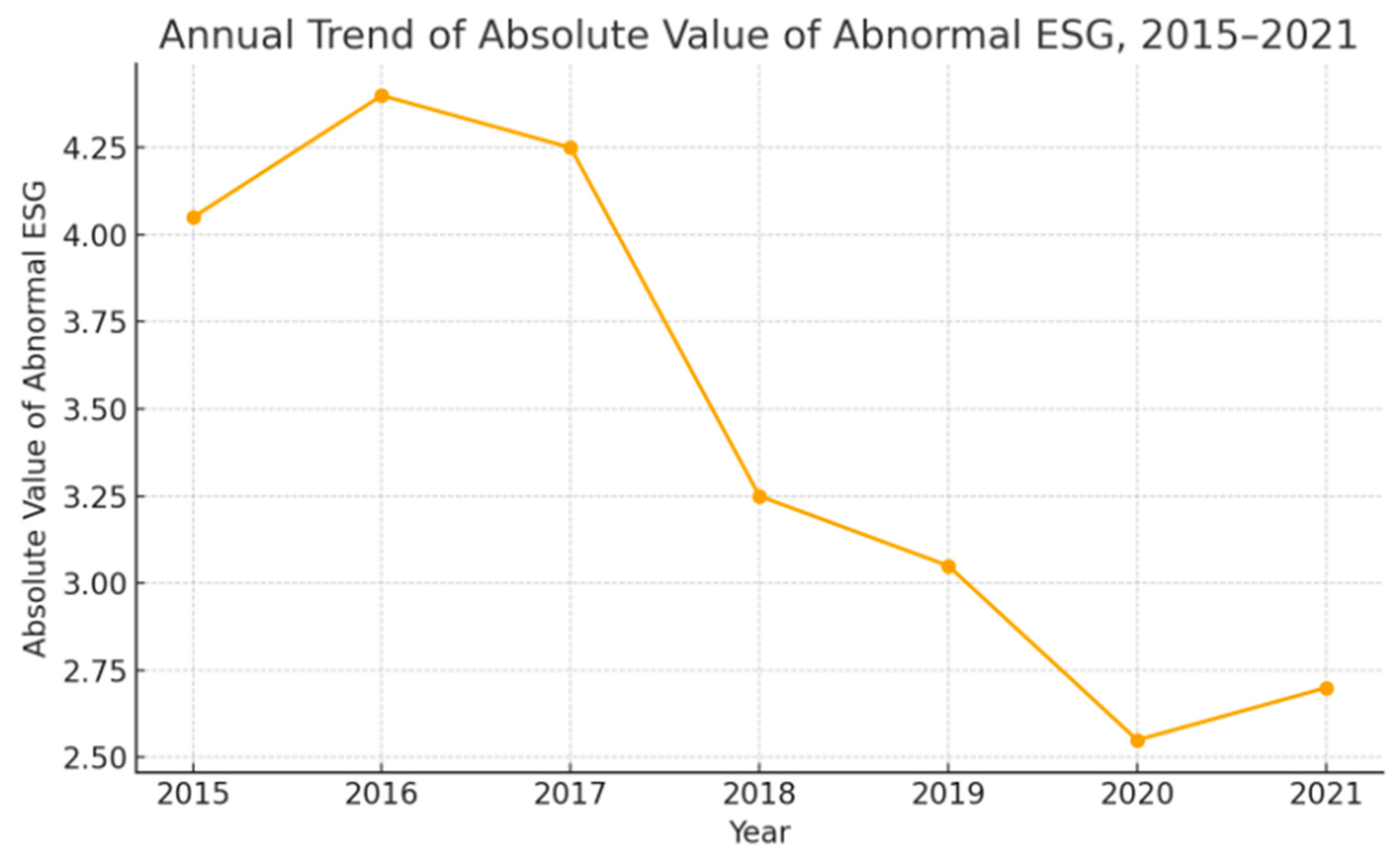
| Abs_ESG_resid | 9181 | 2.878 | 2.750 | 0 | 2.151 | 25.160 |
| ESG_contro | 10,818 | 1.941 | 1.222 | 0 | 2 | 7 |
| Size | 10,967 | 22.691 | 1.487 | 20.019 | 22.482 | 28.520 |
| Log_employee | 10,965 | 7.909 | 1.430 | 2.485 | 7.804 | 13.165 |
| CFO | 10,967 | 0.108 | 0.229 | −1.728 | 0.099 | 1.483 |
| ROA | 10,967 | 0.034 | 0.083 | −0.374 | 0.039 | 0.219 |
| Tobinq | 10,943 | 2.083 | 1.501 | 0.818 | 1.590 | 9.643 |
| Age | 10,970 | 20.419 | 5.721 | 8 | 20 | 35 |
| Independ | 10,967 | 0.385 | 0.077 | 0.200 | 0.375 | 0.800 |
| Tangibility | 10,965 | 0.194 | 0.157 | 0 | 0.157 | 0.928 |
| State_owned | 10,970 | 0.336 | 0.472 | 0 | 0 | 1 |
| ROE | 9569 | 0.074 | 1.173 | −2.570 | 0.074 | 6.904 |
| Financial_efficiency | 10,902 | 0.955 | 0.052 | 0.658 | 0.976 | 1 |
| Cust_stability | 6429 | 0.804 | 0.36 | 0 | 1 | 1 |
| Profit volatility | 10,961 | 0.054 | 0.32 | 0 | 0.021 | 19.656 |
| Fixed asset turnover | 10,931 | 20.066 | 62.708 | 0.424 | 6.045 | 686.791 |
| Analyst_attention | 7610 | 11.616 | 11.883 | 1.000 | 7.000 | 73.000 |
| Internet_index | 9744 | 6.718 | 0.833 | 4.935 | 6.636 | 9.207 |
| Credit availability | 10,072 | 0.045 | 0.201 | −0.266 | 0.039 | 0.875 |
| Dependent Variable | (1) Abs_ESG_resid Full Sample | (2) Abs_ESG_resid ESG_resid ≥ 0 | (3) Abs_ESG_resid ESG_resid < 0 | (4) ESG_contro (rater × year-normalized) |
|---|---|---|---|---|
| ESG_contro | 0.145 *** | −0.0423 * | 0.3841 *** | |
| ESG_contro_z | - | - | - | 0.158 *** (5.09) |
| (4.7075) | (−2.0453) | (11.8585) | 0.319 *** (3.68) | |
| ESG_NUM | 0.021 ** (2.19) | 0.013 (1.42) | 0.018 * (1.68) | 0.022 ** (2.24) |
| Size | 0.6441 *** | 0.8924 *** | 0.4677 *** | |
| (11.4422) | (12.2709) | (8.5108) | 0.155 (1.22) | |
| Log_employee | 0.0428 | 0.2080 | −0.1349 | |
| (1.1297) | (1.2261) | (−0.7897) | ||
| CFO | −0.0657 | −0.2218 | 0.0501 | 0.119 (1.45) |
| (−0.7314) | (−1.1387) | (0.5184) | ||
| ROA | 0.2532 | 0.5372 | −0.2326 | –0.028 (–1.09) |
| (0.7907) | (0.8031) | (−0.6293) | ||
| Tobinq | 0.0674 ** | 0.0902 ** | 0.0076 | 0.125 (1.2) |
| (2.2897) | (2.3318) | (0.3757) | ||
| Age | 0.0836 ** | 0.0579 * | 0.0181 | 0.055 (0.95) |
| (2.5755) | (1.9505) | (1.4252) | ||
| Independ | −0.1803 | −0.7182 | 0.2708 | 0.014 (0.42) |
| (−0.4018) | (−1.8427) | (1.6762) | ||
| Tangibility | −0.3846 | −0.0437 | −0.6459 ** | –0.047 (–1.26) |
| (−1.7835) | (−0.0897) | (−3.5538) | ||
| State_owned | −0.1560 ** | −0.0316 | −0.4028 *** | –0.181 (–1.55) |
| (−2.4544) | (−0.1740) | (−7.3528) | ||
| Constant | −11.9280 *** | −15.5034 *** | −8.8024 *** | –2.097 *** (–4.84) |
| (−12.5816) | (−11.9536) | (−7.7465) | ||
| Year fixed effects | YES | YES | YES | YES |
| Industry fixed effects | YES | YES | YES | YES |
| N | 9359 | 5502 | 2557 | 9145 |
| Adj. R2 | 0.2529 | 0.1779 | 0.5585 | 0.1268 |
| Panel A: The Impact of ESG Controversies on the Absolute Value of Abnormal ESG | |||||||
|---|---|---|---|---|---|---|---|
| Dependent Variable | (1) Alternative Abs_ESG_resid | (2) Alternative ESG_contro Abs_ESG_resid | (3) Firm Fixed Effects Abs_ESG_resid | (4) 2SLS Pre_ESG_contro First stage | (5) 2SLS Abs_ESG_resid Second stage | (6) Mediating Effect Cost Step 1 | (7) Mediating Effect Abs_ESG_resid Step 2 |
| ESG_contro | 0.0615 *** | 0.2814 *** | 0.2330 *** | 0.6434 *** | 1.7819 ** | 0.5224 *** | |
| (4.1511) | (3.8581) | (2.4569) | (2.7560) | (2.6318) | (3.1152) | ||
| City_ESG_contro_LOO | 0.7725 *** (18.4754) | ||||||
| ESG_NUM | 1.350 ** (2.73) | 0.020 ** (2.03) | |||||
| Cost | 0.0490 ** | ||||||
| (2.7920) | |||||||
| Controls | YES | YES | YES | YES | YES | YES | YES |
| Year fixed effects | YES | YES | YES | YES | YES | YES | YES |
| Industry fixed effects | YES | YES | NO | YES | YES | YES | YES |
| Firm fixed effects | NO | NO | YES | NO | NO | NO | NO |
| N | 8159 | 8159 | 7259 | 12,792 | 9759 | 11,792 | 8859 |
| Adj. R2 | 0.0745 | 0.2511 | 0.7843 | 0.5344 | 0.2575 | 0.4932 | 0.5642 |
| Panel B: The impact of ESG controversies on outperformance of actual ESG relative to expected ESG | |||||||
| ESG_contro | −0.0452 *** | −0.1547 * | −0.4216 *** | 0.8536 *** | −1.7881 * | 1.9016 ** | 0.0519 |
| (−2.9416) | (−1.5417) | (−3.8507) | (10.1218) | (−1.5816) | (−1.8982) | (2.1028) | |
| City_ESG_contro_LOO | |||||||
| ESG_NUM | 0.150 ** (1.88) | 0.150 ** (3.03) | |||||
| Cost | −0.5419 ** | ||||||
| (−1.7815) | |||||||
| Controls | YES | YES | YES | YES | YES | YES | YES |
| Year fixed effects | YES | YES | YES | YES | YES | YES | YES |
| Industry fixed effects | YES | YES | NO | YES | YES | YES | YES |
| Firm fixed effects | NO | NO | YES | NO | NO | NO | NO |
| N | 4302 | 4302 | 4302 | 5935 | 4302 | 5935 | 4302 |
| Adj. R2 | 0.0916 | 0.1252 | 0.5960 | 0.1191 | 0.0483 | −0.1144 | 0.1576 |
| Panel C: The impact of ESG controversies on underperformance of actual ESG relative to expected ESG | |||||||
| ESG_contro | 0.1583 *** | 0.5628 *** | 0.3383 *** | 1.7882 *** | 1.1125 *** | 0.7564 ** | 0.5292 *** |
| (14.1024) | (14.4769) | (9.7585) | (11.1300) | (5.7548) | (1.2847) | (7.1207) | |
| City_ESG_contro_LOO | |||||||
| ESG_NUM | 0.250 ** (1.55) | 0.350 ** (1.83) | |||||
| Cost | 0.1204 ** | ||||||
| (2.4438) | |||||||
| Controls | YES | YES | YES | YES | YES | YES | YES |
| Year fixed effects | YES | YES | YES | YES | YES | YES | YES |
| Industry fixed effects | YES | YES | NO | YES | YES | YES | YES |
| Firm fixed effects | NO | NO | YES | NO | NO | NO | NO |
| N | 4857 | 4857 | 4857 | 4857 | 4857 | 4857 | 4857 |
| Adj. R2 | 0.1703 | 0.2405 | 0.5300 | 0.2332 | 0.1594 | 0.6214 | 0.2385 |
| Variable: | (1) 2SLS Model 1 | (2) 2SLS Model 2 | (3) 2SLS Model 3 |
|---|---|---|---|
| ESG_contro (instrumented) | –0.075 *** (0.035) | –0.087 *** (0.016) | –0.111 *** (0.117) |
| ESG_NUM | 0.033 ** (0.006) ** | 0.012 ** (0.016) ** | 0.032 ** (0.017) ** |
| Firm Controls | Yes | Yes | Yes |
| Year FE | Yes | Yes | Yes |
| Observations | 5126 | 5126 | 5126 |
| Kleibergen–Paap rk Wald F | 17.8 | 15.9 | 18.2 |
| Cragg–Donald F | 21.3 | 19.6 | 22.0 |
| Panel A: The Relation Between ESG Controversies and Absolute Value of Abnormal ESG | ||||
|---|---|---|---|---|
| Dependent Variable | (1) | (2) | (3) | (4) |
| High ROA | Low ROA | High ROE | Low ROE | |
| Abs_ESG_resid | Abs_ESG_resid | Abs_ESG_resid | Abs_ESG_resid | |
| ESG_contro | 0.0532 | 0.2341 *** | 0.1183 * | 0.2202 *** |
| (1.2265) | (5.8116) | (1.6663) | (5.6978) | |
| Controls | YES | YES | YES | YES |
| Year fixed effects | YES | YES | YES | YES |
| Industry fixed effects | YES | YES | YES | YES |
| N | 2070 | 7089 | 2316 | 6843 |
| Adj. R2 | 0.1710 | 0.1489 | 0.1709 | 0.1396 |
| Coefficients of ESG_contro | (1) versus (2) | (3) versus (4) | ||
| Chi-squire:5.41 ** | Chi-squire:5.23 ** | |||
| Panel B: The relation between ESG controversies and outperformance of actual ESG relative to expected ESG (ESG_resid >= 0) | ||||
| ESG_contro | −0.1609 ** | −0.1415 | −0.1551 ** | 0.0508 |
| (−2.1152) | (−0.2531) | (−2.2114) | (0.1313) | |
| Controls | YES | YES | YES | YES |
| Year fixed effects | YES | YES | YES | YES |
| Industry fixed effects | YES | YES | YES | YES |
| N | 905 | 3397 | 1044 | 3258 |
| Adj. R2 | 0.2128 | 0.1421 | 0.1778 | 0.1368 |
| Coefficients of ESG_contro | (1) versus (2) | (3) versus (4) | ||
| Chi-squire: 3.21 ** | Chi-squire: 5.27 ** | |||
| Panel C: The relation between ESG controversies and underperformance of actual ESG relative to expected ESG (ESG_resid < 0) | ||||
| ESG_contro | 0.2616 *** | 0.2020 *** | 0.5544 *** | 0.5682 *** |
| (6.5945) | (8.3471) | (5.8131) | (9.5568) | |
| Controls | YES | YES | YES | YES |
| Year fixed effects | YES | YES | YES | YES |
| Industry fixed effects | YES | YES | YES | YES |
| N | 1165 | 3692 | 1272 | 3585 |
| Adj. R2 | 0.2193 | 0.2024 | 0.2343 | 0.1891 |
| Coefficients of ESG_contro | (1) versus (2) | (3) versus (4) | ||
| Chi-squire: 0.09 | Chi-squire: 2.87 | |||
| Dependent Variable | (1) | (2) | (3) | (4) | (5) | (6) |
|---|---|---|---|---|---|---|
| Abs_ESG_resid | Abs_ESG_resid | Abs_ESG_resid | Abs_ESG_resid | Abs_ESG_resid | Abs_ESG_resid | |
| Full Sample | ESG_resid >= 0 | ESG_resid < 0 | Full Sample | ESG_resid >= 0 | ESG_resid < 0 | |
| ESG_contro | 1.2206 *** | −2.0521 | 3.2160 *** | 0.5844 *** | 0.0777 | 0.7778 *** |
| (1.0435) | (−1.2732) | (5.3161) | (5.2722) | (0.3100) | (5.2885) | |
| Financial efficiency | 2.5118 * | −5.9832 ** | 10.7925 *** | |||
| (1.8940) | (−2.5767) | (7.2795) | ||||
| ESG_contro*Financial efficiency | −1.3598 *** | 1.0165 | −3.1051 *** | |||
| (−3.7738) | (1.0983) | (−6.6892) | ||||
| Cust_stability | 0.7768 * | 0.4735 | 0.0511 | |||
| (1.7693) | (1.5165) | (0.3322) | ||||
| ESG_contro*Cust_stability | −0.1584 ** | −0.1198 | −0.1580 * | |||
| (−2.1697) | (−0.9838) | (−1.8782) | ||||
| Size | 0.6104 *** | 0.6895 *** | 0.5575 *** | 0.5655 *** | 0.6294 *** | 0.4973 *** |
| (11.1647) | (7.6041) | (9.7528) | (9.9749) | (6.4053) | (8.8804) | |
| Log_employee | 0.0467 | 0.1238 * | −0.0505 | 0.0412 | 0.1815 ** | −0.0620 |
| (1.3030) | (1.7430) | (−1.2637) | (0.8531) | (2.1301) | (−1.2674) | |
| CFO | −0.0460 | −0.2090 | 0.0550 | 0.2650 | 0.0705 | 0.2369 |
| (−0.3704) | (−1.0644) | (0.1616) | (1.6271) | (0.2693) | (1.1854) | |
| ROA | 0.1999 | 0.6466 | −0.7533 | 0.1819 | 0.5732 | −0.0563 |
| (0.6147) | (1.1664) | (−1.2125) | (0.5128) | (0.9525) | (−0.1354) | |
| Tobinq | 0.0460 ** | 0.0893 ** | −0.0012 | 0.0544 ** | 0.1130 ** | 0.0102 |
| (2.1951) | (2.3066) | (−0.0704) | (2.1939) | (2.2949) | (0.4178) | |
| Age | 0.0435 ** | 0.0159 * | 0.0091 | 0.0095 | 0.0117 | 0.0030 |
| (2.5456) | (1.8266) | (1.6031) | (1.5122) | (1.0916) | (0.4428) | |
| Independ | −0.1693 | −0.6817 | 0.2245 | 0.2423 | −0.5427 | 0.7948 * |
| (−0.589) | (−1.1774) | (0.5595) | (0.5683) | (−0.7858) | (1.6934) | |
| Tangibility | −0.3594 | −0.0131 | −0.5332 ** | 0.4088 | 1.1569 ** | −0.5331 |
| (−1.4761) | (−0.0301) | (−2.0987) | (1.3034) | (2.0525) | (−1.6172) | |
| State_owned | −0.1596 ** | −0.0406 | −0.4200 *** | −0.0313 | 0.1115 | −0.2896*** |
| (−2.3111) | (−0.3532) | (−5.6052) | (−0.3730) | (0.8023) | (−3.1500) | |
| Constant | −15.0473 *** | −10.7350 *** | −20.0008 *** | −11.7610 *** | −16.4369 *** | −8.1049 *** |
| (−8.3953) | (−3.2089) | (−8.0329) | (−8.3694) | (−9.9500) | (−7.5390) | |
| Year fixed effects | YES | YES | YES | YES | YES | YES |
| Industry fixed effects | YES | YES | YES | YES | YES | YES |
| N | 9122 | 4286 | 4836 | 5749 | 2661 | 3088 |
| Adj. R2 | 0.1540 | 0.1604 | 0.2684 | 0.1314 | 0.1391 | 0.2358 |
| Panel A: The Impact of ESG Controversies | ||||
|---|---|---|---|---|
| Dependent Variable | (1) | (2) | (3) | (4) |
| Profit Volatility | Fixed Asset Turnover | Credit Availability | Environ_subsid | |
| ESG_contro | 0.0071 *** | −0.8243 ** | −0.0489 *** | 0.0007 |
| (3.4385) | (−1.0014) | (−5.8870) | (1.5346) | |
| Controls | YES | YES | YES | YES |
| Year fixed effects | YES | YES | YES | YES |
| Industry fixed effects | YES | YES | YES | YES |
| N | 10,787 | 10,773 | 10,033 | 10,792 |
| Adj. R2 | 0.0773 | 0.4814 | 0.0241 | 0.0788 |
| Panel B: The impact of analyst attention on the association ESG controversies and economic consequences | ||||
| ESG_contro | 0.0075 *** | −2.1005 *** | −0.0085 *** | 0.0007 |
| (5.9423) | (−2.6034) | (−5.4117) | (0.7090) | |
| Analyst_attention | 0.0004 *** | −0.3491 *** | 0.0006 *** | −0.0002 |
| (3.9145) | (−3.8190) | (2.6097) | (−1.3906) | |
| ESG_contro*Analyst_attention | −0.0001 *** | 0.0814 ** | 0.0000 | 0.0001 |
| (−3.0921) | (2.3981) | (0.6158) | (1.0774) | |
| Controls | YES | YES | YES | YES |
| Year fixed effects | YES | YES | YES | YES |
| Industry fixed effects | YES | YES | YES | YES |
| N | 7552 | 7555 | 7237 | 7557 |
| Adj. R2 | 0.1894 | 0.0305 | 0.0591 | 0.0197 |
| Panel C: The impact of internet search index on the association ESG controversies and economic consequences | ||||
| ESG_contro | 0.0286 *** | −18.3192 *** | −0.0215 ** | 0.0005 |
| (2.8486) | (−4.0726) | (−2.5376) | (0.1618) | |
| Internet_index | 0.0120 *** | −6.2732 *** | −0.0181 *** | 0.0028 ** |
| (2.6644) | (−3.6756) | (−4.8001) | (2.1202) | |
| ESG_contro*Internet_index | −0.0028 ** | 2.3332 *** | 0.0019 * | −0.0001 |
| (−2.1540) | (3.6869) | (1.8122) | (−0.2224) | |
| Controls | YES | YES | YES | YES |
| Year fixed effects | YES | YES | YES | YES |
| Industry fixed effects | YES | YES | YES | YES |
| N | 9607 | 9595 | 9062 | 9612 |
| Adj. R2 | 0.0278 | 0.0395 | 0.0206 | 0.0169 |
| Hypothesis | Statement | Expected Sign | Empirical Result | Conclusion |
|---|---|---|---|---|
| H1 | ESG controversies increase abnormal ESG deviations. | + | β = 0.18, p < 0.01 | Supported |
| H2 | Management cost mediates the relationship between ESG controversies and abnormal ESG. | + (indirect) | Indirect effect sig., p < 0.05 | Supported |
| H3 | Financial efficiency negatively moderates the relationship between ESG controversies and abnormal ESG. | – | Interaction term sig., p < 0.05 | Supported |
| H4 | Customer stability negatively moderates the relationship between ESG controversies and abnormal ESG. | – | Weakly sig., p < 0.10 | Partially supported |
Disclaimer/Publisher’s Note: The statements, opinions and data contained in all publications are solely those of the individual author(s) and contributor(s) and not of MDPI and/or the editor(s). MDPI and/or the editor(s) disclaim responsibility for any injury to people or property resulting from any ideas, methods, instructions or products referred to in the content. |
© 2025 by the authors. Licensee MDPI, Basel, Switzerland. This article is an open access article distributed under the terms and conditions of the Creative Commons Attribution (CC BY) license (https://creativecommons.org/licenses/by/4.0/).
Share and Cite
Liu, H.; Yu, X.; Xu, X.; Isik, I. The Impact of ESG Controversies on Abnormal ESG Performance: Evidence from China. Sustainability 2025, 17, 11212. https://doi.org/10.3390/su172411212
Liu H, Yu X, Xu X, Isik I. The Impact of ESG Controversies on Abnormal ESG Performance: Evidence from China. Sustainability. 2025; 17(24):11212. https://doi.org/10.3390/su172411212
Chicago/Turabian StyleLiu, Heng, Xiaoshuang Yu, Xinghao Xu, and Ibrahim Isik. 2025. "The Impact of ESG Controversies on Abnormal ESG Performance: Evidence from China" Sustainability 17, no. 24: 11212. https://doi.org/10.3390/su172411212
APA StyleLiu, H., Yu, X., Xu, X., & Isik, I. (2025). The Impact of ESG Controversies on Abnormal ESG Performance: Evidence from China. Sustainability, 17(24), 11212. https://doi.org/10.3390/su172411212