
Data Quality Improvement Supports Digital Transformation in Industry 5.0

Abstract
1. Introduction
2. Literature Review
2.1. Digital Transformation
2.2. Data Quality Management
2.2.1. Quality Management and Data
2.2.2. Deming’s Profound Knowledge System
- Appreciation for a System: System integration (SI)
- 2.
- Understanding Variation: Data Variation (DV)
- 3.
- Theory of Knowledge: Digital variation knowledge management (DVKM)
- 4.
- Psychology: Employee Resilience (ER)
2.3. A Framework on Data Quality Improvement and Digital Transformation
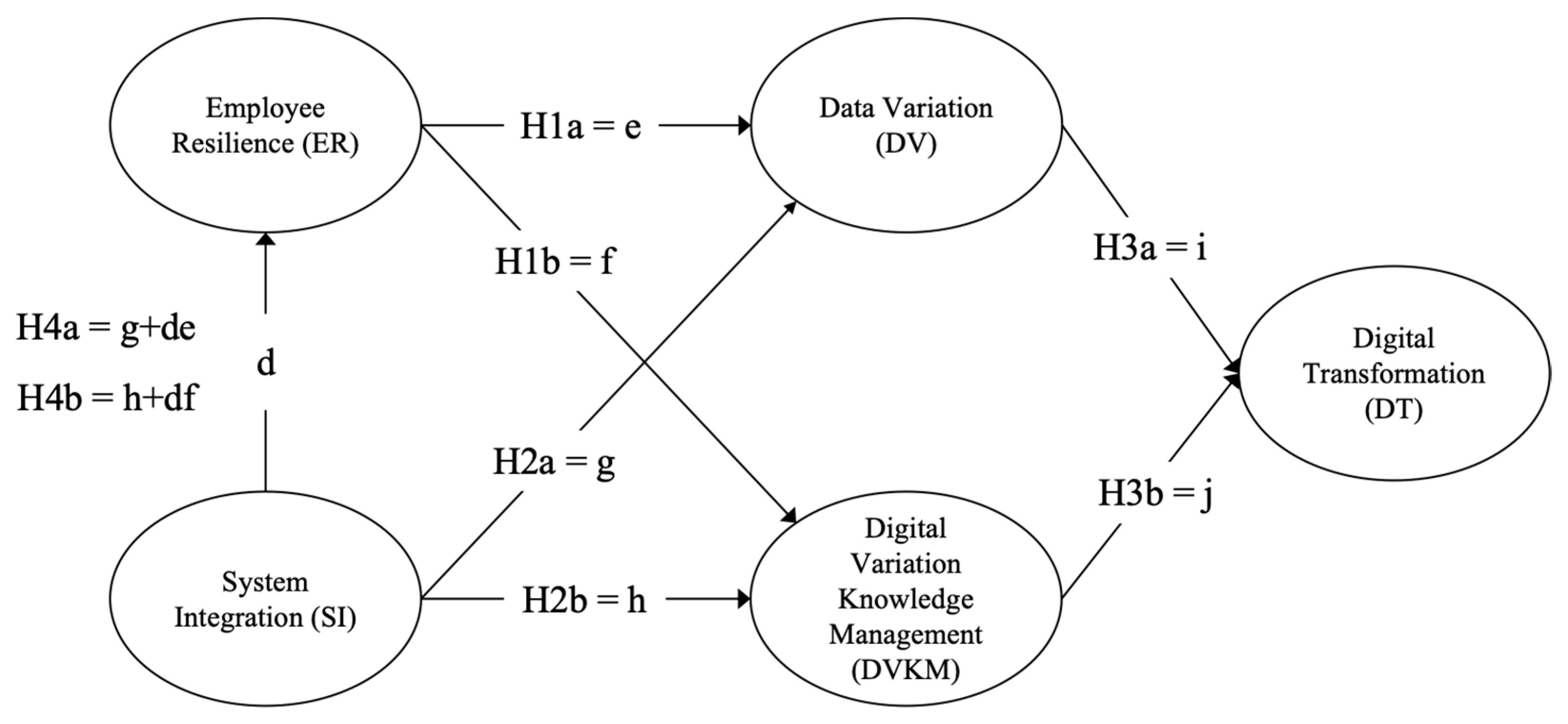
2.3.1. A Research Model
2.3.2. The Driving Force of Human and System
2.3.3. The Direct Impact of Data and Interrelationships
2.3.4. The Mediating Effect of Employee Resilience
3. Methodology and Data Analysis
3.1. Questionnaire and Data Collection
3.2. Exploratory Factor Analysis
3.3. Reliability Tests
3.4. Validity Tests
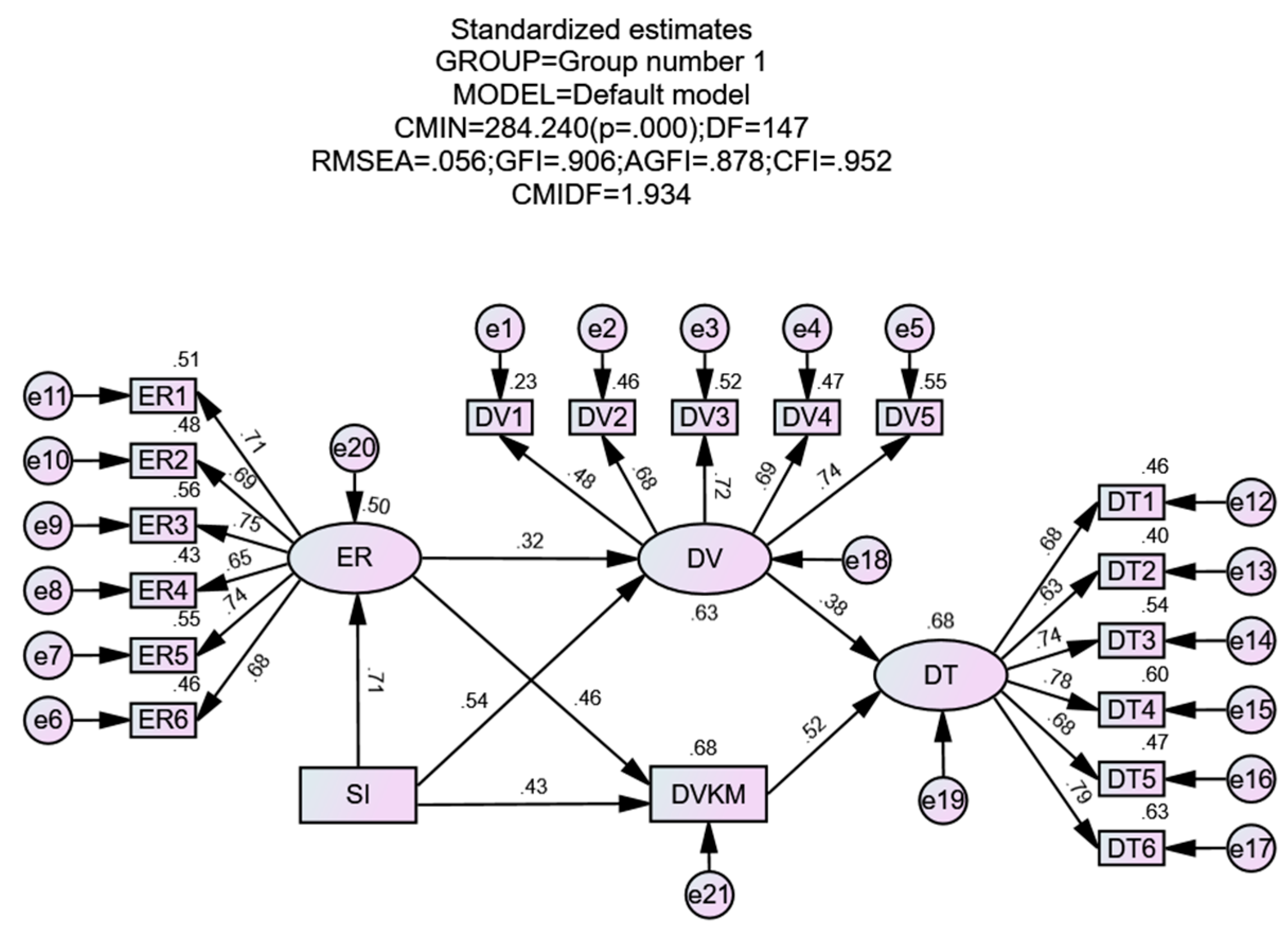
3.5. Structural Model and Hypotheses Testing
3.6. Multiple-Group Analysis
3.6.1. Multiple-Group Analysis of Firm Size
3.6.2. Multiple-Group Analysis of Firm Nature
4. Discussion
4.1. ER as a Core Driver of DV/DVKM
4.2. SI as a Driver for DV/DVKM
4.3. DV and DVKM as Dual Pathways to DT
4.4. The Mediating Effect of ER on SI and DV/DVKM
4.5. Research Contribution
5. Conclusions
Author Contributions
Funding
Institutional Review Board Statement
Informed Consent Statement
Data Availability Statement
Conflicts of Interest
Appendix A. Questionnaire
Appendix A.1. Title
Appendix A.2. Instructions
Appendix A.3. Basic Information Questions
- Your industry sector [Multiple choice] * (* Denotes a mandatory question; same below.)
- □
- Manufacturing
- □
- Construction
- □
- Logistics and Transport
- □
- Education/Training
- □
- Internet
- □
- Computer/Software
- □
- Wholesale and Retail
- □
- Accommodation and Catering
- □
- Finance
- □
- Real Estate
- □
- Rental/Leasing
- □
- Professional Services (e.g., Legal/Consultancy)
- □
- Scientific Research
- □
- Lifestyle Services (e.g., Domestic/Hairdressing)
- □
- Healthcare/Social Security
- □
- Culture and Entertainment
- □
- Agriculture, Forestry, Animal Husbandry, and Fisheries
- □
- Water Conservancy, Environment, and Public Facilities Management
- □
- Electricity and Gas
- □
- Mining
- □
- Other _________________*
- 2.
- Your manufacturing sector [Fill-in-the-blank] *_________________________________Depends on the first option selected in Question 3
- 3.
- The geographical location of your company [Fill-in-the-blank] *_________________________________
- 4.
- Nature of your company [Single-choice question] *
- ○
- State-owned
- ○
- Collective
- ○
- Private
- ○
- Foreign-funded
- ○
- Other
- 5.
- Size of your company [Single choice] *
- ○
- <100 employees
- ○
- 100–499 employees
- ○
- 500–1499 employees
- ○
- 1500–4999 employees
- ○
- >5000 employees
- 6.
- Age of your company [Single-choice question] *Company age = 2025–Year of company establishment
- ○
- <10 years
- ○
- 10–19 years
- ○
- 20–29 years
- ○
- >30 years
- 7.
- Your company’s annual revenue [Single-choice question] *
- ○
- <500,000 yuan
- ○
- 500,000–10,000,000 yuan
- ○
- 10,000,000–50,000,000 yuan
- ○
- 50,000,000–100,000,000 yuan
- ○
- >100,000,000 yuan
- 8.
- Length of service at your current company [Single choice] *
- ○
- <1 year
- ○
- 1–5 years
- ○
- 6–10 years
- ○
- >10 years
- 9.
- Your business area [Multiple choice] *
- □
- Logistics
- □
- Finance
- □
- Human Resources
- □
- Operations
- □
- Sales
- □
- Procurement
- □
- Production
- □
- Quality
- □
- Research and Development
- □
- Technology
- □
- Administration
- □
- Other
Appendix A.4. Variable Questions
- 10.
- Digital Transformation [Matrix Scale Question] *
| Strongly Disagree | Somewhat Disagree | Undecided | Somewhat Agree | Strongly Agree | |
| The company possesses advanced information technologies such as embedded systems, cloud computing, simulation, and additive manufacturing. | ○ | ○ | ○ | ○ | ○ |
| The company has digitized its business processes and established digital-related positions or departments. | ○ | ○ | ○ | ○ | ○ |
| The company employs intelligent online platforms to interact with customers or service recipients, utilizing these platforms to collect and analyze customer or service recipient information. | ○ | ○ | ○ | ○ | ○ |
| The company’s business model is closely tied to digital operations or technologies, with digitalization driving significant performance growth. | ○ | ○ | ○ | ○ | ○ |
| The company regards digitalization as pivotal to its competitive strategy, with its digital vision widely embraced throughout the organization. | ○ | ○ | ○ | ○ | ○ |
| The company has established a digital transformation strategy and set clear, quantifiable objectives. | ○ | ○ | ○ | ○ | ○ |
- 11.
- Data Anomalies [Matrix Rating Scale Question] *
| Strongly Disagree | Somewhat Disagree | Undecided | Somewhat Agree | Strongly Agree | |
| Data accurately reflects the real events or objects it represents. | ○ | ○ | ○ | ○ | ○ |
| The dataset contains all necessary data with no missing values. | ○ | ○ | ○ | ○ | ○ |
| Data for the same event or object is consistent across all systems in terms of values, formats, etc., with no conflicts. | ○ | ○ | ○ | ○ | ○ |
| Data collection is highly timely, typically completed shortly after the event occurs. | ○ | ○ | ○ | ○ | ○ |
| Data conforms to specified formats, types, and scopes, with no invalid data. | ○ | ○ | ○ | ○ | ○ |
- 12.
- Internal and External Integration of the Firm [Matrix Rating Scale Item] *
| Strongly Disagree | Somewhat Disagree | Undecided | Somewhat Agree | Strongly Agree | |
| The company has effectively integrated information technology and equipment, forming interconnected and efficiently operating systems. | ○ | ○ | ○ | ○ | ○ |
| Employees are proficient in operating, managing, and training intelligent devices, fostering a favorable human–machine interaction environment. | ○ | ○ | ○ | ○ | ○ |
| Departments collaborate closely with frequent communication, establishing an interconnected organizational structure. | ○ | ○ | ○ | ○ | ○ |
| Employee development is closely aligned with organizational growth, fostering a mutually dependent and reinforcing relationship. | ○ | ○ | ○ | ○ | ○ |
| The company maintains strong collaborative relationships with external stakeholders, cultivating a healthy business ecosystem. | ○ | ○ | ○ | ○ | ○ |
- 13.
- Employee Knowledge Application and Exploration [Matrix Scale Item] *
| Strongly Disagree | Somewhat Disagree | Undecided | Somewhat Agree | Strongly Agree | |
| Employees use their knowledge and skills in controlling data anomalies to drive incremental improvement activities. | ○ | ○ | ○ | ○ | ○ |
| Employees can apply knowledge and skills in controlling data anomalies to solve problems. | ○ | ○ | ○ | ○ | ○ |
| The company solicits employee feedback and suggestions regarding data anomaly control to drive incremental process enhancements. | ○ | ○ | ○ | ○ | ○ |
- 14.
- Knowledge Acquisition and Development in the Firm [Matrix Rating Scale Item] *
| Strongly Disagree | Somewhat Disagree | Undecided | Somewhat Agree | Strongly Agree | |
| The company can easily access new technologies for controlling data anomalies through partnerships with other companies, universities, consulting offices, etc. | ○ | ○ | ○ | ○ | ○ |
| The company invests in research and development (R&D) of new technologies for controlling data anomalies to improve or develop products/processes. | ○ | ○ | ○ | ○ | ○ |
| The company can easily introduce new technologies for controlling data anomalies in its processes or products without any great resistance to change. | ○ | ○ | ○ | ○ | ○ |
- 15.
- Employee Resilience [Matrix Scale Item] *
| Strongly Disagree | Somewhat Disagree | Undecided | Somewhat Agree | Strongly Agree | |
| Our employees quickly adapt to new ways of working or new tasks. | ○ | ○ | ○ | ○ | ○ |
| When necessary, our employees can easily shift their work focus. | ○ | ○ | ○ | ○ | ○ |
| Our employees adapt easily to changing circumstances. | ○ | ○ | ○ | ○ | ○ |
| Our employees are able to quickly shift their work focus and activities in response to changing organizational priorities. | ○ | ○ | ○ | ○ | ○ |
| Our employees enjoy experimenting and trying new things. | ○ | ○ | ○ | ○ | ○ |
| When faced with setbacks, our employees bounce back quickly. | ○ | ○ | ○ | ○ | ○ |
- 16.
- Employee Psychological Safety [Matrix Scale Item] *
| Strongly Disagree | Somewhat Disagree | Undecided | Somewhat Agree | Strongly Agree | |
| Our employees are unafraid to raise questions and tackle difficult problems. | ○ | ○ | ○ | ○ | ○ |
| When unsure how to proceed with a matter, our employees feel confident in asking one another for clarification. | ○ | ○ | ○ | ○ | ○ |
| Our employees find it difficult to approach other members of staff within the company for assistance. | ○ | ○ | ○ | ○ | ○ |
| Within our company, employees’ unique skills and talents are valued and utilized. | ○ | ○ | ○ | ○ | ○ |
| If our employees make mistakes, they are often blamed. | ○ | ○ | ○ | ○ | ○ |
- 17.
- Investment in Information Technology and Facilities [Matrix Rating Scale Question] *
| Strongly Disagree | Somewhat Disagree | Undecided | Somewhat Agree | Strongly Agree | |
| Over the past three years, the company’s capital expenditure on information technology has increased annually. | ○ | ○ | ○ | ○ | ○ |
| Over the past three years, the company’s information technology facilities have been progressively enhanced. | ○ | ○ | ○ | ○ | ○ |
| Over the past three years, the company’s investment in information technology and facilities has exceeded the industry average. | ○ | ○ | ○ | ○ | ○ |
| Over the past three years, the company’s information technology and facilities have been fully capable of meeting operational requirements. | ○ | ○ | ○ | ○ | ○ |
References
- Central Committee of the Communist Party of China, the Chinese State Council. An Outline to Boost Quality Strength. Available online: https://www.gov.cn/zhengce/2023-02/06/content_5740407.htm (accessed on 24 November 2025).
- Bitkom, V.Z. Survey Report on Platform Industry 4.0: The Industry 4.0 Implementation Strategy; J.E.T.R.O., Translator; Platform Industry 4.0 Office: Berlin, Germany, 2015. (In Japanese) [Google Scholar]
- Kai, Y. Quality in the Era of Industry 4. 0 Integrating Tradition and Innovation in the Age of Data and AI, 1st ed.; John Wiley & Sons, Inc.: Hoboken, NJ, USA, 2024. [Google Scholar]
- Maija, B.; Lars, D.N.; Athanasios, P. Industry 5.0: Towards a Sustainable, Human-Centric and Resilient European Industry; European Commission: Brussels, Belgium, 2021. [Google Scholar]
- VanDerHorn, E.; Mahadevan, S. Digital Twin: Generalization, characterization and implementation. Decis. Support Syst. 2021, 145, 113524. [Google Scholar] [CrossRef]
- Fukawa, N.; Rindfleisch, A. Enhancing innovation via the digital twin. J. Prod. Innov. Manag. 2023, 40, 391–406. [Google Scholar] [CrossRef]
- Rolando, B. Marketing Automation in E-Commerce: Optimizing Customer Journey, Revenue Generation, and Customer Retention Through Digital Innovation. J. Ilm. Manaj. Dan Kewirausahaan (JUMANAGE) 2025, 4, 566–580. [Google Scholar] [CrossRef]
- Borangiu, T.; Trentesaux, D.; Thomas, A.; Leitão, P.; Barata, J. Digital transformation of manufacturing through cloud services and resource virtualization. Comput. Ind. 2019, 108, 150–162. [Google Scholar] [CrossRef]
- Liu, Y.; Ni, Z.; Karlsson, M.; Gong, S. Methodology for digital transformation with internet of things and cloud computing: A practical guideline for innovation in small-and medium-sized enterprises. Sensors 2021, 21, 5355. [Google Scholar] [CrossRef] [PubMed]
- Lü, C.; Peng, C.; Cao, D. Ambidextrous Learning, Innovation-Driven Process, and Digital Transformation: The Moderating Role of Digital Capability. J. Syst. Manag. 2023, 32, 379. [Google Scholar]
- Zhang, H.; Huang, Q. Can Returnee Executives Promote the Digital Transformation of enterprises? Stud. Sci. Sci. 2024, 42, 778. [Google Scholar]
- Niu, L.; Chen, Z.; Liu, Z. Research on the digital transformation of small and medium-sized enterprises under the matching of resources and capabilities. Stud. Sci. Sci. 2023, 42, 766. [Google Scholar] [CrossRef]
- Ma, H.; Wang, Y. Research on the Impact of Big Data Resources on the Digital Transformation Performance of Manufacturing Enterprises. Stud. Sci. Sci. 2024, 42, 146–157. [Google Scholar]
- Dubey, R.; Bryde, D.J.; Blome, C.; Dwivedi, Y.K.; Childe, S.J.; Foropon, C. Alliances and digital transformation are crucial for benefiting from dynamic supply chain capabilities during times of crisis: A multi-method study. Int. J. Prod. Econ. 2024, 269, 109166. [Google Scholar] [CrossRef]
- Cubillas-Para, C.; Cegarra-Navarro, J.G.; Vătămănescu, E.M. Gliding from regenerative unlearning toward digital transformation via collaboration with customers and organisational agility. J. Bus. Res. 2024, 177, 114637. [Google Scholar] [CrossRef]
- Zhu, X.; Li, Y. The use of data-driven insight in ambidextrous digital transformation: How do resource orchestration, organizational strategic decision-making, and organizational agility matter? Technol. Forecast. Soc. Change 2023, 196, 122851. [Google Scholar] [CrossRef]
- Li, L.; Chen, L.; Yan, J.; Xu, C.; Jiang, N. How does technological opportunism affect firm performance? The mediating role of resource orchestration. J. Bus. Res. 2023, 166, 114093. [Google Scholar] [CrossRef]
- Chen, H.; Tian, Z. Environmental uncertainty, resource orchestration and digital transformation: A fuzzy-set QCA approach. J. Bus. Res. 2022, 139, 184–193. [Google Scholar] [CrossRef]
- Liu, X.; Chen, Z.; Ma, P. CEO with information technology background and enterprise digital transformation. China Soft Sci. 2023, 10, 121–130. [Google Scholar]
- Tang, X.; Gao, X.; Zhao, T.; Ding, S. Executive team heterogeneity and corporate digital transformation. China Soft Sci. 2022, 10, 83–98. [Google Scholar]
- Yang, S.; Song, T.; Wu, X. The institutional motivation and process of digital transformation of enterprises. Sci. Res. Manag. 2023, 44, 39–46. [Google Scholar]
- Malik, M.; Andargoli, A.; Ali, I.; Chavez, R. A socio-cognitive theorisation of how data-driven digital transformation affects operational productivity? Int. J. Prod. Econ. 2024, 277, 109403. [Google Scholar] [CrossRef]
- Liu, Q.; Kamioka, T. The effects of employees’ digital growth mindset and supervisors’ coaching behaviour on digital self-efficacy. Technol. Soc. 2025, 81, 102875. [Google Scholar] [CrossRef]
- Alabdali, M.A.; Yaqub, M.Z.; Agarwal, R.; Alofaysan, H.; Mohapatra, A.K. Unveiling green digital transformational leadership: Nexus between green digital culture, green digital mindset, and green digital transformation. J. Clean. Prod. 2024, 450, 141670. [Google Scholar] [CrossRef]
- Nasiri, M.; Ukko, J.; Saunila, M.; Rantala, T. Managing the digital supply chain: The role of smart technologies. Technovation 2020, 96, 102121. [Google Scholar] [CrossRef]
- Leino, S.P.; Kuusisto, O.; Paasi, J.; Tihinen, M. 3.3 VTT model of digimaturity. Towards A N. Era Manuf. 2017, 7, 41–46. [Google Scholar]
- Gill, M.; VanBoskirk, S. The digital maturity model 4.0. Benchmarks Digit. Transform. Playb. 2016, 22, 1–17. [Google Scholar]
- Alahmadi, M. Optimizing Data Quality for Sustainable Development: An Integration of Green Finance with Financial Market Regulations. Sustainability 2024, 16, 10418. [Google Scholar] [CrossRef]
- Redman, T.C. People and Data: Uniting to Transform Your Business, 1st ed.; Kogan Page Limited: New York, NY, USA, 2023. [Google Scholar]
- Pawanr, S.; Gupta, K. A Review of Recent Advances in the Energy Efficiency of Machining Processes for Sustainability. Energies 2024, 17, 3659. [Google Scholar] [CrossRef]
- Choi, T.M.; Luo, S. Data quality challenges for sustainable fashion supply chain operations in emerging markets: Roles of blockchain, government sponsors and environment taxes. Transp. Res. Part E Logist. Transp. Rev. 2019, 131, 139–152. [Google Scholar] [CrossRef]
- ASQ (American Society of Quality). W. Edwards Deming’s 14 Points for Management. Available online: https://asq.org/quality-resources/tqm/deming-points (accessed on 25 October 2025).
- Chiarini, A. Deming’s System of Profound Knowledge. In From Total Quality Control to Lean Six Sigma: Evolution of the Most Important Management Systems for the Excellence; Springer Science & Business Media: Milano, Italy, 2012. [Google Scholar]
- Frick, J.; Grudowski, P. Quality 5.0: A paradigm shift towards proactive quality control in industry 5.0. Asia-Pac. J. Bus. Adm. 2023, 14, 51–56. [Google Scholar] [CrossRef]
- Arsovski, S. Social oriented quality: From Quality 4.0 towards Quality 5.0. In Proceedings of the 13th International Quality Conference, Kragujevac, Serbia, 29 May–1 June 2019; Volume 13, pp. 397–404. [Google Scholar]
- Sharma, A.; Garg, C.P.; Kashav, V. Breaking the bottlenecks: A fuzzy SWARA approach to AI-ML implementation barriers in B2B industrial operations and supply chain management. J. Bus. Ind. Mark. 2025, 48, 1572–1592. [Google Scholar] [CrossRef]
- Sadiq, S.; Indulska, M. Open data: Quality over quantity. Int. J. Inf. Manag. 2017, 37, 150–154. [Google Scholar] [CrossRef]
- Miller, R.; Whelan, H.; Chrubasik, M.; Whittaker, D.; Duncan, P. A Framework for Current and New Data Quality Dimensions: An Overview. Data 2024, 9, 151. [Google Scholar] [CrossRef]
- Redman, T.C. Ensure High-Quality Data Powers Your AI. Harv. Bus. Rev. 2024. Available online: https://hbr.org/2024/08/ensure-high-quality-data-powers-your-ai (accessed on 25 October 2025).
- ISO 8000-8:2015; Data Quality—Part 8: Information and Data Quality: Concepts and Measuring. ISO: Geneva, Switzerland, 2015.
- ISO/IEC 5259-2:2024; Artificial Intelligence—Data Quality for Analytics and Machine Learning (ML)—Part 2: Data Quality Measures. 1st ed. ISO/IEC 2024: Geneva, Switzerland, 2024.
- DAMA UK Working Group. The Six Primary Dimensions for Data Quality Assessment: Defining Data Quality Dimensions. 2013. Available online: https://www.dama-uk.org/resources/the-six-primary-dimensions-for-data-quality-assessment (accessed on 25 October 2025).
- Gonzalez, R.V.D.; de Melo, D.M. The effects of organization context on knowledge exploration and exploitation. J. Bus. Res. 2018, 90, 215–225. [Google Scholar] [CrossRef]
- Braun, T.J.; Hayes, B.C.; DeMuth, R.L.F.; Taran, O.A. The Development, Validation, and Practical Application of an Employee Agility and Resilience Measure to Facilitate Organizational Change. Ind. Organ. Psychol. 2017, 10, 703–723. [Google Scholar] [CrossRef]
- Scholtes, P.R. Communities as systems. Qual. Prog. 1997, 30, 49–53. [Google Scholar]
- Kennedy, B. A 21st century appreciation for: Quality, excellence and complex human adaptive systems. TQM J. 2020, 32, 2–20. [Google Scholar] [CrossRef]
- Edgeman, R.L.; Fraley, L.A. A System of Profound Consciousness: Building beyond Deming. Total Qual. Manag. Bus. Excell. 2008, 19, 683–707. [Google Scholar] [CrossRef]
- Imran, F.; Shahzad, K.; Butt, A.; Kantola, J. Digital transformation of industrial organizations: Toward an integrated framework. J. Change Manag. 2021, 21, 451–479. [Google Scholar] [CrossRef]
- Kline, R.B. Principles and Practice of Structural Equation Modeling, 5th ed.; The Guilford Press: New York, UK, USA, 2023. [Google Scholar]
- Wu, M. Chapter 7: Scale Reliability. In Practical Questionnaire Statistical Analysis—SPSS Operation and Application, 1st ed.; Chongqing University Press: Chongqing, China, 2010; pp. 237–265. (In Chinese) [Google Scholar]
- Field, A. Discovering Statistics Using IBM SPSS Statistics, 6th ed.; Sage Publications Limited: London, UK, 2024. [Google Scholar]
- Fornell, C.; Larcker, D.F. Evaluating structural equation models with unobservable variables and measurement error. J. Mark. Res. 1981, 18, 39–50. [Google Scholar] [CrossRef]
- Gu, R.; Hu, G. Path analysis of the impact of e-government strategic management on service capability. E-Government 2012, 14, 46–60. [Google Scholar] [CrossRef]
- Wu, M. Chapter 7: Multiple-Group Analysis. In Structural Equation Modeling: Advanced AMOS Applications, 1st ed.; Chongqing University Press: Chongqing, China, 2013; pp. 250–309. (In Chinese) [Google Scholar]



| Theory | Literature | Core Viewpoints |
|---|---|---|
| Resource-Based View | [10,11] | Corporate resources constitute the source of competitive advantage, with human capital and digital capabilities serving as vital resources for advancing digital transformation. |
| Dynamic Capability View | [12,13,14,15] | Emphasis is put on the continuous adaptation of enterprises to their environment, where an organization’s sensing capabilities, integration capabilities, and reconfiguration capabilities can trigger digital transformation. |
| Resource Orchestration Theory | [16,17,18] | The coordinated allocation and value transformation of resources are highlighted, with the orchestration process comprising three stages: building resource portfolios, bundling resources, and leveraging resources. |
| Upper Echelons Theory | [19,20] | Senior executives serve as the decision-making agents for corporate actions and are pivotal in determining organizational direction. |
| Organizational Cognitive Perspective | [21] | An organization’s sense of urgency and manageability serves as a diagnostic method for managers to address external stakeholder demands, significantly promoting digital transformation. |
| Organizational Learning Theory | [10] | An organization’s learning capacity plays a vital role in digital transformation. |
| Institutional Theory | [21] | Institutional pressures—including regulatory, cognitive, and normative pressures—arise from the influence of multiple external institutional factors on enterprises, thereby impacting digital transformation. |
| Organizational Routine Theory | [13] | The continuous updating or innovation of organizational routines, such as rules, procedures, and paradigms to adapt to digital change. |
| Socio Cognitive Theory | [22,23] | Individuals’ perceptions or states of mind—such as psychological safety and self-efficacy—mediate the relationship between the social environment and observed behaviors (outcomes), thereby facilitating corporate digital transformation. |
| The Stimulus-Organism-Response (SOR) Framework | [24] | Organizational culture, as an external stimulus, influences employees’ perceptions and attitudes, thereby shaping their behaviors and driving digital transformation. |
| Transformational Leadership Theory | [24] | Transformational leadership styles can promote enterprise digital transformation by motivating and empowering employees. |
| Imprinting Theory | [11,19] | Executives’ educational and professional backgrounds create cognitive imprints, shaping their life values and subsequently influencing digital transformation decisions. |
| Timeline | Products | Quality System | Data Management |
|---|---|---|---|
| Industry 3.0 | Customized products by flexible manufacturing and lean production | Quality 3.0 (TQM; Lean Six Sigma; SPC) | Reactive, elaborate data analysis |
| Industry 4.0 | Smart products by cyber-physical systems | Quality 4.0 (Big data, AI check) | Proactive life-cycle data tracking |
| Industry 5.0 | Sustainable products by human-centricity and resilience system | Quality 5.0 (Sustainable quality management) | Proactive social network analysis |
| DPKS Components | DPKS Definition | DataQualityManagement | Industry 5.0 Concepts | |
| 1 | Appreciation for a System | Organizations are interconnected systems whose purpose is to let all stakeholders benefit sustainably. | System Integration (SI) | Resilience |
| 2 | Understanding Variation | Variations are impossible to avoid and can cause quality problems. Variation can be reduced with statistical tools. | Data Variation (DV) | Resilience |
| 3 | Theory of Knowledge | Theory is helpful to understand cause and effect relationships, which can be used for forecasting and rational decisions. | Digital Variation Knowledge Management (DVKM) | Human-centricity |
| 4 | Psychology | Psychology is helpful to understand the relationships among humans and between humans and the environment, which is the basis of human motivation. | Employee Resilience (ER) | Human-centricity; Resilience |
| Characterization | Options | Sample (n) | % |
|---|---|---|---|
| Industry | Agricultural and sideline food processing industry | 46 | 15.3 |
| Food manufacturing industry | 52 | 17.3 | |
| Automobile manufacturing industry | 28 | 9.3 | |
| Other manufacturing industries | 175 | 58.1 | |
| Nature of Firm Ownership | State-owned | 72 | 23.9 |
| Collective | 3 | 1.0 | |
| Private | 190 | 63.1 | |
| Foreign-owned | 27 | 9.0 | |
| Other | 9 | 3.0 | |
| Firm Size | <100 | 30 | 10.0 |
| 100–499 employees | 104 | 34.6 | |
| 500–1499 employees | 75 | 24.9 | |
| 1500–4999 employees | 43 | 14.3 | |
| >5000 employees | 49 | 16.3 | |
| Firm Age | <10 years | 52 | 17.3 |
| 10–19 years | 135 | 44.9 | |
| 20–29 years | 69 | 22.9 | |
| >30 years | 45 | 15.0 | |
| Yearly Sales (Million Yuan) | <50 | 10 | 3.3 |
| 50–1000 | 32 | 10.6 | |
| 1000–5000 | 67 | 22.3 | |
| 5000–10,000 | 53 | 17.6 | |
| >10,000 | 139 | 46.2 |
| Item | Factors Loadings Above 0.50 (KMO = 0.924) | ||
|---|---|---|---|
| F1-DT | F2-ER | F3-DV | |
| DT4 | 0.755 | ||
| DT6 | 0.748 | ||
| DT3 | 0.718 | ||
| DT2 | 0.696 | ||
| DT5 | 0.692 | ||
| DT1 | 0.634 | ||
| ER3 | 0.736 | ||
| ER5 | 0.733 | ||
| ER1 | 0.716 | ||
| ER2 | 0.694 | ||
| ER4 | 0.678 | ||
| ER6 | 0.675 | ||
| DV3 | 0.768 | ||
| DV5 | 0.753 | ||
| DV2 | 0.732 | ||
| DV1 | 0.592 | ||
| DV4 | 0.520 | ||
| EV | 7.164 | 1.446 | 1.338 |
| PV | 42.139 | 8.505 | 7.872 |
| CP | 42.139 | 50.643 | 58.516 |
| Items | CTIC | Item-Deleted Cronbach’s α | Overall Cronbach’s α |
|---|---|---|---|
| DT1 | 0.635 | 0.845 | 0.863 |
| DT2 | 0.595 | 0.852 | |
| DT3 | 0.666 | 0.839 | |
| DT4 | 0.703 | 0.832 | |
| DT5 | 0.632 | 0.846 | |
| DT6 | 0.725 | 0.829 | |
| ER1 | 0.647 | 0.826 | 0.851 |
| ER2 | 0.626 | 0.833 | |
| ER3 | 0.701 | 0.814 | |
| ER4 | 0.588 | 0.835 | |
| ER5 | 0.681 | 0.817 | |
| ER6 | 0.606 | 0.832 | |
| DV1 | 0.428 | 0.805 | 0.800 |
| DV2 | 0.621 | 0.750 | |
| DV3 | 0.665 | 0.735 | |
| DV4 | 0.542 | 0.774 | |
| DV5 | 0.683 | 0.729 |
| Construct | Item | Factor Loadings | AVE | C.R. |
|---|---|---|---|---|
| DV | DV1: Data accurately reflects the real events or objects it represents. | 0.463 | 0.458 | 0.804 |
| DV2: The dataset contains all necessary data with no missing values. | 0.708 | |||
| DV3: Data for the same event or object is consistent across all systems in terms of values, formats, etc., with no conflicts. | 0.750 | |||
| DV4: Data collection is highly timely, typically completed shortly after the event occurs. | 0.638 | |||
| DV5: Data conforms to specified formats, types, and scopes, with no invalid data. | 0.777 | |||
| ER | ER1: Our employees quickly adapt to new ways of working or new tasks. | 0.701 | 0.498 | 0.856 |
| ER2: When necessary, our employees can easily shift their work focus. | 0.694 | |||
| ER3: Our employees adapt easily to changing circumstances. | 0.768 | |||
| ER4: Our employees are able to quickly shift their work focus and activities in response to changing organizational priorities. | 0.654 | |||
| ER5: Our employees enjoy experimenting and trying new things. | 0.742 | |||
| ER6: When faced with setbacks, our employees bounce back quickly. | 0.668 | |||
| DT | DT1: The company possesses advanced information technologies such as embedded systems, cloud computing, simulation, and additive manufacturing. | 0.692 | 0.520 | 0.866 |
| DT2: The company has digitized its business processes and established digital-related positions or departments. | 0.631 | |||
| DT3: The company employs intelligent online platforms to interact with customers or service recipients, utilizing these platforms to collect and analyze customer or recipient information. | 0.731 | |||
| DT4: The company’s business model is closely tied to digital operations or technologies, with digitalization driving significant performance growth. | 0.770 | |||
| DT5: The company regards digitalization as pivotal to its competitive strategy, with its digital vision widely embraced throughout the organization. | 0.691 | |||
| DT6: The company has established a digital transformation strategy and set clear, quantifiable objectives. | 0.798 |
| DV | ER | DT | |
|---|---|---|---|
| DV | 0.458 | ||
| ER | 0.665 | 0.498 | |
| DT | 0.685 | 0.693 | 0.520 |
| The square roots of AVE | 0.677 | 0.706 | 0.721 |
| Hypothesis | Path Coefficient | p-Value |
|---|---|---|
| H1a: ER → DV | 0.316 | 0.000 |
| H1b: ER → DVKM | 0.459 | 0.000 |
| H2a: SI → DV | 0.537 | 0.000 |
| H2b: SI → DVKM | 0.432 | 0.000 |
| H3a: DV → DT | 0.383 | 0.000 |
| H3b: DVKM → DT | 0.525 | 0.000 |
| MediationTest | ||
| Hypothesis | IndirectEstimate | Mediation |
| H4a: SI → ER → DV | 0.117 at p = 0.000 | partial |
| H4b: SI → ER → DVKM | 0.390 at p = 0.001 | partial |
| Model | χ2 | df | χ2/df | p-Value | GFI | AGFI | CFI | RMSEA |
|---|---|---|---|---|---|---|---|---|
| Unconstrained | 376.495 | 232 | 1.623 | 0.000 | 0.878 | 0.839 | 0.935 | 0.046 |
| Measurement weights | 387.930 | 246 | 1.577 | 0.000 | 0.873 | 0.842 | 0.936 | 0.044 |
| Structural covariances | 420.329 | 252 | 1.668 | 0.000 | 0.864 | 0.835 | 0.924 | 0.047 |
| Measurement residuals | 438.664 | 269 | 1.631 | 0.000 | 0.858 | 0.839 | 0.923 | 0.046 |
| Model | Δχ2 | Δdf | Δχ2/df | p-Value | ΔNFI | ΔIFI | ΔRFI | ΔTLI |
|---|---|---|---|---|---|---|---|---|
| Measurement weights | −0.046 | 14 | −0.046 | 0.652 | −0.005 | 0.001 | 0.005 | 0.006 |
| Structural covariances | 0.045 | 20 | 0.045 | 0.002 | −0.018 | −0.011 | −0.004 | −0.005 |
| Measurement residuals | 0.008 | 37 | 0.008 | 0.006 | −0.025 | −0.013 | 0.000 | 0.000 |
| Model | χ2 | df | χ2/df | p-Value | GFI | AGFI | CFI | RMSEA |
|---|---|---|---|---|---|---|---|---|
| Unconstrained | 531.094 | 294 | 1.806 | 0.000 | 0.847 | 0.802 | 0.919 | 0.052 |
| Measurement weights | 547.769 | 309 | 1.773 | 0.000 | 0.840 | 0.804 | 0.918 | 0.051 |
| Structural weights | 571.127 | 315 | 1.813 | 0.000 | 0.838 | 0.804 | 0.912 | 0.052 |
| Structural covariances | 573.558 | 316 | 1.815 | 0.000 | 0.837 | 0.804 | 0.912 | 0.052 |
| Structural residuals | 587.724 | 319 | 1.842 | 0.000 | 0.835 | 0.804 | 0.908 | 0.053 |
| Measurement residuals | 607.207 | 337 | 1.802 | 0.000 | 0.830 | 0.808 | 0.907 | 0.052 |
| Model | Δχ2 | Δdf | Δχ2/df | p-Value | ΔNFI | ΔIFI | ΔRFI | ΔTLI |
|---|---|---|---|---|---|---|---|---|
| Measurement weights | 16.675 | 15 | −0.033 | 0.339 | −0.005 | −0.001 | 0.003 | 0.004 |
| Structural weights | 40.033 | 21 | 0.007 | 0.007 | −0.012 | −0.007 | −0.001 | −0.001 |
| Structural covariances | 42.464 | 22 | 0.009 | 0.005 | −0.013 | −0.007 | −0.001 | −0.001 |
| Structural residuals | 56.630 | 25 | 0.036 | 0.000 | −0.017 | −0.011 | −0.004 | −0.005 |
| Measurement residuals | 76.113 | 43 | −0.004 | 0.001 | −0.023 | −0.012 | 0.000 | 0.000 |
| Model | χ2 | df | χ2/df | p-Value | GFI | AGFI | CFI | RMSEA |
|---|---|---|---|---|---|---|---|---|
| Unconstrained | 358.395 | 232 | 1.545 | 0.000 | 0.880 | 0.842 | 0.943 | 0.043 |
| Measurement weights | 399.657 | 246 | 1.625 | 0.000 | 0.866 | 0.834 | 0.931 | 0.046 |
| Structural covariances | 408.040 | 252 | 1.619 | 0.000 | 0.862 | 0.833 | 0.930 | 0.046 |
| Measurement residuals | 449.407 | 269 | 1.671 | 0.000 | 0.851 | 0.830 | 0.919 | 0.047 |
| Model | Δχ2 | Δdf | Δχ2/df | p-Value | ΔNFI | ΔIFI | ΔRFI | ΔTLI |
|---|---|---|---|---|---|---|---|---|
| Measurement weights | 41.262 | 14 | 0.08 | 0.000 | −0.017 | −0.013 | −0.009 | −0.010 |
| Structural covariances | 49.645 | 20 | 0.074 | 0.000 | −0.020 | −0.014 | −0.008 | −0.009 |
| Measurement residuals | 91.012 | 37 | 0.126 | 0.000 | −0.037 | −0.025 | −0.014 | −0.015 |
| Model | χ2 | df | χ2/df | p-Value | GFI | AGFI | CFI | RMSEA |
|---|---|---|---|---|---|---|---|---|
| Unconstrained | 511.723 | 294 | 1.741 | 0.000 | 0.849 | 0.805 | 0.926 | 0.050 |
| Measurement weights | 550.499 | 309 | 1.782 | 0.000 | 0.838 | 0.801 | 0.918 | 0.051 |
| Structural weights | 562.454 | 315 | 1.786 | 0.000 | 0.838 | 0.804 | 0.916 | 0.051 |
| Structural covariances | 567.572 | 316 | 1.796 | 0.000 | 0.835 | 0.802 | 0.914 | 0.052 |
| Structural residuals | 586.216 | 319 | 1.838 | 0.000 | 0.830 | 0.798 | 0.909 | 0.053 |
| Measurement residuals | 627.365 | 337 | 1.862 | 0.000 | 0.820 | 0.797 | 0.901 | 0.054 |
| Model | Δχ2 | Δdf | Δχ2/df | p-Value | ΔNFI | ΔIFI | ΔRFI | ΔTLI |
|---|---|---|---|---|---|---|---|---|
| Measurement weights | 38.776 | 15 | 0.041 | 0.000 | −0.012 | −0.008 | −0.005 | −0.005 |
| Structural weights | 50.731 | 21 | 0.045 | 0.000 | −0.015 | −0.010 | −0.005 | −0.005 |
| Structural covariances | 55.849 | 22 | 0.055 | 0.000 | −0.017 | −0.012 | −0.006 | −0.007 |
| Structural residuals | 74.493 | 25 | 0.097 | 0.000 | −0.023 | −0.017 | −0.010 | −0.011 |
| Measurement residuals | 115.642 | 43 | 0.121 | 0.000 | −0.035 | −0.026 | −0.013 | −0.014 |
Disclaimer/Publisher’s Note: The statements, opinions and data contained in all publications are solely those of the individual author(s) and contributor(s) and not of MDPI and/or the editor(s). MDPI and/or the editor(s) disclaim responsibility for any injury to people or property resulting from any ideas, methods, instructions or products referred to in the content. |
© 2025 by the authors. Licensee MDPI, Basel, Switzerland. This article is an open access article distributed under the terms and conditions of the Creative Commons Attribution (CC BY) license (https://creativecommons.org/licenses/by/4.0/).
Share and Cite
Wang, J.; Wu, Z.; Wang, T. Data Quality Improvement Supports Digital Transformation in Industry 5.0. Sustainability 2025, 17, 11183. https://doi.org/10.3390/su172411183
Wang J, Wu Z, Wang T. Data Quality Improvement Supports Digital Transformation in Industry 5.0. Sustainability. 2025; 17(24):11183. https://doi.org/10.3390/su172411183
Chicago/Turabian StyleWang, Jian, Zhuowei Wu, and Ting Wang. 2025. "Data Quality Improvement Supports Digital Transformation in Industry 5.0" Sustainability 17, no. 24: 11183. https://doi.org/10.3390/su172411183
APA StyleWang, J., Wu, Z., & Wang, T. (2025). Data Quality Improvement Supports Digital Transformation in Industry 5.0. Sustainability, 17(24), 11183. https://doi.org/10.3390/su172411183