1. Introduction
The use of social media has been one of the most transformative developments of the past two decades, altering how reality is perceived and interpreted. These platforms have reshaped social interaction by redefining how individuals communicate and construct their personal and collective narratives, especially among “digital residents”, as defined by White and Le Cornu [
1]. Within this context, social media belongs to the broader field of digital leisure which, according to Galzacorta, Blanco, and Gutiérrez [
2], includes “social digital leisure (virtual social networks), mobile digital leisure (smartphones), and recreational digital leisure (video games)”.
Digital self-perception constitutes a key element of psychological well-being and educational sustainability, as it shapes how students manage their identity, social relationships, and emotional health in technology-mediated environments.
From the framework of the Sustainable Development Goals (SDGs 4 and 3), understanding how young people construct their self-perception within the digital ecosystem is essential for promoting equitable, safe, and emotionally sustainable educational practices. Digital leisure, also considered a non-formal learning space, can support the development of communicative and creative competences, although its excessive use may hinder self-regulation and emotional well-being [
3]. Over the past two decades, social networks have evolved into everyday spaces for interaction, leisure, and learning among university students, prompting international organisations to call for a more conscious and responsible use of digital environments. UNESCO’s Media and Information Literacy (MIL) Framework highlights digital competence as a requirement for well-being and critical participation [
4], while the European Union’s Digital Education Action Plan (2021–2027) and the Better Internet for Kids Plus (BIK+) initiative emphasise safe and empowering digital engagement [
5,
6]. Similarly, the Digital Services Act (DSA) underscores the responsibility of platforms regarding risks such as addiction, misinformation, and the psychological impact of intensive use [
7]. Within higher education, where digital leisure intersects with learning and identity formation, addressing these social and emotional effects aligns with Sustainable Development Goal 4 (Quality Education) and contributes to fostering autonomy, reflection, and sustainable human development [
8].
These international guidelines are reflected in the university context, where intensive social media use presents challenges for students’ personal development and digital coexistence. This requires considering the sustained growth of digital leisure consumption over the past two decades [
9], and the notable increase in social media engagement following the COVID-19 pandemic [
10]. During this period, intensive digital media use has been linked to adolescents’ psychological well-being, showing both negative consequences—such as anxiety and depression—and benefits related to maintaining social connection in isolation [
11]. These factors will serve as the basis for examining the relationship between social media use and university students’ self-perception—the central objective of the present research.
1.1. Social Media
Social networks, originally conceptualised in sociology, have evolved into digital platforms that connect individuals, entities, and organisations, enabling the creation, sharing, and consumption of online content. As part of everyday life, social media has reshaped interaction patterns and leisure practices, while raising concerns about excessive use, potential addiction, and risks to privacy [
12]. Recent research shows that overuse can negatively affect mental health, impairing attention, self-esteem, and emotional balance [
13,
14,
15,
16]. At the same time, social media contributes to the formation of collective identities and community participation [
17], offering both exposure to digital violence and opportunities for safe interaction, expression, and cohesion among diverse groups [
18,
19,
20,
21].
1.2. Social Media Addiction
Addiction to technology or social media is not officially recognised as a disorder in the DSM-5 [
22], nor in its updated version, the DSM-5-TR [
23]. Problematic use has become a key subject of debate among addiction specialists [
24]. Excessive social media use presents behavioural patterns comparable to other addictions, including loss of control, tolerance, and interference with daily functioning [
25,
26]. Prieto and Moreno describe additional indicators of problematic consumption, such as constant preoccupation, planning, neglect of responsibilities, self-deception, and persistence despite negative consequences [
27].
Recent research links this problematic use to emotional difficulties including anxiety, depression, and stress [
28,
29], as well as to social withdrawal, individualism, isolation [
30]; reduced attention, mood instability, decreased productivity, cognitive impairment [
31], and automatisms that may override rational decision-making [
32]. Excessive use also influences identity formation and self-presentation, given that digital identity management mediates the relationship between personality traits and social media addiction [
33]. Individual motivations, personal values, and usage patterns further shape subjective well-being and interaction with digital environments [
34]. Social media has thus become a space for constructing multiple versions of the self, aligned with role theory and the management of different facets of social identity [
35]. While self-presentation is not inherently harmful if core personality traits and offline authenticity remain intact [
36,
37], insufficient self-regulation and digital education can foster addictive behaviours and distortions in self-image, affecting self-perception and how users view others [
38,
39,
40,
41,
42].
This literature supports the dimension of dependence and anxiety, and also shows how excessive use influences self-perception and digital identity, which are central elements of the proposed model.
1.3. Self-Perception in Social Media
From a psychological perspective, digital self-perception emerges from the interplay between the identity projected online and the social validation received through virtual platforms. It refers to how individuals view and evaluate themselves within digital environments, particularly on social media [
43]. Among adolescents, self-concept in these contexts is linked to affective perception, and discrepancies between online and offline identities have been associated with higher well-being [
44]. Users engage in behaviours such as exemplification, self-promotion, and the pursuit of social validation, shaped by follower counts, available feedback, and prevailing cultural norms [
45,
46,
47].
Research also shows that the unconscious use of digital filters can homogenise beauty standards and threaten self-image by reducing the visibility of diverse features, making it harder for individuals to recognise their own appearance as “normal” or “common” [
48]. These processes relate to lower self-esteem and reduced emotional well-being [
49], particularly when exposure to unrealistic beauty ideals leads to body dissatisfaction and a devalued self-concept [
50]. Festinger’s social comparison theory posits that individuals possess a constant drive to evaluate themselves based on the opinions and abilities of others [
51], especially when objective standards are lacking [
52]. Social media intensifies these dynamics, making comparison a central mechanism of interaction and validation [
53].
Prolonged exposure to idealised online content encourages efforts to modify one’s appearance [
54], supports the internalisation of aesthetic norms [
55], and may increase frustration and rejection when perceived discrepancies arise [
56].
In this context, these studies support the dimension of social comparison and influence on self-image, by showing how validation dynamics and exposure to idealised models directly affect self-perception.
1.4. Social Validation in Social Media
Social media influences not only self-image and self-esteem but also how individuals initiate and maintain interpersonal relationships. Digital environments now coexist with face-to-face interactions, allowing young people to expand their social networks beyond geographical boundaries [
57]. Although online communication offers opportunities for connection, face-to-face contact remains more beneficial for mental health [
58], and the quality of virtual interactions plays an important role in emotional adjustment, particularly during adolescence [
59].
These changes in relational dynamics can affect perceptions of emotional support and social validation, with consequences for self-esteem and well-being [
60,
61]. For this reason, balanced and mindful use is necessary so that social media complements, rather than replaces, in-person interaction [
62]. Validation through indicators such as “likes” can shape happiness and self-esteem [
63] and may increase anxiety when users feel unable to meet perceived social standards [
64,
65]. Furthermore, exposure to idealised or misleading content can distort perceptions of oneself and others [
66], and excessive use may heighten anxiety and undermine self-esteem by linking self-worth to group approval [
67]. This evidence supports the dimension of approval-seeking and digital authenticity, and helps to explain the preference for online interaction as a form of emotional validation.
1.5. Objectives
The objectives defined for this research are as follows:
- -
To analyse social media use and digital self-perception among university students.
- -
To identify variables that generate undesirable consequences.
1.6. Hypotheses
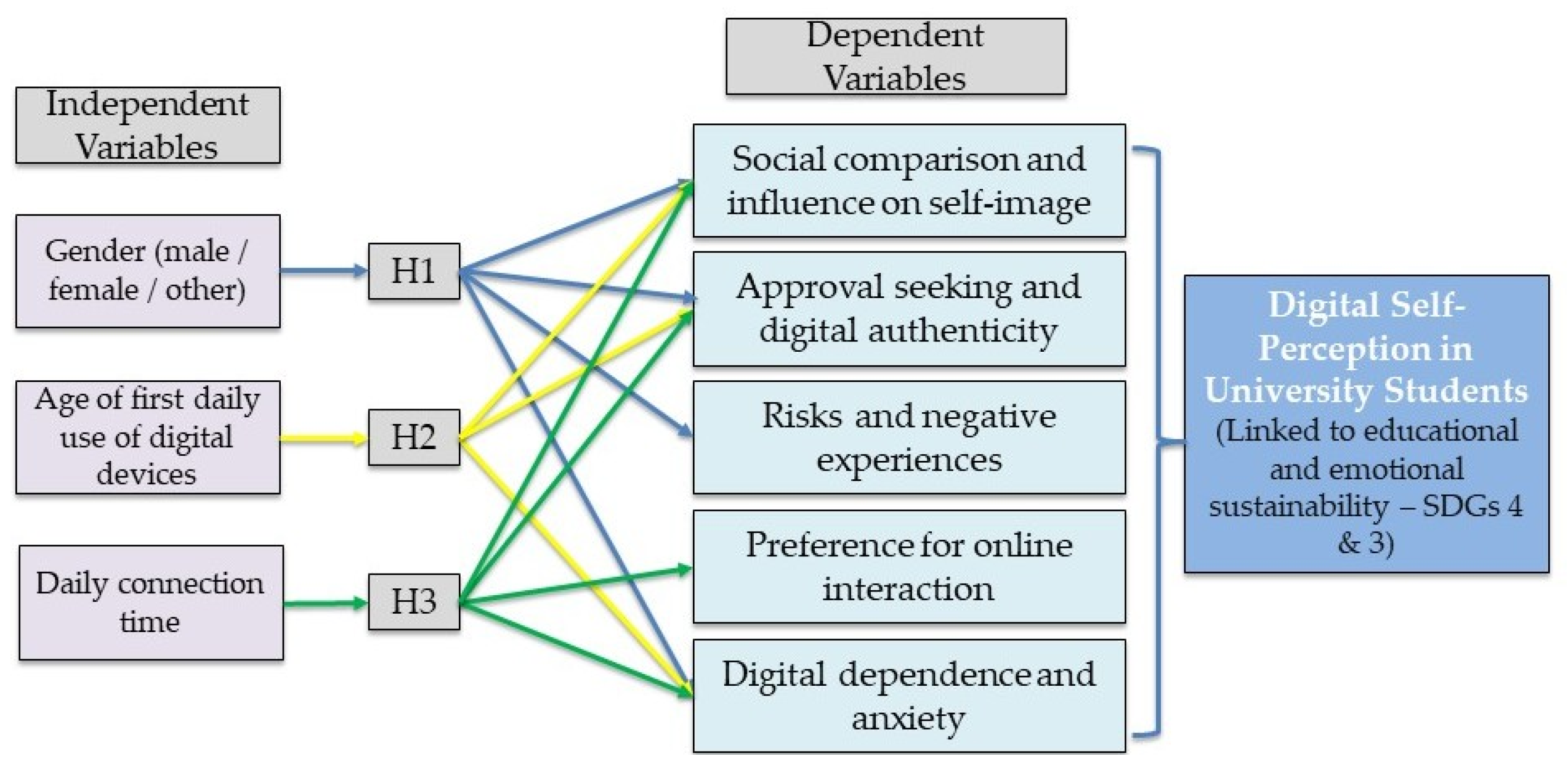
The analytical model considered as independent variables those related to digital usage habits and sociodemographic characteristics:
- -
Gender (male, female, other).
- -
Age of initiation in the daily use of digital devices.
- -
Daily connection time (hours).
The dependent variables corresponded to the five dimensions identified through the exploratory factor analysis:
- -
Social comparison and influence on self-image.
- -
Search for approval and digital authenticity.
- -
Risks and negative experiences.
- -
Preference for online interaction.
- -
Digital dependence and anxiety.
These dimensions represent different elements of self-perception and experiences associated with social media use. Based on the theoretical framework and research objectives, the following working hypotheses were formulated:
H1. It is proposed that significant differences exist between men and women in the dimensions of social comparison, search for approval, perceived risks, and digital dependence.
H2. It is theorised that an earlier age of initiation in the daily use of digital devices is associated with higher levels of social comparison, search for approval, and digital dependence.
H3. It is expected that a greater number of daily connection hours is associated with higher scores in social comparison, search for approval, and digital dependence.
These hypotheses guided the selection of statistical analyses, which combined descriptive, correlational (Spearman’s ρ), and comparative tests (χ2 and Kruskal–Wallis).
1.7. Theoretical Foundation of the Analytical Model
Given the exploratory nature of this study, the analytical model is proposed as a theoretically informed framework rather than a validated structural solution. It integrates contributions from social psychology, media education and digital well-being studies to organise the main findings of the literature review into five core dimensions of university students’ digital self-perception: social comparison and influence on self-image, approval seeking and digital authenticity, risks and negative experiences, preference for online interaction, and digital dependence and anxiety. These dimensions synthesise recurring constructs identified in the previous subsections and provide a coherent structure for analysing how social media use is related to self-perception in higher education contexts.
1.7.1. Social Comparison and Influence on Self-Image
Building on Festinger’s Social Comparison Theory, this dimension encompasses the processes through which individuals evaluate their personal worth in relation to others. In digital environments, continuous exposure to idealised representations on social media intensifies self-evaluative dynamics that affect self-esteem and body satisfaction [
51,
53,
55]. The items assigned to this factor capture the extent to which internalised aesthetic and behavioural standards derived from online content shape the perception of one’s own body and digital identity.
1.7.2. Approval Seeking and Digital Authenticity
This dimension is grounded in research on digital identity and social validation, which conceptualises social media as stages for self-representation where feedback through “likes” and comments conditions self-image [
46,
63]. This draws on theories of digital self-perception that interpret online behaviour as an expression of the need for social recognition and coherence between personal identity and its mediated display [
18]. The items reflect how users adapt their self-presentation in order to obtain approval and maintain a sense of authenticity within their digital networks.
1.7.3. Risks and Negative Experiences
Informed by studies on digital leisure and emotional well-being [
2,
3], this dimension focuses on students’ perceptions of the risks associated with intensive social media use, including harassment, interpersonal conflict and loss of trust. It is also linked to institutional alerts contained in the Digital Services Act (DSA) and European initiatives that seek to promote safer digital ecosystems [
6]. The items therefore assess awareness of potentially harmful situations and negative experiences that may arise from participation in social networks.
1.7.4. Preference for Online Interaction
This dimension derives from work on the digitalisation of sociability and from UNESCO’s Media and Information Literacy (MIL) framework, which stresses the need to balance online engagement with in-person relationships [
57]. It evaluates the tendency to prioritise screen-mediated communication over face-to-face encounters, and the extent to which students experience digital interaction as more comfortable or accessible. The corresponding items address patterns of relational preference that may influence communicative competence and everyday empathy.
1.7.5. Digital Dependence and Anxiety
Grounded in behavioural addiction models, this dimension examines the relationship between frequency of use, perceived loss of control and distress associated with disconnection [
24,
25,
26]. It aligns with the notion of digital well-being promoted in the European Union’s Digital Education Action Plan (2021–2027), which highlights emotional self-regulation in the use of connective technologies. The items focus on feelings of dependence, difficulty limiting social media use and anxiety when access is restricted or interrupted.
Taken together, these five dimensions constitute an exploratory theoretical model that organises the main ways in which social media use relates to digital self-perception among university students. The model is consistent with international frameworks on media literacy and educational sustainability associated with SDG 4 and SDG 3 [
4,
8], and it serves as a conceptual bridge between prior theoretical work and the empirical analysis carried out in this study (see
Figure 1).
This study differs from previously validated instruments related to social media addiction, FoMO, social comparison, or self-presentation. Our analytical model integrates five conceptual dimensions aligned with digital emotional literacy and SDGs 3 and 4, offering a methodological contribution through new item formulations that capture digital authenticity, perceived risks, and digital dependence from a sustainability-oriented educational perspective.
2. Materials and Methods
The study follows a quantitative, non-experimental and cross-sectional design with a descriptive and correlational, exploratory orientation. A self-report instrument was used to collect data on students’ social media use and its relationship with digital self-perception. The instrument was developed to assess digital leisure practices and the five theoretical dimensions identified in the literature, providing a structured measure of the constructs examined in the study.
2.1. Instrument Design
The initial instrument consisted of 36 items covering the five theoretical dimensions proposed in the study [
68]. An Exploratory Factor Analysis (EFA) was conducted on all 36 items; however, only 16 items showed strong and unambiguous loadings on the extracted factors (factor loadings > 0.40 and absence of cross-loadings). These 16 items are therefore presented in
Table 1 as a synthetic representation of the factorial structure. To ensure transparency, the factor analysis was performed on the full 36-item instrument, and the remaining items—although not displayed in
Table 1 due to their lower or less stable loadings—were retained for descriptive purposes and scoring, according to the intended theoretical model. A complete list of all items and their corresponding loadings is provided
Appendix A.
The EFA employed Principal Component extraction and Varimax rotation with Kaiser normalisation, following its suitability for exploratory data reduction and interpretability in early-stage instrument development. Factor retention was based on the Kaiser criterion (eigenvalues > 1) and scree plot inspection. Sampling adequacy was confirmed by a meritorious Kaiser–Meyer–Olkin (KMO) value of 0.813 and a significant Bartlett’s test of sphericity (χ
2 (136) = 1337.122;
p < 0.001), both calculated on the full 36-item set, supporting the suitability of the data for factor analysis [
69]. This procedure yielded a five-factor solution consistent with the theoretical framework.
Internal consistency was assessed using Cronbach’s alpha, interpreted according to the criteria of George and Mallery (α ≥ 0.70 acceptable; α ≥ 0.80 good) [
70]. Factor 1 (“Social comparison and influence on self-image”) and Factor 5 (“Digital dependence and anxiety”) showed acceptable to good reliability (α = 0.867 and α = 0.742, respectively). Factor 2 (“Approval seeking and digital authenticity”) obtained α = 0.595, a value considered acceptable for exploratory research and early-stage scales, particularly when items reflect emerging psychosocial constructs, as noted by Hair et al., who indicate that coefficients around 0.60 may be tolerated in preliminary validation studies [
71].
Conversely, Factor 3 (“Risks and negative experiences”) presented low internal consistency (α = 0.445), below recommended thresholds even in exploratory contexts, and Factor 4 (“Preference for online interaction”) consisted of a single item, which does not permit reliability estimation. Due to these limitations, Factors 3 and 4 are reported only as exploratory findings and were not used in the statistical analyses. Their refinement and expansion are recommended for future research to improve psychometric adequacy.
Table 1 presents only the items with the highest and most stable loadings for interpretive clarity. This approach ensures transparency regarding item selection, dimensional structure, and the criteria applied for retaining the factors used in subsequent analyses. Because the study employed a cross-sectional design and the instrument was developed for exploratory purposes, no test–retest reliability or criterion-related validity could be assessed. These psychometric properties should therefore be examined in future studies before the instrument can be considered fully validated.
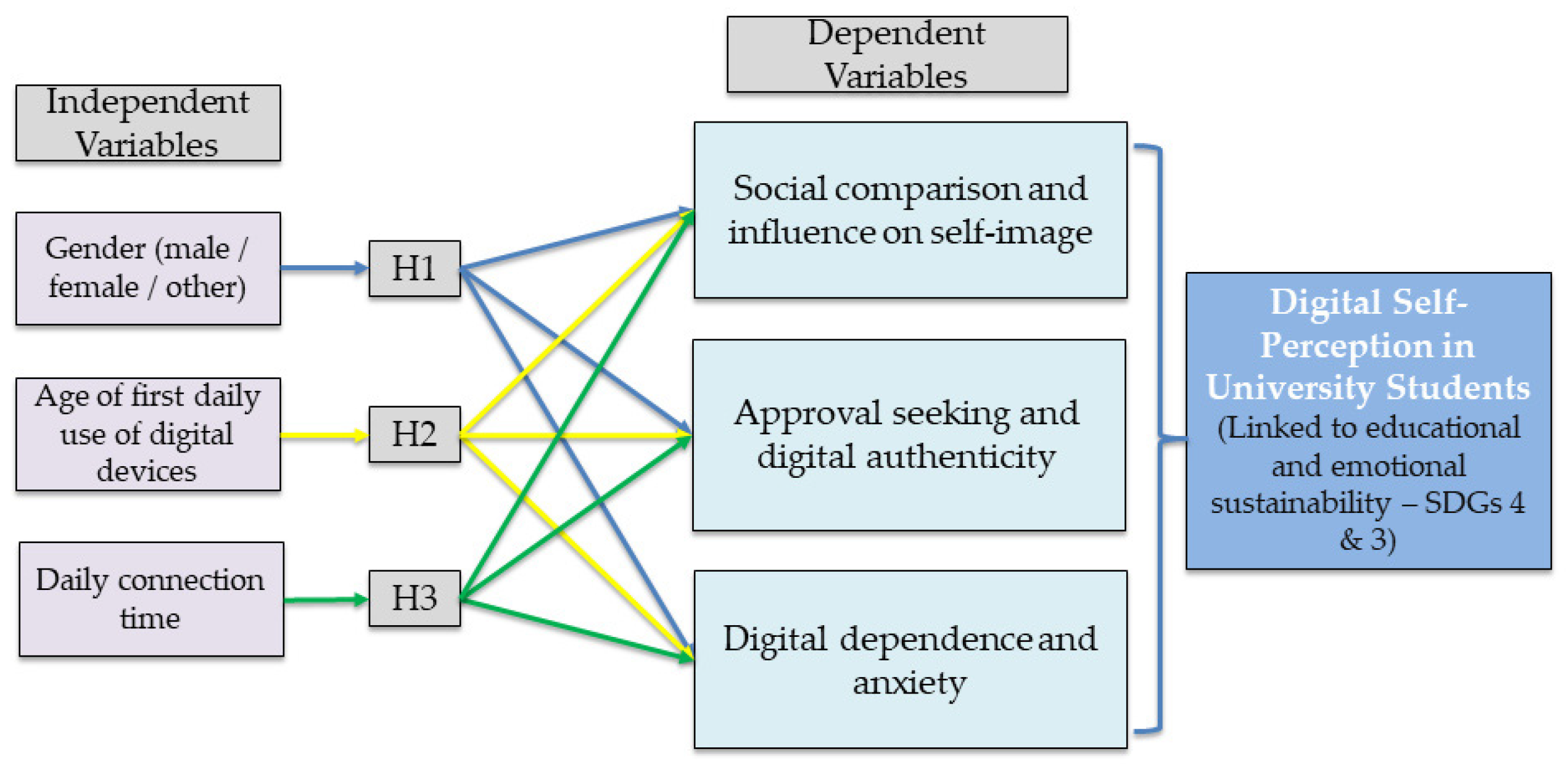
Following the Exploratory Factor Analysis, the theoretical model and the corresponding hypotheses were refined to align with the empirical structure obtained. Only the dimensions with adequate internal consistency (Factors 1, 2, and 5) were retained for inferential analyses, whereas Factors 3 and 4 were considered exploratory and excluded due to insufficient reliability. Accordingly, the hypotheses were reformulated to correspond to the validated dimensions, and the theoretical model was updated, H1 has been revised as follows: significant differences are proposed to exist between men and women in the dimensions of social comparison, search for approval, perceived risks, and digital dependence. (See
Figure 2):
2.2. Sample Description
The sample consisted of 261 undergraduate students recruited through non-probability convenience sampling from one higher education institution: CES Don Bosco, Madrid. A total of 275 questionnaires were initially collected; 14 were excluded due to withdrawal, incomplete responses, or outlier values, resulting in a final valid sample of 261 participants. The total number of students enrolled in the institution at the time of data collection was 1115. Therefore, the final valid sample of 261 participants corresponds to a response rate of 24.4%, which is consistent with typical participation levels reported in voluntary, non-probability surveys conducted in higher education settings.
Participation was voluntary and anonymous, and all respondents provided informed consent in accordance with the Declaration of Helsinki. Inclusion criteria required (a) being an undergraduate university student, (b) being at least 18 years old, and (c) voluntarily agreeing to participate. The research protocol was reviewed and approved by the Institutional Review Board of CES Don Bosco (Approval Code: 2175–2023; Approval Date: 23 October 2023). All procedures complied with the ethical principles of the Declaration of Helsinki.
The gender distribution was 75.1% female (n = 196), 24.5% male (n = 64), and 0.4% identifying as “other” (n = 1). Ages ranged from 18 to 44 years (M = 19.64, SD = 2.88). Regarding academic year, 95.8% of participants were first-year students (n = 250) and 4.2% were in their fourth year (n = 11), reflecting the characteristics of the convenience sampling procedure.
The inclusion of first- and fourth-year students was determined by practical and institutional constraints associated with the data collection procedure. Access to classrooms required instructor approval, and during the data collection period, authorisation was granted only in specific compulsory subjects taught in the first and fourth years of the undergraduate programmes. As a consequence, these were the only cohorts for which systematic and coordinated access to students was feasible.
This sampling configuration does not respond to theoretical or comparative criteria, but rather to the operational possibilities available at the time of data collection. Given these constraints, and in line with the exploratory nature of the study, the inclusion of first- and fourth-year students is justified as an appropriate and methodologically coherent approach within a non-probability convenience sampling framework. Nonetheless, the imbalance across academic years is acknowledged as a limitation, and future studies should aim to incorporate more diverse and representative cohorts to enhance external validity.
2.3. Procedure
Data collection was conducted through an online instrument administered via Google Forms. The survey remained open for three weeks, and the average completion time was approximately 20 min. Participation was voluntary and anonymous, and all individuals were informed about the study objectives and data usage prior to responding. The procedure took place between November and December 2024.
2.4. Data Analysis
To address the first objective—analysing social media use and its relationship with university students’ self-perception—descriptive and correlational analyses were conducted. For the second objective—identifying variables associated with undesirable consequences of digital use—association tests (Pearson’s chi-square and Spearman’s rho) and non-parametric group comparison tests (Mann–Whitney U) were applied. Spearman’s correlations were used to test H2 and H3, whereas gender differences for H1 were examined using the Mann–Whitney U test.
Data analysis was performed using IBM SPSS Statistics (version 24). Descriptive statistics were calculated for sociodemographic variables (gender, age, academic year) and digital-use variables (age of first exposure, daily connection time, number of platforms used), including frequencies, percentages, means, medians, and standard deviations.
Given the categorical and ordinal nature of most variables, non-parametric techniques were used. Normality tests were not conducted, as the analytical strategy relied on distribution-free methods. Associations between categorical variables (e.g., gender and age of initiation in digital device use or unsupervised internet access) were examined using Pearson’s chi-square test (χ2), complemented by the linear-by-linear association test for ordinal trends.
For ordinal variables—including age of initiation, daily connection hours, and dimension scores—Spearman’s correlation coefficient (ρ) was used to identify monotonic relationships. To analyse gender differences in the model’s dimensions, the Mann–Whitney U test was applied, as the gender variable consisted of two analysable groups (women and men) and the scores were ordinal and non-normally distributed. Although Kruskal–Wallis was initially considered during the design phase, it was not used because the gender comparisons involved only two valid groups. The “other” gender category (n = 1) was excluded from inferential analyses due to its limited size.
In line with the study’s exploratory aim, only dimensions with adequate internal consistency (Factors 1, 2, and 5) were included in hypothesis testing. Factors 3 and 4—showing low reliability (α = 0.445) or consisting of a single item—were excluded from inferential analyses and reported descriptively as exploratory findings. Together, these procedures provided a coherent statistical framework aligned with the exploratory orientation of the study, the ordinal nature of the variables, and the psychometric properties of the instrument.
2.5. Use of Generative Artificial Intelligence
Generative AI tools (ChatGPT 5.1, OpenAI, San Francisco, CA, USA) were used exclusively to support the conceptual organisation and methodological orientation of the manuscript. This included assistance in:
- (a)
Refining the theoretical alignment between the study variables and the three validated factors;
- (b)
Improving the clarity and coherence of the structure of the analytical model;
- (c)
Providing language suggestions for improving readability and consistency in the explanation of constructs.
No generative AI system was used to produce data, conduct statistical analyses, interpret empirical results, or generate figures, tables, or original scientific content. All theoretical decisions, analyses, interpretations, and conclusions were carried out entirely by the authors.
3. Results
The statistical analyses described in the previous section enabled the examination of the hypotheses formulated in the research model. In line with the study’s objectives, the results are organised into four sections: (1) description of the sample and digital habits, (2) analysis of the platforms used, (3) associations between digital-use variables and the psychological dimensions included in the analyses (Factors 1, 2 and 5), and (4) gender differences in these dimensions. Each section specifies the hypothesis being tested and summarises whether the findings support it.
3.1. Onset and Patterns of Digital Use
Regarding the age of initiation in the daily use of digital devices, the results show that most students began between the ages of 12 and 15, representing 56.7% (n = 148) of the sample. The second largest group included those who started between the ages of 9 and 12, accounting for 30.3% (n = 79).
To a lesser extent, 21 participants (8.0%) reported starting to use digital devices on a daily basis after the age of 15. Additionally, 10 students (3.8%) indicated that they began between the ages of 5 and 8, while only 3 participants (1.1%) reported having started at a very early age (between 1 and 4 years old).
The cumulative percentage indicates that more than 92% of university students were already using digital devices daily before the age of 15, evidencing a widespread adoption during childhood and adolescence.
Concerning the age at which students reported first accessing the internet without restrictions or supervision, the majority indicated that this occurred between the ages of 13 and 15, representing 51.7% (n = 135) of the sample. A substantial group, equivalent to 25.3% (n = 66), reported having reached this level of digital autonomy between the ages of 16 and 18.
Likewise, 16.9% (n = 44) stated that they first accessed the internet unsupervised between the ages of 11 and 13. Minority groups included those who reported earlier access between 5 and 10 years old (3.1%, n = 8) and those who did so only after turning 18 (3.1%, n = 8). The cumulative percentage shows that for 93.9% of students, unrestricted internet access occurred before the age of 18, with a clear concentration between 13 and 15 years old.
Regarding daily hours of internet-connected device use, the distribution reveals a high level of usage within the university sample. The modal group comprised those who reported using devices for 4 to 6 h per day, with very similar frequencies: 17.6% (n = 46) for 4 h, 17.6% (n = 46) for 5 h, and 17.2% (n = 45) for 6 h. Collectively, this segment represents nearly half of all participants (52.4%).
Another significant group included those who reported 7 h (15.3%, n = 40) and 8 h (10.0%, n = 26) of daily use, adding an additional 25.3%. Similarly, 10.0% (n = 26) reported using connected devices for up to 10 h a day, indicating a very high level of digital engagement.
In contrast, the categories reflecting lower levels of use were marginal: only 0.4% (n = 1) reported one hour per day, 1.5% (n = 4) reported two hours, and 7.3% (n = 19) reported three hours. Finally, 3.1% (n = 8) of students indicated using digital devices for nine hours per day.
To explore the potential relationship between gender and age of initiation in the daily use of digital devices, a cross-tabulation analysis accompanied by Pearson’s chi-square test was conducted. The sample comprised 261 valid cases with no missing data. Descriptive results show that both women and men predominantly began using digital devices daily between the ages of 12 and 15, though with different proportions: 79.1% of women compared with 20.9% of men within this age range. Men showed a relatively higher representation in the 9–12 age group (34.2% compared with 64.6% of women in the same category).
However, Pearson’s chi-square test (χ2 = 9.008; df = 8; p = 0.342) indicated that the observed differences were not statistically significant. This suggests that, although there are visible variations between men and women, these differences do not constitute a systematic association between gender and age of initiation in daily digital device use. The linear-by-linear association test was likewise non-significant (p = 0.180).
Subsequently, a cross-tabulation analysis was performed to examine the relationship between gender and the age of first unrestricted or unsupervised internet access in a sample of 261 valid cases. Descriptive data indicate that most participants—both men and women—reported gaining such access between the ages of 14 and 16 (74.8% of women and 24.4% of men in this category). A substantial proportion also indicated obtaining unsupervised access between the ages of 17 and 18 (80.3% of women and 19.7% of men). At earlier ages (5–10 and 11–13), men exhibited a proportionally higher presence than women (12.5% vs. 87.5% for 5–10 years, and 34.1% vs. 65.9% for 11–13 years).
Nevertheless, Pearson’s chi-square test (χ2 = 4.574; df = 8; p = 0.802) revealed no statistically significant gender differences. Similarly, the linear-by-linear association test was non-significant (p = 0.340). This indicates that, although proportional variations between men and women are observed across certain age ranges, these differences do not represent a consistent or systematic association.
A mean comparison analysis was conducted to examine the number of daily hours spent using internet-connected devices by gender. The sample included a total of 261 valid cases. Results showed that women reported an average of 6.08 h per day (SD = 2.08; n = 196), whereas men reported a slightly lower mean of 5.80 h per day (SD = 2.08; n = 64). The single respondent identifying as “other” reported an average of 7 h per day; however, this cannot be considered representative due to the limited group size.
Overall, the global mean for the sample was 6.02 h per day (SD = 2.08), confirming an intensive and sustained pattern of internet use among university students. Although minor gender differences were observed, these appear to be of minimal magnitude. These descriptive and exploratory analyses provided contextual insight into initial digital habits before proceeding with inferential tests aimed at examining the research hypotheses.
These descriptive results provide the contextual background for the inferential analyses reported in the following sections, where the study’s hypotheses are tested.
3.2. Platform Analysis
To further examine digital habits, the presence and frequency of use across different social media platforms were analysed, in line with the first objective of the study.
Regarding the possession of active social media accounts, the results show an almost universal level of penetration within the sample. Of the 261 participants, 257 (98.5%) reported having active accounts, while only 4 students (1.5%) indicated that they did not. The cumulative percentage confirms that social media presence constitutes a shared and homogeneous practice among the university population analysed.
Concerning the number of social networks habitually used by participants, all 261 valid cases responded to this variable, with no missing data. The mean number of platforms used was 4.84 (SD = 1.62), and the median was 5, indicating that half of the students actively use five or more social media platforms. The range of responses was broad, with a minimum of one and a maximum of eleven platforms, reflecting the coexistence of users with highly selective profiles and others with more diversified patterns of platform engagement.
In terms of specific platforms used regularly, the results reveal a clear predominance of certain applications over others. The most widespread among the sample were WhatsApp (96%, n = 250) and Instagram (95%, n = 248), followed by TikTok (84%, n = 219) and YouTube (61%, n = 160). This demonstrates that instant communication, visual interaction, and audiovisual consumption constitute the main pillars of university students’ digital lives.
A second group of platforms showed intermediate adoption rates, including Pinterest (39%, n = 103) and BeReal (38%, n = 100), reflecting interests linked to self-expression, authenticity, and inspiration.
To a lesser extent, students reported using Twitter/X (23%, n = 59), Telegram (11%, n = 28), Snapchat (9%, n = 24), and LinkedIn (8%, n = 20). Finally, Facebook (4%, n = 11) and Twitch (7%, n = 17) presented the lowest levels of use, consistent with Facebook’s declining relevance among younger generations and Twitch’s more specialised adoption among users engaged with streaming content.
Overall, the results indicate an intensive and diversified usage pattern, characterised by the high prevalence of visually oriented and interactive platforms (WhatsApp, Instagram, TikTok), which may reflect a digital environment oriented toward self-image and social interaction.
3.3. Association Between Factors and Social Media Use
Following the description of digital habits and platform use, associations were analysed between the independent variables (age of initiation in daily digital device use and daily connection hours) and the psychosocial dimensions derived from the factor analysis. In accordance with the study’s second objective, these analyses tested Hypotheses H2 and H3, which predicted associations between digital usage patterns and the dimensions of social comparison, search for approval, and digital dependence. Before analysing the associations between digital-use variables and the psychosocial dimensions, descriptive statistics were calculated for the three dimensions included in the inferential analyses (Factors 1, 2 and 5).
Table 2 summarises their means, standard deviations, and distribution indices (skewness and kurtosis).
Spearman’s correlation analysis showed that age of initiation was negatively and significantly associated with the three dimensions that remained suitable for inferential testing due to adequate internal consistency:
- -
Social comparison and influence on self-image (ρ = −0.123; p = 0.047),
- -
Search for approval and digital authenticity (ρ = −0.151; p = 0.014),
- -
Digital dependence and anxiety (ρ = −0.150; p = 0.015).
Additionally, inter-factor correlations were examined to provide a complete overview of the relationships among the three retained dimensions.
Table 3 presents the Spearman’s rho coefficients.
These findings indicate that earlier initiation of daily digital device use is associated with higher levels of comparison, approval-seeking behaviours, and digital dependence, consistent with H2.
Regarding daily connection hours, positive and statistically significant correlations were found with:
- -
Social comparison and influence on self-image (ρ = 0.190; p = 0.002),
- -
Search for approval and digital authenticity (ρ = 0.231; p < 0.001),
- -
Digital dependence and anxiety (ρ = 0.203; p = 0.001).
These results support H3, suggesting that greater daily connection time is linked to higher exposure to comparison mechanisms, stronger reliance on social validation, and greater feelings of dependence.
In contrast, neither age of initiation nor daily connection hours were significantly associated with the dimensions of risks and negative experiences or preference for online interaction. Given that both dimensions were excluded from inferential analyses due to insufficient internal consistency (α = 0.445 and 1 item, respectively), these findings are reported descriptively and do not form part of hypothesis testing.
In summary, the results partially support H2 and H3, with significant correlations emerging for the three dimensions with acceptable internal consistency (Factors 1, 2, and 5). No associations were expected—or tested—for Factors 3 and 4 because of their psychometric limitations.
3.4. Gender Differences Across Dimensions
Finally, to test Hypothesis H1, gender differences were examined in the three dimensions with adequate internal consistency: social comparison and influence on self-image, approval seeking and digital authenticity, and digital dependence and anxiety. The gender variable originally included three categories (male, female, and other); however, the “other” category was represented by only one participant (n = 1), who was therefore excluded from the inferential analyses [
72]. All comparisons were conducted between women (n = 196) and men (n = 64) using the Mann–Whitney U test, given the ordinal nature of the scores and the presence of non-normal distributions (see
Table 4).
Women scored significantly higher than men in social comparison and influence on self-image (M = 1.78, SD = 0.94 vs. M = 1.10, SD = 0.82). The difference was statistically significant, U = 3618.50, Z = –5.087, p < 0.001, with a medium effect size (r = 0.32). This result indicates that female students report a greater tendency to compare their appearance with others and to perceive a stronger impact of social media on their self-image.
For approval seeking and digital authenticity, women also obtained higher scores (M = 1.44, SD = 0.64) than men (M = 1.18, SD = 0.58). The Mann–Whitney U test confirmed a significant difference, U = 4668.50, Z = –3.084, p = 0.002, although the effect size was small (r = 0.19). This suggests that, while both groups value social validation in digital environments, this tendency is more pronounced among women.
Similarly, women reported higher levels of digital dependence and anxiety (M = 1.94, SD = 0.95) compared with men (M = 1.55, SD = 0.82). The difference was statistically significant, U = 4801.00, Z = –2.854, p = 0.004, with a small effect size (r = 0.18). These findings indicate that, although the magnitude is modest, women exhibit greater vulnerability to feelings of dependence on digital devices and discomfort or anxiety when access is limited.
Taken together, these results support H1, revealing statistically significant gender differences in social comparison, approval seeking, and digital dependence. The associated effect sizes range from small to medium, indicating that the observed differences are robust but should be interpreted as modest in magnitude rather than large or extreme.
4. Discussion
4.1. Objectives, Model and Overview of Findings
This study pursued two objectives: (a) to analyse social media use and digital self-perception among university students, and (b) to identify usage variables associated with undesirable consequences linked to self-image, approval seeking, and digital dependence. The analytical model organised these constructs into five theoretical dimensions, of which three—social comparison and influence on self-image, approval seeking and digital authenticity, and digital dependence and anxiety—showed acceptable internal consistency and were therefore retained for inferential analyses.
Descriptive results confirmed the centrality of social media in students’ daily lives, with an average use of just over six hours per day and a mean of nearly five active platforms per participant, predominantly WhatsApp, Instagram, and TikTok.
This pattern aligns with the notion of digital social leisure [
2] and with international frameworks that call for conscious, emotionally sustainable engagement with digital environments, such as UNESCO’s Media and Information Literacy (MIL) framework and the European Commission’s Digital Education Action Plan [
4,
5,
6].
At the psychosocial level, the three retained dimensions were moderately to strongly inter-correlated (ρ between 0.39 and 0.68), indicating that social comparison, approval seeking, and digital dependence form an interconnected system of digital self-perception rather than isolated phenomena.
Together, these results partially meet the first objective by showing that university students’ self-perception in social media is structured around intertwined dynamics of external validation and perceived dependence.
The second objective was addressed through the analysis of associations between the three dimensions and two key usage variables: age of initiation in the daily use of digital devices and daily connection hours. These analyses allowed the testing of hypotheses H2 and H3, while H1 was examined through gender-based comparisons. As detailed below, H1, H2, and H3 were supported for the dimensions with sufficient reliability, within the exploratory scope of the model.
4.2. Gender Differences in Digital Self-Perception (H1)
H1 proposed gender differences in social comparison, approval seeking, and digital dependence. The results supported this hypothesis for the three retained dimensions: women scored significantly higher than men in social comparison and influence on self-image, approval seeking and digital authenticity, and digital dependence and anxiety, with effect sizes ranging from small to medium.
These findings are consistent with previous work showing greater exposure of young women to aesthetic norms, image-related pressure, and emotionally costly forms of online comparison [
13,
14,
15,
16,
37,
50,
53]. From the perspective of social comparison theory [
51,
52], image-centred platforms amplify self-evaluation processes by continuously exposing users to idealised representations that function as implicit standards. The higher scores among women indicate a greater internalisation of such standards and a stronger tendency to rely on feedback (likes, comments, and views) as a source of self-validation [
63,
64,
65].
The association between higher levels of digital dependence and being female also converges with evidence linking problematic social media use to heightened emotional vulnerability, particularly anxiety and mood instability, in groups more exposed to appearance-focused content [
15,
16,
29,
50]. In line with meta-analytic findings on self-esteem and social networking [
67], these results suggest that the emotional costs of online comparison and validation processes are not evenly distributed across genders.
Within the exploratory model proposed here, H1 is therefore confirmed for the three dimensions with adequate internal consistency. These results support the idea of a gendered “digital emotional gap”, whereby women not only participate intensively in social media but also experience stronger emotional involvement in comparison and validation dynamics. This underlines the need for gender-sensitive digital emotional literacy initiatives that explicitly address body image, authenticity, and the management of social feedback in higher education contexts [
3,
4,
6,
37].
4.3. Age of Initiation and Configuration of Self-Perception (H2)
H2 hypothesised that earlier initiation in the daily use of digital devices would be associated with higher levels of social comparison, approval seeking, and digital dependence. Spearman’s correlations corroborated this hypothesis for the three retained dimensions: age of initiation correlated negatively and significantly with social comparison and influence on self-image, approval seeking and digital authenticity, and digital dependence and anxiety.
Although effect sizes were small, the pattern was consistent: students who began using digital devices daily at younger ages reported greater involvement in comparison processes, a stronger need for online approval, and more intense feelings of dependence and anxiety when access was restricted. This is in line with research that links early and intensive exposure to social media with the consolidation of habits centred on external validation and affect-dependent self-presentation [
17,
33,
37,
53]. It also converges with studies describing problematic use as a progressive phenomenon, shaped by accumulated experiences of reinforcement in digital environments [
24,
25,
26,
28,
29].
From a psychosocial perspective, these findings suggest that early initiation may normalise the use of social media as a primary space for self-definition, increasing the likelihood that identity management and emotional regulation will be anchored in online feedback [
33,
34]. The model proposed here interprets this as a developmental trajectory in which earlier exposure facilitates the internalisation of appearance- and approval-related norms, while also increasing susceptibility to dependence and anxiety.
It is important to emphasise, however, that this study could not test the associations originally hypothesised between age of initiation and the dimensions of risks and negative experiences or preference for online interaction, due to the limited reliability of those factors. Consequently, H2 is supported only for the three dimensions with acceptable internal consistency, and the role of early initiation in other elements of digital self-perception remains an open question for future research.
4.4. Daily Connection Time and Emotional Centrality of Social Media (H3)
H3 posited that a greater number of daily connection hours would be associated with higher scores in social comparison, approval seeking, and digital dependence. This hypothesis was also supported for the three retained dimensions: daily connection time showed positive and statistically significant correlations with social comparison and influence on self-image, approval seeking and digital authenticity, and digital dependence and anxiety.
These associations are consistent with behavioural and cognitive–behavioural models of addiction, which describe problematic social media use as the outcome of escalating engagement, loss of control, and interference with everyday functioning [
24,
25,
26]. The results suggest that greater time spent connected is not only a quantitative indicator but is qualitatively linked to more intense comparison mechanisms, stronger reliance on social validation, and a heightened sense of dependence.
In line with recent work on Fear of Missing Out and problematic use, the combination of social comparison and low self-esteem has been identified as a key pathway through which intensive social media use leads to discomfort and emotional dysregulation [
53]. The present findings align with this mechanism and can also be interpreted in light of research on false self-presentation, which points to the role of strategically managed online identities and social comparison in sustaining excessive use [
73]. In this view, students who spend more hours connected are more exposed to, and more likely to reproduce, idealised self-presentations that reinforce both comparison and the need to maintain an attractive digital persona.
As with H2, the correlations for H3 were not examined for the dimensions of risks and negative experiences or preference for online interaction, given their insufficient reliability. The hypothesis is therefore confirmed only for the three psychometrically robust dimensions, and the relationship between connection time and other facets of digital experience should be addressed in future studies using refined measures.
4.5. Implications for the Analytical Model, SDGs and Educational Practice
Taken together, the results partially confirm the three working hypotheses and provide empirical support for the exploratory analytical model centred on social comparison, approval seeking, and digital dependence as core components of digital self-perception in university students. The consistent pattern of associations with age of initiation, daily connection time, and gender suggests that these dimensions capture key psychosocial mechanisms through which social media use intersects with emotional well-being.
At the same time, the study underscores the preliminary nature of the model. The exclusion of the risks/negative experiences and preference for online interaction dimensions from inferential analyses—due to limited internal consistency—indicates that additional item refinement and psychometric work are needed before a more comprehensive structural solution can be proposed. In this sense, the results should be interpreted as exploratory evidence that organises relevant constructs and identifies promising lines for future model development, rather than as a fully validated measurement framework.
From an educational perspective, the findings reinforce the importance of digital emotional literacy as a key component of sustainable higher education. International frameworks such as UNESCO’s MIL, the Digital Education Action Plan, and the Better Internet for Kids (BIK+) strategy stress that digital competence must integrate critical, ethical, and emotional dimensions to promote well-being and safe participation [
4,
5,
6,
7]. The present study contributes to this agenda by showing that social comparison, approval dependence, and digital anxiety are not marginal phenomena but central element of how students experience their online presence.
Linking these results with SDG 3 (Good Health and Well-being) and SDG 4 (Quality Education) highlights the need for university policies that explicitly address digital well-being, incorporating preventive strategies (e.g., early media education, promotion of authenticity and self-acceptance online) and support mechanisms for students who experience high levels of dependence or emotional distress associated with social media use [
3,
8,
60,
61]. Within this framework, the exploratory model proposed here may serve as a starting point for designing interventions and future research on digital self-perception and emotional sustainability in hyperconnected university contexts.
6. Conclusions
This study examined how university students’ social media use relates to three dimensions of digital self-perception—social comparison and influence on self-image, approval seeking and digital authenticity, and digital dependence and anxiety. The analyses revealed consistent associations between these dimensions and gender, age of initiation in daily digital device use, and daily connection time, offering exploratory support for the proposed analytical model.
Women reported higher levels of comparison, approval seeking, and digital dependence, thereby supporting H1 and reflecting persistent gendered emotional patterns in visually oriented digital environments. Earlier exposure to daily digital use and longer connection time were linked to stronger involvement in comparison and validation processes, as well as to higher feelings of dependence and anxiety, providing support for H2 and H3 within the limits of a correlational design. These findings do not imply causation but highlight recurrent patterns through which digital contexts shape students’ emotional responses and perceived authenticity.
The study contributes an empirically grounded, yet still preliminary, framework for understanding digital self-perception in higher education. While the factor structure obtained offers conceptual coherence, further validation—including test–retest reliability, criterion validity, and confirmatory analyses—is necessary before the instrument can be considered fully validated. The exclusion of two dimensions due to insufficient internal consistency reinforces the need to refine measurement strategies.
From an educational perspective, the results underscore the importance of integrating emotional and critical dimensions of digital competence into university curricula. International frameworks such as UNESCO’s Media and Information Literacy and the European Commission’s Digital Education Action Plan emphasise the need for reflective and responsible digital engagement. The present findings align with these guidelines by showing that students’ digital well-being depends not only on technical proficiency but also on their ability to navigate comparison pressures, authenticity expectations, and tendencies toward dependence.
Finally, the study highlights the connection between Sustainable Development Goals 3 (Good Health and Well-being) and 4 (Quality Education). Promoting emotional literacy, balanced digital leisure, and healthy online participation may strengthen institutional policies aimed at fostering sustainable digital environments in higher education. By offering initial empirical insights, this research lays the groundwork for developing interventions that enhance students’ emotional resilience and support responsible digital citizenship in increasingly hyperconnected academic settings.




 ,
,