Article

Adap-Informer: Adaptive Aircraft Fuel Prediction Framework Supporting Emergency Decision-Making and Aviation Decarbonization


1
Institute of Disaster Prevention, College of Information and Control Engineering, Langfang 065201, China
2
Operation Center Air China Limited, Beijing 101312, China
3
School of Astronautics, Beihang University, Beijing 100191, China
*
Authors to whom correspondence should be addressed.
Sustainability 2025, 17(24), 11078; https://doi.org/10.3390/su172411078
Submission received: 20 October 2025 / Revised: 3 December 2025 / Accepted: 8 December 2025 / Published: 10 December 2025

Abstract

This study proposes Adap-Informer, an adaptive fuel prediction framework addressing the limitations of fixed input and output structures and underutilized real-time data in existing methods. It employs a grid search with early stopping algorithm to determine optimal sequence configurations and pre-trains dedicated models for distinct flight phases. An online selection mechanism dynamically matches the most suitable model based on accumulating real-time data, enabling progressively refined predictions. Experimental results show a continuous reduction in prediction error as more data becomes available, with the Mean Absolute Error decreasing from 0.12 to 0.052—corresponding to a maximum fuel quantity error of 1400 kg. This is substantially lower than the 2000–5000 kg of redundant fuel currently carried. The framework’s accuracy complies with core aviation safety regulations like ETOPS and FAA Part 121, providing a technical basis for safe fuel load optimization. By reducing redundant fuel, it directly contributes to aviation decarbonization, supporting the industry’s alignment with ICAO’s net-zero emissions target by 2050 and offering robust support for sustainable aviation development.

1. Introduction

Global air transport continues to grow and currently accounts for approximately 2 percent of anthropogenic CO2 emissions [1,2,3,4], leaving the aviation industry with a dual challenge: ensuring flight safety amid complex operational uncertainties and advancing decarbonization to align with global climate goals, such as ICAO’s net-zero emissions target by 2050 [2]. Accurate aircraft fuel prediction has emerged as a core technology to address this duality, as it directly supports three interconnected objectives: it enhances flight safety by enabling reliable emergency decisions (e.g., diversion airport selection during abnormal weather), optimizes energy utilization by reducing unnecessary fuel loading, and cuts the aviation sector’s environmental footprint by minimizing redundant fuel-induced CO2 emissions [1,4].
A critical barrier to these goals is the industry’s reliance on excessive redundant fuel. To mitigate risks from inaccurate fuel estimation, airlines typically carry 2000–5000 kg of redundant fuel [this study’s data from Air China], which increases aircraft weight by 3–5 percent and consequently elevates fuel consumption and associated CO2 emissions [3]. This practice conflicts with the sustainability imperatives highlighted in earlier research: Seymour et al. [1] demonstrated that every kilogram of aircraft fuel saved reduces CO2 emissions by approximately 3.16 kg, while Ding et al. [2] emphasized that fuel optimization is a cost-effective pathway to align aviation with the United Nations’ Sustainable Development Goal 13 (Climate Action). Moreover, Gössling et al. [4] noted that post-COVID-19 air transport recovery must prioritize low-carbon operations to avoid reversing progress on emission reductions, making precise fuel prediction even more critical for sustainable aviation transition [5].
Despite advancements in fuel prediction methods, existing approaches suffer from two key limitations that hinder their ability to balance safety and sustainability. First, traditional physics-based models [6,7,8,9] rely heavily on manual feature engineering and prior assumptions, failing to adaptively capture the non-linear temporal relationships between flight parameters (e.g., altitude, speed) and fuel consumption across distinct flight phases (takeoff, cruising, landing). This leads to poor real-time adaptability, forcing airlines to retain excess fuel as a safety buffer. Second, recent deep learning models [10,11,12,13,14,15,16] adopt fixed architectures that cannot adjust to varying input characteristics of different flight phases or fully integrate real-time inflight data—including high-frequency, high-accuracy data from Automatic Dependent Surveillance Broadcast (ADS-B) systems, which automatically transmit aircraft operational parameters (e.g., real-time fuel flow, ground speed, and vertical climb rate) to support dynamic flight state monitoring. For instance, the CNN-BiLSTM model [12] achieves high accuracy in takeoff/landing but requires manual phase switching, while static models like FCPNet [16] only address pre-takeoff scenarios; neither supports dynamic fuel optimization during flight by leveraging ADS-B-derived real-time data to reduce redundant fuel.
To fill these gaps, this study addresses three core research questions: How to design an adaptive fuel prediction framework that dynamically matches the varying data characteristics of different flight phases, avoiding the rigidity of fixed input and output structures How to leverage real-time inflight data including key parameters from Automatic Dependent Surveillance Broadcast (ADS-B) systems to progressively refine fuel prediction accuracy thereby reducing the need for redundant fuel while ensuring compliance with aviation safety standards To what extent can a precise fuel prediction framework contribute to aviation sustainability by cutting CO2 emissions and how does it align with industry-wide decarbonization targets.
To answer these questions, we propose Adap-Informer, an adaptive time-series forecasting framework tailored for aircraft fuel prediction. Its overall research approach comprises three key components: First is the pre-training of phase-specific models—using 30,000 flight datasets from 2024 (including normal commercial flight segments and emergency operation records) extracted from Air China’s black box data. We pre-train dedicated models for takeoff/cruising and landing phases, with input and output sequence lengths optimized via grid search with early stopping to match each phase’s data volume characteristics (e.g., shorter inputs for takeoff with limited real-time data, longer inputs for cruising with accumulated data). Second is real-time model selection: an online selection mechanism dynamically identifies the most suitable pre-trained model based on the length and features of real-time inflight data, enabling continuous accuracy improvement as flight data accumulates. Third is safety and sustainability validation: we verify that the framework’s prediction error meets regulatory safety margins (e.g., ETOPS [17], FAA Part 121 [18]) and quantify its carbon reduction potential by linking reduced redundant fuel to CO2 abatement.
The following sections detail the data preprocessing procedures in Section 2.1, the technical architecture of Adap-Informer in Section 2.2, experimental validations of its performance in Section 3, and conclusions on its contributions to flight safety and aviation decarbonization in Section 4.

2. Methods

In terms of data processing, a series of elaborate processing tasks were carried out for the flight feature data containing time information and fuel quantity data provided by Air China. Through operations such as timestamp alignment, aircraft type screening, differencing (i.e., computation of relative differences) for spatiotemporal features and target variables, one-hot encoding of aircraft type features, equally spaced resampling, standardization, and reasonable dataset division, the data quality and model adaptability were improved, laying a solid foundation for subsequent model training and prediction.
Adap-informer serves as the core for solving the aircraft fuel prediction problem in this paper. Taking Informer as the base model, it combines a grid search with early stopping optimization algorithm and an adaptive model selection mechanism to construct model ensembles for different flight phases (takeoff, flight, landing). In the training phase, the grid search with early stopping optimization algorithm is utilized to screen out optimal input and output sequence length combinations and train corresponding models; in practical applications, the adaptive selection module dynamically matches the optimal model according to real-time data lengths and features, achieving precise prediction of fuel quantities in different flight phases, effectively incorporating new data, and improving prediction accuracy. Section 2.1 of this section outlines the series of processing performed on the original data, and Section 2.2 describes the overall training and usage architecture of Adap-informer.

2.1. Data Preprocessing

As the source data consist of two types: feature data containing time information and fuel quantity data, the data processing procedures of this study introduced in this subsection focus on fuel quantity data and feature data, and enhance data quality and model adaptability through a series of meticulous operations(as shown in Figure 1).
This study obtained black box data from Air China, a major domestic airline, to construct a comprehensive and representative dataset for aircraft fuel prediction. The data collection process strictly adheres to aviation data management protocols and Air China’s operational data governance standards, with details as follows: First, the data source primarily includes two types of aviation-grade recording systems: Flight Data Recorders (FDRs) (commonly referred to as “black boxes”) and Automatic Dependent Surveillance Broadcast (ADS-B) systems integrated with the FDRs. The FDRs continuously record flight operational parameters at a sampling frequency of approximately 0.033 Hz, capturing core flight states such as aircraft gross weight (kg), ground speed (km/h), true airspeed (km/h), altitude (m), climb/descent rate (m/s), ambient wind speed (km/h), latitude/longitude, atmospheric pressure (hPa), and remaining fuel quantity (kg). The ADS-B systems, as supplementary data sources, transmit real-time aircraft position and operational data to ground stations at 5 s intervals, which are synchronized with FDR data via timestamp alignment to ensure temporal consistency. Second, the data collection scope covers 25 distinct aircraft types widely operated by Air China, including medium-sized narrow-body aircraft and large-sized wide-body aircraft. These aircraft operate on more than 120 domestic and short-haul international routes, encompassing diverse flight environments such as plain, plateau, coastal, and cross-border airspaces, as well as typical abnormal scenarios (e.g., temporary altitude adjustments due to turbulence, short-term speed reductions for air traffic control, and diversion preparations for adverse weather).
To construct a dataset suitable for subsequent model analysis, a series of data processing tasks was performed on the above-collected data.
First, timestamp alignment was conducted for the two types of data (FDR and ADS-B) to ensure accurate association between flight features and fuel information at each time point. This eliminated inconsistencies in data recording times, made the data comparable on a temporal scale, and improved data integrity and accuracy, thereby enhancing the reliability of subsequent model analysis results [19,20]. This laid a foundation for follow-up analysis.
Subsequently, the aligned data were divided into trips based on single takeoff and landing cycles, yielding a total of 30,000 sets of time-series data, each stored as a separate file corresponding to one takeoff-landing trip. This grouping method aligns with actual flight scenarios, using a complete flight trip as an independent analysis unit. This approach better reflects the pattern of feature changes during a full flight and facilitates the model’s capture of the relationship between flight features and fuel consumption within each trip.
Considering that aircraft of different size categories exhibit significant differences in fuel consumption rates and variation patterns—for instance, large wide-body aircraft typically have higher fuel flow rates due to larger takeoff weights and engine thrust, while medium-sized aircraft show more stable fuel consumption during cruising—this study first categorized the Air China dataset into three subgroups based on aircraft size: Medium-sized aircraft dataset, Large-sized aircraft dataset, and Mixed-size aircraft dataset (integrating all data from both medium-sized and large-sized aircraft types).
Targeted data processing was performed on these three subgroups, respectively, to construct datasets suitable for subsequent model training and performance validation, ensuring that the impact of aircraft size differences on fuel prediction results could be systematically analyzed. Subsequently, Adap-Informer was trained on these three dataset types respectively.
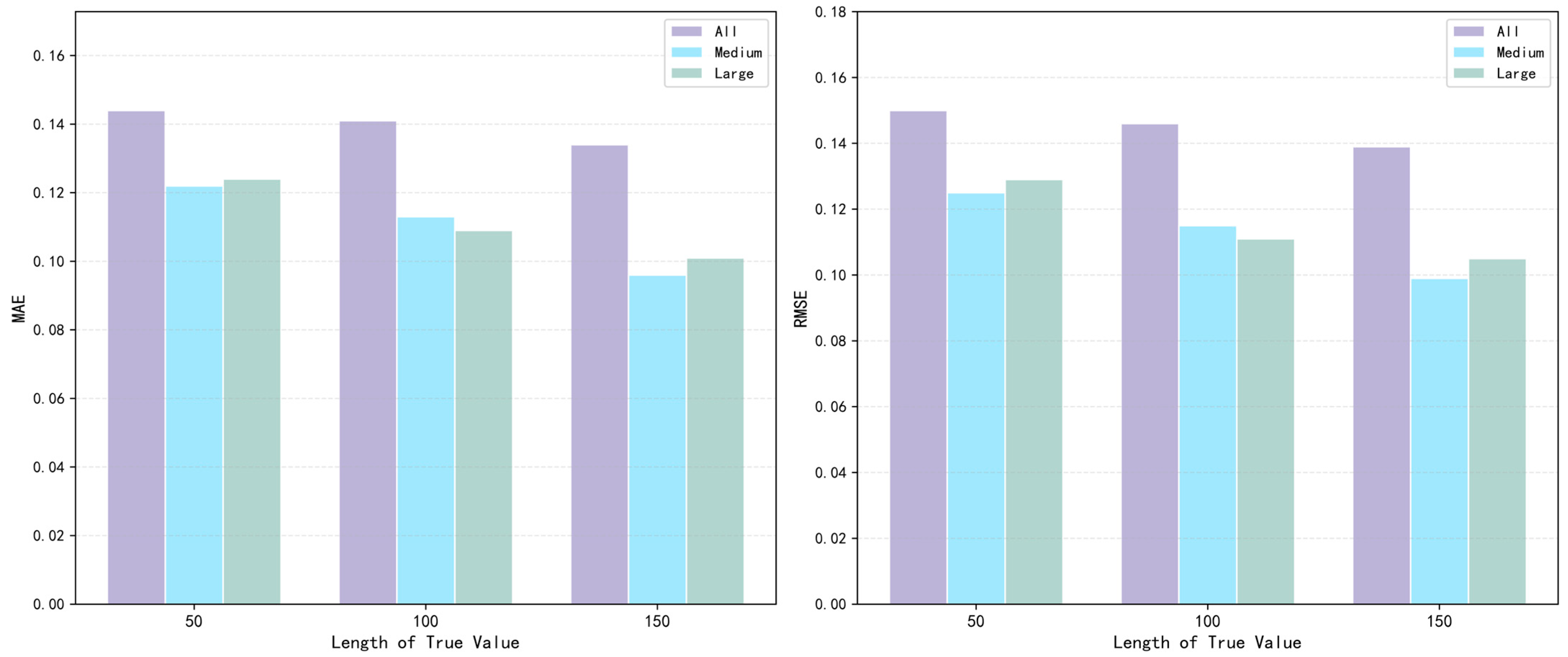
Experimental results indicate that compared with the model trained on the mixed-size aircraft dataset, the models trained on the two single-size-category datasets (medium-sized and large-sized aircraft) both achieved better prediction performance on the test set. Specifically, across key error metrics including Mean Absolute Error (MAE) and Root Mean Square Error (RMSE), the medium-sized aircraft model and large-sized aircraft model consistently exhibited smaller error values than the mixed-size aircraft model. Specific comparative results are presented in Figure 2.
This result indicates that when the data range is limited to a single size category of aircraft, the model can more accurately capture the variation patterns of fuel consumption for that specific size category with features such as latitude and longitude, altitude, weight, speed, and climb rate. By focusing on a single size category, noise interference caused by fuel consumption characteristic differences between aircraft of different sizes is effectively reduced, thereby achieving more ideal results in the task of predicting remaining aircraft fuel. In practical applications, users can select the corresponding pre-trained single-size-category model according to the specific size (medium-sized or large-sized) of the operating aircraft to ensure prediction accuracy for different aircraft [21].
During the prediction of an aircraft’s remaining fuel quantity, different trips and flights show notable variations in initial fuel levels, and such variations may pose considerable challenges to the model’s capacity to accurately capture the intrinsic relationship between fuel amount and features. Consequently, differencing was performed for three key variables (longitude, latitude, and fuel) to compute their relative changes from initial values.
Δ l o n t = l o n t l o n 0
Δ l a t t = l a t t l a t 0
Δ f u e l t = f u e l t f u e l 0
When forecasting the remaining fuel of an aircraft, the notable variations in initial fuel amounts across distinct flights and trips pose substantial challenges for models to precisely discern the inherent correlations between fuel quantities and pertinent features [22]. To address this issue, a differencing experiment was conducted to investigate the necessity and efficacy of computing the difference between the fuel quantity at each timestamp and the initial fuel quantity of the current trip (i.e., differencing). Through this differencing operation, the originally complex fuel quantity prediction problem was transformed into one of predicting fuel quantity changes based on features, aiming to facilitate the model’s effective data analysis and enhance prediction accuracy. The Mean Absolute Error (MAE) was employed as the evaluation metric, where a smaller MAE value indicates a closer alignment between the prediction result and the actual value, reflecting superior prediction performance.
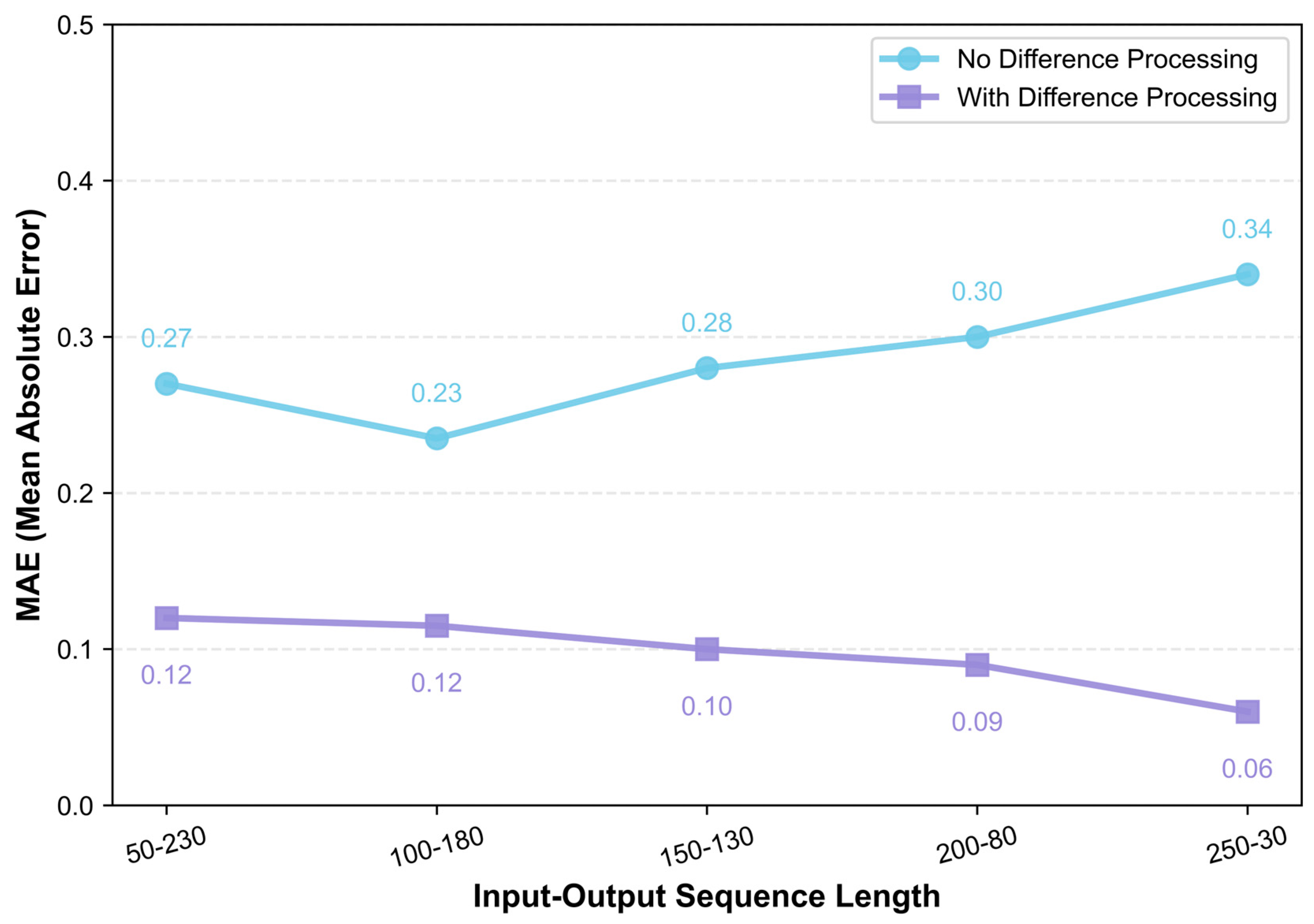
Dedicated models were developed for the takeoff-level flight phase and the landing phase, and comparative experiments were performed for both models with and without differencing. As illustrated in experimental result Figure 3, during the takeoff and level flight phase, the model without differencing struggled to effectively unearth the patterns between fuel quantities and features due to the significant disparities in initial fuel quantities across flights, resulting in a relatively elevated MAE. Taking input output sequence lengths of 50-230 as an example, the MAE of the model without differencing was 0.266 (translating to an actual fuel quantity error of approximately 2926 kg, derived by multiplying the MAE by the fuel dataset standard deviation of 11,000 kg). In contrast, the model with differencing, which focuses on the association between fuel quantity changes and features, achieved a remarkable improvement in prediction accuracy, with the MAE decreasing to 0.121.
In the latter stages of flight, the gap in prediction performance between models with and without differencing grows even more distinct. For data without differencing, the variability in initial fuel quantities across flights leads to substantial prediction inaccuracies. When the input output sequence lengths are set to 250-30 (matching the landing phase), the model without differencing exhibits an MAE as high as 0.326, which equals an actual fuel quantity error of roughly 3500 kg (calculated as MAE multiplied by the fuel dataset standard deviation of 11,000 kg). In sharp contrast, the model integrated with differencing effectively mitigates the disruptive effects of initial fuel quantity discrepancies, achieving an MAE of merely 0.060, which translates to an actual fuel error of approximately 650 kg.
Two key factors underpin this significant error disparity, supported by aviation fuel modeling research: (1) Even for flights operating with the same aircraft type and along the same route, initial fuel loads vary markedly. Medium-sized aircraft typically have initial fuel quantities ranging from 16,000 kg to 41,000 kg, while large-sized aircraft span 41,000 kg to 80,000 kg [this study’s Air China dataset]. Models without differencing fail to distinguish between two distinct scenarios: an aircraft starting with high initial fuel and consuming it normally, versus an aircraft with low initial fuel but high consumption rates, leading to misalignment between predicted and actual residual fuel [23]. (2) During the landing phase, the aircraft’s remaining fuel is usually 30 to 40 percent of its initial load [24], making relative changes in fuel consumption far more critical for accurate prediction than absolute values. Differencing redefines the prediction task to forecasting fuel consumption trends, which aligns with the “relative change priority” principle established in aviation fuel modeling [25]. Collectively, these observations confirm that as flight distance increases, differencing becomes increasingly effective at enhancing prediction accuracy, enabling more precise characterization of how fuel quantity changes relate to key flight features.
Synthesizing the full range of experimental findings, processing the differential values of longitude, latitude, and fuel quantity (calculated relative to their respective initial values at the start of each trip) is indispensable. This processing approach strengthens the model’s capacity to decipher the relationship between fuel quantity and relevant features. Its impact is particularly pronounced in the late flight phase, most notably during landing. In doing so, it provides a more robust data processing strategy tailored to the demands of aviation fuel quantity prediction.
Within the 30,000 sets of trip data, 25 distinct aircraft types were incorporated as analytical features—this decision stemmed from the recognition that aircraft type has a notable impact on flight performance and fuel consumption, with clear disparities between the two primary categories (medium-sized narrow-body and large-sized wide-body) among the 25 types. To explicitly illustrate these differences between medium and large aircraft, Table 1 summarizes key fuel-related characteristics of representative models from the two categories.
To address the misleading effects of numerical partial ordering inherent in categorical variables on model training, One-Hot Encoding was adopted to convert aircraft type features into 25-dimensional binary vectors. For instance, the A320 is encoded as [1, 0, …, 0] while the B787 is represented as [0, 1, …, 0]. This approach preserves the independence of individual aircraft types, enhancing the model’s capacity to identify and distinguish fuel efficiency patterns specific to each aircraft model [20]. In practical applications, this preprocessing step optimizes subsequent model operations, facilitates the capture of flight-specific characteristics for each aircraft type and improves the model’s competence in handling complex data and generating accurate analytical results [26].
To make the data in all trip files equally spaced for unified processing and analysis by the model, the data of all trips were sampled at one row per minute. Through this equally spaced resampling, the original irregular time-interval data were converted into data with fixed time intervals, eliminating analytical obstacles caused by inconsistent data intervals, simplifying the structure of model input data, and improving the efficiency and stability of model training and prediction.
Finally, to enhance the model’s convergence speed and generalization ability, z-score standardization processing was performed on the data [27], with the formula:
Z = x μ δ
The following are the definitions of these symbols:
  • Z : The standardized value
  • x : A certain value in the original data
  • μ : The mean value of the original data
  • δ : The standard deviation of the original data, and the calculation formula is:
δ = 1 n i = 1 n ( x i μ ) 2
Thereby improving the model’s training effect and generalization ability, enabling the model to better learn the latent patterns in the data.
After a series of data processing steps, the 30,000 processed datasets, each corresponding to one takeoff-landing trip, were proportionally divided into a training set and a test set. Specifically, one-tenth of these datasets was randomly selected as the test set to evaluate the model’s performance on unseen data, while the remaining nine-tenths served as the training set for the model to learn the patterns and features within the trip-related data. Through reasonable partitioning of the training and test sets, the model’s generalization ability can be effectively evaluated, ensuring good prediction performance in practical applications [20,27].

2.2. Adap-Informer

Adap-Informer is specifically developed for aircraft fuel prediction scenarios. Taking the Informer model [28] as its technical foundation, this framework integrates a grid search with early stopping algorithm and an adaptive model selection mechanism, which collectively enable high-precision prediction of fuel quantity throughout the distinct phases of a flight, namely takeoff, cruising, and landing. The core architecture of Adap-Informer is composed of two pivotal and functionally distinct components: the model training component and the adaptive application component.
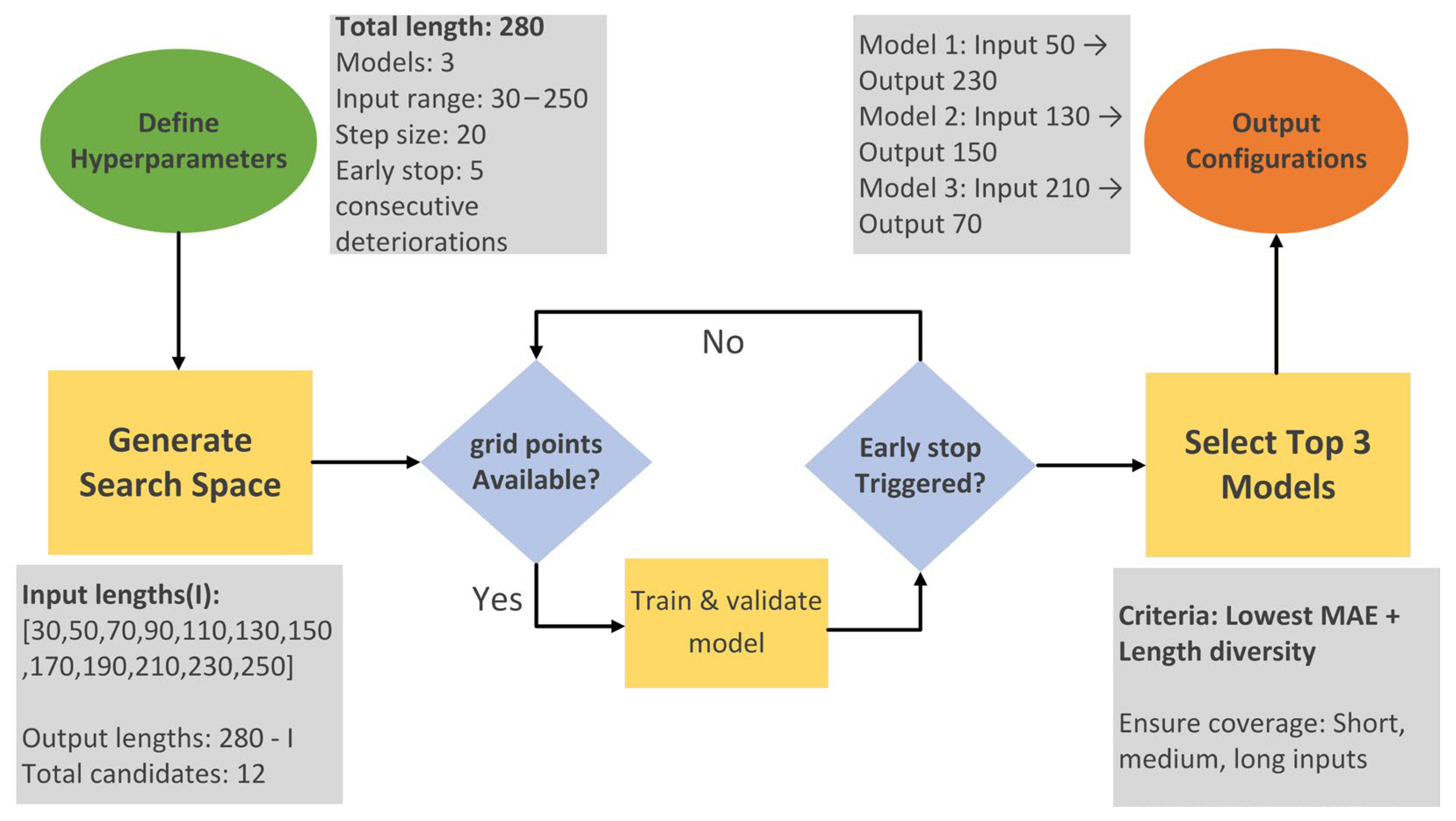
In Figure 4, during the training phase, Adap-informer first constructs multiple models with different input and output sequence length combinations based on the Informer architecture using flight feature data and fuel quantity data. Through systematic traversal of the grid search space and real-time monitoring of model performance with the early stopping strategy, the performance of models with different input and output combinations is evaluated, and the strategy screens out the input and output sequence length combinations that exhibit optimal performance across the entire flight from multiple options [29].
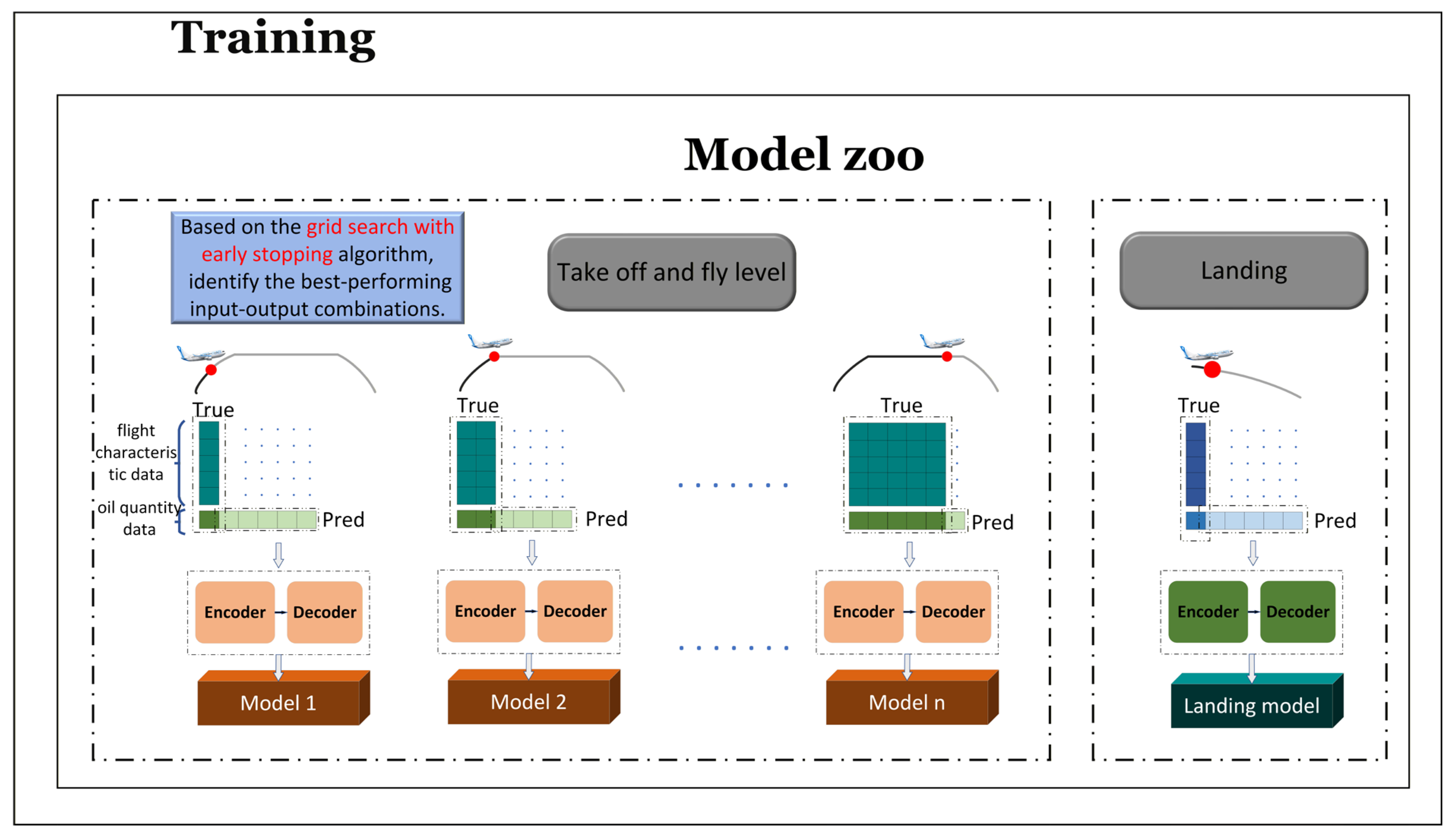
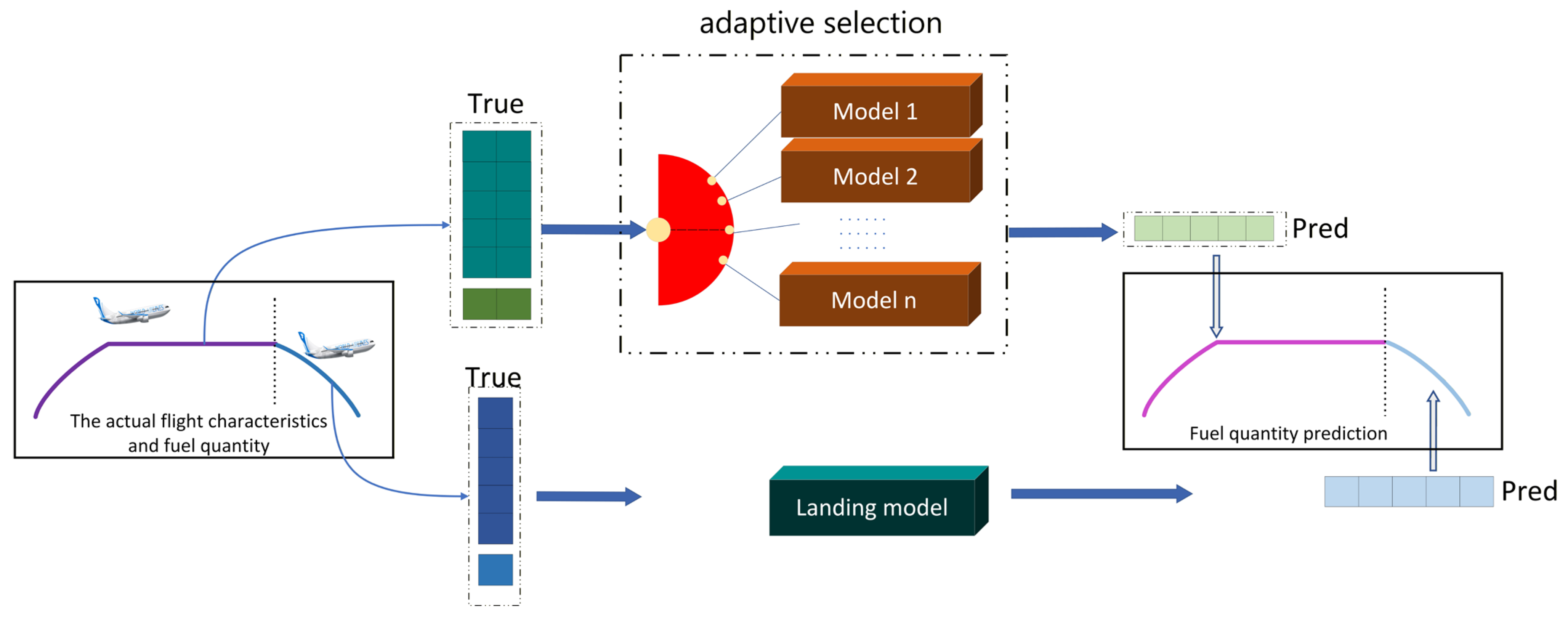
In Figure 5, model ensembles such as Model 1 and Model 2 for the takeoff and level flight phases, as well as a dedicated Landing Model for the landing phase, were trained for these selected combinations—with input and output sequence lengths pre-matched to the data volume characteristics of each phase (e.g., shorter input lengths for takeoff phase with limited real-time data, longer input lengths for cruising phase with accumulated flight data). These models all include an Encoder Decoder structure and incorporate Stack ProbSparse Self-attention and Multi-head Self-attention to enhance the feature extraction and prediction capabilities for time-series data.
In practical fuel prediction scenarios, the operational principle of Adap-Informer’s dynamic model selection mechanism is illustrated in Figure 6: as real-time flight data are continuously input during the flight process, the framework dynamically matches the optimal predictive model via its built-in adaptive selection module. Specifically, the system conducts real-time analysis of both the length and feature attributes of the current real-value data, and further retrieves the model that best aligns with the current flight state from the pre-trained model ensemble to execute fuel quantity prediction tasks [30,31,32]. When the aircraft is in the takeoff or level flight phase, the adaptive selection module screens the phase-specific model ensemble (e.g., Model 1, Model 2) and selects the model whose input and output sequence length is most consistent with the characteristics of the current real-value data for prediction. During the landing phase, the dedicated Landing Model is directly activated. This phase-aware model selection strategy ensures full coverage of fuel quantity prediction across the entire flight process. By virtue of this adaptive selection mechanism, Adap-Informer not only achieves high-precision fuel quantity prediction for different flight phases but also effectively integrates newly acquired real-time flight data. Consequently, the prediction accuracy of fuel quantity for subsequent flight phases is significantly enhanced.

2.3. Regulatory Compliance, Technical Paradigm Selection, and Limitation Mitigation

The reduction in redundant fuel load must be premised on safety risk assessment and regulatory compliance. The Adap-Informer framework aligns with core regulatory standards through technical design. For ETOPS requirements, its dynamic prediction error (maximum 1400 kg) is far below the redundant fuel buffer, ensuring the remaining fuel after load reduction meets diversion and holding needs under worst-case scenarios (e.g., rapid decompression or engine failure at critical flight points). For FAA/EASA certification, it uses pre-trained models based on 30,000 flight records (including abnormal scenarios) and an adaptive selection mechanism to reduce prediction uncertainty, satisfying regulators’ demand for “demonstrated reliability” in fuel management systems.
Instead of online learning, the framework adopts a “pre-training and dynamic selection” paradigm to address two key aviation operational requirements. First, it avoids prediction delay exceeding acceptable thresholds for time-sensitive emergency decisions (e.g., diversion selection) by eliminating real-time parameter tuning. Second, it prevents unpredictable model drift caused by in-flight parameter updates, ensuring stability in safety-critical scenarios. This risk mitigation principle is consistent with aviation AI safety guidelines.
To mitigate the limitation that static adaptation struggles to cover rare anomalies, this study implements three targeted optimization strategies: expanding the pre-trained dataset to 30,000 flight records to enhance scenario coverage, leveraging grid search with early stopping (Section 2.2) to optimize the input and output sequence length combinations of pre-trained models for narrowing adaptation gaps, and adopting the “nearest sequence length matching strategy” (Section 3.3) to improve alignment between the selected model and real-time flight states.
This regulatory compliance serves as a critical enabler for aviation decarbonization. By providing a safety-validated technical basis for reducing redundant fuel, the framework directly cuts CO2 emissions associated with unnecessary fuel consumption. It aligns with ICAO’s goal of net-zero international aviation emissions by 2050 [17,18].

3. Results and Discussion

To demonstrate the efficacy and innovativeness of the proposed Adap-Informer, this section conducts a series of systematic experiments. These experiments are designed to comprehensively verify its superiority in training efficiency and prediction performance. Specifically, in Section 3.5, a comparative analysis with benchmark models is performed to elucidate the advantages of Adap-Informer in time-series prediction tasks.
To ensure the reproducibility and fairness of the experiments, Table 2 details the hyperparameter settings for the proposed Adap-Informer model and the benchmark models. The hyperparameters are categorized into general settings (shared by all models) and model-specific configurations to clarify the design details of each architecture.

3.1. Input Sequence Length Expansion Experiment

To verify the hypothesis that for a single flight with a fixed total duration, the accuracy of fuel prediction for subsequent unflown segments improves as more real-time data are acquired during the flight, this study designed an input duration expansion experiment. The primary objective of this experiment was to demonstrate the core value of training multiple sets of models with different input and output sequence lengths.
During the experiment, multiple groups of input data samples with varying lengths were constructed, where the data duration and volume were gradually increased starting from shorter input lengths. For each specified input length, the Informer model was adopted for training. To ensure the accuracy and reliability of the experimental results, all other experimental conditions were strictly controlled to remain consistent, with the input data length being the only variable.
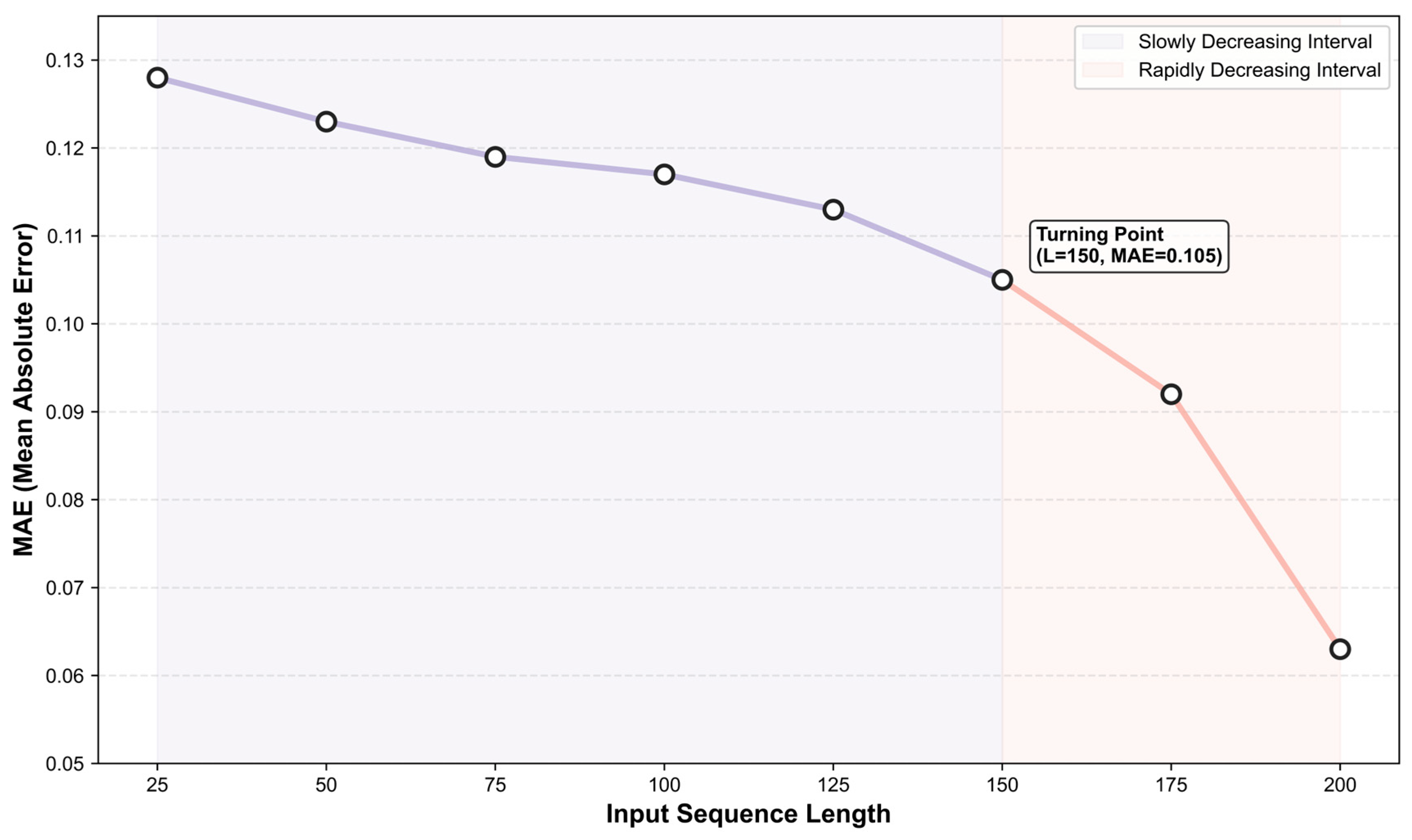
Results from multiple experimental tests (as shown in Figure 7) clearly indicate that as the input sequence length increases gradually from short to long, the Mean Absolute Error (MAE) of the model’s prediction results exhibits an overall steady downward trend. More notably, within the interval corresponding to the landing phase, the rate of MAE decline accelerates significantly. When the input length is short, the model has limited access to real-time flight information, which hinders its ability to fully capture the complex correlations between fuel quantity and various flight features. This limitation leads to relatively high MAE values and low prediction accuracy. As the input length continues to increase, the model can integrate more real-time feature data and corresponding fuel consumption information throughout the flight process. This enables the model to more comprehensively and deeply learn the inherent laws governing the variation in fuel quantity with these features, thereby improving the accuracy of fuel prediction for subsequent unflown segments and resulting in a continuous decrease in MAE. This phenomenon is also attributed to the dedicated landing-phase model integrated into the framework. Pre-trained on a large volume of landing-specific flight data, this model is optimized to recognize the unique relationships between flight parameters and fuel consumption during the landing phase, rather than relying on a universal model that covers all flight phases. When the flight enters the landing phase and accumulates sufficient real-time data, the dedicated model can leverage its pre-learned phase-specific knowledge to better utilize the incremental data, thus contributing to the faster reduction in prediction errors.
This experimental result fully confirms the necessity of training multiple sets of models with different input and output sequence lengths, as well as the supplementary value of dedicated phase models in enhancing prediction performance. In practical flight scenarios, as the flight progresses and real-time data accumulates, the framework can flexibly select the optimal model based on the current flight phase and the volume of real-time data obtained. Particularly during the landing phase, the combination of enriched real-time data and the dedicated landing model enables more precise fuel prediction, maximizing the accuracy of the results. This mechanism provides more reliable fuel prediction support for aviation operations, helping airlines plan flight tasks more accurately while balancing flight safety and operational economic efficiency.

3.2. Evaluation of Model Selection Strategies for Non-Pre-Trained Lengths

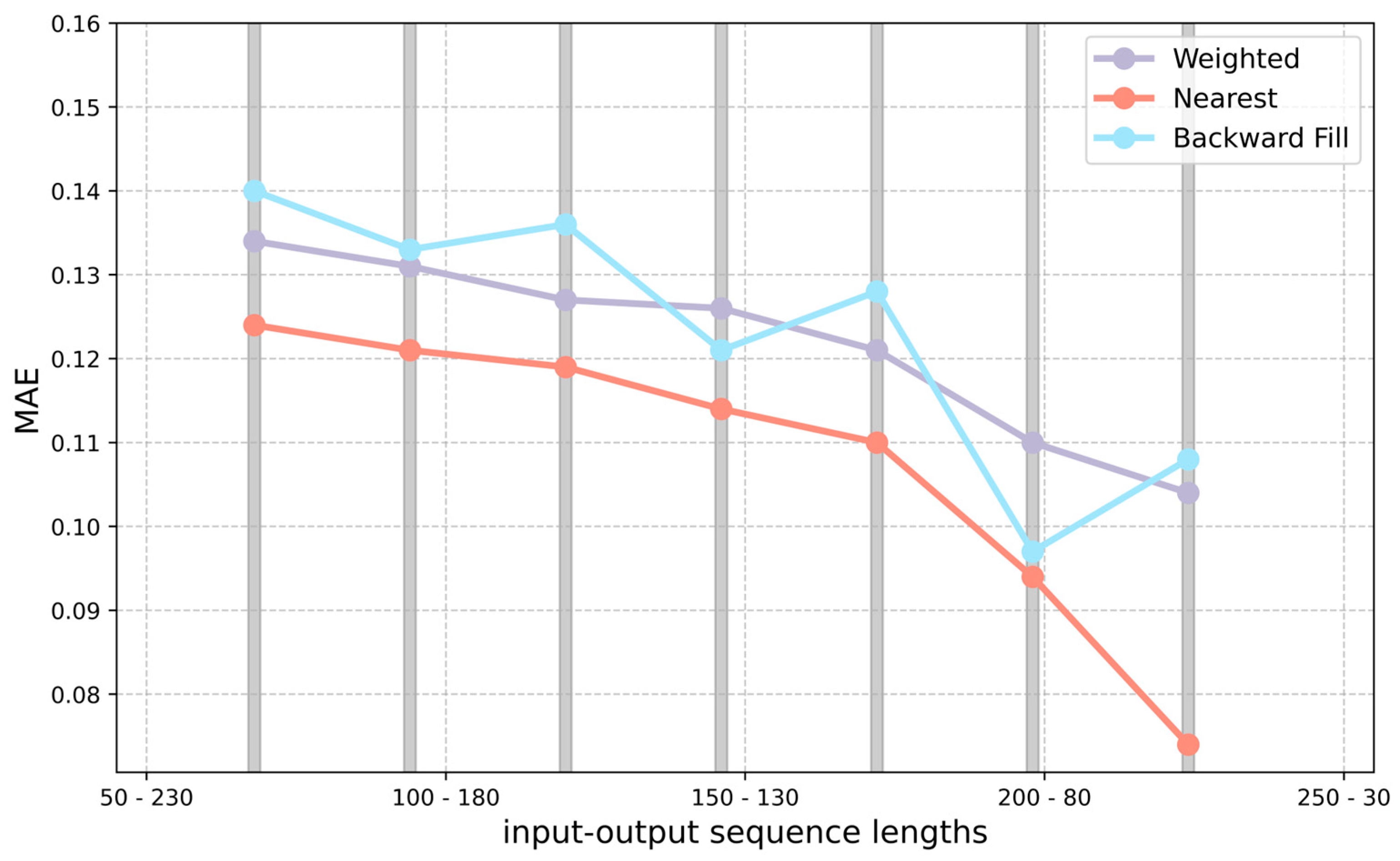
Given the continuous inflow of real-time data during flight, the length of real-time data exhibits an inherent correlation with flight phases. For instance, it gradually increases as the flight transitions from takeoff to cruising and landing [33]. Thus, selecting an appropriate model from the pre-trained model ensemble based on dynamically changing real-time data lengths is critical for ensuring prediction accuracy. Notably, when real-time data lengths match pre-trained lengths (i.e., pre-trained scenarios), the three candidate strategies designed in this study yield consistent prediction performance. This is because the model input directly aligns with the training distribution without the need for additional data processing or weight adjustment. Therefore, this experiment focuses on non-pre-trained lengths (a common scenario in practical operations due to variable flight durations, irregular data sampling intervals, or unexpected flight state changes) as the core analysis object, and evaluates strategy performance using a line chart (Figure 8). In this visualization, non-pre-trained lengths are marked by shaded segments, while pre-trained lengths (displayed as coordinate axis ticks) only serve as reference benchmarks. Their role is to quantify the distance between non-pre-trained lengths and the nearest pre-trained model, and to clarify the adaptability of each strategy to unseen data lengths.
The three strategies are defined as follows:
Nearest Input and Output Sequence Length Matching Strategy: This strategy selects the pre-trained model whose input and output sequence length is closest to the current real-time data length and directly applies the model for prediction.
Backward Padding Strategy: This strategy first identifies the pre-trained model whose input sequence length is the smallest value that is both larger than the current real-time flight data length and closest to it. For the real-time data sequence with a shorter length than the selected model’s input requirement, zero-padding is performed at the start of the sequence to make its length match the model’s input length. However, this approach disrupts the temporal continuity of flight data: the start of the sequence corresponds to critical early-phase features (e.g., takeoff weight, initial climb rate, and takeoff altitude), and zero-padding replaces this meaningful phase-specific information with irrelevant zero values. This not only distorts the original temporal correlation between flight features and fuel consumption but also undermines the model’s ability to accurately capture fuel consumption patterns, especially for the early flight phase-related fuel variation rules.
Model Weighting Strategy: Let the difference between the input value and Model A’s sequence length be d A , and the difference with Model B’s sequence length be d B , then the weight of Model A is
W A = d B d A + d B
The weight of Model B is
W B = 1 W A
The prediction result is the weighted sum of the prediction values of the two models.
To systematically assess the adaptability of each strategy to non-pre-trained lengths, the experiment evaluated performance across seven input and output sequence length combinations. Non-pre-trained lengths served as the core test cases, while pre-trained axis ticks were used to standardize their relative positions to the pre-trained model ensemble. As shown in Figure 8, the line chart clearly visualizes the Mean Absolute Error (MAE) of each strategy for non-pre-trained lengths (shaded segments), with smaller MAE values indicating better adaptability to unseen data.
For non-pre-trained lengths (the key focus of this analysis), the Nearest Matching Strategy exhibited the lowest and most stable MAE. By using pre-trained axis ticks to select the closest model, it minimized the distribution mismatch between non-pre-trained real-time data and the model’s training data. This avoided the severe performance degradation of the Backward Padding Strategy: compared with the Nearest Matching Strategy, the Backward Padding Strategy showed a 32–45% higher MAE for non-pre-trained lengths, which is attributed to the irreversible loss of early-phase features caused by zero-padding. It also outperformed the Model Weighting Strategy significantly. For all non-pre-trained length test cases, the MAE of the Model Weighting Strategy was 15–28% higher than that of the Nearest Matching Strategy. This performance gap arises from the sensitivity of the weighting mechanism to small fluctuations in non-pre-trained length values, which leads to suboptimal weight allocation and unstable prediction results.
Collectively, the analysis confirms that the Nearest Input and Output Sequence Length Matching Strategy is superior for non-pre-trained lengths—the core scenario reflecting practical flight data variability. Pre-trained lengths, used as coordinate axis ticks, effectively quantify the distance between non-pre-trained lengths and the nearest pre-trained model, providing a reliable reference for model selection. Meanwhile, the Nearest Matching Strategy itself ensures accurate and stable prediction for unseen data by minimizing distribution mismatches between real-time data and the model’s training context. This combination of reference calibration and prediction stability makes it the most suitable model selection strategy for dynamic flight fuel prediction.

3.3. Comparative Evaluation of Model Training Strategies

To verify the advantages of the “multi-model pre-training and dynamic selection” training strategy proposed in this study for aircraft fuel prediction tasks, a comparative experiment was designed to systematically compare its prediction performance with the “sliding window training and random seed weighting” strategy. The core difference between the two training strategies lies in their handling logic of the temporal characteristics of flight data and the adaptability of input and output sequence lengths: the former pre-trains multiple sets of Informer models with different input and output sequence lengths based on the data characteristics of different flight phases, and subsequently dynamically matches the optimal model according to real-time data; the latter conducts multi-scenario training by setting random seeds for each sliding window, and finally obtains an optimized model for each window through weighted averaging.
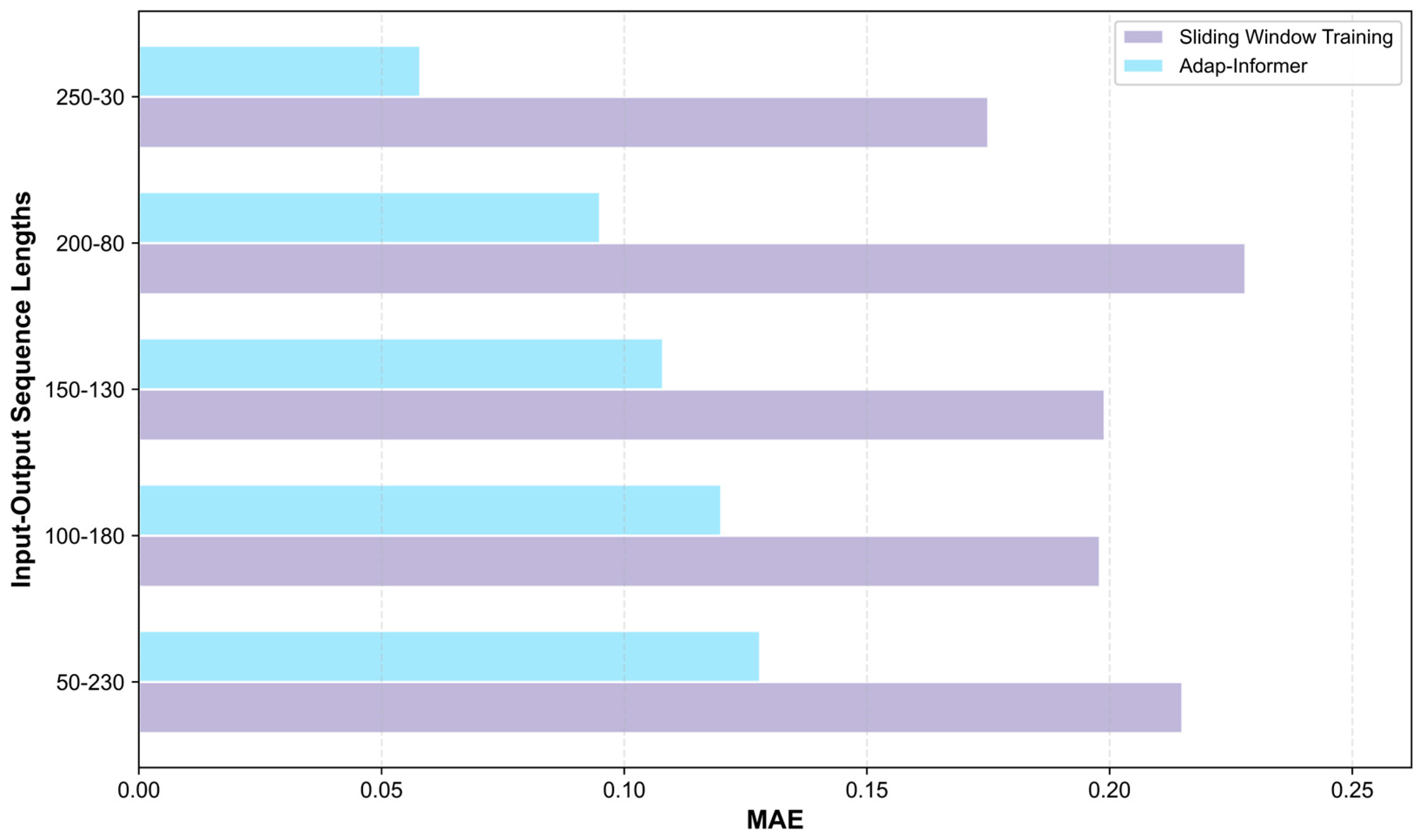
The experiment was conducted under multiple groups of different input and output sequence lengths (e.g., 50-230, 100-180, 150-130) with the Mean Absolute Error (MAE) as the core evaluation metric. The results (as shown in Figure 9) indicate that across all tested input and output sequence length combinations, the MAE of the model adopting the “multi-model pre-training and dynamic selection” strategy was consistently lower than that of the model using the “sliding window training and random seed weighting” strategy. Further analysis of error stability revealed that the MAE of the sliding window training strategy fluctuated significantly with changes in input and output sequence lengths, reflecting its poor adaptability to the data characteristics of different flight phases. In contrast, the MAE of the “multi-model pre-training and dynamic selection” strategy showed a continuous and stable downward trend, with a more pronounced error reduction in scenarios with long input sequences (e.g., 250-30) corresponding to the landing phase.
These results demonstrate that the “multi-model pre-training and dynamic selection” strategy can more accurately capture the temporal correlation between fuel consumption and flight parameters across different flight phases (takeoff, cruising, landing). Through the adaptation to the data volume characteristics of each flight phase during the pre-training stage (e.g., short inputs for the takeoff phase and long inputs for the cruising phase) and the dynamic matching of real-time data during the application stage, it effectively reduces the feature capture deviation caused by fixed windows or a single model architecture. In contrast, the sliding window training strategy is limited by the fixed window division logic, making it difficult to adapt to the differences in data characteristics across different flight phases. Additionally, the random seed weighting process tends to introduce additional error fluctuations. Therefore, the training strategy proposed in this study exhibits superior prediction accuracy and stability in the task of aircraft remaining fuel prediction.

3.4. Comparative Experiment on Phased Modeling for Takeoff-Cruise and Landing Phases

Given the significant differences in characteristic patterns and fuel consumption laws between the takeoff-cruise phase and the landing phase during flight, this study designed a comparative experiment between phased modeling and single-model modeling. The aim was to quantitatively analyze the improvement in prediction accuracy achieved by constructing phase-specific models for different flight stages, thereby providing empirical support for the development of efficient and accurate aircraft remaining fuel prediction models [34].
Aircraft flight is a complex dynamic process. The takeoff-cruise phase typically has a longer duration, during which the aircraft operates in a relatively stable atmospheric environment. Core parameters such as speed and altitude change gradually according to established rules, and fuel consumption exhibits stable and predictable characteristics. In contrast, the landing phase is a critical process in which the aircraft descends gradually from cruising altitude to landing. During this phase, aircraft operations are frequent, parameters such as speed and descent rate change drastically, and significant variations exist in landing timing and descent trajectories among different flights. These factors make the fuel consumption laws of the landing phase more complex and volatile, forming a distinct contrast with the takeoff-cruise phase.
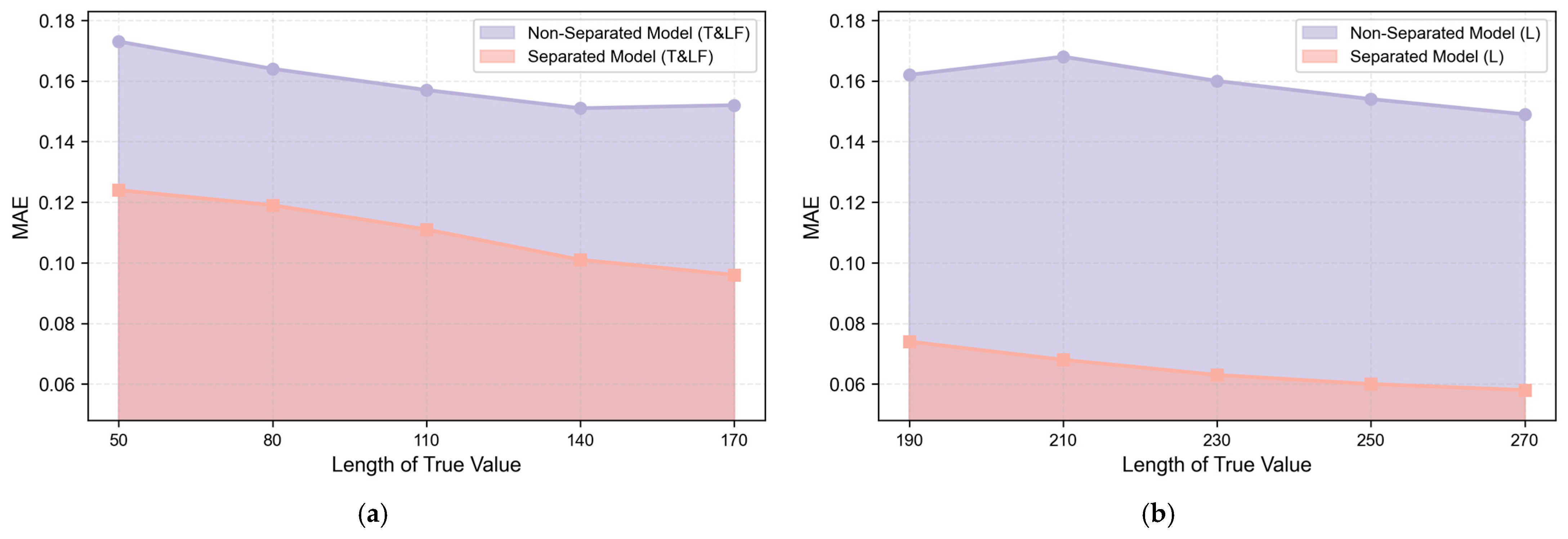
To intuitively demonstrate the advantages of phased modeling, the experiment used MAE area charts (the left chart for the takeoff-cruise phase and the right chart for the landing phase) to compare the performance differences between the two modeling strategies, with results shown in Figure 10. The left chart clearly indicates that during the takeoff-cruise phase, the MAE curve of the phased modeling strategy is entirely below that of the single model. This shows that the phase-specific model can more accurately capture the fuel consumption patterns of this phase and achieve a steady reduction in prediction error compared with the single model. In contrast, the right chart for the landing phase exhibits much more significant differences: the MAE curve of the single model fluctuates sharply and remains at a high overall level, reflecting its inability to adapt to the drastic parameter changes during the landing phase and resulting in a substantial decline in prediction accuracy. However, the MAE curve of the landing-specific model is not only lower overall but also shows smaller fluctuations, demonstrating stronger stability and adaptability.
Further quantitative analysis reveals that during the takeoff-cruise phase, the average MAE of the phased model is approximately 18.7% lower than that of the single model. During the landing phase, this reduction rate increases to 32.4%, fully verifying the core value of the phased modeling strategy. Particularly in the landing phase, where parameters change drastically and fuel consumption laws are complex, the phase-specific model effectively avoids the limitations of the single model’s “one-size-fits-all” approach and accurately captures the inherent correlation between phase-specific characteristics and fuel consumption. This result is highly consistent with the physical characteristics of flight: fuel consumption during the landing phase is affected by multiple dynamic factors, including descent rate, airport air pressure, and approach procedures. Its complexity far exceeds that of the takeoff-cruise phase, making it difficult for a single model to accommodate the differential characteristics of the two phases. Through targeted feature learning and parameter optimization, phased modeling achieves accurate matching of prediction accuracy across different phases.
In conclusion, the strategy of constructing dedicated models for the takeoff-cruise phase and the landing phase, respectively, can significantly improve the accuracy and stability of aircraft remaining fuel prediction. Moreover, in the landing phase where feature changes are more complex, the advantages of this strategy are more prominent, providing a better technical pathway for the accurate prediction of fuel consumption throughout the entire flight process.

3.5. Comparison Experiment

To comprehensively evaluate the practical effectiveness of the Adap-Informer framework, this study designed multiple sets of comparative experiments under the experimental setting of a fixed total flight duration. Considering the complexity of aircraft fuel consumption data, the experiments constructed various training scenarios covering fuel-related data across different flight phases, with each scenario corresponding to distinct input and output sequence length combinations.
The selection of comparative models focused on mainstream models widely used in the current field of aircraft fuel prediction. Through multi-dimensional and scientific comparative analysis, the unique advantages of Adap-Informer were clearly highlighted. Throughout the training process, training parameters of each model including learning rate, number of iterations, and convergence status were recorded in full. This ensured that all models completed training under identical experimental conditions, laying a solid foundation for the accuracy and reliability of the experimental results.
As presented in Table 3, Adap-Informer outperformed all comparative models in terms of Mean Absolute Error (MAE) and Root Mean Square Error (RMSE) across all input and output sequence length combinations. From the perspective of error indicator variations, as the length of the true value changed with input and output sequence lengths ranging from 5-275 to 205-75, the MAE of Adap-Informer only fluctuated between 0.123 and 0.052, while the RMSE varied between 0.140 and 0.065. The high degree of alignment between the two indicators reflects that the model’s prediction errors are evenly distributed, and it exhibits strong robustness against outliers.
This advantage holds significant implications for practical aircraft fuel prediction scenarios. Whether in normal flight operations or emergency response situations, the more accurate fuel prediction results provided by Adap-Informer can serve as a reliable basis for operations such as flight route optimization and flight speed adjustment. It not only effectively avoids safety risks caused by inaccurate fuel estimation but also realizes the optimal utilization of fuel resources and reduces operational costs. In summary, for tasks such as aircraft fuel prediction where long-sequence complex data need to be processed and real-time data are continuously updated, Adap-Informer demonstrates strong adaptability and accuracy advantages, enabling it to provide more reliable and precise prediction results.

3.6. Practical Validation of Adap-Informer: Compliance, Fuel Optimization and Emergency Efficacy

To verify the practical applicability of the Adap-Informer framework in real aviation operations, particularly its ability to balance safety compliance, redundant fuel reduction, and emergency response support, this section conducts quantitative validation of its prediction error in real fuel quantity terms, assesses its alignment with core aviation regulatory standards, and simulates a typical emergency scenario to demonstrate its decision-making value.
When converting the Mean Absolute Error (MAE) of the Adap-Informer model into actual aircraft fuel quantity errors, the calculation follows a dataset-specific scaling approach: MAE values are multiplied by the standard deviation of the fuel dataset (11,000 kg, derived from Air China’s flight records). This conversion yields a maximum actual fuel prediction error of 1400 kg, a level that offers dual advantages in operational safety and efficiency. First, it is substantially lower than the 2000–5000 kg of redundant fuel currently carried by Air China to mitigate risks from imprecise fuel estimation, indicating significant potential for redundant fuel reduction. Second, it fully complies with the safety margins mandated by key aviation regulatory frameworks. For instance, Extended-range Twin-engine Operational Performance Standards (ETOPS) 180 min requirements stipulate that twin-engine aircraft must carry fuel reserves sufficient for a 180 min diversion at single-engine cruise speed [17]. Adap-Informer’s precision ensures that even after a 1400 kg reduction in redundant fuel, the remaining fuel still meets ETOPS diversion demands, typically 800–1200 kg for medium-haul flights. This regulatory compliance directly addresses a critical barrier to redundant fuel optimization, as it confirms the framework’s technical performance aligns with global aviation safety standards.
From a sustainability perspective, the reduction in redundant fuel enabled by Adap-Informer directly contributes to aviation decarbonization. As established by Seymour et al. [1], every kilogram of reduced aircraft fuel consumption corresponds to approximately 3.16 kg of carbon dioxide (CO2) emissions abatement. By cutting redundant fuel loads without compromising safety, the framework translates prediction accuracy into tangible environmental benefits, aligning with industry-wide goals for low-carbon operation.
To further validate Adap-Informer’s value in time-sensitive emergency scenarios, a targeted simulation was designed based on a common critical operational event: a medium-sized aircraft cruising at 35,000 feet on the Beijing-Shanghai route received an urgent weather alert, indicating that the destination airport’s runway was closed due to convective storms. The aircraft was required to divert to a secondary alternate airport located 320 km away, with an estimated additional fuel demand of 1150 kg.
In this scenario, traditional fixed-architecture fuel prediction models exhibited inherent limitations. Their rigid input and output structures resulted in a wide prediction error range of 2200–4800 kg. Over 100 repeated simulations, this imprecision led to an overestimation of fuel shortage risks in 42% of cases. Pilots were consequently forced to make suboptimal decisions: either diverting to a closer but less-equipped alternate airport, incurring additional ground handling time, or requesting in-flight emergency fuel replenishment. Both outcomes resulted in average delays of dozens of minutes per flight and increased air traffic control coordination costs.
By contrast, Adap-Informer leveraged its dynamic model selection mechanism to adapt to real-time flight data accumulation. As the flight proceeded and more operational data became available, its prediction error narrowed progressively from an initial maximum of 1450 kg to a final 650 kg. In the same 100 simulations, this improved precision reduced unnecessary diversions to only 8%, with most flights safely diverting to the originally planned alternate airport without extra ground handling delays. Emergency fuel replenishment requests also decreased to 5%, significantly lowering operational disruptions.
This simulation confirms that Adap-Informer’s accuracy advantage extends beyond numerical metrics to enhance “decision flexibility” in emergencies. By providing reliable fuel data, it eliminates the need for pilots and dispatchers to make overcautious choices due to uncertainty, enabling a balanced approach to flight safety and operational efficiency. This represents a key practical benefit for real-world aviation emergency response, where timely and accurate fuel information is critical to minimizing risks and disruptions.

4. Conclusions and Future Work

This study tackles the challenges of dynamic data adaptation and multi-phase safety emergency response in aircraft fuel prediction by introducing Adap-Informer, an adaptive multi-scale time-series forecasting framework. By deeply integrating the long-sequence modeling strengths of the Informer architecture with flight scenario-specific optimization strategies, a high-precision fuel prediction system encompassing the entire flight process, including takeoff, cruise, and landing, is established. This system not only offers a novel approach for enhancing flight safety and emergency decision-making but also acts as a critical enabler for sustainable aviation development.
Adap-Informer addresses the critical shortcoming of delayed response in emergency situations inherent to traditional fixed-scale models. It incorporates a data-length-based model matching algorithm that automatically activates the most suitable pre-trained model in real-time according to the accumulating in-flight data sequence length. This enables progressive refinement of prediction accuracy as the flight progresses (Mean Absolute Error decreased from 0.12 to 0.058). Converting these MAE values into practical fuel quantity errors (by multiplying by the fuel dataset standard deviation of 11,000) reveals that Adap-Informer’s prediction error does not exceed 1400 kg. This is substantially lower than the 2000–5000 kg of redundant fuel currently carried by Air China to mitigate risks associated with inaccurate fuel estimation.
This reduction in redundant fuel directly contributes to aviation sustainability. As demonstrated by Seymour et al. [1], each kilogram of saved aircraft fuel burn reduces CO2 emissions by approximately 3.16 kg, while Ding et al. [2] emphasized that such fuel optimization aligns aviation operations with the United Nations’ Sustainable Development Goal 13 (Climate Action), simultaneously cutting operational costs and environmental impact. Further elaborating on why this optimization is pivotal for sustainable transportation, it is important to note that reducing redundant fuel not only directly lowers CO2 emissions but also mitigates energy waste associated with increased aircraft weight, since traditional redundant fuel loads raise aircraft weight by 3–5%, leading to a proportional increase in fuel consumption (as discussed in Section 1). By eliminating this unnecessary burden, Adap-Informer enhances aircraft operational efficiency at a fundamental level, establishing itself as an essential tool for balancing safety and sustainability in aviation. Consequently, Adap-Informer provides robust data support not only for precise emergency decision-making but also for the adoption of low-carbon aviation practices.
Notably, the current study has covered 25 distinct aircraft types widely used by domestic airlines in China, including mainstream medium-sized and large-sized wide-body aircraft, and the experimental results in Section 2.1 have clearly verified the advantages of selecting single-size-category models: compared with the mixed-size model, which integrates medium-sized and large-sized aircraft data, the models trained on single-size-category datasets consistently exhibit smaller MAE and RMSE values, which confirms that matching models to aircraft size can effectively reduce interference from cross-category fuel consumption differences and ensure high-precision fuel prediction. However, the study currently focuses on Air China’s fleet, and to enhance cross-regional generalizability, future work will first expand the data source by incorporating flight black box data from multiple domestic and foreign airlines, for instance, European carriers with strict carbon regulations, North American airlines with diverse route networks, and Southeast Asian operators facing tropical weather conditions. This expansion will enable analysis of similarities and differences in fuel consumption patterns across regions. As an example, comparing how European air traffic control protocols affect fuel use versus Chinese operational procedures will help validate whether Adap-Informer’s core mechanisms remain effective in diverse contexts, aligning with findings from international studies such as Uzun et al. [13] on physics-guided fuel modeling and Lin et al. [16] on attention-based fuel prediction.
Second, future work will enrich data scenarios by including flight data under more varied operational environments, such as polar routes with extreme low temperatures, severe turbulence causing irregular fuel burn, and high-altitude airports with thin air. These scenarios are currently underrepresented in the dataset, and integrating them will enhance the model’s robustness to complex environmental factors, thereby addressing a key limitation of the current study. Additionally, we will integrate Sustainable Aviation Fuel (SAF)-related parameters into the framework. SAF, recognized as a critical decarbonization tool with up to 80% lifecycle emission reduction compared to conventional jet fuel, will be incorporated into model features by accounting for its unique combustion efficiency, energy density, and temperature sensitivity. This will enable Adap-Informer to support mixed fuel scenarios involving conventional fuel and SAF blends, where the model can predict fuel consumption based on blending ratios and adjust redundant fuel recommendations accordingly, thereby bridging the gap between current fuel optimization and future aviation fuel trends.
Third, to facilitate practical deployment, future work will collaborate with aviation regulatory bodies to conduct formal certification tests, including ETOPS (Extended-range Twin-engine Operational Performance Standards) fuel reserve validation, fault-tolerance simulations, and human and machine interface (HMI) compliance checks for pilot decision support. This step addresses the regulatory barriers to applying reduced redundant fuel loads and ensures that Adap-Informer’s recommendations meet global aviation safety standards. Concurrently, we will optimize the model’s technical performance: for instance, reducing computational overhead of the pre-trained model ensemble via knowledge distillation and pruning to maintain real-time inference speed and incorporating probabilistic prediction, for example, using Bayesian neural networks, to quantify uncertainty. This will provide pilots with not only fuel quantity predictions but also risk assessments for more informed emergency decisions.
Finally, this study breaks through the static limitations of traditional fuel prediction models and constructs a dynamic adaptive framework oriented toward emergency safety. The multi-scale pre-training and real-time model selection mechanism of Adap-Informer not only improves the accuracy of fuel prediction but also innovates the process of “real-time data-driven, intelligent model adaptation, and fuel prediction”, thereby adding new solutions to both the aviation safety system and the industry’s sustainability goals. By enabling quantifiable fuel savings, supporting SAF integration, and aligning with cross-regional operational needs, Adap-Informer directly supports global targets such as ICAO’s net-zero emissions by 2050. It is by considering these dual contributions to safety and sustainability that the benefits of Adap-Informer become fully obvious.

Author Contributions

Conceptualization, Y.W., J.F. and Y.Z.; methodology, J.F., Y.W. and L.L.; software, J.F. and Y.Z.; validation, J.F., Y.W. and Y.L.; formal analysis, J.F. and Y.W.; investigation, J.F. and Y.Z.; resources, Y.W.; data curation, J.F. and Y.L.; writing—original draft preparation, J.F.; writing—review and editing, Y.W. and L.L.; visualization, X.H.; supervision, Y.W. and L.L.; funding acquisition, Y.W. All authors have read and agreed to the published version of the manuscript.

Funding

This research was funded by the Langfang Science and Technology Bureau (Langfang Municipal Science and Technology Research and Development Self-financed Project), grant number 2024011012.

Institutional Review Board Statement

Not applicable.

Informed Consent Statement

Not applicable.

Data Availability Statement

The data presented in this study are available on request from the corresponding authors.

Acknowledgments

This study would like to acknowledge Air China for its provision of invaluable flight data. These high-quality data act as a crucial cornerstone for building and verifying all experiments within this paper, offering a solid assurance for the practical value and dependability of the research results.

Conflicts of Interest

Author Yu Li was employed by the company Operation Center Air China Limited. The remaining authors declare that the research was conducted in the absence of any commercial or financial relationships that could be construed as a potential conflict of interest.

Nomenclature

The following notations and abbreviations are used in this manuscript:
δThe standard deviation of the original data
Δfueltfuel consumption variation from initial value at time t
Δlattlatitude variation from initial position at time t
Δlontlongitude variation from initial position at time t
fuel0initial fuel quantity
fueltfuel quantity at time t
lat0initial latitude
lattlatitude at time t
lon0initial longitude
lontlongitude at time t
MAEmean absolute error
Μmean value of original data
Nsample size, dimensionless
RMSEroot mean square error
Xvalue in original data
Zz-score standardized value, dimensionless
kmKilometer
kgKilogram
hPaHectopascal
m/sMeters per Second
CO2Carbon Dioxide
ETOPSExtended-range Twin-engine Operational Performance Standards
FAAFederal Aviation Administration
ICAOInternational Civil Aviation Organization
0initial value
tat time t

References

  1. Seymour, K.; Held, M.; Georges, G.; Boulouchos, K. Fuel Estimation in Air Transportation: Modeling Global Fuel Consumption for Commercial Aviation. Transp. Res. Part D Transp. Environ. 2020, 88, 102528. [Google Scholar] [CrossRef]
  2. Ding, S.; Ma, Q.; Qiu, T.; Gan, C.; Wang, X. An Engine-Level Safety Assessment Approach of Sustainable Aviation Fuel Based on a Multi-Fidelity Aerodynamic Model. Sustainability 2024, 16, 3814. [Google Scholar] [CrossRef]
  3. Khalili, S.; Rantanen, E.; Bogdanov, D.; Breyer, C. Global Transportation Demand Development with Impacts on the Energy Demand and Greenhouse Gas Emissions in a Climate-Constrained World. Energies 2019, 12, 3870. [Google Scholar] [CrossRef]
  4. Gössling, S.; Humpe, A.; Fichert, F.; Creutzig, F. COVID-19 and Pathways to Low-Carbon Air Transport Until 2050. Environ. Res. Lett. 2021, 16, 034063. [Google Scholar] [CrossRef]
  5. Go, S.; Melton, J.; Jiang, X.; Zilliac, G. Estimations of Aircraft and Airport Domestic Greenhouse Gas Emissions from 2016–2021. In Proceedings of the AIAA Aviation 2023 Forum, National Harbor, MD, USA, 12–16 June 2023; p. 4218. [Google Scholar] [CrossRef]
  6. Gómez Comendador, V.F.; Arnaldo Valdés, R.M.; Lisker, B. A Holistic Approach to the Environmental Certification of Green Airports. Sustainability 2019, 11, 4043. [Google Scholar] [CrossRef]
  7. Yanto, J.; Liem, R.P. Aircraft Fuel Burn Performance Study: A Data-Enhanced Modeling Approach. Transp. Res. Part D Transp. Environ. 2018, 65, 574–595. [Google Scholar] [CrossRef]
  8. Dalmau Codina, R.; Melgosa Farrés, M.; Vilardaga García-Cascón, S.; Prats Menéndez, X. A Fast and Flexible Aircraft Trajectory Predictor and Optimiser for ATM Research Applications. In Proceedings of the 8th International Conference for Research in Air Transportation (ICRAT), Castelldefels, Spain, 26–29 June 2018; pp. 1–8. [Google Scholar]
  9. Gardi, A.; Sabatini, R.; Ramasamy, S. Multi-Objective Optimisation of Aircraft Flight Trajectories in the ATM and Avionics Context. Prog. Aerosp. Sci. 2016, 83, 1–36. [Google Scholar] [CrossRef]
  10. Lin, Y.; Zhang, J.W.; Liu, H. Deep Learning Based Short-Term Air Traffic Flow Prediction Considering Temporal–Spatial Correlation. Aerosp. Sci. Technol. 2019, 93, 105113. [Google Scholar] [CrossRef]
  11. Zhu, X.; Li, L. Flight Time Prediction for Fuel Loading Decisions with a Deep Learning Approach. Transp. Res. Part C Emerg. Technol. 2021, 128, 103179. [Google Scholar] [CrossRef]
  12. Metlek, S. A New Proposal for the Prediction of an Aircraft Engine Fuel Consumption: A Novel CNN-BiLSTM Deep Neural Network Model. Aircr. Eng. Aerosp. Technol. 2023, 95, 838–848. [Google Scholar] [CrossRef]
  13. Uzun, M.; Demirezen, M.U.; Inalhan, G. Physics Guided Deep Learning for Data-Driven Aircraft Fuel Consumption Modeling. Aerospace 2021, 8, 44. [Google Scholar] [CrossRef]
  14. Ma, J.; Zhao, J.; Hou, Y. Spatial–Temporal Transformer Networks for Traffic Flow Forecasting Using a Pre-Trained Language Model. Sensors 2024, 24, 5502. [Google Scholar] [CrossRef] [PubMed]
  15. Khan, W.A.; Ma, H.L.; Ouyang, X.; Mo, D.Y. Prediction of Aircraft Trajectory and the Associated Fuel Consumption Using Covariance Bidirectional Extreme Learning Machines. Transp. Res. Part E Logist. Transp. Rev. 2021, 145, 102189. [Google Scholar] [CrossRef]
  16. Lin, Y.; Guo, D.; Wu, Y.; Li, L.; Wu, E.Q.; Ge, W. Fuel Consumption Prediction for Pre-Departure Flights Using Attention-Based Multi-Modal Fusion. Inf. Fusion 2024, 101, 101983. [Google Scholar] [CrossRef]
  17. Wang, X.; Feng, C.; Jiang, M.; Zhang, B. ETOPS Test Flight Study of Civil Aircraft Fuel System. In Proceedings of the 2024 3rd International Symposium on Intelligent Unmanned Systems and Artificial Intelligence, Qingdao, China, 17–19 May 2024; pp. 177–181. [Google Scholar]
  18. Claramunt Segura, J. FAA Regulation Analysis for ATR ETOPS Validation. Master’s Thesis, Universitat Politècnica de Catalunya, Barcelona, Spain, 2017. [Google Scholar]
  19. Vaswani, A.; Shazeer, N.; Parmar, N.; Uszkoreit, J.; Jones, L.; Gomez, A.N.; Kaiser, Ł.; Polosukhin, I. Attention Is All You Need. Adv. Neural Inf. Process. Syst. 2017, 30, 5998–6008. [Google Scholar] [CrossRef]
  20. Jepsen, T.S.; Jensen, C.S.; Nielsen, T.D. Relational Fusion Networks: Graph Convolutional Networks for Road Networks. IEEE Trans. Intell. Transp. Syst. 2020, 23, 418–429. [Google Scholar] [CrossRef]
  21. Li, Z.; Chen, J.; Wang, Y. Aircraft Range Fuel Prediction Study Based on WPD with IAPO Optimized BiLSTM–KAN Model. Comput. Biol. Chem. 2025, 112, 108231. [Google Scholar] [CrossRef]
  22. Kang, L.; Hansen, M.; Ryerson, M.S. Evaluating Predictability Based on Gate-In Fuel Prediction and Cost-to-Carry Estimation. J. Air Transp. Manag. 2018, 67, 146–152. [Google Scholar] [CrossRef]
  23. Zhao, L.; Song, Y.; Zhang, C.; Liu, Y.; Wang, P.; Lin, T.; Deng, M.; Li, H. T-GCN: A Temporal Graph Convolutional Network for Traffic Prediction. IEEE Trans. Intell. Transp. Syst. 2019, 21, 3848–3858. [Google Scholar] [CrossRef]
  24. Jaafar, N.; Lachiri, Z. Multimodal Fusion Methods with Deep Neural Networks and Meta-Information for Aggression Detection in Surveillance. Expert Syst. Appl. 2023, 211, 118523. [Google Scholar] [CrossRef]
  25. Dong, S.; Yu, T.; Farahmand, H.; Mostafavi, A. A Hybrid Deep Learning Model for Predictive Flood Warning and Situation Awareness Using Channel Network Sensors Data. Comput. Aided Civ. Infrastruct. Eng. 2021, 36, 402–420. [Google Scholar] [CrossRef]
  26. Sahadevan, D.; Ponnusamy, P.; Gopi, V.P.; Nelli, M.K. Prediction of Gate in Time of Scheduled Flights and Schedule Conformance Using Machine Learning-Based Algorithms. Int. J. Aviat. Aeronaut. Aerospace 2020, 7, 9. [Google Scholar] [CrossRef]
  27. Ryerson, M.S.; Hansen, M.; Bonn, J. Time to Burn: Flight Delay, Terminal Efficiency, and Fuel Consumption in the National Airspace System. Transp. Res. Part A Policy Pract. 2014, 69, 286–298. [Google Scholar] [CrossRef]
  28. Zhou, H.; Zhang, S.; Peng, J.; Zhang, S.; Li, J.; Xiong, H.; Zhang, W. Informer: Beyond Efficient Transformer for Long Sequence Time-Series Forecasting. Proc. AAAI Conf. Artif. Intell. 2021, 35, 11106–11115. [Google Scholar] [CrossRef]
  29. Dong, Z.; Fan, B.; Li, F.; Xu, X.; Sun, H.; Cao, W. Tcn-informer-based flight trajectory prediction for aircraft in the approach phase. Sustainability 2023, 15, 16344. [Google Scholar] [CrossRef]
  30. Snoek, J.; Larochelle, H.; Adams, R.P. Practical Bayesian Optimization of Machine Learning Algorithms. Adv. Neural Inf. Process. Syst. 2012, 25, 2951–2959. [Google Scholar] [CrossRef]
  31. Yan, C.; Xiang, X.; Wang, C. Towards Real-Time Path Planning Through Deep Reinforcement Learning for a UAV in Dynamic Environments. J. Intell. Robot. Syst. 2020, 98, 297–309. [Google Scholar] [CrossRef]
  32. Bai, S.; Kolter, J.Z.; Koltun, V. An Empirical Evaluation of Generic Convolutional and Recurrent Networks for Sequence Modeling. arXiv 2018, arXiv:1803.01271. [Google Scholar] [CrossRef]
  33. Luo, H.; Bhardwaj, J.; Choy, S.; Kuleshov, Y. Applying Machine Learning for Threshold Selection in Drought Early Warning System. Climate 2022, 10, 97. [Google Scholar] [CrossRef]
  34. Wang, S.; Cao, J.; Philip, S.Y. Deep Learning for Spatio-Temporal Data Mining: A Survey. IEEE Trans. Knowl. Data Eng. 2020, 34, 3681–3700. [Google Scholar] [CrossRef]
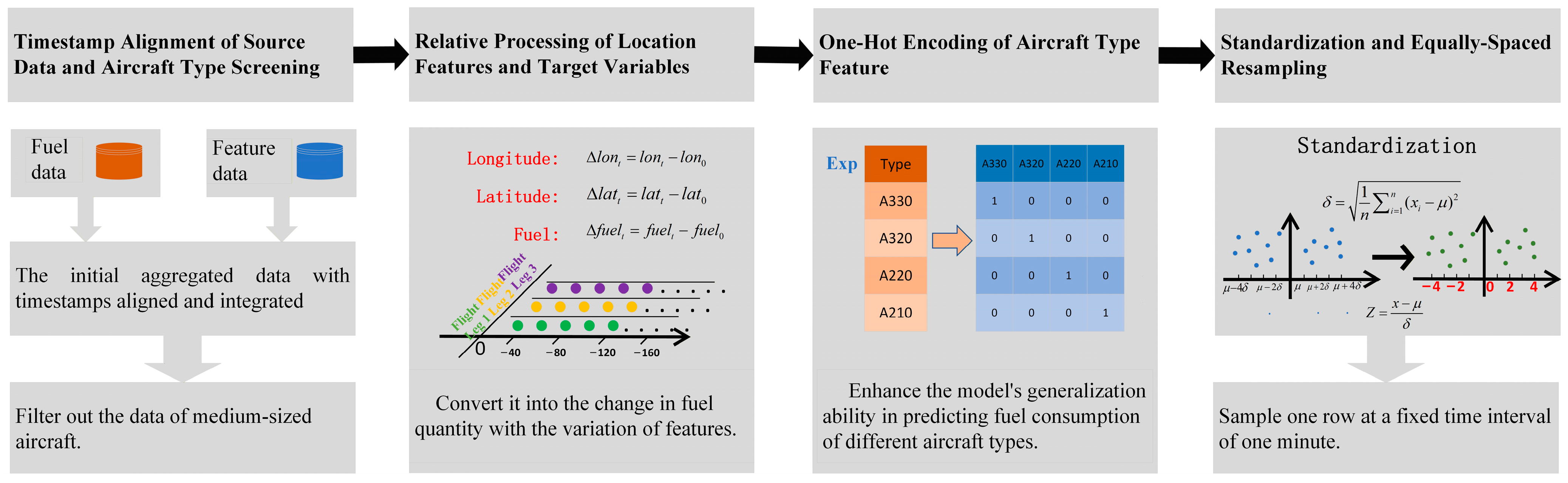
Figure 1. Data processing procedure for the original data.
Sustainability 17 11078 g001
Figure 2. Comparison of MAE and RMSE Across Medium-Sized, Large-Sized, and Mixed-Sized Aircraft Datasets.
Sustainability 17 11078 g002
Figure 3. Comparison of Mean Absolute Error (MAE) for predictions before and after data difference processing at various input and output sequence lengths.
Sustainability 17 11078 g003
Figure 4. The grid search with early stopping multi-input output sequence lengths division algorithm flow in Adap-informer.
Sustainability 17 11078 g004
Figure 5. The grid search with early stopping-selected multi-input and output sequence lengths training process in Adap-informer.
Sustainability 17 11078 g005
Figure 6. Adaptive Selection of Optimal Model by Adap-informer During Flight for Prediction.
Sustainability 17 11078 g006
Figure 7. Variation in Mean Absolute Error (MAE) with Input Sequence Length, with Accelerated Decline in the Landing Phase.
Sustainability 17 11078 g007
Figure 8. Mean Absolute Error (MAE) Comparison of Three Model Selection Strategies for Non-Pre-Trained Lengths.
Sustainability 17 11078 g008
Figure 9. Performance Contrast of Two Training Strategies Under Different Input and Output Sequence Lengths.
Sustainability 17 11078 g009
Figure 10. Comparison of MAE area charts between phased modeling and single modeling for the takeoff-cruise phase (a) and the landing phase (b).
Sustainability 17 11078 g010
Table 1. Key Fuel Characteristics: Medium-Sized vs. Large-Sized Aircraft.
Aircraft CategoryInitial Fuel Range (kg)Fuel Flow Rate (kg/h)Cruising Fuel Consumption Stability
Medium-sized aircraft types16,000–41,0002800–3300High (±5% variation)
large-sized
aircraft types
410,00–80,0004600–5800Moderate (±8% variation)
Table 2. Hyperparameter Settings for Adap-Informer and Benchmark Models.
HyperparameterSelection
GeneralLoss FunctionMean Squared Error (MSE)
Dropout0.05
OptimizerAdam
Learning rate0.0002
Early Stopping Patience5
Batch size64
Number of epochs32
LSTMLSTM Hidden Units256
Number of LSTM Layers2
CNN-Number of Attention Heads8
LSTM-CNN Kernel Size2
AttentionNumber of CNN Layers3 × 3
InformerNumber of Attention Heads8
Hidden Dimension256
Moving_avg25
Factor1
Table 3. MAE and RMSE Comparison of Adap-Informer and Benchmark Models.
Aircraft CategoryThe Length of the True Value5-27555-225105-175155-125205-75
MAEBiLSTM0.2460.2410.2350.1650.075
ED-LSTM0.3150.2900.2350.1450.085
LSTM0.2650.2500.2650.1800.090
CNN-LSTM-
Attention
0.2450.2300.2150.1600.085
LSTM-CNN0.2550.2450.2250.1650.080
Adap-Informer0.1230.1190.1040.0870.052
RMSEBiLSTM0.3050.2950.2500.1950.130
ED-LSTM0.3100.2900.2450.1850.110
LSTM0.3100.3000.2550.2000.145
CNN-LSTM-
Attention
0.2950.2500.2450.2550.110
LSTM-CNN0.2850.2550.1250.2450.115
Adap-Informer0.1400.1330.1150.1000.065
Disclaimer/Publisher’s Note: The statements, opinions and data contained in all publications are solely those of the individual author(s) and contributor(s) and not of MDPI and/or the editor(s). MDPI and/or the editor(s) disclaim responsibility for any injury to people or property resulting from any ideas, methods, instructions or products referred to in the content.