How Land-Use Planning Deeply Affects the Spatial Distribution of Composite Soundscapes

 ,
, 
Abstract
1. Introduction
2. Methods
2.1. Study Area
2.2. Delineation of Research Space Units
2.3. Data Sources and Processing Procedures
2.3.1. Objective Acoustic Parameters
2.3.2. Soundscape Subjective Parameters
- (1)
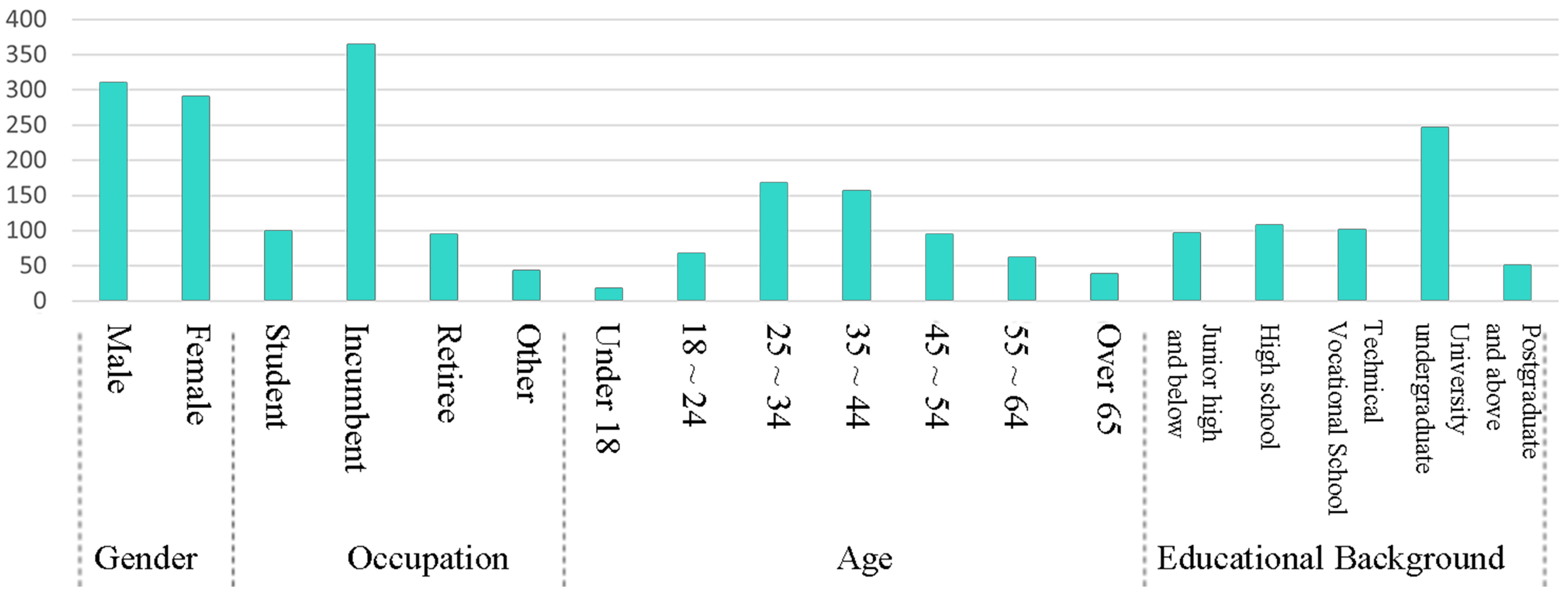
- Basic information of respondents. This includes gender, age (seven options: under 18, 18–24, 25–34, 35–44, 45–54, 55–64, and 65 and above), employment status (seven options: student, incumbent, retiree, and other), and educational background (four options: high school and below, technical vocational school, university graduate, and postgraduate and above).
- (2)
- Respondents’ perception of sound sources [1]. According to the international standard for soundscape (ISO/TS 12913-2) [28], sound sources are categorized into natural, human, and mechanical sounds, and the specific types of sound sources are shown in Table 1, and a five-level scale is used to quantify the perceived frequency of each type of sound source.
- (3)
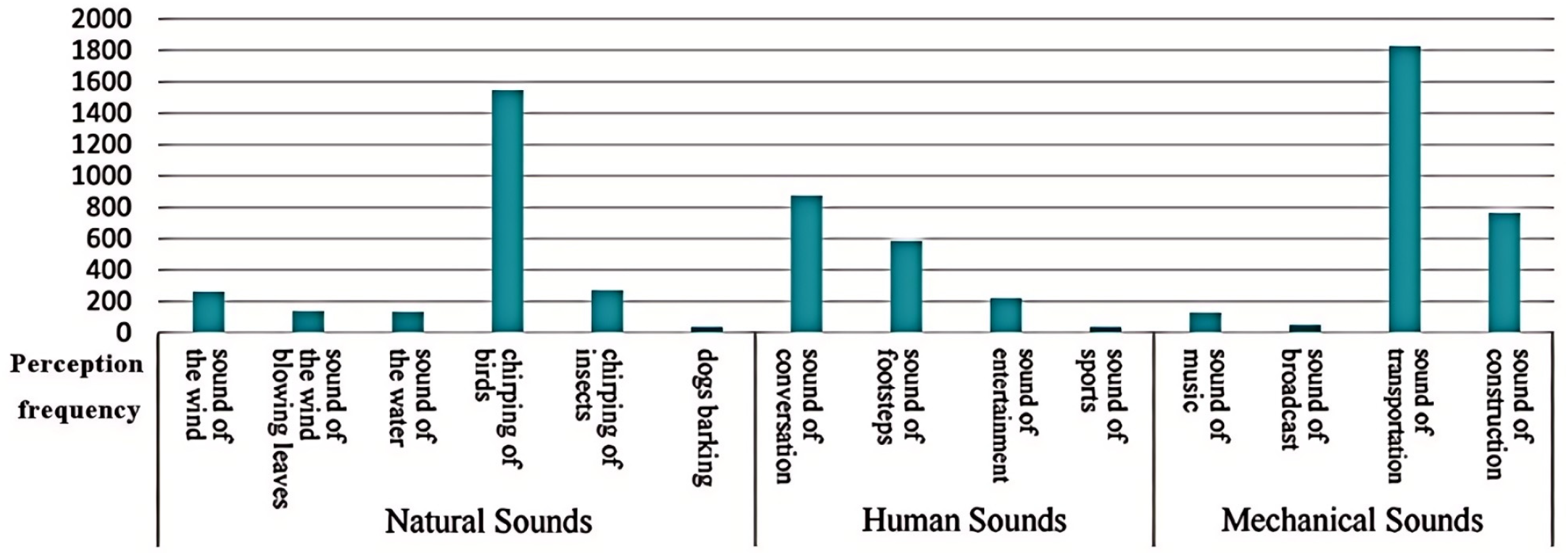
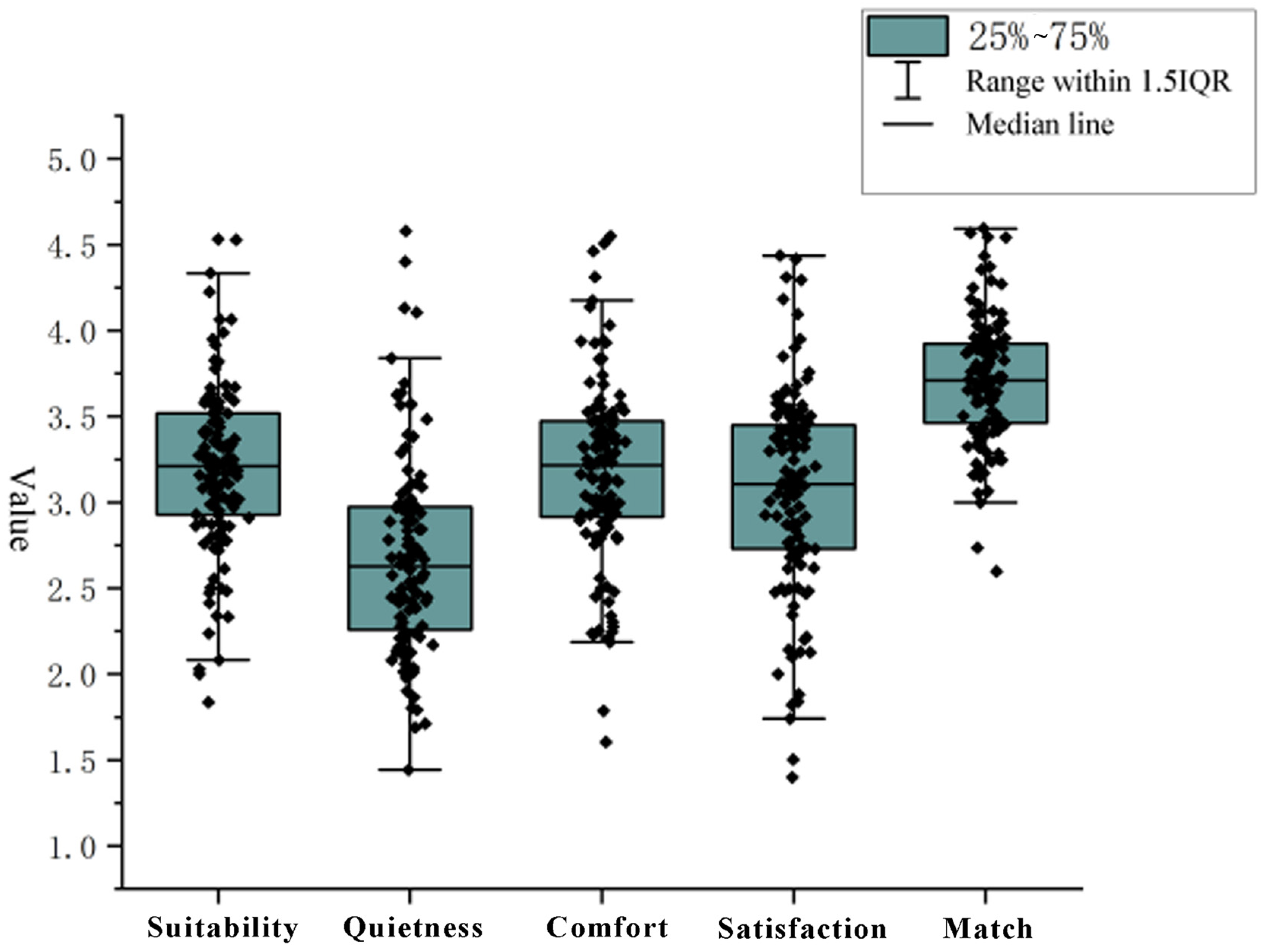
- Respondents’ evaluation of the soundscape. In this study, based on the theoretical framework of multidimensional soundscape perception (e.g., pleasantness, eventfulness, familiarity), standardized ISO soundscape descriptors, and empirical validation across diverse environments, these five indicators—Appropriateness, Quietness, Comfort, Satisfaction, and Matching—were selected for their comprehensive ability to capture the physical, psychological, and contextual dimensions of soundscape quality. Suitability (characterizing the degree of relaxation and Appropriateness of the soundscape), Quietness (characterizing the degree of Quietness of the soundscape as perceived by the respondents), Comfort (characterizing the degree of Comfort of the soundscape as perceived by the respondents), Satisfaction (characterizing the degree of Satisfaction with the soundscape as perceived by the respondents), and Match (characterizing the degree of matching, as perceived by the respondents, of a soundscape with the soundscape in their area). The soundscape evaluation was quantified through a five-level scale divided into five degrees: strongly agree (+2 points), relatively agree (+1 point), moderate (0 points), relatively disagree (−1 point), and strongly disagree (−2 points). At the same time, we categorized the specific sound sources in the study area into three main types: natural sounds: wind, wind blowing leaves, water, chirping of birds and insects, and dogs barking; human sounds: conversation, footsteps, entertainment (excluding conversations), and sports; and mechanical sounds: music (musical instruments), broadcasts (electric broadcasting), transportation, and construction.

| Sound Source Type | Specific Sound Source |
|---|---|
| Natural sound | wind, leaves blown by the wind, water, birds, insects, dogs |
| Human sound | conversation, footsteps, entertainment activities fitness exercises |
| Mechanical sound | music, radio, traffic, construction |
2.3.3. Urban Land-Use Planning Data
2.4. Procedure
2.4.1. Objective Acoustic Data Acquisition and Processing
2.4.2. Questionnaire Distribution and Collection
2.5. Research Process
3. Results
3.1. Spatial Distribution of the Urban Soundscape
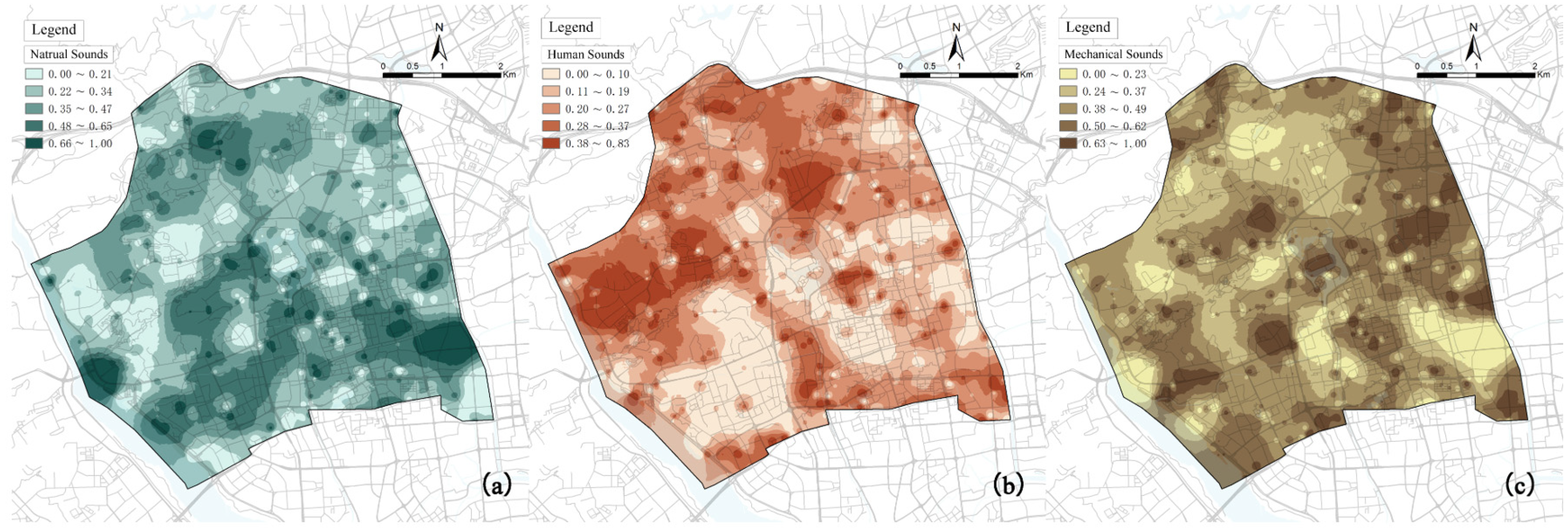
3.1.1. Characterization of Objective Indicators
3.1.2. Characterization of Subjective Indicators
- (1)
- Frequency of soundscape perception
- (2)
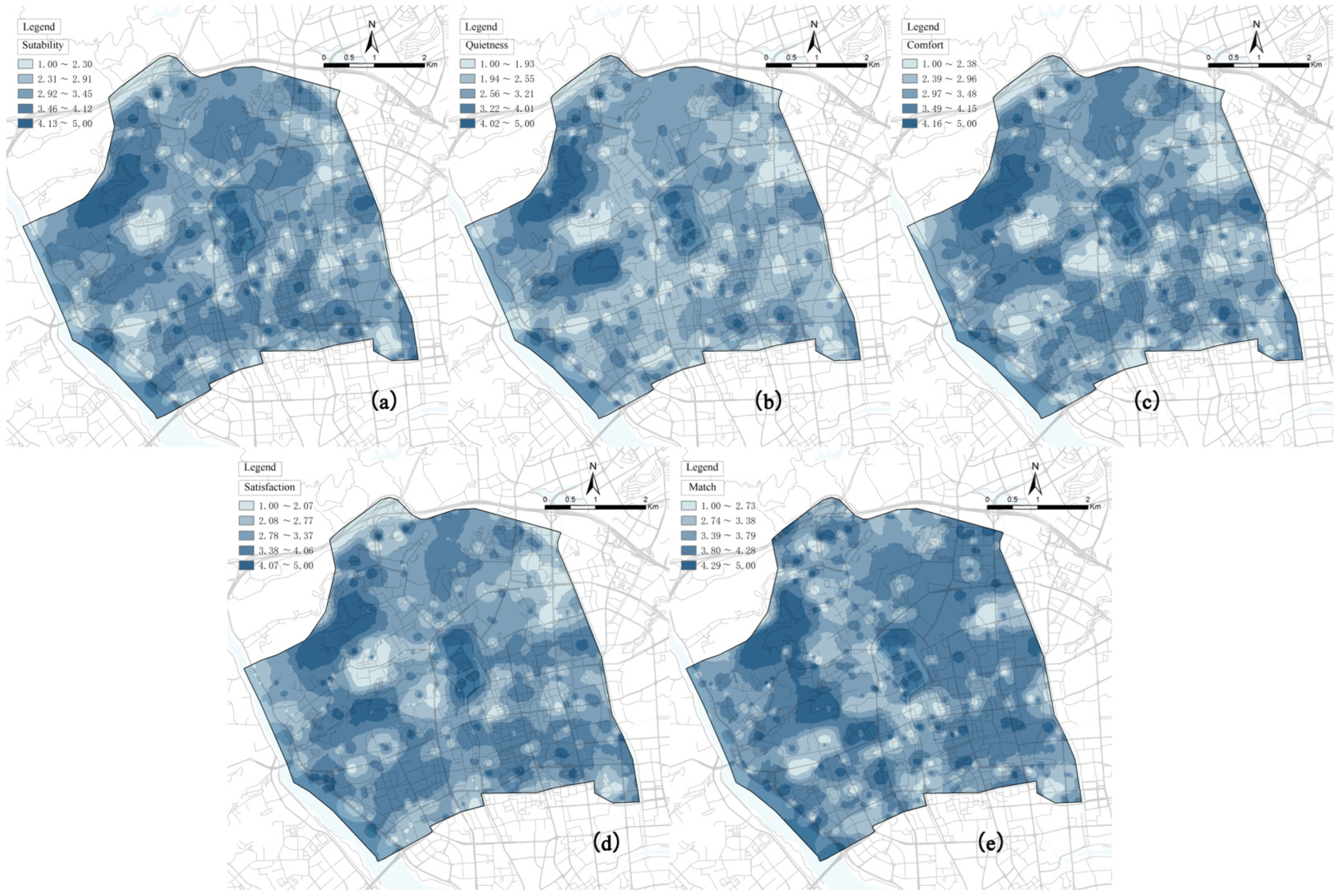
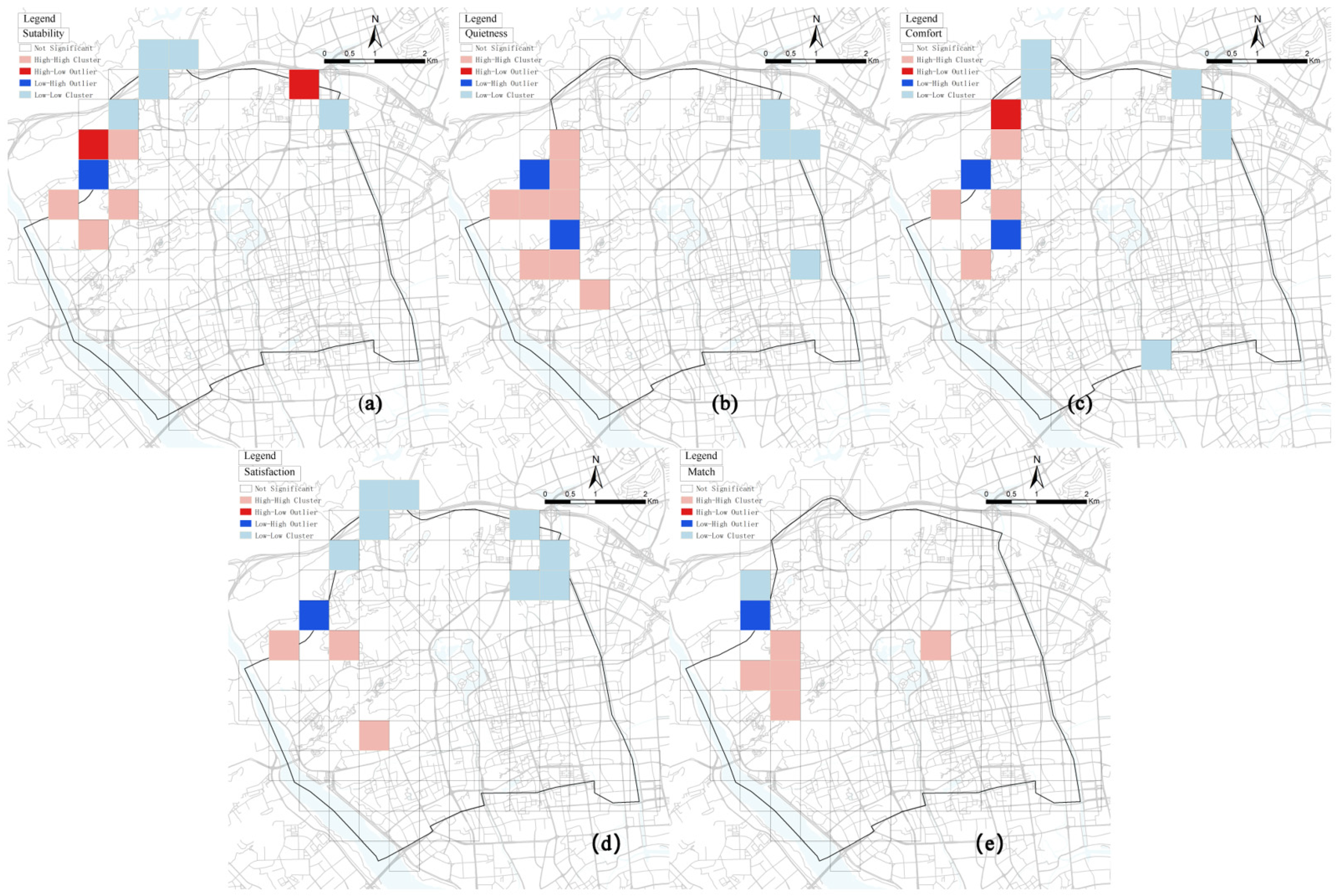
- Multidimensional evaluation of soundscape
3.2. Study of the Relationship Between Urban Land-Use Planning and Subjective and Objective Indicators of Soundscape
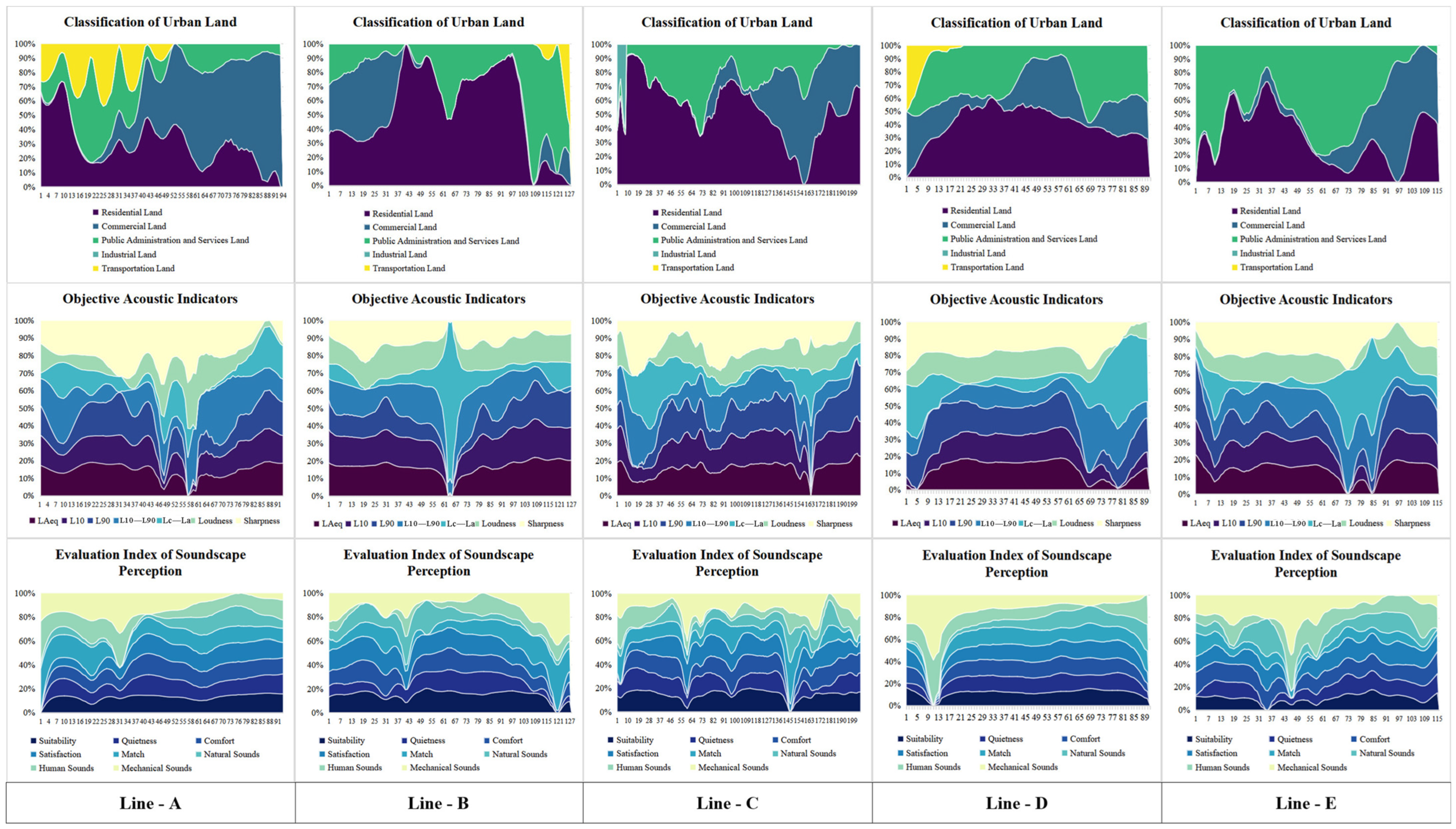
3.3. Characteristics of Typical Urban Road Soundscape and Land-Use Interaction
4. Discussion: The Urban Soundscape Is Influenced by Many Factors
4.1. Intervention in the Acoustic Environment by the Complex Urban Environment
4.2. Synergy of Site Functions on Soundscape Resources
4.3. Relationship Between the Public’s Need for Tranquility and Planning
5. Conclusions
- (1)
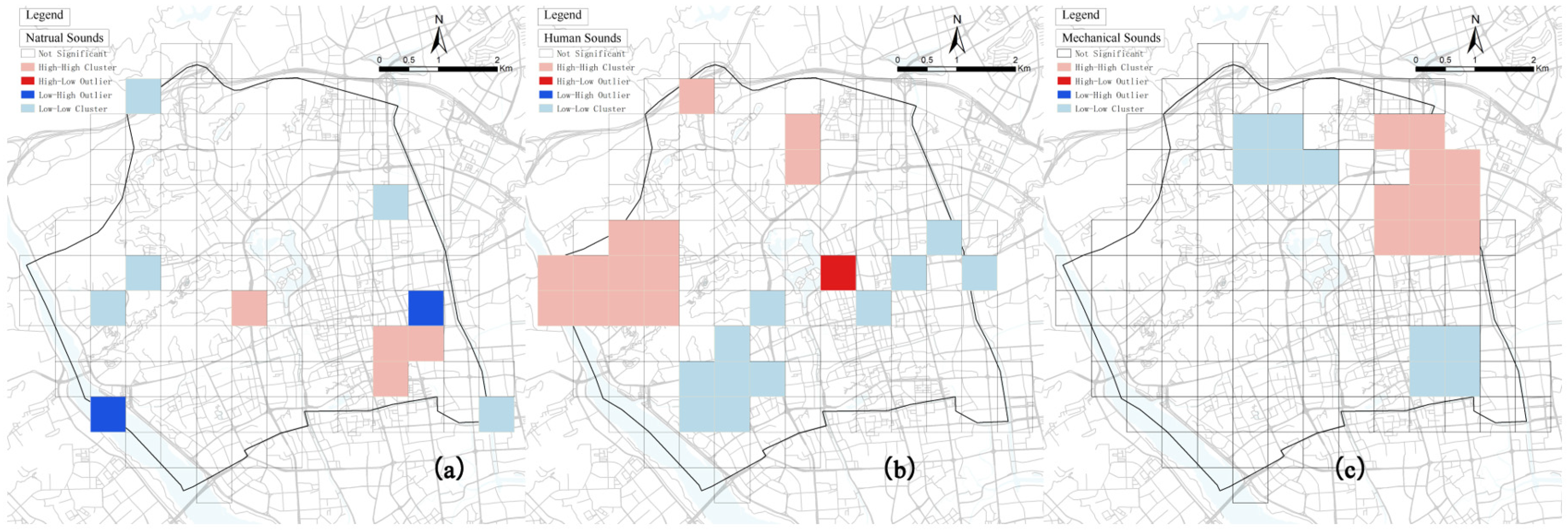
- Objective acoustic characteristics and soundscape perception evaluation are affected by the function of urban land use. Areas with the same urban soundscape distribution pattern have similar spatial functional characteristics, and soundscape evaluation will be affected by the surrounding environment. This is because the urban land-use function directly affects the natural environmental elements and crowd activities in the space, leading to changes in the objective acoustic environment, and affecting the evaluation of the subjective soundscape. Areas with the same distribution pattern of sound source perception tend to show similar spatial functional characteristics, and there are some differences in the distribution pattern of different categories of sound source perception. The overall spatial distribution of soundscape evaluation is relatively similar, but there are some differences in the urban spatial functions corresponding to high- and low-value areas. The distribution of soundscape evaluation is not random, and different soundscape evaluation indicators have significant spatial autocorrelation and spatial aggregation effects. Therefore, corresponding soundscape optimization strategies should be proposed for different urban spatial functions.
- (2)
- The critical objective acoustic indicators affecting the evaluation of urban soundscape perception are equivalent continuous A sound level LAeq, background sound L90, LC–LA, and loudness. Sound level remains the most critical factor influencing individuals’ perception and evaluation of the sound environment, and LAeq has a key influence on all soundscape evaluation indicators. Individuals rate the quiet environment highly and experience a strong sense of discomfort in the noisy environment. However, it should be noted that soundscape evaluation results may also vary due to individual differences and other physical environment factors.
- (3)
- Urban land-use planning has a significant impact on the urban soundscape. Urban land-use planning, to a certain extent, delineates the behavior of individuals in its space and therefore produces soundscape characteristics corresponding to the behavioral activities of the crowd. There are significant differences in the objective sound environment in different urban land-use plans, and urban land-use plans also influence people’s perception of the sound environment.
Author Contributions
Funding
Institutional Review Board Statement
Informed Consent Statement
Data Availability Statement
Conflicts of Interest
References
- Feng, L.; Wang, J.; Liu, B.; Hu, F.; Hong, X.; Wang, W. Does Urban Green Space Pattern Affect Green Space Noise Reduction? Forests 2024, 15, 1719. [Google Scholar] [CrossRef]
- Masum, M.; Pal, S.; Akhie, A.; Ruva, I.; Akter, N.; Nath, S. Spatiotemporal monitoring and assessment of noise pollution in an urban setting. Environ. Chall. 2021, 5, 100218. [Google Scholar] [CrossRef]
- Clark, C.; Paunovic, K. WHO Environmental Noise Guidelines for the European Region: A Systematic Review on Environmental Noise and Quality of Life, Wellbeing and Mental Health. Int. J. Environ. Res. Public Health 2018, 15, 2400. [Google Scholar] [CrossRef]
- Li, M.; Van Renterghem, T.; Kang, J.; Verheyen, K.; Botteldooren, D. Sound absorption by tree bark. Appl. Acoust. 2020, 165, 107328. [Google Scholar] [CrossRef]
- Ling, S.; Yu, F.; Sun, D.; Sun, G.; Xu, L. A comprehensive review of tire-pavement noise: Generation mechanism, measurement methods, and quiet asphalt pavement. J. Clean. Prod. 2021, 287, 125056. [Google Scholar] [CrossRef]
- Li, W.; Zhai, J.; Zhu, M. Characteristics and perception evaluation of the soundscapes of public spaces on both sides of the elevated road: A case study in Suzhou, China. Sustain. Cities Soc. 2022, 84, 103996. [Google Scholar] [CrossRef]
- Peris, E.; Fenech, B. Associations and effect modification between transportation noise, self-reported response to noise and the wider determinants of health: A narrative synthesis of the literature. Sci. Total. Environ. 2020, 748, 141040. [Google Scholar] [CrossRef] [PubMed]
- Kang, J.; Yang, W. Soundscape in urban open public spaces. World Archit. 2002, 144, 76–79. [Google Scholar]
- Alves, J.A.; Paiva, F.N.; Silva, L.T.; Remoaldo, P. Low-Frequency Noise and Its Main Effects on Human Health—A Review of the Literature between 2016 and 2019. Appl. Sci. 2020, 10, 5205. [Google Scholar] [CrossRef]
- Coensel, B.D.; Vanwetswinkel, S.; Botteldooren, D. Effects of Natural Sounds on the Perception of Road Traffic Noise. J. Acoust. Soc. Am. 2011, 129, EL148–EL153. [Google Scholar] [CrossRef]
- Kang, J.; Aletta, F.; Gjestland, T.T.; Brown, L.A.; Botteldooren, D.; Schulte-Fortkamp, B.; Lercher, P.; van Kamp, I.; Genuit, K.; Fiebig, A.; et al. Ten questions on the soundscapes of the built environment. Build. Environ. 2016, 108, 284–294. [Google Scholar] [CrossRef]
- Kang, J. From Environmental Noise Control to Soundscape Design. Int. J. Acoust. Vib. 2015, 20, 62. [Google Scholar]
- Dorota, J.; Marie-Ève, H.; Poonum, W.; James, C.; Jos, V.; Jördis, W.; Elizabet, P. Development of the WHO Environmental Noise Guidelines for the European Region: An Introduction. Int. J. Environ. Res. Public Health 2018, 15, 813. [Google Scholar]
- Prior, J. Sonic environmental aesthetics and landscape research. Landsc. Res. 2016, 42, 6–17. [Google Scholar] [CrossRef]
- Song, X.; Lv, X.; Yu, D.; Wu, Q. Spatial-Temporal change analysis of plant soundscapes and their design methods. Urban For. Urban Green. 2018, 29, 96–105. [Google Scholar] [CrossRef]
- Jo, H.I.; Jeon, J.Y. The influence of human behavioral characteristics on soundscape perception in urban parks: Subjective and observational approaches. Landsc. Urban Plan. 2020, 203, 103890. [Google Scholar] [CrossRef]
- de la Prida, D.; Pedrero, A.; Navacerrada, M.Á.; Díaz, C. Relationship between the geometric profile of the city and the subjective perception of urban soundscapes. Appl. Acoust. 2019, 149, 74–84. [Google Scholar] [CrossRef]
- Li, Z.; Ba, M.; Kang, J. Measuring soundscape quality of urban environments using physiological indicators: Construction of physiological assessment dimensions and comparison with subjective dimensions. Build. Environ. 2024, 257, 111549. [Google Scholar] [CrossRef]
- Yang, L.; Liu, J.; Albert, C.; Guo, X. Exploring the effects of soundscape perception on place attachment: A comparative study of residents and tourists. Appl. Acoust. 2024, 222, 110048. [Google Scholar] [CrossRef]
- Dumyahn, S.L.; Pijanowski, B.C. Soundscape conservation. Landsc. Ecol. 2011, 26, 1327–1344. [Google Scholar] [CrossRef]
- Preis, A.; Kociński, J.; Hafke-Dys, H.; Wrzosek, M. Audio-Visual interactions in environment assessment. Sci. Total. Environ. 2015, 523, 191–200. [Google Scholar] [CrossRef] [PubMed]
- Buxton, R.T.; Pearson, A.L.; Allou, C.; Fristrup, K.; Wittemyer, G. A synthesis of health benefits of natural sounds and their distribution in national parks. Proc. Natl. Acad. Sci. USA 2021, 118, e2013097118. [Google Scholar] [CrossRef]
- Xiang, Y.; Meng, Q.; Li, M.; Yang, D.; Wu, Y. Using soundscape diversity to interpret soundscape evaluation in urban green spaces—Relationship, integration, and application. Urban For. Urban Green. 2024, 97, 128371. [Google Scholar] [CrossRef]
- Xiang, Y.; Meng, Q.; Zhang, X.; Li, M.; Yang, D.; Wu, Y. Soundscape diversity: Evaluation indices of the sound environment in urban green spaces—Effectiveness, role, and interpretation. Ecol. Indic. 2023, 154, 110725. [Google Scholar] [CrossRef]
- Liu, F.; Liu, P.; Kang, J.; Meng, Q.; Wu, Y.; Yang, D. Relationships between landscape characteristics and the restorative quality of soundscapes in urban blue spaces. Appl. Acoust. 2022, 189, 108600. [Google Scholar] [CrossRef]
- Liao, Z.; Guan, Y.; Guo, S.; Cai, D.; Yu, M.; Yao, W.; Zhang, C.; Deng, R. A grid-based method for measuring urban greenness at the block scale. J. Earth Inf. Sci. 2022, 24, 1475–1487. [Google Scholar]
- Yu, T.; Dong, R. Comparative Study on the Spatial Distribution Characteristics of Urban Environmental Noise. Environ. Sci. Technol. 2019, 42, 130–137. [Google Scholar]
- ISO/TS 12913-2; Acoustics—Soundscape—Part 2: Data Collection and Reporting Requirements. International Organization for Standardization: Geneva, Switzerland, 2018.
- GB/T 21010-2017; Land Use Status Classification. Standardization Administration of China: Beijing, China, 2017.
- ISO 1996-2:2017; Acoustics—Description, Measurement and Assessment of Environmental Noise—Part 2: Determination of Environmental Noise Levels. International Organization for Standardization: Geneva, Switzerland, 2017.
- ANSI/ASA S1.13-2005 (R 2010); Measurement of Sound Pressure Levels in Air. Acoustical Society of America: New York, NY, USA, 2010.
- Basner, M.; Babisch, W.; Davis, A.; Brink, M.; Clark, C.; Janssen, S.; Stansfeld, S. Auditory and non-auditory effects of noise on health. Lancet 2014, 383, 1325–1332. [Google Scholar] [CrossRef]
- Hahad, O.; Jimenez, M.T.B.; Kuntic, M.; Frenis, K.; Steven, S.; Daiber, A.; Münzel, T. Cerebral consequences of environmental noise exposure. Environ. Int. 2022, 165, 107306. [Google Scholar] [CrossRef] [PubMed]
- Guo, X.; Yang, L.; Wei, Y.; Zhu, T.; Liu, J.; Ren, W. Research on the Influencing Factors of Place Creation in Historical Districts under Soundscape Perception. Acoust. Technol. 2022, 41, 108–115. [Google Scholar]
- Baliatsas, C.; Van Kamp, I.; Van Poll, R.; Yzermans, J. Health effects from low-frequency noise and infrasound in the general population: Is it time to listen? A systematic review of observational studies. Sci. Total Environ. 2016, 557–558, 163–169. [Google Scholar] [CrossRef]
- Lin, H.; Wang, J.-B.; Zhang, X.; Hu, F.; Liu, J.; Hong, X.-C. Historical sensing: The spatial pattern of soundscape occurrences recorded in poems between the Tang and the Qing Dynasties amid urbanization. Humanit. Soc. Sci. Commun. 2024, 11, 730. [Google Scholar] [CrossRef]
- Marquis-Favre, C.; Braga, R.; Gourdon, E.; Combe, C.; Gille, L.-A.; Ribeiro, C.; Mietlicki, F. Estimation of psychoacoustic and noise indices from the sound pressure level of transportation noise sources: Investigation of their potential benefit to the prediction of long-term noise annoyance. Appl. Acoust. 2023, 211, 109560. [Google Scholar] [CrossRef]
- Yang, M.; Masullo, M. Combining binaural psychoacoustic characteristics for emotional evaluations of acoustic environments. Appl. Acoust. 2023, 210, 109433. [Google Scholar] [CrossRef]
- Swart, D.J.; Bekker, A. The relationship between consumer Satisfaction and psychoacoustics of electric vehicle signature sound. Appl. Acoust. 2019, 145, 167–175. [Google Scholar] [CrossRef]
- Memmedova, K.; Ertuna, B. Development of a fuzzy Likert scales to measure variables in social sciences. Inf. Sci. 2023, 654, 119792. [Google Scholar] [CrossRef]


| Sound Source Perception | Moran’s I | Z-Score | |
|---|---|---|---|
| Sound source category | Natural sound | 0.326 | 4.872 |
| Human sound | 0.547 | 8.030 | |
| Mechanical sound | 0.322 | 4.794 | |
| Soundscape Evaluation | Moran’s I | z-Score |
|---|---|---|
| Suitability | 0.290 | 9.055 |
| Quietness | 0.303 | 9.469 |
| Comfort | 0.307 | 9.586 |
| Satisfaction | 0.354 | 11.025 |
| Match | 0.141 | 4.441 |
| Implicit Variable | Independent Variable (Objective Acoustics) | Standardized Coefficient | t | Covariance Statistics | R-Square | F | ||
|---|---|---|---|---|---|---|---|---|
| Tolerances | VIF | |||||||
| Sound source perception | Natural sounds | / | / | / | / | / | / | / |
| Human sounds | L90 | −0.296 | −3.372 | 1.000 | 1.000 | 0.088 | 11.373 ** | |
| Mechanical sounds | L90 | 0.216 | 2.402 | 1.000 | 1.000 | 0.047 | 5.772 * | |
| Soundscape Evaluation | Suitability | LAeq | −1.077 | −5.297 | 0.108 | 9.278 | 0.483 | 36.098 *** |
| LC–LA | −0.247 | −3.552 | 0.924 | 1.082 | ||||
| L90 | 0.411 | 2.046 | 0.110 | 9.071 | ||||
| Quietness | LAeq | −0.836 | −16.517 | 1.000 | 1.000 | 0.698 | 272.809 *** | |
| Comfort | LAeq | −1.247 | −6.379 | 0.108 | 9.278 | 0.522 | 42.241 *** | |
| LC–LA | −0.236 | −3.537 | 0.924 | 1.082 | ||||
| L90 | 0.569 | 2.942 | 0.110 | 9.071 | ||||
| Satisfaction | LAeq | −1.234 | −5.739 | 0.108 | 9.278 | 0.422 | 28.261 *** | |
| LC–LA | −0.250 | −3.401 | 0.924 | 1.082 | ||||
| L90 | 0.648 | 3.051 | 0.110 | 9.071 | ||||
| Match | LAeq | −1.119 | −3.746 | 0.079 | 12.702 | 0.179 | 12.730 *** | |
| Loudness | 0.791 | 2.647 | 0.079 | 12.702 | ||||
| Residential Land | Commercial Land | Public Administration and Service Land | Industrial Land | Transport Land | |
|---|---|---|---|---|---|
| LAeq | −0.200 * | 0.239 ** | 0.076 | 0.017 | 0.063 |
| L10 | −0.180 | 0.235 * | 0.080 | 0.030 | 0.058 |
| L90 | −0.102 | 0.218 | 0.020 | −0.015 | 0.069 |
| L10–L90 | 0.421 ** | −0.213 * | −0.042 | 0.042 | −0.141 |
| LC–LA | −0.305 ** | 0.048 | 0.097 | 0.250 ** | 0.012 |
| Loudness | −0.332 ** | 0.301 ** | 0.090 | 0.011 | 0.109 |
| Sharpness | 0.452 ** | −0.082 | −0.209 * | −0.235 * | −0.033 |
| Suitability | 0.164 | −0.075 | 0.056 | −0.353 ** | −0.079 |
| Quietness | 0.205 * | −0.016 | −0.016 | −0.155 | −0.135 |
| Comfort | 0.130 | −0.082 | 0.043 | −0.312 ** | −0.040 |
| Satisfaction | 0.090 | 0.074 | 0.151 | −0.418 ** | −0.120 |
| Match | 0.011 | −0.008 | 0.099 | −0.081 | −0.067 |
| Natural sounds | −0.055 | 0.270 ** | 0.100 | −0.108 | −0.074 |
| Human sounds | 0.267 ** | −0.288 ** | −0.360 ** | 0.193 | −0.130 |
| Mechanical sounds | −0.165 | −0.045 | 0.195 * | −0.046 | 0.187 * |
Disclaimer/Publisher’s Note: The statements, opinions and data contained in all publications are solely those of the individual author(s) and contributor(s) and not of MDPI and/or the editor(s). MDPI and/or the editor(s) disclaim responsibility for any injury to people or property resulting from any ideas, methods, instructions or products referred to in the content. |
© 2025 by the authors. Licensee MDPI, Basel, Switzerland. This article is an open access article distributed under the terms and conditions of the Creative Commons Attribution (CC BY) license (https://creativecommons.org/licenses/by/4.0/).
Share and Cite
Feng, L.-Y.; Hu, F.; Liu, B.-Y.; Zhang, D.-Y.; Guo, L.-H.; Yu, S.; Hong, X.-C. How Land-Use Planning Deeply Affects the Spatial Distribution of Composite Soundscapes. Sustainability 2025, 17, 10948. https://doi.org/10.3390/su172410948
Feng L-Y, Hu F, Liu B-Y, Zhang D-Y, Guo L-H, Yu S, Hong X-C. How Land-Use Planning Deeply Affects the Spatial Distribution of Composite Soundscapes. Sustainability. 2025; 17(24):10948. https://doi.org/10.3390/su172410948
Chicago/Turabian StyleFeng, Li-Yi, Fangbing Hu, Bin-Yan Liu, Dan-Yin Zhang, Lian-Huan Guo, Shanshan Yu, and Xin-Chen Hong. 2025. "How Land-Use Planning Deeply Affects the Spatial Distribution of Composite Soundscapes" Sustainability 17, no. 24: 10948. https://doi.org/10.3390/su172410948
APA StyleFeng, L.-Y., Hu, F., Liu, B.-Y., Zhang, D.-Y., Guo, L.-H., Yu, S., & Hong, X.-C. (2025). How Land-Use Planning Deeply Affects the Spatial Distribution of Composite Soundscapes. Sustainability, 17(24), 10948. https://doi.org/10.3390/su172410948