


Consumer Acceptance of Digital Product Passports: The Roles of Technological Awareness and Value Orientations



Abstract
1. Introduction
2. Literature Review, Research Model, and Hypotheses
2.1. Digital Product Passports in the Fashion Industry
2.2. Theoretical Background
2.2.1. The Technology Acceptance Model (TAM)
2.2.2. Consumer Shopping Orientation: Expanded Dimensions
2.3. Research Model and Hypotheses
2.3.1. Perceived Usefulness and Ease of Use of DPP
2.3.2. Familiarity with Technologies Relevant to DPP
2.3.3. Consumer Ethical-Sustainability, and Circular Value Orientations
3. Research Methodology
3.1. Research Instrument
3.2. Sampling and Sample
3.3. Data Analysis
4. Results
4.1. Descriptive Statistics and Results
4.2. Measurement Reliability and Validity
4.3. Hypothesis Testing
5. Discussion, Implications, and Limitations
5.1. Discussion
5.2. Implications and Limitations
Author Contributions
Funding
Institutional Review Board Statement
Informed Consent Statement
Data Availability Statement
Conflicts of Interest
References
- Niinimäki, K.; Peters, G.; Dahlbo, H.; Perry, P.; Rissanen, T.; Gwilt, A. The environmental price of fast fashion. Nat. Nat. Rev. Earth Environ. 2020, 1, 189–200. [Google Scholar] [CrossRef]
- Saha, K.; Dey, P.K.; Kumar, V. A comprehensive review of circular economy research in the textile and clothing industry. J. Clean. Prod. 2024, 444, 141252. [Google Scholar] [CrossRef]
- Thomasset, A.; Benayoun, S. Review: Leather sustainability, an industrial ecology in process. J. Ind. Ecol. 2024, 28, 1842–1856. [Google Scholar] [CrossRef]
- D’Adamo, I.; Gagliarducci, M.; Iannilli, M.; Mangani, V. Fashion Wears Sustainable Leather: A Social and Strategic Analysis Toward Sustainable Production and Consumption Goals. Sustainability 2024, 16, 9971. [Google Scholar] [CrossRef]
- European Commission. Ecodesign for Sustainable Products Regulation. Available online: https://commission.europa.eu/energy-climate-change-environment/standards-tools-and-labels/products-labelling-rules-and-requirements/ecodesign-sustainable-products-regulation_en (accessed on 16 October 2025).
- Jensen, S.F.; Kristensen, J.H.; Adamsen, S.; Christensen, A.; Waehrens, B.V. Digital product passports for a circular economy: Data needs for product life cycle decision-making. Sustain. Prod. Consum. 2023, 37, 242–255. [Google Scholar] [CrossRef]
- Weihrauch, D.; Carodenuto, S.; Leipold, S. From voluntary to mandatory corporate accountability: The politics of the German Supply Chain Due Diligence Act. Regul. Gov. 2023, 17, 909–926. [Google Scholar] [CrossRef]
- ESG News. France Targets Ultra-Fast Fashion with Eco-Tax, Ad Ban, and Transparency Rules. ESG News, 17 June 2025. Available online: https://esgnews.com/france-targets-ultra-fast-fashion-with-eco-tax-ad-ban-and-transparency-rules/ (accessed on 24 November 2025).
- Zhang, A.; Seuring, S. Digital product passport for sustainable and circular supply chain management: A structured review of use cases. Int. J. Logist. Res. Appl. 2024, 27, 2513–2540. [Google Scholar] [CrossRef]
- Adisorn, T.; Tholen, L.; Götz, T. Towards a Digital Product Passport Fit for Contributing to a Circular Economy. Energies 2021, 14, 2289. [Google Scholar] [CrossRef]
- Colasante, A.; D’Adamo, I.; Desideri, S.; Iannilli, M.; Mangani, V. Environmental Concerns in the Fashion Industry: A Twin Transition with the Digital Product Passport. Bus. Strategy Environ. 2025, 34, 9242–9256. [Google Scholar] [CrossRef]
- Voulgaridis, K.; Lagkas, T.; Angelopoulos, C.M.; Boulogeorgos, A.-A.A.; Argyriou, V.; Sarigiannidis, P. Digital product passports as enablers of digital circular economy: A framework based on technological perspective. Telecommun. Syst. 2024, 85, 699–715. [Google Scholar] [CrossRef]
- Oesterreich, T.D.; Anton, E.; Hettler, F.M.; Teuteberg, F. What drives individuals’ trusting intention in digital platforms? An exploratory meta-analysis. Manag. Rev. Q. 2024, 75, 3615–3667. [Google Scholar] [CrossRef]
- Elzinga, R.; Reike, D.; Negro, S.O.; Boon, W.P.C. Consumer acceptance of circular business models. J. Clean. Prod. 2020, 254, 119988. [Google Scholar] [CrossRef]
- Parliamentary Research Services (EPRS) of the Secretariat of the European Parliament. Digital Product Passport for the Textile Sector; Publications Office of the European Union: Brussels, Belgium, 2024. [Google Scholar]
- Monteiro, J.; Barata, J.; Gentilini, S. A Digital Twin-Based Digital Product Passport. Procedia Comput. Sci. 2024, 246, 4123–4132. [Google Scholar] [CrossRef]
- Nowacki, S.; Sisik, G.M.; Angelopoulos, C.M. Digital Product Passports: Use Cases Framework and Technical Architecture Using DLT and Smart Contracts. In Proceedings of the 19th International Conference on Distributed Computing in Smart Systems and the Internet of Things (DCOSS-IoT), Corfu, Greece, 19–21 June 2023; pp. 373–380. [Google Scholar]
- Canciani, A.; Felicioli, C.; Severino, F.; Tortola, D. Enhancing Supply Chain Transparency through Blockchain Product Passports. In Proceedings of the 2024 IEEE International Conference on Pervasive Computing and Communications Workshops and Other Affiliated Events (PerCom Workshops), Biarritz, France, 11–15 March 2024; pp. 751–756. [Google Scholar]
- Thunyaluck, M.; Valilai, O.F. Integrating Digital Product Passports in Multi-Level Supply Chain for enabling Horizontal and Vertical Integration in the Circular Economy. In Proceedings of the 2024 IEEE International Conference on Industrial Engineering and Engineering Management (IEEM), Bangkok, Thailand, 15–18 December 2024; pp. 36–42. [Google Scholar]
- Kim, M.J.; Han, C.H.; Park, K.J.; Moon, J.S.; Um, J. A Blockchain-Based Digital Product Passport System Providing a Federated Learning Environment for Collaboration Between Recycling Centers and Manufacturers to Enable Recycling Automation. Sustainability 2025, 17, 2679. [Google Scholar] [CrossRef]
- Popowicz, M.; Pohlmann, A.; Schöggl, J.-P.; Baumgartner, R.J. Digital Product Passports as Information Providers for Consumers—The Case of Digital Battery Passports. Bus. Strategy Environ. 2025, 34, 7700–7722. [Google Scholar] [CrossRef]
- Jeganathan, K.; Szymkowiak, A. Bridging Digital Product Passports and in-store experiences: How augmented reality enhances decision comfort and reuse intentions. J. Retail. Consum. Serv. 2025, 84, 104242. [Google Scholar] [CrossRef]
- Deloitte. Sustainability Has Staying Power. Available online: https://www.deloitte.com/us/en/insights/topics/environmental-social-governance/sustainable-consumption-trends.html?utm_source.com (accessed on 31 October 2025).
- Haase, L.M.; Lythje, L.S.; Skouboe, E.B.; Petersen, M.L. More Than Legislation: The Strategic Benefits and Incentives for Companies to Implement the Digital Product Passport. J. Circ. Econ. 2025, 2, 2. [Google Scholar] [CrossRef]
- Davis, F.D. Perceived Usefulness, Perceived Ease of Use, and User Acceptance of Information Technology. MIS Q. 1989, 13, 319–340. [Google Scholar] [CrossRef]
- Ma, Y.J.; Gam, H.J.; Banning, J. Perceived ease of use and usefulness of sustainability labels on apparel products: Application of the technology acceptance model. Fash. Text. 2017, 4, 3. [Google Scholar] [CrossRef]
- Kim, H.-Y.; Lee, J.Y.; Mun, J.M.; Johnson, K.K.P. Consumer adoption of smart in-store technology: Assessing the predictive value of attitude versus beliefs in the technology acceptance model. Int. J. Fash. Des. Technol. Educ. 2017, 10, 26–36. [Google Scholar] [CrossRef]
- Luo, G.L.; Zheng, H.; Guo, Y.L. Impact of consumer information capability on green consumption intention: The role of green trust and media publicity. Front. Psychol. 2023, 14, 1247479. [Google Scholar] [CrossRef] [PubMed]
- Altarteer, S.; Charissis, V. Technology Acceptance Model for 3D Virtual Reality System in Luxury Brands Online Stores. IEEE Access 2019, 7, 64053–64062. [Google Scholar] [CrossRef]
- Wei, Z.; Lee, M.-Y.; Shen, H. What drives consumers in China to buy clothing online? Application of the technology acceptance model. J. Text. Fibrous Mater. 2018, 1, 2515221118756791. [Google Scholar] [CrossRef]
- Şener, T.; Bişkin, F.; Kılınç, N. Sustainable dressing: Consumers’ value perceptions towards slow fashion. Bus. Strategy Environ. 2019, 28, 1548–1557. [Google Scholar] [CrossRef]
- Workman, J.E.; Cho, S. Gender, Fashion Consumer Groups, and Shopping Orientation. Fam. Consum. Sci. Res. J. 2012, 40, 267–283. [Google Scholar] [CrossRef]
- Michon, R.; Chebat, J.-C.; Yu, H.; Lemarié, L. Fashion orientation, shopping mall environment, and patronage intentions: A study of female fashion shoppers. J. Fash. Mark. Manag. 2015, 19, 3–21. [Google Scholar]
- Tomșa, M.-M.; Romonți-Maniu, A.-I.; Scridon, M.-A. Is Sustainable Consumption Translated into Ethical Consumer Behavior? Sustainability 2021, 13, 3466. [Google Scholar] [CrossRef]
- Cho, E.; Gupta, S.; Kim, Y.-K. Style consumption: Its drivers and role in sustainable apparel consumption. Int. J. Consum. Stud. 2015, 39, 661–669. [Google Scholar] [CrossRef]
- Gupta, S.; Gwozdz, W.; Gentry, J. The Role of Style Versus Fashion Orientation on Sustainable Apparel Consumption. J. Macromarketing 2019, 39, 188–207. [Google Scholar] [CrossRef]
- Niinimäki, K. Ethical foundations in sustainable fashion. Text. Cloth. Sustain. 2015, 1, 3. [Google Scholar] [CrossRef]
- Freestone, O.M.; McGoldrick, P.J. Motivations of the Ethical Consumer. J. Bus. Ethics 2008, 79, 445–467. [Google Scholar] [CrossRef]
- Hwang, K.; Kim, H. Are Ethical Consumers Happy? Effects of Ethical Consumers’ Motivations Based on Empathy Versus Self-orientation on Their Happiness. J. Bus. Ethics 2018, 151, 579–598. [Google Scholar] [CrossRef]
- Thøgersen, J. Psychological Determinants of Paying Attention to Eco-Labels in Purchase Decisions: Model Development and Multinational Validation. J. Consum. Policy 2000, 23, 285–313. [Google Scholar] [CrossRef]
- Testa, F.; Marullo, C.; Gusmerotti, N.M.; di Iorio, V. Exploring circular consumption: Circular attitudes and their influence on consumer behavior across the product lifecycle. Bus. Strategy Environ. 2024, 33, 6961–6983. [Google Scholar] [CrossRef]
- Slaton, K.; Pookulangara, S. Exploring Consumer Use of Digital Product Passports for Secondary Luxury Consumption: A Conceptual Study. Adv. Consum. Res. 2025, 2, 279–292. [Google Scholar]
- Psarommatis, F.; May, G. Digital Product Passport: A Pathway to Circularity and Sustainability in Modern Manufacturing. Sustainability 2024, 16, 396. [Google Scholar] [CrossRef]
- Ajdinović, S.; Strljic, M.; Lechler, A.; Riedel, O. Interoperable Digital Product Passports: An Event-Based Approach to Aggregate Production Data to Improve Sustainability and Transparency in the Manufacturing Industry. In Proceedings of the 2024 IEEE/SICE International Symposium on System Integration (SII), Ha Long, Vietnam, 8–11 January 2024; pp. 729–734. [Google Scholar]
- Badhwar, A.; Islam, S.; Tan, C.S.L. Exploring the potential of blockchain technology within the fashion and textile supply chain with a focus on traceability, transparency, and product authenticity: A systematic review. Front. Blockchain 2023, 6, 1044723. [Google Scholar] [CrossRef]
- Venkatesh, V.; Morris, M.G.; Davis, G.B.; Davis, F.D. User Acceptance of Information Technology: Toward a Unified View. MIS Q. 2003, 27, 425–478. [Google Scholar] [CrossRef]
- Claudy, M.C.; Michelsen, C.; O’Driscoll, A.; Mullen, M.R. Consumer awareness in the adoption of microgeneration technologies: An empirical investigation in the Republic of Ireland. Renew. Sustain. Energy Rev. 2010, 14, 2154–2160. [Google Scholar] [CrossRef]
- Mofleh, S.; Wanous, M.; Strachan, P. The gap between citizens and e-government projects: The case for Jordan. Electron. Gov. Int. J. 2008, 5, 275–287. [Google Scholar] [CrossRef]
- Lingmont, D.N.J.; Alexiou, A. The contingent effect of job automating technology awareness on perceived job insecurity: Exploring the moderating role of organizational culture. Technol. Forecast. Soc. Change 2020, 161, 120302. [Google Scholar] [CrossRef]
- Saaksjarvi, M. Consumer Adoption of Technological Innovations. Eur. J. Innov. Manag. 2003, 6, 90–100. [Google Scholar] [CrossRef]
- Ko, E.; Kim, E.Y.; Lee, E.K. Modeling consumer adoption of mobile shopping for fashion products in Korea. Psychol. Mark. 2009, 26, 669–687. [Google Scholar] [CrossRef]
- Watchravesringkan, K.; Nelson Hodges, N.; Kim, Y.H. Exploring consumers’ adoption of highly technological fashion products: The role of extrinsic and intrinsic motivational factors. J. Fash. Mark. Manag. 2010, 14, 263–281. [Google Scholar] [CrossRef]
- Chartrand, T.L. The Role of Conscious Awareness in Consumer Behavior. J. Consum. Psychol. 2005, 15, 203–210. [Google Scholar] [CrossRef]
- Dodds, W.B.; Monroe, K.B.; Grewal, D. Effects of Price, Brand, and Store Information on Buyers’ Product Evaluations. J. Mark. Res. 1991, 28, 307–319. [Google Scholar]
- Laroche, M.; Bergeron, J.; Barbaro-Forleo, G. Targeting consumers who are willing to pay more for environmentally friendly products. J. Consum. Mark. 2001, 18, 503–520. [Google Scholar] [CrossRef]
- De Pelsmacker, P. Driesen, Liesbeth, Rayp, Glenn, Do Consumers Care about Ethics? Willingness to Pay for Fair-Trade Coffee. J. Consum. Aff. 2005, 39, 363–385. [Google Scholar] [CrossRef]
- Kim, J.; Forsythe, S. Adoption of Virtual Try-on technology for online apparel shopping. J. Interact. Mark. 2008, 22, 45–59. [Google Scholar] [CrossRef]
- Joergens, C. Ethical fashion: Myth or future trend? J. Fash. Mark. Manag. 2006, 10, 360–371. [Google Scholar] [CrossRef]
- Dickson, M.A. Personal Values, Beliefs, Knowledge, and Attitudes Relating to Intentions to Purchase Apparel from Socially Responsible Businesses. Cloth. Text. Res. J. 2000, 18, 19–30. [Google Scholar] [CrossRef]
- Connell, K.Y.H. Internal and external barriers to eco-conscious apparel acquisition. Int. J. Consum. Stud. 2010, 34, 279–286. [Google Scholar] [CrossRef]
- Guiot, D.; Roux, D. A Secondhand Shoppers’ Motivation Scale: Antecedents, Consequences, and Implications for Retailers. J. Retail. 2010, 86, 355–371. [Google Scholar] [CrossRef]
- Turunen, L.L.M.; Leipämaa-Leskinen, H. Pre-loved luxury: Identifying the meanings of secondhand luxury possessions. J. Prod. Brand Manag. 2015, 24, 57–65. [Google Scholar] [CrossRef]
- Park, H.J.; Lin, L.M. Exploring attitude–behavior gap in sustainable consumption: Comparison of recycled and upcycled fashion products. J. Bus. Res. 2020, 117, 623–628. [Google Scholar] [CrossRef]
- Parasuraman, A.; Colby, C.L. An Updated and Streamlined Technology Readiness Index:TRI 2.0. J. Serv. Res. 2015, 18, 59–74. [Google Scholar] [CrossRef]
- Queiroz, M.M.; Fosso Wamba, S. Blockchain adoption challenges in supply chain: An empirical investigation of the main drivers in India and the USA. Int. J. Inf. Manag. 2019, 46, 70–82. [Google Scholar] [CrossRef]
- U.S. Census Bureau. QuickFacts: United States. Available online: https://data.census.gov/profile/United_States?g=010XX00US (accessed on 29 October 2025).
- Tang, D.; Wen, Z. Statistical approaches for testing common method bias: Problems and suggestions. J. Psychol. Sci. 2020, 43, 215–223. [Google Scholar]
- Corsini, F.; Gusmerotti, N.M.; Testa, F.; Frey, M. Exploring the drivers of the intention to scan QR codes for environmentally related information when purchasing clothes. J. Glob. Fash. Mark. 2025, 16, 18–31. [Google Scholar] [CrossRef]
- Hair, J.F. Multivariate Data Analysis; Pearson Education: London, UK, 2009. [Google Scholar]
- Fornell, C.; Larcker, D.F. Evaluating Structural Equation Models with Unobservable Variables and Measurement Error. J. Mark. Res. 1981, 18, 39–50. [Google Scholar] [CrossRef]

| Items | n | % | Items | n | % |
|---|---|---|---|---|---|
| Gender | Race/Ethnicity | ||||
| Male | 220 | 51.5 | White or Caucasian | 314 | 57 |
| Female | 204 | 47.8 | Black or African American | 52 | 9.4 |
| Others | 3 | 0.7 | American Indian/Native American or Alaska Native | 9 | 1.6 |
| Asian | 52 | 9.4 | |||
| Native Hawaiian or Pacific Islander | 1 | 0.2 | |||
| Age | Education | ||||
| 18–25 | 19 | 4.4 | Some high school or less | 5 | 1.2 |
| 26–35 | 115 | 26.9 | High school diploma or GED | 43 | 10.1 |
| 36–45 | 128 | 30 | Some college, no degree | 73 | 17.1 |
| 46–55 | 91 | 21.3 | Associate or technical degree | 52 | 12.2 |
| 56–64 | 46 | 10.8 | Bachelor’s degree | 171 | 40.1 |
| 65+ | 28 | 6.6 | Graduate or professional degree | 79 | 18.5 |
| Annual Household Income ($) | Annual Fashion Spending ($) | ||||
| Less than $25,000 | 48 | 11.3 | Less than $250 | 73 | 17.1 |
| $25,000–49,999 | 80 | 18.8 | $250–499 | 93 | 21.8 |
| $50,000–74,999 | 80 | 18.8 | $500–999 | 79 | 18.5 |
| $75,000–99,999 | 75 | 17.6 | $1000–1999 | 81 | 19 |
| $100,000–149,999 | 69 | 16.2 | $2000–2999 | 43 | 10.1 |
| $150,000 or more | 61 | 14.3 | $3000–4999 | 26 | 6.1 |
| $5000–7499 | 15 | 3.5 | |||
| $7500–9999 | 7 | 1.6 | |||
| $10,000 or more | 10 | 2.3 |
| Factors | α | EFA Loading | CFA Loading | CR | Mean/Std. | AVE |
|---|---|---|---|---|---|---|
| Technological Awareness | 0.90 | 0.92 | 0.66 | |||
| I am familiar with…… | ||||||
| QR codes or NFC tags used to access information. | 0.78 | 0.65 | 5.14/1.78 | |||
| blockchain technology for secure digital recordkeeping. | 0.71 | 0.66 | 3.53/1.87 | |||
| artificial intelligence (AI) used to analyze or create information. | 0.85 | 0.74 | 5.02/1.67 | |||
| The Internet of Things (IoT), where devices are connected and share data. | 0.79 | 0.73 | 4.35/1.97 | |||
| data standards that allow different systems to share information. | 0.85 | 0.88 | 4.04/1.80 | |||
| privacy and data protection technologies. | 0.88 | 0.91 | 4.43/1.71 | |||
| Ethical–Sustainability Orientation | 0.89 | 0.87 | 0.68 | |||
| I consider whether clothing is produced responsibly. | 0.80 | 0.89 | 4.83/1.59 | |||
| I value brands that follow fair labor practices. | 0.84 | 0.81 | 5.27/1.38 | |||
| I prefer clothing that reduces environmental impact. | 0.84 | 0.85 | 5.07/1.51 | |||
| Circular Value Orientation | 0.87 | 0.86 | 0.67 | |||
| I consider whether the product will be easy to resell. | 0.86 | 0.92 | 3.21/1.94 | |||
| I value clothing that has resale market demand. | 0.87 | 0.98 | 3.42/1.98 | |||
| I prefer brands whose products maintain value over time. | 0.71 | 0.60 | 4.87/1.83 | |||
| Perceived Usefulness | 0.95 | 0.92 | 0.74 | |||
| I felt the DPP increased my confidence in this purchase. | 0.88 | 0.91 | 5.63/1.38 | |||
| I believe the DPP added meaningful value to my shopping experience. | 0.88 | 0.94 | 5.55/1.48 | |||
| Using DPP helped me make better shopping decisions. | 0.86 | 0.89 | 5.51/1.37 | |||
| The DPP increased the overall value I perceive in this brand. | 0.83 | 0.89 | 5.33/1.49 | |||
| Acceptance | 0.95 | 0.9 | 0.64 | |||
| I intend to purchase the activewear product featured in the DPP I just viewed. | 0.83 | 0.92 | 3.96/1.80 | |||
| I am likely to buy this DPP-equipped product. | 0.82 | 0.94 | 4.24/1.78 | |||
| If I needed activewear, I would choose this DPP-equipped product. | 0.78 | 0.91 | 4.49/1.72 | |||
| I would choose this DPP-equipped product even if its price is higher than a similar product without a DPP. | 0.80 | 0.79 | 3.79/1.82 | |||
| I am willing to pay more for this product because it includes a DPP I trust. | 0.79 | 0.78 | 3.74/1.89 |
| Technological Awareness (TA) | Ethical–Sustainability Orientation (ESO) | Circular Value Orientation (CVO) | Perceived Usefulness (PU) | Acceptance (ACP) | |
|---|---|---|---|---|---|
| Technological Awareness (TA) | 0.66 a | ||||
| Ethical–Sustainability Orientation (ESO) | 0.20 | 0.68 | |||
| Circular Value Orientation (CVO) | 0.12 | 0.46 | 0.67 | ||
| Perceived Usefulness (PU) | 0.14 | 0.50 | 0.34 | 0.74 | |
| Acceptance (ACP) | 0.27 | 0.57 | 0.55 | 0.64 | 0.64 |
| Hypothesis | Path Relationship | Path Coefficient (β) | p-Value | Testing Result |
|---|---|---|---|---|
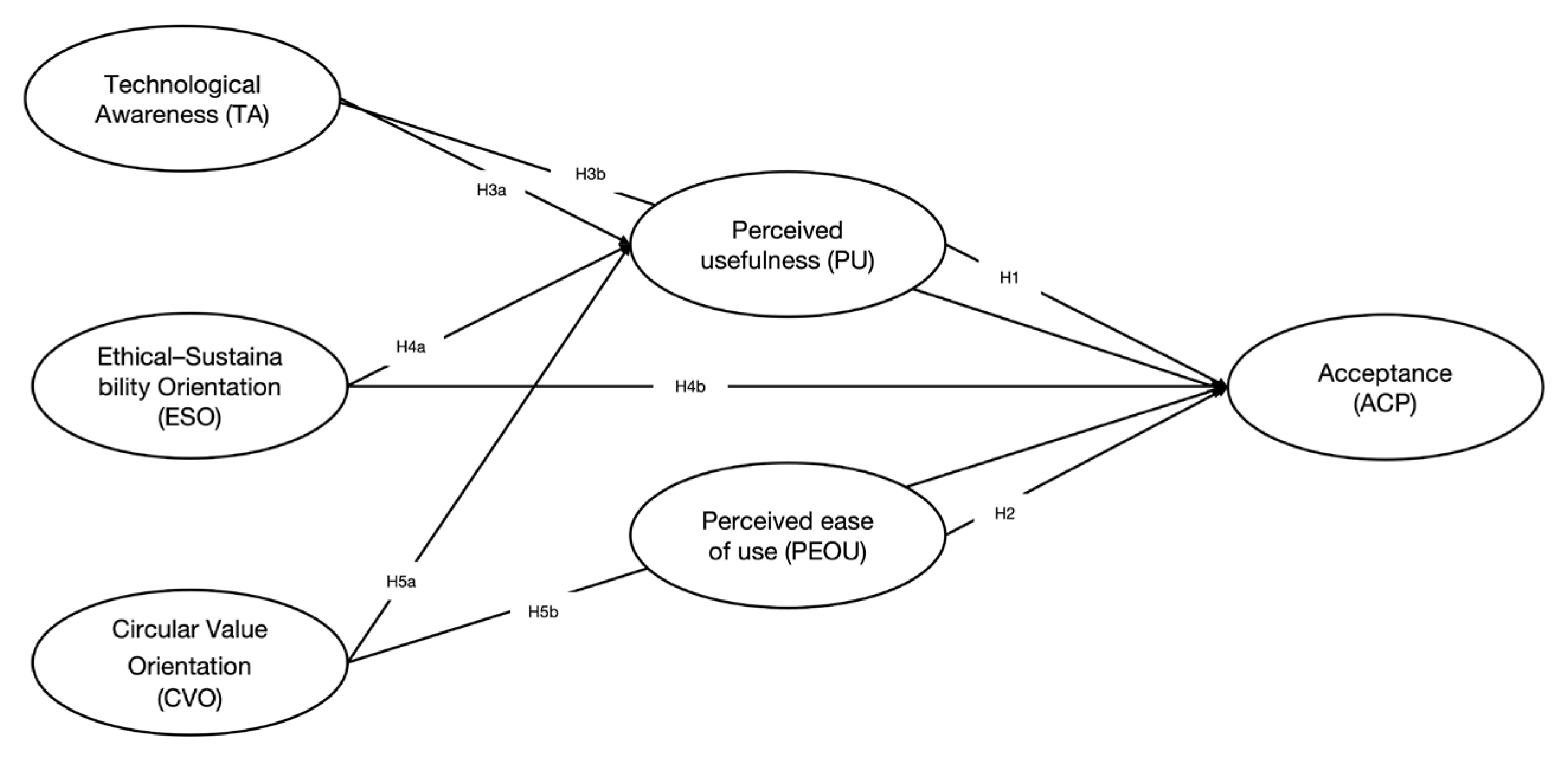
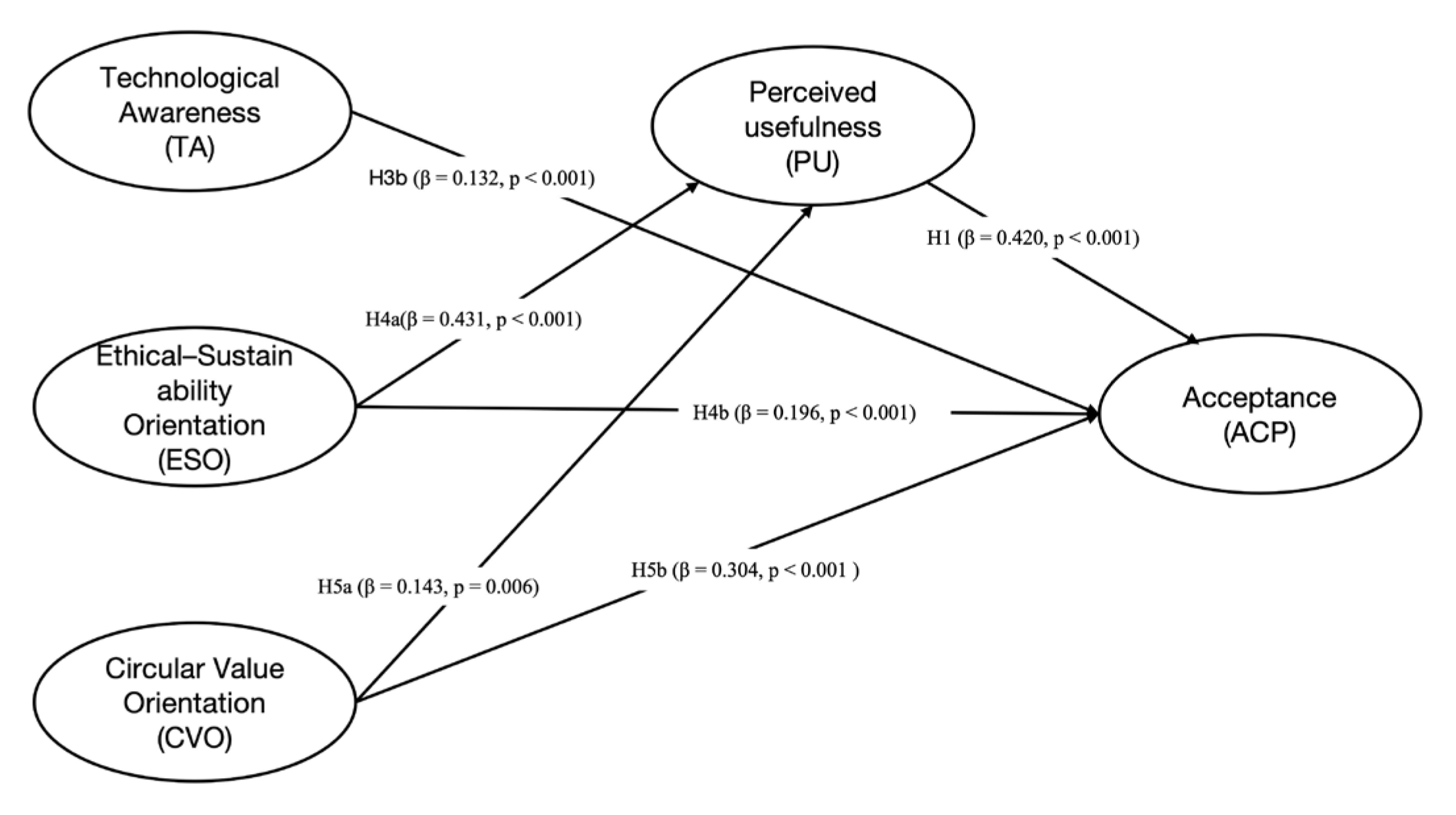
| H1 | PU → ACP | 0.042 | <0.001 | Supported |
| H2 | PEOU → ACP | - | - | Removed |
| H3a | TA → PU | n.s. | >0.05 | Not Supported |
| H3b | TA → ACP | 0.132 | <0.001 | Supported |
| H4a | ESO → PU | 0.431 | <0.001 | Supported |
| H4b | ESO → ACP | 0.196 | <0.001 | Supported |
| H5a | CVO → PU | 0.143 | 0.006 | Supported |
| H5b | CVO → ACP | 0.304 | <0.001 | Supported |
Disclaimer/Publisher’s Note: The statements, opinions and data contained in all publications are solely those of the individual author(s) and contributor(s) and not of MDPI and/or the editor(s). MDPI and/or the editor(s) disclaim responsibility for any injury to people or property resulting from any ideas, methods, instructions or products referred to in the content. |
© 2025 by the authors. Licensee MDPI, Basel, Switzerland. This article is an open access article distributed under the terms and conditions of the Creative Commons Attribution (CC BY) license (https://creativecommons.org/licenses/by/4.0/).
Share and Cite
Zhao, R.; Liu, C. Consumer Acceptance of Digital Product Passports: The Roles of Technological Awareness and Value Orientations. Sustainability 2025, 17, 10878. https://doi.org/10.3390/su172310878
Zhao R, Liu C. Consumer Acceptance of Digital Product Passports: The Roles of Technological Awareness and Value Orientations. Sustainability. 2025; 17(23):10878. https://doi.org/10.3390/su172310878
Chicago/Turabian StyleZhao, Rui, and Chuanlan Liu. 2025. "Consumer Acceptance of Digital Product Passports: The Roles of Technological Awareness and Value Orientations" Sustainability 17, no. 23: 10878. https://doi.org/10.3390/su172310878
APA StyleZhao, R., & Liu, C. (2025). Consumer Acceptance of Digital Product Passports: The Roles of Technological Awareness and Value Orientations. Sustainability, 17(23), 10878. https://doi.org/10.3390/su172310878

