


Article

From Waste to Worth: Upcycling Piscindustrial Remnants into Mineral-Rich Preparations

by
Ileana Lopez Wagner
1,
Priscila Soria Valle
1,
Arun Rajan
1,
Manuel d’Oliveira Martins
2 and
Bruno Sil dos Santos
1,*
1
School of Human Sciences, London Metropolitan University, 166-220 Holloway Road, London N7 8DB, UK
2
Conserveira do Arade, Zona Industrial Pateiro, 8400-651 Lagoa, Portugal
*
Author to whom correspondence should be addressed.
Sustainability 2025, 17(23), 10833; https://doi.org/10.3390/su172310833
Submission received: 9 October 2025 / Revised: 14 November 2025 / Accepted: 29 November 2025 / Published: 3 December 2025
(This article belongs to the Special Issue Sustainable Waste Process Engineering and Biomass Valorization)

Abstract

This study investigates the valorisation of piscindustrial by-products, specifically fishbones from mackerel, horse-mackerel, and sardines, as sustainable sources of multi-mineral ingredients (MMIs) for future dietary supplementation. Ground fishbone powders were first analysed for moisture content and total ash to establish baseline composition. Following these preliminary assessments, the samples underwent mineral profiling using microwave plasma atomic emission spectroscopy (MP-AES), enabling quantification of calcium, phosphorus, magnesium, iron, zinc, sodium, potassium, copper, lead, cadmium, selenium, chromium, tin, manganese, and mercury. All three species yielded high concentrations of essential minerals, supporting their relevance as upcycled nutritional resources. A sardine-based capsule formulation was developed and compared with a commercial calcium supplement through 240 min dissolution testing. While calcium release values differed significantly from 75 min onward, both formulations exhibited similar dissolution profile shapes, despite differing dosage forms. Statistical analysis confirmed time- and formulation-dependent effects, with the sardine capsule demonstrating enhanced calcium bioaccessibility in later phases (95.26 ± 10.11 vs. 78.79 ± 5.39 mg). This work contributes to the advancement of the United Nations Sustainable Development Goals (SDGs), particularly SDG 3, SDG 12, and SDG 14. By transforming marine waste into health-promoting ingredients, and enabling revenue streams for ocean-cleaning charities, this initiative exemplifies circular innovation at the interface of nutrition, sustainability, and marine stewardship.

1. Introduction

Fish have long held a foundational role in human nutrition, particularly among coastal and riverine populations whose subsistence patterns were shaped by proximity to aquatic ecosystems. Archaeological findings, corroborated by stable isotope analysis of human remains, reveal consistent consumption of marine proteins dating back over 10,000 years, underscoring the deep temporal integration of fish into early dietary regimes [1]. Beyond sustenance, ancient civilizations across diverse geographies developed sophisticated preservation techniques such as drying, salting, smoking, and fermenting. These methods reveal an early grasp of biochemical preservation and resource stewardship, enabling trade, ritual use, and seasonal resilience. The historical continuity of fish preservation illustrates its pivotal role in shaping food security, social organisation, and early forms of circular economy [2].
The Industrial Revolution marked a transformative period in food preservation and distribution, with profound implications for the fish industry. Among its most consequential innovations was the advent of canning technology in the early 19th century, later industrialised across Europe and North America. This breakthrough enabled the large-scale production of shelf-stable fish products, revolutionising access to marine protein far beyond coastal regions [1,3,4,5]. Species such as sardines (Sardina pilchardus), tuna (Thunnus sp.), and mackerel (Scomber scombrus) became widely available, affordable, and transportable, supporting both military provisioning and civilian consumption. The rise of canned fish democratised protein intake and catalysed new trade networks and industrial fisheries, reshaping global supply chains [6,7,8]. In contemporary contexts, canned fish continues to play a pivotal role in food security and sustainable nutrition, particularly in regions with limited infrastructure for cold storage or fresh seafood distribution. Its long shelf life, nutrient density, and minimal preparation requirements make it a strategic asset in humanitarian aid and climate-resilient diets [3,5,9].
The global canned seafood industry now plays a multifaceted role in advancing nutritional access, stimulating economic development, and increasingly aligning with ecological stewardship. As consumer demand shifts toward shelf-stable, protein-rich foods with traceable sourcing, the fish industry has begun adopting more responsible harvesting and sourcing practices to reduce bycatch and mitigate environmental degradation. These efforts reflect a broader transition toward sustainability within marine supply chains [9,10]. Market analyses forecast a compound annual growth rate (CAGR) of 6.2% from 2024 to 2031, driven by rising urbanisation, food security initiatives, and the growing appeal of convenient, nutrient-dense products [3,10,11,12]. Still, this expansion is accompanied by persistent challenges in resource efficiency. Industrial fish processing, particularly in the canning sector, generates substantial sidestreams. These include fishbones, skin, and viscera, that are frequently underutilized [4,10,13]. The prevailing linear model of resource utilisation, characterised by extractive production, short-term use, and disposal, stands in stark contrast to the principles of circular economy. This approach perpetuates inefficiencies and contradicts zero-waste commitments adopted by numerous European nations under frameworks such as the EU Circular Economy Action Plan and the Waste Framework Directive [9,11].
Among the most overlooked piscindustrial by-products, those arising from industrial fish processing, are fishbones, which constitute approximately 10–15% of total fish biomass [6,7,14,15]. Despite their frequent relegation to low-value applications such as animal feed or landfill, fishbones possess a naturally balanced mineral profile rich in calcium, phosphorus, magnesium, and trace elements. This biochemical composition renders them strategic bioresources rather than disposable outputs, with potential for targeted nutritional interventions among populations vulnerable to osteoporosis, mineral deficiencies, or metabolic bone disorders [8,13,14,15,16,17,18,19,20,21,22,23,24]. Thus, reframing fishbones as functional resources offers a dual benefit: supporting human health through supplementation and reducing environmental burden by valorising waste streams. Despite growing global demand for mineral supplementation, especially calcium, most commercial formulations rely on mined or synthetic sources such as limestone-derived calcium carbonate. These sources raise concerns regarding sustainability, traceability, and ecological degradation due to extractive mining practices and carbon-intensive processing [19,23,25,26,27]. In contrast, marine-derived minerals from minimally processed fishbone residues offer a renewable, biocompatible, and potentially more bioavailable alternative.
This study presents a proof of concept for the development of multi-mineral ingredient (MMI) preparations derived from fishbone residues generated during seafood processing. Specifically, we aim to characterise the mineral composition of these piscindustrial by-products, assess their bioaccessibility through simulated gastric dissolution protocols, and evaluate their potential contribution to selected United Nations Sustainable Development Goals (SDGs), including SDG 3 (Good Health and Well-being), SDG 12 (Responsible Consumption and Production), and SDG 14 (Life Below Water) [28]. This research is conducted in collaboration with Conserveira do Arade, an industrial partner located in Algarve, Portugal, whose artisanal fish processing operations yield consistent volumes of fishbone residues from sardines (Sardina pilchardus), mackerel (Scomber scombrus), and horse-mackerel (Trachurus trachurus). By repurposing these residues into high-value nutraceutical formulations, we seek to demonstrate a tangible shift from linear resource flows toward circular economy practices within the marine bioeconomy. This integrative approach underscores the feasibility of aligning industrial innovation with ecological responsibility, offering a scalable model for sustainable transformation in seafood processing sectors.

2. Materials and Methods

2.1. Materials

Sulfuric acid (ACS grade, 95.0–98.0%), concentrated nitric acid, hydrochloric acid solution (0.1 M, 0.1 N), 0.1 M nitric acid (0.1 N) and ICP multi-element standard solutions used for mineral quantification were obtained from Thermo Fisher Scientific (Fisher Scientific, Loughborough, UK). Clear, empty gelatine capsules size 00, batch no. F2405000760, were procured from Capsuline (Capsuline, Dania Beach, FL, USA) for formulation purposes. Centrum Advance® tablets (Haleon, Weybridge, UK), batch no. XD6S, were purchased from a local high street retailer and served as the commercial comparator. Fishbones from mackerel, horse-mackerel, and sardines were generously donated by Conserveira do Arade (Algarve, Portugal) as part of a valorisation initiative.

2.2. Collection and Preparation of Fishbone Samples

Fishbones were sourced as by-products from the industrial preparation of canned sardines, mackerel, and horse-mackerel at Conserveira do Arade (Algarve, Lagoa, Portugal). Following standard processing protocols, whole fish were oven cooked (UNOX, Porto, Portugal) at 180 °C for 20 min and manually filleted at room temperature (22 ± 2 °C). Post filleting, residual fishbones were systematically recovered and subjected to a preliminary cleaning step to remove adhering muscle tissue. The cleaning procedure involved rinsing the bones under running potable water for 2–3 min, followed by immersion in chilled deionised water (4 °C) for 10 min to facilitate residual protein detachment. Cleaned bones were then drained and immediately frozen at −20 °C in sterile polyethylene containers (Fisher Scientific, Loughborough, UK). Samples were stored under these conditions until further use in proximate, including mineral composition, analysis, and formulation development.

2.3. Pre-Processing and Moisture Content Determination of Fishbone Samples

Frozen batches of fishbone samples, sourced from sardines, mackerel, and horse-mackerel, were thawed at ambient room temperature (22 ± 2 °C) and gently blotted with sterile absorbent tissue to remove surface moisture. The semi-dried bones were then transferred to a JeioTech 65L (OV-12) vacuum oven (JeioTech, Daejeon, Republic of Korea) and subjected to controlled dehydration at 70 °C under reduced pressure (−0.08 MPa) for 12 h. Following initial drying, the samples were mechanically ground using a food processor (Kenwood FP120A, Hertfordshire, UK) equipped with stainless steel blades, operating at circa 1500–2500 rpm for 5 min to obtain a homogenous powder. From each batch, ground fishbone material was weighed and placed in a flat-bottomed metal dish. These subsamples were re-dried under the same vacuum oven conditions (70 °C, −0.08 MPa) until a constant weight was achieved, confirming complete moisture removal for subsequent compositional analysis. All measurements were performed in quadruplicate to ensure reproducibility.

2.4. Total Ash Determination of Ground Fishbone Samples

To quantify the inorganic mineral content, total ash was determined gravimetrically. Precisely 1.00 g of each dried and ground fishbone sample was weighed into pre-weighed crucibles and subjected to incineration in a muffle furnace (Carbolite Gero CWF 12/30-3000, Hope Valley, UK) at 600 °C for 12 h. After cooling to ambient temperature, the crucibles were reweighed, and ash content was expressed as a percentage of the initial sample mass. All measurements were performed in duplicate to ensure reproducibility.

2.5. Wet Digestion of Ground Fishbone Samples

Wet oxidation pre-treatment was performed on two replicates from each fishbone batch. Approximately 1.00 g of ground fishbone sample was accurately weighed and transferred into digestion tubes. After this, 10 mL of concentrated sulfuric acid was added, and the mixture was shaken vigorously to disperse any dry agglomerates. Subsequently, 5 mL of concentrated nitric acid was introduced and gently mixed. The samples were heated cautiously at 420–430 °C in a Kjel-Digester K-449 block (BÜCHI Labortechnik AG, Flawil, Switzerland) until the initial vigorous reaction subsided. Heating was then intensified to promote the removal of nitrous fumes. Once the reaction slowed, the tubes were cooled to below 100 °C, and incremental additions of 5 mL nitric acid were made, followed by reheating. This cycle was repeated until complete oxidation of organic matter was achieved and the fumes generated during the process became clear. After final cooling to room temperature, each digest was diluted to volume with ultrapure water (resistivity ≥ 18.2 MΩ·cm) and syringe filtered through 0.45 µm PTFE membranes (Fisher Scientific, Loughborough, UK) in preparation for elemental analysis.

2.6. Mineral Profiling of Ground Fishbone Samples

Elemental profiling of ground fishbone powder was conducted using microwave plasma atomic emission spectrometry (MP-AES) to quantify nutritionally relevant minerals. Calibration of each element was performed with certified multi-element standards across a minimum of six serial concentrations. Concentrations of calcium (Ca, LOD: 0.14 ppm, LOQ: 0.42 ppm), phosphorus (P, LOD: 0.07 ppm, LOQ: 0.20 ppm), magnesium (Mg, LOD: 8.25 ppb, LOQ: 24.99 ppb), iron (Fe, LOD: 9.27 ppb, LOQ: 28.10 ppb), zinc (Zn, LOD: 4.96 ppb, LOQ: 15.03 ppb), sodium (Na, LOD: 73.07 ppb, LOQ: 221.42 ppb), potassium (K, LOD: 19.00 ppb, LOQ: 57.56 ppb), copper (Cu, LOD: 4.32 ppb, LOQ: 13.08 ppb), lead (Pb, LOD: 10.27 ppb, LOQ: 31.12 ppb), cadmium (Cd, LOD: 0.02 ppm, LOQ: 0.06 ppm), selenium (Se, LOD: 0.08 ppm, LOQ: 0.25 ppm), chromium (Cr, LOD: 4.63 ppb, LOQ: 14.02 ppb), tin (Sn, LOD: 0.38 ppm, LOQ: 1.14 ppm), manganese (Mn, LOD: 6.15 ppb, LOQ: 18.63 ppb), and mercury (Hg, LOD: 0.02 ppm, LOQ: 0.05 ppm) were determined using an Agilent 4110 MP-AES system (Agilent Technologies, Santa Clara, CA, USA). Instrumental operating conditions were set as follows: radio frequency power of 1.0 kW, operating frequency of 2.45 GHz, plasma gas flow rate of 20 L/min, and axial viewing configuration. Elemental analysis was conducted at the following wavelengths (nm): Ca (422.673), P (213.618), Mg (285.213), Fe (259.940), Zn (213.857), Na (589.592), K (766.491), Cu (324.754), Pb (283.306), Cd (228.802), Se (196.026), Cr (357.869), Sn (283.999), Mn (257.610), and Hg (253.652). All measurements were conducted in triplicate for each of the batches, and results were expressed as either milligrams per gram (mg/g) or micrograms per gram (µg/g) of dry ground fishbone material.

2.7. Manufacture of MMI Capsules from Ground Fishbone

Ground fishbone powder was encapsulated using a manual capsule-filling machine (ALL-IN Online International Oy, Pirkkala, Finland) with a capacity of 100 capsules per batch. Size 00 gelatine capsules were selected for their volumetric suitability and compatibility with the powder’s characteristics. Prior to encapsulation, the powder was sieved through a 500 µm mesh (Endecotts, London, UK) to ensure uniform particle size distribution and reduce agglomeration. The capsule-filling machine was calibrated to ensure consistent tamping pressure and fill volume across all capsule wells. Approximately 100 capsules were filled per batch, with each capsule inspected for structural integrity. To assess batch consistency, 20 capsules were randomly selected from each 100-capsule batch for weight uniformity testing. Each capsule was individually weighed, and the net fill weight was calculated by subtracting the average empty capsule weight. Capsules were considered compliant if not more than two deviated by more than ±7.5% of the mean fill weight and if none exceeded ±15%, in accordance with updated pharmacopeial standards [29]. All encapsulation procedures were conducted under controlled ambient conditions (22 ± 2 °C, 45–55% RH) to minimise moisture uptake and ensure powder stability.

2.8. Comparative Dissolution Studies of MMI Capsules and a Marketed Multi-Mineral Product

A comparative dissolution study was conducted to evaluate calcium release from two oral formulations: a sardine-derived ground fishbone capsule (size 00) and a commercially available multi-mineral product containing calcium, Centrum Advance® (Haleon, Surrey, UK). The aim was to simulate gastric conditions and quantify calcium content over time using MP-AES. The study employed an Erweka DT126 (Erweka, Langen, Germany) and a British Pharmacopoeia Apparatus 1 (basket method), with each vessel containing 900 mL of simulated gastric fluid (pH~1.2) maintained at 37 ± 0.5 °C to replicate stomach conditions. The rotation speed was set at 50 rpm. Sampling was conducted at seventeen time points over a four-hour period, beginning at t = 0 and continuing every 15 min until t = 240 min. At each interval, a 1 mL aliquot was withdrawn, immediately filtered through a 0.45 µm membrane, and replaced with an equal volume of pre-warmed dissolution medium to maintain sink conditions [30]. Calcium concentrations in the collected samples were determined using MP-AES. Calibration curves were prepared using certified calcium standards, and all measurements were performed in triplicate to ensure analytical precision. Each formulation was tested in six independent replicates (n = 6), with capsules randomly selected and inspected for uniformity prior to testing. Dissolution profiles were plotted as cumulative calcium release versus time. Comparative analysis between the two formulations was expressed as mean ± standard deviation, and statistical significance was evaluated using appropriate parametric or non-parametric tests based on data distribution.

2.9. Statistical Analysis

Statistical analysis was conducted using OriginPro 2025b (OriginLab Corp., Northampton, MA, USA). Calcium concentrations obtained via MP-AES were initially expressed in mg/L and subsequently converted to total amount released per time point (mg) by accounting for sample volume and dilution, enabling the construction of cumulative dissolution profiles over the four-hour period. All data are presented as mean ± standard deviation, and graphical annotations include asterisks to denote statistical significance (p < 0.05, p < 0.01, p < 0.001), with “ns” indicating non-significant comparisons. The statistical analysis included both parametric and non-parametric approaches. The f2 similarity factor was used as a descriptive tool to assess dissolution profile similarity. A repeated measures ANOVA was used to evaluate differences in calcium release over time and between formulations. This included: Mauchly’s test to check the sphericity assumption; the Greenhouse–Geisser correction to adjust degrees of freedom when sphericity was violated; between-subjects effect analysis to compare overall formulation performance; and Tukey’s post hoc test to identify specific time points or formulation pairs with significant differences. All parametric tests assumed normal distribution and homogeneity of variance and were applied with a significance threshold of p < 0.05.

3. Results and Discussion

3.1. Moisture Content and Total Ash Determination of Ground Fishbone Samples

Fish used in this study were sourced from the Portuguese coastal region, reflecting typical catch profiles associated with both artisanal and industrial fisheries operating in the Algarve. Sampling was conducted across multiple production batches of canned seafood products, specifically those containing sardines, mackerel, and horse-mackerel. For each batch, fishbone residues were isolated post processing, with an average bone content representing approximately 10% of the total fish biomass. From a valorisation perspective, moisture content and total ash determination are critical parameters for evaluating the nutritional and functional potential of bone-derived ingredients. Moisture analysis provides insight into sample stability, shelf life, and susceptibility to microbial degradation, while ash content reflects the total mineral load. Together, these metrics serve as essential indicators of suitability for incorporation into nutraceutical and functional food applications.
Moisture loss varied significantly across the three fish species. Horse-mackerel samples exhibited the highest reduction at 6.92 ± 0.13%, suggesting a greater initial water content or species-specific skeletal structure influencing drying behaviour. In contrast, sardine and mackerel bones showed markedly lower moisture losses of 0.74 ± 0.06% and 1.58 ± 0.06%, respectively. One-way ANOVA confirmed a highly significant difference in moisture content among the three fish species analysed (p < 0.05), indicating that factors such as skeletal architecture, tissue composition, and pre-processing conditions can substantially influence moisture retention and loss. These findings underscore the importance of species selection in optimising drying protocols and standardising bone-derived ingredient production, particularly for applications requiring low residual moisture and high compositional consistency. Ash content was consistently high across all samples, confirming the mineral-rich nature of fishbone residues. Horse-mackerel yielded the highest ash percentage at 47.42 ± 0.35%, followed by sardine (43.52 ± 8.49%) and mackerel (43.46 ± 0.83%). The relatively low standard deviation in horse-mackerel and mackerel samples suggests greater batch uniformity, whereas the higher variability observed in sardine samples may be attributed to processing heterogeneity or anatomical differences. One-way ANOVA revealed no statistically significant differences in total ash across the three fish species analysed (p > 0.05), suggesting that the observed variation in ash levels may be attributed to natural skeletal variability rather than species-specific differences. These findings reinforce the potential of fishbone residues as a reliable source of dietary minerals and support their suitability for MMI formulations.

3.2. Mineral Profiling of Ground Fishbone Samples

The mineral composition of ground fishbone samples from sardines, horse-mackerel, and mackerel was analysed to assess their suitability for future preparations. Mineral profiling is deemed essential for unlocking the thresholds needs for use in nutraceuticals, functional foods, or fortified products. Although mineral composition variation may depend on species, age, season, and processing method, its profiling enables batch-to-batch consistency, essential for regulatory compliance and product reproducibility [11,31]. From the samples analysed, calcium and phosphorus were the most abundant minerals across all species, as shown in Table 1. Sardine bones exhibited the highest calcium concentration at 170.47 ± 0.33 mg/g, followed by horse-mackerel (156.03 ± 1.25 mg/g) and mackerel (131.03 ± 6.26 mg/g). The latter two findings identified a strong correlation with previous data gathered in the northern sea region of Europe [7]. Phosphorus levels were highest in horse-mackerel (116.79 ± 9.43 mg/g), with sardine and mackerel showing 86.07 ± 9.95 mg/g and 90.84 ± 5.30 mg/g, respectively. These values closely align with those reported by Toppe et al., where calcium and phosphorus concentrations were approximately 233 mg/g and 111 mg/g, respectively, for horse-mackerel; and, 143 mg/g and 86 mg/g for mackerel. This suggests that small pelagic species may offer superior mineral yields for bone-derived formulations [7,13]. Magnesium content was relatively consistent across species, ranging from 3.36 ± 0.07 mg/g in sardine to 3.76 ± 0.11 mg/g in mackerel. Sodium levels varied more markedly, with horse-mackerel showing the highest concentration (2.64 ± 0.25 mg/g) and mackerel the lowest (0.92 ± 0.03 mg/g). Significant differences from previously published findings were noticed since sodium levels in horse-mackerel and mackerel were 7.10 mg/g and 6.50 mg/g, respectively [7,21]. Potassium was most abundant in sardine (4.68 ± 0.06 mg/g) and mackerel (4.58 ± 0.04 mg/g), while horse-mackerel contained significantly less (2.09 ± 0.04 mg/g). All the latter findings were below reported values for both mackerel (6.70 mg/g) and horse-mackerel (4.40 mg/g) [7]. Among trace elements, iron and zinc were present in measurable quantities. Iron levels were highest in mackerel (147.23 ± 37.46 µg/g) and sardine (147.01 ± 8.82 µg/g), with horse-mackerel showing lower and more variable concentrations (73.32 ± 38.81 µg/g). Although iron content in horse-mackerel samples tested was similar to the findings by Toppe et al. (56 µg/g), sardine and mackerel batches showed an increased presence of this metal when compared with previous findings (mackerel: 73 µg/g; canned sardines: 22 µg/g) [7,21,26,32,33]. Zinc was most abundant in sardine (111.69 ± 2.56 µg/g), followed by mackerel (76.08 ± 6.06 µg/g) and horse-mackerel (56.15 ± 7.68 µg/g). Still, these were considered below the expect values for mackerel (125 µg/g) and horse-mackerel (70 µg/g) and more prevalent in the sardine batches tested (canned sardine: 23 µg/g) [7,21,26,32]. No detectable or quantifiable levels of copper, lead, cadmium, selenium, chromium, tin, manganese, or mercury were found in any of the samples, supporting the safety profile of these residues for food-grade applications [10,26,27,31,34].
Overall, the mineral profiles confirm the compositional richness and inter-species variability of fishbone residues. Sardine bones, in particular, demonstrated superior calcium and zinc concentrations, while horse-mackerel showed higher contents of phosphorus and sodium content. These findings reinforce the potential of fishbone residues as strategic bioresources for MMI formulations, with species-specific profiles offering opportunities for targeted nutritional applications.

3.3. Manufacture and Comparative Dissolution Studies of MMI Capsules and a Marketed Multi-Mineral Product

Initial formulation trials focused on encapsulating ground fishbone powders derived from horse-mackerel, mackerel, and sardine species into hard gelatine capsules of size 00. The mean fill weights achieved for each species were as follows: horse-mackerel capsules contained 588.91 ± 35.48 mg, mackerel capsules 528.10 ± 52.12 mg, and sardine capsules 987.33 ± 31.20 mg of fishbone powder. These values reflect the inherent differences in powder density and flow characteristics across species, with sardine powder demonstrating the highest packing efficiency. Capsule sizes 1 and 000 were also evaluated during preliminary trials; however, their fill capacities proved unsuitable for the study’s objectives and are therefore not reported. Size 00 was ultimately selected for its balance between fill volume and ease of manufacture, aligning with standard nutraceutical capsule formats. Among the three formulations, sardine-derived capsules were selected for progression to dissolution testing based on several critical factors. Firstly, sardine capsules exhibited the highest powder load, nearly doubling that of mackerel and horse-mackerel counterparts. Secondly, the mineral profile of sardine fishbone powder was markedly superior, with elevated levels of calcium, iron, zinc, and potassium, elements of nutritional and therapeutic relevance in multinutrient preparations. Furthermore, the powder flowability of sardine fishbone was notably better, facilitating consistent capsule filling and reducing variability in weight and content uniformity. This was attributed to its finer particle size distribution and lower moisture content, which enhanced its handling properties compared with the more irregular and cohesive powders derived from mackerel and horse-mackerel. To benchmark the sardine capsules against a commercial multi-mineral product, Centrum Advance® was selected as a reference formulation. The comparative analysis of calcium content revealed that 1 g of sardine fishbone powder contained 170.47 ± 0.33 mg of calcium, closely matching the 162 mg of calcium declared per tablet in Centrum Advance®. This proximity in elemental concentration provided a rational basis for selecting calcium as the primary analyte in dissolution studies. Calcium was also the most abundant mineral across all fishbone samples, reinforcing its relevance as a marker for bioaccessibility and formulation performance. The dissolution study was therefore designed to compare the release kinetics of calcium from sardine capsules against that of Centrum Advance®, enabling a direct assessment of the bioavailability potential of the marine-derived formulation. Dissolution testing was conducted under simulated gastric conditions to reflect the physiological environment in which mineral solubilisation primarily occurs. Minerals such as calcium, magnesium, and iron require initial processing in the acidic environment of the stomach, where they are ionised and rendered bioaccessible prior to absorption in the small intestine. This step is critical for effective uptake, as the stomach’s low pH facilitates the release of minerals from complex matrices, enabling subsequent transport across the intestinal epithelium. As noted by Powell et al., mineral absorption is regulated by gastrointestinal processing, with gastric acid playing a key role in enhancing solubility and uptake potential [20,35]. As shown in Figure 1, the dissolution profiles of calcium from sardine capsules and Centrum Advance® were assessed over a 240 min period. Both formulations exhibited a time-dependent increase in calcium release, with the sardine formulation consistently demonstrating a higher dissolution rate across all time points, with the exception at the 15 min sampling point (Centrum Advance®, 8.15 ± 0.90%; sardine capsule, 6.28 ± 1.80%). From 75 min, the difference between the two formulations became statistically significant. Notably, the sardine capsule achieved a greater calcium fraction dissolved (95.26 ± 10.11 mg), reaching nearly 60% by 240 min, whereas Centrum Advance® (78.79 ± 5.39 mg) remained below this threshold throughout. At earlier time points (15–45 min), differences between the formulations were not statistically significant, suggesting comparable initial dissolution behaviour. However, the divergence in release profiles over time reflects formulation-dependent kinetics, with the sardine capsules offering greater calcium bioaccessibility in the later phases of dissolution. As neither formulation reached ≥85% dissolution, the f2 similarity factor was deemed inappropriate for formal equivalence assessment, although calculated at 47.67. Instead, profile comparison was conducted using repeated measures ANOVA and post hoc testing to assess temporal and formulation-dependent differences. Mauchly’s test indicated a significant violation of the sphericity assumption for the within-subject factor Time (p < 0.0001). Consequently, degrees of freedom were adjusted using the Greenhouse–Geisser correction. The corrected analysis revealed a statistically significant effect of Time on calcium release (F(2.02) = 5.02, p = 0.0303), with a mean square of 775.81. This confirms that dissolution profiles varied meaningfully across time points, even after accounting for unequal variances between repeated measures. The between-subjects effect was also highly significant (F = 2930.12, p < 0.0001), indicating that the formulations differed substantially in their overall dissolution performance. Although the calcium dissolution values between the sardine ground fishbone capsule and Centrum Advance® tablet were statistically dissimilar, particularly after the 75 min time point, the overall shape of their dissolution profiles remained notably similar. This resemblance in release kinetics is especially relevant given the distinct dosage forms: Centrum Advance® as a directly compacted tablet and the sardine formulation as a conventional hard gelatine capsule. Despite formulation-dependent differences, both products exhibited comparable initial dissolution behaviour and a consistent time-dependent release pattern, supporting the visual and statistical proximity of their calcium release profiles. These findings support the potential of sardine-derived mineral capsules as a viable alternative to conventional multi-mineral tablets, with enhanced bioaccessibility and favourable manufacturing characteristics.

4. Conclusions

Herein, we demonstrate the promising potential of ground fishbone powders derived from mackerel, horse-mackerel, and sardines as mineral-rich candidates for future marine MMI formulations. Through comprehensive profiling, all tested powders exhibited substantial levels of calcium (131.03 ± 6.26 to 170.47 ± 0.33 mg/g), phosphorus (86.07 ± 9.95 to 116.79 ± 9.43 mg/g), magnesium (3.36 ± 0.07 to 3.76 ± 0.11 mg/g), iron (73.32 ± 38.81 to 3.76 ± 0.11 µg/g), and zinc (56.15 ± 7.68 to 111.69 ± 2.56 µg/g)—minerals traditionally present in nutritional supplementation. These findings affirm the viability of repurposing piscindustrial by-products into high-value ocean-sourced supplements, aligning with both sustainability and health innovation goals. The novelty of this work lies in the development and testing of a sardine-based ground fishbone capsule, which enabled a direct comparison with a commercial calcium-containing preparation. To our knowledge, this represents the first published comparison using dissolution studies for this type of formulation. Despite statistical variability in dissolution profiles, the overall shape and release kinetics were notably similar, suggesting functional equivalence in calcium bioaccessibility. After 240 min, calcium release reached 56.60 ± 6.01% for the sardine-derived capsule and 48.63 ± 3.32% for the Centrum Advance® tablet. This proximity supports the formulation’s relevance for future product development with a focus on expanding dissolution testing to include other key minerals identified in the profiling phase, thereby strengthening the comparative performance data across the full mineral spectrum. In addition to this, efforts will focus on establishing a novel, scalable manufacturing protocol to enable capsule bulk production and market readiness. Notably, the fishbone powder is used in its native form, following thorough washing and mechanical grinding, without the application of chemical extraction processes. This low-impact approach preserves the natural mineral matrix while minimising environmental and operational burdens. The protocol is designed to be adaptable across the canning sector, from micro-enterprises to well-established companies, thereby supporting circular economy principles and contributing to the reduction of industrial waste. It is important to recognise that mineral composition may be influenced by factors such as fish species, age, seasonal variation, and processing conditions. While these fluctuations may not be substantial in all cases, they nonetheless introduce inherent limitations to the generalisability of the findings. To mitigate this variability, consistent mineral profiling across production batches is essential for ensuring reproducibility and supporting the development of standardised, quality-assured formulations. Beyond its scientific and technical validation, this research presents a novel socio-environmental model with tangible impact. The proposed commercialisation of fishbone-derived supplements by Conserveira do Arade introduces a dual-purpose innovation: transforming marine waste streams into high-value health products while generating revenue to support ocean conservation charities. As previously detailed, the mineral content is retained through a non-invasive process since fishbones are simply washed and mechanically ground, with no chemical extraction involved. This approach safeguards the native mineral composition and aligns with the research’s commitment to low-impact, sustainable practices. This pioneering circular strategy exemplifies how piscindustrial mineral waste innovation can align with ecological stewardship, offering a sustainable health solution that reinvests in the very ecosystems from which it originates.

Author Contributions

Conceptualization, B.S.d.S. and M.d.M.; methodology, B.S.d.S., M.d.M., I.L.W., P.S.V. and A.R.; software, B.S.d.S.; validation, I.L.W., P.S.V. and B.S.d.S.; formal analysis, I.L.W., P.S.V. and B.S.d.S.; investigation, I.L.W., P.S.V. and A.R.; resources, B.S.d.S., M.d.M. and A.R.; data curation, I.L.W., P.S.V. and B.S.d.S.; writing—original draft preparation, I.L.W., P.S.V. and B.S.d.S.; writing—review and editing, I.L.W., P.S.V., M.d.M., A.R. and B.S.d.S.; visualization, I.L.W., P.S.V. and B.S.d.S.; supervision, A.R. and B.S.d.S.; project administration, M.d.M. and B.S.d.S. All authors have read and agreed to the published version of the manuscript.

Funding

This research received no external funding.

Institutional Review Board Statement

Not applicable.

Informed Consent Statement

Not applicable.

Data Availability Statement

The raw data supporting the conclusions of this article will be made available by the authors on request.

Acknowledgments

The authors would like to express their sincere gratitude to the technical staff at London Metropolitan University for their invaluable support throughout the laboratory procedures and analytical workflows. Special thanks are extended to the team at Conserveira do Arade (Algarve, Portugal) for their generous donation of fishbone material and continued collaboration in marine by-product valorisation. We also gratefully acknowledge Rebecca G. Belgrave at University College London for the expert guidance in statistical tools management, which greatly enhanced the robustness of the data analysis.

Conflicts of Interest

Author Manuel d’Oliveira Martins was employed by the Conserveira do Arade, Zona Industrial Pateiro. The remaining authors declare that the research was conducted in the absence of any commercial or financial relationships that could be construed as a potential conflict of interest.

Abbreviations

The following abbreviations are used in this manuscript:
ACSAmerican Chemical Society
ANOVAAnalysis of variance
°CDegrees Celsius
CAGRCompound annual growth rate
EUEuropean Union
gGram
kWKilowatt
LLitre
LODLimit of detection
LOQLimit of quantification
MMolarity
mgMilligram
minMinute
mLMillilitre
MMIMulti-mineral ingredient
MPaMegapascal
MP-AESMicrowave plasma atomic emission spectrometry
MΩ·cmMegaohms-cm
nNumber of replicates
NNormality
n.d.No data
no.Number
nsNon-significant
pProbability
pHHydrogen potential
ppbParts per billion
ppmParts per million
PTFEPolytetrafluoroethylene
RHRelative humidity
rpmRotations per minute
SDGsSustainable Development Goals
tTime
µgMicrogram
%Percentage

References

  1. Richards, M.P.; Schulting, R.J. Touch not the fish: The Mesolithic-Neolithic change of diet and its significance. Antiquity 2006, 80, 444–456. [Google Scholar] [CrossRef]
  2. Curtis, R. Garum and Salsamenta: Production and Commerce in Materia Medica; Brill: Boston, MA, USA, 2018. [Google Scholar]
  3. Fernández-González, R.; Teixeira Pereira, Z.G.; Ricoy-Casas, R.M. Governance of the circular economy in the canned fish industry: A case study from Spain. Environ. Technol. Innov. 2024, 34, 103618. [Google Scholar] [CrossRef]
  4. Fernández-González, R.; Pérez-Vas, R.; Pérez-Pérez, M.; Pereira, Z.G.T.; Puime-Guillén, F.; Ricoy-Casas, R.M. Resilience and adaptation: Galician canning fish industry evolution. Mar. Policy 2024, 163, 106087. [Google Scholar] [CrossRef]
  5. Downing, D.L. Canning of fish and seafood. In A Complete Course in Canning and Related Processes, 14th ed.; Featherstone, S., Ed.; Woodhead Publishing: Cambridge, UK, 2016; pp. 231–265. [Google Scholar]
  6. Kim, J.-S.; Yang, S.-K.; Heu, M.-S. Component characteristics of cooked tuna bone as a food source. Korean J. Fish. Aquat. Sci. 2000, 33, 38–42. [Google Scholar]
  7. Toppe, J.; Albrektsen, S.; Hope, B.; Aksnes, A. Chemical composition, mineral content and amino acid and lipid profiles in bones from various fish species. Comp. Biochem. Physiol. Part B Biochem. Mol. Biol. 2007, 146, 395–401. [Google Scholar] [CrossRef]
  8. Larsen, T.; Thilsted, S.H.; Kongsbak, K.; Hansen, M. Whole small fish as a rich calcium source. Br. J. Nutr. 2000, 83, 191–196. [Google Scholar] [CrossRef]
  9. Cortés, A.; Esteve-Llorens, X.; González-García, S.; Moreira, M.T.; Feijoo, G. Multi-product strategy to enhance the environmental profile of the canning industry towards circular economy. Sci. Total Environ. 2021, 791, 148249. [Google Scholar] [CrossRef]
  10. Pais-Costa, A.J.; Marques, A.; Oliveira, H.; Goncalves, A.; Camacho, C.; Augusto, H.C.; Nunes, M.L. New Perspectives on Canned Fish Quality and Safety on the Road to Sustainability. Foods 2025, 14, 99. [Google Scholar] [CrossRef]
  11. European Market Observatory for Fisheries and Aquaculture Products; Publications Office of the European Union: Luxembourg, 2022.
  12. Canned Seafood Market Size, Share, Trends & Forecast. 2025. Available online: https://www.verifiedmarketresearch.com/product/canned-seafood-market/ (accessed on 21 August 2025).
  13. Toppe, J.; Aksnes, A.; Hope, B.; Albrektsen, S. Inclusion of fish bone and crab by-products in diets for Atlantic cod, Gadus morhua. Aquaculture 2006, 253, 636–645. [Google Scholar] [CrossRef]
  14. Liaset, B.; Julshamn, K.; Espe, M. Chemical composition and theoretical nutritional evaluation of the produced fractions from enzymic hydrolysis of salmon frames with Protamex™. Process Biochem. 2003, 38, 1747–1759. [Google Scholar] [CrossRef]
  15. Malde, M.K.; Graff, I.E.; Siljander-Rasi, H.; Venalainen, E.; Julshamn, K.; Pedersen, J.I.; Valaja, J. Fish bones—A highly available calcium source for growing pigs. J. Anim. Physiol. Anim. Nutr. 2010, 94, e66–e76. [Google Scholar] [CrossRef]
  16. Rodehutscord, M.; Faust, M.; Hof, C. Digestibility of phosphorus in protein-rich ingredients for pig diets. Arch. Tierernaehr. 1997, 50, 201–211. [Google Scholar] [CrossRef]
  17. Hansen, M.; Thilsted, S.H.; Sandström, B.; Kongsbak, K.; Larsen, T.; Jensen, M.; Sørensen, S.S. Calcium absorption from small soft-boned fish. J. Trace Elem. Med. Biol. 1998, 12, 148–154. [Google Scholar] [CrossRef]
  18. Martinez, I.; Santaella, M.; Ros, G.; Periago, M.J. Content and in vitro availability of Fe, Zn, Mg, Ca and P in homogenized fish-based weaning foods after bone addition. Food Chem. 1998, 63, 299–305. [Google Scholar] [CrossRef]
  19. Maktoof, A.A.; Elherarlla, R.J.; Ethaib, S. Identifying the nutritional composition of fish waste, bones, scales, and fins. IOP Conf. Ser. Mater. Sci. Eng. 2020, 871, 012013. [Google Scholar] [CrossRef]
  20. Jensen, M.B.; Jakobsen, J.; Jacobsen, C.; Sloth, J.J.; Ibarruri, J.; Bald, C.; Iñarra, B.; Bøknæs, N.; Sørensen, A.-D.M. Content and Bioaccessibility of Minerals and Proteins in Fish-Bone Containing Side-Streams from Seafood Industries. Mar. Drugs 2024, 22, 162. [Google Scholar] [CrossRef]
  21. Khairul, U.T.; Idris, N.I.M.; Shah, R.M.; Nawi, I.H.M.; Che Soh, N. Evaluation of Minerals Composition in Fish Bone Meal as Organic Fertilizer Development for Sustainable Environment. Curr. World Environ. 2025, 19, 1260–1268. [Google Scholar] [CrossRef]
  22. Hemung, B.-O. Properties of tilapia bone powder and its calcium bioavailability based on transglutaminase assay. Int. J. Biosci. Biochem. Bioinform. 2013, 3, 306–309. [Google Scholar]
  23. Nemati, M.; Huda, N.; Ariffin, F. Development of calcium supplement from fish bone wastes of yellowfin tuna (Thunnus albacares) and characterization of nutritional quality. Int. Food Res. J. 2017, 24, 2419–2426. [Google Scholar]
  24. Amitha, C.V.; Raju, I.P.; Lakshmisha, P.; Kumar, A.; Gajendra, A.S.; Pal, J. Nutritional Composition of Fish Bone Powder Extracted from Three different Fish Filleting Waste Boiling with Water and an Alkaline Media. Int. J. Curr. Microbiol. Appl. Sci. 2019, 8, 2942–2948. [Google Scholar] [CrossRef]
  25. Kim, S.-K.; Mendis, E. Bioactive compounds from marine processing byproducts—A review. Food Res. Int. 2006, 39, 383–393. [Google Scholar] [CrossRef]
  26. Mol, S. Levels of Heavy Metals in Canned Bonito, Sardines, and Mackerel Produced in Turkey. Biol. Trace Elem. Res. 2010, 143, 974–982. [Google Scholar] [CrossRef]
  27. Kosker, A.R.; Gundogdu, S.; Esatbeyoglu, T.; Ayas, D.; Ozogul, F. Metal levels of canned fish sold in Türkiye: Health risk assessment. Front. Nutr. 2023, 10, 1255857. [Google Scholar] [CrossRef]
  28. United Nations General Assembly. Transforming Our World: The 2030 Agenda for Sustainable Development; United Nations: New York, NY, USA, 2015. [Google Scholar]
  29. British Pharmacopoeia Commission. Appendix XII C. Consistency of Formulated Preparations; British Pharmacopoeia Commission: London, UK, 2025. [Google Scholar]
  30. British Pharmacopoeia Commission. Appendix XII B. Dissolution; British Pharmacopoeia Commission: London, UK, 2025. [Google Scholar]
  31. Commission Regulation (EU) 2023/915 of 25 April 2023 on maximum levels for certain contaminants in food and repealing Regulation (EC) No 1881/2006 (Text with EEA relevance). Off. J. Eur. Union 2023, L199, 103–157.
  32. Bandarra, N.; Batista, I.; Nunes, M.L.; Empis, J.M. Seasonal variation in the chemical composition of horse-mackerel (Trachurus trachurus). Eur. Food Res. Technol. 2001, 212, 535–539. [Google Scholar] [CrossRef]
  33. Durmus, M. Evaluation of Nutritional and Mineral-Heavy Metal Contents of Horse Mackerel (Trachurus trachurus) in the Middle Black Sea in terms of Human Health. Biol. Trace Elem. Res. 2019, 190, 208–216. [Google Scholar] [CrossRef]
  34. Popovic, A.R.; Djinovic-Stojanovic, J.M.; Dordevic, D.S.; Relic, D.J.; Vranic, D.V.; Milijasevic, M.P.; Pezo, L.L. Levels of toxic elements in canned fish from the Serbian markets and their health risks assessment. J. Food Compos. Anal. 2018, 67, 70–76. [Google Scholar] [CrossRef]
  35. Powell, J.J.; Jugdaohsingh, R.; Thompson, R.P.H. The regulation of mineral absorption in the gastrointestinal tract. Proc. Nutr. Soc. 1999, 58, 147–153. [Google Scholar] [CrossRef]
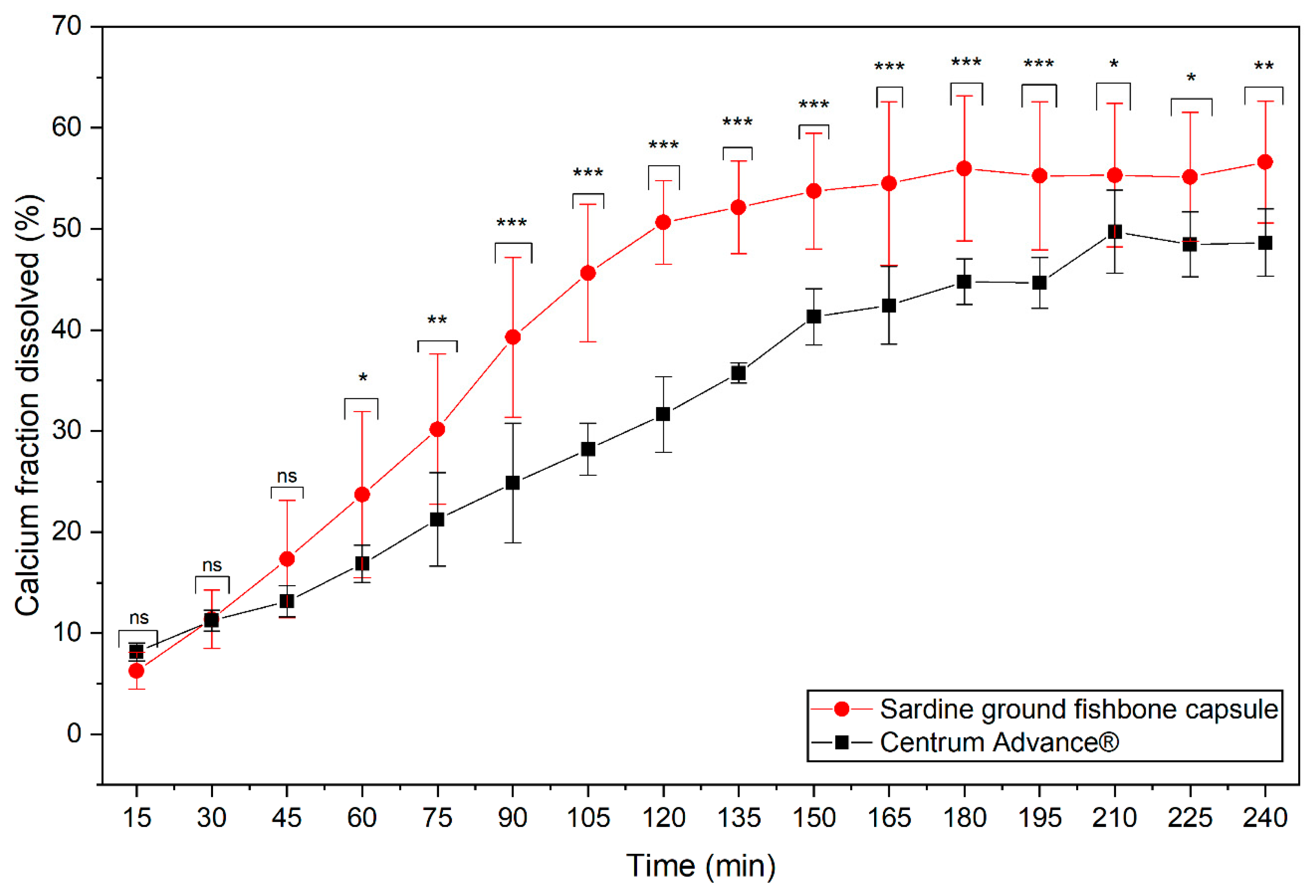
Figure 1. Dissolution profiles of sardine ground fishbone capsules and Centrum Advance® over time. The non-parallel trajectories and significant Formulation × Time interaction (p = 0.0303) indicate that drug release patterns differ across formulations and time points. Asterisks denote significant differences between formulations at each time point (* p < 0.05, ** p < 0.01, *** p < 0.001). Comparisons with p > 0.05 are marked as ‘ns’.
Sustainability 17 10833 g001
Table 1. Mineral profiling of sardine, horse-mackerel, and mackerel ground fishbone samples.
SardineHorse-MackerelMackerel
Calcium (Ca)mg/g170.47 ± 0.33156.03 ± 1.25131.03 ± 6.26
Phosphorus (P)mg/g86.07 ± 9.95116.79 ± 9.4390.84 ± 5.30
Magnesium (Mg)mg/g3.36 ± 0.073.42 ± 0.133.76 ± 0.11
Iron (Fe)µg/g147.01 ± 8.8273.32 ± 38.81147.23 ± 37.46
Zinc (Zn)µg/g111.69 ± 2.5656.15 ± 7.6876.08 ± 6.06
Sodium (Na)mg/g1.55 ± 0.082.64 ± 0.250.92 ± 0.03
Potassium (K)mg/g4.68 ± 0.062.09 ± 0.044.58 ± 0.04
Copper (Cu)µg/gn.d. 1n.d. 2n.d. 1
Lead (Pb)µg/gn.d. 1n.d. 1n.d. 1
Cadmium (Cd)µg/gn.d. 1n.d. 1n.d. 1
Selenium (Se)mg/gn.d. 1n.d. 2n.d. 1
Chromium (Cr)µg/gn.d. 1n.d. 1n.d. 1
Tin (Sn)µg/gn.d. 1n.d. 1n.d. 1
Manganese (Mn)µg/gn.d. 2n.d. 1n.d. 1
Mercury (Hg)mg/gn.d. 1n.d. 1n.d. 1
1 Value below LOD. 2 Value below LOQ.
Disclaimer/Publisher’s Note: The statements, opinions and data contained in all publications are solely those of the individual author(s) and contributor(s) and not of MDPI and/or the editor(s). MDPI and/or the editor(s) disclaim responsibility for any injury to people or property resulting from any ideas, methods, instructions or products referred to in the content.


