Article

The Interplay Among Green Innovation, Digitalization and Institutional Quality, for Sustainable Development in Sub-Saharan Africa

1
Department of Business Administration, Near East University, 99138 Nicosia, Northern Cyprus, Turkey
2
Department of Economics, Near East University, 99138 Nicosia, Northern Cyprus, Turkey
*
Author to whom correspondence should be addressed.
Sustainability 2025, 17(23), 10691; https://doi.org/10.3390/su172310691
Submission received: 23 October 2025 / Revised: 20 November 2025 / Accepted: 26 November 2025 / Published: 28 November 2025
(This article belongs to the Section Air, Climate Change and Sustainability)

Abstract

The attainment of Sustainable Development is a daunting task globally. In the Sub-Saharan Africa region, it becomes even more unsettling given the resource constraints that may delay or deter its smooth pursuit. This research seeks to explore the contributions of green innovation, digitalization, natural resources rents and institutional quality towards the advancement of sustainable development in African countries. The adoption of the sustainable development index of Hickel, provides the basis for the originality of this paper given the analytical merging of the human development index and ecological footprint that provides for a comprehensive exploration of sustainable development. The data of the forty-three Sub-Saharan African nations is considered in this analysis for the time spanning from 2000 to 2021 and the ‘Method of Moments Quantile Regression’ is employed in the analysis. Major findings indicate that green innovation, digital technology, natural resources rents and renewable energy support sustainable development. These findings are consistent with reducing environmental damage and improving human development. The robust findings establish that while Income per capita and Institutional Quality support the advancement of human development, these variables are however, detrimental to the environment and reduce overall sustainable development. Our paper provides policy makers in African countries a basis to advocate for sustainable development with an inclination toward green technologies, renewable energy, digitalization, and natural resources rents.

1. Introduction

As early as 1987, Sustainable Development (SD) was an emerging and notable subject matter to which more awareness was of the essence. The World Commission on Environment and Development (WCED) in their special working meeting held in January 1987, among other issues, indicated that sustainable development was a pertinent aspect for consideration. To date, SD is still increasingly topical where sustainability in all spheres of life is pertinent. In the Sub-Saharan Africa (SSA) region, there are a broad number of aspects regarding SD; however, it is clear that effective governance and policy implementation are strongly related to SD [1]. Corruption is, however, noted as an inhibitor of Green Innovation (GI) and subsequently as an impediment of SD [2]. African nations may therefore grapple with ascertaining the key elements to focus on as they seek to advance SD amidst the glaring challenges of limited resources, the natural resource curse (RC), under developed technological infrastructure, poor governance, among other considerations. Nonetheless, the attainment of the SDGs is seen as a collective concern for governments and enterprises with the need to develop mindfully designed strategies aimed at improving energy efficiency and promoting GI [3]. The implications for SD in SSA can be further scrutinized by reviewing SD through the assessment of the interplay of key factors that provide for a representation of human development and the ecological linkage, thus the evaluation of digitalization, institutional quality, Green Innovation (GI), and Natural Resources Rents (NRRs).
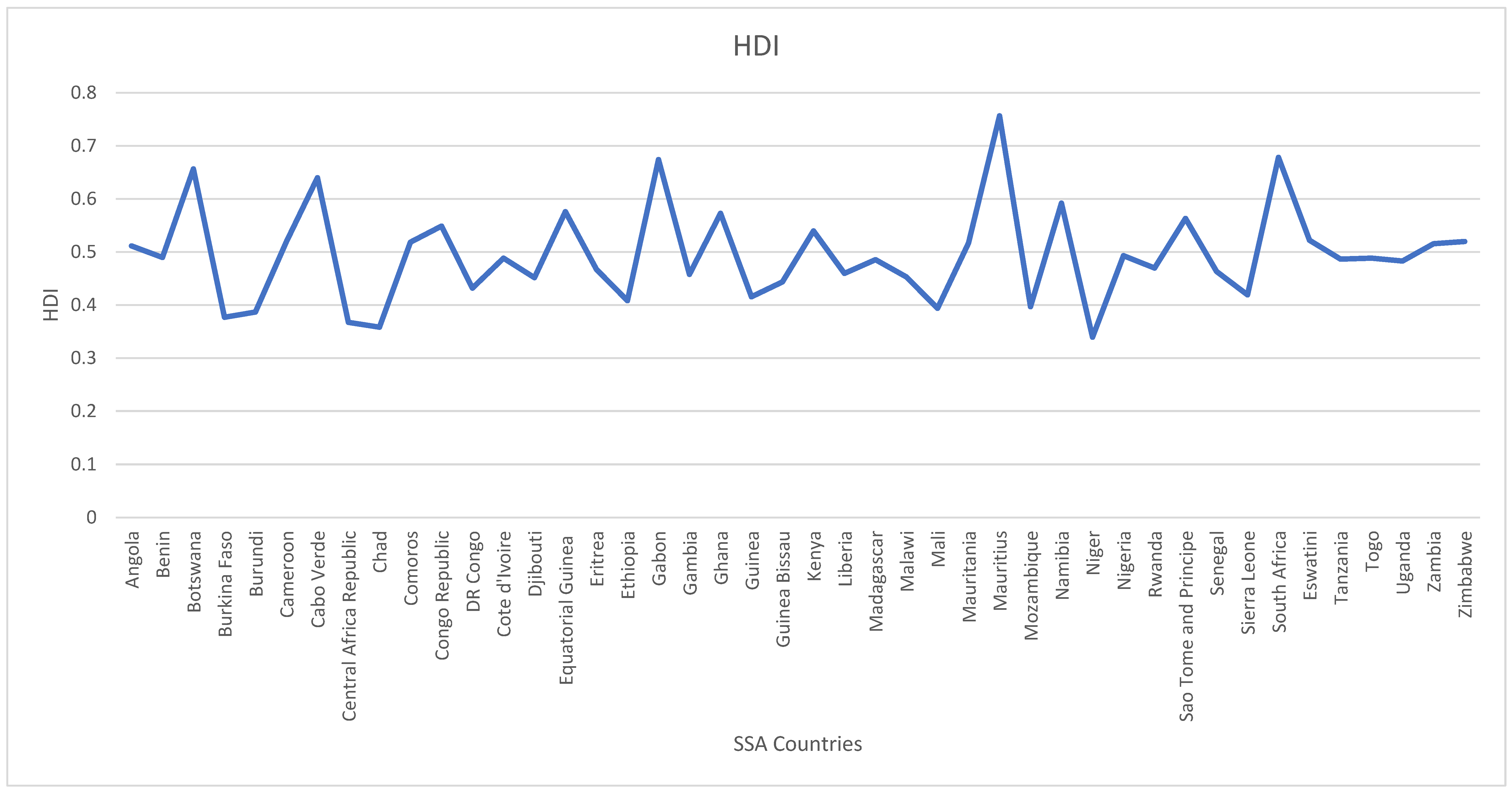
According to the Global Footprint Network (GFN), SD in a nation is assessed through two major indicators namely the Human Development Index (HDI) and Ecological Footprint (EFP) [4]. This cohesion is the basis for the Sustainable Development Index, which comprehensively evaluates SD and therefore the analysis here is a comprehensive review to guide African countries toward SD [5]. HDI is an index of health, knowledge and the standard of living indicators of the ‘United Nations Development Programme’ (UNDP). UNDP [6] further highlights that HDI calls for assessing the development of a country based on the capabilities of their people and not just economic growth. The UNDP’s HDI measures the extent to which a country’s residents effectively attain longevity, access to education and income and with an HDI higher than 0.7, a given country is deemed to have a high human index [4]. The average HDI data of the UNDP [6] for the time frame ranging from 2000 to 2021 is utilized to construct Figure 1; and from the 44 SSA economies employed in this research, only Mauritius has an average HDI that is greater than 0.7, of 0.7564. This indicates the need for more efforts towards improved HDI levels in SSA. This evidence clearly shows that the SSA countries are still struggling in advancing human development.
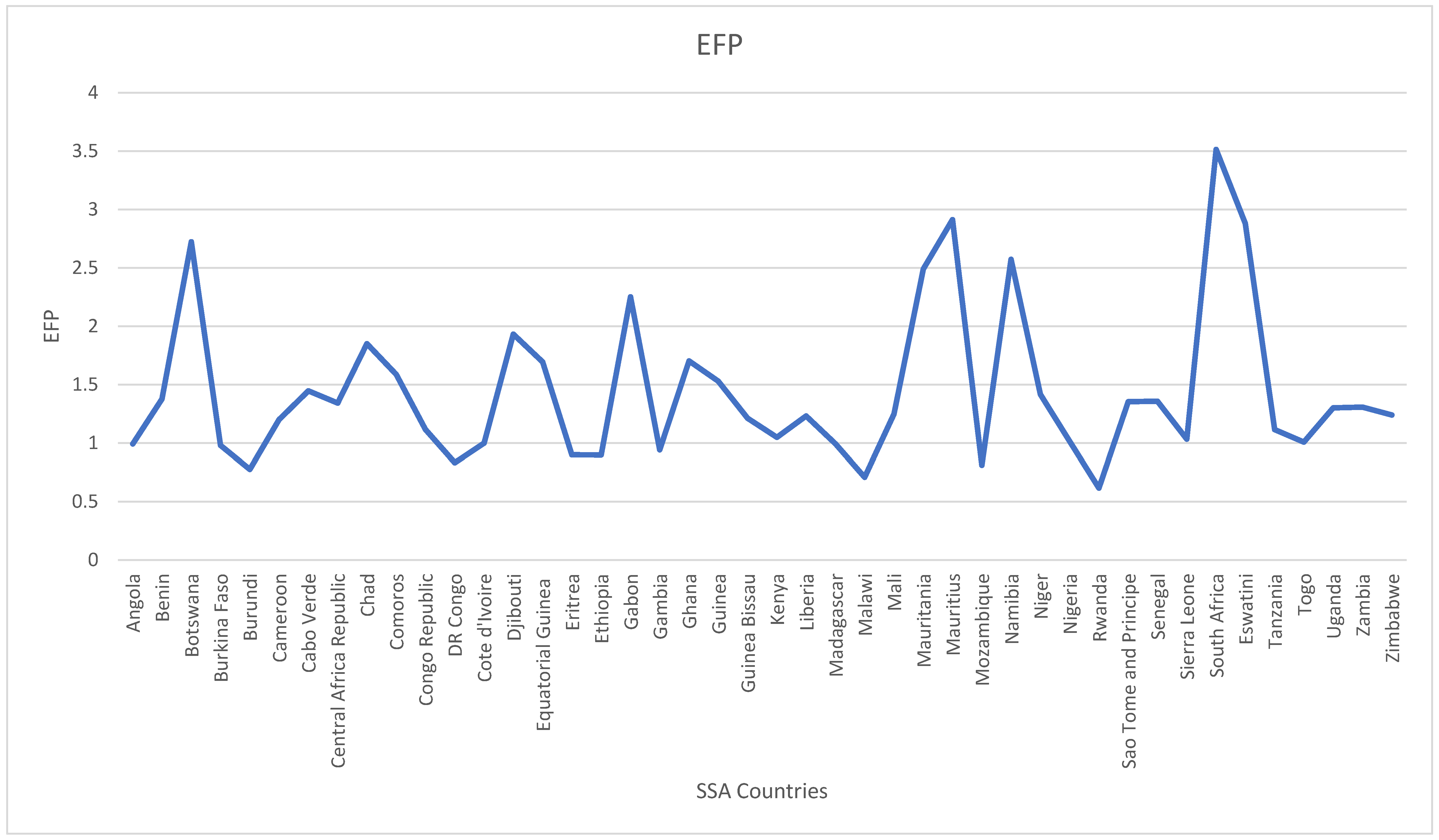
EFP on the other hand, represents the measure of the extent to which humans live within the means of nature and with less than 1.5 global hectares (gha) per person, the resource demand globally is replicable alongside the ease to maintain biodiversity [4]. The EFP level in SSA provides a better indication that the people seek to preserve nature, as they utilize it for their day-to-day survival. In Figure 2, only 13 SSA countries, out of the 44 assessed, have an average EFP of more than 1.5 gha per person. This shows that the greater percentage of SSA countries are not struggling with maintaining the ecological quality.
Generally, it is clear that the SSA countries are more compliant with EFP requirements compared to HDI. However, it is clear that collectively, both HDI and EFP require a significant improvement to effectively contribute to improve SD. The levels of SD in SSA can thus be deemed to be below average and the need to explore pertinent factors that can contribute to an improvement is highly prudent.
While similar studies focused on SD using either the HDI or the EFP, in our study, both dimensions are considered to create robust findings. Past studies on SD concentrated on examining the environmental aspect of sustainability [7,8]. This paper derives its novelty from merging environmental sustainability and human development dimensions thus adopting the Sustainability Development Index (SDI). Hickel [5] indicates that the SDI is a ratio of HDI to EFP. This enables the comprehensive capture of evidence that is crucial in achieving sustainable futures.
There is a dearth of studies examining the interplay of green technological innovation, institutional quality and NRRs on sustainable development (through adopting the ratio of HDI and EFP) of SSA nations. This research checks the robustness of the findings presented from the SD index, by examining on how HDI and EFP are influenced with green technological innovation, NRRs and institutional quality. This allows for the shortfalls of the SD index to be overcome, where HDI and EFP may be both rising, causing the presentation of conflicting results. By adopting the ‘Methods of Moments Quantile Regression’ (MMQR), findings that are robust for policy implications toward sustaining the SSA region are presented. This helps in establishing the implied enablers and hindrances of SD with suitable recommendations to policy makers and key stakeholders. The data of SSA nations is utilized for the time spanning from 2000 to 2021. The key research questions that this paper addresses will explore the following objectives: the need to establish the relationship between digital technology and SD, to ascertain the influence of GI on SD and to understand national income and institutional quality related to SD.

2. Literature Review

2.1. Green Innovation and Sustainable Development

The attainment of the SDGs is seen as a collective concern for governments and enterprises with the need to develop mindfully designed strategies aimed at promoting GI [3]. Government interventions are required in the encouragement of publicly listed companies to invest in GI activities for SD [9]. This is so because some companies may focus more on operational conditions and corporate governance at the expense of GI [10]. Thus, in order for private and public organizations (companies) to invest in GI, strong policies from the government are essential. These policies once enacted should be enforced; hence, ensuring the implementation of GI. In SSA, where the rule of law is lacking and there is the presence of political instability, such policies when enacted can rarely be implemented.
Rahmani [11] further establishes that with supportive environments, incentives offered, and clear regulations and standards, GI practices adoption among enterprises can be found to be essential and attainable. The SSA countries could benchmark from the Nordic and Baltic regions where their exceptional resource managements, and therefore SD, is attributed to GIs [12]. This is supported with the notion that green financial policies too, can be enablers for SD with the adoption of renewable green technology [13]. There is a significant linkage of HDI to SD when mediated by GI, therefore GI is critical for the attainment of SD in emerging jurisdictions like the SSA countries [14]. However, in the BRICS countries, which are majorly constituted by developed economies, GI is found to have a negative effect in mediating HDI and EFP towards SD [15].
The need for GI is further found to be effective for the mitigation of environmental impacts, with green space preservation, green building technologies and the implementation of Renewable Energy (RE) approaches [16]. Furthermore, environmental quality is improved when GI, alongside energy productivity, reduces carbon emissions [17]. Specifically, GI alongside increased use of RE, effective management of financial resources, natural assets, and sustainable economic growth, are seen to lead to the attainment of SD [18]. Liu [12] articulates that with the adoption of GI, digital governance practices in smaller economies—especially in the Nordic, Baltic regions—can effectively advance the attainment of the SDGs. This can further be explored in the context of SSA to ascertain the impact of GI and Digitalization for SD. The complexities of GI towards the attainment of SD are observed with a negative relationship when moderated between economic factors and SDGs, while having a positive association between social factors and the SDGs [19]. A number of studies on GI have been made in the recent past; however, alongside SD, more insight can be provided.

2.2. Technological Innovation (Digital Technology) and Sustainable Development

Ahmad [20] postulate that SD is a long-term process that is positively influenced by technological development. This indicates that SD attainment is a process that requires meticulous and innovative approaches of implementation so as to be effectively attained through the creation, implementation and engagement of relevant TI while mindful of the green financial implications. Empirical evidence depicts that strong environmental regulations and technological innovations (TI), in SSA, promotes sustainability especially with the environmental perspective [21]. Unfortunately, the limited resources among other encumbrances may slow down the TI transition in SSA [22]. Amidst those realizations and the glaring need for SD, the SSA countries would still be required to persist towards SD. The need for resilient grid infrastructure in SSA is therefore noted [23]. The governments would thus need to make a deliberate effort to support the TI developments in light of the challenges. Chen [24] provide insight into the suitable approach to reach the sustainable development goals with TI, especially if adopted with suitably enabling policies.
Chen [24] finds that with suitable policies in line with TI, the accomplishment of the SDGs is enabled. This provides a basis for the need to enhance the usage of suitable TI so as to attain SD. IQ is also observed to play a crucial role in enabling TI to advance SD. It is notable that with strong governance, TI has a positive impact on SDGs [25]. This calls for policy makers and government entities to be reassured that the envisaged change towards strengthening SD in SSA calls for their undivided focus on utilizing their governance mechanisms to encourage the development and adoption of TI in line with the SDGs. However, in the long run (LR), given the environmental impact, there may be a negative impact between TI and the environmental quality, which is a key constitute for SD [26]. Dao [27] also articulates that there are varying levels of impact of TI on the environmental quality support. Therefore, since TI influence on SD varies, there is need to further investigate the influence of TI on SD for the SSA nations. This is essential in informing policies towards advancing SD in this region.
The development of Fintech that empowers the financial sector with the application of digital technology for resource conservation and the reduction in energy dependency is highly advisable [28]. The challenges of TI can be overcome for sustainable natural resources usage through robust policy development, research and development (R&D) investments, and fostering of useful global partnerships [29]. The need for a comprehensive investment strategy is established where green finance (GF) principles are integrated with TI to establish SD in the LR [30]. GF is by far more important in advancing TI through the R&D in clean technologies alongside RE that ensures the attainment of a cleaner environment; hence, SD is fostered [7]. The green TI reduce health risks significantly, not only in the short run (SR) but also in longer-term implications, are an indication of SD [31]. The linkage between TI and SD can thus be further explored alongside other variables, such as GI, FD, and NRR, because TI and FD among other factors are found to lead to sustained prosperity [32].

2.3. Natural Resources Rents and Sustainable Development

The need for resource management is seen with the strong linkage between natural resource consumption efficiency and economic development [33]. However, the expansion of the variety of natural resource exploitation could as well increase the negative impact on environmental quality [27]. The need not to exceed the minimum threshold of exploitation is pertinent for NRR not to be exhibited as a curse [34]. A notable illustration in SSA is seen in Nigeria where emphasis is placed on the prerequisite of saving, stabilizing, investing and the need for clear fiscal rules, would be enablers for management of political discretion and thus reduce rent seeking that is inclined to a resource curse [35]. The improvement of the capacity of the environment to regenerate reduces the impact of NRR activities [36]. The SSA countries would require an enhancement of their resource management so as to control the exploitation of resources and the underlying NRR in such a manner that preserves the regeneration of the environment. With this responsibility, the implied resource curse is minimized and the attainment of SD is preserved.
As much as natural resources are established to have a positive effect on economic development, for the attainment of SD, it is pertinent that governments provide for suitable strategies aimed at effectively managing the resources [37]. The SSA countries are found to have low or very low levels of government commitment as indicated by the Natural Resource Political Commitment Index [38]. Therefore, with a great improvement in the legal and political entities, there can be a boost in the impact of Natural Resource Rents in the SSA FD [39].
In SSA, the advancement of NRR is linked with political intervention, aimed at achieving FD [39]. This illustrates the need for pro-SD in the political and governmental sphere of operations so as to attain NRR effectively in SSA. The role of policy makers is noted from the G7 countries, towards the implementation of regulations and measures that facilitate the transition towards sustainable development are highlighted [40]. Suitable policies regarding the sustainable use of NRR can be formulated [41]. The suitable policies established can be looked at in the SSA region with a forward-looking scope that evaluates policy formulation with a follow through to effective implementation so as to use NRR sustainably for a clear and direct impact on SD. The SSA countries require readily dedicated government and policy maker commitments towards the attainment of SD with intentional and safe usage of natural resources, as will be further explored in this article.

2.4. Renewable Energy, Financial Development and Sustainable Development

Fotio et al. [42] affirmed the positive linkage between RE and SD. The relationship between RE and SD is both positive and significant in SSA, providing a justification for the need for increased investment in RE [43]. However, in SSA the potential of RE is not fully explored [44]. Parab et al. [45] established that the relationship between RE and SD is found to be positive in both the short run and long run, indicating that positive influence of RE on SD in the SSA countries.
RE is found to be key in the determination of environmental enhancement with the reduction in both ecological footprint and carbon emissions while SD would have led to an increase; however, the investment of the SSA countries in RE promotes SD [46]. In the SSA countries, with the use of RE, both carbon emissions and toxic air are reduced thus the realization of RE leading to the attainment of SD goals [47]. The positive relationship between RE and SD in the SSA countries calls for policies to be developed for the improvement of RE and green SD in the SSA countries [48]. The complexities amidst the exploration of RE in SSA are highlighted and the reassurance of future development opportunities is noted [49].
The researchers evaluate FD in relation to income thus utilizing GDPC given that it is the complete data available to enable an effective analysis of representative number of countries in the SSA region. Real GDPC has a positive impact on SD [50]. GDPC is also related to Economic Growth and therefore this context utilized these terms synonymously. Economic Growth (EG) can be stimulated towards SD [51]. The China BRI (Belt and Road Initiative) countries present a good benchmark for the SSA perspective on the attainment of FD while promoting SD [52]. There is a positive relationship between resource abundance and FD [53]. The dynamics in light of SD in SSA call for further exploration even with the indicated positive relationship with resource abundance. However, improving EG and SD are acknowledged to be a challenge [54]. Pais et al. [55] find that EG has the possibility of affecting SD negatively and policy makers need to look out for ways to attain both. It is noted that in the longer run, with a rise in the financial markets, EG contributes to SD [56]. FD may likely exert pressure on the attainment of SD [32]. This calls for further ascertainment of the impact of FD on SD and the genesis of the negative implications of FD.

2.5. Synergies of Green Innovation, Technological Innovation, Natural Resources Rent, Renewable Energy, and Financial Development in Relation to Sustainable Development

An increment in RE, IQ and TI leads to a reduction in carbon emissions and thus an increase in SD [57]. Furthermore, IQ moderates the negative relationship between FD and SD thus leading to the promotion of SD [58]. The promotion of TI and human capital development for the effective usage and management of natural resources, enhances FD [59]. It is further highlighted that attaining SD calls for governments to pay special attention to FD, TI and RE [32]. The top 10 rich African countries are seen to harness the benefits of TI in advancing environmental sustainability [7]. This provides a clear basis for future projections by the SSA countries that seek to attain SD to adopt the model seen in the richer countries.
Economic growth is found to be enhanced synergistically by natural resource consumption and FD [33]. Manigandan et al. [60], find that together with GI, FD is found to contribute to SD. FD is seen to ensue in the G7 countries where the investment friendly environment and energy price stability are contributory factors [53]. Real GDPC and therefore FD directly contribute to SD [50]. RE and GI strongly contribute to environmental quality and thus SD [17]. SD planning, research innovation, and conservation and protection of natural resources illustrate the key solutions aimed at mitigating environmental and natural resource depletion after the COVID-19 predicament in developing countries [61]. This can be a pillar of encouragement to the SSA countries, which are primarily in this category, to seek for the aforementioned key solutions more so for the attainment of SD. Xu & Xu [62] find that natural resource-related financial development decreases ecological sustainability. This is an indication that supports the findings herein where there is a consistent negative relationship between GDPC and SD. However, the adoption of green energy, the moderating impact of financial development on green energy–sustainability relationships, and environmental innovations increases ecological sustainability [62].
In the SSA countries, while RE is found to contribute significantly to SD, IQ magnifies this positive relationship [63]. However, FD and SD are found to have a negative impact on RE in the SSA countries [64]. Fotio et al. [42] emphasized the negative relationship between FD and RE in SSA. However, as long as SSA policy makers are encouraged to align FD towards the deliberate investment in RE [65]. Investment in RE and GI respectively enables the attainment of SDG 07 (Affordable and clean energy) and SDG 09 (Industry, Innovation and Infrastructure), respectively [66].
The need to explore further the interplay of these key determinants in relation to SD is clear so as to align other measures that illustrate practical interventions that can enable SSA countries to effectively attain and maintain SD.

3. Model, Data and Methods

3.1. Research Model

This research is based on the RC and RB hypothesis that explains how NRs and their rents affect the economic development of countries. The famous RB hypothesis is widely known for ascertaining that countries that are rich in NRs can utilize them to promote economic development [67]. NRs are by far considered as the most precious resources of countries. For instance, mineral resources are of great economic vale and can be extracted and used to boost the GDP of nations. Nonetheless, the RC hypothesis articulates that poor institutional quality in countries with abundant NRs may turn the blessing to a curse and this is known as a RC [68]. According to the RC theory, corruption and poor governance in countries with abundance in NRs deters economic development and this has been witnessed in the developing nations, like African nations, with poor economic growth yet they have abundant NRs. Institutional quality become the crucial moderating factor in determining the influence of NRs on economic development. The nexus NRs and economic development have been extensively conducted and recent empirical studies have also started to investigate its nexus with environmental sustainability [7]. This research employs the RC and RB hypotheses in the context of sustainable development, which combines economic development and environmental sustainability. Sustainable development is of paramount importance to understand as it explains the needs of the present generations can be met without exhausting the resources available to meet needs of future generations [69]. Therefore, this research takes NRR as the core explanatory variable together with institutional quality, which helps in explaining the existence of the RC in developing nations with abundance in NR. Thus, the model specified in the function presented in Equation (1) shows that sustainable development is explained from changes happening in institutional quality and NRR.
S D = f N R R ,   I Q
where, S D represents sustainable development and is the dependent variable (DV), while N R R and I Q , the natural resources rents and institutional quality, are the exogenous variables.
While this research takes NRR and IQ as the core independent factors, we include green innovation and technological innovation in line with the recent studies of, [7,8]. Green innovation is essential in encouraging the R&D in advancing RE development and clean technologies that are essential in advancing economic development without causing harm to the environment [70]. Technological advancement is the driver to economic development as explained in the Endogenous Growth Models (EGM) [71]. This is indicative that with clean technological innovation, both environmental sustainability and economic development (sustainable development) is achievable. Furthermore, to ensure that robust findings are guaranteed in the analysis, some key control variables like RE and economic growth are included in the model specification. RE is widely accepted as the major driver towards achieving ES because it does not cause carbon emission [72]. At the same time, RE is key in boosting economic growth [73]. The importance of economic growth in affecting ES is also provided for in the ‘Environmental Kuznets Curve’ (EKC) hypothesis [74]. Thus, economic growth and RE can play a fundamental role in improving sustainable development in the economies. Equation (2), thus presents the main model adopted in this research in explaining sustainable development.
Model 1:
S D t i = β 0 + β 1 N R R t i + β 2 l o g G I t i + D I G +   β 4 I Q t i + β 5 R E t i + β 6 l o g G D P C t i +   μ
where, GI and DIG are the additional explanatory variables employed to augment NRR and IQ explained in Equation (1) and RE and GDPC are the control variables in the model. GI is the green innovation, DIG is digital technology, RE is the renewable energy, and GDPC is the GDP per capita. β 0 is the model’s constant term, β 1 6 are the model’s parameters to be estimated. The superscripts t and i are used to represent the time frame of the data and the number of countries employed, indicating that the data used is longitudinal data. The μ represents the error noise of the statistical model covering the effect of other factors that influences SD that are not included in the model and l o g is the log operator showing that GDPC and GI are transformed into log form. Indicators that are transformed into log form are those measured in absolute terms, say thousands or millions of dollars. This ensures that the indicators are standardized, ensuring that they become stationary after testing for unit root (UR); hence, this avoids issues of spurious regressions.
To ensure the results of Model 1 are robust and all of the limitations of the Hickel [5] SD index are overcome, Models 2 and 3 in Equations (3) and (4), respectively, are specified and analyzed. Factors that increase SD should reduce EFP and increase HDI, while factors that reduce SD should increase EFP and reduce HDI. By employing these models in this analysis, robust findings that inform the adoption of correct policies for sustainable development in Africa are presented.
Model 2:
E F P t i = β 0 + β 1 N R R t i + β 2 l o g G I t i + β 3 D I G t i +   β 4 I Q t i + β 5 R E t i + β 6 l o g G D P C t i +   μ
Model 3:
H D I t i = β 0 + β 1 N R R t i + β 2 l o g G I t i + β 3 D I G t i +   β 4 I Q t i + β 5 R E t i + β 6 l o g G D P C t i +   μ
In Model 2 and 3 EFP and HDI are the DVs of the models and they represent ‘Ecological Footprint’ and ‘Human Development Index’, respectively.

3.2. Data

This research uses the data of 44 SSA countries and the time frame considered is 2000 to 2021. Thus, annual data is used making 968 observations. The data for the Sustainable Development Index is retrieved from the GFN and UNDP, while the data for Green Innovation is retrieved from OWD. The data of technological innovation, NRRs, institutional quality, RE and GPD per capita is retrieved from the World Bank (WB). All indicators considered in this research are explained below and their measurements are summarized in Table 1, while their descriptive statistics findings are summarized in Table 2.
Sustainable Development—in a nation is assessed through two major indicators, namely the HDI and EFP [4]. This paper takes the ratio of HDI to EFP to proxy SD, where rising SD index represents improvements in the HDI alongside a reduction in EFP.
Green Innovation—in this study, green innovation is represented by the international financial flow of green funds to developing countries, aimed at the promotion of clean energy development and renewable energy production. The green innovation indicator employed represents funds meant to finance research and development (R&D) programs on clean technologies and RE [70]. GI looks at the enhancement of environmental quality alongside energy productivity thus reducing carbon emissions [17]. GI thus remains a key aspect to consider for the attainment of SD especially in SSA [14].
Digitalization—this research uses the index of digitalization calculated with the Geometric mean by employing the ‘Internet Users’ (IU) measured as the percentage of population and ‘Mobile Cellular Subscriptions’ (MCS) per 100 people, following [7,75]. The MCS is an indicator for subscriptions to a public mobile phone service that utilized cellular technology and offered voice communications. This excludes data cards, USB modems, public mobile data services, private trunked mobile radio, telemetry services, radio paging and telepoint [76].
Renewable Energy—is the contribution of renewables to total primary energy supply [77]. Renewables are diverse, some of which include; hydro, geothermal, solar, wind, wave, and tide sources, alongside energy sources from solid bio fuels, bio gasoline, bio diesels, renewable municipal waste and bio gases. The level of RE in this study is established as a percentage of final energy consumption.
Natural Resources Rents—is the total NRR established as a percentage of GDP. It comprises the summation of oil, natural gas, coal, mineral and forest rents. It is noted that NRR can be managed to impact SD positively given that the environment regenerates [36].
Institutional Quality—the proxy for IQ in this paper looks at the incorporation of the two indicators of Government Effectiveness (GE) and Control of Corruption (CC). GE estimates the perceptions of the quality of public services, the quality of the civil service and the degree of its independence from political pressures, the quality of policy formulation and implementation, and the credibility of the government’s commitment to such policies. The estimate gives the country’s score on the aggregate indicator, in units of a standard normal distribution, i.e., ranging from approximately −2.5 to 2.5. The CC estimates and captures perceptions of the extent to which public power is exercised for private gain, including both petty and grand elements of corruption. The estimate gives the respective country’s score on the aggregate indicator, in units of a standard normal distribution, i.e., ranging from approximately −2.5 to 2.5.
GDP per Capita—is the gross domestic product divided by the population. It shows the income per each person in an economy as a total amount in US dollars. It is calculated without making deductions for depreciation of fabricated assets or for depletion and degradation of natural resources.

3.3. Method

This research adopts the MMQR method in analyzing the relationship specified in the Equations (2)–(4). The MMQR method is credited to the work of Machado and Silva [78] and has risen to become the most prominent method of data analysis because of its various advantages and potential to provide reliable findings that gives key policies [7,79]. To ensure robust findings are presented, some robustness test methods, the “Panel Correlated Standard Errors” (PCSE) and ‘Feasible Generalized Least Squares’ (FGLS) are employed [80,81,82]. Some of the advantages and reasons for employing the MMQR method are explained below.
Firstly, the MMQR method is employed in this analysis because it generates results that are heterogeneous; hence, enabling the analysis of symmetric effects in the model. The MMQR enables the analysis of symmetric effects in the model as it presents findings in different quantiles, with the lower-quantiles depicting the relationship at low levels of SD and the upper-quantiles depicting the relationship at high levels of SD. Employing the MMQR method enable the development of policies that can be used in improving SD in the SSA countries with low- and high-level SD. To this end, the statistical equation representing the MMQR model is presented in Equation (5).
Q y ( δ ! X i t ) = β 0 + β 1 N R R t i + β 2 l o g G I t i + D I G + β 4 I Q t i + β 5 R E t i + β 6 l o g G D P C t i + μ
Here, Q y ( δ ! X i t ) is the conditional quantile of the dependent variable [79].
Secondly, the MMQR method is employed in this research because of the results of the various pretesting method in Appendix A. The ‘Variance Inflation Factor’ (VIF) results in Table A1 show that ‘multi-collinearity’ is not present among independent variables specified in the model, thus the analysis of this model can yield reliable findings. CD results of the variables, according to Pesaran [83] and the CD results according to Friedman [84]; Frees [85,86]; Pesaran [87] are presented in Table A2, showing the existence of CD, which can be corrected by using ‘second-generation’ (SG) methods like the MMQR in the analysis. Heterogeneity is also present in the model as shown by the findings of Pesaran and Yamagata [88] in Table A2. Thus, with the presence of CD and ‘heterogeneity’ this chooses to employ the MMQR method to overcome these problems. Additionally, there is the existence of different integration orders in the variables as shown by the findings in Table A3. According to the CADF and CIPS methods (Pesaran [89]; Im et al. [90], the MMQR method that accepts variables in I(0) and I(1) is used. Finally, there is the existence of significant (sig) ‘cointegration’ in the model according to the Kao and Pedroni methods; after subtracting ‘cross-sectional means’ to cater for CD, the MMQR method is selected because it gives long run (LR) findings.
All the results presented in the analysis of this study are run by employing the STATA 15.0 software.

4. Results and Discussion

The findings provided in Table 3 (of the MMQR method) depict that GI significantly increases SD in the SSA nations. However, the relationship is significant in the 0.1 to 0.75 quantiles ( β = −0.0037, −0.0032, −0.0024, −0.0016; p-value < 0.05) and insignificant in the 0.9 quantile, showing that asymmetric effects exist. The PCSE and FGLS findings in Table 4 supports the sig positive association of GI with SD ( β = −0.0023, −0.0013; p-value < 0.05). Model 2 findings of the MMQR method in Table 3 supports by showing that green innovation sig reduces EFP ( β = −0.0055 to −0.0146, in quantiles 0.5 to 0.9; p-value < 0.05), while Model 3 findings show an insig relationship with HDI. Model 2 findings of the PCSE method in Table 4 supports the sig negative association of GI and EFP ( β = −0.0066; p-value < 0.01), while the PCSE findings of Model 3 shows that GI is not sig related with HDI. The FGLS findings of Model 2 and 3 in Table 4 indicates that GI is linked with decreases in EFP and increases in the HDI ( β = −0.0058, 0.0004; p-value < 0.01). The findings presented here supports the importance of GI in fostering the SD of the SSA region. Its importance is observed in lowering the EFP and raising the HDI. By reducing the EFP and increasing HDI, ES is attained together with advancements in the human development (quality health, education and standards of living). The positive link of green innovation and sustainable development presented in the findings of the study are supported by many empirical studies that have been undertaken in the past. For example, in the Nordic and Baltic region SD is attributed to GI [12]. Xu et al. [18] furthermore highlights that GI guarantees the attainment of SD. Other studies have also shown that GI (Green Finance) reduces EFP [7]. Shang et al. [13] postulate that the enactment of green financial policies provides for an intentional approach towards enabling SD. The notable contribution of GI in mediating the impact of HDI towards SD is further affirmed in emerging economies [14]. These results are important for policy making as they show that the SSA countries with low levels of SD, that is, low HDI and high EFP, can improve SD of their nations with GI. The SSA countries could consider the enactment of policies that promote the adoption of GI alongside RE so as to keep on track towards SD.
On the relationship of digitalization with SD, Model 1 results of the MMQR in Table 3 show insig relationship in the 0.1 quantile and sig positive relationship in the 0.25 to the 0.9 quantiles ( β = 0.0008 to 0.0028 in the 0.25 to 0.9 quantiles; p-value < 0.01). The PCSE and FGLS results supports the sig positive association of digitalization and SD ( β = 0.0015, 0.0018; p-value < 0.01). The MMQR findings of Model 2 and 3 in Table 3 supports the results of Model 1 by showing that digitalization reduces EFP ( β = −0.0049, −0.0044, −0.0037 in the 0.1 to 0.5 quantiles; p-value < 0.01) and increases HDI ( β = between 0.0015 and 0.001 in the 0.1 to 0.9 quantiles; p-value < 0.01). The PCSE and FGLS results of Model 2 and 3 support the importance of digitalization in lessening EFP ( β = −0.0034, −0.004, respectively; p-value < 0.01) and supporting HDI ( β = 0.0012, 0.0009, respectively; p-value < 0.01). Usman et al. [25] highlighted that technological innovations have a strong relationship with SDGs especially amidst good governance. Many empirical studies have also concurred on the importance of technological innovations (digitalization) with SD [7,28,29,30]. This calls for the SSA countries to finance the investment in digital technology, especially green technology, for attaining environmental sustainability and human development.
Model 1 findings of the MMQR method presented in Table 3 shows that NRR exhibit a sig positive relationship with SD ( β = 0.0011, 0.0004, 0.0021, 0.0027 and 0.0032 from lower- to upper-quantiles; p-value < 0.05). The PCSE and FGLS results of Model 1 in Table 4 depict that NRR has a positive association with SD ( β = 0.0021 and 0.0017, respectively; p-value < 0.01). The Model 2 MMQR results shows that NRR is negatively related with EFP ( β = −0.011, −0.01, −0.0093, −0.0079, −0.0069, −0.0069 in the lower- to upper-quantiles; p-value < 0.05) and positively related with HDI ( β = 0.0009, 0.0007 in the 0.1 and 0.25 quantiles; p-value < 0.01). In the 0.5 quantile NRR has a weak positive association with HDI ( β = 0.0002; p-value < 0.1) and weak negative association in the 0.9 quantile ( β = −0.0003; p-value < 0.1). The influence of NRR on HDI is thus asymmetric, it supports HDI when it is low more than when it is high, calling for the SSA countries with low human development to capitalize on the income generated from selling their NRs. NRR is thus established to be more of a blessing than a curse as illustrated by [91]. As long as the environment has the ability to regenerate, the impact of NRR over time can be managed to continuously influence SD positively [36]. The RB hypothesis is supported in this research, showing that economic development is supported with NRs in countries with high NRs endowments [12,33,60]. However, [38] applicable policies on NRRs sustainable usage and strategies to effectively manage NRs can be enacted [37,41].
The MMQR findings of Model 1 shows that IQ exhibit a weak positive relationship with SD ( β = 0.0086, 0.0109, 0.0128, in the 0.5 to 0.9 quantiles; p-value < 0.1), and insig effects in the lower quantiles, reflecting the existence of asymmetric effects. The PCSE findings of Model 1 reflect the existence of strong positive influence of IQ on SD ( β = 0.0087; p-value < 0.01), while the FGLS results show that the relationship is a strong negative one ( β = −0.0122; p-value < 0.01). The findings are conflicting, making it difficult for policy making; hence, the importance of the results of Model 2 and 3 in clarifying how IQ influence EFP and HDI, the two index used in the Hickel [5] SD index. Model 2 results, according to the MMQR technique, depict that IQ worsens EFP ( β = 0.06 to 0.088 in the 0.1 to 0.9 quantiles; p-value < 0.01) and improves HDI ( β = 0.0213, 0.0189, 0.0156, 0.0134 and 0.0117, in the 0.1 to 0.9 quantiles; p-value < 0.01). The findings of the PCSE and FGLS methods in Table 4 also supports by showing that IQ has a strong positive relationship with EFP ( β = 0.0729 and 0.0776, respectively; p-value < 0.01) and a sig positive relationship with HDI ( β = 0.0161 and 0.0143, respectively; p-value < 0.01). These findings highlights that IQ supports human development (education, healthy and living standards) in the SSA countries, but contributes to the degradation of the environment. The detrimental effects of IQ on the environment, presented in this research, is supported by the evidence presented in [92], showing that government effectiveness, a proxy of IQ, is associated with increases in the EFP of the SSA region. Nonetheless, other studies have shown that IQ improves the ecological quality in the BRICS [92]. The importance of IQ in supporting human development, as shown in this analysis, is also supported by the findings of [93]. The SSA countries need to develop strong policies and adopt robust policy frameworks that support green projects for ES and also allow investments in education, health and economic development, to ensure advancement of human development. The current policy frameworks in SSA is more favorable to human development than ecological sustainability, calling for the need for policy reforms to ensure that environmental policies for ES are adopted in this region.
The MMQR results of Model 1 show that the influence of RE on SD is a sig positive one ( β = 0.001 to 0.0026, in the 0.1 to 0.9 quantiles, respectively; p-value < 0.01). Other methods, PCSE and FGLS, also support the importance of RE for SD in SSA ( β = 0.0018 and 0.0019, respectively; p-value < 0.01). Findings of Model 2, used for robust checks, show that RE lessens the impact on the environment through lowering the EFP ( β = −0.0039 to 0.0098 in the 0.1 to 0.9 quantiles; p-value < 0.01), while Model 3 results shows that RE does not sig advance human development. Furthermore, RE is observed to lessen EFP in the PCSE and FGLS results ( β = −0.0066 and 0.0085, respectively; p-value < 0.01) and improve HDI, according to the FGLS results ( β = 0.0002; p-value < 0.01), but the PCSE presents insig results. Fotio et al. [42]; attested the notion of a positive relationship between RE and SD. Parab et al. [45] further notes that the said relationship is also persistent not just in the SR but in the LR as well. This provides a scientifically supported basis that in the SSA countries, the aspect of RE is pertinent in the attainment of SD.
GDP per capita is observed to be linked with a sig negative connection with SD, according to the MMQR findings in Table 3 ( β = −0.0202 to −0.046 in the 0.25 to 0.9, respectively; p-value < 0.01). In the 0.1 quantile, the association of GDP per capita and SD is a weak negative one ( β = −0.0144; p-value < 0.1). The PCSE and FGLS findings support the presence of a negative relationship between GDP per capita and SD ( β = −0.03 and 0.0192, respectively; p-value < 0.01). Real GDPC ought to have a positive impact on SD, following the evidence presented in past research [50]. The negative influence of GDP per capita on SD is a major cause of concern for policy implications; hence, Models 2 and 3 are employed for robustness checks, ensuring sound policies are adopted. Model 2 results in Table 3 depict that GDP per capita exacerbates EFP ( β = 0.2958 to 0.4239, in the lower- to upper-quantiles; p-value < 0.01) and improves human development ( β = 0.0589 to 0.0625, in the lower- to upper-quantiles; p-value < 0.01). The detrimental effects of GDP per capita on the environment is supported by the PCSE and FGLS results of Model 2 in Table 4 ( β = 0.3547 and 0.258, respectively; p-value < 0.01), together with the importance of GDP per capita in supporting human development ( β = 0.0609 and 0.0668, respectively; p-value < 0.01). These findings give some important insights, showing that GDP per capita is negatively related with the Hickel [5] SD index because it raises the EFP. Although it improves the human development, its influence of EFP is stronger as shown by the high coefficient values. This highlights that in SSA the linkage between GDP per capita and SD presents a challenge [54]. Activities meant to improve human development harm the environment, posing a great dilemma to policy implications. The adoption of green technological approaches (the use of low-carbon energy, the use of clean technologies and shunning activities that harm the environment like deforestation) advances human development and ES at the same time, and are essential for SD in SSA.


5. Conclusions

This research bridges the gap in the literature by adopting the Hickel [5] SDI, which incorporates HDI and EFP in evaluating the interplay of digitalization, green innovation, NRRs, and institutional quality in the presence of RE and FD for sustainable development in SSA. The findings herein allow for the adoption of relevant policies that ensure the improvement of both the ecology and human development. This research also employs contemporary studies, the MMQR, PCSE and FGLS, that overcome problems of CD, serial correlation, heterogeneity and heteroscedasticity that exist in longitudinal data. Therefore, robust reliable findings that are useful in making policies toward supporting SD are presented. Key findings reflect the importance of green innovation, digitalization, NRRs and RE is supporting overall SD in SSA, while GDP per capita is detrimental to SD. The findings show that GDP per capita is detrimental to SD because it is associated with increases in the EFP, nonetheless, it is important for supporting human development. The influence of IQ on SD is ambiguous because it positively influences both EFP and human development. This poses a dilemma and calls for policy reforms to ensure that both the environment and human development are supported with the correct policies. Future studies can consider employing other proxies of sustainable development that provides robust and alternative findings, to explore further implications of SD in the SSA countries. Studies that consider primary data in order to capture other information that could not be captured with secondary data can be useful in understanding various techniques and approaches that can be adopted for sustainable development in SSA.

Policy Implications

  • Developing nations, such as the SSA countries, can capitalize on green innovation tools to support sustainable development. Investment in R&D programs, meant to support development of green energies, like RE and nuclear energy that is less polluting and clean technologies, is fundamental to advance sustainable environments and human development.
  • Investment in green innovation in SSA can be achieved in two or more ways: first, SSA should solicit public and private funds for supporting R&D programs on clean energies and technology. Second, SSA can rely on the international funds from the UN and the developed countries given to support green projects because of the lack of finance in this region.
  • Adoption of clean technologies, and the enhancement of good governance and global partnerships is called for to support long-term sustainable development plans in SSA.
  • Income generated from selling NRs is essential in supporting SD in the SSA region. This region is rich in NRs and they can capitalize on them to generate funds that can be used to support sustainable projects. Therefore, the management of NRs and the income generated from it is essential.
  • This calls for the development of strong institutions and policies that are aligned with national green projects and technological advancements approaches. Policy frameworks that enable the distribution of finance in areas where they are highly needed for developmental programs should be supported.
  • In short, SSA can capitalize on the technology–institution–resource coupling to foster SD. This allows for significant investment in clean technology through green finance, which in turn supports efficient resource allocation coupled with institutions that provide appropriate frameworks for sustainable development.

Author Contributions

Conceptualization, A.D. and T.N.; methodology, A.D.; validation, A.D.; formal analysis, A.D. and T.N.; investigation, A.D.; resources, T.N.; data curation, A.D.; writing—original draft preparation, T.N.; writing—review and editing, A.D.; visualization, T.N.; supervision, A.D.; project administration, A.D. All authors have read and agreed to the published version of the manuscript.

Funding

This research received no external funding.

Institutional Review Board Statement

Not applicable.

Informed Consent Statement

Not applicable.

Data Availability Statement

The data used in this paper is secondary data and were retrieved from the World Bank (https://data.worldbank.org/), United Nations Development Programme (https://hdr.undp.org/data-center/human-development-index#/indicies/HDI, accessed on 25 November 2025), Global Footprint Network (https://data.footprintnetwork.org) and Our World in Data (https://ourworldindata.org/grapher/international-finance-clean-energy, accessed on 25 November 2025).

Conflicts of Interest

The authors declare that they have no competing interests.

Appendix A

Table A1. VIF findings.
VariableVIF1/VIF
logGDPC2.970.3372
RE2.550.3920
TI2.000.4998
IQ1.610.6225
NRR1.320.7579
logGI1.170.8515
Mean VIF1.94
Table A2. CD and Heterogeneity findings.
Statisticp-Value Statisticp-Value
Pesaran (2004) [94]CD test in model
SD65.41 ***0.000Pesaran (2015) [87]8.706 ***0.000
logGI35.86 ***0.000Frees69.089 ***0.007
TI136.80 ***0.000Friedman8.723 ***
NRR27.06 ***0.000
IQ0.770.438 Heterogeneity test
RE45.61 ***0.000 17.731 ***0.000
logGDPC121.69 ***0.000 22.227 ***0.000
Note: *** is sig at 1%.
Table A3. UR findings.
CADFCIPS
Level1st DLevel1st D
SD−2.154 *** −2.678 ***
logGI−3.046 *** −3.990 ***
TI−1.843−2.307 ***−1.323−2.794 ***
NRR−2.073 ** −2.251 ***
IQ−1.236−3.047 ***−1.989−5.111 ***
RE−1.953 *−3.047 ***−1.995−3.831 ***
logGDPC−2.125 *** −2.605 ***
Note: *** is sig at 1%; ** is sig at 5%; * is sig at 10%.
Table A4. Cointegration Findings.
Statisticp-Value Statisticp-Value
Kao test Pedroni test
MDF−4.3039 ***0.0000MPP5.5720 ***0.0000
DF−4.9154 ***0.0000PP−6.7706 ***0.0000
ADF−1.10310.1350ADF7.6416 ***0.0000
UMDF−7.1454 ***0.0000
UDF−6.1217 ***0.0000
Note: DF is Dickey–Fuller; MDF is Modified DF; ADF is Augmented Dickey–Fuller; UMDF is Unadjusted MDF; UDF is Unadjusted DF; PP is Phillips–Perron; MPP is Modified PP; *** is sig at 1%.

References

  1. Nyandwe, E.M.; Zhang, Q.; Wang, D.; Yeo, A.D. Towards Sustainable Development of Mineral Resources in Sub-Saharan Africa: A Structural Equation Modeling Approach. Sustainability 2024, 16, 9087. [Google Scholar] [CrossRef]
  2. Majeed, M.A.; Ahsan, T.; Gull, A.A. Does corruption sand the wheels of sustainable development? Evidence through green innovation. Bus. Strategy Environ. 2024, 33, 4626–4651. [Google Scholar] [CrossRef]
  3. Xing, Y. Under the Goal of Sustainable Development, Do Regions with Higher Energy Intensity Generate More Green Innovation? Evidence from Chinese Cities. Sustainability 2024, 16, 6679. [Google Scholar] [CrossRef]
  4. GFN. Measuring Sustainable Development. 2025. Available online: https://data.footprintnetwork.org/?_ga=2.166959998.1193082126.1732690571-1325840133.1732690570#/sustainableDevelopment?cn=all&yr=2019&type=BCpc,EFCpc (accessed on 27 November 2024).
  5. Hickel, J. The sustainable development index: Measuring the ecological efficiency of human development in the anthropocene. Ecol. Econ. 2020, 167, 106331. [Google Scholar] [CrossRef]
  6. UNDP. Available online: https://hdr.undp.org/data-center/human-development-index#/indicies/HDI (accessed on 27 November 2024).
  7. Deka, A. The role of natural resources rent, trade openness and technological innovations on environmental sustainability—Evidence from resource-rich african nations. Resour. Policy 2024, 98, 105364. [Google Scholar] [CrossRef]
  8. Deka, A. Juxtaposing the role of effective capital, energy efficiency and technological innovations on environmental sustainability in the EU countries. Manag. Environ. Qual. Int. J. 2025. [Google Scholar] [CrossRef]
  9. Cai, H.H.; Khan, N.U.; Tang, S.; Siddiqui, M.; Xia, M.; Qu, H. Developing environmental sustainability policy – How financing and subsidies are influencing green innovation in mineral extraction industries in China. J. Environ. Manag. 2024, 368, 122218. [Google Scholar] [CrossRef] [PubMed]
  10. Yang, C.; Zhu, C.; Albitar, K. ESG ratings and green innovation: A U-shaped journey towards sustainable development. Bus. Strategy Environ. 2024, 33, 4108–4129. [Google Scholar] [CrossRef]
  11. Rahmani, A.; Naeini, A.B.; Mashayekh, J.; Aboojafari, R.; Daim, T.; Yalcin, H. Green innovation for a greener future: A meta-analysis of the impact on environmental performance. J. Clean. Prod. 2024, 460, 142547. [Google Scholar] [CrossRef]
  12. Liu, Y.; Alnafrah, I.; Zhou, Y. A systemic efficiency measurement of resource management and sustainable practices: A network bias-corrected DEA assessment of OECD countries. Resour. Policy 2024, 90, 104771. [Google Scholar] [CrossRef]
  13. Shang, T.; Samour, A.; Abbas, J.; Ali, M.; Tursoy, T. Impact of financial inclusion, economic growth, natural resource rents, and natural energy use on carbon emissions: The MMQR approach. Environ. Dev. Sustain. 2024, 27, 14143–14173. [Google Scholar] [CrossRef]
  14. Ghouse, G.; Bhatti, M.I.; Nasrullah, M.J. The impact of financial inclusion, Fintech, HDI, and green finance on environmental sustainability in E-7 countries. Financ. Res. Lett. 2025, 72, 106617. [Google Scholar] [CrossRef]
  15. Qiu, H.; Wan, Q. Inclusivity between digital trade, human development, and environmental quality: Moderating role of green innovations in BRICS countries. Econ. Res. Istraz. 2023, 36, 2150872. [Google Scholar] [CrossRef]
  16. Almulhim, A.I.; Al Kafy, A.; Ferdous, M.N.; Fattah, M.A.; Morshed, S.R. Harnessing urban analytics and machine learning for sustainable urban development: A multidimensional framework for modeling environmental impacts of urbanization in Saudi Arabia. J. Environ. Manag. 2024, 357, 120705. [Google Scholar] [CrossRef]
  17. Umar, M.; Mirza, N.; Umar, Z.; Sokolova, T. Green recovery in BRICS economies: The role of mineral resources, energy productivity, and green innovation in sustainable development. Resour. Policy 2024, 98, 105353. [Google Scholar] [CrossRef]
  18. Xu, T.; Hordofa, T.T.; Kaur, P.; Dongsheng, C.; Muda, I. Natural resources management efficiency: The role of green innovation for digital government. Resour. Policy 2024, 95, 105119. [Google Scholar] [CrossRef]
  19. Islam, H. Nexus of economic, social, and environmental factors on sustainable development goals: The moderating role of technological advancement and green innovation. Innov. Green Dev. 2025, 4, 100183. [Google Scholar] [CrossRef]
  20. Ahmad, M.; Peng, T.; Awan, A.; Ahmed, Z. Policy framework considering resource curse, renewable energy transition, and institutional issues: Fostering sustainable development and sustainable natural resource consumption practices. Resour. Policy 2023, 86, 104173. [Google Scholar] [CrossRef]
  21. Manu, E.K.; Chen, G.S.; Adomako, S. Do environmental regulations and technological innovation enhance environmental well-being in sub-Saharan Africa? Bus. Strat. Environ. 2024, 33, 5736–5752. [Google Scholar] [CrossRef]
  22. Yimer, G. Level of Heavy Metals and Potential Ecological Risks in Irrigated Horticultural Farms in the Vicinity of Lake Ziway, Central Ethiopian Rift Valley Region. J. Toxicol. 2024, 2024, 4724097. [Google Scholar] [CrossRef]
  23. Haldar, A.; Sethi, N.; Jena, P.K.; Padhan, P.C. Towards achieving Sustainable Development Goal 7 in sub-Saharan Africa: Role of governance and renewable energy. Sustain. Dev. 2023, 31, 2446–2463. [Google Scholar] [CrossRef]
  24. Chen, J.; Huang, S.; Ajaz, T. Natural resources management and technological innovation under EKC framework: A glimmer of hope for sustainable environment in newly industrialized countries. Resour. Policy 2022, 79, 103016. [Google Scholar] [CrossRef]
  25. Usman, M.; Khan, N.; Omri, A. Environmental policy stringency, ICT, and technological innovation for achieving sustainable development: Assessing the importance of governance and infrastructure. J. Environ. Manag. 2024, 365, 121581. [Google Scholar] [CrossRef] [PubMed]
  26. Shahabadi, A.; Heidarian, M. The Relationship Between Human Development Indicators and Technology Spillover with Environmental Quality: Evidence from Panel ARDL Model for D8 Countries. Soc. Indic. Res. 2024, 174, 421–444. [Google Scholar] [CrossRef]
  27. Dao, N.B.; Chu, L.K.; Shahbaz, M.; Tran, T.H. Natural resources-environmental technology-ecological footprint nexus: Does natural resources rents diversification make a difference? J. Environ. Manag. 2024, 359, 121036. [Google Scholar] [CrossRef]
  28. Fan, M.; Lu, Z.; Zhou, Y.; Wang, J. Threshold and spillovers effects of fintech on China’s energy dependence on fossil fuel. Resour. Policy 2024, 91, 104890. [Google Scholar] [CrossRef]
  29. Jianing, P.; Bai, K.; Solangi, Y.A.; Magazzino, C.; Ayaz, K. Examining the role of digitalization and technological innovation in promoting sustainable natural resource exploitation. Resour. Policy 2024, 92, 105036. [Google Scholar] [CrossRef]
  30. Guan, X.; Zhao, F. A regenerative agenda for economic recovery: Nurturing natural resource efficiency to foster environmental, social, and economic well-being. Resour. Policy 2024, 91, 104885. [Google Scholar] [CrossRef]
  31. Wang, S.; Abid, N.; Ahmad, F.; Javed, A. Natural resource management and green technological innovation impact on health risks and social development: Evidence from advanced economies. Clim. Chang. 2024, 177, 1–26. [Google Scholar] [CrossRef]
  32. Shang, M.; Ma, Z.; Su, Y.; Shaheen, F.; Mohd Tahir, L.; Khalid Anser, M.; Zaman, K. Understanding the importance of sustainable ecological innovation in reducing carbon emissions: Investigating the green energy demand, financial development, natural resource management, industrialisation and urbanisation channels. Econ. Res. Istraz. 2022, 36, 2137823. [Google Scholar] [CrossRef]
  33. Qiu, K.; Liu, C.; Li, Y. The effect of natural resource utilization efficency, financial development for the economic development In Asian Countries. Resour. Policy 2023, 86, 104089. [Google Scholar] [CrossRef]
  34. Dell’aNno, R.; Maddah, M. Natural resources, rent seeking and economic development. An analysis of the resource curse hypothesis for Iran. Macroecon. Financ. Emerg. Mark. Econ. 2022, 15, 47–65. [Google Scholar] [CrossRef]
  35. Asiegbu, M.F.; Ikeanyibe, O.M.; Abang, P.O.; Nwosu, O.C.; Ugwu, C.E. Natural resource fund governance and the institutionalization of rent seeking in Nigeria’s oil sector. Politics Policy 2024, 52, 169–195. [Google Scholar] [CrossRef]
  36. Erdogan, S.; Pata, U.K.; Kartal, M.T. The effectiveness of geopolitical risk, load capacity factor, and urbanization on natural resource rent: Evidence from top ten oil supplier countries. Resour. Policy 2024, 96, 105224. [Google Scholar] [CrossRef]
  37. Wang, J.; Tian, G. Driver or a Barrier to the Economy: Natural Resources a blessing or a curse for Developed Economies? Resour. Policy 2023, 87, 104331. [Google Scholar] [CrossRef]
  38. Esumanba, S.V.; Emmanuel, G.; Francis, A.; Danaa, N.; Kwaku, A.J. Political Commitment to resource management, the African case. SN Bus. Econ. 2024, 4, 1–19. [Google Scholar] [CrossRef]
  39. Sandow, J.N.; Oteng-Abayie, E.F.; Sakyi, D.; Obuobi, B. Financial sector development and natural resource rents: The role of institutions in Sub-Saharan Africa. Environ. Sci. Pollut. Res. 2022, 29, 89340–89357. [Google Scholar] [CrossRef] [PubMed]
  40. Khaddage-Soboh, N.; Safi, A.; Rasheed, M.F.; Hasnaoui, A. Examining the role of natural resource rent, environmental regulations, and environmental taxes in sustainable development: Evidence from G-7 economies. Resour. Policy 2023, 86, 104071. [Google Scholar] [CrossRef]
  41. Fu, R.; Liu, J. Revenue sources of natural resources rents and its impact on sustainable development: Evidence from global data. Resour. Policy 2023, 80, 103226. [Google Scholar] [CrossRef]
  42. Fotio, H.K.; Nchofoung, T.N.; Asongu, S.A. Financing renewable energy generation in SSA: Does financial integration matter? Renew. Energy 2022, 201, 47–59. [Google Scholar] [CrossRef]
  43. Oyegbile, M.O.; Emeke, C.; Eze, M.C. Assessing the Economic Impacts of Renewable Energy in Sub-Saharan Africa: A GDP-Centric Approach. In Proceedings of the SPE Nigeria Annual International Conference and Exhibition, Lagos, Nigeria, 5–7 August 2024. [Google Scholar]
  44. da Silva, P.P.; Cerqueira, P.A.; Ogbe, W. Determinants of renewable energy growth in Sub-Saharan Africa: Evidence from panel ARDL. Energy 2018, 156, 45–54. [Google Scholar] [CrossRef]
  45. Parab, N.; Naik, R.; Reddy, Y.V. Renewable energy, economic growth and sustainable development: A model development in the light of empirical insights. In Natural Resources Forum; Blackwell Publishing Ltd.: Oxford, UK, 2024; Volume 48, pp. 572–593. [Google Scholar]
  46. Abdi, A.H.; Siyad, S.A.; Sugow, M.O.; Omar, O.M. Approaches to ecological sustainability in sub-Saharan Africa: Evaluating the role of globalization, renewable energy, economic growth, and population density. Res. Glob. 2025, 10, 100273. [Google Scholar] [CrossRef]
  47. Hanif, I. Impact of economic growth, nonrenewable and renewable energy consumption, and urbanization on carbon emissions in Sub-Saharan Africa. Environ. Sci. Pollut. Res. 2018, 25, 15057–15067. [Google Scholar] [CrossRef]
  48. He, J.; Osabohien, R.; Yin, W.; Adeleke, O.K.; Uduma, K.; Agene, D.; Su, F. Green economic growth, renewable energy and food security in Sub-Saharan Africa. Energy Strategy Rev. 2024, 55, 101503. [Google Scholar] [CrossRef]
  49. Moyo, B.; Oree, V. Renewable Energy Policies in Sub-Saharan Africa: An Analysis of Strategies, Challenges, and Pathways to Sustainable Development. In Proceedings of the 2024 1st International Conference on Smart Energy Systems and Artificial Intelligence (SESAI), Balaclava, Mauritius, 3–6 June 2024; pp. 1–6. [Google Scholar]
  50. Sezgin, F.H.; Turhan, G.T.; Sart, G.; Danilina, M. Impact of Financial Development and Remittances on Educational Attainment within the Context of Sustainable Development: A Panel Evidence from Emerging Markets. Sustainability 2023, 15, 12322. [Google Scholar] [CrossRef]
  51. Latief, R.; Kong, Y.; Peng, Y.; Javeed, S.A. Conceptualizing Pathways of Sustainable Development in the Union for the Mediterranean Countries with an Empirical Intersection of Energy Consumption and Economic Growth. Int. J. Environ. Res. Public Health 2020, 17, 5614. [Google Scholar] [CrossRef]
  52. Li, C.; Zhao, G.; Koh, K.P.; Xu, Z.; Yue, M.; Wang, W.; Tan, Y.; Wu, L. Impact of China’s financial development on the sustainable development goals of the Belt and Road Initiative participating countries. Humanit. Soc. Sci. Commun. 2024, 11, 1–12. [Google Scholar] [CrossRef]
  53. Wei, H.; Rizvi, S.K.A.; Ahmad, F.; Zhang, Y. Resource cursed or resource blessed? The role of investment and energy prices in G7 countries. Resour. Policy 2020, 67, 101663. [Google Scholar] [CrossRef]
  54. Boţa-Avram, C.; Groşanu, A.; Răchişan, P.-R.; Gavriletea, M.D. The Bidirectional Causality between Country-Level Governance, Economic Growth and Sustainable Development: A Cross-Country Data Analysis. Sustainability 2018, 10, 502. [Google Scholar] [CrossRef]
  55. Pais, D.F.; Afonso, T.L.; Marques, A.C.; Fuinhas, J.A. Are Economic Growth and Sustainable Development Converging? Evidence from the Comparable Genuine Progress Indicator for Organisation for Economic Co-Operation and Development Countries. Int. J. Energy Econ. Policy 2019, 9, 202–213. [Google Scholar] [CrossRef]
  56. Jie, Y.; Lan, J. Dynamic linkages between human capital, natural resources, and economic growth – Impact on achieving sustainable development goals. Heliyon 2024, 10, e33536. [Google Scholar] [CrossRef]
  57. Liu, H.; Anwar, A.; Razzaq, A.; Yang, L. The key role of renewable energy consumption, technological innovation and institutional quality in formulating the SDG policies for emerging economies: Evidence from quantile regression. Energy Rep. 2022, 8, 11810–11824. [Google Scholar] [CrossRef]
  58. Hunjra, A.I.; Tayachi, T.; Chani, M.I.; Verhoeven, P.; Mehmood, A. The Moderating Effect of Institutional Quality on the Financial Development and Environmental Quality Nexus. Sustainability 2020, 12, 3805. [Google Scholar] [CrossRef]
  59. Khan, Z.; Hussain, M.; Shahbaz, M.; Yang, S.; Jiao, Z. Natural resource abundance, technological innovation, and human capital nexus with financial development: A case study of China. Resour. Policy 2020, 65, 101585. [Google Scholar] [CrossRef]
  60. Manigandan, P.; Alam, S.; Murshed, M.; Ozturk, I.; Altuntas, S.; Alam, M.M. Promoting sustainable economic growth through natural resources management, green innovations, environmental policy deployment, and financial development: Fresh evidence from India. Resour. Policy 2024, 90, 104681. [Google Scholar] [CrossRef]
  61. Solangi, Y.A.; Jianguo, D. Examining challenges and solutions for environmental and natural resource management with a focus on mineral resources. Resour. Policy 2023, 86, 104085. [Google Scholar] [CrossRef]
  62. Xu, S.; Xu, L. Natural resource management, green energy, financial development, and ecological sustainability: Reshaping urban landscape in G7 countries. Rev. Dev. Econ. 2024, 29, 775–794. [Google Scholar] [CrossRef]
  63. Diallo, S.; Ouoba, Y. Effect of renewable energy on economic growth in sub-Saharan Africa: Role of institutional quality. Sustain. Dev. 2024, 32, 3455–3470. [Google Scholar] [CrossRef]
  64. Onuoha, F.C.; Dimnwobi, S.K.; Okere, K.I.; Ekesiobi, C. Sustainability burden or boost? examining the effect of public debt on renewable energy consumption in Sub-Saharan Africa. Energy Sources Part B Econ. Plan. Policy 2023, 18, 2214917. [Google Scholar] [CrossRef]
  65. Chireshe, J. Finance and Renewable Energy Development Nexus: Evidence from Sub-Saharan Africa. Int. J. Energy Econ. Policy 2021, 11, 318–325. [Google Scholar] [CrossRef]
  66. Amin, N.; Sharif, A.; Shabbir, M.S.; Pan, Y. Evaluating the impact of natural resource rents, R&D expenditures, green finance and energy efficiency on carbon emissions in BRICS economies: Greening the path to carbon neutrality in the post-COP 27 era. Technol. Soc. 2025, 81, 102826. [Google Scholar] [CrossRef]
  67. Rostow, W. The Stages of Economic Growth: A Non-Communist Manifesto; Cambridge University Press: Cambridge, UK, 1961. [Google Scholar]
  68. Auty, R.M. The political economy of resource-driven growth. Eur. Econ. Rev. 2001, 45, 839–846. [Google Scholar] [CrossRef]
  69. Hussen, A.M. Principles of Environmental Economics; Routledge: London, UK; Taylor & Francis: New York, NY, USA, 2000. [Google Scholar]
  70. Our World in Data. Health Access and Quality Index. 2024. Available online: https://ourworldindata.org/grapher/healthcare-access-and-quality-index (accessed on 25 November 2025).
  71. Mankiw, G.N. Macroeconomics; Worth Publishers: New York, NY, USA, 2010. [Google Scholar]
  72. Banga, C.; Deka, A.; Kilic, H.; Ozturen, A.; Ozdeser, H. The role of clean energy in the development of sustainable tourism: Does renewable energy use help mitigate environmental pollution? A panel data analysis. Environ. Sci. Pollut. Res. 2022, 29, 59363–59373. [Google Scholar] [CrossRef]
  73. Kadir, M.O.; Deka, A.; Ozdeser, H.; Seraj, M.; Turuc, F. The impact of energy efficiency and renewable energy on GDP growth: New evidence from RALS-EG cointegration test and QARDL technique. Energy Effic. 2023, 16, 46. [Google Scholar] [CrossRef]
  74. Grossman, G.M.; Krueger, A.B. The inverted-U: What does it mean? Environ. Dev. Econ. 1996, 1, 119–122. [Google Scholar] [CrossRef]
  75. Tan, Q.; Yasmeen, H.; Ali, S.; Ismail, H.; Zameer, H. Fintech development, renewable energy consumption, government effectiveness and management of natural resources along the belt and road countries. Resour. Policy 2022, 80, 103251. [Google Scholar] [CrossRef]
  76. World Bank Group. Governance Indicators, Institutional Quality. 2025. Available online: https://databank.worldbank.org/Institutional-Quality/id/98e680fc# (accessed on 25 November 2025).
  77. OECD. Renewable Energy Definition. 2025. Available online: https://www.oecd.org/en/data/indicators/renewable-energy.html (accessed on 22 April 2025).
  78. Machado, J.A.F.; Santos Silva, J. Quantiles via moments. J. Econom. 2019, 213, 145–173. [Google Scholar] [CrossRef]
  79. Lv, Z.; Chen, L.; Ali, S.A.; Muda, I.; Alromaihi, A.; Boltayev, J.Y. Financial technologies, green technologies and natural resource nexus with sustainable development goals: Evidence from resource abundant economies using MMQR estimation. Resour. Policy 2024, 89, 104649. [Google Scholar] [CrossRef]
  80. Beck, N.; Katz, J.N. What To Do (and Not to Do) with Time-Series Cross-Section Data. Am. Political Sci. Rev. 1995, 89, 634–647. [Google Scholar] [CrossRef]
  81. Bailey, D.; Katz, J.N. Implementing Panel-Corrected Standard Errors in R: ThepcsePackage. J. Stat. Softw. 2011, 42, 1–11. [Google Scholar] [CrossRef]
  82. Aitken, A.C. IV.—On Least Squares and Linear Combination of Observations. Proc. R. Soc. Edinb. 1935, 55, 42–48. [Google Scholar] [CrossRef]
  83. Pesaran, M.H. General diagnostic tests for cross-sectional dependence in panels. Empir. Econ. 2021, 60, 13–50. [Google Scholar] [CrossRef]
  84. Friedman, M. The use of ranks to avoid the assumption of normality implicit in the analysis of variance. J. Am. Stat. Assoc. 1937, 32, 675–701. [Google Scholar] [CrossRef]
  85. Frees, E.W. Assessing cross-sectional correlation in panel data. J. Econ. 1995, 69, 393–414. [Google Scholar] [CrossRef]
  86. Frees, E.W. Longitudinal and Panel Data: Analysis and Applications in the Social Sciences; Cambridge University Press: Cambridge, UK, 2004. [Google Scholar]
  87. Pesaran, M.H. Testing Weak Cross-Sectional Dependence in Large Panels. Econ. Rev. 2015, 34, 1089–1117. [Google Scholar] [CrossRef]
  88. Pesaran, M.H.; Yamagata, T. Testing slope homogeneity in large panels. J. Econ. 2008, 142, 50–93. [Google Scholar] [CrossRef]
  89. Pesaran, M.H. A simple panel unit root test in the presence of cross-section dependence. J. Appl. Econ. 2007, 22, 265–312. [Google Scholar] [CrossRef]
  90. Im, K.S.; Pesaran, M.; Shin, Y. Testing for unit roots in heterogeneous panels. J. Econ. 2003, 115, 53–74. [Google Scholar] [CrossRef]
  91. Yanıkkaya, H.; Turan, T. Curse or blessing? An empirical Re-examination of natural resource-growth nexus. J. Int. Dev. 2018, 30, 1455–1473. [Google Scholar] [CrossRef]
  92. Jarijari, T.; Deka, A.; Cavusoglu, B. The synergistic role of natural resources, green finance and green technological innovations in promoting environmental sustainability in Sub-Saharan Africa. Resour. Policy 2025, 105, 105598. [Google Scholar] [CrossRef]
  93. Sibanda, N.; Deka, A.; Ozdamli, F. Advancing sustainable development with green financial technology and natural resources rents. Technol. Sustain. 2025, 4, 424–442. [Google Scholar] [CrossRef]
  94. Pesaran, M.H. General Diagnostic Tests for Cross Section Dependence in Panels; Cambridge Working Papers No 1240. Economics; IZA: Bonn, Germany, 2004. [Google Scholar]
Figure 1. Average HDI of 44 SSA nations from 2000 to 2021 (Data source: [6]).
Sustainability 17 10691 g001
Figure 2. Average EFP of 44 SSA nations from 2000 to 2021 (Data source: [4]).
Sustainability 17 10691 g002
Table 1. Summary of variables.
VariableSourceMeasurements
Sustainable Development (SD)GFN and UNDPRatio of HDI to EFP
Green Innovation (GI)OWDMillions of dollars of funds received in developing nations for R&D on clean energies and technologies
Digitalization (DIG)WBGeometric mean calculated index of IU and MCS
Natural Resources Rents (NRR)WBRevenue from selling NR expressed as % of GDP
Institutional Quality (IQ)WBIndex of CC and GE calculated with PCA
Renewable energy (RE)WB% of energy use
GDP per capita (GDPC)WBIncome per person
Table 2. Descriptive statistics.
VariableObsMeanStd. Dev.Min.Max.
HDI9680.49520.09980.260.82
EFP9681.44210.68780.56504.0241
GDPC9681828.7572502.446110.460919,849.72
RE96867.030225.08883.6898.34
NRR96811.555111.23470.002388.5923
IU96811.618715.60970.005973.5
MCS96847.597941.69400168.9244
GE968−0.78490.5715−1.87941.1504
CC968−0.64150.5932−1.64541.2449
GI9685.39000002.5900000005.150000000
Table 3. Findings of MMQR method.
CoefficientStd. Err.p-ValueCoefficientStd. Err.p-ValueCoefficientStd. Err.p-Value
Model 1: SD is DVModel 2: EFP is DVModel 3: HDI is DV
Quantile 0.1
logGI0.0037 ***0.00070.0000.00020.00220.9440.00010.00040.701
DIG0.00040.00030.220−0.0049 ***0.00110.0000.0015 ***0.00010.000
NRR0.0011 **0.00050.031−0.0108 ***0.00170.0000.0009 ***0.00020.000
IQ0.00480.00570.3990.0602 ***0.02160.0050.0213 ***0.00310.000
RE0.0010 ***0.00030.000−0.0039 ***0.00110.0000.00020.00020.320
logGDPC−0.0144 *0.00810.0740.2958 ***0.02670.0000.0589 ***0.00410.000
Quantile 0.25
logGI0.0032 ***0.00060.000−0.00220.00200.2810.00010.00020.608
DIG0.0008 ***0.00030.002−0.0044 ***0.00090.0000.0013 ***0.00010.000
NRR0.0014 ***0.00040.001−0.0102 ***0.00160.0000.0007 ***0.00020.000
IQ0.00630.00490.2090.0646 ***0.01980.0010.0189 ***0.00240.000
RE0.0013 ***0.00030.000−0.0048 ***0.00100.0000.00010.00010.379
logGDPC−0.0202 ***0.00710.0040.3161 ***0.02460.0000.0599 ***0.00310.000
Quantile 0.5
logGI0.0024 ***0.00060.000−0.0055 **0.00220.0120.00020.00020.468
DIG0.0015 ***0.00030.000−0.0037 ***0.00110.0010.0011 ***0.00010.000
NRR0.0021 ***0.00040.000−0.0093 ***0.00170.0000.0002*0.00010.079
IQ0.0086 *0.00490.0780.0708 ***0.02130.0010.0156 ***0.00180.000
RE0.0018 ***0.00030.000−0.0061 ***0.00110.0000.000040.00010.646
logGDPC−0.0293 ***0.00690.0000.3449 ***0.02650.0000.0611 ***0.00230.000
Quantile 0.75
logGI0.0016 **0.00070.027−0.0108 ***0.00320.0010.00020.00020.445
DIG0.0023 ***0.00030.000−0.00250.00150.105 0.0010 ***0.00010.000
NRR0.0027 ***0.00050.000−0.0079 ***0.00240.001−0.00010.00010.685
IQ0.0109 *0.00590.0670.0807 ***0.03100.0090.0134 ***0.00170.000
RE0.0022 ***0.00030.000−0.0082 ***0.00160.000−0.00000030.000080.969
logGDPC−0.0386 ***0.00850.0000.3906 ***0.03850.0000.0619 ***0.00230.000
Quantile 0.9
logGI0.00090.00090.288−0.0146 ***0.00420.0000.00020.00020.487
DIG0.0028 ***0.00040.000−0.00160.00200.4170.0009 ***0.00010.000
NRR0.0032 ***0.00060.000−0.0069 **0.00320.029 −0.0003 *0.00010.065
IQ0.0128 *0.00740.0830.0879 **0.04060.0300.0117 ***0.00190.000
RE0.0026 ***0.00040.000−0.0098 ***0.00210.000−0.000040.00010.707
logGDPC−0.046 ***0.01050.0000.4239 ***0.05040.0000.0625 ***0.00250.000
Note: *** = p-value < 1%; ** = p-value < 5%; * = p-value < 10%.
Table 4. Findings of PCSE and FGLS methods.
CoefficientStd. Err.p-ValueCoefficientStd. Err.p-ValueCoefficientStd. Err.p-Value
Model 1: SD is DVModel 2: EFP is DVModel 3: HDI is DV
PCSE
logGI0.0023 ***0.00060.000−0.0066 ***0.00190.0010.00010.00020.442
DIG0.0015 ***0.00020.000−0.0034 ***0.00090.0000.0012 ***0.00010.000
NRR0.0021 ***0.00030.000−0.0090 ***0.00150.0000.0003 **0.00010.012
IQ0.0087 ***0.00320.0070.0729 ***0.01440.0000.0161 ***0.00110.000
RE0.0018 ***0.00020.000−0.0066 ***0.00070.0000.00010.00010.420
FGLS
logGI0.0013 ***0.00040.001−0.0058 ***0.00150.000 0.0004 ***0.00010.003
DIG0.0018 ***0.00010.000−0.0040 ***0.00060.0000.0009 ***0.000050.000
NRR0.0017 ***0.00030.000−0.0033 ***0.00120.0060.0002 **0.00010.028
IQ−0.0122 ***0.00360.0010.0776 ***0.01440.0000.0143 ***0.00110.000
RE0.0019 ***0.00020.000−0.0085 ***0.00080.0000.0002 ***0.000060.001
Note: *** = p-value < 1%; ** = p-value < 5%.
Disclaimer/Publisher’s Note: The statements, opinions and data contained in all publications are solely those of the individual author(s) and contributor(s) and not of MDPI and/or the editor(s). MDPI and/or the editor(s) disclaim responsibility for any injury to people or property resulting from any ideas, methods, instructions or products referred to in the content.