Leveraging AI for Sustainable Freight Transportation: Survey Insights from Moroccan Transport Companies


Abstract
1. Introduction
2. Sustainable Development Goals and Freight Transportation
3. Environmental Challenges in Freight Transportation
4. Artificial Intelligence for Sustainable Freight Transportation
4.1. Review of AI Applications in Sustainable Freight Transportation
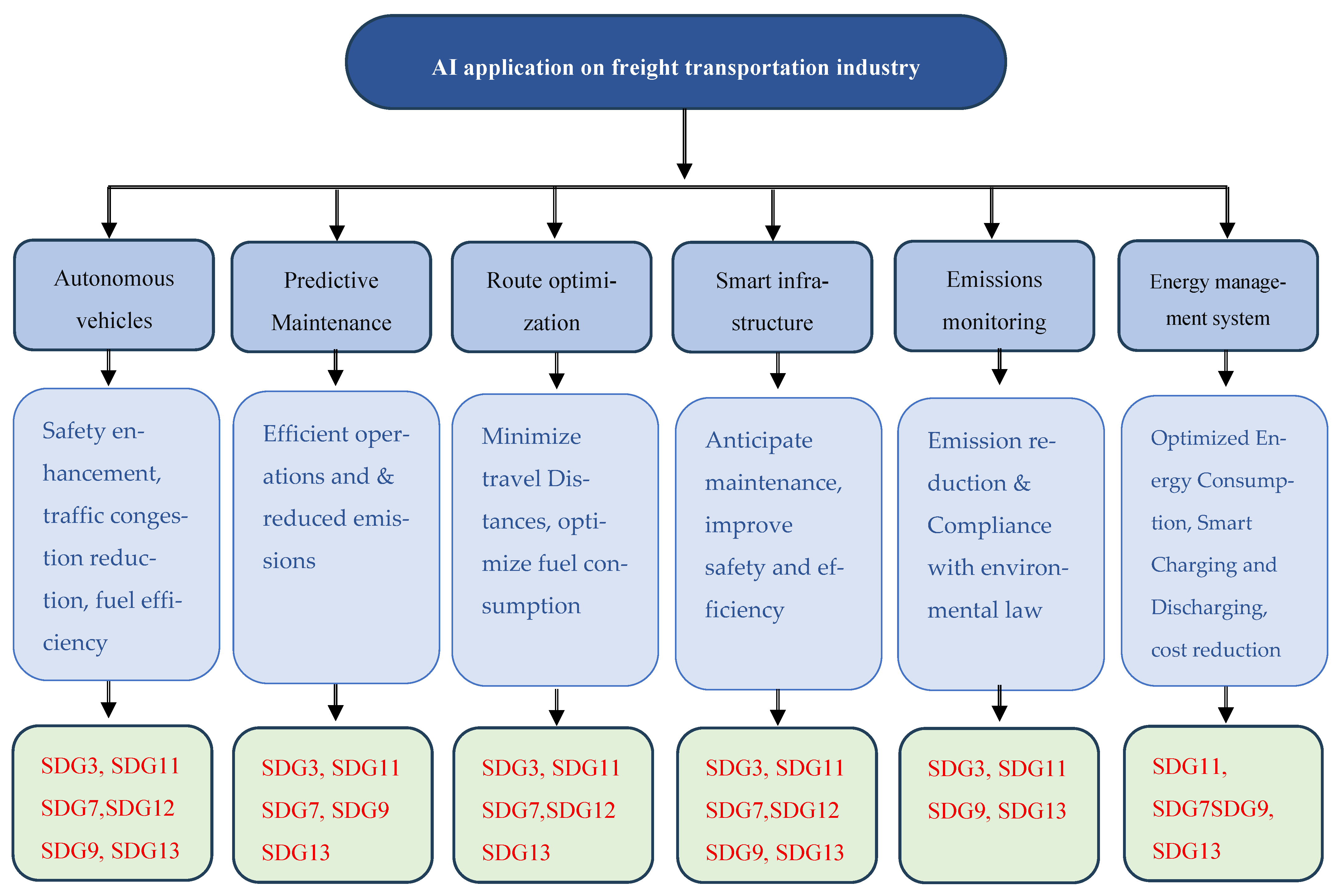
4.2. Proposed Framework for AI Integration in Freight Transportation Sector to Enhance SDGs
4.3. Key AI Algorithms and Integration Approaches
5. Empirical Study: Survey Insights from Moroccan Freight Companies
5.1. Methodology
5.2. Survey Results
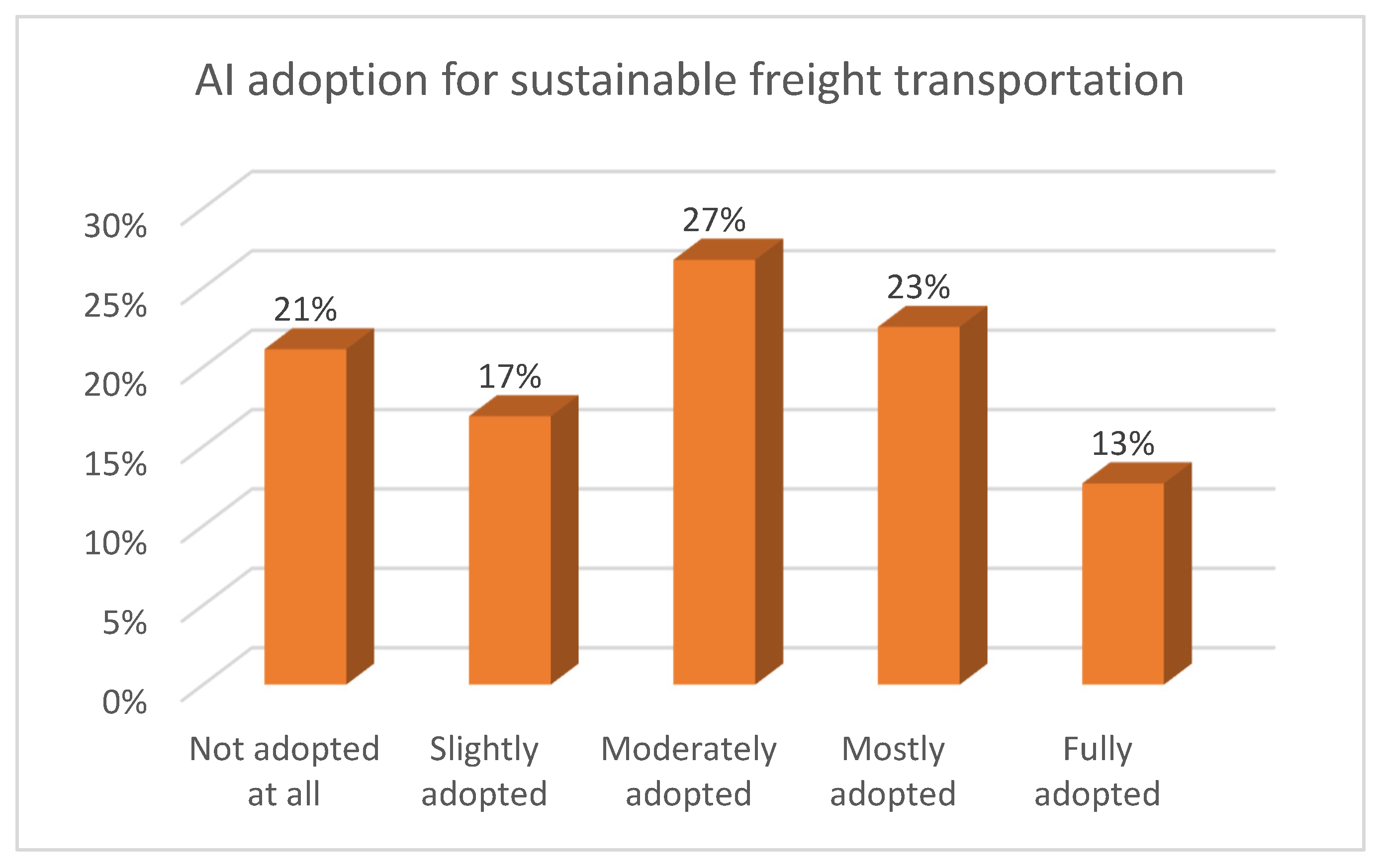
5.2.1. AI Adoption for Carbon Neutrality
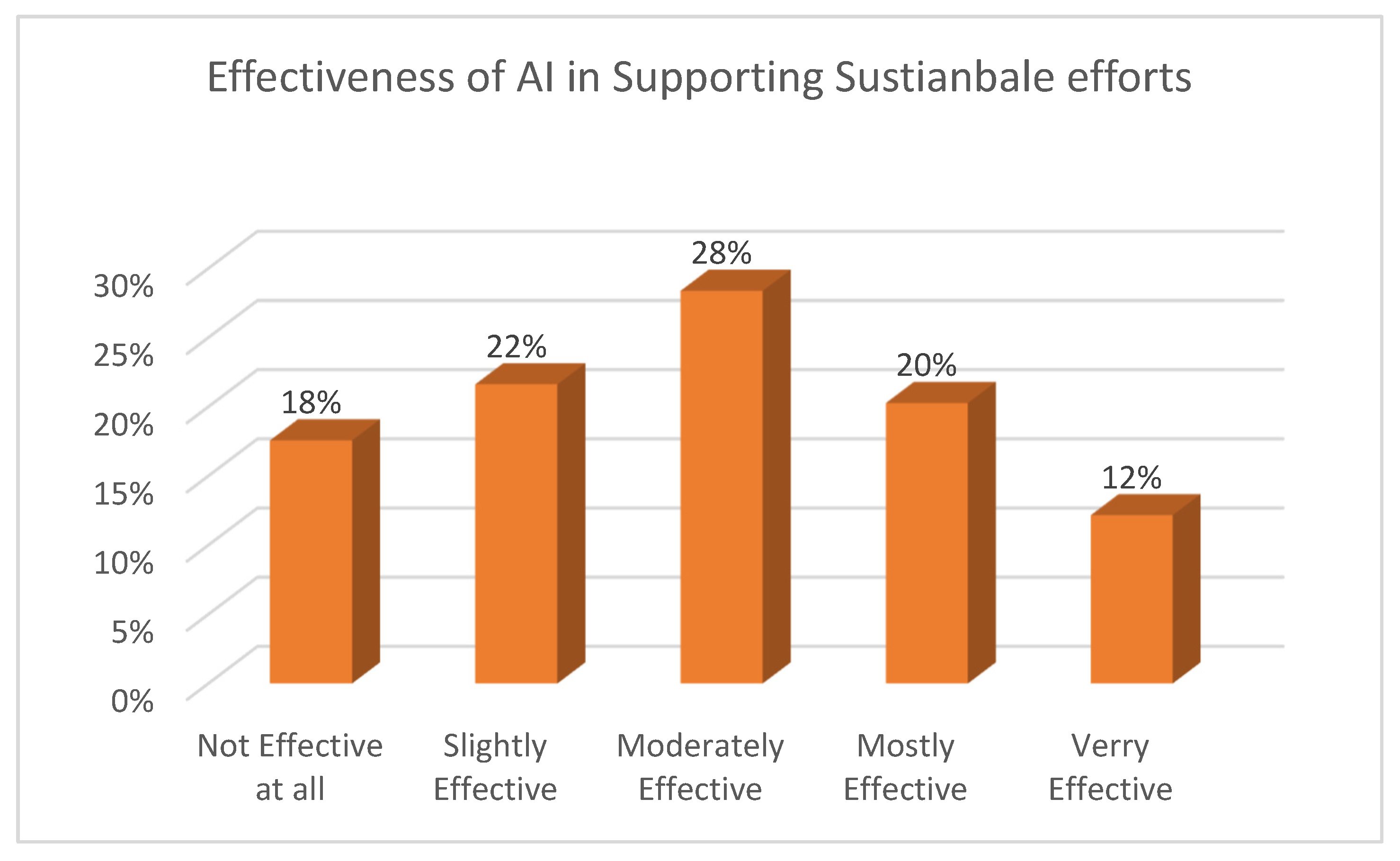
5.2.2. The Effectiveness of AI Adoption in Achieving Carbon Reduction Goals
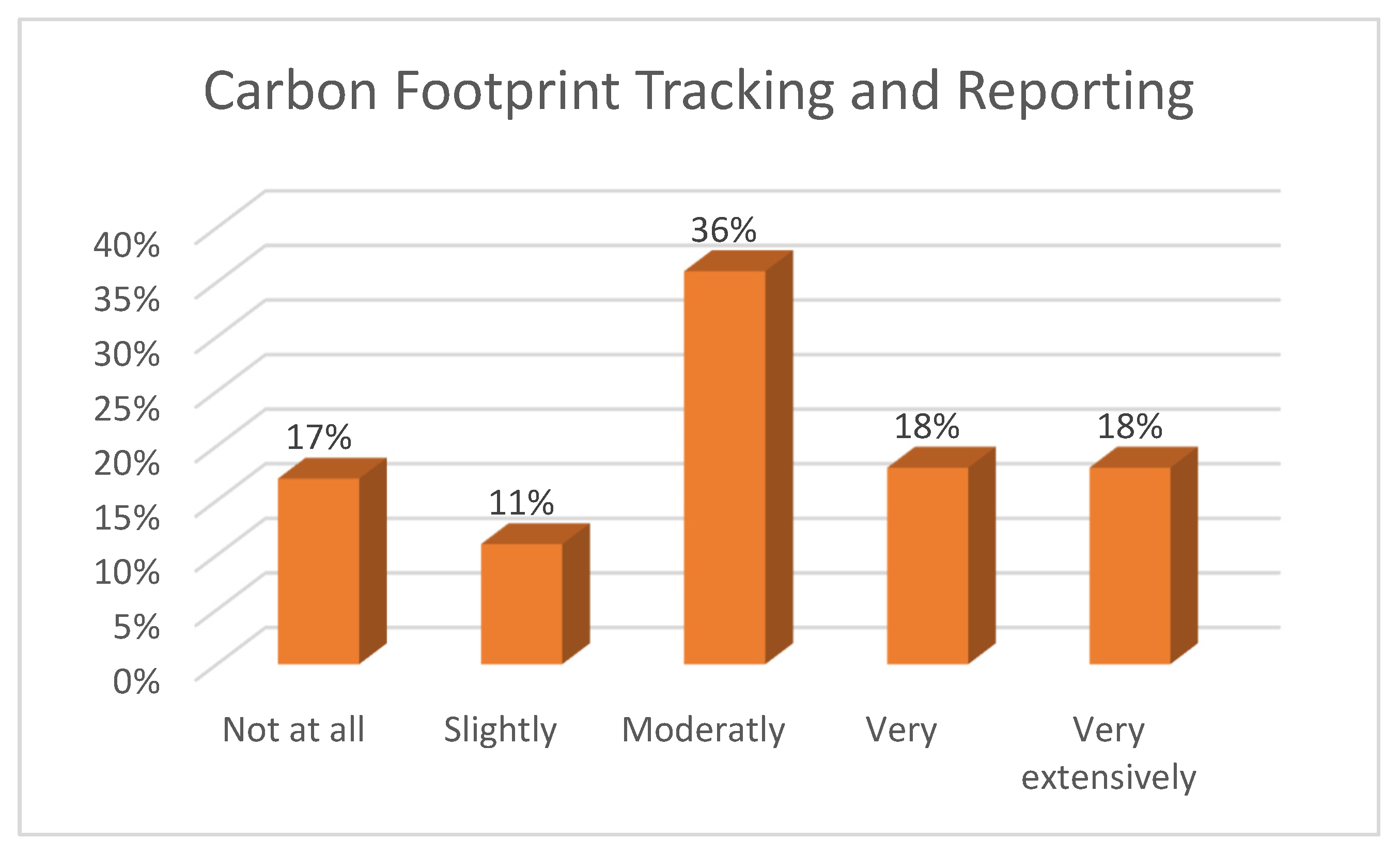
5.2.3. Carbon Footprint Monitoring and Reporting in Freight Transportation Sector
5.2.4. Challenges in Achieving Carbon Neutrality Within Freight Transportation Sector
6. Discussion
6.1. AI Adoption
6.2. AI Effectiveness
6.3. Carbon Emissions Tracking
6.4. Challenges and Barriers
7. Conclusions
Author Contributions
Funding
Institutional Review Board Statement
Informed Consent Statement
Data Availability Statement
Conflicts of Interest
References
- Mani, V.; Gunasekaran, A.; Delgado, C. Enhancing Supply Chain Performance through Supplier Social Sustainability: An Emerging Economy Perspective. Int. J. Prod. Econ. 2018, 195, 259–272. [Google Scholar] [CrossRef]
- Fulzele, V.; Shankar, R. Performance Measurement of Sustainable Freight Transportation: A Consensus Model and FERA Approach. Ann. Oper. Res. 2023, 324, 501–542. [Google Scholar] [CrossRef]
- Grushevenko, D.; Kapustin, N. Modelling of Energy Consumption in the Transport Sector. In Proceedings of the Rudenko International Conference “Methodological Problems in Reliability Study of Large Energy Systems” (RSES 2021), Volzhsky, Russia, 13–17 September 2021. [Google Scholar] [CrossRef]
- Dhulasi Priya, S.; Saranya, K.G. Significance of Artificial Intelligence in the Development of Sustainable Transportation. Sci. Temper 2023, 14, 418–425. [Google Scholar] [CrossRef]
- Ellram, L.M.; Murfield, M.L.U. Environmental Sustainability in Freight Transportation: A Systematic Literature Review and Agenda for Future Research. Transp. J. 2017, 56, 263–298. [Google Scholar] [CrossRef]
- Abdullahi, I.; Larijani, H.; Liarokapis, D.; Paterson, J.; Jones, D.; Murray, S. A Data-Intelligence-Driven Digital Twin Framework for Improving Sustainability in Logistics. Appl. Sci. 2025, 15, 601. [Google Scholar] [CrossRef]
- Hussain, K.M. Revolutionizing Route Optimization Systems with Artificial Intelligence for a Smarter, Sustainable Logistics Ecosystem. Int. J. Comput. Sci. Mob. Comput. 2025, 14, 66–68. [Google Scholar] [CrossRef]
- Ke, H.; Xu, G.; Li, C.; Gao, J.; Xiao, X.; Wu, X.; Yan, Q. Optimization of China’s Freight Transportation Structure Based on Adaptive Genetic Algorithm under the Background of Carbon Peak. Environ. Sci. Pollut. Res. 2023, 30, 85087–85101. [Google Scholar] [CrossRef] [PubMed]
- Temizceri, F.T.; Kara, S.S. Towards Sustainable Logistics in Turkey: A Bi-Objective Approach to Green Intermodal Freight Transportation Enhanced by Machine Learning. Res. Transp. Bus. Manag. 2024, 55, 101145. [Google Scholar] [CrossRef]
- Aloui, A.; Hamani, N.; Delahoche, L. An Integrated Optimization Approach Using a Collaborative Strategy for Sustainable Cities Freight Transportation: A Case Study. Sustain. Cities Soc. 2021, 75, 103331. [Google Scholar] [CrossRef]
- Tjandra, S.; Kraus, S.; Ishmam, S.; Grube, T.; Linßen, J.; May, J.; Stolten, D. Model-Based Analysis of Future Global Transport Demand. Transp. Res. Interdiscip. Perspect. 2024, 23, 101016. [Google Scholar] [CrossRef]
- Kwilinski, A.; Lyulyov, O.; Pimonenko, T. Environmental Sustainability within Attaining Sustainable Development Goals: The Role of Digitalization and the Transport Sector. Sustainability 2023, 15, 11282. [Google Scholar] [CrossRef]
- Stanković, M. The Economic Importance of Transportation Sector. Knowl.-Int. J. 2021, 47, 143–146. [Google Scholar] [CrossRef]
- Fatorachian, H.; Kazemi, H.; Pawar, K. Digital Transformation for Sustainable Transportation: Leveraging Industry 4.0 Technologies to Optimize Efficiency and Reduce Emissions. Future Transp. 2025, 5, 34. [Google Scholar] [CrossRef]
- Sharma, A.; Strezov, V. Life Cycle Environmental and Economic Impact Assessment of Alternative Transport Fuels and Power-Train Technologies. Energy 2017, 133, 1132–1141. [Google Scholar] [CrossRef]
- International Transport Forum. ITF Transport Outlook 2019; OECD: Paris, France, 2019; ISBN 978-92-821-0388-3. [Google Scholar]
- Jouzdani, J.; Govindan, K. On the Sustainable Perishable Food Supply Chain Network Design: A Dairy Products Case to Achieve Sustainable Development Goals. J. Clean. Prod. 2021, 278, 123060. [Google Scholar] [CrossRef]
- Ajao, A. Effects of Freight Rates on Road Transportation of Agricultural Product in Southwest Nigeria. Niger. J. Logist. Transp. 2024, 15, 185–202. [Google Scholar] [CrossRef]
- Schulte, J.; Ny, H. Electric Road Systems: Strategic Stepping Stone on the Way towards Sustainable Freight Transport? Sustainability 2018, 10, 1148. [Google Scholar] [CrossRef]
- Gandhi, N.; Kant, R.; Thakkar, J.J.; Shankar, R. Prioritizing Solutions to Mitigate the Risks Due to Adoption of Intermodal Railroad Freight Transportation for Achieving Sustainable Development Goals. J. Clean. Prod. 2024, 435, 140535. [Google Scholar] [CrossRef]
- Centobelli, P.; Cerchione, R.; Esposito, E. Pursuing Supply Chain Sustainable Development Goals through the Adoption of Green Practices and Enabling Technologies: A Cross-Country Analysis of LSPs. Technol. Forecast. Soc. Chang. 2020, 153, 119920. [Google Scholar] [CrossRef]
- Lu, C.; Fang, Y.; Fang, J. A New Method to Evaluate the Coordination of Freight Transport and Economy for Sustainable Development. J. Innov. Knowl. 2022, 7, 100254. [Google Scholar] [CrossRef]
- Maparu, T.S.; Mazumder, T.N. Transport Infrastructure, Economic Development and Urbanization in India (1990–2011): Is There Any Causal Relationship? Transp. Res. Part A Policy Pract. 2017, 100, 319–336. [Google Scholar] [CrossRef]
- Kumar, A.; Anbanandam, R. Assessment of Environmental and Social Sustainability Performance of the Freight Transportation Industry: An Index-Based Approach. Transp. Policy 2022, 124, 43–60. [Google Scholar] [CrossRef]
- De Bruin, K.; Yakut, A.M. The Impacts of Removing Fossil Fuel Subsidies and Increasing Carbon Taxation in Ireland. Environ. Resour. Econ. 2023, 85, 741–782. [Google Scholar] [CrossRef]
- Bakioğlu, G. Prioritization of Digital Technology Applications in Intermodal Freight Transport Using CRITIC-Based Picture Fuzzy TOPSIS Method. Int. J. Automot. Sci. Technol. 2025, 9, 230–240. [Google Scholar] [CrossRef]
- Kumar, A.; Calzavara, M.; Velaga, N.R.; Choudhary, A.; Shankar, R. Modelling and Analysis of Sustainable Freight Transportation. Int. J. Prod. Res. 2019, 57, 6086–6089. [Google Scholar] [CrossRef]
- Khan, M.I.; Yasmin, T.; Shakoor, A. Technical Overview of Compressed Natural Gas (CNG) as a Transportation Fuel. Renew. Sustain. Energy Rev. 2015, 51, 785–797. [Google Scholar] [CrossRef]
- Muratori, M.; Smith, S.J.; Kyle, P.; Link, R.; Mignone, B.K.; Kheshgi, H.S. Role of the Freight Sector in Future Climate Change Mitigation Scenarios. Environ. Sci. Technol. 2017, 51, 3526–3533. [Google Scholar] [CrossRef]
- Vanek, F. Mode and Commodity Perspectives on U.S. Freight Energy Consumption and CO2 Emissions: Insights and Directions for Improvement. Int. J. Sustain. Transp. 2019, 13, 741–760. [Google Scholar] [CrossRef]
- Andrlík, B. Measuring Costs of Noise Pollution Generated by Freight Transport: Case of the Slovak and Czech Republic. Eur. Transp./Trasp. Eur. 2021, 1–18. [Google Scholar] [CrossRef]
- Boldizsár, A. Environmental Impact of Freight Transport–Freight Footprint as a New Freight Transport Indicator. Period. Polytech. Transp. Eng. 2023, 52, 18–23. [Google Scholar] [CrossRef]
- Mansoursamaei, M.; Moradi, M.; González-Ramírez, R.G.; Lalla-Ruiz, E. Machine Learning for Promoting Environmental Sustainability in Ports. J. Adv. Transp. 2023, 2023, 2144733. [Google Scholar] [CrossRef]
- Yadav, M.; Singh, G. Environmental Sustainability with Artificial Intelligence. EPRA Int. J. Multidiscip. Res. 2023, 9, 213–217. [Google Scholar] [CrossRef]
- Linke, R.; Wilke, J.K.; Öztürk, Ö.; Schöpp, F.; Kassens-Noor, E. The Future of the eHighway System: A Vision of a Sustainable, Climate-Resilient, and Artificially Intelligent Megaproject. J. Mega Infrastruct. Sustain. Dev. 2022, 2, 51–64. [Google Scholar] [CrossRef]
- Bhardwaj, V. AI-Enabled Autonomous Driving: Enhancing Safety and Efficiency through Predictive Analytics. Int. J. Sci. Res. Manag. 2024, 12, 1076–1094. [Google Scholar] [CrossRef]
- Rana, K.; Khatri, N. Automotive Intelligence: Unleashing the Potential of AI beyond Advance Driver Assisting System, a Comprehensive Review. Comput. Electr. Eng. 2024, 117, 109237. [Google Scholar] [CrossRef]
- Sever, T.; Contissa, G. Automated Driving Regulations–Where Are We Now? Transp. Res. Interdiscip. Perspect. 2024, 24, 101033. [Google Scholar] [CrossRef]
- Zhao, L.; Malikopoulos, A.A. Enhanced Mobility with Connectivity and Automation: A Review of Shared Autonomous Vehicle Systems. IEEE Intell. Transp. Syst. Mag. 2022, 14, 87–102. [Google Scholar] [CrossRef]
- Makahleh, H.Y.; Ferranti, E.J.S.; Dissanayake, D. Assessing the Role of Autonomous Vehicles in Urban Areas: A Systematic Review of Literature. Future Transp. 2024, 4, 321–348. [Google Scholar] [CrossRef]
- Monios, J.; Bergqvist, R. The Transport Geography of Electric and Autonomous Vehicles in Road Freight Networks. J. Transp. Geogr. 2019, 80, 102500. [Google Scholar] [CrossRef]
- Faisal, A.; Yigitcanlar, T.; Kamruzzaman, M.d.; Currie, G. Understanding Autonomous Vehicles: A Systematic Literature Review on Capability, Impact, Planning and Policy. J. Transp. Land Use 2019, 12, 45–72. [Google Scholar] [CrossRef]
- Jones, E.C.; Leibowicz, B.D. Contributions of Shared Autonomous Vehicles to Climate Change Mitigation. Transp. Res. Part D Transp. Environ. 2019, 72, 279–298. [Google Scholar] [CrossRef]
- Silva, Ó.; Cordera, R.; González-González, E.; Nogués, S. Environmental Impacts of Autonomous Vehicles: A Review of the Scientific Literature. Sci. Total Environ. 2022, 830, 154615. [Google Scholar] [CrossRef]
- Kansal, L.; Ediga, P. IoT-Enabled Predictive Maintenance for Sustainable Transportation Fleets. MATEC Web Conf. 2024, 392, 01189. [Google Scholar] [CrossRef]
- Ojeda, J.C.O.; De Moraes, J.G.B.; Filho, C.V.D.S.; Pereira, M.D.S.; Pereira, J.V.D.Q.; Dias, I.C.P.; Da Silva, E.C.M.; Peixoto, M.G.M.; Gonçalves, M.C. Application of a Predictive Model to Reduce Unplanned Downtime in Automotive Industry Production Processes: A Sustainability Perspective. Sustainability 2025, 17, 3926. [Google Scholar] [CrossRef]
- Ersöz, O.Ö.; İnal, A.F.; Aktepe, A.; Türker, A.K.; Ersöz, S. A Systematic Literature Review of the Predictive Maintenance from Transportation Systems Aspect. Sustainability 2022, 14, 14536. [Google Scholar] [CrossRef]
- Kliestik, T.; Nica, E.; Durana, P.; Popescu, G.H. Artificial Intelligence-Based Predictive Maintenance, Time-Sensitive Networking, and Big Data-Driven Algorithmic Decision-Making in the Economics of Industrial Internet of Things. Oeconomia Copernic. 2023, 14, 1097–1138. [Google Scholar] [CrossRef]
- Fan, Z.; Yan, Z.; Wen, S. Deep Learning and Artificial Intelligence in Sustainability: A Review of SDGs, Renewable Energy, and Environmental Health. Sustainability 2023, 15, 13493. [Google Scholar] [CrossRef]
- Saravanan, M.R.; Selvan, M.C.; Ajay, M.A. AI-Enabled Logistics: A Key to Achieving India’s Sustainable Development Goals. In Proceedings of the Artificial Intelligence in Logistics and Supply Chain Management: Ethical Implications in Automation, Transparency & Sustainability, Pollachi, India, 7 March 2025. [Google Scholar]
- Serradilla, O.; Zugasti, E.; Rodriguez, J.; Zurutuza, U. Deep Learning Models for Predictive Maintenance: A Survey, Comparison, Challenges and Prospects. Appl. Intell. 2022, 52, 10934–10964. [Google Scholar] [CrossRef]
- Leal Filho, W.; Mbah, M.F.; Dinis, M.A.P.; Trevisan, L.V.; De Lange, D.; Mishra, A.; Rebelatto, B.; Ben Hassen, T.; Aina, Y.A. The Role of Artificial Intelligence in the Implementation of the UN Sustainable Development Goal 11: Fostering Sustainable Cities and Communities. Cities 2024, 150, 105021. [Google Scholar] [CrossRef]
- Ge, X.; Jin, Y. Sustainability Oriented Vehicle Route Planning Based on Time-Dependent Arc Travel Durations. Sustainability 2023, 15, 3208. [Google Scholar] [CrossRef]
- Jahagirdar, S.; Jahagirdar, S.; Apandkar, A. Green Logistics and Sustainable Transportation: Ai-Based Route Optimization, Carbon Footprint Reduction, And the Future of Eco-Friendly Supply Chains. J. Inform. Educ. Res. 2025, 5, 3167–3183. [Google Scholar] [CrossRef]
- Kumar, A.; Sharma, S.; Goyal, N.; Singh, A.; Cheng, X.; Singh, P. Secure and Energy-Efficient Smart Building Architecture with Emerging Technology IoT. Comput. Commun. 2021, 176, 207–217. [Google Scholar] [CrossRef]
- Galkin, A.; Samchuk, G.; Kopytkov, D.; Thompson, R.G. Digital Twins in Logistics: A Comprehensive Bibliometric Analysis for Advancing Smart Cities and Sustainable Development. Discov. Sustain. 2025, 6, 853. [Google Scholar] [CrossRef]
- Pan, S.; Zhou, W.; Piramuthu, S.; Giannikas, V.; Chen, C. Smart City for Sustainable Urban Freight Logistics. Int. J. Prod. Res. 2021, 59, 2079–2089. [Google Scholar] [CrossRef]
- Kataria, A.; Rani, S.; Kautish, S. Artificial Intelligence of Things for Sustainable Development of Smart City Infrastructures. In Digital Technologies to Implement the UN Sustainable Development Goals; Leal Filho, W., Kautish, S., Wall, T., Rewhorn, S., Paul, S.K., Eds.; Springer Nature: Cham, Switzerland, 2024; pp. 187–213. ISBN 978-3-031-68427-2. [Google Scholar]
- Yavari, A.; Mirza, I.B.; Bagha, H.; Korala, H.; Dia, H.; Scifleet, P.; Sargent, J.; Tjung, C.; Shafiei, M. ArtEMon: Artificial Intelligence and Internet of Things Powered Greenhouse Gas Sensing for Real-Time Emissions Monitoring. Sensors 2023, 23, 7971. [Google Scholar] [CrossRef]
- Mohsen, B.M.; Mohsen, M. Reducing Emissions Through AI-Driven Multimodal Transport Optimization in IoT-Connected Environments. Int. J. Energy Res. 2025, 2025, 2399288. [Google Scholar] [CrossRef]
- Davydenko, L.; Davydenko, N.; Bosak, A.; Bosak, A.; Deja, A.; Dzhuguryan, T. Smart Sustainable Freight Transport for a City Multi-Floor Manufacturing Cluster: A Framework of the Energy Efficiency Monitoring of Electric Vehicle Fleet Charging. Energies 2022, 15, 3780. [Google Scholar] [CrossRef]
- Douaidi, L. Artificial Intelligence-Driven Optimization of Electric Vehicle Charging Infrastructure and User-Centric Experience. Ph.D. Thesis, Université Bourgogne Europe, Dijon, France, 2025. [Google Scholar]
- Hannan, M.A.; Al-Shetwi, A.Q.; Ker, P.J.; Begum, R.A.; Mansor, M.; Rahman, S.A.; Dong, Z.Y.; Tiong, S.K.; Mahlia, T.M.I.; Muttaqi, K.M. Impact of Renewable Energy Utilization and Artificial Intelligence in Achieving Sustainable Development Goals. Energy Rep. 2021, 7, 5359–5373. [Google Scholar] [CrossRef]
- Kulkov, I.; Kulkova, J.; Rohrbeck, R.; Menvielle, L.; Kaartemo, V.; Makkonen, H. Artificial Intelligence-Driven Sustainable Development: Examining Organizational, Technical, and Processing Approaches to Achieving Global Goals. Sustain. Dev. 2024, 32, 2253–2267. [Google Scholar] [CrossRef]
- Chowdhury, W.A. AI for Multimodal Transport Optimization: Integrating Air, Sea, and Land Logistics for Efficiency. J. Inf. Syst. Eng. Manag. 2025, 10, 1088–1092. [Google Scholar] [CrossRef]
- Rahiminia, S.; Mehrabi, A.; Jabbarzadeh, A.; Aghaee, M.P. A Hybrid Optimization Approach for Designing Sustainable Intermodal Freight Transport under Mixed Uncertainty. Socio-Econ. Plan. Sci. 2025, 98, 102146. [Google Scholar] [CrossRef]
- Pattanaik, V.; Singh, M.; Gupta, P.K.; Singh, S.K. Smart Real-Time Traffic Congestion Estimation and Clustering Technique for Urban Vehicular Roads. In Proceedings of the IEEE Region 10 Conference (TENCON), Singapore, 22–25 November 2016; pp. 3420–3423. [Google Scholar]
- Luqman, A.; Zhang, Q.; Talwar, S.; Bhatia, M.; Dhir, A. Artificial Intelligence and Corporate Carbon Neutrality: A Qualitative Exploration. Bus. Strat. Env. 2024, 33, 3986–4003. [Google Scholar] [CrossRef]
- Jankovic, S.D.; Curovic, D.M. Strategic Integration of Artificial Intelligence for Sustainable Businesses: Implications for Data Management and Human User Engagement in the Digital Era. Sustainability 2023, 15, 15208. [Google Scholar] [CrossRef]
- Fatorachian, H.; Kazemi, H. Leveraging Technology and Sustainability Practices for Smart Mobility and Green Logistics: A Dual-Theoretical Approach to Adoption Dynamics. Int. J. Sustain. Eng. 2025, 18, 2531890. [Google Scholar] [CrossRef]
- Soomro, R.B.; Al-Rahmi, W.M.; Dahri, N.A.; Almuqren, L.; Al-mogren, A.S.; Aldaijy, A. A SEM–ANN Analysis to Examine Impact of Artificial Intelligence Technologies on Sustainable Performance of SMEs. Sci. Rep. 2025, 15, 5438. [Google Scholar] [CrossRef]
- Selvi, M.V.; Upadhyay, P.; Revathi, A.; Punitha, N.; Saravanakumar, M. Enhancing Urban AI-Powered Transportation Systems with Machine Learning. In Urban Mobility and Challenges of Intelligent Transportation Systems; IGI Global Scientific Publishing: Hershey, PA, USA, 2025; pp. 363–382. [Google Scholar]
- Barua, L.; Zou, B.; Zhou, Y. Machine Learning for International Freight Transportation Management: A Comprehensive Review. Res. Transp. Bus. Manag. 2020, 34, 100453. [Google Scholar] [CrossRef]
- Xia, W.; Zhou, D.; Xia, Q.; Zhang, L. Design and Implementation Path of Intelligent Transportation Information System Based on Artificial Intelligence Technology. J. Eng. 2020, 2020, 482–485. [Google Scholar] [CrossRef]
- Parthasarathy, V. AI-Driven Carbon Footprint Tracking and Emission Reduction in Logistics Networks. J. Artif. Intell. Data Sci. Mach. Learn. 2024, 5, 47–56. [Google Scholar] [CrossRef]
- Böhm, M.; Nanni, M.; Pappalardo, L. Gross Polluters and Vehicle Emissions Reduction. Nat. Sustain. 2022, 5, 699–707. [Google Scholar] [CrossRef]
- Chen, L.; Msigwa, G.; Yang, M.; Osman, A.I.; Fawzy, S.; Rooney, D.W.; Yap, P.-S. Strategies to Achieve a Carbon Neutral Society: A Review. Environ. Chem. Lett. 2022, 20, 2277–2310. [Google Scholar] [CrossRef]
- Wintergreen, J. ISO 14064 International Standard for GHG Emissions Inventories and Verification; United States Environmental Protection Agency: Washington, DC, USA, 2007. [Google Scholar]
- Funk, B.; Niemeyer, P.; Gómez, J.M. (Eds.) Information Technology in Environmental Engineering: Selected Contributions to the Sixth International Conference on Information Technologies in Environmental Engineering (ITEE2013); Environmental Science and Engineering; Springer: Berlin/Heidelberg, Germany, 2014; ISBN 978-3-642-36010-7. [Google Scholar]
- Wong, E.Y.C.; Tai, A.H.; Zhou, E. Optimising Truckload Operations in Third-Party Logistics: A Carbon Footprint Perspective in Volatile Supply Chain. Transp. Res. Part D Transp. Environ. 2018, 63, 649–661. [Google Scholar] [CrossRef]
- Albuquerque, V.; Pereira, F.; Rocha, J.; Dias, M.S.; Ferreira, J.C. Sustainability Measurement in a Logistics Transportation Company. Transp. Res. Procedia 2023, 72, 48–55. [Google Scholar] [CrossRef]
- Abduljabbar, R.; Dia, H.; Liyanage, S.; Bagloee, S.A. Applications of Artificial Intelligence in Transport: An Overview. Sustainability 2019, 11, 189. [Google Scholar] [CrossRef]
- Guntuka, L.; Mukandwal, P.S.; Aktas, E.; Paluvadi, V.S.K. From Carbon-Neutral to Climate-Neutral Supply Chains: A Multidisciplinary Review and Research Agenda. Int. J. Logist. Manag. 2024, 35, 916–942. [Google Scholar] [CrossRef]
- Kirikkaleli, D.; Ali, K.; Zhang, Q.; Kirikkaleli, N.O. Environmental Sustainability in the USA: Role of Artificial Intelligence. Sustain. Futures 2025, 9, 100823. [Google Scholar] [CrossRef]



| Sustainable Development Goals | Targets |
|---|---|
| SDG2—Zero hunger | Target 2.3 Double the agricultural productivity and income of small-scale food producers (access to markets) |
| SDG 3—Good health and well-being | Target 3.6 Halve number of global deaths and road injuries from traffic accidents |
| Target 3.9 Reduce deaths and illnesses from pollution | |
| SDG 7—Affordable and Clean Energy | Target 7.3 Double the global rate of improvement in energy efficiency |
| SDG 9—Industry, Innovation, and Infrastructure | Target 9.1 Develop sustainable and resilient infrastructure |
| SDG 11—Sustainable Cities and Communities | Target 11.2 Provide access to safe, affordable, accessible and sustainable transport systems for all |
| Target 11.6 Reduce the adverse environmental impact of cities | |
| SDG 12—Responsible consumption and production | Target 12.c Rationalize inefficient fossil-fuel subsidies |
| SDG 13—Climate action | Target 13.1 Strengthen resilience |
| Target 13.2 Integrate climate change measures into national plans |
| AI Technique | Application | Sustainability Impact | Case Study | References |
|---|---|---|---|---|
| Reinforcement Learning | Fleet management and operational optimization | Enabled a 20–30% decrease in carbon emissions across selected transport operations | UK, John G Russell (Transport) | [6,7] |
| Genetic Algorithms | Route planning and logistics optimization | Achieved over 10% reduction in emissions and energy use, along with improved cost-efficiency and delivery paths | China’s freight transportation | [4,8] |
| Machine learning | Emission forecasting and logistics planning | Supported the prediction of CO2 output and development of low-impact intermodal transport strategies | Izmir to Europe freight corridor | [9] |
| Digital Twin | Simulation of logistics operations | Reduced empty vehicle trips through virtual modeling and scenario testing | UK, John G Russell (Transport) | [6] |
| Supervised & Reinforcement Learning | Cost and performance optimization | lowered transit costs by 20%, improved delivery timeliness by 15%, and cut carbon footprint by 10% | U.S.-based logistics firm Trans Co | [65] |
| AI-Driven Multimodal Optimization | Intermodal network planning and inventory control | Reduced total logistics costs and emissions while guiding strategic decisions on terminal placement and inventory flow | Rail-road intermodal network | [66] |
| conventional techniques | Urban traffic congestion management | Significantly shortened travel time compared to traditional routing methods | New Delhi, India | [67] |
| AI-Enhanced Logistics Platforms | Delivery route optimization | Reduced transportation expenses by up to 20% and fuel consumption by approximately 15% | Unknown | [50,54] |
| AI route optimization | Mileage reduction and fuel efficiency | Removed unnecessary travel distances, saving millions of gallons of fuel annually | UPS and DHL | [54] |
| Hybrid Heuristic with Machine Learning | Agri-food logistics optimization | Delivered a 20% drop in logistics costs, 16% fewer CO2 emissions, and an 8% reduction in accident risk | French agri-food sector | [10] |
Disclaimer/Publisher’s Note: The statements, opinions and data contained in all publications are solely those of the individual author(s) and contributor(s) and not of MDPI and/or the editor(s). MDPI and/or the editor(s) disclaim responsibility for any injury to people or property resulting from any ideas, methods, instructions or products referred to in the content. |
© 2025 by the authors. Licensee MDPI, Basel, Switzerland. This article is an open access article distributed under the terms and conditions of the Creative Commons Attribution (CC BY) license (https://creativecommons.org/licenses/by/4.0/).
Share and Cite
Moumni, H.; Bannari, R.; Oufaska, K. Leveraging AI for Sustainable Freight Transportation: Survey Insights from Moroccan Transport Companies. Sustainability 2025, 17, 10628. https://doi.org/10.3390/su172310628
Moumni H, Bannari R, Oufaska K. Leveraging AI for Sustainable Freight Transportation: Survey Insights from Moroccan Transport Companies. Sustainability. 2025; 17(23):10628. https://doi.org/10.3390/su172310628
Chicago/Turabian StyleMoumni, Hajar, Rachid Bannari, and Kenza Oufaska. 2025. "Leveraging AI for Sustainable Freight Transportation: Survey Insights from Moroccan Transport Companies" Sustainability 17, no. 23: 10628. https://doi.org/10.3390/su172310628
APA StyleMoumni, H., Bannari, R., & Oufaska, K. (2025). Leveraging AI for Sustainable Freight Transportation: Survey Insights from Moroccan Transport Companies. Sustainability, 17(23), 10628. https://doi.org/10.3390/su172310628