Impact of Regulation on the Water Quality of a Mediterranean River: The Case of the Biobío River

Abstract
1. Introduction
2. Materials and Methods
2.1. Study Area
2.2. Data Sources
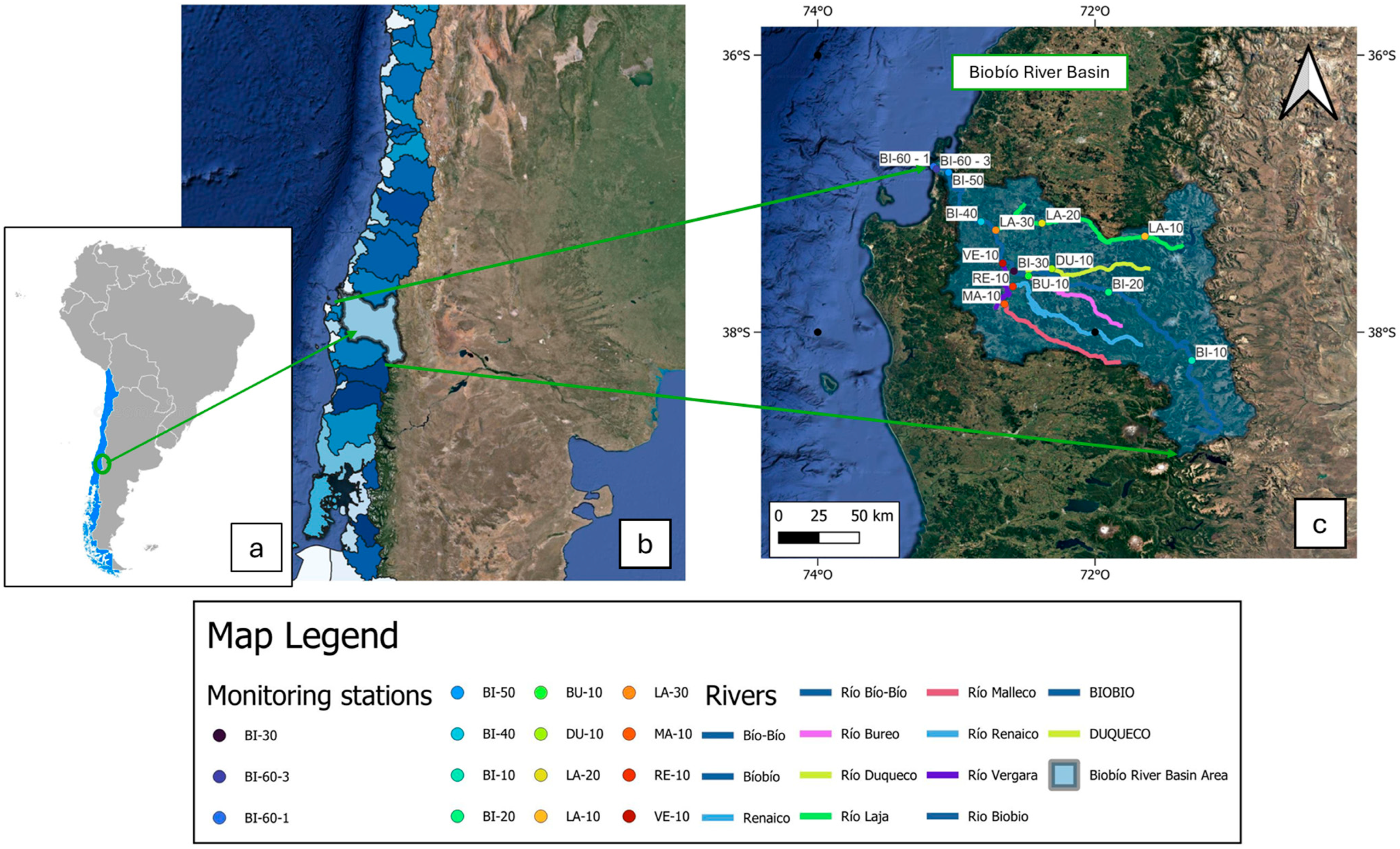
- Centro de Ciencias Ambientales EULA-Chile systematically and consistently collected and processed Water Quality Index (WQI) data for the Biobío River Basin as part of the Biobío River Water Quality Monitoring Program (PMBB) between 1994 and 2017 [19].
- The Dirección General de Aguas (DGA) of Chile, which provided water quality records for the period 2018–2023 [11].
2.3. Physicochemical Variables and Analytical Methods
2.4. Calculation of the Water Quality Index (WQI)
2.5. Data Analysis
- The detection of periods of sustained WQI improvement following the implementation of environmental regulations.
- The identification of phases of relaxation or stabilization in WQI values, potentially associated with a decline in the perceived level of “fiscalización” (environmental enforcement), as it is locally referred to in Chile. From this point forward, the term “enforcement” will be used to refer to “fiscalización”.
- The evaluation of differences between mainstem and secondary tributary stations highlighted the effects of localized anthropogenic pressures.
2.6. Conceptual Modeling
- The enactment and implementation of environmental regulatory instruments.
- The social perception of environmental risk and regulatory enforcement.
- The level of environmental compliance among water users.
- Resulting changes in water quality, measured using the Water Quality Index (WQI).
3. Results
3.1. General Trend of the Water Quality Index (WQI) in the Biobío River Basin (1994–2023)
3.2. Association Between Regulatory Milestones and Responses Observed in the WQI
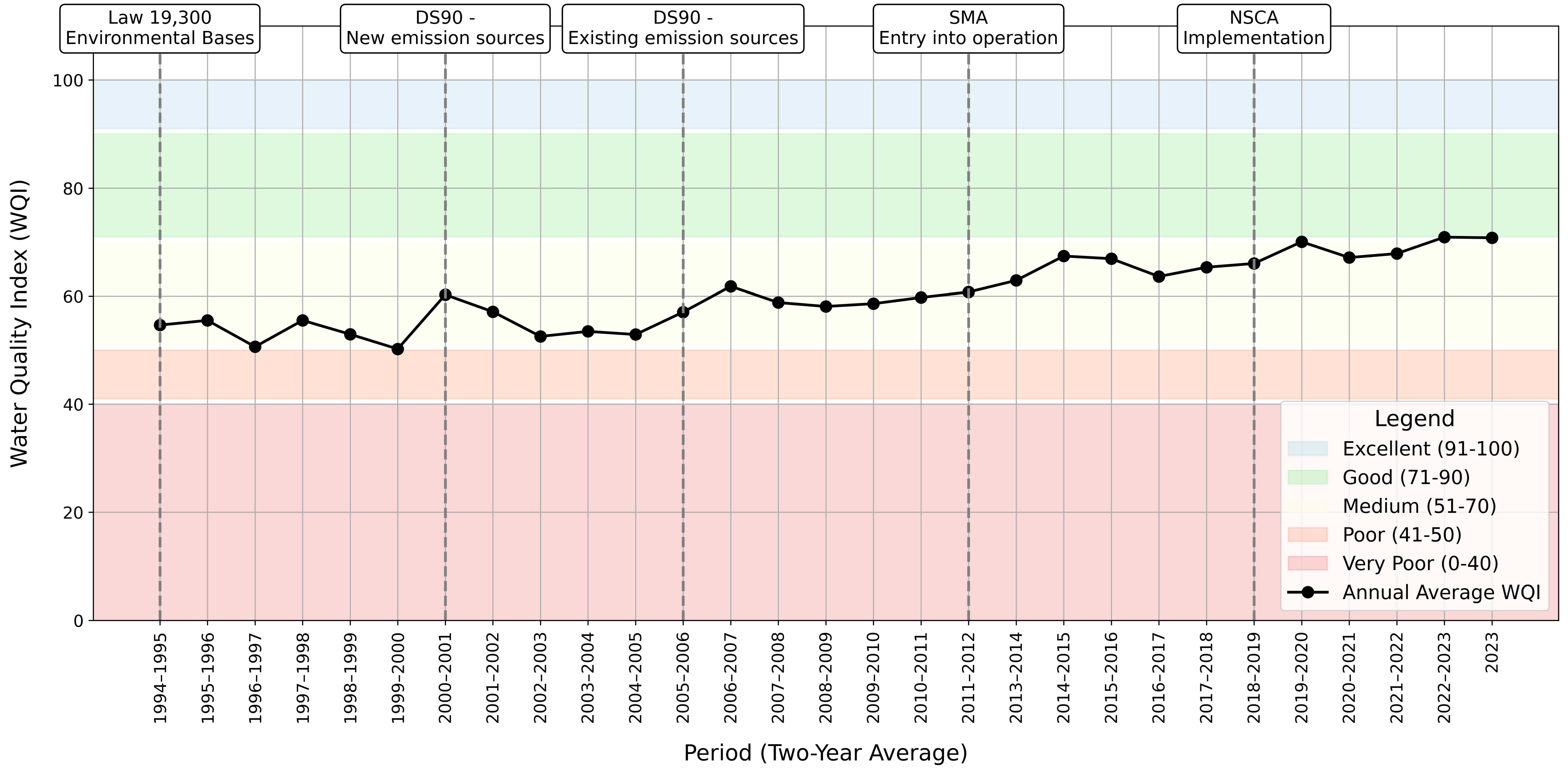
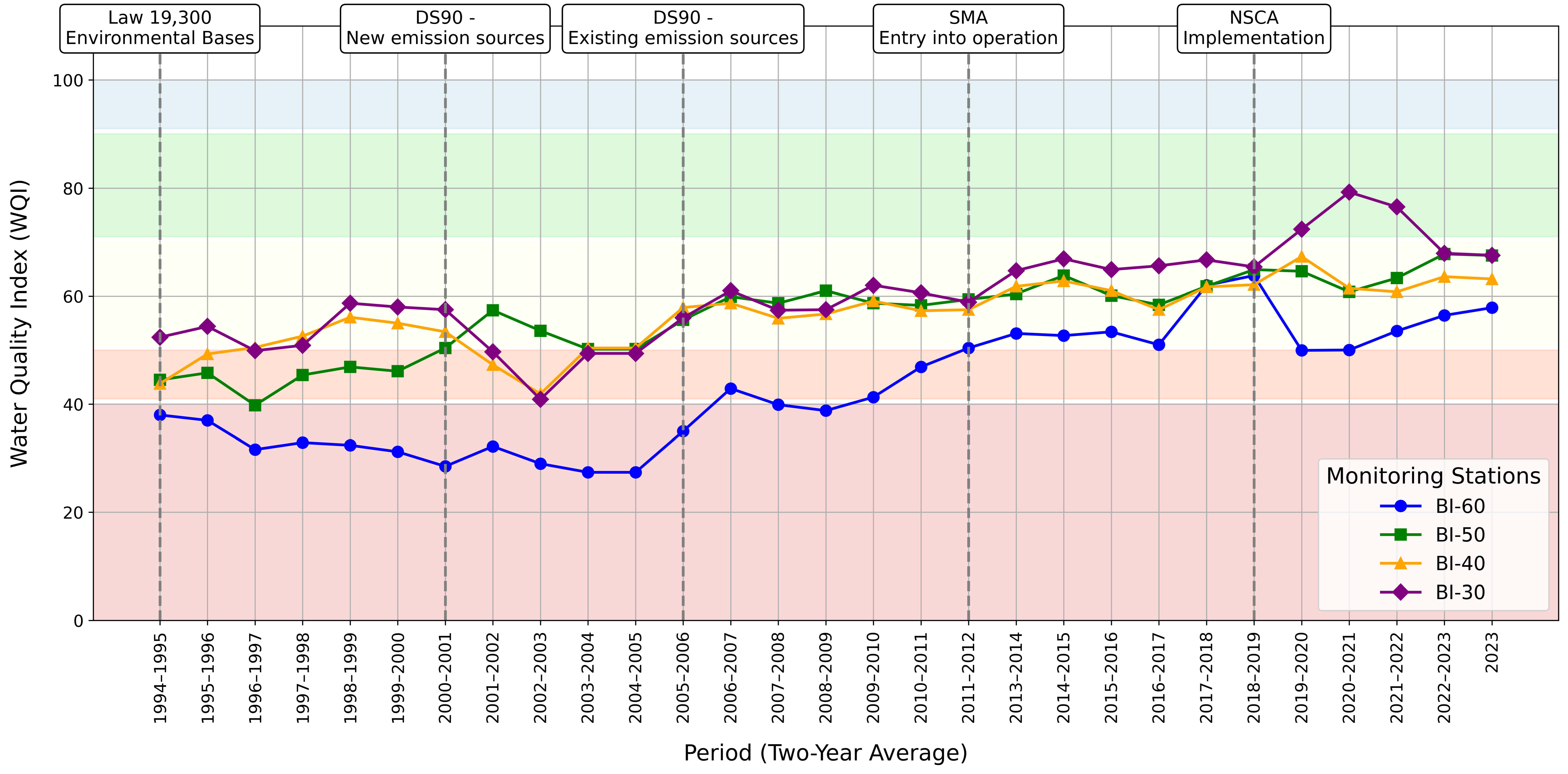
- 1994 (Law No. 19,300): Marked the beginning of environmental institutionalization in Chile, and initial signs of improvement in the WQI were observed.
- 2000 (Decreto Supremo No. 90): Following its entry into force 180 days after publication in Chile’s Diario Oficial, on 7 March 2001, a sustained improvement was recorded between 2005 and 2008. This trend coincided with the regulatory compliance deadlines for both new emission sources (3 September 2001) and existing sources (3 September 2006).
- 2012–2013 (Operational launch of the SMA): Continued improvement was observed until 2016, which may be attributable to enhanced visible enforcement.
- 2018 (Implementation of the NSCA): A clear recovery in WQI was observed at several stations in response to the establishment of defined quality objectives for the receiving water body.
3.3. Dynamics of Compliance and Relaxation in Response to Regulations
3.4. Specific Cases: Santa Fe Pulp Mill and Inforsa Plant
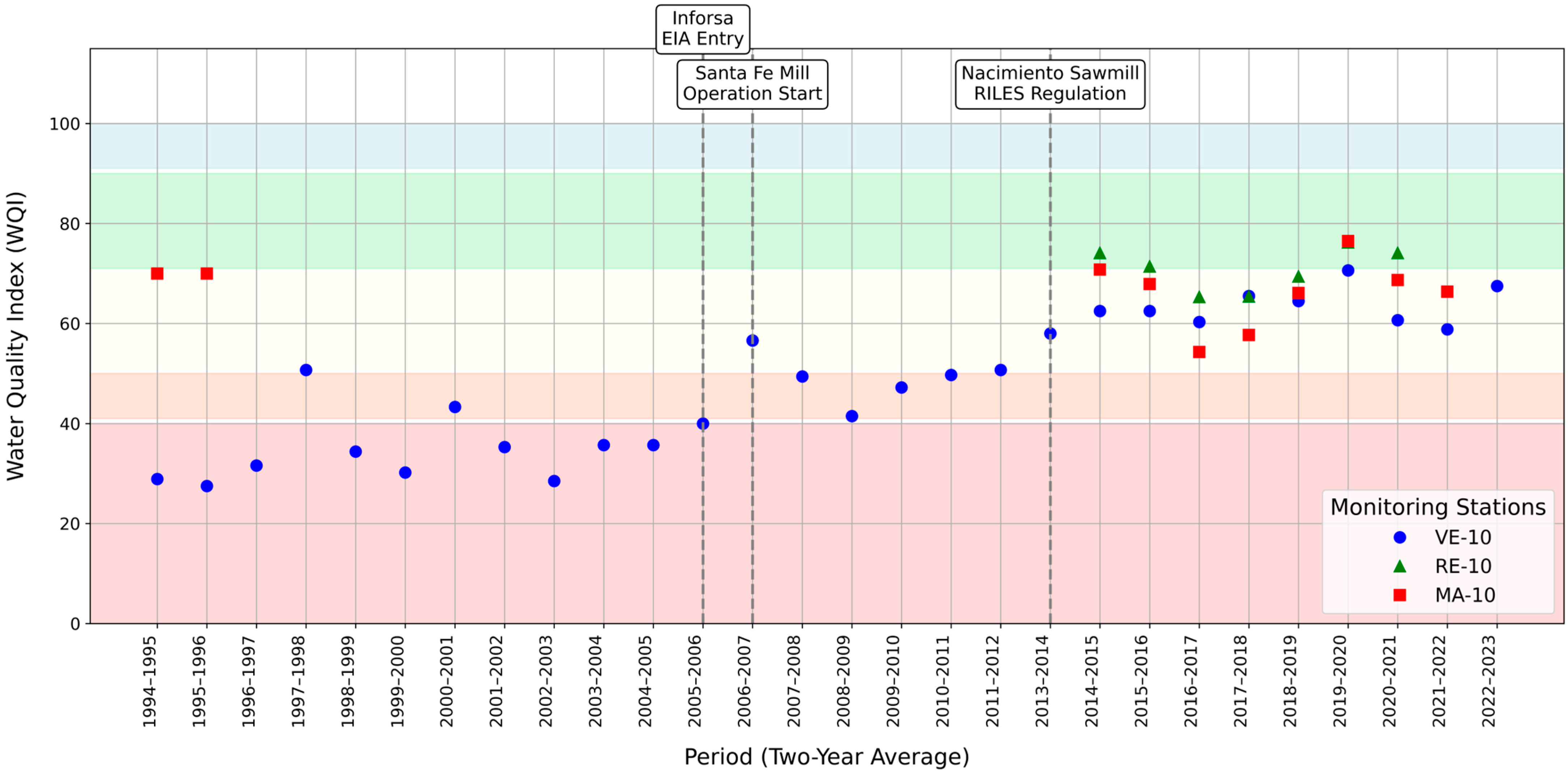
- Construction and Operation of the Santa Fe Pulp Mill (2006): Approved through Environmental Qualification Resolution RCA66-2004, the Santa Fe pulp mill began operations in 2006 under the requirements established by Decreto Supremo No. 90. The project was evaluated within the framework of the Environmental Impact Assessment System (SEIA), which mandates verification of regulatory compliance and the implementation of mitigation measures. In this context, the plant incorporated advanced technology for the treatment of RILES (Residuos Industriales Líquidos, or industrial liquid waste), enabling the establishment of high environmental standards from the outset. WQI data recorded at station VE-10 did not show significant deterioration following the plant’s commissioning, suggesting adequate compliance by the company.
- Regulation of RILES from the Nacimiento Sawmill (2013): In 2013, Resolution No. 178 established treatment requirements for liquid waste discharges (RILES) from the Nascimento sawmill. Although the positive impact was more limited than that of other milestones, localized improvement in water quality was expected, which was partially reflected in the data from station VE-10.
- Closure of the Inforsa Plant (2013): This plant, also located in Nacimiento, operated for decades under the name Industrias Forestales S.A. (Inforsa). After entering the Sistema de Evaluación de Impacto Ambiental (Environmental Impact Assessment System, SEIA) in 2005 (Resolution No. 136), the plant ceased operations permanently in 2013. From that year onward, a clear improvement in WQI values was observed at station VE-10, reflecting the positive effect of eliminating a significant source of pollutant discharge.
4. Discussion
4.1. Relationship Between Water Quality Trends and Regulatory Milestones
4.2. Reaction and Relaxation Dynamics in Environmental Compliance
4.3. Localized Responses: Industrial Activity and Water Quality Outcomes
- Santa Fe Pulp Mill (2006): Although it was a new source of environmental pressure, its operation under the strict regulatory framework of Decreto Supremo No. 90 prevented significant deterioration in WQI values, indicating successful regulatory compliance during its initial phase.
- Closure of Inforsa (2013): The shutdown of this facility (which had previously operated under limited RILES treatment conditions) resulted in a clear and rapid improvement in WQI values at downstream stations, demonstrating the direct effect of eliminating a persistent pollution source.
4.4. Importance of Effective Implementation Versus Formal Promulgation
4.5. Conceptual Representation: Compliance Cycles in Response to Regulation
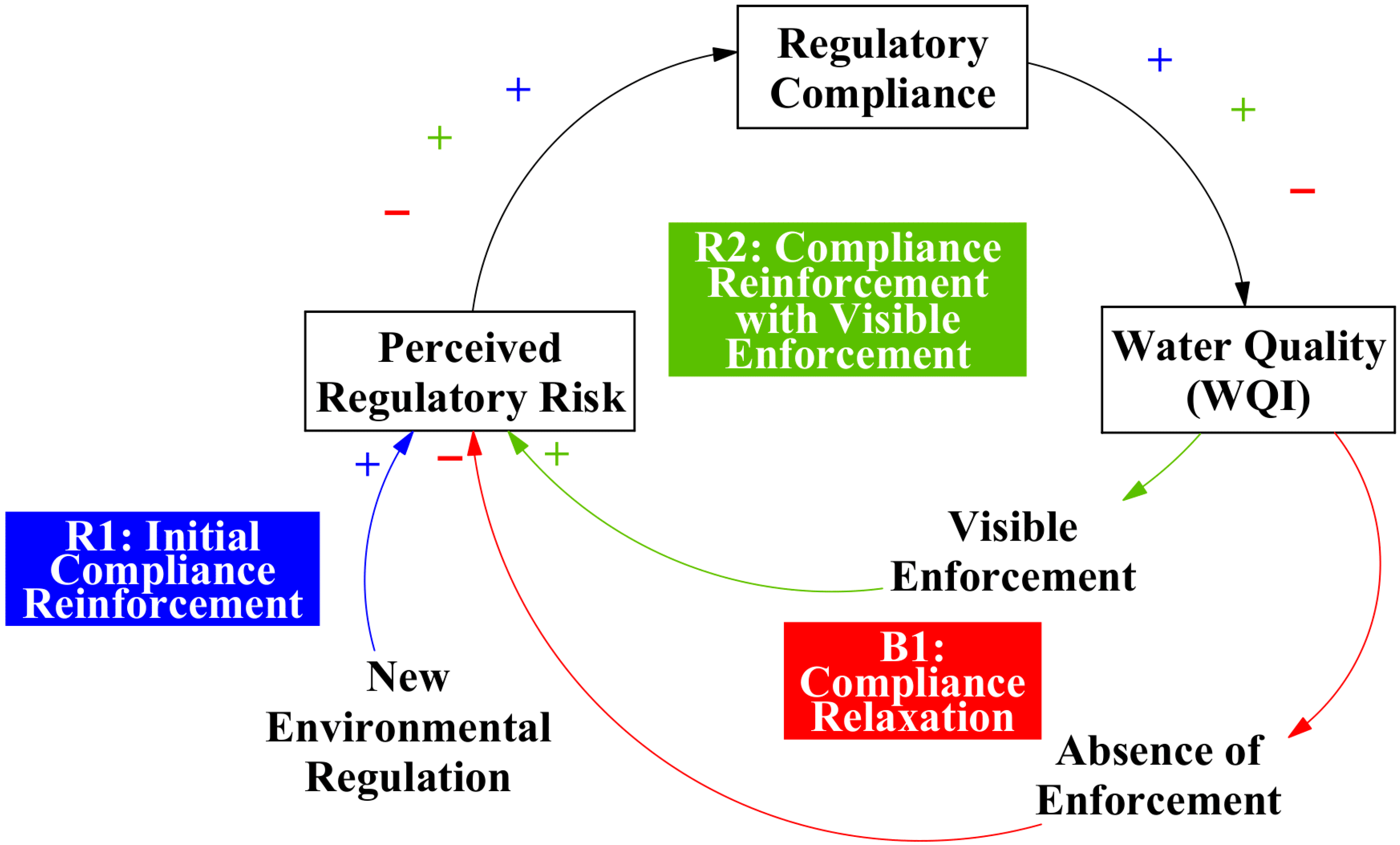
- Initial Compliance Reinforcement (R1): This loop captures the initial “reaction” phase following the enactment of new environmental regulations (such as Decreto Supremo No. 90 [10] or Norma Secundaria de Calidad Ambiental [11]. The announcement or implementation of these instruments increases perceived regulatory risk, encourages environmental compliance, and results in short-term improvements in water quality.
- Compliance Reinforcement with Visible Enforcement (R2): This loop extends the “reaction” phase by maintaining a high perception of regulatory risk through sustained and visible enforcement activities (“fiscalización”). This ongoing oversight helps reinforce compliance and supports the persistence of water-quality improvements over time.
- Compliance Relaxation (B1): This loop represents the “relaxation” phase. In the absence of continued enforcement, the perceived risk of non-compliance diminishes, leading to a gradual relaxation of compliance behavior and subsequent deterioration of water quality indicators.
4.6. Implications for Future Environmental Governance
- Strengthen periodic enforcement mechanisms and ensure the effectiveness of sanctions.
- Develop environmental risk communication strategies that sustain a high perception of oversight among economic actors.
- Future analyses should consider incorporating natural (climatic and hydrological) and socioeconomic factors, as they may modulate system responses.
4.7. Scope and Limitations of the Interpretative Approach
5. Conclusions
Supplementary Materials
Author Contributions
Funding
Institutional Review Board Statement
Informed Consent Statement
Data Availability Statement
Acknowledgments
Conflicts of Interest
Correction Statement
Abbreviations
| WQI | Water Quality Index |
| DGA | Dirección General de Aguas |
| NSCA | Norma Secundaria de Calidad Ambiental |
| SMA | Superintendencia del Medio Ambiente |
| SEA | Servicio de Evaluación Ambiental |
| SEIA | Sistema de Evaluación de Impacto Ambiental |
| RILES | Residuos Industriales Líquidos |
| EULA | Centro de Ciencias Ambientales |
| RCA | Resolución de Calificación Ambiental |
| DS90 | Decreto Supremo N°90 |
| DBO | Demanda Bioquímica de Oxígeno |
References
- Giri, S. Water Quality Prospective in Twenty First Century: Status of Water Quality in Major River Basins, Contemporary Strategies and Impediments. Environ. Pollut. 2021, 271, 116332. [Google Scholar] [CrossRef] [PubMed]
- Akhtar, N.; Syakir Ishak, M.I.; Bhawani, S.A.; Umar, K. Various Natural and Anthropogenic Factors Responsible for Water Quality Degradation: A Review. Water 2021, 13, 2660. [Google Scholar] [CrossRef]
- Wang, L.; Cao, Y.; Infante, D.M. Disentangling Effects of Natural Factors and Human Disturbances on Aquatic Systems—Needs and Approaches. Water 2023, 15, 1387. [Google Scholar] [CrossRef]
- Saxena, V. Water Quality, Air Pollution, and Climate Change: Investigating the Environmental Impacts of Industrialization and Urbanization. Water Air Soil Pollut. 2025, 236, 73. [Google Scholar] [CrossRef]
- Awewomom, J.; Dzeble, F.; Takyi, Y.D.; Ashie, W.B.; Ettey, E.N.Y.O.; Afua, P.E.; Sackey, L.N.; Opoku, F.; Akoto, O. Addressing Global Environmental Pollution Using Environmental Control Techniques: A Focus on Environmental Policy and Preventive Environmental Management. Discov. Environ. 2024, 2, 8. [Google Scholar] [CrossRef]
- Peña, H.; Luraschi, M.; Valenzuela, S. Agua, Desarrollo y Políticas Públicas: La Experiencia de Chile. REGA—Rev. De Gestão De Água Da América Lat. 2004, 1, 25–50. [Google Scholar]
- Meza, F. Control de Calidad de Las Aguas En Chile. INIA Tierra Adentro 2009, 83, 42–45. [Google Scholar]
- Alvarez, L.; Vargas, L.; Jimenez, A. Priorities for the Rural Water and Sanitation Services Regulation in Latin America. Front. Water 2024, 6, 1406301. [Google Scholar] [CrossRef]
- Congreso Nacional de Chile, C. Ley N°19.300: Ley Sobre Bases Generales Del Medio Ambiente. Available online: https://www.bcn.cl/leychile/navegar?idNorma=30667 (accessed on 26 April 2025).
- Congreso Nacional de Chile, C. Decreto Supremo N°90: Norma de Emisión Para La Regulación de Contaminantes Asociados a Descargas de Residuos Líquidos a Aguas Marinas y Continentales. Available online: https://www.bcn.cl/leychile/navegar?idNorma=182637 (accessed on 26 April 2025).
- Congreso Nacional de Chile, C. Decreto Supremo N°9: Establece Normas Secundarias de Calidad Ambiental Para La Protección de Las Aguas Continentales Superficiales de La Cuenca Del Río Biobío. Available online: https://www.bcn.cl/leychile/navegar?idNorma=1084403 (accessed on 26 April 2025).
- Congreso Nacional de Chile, C. Ley N°20.417 (2010), Que Creó El Ministerio Del Medio Ambiente, La SMA y El SEA: Crea El Ministerio Del Medio Ambiente, El Servicio de Evaluación Ambiental y La Superintendencia Del Medio Ambiente. Available online: https://www.bcn.cl/leychile/navegar?idNorma=1010459 (accessed on 26 April 2025).
- Ochoa, F.; Delgado, V.; Álvez, A.; Rivera, D. El Acceso al Recurso Hídrico En La Praxis Judicial Chilena: Paradojas y Malas Prácticas. Actas De Derecho De Aguas 2016, 6, 5–28. [Google Scholar]
- Delgado, V. Reparación Del Daño Ambiental Causado a Las Aguas Subterráneas En Los Tribunales de Chile. Revista Derecho Privado 2020, 38, 279–310. [Google Scholar] [CrossRef]
- Cornejo-D’Ottone, M.; Figueroa, R.; Parra, O. Seasonality of the N2O Cycle of the Biobío River during the Megadrought. J. Limnol. 2019, 78, 14–26. [Google Scholar] [CrossRef]
- Alonso, Á.; Figueroa, R.; Castro-Díez, P. Pollution Assessment of the Biobío River (Chile): Prioritization of Substances of Concern Under an Ecotoxicological Approach. Environ. Manag. 2017, 59, 856–869. [Google Scholar] [CrossRef] [PubMed]
- Stehr, A.; Debels, P.; Arumi, J.L.; Alcayaga, H.; Romero, F. Modeling the Hydrological Response to Climate Change: Experiences from Two South-Central Chilean Watersheds. Tecnol. Y Cienc. Del Agua 2010, 1, 37–58. [Google Scholar] [CrossRef]
- Yevenes, M.A.; Figueroa, R.; Parra, O. Seasonal Drought Effects on the Water Quality of the Biobío River, Central Chile. Environ. Sci. Pollut. Res. 2018, 25, 13844–13856. [Google Scholar] [CrossRef]
- Figueroa, R.; Parra, O.; Urrutia, R.; Valdovinos, C. La Cuenca Hidrográfica Del Río Biobío. In Centro de Ciencias Ambientales EULA-Chile: Evolución y Perspectivas a 30 años de su Creación; Universidad de Concepción: Concepción, Chile, 2020; pp. 91–139. [Google Scholar]
- Torres, P.; Cruz, C.H.; Patiño, P.J. Índices de Calidad de Agua En Fuentes Superficiales Utilizadas En La Producción de Agua Para Consumo Humano. Una Revisión Crítica. Rev. Ing. Univ. De Medellín 2009, 8, 79–94. [Google Scholar]
- Kumar, D.; Kumar, R.; Sharma, M.; Awasthi, A.; Kumar, M. Global Water Quality Indices: Development, Implications, and Limitations. Total Environ. Adv. 2024, 9, 200095. [Google Scholar] [CrossRef]
- Billi, M.; Delgado, V.; Jiménez, G.; Morales, B.; Neira, C.; Silva, M.I.; Urquiza, A. Gobernanza Policéntrica Para La Resiliencia al Cambio Climático: Análisis Legislativo Comparado y Ley Marco de Cambio Climático En Chile. Estud. Públicos 2020, 160, 7–53. [Google Scholar] [CrossRef]
- Hammoumi, D.; Al-Aizari, H.S.; Alaraidh, I.A.; Okla, M.K.; Assal, M.E.; Al-Aizari, A.R.; Moshab, M.S.; Chakiri, S.; Bejjaji, Z. Seasonal Variations and Assessment of Surface Water Quality Using Water Quality Index (WQI) and Principal Component Analysis (PCA): A Case Study. Sustainability 2024, 16, 5644. [Google Scholar] [CrossRef]
- Debels, P.; Figueroa, R.; Urrutia, R.; Barra, R.; Niell, X. Evaluation of Water Quality in the Chillán River Using Physico-Chemical Parameters and a Modified Water Quality Index. Environ. Monit. Assess. 2005, 110, 301–322. [Google Scholar] [CrossRef]
- Crielaard, S.; Lenschow, A.; Krueger, T. Refining the Causal Loop Diagram—A Transparent Approach for Qualitative Systems Analysis of the Water–Soil–Agriculture System in Northern Germany. Hydrol. Earth Syst. Sci. 2022, 26, 5989–6008. [Google Scholar] [CrossRef]
- Sterman, J.D. Business Dynamics: Systems Thinking and Modeling for a Complex World; Irwin/McGraw-Hill: Boston, MA, USA, 2000. [Google Scholar]
- Meadows, D.H. Thinking in Systems: A Primer; Chelsea Green Publishing: White River Junction, VT, USA, 2008. [Google Scholar]
- Stave, K.A. Using System Dynamics to Improve Public Participation in Environmental Decisions. Syst. Dyn. Rev. 2002, 18, 139–167. [Google Scholar] [CrossRef]



| Station Code | Station Name | Surveillance Area | Data Source | Monitoring Period | Observations * |
|---|---|---|---|---|---|
| 08307001-3 | Biobío River before Llanquén | BI-10 | EULA/DGA | 1991–2023 | Continuous data |
| 08317001-8 | Biobío River at Rucalhue | BI-20 | EULA/DGA | 1991–2023 | Continuous data |
| 08334001-0 | Biobío River at Coihue | BI-30 | EULA/DGA | 1991–2023 | Continuous data |
| 08390000-8 | Biobío River before Gomero junction | BI-40 | EULA/DGA | 1991–2023 | Continuous data |
| 08394005-0 | Biobío River before La Mochita Plant | BI-50 | EULA/DGA | 1991–2023 | Continuous data |
| 08394003-4 | Biobío River at North Mouth | BI-60-1 | EULA/DGA | 1991–2023 | Continuous data |
| 08394004-2 | Biobío River at South Mouth | BI-60-3 | EULA/DGA | 1991–2023 | Continuous data |
| 08333004-K | Bureo River upstream of Biobío confluence | BU-10 | EULA/DGA | 2018–2023 | Continuous data |
| 08323001-0 | Duqueco River at Cerrillos | DU-10 | EULA/DGA | 2018–2023 | No data between 1994–2002 |
| 08375003-0 | Laja River downstream of Antuco Hydropower Plant | LA-10 | EULA/DGA | 1991–2023 | Continuous data |
| 08381013-0 | Laja River upstream of Caliboro confluence | LA-20 | EULA/DGA | 1991–2023 | Data available from 2014 |
| 08386003-0 | Laja River at Laja Bridge | LA-30 | EULA/DGA | 1991–2023 | Continuous data |
| 08352003-5 | Malleco River at Malleco Bridge (Route 180) | MA-10 | EULA/DGA | 2018–2023 | Data available from 2014 |
| 08344001-5 | Renaico River at Renaico | RE-10 | DGA | 2018–2023 | Data available from 2014 |
| 08359002-5 | Vergara River at Nacimiento | VE-10 | EULA/DGA | 2018–2023 | Continuous data |
| Parameter | ||||||||||||
|---|---|---|---|---|---|---|---|---|---|---|---|---|
| 0 | 10 | 20 | 30 | 40 | 50 | 60 | 70 | 80 | 90 | 100 | ||
| Aluminum (mg/L) | 0.1 | 3.3 | 1.93 | 1.62 | 1.4 | 1.17 | 0.72 | 0.43 | 0.16 | 0.09 | 0.06 | 0.01 |
| Ammonium (mg N/L) | 0.13 | 0.125 | 0.11 | 0.1 | 0.095 | 0.075 | 0.05 | 0.03 | 0.025 | 0.01 | 0.005 | <0.001 |
| AOX (mg/L) | 0.1 | 0.825 | 0.65 | 0.5 | 0.3 | 0.15 | 0.1 | 0.05 | 0.006 | 0.005 | 0.002 | <0.001 |
| Chloride (mg/L) | 0.1 | 90 | 60 | 45 | 30 | 15 | 10 | 5 | 2 | 1 | 0.5 | <0.05 |
| Fecal Coliforms (NMP/100 mL) | 0.16 | 21,000 | 15,000 | 10,000 | 5000 | 1000 | 475 | 50 | 30 | 10 | 3 | <0.5 |
| Conductivity (µS/cm) | 0.1 | 300 | 180 | 140 | 100 | 75 | 50 | 25 | 15 | 10 | 5 | <0.5 |
| BOD5 (mg/L) | 0.17 | 12 | 10 | 8 | 6 | 4 | 3 | 2.5 | 2 | 1.5 | 1 | <0.5 |
| COD (mg/L) | 0.1 | 30 | 20 | 15 | 10 | 7 | 5 | 3 | 2 | 1 | 0.5 | <0.25 |
| Total Phenols (mg/L) | 0.1 | 0.04 | 0.012 | 0.008 | 0.005 | 0.004 | 0.003 | 0.0015 | 0.001 | 0.0005 | 0.0002 | <0.001 |
| Total Phosphorus (mg/L) | 0.14 | 0.3 | 0.27 | 0.22 | 0.2 | 0.17 | 0.12 | 0.1 | 0.07 | 0.05 | 0.03 | <0.01 |
| Total Iron (mg/L) | 0.1 | 3 | 2.4 | 1.7 | 1 | 0.75 | 0.5 | 0.3 | 0.2 | 0.1 | 0.05 | <0.05 |
| Nitrate (mg N/L) | 0.1 | 10 | 7.5 | 5 | 3 | 2.5 | 2 | 1.5 | 1 | 0.5 | 0.25 | <0.1 |
| Nitrite (mg N/L) | 0.07 | 0.045 | 0.03 | 0.025 | 0.02 | 0.015 | 0.01 | 0.005 | 0.003 | 0.0025 | 0.001 | <0.001 |
| Total Nitrogen (mg/L) | 0.1 | 5 | 4.5 | 3.5 | 3 | 2.5 | 2 | 1.5 | 1 | 0.5 | 0.3 | <0.1 |
| Orthophosphate (mg P/L) | 0.12 | 0.3 | 0.27 | 0.22 | 0.2 | 0.17 | 0.12 | 0.1 | 0.07 | 0.05 | 0.03 | <0.01 |
| Dissolved Oxygen (mg/L) | 0.17 | <5 | 5.6–6.2 | 5.9–6.8 | 6.2–6.9 | 6.5–8.7 | 6.5–8.9 | 6.5–8.5 | 6.5–8.3 | 6.5–7.8 | 6.5–7.5 | <6.5–7 |
| pH (units) | 0.11 | <5 | 5.6–9.2 | 5.9–9 | 6.2–8.9 | 6.5–8.7 | 6.5–8.5 | 6.5–8.3 | 6.5–8.2 | 6.5–8 | 6.5–7.8 | 6.5–7.5 |
| Total Suspended Solids (mg/L) | 0.1 | 150 | 110 | 80 | 55 | 45 | 30 | 20 | 10 | 5 | 2 | <1 |
| Sulfate (mg/L) | 0.1 | 180 | 140 | 100 | 80 | 50 | 40 | 30 | 20 | 10 | 5 | <1 |
| Quality Class | WQI Range (%) | Environmental Characteristics | Color |
|---|---|---|---|
| I Very Good | 91–100 | Excellent quality | Blue |
| II Good | 71–90 | Acceptable quality | Green |
| III Fair | 51–70 | Contaminated | Yellow |
| IV Poor | 41–50 | Heavily contaminated | Orange |
| V Very Poor | 0–40 | Excessively contaminated | Red |
Disclaimer/Publisher’s Note: The statements, opinions and data contained in all publications are solely those of the individual author(s) and contributor(s) and not of MDPI and/or the editor(s). MDPI and/or the editor(s) disclaim responsibility for any injury to people or property resulting from any ideas, methods, instructions or products referred to in the content. |
© 2025 by the authors. Licensee MDPI, Basel, Switzerland. This article is an open access article distributed under the terms and conditions of the Creative Commons Attribution (CC BY) license (https://creativecommons.org/licenses/by/4.0/).
Share and Cite
Rodriguez, K.; Arumi, J.L.; Delgado, V. Impact of Regulation on the Water Quality of a Mediterranean River: The Case of the Biobío River. Sustainability 2025, 17, 9997. https://doi.org/10.3390/su17229997
Rodriguez K, Arumi JL, Delgado V. Impact of Regulation on the Water Quality of a Mediterranean River: The Case of the Biobío River. Sustainability. 2025; 17(22):9997. https://doi.org/10.3390/su17229997
Chicago/Turabian StyleRodriguez, Karla, Jose Luis Arumi, and Verónica Delgado. 2025. "Impact of Regulation on the Water Quality of a Mediterranean River: The Case of the Biobío River" Sustainability 17, no. 22: 9997. https://doi.org/10.3390/su17229997
APA StyleRodriguez, K., Arumi, J. L., & Delgado, V. (2025). Impact of Regulation on the Water Quality of a Mediterranean River: The Case of the Biobío River. Sustainability, 17(22), 9997. https://doi.org/10.3390/su17229997