Review

Are Nature-Based Climate Solutions in the Russian Arctic Feasible? A Review

by
Sergey V. Dudov
1,*,
Aleksandra V. Pryadilina
2,
Anton S. Kumaniaev
1,
Maxim V. Bocharnikov
2,
Andrey D. Naumov
3,
Sergey S. Chernianskii
4 and
Vladimir Y. Slobodyan
2,3
1
Faculty of Biology, Lomonosov Moscow State University, Leninskie Gory 1, Moscow 119991, Russia
2
Faculty of Geography, Lomonosov Moscow State University, Leninskie Gory 1, Moscow 119991, Russia
3
Institute of Environmental Survey, Planning & Assessment JSC, Leninskiye Gory 1 Bld. 75G, Moscow 119234, Russia
4
EnviSoilCons Pr, Golubinačka 55A, 22320 Inđija, Serbia
*
Author to whom correspondence should be addressed.
Sustainability 2025, 17(22), 10409; https://doi.org/10.3390/su172210409
Submission received: 29 September 2025 / Revised: 11 November 2025 / Accepted: 12 November 2025 / Published: 20 November 2025

Abstract

Arctic ecosystems are highly vulnerable to ongoing and projected climate change. Rapid warming and growing anthropogenic pressure are driving a profound transformation of these regions, increasingly positioning the Arctic as a persistent, globally significant source of greenhouse gases. In the Russian Arctic—a critical zone for national economic growth and transport infrastructure—intensive development is replacing natural ecosystems with anthropogenically modified ones. In this context, Nature-based Solutions (NbS) represent a vital tool for climate change adaptation and mitigation. However, many NbS successfully applied globally have limited applicability in the Arctic due to its inaccessibility, short growing season, low temperatures, and permafrost. This review demonstrates the potential for adapting existing NbS and developing new ones tailored to the Arctic’s environmental and socioeconomic conditions. We analyze five key NbS pathways: forest management, sustainable grazing, rewilding, wetland conservation, and ecosystem restoration. Our findings indicate that protective and restorative measures are the most promising; these can deliver measurable benefits for both climate, biodiversity and traditional land-use. Combining NbS with biodiversity offset mechanisms appears optimal for preserving ecosystems while enhancing carbon sequestration in biomass and soil organic matter and reducing soil emissions. The study identifies critical knowledge gaps and proposes priority research areas to advance Arctic-specific NbS, emphasizing the need for multidisciplinary carbon cycle studies, integrated field and remote sensing data, and predictive modeling under various land-use scenarios.

1. Introduction

1.1. Rapidly Changing Arctic

Temperatures in the Arctic have been rising nearly four times faster than the average rate of global warming since 1979 [1]. This rapid rise in temperatures is primarily attributed to the reduction in sea ice cover and the effective positive albedo feedback, as well as the peculiarities of atmospheric circulation in the region [2]. According to the IPCC, temperatures in the Russian Arctic will rise by 2.9–3.1 °C by 2040 and 4.3–10.6 °C by 2100 [3]. The greatest rate of change in surface temperature is expected in the Yamalo-Nenets Autonomous Okrug (YaNAO), as well as in the coastal areas of the Asian part of the Arctic Zone of the Russian Federation (up to 1.5 °C/10 years) [4].
Arctic ecosystems are extremely sensitive to global climate change and can have a feedback effect on it. This process is largely determined by the characteristics of the biogeochemical carbon cycle. The current estimate of organic carbon in permafrost is 1400–1600 Pg C [5,6]. Of this stock, 65–70% (1035 ± 150 Pg) of carbon is found in the surface layer (depth 0–3 m). Carbon stocks in soils and frozen ground in permafrost regions are comparable to global soil carbon stocks ≈ 1700 Pg C and are at least twice the mass of carbon in the atmosphere ≈ 890 Pg C [6]. For example, so-called yedoma ice-rich deposits of Eastern Siberia and Alaska are estimated to hold as much as 327–466 Pg C [7].
However, it is the permafrost that is subject to climate-driven degradation, with its temperatures having risen during the reference decade between 2007 and 2016 by 0.39 ± 0.15 °C in the continuous zone and 0.20 ± 0.10 °C in the discontinuous zone [8]. Therefore, the problem of permafrost protection is considered a critical issue on the global climate agenda, and the Arctic is considered a key region in global climate policy [9,10,11].
Various carbon balance assessments indicate that Arctic ecosystems can act as both carbon sinks and carbon sources [12]. During 2001–2020, the Arctic and Boreal zones were a CO2 sink of −548 ± 140 Tg C yr−1 (≈−0.55 ± 0.14 Pg C yr−1, ≈−2.0 ± 0.5 GtCO2e yr−1), while >30% of the area acted as sources of carbon dioxide [13]. Wildfires emitted an average of 237 Tg C yr−1 (≈0.24 Pg C yr−1, ≈0.88 GtCO2e yr−1) (43% of the total CO2 sink in the Arctic and Boreal zones).
It has been shown that the annual CO2 balance is changing due to increased emissions in winter [14], with local conditions such as nitrogen availability and water regime affecting the carbon budget. Various model estimates show that under warming conditions, the Arctic will act as a carbon emitter, and its role in the global carbon cycle will increase in the future [5]. Under different climate change scenarios, cumulative carbon dioxide emissions are projected at 55–232 Pg C (≈200–850 GtCO2e) by 2100, depending on the warming trajectory [5].
Methane (CH4) is the second most significant greenhouse gas, with an estimated impact on the climate that is 27–30 times stronger than that of CO2 over a 100-year time frame [15]. Concurrently, the scientific literature continues to exhibit a degree of uncertainty with regard to the Arctic’s contribution to global CH4 emissions. Rapid warming of the boreal zone and the Arctic, especially the melting of permafrost, creates conditions for increased CH4 emissions from wetlands, lakes, rivers, and coastal areas [16]. A review of long-term observations reveals a statistically significant trend of an 8.9% increase in methane emissions from Boreal and Arctic wetlands between 2002 and 2021, due to rising temperatures and increased ecosystem productivity [17]. Alarmist estimates of the role of methane emissions from thawing permafrost as a powerful feedback mechanism for warming are known as the methane bomb concept [18], which, however, is not supported by subsequent studies [5]. Methane emissions from permafrost regions of Siberia are estimated at 20 Tg CH4 yr−1 (≈0.56 GtCO2e yr−1, GWP100 = 28) by mid-21st century [19], which is the lower limit of previous model estimates. Concurrently, the Arctic soils are an underestimated methane sink, whose role may increase under climate change [20,21].
The global biodiversity crisis is evident in the loss of biodiversity at various levels of its organization, the widespread distribution of modified ecosystems, and the fragmentation and disruption of natural ecosystems [22]. It is pointed out that biodiversity loss leads to a decrease in ecosystem resilience [23,24]. The conservation of biodiversity, in particular the diversity of tree species, is important for mitigating the risks of climate change [25,26]. Rapid climate change in the Arctic is also causing the transformation of biotic complexes, manifested in changes in biogeochemical cycles [27,28], changes in the structure of plant communities, for instance, shrubification [29,30], the expansion of species and community ranges to the north [31], and the introduction of alien species [32,33]. Thus, preserving Arctic biodiversity is a relevant conservation challenge [34].
Climate change in the Arctic has socio-economic effects. It plays a significant role in transforming the structure of natural resource use by indigenous populations and in infrastructure risks [35]. It is estimated that 30–50% of critical infrastructure in all permafrost regions worldwide could be affected by 2050 at current rates of warming [36]. The effect of permafrost degradation could reach $132 billion (maximum estimate), including damage to housing stock: ≈$15 billion, and linear facilities in the range of $70–100 billion [37], while the actual damage may exceed these estimates due to unaccounted factors.
Climate change could potentially lead to an increase in the incidence of the natural focal diseases and zoonoses that threaten the local population and reindeer herds [38,39]. In 2016, an outbreak of anthrax was recorded in the YaNAO, infecting 2650 reindeer and 36 people, with one fatality. One of the reasons for the epidemic was attributed to abnormally high summer temperatures, which led to the activation of soil foci of the disease [40].
At least 10–15% of Russia’s economy is concentrated in the Arctic zone of the Russian Federation. Up to 80% of natural gas and 17% of oil are produced here [41]. Seventy percent of Russia’s infrastructure in the Arctic is located in the permafrost zone, including 90% of gas production and key ports. The value of assets on permafrost soils as of 2016 was estimated at $248.6 billion, or 7.5% of Russia’s GDP [42].
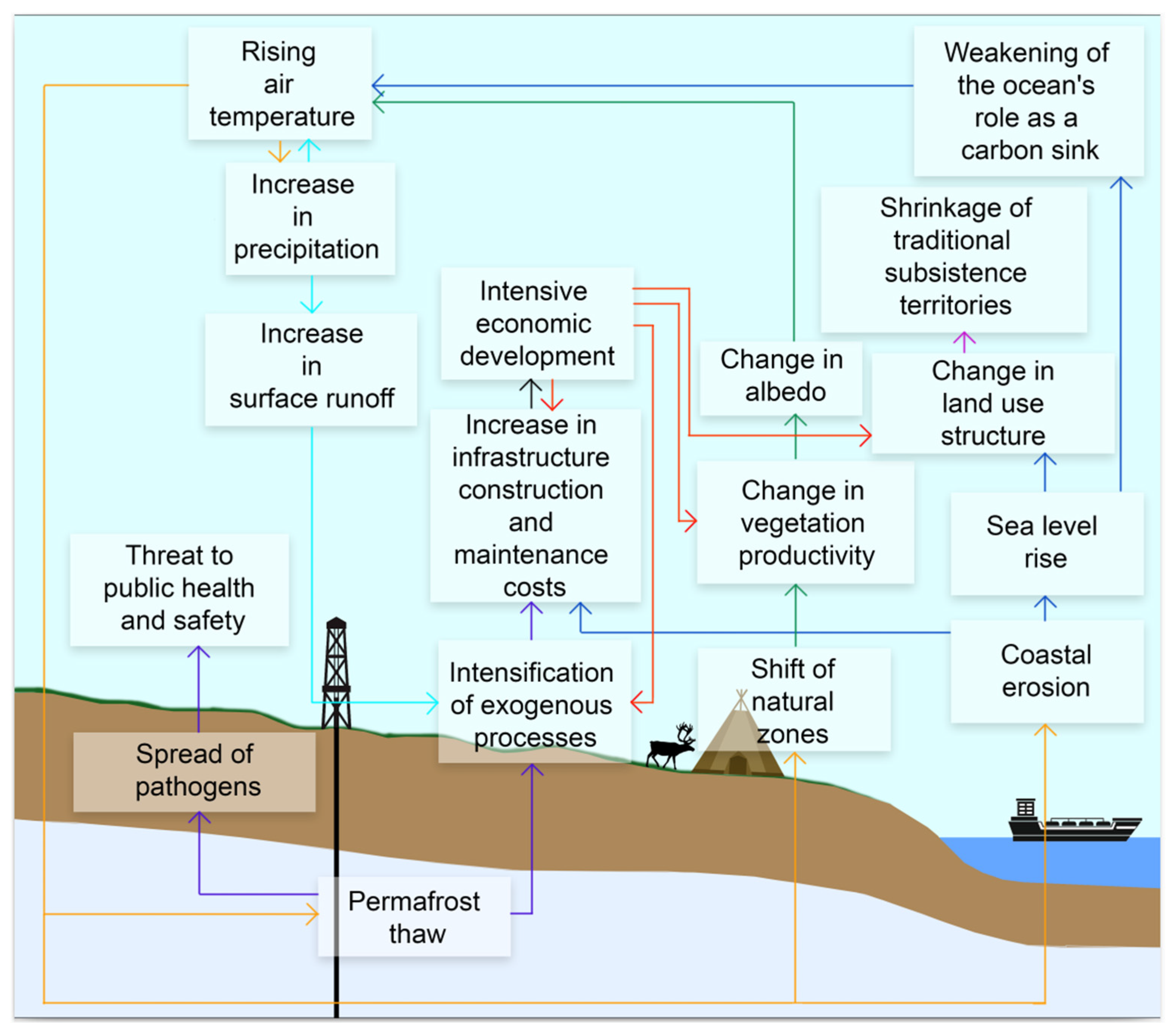
According to the Strategy for the Development of the Arctic Zone of the Russian Federation [41], there are plans to build new ports and transport infrastructure, develop deposits, and expand oil and gas chemical production. Thus, anthropogenic impact in the Russian Arctic will grow, and the search for comprehensive natural solutions is urgently needed. The key climate change risks for the Russian Arctic discussed above are summarized in Figure 1.
Thus, in the context of climate risks, it is important to seek solutions for adapting to and mitigating the effects of climate change that contribute to the sequestration or reduction of greenhouse gas emissions, as well as to the conservation of biodiversity and traditional way of life in the Russian Arctic.

1.2. Nature-Based Climate Solutions

Nature-based solutions (NbS) are the human interventions in natural processes, which leads to measurable effects in the climate change mitigation or adaptation [43,44]. They should be based on the following fundamental principles [45]: (1) NbS are nature-based, they are the result of targeted human stewardship of ecosystems and do not move ecosystems further from their natural state; (2) NbS are resilient, support biodiversity and climate adaptation, and ensure sustainable food production and forestry; (3) NbS create additional long-term climate change mitigation effects; (4) NbS are quantified in terms of cumulative effects on radiative forcing, and are accounted for using measurable conservative estimates which avoids double counting; (5) NbS respect human rights and indigenous self-determination. A number of international documents, including the Paris Agreement, the European Green Deal, and the Kunming–Montreal Global Biodiversity Framework, emphasize the role of NbS in mitigating the effects of climate change and preserving biodiversity [46].
The most important criterion for NbS is the correct determination of the baseline, as the level of net greenhouse gas emissions when implementing a scenario without additional activities. The reductions in emissions and/or increases in absorption achieved as a result of the measures taken represent the difference between the baseline and the actual level of net greenhouse gas emissions (in tons of CO2 equivalent). Risk management must be implemented in any NbS project—the activity may not lead to the desired amount of carbon sequestration, have zero effect, or lead to an increase in emissions. The key risks of natural climate projects are considered to be carbon leakage, volatility, financial and reversal risks.
The objectives of ecosystem-based climate projects extend beyond carbon sequestration to include sustainable ecosystem management, conservation, and, where feasible, the enhancement of ecosystem services’ quality and volume. This aligns with existing NbS classifications, which are intrinsically linked to key ecosystem services [47]. Consequently, such projects must avoid adverse impacts on biodiversity and instead generate positive outcomes [48]. In addition, NbS must have a socio-economic context. While potentially feasible with existing technologies, they should not interfere with traditional land use or worsen the lives of indigenous people [45].
The implementation of natural climate solutions requires an ecosystem approach. Complex interactions between ecosystem components mean that solutions for some types of ecosystems are not applicable to others, while the functioning of many ecosystems is directly or indirectly influenced by human activity [49]. A recent review based on 257,266 publications on the topic of NbS [50] noted an imbalance in research. Thus, 87% of scientific research is devoted to ecosystem management, while 30% is devoted to protection and 29% to restoration. The authors point to the fact that existing research focuses on NbS with a high evidence base but with low potential, while there is little discussion of promising solutions.
More than 100 methodologies for various types of NbS have been developed worldwide [51], however, methodologies for solutions for the Arctic have not yet been developed. NbS reviews for Russia [51], Canada [52], and the United States [53] do not contain specific solutions for the Arctic. However, the Arctic context—permafrost, short growing season, low ecosystem productivity, and inaccessibility—dictates the need for specific natural and climatic solutions. Sixty-one promising nature-based solutions for the Arctic, including eight for terrestrial ecosystems, are proposed on the portal https://climateinterventions.org/ (accessed on 18 August 2025) [54].
The aim of the study is to assess the prospects for the application of NbS for climate change adaptation and mitigation in the Arctic zone of the Russian Federation to identify gaps in knowledge and promising areas for further research. In this review, we consider only ecosystem solutions and leave out of focus such controversial projects as geoengineering through the injection of aerosols into the stratosphere [55].

2. Materials and Methods

In the context of this study, we considered the geographical boundaries of the Arctic within the framework of the Arctic Monitoring and Assessment Programme (AMAP) [56] approach. To analyze information on the territory of Russia, we used the boundaries of the Arctic zone of the Russian Federation (AZRF)—the administrative definition of the Arctic boundaries.
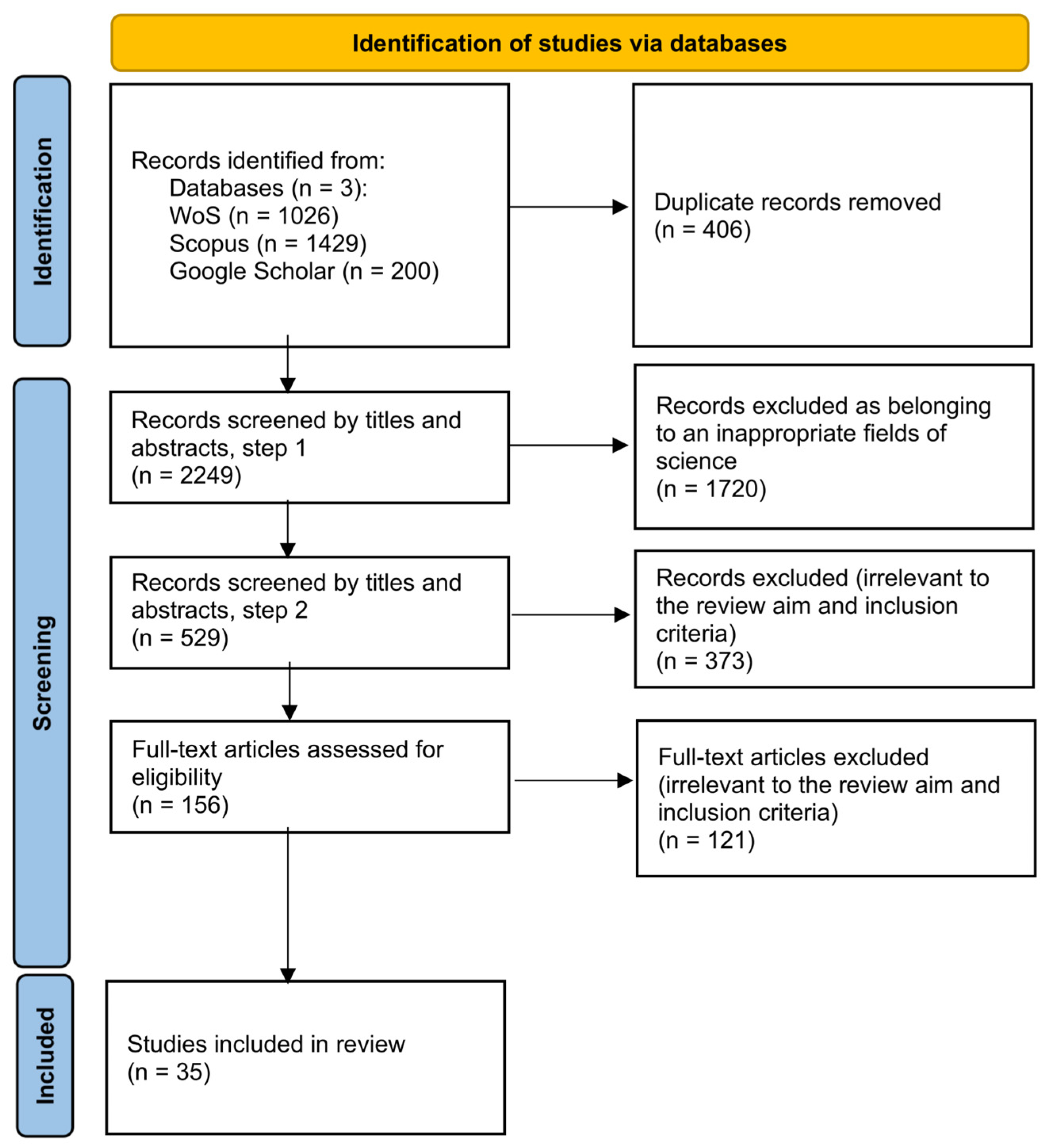
We conducted a systematic literature analysis following the PRISMA 2020 framework [57] (Figure 2). A search was performed across the Web of Science, Scopus, and Google Scholar databases using the keyword combination: (“nature-based climate solution” OR “climate solutions”) AND (“arctic” OR “polar” OR “permafrost”). This search yielded 1026, 1426, and 200 records from each database, respectively, covering publications from 2000 to 2025. We then combined all the extracted data into a single document and removed duplicate articles by title. For the remaining 2249 publications, we conducted a two-step screening. At the first step, titles and abstracts were screened to identify only peer-reviewed articles mentioning terrestrial ecosystems, global cold biomes, the carbon biogeochemical cycle, or its constituent elements. Publications were categorized as “potentially relevant” or “definitely irrelevant” resulting in 529 selected publications. During the second step, the titles and abstracts of these publications were assessed for specific mentions of nature-based solutions (NbS), climate change adaptation and mitigation measures, and/or biodiversity conservation, yielding 156 publications. A full-text analysis of these was conducted. We selected 35 publications that explicitly discussed NbS in the Arctic and other permafrost regions. Studies of global scope without a specific focus on the Arctic or other cold biomes were excluded. All screening stages were performed independently by two researchers. Any discrepancies in publication selection were resolved by the first author. Finally, we employed the bibliometrix R package version 5.1.0 [58] to perform two analytical procedures: (1) generating a keywords co-occurrence network using the (biblioNetwork) function, and (2) constructing a conceptual structure map based on article abstracts using the (conceptualStructure) function.
We used the map units of the “Biomes of Russia” map as reference of regional ecosystem diversity for comparative geographical analysis [59]. To analyze the potential of NbS, we selected two key regions of the AZRF within YaNAO and in Republic of Sakha (Yakutia), since these regions were considered to be at the highest risk from climate change [4].
We analyzed open spatial products from the global forest change map (GFCM) [60], map of forest losses from fires [61], Global Land Cover and Land Use Change, 2000–2020 (GLCLU) maps [62] (spatial resolution ≈ 30 m for both products), and Northern Hemisphere permafrost map [63] (spatial resolution ≈ 1 km).
We calculated zonal statistics between these raster products and the vector layer of the map “Biomes of Russia” [59], which was intersected with data on the administrative-territorial division of the AZRF. For these operations we use the (mask) and (cellSize) functions of the terra package [64] and the (exact_extract) function of the exactextractr package [65].
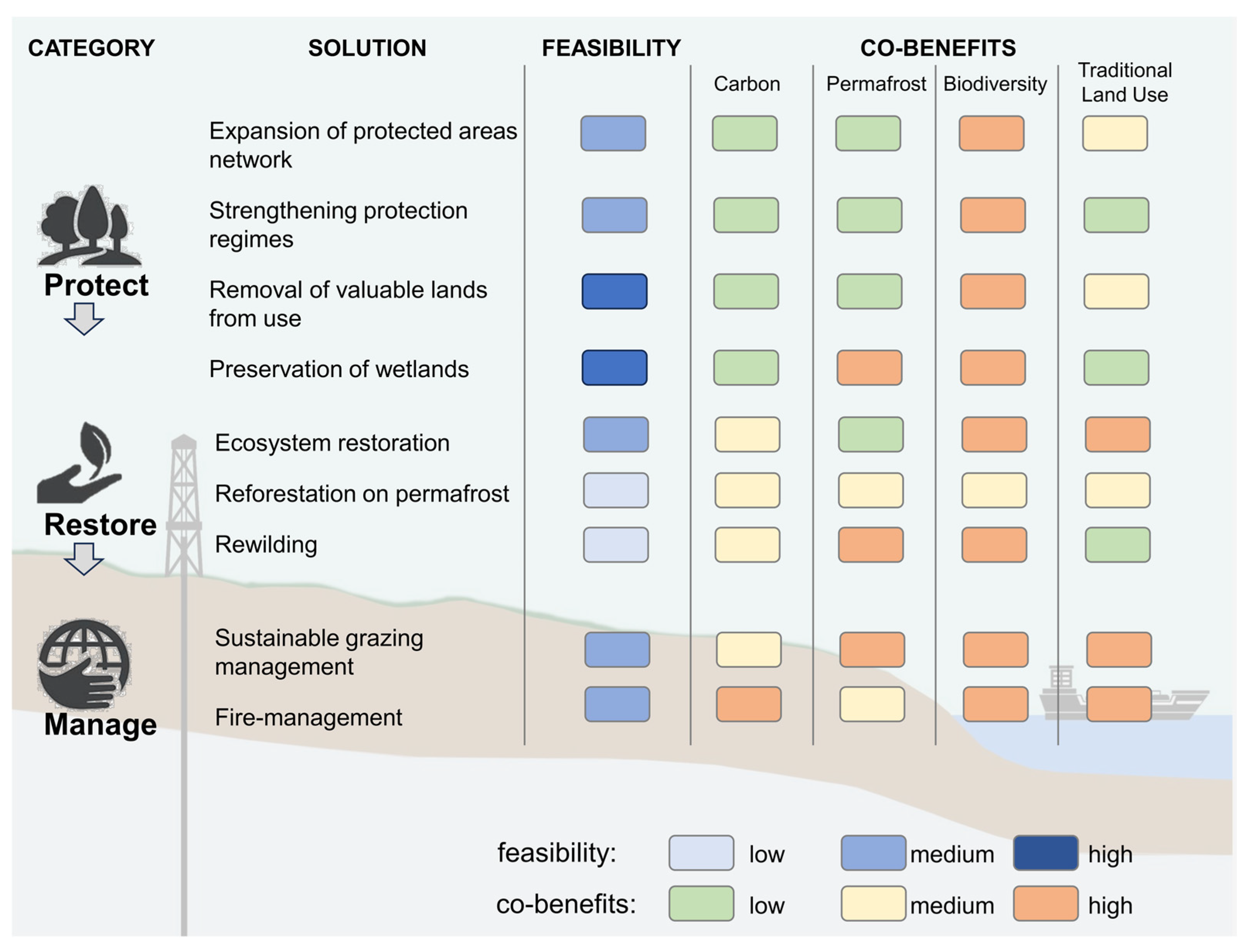
To summarize the feasibility of each possible NbS pathway we used a qualitative scale: High/Medium/Low for short-term feasibility; High/Medium/Low for co-benefits. We assigned these categories based on an expert analysis of publication and spatial statistics.

3. Results and Discussion

3.1. The State of Knowledge and Research Gaps

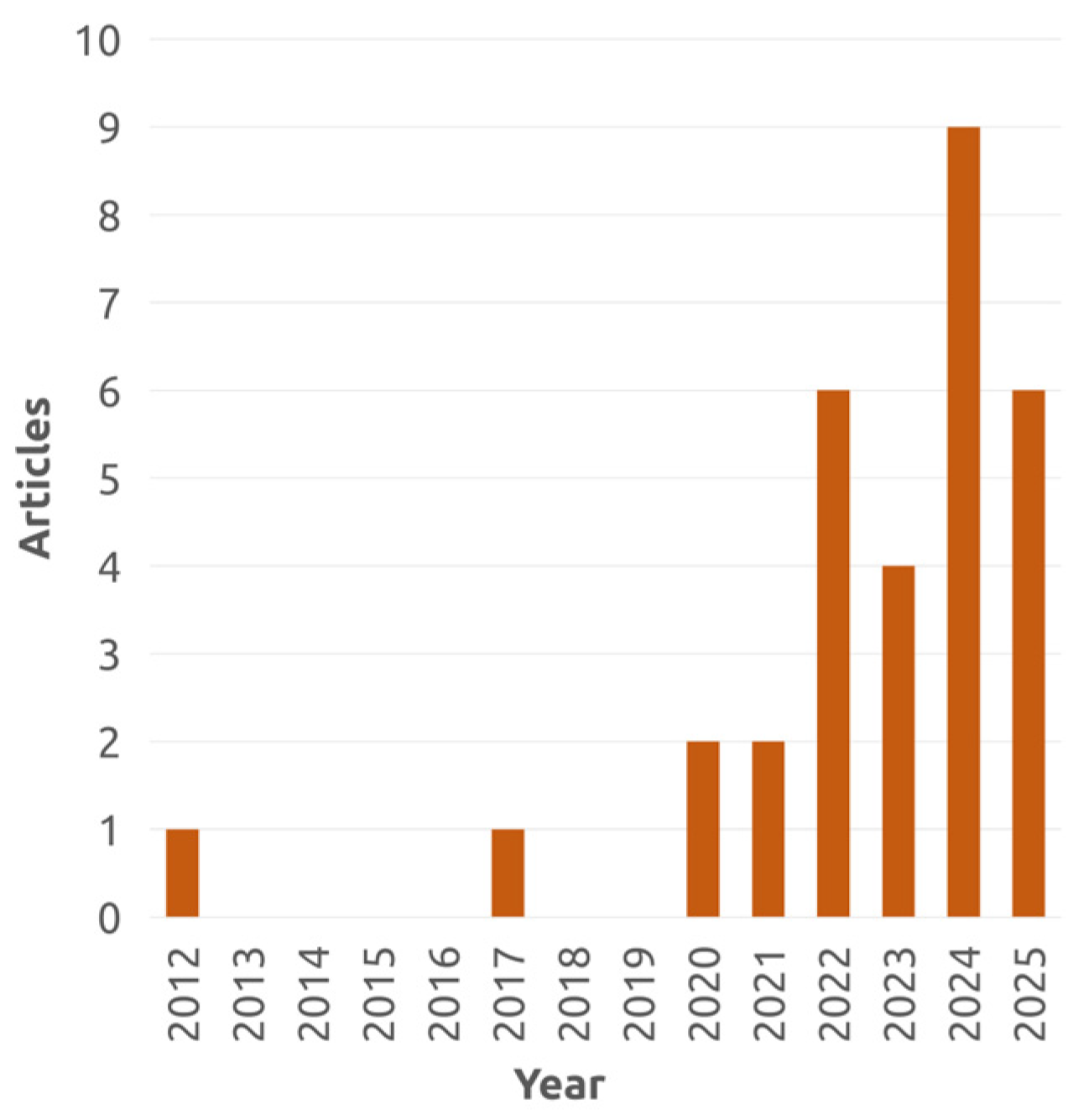
An analysis of search queries showed that although thousands of scientific articles were devoted to the discussion of the NbS in general [50], publications focusing on the Arctic were very scarce; we found only 35 relevant peer-reviewed articles. Most of the articles were published in the period from 2020 (Figure 3).
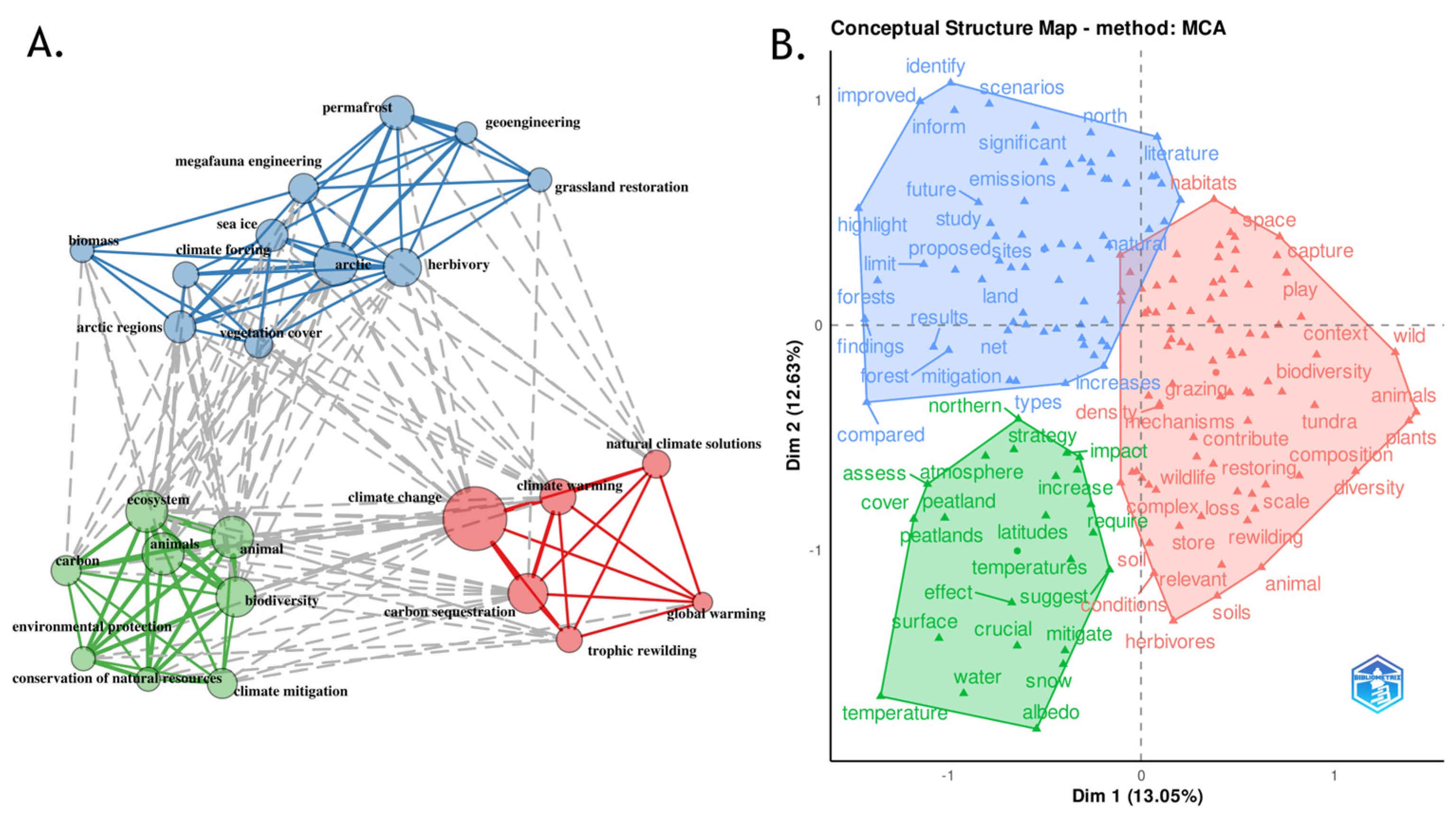
The results of bibliometric analysis are grouped into three distinct clusters based on both keywords and abstract texts (Figure 4). The first two axes of the multiple correspondence analysis (MCA) explain 25% of the variance (Figure 4B).
The red cluster, labeled “climate change”, addresses the issue of changing natural components and processes in the Arctic, encompassing both elements of the carbon balance and biodiversity. It shows a minor overlap with the blue cluster, “climate mitigation”, which describes the opportunities and constraints of various proposed mitigation pathways under different climate change scenarios. The green cluster, “climate warnings”, does not overlap with the previous two. It encompasses assessments of risks to the entire climate system, including the radiation balance, and thermal and hydrological regimes. The identified clusters are not associated with specific NbS pathways but are instead linked to broader research directions.
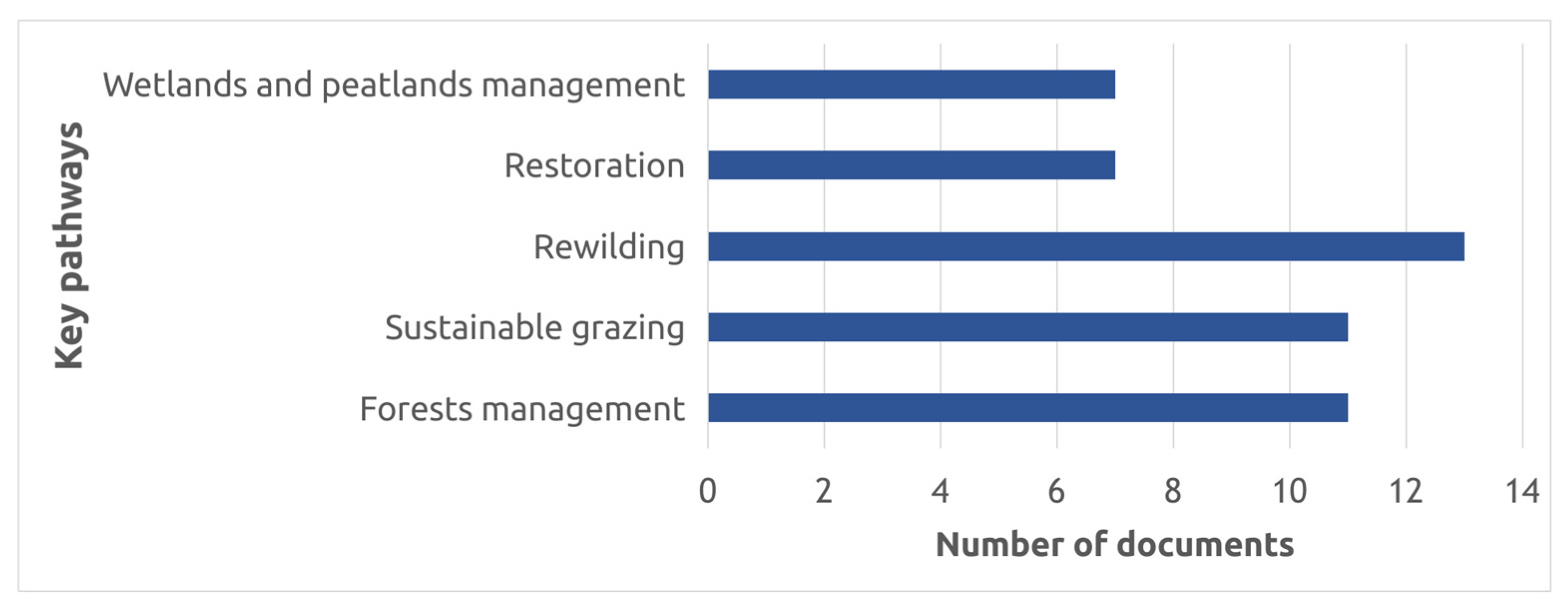
A full-text analysis of publication topics revealed that 25 publications (71%) discussed only one pathway, 9 (35%) discussed two, and one publication discussed all the pathways under consideration. Of these, 13 (37%) of them discuss rewilding (Figure 5). Eleven publications each were devoted to forest and pasture management, and seven to wetland and peatland management and ecosystem restoration.
The scarcity of relevant publications, coupled with their general character, points to a limited theoretical foundation for NbS in the Arctic. The existing scientific research on NbS in the Arctic is incommensurate with the role of this macro-region in the global carbon cycle. Thus, there has been a linear increase in the number of scientific publications devoted to the carbon cycle in Arctic and permafrost zones [5].

3.2. Forest in the Arctic

Forest climate projects are the most widespread group of natural solutions; the potential of such NbS worldwide is estimated at 16.2 million tons of CO2e yr−1 or a two-thirds of all global cost-effective NbS mitigation [47]. This NbS include measures to prevent the conversion of forests to non-forest lands, forest restoration, forest management, forest plantation management, and reducing the use of wood as fuel while expanding its use for the production of building materials, furniture, and other products capable of storing the carbon accumulated in wood for a long time [51]. According to estimates for Russia, Canada, and the United States, forest management is one of the most cost-effective NbS scenarios [52,53,66].
Coniferous oligodominant forests and sparse forests in the Eurasian Arctic are represented by communities of several geographically distinct complexes of the boreal type, widespread in the Hypoarctic [67]. They form subarctic forest-tundra and northern taiga biomes [58]. These are low-productivity sparse forests formed by larch (Larix sibirica Ledeb., Larix gmelinii (Rupr.) Göpp. s.l.), spruce (Picea obovata Ledeb.), and birch (Betula pubescens Ehrh. s.l.) which form ecosystems with slow tree growth and recovery rates after disturbances. A special role in assessing the Arctic carbon budget is assigned to the most widespread communities of dominant formations, primarily larch forests [68]. At the same time, carbon stocks in these forests are significant both directly in the tree stand and in the forest litter, which is due to slow decomposition rates associated with low organic matter turnover. According to the authors’ estimates for the Arctic regions of Northeast Asia dominated by larch forests, the carbon content (taking into account trunks, roots, branches, tree needles, undergrowth, shrubs, and living ground cover) in Yakutia is 3526 million tons, in the Magadan region—156 million tons and in the Chukotka Autonomous Okrug—28.0 million tons [68]. On average, Arctic forests act as sinks of −0.2 to −0.5 t C ha−1 yr−1, but their carbon balance is highly variable in time and space [13]. In young larch forests (up to 50–80 years old), CO2 emissions prevail, as soil respiration and organic matter decomposition exceed biomass growth [68]. Old-growth forests (100–200 years old) become net carbon sinks, accumulating carbon in wood and soil organic matter. Carbon stock in larch forests of NE Asia decreased by ≈1.9 Pg C between 1993–2003 due to forest loss [68]. The main risks to larch forest ecosystems in terms of maintaining the carbon balance are fires, the intensification of which is linked to climate change and the degradation of permafrost [69].
One of the key indicators of climate change in Arctic terrestrial ecosystems is “greening” and “browning”—positive or negative trends in empirical vegetation indices from remote sensing data [57], such as NDVI [70]. The high-latitude forests of Siberia show greening trends, which may indicate an increase in productivity and aboveground biomass, tree and shrub growth due to climate change [71]. Experimental data show that the vegetation shift in an Arctic subregion from less to more productive types through the replacement of tundra by shrub or forest communities can lead to a loss of soil carbon that quantitatively exceeds the carbon gain from the increase in shrub aboveground biomass [72]. Climate change contributes to shifts in forest communities with the replacement of light coniferous by dark coniferous forests [73] and an increase in canopy closure [74]. In the context of climate change, the biosphere functions of Arctic forests are of global importance.
In Russia, about two-thirds of all forests grow on permafrost, primarily in Siberia and the Far East [75]. Both the forest and the components of the forest phytocenosis play a key role in preserving permafrost [76]. Fires drastically reduce carbon stocks and can turn the ecosystem into a source of CO2 emissions for several decades, until the vegetation cover and topsoil horizons are restored [77,78]. Fires play a decisive role in surface albedo and active layer characteristics [79]. Among the characteristics of forest fires, burning intensity is a critical property that determines permafrost stability through the combustion of insulating organic matter, vegetation, and post-fire albedo changes [80,81]. The impact of fires on permafrost is also determined by regional and landscape specifics (terrain conditions, soil type and moisture content, subsurface ice content, as well as vegetation properties) [82,83]. The recovery of active soil layer thickness after fires in the Arctic can take decades [84].
Although warming and greening may enhance the sink function, this trend is partially offset by increased respiratory losses and the risks of permafrost degradation [71]. Thus, Arctic forests cannot be classified unequivocally as either sinks or sources: their role depends on the age of the stands, climatic conditions, and the frequency of fires. On average, they remain net carbon sinks, but under climate change conditions, the likelihood of them becoming carbon sources increases.
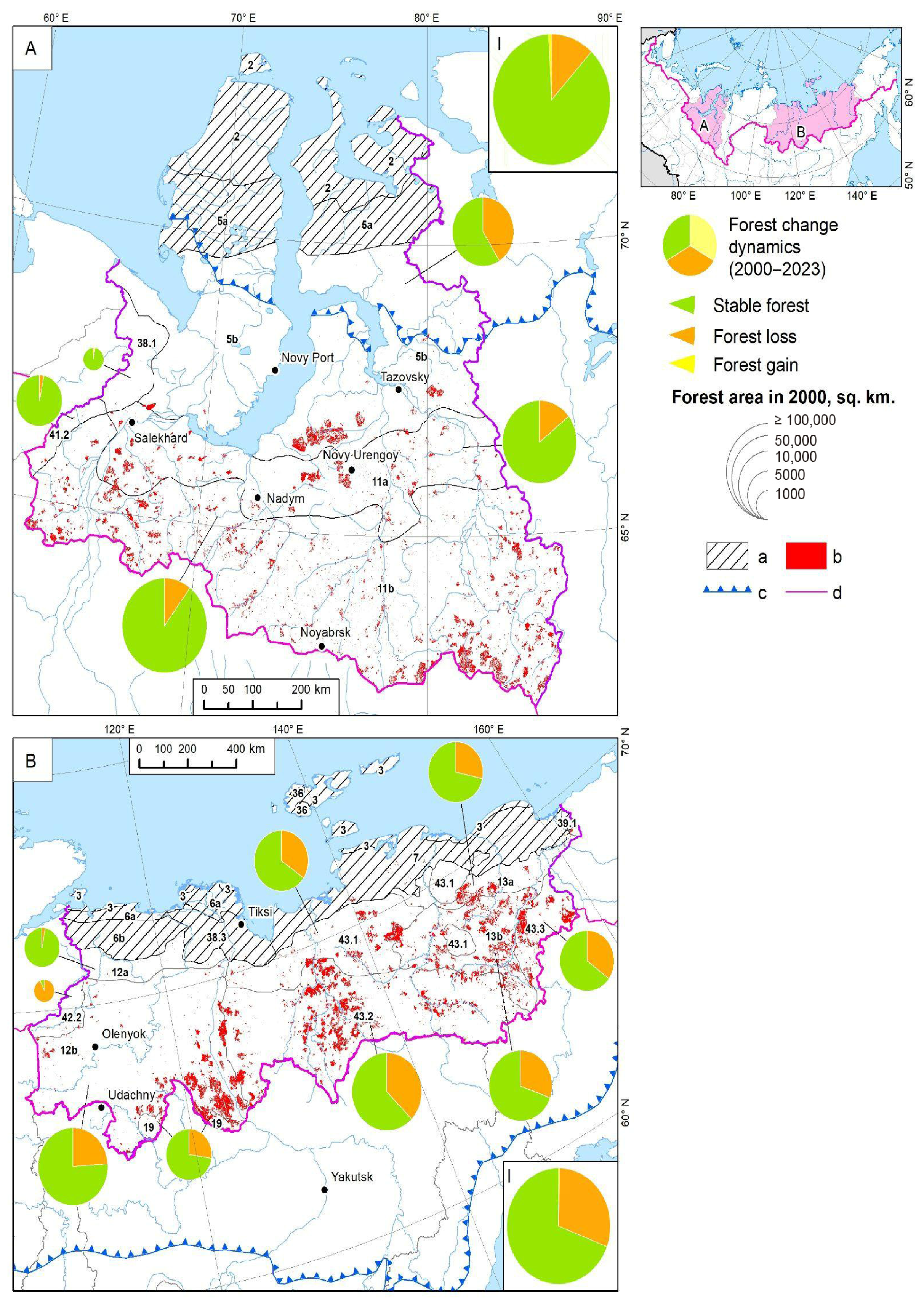
According to the GFCM [60], forests in the Arctic zone of the Russian Federation have suffered catastrophic losses over the past decades. Deforestation is most extensive in the Northern West Siberian northern taiga biome, where between 2000 and 2023 the forest area decreased by 13,000 square kilometers, up to 10% of the biome’s forest area in 2000 (Figure 6; Table A1). A significant reduction in forest area occurred in the Northern West Siberian forest-tundra biome—4000 km2 (14% of the biome’s forest area in 2000) and in the southern hypoarctic tundra biome—about 3000 km2 (41% of the forest area in 2000). In mountain biomes, the reduction in forest area does not exceed 4%. The forest gain is insignificant, not exceeding 1% of the forest area in 2000 for all biomes. Fires are the cause of the destruction of 94% of forests. It has been shown that in the forest-tundra areas of the YaNAO, at least 40% of the territory burned during a 60-year period, and 10% experienced 2–3 fires in the interval of 15–60 years [85], thus disturbances are the main driver of vegetation change in northern Western Siberia. The reduction in forest area in the YaNAO occurred mainly in the island permafrost zone (more than 99% of the area).
The areas of the Republic of Sakha (Yakutia) in the AZRF are located in an area of continuous distribution of permafrost. The percentage of deforestation is drastically high in the Anabar hypoarctic taiga biome, where, according to GFCM data, more than 90% of forests have been lost. In hypoarctic taiga biomes forest loss is estimated at 30–40%, and in northern taiga, middle taiga, and forest-tundra biomes—20–30% (Figure 6; Table A2). The main cause of forest loss is fires (99%). At the same time, forest gain during the period 2000–2023 occurred in areas occupying less than 1% of the total forested area.
Difficult access, poorly developed infrastructure, and low population density complicate the implementation of forestry NbS in the AZRF. Possible NbS pathways in these conditions include the development of ecosystem management approaches, primarily fire monitoring and approaches to forest restoration. One of the key challenges for developing NbS is assessing the feedback loops in climate change when the forest cover of Arctic forests is disturbed [86]. Its complexity is primarily related to the quantitative interpretation of data due to limited information on productivity and biomass stocks, the nature of disturbances, and the restoration pathways.

3.3. Sustainable Grazing Management in the Arctic

Reindeer herding is both a traditional livelihood for Arctic Indigenous peoples, with their well-being tied to pasture health, and a key element of their cultural identity [87,88]. In various regions of the Arctic, pastures occupy the predominant land areas [89].
The reindeer is one of the key species in Arctic ecosystems [90], influencing the composition, structure, and dynamics of plant communities [91], as well as above-ground and below-ground biomass [92]. At the same time, the impact of grazing on the composition and structure of plant communities varies in different natural zones, and different functional groups of plants have varying sensitivity to grazing [91]. Reindeer grazing affects both the carbon and nitrogen cycles in Arctic ecosystems, transforming the biochemical and physicochemical conditions for the stabilization of organic matter in soils [93,94], carbon and nitrogen stocks, and greenhouse gas fluxes [95].
NbS for pasture management have been widely tested in various regions of the world. From a NbS design perspective, pasture management can lead to increased soil carbon stocks [96] and changes in the radiation balance through surface albedo [97]. Overgrazing, on the contrary, contributes to the loss of carbon from both the soil and plant biomass [98]. The impact of grazing varies significantly depending on soil conditions and intensity. For example, a recent study showed that on soils with a clay content of more than 22%, moderate grazing can lead to carbon accumulation due to compensatory growth of root biomass, while on sandy soils there is an almost linear decrease in carbon stocks with increasing grazing intensity [99]. These results confirm the optimal grazing hypothesis [100,101], according to which moderate disturbances stimulate plant productivity and increase the supply of organic carbon to the soil [102]. Albedo management is considered one of the promising approaches to mitigating permafrost thaw [36], which reduces surface heating. It has been shown that reindeer grazing can increase surface albedo in tundras by reducing shrub abundance [103]. Moderate grazing can reduce methane emissions by reducing shrubs and increasing albedo, while overgrazing leads to increased CO2 and CH4 fluxes [95]. These results highlight the need to develop adaptive grazing regimes that take into account both traditional farming practices and climate effects [104].
In various regions of the Arctic, ecosystems are experiencing reindeer overgrazing [91]. The increase in reindeer populations in the 20th century led to significant degradation of vegetation in the West Siberian Arctic [105,106]. At the beginning of the 21st century, the specific area of pasture per reindeer in the YaNAO was four times less than the norm, amounting to less than 26 hectares for the entire grazing period [107]. A study of the state of pastures in the Yamalo-Nenets Autonomous Okrug conducted in 2017–2018 showed that each reindeer has between 11–25 hectares [108]. The excessively high reindeer population and the tundra degradation determine the unstable state of reindeer husbandry in the West Siberian Arctic [109]. Thus, in Yamal, the existing traditional economy leads to the winter pastures of some families being located on the summer pastures of others. At the same time, the quality of winter pastures determines grazing sustainability [110]. Overgrazing and tundra degradation pose risks to both traditional land use practices and biodiversity [104]. In the West Siberian Arctic, reindeer grazing is listed as the main risk to tundra biodiversity [111,112]: high reindeer grazing pressure has a strong negative impact on nesting bird fauna.
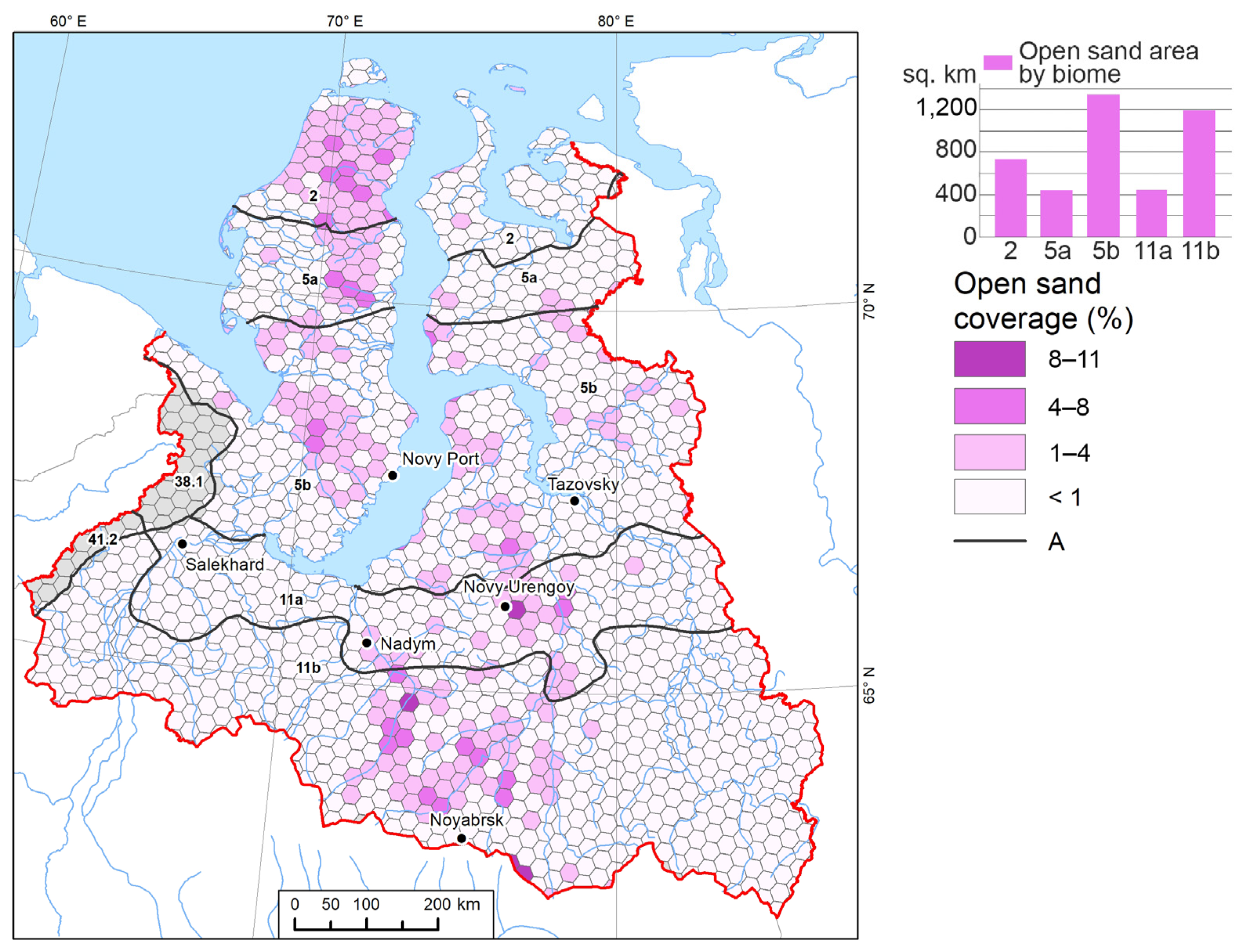
One of the important factors affecting grazing pressure in the tundra is the attitude of its indigenous inhabitants towards reindeer which varies from place to place: in particular, for the Nenets, the reindeer is practically a sacred animal, and the well-being of a family is measured, among other things, by the number of reindeer the regulation of which by various means may be met with resistance from herders. The most significant impact of overgrazing on the Yamal Peninsula has been the widespread formation of sands blowout sites in place of tundra with the replacement of typical tundra communities with species-poor sparce psammophyte communities [113]. The restoration of tundra vegetation in sands blowout sites can take several decades [114]. It takes at least 60–80 years to restore the disturbed lichen mat [115]. The destruction of vegetation contributes to wind erosion and further degradation of habitats, which are transformed into sand drifts and dunes, devoid of vegetation cover and often occupying vast areas. The growing extent of exposed blowout sands points to the occurrence of Arctic desertification [116]. Having its roots in the traditional land use, it threatens to destroy them. It has been shown that areas of sand drifts become centers of thawing of permafrost [117]. According to GLCLU data ([62]; classes 8–20), the area of categories corresponding to wind-blown sands in the Yamalo-Nenets Autonomous Okrug within the West Siberian Plain is 4151 km2 (Figure 7). At the same time, a comparison of GLCLU data for different years does not show a significant increase of the open sand area. Published sources provide various estimates, ranging from 2228 km2 for the YaNAO [118] to 5830 km2 on the Yamal Peninsula alone [104]. For the Eastern European and Western Siberian Arctic, the total area of sand is estimated at 16,857 km2 [116].
For Central Yamal, it has been shown that increasing grazing pressure offsets the ongoing processes of scrub encroachment in conditions of air temperature growth [119]. The authors of the study conclude that sustainable grazing is one of the possible ways to preserve tundra vegetation in the context of global warming.
As the basis of the traditional economy of the indigenous peoples, reindeer herding affects the biodiversity and biogeochemical cycles of the tundra. NbS in the Arctic is only possible under conditions of sustainable grazing that does not lead to the degradation of tundra ecosystems. Industrial development, construction of communications, roads, and industrial facilities in the oil and gas sector potentially leads to the loss of some grazing areas and, potentially, to an increased load on others [120].
A potential area for NbS is the regulation of reindeer population (taking into account the above-mentioned aspects of the indigenous tundra peoples’ cultural attitude towards reindeer) and grazing regimes, for example through measures to support local communities in order to ensure conditions for the restoration of pastures. The successful implementation of NbS requires raising awareness among indigenous communities about sustainable land-use practices, coupled with external incentives for their adoption, modernization of tundra living conditions, and effective management of industrial impacts—especially from oil and gas operations. An optimal approach involves synergistic efforts between project operators and the herders.
Successful examples of integrating indigenous knowledge into broader practices include collecting data on sacred sites, analyzing local residents’ memories of hazardous places—which often correspond to areas with natural disease foci—and documenting interannual fluctuations in key ecosystem services. These services encompass the availability of wild plants and mushrooms and the population dynamics of commercially relevant fish and terrestrial species.
To use this data effectively in developing environmentally and socially sound strategies, it is advisable to create a system of metrics for biodiversity and the associated ecosystem services that are essential for sustaining traditional forms of natural resource use.

3.4. Rewilding in the Arctic

Rewilding is an ecosystem restoration strategy that involves reintroducing lost components, particularly large “ecosystem engineer” species, into their former native ranges from which they were eradicated by humans. It is regarded both as a component of ecological restoration [121], and a potential climate solution [122]. This approach can complement other NbS while enhancing biodiversity conservation [123].
A meta-analysis by Trepel et al. [124] shows that wild herbivorous megafauna influences ecosystem structure and ecological processes, significantly alters soil nutrient availability, promotes the development of open vegetation structure, and reduces the abundance of smaller animals. Megafauna significantly increases ecosystem heterogeneity by influencing the spatial heterogeneity of vegetation structure and plant diversity. It has been noted that large herbivores, acting as important regulators of community composition and structure, can play a stabilizing role in the Arctic [125].
There is a hypothesis about the possibility of managing permafrost ecosystems through the rewilding of large herbivores and, thus, restoring the ecosystem role of megafauna in the Arctic [126]. Based on the analysis of paleontological and paleogeographical data, the potential capacity of pleistocene pastures was estimated at 10.5 tons of biomass per square kilometer [127], with the high role of herbivores leading to the formation of highly productive grass communities. The decline in the role of herbivores due to hunting by ancient humans led to the formation of shrub communities. In edible conditions, the restoration of the ecosystem role of herbivores can lead to a transformation of soil moisture and temperature characteristics, a change in surface albedo, and a change in the thermophysical properties of snow cover. The results of the Pleistocene Park experiment show that grazing of large herbivores in the forest-tundra enhances the carbon cycle: both CO2 uptake (gross primary production, GPP) and CO2 release (ecosystem respiration, Reco) increase, while the net ecosystem exchange (NEE, i.e., the balance between GPP and Reco) remains similar between grazed and undisturbed areas [128]. At the same time, methane emissions decrease due to reduced soil moisture, which limits the anaerobic conditions necessary for CH4 formation. The same experiment showed [129] that in areas of drained thermokarst basins and hills (Yedoms), the average carbon content was six times higher in the upper 38 cm (minimum depth of the active layer) compared to similar areas without grazing. Despite existing models [130], there is currently insufficient field verification experience of the capabilities of such NbS. At the same time, it is emphasized that the inclusion of large herbivores in biogeochemical models is important for carbon balance assessments [130].
In the Arctic, rewilding experiments are still rare. In the Russian Arctic, there are initiatives to rewild muskox [131], a key Arctic ecosystem “engineer” that influences the composition of plant communities, biomass, and carbon and nitrogen cycles [132,133]. It has been shown [134] that the ecological niches of reindeer and muskox overlap, and that the destruction of the muskox population is linked to human activity. Thus, initiatives to restore muskox populations may have potential as NbS, and the total potential of muskox rewilding is estimated at 0.030 ± 0.015 GtCO2 yr−1 (≈0.008 ± 0.004 Pg C yr−1) [122].
When designing rewilding experiments, the key issues are the reliability and reproducibility of the relevant results. Questions remain as to whether and how animals can change the albedo, thermophysical properties of Arctic vegetation, physical and biogeochemical properties of soils in the course of their life activities. What is the carbon balance of ecosystems with the restored ecosystem role of large herbivores? How sustainable can systems with large megafauna be? What is the role of bias associated with animal care, such as feeding, in the results obtained? Accurate and precise experimental design is necessary to answer all these questions.

3.5. Restoration of Degraded Arctic Lands

Ecosystem restoration is considered one of the priority pathways of NbS [135]. It aims to activate natural ecosystem mechanisms by restoring individual components in order to restore biodiversity and ecosystem functions [136].
The Russian Arctic is a region of intensive industrial development. The construction of new industrial facilities and the expansion of both new and existing mineral deposits lead to a continuous increase in the area of degraded lands. For example, in the Nenets Autonomous Okrug, preliminary estimates suggest that disturbed areas cover no more than 1% of the territory, but they are concentrated in certain areas and can reach 8–10% [137]. In the Yamalo-Nenets Autonomous Okrug, the area of urbanized territories, according to GLCLU data [61], has almost doubled from 631 square kilometers in 2000 to 1162 square kilometers in 2020. The area of open sand dunes associated with anthropogenic impacts in this region accounts for 13% of all sandy areas [118].
The extent of anthropogenic disturbances to vegetation in the Russian Arctic has not been sufficiently studied. It has been shown that complete vegetation transformation is observed in 0.2–1.5% of gas fields on Yamal peninsula, with the area where vegetation disturbance exceeds 10% estimated at 11% and 46% of the field area, respectively [138]. The average impact area of a drilling site is estimated at 9.6 hectares, but only 0.3 hectares of vegetation is destroyed, while 6.8 hectares of vegetation is disturbed by 10%. During the construction of each kilometer of road, the area of vegetation cover disturbance is estimated at 16 hectares, of which 1 hectare is completely destroyed and 12 hectares are slightly disturbed [138]. At the same time at the Prudhoe Bay field in Alaska, approximately 34% of the territory has been disturbed since 1968 [139], and between 1990 and 2001, under warming conditions, 19% of the remaining natural landscapes (excluding water bodies and infrastructure facilities) changed their appearance as a result of the development of thermokarst phenomena, which led to the formation of a new geoecological regime. Self-restoration of main plant communities on Yamal Peninsula may take at least 30 years [138]. Meanwhile, at the Prudhoe Bay field, the effects of the disturbances of the 1940s are still being observed [140], in addition the rate of self-restoration of disturbed lands is estimated at 100 years [141].
It has been shown that disturbed areas of tundra are a source of carbon, while undisturbed areas are sinks of tens to hundreds of g C m−2 yr−1 (scaling up to Tg–Pg C at regional level) [142]. Studies in the Canadian Arctic and Alaska show that anthropogenic or climate-driven disturbance of the vegetation and soils (e.g., via thermokarst or fire) releases significant carbon stocks, turning ecosystems from carbon sinks into emission sources [10,74].
Restoring vegetation cover is a difficult task in the Arctic due to harsh climate conditions [143]. Approaches to vegetation restoration in the Arctic are still under development. They are not widely used in the Russian Arctic, despite existing theoretical developments in this area [144].
International practice has approved the use of willow cuttings [145], turf and turf fragments [146,147,148] for the Arctic ecosystems restoration. A promising approach for restoration of disturbed lands in the Arctic is the use of mosses [149] or biocrusts from cyanoprokaryotes, lichens and mosses [150,151]. Mosses, lichens and biocrusts are among the most important ecosystem “engineers” in the Arctic [152], determining patterns of soil formation [153], surface albedo [154] and patterns of carbon and nitrogen accumulation [155,156,157]. The use of biocrusts to restore disturbed lands is considered an effective approach for ecological restoration, significantly reducing wind erosion [158,159], with extensive experience in their use in arid regions. Such approaches can be combined with traditional sand stabilization methods.
Despite the potential for using local vascular plant species [160] to restore vegetation on different soils, ineffective methods of restoration using grass mixtures of “southern” grass species are used in the Russian Arctic [160]. The unsuitability of existing technologies not only reduces efficiency on the one hand, but also poses risks to biodiversity on the other. Thus, the active spread of alien plant species in the Arctic has been recorded [32], with the presence of at least 341 alien taxa documented. A total of 333 alien plant species have been recorded in the Russian Arctic [161], with 216 alien vascular plant species recorded in the West Siberian Arctic [162]. It has been shown that the introduction and spread of alien species in the Russian Arctic is currently occurring locally and is mainly associated with settlements, industrial centers, and transport routes [32].
The introduction of invasive species can result in changes in the conditions and structure of natural ecosystems, leading to a decline in their biodiversity and a reduction in the populations of native species [163]. For example, the Smooth Brome Bromus inermis Leyss., widely used for grass mixtures, is currently one of the most aggressive invasive species rapidly spreading in Alaska [164,165]. This species has been found in various areas of the West Siberian Arctic [166,167], thus demonstrating its potential for expansion in disturbed and natural grasslands.
Restoration is one of the key areas of biodiversity offsets [168,169]. Restoring ecosystems in the Arctic is a challenge, and self-restoration takes a very long time. The key focus areas of environmental restoration in the Arctic aim to establish conditions that initiate natural recovery processes across major landscape facets and to redirect and halt spontaneous degradational processes, including waterlogging, erosion, etc. [144]. In the Arctic, such solutions may have additional climate potential and be considered, reducing GHG emissions and stabilizing permafrost. However, there are many uncertainties. In particular, a scientific gap is the understanding of the thermophysical properties of vegetation cover and the potential for permafrost temperature stabilization [170]. Indigenous people can be involved in the restoration of ecosystems in the Arctic, for whom such activities can be beneficial, as well as a support measure that can potentially reduce poaching or extensive grazing. In addition, indigenous people of the tundra can be involved in harvesting restoration material—willow or moss turf— with its subsequent use in restoring modified ecosystems. It is indicated that involving indigenous people in the implementation of the NbS is one of the key areas of ensuring the sustainability of the NbS [171].

3.6. Arctic Wetlands and Peatlands

Various approaches to NbS associated with wetlands are actively developing in world practice. Among them are the exclusion of conversion of waterlogged lands, restoration of bogs, restoration of coastal and floodplain vegetation [47,52]. These solutions contribute to the long-term potential for mitigating climate change [172]. The global potential of wetland-related NbS is estimated at 1.1–2.6 GtCO2e yr−1 (≈0.30–0.71 Pg C yr−1) in 2030 [173].
Wetlands in the boreal and arctic zones have an important climate-regulating function [174] and cover extensive areas, over 25% of the land area within the AMAP boundary [175] and 16.5% within the boundary of the Circumpolar Arctic Vegetation Map [176,177]. They are natural accumulators of large volumes of organic matter [178] and play key roles in regulating water balance, maintaining permafrost [179] and preserving biodiversity [180]. Arctic wetlands and peatlands are potentially vulnerable to climate change [175], and the 0.8–1.9 million km2 of peatlands in permafrost areas may be potential emitters of CO2 and CH4 [178]. The most vulnerable to climate change are peatlands in areas of discontinuous permafrost [181]. Permafrost degradation in wetland complexes can be accompanied by the development of thermokarst [182], a relatively poorly studied process in the Arctic carbon cycle [183,184], which releases carbon accumulated in permafrost. High densities of reindeer can also lead to permafrost degradation in wetlands [185].
Arctic peatlands remain largely unexploited for peat extraction, despite the existence of applicable extraction methods [186]. Meanwhile, oil and gas development, a dominant economic activity in the region, creates numerous quarries for construction materials. After operations cease, these quarries—either hydraulically excavated or dry—often fill with water, forming deep lakes that pose significant challenges for ecological rehabilitation [187], a process that can take decades. Nevertheless, comprehensive rehabilitation measures exist, aiming to restore hydrology and initiate natural recovery [144,188].
Such ecological rehabilitation, coupled with the restoration of shoreline vegetation, will promote the accumulation of bottom sediments and, in tundra conditions, lead to waterlogging along with peat development. This process facilitates carbon sequestration through the accumulating biomass and peat of the newly formed wetland. These restoration measures can be considered NbS; however, assessments of their carbon sequestration potential in the Arctic are currently lacking.

4. Conclusions

Nature-based Solutions (NbS) are knowledge-intensive and require rigorous scientific development to verify their effectiveness and assess potential impacts [189,190]. However, a significant knowledge gap of NbS feasibility persists both in the Arctic as a whole and in its Russian part. Despite a long history of research in the Russian Arctic, natural factors and processes governing the regional carbon balance remain poorly understood due to the territory’s remoteness and fragmented (“island”) pattern of development. Most carbon cycle studies are concentrated in Alaska and northeastern Canada, leaving vast and climatically sensitive areas of the Russian Arctic critically understudied [191,192,193]. This data deficit is exacerbated by the lack of a comprehensive greenhouse gas monitoring network. The Russia’s Unified National Monitoring System of Climate-Active Substances (“VIP GZ”) provides virtually no coverage of the Arctic. Currently, only a few pilot sites (e.g., “Seven Larches” in the forest-tundra) are operational, while immense tundra regions lack any representation [47]. Developing effective Arctic NbS thus requires robust data on carbon balance patterns across diverse ecosystems and anthropogenic impacts, necessitating an integrated research approach. The need to consolidate scientific efforts to build a foundation for climate adaptation and mitigation policies is widely emphasized [11].
Given its vast area and significance for the global carbon cycle, the Arctic remains a critical gap in the science underpinning NbS. Existing proposals are fragmented and fail to constitute a unified program. Moreover, evidence indicates that ecosystem interventions can lead to carbon losses and permafrost degradation [46]. Therefore, priority should be given to protective and restorative measures, such as ecosystem conservation, rehabilitation of degraded lands, and sustainable ecosystem management (Figure 8).
All proposed approaches currently involve significant uncertainties. Advancing Arctic NbS requires the consolidation of interdisciplinary research spanning geocryology, soil science, ecology, botany, zoology, and social sciences. The scope of research at carbon research and monitoring sites should extend beyond natural ecosystems to include modified ones. Furthermore, a comprehensive assessment of the carbon balance across different land use practices is essential.
As initial practical steps towards implementing such integrated solutions, we propose the following: (1) integrating carbon balance accounting into the practice of forest offsets, which is legally established in the Russian Federation and is generally being successfully implemented. This would make it possible to assess the climate contribution of forest restoration and forest management projects, and could also provide a potential impetus for the development of forest-climate projects in the Arctic; (2) extending mandatory offset requirements to the tundra biome, analogous to the provisions currently in place for forest lands in the Russian Federation; (3) enhancing the management of protected areas; (4) synergizing traditional forms of nature use (with the modernization necessary for their preservation and the safety of society as a whole) and preserving ecosystems that provide relevant services taking into account the entire geography of the relevant forms.
This should be achieved through functional zoning and the effective regulation of land and resource use. Furthermore, the practice of excluding licensed exploration areas and technical corridors from pre-established protected boundaries must be prohibited. Promising solutions with carbon sequestration potential can also deliver co-benefits for biodiversity, positioning them as potential offset mechanisms. Thus, well-designed NbS projects in the Arctic could contribute not only to climate mitigation but also to biodiversity and traditional land-use conservation goals.
In conclusion, while the implementation of NbS in the Arctic is feasible, a precautionary principle dictates a focus on protection and restoration. A synergistic approach, combining conservation, restoration, and management strategies through collaboration between the state, industry, and science, appears most promising.

Author Contributions

Conceptualization, S.V.D. and V.Y.S.; methodology, S.V.D.; software, A.V.P.; validation, S.V.D., V.Y.S. and M.V.B.; formal analysis, A.V.P.; investigation, S.V.D., V.Y.S., M.V.B., A.D.N. and A.S.K.; data curation, A.V.P.; writing—original draft preparation, S.V.D.; writing—review and editing, V.Y.S. and S.S.C.; visualization, A.V.P.; supervision, V.Y.S. and S.S.C.; project administration, V.Y.S.; funding acquisition, V.Y.S. and S.V.D. All authors have read and agreed to the published version of the manuscript.

Funding

Our research was partially supported by Lomonosov Moscow State University Program of Development, Project No 23-SCH07-66.

Institutional Review Board Statement

Not applicable.

Informed Consent Statement

Not applicable.

Data Availability Statement

No new data were generated or analyzed in support of this review. All information and conclusions presented are based on previously published studies, which are cited throughout the manuscript and listed in the reference section.

Acknowledgments

The authors thank Kirill A. Korznikov for his help in searching international scientific databases and Violetta D. Dziziurova for her valuable comments on the manuscript.

Conflicts of Interest

Author Sergey S. Chernianskii was employed by EnviSoilCons Pr. Authors Andrey D. Naumov and Vladimir Y. Slobodyan were employed by Institute of Environmental Survey, Planning & Assessment JSC. The remaining authors declare that the research was conducted in the absence of any commercial or financial relationships that could be construed as a potential conflict of interest.

Abbreviations

The following abbreviations are used in this manuscript:
AMAPArctic Monitoring and Assessment Programme
AZRFArctic Zone of Russian Federation
CAVMCircumpolar Arctic Vegetation Map
GDPGross Domestic Product
GFCMGlobal Forest Change map
GHGGreenhouse gases
GLCLUGlobal Land Cover and Land Use Change dataset
GPPGross Primary Production
IPCCIntergovernmental Panel on Climate Change
MCAMultiple Correspondence Analysis
NbSNature-based climate solutions
NDVINormalized Difference Vegetation Index
NEENet Ecosystem Exchange
NPPNet Primary Production
PRISMAPreferred Reporting Items for Systematic reviews and Meta-Analyses
RecoEcosystem Respiration
YaNAOYamalo-Nenets Autonomous Okrug

Appendix A

Table A1. Land cover change in the biomes of the Yamalo-Nenets Autonomous Okrug.
Biomes IndexBiomsTree
Cover 2000, sq. km
Forest Loss (2000–2023), sq. kmForest Loss Share (2000–2023), %Forest Loss (% of 2000 area)Open Sand, sq. kmOpen Sand Share, %Built-Up Areas, sq.kmBuilt-Up Areas Share, %
2Novozemelsko-Yamalo-Gydan Arctic tundra0000725.820 0
5aNorthern hypoarctic Kola-Bolshezemelsko-Taz tundra0000445.960.6 0.001
5bSouthern hypoarctic Kola-Bolshezemelsko-Taz tundra6500.82672.61411340.012040.1
11aNorthern West Siberian forest-tundra27,947.93977.9414445.113460.3
11bNorthern West Siberian northern taiga125,261.112,722.45101193.30.35840.2
38.1Hypoarctic Polar Ural tundra599.613.70.12--260.2
41.2Hypoarctic Northern Ural tundra1491.947.313--20.03
Table A2. Land cover change in the biomes of the Yakutia.
Biomes IndexBiomsTree
Cover 2000, sq. km
Forest Loss (2000–2023), sq. kmForest Loss Share (2000–2023), %Forest Loss (% of 2000 area)Open Sand, sq. kmOpen Sand Share, %Built-Up Areas, sq.kmBuilt-Up Areas Share, %
3Taimyr-East Siberian arctic tundra0000283.20.50.3<0.01
6aTaimyr-Central Siberian northern hypoarctic tundra0000348.810.8<0.01
6bTaimyr-Central Siberian southern hypoarctic tundra0000532.610.6<0.01
7Lena-Kolyma hypoarctic tundra0000276.60.25.2<0.01
12aKotui-Lena (Olenyok) forest-tundra1735.451.20.131171.92.62.2<0.01
12bKotui-Lena (Olenyok) northern taiga88,018.620,930.36241903.80.530.9<0.01
13aNizhnekolymsky forest-tundra14,093.44002.072818.30.031.1<0.01
13bNizhnekolymsky northern taiga43,637.113,301.5113053.40.0410<0.01
19Middle taiga of Central Yakutia (boreal forests)7143.61935.01327277.621.6<0.01
36High Arctic island mountain tundra--00000<0.01
38.3Kharaulakh Range middle Siberian Hypoarctic tundra--0012,807231.9<0.01
39.1Chukchi (Beringian, Western Chukchi) hypoarctic tundra--00219.27.50<0.01
42.2Anabar hypoarctic taiga282261.61932857120.3<0.01
43.1Verkhoyano-Kolyma (Polousny Range) hypoarctic taiga11,419.13955.323516,773.9105.1<0.01
43.2Verkhoyano-Kolyma (Verkhoyano-Yano-Indigirka) hypoarctic taiga79,010.229,480.483759,320.31734.9<0.01
43.3Verkhoyano-Kolyma (Oymyakon-Omolon) hypoarctic taiga20,030.46974.71335439.40.80.4<0.01

References

  1. Rantanen, M.; Karpechko, A.Y.; Lipponen, A.; Nordling, K.; Hyvarinen, O.; Ruosteenoja, K.; Vihma, T.; Laaksonen, A. The Arctic Has Warmed Nearly Four Times Faster than the Globe since 1979. Commun. Earth Environ. 2022, 3, 168. [Google Scholar] [CrossRef]
  2. Chylek, P.; Folland, C.; Klett, J.D.; Wang, M.; Hengartner, N.; Lesins, G.; Dubey, M.K. Annual Mean Arctic Amplification 1970–2020: Observed and Simulated by CMIP6 Climate Models. Geophys. Res. Lett. 2022, 49, e2022GL099371. [Google Scholar] [CrossRef]
  3. Gutiérrez, J.M.; Jones, R.G.; Narisma, G.T.; Alves, L.M.; Amjad, M.; Gorodetskaya, I.V.; Grose, M.; Klutse, N.A.B.; Krakovska, S.; Li, J.; et al. Atlas. In Climate Change 2021: The Physical Science Basis. Climate Change 2021: The Physical Science Basis. Contribution of Working Group I to the Sixth Assessment Report of the Intergovernmental Panel on Climate Change; Cambridge University Press: Cambridge, UK; New York, NY, USA, 2021; pp. 1927–2058. [Google Scholar]
  4. Third Assessment Report on Climate Change and Its Impacts in the Russian Federation. General Summary; Science-Intensive Technologies: St. Petersburg, Russia, 2022; ISBN 978-5-907618-14-5.
  5. Schuur, E.A.G.; Abbott, B.W.; Commane, R.; Ernakovich, J.; Euskirchen, E.; Hugelius, G.; Grosse, G.; Jones, M.; Koven, C.; Leshyk, V.; et al. Permafrost and Climate Change: Carbon Cycle Feedbacks From the Warming Arctic. Annu. Rev. Environ. Resour. 2022, 47, 343–371. [Google Scholar] [CrossRef]
  6. Friedlingstein, P.; O’Sullivan, M.; Jones, M.W.; Andrew, R.M.; Hauck, J.; Landschützer, P.; Le Quéré, C.; Li, H.; Luijkx, I.T.; Olsen, A.; et al. Global Carbon Budget 2024. Earth Syst. Sci. Data 2025, 17, 965–1039. [Google Scholar] [CrossRef]
  7. Strauss, J.; Schirrmeister, L.; Grosse, G.; Fortier, D.; Hugelius, G.; Knoblauch, C.; Romanovsky, V.; Schädel, C.; Von Deimling, T.S.; Schuur, E.A.G.; et al. Deep Yedoma Permafrost: A Synthesis of Depositional Characteristics and Carbon Vulnerability. Earth-Sci. Rev. 2017, 172, 75–86. [Google Scholar] [CrossRef]
  8. Biskaborn, B.K.; Smith, S.L.; Noetzli, J.; Matthes, H.; Vieira, G.; Streletskiy, D.A.; Schoeneich, P.; Romanovsky, V.E.; Lewkowicz, A.G.; Abramov, A.; et al. Permafrost Is Warming at a Global Scale. Nat. Commun. 2019, 10, 264. [Google Scholar] [CrossRef]
  9. Schuur, E.A.G.; McGuire, A.D.; Schädel, C.; Grosse, G.; Harden, J.W.; Hayes, D.J.; Hugelius, G.; Koven, C.D.; Kuhry, P.; Lawrence, D.M.; et al. Climate Change and the Permafrost Carbon Feedback. Nature 2015, 520, 171–179. [Google Scholar] [CrossRef] [PubMed]
  10. Natali, S.M.; Holdren, J.P.; Rogers, B.M.; Treharne, R.; Duffy, P.B.; Pomerance, R.; MacDonald, E. Permafrost Carbon Feedbacks Threaten Global Climate Goals. Proc. Natl. Acad. Sci. USA 2021, 118, e2100163118. [Google Scholar] [CrossRef]
  11. Natali, S.M.; Bronen, R.; Cochran, P.; Holdren, J.P.; Rogers, B.M.; Treharne, R. Incorporating Permafrost into Climate Mitigation and Adaptation Policy. Environ. Res. Lett. 2022, 17, 091001. [Google Scholar] [CrossRef]
  12. McGuire, A.D.; Christensen, T.R.; Hayes, D.; Heroult, A.; Euskirchen, E.; Kimball, J.S.; Koven, C.; Lafleur, P.; Miller, P.A.; Oechel, W.; et al. An Assessment of the Carbon Balance of Arctic Tundra: Comparisons among Observations, Process Models, and Atmospheric Inversions. Biogeosciences 2012, 9, 3185–3204. [Google Scholar] [CrossRef]
  13. Virkkala, A.-M.; Rogers, B.M.; Watts, J.D.; Arndt, K.A.; Potter, S.; Wargowsky, I.; Schuur, E.A.G.; See, C.R.; Mauritz, M.; Boike, J.; et al. Wildfires Offset the Increasing but Spatially Heterogeneous Arctic–Boreal CO2 Uptake. Nat. Clim. Change 2025, 15, 188–195. [Google Scholar] [CrossRef]
  14. See, C.R.; Virkkala, A.-M.; Natali, S.M.; Rogers, B.M.; Mauritz, M.; Biasi, C.; Bokhorst, S.; Boike, J.; Bret-Harte, M.S.; Celis, G.; et al. Decadal Increases in Carbon Uptake Offset by Respiratory Losses across Northern Permafrost Ecosystems. Nat. Clim. Change 2024, 14, 853–862. [Google Scholar] [CrossRef]
  15. Forster, P.; Storelvmo, T.; Armour, K.; Collins, W.; Dufresne, J.-L.; Frame, D.; Lunt, D.J.; Mauritsen, T.; Palmer, M.D.; Watanabe, M.; et al. The Earth’s Energy Budget, Climate Feedbacks, and Climate Sensitivity. In Climate Change 2021: The Physical Science Basis. Contribution of Working Group I to the Sixth Assessment Report of the Intergovernmental Panel on Climate Change; Cambridge University Press: Cambridge, UK; New York, NY, USA, 2021; pp. 923–1054. [Google Scholar]
  16. Parmentier, F.-J.W.; Thornton, B.F.; Silyakova, A.; Christensen, T.R. Vulnerability of Arctic-Boreal Methane Emissions to Climate Change. Front. Environ. Sci. 2024, 12, 1460155. [Google Scholar] [CrossRef]
  17. Yuan, K.; Li, F.; McNicol, G.; Chen, M.; Hoyt, A.; Knox, S.; Riley, W.J.; Jackson, R.; Zhu, Q. Boreal–Arctic Wetland Methane Emissions Modulated by Warming and Vegetation Activity. Nat. Clim. Change 2024, 14, 282–288. [Google Scholar] [CrossRef]
  18. Whiteman, G.; Hope, C.; Wadhams, P. Vast Costs of Arctic Change. Nature 2013, 499, 401–403. [Google Scholar] [CrossRef]
  19. Anisimov, O.; Zimov, S. Thawing Permafrost and Methane Emission in Siberia: Synthesis of Observations, Reanalysis, and Predictive Modeling. Ambio 2021, 50, 2050–2059. [Google Scholar] [CrossRef]
  20. Oh, Y.; Zhuang, Q.; Liu, L.; Welp, L.R.; Lau, M.C.Y.; Onstott, T.C.; Medvigy, D.; Bruhwiler, L.; Dlugokencky, E.J.; Hugelius, G.; et al. Reduced Net Methane Emissions Due to Microbial Methane Oxidation in a Warmer Arctic. Nat. Clim. Change 2020, 10, 317–321. [Google Scholar] [CrossRef]
  21. Voigt, C.; Virkkala, A.-M.; Gosselin, G.H.; Bennett, K.A.; Black, T.A.; Detto, M.; Chevrier-Dion, C.; Guggenberger, G.; Hashmi, W.; Kohl, L.; et al. Arctic Soil Methane Sink Increases with Drier Conditions and Higher Ecosystem Respiration. Nat. Clim. Change 2023, 13, 1095–1104. [Google Scholar] [CrossRef] [PubMed]
  22. Diaz, S.; Malhi, Y. Biodiversity: Concepts, Patterns, Trends, and Perspectives. Annu. Rev. Environ. Resour. 2022, 47, 31–63. [Google Scholar] [CrossRef]
  23. Cardinale, B.J.; Duffy, J.E.; Gonzalez, A.; Hooper, D.U.; Perrings, C.; Venail, P.; Narwani, A.; Mace, G.M.; Tilman, D.; Wardle, D.A.; et al. Biodiversity Loss and Its Impact on Humanity. Nature 2012, 486, 59–67. [Google Scholar] [CrossRef]
  24. Hooper, D.U.; Adair, E.C.; Cardinale, B.J.; Byrnes, J.E.K.; Hungate, B.A.; Matulich, K.L.; Gonzalez, A.; Duffy, J.E.; Gamfeldt, L.; O’Connor, M.I. A Global Synthesis Reveals Biodiversity Loss as a Major Driver of Ecosystem Change. Nature 2012, 486, 105–108. [Google Scholar] [CrossRef]
  25. Gauthier, S.; Bernier, P.; Kuuluvainen, T.; Shvidenko, A.Z.; Schepaschenko, D.G. Boreal Forest Health and Global Change. Science 2015, 349, 819–822. [Google Scholar] [CrossRef]
  26. Mori, A.S.; Dee, L.E.; Gonzalez, A.; Ohashi, H.; Cowles, J.; Wright, A.J.; Loreau, M.; Hautier, Y.; Newbold, T.; Reich, P.B.; et al. Biodiversity–Productivity Relationships Are Key to Nature-Based Climate Solutions. Nat. Clim. Change 2021, 11, 543–550. [Google Scholar] [CrossRef]
  27. Marañón-Jiménez, S.; Luo, X.; Richter, A.; Gündler, P.; Fuchslueger, L.; Verbrigghe, N.; Poeplau, C.; Sigurdsson, B.D.; Janssens, I.; Peñuelas, J. Warming Weakens Soil Nitrogen Stabilization Pathways Driving Proportional Carbon Losses in Subarctic Ecosystems. Glob. Change Biol. 2025, 31, e70309. [Google Scholar] [CrossRef]
  28. Miura, M.; Jones, T.G.; Ford, H.; Hill, P.W.; Jones, D.L. Life in the Dark: Impact of Future Winter Warming Scenarios on Carbon and Nitrogen Cycling in Arctic Soils. Soil Biol. Biochem. 2023, 186, 109184. [Google Scholar] [CrossRef]
  29. Myers-Smith, I.H.; Elmendorf, S.C.; Beck, P.S.A.; Wilmking, M.; Hallinger, M.; Blok, D.; Tape, K.D.; Rayback, S.A.; Macias-Fauria, M.; Forbes, B.C.; et al. Climate Sensitivity of Shrub Growth across the Tundra Biome. Nat. Clim. Change 2015, 5, 887–891. [Google Scholar] [CrossRef]
  30. Mekonnen, Z.A.; Riley, W.J.; Berner, L.T.; Bouskill, N.J.; Torn, M.S.; Iwahana, G.; Breen, A.L.; Myers-Smith, I.H.; Criado, M.G.; Liu, Y.; et al. Arctic Tundra Shrubification: A Review of Mechanisms and Impacts on Ecosystem Carbon Balance. Environ. Res. Lett. 2021, 16, 053001. [Google Scholar] [CrossRef]
  31. Markley, P.T.; Gross, C.P.; Daru, B.H. The Changing Biodiversity of the Arctic Flora in the Anthropocene. Am. J. Bot. 2025, 112, e16466. [Google Scholar] [CrossRef]
  32. Wasowicz, P.; Sennikov, A.N.; Westergaard, K.B.; Spellman, K.; Carlson, M.; Gillespie, L.J.; Saarela, J.M.; Seefeldt, S.S.; Bennett, B.; Bay, C.; et al. Non-Native Vascular Flora of the Arctic: Taxonomic Richness, Distribution and Pathways. Ambio 2020, 49, 693–703. [Google Scholar] [CrossRef] [PubMed]
  33. Rew, L.J.; McDougall, K.L.; Alexander, J.M.; Daehler, C.C.; Essl, F.; Haider, S.; Kueffer, C.; Lenoir, J.; Milbau, A.; Nuñez, M.A.; et al. Moving up and over: Redistribution of Plants in Alpine, Arctic, and Antarctic Ecosystems under Global Change. Arct. Antarct. Alp. Res. 2020, 52, 651–665. [Google Scholar] [CrossRef]
  34. Lemieux, T.A.; Coles, J.D.R.; Haley, A.L.; LaFlamme, M.L.; Steel, S.K.; Scott, K.M.; Provencher, J.F.; Price, C.; Bennett, J.R.; Barrio, I.C.; et al. Persistent and Emerging Threats to Arctic Biodiversity and Ways to Overcome Them: A Horizon Scan. Arct. Sci. 2025, 11, 1–29. [Google Scholar] [CrossRef]
  35. Ford, J.D.; Pearce, T.; Canosa, I.V.; Harper, S. The Rapidly Changing Arctic and Its Societal Implications. Wiley Interdiscip. Rev.-Clim. Change 2021, 12, e735. [Google Scholar] [CrossRef]
  36. Hjort, J.; Streletskiy, D.; Doré, G.; Wu, Q.; Bjella, K.; Luoto, M. Impacts of Permafrost Degradation on Infrastructure. Nat. Rev. Earth Env. 2022, 3, 24–38. [Google Scholar] [CrossRef]
  37. Melnikov, V.P.; Osipov, V.I.; Brouchkov, A.V.; Falaleeva, A.A.; Badina, S.V.; Zheleznyak, M.N.; Sadurtdinov, M.R.; Ostrakov, N.A.; Drozdov, D.S.; Osokin, A.B.; et al. Climate Warming and Permafrost Thaw in the Russian Arctic: Potential Economic Impacts on Public Infrastructure by 2050. Nat Hazards 2022, 112, 231–251. [Google Scholar] [CrossRef]
  38. Waits, A.; Emelyanova, A.; Oksanen, A.; Abass, K.; Rautio, A. Human Infectious Diseases and the Changing Climate in the Arctic. Environ. Int. 2018, 121, 703–713. [Google Scholar] [CrossRef] [PubMed]
  39. Omazic, A.; Bylund, H.; Boqvist, S.; Högberg, A.; Björkman, C.; Tryland, M.; Evengård, B.; Koch, A.; Berggren, C.; Malogolovkin, A.; et al. Identifying Climate-Sensitive Infectious Diseases in Animals and Humans in Northern Regions. Acta Vet. Scand. 2019, 61, 53. [Google Scholar] [CrossRef] [PubMed]
  40. Simonova, E.G.; Kartavaya, S.A.; Titkov, A.V.; Loktionova, M.N.; Raichich, S.R.; Tolpin, V.A.; Lupyan, E.A.; Platonov, A.E. Anthrax in the Territory of Yamal: Assessment of Epizootiological and Epidemiological Risks. Probl. Osob. Opasnykh Infektsii 2017, 1, 89–93. [Google Scholar] [CrossRef]
  41. Security Council of the Russian Federation. Strategy for the Development of the Arctic Zone of the Russian Federation and National Security for the Period up to 2035. Approved by Decree of the President of the Russian Federation No. 645. (26 October 2020). Available online: http://www.scrf.gov.ru/media/files/file/hcTiEHnCdn6TqRm5A677n5iE3yXLi93E.pdf (accessed on 24 September 2025).
  42. Streletskiy, D.A.; Suter, L.J.; Shiklomanov, N.I.; Porfiriev, B.N.; Eliseev, D.O. Assessment of Climate Change Impacts on Buildings, Structures and Infrastructure in the Russian Regions on Permafrost. Environ. Res. Lett. 2019, 14, 025003. [Google Scholar] [CrossRef]
  43. IUCN. International Union for Conservation of Nature IUCN Global Standard for Nature-Based Solutions: A User-Friendly Framework for the Verification, Design and Scaling up of NbS: First Edition, 1st ed.; IUCN, International Union for Conservation of Nature: Gland, Switzerland, 2020; ISBN 978-2-8317-2058-6. [Google Scholar]
  44. Johnson, B.A.; Kumar, P.; Okano, N.; Dasgupta, R.; Shivakoti, B.R. Nature-Based Solutions for Climate Change Adaptation: A Systematic Review of Systematic Reviews. Nat. Based Solut. 2022, 2, 100042. [Google Scholar] [CrossRef]
  45. Ellis, P.W.; Page, A.M.; Wood, S.; Fargione, J.; Masuda, Y.J.; Denney, V.C.; Moore, C.; Kroeger, T.; Griscom, B.; Sanderman, J.; et al. The Principles of Natural Climate Solutions. Nat. Commun. 2024, 15, 547. [Google Scholar] [CrossRef]
  46. Cook-Patton, S.C.; Drever, C.R.; Griscom, B.W.; Hamrick, K.; Hardman, H.; Kroeger, T.; Pacheco, P.; Raghav, S.; Stevenson, M.; Webb, C.; et al. Protect, Manage and Then Restore Lands for Climate Mitigation. Nat. Clim. Change 2021, 11, 1027–1034. [Google Scholar] [CrossRef]
  47. Griscom, B.W.; Adams, J.; Ellis, P.W.; Houghton, R.A.; Lomax, G.; Miteva, D.A.; Schlesinger, W.H.; Shoch, D.; Siikamäki, J.V.; Smith, P.; et al. Natural Climate Solutions. Proc. Natl. Acad. Sci. USA 2017, 114, 11645–11650. [Google Scholar] [CrossRef]
  48. Seddon, N.; Turner, B.; Berry, P.; Chausson, A.; Girardin, C.A.J. Grounding Nature-Based Climate Solutions in Sound Biodiversity Science. Nat. Clim. Change 2019, 9, 84–87. [Google Scholar] [CrossRef]
  49. Corlett, R.T. The Anthropocene Concept in Ecology and Conservation. Trends Ecol. Evol. 2015, 30, 36–41. [Google Scholar] [CrossRef]
  50. Chang, C.H.; Erbaugh, J.T.; Fajardo, P.; Lu, L.; Molnár, I.; Papp, D.; Robinson, B.E.; Austin, K.G.; Castro, M.; Cheng, S.H.; et al. Global Evidence of Human Well-Being and Biodiversity Impacts of Natural Climate Solutions. Nat. Sustain. 2024, 8, 75–85. [Google Scholar] [CrossRef]
  51. Romanovskaya, A.A. Approaches to Implementing Ecosystem Climate Projects in Russia. Izv. Ross. Akad. nauk. Seriâ Geogr. 2023, 87, 463–478. [Google Scholar] [CrossRef]
  52. Drever, C.R.; Cook-Patton, S.C.; Akhter, F.; Badiou, P.H.; Chmura, G.L.; Davidson, S.J.; Desjardins, R.L.; Dyk, A.; Fargione, J.E.; Fellows, M.; et al. Natural Climate Solutions for Canada. Sci. Adv. 2021, 7, eabd6034. [Google Scholar] [CrossRef] [PubMed]
  53. Robertson, G.P.; Hamilton, S.K.; Paustian, K.; Smith, P. Land-Based Climate Solutions for the United States. Glob. Chang. Biol. 2022, 28, 4912–4919. [Google Scholar] [CrossRef]
  54. Van Wijngaarden, A.; Moore, J.C.; Alfthan, B.; Kurvits, T.; Kullerud, L. A Survey of Interventions to Actively Conserve the Frozen North. Clim. Change 2024, 177, 58. [Google Scholar] [CrossRef]
  55. Catonini, F.; Buerkert, J.S.; Kristensen, K.S. Arctic Geoengineering Between Governance and Science: A Structured Literature Review of the Arctic Geoengineering Discourse. WIREs Energy Amp Environ. 2025, 14, e70008. [Google Scholar] [CrossRef]
  56. AMAP. AMAP Arctic Climate Change Update 2024: Key Trends and Impacts; Arctic Monitoring and Assessment Programme (AMAP): Tromsø, Norway, 2024; ISBN 978-82-7971-203-9. [Google Scholar]
  57. Page, M.J.; McKenzie, J.E.; Bossuyt, P.M.; Boutron, I.; Hoffmann, T.C.; Mulrow, C.D.; Shamseer, L.; Tetzlaff, J.M.; Akl, E.A.; Brennan, S.E.; et al. The PRISMA 2020 statement: An updated guideline for reporting systematic reviews. BMJ 2021, 372, n71. [Google Scholar] [CrossRef] [PubMed]
  58. Aria, M.; Cuccurullo, C. bibliometrix: An R-tool for comprehensive science mapping analysis. J. Informetr. 2017, 11, 959–975. [Google Scholar] [CrossRef]
  59. Ogureeva, G.N.; Leonova, N.B.; Buldakova, E.V.; Kadetov, N.G.; Arkhipova, M.V.; Miklyaeva, I.M.; Bocharnikov, M.V.; Dudov, S.V.; Ignatova, E.A.; Ignatov, M.S.; et al. The Biomes of Russia. Map. Scale 1:7,500,00. Second Revised Edition. 2018. Available online: https://www.elibrary.ru/item.asp?id=36725020 (accessed on 14 April 2025).
  60. Hansen, M.C.; Potapov, P.V.; Moore, R.; Hancher, M.; Turubanova, S.A.; Tyukavina, A.; Thau, D.; Stehman, S.V.; Goetz, S.J.; Loveland, T.R.; et al. High-Resolution Global Maps of 21st-Century Forest Cover Change. Science 2013, 342, 850–853. [Google Scholar] [CrossRef]
  61. Tyukavina, A.; Potapov, P.; Hansen, M.C.; Pickens, A.H.; Stehman, S.V.; Turubanova, S.; Parker, D.; Zalles, V.; Lima, A.; Kommareddy, I.; et al. Global Trends of Forest Loss Due to Fire From 2001 to 2019. Front. Remote Sens. 2022, 3, 825190. [Google Scholar] [CrossRef]
  62. Potapov, P.; Hansen, M.C.; Pickens, A.; Hernandez-Serna, A.; Tyukavina, A.; Turubanova, S.; Zalles, V.; Li, X.; Khan, A.; Stolle, F.; et al. The Global 2000–2020 Land Cover and Land Use Change Dataset Derived from the Landsat Archive: First Results. Front. Remote Sens. 2022, 3, 856903. [Google Scholar] [CrossRef]
  63. Obu, J.; Westermann, S.; Bartsch, A.; Berdnikov, N.; Christiansen, H.H.; Dashtseren, A.; Delaloye, R.; Elberling, B.; Etzelmüller, B.; Kholodov, A.; et al. Northern Hemisphere Permafrost Map Based on TTOP Modelling for 2000–2016 at 1 Km2 Scale. Earth Sci. Rev. 2019, 193, 299–316. [Google Scholar] [CrossRef]
  64. Hijmans, R. Terra: Spatial Data Analysis. R Package Version 1.8-29. Available online: https://CRAN.R-project.org/package=terra (accessed on 1 July 2025).
  65. Baston, D. Exactextractr: Fast Extraction from Raster Datasets Using Polygons. R Package Version 0.9.1. Available online: https://cran.r-project.org/package=exactextractr (accessed on 1 July 2025).
  66. Shvarts, E.A.; Ptichnikov, A.V.; Romanovskaya, A.A.; Korotkov, V.N.; Baybar, A.S. The Low-Carbon Development Strategy of Russia Until 2050 and the Role of Forests in Its Implementation. Sustainability 2025, 17, 6917. [Google Scholar] [CrossRef]
  67. Yurtsev, B.A. Problems of botanical geography of the North-East Asia; Nauka: Leningrad, Russia, 1974. [Google Scholar]
  68. Schepaschenko, D.G.; Shvidenko, A.Z.; Shalaev, V.S. Biological Productivity and Carbon Budget of Larch Forests of Northern-East Russia; Moscow State Forest University: Moscow, Russia, 2008; ISBN 978-5-8135-0443. [Google Scholar]
  69. Ivanov, A.V.; Neumann, M.; Darman, G.F.; Danilov, A.V.; Susloparova, E.S.; Solovyov, I.D.; Kravchenko, O.M.; Smuskina, I.N.; Bryanin, S. Vulnerability of Larch Forests to Forest Fires along a Latitudinal Gradient in Eastern Siberia. Can. J. For. Res. 2022, 52, 1543–1552. [Google Scholar] [CrossRef]
  70. Myers-Smith, I.H.; Kerby, J.T.; Phoenix, G.K.; Bjerke, J.W.; Epstein, H.E.; Assmann, J.J.; John, C.; Andreu-Hayles, L.; Angers-Blondin, S.; Beck, P.S.A.; et al. Complexity Revealed in the Greening of the Arctic. Nat. Clim. Change 2020, 10, 106–117. [Google Scholar] [CrossRef]
  71. Berner, L.T.; Goetz, S.J. Satellite Observations Document Trends Consistent with a Boreal Forest Biome Shift. Glob. Chang. Biol. 2022, 28, 3275–3292. [Google Scholar] [CrossRef] [PubMed]
  72. Parker, T.C.; Subke, J.; Wookey, P.A. Rapid Carbon Turnover beneath Shrub and Tree Vegetation Is Associated with Low Soil Carbon Stocks at a Subarctic Treeline. Glob. Chang. Biol. 2015, 21, 2070–2081. [Google Scholar] [CrossRef]
  73. Kharuk, V.I.; Kasischke, E.S.; Yakubailik, O.E. The Spatial and Temporal Distribution of Fires on Sakhalin Island, Russia. Int. J. Wildland Fire 2007, 16, 556–562. [Google Scholar] [CrossRef]
  74. Mamet, S.D.; Brown, C.D.; Trant, A.J.; Laroque, C.P. Shifting Global Larix Distributions: Northern Expansion and Southern Retraction as Species Respond to Changing Climate. J. Biogeogr. 2019, 46, 30–44. [Google Scholar] [CrossRef]
  75. European Forest Institute. Russian Forests and Climate Change; European Forest Institute, Leskinen, P., Lindner, M., Verkerk, P.J., Nabuurs, G.-J., Van Brusselen, J., Kulikova, E., Hassegawa, M., Lerink, B., Eds.; What Science Can Tell Us; European Forest Institute: Joensuu, Finland, 2020; Volume 11, ISBN 978-952-7426-00-5. [Google Scholar]
  76. Loranty, M.M.; Berner, L.T.; Taber, E.D.; Kropp, H.; Natali, S.M.; Alexander, H.D.; Davydov, S.P.; Zimov, N.S. Understory Vegetation Mediates Permafrost Active Layer Dynamics and Carbon Dioxide Fluxes in Open-Canopy Larch Forests of Northeastern Siberia. PLoS ONE 2018, 13, e0194014. [Google Scholar] [CrossRef]
  77. Davidson, S.J.; Sloan, V.L.; Phoenix, G.K.; Wagner, R.; Fisher, J.P.; Oechel, W.C.; Zona, D. Vegetation Type Dominates the Spatial Variability in CH4 Emissions Across Multiple Arctic Tundra Landscapes. Ecosystems 2016, 19, 1116–1132. [Google Scholar] [CrossRef]
  78. Köster, K.; Aaltonen, H.; Köster, E.; Berninger, F.; Pumpanen, J. Post-Fire Soil Carbon Emission Rates along Boreal Forest Fire Chronosequences in Northwest Canada Show Significantly Higher Emission Potentials from Permafrost Soils Compared to Non-Permafrost Soils. Front. Ecol. Evol. 2024, 11, 1331018. [Google Scholar] [CrossRef]
  79. Talucci, A.C.; Loranty, M.M.; Holloway, J.E.; Rogers, B.M.; Alexander, H.D.; Baillargeon, N.; Baltzer, J.L.; Berner, L.T.; Breen, A.; Brodt, L.; et al. Permafrost–Wildfire Interactions: Active Layer Thickness Estimates for Paired Burned and Unburned Sites in Northern High Latitudes. Earth Syst. Sci. Data 2025, 17, 2887–2909. [Google Scholar] [CrossRef]
  80. Alexander, H.D.; Natali, S.M.; Loranty, M.M.; Ludwig, S.M.; Spektor, V.V.; Davydov, S.; Zimov, N.; Trujillo, I.; Mack, M.C. Impacts of Increased Soil Burn Severity on Larch Forest Regeneration on Permafrost Soils of Far Northeastern Siberia. For. Ecol. Manag. 2018, 417, 144–153. [Google Scholar] [CrossRef]
  81. Rocha, A.V.; Shaver, G.R. Postfire Energy Exchange in Arctic Tundra: The Importance and Climatic Implications of Burn Severity. Glob. Chang. Biol. 2011, 17, 2831–2841. [Google Scholar] [CrossRef]
  82. O’Neill, H.B.; Smith, S.L.; Burn, C.R.; Duchesne, C.; Zhang, Y. Widespread Permafrost Degradation and Thaw Subsidence in Northwest Canada. JGR Earth Surf. 2023, 128, e2023JF007262. [Google Scholar] [CrossRef]
  83. Painter, S.L.; Coon, E.T.; Khattak, A.J.; Jastrow, J.D. Drying of Tundra Landscapes Will Limit Subsidence-Induced Acceleration of Permafrost Thaw. Proc. Natl. Acad. Sci. USA 2023, 120, e2212171120. [Google Scholar] [CrossRef]
  84. Iwahana, G.; Harada, K.; Uchida, M.; Tsuyuzaki, S.; Saito, K.; Narita, K.; Kushida, K.; Hinzman, L.D. Geomorphological and Geochemistry Changes in Permafrost after the 2002 Tundra Wildfire in Kougarok, Seward Peninsula, Alaska. JGR Earth Surf. 2016, 121, 1697–1715. [Google Scholar] [CrossRef]
  85. Sizov, O.; Ezhova, E.; Tsymbarovich, P.; Soromotin, A.; Prihod’ko, N.; Petäjä, T.; Zilitinkevich, S.; Kulmala, M.; Bäck, J.; Köster, K. Fire and Vegetation Dynamics in Northwest Siberia during the Last 60 Years Based on High-Resolution Remote Sensing. Biogeosciences 2021, 18, 207–228. [Google Scholar] [CrossRef]
  86. Berner, L.T.; Beck, P.S.A.; Bunn, A.G.; Goetz, S.J. Plant Response to Climate Change along the Forest-tundra Ecotone in Northeastern Siberia. Glob. Chang. Biol. 2013, 19, 3449–3462. [Google Scholar] [CrossRef] [PubMed]
  87. Loginov, V.G.; Ignatyeva, M.N.; Naumov, I.V. Reindeer Husbandry as a Basic Sector of the Traditional Economy of Indigenous Ethnic Groups: Present and Future. Reg. Sci. Policy Pract. 2022, 14, 187–203. [Google Scholar] [CrossRef]
  88. Klokov, K.B. Geographical Variability and Cultural Diversity of Reindeer Pastoralism in Northern Russia: Delimitation of Areas with Different Types of Reindeer Husbandry. Pastoralism 2023, 13, 15. [Google Scholar] [CrossRef]
  89. Golovnev, A.V.; Kukanov, D.A.; Perevalova, E.V. Arctic: Atlas of Nomadic Technologies; MAE RAS Publication: St. Petersburg, Russia, 2018; ISBN 978-5-88431-359-0. [Google Scholar]
  90. Koltz, A.M.; Gough, L.; McLaren, J.R. Herbivores in Arctic Ecosystems: Effects of Climate Change and Implications for Carbon and Nutrient Cycling. Ann. N. Y. Acad. Sci. 2022, 1516, 28–47. [Google Scholar] [CrossRef]
  91. Bernes, C.; Bråthen, K.A.; Forbes, B.C.; Speed, J.D.; Moen, J. What Are the Impacts of Reindeer/Caribou (Rangifer Tarandus L.) on Arctic and Alpine Vegetation? A Systematic Review. Env. Evid. 2015, 4, 4. [Google Scholar] [CrossRef]
  92. Köster, K.; Berninger, F.; Köster, E.; Pumpanen, J. Influences of Reindeer Grazing on Above- and Belowground Biomass and Soil Carbon Dynamics. Arct. Antarct. Alp. Res. 2015, 47, 495–503. [Google Scholar] [CrossRef]
  93. Stark, S.; Männistö, M.K.; Ganzert, L.; Tiirola, M.; Häggblom, M.M. Grazing Intensity in Subarctic Tundra Affects the Temperature Adaptation of Soil Microbial Communities. Soil Biol. Biochem. 2015, 84, 147–157. [Google Scholar] [CrossRef]
  94. Filimonenko, E.; Uporova, M.; Dimitryuk, E.; Samokhina, N.; Ge, T.; Aloufi, A.S.; Prikhodko, N.; Kuzyakov, Y.; Soromotin, A. Effects of Reindeer Grazing on Thermal Stability of Organic Matter in Topsoil in Arctic Tundra. Catena 2025, 254, 108928. [Google Scholar] [CrossRef]
  95. Köster, K.; Köster, E.; Berninger, F.; Heinonsalo, J.; Pumpanen, J. Contrasting Effects of Reindeer Grazing on CO2, CH4, and N2 O Fluxes Originating from the Northern Boreal Forest Floor. Land. Degrad. Dev. 2018, 29, 374–381. [Google Scholar] [CrossRef]
  96. Bossio, D.A.; Cook-Patton, S.C.; Ellis, P.W.; Fargione, J.; Sanderman, J.; Smith, P.; Wood, S.; Zomer, R.J.; von Unger, M.; Emmer, I.M.; et al. The Role of Soil Carbon in Natural Climate Solutions. Nat. Sustain. 2020, 3, 391–398. [Google Scholar] [CrossRef]
  97. McGregor, S.; Cromsigt, J.P.G.M.; te Beest, M.; Chen, J.; Roy, D.P.; Hawkins, H.; Kerley, G.I.H. Grassland Albedo as a Nature-Based Climate Prospect: The Role of Growth Form and Grazing. Environ. Res. Lett. 2024, 19, 124004. [Google Scholar] [CrossRef]
  98. Ren, S.; Terrer, C.; Li, J.; Cao, Y.; Yang, S.; Liu, D. Historical Impacts of Grazing on Carbon Stocks and Climate Mitigation Opportunities. Nat. Clim. Change 2024, 14, 380–386. [Google Scholar] [CrossRef]
  99. Ren, S.; Wang, T.; Ji, X.; Wei, L.; Wei, J.; Cao, Y.; Ding, J. Grazing Reverses Climate-Induced Soil Carbon Gains on the Tibetan Plateau. Nat. Commun. 2025, 16, 6978. [Google Scholar] [CrossRef] [PubMed]
  100. Ellison, L. Influence of Grazing on Plant Succession of Rangelands. Bot. Rev. 1960, 26, 1–78. [Google Scholar] [CrossRef]
  101. McNaughton, S.J. Grazing as an Optimization Process: Grass-Ungulate Relationships in the Serengeti. Am. Nat. 1979, 113, 691–703. [Google Scholar] [CrossRef]
  102. Wilson, C.H.; Strickland, M.S.; Hutchings, J.A.; Bianchi, T.S.; Flory, S.L. Grazing Enhances Belowground Carbon Allocation, Microbial Biomass, and Soil Carbon in a Subtropical Grassland. Glob. Change Biol. 2018, 24, 2997–3009. [Google Scholar] [CrossRef]
  103. Te Beest, M.; Sitters, J.; Ménard, C.B.; Olofsson, J. Reindeer Grazing Increases Summer Albedo by Reducing Shrub Abundance in Arctic Tundra. Environ. Res. Lett. 2016, 11, 125013. [Google Scholar] [CrossRef]
  104. Golovatin, M.G.; Morozova, L.M.; Ektova, S.N. Effect of Reindeer Overgrazing on Vegetation and Animals of Tundra Ecosystems of the Yamal Peninsula. Czech Polar Rep. 2012, 2, 80–91. [Google Scholar] [CrossRef]
  105. Podkorytov, F.M. Problems of Reindeer Herding in Yamal. In Science to Reindeer Herding; Publishing House “Nauka”, Siberian Branch: Novosibirsk, Russia, 2005; Volume 2, pp. 102–104. [Google Scholar]
  106. Mukhachev, A.D. Yamal Reindeer Breeding. In Agrarian Science—Agricultural Production in Siberia, Mongolia, Kazakhstan and Bulgaria; IIC SSAESB SBAAAS: Novosibirsk, Russia, 2014; Volume 2, pp. 55–60. [Google Scholar]
  107. Loginov, V.G. A Methodological Approach to the Economic Assessment of the Resource Potential of the Tundra Pastures of Yamal. Agrar. Bull. Ural. 2012, 10, 68–70. [Google Scholar]
  108. Ermokhina, K.A. Geobotanical Assessment of Reindeer Pastures in the Yamal and Taz Regions of the Yamalo-Nenets Autonomous Okrug. In Collection of Materials from Proceedings of the Legislative Assembly of the Yamalo-Nenets Autonomous Okrug; Northern Publishing House: Salekhard, Russia, 2018; pp. 8–16. [Google Scholar]
  109. Volkovitskiy, A.; Terekhina, A. The contemporary issues of Yamal reindeer herding discussions and perspectives. Etnografia 2020, 8, 152–169. [Google Scholar] [CrossRef]
  110. Rasmus, S.; Horstkotte, T.; Turunen, M.; Landauer, M.; Löf, A.; Lehtonen, I.; Rosqvist, G.; Holand, Ø. Reindeer Husbandry and Climate Change. In Reindeer Husbandry and Global Environmental Change; Routledge: London, UK, 2022; pp. 99–117. ISBN 978-1-003-11856-5. [Google Scholar]
  111. Rozenfeld, S.B.; Kirtaev, G.V. Necessity of Creation a Network of Seasonal Protected Natural Areas to Preserve Migratory Waterfowl. In Contribution of the Arkhangelsk Region Protected Natural Areas to the Preservation of Natural and Cultural Heritage: Proceedings of the Interregional Conference; FCIARctic: Arkhangelsk, Russia, 2017; pp. 186–191. [Google Scholar]
  112. Severtsov, A.N.; Rozenfeld, S.B.; Kirtaev, G.V.; Rogova, N.V.; Soloviev, M.Y.; Gorchakovsky, A.A.; Bizin, M.S.; Demianets, S.S. Estimation of the Populations Status and Habitat Conditions of Anseriformes in the State Nature Reserve «Gydansky» (Russia) Using Ultralight Aviation. Nat. Conserv. Res. 2018, 3, 76–90. [Google Scholar] [CrossRef]
  113. Morozova, L.M.; Ektova, S.N. Desertification of Tundra Ecosystems of the Yamal Peninsula. In Materials of the Regional Scientific Conference «Mamaev Readings»; OOO “UIPC”: Ekaterinburg, Russia, 2012; pp. 110–114. ISBN 978-5-4430-0017-6. [Google Scholar]
  114. Kopceva, E.M. Natural Restoration of Vegetation in Man-Made Habitats of the Far North (Yamal Sector of the Arctic). Ph.D. Dissertation, St. Petersburg State University, Saint Petersburg, Russia, 2005. Available online: https://search.rsl.ru/ru/record/01002832115 (accessed on 14 July 2025).
  115. Ektova, S.N.; Morozova, L.M. Rate of Recovery of Lichen-Dominated Tundra Vegetation after Overgrazing at the Yamal Peninsula (Short Communication). Czech Polar Rep. 2015, 5, 27–32. [Google Scholar] [CrossRef]
  116. Popov, I. Reindeer in a Desert (Desertification in the Arctic Because of Overgrazing). Polar Sci. 2025, 101234. [Google Scholar] [CrossRef]
  117. Anisimov, O.A.; Anokhin, Y.A.; Lavrov, S.A.; Malkova, G.V.; Myach, L.T.; Pavlov, A.V.; Romanovskij, V.A.; Streleczkij, D.A.; Kholodov, A.L.; Shiklomanov, N.I. Continental Permafrost. In Assessing Methods of the Climate Change Consequences for Physical and Biological Systems; Roshydromet: Moscow, Russia, 2012; pp. 301–359. ISBN 978-5-904206-10-9. [Google Scholar]
  118. Kuklina, V.; Sizov, O.; Fedorov, R.; Butakov, D. Dealing with Sand in the Arctic City of Nadym. Ambio 2023, 52, 1198–1210. [Google Scholar] [CrossRef] [PubMed]
  119. Verma, M.; Bühne, H.S.T.; Lopes, M.; Ehrich, D.; Sokovnina, S.; Hofhuis, S.P.; Pettorelli, N. Can Reindeer Husbandry Management Slow down the Shrubification of the Arctic? J. Environ. Manag. 2020, 267, 110636. [Google Scholar] [CrossRef]
  120. Forbes, B.C.; Stammler, F.; Kumpula, T.; Meschtyb, N.; Pajunen, A.; Kaarlejärvi, E. High Resilience in the Yamal-Nenets Social–Ecological System, West Siberian Arctic, Russia. Proc. Natl. Acad. Sci. USA 2009, 106, 22041–22048. [Google Scholar] [CrossRef]
  121. Mutillod, C.; Buisson, É.; Mahy, G.; Jaunatre, R.; Bullock, J.M.; Tatin, L.; Dutoit, T. Ecological Restoration and Rewilding: Two Approaches with Complementary Goals? Biol. Rev. 2024, 99, 820–836. [Google Scholar] [CrossRef]
  122. Schmitz, O.J.; Sylvén, M.; Atwood, T.B.; Bakker, E.S.; Berzaghi, F.; Brodie, J.F.; Cromsigt, J.P.G.M.; Davies, A.B.; Leroux, S.J.; Schepers, F.J.; et al. Trophic Rewilding Can Expand Natural Climate Solutions. Nat. Clim. Change 2023, 13, 324–333. [Google Scholar] [CrossRef]
  123. Sandom, C.J.; Middleton, O.; Lundgren, E.; Rowan, J.; Schowanek, S.D.; Svenning, J.-C.; Faurby, S. Trophic Rewilding Presents Regionally Specific Opportunities for Mitigating Climate Change. Phil. Trans. R. Soc. B 2020, 375, 20190125. [Google Scholar] [CrossRef]
  124. Trepel, J.; Le Roux, E.; Abraham, A.J.; Buitenwerf, R.; Kamp, J.; Kristensen, J.A.; Tietje, M.; Lundgren, E.J.; Svenning, J.-C. Meta-Analysis Shows That Wild Large Herbivores Shape Ecosystem Properties and Promote Spatial Heterogeneity. Nat. Ecol. Evol. 2024, 8, 705–716. [Google Scholar] [CrossRef]
  125. Olofsson, J.; Post, E. Effects of Large Herbivores on Tundra Vegetation in a Changing Climate, and Implications for Rewilding. Phil. Trans. R. Soc. B 2018, 373, 20170437. [Google Scholar] [CrossRef]
  126. Zimov, S.A. Pleistocene Park: Return of the Mammoth’s Ecosystem. Science 2005, 308, 796–798. [Google Scholar] [CrossRef] [PubMed]
  127. Zimov, S.A.; Zimov, N.S.; Tikhonov, A.N.; Chapin, F.S. Mammoth Steppe: A High-Productivity Phenomenon. Quat. Sci. Rev. 2012, 57, 26–45. [Google Scholar] [CrossRef]
  128. Fischer, W.; Thomas, C.K.; Zimov, N.; Göckede, M. Grazing Enhances Carbon Cycling but Reduces Methane Emission during Peak Growing Season in the Siberian Pleistocene Park Tundra Site. Biogeosciences 2022, 19, 1611–1633. [Google Scholar] [CrossRef]
  129. Windirsch, T.; Grosse, G.; Ulrich, M.; Forbes, B.C.; Göckede, M.; Wolter, J.; Macias-Fauria, M.; Olofsson, J.; Zimov, N.; Strauss, J. Large Herbivores on Permafrost—A Pilot Study of Grazing Impacts on Permafrost Soil Carbon Storage in Northeastern Siberia. Front. Environ. Sci. 2022, 10, 893478. [Google Scholar] [CrossRef]
  130. Beer, C.; Zimov, N.; Olofsson, J.; Porada, P.; Zimov, S. Protection of Permafrost Soils from Thawing by Increasing Herbivore Density. Sci. Rep. 2020, 10, 4170. [Google Scholar] [CrossRef]
  131. Borisyuk, V.N. Reintroduction of the Musk Ox in the Yamalo-Nenets Autonomous Okrug. Sci. Bull. Arct. 2019, 6, 15–19. [Google Scholar]
  132. Mosbacher, J.B.; Kristensen, D.K.; Michelsen, A.; Stelvig, M.; Schmidt, N.M. Quantifying Muskox Plant Biomass Removal and Spatial Relocation of Nitrogen in a High Arctic Tundra Ecosystem. Arct. Antarct. Alp. Res. 2016, 48, 229–240. [Google Scholar] [CrossRef]
  133. Mosbacher, J.B.; Michelsen, A.; Stelvig, M.; Hjermstad-Sollerud, H.; Schmidt, N.M. Muskoxen Modify Plant Abundance, Phenology, and Nitrogen Dynamics in a High Arctic Fen. Ecosystems 2019, 22, 1095–1107. [Google Scholar] [CrossRef]
  134. Sheremetev, I.S.; Rozenfeld, S.B.; Sipko, T.P.; Gruzdev, A.R. Extinction of Large Herbivore Mammals: Niche Characteristics of the Musk Ox Ovibos Moschatus and the Reindeer Rangifer tarandus Coexisting in Isolation. Biol. Bull. Rev. 2014, 4, 433–442. [Google Scholar] [CrossRef]
  135. Buma, B.; Gordon, D.R.; Kleisner, K.M.; Bartuska, A.; Bidlack, A.; DeFries, R.; Ellis, P.; Friedlingstein, P.; Metzger, S.; Morgan, G.; et al. Expert Review of the Science Underlying Nature-Based Climate Solutions. Nat. Clim. Change 2024, 14, 402–406. [Google Scholar] [CrossRef]
  136. Gann, G.D.; McDonald, T.; Walder, B.; Aronson, J.; Nelson, C.R.; Jonson, J.; Hallett, J.G.; Eisenberg, C.; Guariguata, M.R.; Liu, J.; et al. International Principles and Standards for the Practice of Ecological Restoration. Second Edition. Restor. Ecol. 2019, 27, S1–S46. [Google Scholar] [CrossRef]
  137. Lavrinenko, I.A. Map of Technogenic Disturbance of Nenets Autonomous District. Sovr. Probl. DZZ Kosm. 2018, 15, 128–136. [Google Scholar] [CrossRef]
  138. Magomedova, M.A.; Morozova, L.M.; Ektova, S.N.; Rebristaya, O.V.; Chernyadyeva, I.V.; Potemkin, A.D.; Knyazev, M.S. Yamal Peninsula: Plant Cover; City-Press: Tyumen, Russia, 2006; ISBN 978-5-98100-074-4. [Google Scholar]
  139. Raynolds, M.K.; Walker, D.A.; Ambrosius, K.J.; Brown, J.; Everett, K.R.; Kanevskiy, M.; Kofinas, G.P.; Romanovsky, V.E.; Shur, Y.; Webber, P.J. Cumulative Geoecological Effects of 62 Years of Infrastructure and Climate Change in Ice-rich Permafrost Landscapes, Prudhoe Bay Oilfield, Alaska. Glob. Chang. Biol. 2014, 20, 1211–1224. [Google Scholar] [CrossRef] [PubMed]
  140. Walker, D.; Walker, M. History and Pattern of Disturbance in Alaskan Arctic Terrestrial Ecosystems: A Hierarchical Approach to Analysing Landscape Change. J. Appl. Ecol. 1991, 28, 244–276. [Google Scholar] [CrossRef]
  141. Walker, D.A.; Cate, D.; Brown, J.; Racine, C. Disturbance and Recovery of Arctic Alascan Tundra Terrain: A Review of Recent Investigations. CRREL Report 87–11.; Cold Regions Research & Engineering Laboratory: Hanover, NH, USA, 1987. [Google Scholar]
  142. Zamolodchikov, D.G.; Minayeva, T.Y.; Pechkin, A.S. The Impact of Anthropogenic Activity on the Northern Yamal Soils CO2-Gas Exchange. In Soils—Strategic Resource of Russia; Abstracts of VIII Congress of the V.V. Dokuchaev Society of Soil Scientists and the School of Young Scientists on Soil Morphology and Classification Reports; IB FRC Komi SC UB RAS: Moscow-Syktyvkar, Russia, 2021; pp. 667–668. [Google Scholar]
  143. Neby, M.; Semenchuk, P.; Neby, E.; Cooper, E.J. Comparison of Methods for Revegetation of Vehicle Tracks in High Arctic Tundra on Svalbard. Arct. Sci. 2022, 8, 1006–1025. [Google Scholar] [CrossRef]
  144. Minayeva, T.Y.; Avetov, N.A.; Bolshakov, R.G.; Bragg, O.; Golubeva, S.G.; Kirilov, A.G.; Lavrinenko, I.A.; Lavrinenko, O.V.; Lobanova, E.A.; Mizin, I.A.; et al. Ecological Restoration in Arctic: Review of the International and Russian Practices; Triada: Syktyvkar, Russia; Naryan-Mar, Russia, 2016; ISBN 978-5-94789-751-7. [Google Scholar]
  145. Vloon, C.C.; Evju, M.; Klanderud, K.; Hagen, D. Alpine Restoration: Planting and Seeding of Native Species Facilitate Vegetation Recovery. Restor. Ecol. 2022, 30, e13479. [Google Scholar] [CrossRef]
  146. Shirazi, M.A.; Haggerty, P.K.; Hendricks, C.W.; Reporter, M. The Role of Thermal Regime in Tundra Plant Community Restoration. Restor. Ecol. 1998, 6, 111–117. [Google Scholar] [CrossRef]
  147. Hnatowich, I.G.; Lamb, E.G.; Stewart, K.J. Reintroducing Vascular and Non-Vascular Plants to Disturbed Arctic Sites: Investigating Turfs and Turf Fragments. Ecol. Rest. 2023, 41, 3–15. [Google Scholar] [CrossRef]
  148. Hnatowich, I.G.; Lamb, E.G.; Stewart, K.J. Vegetative Growth and Belowground Expansion from Transplanted Low-arctic Tundra Turfs. Restor. Ecol. 2023, 31, e13716. [Google Scholar] [CrossRef]
  149. Lamarre, J.J.; Dhar, A.; Naeth, M.A. Arctic Ecosystem Restoration with Native Tundra Bryophytes. Arct. Antarct. Alp. Res. 2023, 55, 2209394. [Google Scholar] [CrossRef]
  150. Letendre, A.-C.; Coxson, D.S.; Stewart, K.J. Restoration of Ecosystem Function by Soil Surface Inoculation with Biocrust in Mesic and Xeric Alpine Ecosystems. Ecol. Rest. 2019, 37, 101–112. [Google Scholar] [CrossRef]
  151. Ficko, S.; Haughland, D.; Naeth, M. Assisted Dispersal and Retention of Lichen-Dominated Biocrust Material for Arctic Restoration. Restor. Ecol. 2023, 31, e13793. [Google Scholar] [CrossRef]
  152. Longton, R.E. The Role of Bryophytes and Lichens in Polar Ecosystems. Spec. Publ. Br. Ecol. Soc. 1997, 13, 69–96. [Google Scholar]
  153. Agnelli, A.; Corti, G.; Massaccesi, L.; Ventura, S.; D’Acqui, L.P. Impact of Biological Crusts on Soil Formation in Polar Ecosystems. Geoderma 2021, 401, 115340. [Google Scholar] [CrossRef]
  154. Finne, E.A.; Bjerke, J.W.; Erlandsson, R.; Tømmervik, H.; Stordal, F.; Tallaksen, L.M. Variation in Albedo and Other Vegetation Characteristics in Non-Forested Northern Ecosystems: The Role of Lichens and Mosses. Environ. Res. Lett. 2023, 18, 074038. [Google Scholar] [CrossRef]
  155. Jung, P.; Briegel-Williams, L.; Simon, A.; Thyssen, A.; Büdel, B. Uncovering Biological Soil Crusts: Carbon Content and Structure of Intact Arctic, Antarctic and Alpine Biological Soil Crusts. Biogeosciences 2018, 15, 1149–1160. [Google Scholar] [CrossRef]
  156. Cleary, K.G.; Xia, Z.; Yu, Z. The Growth and Carbon Sink of Tundra Peat Patches in Arctic Alaska. JGR Biogeosci. 2024, 129, e2023JG007890. [Google Scholar] [CrossRef]
  157. Tian, C.; Bu, C.; Wu, S.; Siddique, K.H.M. Lichen Biocrusts Contribute to Soil Microbial Biomass Carbon in the Northern Temperate Zone: A Meta-analysis. Eur. J. Soil. Sci. 2024, 75, e13517. [Google Scholar] [CrossRef]
  158. Xiao, B.; Zhao, Y.; Wang, Q.; Li, C. Development of Artificial Moss-Dominated Biological Soil Crusts and Their Effects on Runoff and Soil Water Content in a Semi-Arid Environment. J. Arid. Environ. 2015, 117, 75–83. [Google Scholar] [CrossRef]
  159. Guida, G.; Nicosia, A.; Settanni, L.; Ferro, V. A Review on Effects of Biological Soil Crusts on Hydrological Processes. Earth-Sci. Rev. 2023, 243, 104516. [Google Scholar] [CrossRef]
  160. Khitun, O.V. Natural Recovery of Man-Made Disturbances in the West Siberian Arctic and Recommended Species for Rehabilitation. Eco Tech. 2003, 37–46. [Google Scholar] [CrossRef]
  161. Secretareva, N.A. Vascular Plants of Russian Arctic and Adjacent Territories; KMK: Moscow, Russia, 2004; ISBN 5-87317-167-X. [Google Scholar]
  162. Pismarkina, E.V.; Khitun, O.V.; Egorov, A.A.; Byalt, V.V. An Overview of the Alien Flora of the Yamalo-Nenets Autonomous Area (Russia); Ural Federal University: Yekaterinburg, Russia, 2020; pp. 51–65. [Google Scholar]
  163. Simberloff, D.; Martin, J.-L.; Genovesi, P.; Maris, V.; Wardle, D.A.; Aronson, J.; Courchamp, F.; Galil, B.; García-Berthou, E.; Pascal, M.; et al. Impacts of Biological Invasions: What’s What and the Way Forward. Trends Ecol. Evol. 2013, 28, 58–66. [Google Scholar] [CrossRef]
  164. Carlson, M.L.; Lapina, I.V.; Shephard, M.; Conn, J.S.; Densmore, R.; Spencer, P.; Heys, J.; Riley, J.; Nielsen, J. Invasiveness Ranking System for Non-Native Plants Alaska; R10-TP-143; United States Department of Agriculture, Forest Service Alaska Region: Washington, DC, USA, 2008.
  165. Fink, K.A.; Wilson, S.D. Bromus Inermis Invasion of a Native Grassland: Diversity and Resource Reduction. Botany 2011, 89, 157–164. [Google Scholar] [CrossRef]
  166. Vil`chek, G.E.; Kuzneczov, D.V. Flora of anthropogenic habitats in the city vicinity of Novy Urengoy (Western Siberia). In Flora of Anthropogenic Habitats in the North; IGRAS: Moscow, Russia, 1996; pp. 100–121. [Google Scholar]
  167. Pismarkina, E.V.; Byalt, V.V. Materials for the Study of Biodiversity in the Yamalo-Nenets Autonomous District: Vascular Plants of the Nuny-Yaha River Basin. Vestn. Orenbg. State Pedagog. Univ. 2016, 1, 49–69. [Google Scholar]
  168. Business and Biodiversity Offsets Programme (BBOP). Biodiversity Offset Implementation Handbook; BBOP: Washington, DC, USA, 2009. [Google Scholar]
  169. Tucker, G.M.; Quétier, F.; Wende, W. Guidance on Achieving No Net Loss or Net Gain of Biodiversity and Ecosystem Services. In Report to the European Commission, DG Environment on Contract ENV.B.2/SER/2016/0018; Institute for European Environmental Policy: Brussels, Belgium, 2020. [Google Scholar]
  170. Schuuring, S.; Halvorsen, R.; Eidesen, P.B.; Niittynen, P.; Kemppinen, J.; Lang, S.I. High Arctic Vegetation Communities With a Thick Moss Layer Slow Active Layer Thaw. JGR Biogeosci. 2024, 129, e2023JG007880. [Google Scholar] [CrossRef]
  171. Vogel, B.; Yumagulova, L.; McBean, G.; Norris, K.A.C. Indigenous-Led Nature-Based Solutions for the Climate Crisis: Insights from Canada. Sustainability 2022, 14, 6725. [Google Scholar] [CrossRef]
  172. Schuster, L.; Taillardat, P.; Macreadie, P.I.; Malerba, M.E. Freshwater Wetland Restoration and Conservation Are Long-Term Natural Climate Solutions. Sci. Total Environ. 2024, 922, 171218. [Google Scholar] [CrossRef]
  173. Strack, M.; Davidson, S.J.; Hirano, T.; Dunn, C. The Potential of Peatlands as Nature-Based Climate Solutions. Curr. Clim. Chang. Rep. 2022, 8, 71–82. [Google Scholar] [CrossRef]
  174. Harris, L.I.; Richardson, K.; Bona, K.A.; Davidson, S.J.; Finkelstein, S.A.; Garneau, M.; McLaughlin, J.; Nwaishi, F.; Olefeldt, D.; Packalen, M.; et al. The Essential Carbon Service Provided by Northern Peatlands. Front. Ecol. Env. 2022, 20, 222–230. [Google Scholar] [CrossRef]
  175. Kåresdotter, E.; Destouni, G.; Ghajarnia, N.; Hugelius, G.; Kalantari, Z. Mapping the Vulnerability of Arctic Wetlands to Global Warming. Earth’s Future 2021, 9, e2020EF001858. [Google Scholar] [CrossRef]
  176. Walker, D.A.; Raynolds, M.K.; Daniëls, F.J.; Einarsson, E.; Elvebakk, A.; Gould, W.A.; Katenin, A.E.; Kholod, S.S.; Markon, C.J.; Melnikov, E.S.; et al. The Circumpolar Arctic vegetation map. J. Veg. Sci. 2005, 16, 267–282. [Google Scholar] [CrossRef]
  177. Bartsch, A.; Efimova, A.; Widhalm, B.; Muri, X.; Von Baeckmann, C.; Bergstedt, H.; Ermokhina, K.; Hugelius, G.; Heim, B.; Leibman, M. Circumarctic Land Cover Diversity Considering Wetness Gradients. Hydrol. Earth Syst. Sci. 2024, 28, 2421–2481. [Google Scholar] [CrossRef]
  178. Hugelius, G.; Loisel, J.; Chadburn, S.; Jackson, R.B.; Jones, M.; MacDonald, G.; Marushchak, M.; Olefeldt, D.; Packalen, M.; Siewert, M.B.; et al. Large Stocks of Peatland Carbon and Nitrogen Are Vulnerable to Permafrost Thaw. Proc. Natl. Acad. Sci. USA 2020, 117, 20438–20446. [Google Scholar] [CrossRef] [PubMed]
  179. Kreplin, H.N.; Santos Ferreira, C.S.; Destouni, G.; Keesstra, S.D.; Salvati, L.; Kalantari, Z. Arctic Wetland System Dynamics under Climate Warming. WIREs Water 2021, 8, e1526. [Google Scholar] [CrossRef]
  180. CAFF. Scoping for Resilience and Management of Arctic Wetlands: Resilience & Management of Arctic Wetlands: Phase 2 Report. Conservation of Arctic Flora and Fauna International Secretariat; CAFF: Akureyri, Iceland, 2021; ISBN 978-9935-431-99-8. [Google Scholar]
  181. Gibson, C.; Cottenie, K.; Gingras-Hill, T.; Kokelj, S.V.; Baltzer, J.L.; Chasmer, L.; Turetsky, M.R. Mapping and Understanding the Vulnerability of Northern Peatlands to Permafrost Thaw at Scales Relevant to Community Adaptation Planning. Environ. Res. Lett. 2021, 16, 055022. [Google Scholar] [CrossRef]
  182. Olefeldt, D.; Goswami, S.; Grosse, G.; Hayes, D.; Hugelius, G.; Kuhry, P.; McGuire, A.D.; Romanovsky, V.E.; Sannel, A.B.K.; Schuur, E.A.G.; et al. Circumpolar Distribution and Carbon Storage of Thermokarst Landscapes. Nat. Commun. 2016, 7, 13043. [Google Scholar] [CrossRef] [PubMed]
  183. Serikova, S.; Pokrovsky, O.S.; Laudon, H.; Krickov, I.V.; Lim, A.G.; Manasypov, R.M.; Karlsson, J. High Carbon Emissions from Thermokarst Lakes of Western Siberia. Nat. Commun. 2019, 10, 1552. [Google Scholar] [CrossRef] [PubMed]
  184. In ’T Zandt, M.H.; Liebner, S.; Welte, C.U. Roles of Thermokarst Lakes in a Warming World. Trends Microbiol. 2020, 28, 769–779. [Google Scholar] [CrossRef]
  185. Holmgren, M.; Groten, F.; Carracedo, M.R.; Vink, S.; Limpens, J. Rewilding Risks for Peatland Permafrost. Ecosystems 2023, 26, 1806–1818. [Google Scholar] [CrossRef]
  186. Zarovnyaev, B.N.; Popov, V.F.; Shubin, G.V.; Budikina, M.E.; Sokolova, M.D. Prospects of Peat Development in the Arctic and Subarctic Zones of Russia. Gorn. Inf. Anal. Bull. 2020, 6, 168–177. [Google Scholar] [CrossRef]
  187. Zotova, L.I.; Tumel, N.V. Selection Methodology of Nature Protection Measures in the Field of Permafrost in the Study of the West Siberian Oil and Gas Province. Reg. Environ. Issues 2018, 1, 93–98. [Google Scholar]
  188. Egorov, A.A.; Koptseva, E.M.; Sumina, O.I.; Fatianova, E.V.; Kirillov, P.S.; Ivanov, S.A.; Trofimuk, L.P. Long-Term Biodiversity Monitoring of the Spontaneous Successions for the Assessment of the Artificial Restoration Progress on the Quarries in Russian Arctic. IOP Conf. Ser. Earth Environ. Sci. 2019, 263, 012002. [Google Scholar] [CrossRef]
  189. Novick, K.A.; Keenan, T.F.; Anderegg, W.R.L.; Normile, C.P.; Runkle, B.R.K.; Oldfield, E.E.; Shrestha, G.; Baldocchi, D.D.; Evans, M.E.K.; Randerson, J.T.; et al. We Need a Solid Scientific Basis for Nature-Based Climate Solutions in the United States. Proc. Natl. Acad. Sci. USA 2024, 121, e2318505121. [Google Scholar] [CrossRef]
  190. Orchard, S.; Fitzpatrick, B.M.; Shah, M.A.R.; Andrade, A. Impact Assessment Frameworks for Nature-Based Climate Solutions: A Review of Contemporary Approaches. Sustainability 2025, 17, 677. [Google Scholar] [CrossRef]
  191. Virkkala, A.-M.; Abdi, A.M.; Luoto, M.; Metcalfe, D.B. Identifying Multidisciplinary Research Gaps across Arctic Terrestrial Gradients. Environ. Res. Lett. 2019, 14, 124061. [Google Scholar] [CrossRef]
  192. Pallandt, M.M.T.A.; Kumar, J.; Mauritz, M.; Schuur, E.A.G.; Virkkala, A.-M.; Celis, G.; Hoffman, F.M.; Göckede, M. Representativeness Assessment of the Pan-Arctic Eddy Covariance Site Network and Optimized Future Enhancements. Biogeosciences 2022, 19, 559–583. [Google Scholar] [CrossRef]
  193. Heijmans, M.M.P.D.; Magnusson, R.I.; Lara, M.J.; Frost, G.V.; Myers-Smith, I.H.; van Huissteden, J.; Jorgenson, M.T.; Fedorov, A.N.; Epstein, H.E.; Lawrence, D.M.; et al. Tundra Vegetation Change and Impacts on Permafrost. Nat. Rev. Earth Environ. 2022, 3, 68–84. [Google Scholar] [CrossRef]
Figure 1. Conceptual diagram of climate change risks in the Arctic.
Sustainability 17 10409 g001
Figure 2. Flowchart illustrates the literature selection strategy using the PRISMA methodology.
Sustainability 17 10409 g002
Figure 3. Number of articles relevant to the topic of NbS in the Arctic, by year.
Sustainability 17 10409 g003
Figure 4. Results of bibliometric analysis of selected articles relevant to the topic of NbS in the Arctic. (A) Keywords co-occurrence network; (B) Conceptual structure map, based on abstracts.
Sustainability 17 10409 g004
Figure 5. Number of articles relevant to the topic of NbS in the Arctic, by five key pathways.
Sustainability 17 10409 g005
Figure 6. Forest loss in YaNAO (A) and Arctic Yakutia (B). a—non-forested biomes; b—forest loss due to fire; c—the southern boundary of continuous permafrost [63]; d—AZRF Land Border. I—Structure of forest cover changes in the region as a whole from 2000 to 2023. Biomes of plains [59]. Arctic tundra: 2—Novozemelsko-Yamalo-Gydan; 3—Taimyr-East Siberian; Hypoarctic tundra: 5—Kola-Bolshezemelsko-Taz (5a—northern hypoarctic tundra; 5b—southern hypoarctic tundra), 6—Taimyr-Central Siberian (6a—northern hypoarctic tundra; 6b—southern hypoarctic tundra), 7—Lena-Kolyma; Hypoarctic forest-tundra and northern taiga: 11—Northern West Siberian (11a—forest-tundra; 11b—northern taiga); 12—Kotui-Lena (Olenyok) (12a—forest-tundra, 12b—northern taiga); 13—Nizhnekolymsky (13a—forest-tundra, 13b—northern taiga); Boreal forests: 19—middle taiga of Central Yakutia. Biomes of mountains [59]. 36—High Arctic island mountain tundra; Hypoarctic tundra: 38—middle Siberian (38.1—Polar Ural, 38.3—Kharaulakh Range), 39—Chukchi (39.1—Beringian, Western Chukchi); Hypoarctic taiga: 41.2—Northern Ural, 42.2—Anabar, 43—Verkhoyano-Kolyma (43.1—Polousny Range, 43.2—Verkhoyano-Yano-Indigirka, 43.3—Oymyakon-Omolon).
Sustainability 17 10409 g006
Figure 7. Spatial distribution of open sands in Western Siberian Arctic. A—biomes borders. Biomes of plains. Arctic tundra: 2—Novozemelsko-Yamalo-Gydan; Hypoarctic tundra: 5—Kola-Bolshezemelsko-Taz (5a—northern hypoarctic tundra; 5b—southern hypoarctic tundra); Hypoarctic forest-tundra and northern taiga: 11—Northern West Siberian (11a—forest-tundra; 11b—northern taiga); Biomes of mountains (orobiomes). 38.1—Polar Ural hypoarctic tundra; 41.2—Northern Ural hypoarctic taiga.
Sustainability 17 10409 g007
Figure 8. Overview of possible nature-based climate solutions for the Russian Arctic with relative feasibility and co-benefits.
Sustainability 17 10409 g008
Disclaimer/Publisher’s Note: The statements, opinions and data contained in all publications are solely those of the individual author(s) and contributor(s) and not of MDPI and/or the editor(s). MDPI and/or the editor(s) disclaim responsibility for any injury to people or property resulting from any ideas, methods, instructions or products referred to in the content.