1. Introduction
The World Health Organization (WHO) defines a public health emergency of international concern (PHEIC) as ‘an extraordinary event’ that constitutes ‘a public health risk to other States through the international spread of disease’ and is deemed ‘to potentially require a coordinated international response’ [
1]. Given the global implications of PHEIC, effective international risk communication becomes paramount, not only for immediate crisis response but also for upholding the principles of global health security and sustainable development [
2]. The public relies on media to understand global epidemic spread and socioeconomic impacts, while governments use media to communicate both domestic and international public health policies [
3]. News media thus play a vital role in disseminating PHEIC risk information, making their operational equity—that is, the fairness in their capacity to generate, disseminate, and access public health risk information across different regions—a matter of systemic resilience.
The pursuit of sustainable development, particularly the attainment of Sustainable Development Goal 3 (SDG 3) on good health and well-being, is critically dependent on robust and equitable global health systems. The globalized flow of news transcends national boundaries [
4], as media organizations collaboratively disseminate information through interconnected systems. Segev [
5] establishes that the status of participating nations creates unequal news flows in the global media system, where core countries’ media dominate peripheral nations. World systems theory [
6] characterizes African nations as typical peripheral countries based on their economic and industrial attributes. This structural position may significantly impair both local governments’ and populations’ perceptions of global public health risks, while also limiting other world regions’ attention to Africa’s public health challenges. Such disparities create a vicious cycle that undermines health resilience, exacerbates existing inequalities (SDG 10), and weakens the institutions vital for sustainable development (SDG 16). Examining PHEIC-related news flows between Africa and other regions thus offers critical insights for identifying and rectifying these unsustainable patterns in global health risk communication and enhancing international information dissemination practices.
The production of international news underwent significant transformation during PHEIC outbreaks [
7]. Travel restrictions, social distancing measures, funding constraints, and limited access to local correspondents compelled media organizations to increasingly rely on cross-border citations of foreign reports for disseminating public health risk information. Cross-border citations between media outlets characterize international news flows. While news reports lack explicit citations like academic papers, we systematically traced these “citation-cited” pathways through established methodology. Compared to indirect approaches such as thematic similarity analysis, news citation network analysis allows direct identification of information sources and clearer understanding of dissemination patterns. This study selects three PHEIC cases with distinct characteristics to analyze their news citation network structures, delineate patterns of information exchange between Africa and other world regions, and identify influencing factors, with the ultimate aim of contributing to a more sustainable and equitable architecture for global health information sharing.
2. Literature Review
2.1. The Deeply Interconnected Global Media System
The global media system is undergoing transformation [
8], characterized by significant changes in the constellation of organizations, groups, and individuals that produce news information. The contemporary media system now comprises deeply interconnected news organizations. Journalism operates within specific media systems, typically at the national level, while being embedded within broader regional and global networks [
9]. Traditional news institutions have transformed into content producers, with distribution channels becoming the primary focus [
10].
Despite significant variations in institutional structures, journalistic practices, and professional norms across news organizations, they remain interconnected and mutually dependent in their reporting [
11]. This growing interdependence is driven by several key factors: formal collaborations between media outlets, shared political perspectives and accessibility [
12,
13], as well as common ownership structures [
14,
15]. These factors have strengthened cooperative relationships through content sharing, cross-production, and content replication [
16,
17]. Furthermore, advancements in information technology have significantly enhanced inter-media collaboration [
18].
The globalized flow of news transcends national boundaries, and issues of international significance often receive widespread cross-border media attention [
4]. International news flows serve as crucial sources of information in shaping public discourse and policy responses [
19]. However, these flows are marked by structural imbalances: media outlets from Western developed countries—especially those based in the United States—are widely regarded as dominating the global media system and transnational communication [
20]. In contrast, media organizations from other countries, including China, tend to occupy peripheral or semi-peripheral positions. This asymmetry is further reflected in the disproportionately high frequency of coverage dedicated to news originating from core countries [
21].
Shoemaker and Reese [
22,
23] argue that media organizations are no longer isolated or homogeneous institutions; instead, they operate within broader social systems and are intertwined with global structures of influence. External forces shaping media behavior may include relational factors, such as bilateral trade between countries, geographical proximity, or cultural similarity, as well as the characteristics of events themselves (e.g., conflict involvement, man-made crises, or natural disasters) [
24]. Yan and Bissell [
25] have noted that severity is the only consistently significant factor influencing disaster coverage, while geographical distance and relational proximity between countries do not reliably predict variations in news reporting. It is important to note, however, that existing studies tend to focus on the factors influencing media attention to foreign events, rather than the mechanisms behind media citation of foreign sources.
2.2. The Dissemination of Public Health Risk Information
News media play a critical role in the dissemination of public health risk information [
26]. During PHEIC, media coverage can shape public perceptions and attitudes across countries, thereby influencing how individuals and communities respond to crises [
27,
28]. These effects may manifest in various ways—for instance, by altering public understanding of emerging infectious diseases [
29], or by amplifying fear and panic among populations [
30].
Media coverage of public health emergencies differs from routine news reporting in terms of its urgency, relevance to the public, and the breadth of issues involved [
27]. In particular, because many news outlets lack journalists specifically trained in public health or crisis reporting, they are often unable to deploy correspondents even when events of potential international concern occur. As a result, these outlets frequently rely on information cited from other media sources [
31].
Some studies on public health risk information have focused on news content. For example, Alghamdi et al. [
32] proposed a method for detecting COVID-19 misinformation, while Ng et al. [
33], through an analysis of COVID-19 news reports from 20 countries, identified phase-based differences in reporting content across regions. In the context of public health risk information dissemination in Africa, researchers have found that media outlets in African countries often fail to provide the public with adequate risk-related information [
34,
35]. Meanwhile, Western media have tended to reframe issues of disease transmission as Westernized humanitarian crisis narratives [
36,
37].
Despite these insights, the relationship between public health risk communication and news media remains underexplored. Wahutu [
38] reports that most Western newspapers rarely cite news coverage from African countries. However, Gabore [
39] finds a modest shift during the COVID-19 pandemic, with information from African media appearing more frequently in Western outlets than in previous periods. He also notes significant variation in source usage across media organizations with different attributes, although the underlying mechanisms driving such variation remain unclear.
3. Materials and Methods
3.1. Research Problem
Effective communication of information depends on the coordinated functioning of the global media system. If cross-border interactions of public health risk information are interpreted solely through the lens of geopolitical power hierarchies—assuming that Western developed countries dominate the international news flow—it risks oversimplifying and reifying a complex and dynamic process of global communication.
Scholars have long called for the “internationalization,” “Global South perspective,” or “de-Westernization” of communication studies by adopting transnational and comparative approaches to better capture experiences beyond the Anglo–American axis.
To observe the transregional flow of public health risk information between Africa and other parts of the world, and to understand the mechanisms that shape these flows, this study focuses on international news coverage related to PHEIC and proposes the following four research questions:
RQ1: What are the patterns of information exchange between Africa and other world regions?
RQ2: Who are the key actors involved in these transregional information exchanges?
RQ3: How do the thematic contents of news reports flowing into and out of Africa differ?
RQ4: What factors influence the structural dynamics of news flows between Africa and other regions?
3.2. News Data Collection
Since 2009, the World Health Organization (WHO) has declared seven events as PHEIC. These include: the 2009 influenza A (H1N1) pandemic, the 2014 poliomyelitis outbreak, the 2014 West African Ebola virus disease outbreak, the 2016 Zika virus outbreak, the 2019 Ebola outbreak in the Democratic Republic of the Congo, the 2020 COVID-19 pandemic, and the 2023 mpox outbreak. Considering the potential relationship between the pattern of global public health risk information flow and the geographical spread of the epidemic, this study selects three representative PHEIC cases for analysis: the 2014 Ebola outbreak, the 2016 Zika outbreak, and the 2020 COVID-19 pandemic. The observation period for each case is defined as the 30 days following the WHO’s official declaration of the event as a PHEIC. During these observation windows, the geographical scope of the outbreaks varied: the Ebola outbreak was confined to the African continent; the Zika outbreak occurred primarily outside of Africa; and the COVID-19 pandemic involved widespread global transmission. It is noteworthy that while the Zika virus has historical origins in Africa, the 2016 PHEIC was characterized by its rapid spread in the Americas, and crucially, Africa was not significantly affected during the 30-day observation window of this study, which defines our geographic focus.
This study obtained its research data from the LexisNexis news database, which aggregates news reports from over 9000 global information sources, including newspapers, newswires, press releases, and online news platforms. To ensure data availability and the credibility of news sources, only newspapers and newswire reports were included in this analysis. For each of the three selected PHEIC cases, the keywords “Ebola,” “Zika,” and “COVID-19” were used to retrieve relevant articles within their respective observation periods. The retrieved results were then cleaned to exclude irrelevant data. The specific data cleaning procedure was as follows:
- (1)
Content Extraction: The raw news data, initially in DOCX format, were programmatically processed using Python v3.8.3 scripts. Each file was first converted into HTML to facilitate structured parsing. Utilizing the BeautifulSoup library, we systematically extracted the title, publication date, media outlet name, and the full text of each article.
- (2)
Deduplication: To ensure the integrity of the news flow analysis by excluding duplicate news reports published by the same outlet at different times, a near-duplicate detection procedure was applied. Given the substantial size of the dataset, the SimHash algorithm was employed for its computational efficiency. The title and body text of each news report were transformed into a SimHash hash vector. For articles published by the same media outlet, pairwise Hamming distances were calculated. Article pairs with a Hamming distance of less than 3 were identified as duplicates, after which only the chronological first instance was retained in the dataset.
- (3)
Curation of Multi-item Reports: A subset of articles, termed “multi-item reports,” contained summaries of multiple unrelated news events, only one of which was related to the pandemic. These articles were identifiable by characteristic titles such as “Briefs for [Date]” or “World News Digest.” We manually screened the extracted article titles to identify these reports. The full text of each identified multi-item report was then manually inspected, and all non-pandemic-related news segments were meticulously removed to preserve only the relevant public health content.
After this multi-step cleaning process, the final corpus comprised 20,754 news articles.
3.3. Construction of the News Citation Network
This study constructed citation networks at both the media and national levels. The “citing–cited” relationships between individual media outlets were directly extracted from the news corpus. The national-level network was then built by aggregating these media-level links based on the country of origin of each outlet. Unlike scientific papers, which adhere to formal citation standards, news citations are often implicit and lack a fixed format. Previous studies have attempted to measure news flow by examining hyperlinks between websites but found that core countries’ news articles contained far more hyperlinks than those from peripheral and semi-peripheral countries, with over 90% of reports containing no hyperlinks [
20,
40]. Other researchers have inferred inter-media agenda-setting influences by analyzing the causal relationships in news themes between countries [
41]. However, these approaches can only partially or indirectly reflect information behavior between media organizations. This study employs a more direct method to quantify “citing–cited” relationships between media outlets.
The specific procedure was as follows: First, a media library was created, containing the official names, abbreviations, and common aliases of all publishing outlets present in the corpus. These names were compiled from the LexisNexis database, Wikipedia, and the official websites of the media organizations. Second, Python scripts were used to check whether the name of any media outlet from this library appeared in a given news article. If a match was found, the surrounding context (the sentences before and after the mention) was output for manual inspection to verify the existence of a genuine citation relationship. This manual verification was necessary because the mere presence of a media name in a report does not invariably constitute a citation; further contextual checks were essential to confirm the relationship.
The “citing–cited” relationships between media outlets identified through the above steps were used to construct a media-level citation network, where nodes represent media outlets. This network was then aggregated to the national level based on the country affiliation of each media outlet, forming the national-level citation network.
3.4. Content Topic Analysis
This study employed Leximancer, an unsupervised natural language processing tool, to analyze the thematic content of the news corpus. Leximancer automatically identifies and maps concepts based on semantic co-occurrence and relational analysis, producing a conceptual map without requiring manual coding. This approach enhances methodological reliability and is especially suitable for exploratory research [
42]. Similarly to grounded theory’s layered approach, the software generates visual outputs where nodes represent concepts and circles denote themes, with many-to-many relationships between them.
While Leximancer facilitates comprehensive and transparent qualitative data synthesis, it does not replace the interpretive role of researchers. Meaning-making still requires contextual expertise to translate machine-generated patterns into meaningful insights [
43]. Accordingly, after initial analysis, the researchers reviewed and discussed the generated themes and concepts, reflecting on their relevance and coherence.
In this study, a two-stage coding approach was adopted, combining machine-based coding with researcher-led axial coding. Specifically, less salient or semantically overlapping themes were regrouped and simplified to create a coherent thematic framework.
3.5. Analysis of Influencing Factors
The structure of the news citation network reflects the global flow of information regarding PHEIC events—essentially representing the transnational dissemination of public health risk information. The formation of such citation patterns is complex. Scholarly interpretations vary [
24,
25], but a key perspective relevant to this study centers on inter-media citation as a reflection of underlying influence and agenda-setting power within the global media system. Building on this understanding of influence, prior research suggests that factors external to the media system can shape transnational interactions among news organizations. Guo and Vargo [
41], for instance, found that different external factors drive different news flow patterns: population size and gross domestic product (GDP) significantly predict the cross-border flow of international topics but have limited influence on the transnational diffusion of domestic issues. Trade relations and shared languages facilitate the international flow of issues, while trade and geographic proximity shape the outbound flow of domestic topics. Building on prior research, we grouped the influencing factors into three categories: national traits, relatedness, and emergency event (see
Table 1).
National traits capture a country’s demographic and economic scale; relatedness reflects the cultural, economic, and geographic proximity between countries; and an emergency event denotes the severity of the public health crisis. Data on population and GDP were retrieved from the Gravity dataset provided by CEPII (France), while area data came from the World Bank’s open-access database. All relatedness variables were also sourced from the CEPII Gravity dataset. The number of confirmed cases was used to measure the emergency event, based on WHO situation reports on PHEIC events [
44,
45,
46]. All variables were matched to the same calendar year as the observation period for each case, with case counts recorded as of the final day of that period.
To assess the influence of these variables on the citation network, this study employed the Multiple Regression Quadratic Assignment Procedure (MRQAP). MRQAP combines multiple regression with permutation-based matrix comparison, regressing the dependent network on a set of explanatory networks and testing coefficient significance through random permutation of matrix rows and columns.
To control for collinearity and autocorrelation, the double semi-partialing permutation method was used [
47]. This method is robust to multicollinearity, eliminating the need for prior QAP correlation checks between predictors. A total of 10,000 permutations were run to ensure a stable reference distribution [
48].
4. Results
4.1. Patterns of Information Exchange Between Africa and Other Regions
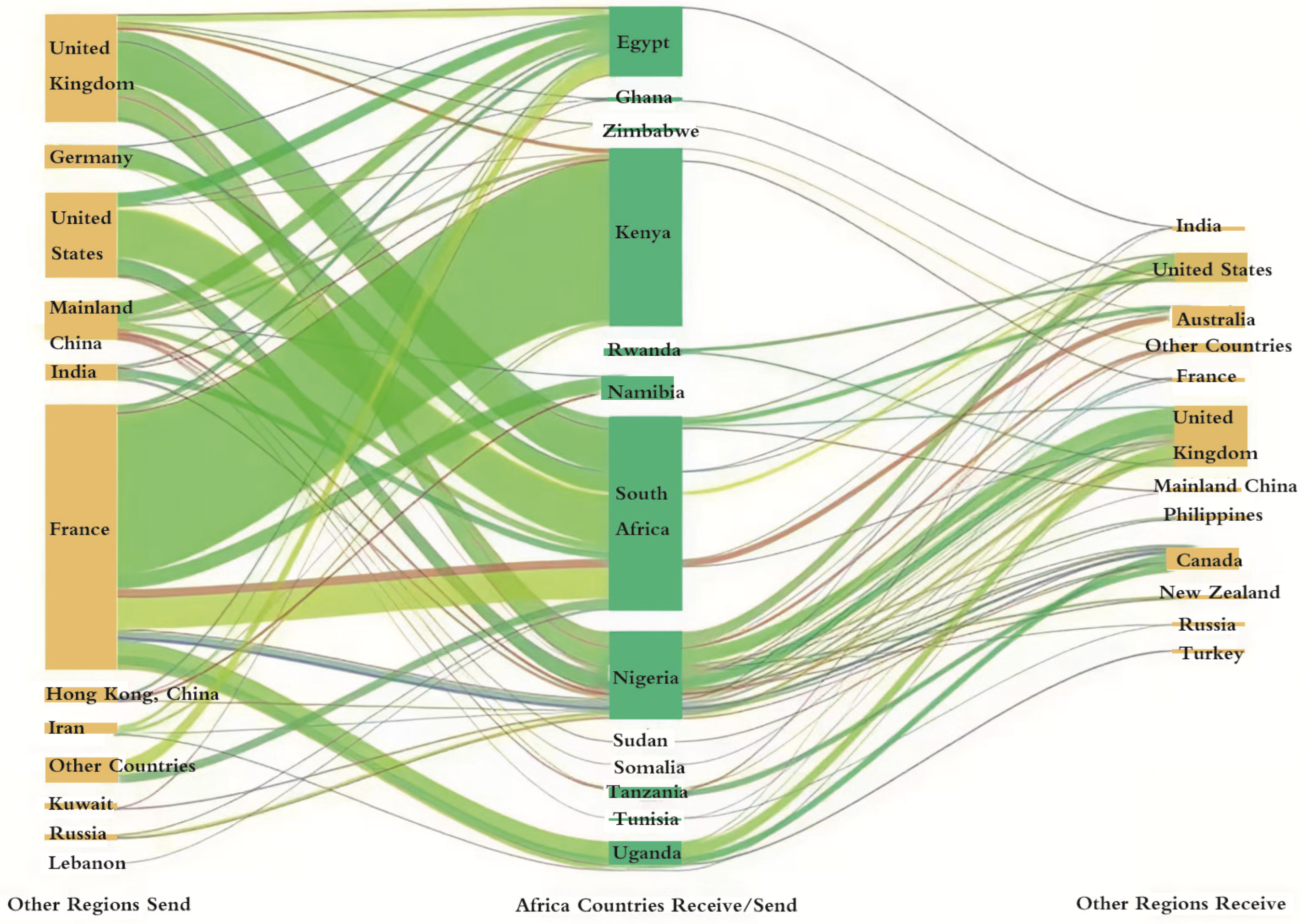
A total of 13 African countries (Egypt, Ghana, Zimbabwe, Kenya, Rwanda, Namibia, South Africa, Nigeria, Sudan, Somalia, Tanzania, Tunisia, and Uganda) and 31 non-African countries and regions were identified as nodes in the transcontinental public health risk information flows (see
Figure 1). In the figure, nodes represent information source/recipient countries, and edges indicate the direction and volume of information flow.
In terms of inbound information to Africa, France, the United Kingdom, and the United States emerged as dominant sources, with France nearly monopolizing the external information supply for Kenya, Uganda, and Namibia. However, the incoming information primarily flowed to only a small number of African countries. Regarding outbound information from Africa, Nigeria stood out as the primary source of African-origin information disseminated globally, while the UK and the US were major recipients of this African content.
A comparative analysis of participant numbers and citation frequencies across the three cases—examining both inbound and outbound flows involving Africa—revealed that in all cases, whether at the media or country level, Africa received substantially more information from the rest of the world than it produced. Even in the case of the Ebola outbreak, which originated in Africa, information largely flowed into Africa rather than out. During the Zika outbreak, no outbound information from Africa was observed at all. For COVID-19, both the number of participating entities and the volume of citations were significantly higher than the other two cases. These findings indicate an asymmetrical relationship between African and non-African actors, with African media showing limited engagement even with global public health emergencies occurring outside the continent.
4.2. Major Media Participants in the Information Exchange
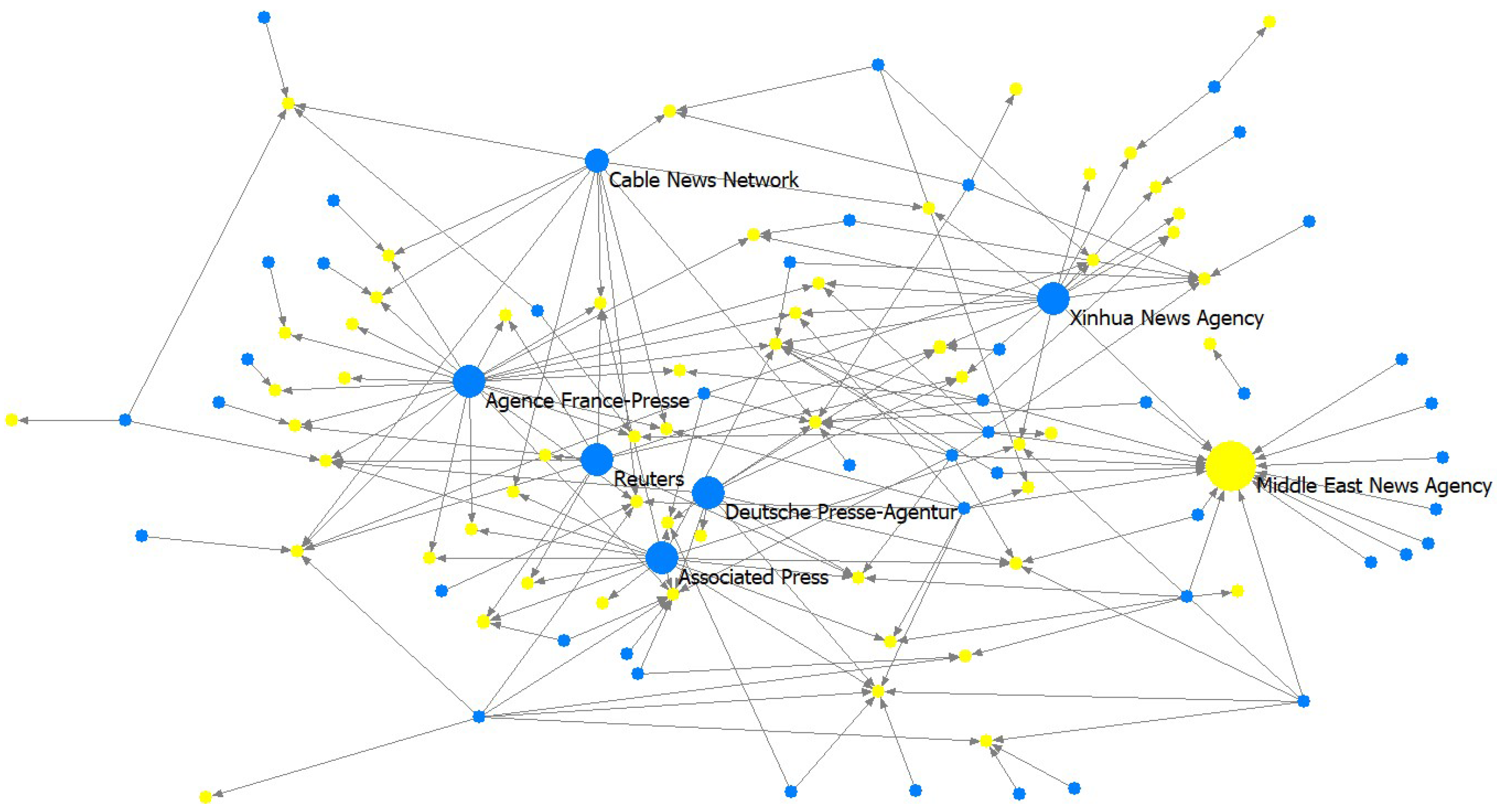
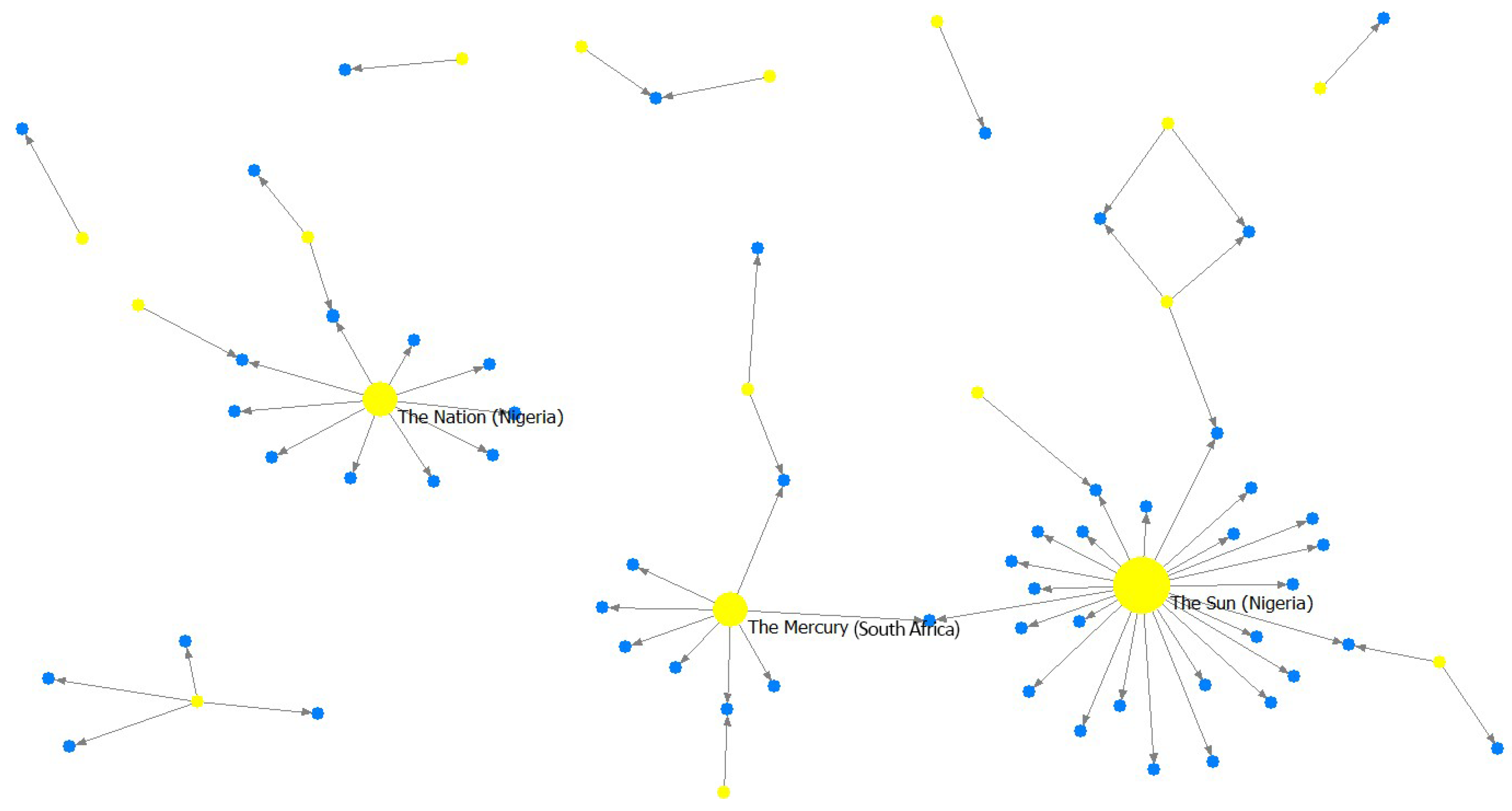
A total of 64 African media outlets and 103 media outlets from outside Africa participated in the cross-regional dissemination of public health risk information (see
Figure 2 and
Figure 3). In the figures, nodes represent media outlets, edges represent information flows, and key actors are highlighted. Yellow nodes indicate African media, while blue nodes represent non-African media.
In the inbound information direction, major external information sources included international news agencies such as Agence France-Presse (AFP), Reuters, Associated Press (AP), Deutsche Presse-Agentur (DPA), Xinhua News Agency, and Cable News Network (CNN). Most of the African outlets citing external sources were based in Egypt, Nigeria, Kenya, and South Africa—covering the northern, western, eastern, and southern regions of the continent, respectively. On the right side of
Figure 2, a star-shaped subnetwork centered around the Middle East News Agency, headquartered in Cairo, aggregated external information from 24 outlets across 17 countries.
In the outbound direction, the majority of African-originated information came from Nigeria. In
Figure 3, star-shaped subnetworks centered on Nigerian newspapers The Sun and The Nation, as well as South Africa’s The Mercury, show the central role of these media outlets.
Table 2 presents the major media participants across the three case studies.
4.3. Themes of Inbound and Outbound Information
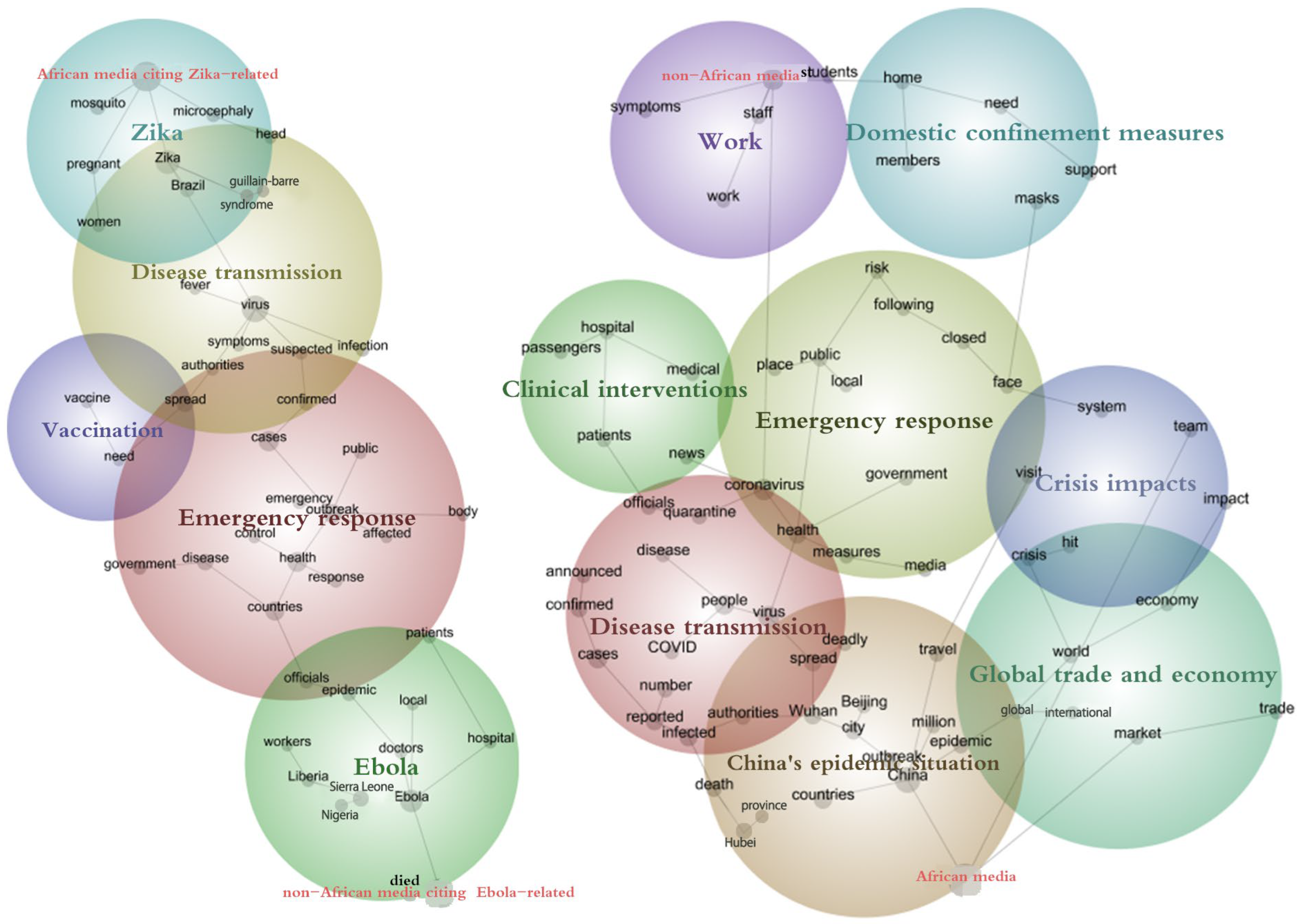
Given the geographic differences between each epidemic and the African continent, this study extracted two groups of citation-linked news reports for content analysis. The first group included African media reports citing Zika-related content and non-African media citing reports on the Ebola outbreak. The second group comprised both African and external media citation reports during the COVID-19 pandemic. The first group reflected attention to outbreaks in geographically distant regions, while the second occurred in the context of a globally spreading pandemic.
Content analysis of the two groups revealed five and eight prominent themes, respectively (see
Figure 4). In the first group, the most intense themes were emergency response and disease transmission. Concepts most closely associated with African media texts included disease, location, transmission source, and vulnerable populations. In contrast, external media texts focused on disease, location, doctors, and hospitals. In the second group, the strongest themes were disease transmission, China’s epidemic situation, and emergency response. African media texts were primarily associated with themes related to the pandemic in China and global trade and economy, while external media texts centered on work, domestic confinement measures, and other pandemic-related lifestyle changes.
By associating concept clusters within each group’s full text corpus, further observations were made: during the Zika outbreak, African media mainly focused on how the disease was spreading; during the Ebola outbreak, external media were more concerned with the outbreak’s emergence and African countries’ emergency responses; and during the COVID-19 pandemic, African media were primarily concerned with China’s situation and global disease spread, while external media focused on how the pandemic affected daily life in Africa—including working from home and public health responses triggered by the outbreak.
4.4. Factors Influencing the Exchange of Public Health Risk Information
Corresponding to the country-level citation matrix, we constructed a variable data matrix to represent national traits, relatedness, and emergency events. By calculating the differences between country pairs in each matrix cell, we converted attribute data (numeric or categorical) into binary matrices representing inter-country differences. Relatedness variables, which were already relational in nature, were used to generate adjacency matrices directly. We conducted MRQAP analysis using UCINET 6, with the results shown in
Table 3.
The Zika outbreak occurred in countries outside Africa. Among national traits, only GDP significantly influenced African countries’ access to Zika-related information. The regression results showed a significant positive coefficient for GDP difference, indicating that the greater the GDP gap between an African country and another country, the more information flowed from that country into Africa. This suggests African countries mainly accessed Zika-related information from wealthier nations.
The Ebola outbreak occurred in African countries. Here, only the emergency event—as measured by the number of confirmed cases—significantly influenced African countries’ acquisition of Ebola-related information. The regression revealed a significant positive coefficient for confirmed cases, meaning that African countries with larger gaps in case numbers relative to other countries received more information. In other words, African countries more severely affected by Ebola obtained more information from abroad. Additionally, both GDP (national trait) and confirmed cases (emergency event) influenced how much information non-African countries received from Africa. The positive coefficients in the regression suggest that wealthier countries and countries engaging with more severely affected African nations received more Ebola-related information.
The COVID-19 pandemic involved both African and non-African countries. African countries’ access to COVID-19 information was significantly influenced by bilateral trade and confirmed cases, both of which had positive coefficients in the regression. This indicates that African countries received more COVID-19 information from trading partners and countries with higher confirmed cases. In contrast, GDP and common languages were significant predictors of information flowing out from Africa to other countries. This suggests that wealthier countries and those sharing common languages with African countries received more COVID-19 information from the continent.
In summary, although the regression results provide valuable insights, the factors influencing the exchange of health risk information between African countries and the rest of the world varied by context. When Africa was not directly affected by an outbreak (as in the case of Zika), African countries primarily obtained information from economically stronger countries. When Africa was directly affected (as with Ebola and COVID-19), an emergency event became a key factor influencing information acquisition. Bilateral trade only influenced information inflow during the COVID-19 pandemic. This may be because COVID-19 was a global event, and African countries had more opportunities to obtain information from a wider array of external sources beyond those with severe outbreaks.
As for information flowing out of Africa, an emergency event only significantly influenced information dissemination when the epidemic was mostly confined to Africa (as in the case of Ebola). However, when Africa was involved in the outbreak, wealthier countries consistently received more information from Africa. Compared to the Ebola outbreak, common languages emerged as an additional significant factor in information flow during COVID-19. This may be because Ebola was mostly confined to Africa, making emergency events the dominant factor, while COVID-19 was global in scope, and Africa’s influence was more limited. Therefore, relatedness such as common languages became more important in driving outbound information flow from Africa.
5. Discussion
This study reveals pronounced asymmetries in the dissemination of public health risk information between Africa and the rest of the world. These disparities—observable across national, organizational, and thematic dimensions—reflect deeper structural inequalities within the global communication system.
At the national level, information flows predominantly from outside into Africa. France, the United Kingdom, and the United States act as the principal external sources, while the United Kingdom, the United States, and Canada are the main recipients of Africa-originated information. Such one-directional flows indicate the persistence of a hierarchical global information structure, where African media remain largely dependent on external suppliers and have limited influence on global information agendas.
At the media actor level, international news agencies (e.g., Agence France-Presse, AFP) continue to dominate as global information hubs, reinforcing the concentration of transnational news production within the Global North. Egypt’s Middle East News Agency (MENA) functions as a regional intermediary that bridges local and international reporting. However, the overall outbound flow from Africa remains fragmented, forming small subnetworks centered on The Sun and The Nation (Nigeria) and The Mercury (South Africa). This fragmentation weakens the coherence and visibility of African narratives in global media ecosystems.
At the thematic level, inequalities are also evident. African media tend to emphasize disease transmission processes and domestic public health impacts, reflecting an information logic focused on survival and prevention. In contrast, external media frame their coverage around governmental responses, humanitarian assistance, and international coordination, embodying a governance-oriented perspective. Moreover, coverage of Ebola and Zika was closely tied to biomedical and geographic attributes—disease names, symptoms, affected individuals, and locations—while COVID-19 coverage integrated both global and African-local dimensions, encompassing socioeconomic and governance implications. These thematic disparities reveal a form of epistemic inequality, where African media frame health risks as localized emergencies while global media construct Africa as a site of crisis requiring external intervention.
Beyond these structural and thematic disparities, regression analysis provides deeper insights into the factors influencing the exchange of health risk information. When Africa was not directly affected (Zika), GDP differences were the main driver of information inflow, indicating dependence on economically stronger nations. When Africa was directly affected (Ebola), outbreak severity—measured by confirmed cases—became the key determinant of information acquisition, suggesting that more severe crises attract more external attention. During the COVID-19 pandemic, bilateral trade and confirmed cases significantly influenced inflow to Africa, while GDP and common languages explained the outbound flow. These patterns suggest that economic capacity, epidemic severity, and relational proximity jointly shape the flow of public health information between Africa and the rest of the world.
From the perspective of sustainable development, these findings highlight the importance of building equitable, resilient, and inclusive global communication systems. Sustainable risk communication requires not only technological connectivity but also the capacity of all regions to participate equally in knowledge production and exchange. Enhancing Africa’s communicative agency contributes directly to achieving several Sustainable Development Goals (SDGs), particularly SDG 3 (Good Health and Well-Being), SDG 10 (Reduced Inequalities), and SDG 16 (Peace, Justice, and Strong Institutions). Therefore, addressing the structural imbalances in global media networks is not merely a communication issue—it is a prerequisite for sustainable global health governance.
6. Conclusions
This study constructed and analyzed citation networks of PHEIC-related news reports to examine the flow of public health risk information between Africa and the rest of the world. The findings demonstrate persistent asymmetries in this global information system—manifested in country-level participation, media actor dominance, and thematic framing. These asymmetries reflect deeper structural imbalances in global communication, where Africa remains more of an information receiver than a source.
At the same time, the regression results highlight that the exchange of risk information is not random but systematically influenced by economic, epidemiological, and relational factors. In essence, differences in national economic capacity, the severity of the emergency, and relational proximity such as trade and shared language collectively shape how information flows between Africa and other regions.
From the perspective of sustainable development, these findings underscore that information equity and communication resilience are integral to global health sustainability. Achieving Sustainable Development Goals (particularly SDG 3: Good Health and Well-being, SDG 10: Reduced Inequalities, and SDG 16: Peace, Justice, and Strong Institutions) requires not only technological connectivity but also equitable participation in knowledge production and dissemination.
Based on the findings, two recommendations are proposed:
- (1)
Strengthen Africa’s media and early-warning capacity to enhance monitoring and communication of emerging disease risks before outbreaks reach the continent;
- (2)
Encourage sustained engagement of international media with African health and sustainability issues beyond crisis periods to ensure balanced and continuous information exchange.
This study has limitations. The dataset does not capture the full life cycles of all PHEICs, and certain institutional factors such as media ownership could not be included. Future research may extend this work by examining structural inequalities through a broader range of variables, including media systems, digital infrastructure, and cultural ties.
In conclusion, fostering equitable global communication is essential for building sustainable public health governance. Empowering African media within global information networks can help create a more just, informed, and resilient system of global risk communication.