


Ranking Regional Sustainability: A National Perspective on Measurement and Evaluation (Based on Materials from Kazakhstan)

 ,
,  , ,
, ,  , and
, and
Abstract
1. Introduction
The Research Methodology
- -
- A review of studies reflecting the main approaches to assessing the level of achievability of the SDGs by certain countries has been conducted.
- -
- The main results of the study of indicators demonstrating the levels of economic and sustainable development of regions have been presented.
- -
- Econometric modeling in the R program was used to identify the relationships between GRP per capita (as an indicator expressing the results of regional development) and the environmental, social, and economic factors that determine it, taking into account the specifics of the development of Kazakhstan’s regions. Based on a reasoned presentation of the choice of dependent and independent variables, the following actions were performed:
- a
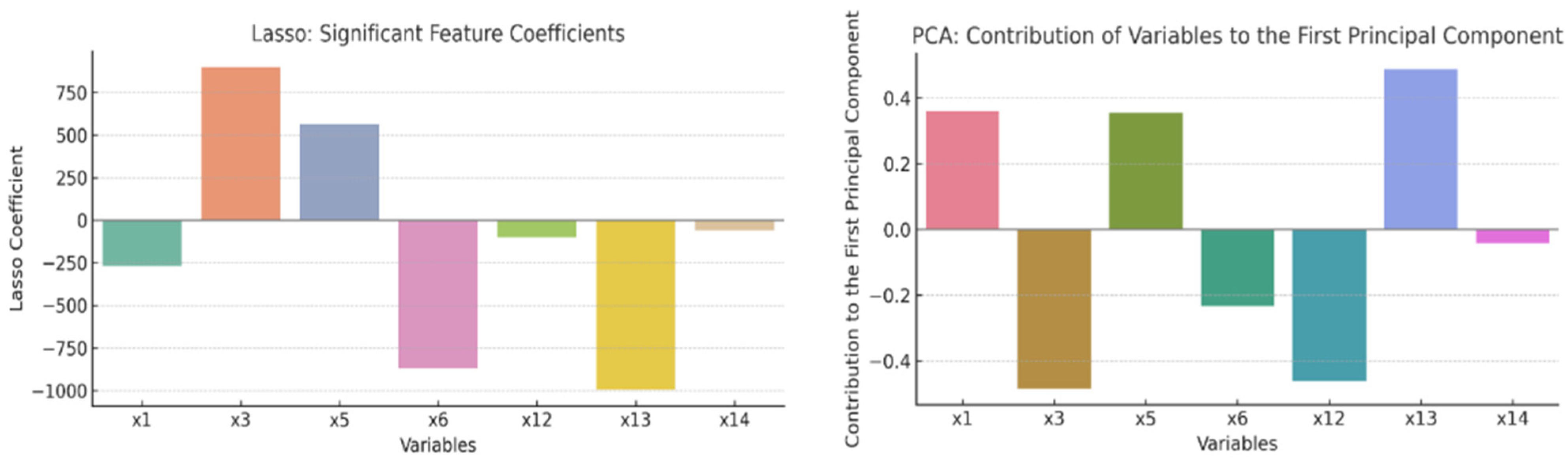
- A correlation analysis of the dependence of indicators was carried out, and significant indicators were determined based on the PCA, AIC, and Lasso methods;
- b
- Regression models of factorial sustainable regional development for each region were built;
- c
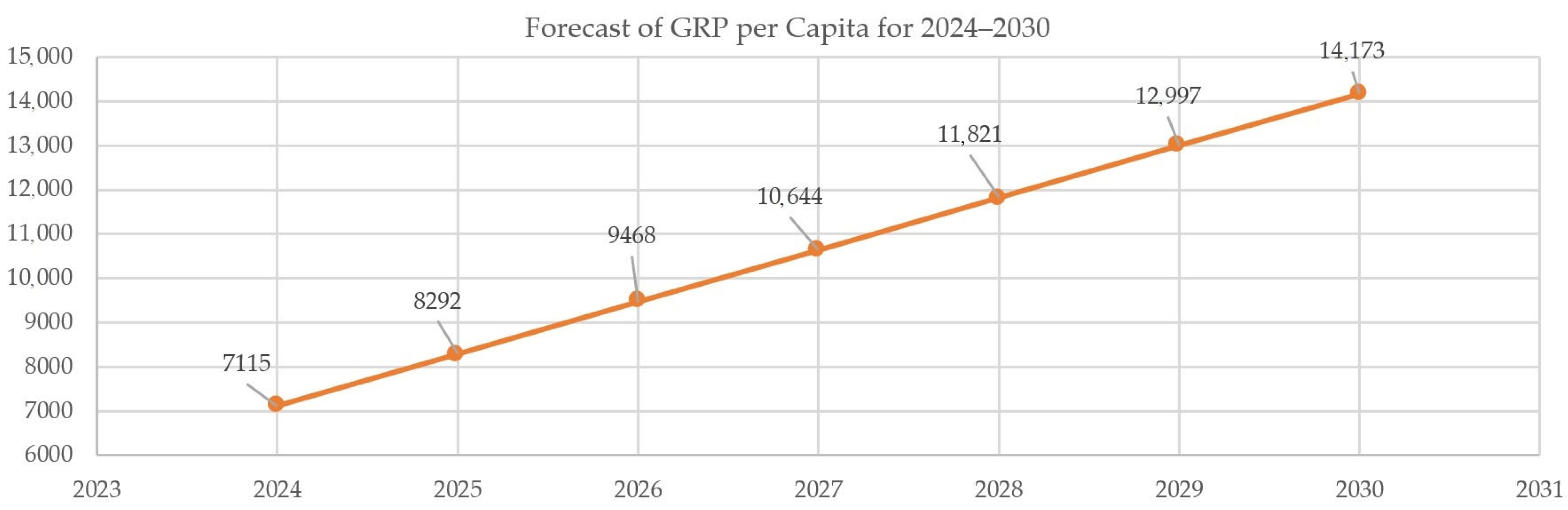
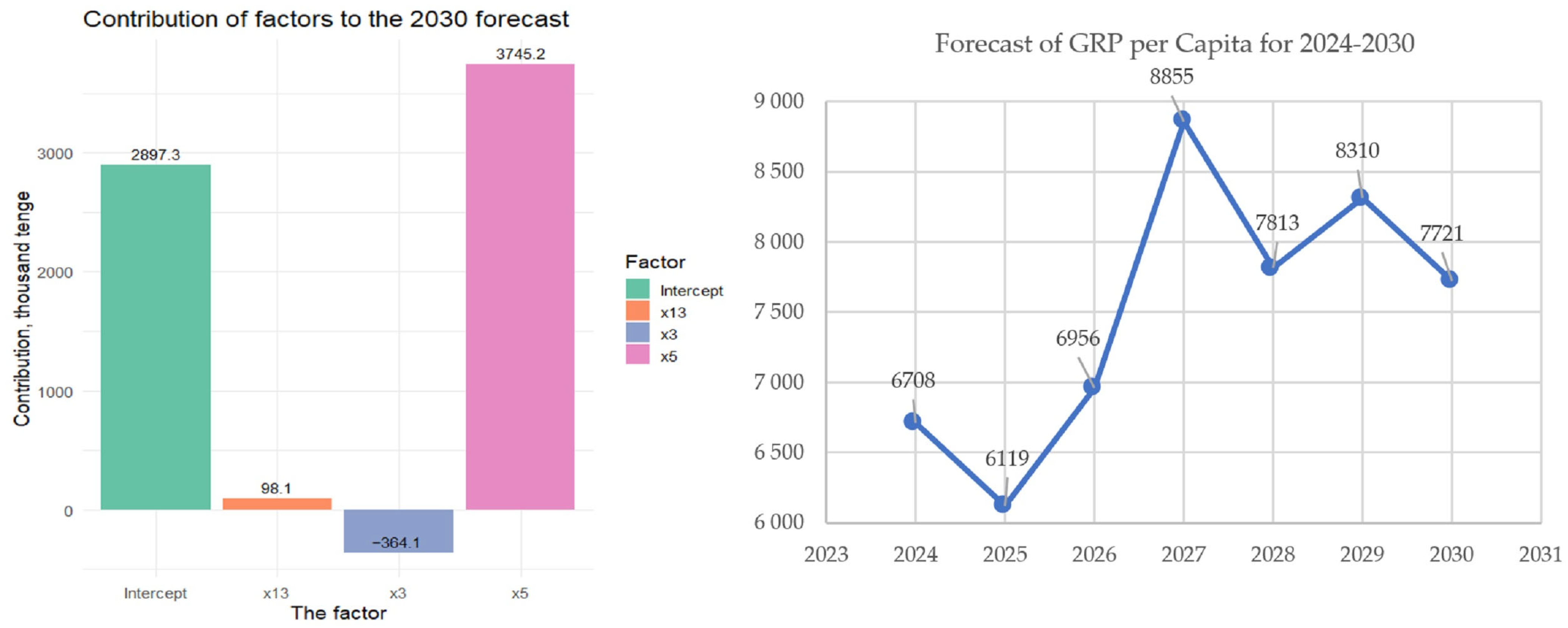
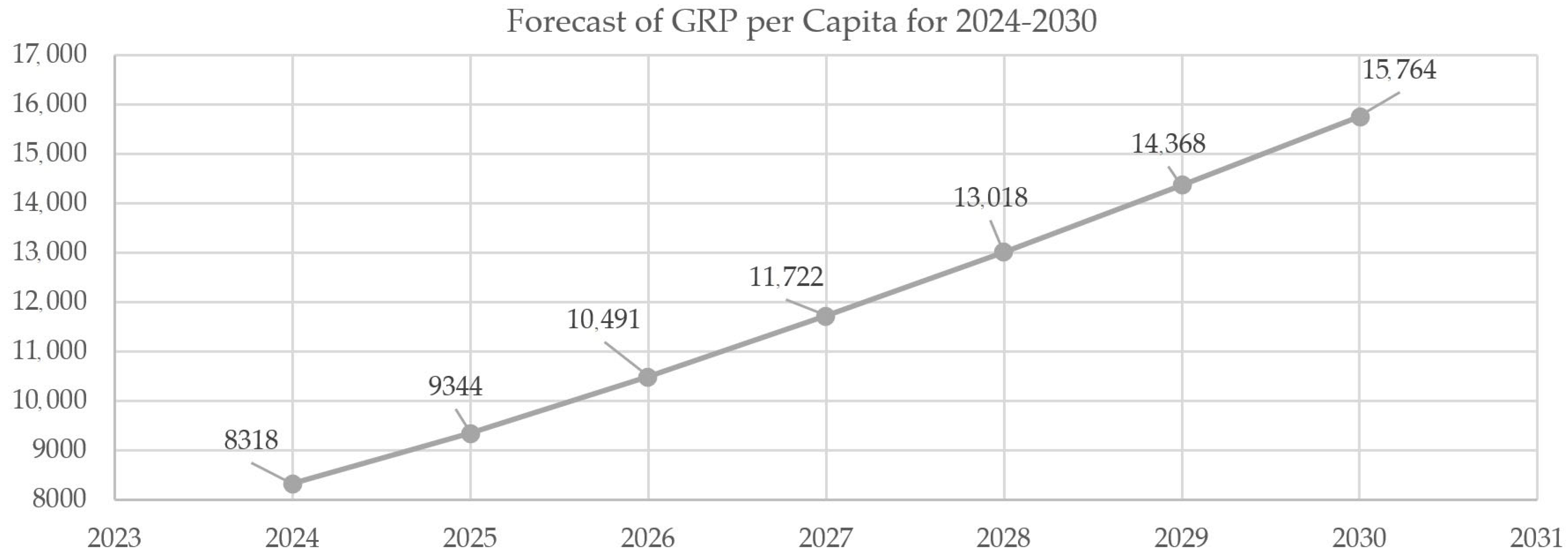
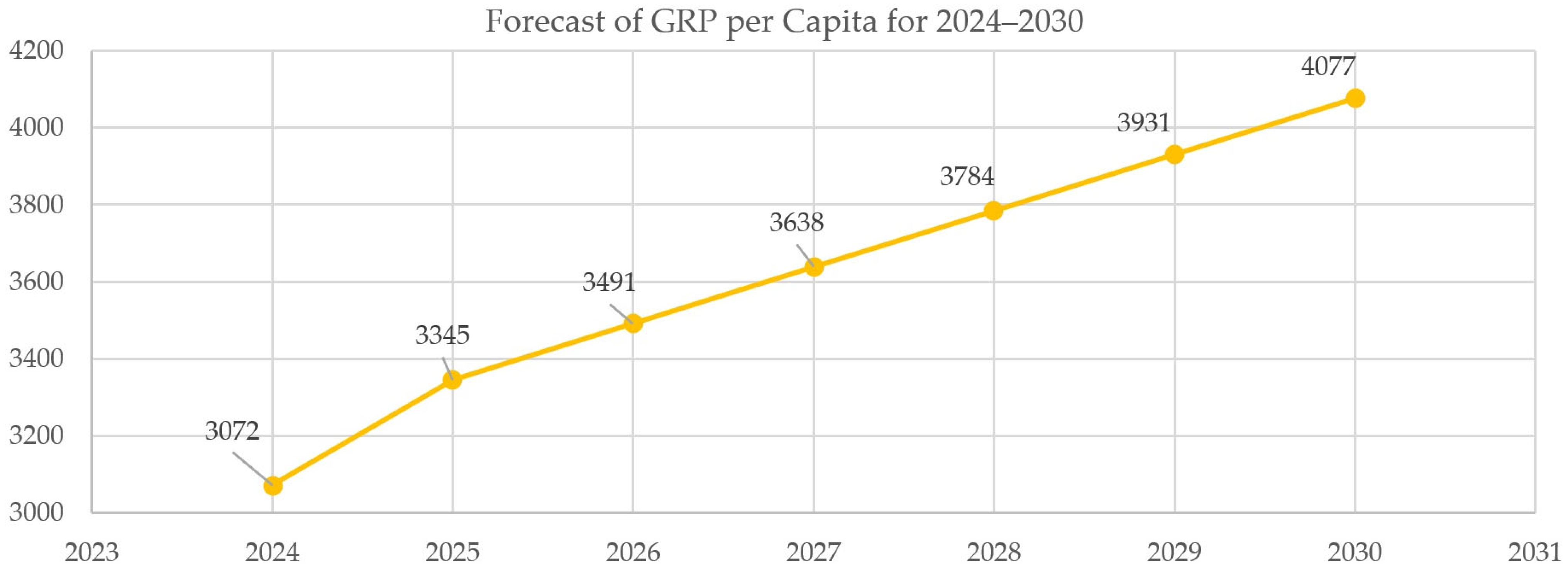
- Based on the constructed model, a forecast of GRP per capita was made for all four regions to determine the prospects for applying the findings obtained in the study.
- -
- Based on the conducted econometric study, the main indicators recommended by the authors for inclusion in the regional rating were determined. The rationale behind the philosophy of the methodology of this rating is presented, and it was tested on the metadata of the regions.
2. Theoretical Framework (Literature Review)
3. Results
- (1)
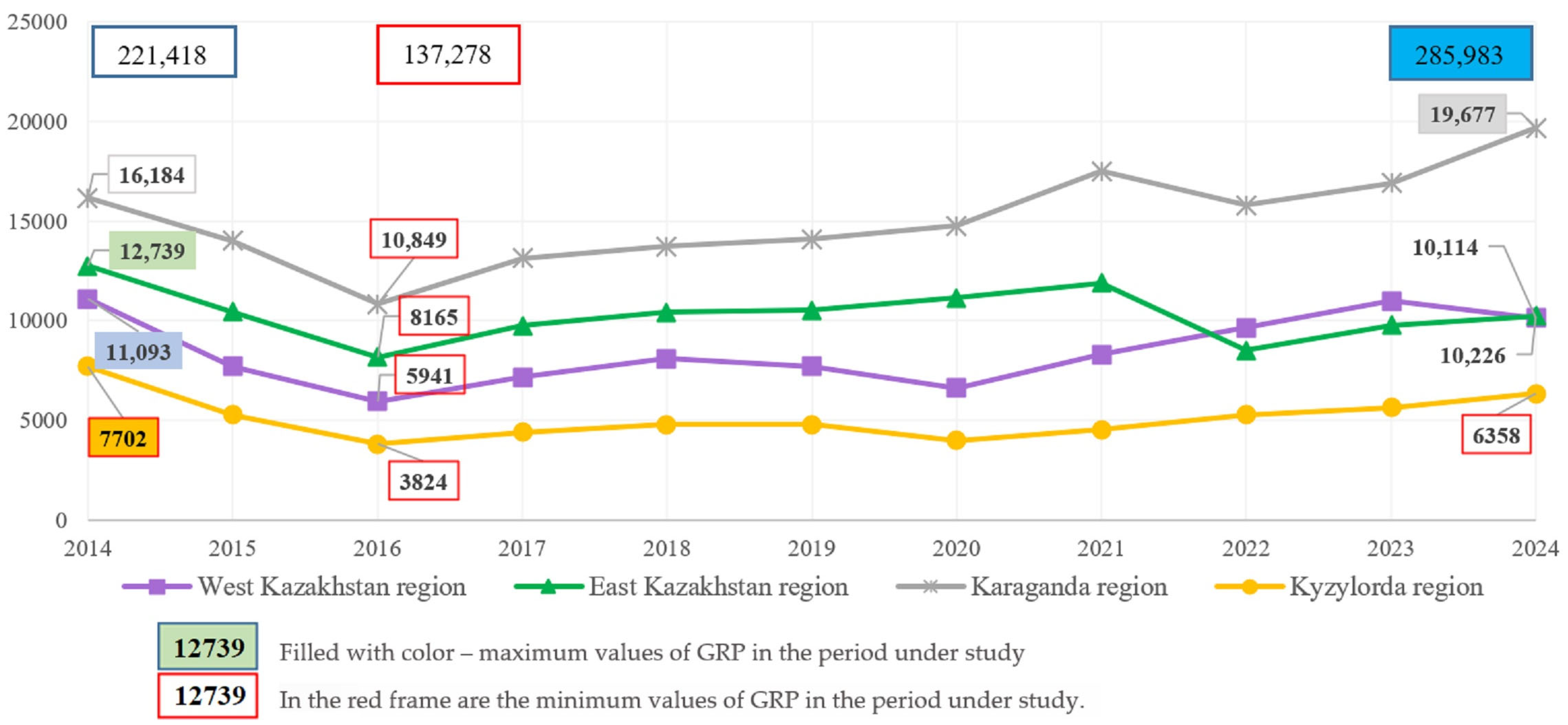
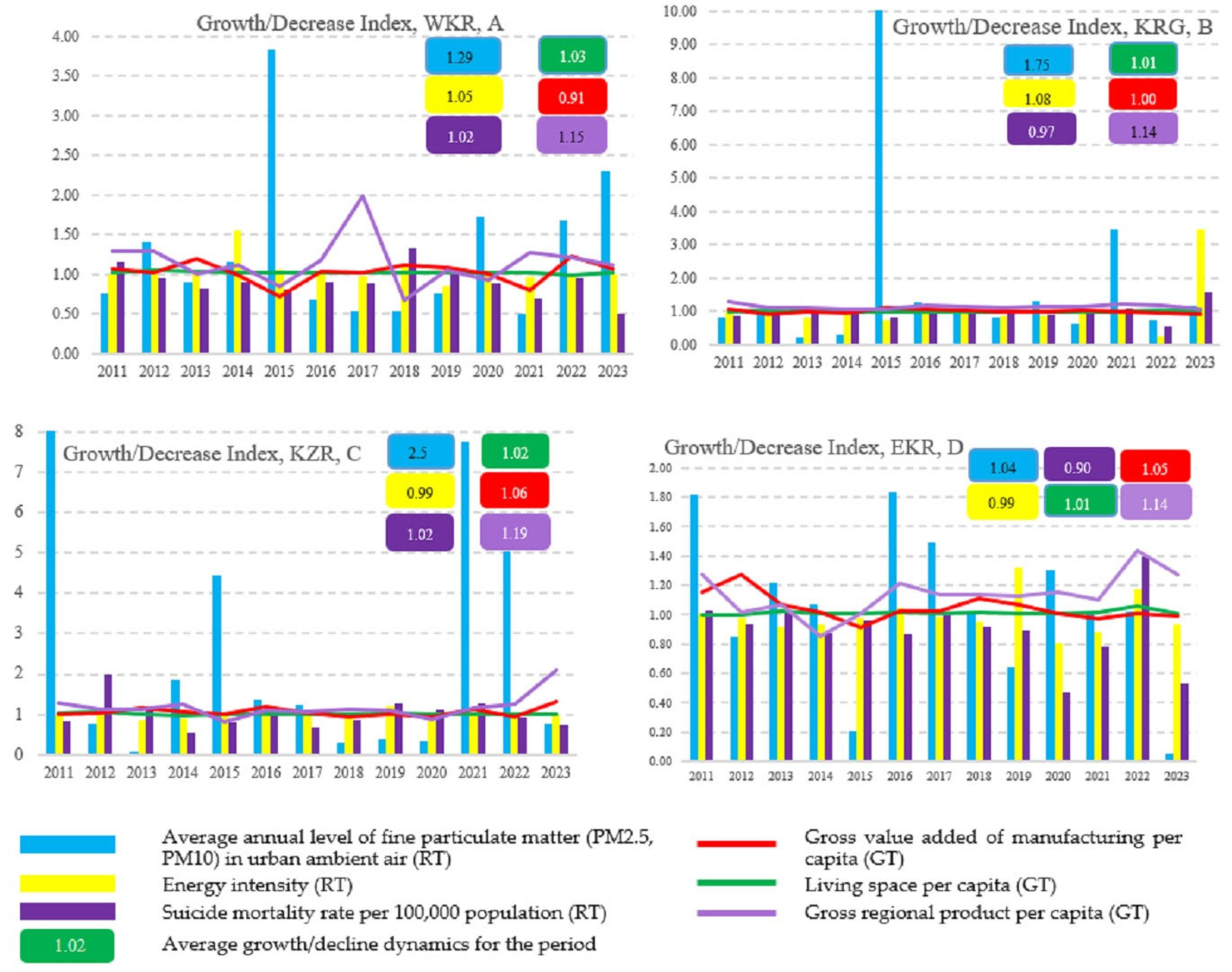
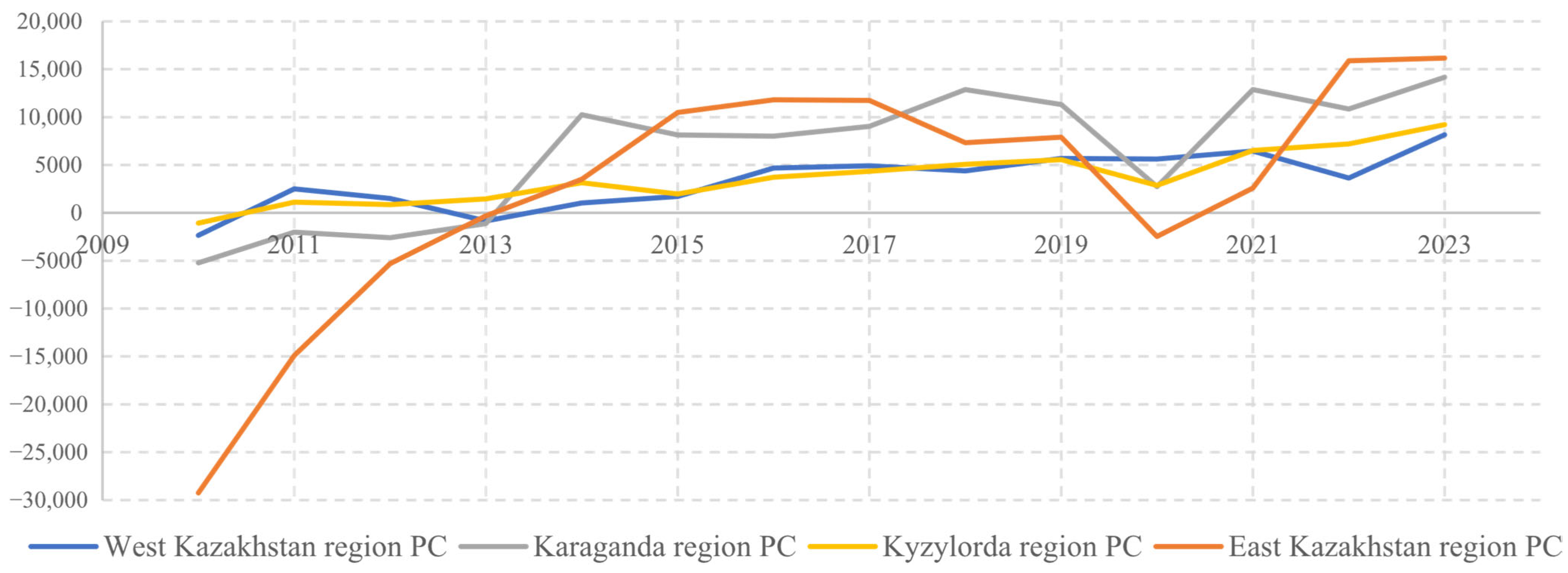
- A drop in world prices for Brent crude oil to USD 44.08 in 2015 against USD 107.95 in 2014 (a reduction in tax revenues to the budget from the oil sector, on which the dependence of Kazakhstan’s budget is about 20%);
- (2)
- The transition to a floating exchange rate and currency depreciation (the rate increased from 182 to 342 KZT per USD during 2015–2016) [33];
- (3)
- Weakening external demand for Kazakhstani products from Russia as a result of economic sanctions (after the annexation of Crimea in 2014);
- (4)
- Structural dependence on raw material exports and weak diversification of the economy (the predominance of extractive industries in the GRP structure).
| According to East Kazakhstan region | According to West Kazakhstan region | ||||||||||
| Result | Result | ||||||||||
| lm(formula = y; ~ x3 + x5 + x6 + x13, data = df) | lm(formula = y; ~ x1 + x3 + x5 + x6 + x13, data = df) | ||||||||||
| Residuals: | Residuals: | ||||||||||
| Min | 1Q | Median | 3Q | Max | Min | 1Q | Median | 3Q | Max | ||
| −1383.33 | −787.45 | −68.38 | 753.21 | 1749.22 | −1020.1 | −165.6 | −103.6 | 460.1 | 714.6 | ||
| Coefficients: | Coefficients: | ||||||||||
| Estimate | Std. Error | t value | Pr(>|t|) | Estimate | Std. Error | t value | Pr(>|t|) | ||||
| (Intercept) | 1.592 × 10³ | 2.889 × 10³ | 0.551 | 0.5952 | (Intercept) | −1.126 × 10⁴ | 6.028 × 10³ | −1.868 | 0.09870 | ||
| x3 | −5.218 × 10⁻¹ | 3.306 × 100 | −0.158 | 0.8781 | x1 | −3.671 × 10³ | 3.233 × 10³ | −1.135 | 0.28907 | ||
| x5 | 9.637 × 10² | 4.533 × 10² | 2.126 | 0.0624. | x3 | 1.912 × 101 | 6.551 × 100 | 2.919 | 0.01933 * | ||
| x6 | −8.095 × 10⁻³ | 3.885 × 10⁻³ | −2.083 | 0.0669 | x5 | 7.367 × 10³ | 3.025 × 10³ | 2.435 | 0.04086 * | ||
| x13 | −2.331 × 10⁻¹ | 1.790 × 10⁻¹ | −1.303 | 0.2251 | x6 | −2.427 × 10⁻³ | 5.467 × 10⁻⁴ | −4.440 | 0.00217 ** | ||
| x13 | −1.251 × 10⁻¹ | 3.016 × 10⁻² | −4.149 | 0.00321 ** | |||||||
| Signif. codes: 0 ‘***’ 0.001 ‘**’ 0.01 ‘*’ 0.05 ‘.’ 0.1 ‘ ’ 1 | Signif. codes: 0 ‘***’ 0.001 ‘**’ 0.01 ‘*’ 0.05 ‘.’ 0.1 ‘ ’ 1 | ||||||||||
| Residual standard error: 1118 on 9 degrees of freedom | Residual standard error: 661.9 on 8 degrees of freedom | ||||||||||
| Multiple R-squared: 0.7047, Adjusted R-squared: 0.5734 | Multiple R-squared: 0.8909, Adjusted R-squared: 0.8226 | ||||||||||
| F-statistic: 5.369 on 4 and 9 DF, p-value: 0.01724 | F-statistic: 13.06 on 5 and 8 DF, p-value: 0.001117 | ||||||||||
| yWKR = 2897.28 − 1.52·x3 + 489.23·x5 − 0.10·x13 Note: *** – highest level of variable significance; ** – high level of variable significance; * – significant variable; . - marginal statistical significance, p–value greater than 0.1 Prepared by using R–Studio (Version 2.09.2025) | y;EKR = −11,260 + 19.12⋅x3 + 7367⋅x5 − 0.00243⋅x6 − 0.125⋅x13 Note: *** – highest level of variable significance; ** – high level of variable significance; * – significant variable; . - marginal statistical significance, p–value greater than 0.1 Prepared by using R–Studio (Version 2.09.2025) | ||||||||||
| For the Karaganda region | For the Kyzylorda region | ||||||||||
| Result | Result | ||||||||||
| lm(formula = y; ~ x5 + x6 + x12, data = df) | |||||||||||
| Residuals: | Residuals: | ||||||||||
| Min | 1Q | Median | 3Q | Max | Min | 1Q | Median | 3Q | Max | ||
| −936.2 | −253.6 | −106.1 | 338.3 | 873.8 | −683.27 | −407.48 | −16.81 | 238.54 | 828.51 | ||
| Coefficients: | Coefficients: | ||||||||||
| Estimate | Std. Error | t value | Pr(>|t|) | Estimate | Std. Error | t value | Pr(>|t|) | ||||
| (Intercept) | 2.139 × 10³ | 3.069 × 10³ | 0.697 | 0.50161 | (Intercept) | −7.083 × 10³ | 3.375 × 10³ | −2.099 | 0.065275 | ||
| x5 | −1.04 × 10³ | 1.761 × 10² | 5.907 | 0.00015 *** | x3 | 3.465 × 101 | 5.946 × 100 | 5.827 | 0.000251 *** | ||
| x6 | −1.619 × 10⁻³ | 6.644 × 10⁻⁴ | −2.437 | 0.03504 * | x5 | 1.144 × 10³ | 4.658 × 10² | 2.457 | 0.036360 * | ||
| x12 | 10324 × 100 | 8.091 × 10⁻¹ | 1.636 | 0.13290 | x6 | 1.319 × 10⁻³ | 2.271 × 10⁻³ | 0.581 | −0.575703 | ||
| x13 | −1.228 × 10⁻¹ | 3.748 × 10⁻² | −3.277 | 0.009580 ** | |||||||
| Signif. codes: 0 ‘***’ 0.001 ‘**’ 0.01 ‘*’ 0.05 ‘.’ 0.1 ‘ ’ 1 | Signif. codes: 0 ‘***’ 0.001 ‘**’ 0.01 ‘*’ 0.05 ‘.’ 0.1 ‘ ’ 1 | ||||||||||
| Residual standard error: 556.7 on 10 degrees of freedom | Residual standard error: 575.5 on 9 degrees of freedom | ||||||||||
| Multiple R-squared: 0.8949, Adjusted R-squared: 0.8634 | Multiple R-squared: 0.8574, Adjusted R-squared: 0.7941 | ||||||||||
| F-statistic: 28.39 on 3 and 10 DF, p-value: 3.312 × 10⁻⁵ | F-statistic: 13.53 on 4 and 9 DF, p-value: 0.0007578 | ||||||||||
| YKRG = 2139.0 − 1040.0 × x5 – 0.001619 × x6 Note: *** – highest level of variable significance; ** – high level of variable significance; * – significant variable; . - marginal statistical significance, p–value greater than 0.1 Prepared by using R–Studio (Version 2.09.2025) | YKZR = −7.083 + 3.465 × x3 + 1.144 × x5 – 1.228 × x13 Note: *** – highest level of variable significance; ** – high level of variable significance; * – significant variable; . - marginal statistical significance, p–value greater than 0.1 Prepared by using R–Studio (Version 2.09.2025) | ||||||||||
4. Discussion
5. Conclusions
- This research, for the first time, provides an opportunity to assess and compare the level of sustainable development of individual regions on the scale of a given country—Kazakhstan. Despite the fact that Kazakhstan is making efforts to achieve the sustainable development goals and fulfill its obligations, compared to developed countries the issue of introducing sustainable development indicators into strategic planning and management of regional development is still underdeveloped.
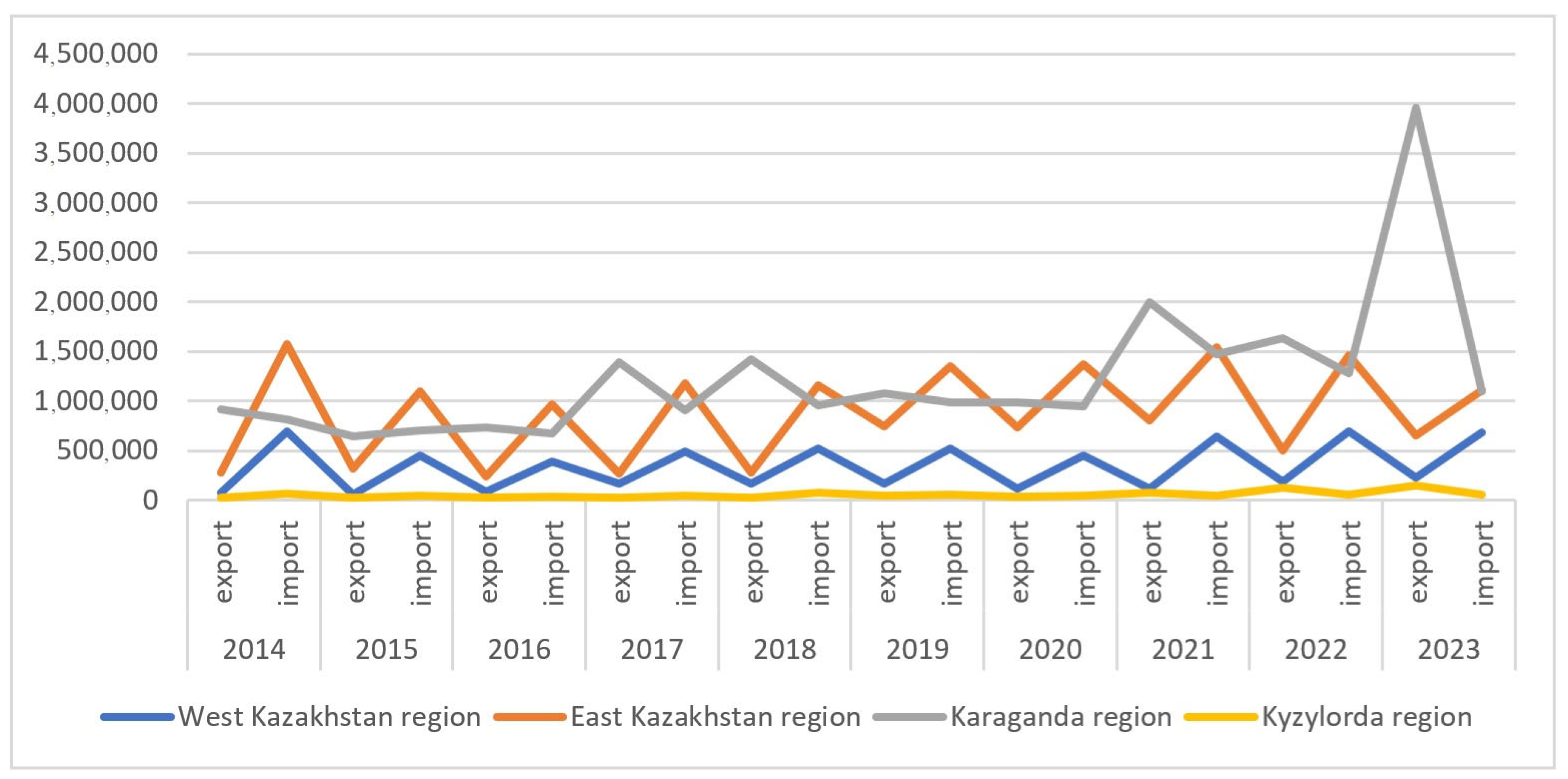
- A review of the indicators of regional economic development showed that regional development is significantly affected by the volatility of world oil prices, due to raw material dependence, which is especially strongly felt at the regional level (reduction in tax revenues to the budget from the oil sector and dependence of regions on central transfers). In addition, currency fluctuations increase the vulnerability of the regional economy, which reduces the investment attractiveness of not only the region but also businesses operating within it. The weakening of external demand for Kazakhstani products from Russia as a result of economic sanctions and geopolitical risks in general has a particularly acute effect on regions whose economies are integrated with other countries. In addition, structural dependence on raw material exports and weak diversification of the economy remains an important problem for all regions. The analysis showed that the Karaganda region is significantly ahead of other regions in terms of export volumes, which indicates the need to concentrate the efforts of regional authorities and regional businesses in other regions on expanding integration ties. For WKR, import dependence on Russia remains high, which requires comprehensive solutions for the development of import substitution.
- In regional development management, the availability of timely, comparable, and adequate information is an important condition for making timely, primarily preventive, management decisions, especially when it comes to managing environmental risks, mitigating social tensions, and public trust in the authorities. The study showed significant lags in information data. It is necessary to organize systematic data collection and formation by regions, taking into account quarterly changes. Not all sustainable development indicators of the country, which are generated on the data provided by the responsible body (Bureau of National Statistics), have the same time coverage, which does not allow expansion of the list of analyzed data. This, in turn, indicates the generation of some doubts about the objectivity of the findings. In addition, regional executive bodies should include indicators that are clearly linked to the SDGs in order to show the contribution of the regions to achieving the national goals. The release of the Voluntary Local Review will improve the effectiveness of the measures implemented for the sustainable development of the region. This, in turn, will contribute to the creation of strategies and initiatives aimed at reducing the income gap and supporting economic development in the regions.
- The study showed the need to expand the theory of sustainable development and include the “goal–principle–indicator” approach when developing indicators for various systems for assessing/rating the level of regional development in the context of the SDGs. Conceptually, the approach explains the inclusion of indicators adopted by a particular country to achieve the stated commitments in the NDC. Along with this, the approach allows linking country SDGs with the thematic area of ESG principles, expressing this connection through an indicator.
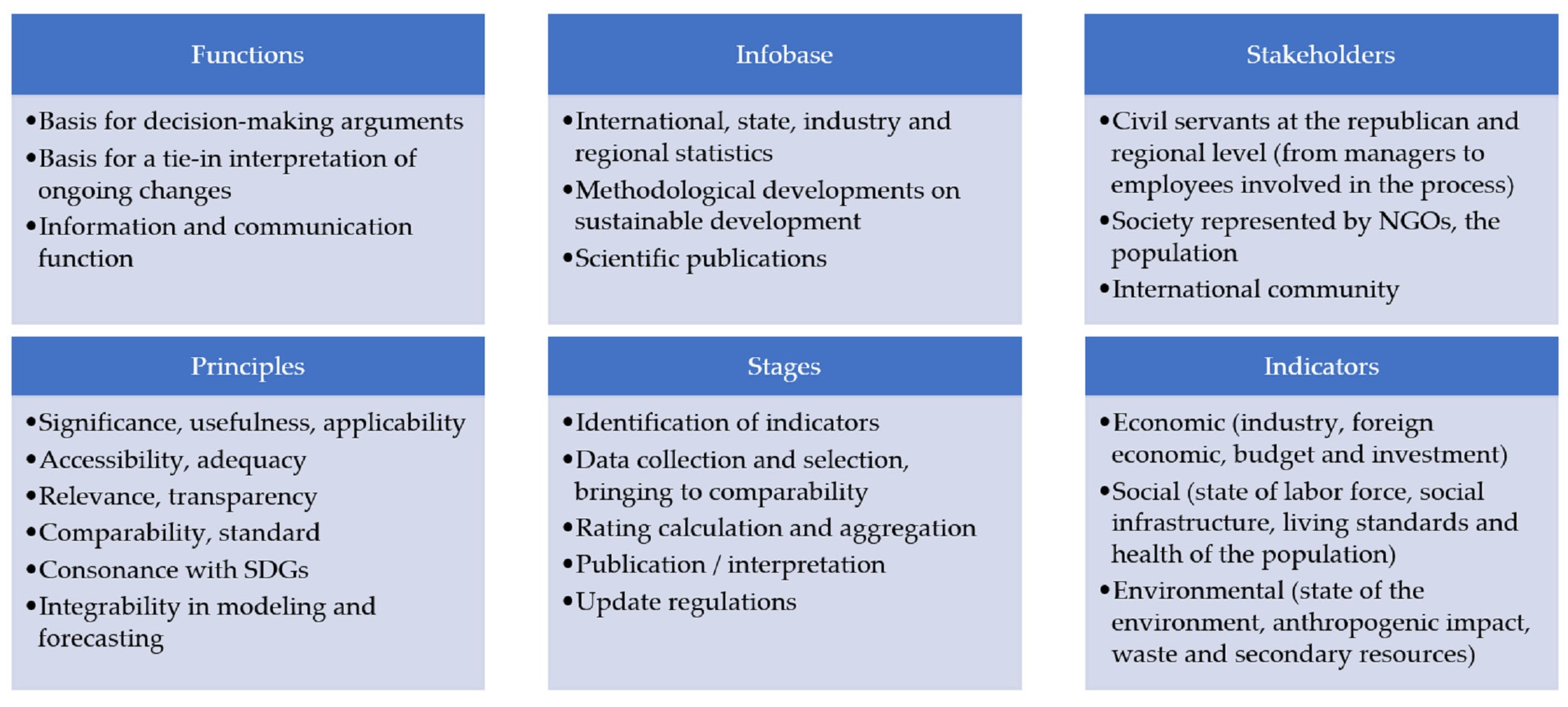
- The paper presents a rationale for the NRSD methodology, which includes components that comprehensively determine its application in the process of assessing the level of sustainable development of a region. The components include the functions of the NRSD, the information base, the range of stakeholders, the principles of data selection, stages (rating processes), indicators, and rating calculation. The possibility of applying the methodology to assess the level of sustainable development in different countries is justified by its flexibility and consistency. The use of correlation and regression analysis allows us to mathematically justify the inclusion of certain environmental, social, and economic indicators, ensuring their structural balance in accordance with the trends in the current development of a particular region. This technique allows us to obtain reference criteria not just for sustainable development (as it should be), but also, based on the principle of “how it is possible to be”. Indicators help to measure, monitor, evaluate, and analyze the pace and effectiveness of movement towards achieving the goals of sustainable development of the region. Along with this, they allow us to adjust the political vector so that development goes in the right direction, ensuring its sustainability. This factor helps to establish the possibility of transferring responsibility for achieving specific personal targets to certain departments, offices, and agencies. In addition, it helps to perform a partial assessment of the effectiveness of the regional management in implementing certain goals and objectives of the policy.
- The hypothesis put forward in the work was tested and partially proven. On the one hand, the study showed that linking regional sustainable development ratings to the national SDG indicators of a particular country provides greater adaptability and applicability in strategic regional management. Thus, Kazakhstan’s choice of the set of indicators given in the work, its presentation of statistical data on them, and the study of reports of regional authorities reflecting their achievement showed that a certain degree of integration has been achieved. However, the limitations of the information itself, the discrepancy in the time coverage of individual indicators, and the lack of information on significant environmental indicators of regional development indicate that the strategic management of regional development in Kazakhstan does not fully take into account the commitments made under the NDC.
Author Contributions
Funding
Institutional Review Board Statement
Informed Consent Statement
Data Availability Statement
Conflicts of Interest
Abbreviations
| AIC | Akaike Information Criterion |
| ARIMA | Autoregressive Integrated Moving Average |
| CIS | Commonwealth of Independent States |
| CSD | UN Commission on Sustainable Development |
| EAEU | Eurasian Economic Union |
| EKR | East Kazakhstan Region |
| ESG | Environmental, Social, and Governance |
| EU RSDI | European Regional Sustainable Development Index |
| GDP | Gross Domestic Product |
| GRP | Gross Regional Product |
| GT | Growth Targets |
| GVA | Gross Value Added |
| KZR | Kyzylorda Region |
| KRG | Karaganda Region |
| NDC | Nationally Determined Contribution |
| NRSD | National Rating of Sustainable Development of Regions |
| OECD | The Organization for Economic Co-operation and Development |
| PCA | Principal Component Analysis |
| R&D | Research and Development |
| RT | Reduction Target |
| SDG | Sustainable Development Goal |
| TBL | Triple Bottom Line |
| UN | United Nations |
| USD | United States Dollars |
| VLR | Voluntary Local Review |
| VNR | Voluntary National Review |
Appendix A
References
- Institute of Economic Research of the Republic of Kazakhstan. Voluntary National Review of Kazakhstan. Institute of Economic Research of the Republic of Kazakhstan. Available online: https://eri.kz/ru/Celi_ustojchivogo_razvitija/Nacionalnyj_otchet/ (accessed on 15 September 2025). (In Russian).
- Almaty Development Center. Voluntary Local Review of Almaty. Available online: https://almatydc.kz/press/news/almaty-usilit-svoi-pozicii-na-mezhdunarodnom-urovne (accessed on 15 September 2025). (In Russian).
- OECD. Regional Outlook 2023. Available online: https://www.oecd.org/en/publications/oecd-regional-outlook-2023_92cd40a0-en.html (accessed on 31 October 2025).
- United Nations. Human Development Report 2021-22. 2022. Available online: https://hdr.undp.org/content/human-development-report-2021-22 (accessed on 29 October 2025).
- World Bank Group. World Development Indicators (for 2023). Available online: https://databank.worldbank.org/source/world-development-indicators (accessed on 15 September 2025).
- Bureau of National Statistics of the Republic of Kazakhstan. Monitoring of the Sustainable Development Goals Until 2030 by the Bureau of National Statistics of the Republic of Kazakhstan. Available online: https://stat.gov.kz/en/sustainable-development-goals/goal/1/ (accessed on 15 September 2025).
- Lavers Westin, A.; Rosado, L.; Kalmykova, Y.; Patrício, J. Methods for Downscaling National Material Consumption Data to the Regional and Municipal Levels. Sustainability 2020, 12, 8336. [Google Scholar] [CrossRef]
- Ferreira, H.; Marques, C.S.; Farinha, L. Regional Smart Specialisation Strategies: A Systematic Literature Review. J. Knowl. Econ. 2025. [Google Scholar] [CrossRef]
- Hilgart, J.; Miles, C.; Jo-Ana, C. How to Present an Informative Summary of Findings Table for Systematic Reviews of Interventions: A Tutorial. Cochrane Evid. Synth. Methods 2024, 2, e12093. [Google Scholar] [CrossRef]
- Iqbal Khan, K.; Mahmood, S.; Khalid, A. Transforming Manufacturing Sector: Bibliometric Insight on ESG Performance for Green Revolution. Discov. Sustain. 2024, 5, 359. [Google Scholar] [CrossRef]
- Rimidis, M.; Butkus, M. From Adversity to Advantage: A Systematic Literature Review on Regional Economic Resilience. Urban Sci. 2025, 9, 118. [Google Scholar] [CrossRef]
- Florizone, R.; Gerasimchuk, I. In Ensuring a Resilient Recovery, Will Canada Lead, Follow, or Be Left Behind? International Institute for Sustainable Development. Available online: https://www.iisd.org/articles/insight/ensuring-resilient-recovery-will-canada-lead-follow-or-be-left-behind (accessed on 15 September 2025).
- Lapatinas, A.; Litina, A.; Poulios, K. Economic Complexity of Cities and Its Role for Resilience. PLoS ONE 2022, 17, e0269797. [Google Scholar] [CrossRef]
- Sutton, J.; Arcidiacono, A.; Torrisi, G.; Arku, R.N. Regional Economic Resilience: A Scoping Review. Prog. Hum. Geogr. 2023, 47, 500–532. [Google Scholar] [CrossRef]
- O’Callaghan, B.; Yau, N.; Hepburn, C. How Stimulating Is a Green Stimulus? The Economic Attributes of Green Fiscal Spending. Annu. Rev. Environ. Resour. 2022, 47, 697–723. [Google Scholar] [CrossRef]
- Li, R.; Cao, F. The Impact of Sustainable Public Procurement on Corporate ESG Performance—The Chinese Evidence. PLoS ONE 2023, 18, e0292286. [Google Scholar] [CrossRef]
- Li, P.; Lin, Z.; Peng, B.; Du, H. Do CEOs’ Social Networks Affect Carbon Emissions in China? The Moderating Role of CEO Reputation. Int. Rev. Econ. Finance 2023, 88, 1122–1137. [Google Scholar] [CrossRef]
- Malkina, M.; Balakin, R. Risks of Regional Tax Systems and Their Portfolio Decomposition: The Case of Modern Russia. Acta Univ. Agric. Silvic. Mendel. Brun. 2020, 68, 995–1009. [Google Scholar] [CrossRef]
- United Nations. Indicators of Sustainable Development: Guidelines and Methodologies, 3rd ed.; United Nations: New York, NY, USA, 2007. [Google Scholar]
- Strizhakova, Y.; Strizhakov, D. Indicators of Sustainable Economic Development: Methods and Algorithms of Use. In European Research Forum; 2021. (In Russian). Available online: https://www.sciencen.org/assets/DOI/KOF-285-Strizhakova-Strizhakov.pdf (accessed on 15 September 2025).
- World Bank Group. Release of World Development Indicators 2015; The World Bank: Washington, DC, USA, 2016; p. 20433. Available online: https://blogs.worldbank.org/en/opendata/release-world-development-indicators015 (accessed on 15 September 2025).
- Sustainable Development Report 2025: The SDG Index and Dashboards. Available online: https://dashboards.sdgindex.org/ (accessed on 15 September 2025).
- Living Planet Index. Available online: https://www.livingplanetindex.org/latest_results (accessed on 15 September 2025).
- Shvarts, E.; Boev, P.; Knizhnikov, A.; Voropaev, A.; Postnova, A.; Mattoon, S.; Wackernagel, M.; Zokai, G.; Iha, K.; Borucke, M.; et al. Ecological Footprint of the Russian Regions; WWF-Russia: Moscow, Russia, 2014. [Google Scholar] [CrossRef]
- Environmental Performance Index. Available online: https://epi.yale.edu/ (accessed on 6 November 2025).
- Environmental Performance Index—The Environmental Performance Index|23° Grale. Available online: https://global-reports.23degrees.eu/epi/root (accessed on 6 November 2025).
- Lawn, P.A. A Theoretical Foundation to Support the Index of Sustainable Economic Welfare (ISEW), Genuine Progress Indicator (GPI), and Other Related Indexes. Ecol. Econ. 2003, 44, 105–118. [Google Scholar] [CrossRef]
- United Nations Department of Economic and Social Affairs. The Sustainable Development Goals Report 2023: Special Edition; The Sustainable Development Goals Report; United Nations: New York, NY, USA, 2023. [Google Scholar] [CrossRef]
- World Bank. A More Accurate Pulse on Sustainability. Available online: https://www.worldbank.org/en/news/feature/2013/06/05/accurate-pulse-sustainability (accessed on 15 September 2025).
- Bobylev, S. Economics of Sustainable Development: Textbook (Online Library Open Access); Knorus: Ulbroka, Latvia, 2021. (In Russian) [Google Scholar]
- Statistics of National Accounts—Agency for Strategic Planning and Reforms of the Republic of Kazakhstan Bureau of National statistics. Available online: https://stat.gov.kz/en/industries/economy/national-accounts/ (accessed on 15 September 2025).
- Madani, D.H.; Sarsenov, I.; World Bank. A long Road to Recovery. Available online: https://documents.worldbank.org/en/publication/documents-reports/documentdetail/161971468948927405 (accessed on 15 September 2025). (In Russian).
- National Bank of Kazakhstan. Daily Official (Market) Foreign Exchange Rates. Available online: https://nationalbank.kz/en/exchangerates/ezhednevnye-oficialnye-rynochnye-kursy-valyut (accessed on 15 September 2025).
- Akimat of West-Kazakhstan Region. Available online: https://www.gov.kz/memleket/entities/bko (accessed on 16 September 2025).
- Akimat of Kyzylorda Region. Available online: https://www.gov.kz/memleket/entities/kyzylorda (accessed on 15 September 2025).
- Mayor Office of East Kazakhstan Region. Available online: https://www.gov.kz/memleket/entities/akimvko (accessed on 15 September 2025).
- Akimat of Karaganda Region. Available online: https://www.gov.kz/memleket/entities/karaganda (accessed on 15 September 2025).
- Mazziotta, M.; Pareto, A. Methods for Constructing Composite Indices: One for all or all for one? Riv. Ital. Econ. Demogr. E Stat. 2013, 67, 67–80. [Google Scholar]
- Ziemba, P.; Becker, A.; Becker, J. Models and Indices of Sustainability Assessment in the Energy Context. Energies 2022, 15, 9465. [Google Scholar] [CrossRef]
- Pinter, L.; Hardi, P.; Bartelmus, P. Sustainable Development Indicators: Proposals for the Way Forward. ResearchGate. Available online: https://www.researchgate.net/publication/288969144_Sustainable_development_indicators_Proposals_for_the_way_forward (accessed on 15 September 2025).
- 2005 Environmental Sustainability Index. Available online: https://www.earth.columbia.edu/news/2005/images/ESI2005_policysummary.pdf (accessed on 15 September 2025).
- RAEX-Analytics. Rating of Sustainable Development of Russian Regions. Available online: https://raex-rr.com/ESG/ESG_regions/ESG_rating_regions/2021/ (accessed on 15 September 2025). (In Russian).
- Armstrong, J.S. Selecting Forecasting Methods. SSRN Electron. J. 2009. [Google Scholar] [CrossRef]

| Authors and Object of Research | Purpose of the Study | Indicators | Methods | |
|---|---|---|---|---|
| 1 | Florizone, & Gerasimchuk, 2020 [12] | Promising directions in the implementation of SDGs | Energy efficiency, investments in energy-efficient technologies per capita, investments in education and retraining | Comparative analysis of international experience, case study, forecasting, scenario method |
| The object of the study is the economies of Australia, New Zealand, South Korea, and the countries of the European Union | ||||
| 2 | Lapatinas et al., 2022 [13] | Recommendations for the development of cities as drivers of sustainable development | GRP, level of urbanization, human capital, innovation potential | A forecasting territorial model of regional growth (the MASST model), scenario approach |
| The object of the study is European cities | ||||
| 3 | Sutton et al., 2023 [14] | An approach was developed to measure regional economic resilience in European countries | Sustainability indicators–GRP per capita, unemployment, GRP structure, human capital, labor force structure by age | Econometric analysis based on NUTS-2 (Eurostat) data, index approach based on indices of economic sustainability of regions, cartographic analysis |
| The object of the study is European countries | ||||
| 4 | O’Callaghan et al., 2022 [15] | Assessing economic stimulus measures to fight climate change | Energy efficiency, investment in education and retraining, investment in ecology, R&D for the development of clean technologies | Content analysis, questionnaires, correlation, regression analysis |
| About 700 countries have implemented recovery programs after the financial crisis | ||||
| 5 | R. Li & Cao, 2023 [16] | Multilevel linear model of regional development | SWB dependent variable, food security, quality, and conditions of living/working environment | Combination of geospatial models (InVEST, CASA, and RUSLE) and sociological methods (surveys, perception assessment, and sense of subjective well-being), cluster analysis |
| Regions of China | ||||
| 6 | Li et al., 2023 [17] | Social and ecological structure of factors influencing the subjective well-being of society (SWB) | Income, age, and environmental awareness of residents as factors of balanced regional development | Qualitative methods (questionnaires) and multilevel linear models for assessing the demand and supply of ecosystem services in regions |
| Regions of China | ||||
| 7 | Malkina & Balakin, 2020 [18] | A model that quantifies the contribution of different industries to the growth of tax revenues | Structural factor (share of industry in GDP), fiscal factor (tax burden), interbudgetary burden (share of expenses covered by taxes), scale factor (GRP) | PCA analysis based on proportional, logarithmic, and integral methods |
| The object of the study is the regions of Russia |
| Variable | Indicator | SDG | ESG | Literature Review |
|---|---|---|---|---|
| DV-y | Gross regional product per capita, thousands of KZT | SDG 8, 10 | Responsible management, social responsibility | Lapatinas et al., 2022 [13]; Malkina & Balakin, 2020 [18]; Sutton et al., 2023 [14] |
| IV–x1 | Average annual level of fine particulate matter (PM2.5 and PM10) in the atmosphere of cities, mg/cubic meter | SDG 13 | Environmental responsibility | Florizone, & Gerasimchuk, 2020 [12] |
| IV–x2 | Area of forested territory, thousand hectares | SDG 15 | Environmental responsibility | Li & Cao, 2023 [16] |
| IV–x3 | Number of research specialists performing R&D, people | SDG 9 | Social responsibility | Florizone, & Gerasimchuk, 2020 [12] |
| IV–x4 | Amount of damage from man-made emergencies, thousands of KZT | SDG 13 | Environmental responsibility | O’Callaghan et al., 2022 [15] |
| IV–x5 | Energy intensity, TOE per thousand USD | SDG 7 | Environmental responsibility | Florizone, & Gerasimchuk, 2020 [12] |
| IV–x6 | Domestic R&D expenditure, million KZT | SDG 9 | Environmental responsibility | O’Callaghan et al., 2022 [15] |
| IV–x7 | Maternal mortality rate per 100,000 live births | SDG 3 | Responsible management | Li & Cao, 2023 [16] |
| IV–x8 | Suicide mortality rate per 100,000 population | SDG 3 | Responsible management | Li & Cao, 2023 [16] |
| IV–x9 | Under-five mortality rate per 1000 births | SDG 3 | Social responsibility | Li & Cao, 2023 [16] |
| IV–x10 | Housing per resident, sq. m | SDG 10 | Social responsibility | Li & Cao, 2023 [16] |
| IV–x11 | Labor productivity in agriculture, thousands of KZT | SDG 8 | Responsible management, social responsibility | Malkina & Balakin, 2020 [18] |
| IV–x12 | GVA of the manufacturing industry per capita, USD | SDG 8 | Environmental responsibility | Sutton et al., 2023 [14] |
| IV–x13 | Young people (aged 15 to 35) who are not studying, working, or acquiring professional skills | SDG 4, 8 | Environmental responsibility | Sutton et al., 2023 [14] |
| IV–x14 | Total population with incomes below the subsistence level, people | SDG 10 | Social responsibility | Li et al., 2023 [17] |
| Designation | West Kazakhstan Region | Karaganda Region | Kyzylorda Region | East Kazakhstan Region | Reduction Coefficient | |
|---|---|---|---|---|---|---|
| Gross regional product per capita, thousands of KZT | q | 7260.5 | 6793.9 | 3071.8 | 6119.6 | 1 |
| Number of research specialists performing R&D, people | x3 | 228 | 523 | 217 | 666 | 1 |
| Energy intensity, TOE per thousand USD | x5 | 5.49 | 2.11 | 5.41 | 0.81 | 100 |
| Domestic expenditure on R&D, million KZT | x6 | 35,832.69 | 119,442.29 | 59,721.14 | 214,996.12 | 0.01 |
| Labor productivity in agriculture, thousands of KZT | x11 | 3678.3 | 5974.6 | 6385.2 | 7721.4 | 1 |
| GVA of manufacturing industry per capita, USD | x12 | 689.9 | 3215.9 | 391.4 | 2087.6 | 1 |
| Young people (aged 15 to 35) who do not study, work, or acquire professional skills | x13 | 4128 | 13,917 | 10,039 | 6538 | 0.01 |
| Total population with incomes below the subsistence minimum, people | x14 | 3469 | 3185 | 811 | 2433 | 1 |
| ESG | West Kazakhstan Region | Karaganda Region | Kyzylorda Region | East Kazakhstan Region | |
|---|---|---|---|---|---|
| Gross regional product per capita, thousands of KZT | Responsible management, social responsibility | 7261 | 6794 | 3072 | 6120 |
| Number of research specialists performing R&D, people | Social responsibility | 228 | 523 | 217 | 666 |
| Energy intensity, TOE per thousand USD | Environmental responsibility | 549 | 211 | 541 | 81 |
| Domestic expenditure on R&D, million KZT | Environmental responsibility | 358 | 1194 | 597 | 2150 |
| Labor productivity in agriculture, thousands of KZT | Responsible management | 3678 | 5975 | 6385 | 7721 |
| GVA of manufacturing industry per capita, USD | Responsible management | 690 | 3216 | 391 | 2088 |
| Young people (aged 15 to 35) who do not study, work, or acquire professional skills | Social responsibility | 41 | 139 | 100 | 65 |
| Total population with incomes below the subsistence minimum, people | Social responsibility | 3469 | 3185 | 811 | 2433 |
| National sustainable development rating | Environmental, social responsibility, responsible management | 7834 | 13,092 | 8673 | 14,231 |
| Ranking | 4 | 2 | 3 | 1 |
Disclaimer/Publisher’s Note: The statements, opinions and data contained in all publications are solely those of the individual author(s) and contributor(s) and not of MDPI and/or the editor(s). MDPI and/or the editor(s) disclaim responsibility for any injury to people or property resulting from any ideas, methods, instructions or products referred to in the content. |
© 2025 by the authors. Licensee MDPI, Basel, Switzerland. This article is an open access article distributed under the terms and conditions of the Creative Commons Attribution (CC BY) license (https://creativecommons.org/licenses/by/4.0/).
Share and Cite
Adambekova, A.; Adambekov, N.; Kulzhabayeva, M.; Appazov, A.; Adambekova, Z.; Ismagulova, A. Ranking Regional Sustainability: A National Perspective on Measurement and Evaluation (Based on Materials from Kazakhstan). Sustainability 2025, 17, 10211. https://doi.org/10.3390/su172210211
Adambekova A, Adambekov N, Kulzhabayeva M, Appazov A, Adambekova Z, Ismagulova A. Ranking Regional Sustainability: A National Perspective on Measurement and Evaluation (Based on Materials from Kazakhstan). Sustainability. 2025; 17(22):10211. https://doi.org/10.3390/su172210211
Chicago/Turabian StyleAdambekova, Ainagul, Nurbek Adambekov, Meruyert Kulzhabayeva, Almas Appazov, Zhuldyz Adambekova, and Anara Ismagulova. 2025. "Ranking Regional Sustainability: A National Perspective on Measurement and Evaluation (Based on Materials from Kazakhstan)" Sustainability 17, no. 22: 10211. https://doi.org/10.3390/su172210211
APA StyleAdambekova, A., Adambekov, N., Kulzhabayeva, M., Appazov, A., Adambekova, Z., & Ismagulova, A. (2025). Ranking Regional Sustainability: A National Perspective on Measurement and Evaluation (Based on Materials from Kazakhstan). Sustainability, 17(22), 10211. https://doi.org/10.3390/su172210211

