Article

Evaluation of Disaster Resilience and Optimization Strategies for Villages in the Hengduan Mountains Region, China

1
College of Geographical Science, Qinghai Normal University, Xining 810008, China
2
Qinghai Provincial Academy of Territorial Spatial Planning, Xining 810001, China
3
School of National Safety and Emergency Management, Qinghai Normal University, Xining 810008, China
4
Academy of Plateau Science and Sustainability, People’s Government of Qinghai Province & Beijing Normal University, Xining 810008, China
5
MOE Key Laboratory of Environmental Change and Natural Disasters, Beijing Normal University, Beijing 100875, China
6
Academy Disaster Reducion & Emergency Management, Ministry Emergency Management, Beijing Normal University, Beijing 100875, China
7
Ministry of Education, Beijing Normal University, Beijing 100875, China
8
Qinghai Provincial Department of Emergency Management, Xining 810001, China
*
Authors to whom correspondence should be addressed.
Sustainability 2025, 17(22), 10176; https://doi.org/10.3390/su172210176
Submission received: 30 September 2025 / Revised: 9 November 2025 / Accepted: 11 November 2025 / Published: 13 November 2025

Abstract

The intensifying global warming and the increasing frequency of extreme weather events have created an urgent need for targeted resilience building in mountainous villages. This study focuses on three typical villages in the Hengduan Mountains region. From the perspective of individual villagers, a disaster resilience evaluation index system was constructed, encompassing four dimensions: disaster prevention capacity, disaster resistance capacity, disaster relief capacity, and recovery capacity. Using the entropy method and a village disaster resilience assessment model, the disaster resilience levels of each village were quantitatively evaluated. The results indicate the following: (1) Disaster resistance capacity is the key factor constraining the disaster resilience level of mountain villages. (2) The overall disaster resilience of mountain villages is at a medium level, with minor differences among villages. (3) Significant disparities exist in capacity dimensions across villages: Qina Village demonstrates the strongest disaster resistance capacity, while Xiamachang Village excels in disaster prevention capacity but shows relative weakness in recovery capacity. (4) Household material endowment has a significant positive impact on disaster prevention, resistance, relief, and recovery capacities, while individual self-rescue capability and individual–government collaboration capacity also significantly enhance disaster prevention, resistance, and relief capacities. We propose the following: Leveraging the rural revitalization strategy as a pivotal point, this approach promotes the diversified development of the village economy. It facilitates the increase in villagers’ income through the implementation of employment skill training programs, thereby strengthening household material foundations to enhance individual disaster resilience. By relying on the mass monitoring and mass prevention mechanism and a disaster information sharing platform, real-time exchange of disaster situation information is achieved, which enhances communication and collaboration between villagers and the government, consequently improving the synergistic efficiency between individuals and governmental bodies. Simultaneously, a villager-centered disaster prevention system is constructed. Through measures such as disaster prevention publicity and practical disaster response drills, villagers’ awareness of disasters and their capabilities for self and mutual rescue are elevated, ultimately strengthening the overall disaster resilience of rural areas in the Hengduan Mountains region.

1. Introduction

China is a major mountainous country, with mountainous areas accounting for approximately 70% of its total land territory. Meanwhile, over one-third of the nation’s population resides in mountainous regions [1]. Mountainous regions are characterized by a significant proportion of ethnic minorities and a large rural population. The co-occurrence of villages and disasters is extremely common, with densely populated village areas extensively overlapping high-density disaster-prone zones, resulting in severe threats from mountain disasters to numerous mountainous towns and villages. Due to the influence of natural attributes such as steep energy gradients, spatial heterogeneity, and fragmented surface morphology in mountainous areas, mountain villages have become key regions characterized by unbalanced and insufficient socioeconomic development. These areas exhibit natural–human interactive coupling characteristics including closed geographical spaces, vulnerability of ecosystems, and socioeconomic marginality [2]. Mountain villages, as vital units within disaster management systems, exhibit passivity and vulnerability when confronting mountain hazards. In recent years, under the global climate change context, extreme weather events have exerted profound impacts on geological environments, leading to escalating mountain disaster risks. This exacerbates the challenges of disaster prevention and mitigation in mountain villages, severely constraining their socioeconomic development. Therefore, it is imperative to explore disaster resilience in mountain villages, enhance farmers’ adaptive capacities, and construct pathways for a harmonious human–nature community.
Disaster resilience, as a new perspective for mitigating and adapting to disaster risks under the context of climate change, has become a novel approach for the international community to address disaster risks and an innovative strategy for resilient city construction in China. Ref. [3] conducted a systematic review and scientometric analysis of 1327 publications on disaster resilience research from the CNKI and Web of Science databases. The results revealed that domestic studies prioritize disaster resilience at the urban scale, while international research emphasizes community resilience, particularly highlighting the need for further exploration of rural communities [4]. In their study, He et al. [5] examined the spatiotemporal characteristics of disaster resilience and the configuration pathways of responses in coastal cities. Ren et al. [6] developed an indicator system to assess urban safety resilience in cities within the Yellow River Basin. Tian et al. [7] conceptualized a framework for perceived resilience and evaluated variations in perceived resilience among rural households across different elevation zones. Ruslanjari et al. [8] employed the Disaster Resilience of Place (DROP) model to identify and evaluate key components constituting disaster resilience. Currently, there is no consensus on disaster resilience evaluation methods, and most scholars both domestically and internationally assess disaster resilience by constructing indicator systems. In Li et al.’s study [9], the urban disaster resilience evaluation index system in China was constructed from six aspects: economic resilience, social resilience, environmental resilience, community resilience, infrastructure resilience, and institutional resilience. Bai et al. [10] constructed a disaster resilience evaluation framework and indicator system for traditional villages from macro, meso, and micro scales, covering six dimensions: society, culture, environment, ecology, architecture, and location. Under the context of sustainable development and rural revitalization, research on village resilience remains a hot topic [11,12]. As an important type of social-ecological system, villages are characterized by relatively complex natural ecological conditions, insufficient infrastructure investment, homogeneous economic drivers, and weak comprehensive disaster prevention and mitigation capabilities compared to urban communities [13]. The current research on disaster resilience, both domestically and internationally, exhibits a significant urban bias, with insufficient attention paid to rural areas as high-vulnerability disaster-bearing spaces. Systematic studies evaluating disaster resilience in mountainous villages from an individual micro-perspective remain particularly scarce.
In light of this, this study attempts to select three typical villages in the Hengduan Mountains region. Based on the latest theoretical advancements in disaster resilience research both domestically and internationally, we construct a village disaster resilience measurement indicator system from an individual micro-perspective, encompassing four dimensions: disaster prevention capacity, disaster resistance capacity, disaster relief capacity, and recovery capacity. The entropy method and disaster resilience assessment model are comprehensively applied to measure village disaster resilience and conduct empirical analysis. Subsequently, optimization strategies for enhancing mountain village disaster resilience are proposed, aiming to provide theoretical foundations and scientific methods for rural revitalization and resilient city construction. Subsequently, optimization strategies for enhancing the disaster resilience of mountainous villages were proposed, aiming to provide a theoretical foundation and scientific methodology for rural resilience building and sustainable development.

2. Materials and Methods

2.1. Assessment Framework for Village Disaster Resilience

Resilience in the context of disasters is defined as the capacity of a system to make adequate preparations before disasters to prevent and respond to hazards, absorb the negative disturbances when exposed to disasters, resist disaster impacts, recover rapidly post-disaster, summarize lessons learned, and establish a comprehensive disaster prevention and mitigation system [14]. In the field of disaster prevention, mitigation, and relief, General Secretary Xi Jinping proposed the new concept of ‘two persistences and three transformations,’ emphasizing that we must focus on the entire process of pre-disaster, during-disaster, and post-disaster phases [15]. From the perspective of disaster evolution, the four phases of the disaster management cycle also align with the ‘pre-disaster + during-disaster + post-disaster’ three-in-one, seamlessly connected whole-chain and whole-process natural disaster response mechanism [16]. Among them, the Hyogo Framework for Action 2005–2015: Building the Resilience of Nations and Communities to Disasters [17], proposed by the United Nations Office for Disaster Risk Reduction (UNDRR), shifted from a stance of emergency response and recovery to a proactive attitude of disaster prevention, mitigation, and preparedness. This shift is also evident in the Sendai Framework for Disaster Risk Reduction 2015–2030 (Sendai Framework) [18,19], where the targets and priority action areas within the framework place particular emphasis on disaster risk reduction [20]. Therefore, disaster resilience is manifested in the concrete actions of disaster prevention, mitigation, response, and recovery. Pre-disaster prevention aims to reduce regional vulnerability; disaster response focuses on enhancing regional response capacity, while post-disaster management and recovery-reconstruction emphasize the improvement of adaptive capacity and restorative capacity.
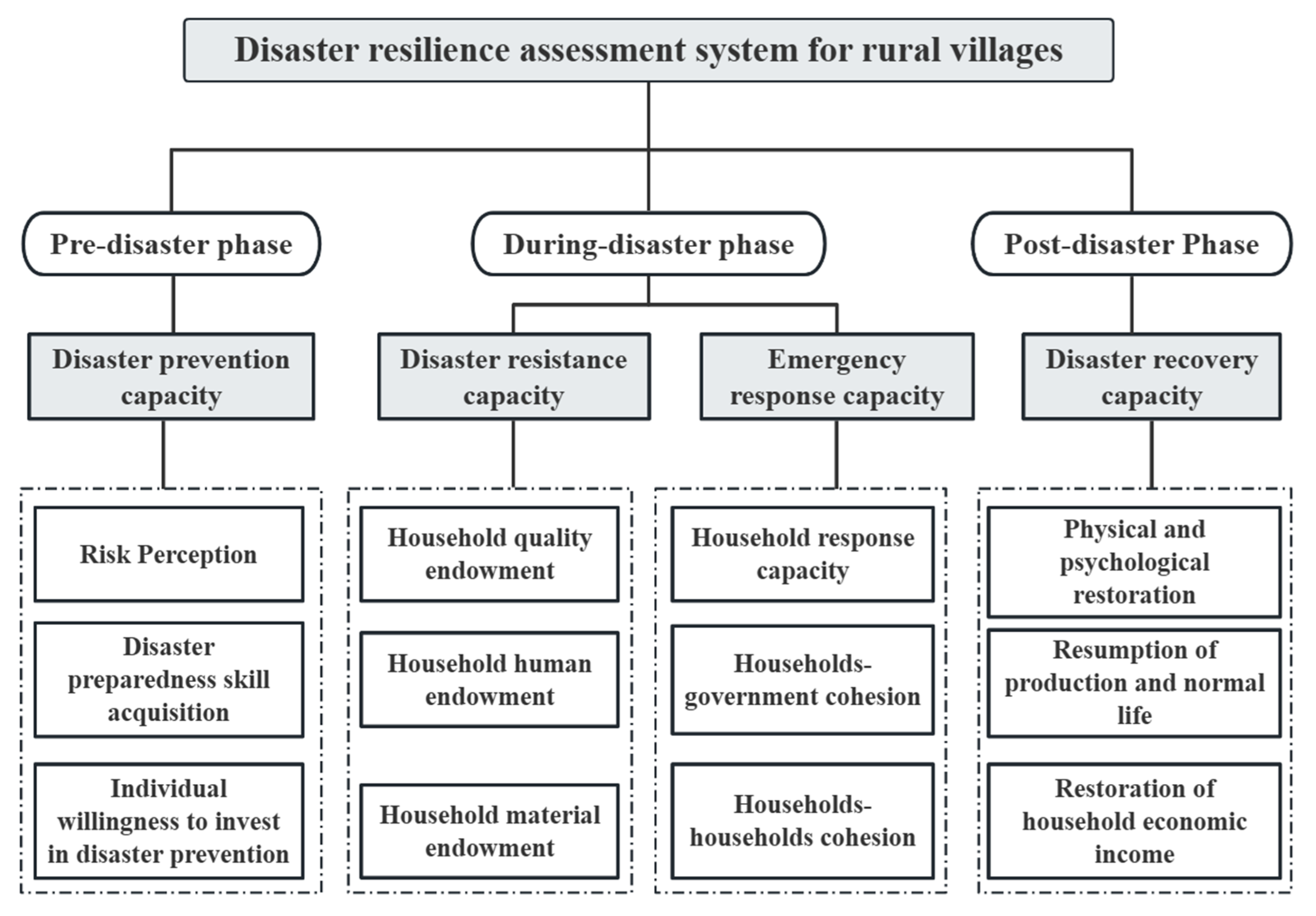
Village disaster resilience is recognized as the comprehensive application of resilience within the village system, which is primarily reflected in three dimensions: goals, processes, and capacities. When confronted with sudden natural disasters and their associated shocks and stresses, the individual agency of villagers exerts a more direct impact on the overall resilience of rural communities [21]. Poor collaborative capacity between individuals and governments, along with inadequate collective action, often result in communities demonstrating weaker resilience capabilities [22]. Therefore, when measuring the disaster resilience of rural communities, it is crucial to consider household-level resilience for enhancing community resilience. This study constructs a measurement framework (see Figure 1) for rural disaster resilience from the micro-level of rural households, comprising four dimensions: disaster prevention capacity, disaster resistance capacity, disaster relief capacity, and recovery capacity.

2.2. Case Study: Hengduan Mountains Region, China

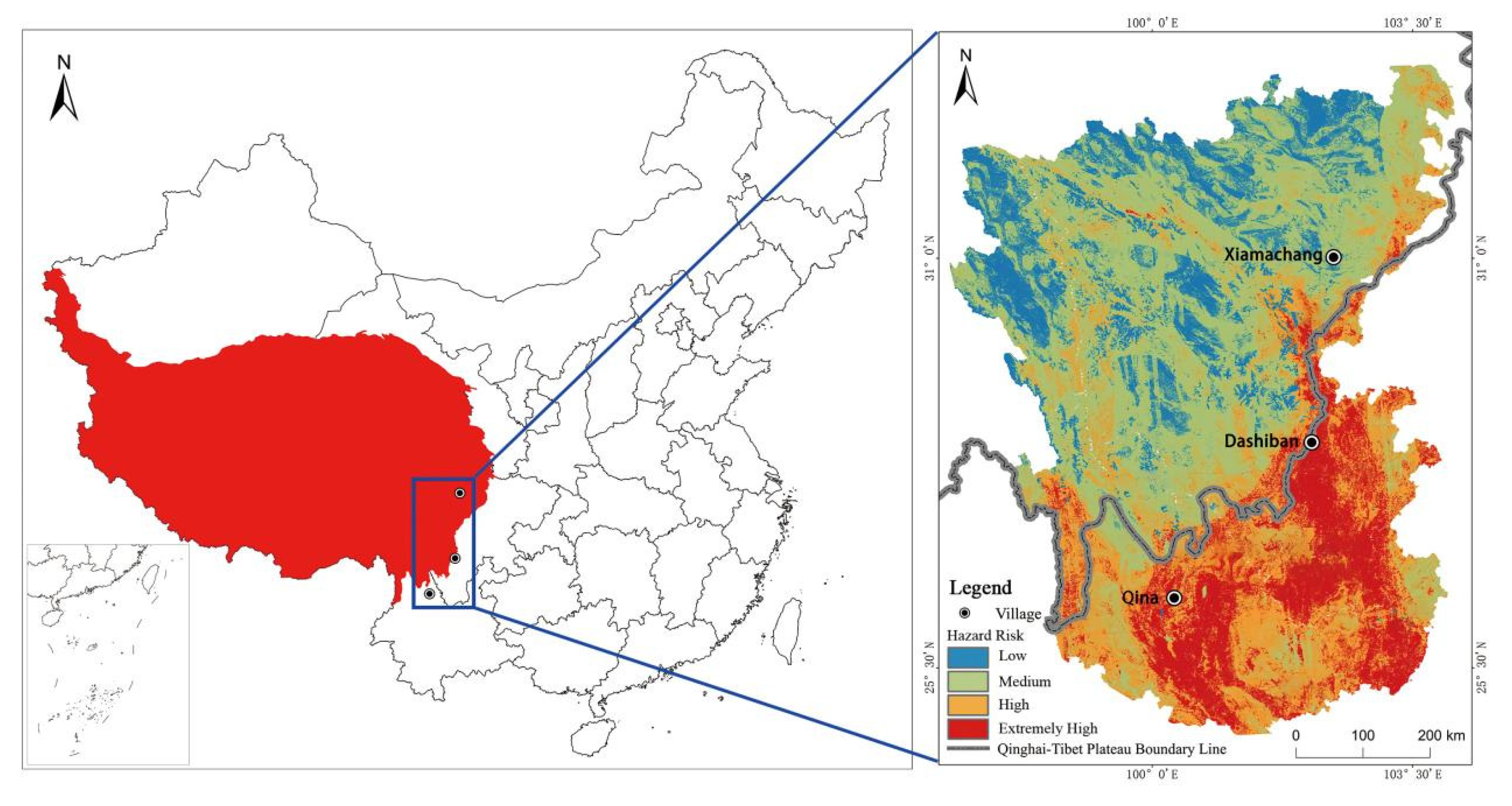
Hengduan Mountains Region, as a typical representation of the western mountainous regions in China, is characterized by high-frequency and high-intensity natural disasters, unique and complex interactions of terrain, humidity, and geological conditions, active disaster-predisposing environments, vulnerable elements at risk, and mutated hazard-causing factors [23]. It stands as one of the most concentrated areas for mountain hazard development and one of the most severely disaster-affected regions [24]. Meanwhile, in the Hengduan Mountains region, mountainous areas account for over 90% of the total area. The distribution of villages exhibits a pattern of “large-scale dispersion and small-scale clustering”. The occurrence of mountain disasters has a particularly severe impact on the economic development of mountain villages. Based on the principles of representativeness and typicality, and considering factors such as village geographical characteristics, transportation conditions, socio-economic levels, and the main industries of villagers, using the hazard risk map of the Hengduan Mountains Xu et al. [25] as the base map, three villages with risks ranging from low to high were selected as study samples along the northeast-southwest direction of the southwestern transitional zone of the Qinghai–Tibet Plateau (see Figure 2). These villages are Xiamachang Village in Meixing Town of Xiaojin County (Aba Prefecture), Dashiban Village in Huiping Township of Mianning County (Liangshan Prefecture), and Qina Village in Qina Town of Yongsheng County (Lijiang City).
Xiamachang Village (31°1′ N, 102°26′ E) is situated in the northern Hengduan Mountains and represents a low-risk pastoral community. Its development is constrained by the topography of the plateau margin, with elevations ranging between 3200 and 3800 m. The total population is approximately 900, of which about 500 are permanent residents. The village possesses around 1800 mu of arable land and supports roughly 2000 heads of large livestock. Staple crops include wheat, maize, and highland barley, supplemented by cash crops such as apples, pears, and grapes. Additionally, the community cultivates valuable medicinal resources including Chinese caterpillar fungus (Ophiocordyceps sinensis), fritillary bulb (Fritillaria spp.), Qianghuo (Notopterygium incisum), matsutake mushrooms (Tricholoma matsutake), and morel mushrooms (Morchella spp.). The village has successfully attracted investment from Jiuzhaigou Wine Company.
Dashiban Village (28°31′ N, 102°10′ E) is a medium-risk agro-pastoral transitional settlement with a population density of 85 persons/km2, characterized by mixed farming. It has a total population of approximately 6000, including about 5000 permanent residents. The village manages around 20,000 mu of cultivated land and sustains about 5000 head of large livestock. The local economy is primarily based on crop cultivation, with animal husbandry serving as a secondary activity. The main source of income is derived from flue-cured tobacco as a cash crop.
Qina Village (26°18′ N, 100°37′ E) is located in the southern Hengduan Mountains and functions as a high-risk agricultural distribution hub. It has a total population of nearly 6500, with approximately 5700 permanent residents and 3361 mu of arable land. The state has invested in the construction of four wells. The village experiences significant population mobility and has a relatively developed private economy. Major food crops include rice, maize, and wheat; principal fruit crops are longan, lychee, and pear; and key cash crops comprise sugarcane, tobacco, and peanuts.
All three villages—Xiamachang, Dashiban, and Qina—are equipped with basic infrastructure, including water supply, electricity, telecommunications, and road networks.

2.3. Data Sources and Processing

2.3.1. Data Sources

The evaluation indicator data for this study were collected through a questionnaire survey conducted during the Second Tibetan Plateau Scientific Expedition and Research, using a stratified random sampling method within the study area. Respondents were primarily adults aged 18 and above familiar with their household situations. Logical correlation questions were included in the questionnaire to ensure response quality. The survey covered basic information of the respondents and four dimensions—disaster prevention capacity, disaster resistance capacity, disaster relief capacity, and recovery capacity—comprising a total of 38 evaluation indicators, including “disaster awareness,” “annual household income” (Table 1), “disaster relief experience,” and “number of insurance types.” Basic characteristic information was presented in tabular form, while the four capacity dimensions were evaluated using a five-point Likert scale, scored from 1 to 5. Prior to the formal survey, a pre-survey was organized by the research team to revise and optimize the questionnaire through small-sample testing. Systematic training on questionnaire content and survey skills was provided to investigators to enhance their familiarity with the questionnaire and operational standardization. A total of 171 households were surveyed, with 154 valid questionnaires collected (50 from Xiamachang Village, 39 from Dashiban Village, and 62 from Qinā Village), resulting in a valid response rate of 88.3%.

2.3.2. Data Processing

The entropy method is an objective weighting method that determines the weights of indicators based on their entropy values. It effectively avoids subjective bias in the weighting process and ensures the objectivity of results [26]. Entropy value is a measure of information uncertainty. The greater the amount of information, the smaller the uncertainty, and the smaller the entropy value; conversely, the smaller the amount of information, the greater the uncertainty, and the larger the entropy value. Moreover, entropy value can be used to measure the discrete degree of indicators. The greater the discrete degree of an indicator, the greater its impact on comprehensive evaluation. The entropy method can profoundly reflect the utility value of information entropy of indicators, thereby determining their weights. Therefore, this study adopts the entropy method to assign weights to each evaluation indicator in the village disaster resilience evaluation index system, enhancing the objectivity and credibility of the evaluation results. The formula of the Entropy Method is as follows:
(1)
The first step is to process the questionnaire survey data using the range standardization method to eliminate the differences caused by the attributes and dimensions of each indicator.
Positive   indicators :   X i j = X i j m i n X 1 j , X 2 j , · · · , X n j m a x X 1 j , X 2 j , · · · , X n j m i n X 1 j , X 2 j , · · · , X n j
Negative   indicators :   X i j = max X 1 j , X 2 j , · · · , X n j X i j m a x X 1 j , X 2 j , · · · , X n j m i n X 1 j , X 2 j , · · · , X n j
(2)
Step 2: Construct the initial indicator matrix based on the number of questionnaires and indicators. Let there be m first-level indicators, each with n second-level indicators, resulting in the initial evaluation indicator matrix:
R = (rij)m×n (i = 1,⋯⋯, m; j = 1,⋯⋯,n)
where rij represents the indicator value of the j-th second-level indicator under the i-th first-level indicator.
(3)
Step 3: Calculate the proportion of all indicators. The formula for calculating the proportion of the value of the i-th first-level indicator under the j-th indicator is as follows:
f i j = r i j i = 1 m γ i j   ( 0     f i j 1 )
(4)
Step 4: Calculate the entropy values for all indicator data. The formula for computing the entropy value of the j-th indicator is as follows:
H j = k i = 1 m f i j ln f i j   , k = 1 / ln   m
(5)
Step 5: Calculate the differentiation coefficients for all indicator data. The formula for calculating the differentiation coefficient of evaluation indicator j is as follows:
d j = 1 H j
(6)
Step 6: Calculate the weights of all indicator data. The formula for calculating the weight of evaluation index j is as follows:
w j = d j / j = 1 n d j

2.4. Development of a Disaster Resilience Evaluation Index System for Villages

Following the principles of scientificity, comprehensiveness, and data accessibility, and based on the disaster resilience measurement framework of villages shown in Figure 1, this study constructed the disaster resilience evaluation index system for traditional villages as presented in Table 2.

2.5. Village Disaster Resilience Assessment Model

Rural Village Disaster Resilience refers to a mitigation and adaptation capacity that spans pre-disaster, during-disaster, and post-disaster phases. It encompasses four interconnected capabilities: pre-disaster prevention capacity, disaster resistance capacity, disaster relief capacity, and post-disaster recovery capacity. This resilience reflects integrated disaster management of natural geography, social relations (cohesion and solidarity), economic development, and other comprehensive factors within a region. Rural village disaster resilience is a unique attribute of social collectives and individuals, where its attributes result in mutual influence and constraints among the four capacities, ultimately forming a comprehensive entity of rural disaster resilience. Based on modifications to the comprehensive index method [37], a rural village disaster resilience assessment model has been developed. Its mathematical expression is as follows:
RP = (ω1F+ω2K+ω3J+ω4H)/n
F = i = 1 n ( W F × F i )
K = i = 1 n ( W K × K i )
J = i = 1 n ( W J × J i )
H = i = 1 n ( W H × H i )
where RP represents the average disaster resilience score; where WF, WK, WJ, WH denote the weights of disaster prevention capacity indicator, disaster resistance capacity indicator, emergency response capacity indicator, and disaster recovery capacity indicator, respectively; where Fi, Ki, Ji, Hi denote the scores of the i-th evaluation indicators for disaster prevention capacity, disaster resistance capacity, emergency response capacity and disaster recovery capacity, respectively; where F, K, J, H denote the scores of disaster prevention capacity, disaster resistance capacity, emergency response capacity and disaster recovery capacity, respectively; where ω1, ω2, ω3, ω4 denote the weights of disaster prevention capacity, disaster resistance capacity, emergency response capacity and disaster recovery capacity, respectively; where n denotes the sample size.

3. Results

3.1. The Dominant Factors Influencing the Disaster Resilience of Villages

In the Village Disaster Resilience Evaluation Index System (Table 2), the weights of ‘disaster prevention capacity, disaster resistance capacity, disaster relief capacity, and recovery capacity’ range from 0.07 to 0.61. Among these, disaster resistance capacity has the highest weight value of 0.61, demonstrating that individual disaster resistance capacity holds a critical position in village resilience. From the perspective of disaster prevention capability, the first-level indicators of “Willingness to Invest in Disaster Prevention” and “Disaster prevention attitude” both exhibit relatively high weight values, reaching 0.34. This indicates whether villagers are willing to invest economically in disaster preparedness during the disaster prevention process and their proactive attitude toward disaster prevention are key factors in evaluating individual disaster prevention capability. From the perspective of disaster resistance capacity, the household human endowment in the primary indicators demonstrates a high weight value of 0.71, indicating that household human endowment plays a crucial role in individual disaster resilience. From the perspective of disaster response capacity, the primary indicators of individual disaster response capacity and individual-government cohesion hold relatively high weight values of 0.57 and 0.32, respectively. This also demonstrates that individuals’ extensive disaster relief experience and effective communication between individuals and governments form the critical foundation for individual disaster response capacity. From the perspective of disaster recovery capacity, the first-level indicators of economic income recovery and individual physical and mental recovery exhibit relatively high weight values, at 0.52 and 0.32, respectively. Households with more diversified income sources demonstrate lower economic vulnerability, leading to quicker economic recovery. For individuals, post-disaster physical and mental recovery is critical. Timely psychological recovery, positive coping with disaster consequences, and swift physical recovery to resume productive activities are beneficial for both individual rehabilitation and overall community recovery. Due to the improved social security system in China, particularly the universal coverage of medical insurance, physical recovery is highly ensured, thus explaining the lower weight value of the “physical recovery” indicator.

3.2. The Interaction Mechanisms Among Dimensions of Rural Disaster Resilience

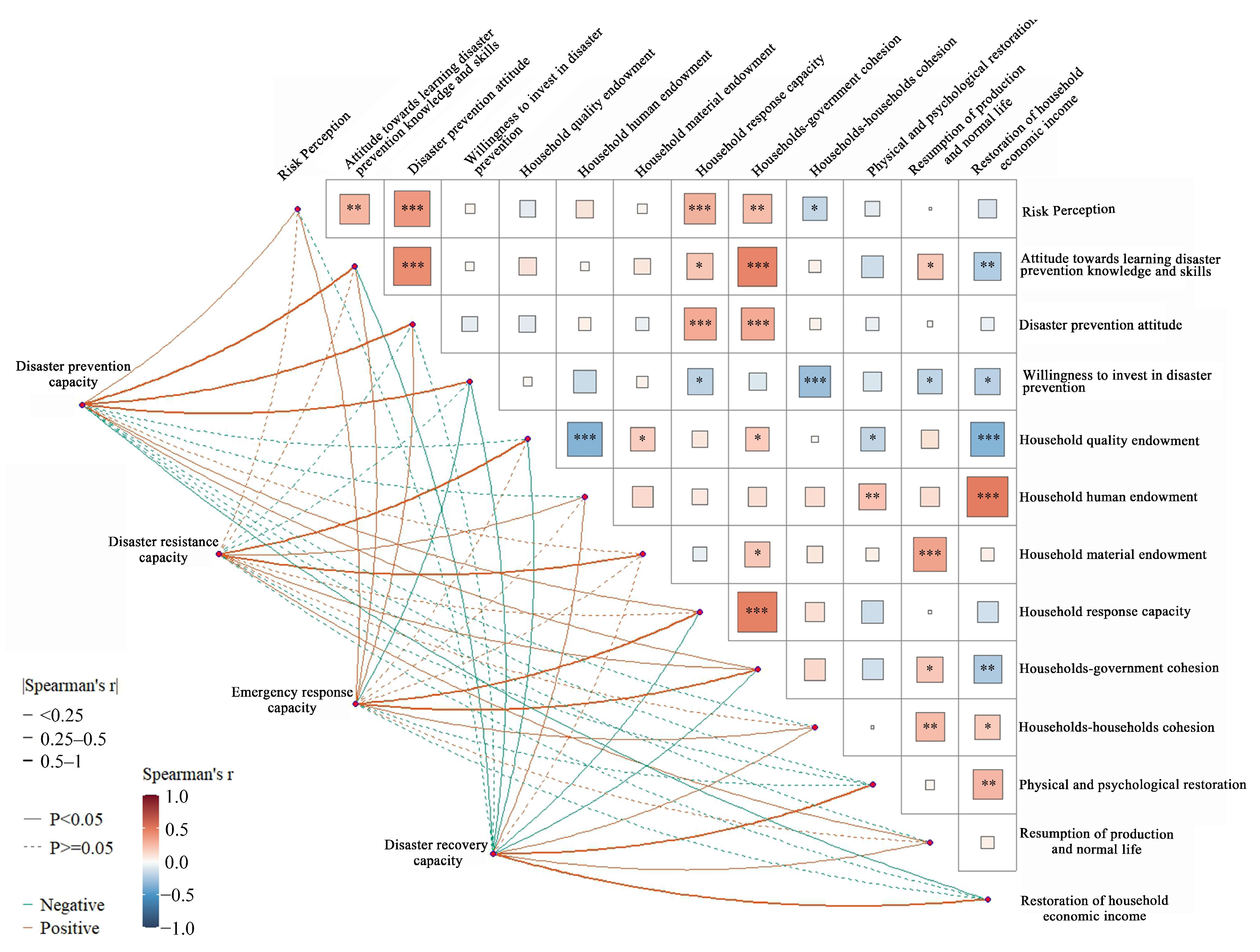
Within the disaster resilience assessment framework, complex interconnections and progressive relationships exist among the four dimensions: disaster prevention capacity, disaster resistance capacity, emergency response capacity, and recovery capacity. Based on the weighting results of the entropy weight method (Table 2) and the case village data, this study conducted Pearson correlation analysis to reveal the interactions among various dimensions and identify key driving factors. The specific findings are as follows:
According to the analysis results of Spearman correlation (see Figure 3), measurement indicators such as household material endowments, individual disaster response ability, and individual-government cohesion have a positive impact on disaster prevention capacity; Measurement metrics such as individual disaster response capacity, individual-government cohesion, interpersonal cohesion, and production and livelihood recovery exert positive impacts on Disaster resistance capacity; Measurement indicators such as disaster cognition, learning attitudes toward disaster prevention knowledge and skills, disaster defense attitudes, family quality endowments, family human endowments, family material endowments, and production and livelihood recovery have a positive impact on emergency response capacity; Measurement indicators including family human endowment, family material endowment, and individual-individual cohesion have positive effects on disaster recovery capacity. The findings reveal that household material endowments exert positive effects across all four stages of disaster management: prevention, resistance, response, and recovery. Individual disaster response capacity and individual-government cohesion also demonstrate positive impacts on the three stages of prevention, resistance, and response. Therefore, enhancing household material endowments serves as an effective approach to improving village-level disaster resilience. Strengthening individual disaster response capabilities and fostering individual-government cohesion can effectively mitigate disaster-induced losses and enhance individual adaptive capacity to disasters.

3.3. Analysis of Disaster Resilience Measurement Results in Typical Villages

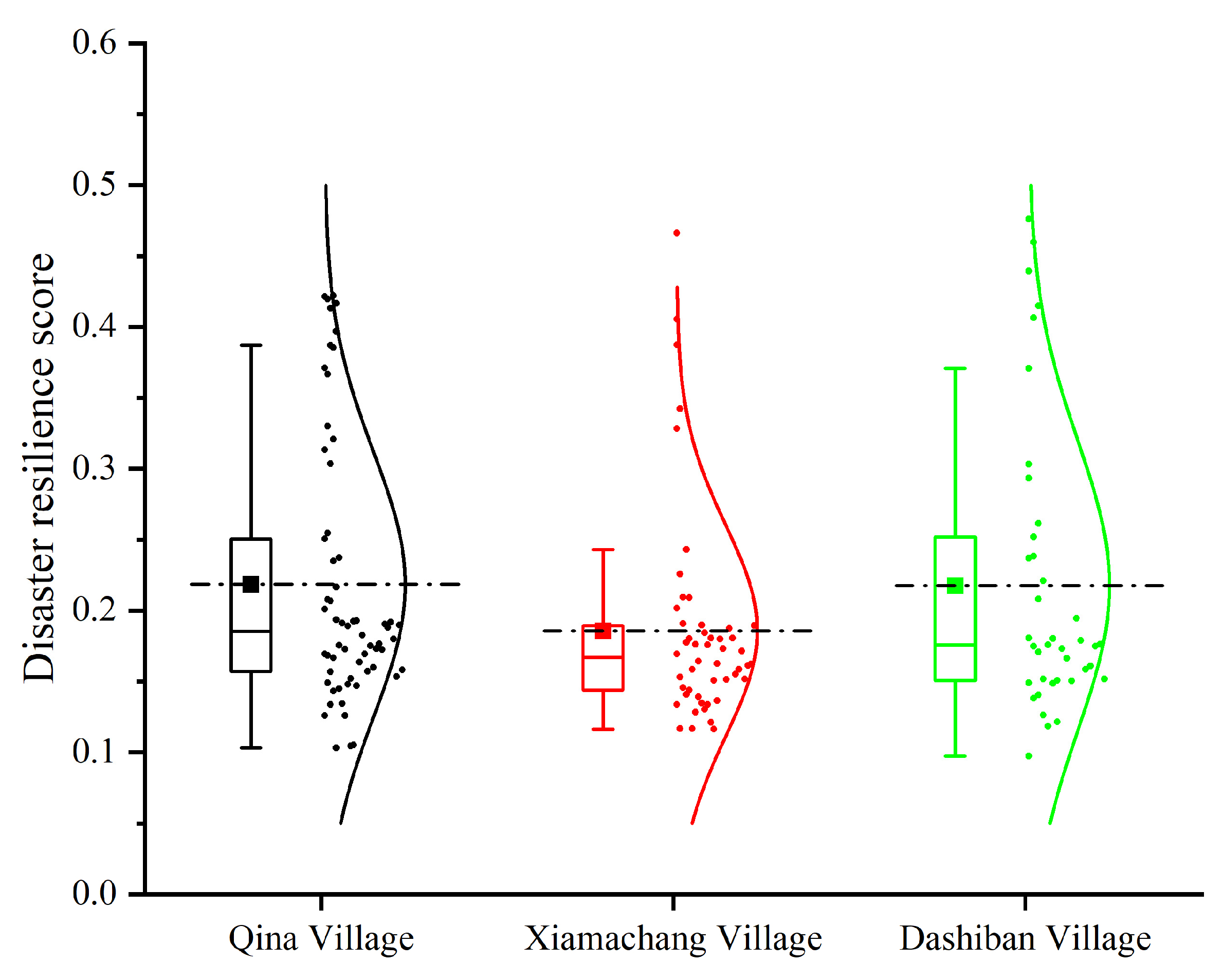
The boxplot of typical village disaster resilience (see Figure 4) reveals significant differences in individual disaster resilience among Xiamachang Village, Qina Village, and Dashiban Village. In terms of mean values, Qina Village exhibits the highest average, while Xiamachang Village shows the lowest. Based on the median and normal distribution curve, the data points of Xiamachang Village are relatively evenly distributed, approximately following a normal distribution. In contrast, Dashiban Village demonstrates a pronounced “bipolar divergence” trend, with only a few scattered individuals achieving higher disaster resilience scores. The data points of Xiamachang Village are predominantly clustered in the lower range of disaster resilience scores. Overall, Dashiban Village shows the most significant disparity in individual disaster resilience, while Qina Village achieves the highest average level of disaster resilience among the studied villages.
The disaster resilience results of the three typical villages (see Table 3) show that Qina Village attained the highest disaster resilience score (0.218), while Xiamachang Village recorded the lowest score (0.186). Qina Village and Dashiban Village exhibited superior disaster resistance and recovery capacities, whereas Xiamachang Village demonstrated pronounced strengths in disaster prevention and relief capacities. Among the four capacity dimensions, disaster resistance capacity recorded the highest mean score (0.061), while disaster relief capacity showed the lowest average (0.038).
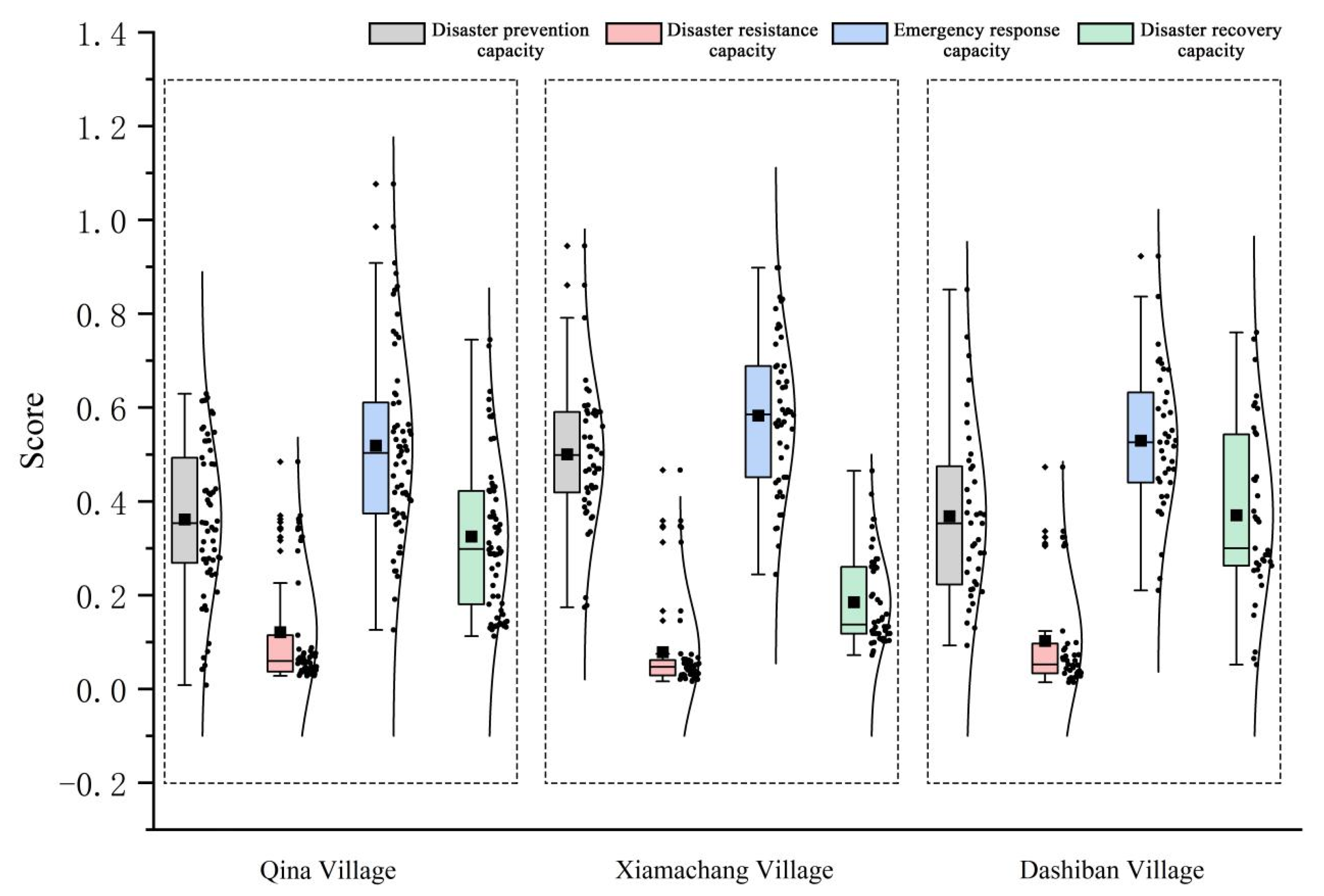
Comparative analysis of the boxplots depicting disaster prevention, resistance, relief, and recovery capacities among Qina, Xiamachang, and Dashiban villages (see Figure 5) reveals significant disparities across these four dimensions, with disaster relief capacity demonstrating the comparatively strongest performance while disaster resistance capacity shows the weakest outcomes.
In terms of disaster prevention capacity, Xiamachang Village exhibits the highest median score (0.499) and the smallest interquartile range (0.176), indicating relatively homogeneous household-level preparedness with a “high-capability and concentrated distribution” pattern. This characteristic stems from respondents’ elevated awareness of disaster risks. Dashiban Village demonstrates the largest interquartile range (IQR = 0.252) with a right-skewed data distribution, indicating significant disparities in household-level prevention capacities and overall inferior disaster preparedness. This pattern is attributable to residents’ weaker willingness to acquire disaster prevention knowledge and skills. Qina Village exhibits a compact data distribution (IQR = 0.232) with left-skewed characteristics, reflecting generally elevated disaster prevention capacities among households. This pattern correlates strongly with villagers’ heightened willingness to acquire disaster prevention knowledge and skills. This suggests that as geohazard frequency and intensity have been increasing, residents’ risk awareness is progressively improving. Consequently, governmental agencies must enhance the dissemination of disaster preparedness knowledge and technical training to meet villagers’ escalating demands for preventive measures.
In terms of disaster resistance capacity, the three typical villages exhibit weak overall performance. Qina Village exhibits the highest median disaster resistance capacity (0.059) with the largest interquartile range (IQR = 0.106), displaying a right-skewed distribution that reflects both strong individual resistance capabilities and significant intra-village disparities. This pattern can be attributed to Qina’s dual role as a critical agro-mineral hub in southern Yongsheng County, characterized by substantial migrant populations, dynamic private-sector economies, and superior household material endowments. Xiamachang Village exhibits the weakest overall disaster resistance capacity (median = 0.047) with a concentrated distribution (IQR = 0.08), which is attributable to its diminished household human capital resulting from large-scale outmigration of working-age adults. Therefore, individual resistance capacity emerges as the primary constraint on the village’s disaster resilience.
In terms of disaster relief capacity, the three studied villages demonstrate relatively strong performance overall, a pattern primarily driven by heightened governmental prioritization of disaster risk prevention and continuously enhanced disaster governance mechanisms in recent years. The median disaster resilience score of Xiamachang Village is the highest (0.586), with the data exhibiting a normal distribution. This indicates that the village not only demonstrates strong disaster relief capacity but also possesses “robustness,” which is closely associated with “individual-government cohesion.” Specifically, this is reflected in villagers’ highly positive attitudes toward indicators such as “perceived fairness, communication accessibility, collaborative effectiveness, and institutional familiarity”. Dashiban Village exhibits a compact data distribution (IQR = 0.192), indicating limited variability in individual disaster relief capabilities. This is closely linked to the village’s strong “households-households cohesion”, as evidenced by respondents’ overwhelmingly positive responses to metrics such as “Number of mutual assistance neighbors” and “Neighborly relations.” Qina Village demonstrates a dispersed data distribution (IQR = 0.241), primarily stems from the village’s robust individual self-rescue capacity, but exhibits significant variability in individual self-rescue capacities. This disparity is most pronounced in the diversity of household-prepared emergency supplies, where Qina Village demonstrates the highest preparedness level among surveyed Villages. This reveals that although the three villages all exhibit high individual disaster relief capacities, there exist significant regional variations in their contributing factors, highlighting the critical role of village cultural contexts in shaping disaster response capabilities.
Regarding recovery capacity, the three studied villages exhibit comparatively weaker performance in this dimension relative to their disaster prevention and relief capabilities. Dashiban Village exhibits the highest median recovery capacity (0.300) with significant data dispersion (IQR = 0.280) and a right-skewed distribution, demonstrating a pattern of “notable capability coexisting with pronounced disparities.” This phenomenon stems from its proximity to Mianning County’s urban core, where households benefit from diversified livelihood strategies, resulting in polarized economic recovery outcomes across individuals. Xiamachang Village exhibits the lowest median recovery capacity (0.137) yet maintains a compact distribution (IQR = 0.142), reflecting uniformly low but stable individual recovery levels. This phenomenon is directly correlated with widespread insurance hesitancy among Xiamachang villagers, a critical barrier constraining post-disaster capital replenishment and livelihood rehabilitation. Therefore, diversifying rural households’ income streams and expanding insurance penetration emerge as imperative strategies to enhance villages’ disaster recovery capacity.
The dimensional comparative analysis of “disaster prevention, resistance, relief, and recovery capacities” across three typical villages reveals that pre-disaster education, household vulnerability, and village cultural contexts collectively shape the disaster resilience architecture of rural communities through their synergistic interactions.

4. Discussion

4.1. Key Factors Influencing Disaster Resilience in Mountainous Villages

Based on the individual perspectives of villagers and grounded in the disaster management cycle theory, this study constructs a comprehensive evaluation system encompassing disaster prevention capacity, disaster resistance capacity, disaster relief capacity, and recovery capacity to assess the differences in disaster resilience across three typical villages in the Hengduan Mountains region. The research reveals the interaction mechanisms among the four capacity dimensions and their regional variations, while identifying key driving factors of disaster resilience in different villages. Within the evaluation system, the disaster resistance capacity dimension carries the highest weight, indicating that household quality endowment, human endowment, and material endowment play a central role in enhancing village-level disaster resilience [38]. Similarly, a survey based on the Walsh Family Resilience Questionnaire (WFRQ-32) by Guo et al. [39] suggests that higher household quality endowment contributes to strengthened disaster resilience. In contrast, household quality and material endowment have relatively lower weights in the study area, reflecting minor disparities in population quality and economic levels among the three villages.
From the perspective of interaction mechanisms among various dimensions of disaster resilience in rural villages, household material endowment plays a positive role across all four stages—prevention, resistance, response, and recovery—consistent with the proposition by Gaisie et al. [40] that household capital exhibits complex linkages with disaster outcomes and exerts multifaceted influences throughout the entire disaster process. This finding suggests that improving the material conditions of rural households should be prioritized to enhance disaster resilience in mountainous villages. Furthermore, individual disaster coping capacity and individual–government cohesion demonstrate significant positive effects in the prevention, resistance, and response stages, directly determining the overall level of village disaster resilience. This result supports the empirical view of Nirmal et al. [41] that household-level emergency preparedness literacy is a fundamental determinant of community resilience, particularly in resource-constrained environments, where strategic stockpiling of emergency supplies can significantly enhance pre-disaster risk reduction capabilities. Additionally, this study corroborates the conclusion of Li et al. [42] that rebuilding the authority of local governments or village committees, consolidating residents’ trust in administrative institutions, ensuring effective dissemination of disaster information and rescue directives, and enhancing residents’ sense of identification with the government contribute to more consistent compliance with instructions and unified actions during disasters. Within this mechanism, trust and kinship within social networks are particularly critical for building resilient communities.

4.2. Analysis of Differences in Disaster Resilience Among Typical Villages

Under the context of climate warming, the frequency and intensity of extreme weather events have significantly increased, leading to a substantial rise in economic losses caused by natural disasters. As one of the regions with the most dramatic topographic gradients in China, the Hengduan Mountains region exhibits significant typicality and complexity in geological disaster prevention and mitigation. This study reveals that, in terms of disaster prevention capacity, as disaster risks increase, villagers demonstrate a stronger willingness to acquire knowledge and skills related to disaster prevention. This finding aligns with the phenomenon observed by Lamjiry et al. [43] in high seismic risk areas, where residents exhibited heightened risk perception and greater willingness to engage in disaster preparedness. Regarding disaster resistance capacity, significant disparities exist among individuals in different villages. Guo et al. [44] compared villages in plains, loess plateaus, and mountainous areas and found that individuals in plain regions exhibited significantly higher disaster resistance capabilities than those in mountainous and plateau villages. In terms of disaster response capacity, village cultural background plays a crucial role in shaping individual disaster response abilities. This observation is consistent with the conclusion of Surjono et al. [45] that “respecting cultural traditions (such as mutual aid customs) can significantly improve community response scores in disasters like earthquakes and floods.” Concerning recovery capacity, livelihood diversification among farmers contributes to enhancing post-disaster recovery at the village level. Similarly, Wei et al. [46], in a study conducted in earthquake-stricken areas in Yunnan, found that villages with a higher proportion of non-agricultural employment demonstrated faster overall recovery speeds.
This study has several limitations. First, the data primarily rely on subjective feedback obtained through questionnaire surveys, lacking objective secondary data from other sources. Future research could adopt mixed-methods approaches to integrate multiple data sources, thereby providing a more comprehensive and in-depth understanding of individual disaster resilience disparities across different villages. Second, due to the dispersed distribution of residents in the study area and the impact of COVID-19 prevention measures, the sample size of this survey is relatively limited. The research team will further expand the sample size in subsequent studies to enhance the representativeness and scientific rigor of the data. Third, as each village possesses unique natural and social environmental characteristics, individual disaster resilience also exhibits significant variation, making direct and meaningful comparisons with other regions sharing similar geographical conditions challenging.

5. Conclusions

This study selected three typical villages in the Hengduan Mountain region as case studies and established a microscale evaluation index system to analyze differences in rural disaster resilience and key influencing factors across different disaster management phases (prevention, resistance, response, and recovery). The main findings are as follows:
(1) In the weighting results of the rural disaster resilience evaluation index system, the resistance capacity dimension was assigned a relatively high weight coefficient, highlighting the critical role of individual resistance capacity in mitigating disaster impacts. (2) The overall disaster resilience of mountainous villages was at a moderate level (mean = 0.207), with Qina Village (0.218) and Dashiban Village (0.217) exhibiting higher resilience than Xiamachang Village (0.186). (3) Significant differences were observed among the villages across the four capacity dimensions: Xiamachang Village performed notably well in disaster prevention (comprehensive score = 0.060), Qina Village demonstrated stronger resistance capacity (score = 0.074), while Xiamachang Village showed relatively weaker recovery capacity (score = 0.037). (4) Interaction mechanisms exist among the dimensions of disaster resilience. Household material endowment positively influenced all four disaster phases (prevention–resistance–response–recovery). Individual emergency response capacity and individual–government collaborative capacity significantly enhanced resilience performance in the first three phases (prevention–resistance–response).
Based on the research findings, the following recommendations are proposed to enhance village resilience: Dashiban Village should improve disaster awareness and self-rescue capabilities through community publicity, training, and drills, thereby strengthening disaster preparedness. Xiamachang Village ought to promote local employment of young and middle-aged laborers by developing rural industries, with a focus on enhancing household human capital to boost the village’s disaster resistance. Qina Village could establish a disaster information sharing platform to enable real-time dissemination of disaster-related information, improve emergency response efficiency, and enhance disaster relief capacity. In terms of recovery capacity building, Xiamachang Village should strengthen vocational skills training, diversify farmers’ income sources, and encourage the purchase of agricultural and disaster insurance to reduce economic constraints during post-disaster recovery.
The contribution of this study lies in constructing a disaster resilience evaluation index system applicable to mountainous villages, providing both an empirical basis and theoretical support for rural disaster governance. The proposed indicator system and analytical approach not only address the gap in existing research regarding attention to disaster resilience at the micro-level (individual villagers), emphasizing the central role of human factors in building disaster resilience, but also reveal the core importance of “disaster resistance capacity” in village resilience. Key driving factors—such as household material endowment, individual disaster self-rescue capability, and individual–government cohesion—have been clearly identified. The research outcomes can provide scientific evidence for local governments to formulate differentiated disaster-risk reduction strategies, enhance villagers’ awareness of disaster risks, optimize resource allocation, and strengthen multi-departmental coordination, thereby offering practical guidance for sustainable rural development.

Author Contributions

Conceptualization, F.Z., Q.Z. and L.L.; Methodology, F.L., W.M., H.L., Q.C. and Y.L.; Software, F.Z.; Formal analysis, F.Z.; Resources, Q.Z. and L.L.; Data curation, F.Z.; Writing—original draft, F.Z., Q.Z. and L.L.; Writing—review & editing, F.Z., F.L., W.M., H.L., Q.C. and Y.L.; Project administration, Q.Z. and L.L.; Funding acquisition, Q.Z. and L.L. All authors have read and agreed to the published version of the manuscript.

Funding

This research was funded by the National Natural Science Foundation of China (NSFC): Dynamic Changes and Disaster Response of the Frost Weathering Zone in the Tibetan Plateau (42271127), and the Research Project on the Second Comprehensive Scientific Expedition to the Tibetan Plateau: Integrated Disaster Risk Evaluation and Defense (2019QZKK0906).

Institutional Review Board Statement

IRB approval is waived because The Ethical Review Measures for Life Sciences and Medical Research Involving Humans, jointly issued by the National Health Commission of the People’s Republic of China, the Ministry of Education, the Ministry of Science and Technology, and the National Administration of Traditional Chinese Medicine, carries authoritative weight. Article 32 of Chapter III, “Ethical Review,” clearly states: “The following types of human research in life sciences and medicine that use human information data or biological samples may be exempt from ethical review, provided they cause no harm to human subjects, involve no sensitive personal information or commercial interests, so as to reduce unnecessary burden on researchers and facilitate the conduct of such studies.” Among these, it is explicitly indicated that “research using anonymized information data” qualifies for exemption from ethical review. The data used in our submitted paper were collected through questionnaires and were fully anonymized, which complies with the exemption conditions stated in the above-mentioned Measures. We have highlighted the relevant section in the document with a red box for your easy reference.

Informed Consent Statement

Informed consent was obtained from all participants involved in the study.

Data Availability Statement

The data presented in this study are available upon request from the corresponding author. The data are not publicly available due to privacy.

Conflicts of Interest

The authors declare no conflicts of interest.

References

  1. Cui, P. Progress and prospects in research on mountain hazards in China. Prog. Geogr. 2014, 33, 145–152. [Google Scholar] [CrossRef]
  2. Deng, W.; Nan, X.; Shi, Z.Q.; Zhang, J.F.; Liu, B.T. Territory space characteristics and regional development of mountain region in China. Chin. J. Nat. 2018, 40, 17–24. [Google Scholar] [CrossRef]
  3. Xu, J.; Shao, Y.W. Resilient Cities: A New Shift to Urban Crisis Management. Urban Plan. Int. 2015, 30, 1–3. [Google Scholar]
  4. Cui, X.L.; Zhang, X.H.; Zhang, J.F. Theme vein and frontier trend of research on disaster resilience at home and abroad. J. Nat. Disasters 2023, 32, 1–12. [Google Scholar] [CrossRef]
  5. He, X.J.; Qiao, G.M.; Pan, Z.Y.; Qian, Y. Study on the Spatio-Temporal Characteristics and Response Configuration Paths of Disaster Resilience in Coastal Zone Cities. J. Catastrophology 2025. Available online: https://link.cnki.net/urlid/61.1097.P.20251010.1434.002 (accessed on 21 October 2025).
  6. Ren, J.; Wang, Z.H.; Wang, S.Y. Research on the assessment of urban safety resilience in the Yellow River Basin based on typical flood disaster chains. J. Saf. Environ. 2025. [Google Scholar] [CrossRef]
  7. Tian, C.S.; Guo, B.Y.; Li, M.; Yao, Y.; Ghimire, S.K.; Zhang, L.; Zhang, C.; Wei, L.; Jiang, Y.; Li, X. Disparate perceived resilience of rural households at different altitude belts: An empirical study from the Wenchuan earthquake-stricken area, China. J. Mt. Sci. 2025, 22, 1151–1168. [Google Scholar] [CrossRef]
  8. Ruslanjari, D.; Putri, R.A.P.; Puspitasari, D.; Djatmiko, R.H.; Tanaka, R.; Hasan, H.A.; Nabil, T.; Fajarian, N.A. From vulnerability to resilience: Examining the Sister Village program’s approach to volcanic disaster risk reduction using the DROP model. Prog. Disaster Sci. 2025, 26, 100439. [Google Scholar] [CrossRef]
  9. Li, Y.; Zhai, G.F. China’s urban disaster resilience evaluation and promotion. Planners 2017, 33, 5–11. [Google Scholar]
  10. Bai, H.W.; Shi, M.J.; Cao, Q.; Ning, Z. Spatial distribution characteristics and disaster resilience assessment of traditional villages in earthquake-prone areas. J. Nat. Disasters 2024, 33, 30–41. [Google Scholar] [CrossRef]
  11. Roberts, E.; Anderson, B.A.; Skerratt, S.; Farrington, J. A review of the rural-digital policy agenda from a community resilience perspective. J. Rural. Stud. 2017, 54, 372–385. [Google Scholar] [CrossRef]
  12. Yan, W.T.; Lu, J.L. Two Models for Revitalizing Village: Enlightenments Under Resilient Perspective. Urban Plan. Int. 2017, 32, 22–28. [Google Scholar] [CrossRef]
  13. Mai, X.; Tao, W.; Liu, W.B. Literature review on the research progress of rural resilience. Hum. Geogr. 2023, 38, 28–34. [Google Scholar] [CrossRef]
  14. Ding, Y.H.; Zhou, Q.; Liu, F.G.; Chen, Q.; Ma, W.D.; Zhou, Y.T. Research evolution and multi-dimensional prospect of disaster resilience. J. Catastrophology 2024, 39, 109–117. [Google Scholar] [CrossRef]
  15. Zhai, G.F. Disaster Prevention, Mitigation, and Relief, and Resilient City Planning and Construction in China. Beijing Plan. Rev. 2018, 2, 26–29. [Google Scholar]
  16. Drabek, T. Human System Responses to Disaster an Inventory of Sociological Findings; Springer: New York, NY, USA, 1986; 479p. [Google Scholar] [CrossRef]
  17. The United Nations Office for Disaster Risk Reduction (UNISDR). Hyogo Framework for Action 2005–2015: Building the Resilience of Nations and Communities to Disasters; United Nations: Geneva, Switzerland, 2007. [Google Scholar]
  18. The United Nations Office for Disaster Risk Reduction (UNISDR). Sendai Framework for Disaster Risk Reduction 2015–2030; United Nations: Geneva, Switzerland, 2015. [Google Scholar]
  19. Drolet, J.; Dominelli, L.; Alston, M.; Ersing, R.; Mathbor, G.; Wu, H. Women rebuilding lives post-disaster: Innovative community practices for building resilience and promoting sustainable development. Gend. Dev. 2015, 23, 433–448. [Google Scholar] [CrossRef]
  20. Phibbs, S.; Kenney, C.; Severinsen, C.; Mitchell, J.; Hughes, R. Synergising public health concepts with the Sendai framework for disaster risk reduction: A conceptual glossary. Int. J. Environ. Res. Public Health 2016, 13, 1241. [Google Scholar] [CrossRef] [PubMed]
  21. Li, H.B. Rural settlements research from the perspective of resilience theory. Geogr. Sci. 2020, 40, 556–562. [Google Scholar] [CrossRef]
  22. Li, T.Y.; G, C.L. Research on the Indicator System of Resilient Cities in China, Singapore Management and Sports Science Institute, Singapore. In Proceedings of the 2014 2nd International Conference on Social Sciences Research(SSR 2014 V6), Hong Kong, China, 10 December 2014; Singapore Management and Sports Science Institute: Singapore; Intelligent Information Technology Application Society: Zhuhai, China, 2014; Volume 6. [Google Scholar]
  23. Shen, Z.X.; Zhang, Q.; Wu, W.H.; Song, C. Spatial pattern and attribution analysis of the regions with frequent geological disasters in the Tibetan Plateau and Hengduan Mountains. Acta Geogr. Sin. 2022, 77, 1211–1224. [Google Scholar]
  24. Li, Y.F.; Zhang, C.D.; Zhang, G.T. The development characteristics and formation modes of rainstorm-triggered flash flood disasters in the Hengduan Mountains. Acta Geogr. Sin. 2024, 79, 600–616. [Google Scholar] [CrossRef]
  25. Xu, R.C.; Li, X.Z.; Hu, K.H.; Nie, Y.; Bian, J. A dynamic risk assessment for mountain hazards in the Hengduan mountain region, China. Mt. Res. 2020, 38, 222–230. [Google Scholar] [CrossRef]
  26. Hou, M.L. Coupling relationship and spatiotemporal characteristics of labor force flow and farmland transfer based on entropy method. J. Arid. Land Resour. Environ. 2020, 34, 52–58. [Google Scholar] [CrossRef]
  27. Wei, B.Y.; Su, G.W.; Wu, Q.; Qi, W.; Zhang, W. Features of awareness and response of rural households to earthquake disasters and their differences between inter-household: A case study of disaster area of Ms6.4 Ning’er, Yunnan, earthquake in 2007. J. Nat. Disasters 2012, 21, 116–124. [Google Scholar] [CrossRef]
  28. Cui, K.; Han, Z.Q.; Wang, D.M. Resilience of an Earthquake-Stricken Rural Community in Southwest China: Correlation with Disaster Risk Reduction Efforts. Int. J. Environ. Res. Public Health 2018, 15, 407. [Google Scholar] [CrossRef]
  29. Sim, T.; Han, Z.Q.; Guo, C.L.; Lau, J.; Yu, J.; Su, G. Disaster preparedness, perceived community resilience, and place of rural villages in northwest China. Nat. Hazards 2021, 108, 907–923. [Google Scholar] [CrossRef]
  30. Cassidy, L.; Barnes, G.D. Understanding household connectivity and resilience in marginal rural communities through social network analysis in the village of Habu, Botswana. Ecol. Soc. 2012, 17, 11. [Google Scholar] [CrossRef]
  31. Bristow, G.; Healy, A. Handbook on Regional Economic Resilience; Edward Elgar Publishing: Cheltenham, UK, 2020. [Google Scholar]
  32. Crookston, B.; Gray, B.; Gash, M.; Aleotti, V.; Payne, H.E.; Galbraith, N. How Do You Know ‘Resilience’ When You See It? Characteristics of Self-perceived Household Resilience among Rural Households in Burkina Faso. J. Int. Dev. 2018, 30, 917–933. [Google Scholar] [CrossRef]
  33. Soetanto, R.; Mullins, A.; Achour, N. The perceptions of social responsibility for community resilience to flooding: The impact of past experience, age, gender and ethnicity. Nat. Hazards 2017, 86, 1105–1126. [Google Scholar] [CrossRef]
  34. Hegney, D.; Ross, H.; Baker, P.; Rogers-Clark, C.; King, C.; Buikstra, E.; Watson-Luke, A.; McLachlan, K.; Stallard, L. Building Resilience in Rural Communities: Toolkit; The University of Queensland: St Lucia, QLD, Australia; University of Southern Queensland: Toowoomba, QLD, Australia, 2008; pp. 10–52. [Google Scholar]
  35. Rockenbauch, T.; Sakdapolrak, P. Social networks and the resilience of rural communities in the Global South: A critical review and conceptual reflections. Ecol. Soc. 2017, 22, 10. [Google Scholar] [CrossRef]
  36. Hanazaki, N.; Berkes, F.; Seixas, C.S.; Peroni, N. Livelihood diversity, food security and resilience among the Caiçara of coastal Brazil. Hum. Ecol. 2013, 41, 153–164. [Google Scholar] [CrossRef]
  37. Greco, S.; Ishizaka, A.; Tasiou, M.; Torrisi, G. On the Methodological Framework of Composite Indices: A Review of the Issues of Weighting, Aggregation, and Robustness. Soc. Indic. Res. 2019, 141, 61–94. [Google Scholar] [CrossRef]
  38. Liu, W.M.; Gerber, E.; Jung, S.; Agrawal, A. The role of human and social capital in earthquake recovery in Nepal. Nat. Sustain. 2022, 5, 167–173. [Google Scholar] [CrossRef]
  39. Guo, C.L.; Sim, T. Walsh Family Resilience Questionnaire Short Version (WFRQ-9): Development and Initial Validation for Disaster Scenarios. Disaster Med. Public Health Prep. 2025, 19, e39. [Google Scholar] [CrossRef] [PubMed]
  40. Gaisie, E.; Han, S.S.; Kim, H.M. Complexity of resilience capacities: Household capitals and resilience outcomes on the disaster cycle in informal settlements. Int. J. Disaster Risk Reduct. 2021, 60, 102292. [Google Scholar] [CrossRef]
  41. Nirmal, C.; Devraj, B. Building Community Resilience: A Study of Gorkha Reconstruction Initiatives. Molung Educ. Front. 2021, 11, 101–124. [Google Scholar] [CrossRef]
  42. Li, Y.H.; Wang, S.Y.; Zhang, Y.; Du, G. The measurement of rural community resilience to natural disaster in China. Sci. Rep. 2024, 14, 20322. [Google Scholar] [CrossRef]
  43. Lamjiry, Z.A.; Gifford, R. Earthquake Threat! Understanding the Intention to Prepare for the Big One. Risk Anal. 2022, 42, 487–505. [Google Scholar] [CrossRef]
  44. Guo, C.L.; Sim, T.; Su, G.W. Individual Disaster Preparedness in Drought-and-Flood-Prone Villages in Northwest China: Impact of Place, Out-Migration and Community. Int. J. Environ. Res. Public Health 2021, 18, 1649. [Google Scholar] [CrossRef]
  45. Surjono, S.; Turniningtyas, A.R.; Adipandang, Y. Risk and Response to Disaster Assessment of Urban Village in The Framework of Sustainable Development. Evergreen 2024, 11, 1157–1166. [Google Scholar] [CrossRef]
  46. Wei, B.Y.; Su, G.W.; Li, Y.K.; Ma, Y. Livelihood Strategies of Rural Households in Ning’er Earthquake-Stricken Areas, Yunnan Province, China. Sustainability 2019, 11, 5905. [Google Scholar] [CrossRef]
Figure 1. Measurement framework for disaster resilience in rural villages. (Image source: Drawn by the authors).
Sustainability 17 10176 g001
Figure 2. Overview of the study area. (Image source: Drawn by the authors.)
Sustainability 17 10176 g002
Figure 3. Correlation of measurement indicators. “***” indicates a high level of relevance; “**” indicates a moderate level of relevance; “*” indicates a low level of relevance.
Sustainability 17 10176 g003
Figure 4. Typical village household disaster resilience score box plot.
Sustainability 17 10176 g004
Figure 5. Boxplot of disaster prevention, resistance, relief, and recovery capacity scores for typical villages.
Sustainability 17 10176 g005
Table 1. Basic information of respondents in the typical village survey questionnaire.
Male (n)Female (n)Mean Age (Years)Mean Annual Household Income (CNY)Percentage of the Population with a High-School Education or Higher (%)Percentage of Persons with Disabilities (%)
Xiamachang Village21295535,476244.00
Dashiban Village201945103,192382.56
Qina Village28334087,046728.06
Table 2. Village disaster resilience evaluation indicator system.
DimensionWeight CoefficientIndicator Weight CoefficientMeasurement Indicators and DirectionalityWeight Coefficient
Disaster prevention capacity0.12Risk perception [27]0.16Disaster preparedness knowledge (+)0.44
Knowledge of disaster types (+)0.56
Attitude towards learning disaster prevention knowledge and skills0.16Attitudes toward learning about disaster risk reduction (+)0.73
Attitudes toward learning disaster risk reduction skills (+)0.27
Disaster prevention attitude [28]0.34Attitudes toward coping with hazard-prone sites (+)0.23
Attitudes toward disaster information (+)0.04
Coping attitudes toward disaster-preparedness cards (+)0.73
Willingness to invest in disaster prevention [29]0.34Willingness to pay for emergency relief supplies (+)1.00
Disaster resistance capacity0.61Household quality endowment [30]0.12Age: proportion of vulnerable age groups (children < 14 yr; older adults ≥ 65 yr) (-)0.80
proportion of females (-)0.09
Educational attainment (+)0.11
Household
human endowment [31]
0.71Proportion of persons with disabilities in household (−)0.60
Labor force proportion in household(percentage of household members aged 16–59 who are economically active) (+)0.01
Proportion of village committee members in household (+)0.39
Household
material endowment [32]
0.17Household per capita annual income (+)0.19
Proportion of wage and salaried income (+)0.09
Proportion of government transfer income (+)0.72
Emergency response capacity0.07Household response capacity [33]0.57Familiarity level with emergency evacuation routes (+)0.13
Familiarity level with early warning signals (+)0.11
Disaster response operational experience (+)0.42
Self-preparedness level of emergency supplies (+)0.34
Households-government cohesion [34]0.32Perception of collaborative constraints (+)0.09
Sense of community belonging (+)0.05
Government communication accessibility level (+)0.15
Government communication frequency level (+)0.41
Effectiveness level of collaborative assistance (+)0.08
Public knowledge level of government disaster management operations (+)0.12
Perception of equity (+)0.04
Perception of collaborative tolerance (+)0.04
Public understanding level of government risk preparedness measures (+)0.02
Households-households cohesion [35]0.11Number of mutual assistance neighbors (+)0.82
Neighborly relations (+)0.18
Disaster recovery capacity0.20Physical and psychological restoration0.34Psychological recovery (+)0.88
Physical recovery (+)0.12
Resumption of production and normal life0.14Number of insurance policies (+)0.79
Number of close relatives and friends (+)0.21
Restoration of household economic income [36]0.52Percentage of employed household members (+)0.07
Diversity of income sources (+)0.93
“+” indicates that the indicator is positively correlated with village disaster resilience; “−” indicates that the indicator is negatively correlated with village disaster resilience.
Table 3. Typical village household disaster resilience comparison table.
Disaster Prevention CapacityDisaster Resistance CapacityEmergency Response CapacityDisaster Recovery CapacityHousehold Disaster Resilience
Qina Village0.043 0.074 0.036 0.065 0.218
Xiamachang Village0.060 0.048 0.041 0.037 0.186
Dashiban Village0.044 0.062 0.037 0.074 0.217
Mean Value0.049 0.061 0.038 0.059 0.207
Disclaimer/Publisher’s Note: The statements, opinions and data contained in all publications are solely those of the individual author(s) and contributor(s) and not of MDPI and/or the editor(s). MDPI and/or the editor(s) disclaim responsibility for any injury to people or property resulting from any ideas, methods, instructions or products referred to in the content.