Article

Forecasting Electronic Waste Using a Jaya-Optimized Discrete Trigonometric Grey Model

1
Department of Industrial Engineering, Faculty of Engineering, Pamukkale University, Kınıklı Campus, Denizli 20160, Türkiye
2
Department of Economics & Business Analytics, University of New Haven, Orange Campus, 584 Derby-Milford Rd, Orange, CT 06477, USA
*
Author to whom correspondence should be addressed.
Sustainability 2025, 17(22), 10073; https://doi.org/10.3390/su172210073
Submission received: 29 September 2025 / Revised: 5 November 2025 / Accepted: 6 November 2025 / Published: 11 November 2025
(This article belongs to the Section Waste and Recycling)

Abstract

The growing use of electrical and electronic appliances, coupled with shorter product lifespans, has accelerated the rise in waste electrical and electronic equipment (WEEE). Accurate forecasting is essential for addressing environmental challenges, conserving resources, and advancing the circular economy (CE). This research employs a Trigonometry-Based Discrete Grey Model (TBDGM(1,1)) that integrates the Jaya algorithm and Least Squares Estimation (LSE) for parameter estimation. By leveraging Jaya’s parameter-free robustness and LSE’s computational efficiency, the model enhances prediction accuracy for small-sample and nonlinear datasets. WEEE data from Washington State (WA) in the USA and Türkiye are utilized to validate the model, demonstrating cross-context adaptability. To evaluate performance, the model is benchmarked against five state-of-the-art discrete grey models. For the WA dataset, additional benchmarking against methods used in prior e-waste forecasting literature enables a dual-layer comparative analysis, which strengthens the validity and practical relevance of the approach. Across evaluations and multiple performance metrics, TBDGM(1,1) attains satisfactory and competitive prediction performance on the WA and Türkiye datasets relative to comparator models. Using TBDGM(1,1), Türkiye’s e-waste is forecast for 2021–2030, with the 2030 amount projected at approximately 489 kilotones. The findings provide valuable insights for policymakers and researchers, offering a standardized and reliable forecasting tool that supports CE-driven strategies in e-waste management.

1. Introduction

In recent years, the generation of waste from electrical and electronic equipment (WEEE) has increased rapidly. Technological advancements, rising adoption rates of electronic products, and consumer behaviour are the primary drivers of this surge. As e-waste has emerged as one of the fastest-growing components of municipal solid waste [1], its effective management has become more critical. E-waste contains a wide range of materials, many of which are economically valuable and environmentally impactful. For instance, some components—such as gold, palladium, and platinum—have significant value [2], whereas others—such as heavy metals [3], chemicals, and flame retardants [4]—pose substantial environmental public-health risks. Globally, 53.6 million metric tons (Mt) of e-waste were generated in 2019, with projections suggesting an increase to 74.7 Mt by 2030 [5]. Existing data consistently highlight substantial gaps between the amounts of e-waste generated and collected. For example, Türkiye, with its large population of approximately 84 million, generated 11.6 kg of e-waste per capita in 2020 [1]. In 2017, only 3% of e-waste was formally collected and treated [6,7]; by 2020, this had increased to about 17% in Türkiye [1]. This low figure is often attributed to ambiguities in collection and accumulation rates—such as undocumented flows and household hoarding [8,9]—underscoring the importance of accurate e-waste prediction for advancing the circular economy (CE).
The quantification of e-waste has been widely studied from various perspectives, with input–output analysis and time series approaches emerging as popular prediction methods. Most studies rely on generic e-waste data due to the lack of comprehensive, actual statistics. Even when real datasets are available, limited sample sizes, short time coverage, missing categories (e.g., informal flows), and inconsistent definitions create effective data scarcity, hindering accurate estimates of generated and collected WEEE [10]. Recently, grey modelling has gained prominence as a preferred approach for e-waste prediction due to its effectiveness in delivering accurate results with limited data. At the same time, classical grey models are essentially linear and may lack the flexibility to represent the nonlinear, non-stationary patterns often seen in e-waste time series shaped by population, technological change, and income [11,12,13,14]. To address this, several enhanced grey approaches have been explored, such as Particle Swarm Optimization (PSO), or Fourier series-based models [15,16] and decomposition-ensemble frameworks [17]. These studies demonstrate promising improvements; however, most applications remain focused on single-country datasets, highlighting the need for approaches that can be tested across different contexts.
Among grey forecasting methodologies, there is no consensus on which is best suited to e-waste applications. To address this gap, this study proposes a Trigonometry-Based Discrete Grey Model (TBDGM(1,1)). The proposed model is a first-order univariate approach designed for small-sample WEEE series. The model augments the baseline linear structure with low-order sine/cosine terms to represent bounded, low-frequency deviations around the trend, thereby mitigating limitations of classical linear forms. Parameter estimation follows a hybrid Jaya–LSE scheme: the Jaya algorithm searches the nonlinear frequency parameters, while the Least Squares Estimation (LSE) provides closed-form estimates for the conditionally linear parameters. The Washington State (WA) e-waste dataset is used to validate the proposed model through comparative analyses. Subsequently, the model is applied to Türkiye’s e-waste dataset to further demonstrate its predictive capabilities. The results indicate that TBDGM(1,1) significantly improves e-waste estimation, delivering reliable predictions across various scenarios.
This study contributes to the e-waste forecasting literature in several ways. First, it introduces a novel trigonometry-based grey model that can represent low-frequency oscillatory deviations around the trend. Second, it integrates Jaya algorithm and LSE, offering a computationally efficient parameter tuning approach. Third, the model is validated on the WA dataset, where a dual-layer comparative analysis is performed against both state-of-the-art discrete grey models and forecasting methods from prior e-waste studies. Finally, the model is applied to the Türkiye dataset to demonstrate cross-context adaptability, with performance evaluated through comparisons against state-of-the-art grey models. Collectively, these contributions provide a robust, transferable, and policy-relevant tool for advancing CE strategies.
The remainder of this paper is structured as follows: Section 2 provides a literature review of existing e-waste estimation models, with a particular focus on grey model-based forecasts. Section 3 outlines the materials and methods, including the system boundary. Section 4 presents the application of the WA dataset to validate the proposed model. In Section 5, the model is applied to e-waste data from Türkiye. Finally, the conclusions and discussion are presented in Section 6, along with suggestions for future research.

2. Literature Review

The literature on e-waste estimation has grown rapidly over the past decade. The first quantification studies appeared in the early 2000s, followed by steady development in the field. Most e-waste estimation methods are based on input–output analysis (IOA). Common IOA approaches include the Sales Method (SM) [18], Simple Delay Method (SD) [19,20,21,22], Distribution Delay Method (DD) [11,23,24,25,26,27], Carnegie Mellon Method (CM) [28], Time Step Method (TS) [18,22,29,30], Consumption and Use Method (C and U) [20,29,31,32], Stock and Lifespan Model [33] and Material Flow Analysis (MFA) [34]. These methods primarily estimate generated e-waste by tracking product flows in the market, such as sales and usage patterns.
Time series analysis is another widely used approach, employing techniques like Autoregressive Integrated Moving Average (ARIMA), Logistic Regression, and Holt’s Linear Trend Method, among others [35,36,37]. In addition, hybrid models that combine IOA and time series methods have been proposed for improved accuracy [38,39,40,41]. Typically, time series methods are used to estimate or project sales, population, and e-waste quantities, while IOA methods quantify e-waste based on stock or sales data.
Beyond these conventional approaches, grey system models have also been applied to e-waste estimation. Designed for small samples and incomplete information, these models employ low-order differential/difference formulations with accumulation operators and minimal distributional assumptions, which makes them robust under sparse or partially missing data. For a comprehensive review of e-waste prediction studies, see Ozsut Bogar and Gungor [42].
The remainder of this section focuses on grey models applied to e-waste estimation.
Grey system theory, an interdisciplinary framework, was first introduced by Ju-Long [43] to address challenges arising from small samples and incomplete information. In this framework, a system is considered “white” when all information is known, “black” when none is known, and “grey” when only partial information is available. In practice, most systems are grey, as uncertainty, driven by internal and external noise, limits the completeness of available information about the system [44]. Grey system theory is especially effective for modelling uncertain systems that may not be handled by traditional stochastic or fuzzy methods due to data scarcity [45].
In grey systems theory, a classical grey model with n variables is expressed as a 2-tuple, GM(m,n), where m represents the order of the whitening differential/difference equation. Grey models effective estimation tools, particularly in cases with limited or uncertain data. They can transform time series data into differential equations for analysis [46]. Unlike traditional forecasting methods, grey models require minimal input and can still predict system behaviour with incomplete or insufficient information. For example, engine control systems inherently include uncertainties due to the time-varying parameters and challenges in obtaining accurate measurements. Similarly, forecasting electricity consumption is complex due to unpredictable social and economic influences that make precise modelling difficult [44].
In the conventional GM(1,1) model, parameters are estimated from a discrete-time formulation, whereas forecasting uses the analytical solution of the continuous-time whitening equation [47]. To resolve this inconsistency, Xie and Liu [48] developed the discrete grey model, DGM(1,1). Recognizing the nonlinear influences of various factors on time series data, researchers have introduced several extensions of DGM(1,1), including models with time-varying parameters to overcome the limitations of a constant growth rate. These enhanced models better capture dynamic trends in time series with changing growth behaviour [49]. For instance, Zhang and Liu [50] proposed a linear time-varying parameter model known as the Time-varying Parameters Discrete Grey Model (TDGM(1,1)). Xie et al. [51] introduced the novel Non-homogeneous Discrete Grey Model (NDGM(1,1)). Qi et al. [52] proposed the Quadratic Time-varying Discrete Grey Model (QDGM(1,1)), and Jiang et al. [53] later developed the Cubic Time-varying Discrete Grey Model (CDGM(1,1)).
Trigonometric grey models represent a novel advancement in grey system theory, integrating trigonometric functions to enhance the predictive accuracy of grey models, particularly by representing oscillatory residuals. Zhou et al. [54] significantly contributed to this area by introducing a trigonometric grey prediction approach that combines the traditional GM(1,1) with a trigonometric residual modification technique. This method effectively addressed cyclical variations in datasets and improved forecasting accuracy for electricity demand in China. Similarly, Tuzemen [55] applied trigonometric GM(1,1) to forecast electricity consumption in Türkiye. Trigonometry-based grey models have since been used in various domains. For instance, Wang et al. [56] applied a trigonometric grey prediction model to forecast household natural gas consumption in China, successfully capturing the cyclical behaviour of residuals. Rajesh [57] applied a similar model to predict the environmental sustainability performance of Indian firms. Additionally, Comert et al. [58] proposed three different trigonometric grey models to forecast traffic parameters. In most of these studies, a two-stage framework is used: a grey model fits the primary series, and the residuals are then modelled with Fourier series to improve accuracy under oscillations.
In addition to classical and extended versions of grey models, recent developments in grey system theory have introduced novel approaches to improve prediction accuracy and model flexibility across various application areas. For instance, He et al. [49] proposed a priority-based discrete grey prediction model for renewable energy forecasting, while Duan and Luo [59] explored structure-adaptive and multivariable grey prediction models in the context of resource forecasting. Liu et al. [60] introduced a recursive polynomial grey prediction model with an adaptive structure to enhance robustness in dynamic environments.
The e-waste estimation problem shares similar uncertainties and complexities due to limited data. E-waste estimation also involves multiple variables, which are often difficult to obtain or quantify. Grey models predict future time series values using the available training window. These models typically assume non-negative data and a uniform sampling interval. Put simply, grey models provide compact low-order dynamic representations under data scarcity, rather than generic curve-fitting.
GM-based quantification studies are limited in the e-waste estimation literature. Table 1 summarizes the existing studies from different perspectives. One of the earliest studies was proposed by Kothari et al. [61]. Since then, a variety of univariate and multivariate grey models have been proposed. The first study in the e-waste estimation literature using grey modelling methods was conducted by Duman et al. [16]. More recently, a novel grey model optimized with PSO and a residual-error modification based on Fourier series has been proposed to improve the accuracy of e-waste prediction [15].
Given that e-waste generation often exhibits irregular behaviour and fluctuations driven by uncertainties arising from sales cycles, heterogeneous product lifespans, and consumer behaviour patterns, this study proposes a simple and effective univariate discrete grey model that incorporates trigonometric terms for e-waste quantification. The model augments the linear accumulated-domain structure of DGM(1,1) with sine/cosine components, thereby mitigating the limitations of strict linearity. Furthermore, the model parameters are estimated using Jaya algorithm and LSE simultaneously to enhance prediction accuracy.
While prior studies have extended grey models and hybridized them with optimization or residual-correction techniques, many solutions are computationally intensive or context-specific. In contrast, the proposed TBDGM(1,1) maintains a simple structure and uses a Jaya–LSE parameter-estimation scheme; it is evaluated in a dual-context design—WA and Türkiye—with comparative analyses to examine robustness and adaptability. Overall, the design indicates that TBDGM(1,1) may offer relatively modest computational demands and be practical to implement for policymakers and researchers.

3. Materials and Methods

3.1. System Boundary

E-waste is a rapidly growing stream within municipal solid waste, as previously mentioned. Motivated by this, we propose a TBDGM(1,1) model for e-waste estimation and forecasting, with parameters optimized by a hybrid Jaya–LSE algorithm. As a preliminary validation prior to the Türkiye application, we first analyze WA dataset for 2003–2015 [16]. This dataset is used to benchmark the proposed model against state-of-the-art discrete grey models and to compare with results reported in the e-waste literature; we then apply the proposed TBDGM(1,1) model to Türkiye for e-waste estimation and forecasting (Figure 1).

3.2. The Proposed TBDGM(1,1) Model

A continuous whitening equation is used to formulate GM(1,1); the parameters are estimated from the discrete equation by LSE, and discrete predictions are obtained from the model’s analytical solution [43]. To mitigate information distortion and reduce discretization errors that arise when translating this continuous formulation into discrete forecasts, Xie and Liu [48] introduced DGM(1,1).
DGM(1,1) presumes a first-order linear difference relation in the accumulated domain and generally performs well on short, roughly monotone series; however, this linear structure can be limited when the data exhibit pronounced, time-varying departures from trend. To address this, we propose TBDGM(1,1), which enriches the baseline trend with a low-parameter harmonic component—adding sine and cosine terms—to represent bounded, relatively low-frequency residual oscillations without imposing strict seasonality. This augmentation increases flexibility and mitigates—rather than eliminating—the limitations of a purely linear structure, while preserving the small-sample strengths that motivate grey modelling. In this specification, the sine–cosine terms provide a smooth harmonic basis that helps approximate gentle, time-varying deviations around the trend, rather than modelling the trend itself. This choice aligns with classical harmonic regression, where low-order trigonometric terms provide a bounded, smooth, and parsimonious approximation to oscillatory components without the edge divergence risks of polynomials [74,75].
The steps of the proposed TBDGM(1,1) model are as follows:
Step 1: Construct the raw series x ( 0 ) from the observed data, where each element denotes the actual annual e-waste amount in this study.
x ( 0 ) = x 0 1 , x 0 2 , , x 0 n ,       n 4
where n is the data size and must be at least 4 to ensure reliable parameter estimation by LSE.
Step 2: The cumulative data series x ( 1 ) is created using first-order accumulating generation operation (1-AGO). In this step, cumulative e-waste data series are obtained:
x ( 1 ) = x 1 1 ,   x 1 2 , , x 1 n
where
x 1 k = i = 1 k x 0 i ,         k = 1 , 2 , , n
Step 3: The discrete equation of TBDGM(1,1) is generated as follows:
x 1 k = β 1 x 1 k 1 + β 2 + β 3 sin ω 1 k + β 4 cos ω 2 k ,         k = 2 , 3 , , n
Step 4: The model parameters (β1, β2, β3, β4, ω1, ω2) are optimized using a hybrid Jaya–LSE algorithm. The parameter estimation procedure is explained in detail in Section 3.3.
Step 5: By substituting the optimum parameters found in Step 4 into the equation in Step 3, the accumulated sequence x ^ 1 is generated recursively.
Step 6: Using the first-order Inverse Accumulated Generating Operation (1-IAGO), the estimated values on the raw scale are obtained as in Equation (5). In this study, the quantities produced by 1-IAGO represent the estimated annual e-waste amounts for each year.
x ^ 0 k = x 0 1 , k = 1 x ^ 1 k x ^ 1 k 1 , k = 2 , 3 , , n
where x ^ 0 k denotes the estimated annual e-waste quantity at time k .

3.3. Parameter Estimation

In the proposed TBDGM(1,1) model, six parameters (β1, β2, β3, β4, ω1, ω2) must be estimated. These parameters naturally separate into a conditionally linear block (β1, β2, β3, β4) and a nonlinear block (ω1, ω2). This separation is advantageous because it reduces inter-parameter coupling and improves identifiability and the numerical conditioning of the resulting estimation subproblems [76,77]. Leveraging this structure, we adopt a hybrid separable estimation scheme that combines the Jaya algorithm for the nonlinear parameters with LSE for the linear parameters. Such “metaheuristic + LSE” strategies are widely used in the literature for separable parameter-estimation problems [78,79,80,81]. Accordingly, we employ this hybrid scheme to reduce the outer optimization from a six-dimensional search to a two-dimensional one, obtain numerically stable, closed-form estimates for the linear block, and improve solution quality by combining the metaheuristic’s global exploration with the statistical efficiency of LSE.
The Jaya algorithm is proposed by Rao [82]. It is based on the concept of simultaneously moving toward the best solution and avoiding the worst solution. The Jaya algorithm requires only two algorithm-specific control parameters: the population number and the maximum number of iterations. This eliminates the need for additional algorithm-specific parameter tuning such as crossover rate or swarm velocity. The Jaya algorithm is selected for its computational efficiency, fast convergence, strong global search capability, and ease of implementation. These features make it suitable for optimizing the proposed TBDGM(1,1) model to enhance prediction accuracy.
Unlike other metaheuristics (e.g., PSO, Genetic Algorithm), the Jaya algorithm requires no algorithm-specific parameters, which simplifies implementation and improves reproducibility [83,84,85]. In parallel, LSE provides a closed-form solution for linear parameters, ensuring stability and accuracy in parameter estimation.
In the implementation process of the Jaya algorithm, the population size and the maximum number of iterations are predefined. Within the boundaries of the solution space, a population of candidate solutions is randomly generated or positioned. These candidates are evaluated using the user-defined objective function, and their fitness values are calculated accordingly.
Here, f(X) represents the objective function to be minimized (or maximized). Assume there are n candidate solutions (e.g., population size, k = 1, 2, …, n), m design variables (e.g., j = 1, 2, …, m) in iteration i. The value of f(X)best denotes the best value among all candidates, while f(X)worst represents the worst value. The value of Xj,k,i is updated using Equation (6).
X j , k , i = X j , k , i + τ 1 , j , i X j , b e s t , i X j , k , i τ 2 , j , i ( X j , w o r s t , i X j , k , i )
Xj,best,i represents the value of variable j in the best candidate, while Xj,worst,i represents the value in the worst candidate. Xj,k,i is the updated value of Xj,k,i. τ1,j,i and τ2,j,i are randomly generated coefficients in the range [0, 1] for the variable j in iteration i. The term “τ1,j,i (Xj,best,i − |Xj,k,i|)” indicates the tendency of the solution to move closer to the best solution, while “−τ2,j,i (Xj,worst,i − |Xj,k,i|)” represents the tendency to move away from the worst solution. If Xj,k,i yields a better value, this solution is accepted; otherwise the current solution is retained. After each iteration, the accepted solutions replace previous solutions, and the resulting population is used as the input for the next iteration. This process continues until the stopping criterion is satisfied.
In the proposed TBDGM(1,1) model, there are 6 parameters to be determined (β1, β2, β3, β4, ω1, ω2) to model cumulative e-waste data series. The parameters ω1 and ω2 correspond to each candidate solution in Equation (4) and are stochastically optimized using the Jaya algorithm to obtain the cumulative data series x ( 1 ) . The parameters β1, β2, β3, and β4, which are also included in Equation (4), are determined using the LSE method, as outlined below:
β ^ = β 1 β 2 β 3 β 4 = A T A 1 A T Y
where the regression matrix A and the output column vector Y are obtained as follows.
A = x 1 ( 1 ) x 1 ( 2 ) x 1 ( n 1 )           1 1 1   s i n ( 2 ω 1 ) s i n ( 3 ω 1 )                 sin n ω 1           c o s ( 2 ω 2 ) c o s ( 3 ω 2 ) c o s ( n ω 2 ) ,     Y = x 1 ( 2 ) x 1 ( 3 ) x 1 ( n )
The estimated parameter values are substituted into the discrete equation of TBDGM(1,1) from Step 3, and the predicted cumulative data series values are calculated (i.e., cumulative e-waste data series). Subsequently, the predicted values of the raw data, x ^ ( 0 ) , are obtained using the first-order inverse accumulation generation operator (1-IAGO). In this study, the results of 1-IAGO give the estimated e-waste quantity for each year.
In this optimization process, the objective function to be minimized is the Root Mean Squared Error (RMSE), which is expressed as follows:
R M S E = 1 n k = 1 n x ^ 0 k x 0 k 2
The candidate solutions within the population evolve iteratively, and the parameter set yielding the best result is identified as the model’s parameter values. Subsequently, estimation operations are carried out using these parameter values. The integration of trigonometric structures with Jaya algorithm helps TBDGM(1,1) balance accuracy, efficiency, and adaptability.

4. The Performance Validation of TBDGM(1,1)

As a preliminary validation prior to the Türkiye application, we analyze the WA annual series for 2003–2015—a benchmark dataset commonly used in e-waste modelling and forecasting (e.g., [16,17]). The goal is method verification: we implement a dual-layer comparison that evaluates the proposed TBDGM(1,1) through a direct comparative assessment against established discrete grey models on the WA dataset and aligns our results with those commonly reported in prior WEEE forecasting studies, thereby situating the method within the broader methodological landscape. Although the WA series ends in 2015, we use it solely for method verification, given its scope alignment and the availability of published results on the same series, enabling like-for-like comparison with prior work. The relevant WA e-waste dataset is listed in Table 2. Country-specific estimates and projections for Türkiye are presented in the next section.
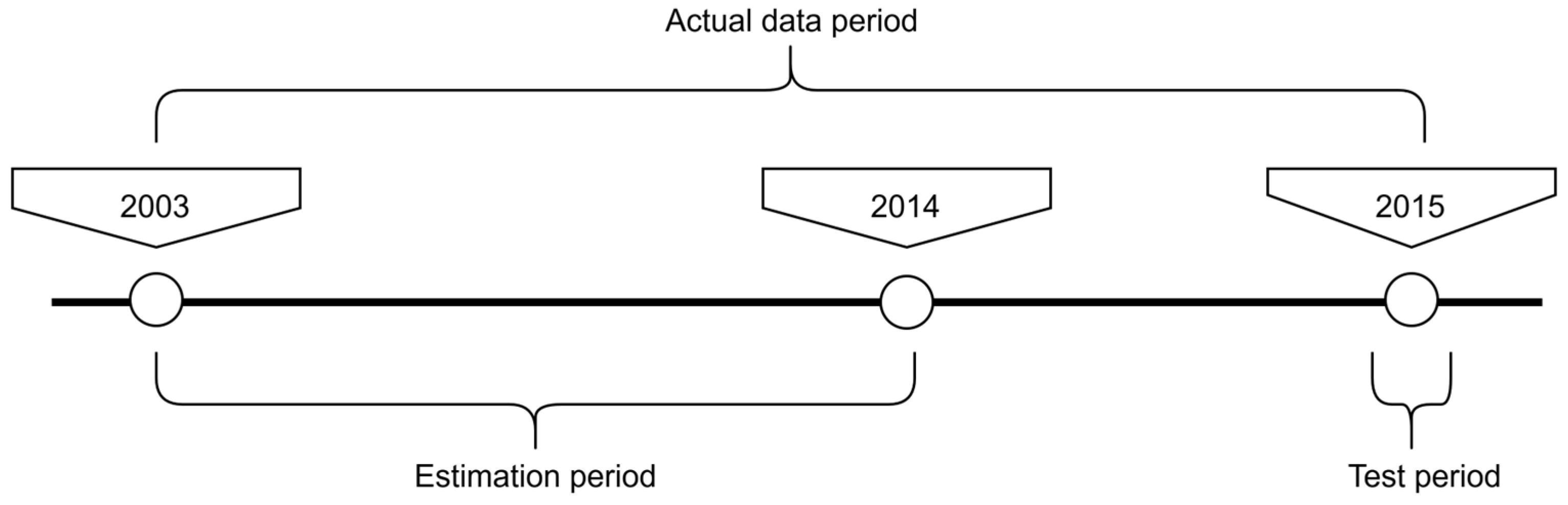
For the Washington benchmark (2003–2015), twelve years (2003–2014) are used for estimation and 2015 is held out for testing and comparison; this split follows established practice in the literature [16,17] and supports comparability to prior studies evaluation with a clean out-of-sample check. A conceptual view of the split appears in Figure 2.
Two comparative analyses were conducted to evaluate both the estimation and forecasting performance of TBDGM(1,1) under this train–test split. First, it was compared with five univariate discrete grey models, namely DGM(1,1), NDGM(1,1), TDGM(1,1), QDGM(1,1), and CDGM(1,1). All calculations were performed in MATLAB R2018a (MathWorks, Natick, MA, USA) on a system with an Intel® Core™ i7-8700 CPU @ 3.20 GHz, 16 GB RAM, and a 64-bit Windows 10 OS.
For TBDGM(1,1), actual e-waste data except for 2015 are used to create a raw dataset x ( 0 ) in Equation (1). Then, the accumulated e-waste data series are obtained from Equation (3) and the model parameters in Equation (4) are estimated using a hybrid Jaya–LSE. For the Jaya algorithm, the population size was set to 30 with a maximum of 100 iterations. Finally, using 1-IAGO in Equation (5), e-waste quantities are estimated for each year, with the year 2015 used for testing. It is mentioned that the Jaya algorithm was executed in 30 independent runs; the results were mutually consistent across runs, supporting the adequacy and robustness of the chosen settings. Moreover, for the comparator discrete grey models, the standard accumulated-domain formulations given in Table A1 were adopted; parameters were estimated by LSE on train data, and inverse accumulation (1-IAGO) was then applied to obtain raw-scale predictions for 2015. Second, results were compared with those reported for the same benchmark series in prior WEEE forecasting studies [16,17].
In addition to RMSE, the Mean Absolute Percentage Error (MAPE) and the Coefficient of Determination (R2) are used as performance metrics. Their formulations are given in Equation (10) and Equation (11), respectively.
M A P E = 100 n k = 1 n x ^ 0 k x 0 k x 0 k
R 2 = 1 k = 1 n x ^ 0 k x 0 k 2 k = 1 n x 0 k x ¯ 0 2 ,         x ¯ 0 = 1 n k = 1 n x 0 k
where x ¯ 0 denotes the mean of the actual values.
RMSE quantifies the typical magnitude of prediction errors in the original measurement units; the optimal value is 0 and there is no finite upper bound [86]. MAPE expresses errors as percentages and is scale-free. According to the commonly cited Lewis guideline, MAPE < 10% “excellent”, 10–20% “good”, 20–50% “reasonable”, and >50% “weak” [87,88,89,90]. R2 quantifies the share of variance explained by the model; it takes values in ( , 1 ] , with 1 best and negative values indicating performance worse than the mean predictor [86]. In summary, lower RMSE and MAPE and higher R2 indicate better performance.
Table 3 presents training (2003–2014) and test (2015) results for the discrete grey models implemented here, alongside published results from prior studies [16,17], highlighting the estimation–forecasting performance of TBDGM(1,1). In the training period, TBDGM(1,1) attains the lowest error and the highest fit among all contenders, with MAPE = 1.1577%, RMSE = 873.49, and R2 = 0.9976. Among the other discrete grey models, CDGM(1,1) exhibits the strongest performance (MAPE = 1.9571%, RMSE = 1688.25, R2 = 0.9912), followed by QDGM(1,1), TDGM(1,1), NDGM(1,1), and DGM(1,1). Moreover, TBDGM(1,1) achieves the most favourable error–fit profile among the literature-reported comparators, attaining slightly lower errors and a marginally higher R2 than, for example, the VMD-GVM-DESM-GWFM approach (MAPE = 1.6000%, RMSE = 1114.79, R2 = 0.9963). In the test period, TBDGM(1,1) maintains the leading position with MAPE = 0.2851% and RMSE = 205.56, again improving on CDGM(1,1) (MAPE = 16.1070%, RMSE = 11,613.67) and matching or exceeding the best literature comparators (e.g., NBGMC(1,3)-PSO: MAPE = 0.3273%, RMSE = 236.02). Classical DGM(1,1) and low-order variants such as NDGM(1,1) and TDGM(1,1) exhibit noticeably larger test errors. Overall, the table indicates favourable performance of TBDGM(1,1) across all three criteria (lower RMSE, lower MAPE, higher R2) in both estimation and testing.
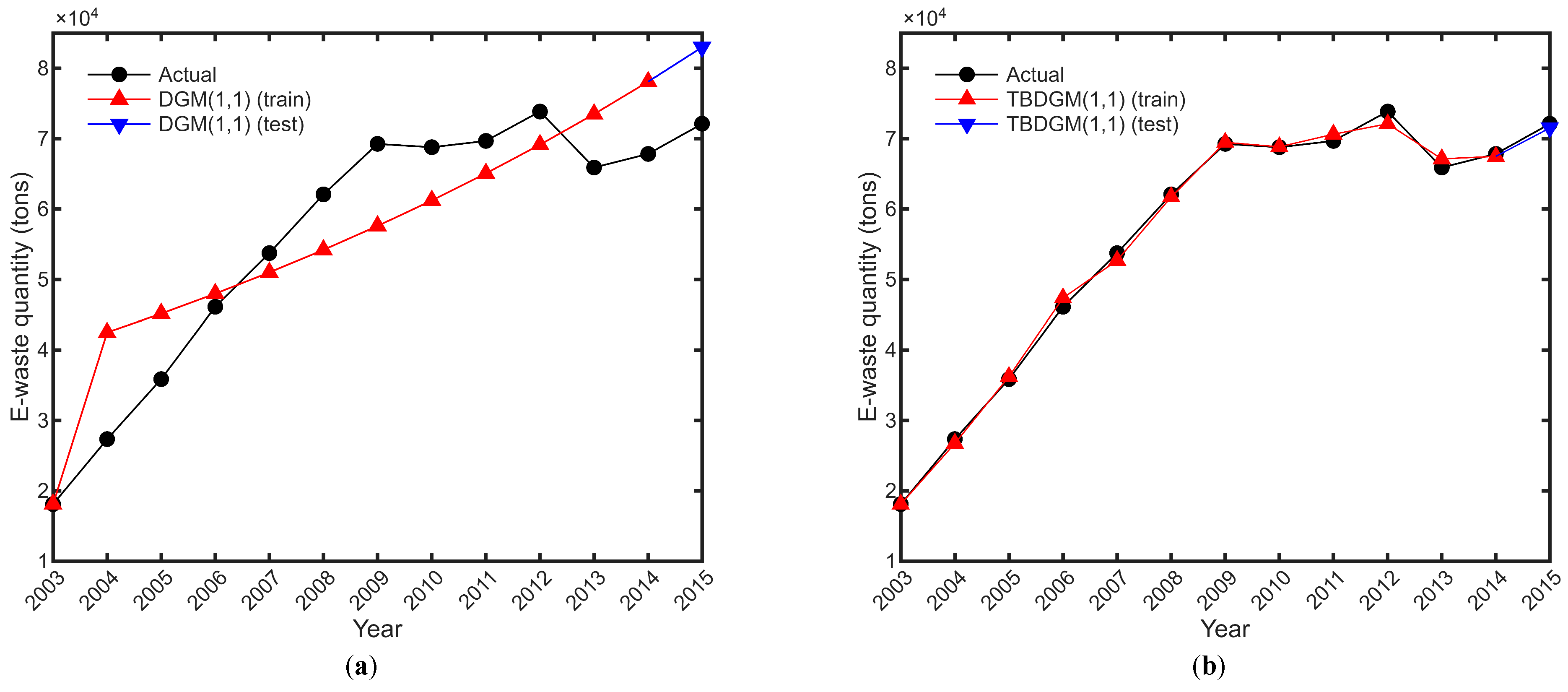
Moreover, Figure 3a,b display the training and test fits for DGM(1,1) and TBDGM(1,1), respectively. It can be clearly seen that TBDGM(1,1) provides a closer fit. In this case, the proposed trigonometric augmentation of DGM(1,1) within the discrete grey framework mitigates—rather than eliminating—the limitations of a purely linear accumulated-domain difference relation.
The overall results on the WA dataset indicate that TBDGM(1,1) achieves consistently strong training fit and competitive test accuracy relative to both mainstream discrete grey models and previously published alternatives, including decomposition-ensemble approaches (VMD-DESM-GWFM and VMD-GVM-DESM-GWFM) or multivariate grey models (GMC(1,3) and NBGMC(1,3)-PSO). This method-focused verification supports the suitability of TBDGM(1,1) for e-waste forecasting under limited samples.

5. E-Waste Estimation and Forecasting for the Türkiye Case with TBDGM(1,1)

After validating TBDGM(1,1) on the WA dataset, it is applied to estimate and forecast Türkiye’s annual e-waste generation. The analysis uses WEEE data reported via Türkiye’s Waste Declaration System (ABS) under the Ministry of Environment and Urbanization. The recorded e-waste data for Türkiye are 4911; 6817; 32,029; 39,394; 37,326; 37,517; 46,360; and 67,153 tons for 2013–2020, respectively [91]. The forecasting horizon is 2021–2030.
Two out-of-sample validation analyses were conducted to rigorously evaluate the predictive capability and robustness of the TBDGM(1,1) model on this e-waste series. Analysis I used data from 2013–2018 for model training, while 2019–2020 were held out for two-step-ahead testing. Analysis II used data from 2013–2019 for training, with 2020 reserved for testing.
As in the WA case, the Jaya algorithm was configured with a population size of 30 and a maximum of 100 iterations for parameter estimation in the proposed model; nonlinear frequency parameters ω1 and ω2 were searched over 0 , 2 π , while the linear parameters (β1, β2, β3, β4) were obtained via LSE. Comparative evaluation on the Türkiye series was conducted against five univariate discrete grey models—DGM(1,1), NDGM(1,1), TDGM(1,1), QDGM(1,1), and CDGM(1,1)—implemented on the same data and train–test splits. Notably, in contrast to the WA benchmark, comparisons for the Türkiye series were limited to univariate discrete grey models because strictly comparable published results on the same dataset are not available. In addition, the cross-family methods (e.g., multivariate grey models or decomposition–ensemble approaches) were not applied due to their reliance on exogenous inputs and dataset-dependent decomposition settings (e.g., the VMD mode count).
Table 4 summarizes training and test outcomes for Analyses I and II. In Analysis I, TBDGM(1,1) model attains a near-zero training error (MAPE = 0.0003%, RMSE = 0.1122, and R2 = 1.000), followed by TDGM(1,1) and NDGM(1,1); by contrast, DGM(1,1) fits the training data poorly. The higher-order polynomial variants QDGM(1,1) and CDGM(1,1) are ill-conditioned on this short series, yielding extreme errors. On the two-year test (2019–2020), DGM(1,1) slightly outperforms TBDGM(1,1) (MAPE 10.14% vs. 14.89%; RMSE 6579.93 vs. 11,515.29), whereas TBDGM(1,1) exhibits lower test MAPE and RMSE than NDGM(1,1), TDGM(1,1), QDGM(1,1), and CDGM(1,1). In Analysis II, TBDGM(1,1) again achieves a near-zero training error (MAPE = 0.025%, RMSE = 7.746, R2 = 1.000). QDGM(1,1) also fits the training sample almost perfectly (MAPE ≈ 0, R2 = 1.000). On the one-year test, TBDGM(1,1) attains a MAPE of 4.607% and RMSE of 3093.488—second only to QDGM(1,1) in MAPE (3.927%; RMSE 2637.38), and substantially better than DGM(1,1), NDGM(1,1), TDGM(1,1), and CDGM(1,1) (all with test MAPE ≥ 16.90%).
Taken together, these results indicate that TBDGM(1,1) provides a consistently stable and reliable profile on the Türkiye series. In contrast to DGM(1,1), NDGM(1,1), and TDGM(1,1), as well as the numerically fragile higher-order polynomial variants QDGM(1,1) and CDGM(1,1), TBDGM(1,1) achieves near-perfect in-sample fit while maintaining robust out-of-sample accuracy across both validation designs, indicating stronger generalization under limited-sample conditions.
The proposed TBDGM(1,1) was empirically validated on two real-world e-waste series (WA and Türkiye) using multiple criteria (MAPE, R2, RMSE). On the WA benchmark, a dual-layer comparison was conducted against state-of-the-art discrete grey models and previously published methods. On the Türkiye series, a comprehensive comparison was carried out against the same discrete grey models. Across these evaluations, TBDGM(1,1) achieved low errors and demonstrated stable short-horizon accuracy relative to the alternatives, supporting its suitability under limited-sample conditions.
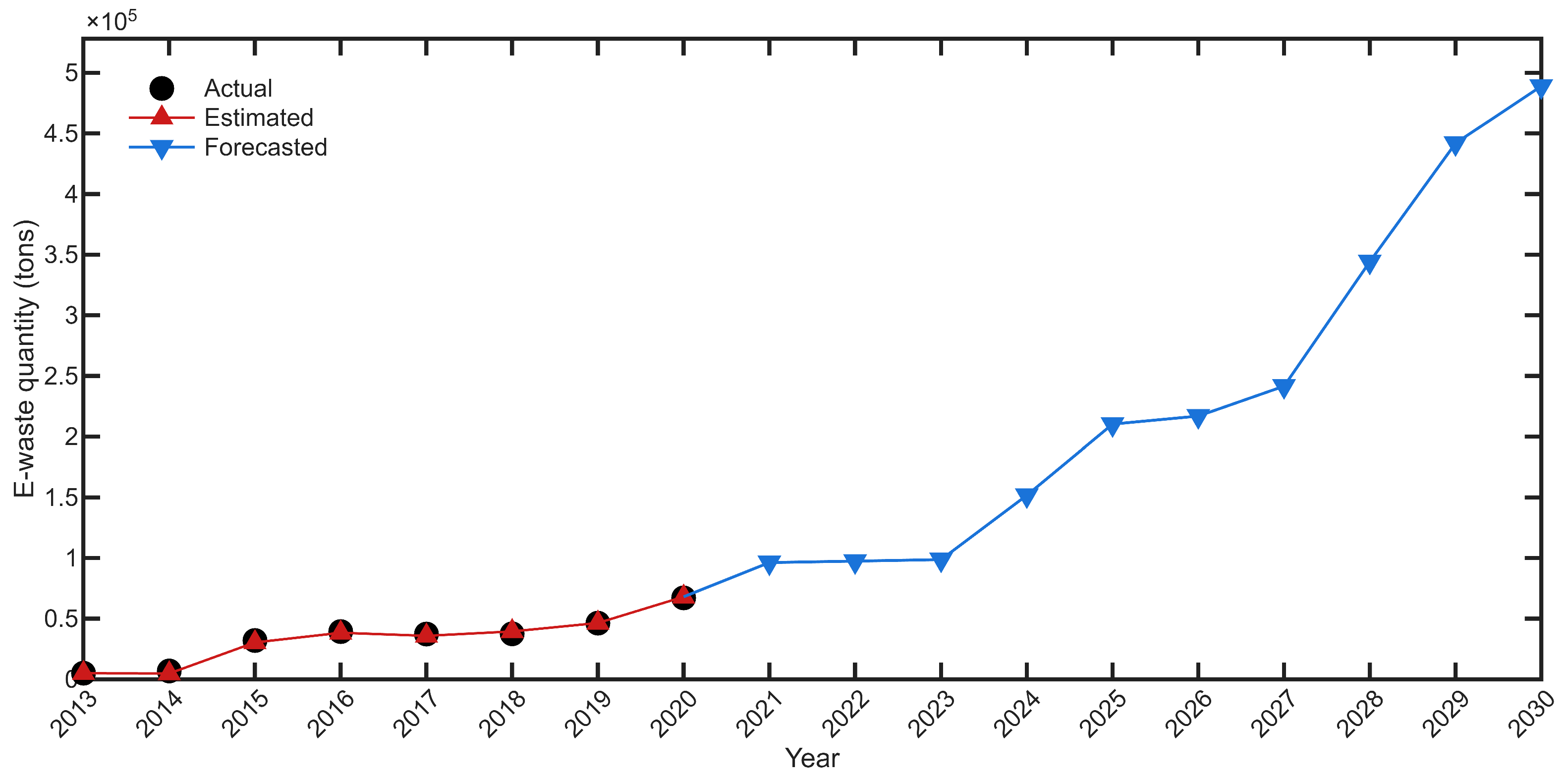
Guided by this evidence, TBDGM(1,1) specification is adopted to generate Türkiye’s e-waste forecasts for 2021–2030. Forecasts are produced using the parameter estimates of TBDGM(1,1) reported in Table 5 and the resulting in-sample estimates and projections are summarized in Figure 4.
These projections not only provide insights into future waste quantities but also offer practical guidance for infrastructure planning, collection logistics, and investment strategies required to support Türkiye’s transition to a CE.

6. Conclusions and Discussion

The global surge in electronic product use has led to sharp rise in e-waste, now a major environmental challenge. Managing this waste requires accurate forecasts to inform policy, plan infrastructure, and optimize logistics for CE systems. Over the past two decades, researchers have developed various methods to estimate e-waste generation. Among them, grey models have been proven particularly effective for forecasting in contexts where data is scarce or incomplete. This study introduces a TBDGM(1,1), which integrates the Jaya algorithm and LSE for parameter estimation to enhance predictive accuracy.
Comparative analyses were performed to assess the estimation and forecasting performance of the proposed model for the cases of WA and Türkiye. For the WA dataset, a dual-layer comparative analysis evaluated TBDGM(1,1) against both state-of-the-art discrete grey models and forecasting methods from prior e-waste studies. For the Türkiye dataset, performance was evaluated against state-of-the-art grey models under two out-of-sample designs. Across these evaluations, TBDGM(1,1) attained leading or clearly competitive performance in WA and delivered competitive, consistent results in Türkiye. The main contribution is to show that TBDGM(1,1) produces consistent and reliable predictions across varied e-waste scenarios. This is enabled by using the Jaya metaheuristic to explore the nonlinear frequency parameters while estimating the linear coefficients via LSE, a separable scheme that improves numerical conditioning and predictive accuracy without heavy parameter estimation load.
The robustness of the proposed model lies not only in its accuracy but also in its transferability. By validating TBDGM(1,1) across two distinct contexts, this study provides evidence that the model can serve as a standardized tool for e-waste forecasting beyond country-specific applications.
This study offers practical insights for policy and strategy development. Forecast-informed planning can support regulations such as setting recycling targets, encouraging sustainable manufacturing from product design to end-of-life, and enforcing extended producer responsibility. These efforts involve all stakeholders working to advance CE strategies such as recovering materials, reducing waste, and conserving scarce resources. The projected waste estimates also support operational decisions in waste management, including facility planning, capacity building, collection systems, and logistics. The model’s adaptability is demonstrated by its validation in two distinct regions, Türkiye and WA, with different data structures.
Beyond environmental and managerial benefits, the findings also carry socioeconomic implications. Reliable forecasts can support cost-effective investment planning, create green job opportunities, and promote sustainable economic growth through enhanced material recovery.
The predictive accuracy and adaptability of the TBDGM(1,1) model can be further enhanced by hybridizing it with other metaheuristic algorithms. In this study, the Jaya algorithm was selected due to its simplicity and ease of implementation. Future work may extend this approach by integrating AI and machine learning methods (e.g., ensemble learning, residual correction).
This study is subject to several limitations. The datasets end in 2015 for WA and 2020 for Türkiye, reflecting the most recent publicly available official statistics. Future work will incorporate more recent and harmonized datasets as they become available. Although TBDGM(1,1) augments the accumulated-domain relation with harmonic terms to capture bounded, low-frequency residual oscillations, it implicitly assumes smooth deviations around the trend. Under abrupt regime shifts (e.g., a policy shock causing a sharp level change in WEEE), the residual can exceed the representational range of the trigonometric component, leading to forecast deviations. As a prospective mitigation, a rolling-TBDGM(1,1) can be employed on a moving window to re-estimate parameters and adapt frequency and level dynamics as new data arrive. In addition, the proposed specification is its univariate design, which cannot directly incorporate external influencing factors (e.g., income, device sales, policy indicators). This restricts the model’s ability to attribute effects to exogenous drivers. As a remedy for future work, a multivariate extension—TBDGM(1,n)—can be considered by augmenting the accumulated-domain relation with exogenous regressors while retaining the trigonometric component to capture residual oscillations. Finally, with very small population sizes the Jaya algorithm can prematurely converge to local optima. This risk can be mitigated by using moderate populations, multi-start/restart schemes, and dynamic population-diversity strategies (e.g., random perturbations or population resizing) to sustain exploration.

Author Contributions

Z.O.B.: Conceptualization, Data curation, Methodology, Software, Validation, Visualization; Writing—original draft, Writing—review & editing. G.M.D. Conceptualization, Writing—original draft, Writing—review & editing. A.G.: Conceptualization, Methodology, Writing—original draft, Writing—review & editing, Supervision. E.K.: Conceptualization, Writing—original draft, Writing—review & editing. All authors have read and agreed to the published version of the manuscript.

Funding

This research received no external funding.

Institutional Review Board Statement

Not applicable.

Informed Consent Statement

Not applicable.

Data Availability Statement

The original contributions presented in this study are included in the article. Further inquiries can be directed to the corresponding author.

Acknowledgments

The basic form of the manuscript is a chapter of the doctoral thesis (in Turkish) by Zeynep Ozsut Bogar (student) and Askiner Gungor (supervisor). The manuscript was later collaboratively developed and enhanced by all authors following the completion of the thesis work.

Conflicts of Interest

The authors declare that they have no known competing financial interest or personal relationships that could have appeared to influence the work reported in this paper.

Appendix A

Table A1. Considered state-of-the-art Discrete Grey Models.
Grey ModelEquation
DGM(1,1)x(1)(k + 1) = β1 x(1)(k) + β2
NDGM(1,1)x(1)(k + 1) = β1 x(1)(k) + β2 k + β3
TDGM(1,1)x(1)(k + 1) = (β1 + β2 k) x(1)(k) + β3 k + β4
QDGM(1,1)x(1)(k + 1) = (β1 + β2 k + β3 k2) x(1)(k) + β4 k2 + β5 k + β6
CDGM(1,1)x(1)(k + 1) = (β1 + β2 k + β3 k2 + β4 k3) x(1)(k) + β5 k3 + β6 k2 + β7 k + β8

References

  1. UNITAR. The Global E-Waste Monitor 2024-Electronic Waste Rising Five Times Faster Than Documented E-Waste Recycling; UNITAR: Geneva, Switzerland, 2024. [Google Scholar]
  2. Hall, W.J.; Williams, P.T. Separation and recovery of materials from scrap printed circuit boards. Resour. Conserv. Recycl. 2007, 51, 691–709. [Google Scholar] [CrossRef]
  3. Buekens, A.; Yang, J. Recycling of WEEE plastics: A review. J. Mater. Cycles Waste Manag. 2014, 16, 415–434. [Google Scholar] [CrossRef]
  4. Yamawaki, T. The gasification recycling technology of plastics WEEE containing brominated flame retardants. Fire Mater. 2003, 27, 315–319. [Google Scholar] [CrossRef]
  5. Forti, V.; Balde, C.P.; Kuehr, R.; Bel, G. The Global E-Waste Monitor 2020: Quantities, Flows and the Circular Economy Potential; 9280891146; United Nations University (UNU)/United Nations Institute for Training and Research (UNITAR): Bonn, Germany; International Telecommunication Union (ITU): Geneva, Switzerland; International Solid Waste Association (ISWA): Rotterdam, The Netherlands, 2020. [Google Scholar]
  6. ÇŞBTC, Ministry of Environment and Urbanization. Waste Electrical and Electronic Equipment Control Regulation; Ministry of Environment and Urbanization: Ankara, Turkey, 2012. (In Turkish) [Google Scholar]
  7. T.C. Sanayi ve Teknoloji Bakanlığı, Ministry of Industry and Technology. Ankara Province Waste Electrical and Electronic Equipment Recycling Facility Pre-Feasibility Report; Ministry of Industry and Technology: Ankara, Turkey, 2021. (In Turkish) [Google Scholar]
  8. Baldé, C.P.; Iattoni, G.; Xu, C.; Yamamoto, T. Update of WEEE Collection Rates, Targets, Flows, and Hoarding–2021 in the EU-27, United Kingdom, Norway, Switzerland, and Iceland; SCYCLE Programme, United Nations Institute for Training and Research (UNITAR): Bonn, Germany, 2022. [Google Scholar]
  9. Ryan-Fogarty, Y.; Coughlan, D.; Fitzpatrick, C. Quantifying WEEE arising in scrap metal collections: Method development and application in Ireland. J. Ind. Ecol. 2021, 25, 1021–1033. [Google Scholar] [CrossRef]
  10. Akpulat, O. Atığın Ötesinde; Vodafone: Düsseldorf, Germany, 2020. [Google Scholar]
  11. Abbondanza, M.; Souza, R. Estimating the generation of household e-waste in municipalities using primary data from surveys: A case study of Sao Jose dos Campos, Brazil. Waste Manag. 2019, 85, 374–384. [Google Scholar] [CrossRef]
  12. Bovea, M.D.; Ibanez-Fores, V.; Perez-Belis, V.; Juan, P. A survey on consumers’ attitude towards storing and end of life strategies of small information and communication technology devices in Spain. Waste Manag. 2018, 71, 589–602. [Google Scholar] [CrossRef]
  13. Petridis, K.; Petridis, N.; Stiakakis, E.; Dey, P. Investigating the factors that affect the time of maximum rejection rate of e-waste using survival analysis. Comput. Ind. Eng. 2017, 108, 15–26. [Google Scholar] [CrossRef]
  14. Petridis, N.E.; Petridis, K.; Stiakakis, E. Global e-waste trade network analysis. Resour. Conserv. Recycl. 2020, 158, 104742. [Google Scholar] [CrossRef]
  15. Duman, G.M.; Kongar, E. ESG Modeling and Prediction Uncertainty of Electronic Waste. Sustainability 2023, 15, 11281. [Google Scholar] [CrossRef]
  16. Duman, G.M.; Kongar, E.; Gupta, S.M. Estimation of electronic waste using optimized multivariate grey models. Waste Manag. 2019, 95, 241–249. [Google Scholar] [CrossRef] [PubMed]
  17. Wang, F.; Yu, L.; Wu, A. Forecasting the electronic waste quantity with a decomposition-ensemble approach. Waste Manag. 2021, 120, 828–838. [Google Scholar] [CrossRef] [PubMed]
  18. Ikhlayel, M. Differences of methods to estimate generation of waste electrical and electronic equipment for developing countries: Jordan as a case study. Resour. Conserv. Recycl. 2016, 108, 134–139. [Google Scholar] [CrossRef]
  19. Jain, A.; Sareen, R. E-waste assessment methodology and validation in India. J. Mater. Cycles Waste Manag. 2006, 8, 40–45. [Google Scholar] [CrossRef]
  20. Kumar, P.; Shrihari, S. Estimation and material flow analysis of waste electrical and electronic equipment (WEEE)—A case study of Mangalore City, Karnataka, India. In Proceedings of the International Conference on Sustainable Solid Waste Management, Chennai, India, 5–7 September 2007; pp. 5–7. [Google Scholar]
  21. Streicher-Porte, M.; Widmer, R.; Jain, A.; Bader, H.-P.; Scheidegger, R.; Kytzia, S. Key drivers of the e-waste recycling system: Assessing and modelling e-waste processing in the informal sector in Delhi. Environ. Impact Assess. Rev. 2005, 25, 472–491. [Google Scholar] [CrossRef]
  22. Wang, F.; Huisman, J.; Stevels, A.; Balde, C.P. Enhancing e-waste estimates: Improving data quality by multivariate Input-Output Analysis. Waste Manag. 2013, 33, 2397–2407. [Google Scholar] [CrossRef]
  23. Oguchi, M.; Kameya, T.; Yagi, S.; Urano, K. Product flow analysis of various consumer durables in Japan. Resour. Conserv. Recycl. 2008, 52, 463–480. [Google Scholar] [CrossRef]
  24. Sakthivel, U.; Swaminathan, G.; Anis, J. Strategies for Quantifying Metal Recovery from Waste Electrical and Electronic Equipment (WEEE/E-waste) Using Mathematical Approach. Process Integr. Optim. Sustain. 2022, 6, 781–791. [Google Scholar] [CrossRef]
  25. Tasaki, T.; Takasuga, T.; Osako, M.; Sakai, S. Substance flow analysis of brominated flame retardants and related compounds in waste TV sets in Japan. Waste Manag. 2004, 24, 571–580. [Google Scholar] [CrossRef]
  26. Yazici, B.; Can, Z.S.; Calli, B. Prediction of future disposal of end-of-life refrigerators containing CFC-11. Waste Manag. 2014, 34, 162–166. [Google Scholar] [CrossRef] [PubMed]
  27. Zhang, S.; Gu, Y.; Tang, A.; Li, B.; Li, B.; Pan, D.; Wu, Y. Forecast of future yield for printed circuit board resin waste generated from major household electrical and electronic equipment in China. J. Clean. Prod. 2021, 283, 124575. [Google Scholar] [CrossRef]
  28. Peralta, G.L.; Fontanos, P.M. E-waste issues and measures in the Philippines. J. Mater. Cycles Waste Manag. 2006, 8, 34–39. [Google Scholar] [CrossRef]
  29. Araújo, M.G.; Magrini, A.; Mahler, C.F.; Bilitewski, B. A model for estimation of potential generation of waste electrical and electronic equipment in Brazil. Waste Manag. 2012, 32, 335–342. [Google Scholar] [CrossRef] [PubMed]
  30. Li, B.; Yang, J.; Lu, B.; Song, X. Estimation of retired mobile phones generation in China: A comparative study on methodology. Waste Manag. 2015, 35, 247–254. [Google Scholar] [CrossRef]
  31. Gonda, L.; D’Ans, P.; Degrez, M. A comparative assessment of WEEE collection in an urban and rural context: Case study on desktop computers in Belgium. Resour. Conserv. Recycl. 2019, 142, 131–142. [Google Scholar] [CrossRef]
  32. Öztürk, T. Generation and management of electrical–electronic waste (e-waste) in Turkey. J. Mater. Cycles Waste Manag. 2014, 17, 411–421. [Google Scholar] [CrossRef]
  33. Wang, W.; Liu, Y.; Feng, K.; Chen, W.-Q. Spatiotemporal dynamics of city-level WEEE generation from different sources in China. Front. Eng. Manag. 2024, 11, 181–193. [Google Scholar] [CrossRef]
  34. Vanegas, P.; Peeters, J.R.; Cattrysse, D.; Dewulf, W.; Duflou, J.R. Improvement potential of today’s WEEE recycling performance: The case of LCD TVs in Belgium. Front. Environ. Sci. Eng. 2017, 11, 13. [Google Scholar] [CrossRef]
  35. Islam, M.T.; Huda, N. E-waste in Australia: Generation estimation and untapped material recovery and revenue potential. J. Clean. Prod. 2019, 237, 117787. [Google Scholar] [CrossRef]
  36. Kosai, S.; Kishita, Y.; Yamasue, E. Estimation of the metal flow of WEEE in Vietnam considering lifespan transition. Resour. Conserv. Recycl. 2020, 154, 104621. [Google Scholar] [CrossRef]
  37. Zeng, X.; Ali, S.H.; Li, J. Estimation of waste outflows for multiple product types in China from 2010–2050. Sci. Data 2021, 8, 15. [Google Scholar] [CrossRef]
  38. Kastanaki, E.; Giannis, A. Forecasting quantities of critical raw materials in obsolete feature and smart phones in Greece: A path to circular economy. J. Environ. Manag. 2022, 307, 114566. [Google Scholar] [CrossRef]
  39. Dwivedy, M.; Mittal, R.K. Estimation of future outflows of e-waste in India. Waste Manag. 2010, 30, 483–491. [Google Scholar] [CrossRef] [PubMed]
  40. Tran, H.P.; Schaubroeck, T.; Nguyen, D.Q.; Ha, V.H.; Huynh, T.H.; Dewulf, J. Material flow analysis for management of waste TVs from households in urban areas of Vietnam. Resour. Conserv. Recycl. 2018, 139, 78–89. [Google Scholar] [CrossRef]
  41. Wang, M.; You, X.; Li, X.; Liu, G. Watch more, waste more? A stock-driven dynamic material flow analysis of metals and plastics in TV sets in China. J. Clean. Prod. 2018, 187, 730–739. [Google Scholar] [CrossRef]
  42. Ozsut Bogar, Z.; Gungor, A. Forecasting Waste Mobile Phone (WMP) Quantity and Evaluating the Potential Contribution to the Circular Economy: A Case Study of Turkey. Sustainability 2023, 15, 3104. [Google Scholar] [CrossRef]
  43. Ju-Long, D. Control problems of grey systems. Syst. Control Lett. 1982, 1, 288–294. [Google Scholar] [CrossRef]
  44. Kayacan, E.; Ulutas, B.; Kaynak, O. Grey system theory-based models in time series prediction. Expert Syst. Appl. 2010, 37, 1784–1789. [Google Scholar] [CrossRef]
  45. Aydemir, E.; Bedir, F.; Özdemir, G. Gri Sistem Teorisi Ve Uygulamalari: Bilimsel Yazin Taramasi. Süleyman Demirel Üniversitesi İktisadi Ve İdari Bilim. Fakültesi Derg. 2013, 18, 187–200. [Google Scholar]
  46. Dong, Y.; Liu, Y.; Chen, J.; Dong, Y.; Qu, B. Forecasting industrial emissions: A monetary approach vs. a physical approach. Front. Environ. Sci. Eng. 2012, 6, 734–742. [Google Scholar] [CrossRef]
  47. Xie, N.-m.; Liu, S.-f. Discrete grey forecasting model and its optimization. Appl. Math. Model. 2009, 33, 1173–1186. [Google Scholar] [CrossRef]
  48. Xie, N.; Liu, S. Discrete GM (1, 1) and mechanism of grey forecasting model. Syst. Eng.-Theory Pract. 2005, 25, 93–99. [Google Scholar]
  49. He, X.; Wang, Y.; Zhang, Y.; Ma, X.; Wu, W.; Zhang, L. A novel structure adaptive new information priority discrete grey prediction model and its application in renewable energy generation forecasting. Appl. Energy 2022, 325, 119854. [Google Scholar] [CrossRef]
  50. Zhang, K.; Liu, S. Linear time-varying parameters discrete grey forecasting model. Syst. Eng.-Theory Pract. 2010, 30, 1650–1657. [Google Scholar]
  51. Xie, N.-M.; Liu, S.-F.; Yang, Y.-J.; Yuan, C.-Q. On novel grey forecasting model based on non-homogeneous index sequence. Appl. Math. Model. 2013, 37, 5059–5068. [Google Scholar] [CrossRef]
  52. Qi, Y.; Wu, Z.; Li, Y.; Yu, J. Grey discrete parameters model and its application. In Proceedings of the 2014 IEEE International Conference on Systems, Man, and Cybernetics (SMC), Taiyuan, China, 4–6 June 2014; pp. 2050–2054. [Google Scholar]
  53. Jiang, S.; Liu, S.; Liu, Z.; Fang, Z. Cubic time-varying parameters discrete grey forecasting model and its properties. Control Decis. 2016, 31, 279–286. [Google Scholar]
  54. Zhou, P.; Ang, B.; Poh, K.L. A trigonometric grey prediction approach to forecasting electricity demand. Energy 2006, 31, 2839–2847. [Google Scholar] [CrossRef]
  55. Tuzemen, A. Trigonometric Grey Prediction Method for Turkey’s Electricity Consumption Prediction. In Interdisciplinary Perspectives on Operations Management and Service Evaluation; IGI Global Scientific Publishing: Hershey, PA, USA, 2021; pp. 136–154. [Google Scholar]
  56. Wang, Q.; Liu, S.; Yan, H. The application of trigonometric grey prediction model to average per capita natural gas consumption of households in China. Grey Syst. Theory Appl. 2019, 9, 19–30. [Google Scholar] [CrossRef]
  57. Rajesh, R. Predicting environmental sustainability performances of firms using trigonometric grey prediction model. Environ. Dev. 2023, 45, 100830. [Google Scholar] [CrossRef]
  58. Comert, G.; Begashaw, N.; Huynh, N. Improved grey system models for predicting traffic parameters. Expert Syst. Appl. 2021, 177, 114972. [Google Scholar] [CrossRef]
  59. Duan, H.; Luo, X. A novel multivariable grey prediction model and its application in forecasting coal consumption. ISA Trans. 2022, 120, 110–127. [Google Scholar] [CrossRef]
  60. Liu, L.; Liu, S.; Yang, Y.; Fang, Z.; Xu, S. A recursive polynomial grey prediction model with adaptive structure and its application. Expert Syst. Appl. 2024, 249, 123629. [Google Scholar] [CrossRef]
  61. Kothari, P.L.; Ahluwalia, P.; Nema, A.K. A grey system approach for forecasting disposable computer waste quantities: A case study of Delhi. Int. J. Bus. Contin. Risk Manag. 2011, 2, 203–218. [Google Scholar] [CrossRef]
  62. Zhao, M.; Zhao, C.; Yu, L.; Li, G.; Huang, J.; Zhu, H.; He, W. Prediction and Analysis of WEEE in China Based on the Gray Model. Procedia Environ. Sci. 2016, 31, 925–934. [Google Scholar] [CrossRef][Green Version]
  63. Duman, G.M.; Kongar, E.; Gupta, S.M. Predictive analysis of electronic waste for reverse logistics operations: A comparison of improved univariate grey models. Soft Comput. 2020, 24, 15747–15762. [Google Scholar] [CrossRef]
  64. Mao, S.; Kang, Y.; Zhang, Y.; Xiao, X.; Zhu, H. Fractional grey model based on non-singular exponential kernel and its application in the prediction of electronic waste precious metal content. ISA Trans. 2020, 107, 12–26. [Google Scholar] [CrossRef]
  65. Kiran, M.; Shanmugam, P.V.; Mishra, A.; Mehendale, A.; Sherin, H.N. A multivariate discrete grey model for estimating the waste from mobile phones, televisions, and personal computers in India. J. Clean. Prod. 2021, 293, 126185. [Google Scholar] [CrossRef]
  66. Guo, R.; Zhong, Z. Assessing WEEE sustainability potential with a hybrid customer-centric forecasting framework. Sustain. Prod. Consum. 2021, 27, 1918–1933. [Google Scholar] [CrossRef]
  67. Kazancoglu, Y.; Ozbiltekin, M.; Ozen, Y.D.O.; Sagnak, M. A proposed sustainable and digital collection and classification center model to manage e-waste in emerging economies. J. Enterp. Inf. Manag. 2020, 34, 267–291. [Google Scholar] [CrossRef]
  68. Wang, J.; He, Y.-q.; Feng, Y. Analysis and prediction on carbon emissions from electrical and electronic equipment industry in China. Environ. Impact Assess. Rev. 2024, 106, 107539. [Google Scholar] [CrossRef]
  69. Wang, G.; Liao, Q.; Xu, H. Anticipating future photovoltaic waste generation in China: Navigating challenges and exploring prospective recycling solutions. Environ. Impact Assess. Rev. 2024, 106, 107516. [Google Scholar] [CrossRef]
  70. Sharma, H.; Kumar, H. Precising E-Waste Generation for Economic Recycling. Indian Econ. J. 2024, 73, 717–732. [Google Scholar] [CrossRef]
  71. Wang, Z.; Li, B.; Song, X.; Zhuang, X.; Wu, W.; Li, A. Generation and resource potential of waste PV modules considering technological iteration: A case study in China. Environ. Impact Assess. Rev. 2025, 112, 107790. [Google Scholar] [CrossRef]
  72. An, X.; Cao, J.; Ba, J.; Zhang, M. Transition and Trajectory of Spatiotemporal Characterization of Waste Photovoltaics in China: 2013–2060. Renew. Energy 2025, 249, 123214. [Google Scholar] [CrossRef]
  73. Duman, G.M.; Kongar, E. A novel Hausdorff fractional grey Bernoulli model and its Application in forecasting electronic waste. Waste Manag. Bull. 2025, 3, 349–358. [Google Scholar] [CrossRef]
  74. Bloomfield, P. Fourier Analysis of Time Series: An Introduction; John Wiley & Sons: Hoboken, NJ, USA, 2004. [Google Scholar]
  75. Shumway, R.H.; Stoffer, D.S. Time Series Analysis and Its Applications: With R Examples; Springer: New York, USA, 2006. [Google Scholar]
  76. Gan, M.; Chen, C.P.; Chen, G.-Y.; Chen, L. On some separated algorithms for separable nonlinear least squares problems. IEEE Trans. Cybern. 2017, 48, 2866–2874. [Google Scholar] [CrossRef] [PubMed]
  77. McLoone, S.; Brown, M.D.; Irwin, G.; Lightbody, A. A hybrid linear/nonlinear training algorithm for feedforward neural networks. IEEE Trans. Neural Netw. 1998, 9, 669–684. [Google Scholar] [CrossRef]
  78. Abdullah, M.; Malik, T.N.; Ahmed, A.; Nadeem, M.F.; Khan, I.A.; Bo, R. A novel hybrid GWO-LS estimator for harmonic estimation problem in time varying noisy environment. Energies 2021, 14, 2587. [Google Scholar] [CrossRef]
  79. Bettayeb, M.; Qidwai, U. A hybrid least squares-GA-based algorithm for harmonic estimation. IEEE Trans. Power Deliv. 2003, 18, 377–382. [Google Scholar] [CrossRef]
  80. Bogar, E. Chaos game optimization-least squares algorithm for photovoltaic parameter estimation. Arab. J. Sci. Eng. 2023, 48, 6321–6340. [Google Scholar] [CrossRef]
  81. Van Thieu, N.; Nguyen, N.H.; Sherif, M.; El-Shafie, A.; Ahmed, A.N. Integrated metaheuristic algorithms with extreme learning machine models for river streamflow prediction. Sci. Rep. 2024, 14, 13597. [Google Scholar] [CrossRef]
  82. Rao, R. Jaya: A simple and new optimization algorithm for solving constrained and unconstrained optimization problems. Int. J. Ind. Eng. Comput. 2016, 7, 19–34. [Google Scholar] [CrossRef]
  83. Diab, A.A.Z.; Tolba, M.A.; El-Magd, A.G.A.; Zaky, M.M.; El-Rifaie, A.M. Fuel cell parameters estimation via marine predators and political optimizers. IEEE Access 2020, 8, 166998–167018. [Google Scholar] [CrossRef]
  84. Duman, G.M.; Kongar, E.; Upadhyaya, K. Forecasting foreign direct investment using optimized Hausdorff fractional multivariate grey Bernoulli model. J. Financ. Econ. Policy 2025, 17, 836–857. [Google Scholar] [CrossRef]
  85. Javidsharifi, M.; Pourroshanfekr Arabani, H.; Kerekes, T.; Sera, D.; Guerrero, J.M. Stochastic optimal strategy for power management in interconnected multi-microgrid systems. Electronics 2022, 11, 1424. [Google Scholar] [CrossRef]
  86. Chicco, D.; Warrens, M.J.; Jurman, G. The coefficient of determination R-squared is more informative than SMAPE, MAE, MAPE, MSE and RMSE in regression analysis evaluation. Peerj Comput. Sci. 2021, 7, e623. [Google Scholar] [CrossRef]
  87. Le, T.-N.; Wang, C.-N. The integrated approach for sustainable performance evaluation in value chain of Vietnam textile and apparel industry. Sustainability 2017, 9, 477. [Google Scholar] [CrossRef]
  88. Lewis, C.D. International and Business Forecasting Methods; Butterworths: London, UK, 1982. [Google Scholar]
  89. Wu, W.-Z.; Jiang, J.; Li, Q. A novel discrete grey model and its application. Math. Probl. Eng. 2019, 2019, 9623878. [Google Scholar] [CrossRef]
  90. Zhang, Y.; Yang, X.; Cui, W. Estimation of the Student Employment in the Aviation Industry Based on Novel Fractional Error Accumulation Grey Model. J. Math. 2022, 2022, 7738447. [Google Scholar] [CrossRef]
  91. ÇŞBTC. Ministry of Environment and Urbanization. Waste Statistics Bulletin (In Turkish). 2020. Available online: https://webdosya.csb.gov.tr/db/ced/icerikler/2020-yili-atik-istat-st-kler--bulten--rev-ze12012023-20230112135036.pdf (accessed on 25 January 2023).
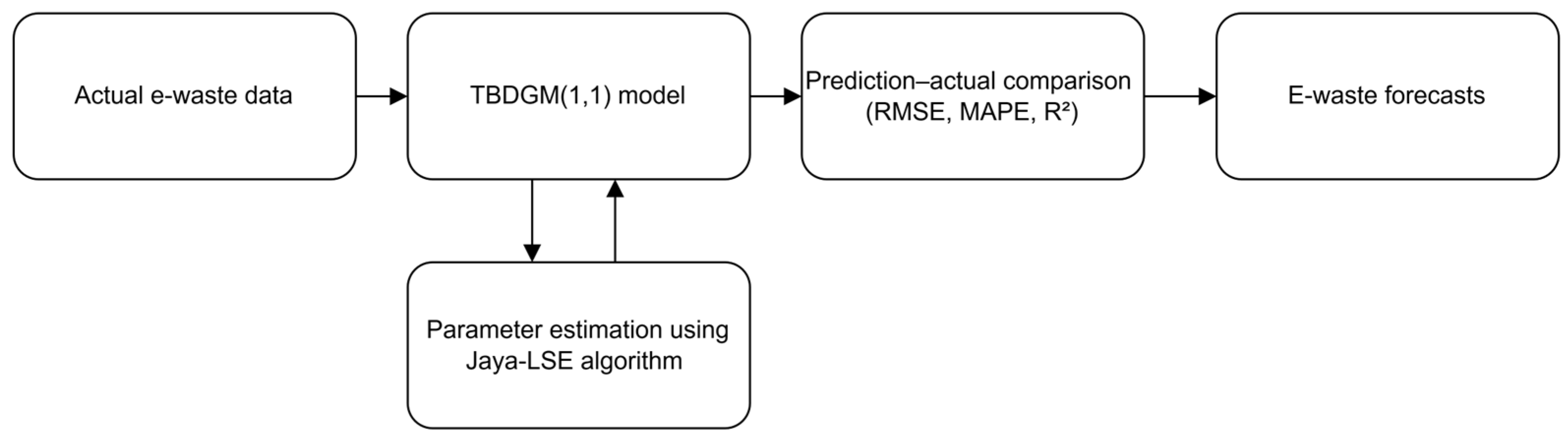
Figure 1. Flowchart of the proposed TBDGM(1,1) for e-waste estimation and forecasting.
Sustainability 17 10073 g001
Figure 2. Conceptual data split for the WA.
Sustainability 17 10073 g002
Figure 3. Train–test fits on the WA dataset: (a) DGM(1,1); (b) TBDGM(1,1).
Sustainability 17 10073 g003
Figure 4. In-sample estimates and 2021–2030 projections of e-waste for Türkiye.
Sustainability 17 10073 g004
Table 1. E-waste estimation studies involving grey models.
StudyMethodRegionProductGM TypeRollingTrain PeriodTest PeriodProjection PeriodMain Focuses and Highlights
Kothari et al. [61]GM and Grey Relational AnalysisIndia/
Delhi
PCGM(1,1)N/A2000–2004N/A2005–2020The study identifies personal computer penetration rate, population, GDP, and gross national income per capita using grey relational analysis, with a generalized regression neural network employed for forecasting.
Zhao et al. [62]GM and Grey Relational AnalysisChinaRefrigerator, washing machine, air
conditioner, PC
GM(1,1)N/A2001–2013N/A2014–2031Grey models are used to predict the quantity of household appliances in China. The real estate market is shown to have a high correlation with household appliance ownership through grey relational analysis.
Duman et al. [16]Multi-variate GMUSA/WAGeneralNBGMC(1,N)N/A2003–201420152016–2017
2018–2030
Inputs include population density and median household income. Nonlinear grey Bernoulli model enhanced with PSO.
Duman et al. [63]Improved Univariate GMUSA/WA GeneralPSO-NNGBMFO(1,1)
PSO—SAIGMFO(1,1)
Yes2003–201420152016–2023Takes into account e-waste recycling and disposal rates. The model is optimized using PSO.
Mao et al. [64]Fractional Derivative Model with Exponential Kernel FunctionChinaThe weight of printed circuit boards (PCBs) from mobile phone, laptop, desktop and television wasteEFGM(q,1)N/A2006–201520162017–2025Predicts precious metal content in electronic waste.
Kiran et al. [65]Multi-variate Discrete GMIndiaMobile phone,
TV, PC
EFDGM(1,N)N/A1998- 2007 PC
2007–2016 TV
2009–2017 Mobile phone
-2018–2030Inputs include GDP and urban/rural population. GM is used to estimate the amount of products in use. Fourier transform and exponential smoothing are combined to reduce periodic and stochastic errors.
Wang et al. [17]Decomposition-based GMUSA/WA and United KingdomGeneral for WA
large household appliances (LHA) and cooling appliances containing refrigerants (CAR)
GVM, GWFMN/A2003–201420152016–2025Integrated variable mode decomposition, exponential smoothing model, and grey modelling methods are used.
Guo and Zhong [66]Grey Relational Analysis (GRA), Principal Component Analysis (PCA), and Kernel GMTaiwan and VietnamTV, washing machine, air conditioner, refrigeratorKGM(1,N)N/A1998–20152016–20202021–2030Explores the influence of customer behaviour on collection and generation of e-waste.
Kazancoglu et al. [67]GMTürkiyeGeneralGM(1,1)N/A2013–2018N/A2019–2021Forecasting of collected e-waste.
Duman and Kongar [15]GM Enhanced by PSOTürkiyeMobile phoneNBGMFO(1,1)N/A2001–2020N/A2021–2035Introduces a novel forecasting method, integrating Fourier residual modification.
Wang et al. [68]Carbon Emissions Prediction from WEEEChinaGeneralGM(1,1)N/A2012–2020N/A2021–2030Forecasts the carbon footprint for developing a comprehensive life cycle management system to minimize the environmental impact of the EEE industry.
Wang et al. [69]Neural Network Model, GM,
Regression Analysis, And Time Series Method
ChinaPV modulesGM(1,1)N/A2008–2022N/A2023–2050Compares four methods for forecasting PV installations
PV waste estimation based on installation forecasts
Sharma and Kumar [70]GMIndiaGeneralGM(1,1)N/A2017–2021N/A2022–2026To assess future quantities of e-waste in India
Wang et al. [71]Grey Verhulst model ChinaPV modulesGVM(1,1)N/A2000–2022N/A2023–2050To project the future growth of PV module installations over an extended period
An et al. [72]GM, Weibull Distribution Market Supply A31 provinces in China PV modulesGM(1,1)N/A2013–2022N/A2023–2030GM employed to project photovoltaic installed capacity
Duman and Kongar [73]Hausdorff Fractional Grey Bernoulli ModelUSA/Connecticut State and United KingdomCovered Electronic Devices and Consumer EquipmentsHNBGM(r,1)N/A2011–2023
2008–2023
2024–2030Optimized Hausdorff fractional grey Bernoulli model is utilized to predict waste of covered electronic devices in Connecticut and United Kingdom
This studyTrigonometry-Based Discrete GMUSA/WA and TürkiyeGeneralTBDGM(1,1)N/A2013–2017
2013–2018
2018–2020
2019–2020
2021–2030Trigonometric GM with Jaya algorithm, validated in USA and Türkiye, showing cross-context adaptability and dual-layer benchmarking.
Notes: Nonlinear Grey Bernoulli model (NBGMC), Nash Nonlinear Grey Bernoulli Model with Fractional Order (NNGBMFO), Self-adaptive Intelligence Grey Model with Fractional Order (SAIGMFO), Exponential Kernel Function (EFGM), Discrete Grey Model Combining Fourier Transform and Exponential Smoothing (EFDGM), Grey Verhulst Model (GVM), Grey Wave Forecasting Method (GWFM), Kernel Based Grey Model (KGM), Nonlinear Grey Bernoulli Model with Fractional Order Accumulation (NBGMFO), Hausdorff Fractional Nonlinear Grey Bernoulli Model (HNBGM), Trigonometry-Based Discrete Grey Model (TBDGM), Gross Domestic Product (GDP), Particle Swarm Optimization (PSO), Photovoltaic (PV), Electrical and Electronic Equipment (EEE), Not applicable (N/A)
Table 2. Actual e-waste (tons) in WA [16].
YearE-Waste (tons)YearE-Waste (tons)
200318,108.186201068,777.911
200427,341.564201169,673.018
200535,877.901201273,851.238
200646,126.412201365,894.784
200753,737.509201467,822.933
200862,071.464201572,103.408
200969,246.269
Table 3. Training and test performance of models on the WA dataset.
State-of-the-Art Discrete Grey ModelsE-Waste Estimation LiteratureThis Study
Training/TestMetricDGM(1,1)NDGM(1,1)TDGM(1,1)QDGM(1,1)CDGM(1,1)GMC(1,3) *NBGMC(1,3)-PSO *VMD-DESM-GWFM **VMD-GVM-DESM-GWFM **TBDGM(1,1)
Training
(2003–2014)
MAPE14.21095.01932.48172.03141.95712.99001.80003.07001.60001.1577
R20.79640.97150.99050.99140.99120.98000.99220.99060.99630.9976
RMSE8101.493032.911748.631668.301688.252539.911586.521837.571114.79873.49
Test
(2015)
MAPE15.09230.373613.787514.128016.10707.84240.3273N/A4.25540.2851
RMSE10,882.06269.389941.2510,786.8011,613.675654.61236.02N/A3068.28205.56
* Duman et al. [16]: Grey Model with Convolution Integral (GMC), Nonlinear Grey Bernoulli Model with Convolution Integral (NBGMC), Particle Swarm Optimization (PSO). ** Wang et al. [17]: Variational Mode Decomposition (VMD), Damped Trend Exponential Smoothing Method (DESM), Grey Wave Forecasting Method (GWFM), Grey Verhulst Model (GVM), Not Applicable (N/A).
Table 4. Comparative performance of models on the Türkiye e-waste dataset across Analysis I and Analysis II.
Training/TestMetricDGM(1,1)NDGM(1,1)TDGM(1,1)QDGM(1,1)CDGM(1,1)TBDGM(1,1)
Analysis ITraining
(2013–2018)
MAPE47.17292.48111.6016332.06874467.64580.0003
R20.71020.99510.99790.00000.00001.0000
RMSE7889.34991029.4661678.1759143,523.52153,231,864.80890.1122
Test
(2019–2020)
MAPE10.142730.412837.18602047.9055378,147.045514.8868
RMSE6579.927621,295.737025,126.66691317,180.7013310,201,362.718011,515.2912
Training/TestMetricDGM(1,1)NDGM(1,1)TDGM(1,1)QDGM(1,1)CDGM(1,1)TBDGM(1,1)
Analysis IITraining
(2013–2019)
MAPE41.4944.5775.0080.0002149.4210.025
R20.7670.9690.9791.0000.0001.000
RMSE7375.0102695.4052209.4120.0001,105,557.0577.746
Test
(2020)
MAPE16.90039.63331.3233.9271285.4664.607
RMSE11,348.5244.57721,034.5872637.377863,229.0643093.488
Table 5. Estimated parameters of TBDGM(1,1) using Jaya–LSE for Türkiye e-waste series.
Parameter β 1 β 2 β 3 β 4 ω 1 ω 2
Value1.22519,430.395−5928.09622,322.7611.7771.507
Disclaimer/Publisher’s Note: The statements, opinions and data contained in all publications are solely those of the individual author(s) and contributor(s) and not of MDPI and/or the editor(s). MDPI and/or the editor(s) disclaim responsibility for any injury to people or property resulting from any ideas, methods, instructions or products referred to in the content.