Article

Impedance Characteristics and Stability Enhancement of Sustainable Traction Power Supply System Integrated with Photovoltaic Power Generation


School of Electrical Engineering, Beijing Jiaotong University, Beijing 100044, China
*
Author to whom correspondence should be addressed.
Sustainability 2025, 17(22), 10055; https://doi.org/10.3390/su172210055
Submission received: 10 October 2025 / Revised: 6 November 2025 / Accepted: 7 November 2025 / Published: 11 November 2025

Abstract

The integration of electric railways with renewable energy sources is crucial for advancing sustainable transportation and building clean, low-carbon, and efficient energy systems in alignment with global sustainable development goals. However, the application of photovoltaic (PV) integration into railway traction power supply systems may exacerbate resonance phenomena between electric locomotives and the traction network. It is therefore necessary to study the impedance frequency characteristics (IFCs) of traction networks to minimize harmonic resonance overvoltage. In this paper, a harmonic impedance model of the sustainable traction power supply system (STPSS) is established, and an impedance analysis method is adopted to reveal the influence law of grid-connected PV inverters on the IFCs of STPSSs. Additionally, to improve the stability of STPSSs, a multi-parameter co-tuning method based on an improved particle swarm optimization algorithm is proposed. This method constructs a multi-objective function that includes resonance frequency, impedance magnitude, and filtering cost, thereby realizing the automatic optimization of the control parameters and filtering parameters of PV inverters. The results demonstrate a 56% reduction in the maximum impedance magnitude within the 0–5 kHz frequency range and a 10.8% cost reduction in the LCL filter implementation, confirming the effectiveness of the proposed optimization model. Results show that the maximum impedance magnitude of the optimized system in the frequency range of 0–5 kHz can be reduced by 56%. Moreover, the cost of LCL filters can be reduced by 10.8% through component value optimization. These findings validate the effectiveness of the proposed method.

1. Introduction

With the urgent demand for clean and environmentally friendly energy, the development of renewable energy and distributed power generation systems has received increasing attention worldwide [1,2]. At the same time, the increasingly serious energy consumption problem of railway transportation has given rise to a new solution, i.e., the use of renewable energy to power the traction power supply system (TPSS) [3,4]. Currently, the application prospects and characteristics of photovoltaic (PV) power generation in railways has been prospectively analyzed by renowned research institutes such as the University of Liverpool, Liverpool, U.K. [5]; North China Electric Power University, Beijing, China [6]; Hunan University, Changsha, China [7]; and Southwest Jiaotong University, Chengdu, China [8,9]. The studies have consistently shown that the combination of PV power generation and TPSSs can not only maximize the use of resources along railway lines, but also effectively reduce the energy consumption of the railway system. More importantly, the introduction of PV inverters endows TPSSs with flexibility and controllability, thus giving rise to a new concept of sustainable traction power supply systems (STPSSs) [7].
The integration of PV power generation may trigger high-order harmonic resonance between locomotives and TPSSs, which has significant power quality risks in railway operations [10]. Research has shown that when electric locomotives and TPSSs form a coupled system, their interaction may induce harmonic resonance in specific frequency bands [11]. Specifically, locomotives based on power electronic converter technology inject characteristic harmonic currents into TPSSs during operation. When the frequencies of these harmonic components overlap with the resonance peak area of the impedance frequency characteristics (IFCs) of TPSSs, this will lead to abnormal amplification of harmonic voltages, which may cause equipment insulation failure or even train operation interruption in severe cases [12]. It is worth noting that the grid connection of PV power generation will inevitably have an impact on the IFCs of STPSSs, which in turn changes the harmonic matching relationship of the original locomotive–network coupling system. This change in system parameters may cause the originally stable operation state to enter a new resonance risk zone, so there is an urgent need to carry out IFC investigations of STPSSs to provide theoretical support for the reliable power supply of renewable energy railway systems [13].
The impedance analysis method, a key method for evaluating interaction stability in power-electronics-based power systems, centers on building a frequency-domain impedance model of the coupled system. This model is used to study the complex impedance characteristics, specifically the magnitude-frequency and phase-frequency responses that vary with frequency and reflect the relationship between voltage and current. It combines the small-signal linearization assumption to obtain impedance spectrum data through simulation modeling or physical testing, and further judges system stability using stability criteria such as the generalized Nyquist criterion. Currently, the impedance analysis method is commonly used in DC microgrid systems [14], renewable energy grid-connected systems [15], and railway locomotive–network coupled systems [16]. It is worth noting that the above studies are all based on the traditional Thevenin equivalent circuit for the grid, which cannot reflect the unique IFCs of TPSSs. Focusing on the field of railway transportation, the distributed parameter modeling approach was used to construct a locomotive–network coupled system impedance model [11], and the resonance distribution law of the actual TPSS broadband impedance characteristics was revealed by the measured data [17,18]. However, the scope of these studies was still limited to the traditional TPSS. In the context of renewable energy integration, the composite impedance network formed by PV power generation and TPSSs will significantly change the resonance characteristics of the coupled system, and studies have not yet explored the dynamic impedance matching mechanism between STPSSs and electric locomotives.
The elimination of harmonic resonance in STPSSs can be achieved through ground-based and on-board approaches [19]. Ground-based approaches primarily involve (1) the installation of passive filters [20], (2) the installation of active power filters [21], and (3) operation mode optimization of the supply network. On-board approaches typically encompass improved PWM methods and integration of auxiliary filters at the AC side port of the locomotive converter [22]. Engineering practice has demonstrated that cost-effective engineering solutions should be prioritized before implementing sophisticated resonance elimination techniques.
The contributions of this paper can be summarized as follows. (1) The harmonic impedance models of PV power generation and TPSSs are established based on the impedance analysis and transfer function analysis. (2) The IFCs of TPSSs and STPSSs are compared, and a comprehensive investigation is conducted on how critical parameters of PV power generation influence the IFCs of STPSSs. (3) Based on the existing multi-strategy particle swarm optimization (PSO) algorithm [23], a multi-parameter co-tuning method based on an improved PSO algorithm is proposed. This method introduces adaptive inertia weight and heterogeneous learning factors to enhance the global search ability in the early iteration stage and the local search ability in the later stage, thereby preventing PSO from converging to local optimal solutions. (4) Simulation results demonstrate the significant potential of the proposed optimization method in industrial applications for renewable energy integration. It offers three major advantages: improving the efficiency and performance of PV power generation parameter tuning, effectively mitigating resonance risks in STPSSs, and reducing the cost of LCL filters.
The rest of this paper is organized as follows. Section 2 describes the topology of the TPSS integrated with PV power generation and then models its harmonic impedance. Section 3 develops a frequency-domain-based IFC analysis framework for STPSSs, through which the influence mechanisms of critical system parameters are investigated. Section 4 proposes an innovative multi-parameter co-tuning method employing an improved PSO algorithm specifically designed for stability enhancement. Simulation verification and a comparative analysis are presented in Section 5, validating the effectiveness of the proposed method. Finally, Section 6 concludes the study, summarizes the principal findings, and discusses potential directions for future research.

2. System Structure and Harmonic Model of TPSS Integrated with PV Power Generation

This section elaborates on the proposed TPSS architecture with integrated PV power generation, commencing with the structural configuration specifically developed for this study. Subsequently, a comprehensive modeling framework encompassing both the two-stage PV inverter and TPSS is presented.

2.1. System Structure of TPSS Integrated with PV Power Generation

To make full use of the renewable energy along existing railways, many studies have proposed different schemes for integrating PV power generation into TPSSs [8,24]. Due to its advantages of a simple structure and lower cost, this paper focuses on the single-phase inverter scheme, shown in Figure 1.
The system is mainly composed of a TPSS and a two-stage PV inverter, where the TPSS adopts the direct feeding system with a return wire. A basic TPSS consists of an electrical substation (ESS), a feeding network section, and a section post (SP). In ESSs, a v/v connection traction transformer (TT) is commonly used to draw power from the three-phase grid and step down the high voltage into two-phase traction voltage. The traction network consists of overhead contact lines (OCLs), negative feeders (NFs), connectors for protective wires (CPWs), and rails. Since PV arrays operate typically at a low voltage, it is suggested to integrate the system into traction arms through a step-down matching transformer (MT). In addition, the two-stage PV inverter mainly consists of two components: the front-stage boost converter and the back-stage single-phase inverter [25].

2.2. Harmonic Impedance Model of Two-Stage PV Inverter

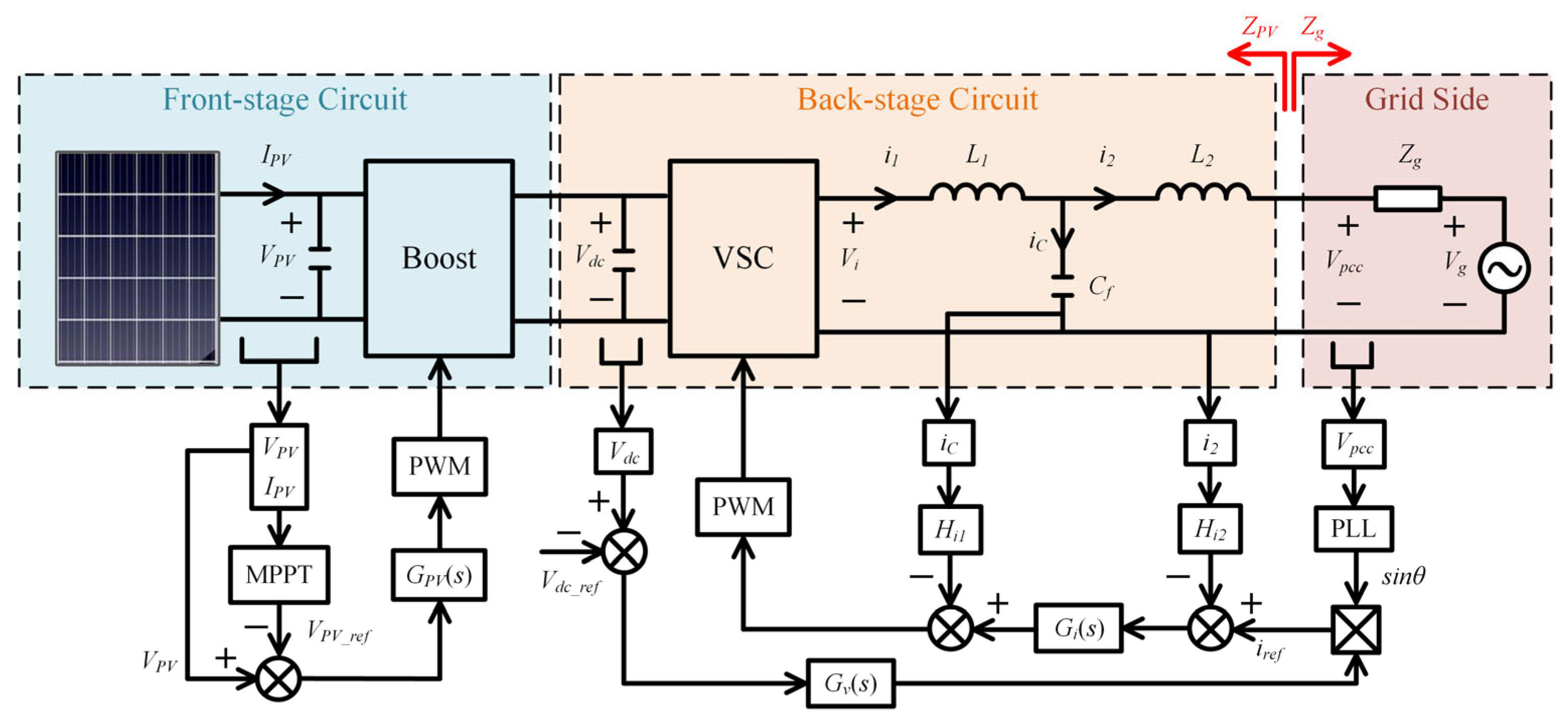
The two-stage PV inverter adopts a two-stage structure, as depicted in Figure 2. The control strategy can be found in detail in [15]. The front-stage boost converter converts the low-voltage DC power output from the PV array into high-voltage DC power for maximum power point tracking (MPPT). On the other hand, the back-stage circuit represents the single-phase inverter, which converts DC power into AC power and realizes grid connection. The output filter of the inverter is selected as the LCL type, which has sufficient suppression capability for high-order harmonics [26].
The primary control objective of the voltage loop in the single-phase inverter is to maintain constant DC-link voltage regulation. This ensures stable DC power supply for the inverter. When establishing an impedance model for a two-stage PV inverter, it is standard practice to assume a constant DC-link voltage condition, as this fundamental assumption simplifies system analysis while maintaining modeling accuracy [26]. According to the control strategy depicted in Figure 2, the controlled process focuses on the dynamics of inverter current i2. Consequently, the linearized model of the digitally controlled inverter with an LCL filter in the s-domain can be derived as shown in Figure 3. In the model, KPWM = Vdc/Vtri, represents the transfer function of the inverter bridge, where Vtri is the magnitude of the triangular carrier. Additionally, Gd(s) is the transfer function combining the computation delay and the PWM delay [27] with sampling frequency fs, denoted as
G d ( s ) = e s · 1.5 T s
where Ts and 0.5Ts are caused by computation and PWM, respectively.
According to the equivalent transformations, the current loop gain, T(s), can be derived as
T ( s ) = H i 2 K P W M G d ( s ) G i ( s ) s 3 L 1 L 2 C f + s 2 L 2 C f H i 1 K P W M G d ( s ) + s ( L 1 + L 2 )
The injected grid current, i2(s), can be derived as
i 2 ( s ) = i s ( s ) V p c c ( s ) Z P V ( s )
where is(s) and ZPV(s) are the Norton equivalent current source and the equivalent harmonic impedance of the point of common coupling (PCC), respectively, expressed as
i s ( s ) = 1 H i 2 · T ( s ) 1 + T ( s ) · i r e f ( s )
Z P V ( s ) = s 3 L 1 L 2 C f + s 2 L 2 C f H i 1 K P W M G d ( s ) + s ( L 1 + L 2 ) + H i 2 K P W M G d ( s ) G i ( s ) s 2 L 1 C f + s C f H i 1 K P W M G d ( s ) + 1
According to (5), the equivalent harmonic impedance, ZPV(s), of the LCL-type single-phase inverter is related to active factors, such as controller parameters and delay time, and passive factors, such as inductance and capacitance. To validate the accuracy of the impedance model derived for the single-phase inverter using the impedance analysis method, we conducted a comprehensive frequency-domain verification in MATLAB R2021a/Simulink. The test parameters followed the benchmark values listed in Table 1.
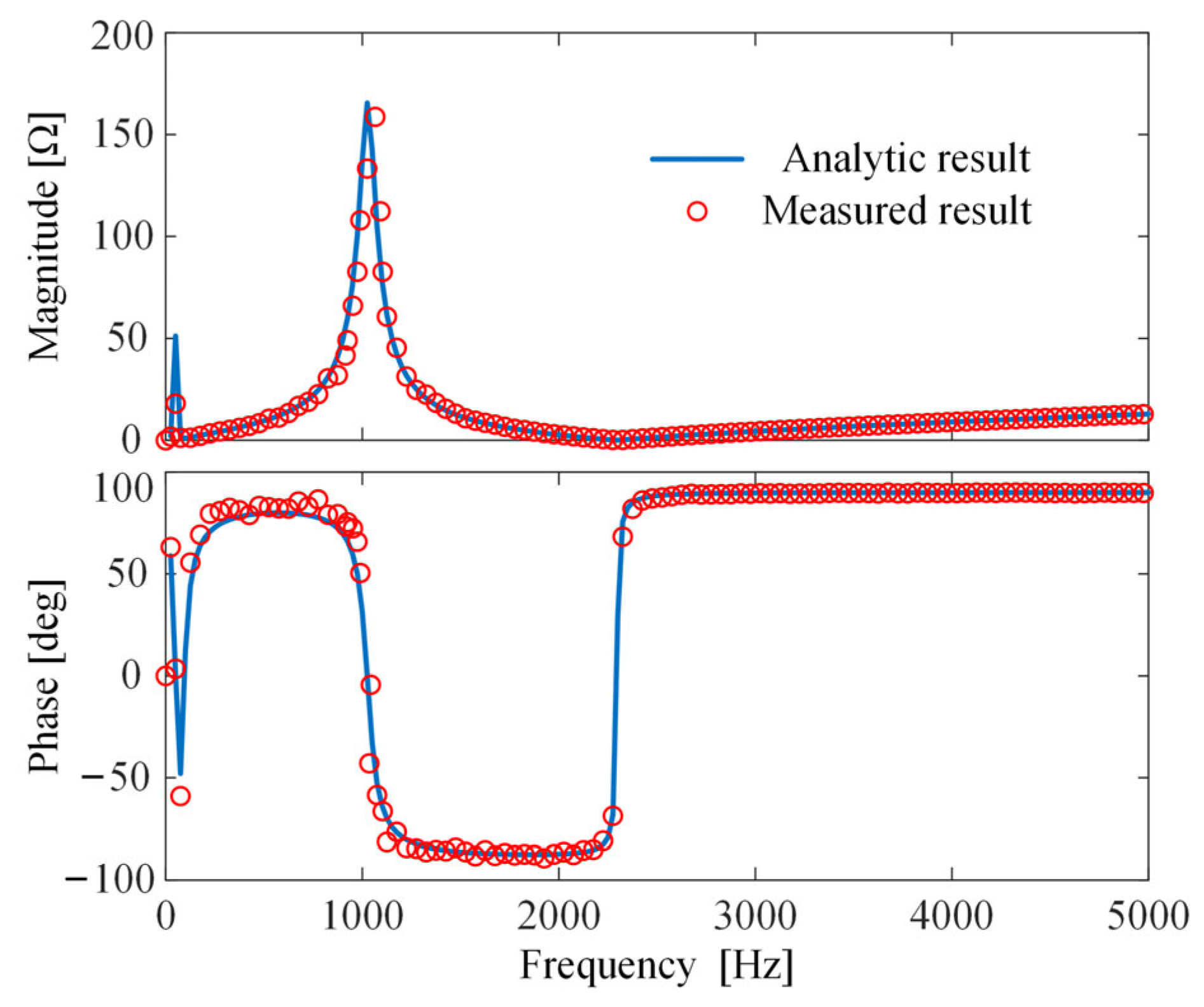
The frequency scanning method was employed, and the test-signal frequency, f = ω/(2π), was swept from 25 Hz to 5025 Hz. A base step size of 50 Hz was used across the majority of the spectrum, while a refined step size of 25 Hz was adopted around the resonant peak region to enhance resolution. This stepwise scanning strategy intentionally avoids frequency alignment with integer multiples of the fundamental frequency, thereby preventing harmonic interference during measurements. Figure 4 presents the comparative analysis of the analytic and measured results. The blue solid curve denotes the IFCs calculated according to (5), while the red circles represent the measured results. The root mean square error (RMSE) was computed over the entire scanned frequency range, yielding a value of 3.6 for the impedance magnitude and 2.8 for the impedance phase. These low error values provide strong evidence of the high consistency between the analytic and measured results. The close alignment, both visual and quantitative, conclusively verifies the validity of the impedance model.

2.3. Harmonic Impedance Model of TPSS Integrated with PV Power Generation

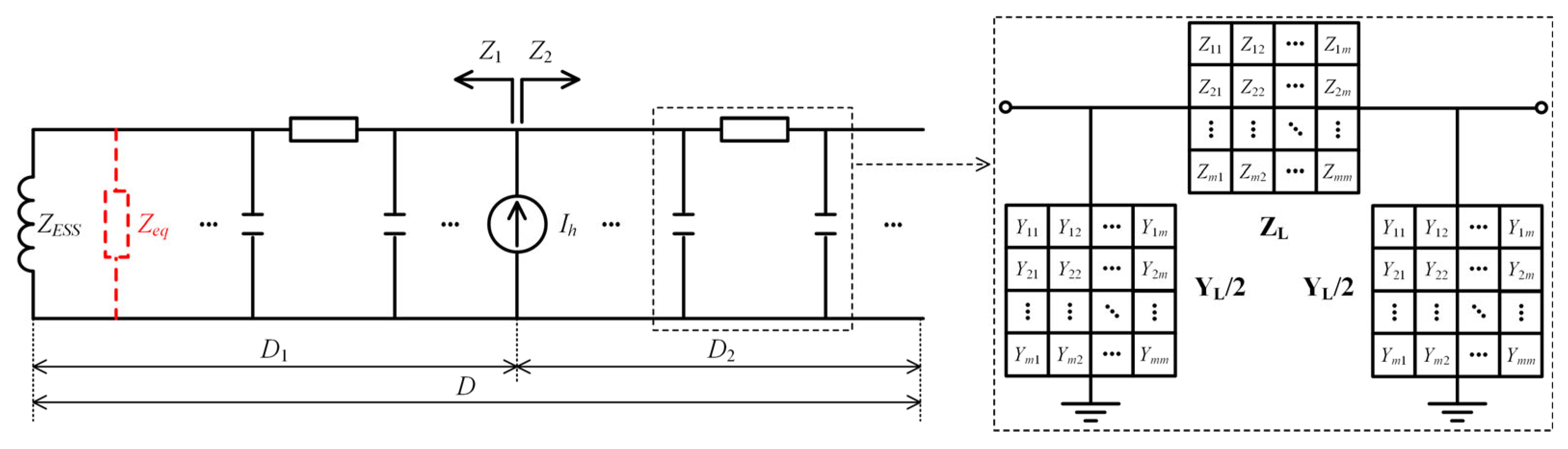
The traction network has a multiconductor transmission line (MTL) structure with special conductors, such as rails, contact wires, and feeders. Following the modeling method outlined in [11,13,19], the distributed structure-based impedance model for the traction network is employed in this paper. Connecting the PV impedance, ZPV, in parallel with the ESS impedance, ZESS, the equivalent harmonic model of a TPSS integrated with PV power generation can be obtained as shown in Figure 5, where Ih represents the locomotive (as the current harmonic source) at the PCC and D and D1 are the distances from the ESS to the SP and PCC, respectively. The impedance of the STPSS is the parallel connection of the left-side impedance, Z1, and the right-side impedance, Z2 [11].
The impedance of the ESS converted to the traction side can be derived as
Z E S S = 2 Z s c K T T 2 + Z T T
where KTT is the ratio of TT, ZTT is the impedance of TT, and Zsc is the equivalent impedance of the power system.
The equivalent harmonic impedance of the MT high-voltage side can be derived as
Z e q = Z P V · K M T 2 n + Z M T
where KMT is the ratio of MT, ZMT is the impedance of MT, and n is the number of parallel PV inverters.
The equivalent impedance of the ESS integrated with the PV inverter can be derived as
Z E S S P V = Z E S S / / Z e q
The proposed model reveals that the integration of the PV inverter modifies the IFCs of the ESS. This impedance transformation consequently induces variations in the IFCs of the STPSS, demonstrating the system’s sensitivity to renewable energy integration.

3. IFCs of TPSS Integrated with PV Power Generation

3.1. Influence Law of PV Power Generation on IFCs

It is necessary to research the influence of PV power generation on IFCs by using an actual railway as an example. The specific structure is the power supply section from the ESS to the SP shown in Figure 1, with the parameters shown in Table 1.
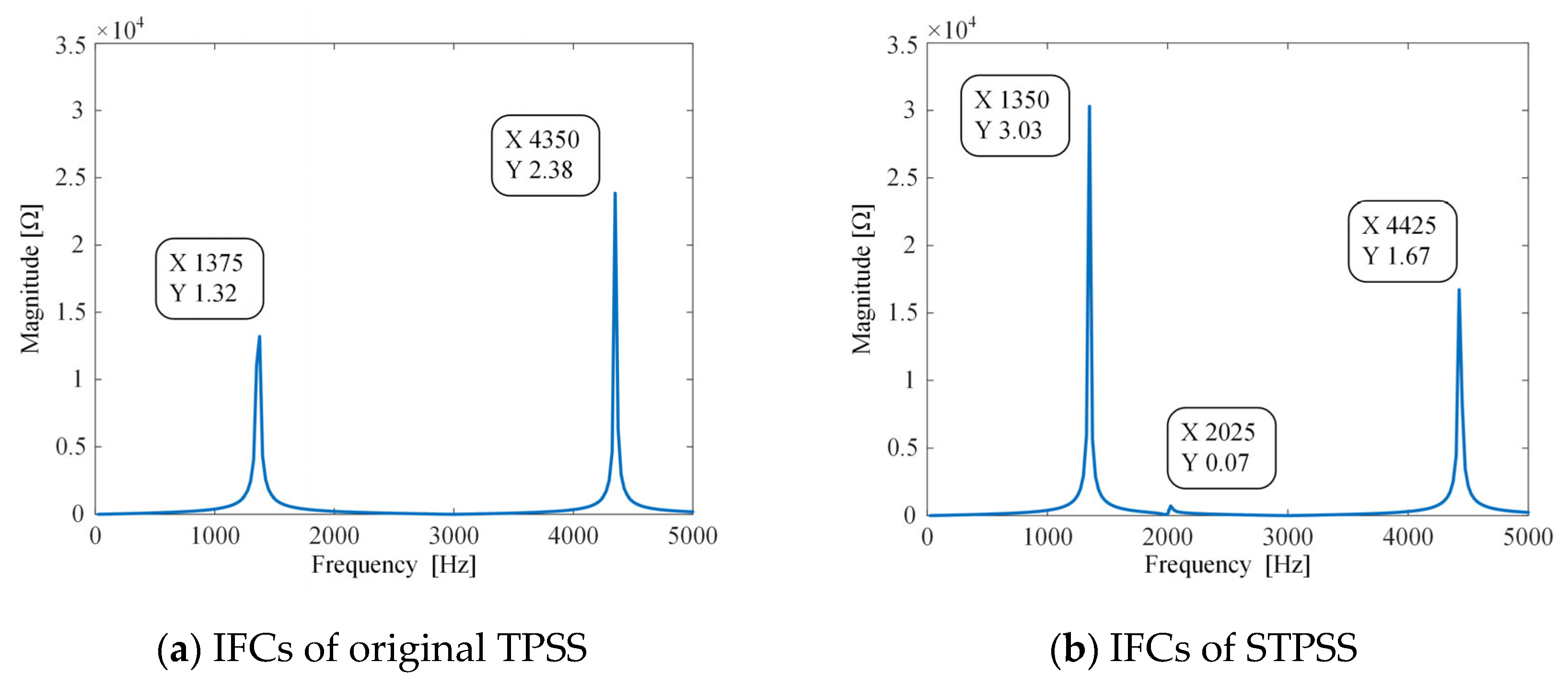
The IFCs of the original TPSS and STPSS are explained in Figure 6. From Figure 6a, we can clearly see that the original TPSS has two resonant points with frequencies of 1375 Hz and 4350 Hz, where the impedance magnitude presents a local maximum. As shown in Figure 6b, with PV power generation integrated, the resonant frequency and impedance magnitude fluctuate up and down, and this leads to a new parallel resonant point whose frequency is approximately equal to the resonant frequency of the PV impedance, ZPV.

3.2. Influence Law of Critical System Parameters on IFCs

To determine the influence of locomotive location, railway length, PV integration location, control parameters, and filter parameters on the IFCs of the STPSS, several analyses have been carried out with different measured parameters and the same parameters in others. The parameters were set to vary over the range shown in Table 2.
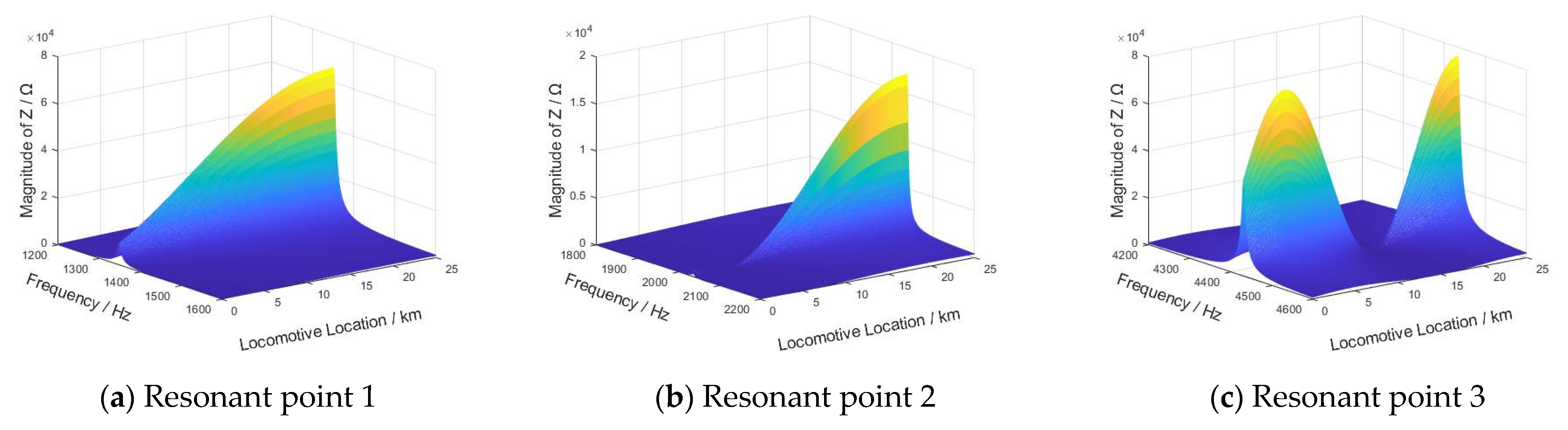
The variation in resonant frequency and impedance magnitude during the locomotive’s movement from the ESS to the SP can be derived from Figure 7. The STPSS exhibits three resonant points, located at 1350 Hz, 2025 Hz, and 4425 Hz. Furthermore, the resonant frequencies remain independent of the locomotive’s location. Taking resonant point 1 as an example, however, the maximum impedance magnitude observed at the tail end (SP) is approximately seven times that observed at the head end (ESS). In other words, while the locomotive’s location influences the impedance magnitude, it does not alter the resonant frequencies of the STPSS. This is because the resonant frequencies are determined by the inherent electrical parameters of the TPSS, such as transformers and traction network conductors, as well as the characteristics of the external power source (e.g., equivalent internal impedance), and are not affected by variations in the location of external loads (i.e., the locomotive). This conclusion is also supported by [19]. The detailed derivation process can be found in Appendix A.
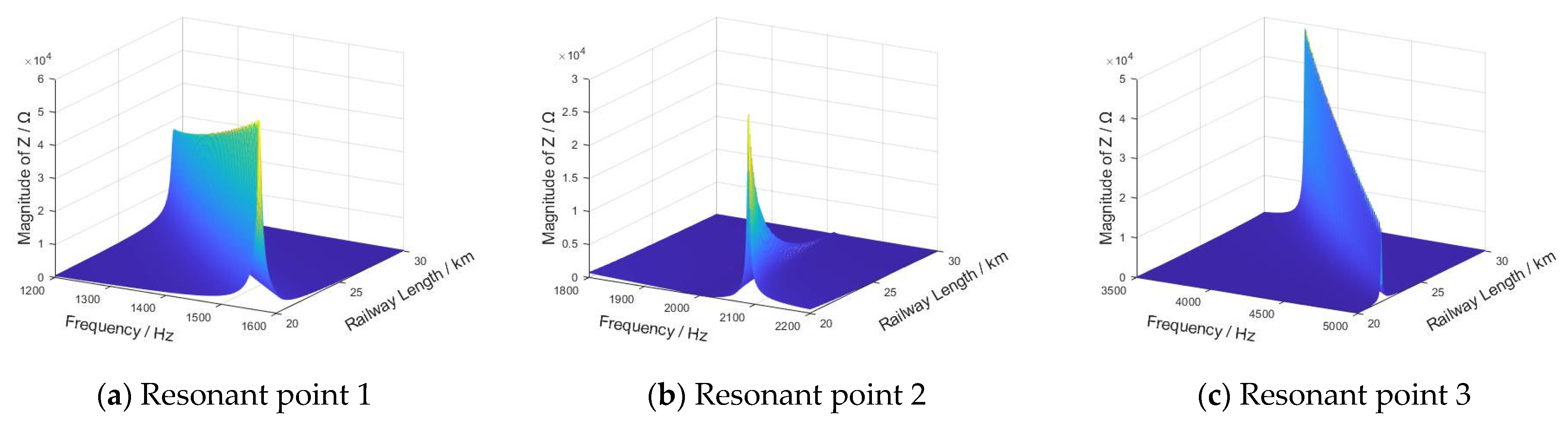
It is shown in Figure 8 that when the railway length varies from 20 km to 30 km, the resonant frequencies of all resonant points decrease to different degrees, and the impedance magnitude fluctuates up and down, meaning that the railway length is also a key parameter to note.
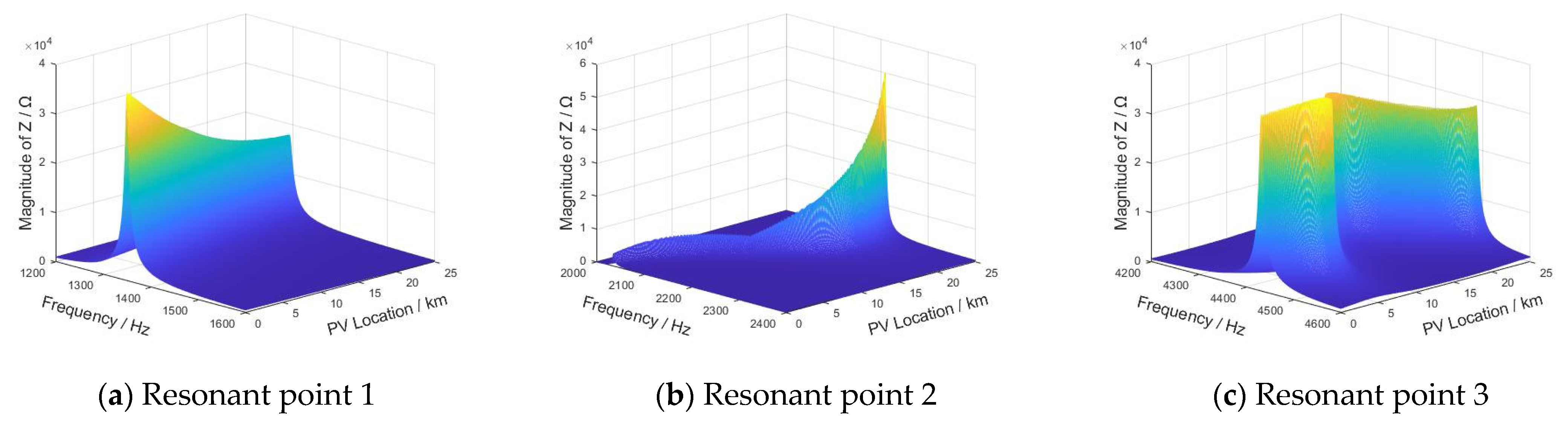
It can be seen from Figure 9 that the PV integration location has different degrees of influence on the resonant frequency and impedance magnitude of all resonant points. In practical engineering, PV power generation is often integrated into ESSs, which facilitates the distribution of energy and reduces the impedance magnitude of resonant point 2.
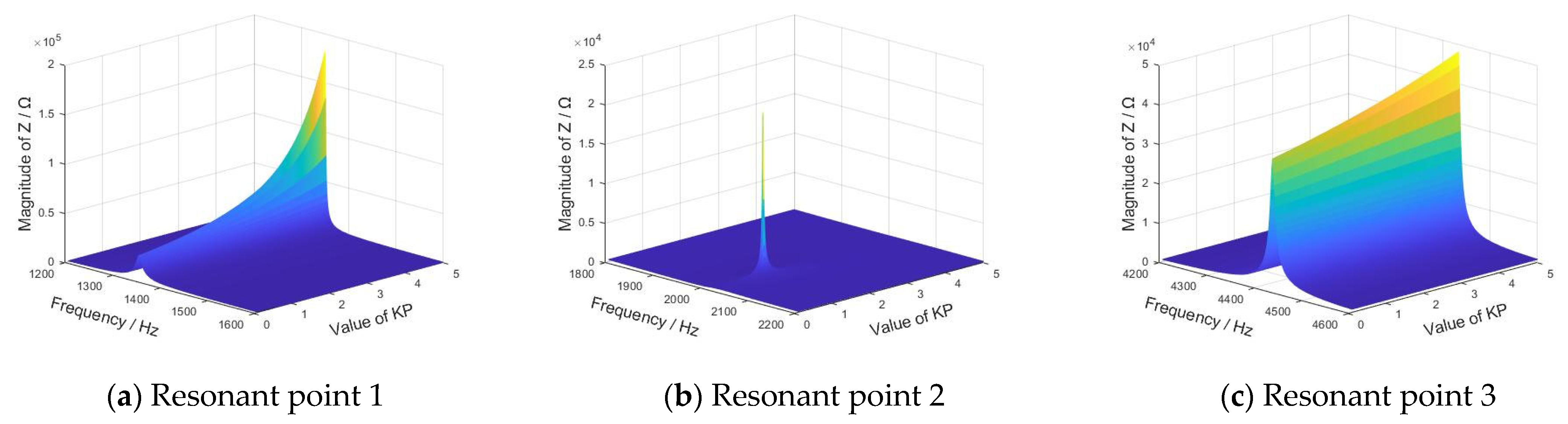
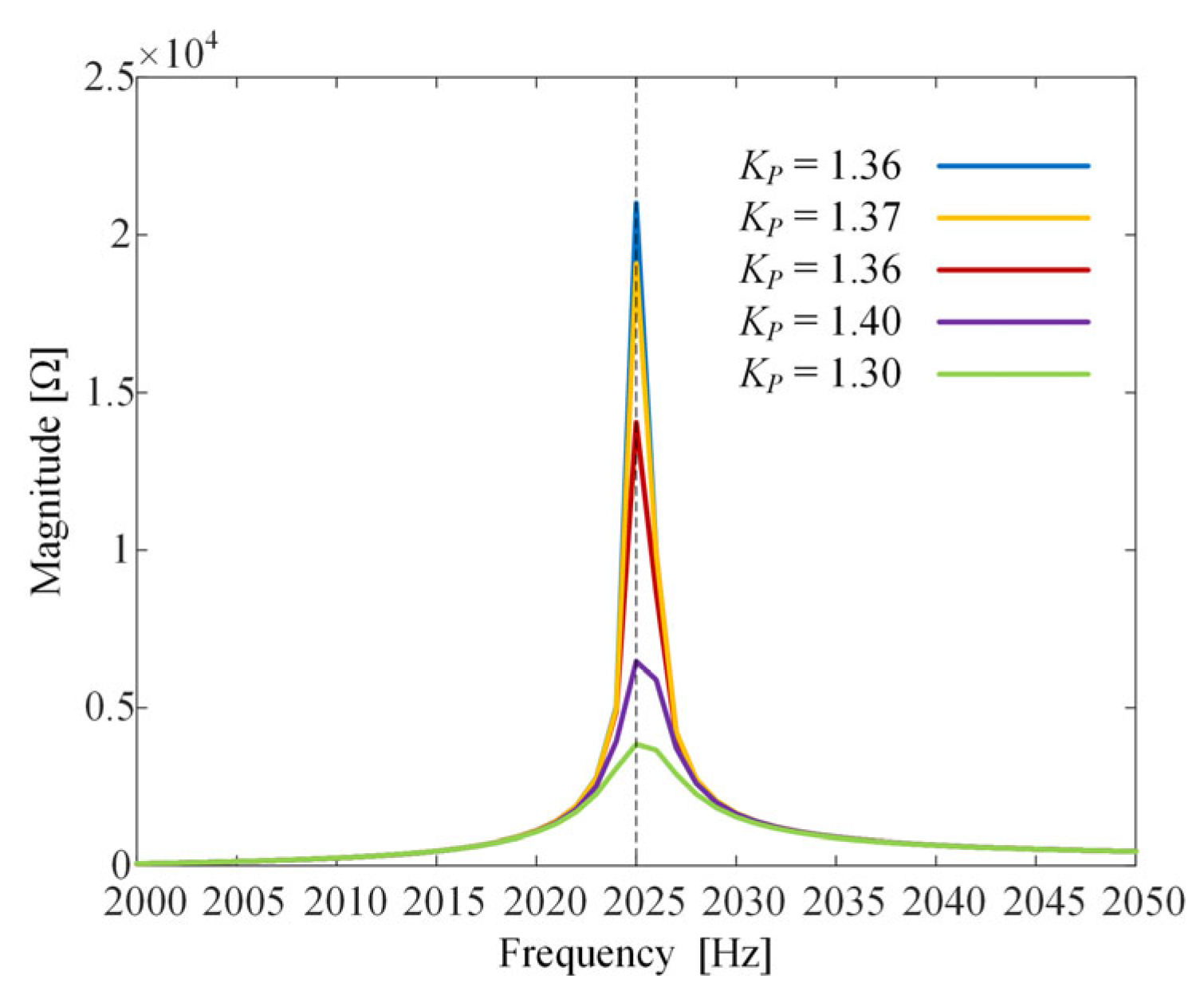
Figure 10 shows that when the value of KP varies from 0.1 to 5, the resonant frequencies of all resonant points remain almost constant. The impedance magnitude of resonant points 1 and 3 is directly proportional to the value of KP. However, the impedance magnitude of resonant point 2 varies considerably and reaches a maximum at KP = 1.36, which needs to be considered when choosing KP.
To further verify the non-monotonic influence of the proportional gain, KP, on the impedance magnitude at resonance point 2, impedance characteristic curves near resonance point 2 under different KP values were plotted, as shown in Figure 11. The curves reveal that the impedance magnitude at resonant point 2 reaches its peak when KP = 1.36. However, when KP slightly deviates from this value, the impedance magnitude decreases below the peak level. This finding provides crucial guidance for tuning controller parameters in practical applications of STPSSs, aiding in the mitigation of resonance risks at the design stage and thereby ensuring stable system operation.
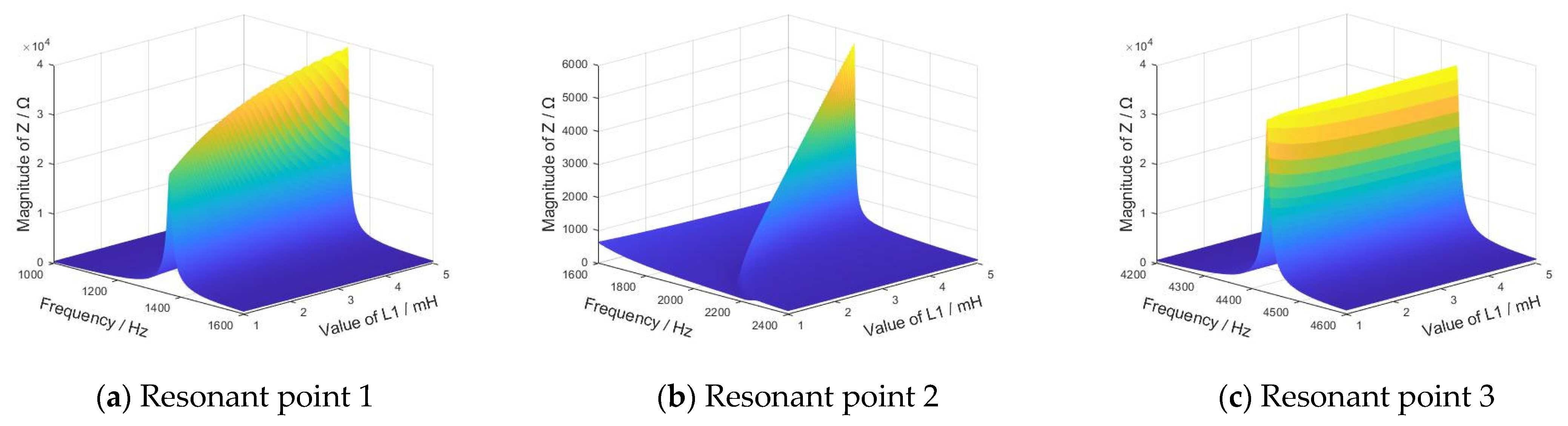
As shown in Figure 12, as L1 increases from 1 mH to 5 mH, the impedance magnitudes at resonance points 1 and 2 exhibit an increasing trend, while that at resonance point 3 remains nearly unaffected. The resonant frequency of point 2 is inversely proportional to the value of L1, whereas the resonant frequencies of points 1 and 3 remain almost constant.
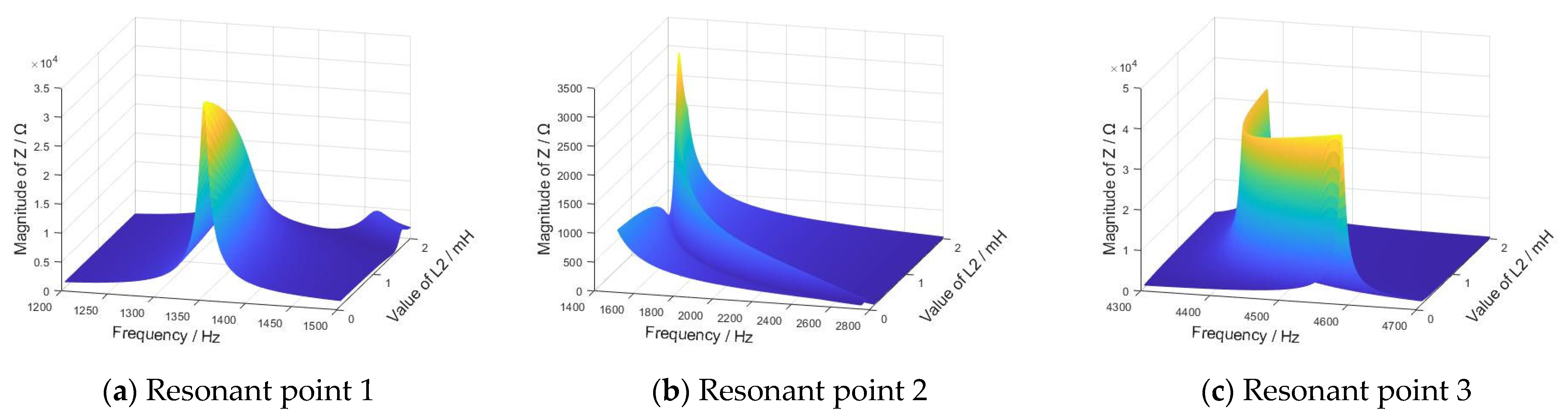
A decrease in the resonant frequencies can be observed for all three points in Figure 13 as L2 varies from 0.1 mH to 2 mH, accompanied by variations in the impedance magnitude.
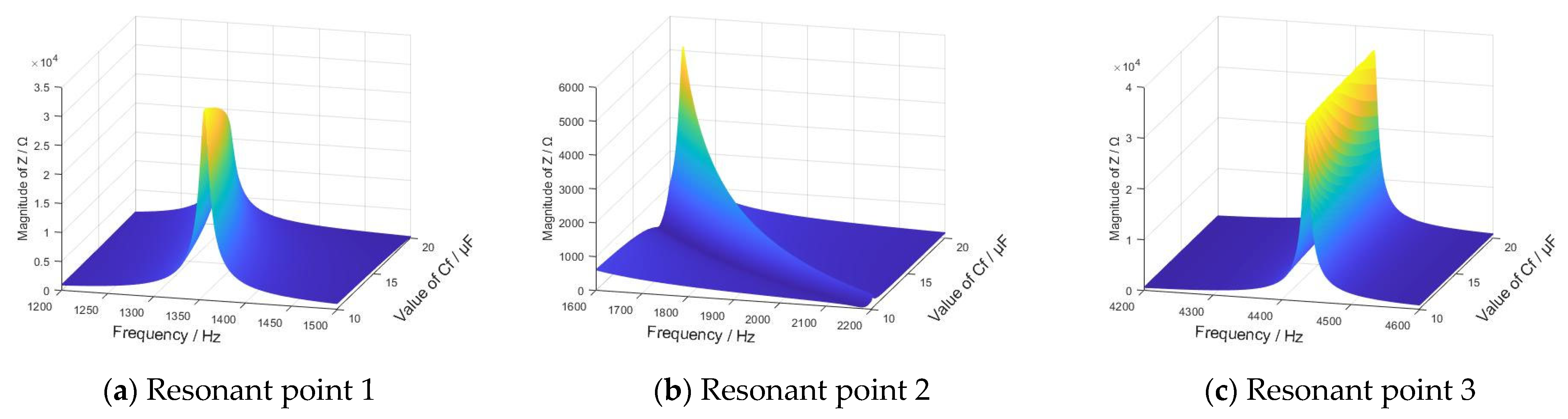
As Cf increases from 10 μF to 20 μF, Figure 14 indicates a decrease in the resonant frequency of point 2, with points 1 and 3 remaining constant. The impedance magnitude shows an inverse proportionality to Cf at point 1 and a direct proportionality at point 2, whereas point 3 is minimally affected.
The influence of the above parameters on IFCs is summarized in Table 3.
It is found that the control parameter, KP, and the filter parameters, L1, L2, and Cf, significantly influence IFCs. The sensitivity analysis reveals distinct roles for each parameter: KP serves as the primary factor for impedance magnitude control, exhibiting a nonlinear influence on peak suppression; L1 and Cf act as effective variables for resonant frequency adjustment, both inversely modulating the second resonant frequency; while L2 comprehensively affects both the frequency and magnitude of all resonance points. Therefore, before integrating PV power generation into TPSSs, a rational design of these parameters through shifting resonant frequencies or reducing impedance magnitude can effectively prevent resonance incidents and ensure the stable operation of STPSSs.

4. Multi-Parameter Co-Tuning Method Based on the Improved PSO Algorithm

Parameter tuning of the PV inverter is a complex multi-objective optimization problem. The conventional methods usually rely on manual calculations and empirical adjustments, which can lead to a huge amount of computation [28]. PSO has the advantages of easy implementation, good robustness, and fast convergence speed in solving this kind of problem [28,29]. However, due to limitations such as fixed parameters and low population diversity, PSO is prone to fall into local optimal solutions during iteration, thus failing to obtain the global optimal solution. The adaptive inertia weight and heterogeneous learning factors are introduced to strengthen the global search ability in the early stage of iteration and the local search ability in the later stage to avoid the PSO falling into local optimal solutions. Therefore, the multi-parameter co-tuning method (MPCTM) based on the improved PSO algorithm is used to improve the tuning efficiency and performance of PV inverter parameters.
The first step is to determine the range of values for KP, L1, L2, and Cf according to the conventional method, which is shown in Table 2. The second step is to set the objective function, which consists of three components: moving the resonant frequency, reducing the impedance magnitude, and reducing the filter cost. Previous studies indicated that locomotives are harmonic sources exciting resonance in the 850–2450 Hz and 3150–3750 Hz frequency ranges [19]. Therefore, resonance can be avoided by shifting the resonant frequency so that an STPSS has no resonant point in the above range, and the objective function is express as
F 1 = 2450 850 2450 f 1 + 850 f 1 + 2450 850 2450 f 2 + 850 f 2 + 3750 3150 3750 f 3 + 3150 f 3
where f1, f2, and f3 are the resonant frequencies of resonant points 1, 2, and 3, respectively. When the resonant frequency of a resonant point falls within the locomotive’s resonant frequency range, the corresponding term of (9) is 1. When the resonant frequency moves out of the range, the corresponding term of (9) is less than 1.
Similarly, after reducing the impedance magnitude to 0 with effective measures, harmonic resonance will not occur [12]. The normalized expression of the impedance magnitude is obtained as
F 2 = m 1 5 e 4 + m 2 1 e 4 + m 3 6 e 4
where m1, m2, and m3 are the impedance magnitudes of resonant points 1, 2, and 3, respectively. The denominator in (10) represents the reference impedance magnitude of the corresponding resonance point, which can be determined from the average of the impedance magnitude calculated in Section 3.
In addition, the cost of the LCL filter is directly proportional to the value of L1, L2, and Cf, so the normalized cost objective function can be expressed as
F 3 = L 1 2 mH + L 2 0.5 mH + C f 12 μ F
The denominator in (11) represents the reference values for inductance and capacitance, which can be determined from Table 1 in Section 3.
The overall fitness function, F, is formulated as the sum of the three normalized objective functions, F1, F2, and F3, as shown in (12), and its minimization is the optimization objective in this paper. Each objective function has been normalized to the same variation range of [0, 3] through the use of reference values in their denominators. Therefore, equal weighting factors (1:1:1) are applied to reflect their balanced contribution to the optimization goal. This ensures that no single objective dominates the fitness function merely due to differences in numerical scale.
F = F 1 + F 2 + F 3
The learning factors, c1 and c2, in classical PSO determine the influence of individual particle experience information and population particle experience information on the optimization trajectory [29]. To solve the problems of early maturation and low population diversity caused by the fixed learning factor, this paper introduces the heterogeneous learning factors, which vary with time during the iteration. In the early stage of iteration, the cognitive learning factor is larger and the social learning factor is smaller when the global search ability is stronger to avoid falling into the local optimal solution. In the later stage, the social learning factor is larger and the cognitive learning factor is smaller when the local search ability is stronger and the particle quickly converges to the global optimal solution. The heterogeneous learning factors can be expressed as
c 1 = c 1 , max + c 1 , min c 1 , max k k max c 2 = c 2 , min + c 2 , max c 2 , min k k max
where ci,max and ci,min are the maximum and minimum learning factors, respectively, and k and kmax are the current and maximum number of iterations, respectively.
The value of inertia weight in classical PSO, which is generally fixed, affects the global and local search abilities [29]. Linearly or nonlinearly varying inertia weights can provide suitable global and local search abilities, which tend to be associated with the iteration process and are therefore less adaptable. This paper introduces an inertia weight that is adaptively adjusted based on the distance of the fitness value from the global optimal solution, which is denoted as
ω = ω min + ω max ω min f f min f a v g f min , f f a v g ω max , f > f a v g
where ωmax and ωmin are the maximum and minimum inertia weights, respectively; f is the current fitness value; favg is the average fitness value of all particles; and fmin is the minimum fitness value. From (14), when the fitness values of particles are consistent, the inertia weight is higher, which will enhance the global search ability, and, on the contrary, when the fitness values of particles are scattered, the inertia weight is smaller, which will enhance the local search ability. When the fitness values of particles are lower than favg, the inertia weight gradually increases to approach the optimal solution, and when the fitness values of particles are higher than favg, the inertia weight remains maximal to avoid missing the optimal solution.
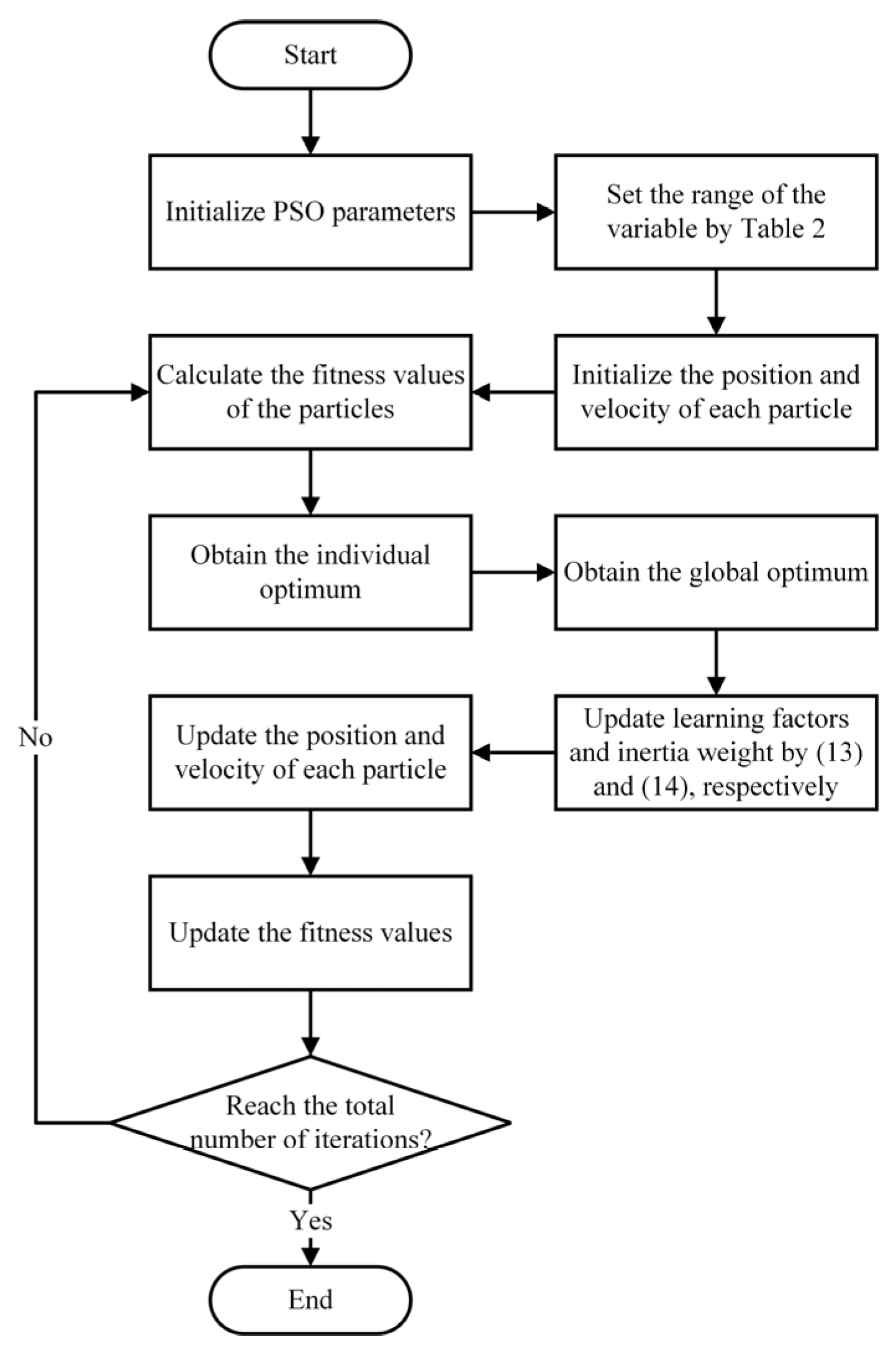
The specific process of the MPCTM is shown in Figure 15. The number of particles is taken as 30, and the dimension number of particles is taken as 4.
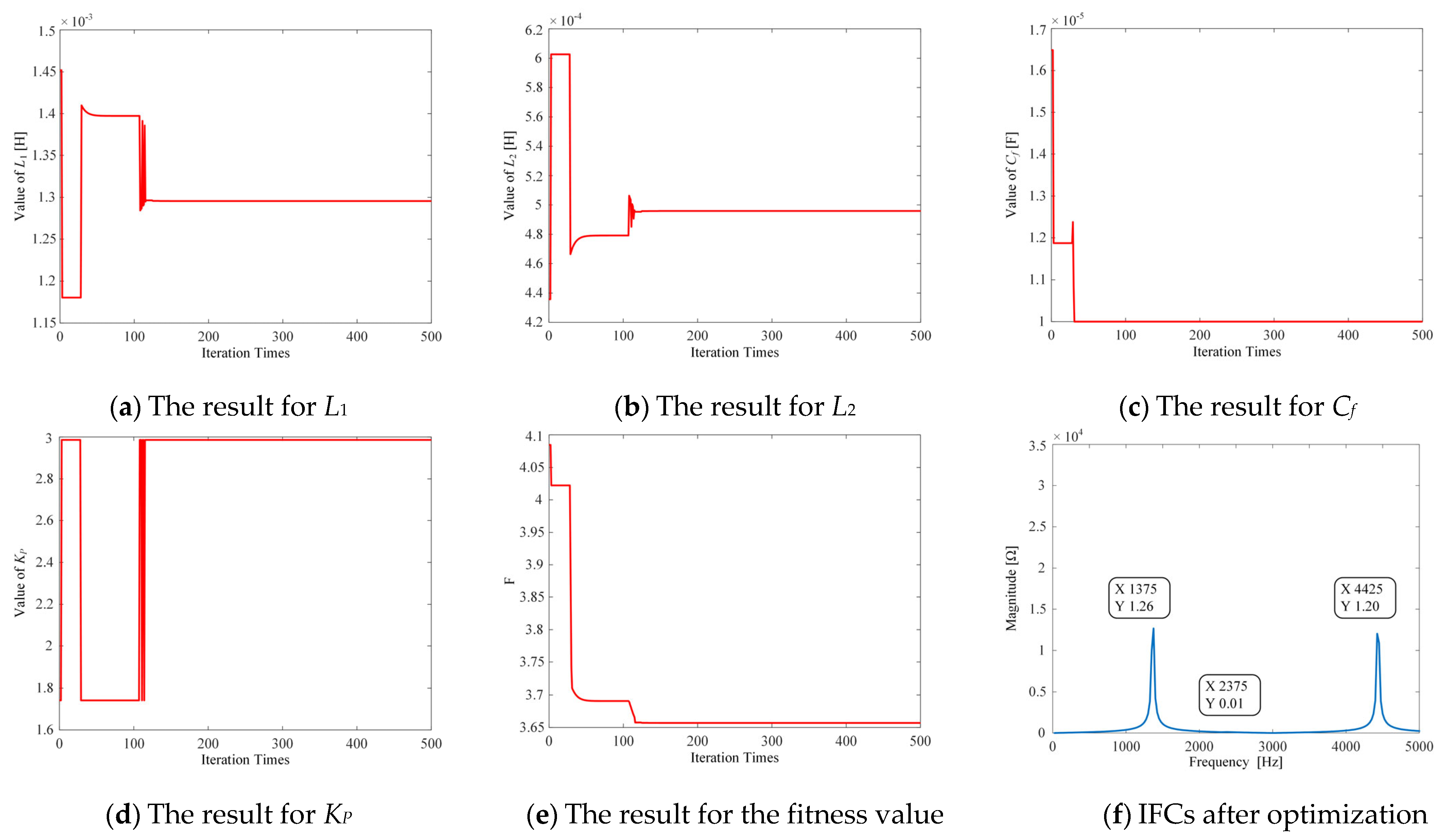
When the number of iterations reaches 120, the fitness value drops to 3.65 and tends to stabilize (no significant decrease in the fitness value occurs with further increases in the number of iterations). Moreover, in similar studies [23,28], the number of iterations for the PSO algorithm typically ranges from 100 to 500, and 120 iterations fall within this reasonable range, indicating that the algorithm has converged to the global optimal solution when the number of iterations reaches 120. The IFCs of STPSSs were plotted based on the optimization results, as shown in Figure 16f. Compared to Figure 6b, the impedance magnitudes of resonant points 1, 2, and 3 are substantially reduced, and resonant point 3 is not within the characteristic harmonic band emitted by the locomotive. Therefore, the resonance risk of the STPSS is decreased.
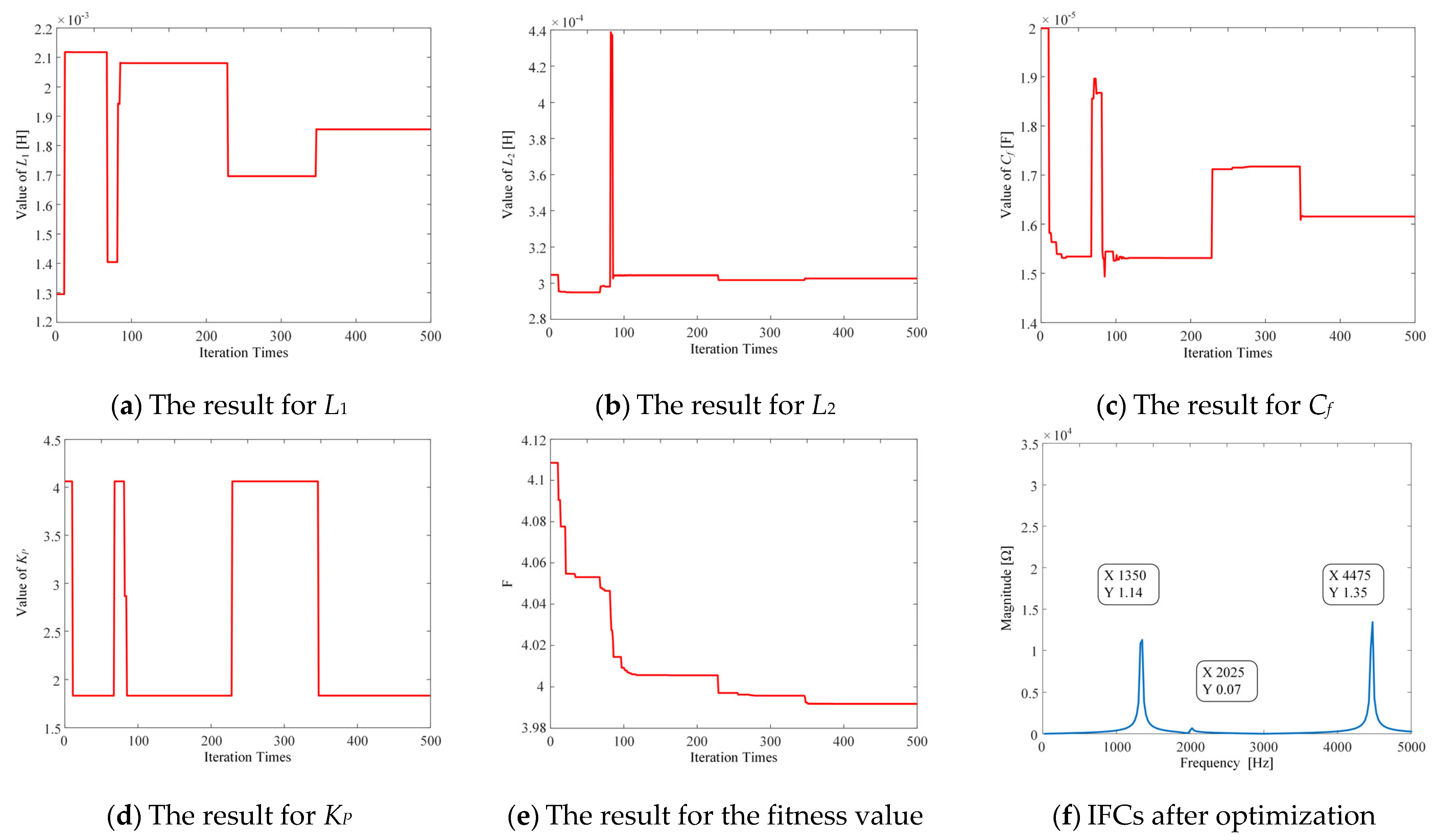
To verify the performance advantages of the improved PSO algorithm further, the optimization results were compared with those of the classical PSO algorithm, as shown in Figure 17. The comparison results are described in Table 4. The minimum fitness value of the proposed method is reduced by 0.34 and the iteration times is reduced by 230 compared to the classical PSO algorithm, while the cost of inductors and capacitors is further reduced by 10.8%.
The introduction of adaptive inertia weight and heterogeneous learning factors allows the improved PSO algorithm to converge quickly to a solution space globally in the early stage of iteration and to converge locally to a more accurate solution in the later stage. The method proposed in this paper enhances the stability, convergence speed, and control performance of the PSO algorithm; improves the tuning efficiency and performance of PV inverter parameters; and reduces the resonance risk of the STPSS.

5. Simulation Results

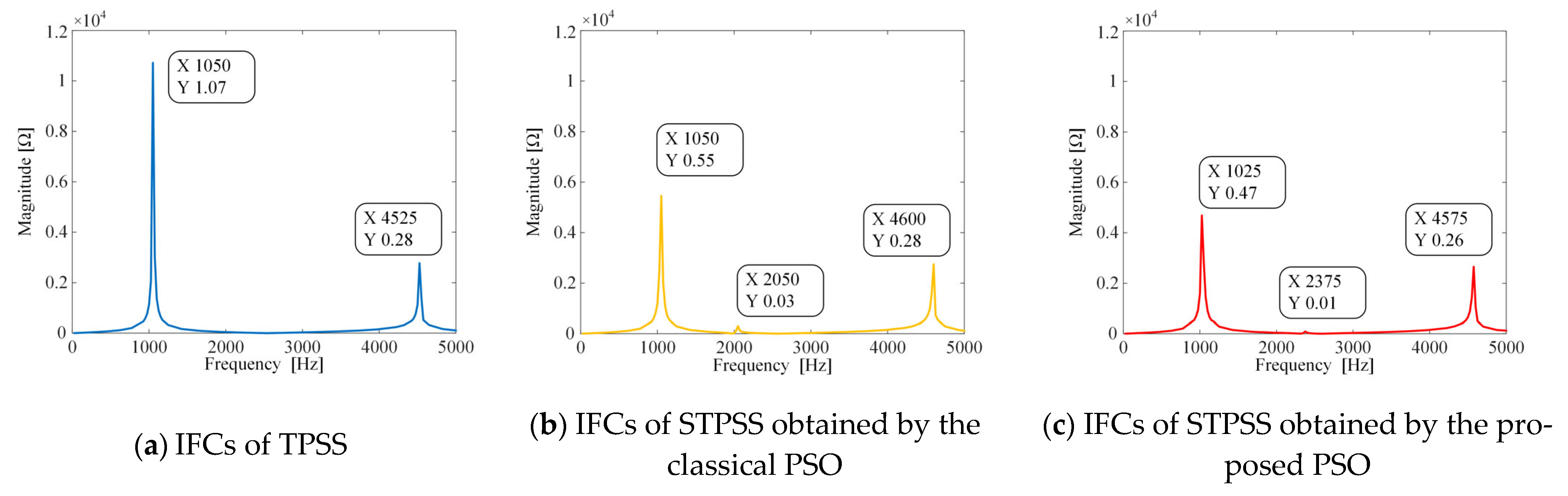
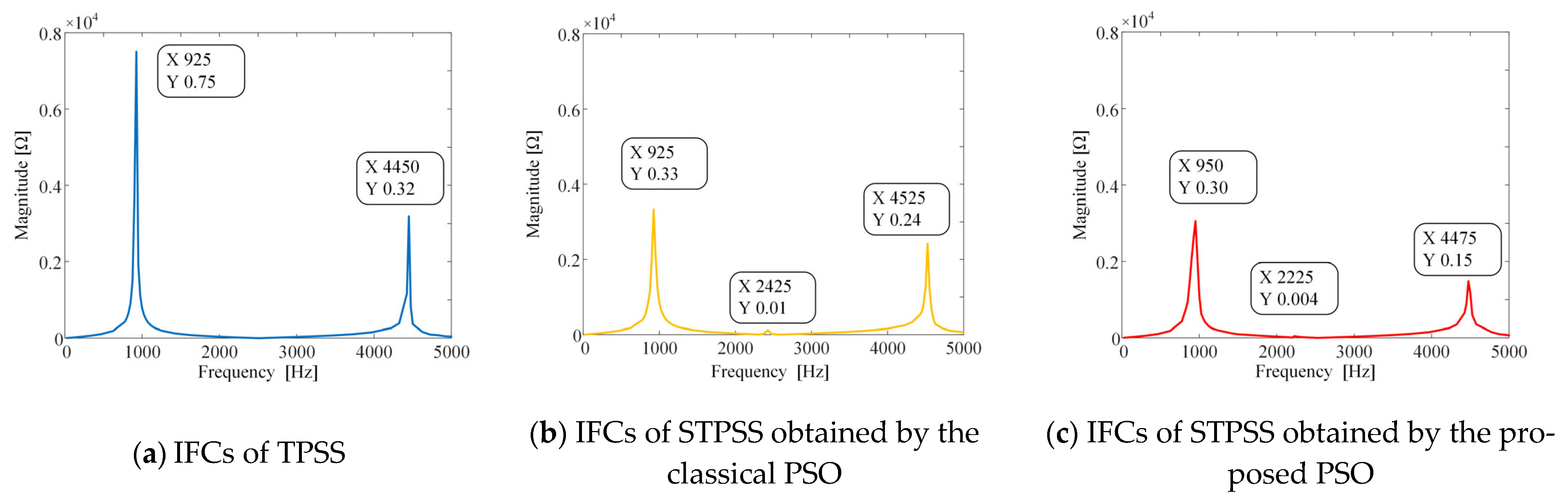
To validate the correctness of the IFC analysis and the efficiency of the proposed MPCTM, a time-domain simulation model was built in MATLAB/Simulink according to the system structure in Figure 1 and Figure 2, including PV power generation, an ESS, and a double-track electrified railway with a direct feeding system (25 km). The system parameters are provided in Table 1. A small signal disturbance voltage was injected into the main circuit from the PCC, and the impedance was calculated according to the measured response current and the voltage of the circuit. The test-signal frequency, f = ω/(2π), was scanned from 25 Hz to 5000 Hz. The measurement results for the IFCs are shown in Figure 18.
From Figure 18a, the TPSS built according to the parameters in Table 1 has two resonant points at 1050 Hz and 4525 Hz, which is consistent with the findings in Section 3. Therefore, the multi-conductor model adopted in this paper can effectively explore the IFCs of TPSSs. Figure 18b depicts the frequency scanning results of the STPSS, where the parameters of the PV inverter were obtained by the classical PSO algorithm. The impedance magnitudes of the original resonant points 1 and 3 are drastically reduced, but resonant point 2 is inevitably introduced. The parameters of the PV inverter were optimized using the improved PSO algorithm proposed in this paper, and the IFCs of the STPSS are illustrated in Figure 18c. The impedance magnitudes of the original resonant points 1 and 3 were further reduced by up to 56%, and the impedance magnitude of resonant point 2 was also curtailed. The improved PSO algorithm performs better compared to the classical PSO algorithm when resonance suppression and cost reduction are the optimization objectives.
The aforementioned simulations were conducted under strong grid conditions with a short-circuit ratio (SCR) of 24. However, remote areas with underdeveloped grid infrastructure often experience weak grid conditions, where grid support capability is significantly reduced. Therefore, supplementary simulations under weak grid conditions were carried out to evaluate the method’s performance. By configuring the grid-side inductance to 100 mH, the system SCR was reduced to 12 to emulate weak grid operation. The results, presented in Figure 19, demonstrate that even under weak grid conditions, the impedance magnitude of the STPSS optimized by the improved PSO algorithm remains effectively reduced, providing satisfactory resonance suppression. The optimization performance is consistent with that under strong grid conditions. This further confirms that the proposed method is robust against variations in grid strength and enhances its applicability in practical engineering scenarios.
As a result, the optimized system exhibits a significant reduction in impedance magnitude, effectively mitigating the risk of harmonic resonance. Moreover, the optimized IFCs become smoother, which enhances the system’s damping capability against oscillatory modes and improves robustness under varying operating conditions or external disturbances. These improvements collectively reduce the risk of system instability from multiple dimensions and achieve an overall enhancement in comprehensive stability.

6. Conclusions

The STPSS is emerging but without consideration of the impact of PV power generation on the resonance risk of the system. This paper firstly establishes the impedance model of the PV inverter and TPSS. Then, the influence of the key parameters of the PV power generation on the IFCs is analyzed. Research demonstrates that critical parameters, including the control parameter, KP, and the filter parameters, L1, L2, and Cf, significantly influence the IFCs. The integration of PV power generation intensifies system resonance risks, for which this paper proposes a multi-parameter co-tuning method based on the improved PSO algorithm. The implemented method not only improves PV inverter parameter tuning efficiency compared to the conventional method but also effectively mitigates STPSS resonance hazards while achieving a 10.8% cost reduction in LCL filter implementation through component value optimization. The research results of this paper also have applicability in new energy integration scenarios, such as energy storage and wind power. Future research should focus on exploring multi-energy coupled mechanisms in hybrid energy STPSSs and developing adaptive resonance suppression strategies under dynamic operation conditions.

Author Contributions

Conceptualization, P.P., T.Z., X.Y., Y.C., G.C. and Q.L.; methodology, P.P., T.Z., G.C. and Q.L.; software, P.P., T.Z. and Y.C.; validation, P.P. and T.Z.; formal analysis, P.P., X.Y. and Y.C.; investigation, P.P. and X.Y.; resources, Q.L. and M.W.; data curation, T.Z. and Y.C.; writing—original draft preparation, P.P.; writing—review and editing, P.P. and T.Z.; visualization, P.P.; supervision, Q.L. and M.W.; project administration, Q.L. and M.W.; funding acquisition, Q.L. and M.W. All authors have read and agreed to the published version of the manuscript.

Funding

This research was funded by the Technology Development Program of the CHN Energy Xinshuo Railway Corporation Limited, grant number GJNY-21-189.

Institutional Review Board Statement

Not applicable.

Informed Consent Statement

Not applicable.

Data Availability Statement

The data presented in this study are available on request from the corresponding author.

Acknowledgments

The authors would like to express their sincere gratitude to the editor and the anonymous reviewers for their invaluable time, insightful comments, and constructive suggestions. Their efforts have significantly improved the quality of this paper. We also extend our heartfelt thanks to all the co-authors for their collaborative efforts, intellectual contributions, and dedicated work throughout the development of this research.

Conflicts of Interest

Peng Peng, Tongxu Zhang, Xiangyan Yang, Yaozhen Chen, Guotao Cao, Qiujiang Liu, and Mingli Wu receive research grants from the Technology Development Program of the CHN Energy Xinshuo Railway Corporation Limited, grant number GJNY-21-189. The funder had the following involvement with the study: in the collection of data.

Appendix A

The left-side impedance, Z1, in Figure 5 can be calculated as
Z 1 = Z c Z E S S P V cosh ( γ D 1 ) + Z c sinh ( γ D 1 ) Z E S S P V sinh ( γ D 1 ) + Z c cosh ( γ D 1 )
Herein, based on the distributed parameter transmission line theory, two key parameters are defined: the characteristic impedance, Zc, and the propagation constant, γ.
Z c = z j ω c ,   γ = j ω c z
The right-side impedance, Z2, in Figure 5 can be calculated as
Z 2 = Z c cosh ( γ D 2 ) sinh ( γ D 2 )
The parallel connection of Z1 and Z2 is the impedance of the STPSS:
Z = Z 1 / / Z 2 = Z c cosh ( γ D 2 ) Z E S S P V cosh ( γ D 1 ) + Z c sinh ( γ D 1 ) Z E S S P V sinh ( γ D ) + Z c cosh ( γ D )
Parallel resonance occurs in the TPSS when the total impedance, Z, theoretically becomes infinite. This condition is mathematically satisfied when the denominator of the impedance expression equals zero, i.e.,:
Z E S S P V sinh ( γ D ) + Z c cosh ( γ D ) = 0
which gives
Z E S S P V = Z c tanh ( γ D )
In practical TPSSs, the value of γD is significantly less than 1. Therefore, the Taylor series approximation, tanh(γD) ≈ γD, can be employed. Furthermore, ZESSPV can be approximated as an inductor, i.e., ZESSPVjωL. Substituting these approximations into A6 yields
j ω L Z c γ D = 1 j ω c D = 1 j ω C
The total shunt capacitance of the traction network is C = cD, where c denotes the shunt capacitance per unit length of the traction network and D stands for the total length of the traction network. An approximate formula for the resonant frequency can be derived:
f 1 2 π L C
Based on the above analytical process, the following conclusion can be drawn: The resonant frequency is determined by the electrical parameters of the TPSS (transformers and traction network conductors) and the characteristics of the external power source (equivalent internal impedance), and is independent of the location of the locomotive harmonic source.

References

  1. Zhang, M.; Li, C. Distributed photovoltaic grid connected power generation system for high-speed railway. In Proceedings of the 3rd International Conference on New Energy Power Engineering (ICNEPE), Huzhou, China, 24–26 November 2023; pp. 209–214. [Google Scholar] [CrossRef]
  2. Wang, S.; Dong, Q.; Zhang, J.; Sun, J.; Gu, X.; Chen, C. Robustness assessment of power network with renewable energy. Electr. Power Syst. Res. 2023, 217, 109138. [Google Scholar] [CrossRef]
  3. Li, X.; Zhao, Y.; Zhang, W.; Wang, F.; Yin, W.; Liu, K. Photovoltaic potential prediction and techno-economic analysis of China railway stations. Energy Rep. 2023, 10, 3696–3710. [Google Scholar] [CrossRef]
  4. Mohamed, A.; Ahmad, R.; Xavier, B. Integrating renewable energy into the electric railway system in dense urban regions. In Proceedings of the 6th International Conference on Smart Power & Internet Energy Systems (SPIES), Abu Dhabi, United Arab Emirates, 4–6 December 2024; pp. 141–146. [Google Scholar] [CrossRef]
  5. Chinomi, N.; Tian, Z.; Yang, N.; Kano, N.; Jiang, L. Analysis of energy efficiency and resilience for AC railways with solar PV and energy storage systems. IEEE Trans. Ind. Cyber-Phys. Syst. 2024, 2, 519–530. [Google Scholar] [CrossRef]
  6. Xia, S.; Wu, H.; Mao, Y.; Wu, T.; Song, G.; Terzic, J.S.; Shahidehpour, M. Photovoltaic power generation and energy storage capacity cooperative planning method for rail transit self-consistent energy systems considering the impact of DoD. IEEE Trans. Smart Grid 2025, 16, 665–677. [Google Scholar] [CrossRef]
  7. Li, J.; Guo, Q.; Wang, X.; Tu, C.; Xiao, F.; Hou, Y.; Shen, X. Parallel-execute-based real-time energy management strategy for STPSS integrated PV and ESS. Appl. Energy 2025, 385, 125538. [Google Scholar] [CrossRef]
  8. Deng, W.; Dai, C.; Chen, W.; Gao, S. Experimental investigation and adaptability analysis of hybrid traction power supply system integrated with photovoltaic sources in AC-fed railways. IEEE Trans. Transport. Electrific. 2021, 7, 1750–1764. [Google Scholar] [CrossRef]
  9. Ge, Y.; Hu, H.; Chen, J.; Wang, K.; He, Z. Combined active and reactive power flow control strategy for flexible railway traction substation integrated with ESS and PV. IEEE Trans. Sustain. Energy 2022, 13, 1969–1981. [Google Scholar] [CrossRef]
  10. Tong, N.; Xu, J.; Xiang, J.; Liu, Y.; Kong, L. High-order harmonic elimination and resonance damping based on inductive-filtering transformer for electrified railway transportation system. IEEE Trans. Ind. Appl. 2022, 58, 5157–5170. [Google Scholar] [CrossRef]
  11. Li, J.; Wu, M.; Molinas, M.; Song, K.; Liu, Q. Assessing high-order harmonic resonance in locomotive-network based on the impedance method. IEEE Access 2019, 7, 68119–68131. [Google Scholar] [CrossRef]
  12. Liu, Q.; Sun, B.; Yang, Q.; Wu, M.; He, T. Harmonic overvoltage analysis of electric railways in a wide frequency range based on relative frequency relationships of the vehicle–grid coupling system. Energies 2020, 13, 6672. [Google Scholar] [CrossRef]
  13. Tao, H.; Lu, W.; Hu, H.; Zhu, X.; He, Z. Stability enhancement method based on adaptive virtual impedance control for a PV-integrated electrified railway system. IEEE Trans. Veh. Technol. 2025, 74, 524–536. [Google Scholar] [CrossRef]
  14. Ren, C.; Li, X.; Wu, J.; Hui, Y.; He, Y.; Han, X.; He, X.; Wang, P. Impedance model based coordination control of secondary ripple in DC microgrid. IEEE Access 2024, 12, 29723–29737. [Google Scholar] [CrossRef]
  15. Zhao, E.; Han, Y.; Lin, X.; Yang, P.; Blaabjerg, F.; Zalhaf, A.S. Impedance characteristics investigation and oscillation stability analysis for two-stage PV inverter under weak grid condition. Electr. Power Syst. Res. 2022, 209, 108053. [Google Scholar] [CrossRef]
  16. Meng, X.; Zhang, Q.; Liu, Z.; Hu, G.; Liu, F.; Zhang, G. Multiple vehicles and traction network interaction system stability analysis and oscillation responsibility identification. IEEE Trans. Power Electron. 2024, 39, 6148–6162. [Google Scholar] [CrossRef]
  17. Pan, P.; Hu, H.; Xiao, D.; Song, Y.; He, Z. An improved controlled-frequency-band impedance measurement scheme for railway traction power system. IEEE Trans. Ind. Electron. 2021, 3, 2184–2195. [Google Scholar] [CrossRef]
  18. Liu, Q.; Wu, M.; Li, J.; Yang, S. Frequency-scanning harmonic generator for (inter) harmonic impedance tests and its implementation in actual 2 × 25 kV railway systems. IEEE Trans. Ind. Electron. 2021, 68, 4801–4811. [Google Scholar] [CrossRef]
  19. Song, K.; Wu, M.; Yang, S.; Liu, Q.; Agelidis, V.G.; Konstantinou, G. High-order harmonic resonances in traction power supplies: A review based on railway operational data, measurements, and experience. IEEE Trans. Power Electron. 2020, 35, 2501–2518. [Google Scholar] [CrossRef]
  20. Anuar, M.N.K.; Abdullah, N. Dominant harmonic current reduction using passive power filter. In Proceedings of the 2022 IEEE International Conference on Power and Energy (PECon), Langkawi, Malaysia, 5–6 December 2022; pp. 186–191. [Google Scholar] [CrossRef]
  21. Sirasugol, S.; Domkitpanya, T.; Narongrit, T.; Areerak, K. Harmonic elimination of AC electric railway systems using shunt active power filters. In Proceedings of the 2024 12th International Electrical Engineering Congress (iEECON), Pattaya, Thailand, 6–8 March 2024; pp. 1–6. [Google Scholar] [CrossRef]
  22. Kurup, H.V.; Raveendran, R. Trapezoidal PWM scheme for selective harmonic elimination in multilevel inverters. In Proceedings of the 2024 IEEE Recent Advances in Intelligent Computational Systems (RAICS), Kothamangalam, India, 16–18 May 2024; pp. 1–5. [Google Scholar] [CrossRef]
  23. Deng, W.; Zhang, L.; Zhou, X.; Zhou, Y.; Sun, Y.; Zhu, W.; Chen, H.; Deng, W.; Chen, H.; Zhao, H. Multi-strategy particle swarm and ant colony hybrid optimization for airport taxiway planning problem. Inf. Sci. 2022, 612, 576–593. [Google Scholar] [CrossRef]
  24. Feng, D.; Zhu, H.; Sun, X.; Lin, S. Evaluation of power supply capability and quality for traction power supply system considering the access of distributed generations. IET Renew. Power Gener. 2020, 14, 3644–3652. [Google Scholar] [CrossRef]
  25. Nwaneto, U.C.; Knight, A.M. Full-order and simplified dynamic phasor models of a single-phase two-stage grid-connected PV system. IEEE Access 2023, 11, 26712–26728. [Google Scholar] [CrossRef]
  26. Choudhari, B.; Karchi, N. Design, modeling and analysis of LCL filter for three phase inverter. In Proceedings of the 2024 IEEE International Conference on Smart Power Control and Renewable Energy (ICSPCRE), Rourkela, India, 19–21 July 2024; pp. 1–5. [Google Scholar] [CrossRef]
  27. Alves, A.G.P.; Dias, R.F.S.; Rolim, L.G.B. Disturbance rejection analysis of grid-connected VSCs controlled in the stationary reference frame under voltage harmonic disturbances. In Proceedings of the 2023 IEEE 8th Southern Power Electronics Conference and 17th Brazilian Power Electronics Conference (SPEC/COBEP), Florianopolis, Brazil, 26–29 November 2023; pp. 1–5. [Google Scholar] [CrossRef]
  28. Zhong, F.; Xie, S. Study on resonance characteristic of continuous co-phase traction power supply system. IET Gener. Transm. Distrib. 2023, 17, 775–789. [Google Scholar] [CrossRef]
  29. Zhang, P.; Wu, X. Research on multi-objective microgrid operation optimization based on improved particle swarm optimization. In Proceedings of the 2024 4th International Conference on Electrical Engineering and Mechatronics Technology (ICEEMT), Hangzhou, China, 5–7 July 2024; pp. 161–165. [Google Scholar] [CrossRef]
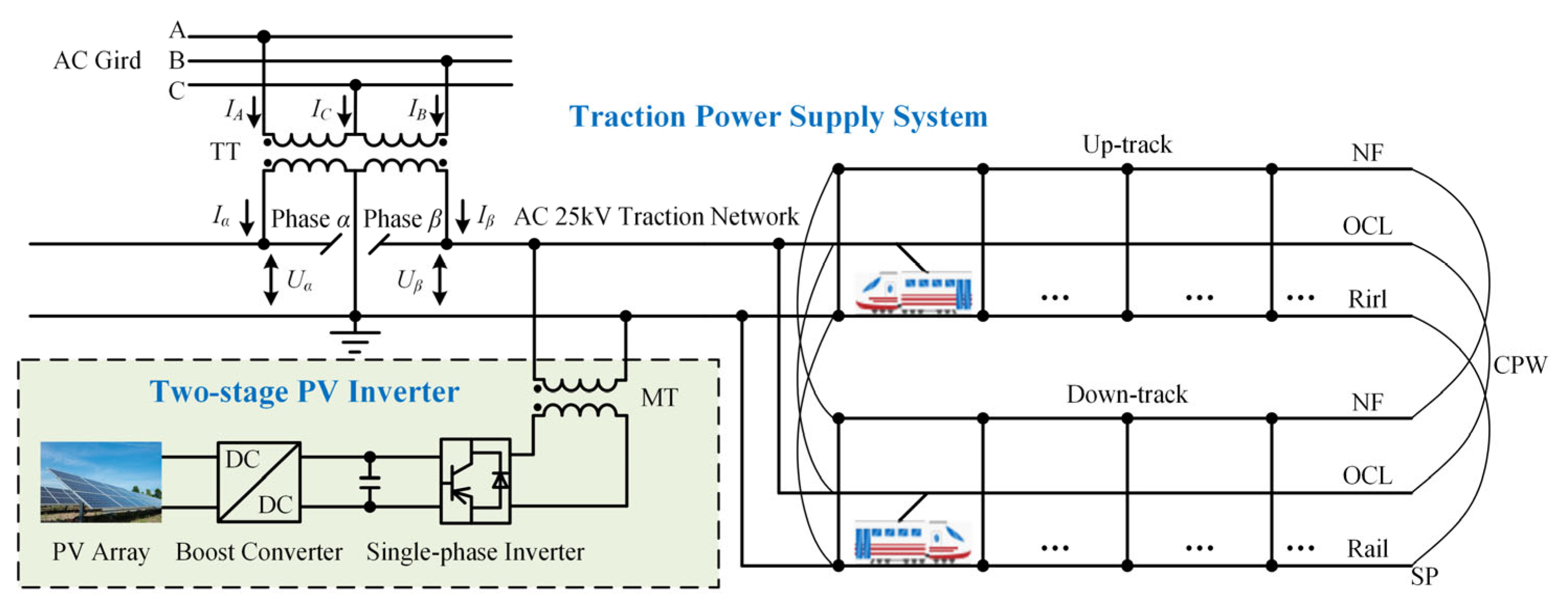
Figure 1. Single-phase inverter scheme for PV integration in TPSS.
Sustainability 17 10055 g001
Figure 2. The topology and control diagram of the two-stage PV inverter with an LCL filter.
Sustainability 17 10055 g002
Figure 3. Control block diagram of single-phase inverter in s-domain.
Sustainability 17 10055 g003
Figure 4. Analytic and measured results for the single-phase inverter with LCL filter.
Sustainability 17 10055 g004
Figure 5. The distributed parameter simplified circuit diagram of traction network with direct power supply.
Sustainability 17 10055 g005
Figure 6. IFCs of original TPSS and STPSS.
Sustainability 17 10055 g006
Figure 7. Influence of locomotive location on IFCs of STPSS.
Sustainability 17 10055 g007
Figure 8. Influence of railway length on IFCs of STPSS.
Sustainability 17 10055 g008
Figure 9. Influence of PV integration location on IFCs of STPSS.
Sustainability 17 10055 g009
Figure 10. Influence of current controller proportional gain, KP, on IFCs of STPSS.
Sustainability 17 10055 g010
Figure 11. Non-monotonic behavior observed at resonance point 2.
Sustainability 17 10055 g011
Figure 12. Influence of inverter-side inductor, L1, on IFCs of STPSS.
Sustainability 17 10055 g012
Figure 13. Influence of grid-side inductor, L2, on IFCs of STPSS.
Sustainability 17 10055 g013
Figure 14. Influence of filter capacitor, Cf, on IFCs of STPSS.
Sustainability 17 10055 g014
Figure 15. Flowchart of the multi-parameter co-tuning method based on the improved PSO algorithm.
Sustainability 17 10055 g015
Figure 16. Optimization process and results of the proposed method.
Sustainability 17 10055 g016
Figure 17. Optimization process and results of the classical PSO algorithm.
Sustainability 17 10055 g017
Figure 18. IFCs of TPSS or STPSS obtained by the classical PSO algorithm and the proposed PSO algorithm.
Sustainability 17 10055 g018
Figure 19. IFCs of TPSS or STPSS under weak grid conditions.
Sustainability 17 10055 g019
Table 1. Main parameters of TPSS and PV power generation.
SubsystemsParametersSymbolsValues
Traction transformerTransformation ratioKTT110 kV/27.5 kV
RailwayRailway lengthD25 km
Resistance valuer0.106 Ω/km
Inductance valuel1.728 mH/km
Capacitance valuec17.96 nF/km
Matching transformerTransformation ratioKMT27.5 kV/1 kV
PV inverterRated capacitySPV1 MW
Number of parallel invertersn5
DC-link voltageVdc2000 V
Proportional gain of current controllerKP1
Inverter-side inductorL12 mH
Grid-side inductorL20.5 mH
Filter capacitorCf12 μF
Table 2. Range of variation of the measured parameters.
ParametersSymbolsRanges
Locomotive locationD1[0 km, 25 km]
Railway lengthD[20 km, 30 km]
PV integration locationX[0 km, 25 km]
Proportional gain of current controllerKP[0, 5]
Inverter-side inductorL1[1 mH, 5 mH]
Grid-side inductorL2[0.1 mH, 2 mH]
Filter capacitorCf[10 μF, 20 μF]
Table 3. Influence of main parameters on IFCs.
ParametersResonant Point 1Resonant Point 2Resonant Point 3
FrequencyMagnitudeFrequencyMagnitudeFrequencyMagnitude
D1NoneDirectlyNoneDirectlyNoneNon-monotonic
DInverselyInverselyInverselyInverselyInverselyDirectly
XNoneInverselyDirectlyDirectlyNon-monotonicNone
KPNoneDirectlyNoneNon-monotonicNoneDirectly
L1NoneDirectlyInverselyDirectlyNoneNone
L2InverselyInverselyInverselyDirectlyInverselyInversely
CfNoneInverselyInverselyDirectlyNoneNone
Table 4. The optimization results for improved PSO and classical PSO algorithms.
AlgorithmL1L2CfKPIteration TimesOptimal Value
Improved PSO1.3 mH0.5 mH10μF2.961203.65
Classical PSO1.9 mH0.3 mH16μF1.833503.99
Disclaimer/Publisher’s Note: The statements, opinions and data contained in all publications are solely those of the individual author(s) and contributor(s) and not of MDPI and/or the editor(s). MDPI and/or the editor(s) disclaim responsibility for any injury to people or property resulting from any ideas, methods, instructions or products referred to in the content.