


A Conflict-Coordination Framework for Constructing Living Shorelines: A Case Study of Ecological Seawalls


Abstract
1. Introduction
2. Materials and Methods
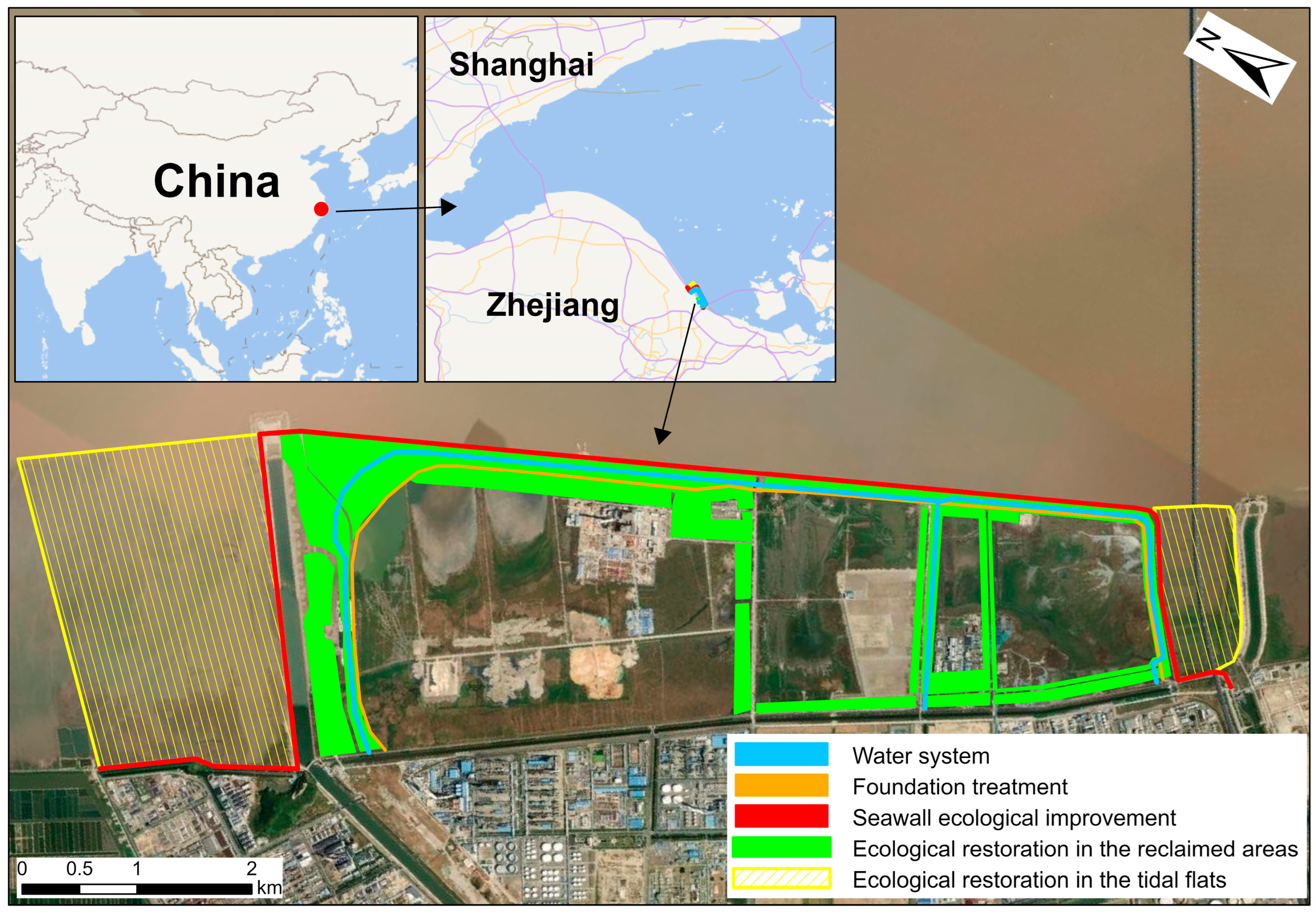
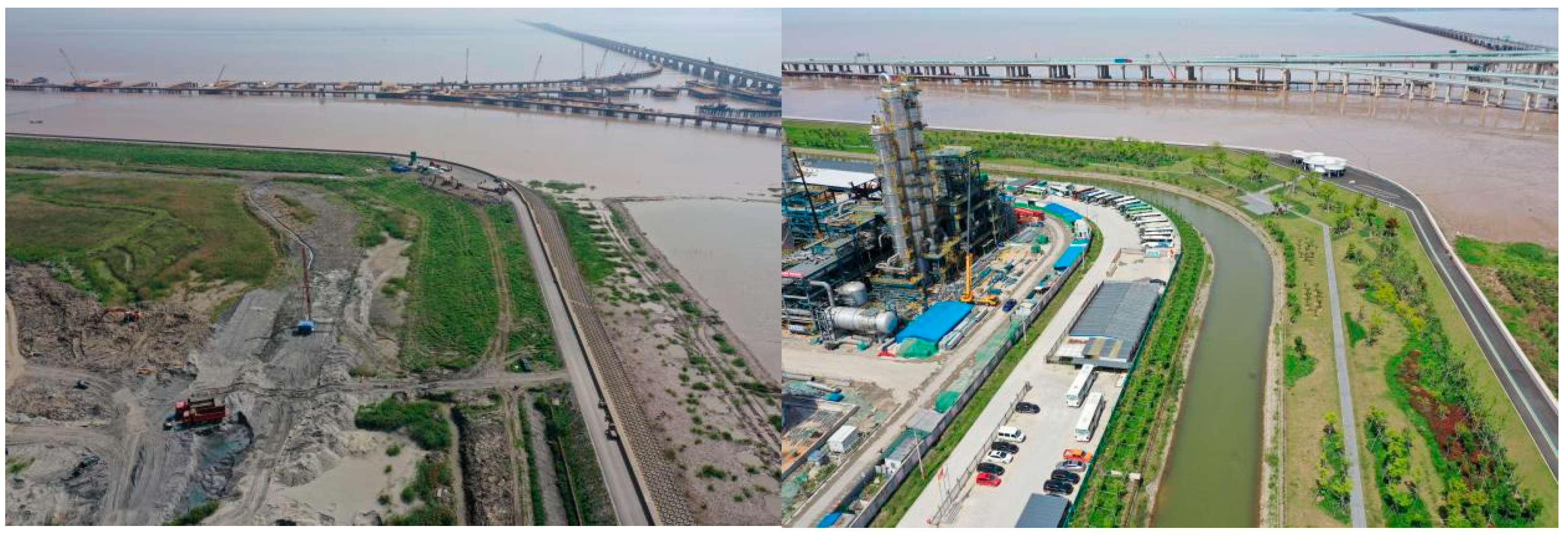
2.1. Study Area
2.2. Conflict-Coordination Framework
2.2.1. Coastal Comprehensive Conflict
2.2.2. Multi-Objective Coordination Degree
- (1)
- Whole-life-cycle carbon emissions
- (2)
- Comprehensive impact intensity
- (3)
- Living shoreline index
- (4)
- Multi-objective coordination degree
2.2.3. Conflict-Coordination Model
3. Results
3.1. Coastal Comprehensive Conflict Intensity
3.2. Conflicts and Multi-Objective Coordination
4. Discussion
5. Conclusions
Author Contributions
Funding
Institutional Review Board Statement
Informed Consent Statement
Data Availability Statement
Conflicts of Interest
References
- Gai, M.; Xu, J. Research progress on coastal resilience and new thinking on integrating human-nature system. Mar. Econ. 2024, 14, 42–55. [Google Scholar] [CrossRef]
- Hou, X.; Guo, Y. Assessment of natural attributes of China’s mainland coastline. J. Trop. Oceanogr. 2025, 1–10. Available online: https://link.cnki.net/urlid/44.1500.p.20250627.1602.002 (accessed on 18 September 2025).
- Cui, Y.; Yan, F.; He, B.; Ju, C.; Su, F. Characteristics of shoreline changes around the South China Sea from 1980 to 2020. Front. Mar. Sci. 2022, 9, 1005284. [Google Scholar] [CrossRef]
- Hosseinzadeh, N.; Ghiasian, M.; Andiroglu, E.; Lamere, J.; Rhode-Barbarigos, L.; Sobczak, J.; Sealey, K.S.; Suraneni, P. Concrete seawalls: A review of load considerations, ecological performance, durability, and recent innovations. Ecol. Eng. 2022, 178, 106573. [Google Scholar] [CrossRef]
- Gittman, R.K.; Scyphers, S.B.; Smith, C.S.; Neylan, I.P.; Grabowski, J.H. Ecological Consequences of Shoreline Hardening: A Meta-Analysis. BioScience 2016, 66, 763–773. [Google Scholar] [CrossRef] [PubMed]
- Dugan, J.E.; Airoldi, L.; Chapman, M.G.; Walker, S.J.; Schlacher, T.; Wolanski, E.; McLusky, D. Estuarine and coastal structures: Environmental effects, a focus on shore and nearshore structures. In Treatise on Estuarine and Coastal Science; Wolanski, E., McLusky, D., Eds.; Academic Press: London, UK, 2012; Volume 8, pp. 17–41. [Google Scholar] [CrossRef]
- Morris, R.L.; Bilkovic, D.M.; Walles, B.; Strain, E.M. Nature-based coastal defence: Developing the knowledge needed for wider implementation of living shorelines. Ecol. Eng. 2022, 185, 106798. [Google Scholar] [CrossRef]
- Chowdhury, M.S.N.; La Peyre, M.; Coen, L.D.; Morris, R.L.; Luckenbach, M.W.; Ysebaert, T.; Walles, B.; Smaal, A.C. Ecological engineering with oysters enhances coastal resilience efforts. Ecol. Eng. 2021, 169, 106320. [Google Scholar] [CrossRef]
- Currin, C.A.; Delano, P.C.; Valdes-Weaver, L.M. Utilization of a citizen monitoring protocol to assess the structure and function of natural and stabilized fringing salt marshes in North Carolina. Wetl. Ecol. Manag. 2008, 16, 97–118. [Google Scholar] [CrossRef]
- Currin, C.A. Living shorelines for coastal resilience. In Coastal Wetlands, 2nd ed.; Perillo, G.M.E., Wolanski, E., Cahoon, D.R., Hopkinson, C.S., Eds.; Elsevier: London, UK, 2019; pp. 1023–1053. [Google Scholar] [CrossRef]
- O’Donnell, J.E.D. Living shorelines: A review of literature relevant to New England Coasts. J. Coast. Res. 2016, 33, 435–451. [Google Scholar] [CrossRef]
- Smith, C.S.; Puckett, B.; Gittman, R.K.; Peterson, C.H. Living shorelines enhanced the resilience of saltmarshes to Hurricane Matthew (2016). Ecol. Appl. 2018, 28, 871–877. [Google Scholar] [CrossRef]
- Isdell, R.E.; Bilkovic, D.M.; Guthrie, A.G.; Mitchell, M.M.; Chambers, R.M.; Leu, M.; Hershner, C. Living shorelines achieve functional equivalence to natural fringe marshes across multiple ecological metrics. PeerJ 2021, 9, e11815. [Google Scholar] [CrossRef]
- NOAA’s Magnolia River Living Shoreline Project, Magnolia Springs, AL. Available online: https://www.habitatblueprint.noaa.gov/magnolia-springs/ (accessed on 18 September 2025).
- NOAA’s Pivers Island Living Shoreline Project, Beaufort, NC. Available online: https://www.habitatblueprint.noaa.gov/living-shorelines/beaufort/ (accessed on 18 September 2025).
- NOAA’s Powel Living Shoreline Project, Bainbridge Island, WA. Available online: https://www.habitatblueprint.noaa.gov/living-shorelines/bainbridge-island/ (accessed on 18 September 2025).
- Long, L.; Bai, J.; Xie, T.; Xiao, C.; Zhang, G.; Chen, G. Living estuarine shorelines as nature-based green engineering for coastal stabilization: A scientometric analysis. Ecol. Eng. 2024, 208, 107361. [Google Scholar] [CrossRef]
- Mi, J.; Zhang, M.; Zhu, Z.; Vuik, V.; Wen, J.; Gao, H.; Bouma, T.J. Morphological wave attenuation of the nature-based flood defense: A case study from Chongming Dongtan Shoal, China. Sci. Total Environ. 2022, 831, 154813. [Google Scholar] [CrossRef] [PubMed]
- Gu, X.J.; Deng, J.M.; Zeng, J.; Han, Y.; Zhang, G.Z.; Wang, F.F.; Quan, Z.J. Conceptual identification and evaluation index system for living shorelines. China Environ. Sci. 2024, 44, 3387–3394. [Google Scholar] [CrossRef]
- Smee, D.L. Coastal Ecology: Living Shorelines Reduce Coastal Erosion. Curr. Biol. 2019, 29, R411–R413. [Google Scholar] [CrossRef]
- Guthrie, A.G.; Bilkovic, D.M.; Mitchell, M.; Chambers, R.; Thompson, J.S.; Isdell, R.E. Ecological equivalency of living shorelines and natural marshes for fish and crustacean communities. Ecol. Eng. 2022, 176, 106511. [Google Scholar] [CrossRef]
- Dario, C.; Curley, C.; Mach, K.J. Shaping coastal nature-based solutions: Perceptions and policy priorities of living shorelines. Nat.-Based Solut. 2024, 6, 100179. [Google Scholar] [CrossRef]
- Smith, C.S.; Kochan, D.P.; Neylan, I.P.; Gittman, R.K. Living Shorelines Equal or Outperform Natural Shorelines as Fish Habitat Over Time: Updated Results from a Long-Term BACI Study at Multiple Sites. Estuaries Coasts 2024, 47, 2655–2669. [Google Scholar] [CrossRef]
- Marine Eco-Environmental Protection in China. Available online: http://www.scio.gov.cn/zfbps/zfbps_2279/202407/t20240711_854815.html (accessed on 17 October 2025).
- Opinions of the CPC Central Committee and the State Council on Fully, Accurately, and Comprehensively Implementing the New Development Philosophy and Effectively Achieving Carbon Peak and Carbon Neutrality. Available online: https://www.gov.cn/zhengce/2021-10/24/content_5644613.htm (accessed on 17 October 2025).
- Sánchez-Arcilla, A.; Cáceres, I.; Le Roux, X.; Hinkel, J.; Schuerch, M.; Nicholls, R.J.; Staneva, J.; de Vries, M.; Pernice, U.; Briere, C.; et al. Barriers and enablers for upscaling coastal restoration. Nat.-Based Solut. 2022, 2, 100032. [Google Scholar] [CrossRef]
- Wang, N.; Li, J.M.; Xu, Z.H.; Shan, J.Z. Benefit assessment of the ecological restoration of the Yellow River Delta coastal wetland based on improved contingent valuation method. Ocean Coast. Manag. 2025, 268, 107753. [Google Scholar] [CrossRef]
- Zhang, P.; Wang, J.; Zhu, Y.; Ge, P.; Liu, Z. Assessment of Ecosystem Service Value and Implementation Pathways: A Case Study of Jiangsu Jianchuan Ecological Restoration Project. Land 2025, 14, 1618. [Google Scholar] [CrossRef]
- Perera, D.; Abunada, Z.; AlQabany, A. Coupled Human and Natural Systems: A Novel Framework for Complexity Management. Sustainability 2024, 16, 9661. [Google Scholar] [CrossRef]
- Li, Y.; Sang, S.; Mote, S.; Rivas, J.; Kalnay, E. Challenges and opportunities for modeling coupled human and natural systems. Natl. Sci. Rev. 2023, 10, nwad054. [Google Scholar] [CrossRef]
- Ellis, J.; Macpherson, E.; Thrush, S.; Fisher, K.; Pilditch, C.; Jorgensen, E.; Low, J.; Stephenson, F.; Allison, A.; Geange, S.; et al. Scale and ecosystem-based management: Navigating mismatches between socio-ecological systems. Biol. Conserv. 2025, 302, 111000. [Google Scholar] [CrossRef]
- Liu, J.; Zhao, Y.; Chen, X.; Akarsha, S. Ecosystem-based management approaches for watershed conservation and geosustainability. Heliyon 2024, 10, e29800. [Google Scholar] [CrossRef]
- Gu, J.; Han, Y.; Luo, L.; Zeng, J. A comprehensive framework for evaluating coastal spatial conflicts: Insights from four marine space use cases in China. Reg. Stud. Mar. Sci. 2025, 90, 104433. [Google Scholar] [CrossRef]
- Respect Ecology and Uphold the Red Line. Available online: https://www.ccdi.gov.cn/yaowenn/202201/t20220107_162981.html (accessed on 23 September 2025).
- Huang, Y.; Liu, Y.; Xu, W.; Li, J. Life cycle carbon emissions of water reservoir and hydroelectric projects: A case study of the Quanmutang project. J. Tsinghua Univ. (Sci. Technol.) 2022, 62, 1366–1373. [Google Scholar] [CrossRef]
- T/CSES 173-2024; Index System for Living Shoreline Evaluation. Standards Press of China: Beijing, China, 2024.
- An, T.; Wang, T.; Gao, J. Methods and applications of ecosystem-based coastal management zoning. Ecol. Econ. 2024, 40, 159–165. [Google Scholar]
- Xiao, C.; Bai, J.; Chen, G.; Long, L.; Qiu, J.; Xu, Y.; Xie, T.; Cui, L. Global trends, hotspots and future prospects of ecological resilience of coastal wetlands: A bibliometric analysis. Mar. Pollut. Bull. 2025, 221, 118475. [Google Scholar] [CrossRef] [PubMed]
- Yang, W.; Tanner, C.C.; Holland, P.; Qu, Z. Dynamic economic valuation of coastal wetland restoration: A nature-based solution for climate and biodiversity. Environ. Chall. 2025, 20, 101182. [Google Scholar] [CrossRef]
- Yuanita, N.; Kurniawan, A.; Nurmansyah, I.M.; Rizaldi, F.M. A physical model simulation of combination of a geo-bag dike and mangrove vegetation as a natural coastal protection system for the Indonesian shoreline. Appl. Ocean Res. 2021, 108, 102516. [Google Scholar] [CrossRef]
- Han, Y.; Zeng, J.; Ye, J.; Zhou, X.; Wu, H.; Lu, L.; Yuan, P. Basic concept of ecological seawalls and its scheme design application in Wenzhou. Zhejiang Hydrotech. 2022, 50, 18–22. [Google Scholar] [CrossRef]

| Dimension | Index | Level | Value |
|---|---|---|---|
| P. Policy | P1. Marine Ecological Redline | Within, except permitted marine use types | 1 |
| Outside | 0 | ||
| S. Social environment | S1. GDP per Capita (104 CNY) | >15 | 1 |
| 10~15 | 0.7 | ||
| 5~10 | 0.4 | ||
| <5 | 0.1 | ||
| S2. Coastal economic density (GDP/Coastline length) (108 CNY/km) | >15 | 1 | |
| 10~15 | 0.7 | ||
| 5~10 | 0.4 | ||
| <5 | 0.1 | ||
| S3. Pollution emission intensity (wastewater emission/GDP) (104 tons/108 CNY) | >3 | 1 | |
| 2~3 | 0.7 | ||
| 1~2 | 0.4 | ||
| <1 | 0.1 | ||
| S4. Expenditure for environmental protection (108 CNY) | <5 | 1 | |
| 5~10 | 0.7 | ||
| 10~15 | 0.4 | ||
| >15 | 0.1 | ||
| S5. Ocean governance capacity | Low | 1 | |
| Moderate | 0.6 | ||
| High | 0.2 | ||
| E. Ecological environment | E1. Water quality a | Worse than Grade IV | 1 |
| Grade IV | 0.8 | ||
| Grade III | 0.6 | ||
| Grade II | 0.4 | ||
| Grade I | 0.2 | ||
| E2. Sediment quality a | Grade III | 1 | |
| Grade II | 0.6 | ||
| Grade I | 0.2 | ||
| E3. Biodiversity index a | <1 | 1 | |
| 1~2 | 0.8 | ||
| 2~3 | 0.6 | ||
| 3~4 | 0.4 | ||
| >4 | 0.2 | ||
| E4. Net primary productivity a (mg C/m2·d) | <50 | 1 | |
| 50~60 | 0.8 | ||
| 60~70 | 0.6 | ||
| 70~80 | 0.4 | ||
| >80 | 0.2 | ||
| T. Technical capacity | T1. Mode of marine use b | Entire change in ocean attributes | 1 |
| Partial change in ocean attributes | 0.6 | ||
| No change in ocean attributes | 0.2 | ||
| T2. Time period of marine space use | Permanent | 1 | |
| Non-permanent | 0.5 | ||
| T3. Areal proportion of constructed entity | Area of constructed entity/area of project | 0~1 | |
| T4. Areal proportion of impact zone | Area of 5%–flow velocity change/double area of project | 0~1 | |
| T5. Materials of constructed entity | Low ecofriendly | 1 | |
| Moderate ecofriendly | 0.6 | ||
| High ecofriendly | 0.2 | ||
| T6. Ecological Improvement | 1-ecological investment/total project investment | 0~1 |
| Indicators | Comprehensive Impact Weight | ||
|---|---|---|---|
| Production Coastline | Living Coastline | Ecological Coastline | |
| Soil type | 0.0511 | 0.0701 | 0.0685 |
| Coastal erosion | 0.0511 | 0.0701 | 0.0685 |
| Areal proportion of ecological redline | 0.1209 | 0.1600 | 0.1277 |
| Seawater quality | 0.0468 | 0.1035 | 0.0889 |
| Marine debris in coastal waters | 0.0468 | 0.1035 | 0.0889 |
| Total length of coastline | 0.0699 | 0.0647 | 0.0522 |
| Natural coastline retention rate | 0.0699 | 0.0647 | 0.0522 |
| Backshore vegetation coverage | 0.0595 | 0.0745 | 0.1209 |
| Intertidal biodiversity | 0.0595 | 0.0745 | 0.1209 |
| Carbon sink capacity of coastal wetlands | 0.0790 | 0.0620 | 0.1116 |
| Population density | 0.0969 | 0.0838 | 0.0596 |
| Total output value of marine fisheries | 0.1239 | 0.0340 | 0.0198 |
| Output value of coastal tourism | 0.1239 | 0.0340 | 0.0198 |
| Policy | Social Environment | Ecological Environment | Technical Capacity | Comprehensive Conflict Intensity (CCI) | |
|---|---|---|---|---|---|
| Reclamation | 0 | 0.860 | 0.700 | 0.832 | 0.806 |
| Ecological restoration and seawall ecologization | 0 | 0.860 | 0.650 | 0.514 | 0.635 |
Disclaimer/Publisher’s Note: The statements, opinions and data contained in all publications are solely those of the individual author(s) and contributor(s) and not of MDPI and/or the editor(s). MDPI and/or the editor(s) disclaim responsibility for any injury to people or property resulting from any ideas, methods, instructions or products referred to in the content. |
© 2025 by the authors. Licensee MDPI, Basel, Switzerland. This article is an open access article distributed under the terms and conditions of the Creative Commons Attribution (CC BY) license (https://creativecommons.org/licenses/by/4.0/).
Share and Cite
Gu, J.; Wei, X.; Han, Y.; Zeng, J.; Hu, M.; Gong, Z. A Conflict-Coordination Framework for Constructing Living Shorelines: A Case Study of Ecological Seawalls. Sustainability 2025, 17, 10050. https://doi.org/10.3390/su172210050
Gu J, Wei X, Han Y, Zeng J, Hu M, Gong Z. A Conflict-Coordination Framework for Constructing Living Shorelines: A Case Study of Ecological Seawalls. Sustainability. 2025; 17(22):10050. https://doi.org/10.3390/su172210050
Chicago/Turabian StyleGu, Jiali, Xiaoran Wei, Yu Han, Jian Zeng, Miao Hu, and Zheng Gong. 2025. "A Conflict-Coordination Framework for Constructing Living Shorelines: A Case Study of Ecological Seawalls" Sustainability 17, no. 22: 10050. https://doi.org/10.3390/su172210050
APA StyleGu, J., Wei, X., Han, Y., Zeng, J., Hu, M., & Gong, Z. (2025). A Conflict-Coordination Framework for Constructing Living Shorelines: A Case Study of Ecological Seawalls. Sustainability, 17(22), 10050. https://doi.org/10.3390/su172210050

