A Model of Factors Influencing Continuance Intention and Actual Usage of Self-Hosted Software Solutions



Abstract
1. Introduction
1.1. Background and Motivation
1.2. Research Problem and Objectives
1.3. Contribution and Significance of the Study
1.4. Structure of the Paper
2. Theoretical Background and Hypothesis Development
2.1. Factors Influencing Intention to Use Self-Hosting
2.1.1. Privacy Concerns
2.1.2. Perceived Autonomy
2.1.3. Perceived Trust
2.1.4. Personal Innovativeness
2.1.5. Perceived Enjoyment
2.1.6. Perceived Usefulness and Perceived Ease of Use
2.1.7. Exclusion of “Attitude Towards Use”
2.2. Continuance Intention and Its Moderated Influence on Actual Usage
2.2.1. Perceived Competence
2.2.2. Perceived Maintenance Cost
3. Methodology
3.1. Research Design and Approach
3.2. Population and Sampling
3.3. Data Collection Procedures
3.4. Measurement Instruments
3.5. Data Analysis Method
4. Results
4.1. Demographic Profile of Survey Respondents
4.2. Measurement Model
4.2.1. Internal Consistency and Convergent Validity
4.2.2. Discriminant Validity
4.2.3. Factor Loadings and Weights
4.2.4. Collinearity Assessment
4.3. Structural Model
4.3.1. Assessment of Collinearity
4.3.2. Assessment of Path Coefficients and Their Significance
4.3.3. Explanatory Power of the Model
4.3.4. Analysis of Control Variables
4.4. Moderating Effect of Perceived Competence and Perceived Maintenance Cost
5. Discussion
5.1. Factors Influencing Continuance Intention
5.2. Continuance Intention and Its Impact on Actual Usage
5.3. The Moderating Role of Perceived Competence and Perceived Maintenance Cost
6. Conclusions
6.1. Theoretical and Practical Implications
6.2. Limitations and Future Research
Author Contributions
Funding
Institutional Review Board Statement
Informed Consent Statement
Data Availability Statement
Conflicts of Interest
Appendix A. Questionnaire Constructs and Items

| Construct | Adapted from | Item | Description |
|---|---|---|---|
| Privacy Concerns | [136,137] | PC1 | I hesitate before keeping my data on a cloud service. |
| PC2 | I feel uneasy about keeping my data on a cloud service. | ||
| PC3 | I get concerned when I keep my data on a cloud service. | ||
| PC4 | I am concerned that my data on a cloud service will be accessed and used by other people without my consent. | ||
| PC5 | I am concerned that using cloud services will reveal my privacy information. | ||
| Perceived Autonomy | [63,138,139] | PA1 | I am bothered when I do not have control over data that I provide to cloud services. [reversed-coded] |
| PA2 | I am bothered when I do not have control or autonomy over decisions about how my data is collected, used, and shared by cloud services. [reversed-coded] | ||
| PA3 | I am concerned when data sovereignty and control is lost or unwillingly reduced as a result of a Vendor Lock-In (hard to switch provider) with cloud services. [reversed-coded] | ||
| PA4 | It’s important to me that I can manage my data the way I want. [reversed-coded] | ||
| PA5 | I do not feel a sense of choice and freedom while using cloud services. [reversed-coded] | ||
| Personal Innovativeness | [140] | PI1 | If I hear about a new information technology, I look for ways to experiment with it. |
| PI2 | Among my peers, I am usually the first to try out new information technologies. | ||
| PI3 | In general, I am hesitant to try out new new information technologies. [reversed-coded] | ||
| PI4 | I like to experiment with new information technologies. | ||
| Perceived Trust | [138,141] | PT1 | Cloud services are trustworthy. |
| PT2 | Cloud services providers keep my best interests in mind. | ||
| PT3 | Cloud services providers keep promises and commitments. | ||
| PT4 | I believe that the services provided by cloud services providers are done in a reliable way. | ||
| PT5 | Cloud services providers handle my data in a competent manner. | ||
| Perceived Ease of Use | [90,142] | PEOU1 | Learning to use self-hosted services is easy for me. |
| PEOU2 | I find it easy to get self-hosted services to do what I want it to do. | ||
| PEOU3 | Using self-hosted services is clear and understandable for me. | ||
| PEOU4 | I find self-hosted services to be flexible to interact with. | ||
| PEOU5 | It is easy for me to become skillful at managing and using using self-hosted services. | ||
| PEOU6 | I find self-hosted services easy to use. | ||
| Perceived Competence | [143] | PCOMP1 | I think I am pretty good at self-hosting. |
| PCOMP2 | I am satisfied with my outcomes at self-hosting. | ||
| PCOMP3 | After managing self-hosting services for a while, I feel pretty skilful. | ||
| PCOMP4 | I am pretty skilled at managing self-hosted services. | ||
| PCOMP5 | I cannot manage self-hosting services very well. [reversed-coded] | ||
| Perceived Usefulness | [90,144] | PU1 | Using self-hosting services enables me to accomplish tasks more quickly. |
| PU2 | Using self-hosting services enhances my performance. | ||
| PU3 | Using self-hosting services enhances my productivity. | ||
| PU4 | Using self-hosting services enhances my effectiveness. | ||
| PU5 | I find self-hosting services useful. | ||
| Perceived Enjoyment | [90,142] | PE1 | Using self-hosting services is enjoyable. |
| PE2 | I have fun using self-hosting services. | ||
| PE3 | I like using self-hosting services. | ||
| PE4 | I am interested in educating myself on self-hosting topics. | ||
| PE5 | In my free time, I like to set up self-host services. | ||
| PE6 | I enjoy solving self-hosting related technical challenges. | ||
| Perceived Maintenance Cost | [145,146] | PMC1 | It takes a lot of time to set up self-hosted services. |
| PMC2 | It takes a lot of effort to set up self-hosted services. | ||
| PMC3 | I am willing to pay a substantial amount for hardware required for self-hosting. [reversed-coded] | ||
| PMC4 | I am willing to devote a considerable amount of my time to maintain self-hosted services. [reversed-coded] | ||
| Continuance Intention | [148] | CI1 | I intend to continue using self-hosting services in the future if possible. |
| CI2 | I will use self-hosting services regularly in the future if possible. | ||
| CI3 | I will frequently use self-hosting services in the future if possible. | ||
| CI4 | I will recommend self-hosting services to others. | ||
| CI5 | I intend to continue using self-hosted services rather than using any cloud alternatives if possible. |
| Item | Category | Examples Provided |
|---|---|---|
| USE1 | Home Automation & IoT | Home Assistant, Node RED, openHAB, Domoticz… |
| USE2 | Media Streaming (Video, Audio) | Jellyfin, Stash, PeerTube, Audiobookshelf, Navidrome, Snapcast… |
| USE3 | Automation | *arr Stack (Radarr, Sonarr, Lidarr…), n8n, changedetection.io, OliveTin… |
| USE4 | Password Managers | Vaultwarden, Passbolt, Passky… |
| USE5 | Photo Galleries | Immich, PhotoPrism, Lychee… |
| USE6 | Document Management | Paperless-ngx, Stirling-PD, Docspell… |
| USE7 | File Transfer & Synchronization | Syncthing, Nextcloud, Seafile… |
| USE8 | DNS | Pi-hole, AdGuard Home, Technitium… |
| USE9 | VPN | WireGuard, Headscale, Nebula… |
| USE10 | Feed Readers | FreshRSS, Miniflux, RSSHub… |
| USE11 | Personal Dashboards | Heimdall, Dashy, Homarr, Homer… |
| USE12 | Note-taking & Editors | Joplin, Memos, Standard Notes, Trilium Notes… |
| USE13 | Money, Budgeting & Management | Firefly III, Actual, Invoice Ninja… |
| USE14 | Software Project Management | Gitea, Forgejo, GitLab… |
| USE15 | Recipe Management | Mealie, Bar Assistant, RecipeSage… |
| USE16 | E-books Management | Calibre, Kavita, Komga… |
| USE17 | Wikis | Wiki.js, Dokuwiki, BookStack… |
| USE18 | Communication, Messaging & Notifications | Matrix, Mumble, Rocket.Chat, ntfy, Gotify… |
| USE19 | Bookmarks and Link Sharing | LinkWarden, linkding, Buku… |
| USE20 | Task Management & To-do Lists | Focalboard, Planka, Wekan… |
| USE21 | Metrics, Status and Uptime pages | Grafana, Uptime Kuma, Gatus, cState… |
References
- Changchit, C.; Chuchuen, C. Cloud computing: An examination of factors impacting users’ adoption. J. Comput. Inf. Syst. 2018, 58, 1–9. [Google Scholar] [CrossRef]
- Bairagi, S.I.; Bang, A.O. Cloud computing: History, architecture, security issues. Int. J. Advent Res. Comput. Electron. (IJARCE) 2015, 2015, 28. [Google Scholar]
- Surbiryala, J.; Rong, C. Cloud computing: History and overview. In Proceedings of the 2019 IEEE Cloud Summit, Washington, DC, USA, 8–10 August 2019; IEEE: New York, NY, USA, 2019; pp. 1–7. [Google Scholar]
- Ryan, M.D. Cloud computing privacy concerns on our doorstep. Commun. ACM 2011, 54, 36–38. [Google Scholar] [CrossRef]
- Chen, D.; Zhao, H. Data security and privacy protection issues in cloud computing. In Proceedings of the 2012 International Conference on Computer Science and Electronics Engineering, Hangzhou, China, 23–25 March 2012; IEEE: New York, NY, USA, 2012; Volume 1, pp. 647–651. [Google Scholar]
- Sen, J. Security and privacy issues in cloud computing. In Cloud Technology: Concepts, Methodologies, Tools, and Applications; IGI Global: Hershey, PA, USA, 2015; pp. 1585–1630. [Google Scholar]
- Hu, W.; Yang, T.; Matthews, J.N. The good, the bad and the ugly of consumer cloud storage. ACM SIGOPS Oper. Syst. Rev. 2010, 44, 110–115. [Google Scholar] [CrossRef]
- Svantesson, D.; Clarke, R. Privacy and consumer risks in cloud computing. Comput. Law Secur. Rev. 2010, 26, 391–397. [Google Scholar] [CrossRef]
- Syynimaa, N.; Viitanen, T. Is My Office 365 GDPR Compliant?: Security Issues in Authentication and Administration. In Proceedings of the 20th International Conference on Enterprise Information Systems, Madeira, Portugal, 21–24 March 2018. [Google Scholar]
- Pearson, S.; Benameur, A. Privacy, security and trust issues arising from cloud computing. In Proceedings of the 2010 IEEE Second International Conference on Cloud Computing Technology and Science, Indianapolis, IN, USA, 30 November–3 December 2010; IEEE: New York, NY, USA, 2010; pp. 693–702. [Google Scholar]
- Khan, K.M.; Malluhi, Q. Establishing trust in cloud computing. IT Prof. 2010, 12, 20–27. [Google Scholar] [CrossRef]
- Habib, S.M.; Hauke, S.; Ries, S.; Mühlhäuser, M. Trust as a facilitator in cloud computing: A survey. J. Cloud Comput. Adv. Syst. Appl. 2012, 1, 19. [Google Scholar] [CrossRef]
- Adjei, J.K. Explaining the role of trust in cloud computing services. Info 2015, 17, 54–67. [Google Scholar] [CrossRef]
- Dong, S.; Abbas, K.; Jain, R. A survey on distributed denial of service (DDoS) attacks in SDN and cloud computing environments. IEEE Access 2019, 7, 80813–80828. [Google Scholar] [CrossRef]
- Birch, K.; Cochrane, D.; Ward, C. Data as asset? The measurement, governance, and valuation of digital personal data by Big Tech. Big Data Soc. 2021, 8, 20539517211017308. [Google Scholar] [CrossRef]
- Arutyunov, V. Cloud computing: Its history of development, modern state, and future considerations. Sci. Tech. Inf. Process. 2012, 39, 173–178. [Google Scholar] [CrossRef]
- Tak, B.C.; Urgaonkar, B.; Sivasubramaniam, A. To move or not to move: The economics of cloud computing. In Proceedings of the 3rd USENIX Workshop on Hot Topics in Cloud Computing (HotCloud 11), Portland, OR, USA, 14–15 June 2011. [Google Scholar]
- Hashem, I.A.T.; Yaqoob, I.; Anuar, N.B.; Mokhtar, S.; Gani, A.; Khan, S.U. The rise of “big data” on cloud computing: Review and open research issues. Inf. Syst. 2015, 47, 98–115. [Google Scholar] [CrossRef]
- Rimal, B.P.; Lumb, I. The rise of cloud computing in the era of emerging networked society. In Cloud Computing: Principles, Systems and Applications; Springer: Cham, Switzerland, 2017; pp. 3–25. [Google Scholar]
- Islam, M.; Reza, S. The rise of big data and cloud computing. Internet Things Cloud Comput. 2019, 7, 45. [Google Scholar] [CrossRef]
- Byrne, D.; Corrado, C.; Sichel, D.E. The Rise of Cloud Computing: Minding Your P’s, Q’s and K’s; Technical Report; National Bureau of Economic Research: Cambridge, MA, USA, 2018. [Google Scholar]
- George, A.S.; Sagayarajan, S.; AlMatroudi, Y.; George, A.H. The Impact of Cloud Hosting Solutions on IT Jobs: Winners and Losers in the Cloud Era. Partners Univers. Int. Res. J. 2023, 2, 1–19. [Google Scholar]
- Duncan, B. Can eu general data protection regulation compliance be achieved when using cloud computing? Cloud Comput. 2018, 2018, 11. [Google Scholar]
- Škrinjar Vidović, M. EU data protection reform: Challenges for cloud computing. Croat. Yearb. Eur. Law Policy 2016, 12, 171–206. [Google Scholar] [CrossRef][Green Version]
- Karthiban, K.; Smys, S. Privacy preserving approaches in cloud computing. In Proceedings of the 2018 2nd International Conference on Inventive Systems and Control (ICISC), Coimbatore, India, 19–20 January 2018; IEEE: New York, NY, USA, 2018; pp. 462–467. [Google Scholar]
- Domingo-Ferrer, J.; Farras, O.; Ribes-González, J.; Sánchez, D. Privacy-preserving cloud computing on sensitive data: A survey of methods, products and challenges. Comput. Commun. 2019, 140, 38–60. [Google Scholar] [CrossRef]
- Chenthara, S.; Ahmed, K.; Wang, H.; Whittaker, F. Security and privacy-preserving challenges of e-health solutions in cloud computing. IEEE Access 2019, 7, 74361–74382. [Google Scholar] [CrossRef]
- Gholami, M.F.; Daneshgar, F.; Low, G.; Beydoun, G. Cloud migration process—A survey, evaluation framework, and open challenges. J. Syst. Softw. 2016, 120, 31–69. [Google Scholar] [CrossRef]
- Silva, G.C.; Rose, L.M.; Calinescu, R. A systematic review of cloud lock-in solutions. In Proceedings of the 2013 IEEE 5th International Conference on Cloud Computing Technology and Science, Bristol, UK, 2–5 December 2013; IEEE: New York, NY, USA, 2013; Volume 2, pp. 363–368. [Google Scholar]
- Razavian, S.M.; Khani, H.; Yazdani, N.; Ghassemi, F. An analysis of vendor lock-in problem in cloud storage. In Proceedings of the ICCKE 2013, Mashhad, Iran, 31 October–1 November 2013; IEEE: New York, NY, USA, 2013; pp. 331–335. [Google Scholar]
- Gröber, L.; Mrowczynski, R.; Vijay, N.; Muller, D.A.; Dabrowski, A.; Krombholz, K. To Cloud or not to Cloud: A Qualitative Study on Self-Hosters’ Motivation, Operation, and Security Mindset. In Proceedings of the 32nd USENIX Security Symposium (USENIX Security 23), Anaheim, CA, USA, 9–11 August 2023; pp. 2491–2508. [Google Scholar]
- Ion, I.; Sachdeva, N.; Kumaraguru, P.; Čapkun, S. Home is safer than the cloud! Privacy concerns for consumer cloud storage. In Proceedings of the Seventh Symposium on Usable Privacy and Security, Pittsburgh, PA, USA, 20–22 July 2011; pp. 1–20. [Google Scholar]
- Stuermer, M.; Abu-Tayeh, G.; Myrach, T. Digital sustainability: Basic conditions for sustainable digital artifacts and their ecosystems. Sustain. Sci. 2017, 12, 247–262. [Google Scholar] [CrossRef]
- Molnar, D.; Schechter, S.E. Self Hosting vs. Cloud Hosting: Accounting for the Security Impact of Hosting in the Cloud; Citeseer: Princeton, NJ, USA, 2010; Volume 2010, pp. 1–18. [Google Scholar]
- Kong, J. A practical approach to improve the data privacy of virtual machines. In Proceedings of the 2010 10th IEEE International Conference on Computer and Information Technology, Bradford, UK, 29 June–1 July 2010; IEEE: New York, NY, USA, 2010; pp. 936–941. [Google Scholar]
- Yacob, T. Securing Sensitive Data in the Cloud: A New Era of Security Through Zero Trust Principles; KTH: Huddinge, Sweden, 2023. [Google Scholar]
- Verborgh, R. Re-decentralizing the Web, for good this time. In Linking the World’s Information: Essays on Tim Berners-Lee’s Invention of the World Wide Web; Association for Computing Machinery: New York, NY, USA, 2023; pp. 215–230. [Google Scholar]
- Asgarinia, H.; Chomczyk Penedo, A.; Esteves, B.; Lewis, D. “Who Should I Trust with My Data?” Ethical and Legal Challenges for Innovation in New Decentralized Data Management Technologies. Information 2023, 14, 351. [Google Scholar] [CrossRef]
- GitHub—Awesome-Selfhosted/Awesome-Selfhosted: A List of Free Software Network Services and Web Applications Which Can Be Hosted on Your Own Servers—github.com. 2025. Available online: https://github.com/awesome-selfhosted/awesome-selfhosted (accessed on 11 July 2025).
- Qasem, Y.A.M.; Abdullah, R.; Jusoh, Y.Y.; Atan, R.; Asadi, S. Analyzing Continuance of Cloud Computing in Higher Education Institutions: Should We Stay, or Should We Go? Sustainability 2021, 13, 4664. [Google Scholar] [CrossRef]
- Pańkowska, M.; Pyszny, K.; Strzelecki, A. Users’ Adoption of Sustainable Cloud Computing Solutions. Sustainability 2020, 12, 9930. [Google Scholar] [CrossRef]
- Goode, S. Keeping the user in the cloud: A cognitive social capital antecedent to use continuance and trust-commitment in personal cloud storage services. Behav. Inf. Technol. 2019, 38, 701–725. [Google Scholar] [CrossRef]
- Behrend, T.S.; Wiebe, E.N.; London, J.E.; Johnson, E.C. Cloud computing adoption and usage in community colleges. Behav. Inf. Technol. 2011, 30, 231–240. [Google Scholar] [CrossRef]
- Ho, S.M.; Ocasio-Velázquez, M.; Booth, C. Trust or consequences? Causal effects of perceived risk and subjective norms on cloud technology adoption. Comput. Secur. 2017, 70, 581–595. [Google Scholar] [CrossRef]
- Chang, K.C.; Seow, Y.M. Adoption Intention on Cloud Storage Services: The Role of Technology Trust, Privacy and Security Concerns. In Proceedings of the PACIS, Chiayi, Taiwan, 27 June–1 July 2016; p. 79. [Google Scholar]
- Utomo, R.G.; Yasirandi, R. Exploring trust, privacy, and security in cloud storage adoption among generation Z: An extended TAM approach. Kinet. Game Technol. Inf. Syst. Comput. Netw. Comput. Electron. Control 2024, 9. [Google Scholar] [CrossRef]
- Marx, T. The push-pull-mooring model of consumer service switching: A meta-analytical review to guide future research. J. Serv. Theory Pract. 2025, 35, 1–29. [Google Scholar] [CrossRef]
- Liao, C.; Palvia, P.; Chen, J.L. Information technology adoption behavior life cycle: Toward a Technology Continuance Theory (TCT). Int. J. Inf. Manag. 2009, 29, 309–320. [Google Scholar] [CrossRef]
- Rahi, S.; Khan, M.M.; Alghizzawi, M. Extension of technology continuance theory (TCT) with task technology fit (TTF) in the context of Internet banking user continuance intention. Int. J. Qual. Reliab. Manag. 2021, 38, 986–1004. [Google Scholar] [CrossRef]
- Tatić, K.; Haračić, M.; Činjarević, M.; Haračić, M. Let’s cloud with me! users’ willingness to use cloud computing services as a function of social norms. Ekon. Vjesn./Econviews-Rev. Contemp. Bus. Entrep. Econ. Issues 2022, 35, 275–285. [Google Scholar] [CrossRef]
- Malhotra, N.K.; Kim, S.S.; Agarwal, J. Internet users’ information privacy concerns (IUIPC): The construct, the scale, and a causal model. Inf. Syst. Res. 2004, 15, 336–355. [Google Scholar] [CrossRef]
- Chang, S.E.; Liu, A.Y.; Lin, S. Exploring privacy and trust for employee monitoring. Ind. Manag. Data Syst. 2015, 115, 88–106. [Google Scholar] [CrossRef]
- Nofer, M.; Hinz, O.; Muntermann, J.; Roßnagel, H. The economic impact of privacy violations and security breaches: A laboratory experiment. Bus. Inf. Syst. Eng. 2014, 6, 339–348. [Google Scholar] [CrossRef]
- Sridhar, V. What Are the Privacy Issues Over Data Collected by the Internet and Telecom Firms? In Emerging ICT Policies and Regulations: Roadmap to Digital Economies; Springer: Singapore, 2019; pp. 233–264. [Google Scholar]
- Xu, H.; Wang, J.; Tai, Z.; Lin, H.C. Empirical study on the factors affecting user switching behavior of online learning platform based on push-pull-mooring theory. Sustainability 2021, 13, 7087. [Google Scholar] [CrossRef]
- Chen, Y.; Li, X.; Li, Q.; Li, W. Exploring customers’ switching from native to lightweight apps: A push–pull–mooring framework perspective. Ind. Manag. Data Syst. 2022, 122, 2633–2656. [Google Scholar] [CrossRef]
- Gashami, J.P.G.; Chang, Y.; Rho, J.J.; Park, M.C. Privacy concerns and benefits in SaaS adoption by individual users: A trade-off approach. Inf. Dev. 2016, 32, 837–852. [Google Scholar] [CrossRef]
- Liu, C.; Marchewka, J.T.; Lu, J.; Yu, C.S. Beyond concern—A privacy-trust-behavioral intention model of electronic commerce. Inf. Manag. 2005, 42, 289–304. [Google Scholar] [CrossRef]
- Arpaci, I. Understanding and predicting students’ intention to use mobile cloud storage services. Comput. Hum. Behav. 2016, 58, 150–157. [Google Scholar] [CrossRef]
- Chang, Y.W.; Hsu, P.Y. An empirical investigation of organizations’ switching intention to cloud enterprise resource planning: A cost-benefit perspective. Inf. Dev. 2019, 35, 290–302. [Google Scholar] [CrossRef]
- Gröber, L.; Lenau, S.; Weil, R.; Groben, E.; Schilling, M.; Krombholz, K. Towards Privacy and Security in Private Clouds: A Representative Survey on the Prevalence of Private Hosting and Administrator Characteristics. In Proceedings of the 33rd USENIX Security Symposium (USENIX Security 24), Philadelphia, PA, USA, 14–16August 2024; pp. 6057–6074. [Google Scholar]
- Ryan, R.M.; Deci, E.L. Overview of self-determination theory: An organismic dialectical perspective. Handb. Self-Determ. Res. 2002, 2, 36. [Google Scholar]
- Li, Y.; Chang, K.C.; Wang, J. Self-determination and perceived information control in cloud storage service. J. Comput. Inf. Syst. 2020, 60, 113–123. [Google Scholar] [CrossRef]
- Wang, X.; Li, Y. Users’ satisfaction with social network sites: A self-determination perspective. J. Comput. Inf. Syst. 2016, 56, 48–54. [Google Scholar] [CrossRef]
- John, W.; Charag, A.H.; Bashir, I. Indian Millennials’ continued usage intentions toward online dating apps: The interplay between trust and perceived autonomy. Young Consum. 2025, 26, 207–226. [Google Scholar] [CrossRef]
- Li, Y.; Chang, K.-C.; Wang, J. How User Information Assurance Influences Perceived Information Control in Cloud Storage Service: A Self-Determination Perspective. J. Comput. Inf. Syst. 2017, 60, 1–11. [Google Scholar]
- Gagné, M.; Deci, E.L. Self-determination theory and work motivation. J. Organ. Behav. 2005, 26, 331–362. [Google Scholar] [CrossRef]
- Teck Soon, H.; Syed, A.; Kadir, S.L. The drivers for cloud-based virtual learning environment: Examining the moderating effect of school category. Internet Res. 2017, 27, 942–973. [Google Scholar] [CrossRef]
- Hew, T.S.; Kadir, S.L.S.A. Predicting the acceptance of cloud-based virtual learning environment: The roles of Self Determination and Channel Expansion Theory. Telemat. Inform. 2016, 33, 990–1013. [Google Scholar] [CrossRef]
- McEvily, B.; Perrone, V.; Zaheer, A. Trust as an organizing principle. Organ. Sci. 2003, 14, 91–103. [Google Scholar] [CrossRef]
- Roca, J.C.; García, J.J.; De La Vega, J.J. The importance of perceived trust, security and privacy in online trading systems. Inf. Manag. Comput. Secur. 2009, 17, 96–113. [Google Scholar] [CrossRef]
- Mayer, R.C.; Davis, J.H.; Schoorman, F.D. An integrative model of organizational trust. Acad. Manag. Rev. 1995, 20, 709–734. [Google Scholar] [CrossRef]
- Chen, L.Y. Perceived risk and trust in the adoption of cloud computing services and their effects on organizational performance. Int. J. Adv. Stud. Comput. Sci. Eng. 2017, 6, 24. [Google Scholar]
- Lynn, T.; van der Werff, L.; Fox, G. Understanding trust and cloud computing: An integrated framework for assurance and accountability in the cloud. In Data Privacy and Trust in Cloud Computing: Building Trust in the Cloud Through Assurance and Accountability; Palgrave Macmillan: Cham, Switzerland, 2021; pp. 1–20. [Google Scholar]
- Forster, K. Impact of Institutional Trust And Trust In Cloud Service Provider on the Adoption of Cloud Computing: A Quantitative Study. Ph.D. Thesis, Capella University, Minneapolis, MN, USA, 2021. [Google Scholar]
- Jones, M.A.; Mothersbaugh, D.L.; Beatty, S.E. Why customers stay: Measuring the underlying dimensions of services switching costs and managing their differential strategic outcomes. J. Bus. Res. 2002, 55, 441–450. [Google Scholar] [CrossRef]
- Agarwal, R.; Prasad, J. A conceptual and operational definition of personal innovativeness in the domain of information technology. Inf. Syst. Res. 1998, 9, 204–215. [Google Scholar] [CrossRef]
- Van Raaij, E.M.; Schepers, J.J. The acceptance and use of a virtual learning environment in China. Comput. Educ. 2008, 50, 838–852. [Google Scholar] [CrossRef]
- He, T.; Zhu, C. Digital informal learning among Chinese university students: The effects of digital competence and personal factors. Int. J. Educ. Technol. High. Educ. 2017, 14, 1–19. [Google Scholar] [CrossRef]
- Xu, H.; Gupta, S. The effects of privacy concerns and personal innovativeness on potential and experienced customers’ adoption of location-based services. Electron. Mark. 2009, 19, 137–149. [Google Scholar] [CrossRef]
- Alkawsi, G.; Ali, N.; Baashar, Y. The moderating role of personal innovativeness and users experience in accepting the smart meter technology. Appl. Sci. 2021, 11, 3297. [Google Scholar] [CrossRef]
- Simarmata, M.T.; Hia, I.J. The role of personal innovativeness on behavioral intention of Information Technology. J. Econ. Bus. 2020, 1, 18–29. [Google Scholar] [CrossRef]
- Prasanna Balasooriya, L.; Wibowo, S.; Grandhi, S.; Wells, M. The Impact of Security Concerns on Personal Innovativeness, Behavioural and Adoption Intentions of Cloud Technology. J. Softw. Netw. 2017, 1, 265–290. [Google Scholar]
- Arpaci, I.; Kilicer, K.; Bardakci, S. Effects of security and privacy concerns on educational use of cloud services. Comput. Hum. Behav. 2015, 45, 93–98. [Google Scholar] [CrossRef]
- Lu, J. Are personal innovativeness and social influence critical to continue with mobile commerce? Internet Res. 2014, 24, 134–159. [Google Scholar] [CrossRef]
- Venkatesh, V. Determinants of perceived ease of use: Integrating control, intrinsic motivation, and emotion into the technology acceptance model. Inf. Syst. Res. 2000, 11, 342–365. [Google Scholar] [CrossRef]
- Venkatesh, V.; Thong, J.Y.; Xu, X. Consumer acceptance and use of information technology: Extending the unified theory of acceptance and use of technology. MIS Q. 2012, 36, 157–178. [Google Scholar] [CrossRef]
- Venkatesh, V.; Bala, H. Technology acceptance model 3 and a research agenda on interventions. Decis. Sci. 2008, 39, 273–315. [Google Scholar] [CrossRef]
- Lin, C.Y.; Huang, C.K.; Ko, C.J. The impact of perceived enjoyment on team effectiveness and individual learning in a blended learning business course: The mediating effect of knowledge sharing. Australas. J. Educ. Technol. 2020, 36, 126–141. [Google Scholar] [CrossRef]
- Davis, F.D. Perceived usefulness, perceived ease of use, and user acceptance of information technology. MIS Q. 1989, 13, 319–340. [Google Scholar] [CrossRef]
- Davis, F.D.; Bagozzi, R.P.; Warshaw, P.R. Extrinsic and intrinsic motivation to use computers in the workplace 1. J. Appl. Soc. Psychol. 1992, 22, 1111–1132. [Google Scholar] [CrossRef]
- Abdalla, R.A. Examining awareness, social influence, and perceived enjoyment in the TAM framework as determinants of ChatGPT. Personalization as a moderator. J. Open Innov. Technol. Mark. Complex. 2024, 10, 100327. [Google Scholar] [CrossRef]
- Won, D.; Chiu, W.; Byun, H. Factors influencing consumer use of a sport-branded app: The technology acceptance model integrating app quality and perceived enjoyment. Asia Pac. J. Mark. Logist. 2023, 35, 1112–1133. [Google Scholar] [CrossRef]
- Holdack, E.; Lurie-Stoyanov, K.; Fromme, H.F. The role of perceived enjoyment and perceived informativeness in assessing the acceptance of AR wearables. J. Retail. Consum. Serv. 2022, 65, 102259. [Google Scholar] [CrossRef]
- Varghese, B.; Leitner, P.; Ray, S.; Chard, K.; Barker, A.; Elkhatib, Y.; Herry, H.; Hong, C.H.; Singer, J.; Tso, F.P.; et al. Cloud futurology. Computer 2019, 52, 68–77. [Google Scholar] [CrossRef]
- Sithipolvanichgul, J.; Chen, C.; Land, J.; Ractham, P. Enhancing user experiences with cloud computing via improving utilitarian and hedonic factors. Energies 2021, 14, 1822. [Google Scholar] [CrossRef]
- Jo, H. Antecedents of continuance intention of social networking services (SNS): Utilitarian, hedonic, and social contexts. Mob. Inf. Syst. 2022, 2022, 7904124. [Google Scholar] [CrossRef]
- Huang, Y.M. Students’ continuance intention toward programming games: Hedonic and utilitarian aspects. Int. J. Hum.-Comput. Interact. 2020, 36, 393–402. [Google Scholar] [CrossRef]
- Park, N.; Rhoads, M.; Hou, J.; Lee, K.M. Understanding the acceptance of teleconferencing systems among employees: An extension of the technology acceptance model. Comput. Hum. Behav. 2014, 39, 118–127. [Google Scholar] [CrossRef]
- Davis, F.D.; Bagozzi, R.P.; Warshaw, P.R. User acceptance of computer technology: A comparison of two theoretical models. Manag. Sci. 1989, 35, 982–1003. [Google Scholar] [CrossRef]
- Venkatesh, V.; Davis, F.D. A theoretical extension of the technology acceptance model: Four longitudinal field studies. Manag. Sci. 2000, 46, 186–204. [Google Scholar] [CrossRef]
- Featherman, M.S.; Pavlou, P.A. Predicting e-services adoption: A perceived risk facets perspective. Int. J. Hum.-Comput. Stud. 2003, 59, 451–474. [Google Scholar] [CrossRef]
- Ratten, V. A US-China comparative study of cloud computing adoption behavior: The role of consumer innovativeness, performance expectations and social influence. J. Entrep. Emerg. Econ. 2014, 6, 53–71. [Google Scholar] [CrossRef]
- Taylor, S.; Todd, P.A. Understanding information technology usage: A test of competing models. Inf. Syst. Res. 1995, 6, 144–176. [Google Scholar] [CrossRef]
- Tripathi, S. Understanding the determinants affecting the continuance intention to use cloud computing. J. Int. Technol. Inf. Manag. 2017, 26, 124–152. [Google Scholar] [CrossRef]
- Palos-Sanchez, P.R.; Arenas-Marquez, F.J.; Aguayo-Camacho, M. Cloud computing (SaaS) adoption as a strategic technology: Results of an empirical study. Mob. Inf. Syst. 2017, 2017, 2536040. [Google Scholar] [CrossRef]
- Gangwar, H.; Date, H. Critical factors of cloud computing adoption in organizations: An empirical study. Glob. Bus. Rev. 2016, 17, 886–904. [Google Scholar] [CrossRef]
- Sharma, S.K.; Al-Badi, A.H.; Govindaluri, S.M.; Al-Kharusi, M.H. Predicting motivators of cloud computing adoption: A developing country perspective. Comput. Hum. Behav. 2016, 62, 61–69. [Google Scholar] [CrossRef]
- Nurdin, N.; Pettalongi, S.S.; Mangasing, M. Understanding digital skill use from the technology continuance theory (TCT). In Proceedings of the 2019 6th International Conference on Information Technology, Computer and Electrical Engineering (ICITACEE), Semarang, Indonesi, 26–27 September 2019; IEEE: New York, NY, USA, 2019; pp. 1–6. [Google Scholar]
- Thompson, R.L.; Higgins, C.A.; Howell, J.M. Personal computing: Toward a conceptual model of utilization. MIS Q. 1991, 15, 125–143. [Google Scholar] [CrossRef]
- Teo, T. Modelling technology acceptance in education: A study of pre-service teachers. Comput. Educ. 2009, 52, 302–312. [Google Scholar] [CrossRef]
- Pai, C.K.; Wang, T.W.; Chen, S.H.; Cai, K.Y. Empirical study on Chinese tourists’ perceived trust and intention to use biometric technology. Asia Pac. J. Tour. Res. 2018, 23, 880–895. [Google Scholar] [CrossRef]
- Deci, E.L.; Ryan, R.M. The “what” and “why” of goal pursuits: Human needs and the self-determination of behavior. Psychol. Inq. 2000, 11, 227–268. [Google Scholar] [CrossRef]
- Marshik, T.; Ashton, P.T.; Algina, J. Teachers’ and students’ needs for autonomy, competence, and relatedness as predictors of students’ achievement. Soc. Psychol. Educ. 2017, 20, 39–67. [Google Scholar] [CrossRef]
- Goldhammer, F.; Gniewosz, G.; Zylka, J. ICT engagement in learning environments. In Assessing Contexts of Learning: An International Perspective; Springer: Cham, Switzerland, 2016; pp. 331–351. [Google Scholar]
- Fathali, S.; Okada, T. Technology acceptance model in technology-enhanced OCLL contexts: A self-determination theory approach. Australas. J. Educ. Technol. 2018, 34. [Google Scholar] [CrossRef]
- Aldraiweesh, A.; Alturki, U. Exploring factors influencing the acceptance of e-learning and students’ cooperation skills in higher education. Sustainability 2023, 15, 9363. [Google Scholar] [CrossRef]
- Zhao, Y.; Zhao, K.; Chen, I.H.; Wang, X.; Wei, S. Peer support and novice teachers’ willingness to participate in teaching reflection in online workshops: The mediating role of perceived competence and sense of belonging. Curr. Psychol. 2024, 43, 32324–32335. [Google Scholar] [CrossRef]
- Oduor, M.; Oinas-Kukkonen, H. Commitment devices as behavior change support systems: A study of users’ perceived competence and continuance intention. In Proceedings of the Persuasive Technology: Development and Implementation of Personalized Technologies to Change Attitudes and Behaviors: 12th International Conference, PERSUASIVE 2017, Amsterdam, The Netherlands, 4–6 April 2017; Proceedings 12. Springer: Berlin/Heidelberg, Germany, 2017; pp. 201–213. [Google Scholar]
- Lee, B.K.; Lee, E.H.; Lee, T. The effect of E-Government website evaluation on user satisfaction and intention to use: The mediating role of warmth and competence judgment on government. Inf. Commun. Soc. 2023, 26, 1868–1889. [Google Scholar] [CrossRef]
- Chan, S.H.; Song, Q.; Hays, L.E.; Trongmateeru, P. The roles of intrinsic and extrinsic motivation and perceived competence in enhancing system use and performance. In Proceedings of the Pacific Asia Conference on Information Systems, Chengdu, China, 24–28 June 2014. [Google Scholar]
- Rhodes, R.E.; Cox, A.; Sayar, R. What predicts the physical activity intention–behavior gap? A systematic review. Ann. Behav. Med. 2022, 56, 1–20. [Google Scholar] [CrossRef]
- Maier, C.; Laumer, S.; Eckhardt, A.; Weitzel, T. Using user personality to explain the intention-behavior gap and changes in beliefs: A longitudinal analysis. In Proceedings of the Thirty Third International Conference on Information Systems (ICIS 2012), Orlando, FL, USA, 16–19 December 2012. [Google Scholar]
- Divine, A.; Berry, T.; Rodgers, W.; Hall, C. The relationship of self-efficacy and explicit and implicit associations on the intention–behavior gap. J. Phys. Act. Health 2020, 18, 29–36. [Google Scholar] [CrossRef] [PubMed]
- Assadi, V.; Hassanein, K. Continuance intention to use high maintenance information systems: The role of perceived maintenance effort. In Proceedings of the European Conference on Information Systems (ECIS), Pretoria, South Africa, 7–9 June 2010; p. 88. [Google Scholar]
- Akbiyik, A.; Hassanein, K.; Head, M. Perceived maintenance load of high maintenance information systems: Conceptualization and development. In Proceedings of the Pacific Asia Conference on Information Systems, Singapore, 6–9 July 2015; p. 163. [Google Scholar]
- Jones, M.A.; Reynolds, K.E.; Mothersbaugh, D.L.; Beatty, S.E. The positive and negative effects of switching costs on relational outcomes. J. Serv. Res. 2007, 9, 335–355. [Google Scholar] [CrossRef]
- Dick, A.S.; Basu, K. Customer loyalty: Toward an integrated conceptual framework. J. Acad. Mark. Sci. 1994, 22, 99–113. [Google Scholar] [CrossRef]
- Li, J.; He, Y. Switching costs and users’ intentions of an app-enabled cross-border e-commerce platform: Examples of Amazon and Tmall Global. Asia Pac. J. Mark. Logist. 2024, 37, 556–572. [Google Scholar] [CrossRef]
- Krishnan, G.; Raghuram, J.N.V. Exploring diabetic patients’ intention to switch POCT self-monitoring glucose devices: Investigating influence of perceived usefulness and perceived ease of use. Int. J. Pharm. Healthc. Mark. 2024, 19, 160–178. [Google Scholar] [CrossRef]
- Chulkov, D.V. On the role of switching costs and decision reversibility in information technology adoption and investment. JISTEM-J. Inf. Syst. Technol. Manag. 2017, 14, 309–321. [Google Scholar] [CrossRef]
- Bansal, H.S.; Taylor, S.F.; St. James, Y. “Migrating” to new service providers: Toward a unifying framework of consumers’ switching behaviors. J. Acad. Mark. Sci. 2005, 33, 96–115. [Google Scholar] [CrossRef]
- Hong, H.; Xu, D. An empirical study of mobile social app continuance intention: Integrating flow experience and switching costs. Int. J. Netw. Virtual Organ. 2017, 17, 410–424. [Google Scholar] [CrossRef]
- Al-Jabali, R.N.; Ahmad, N.; Chiu, W. Continuance intention to use mobile fitness applications: The role of switching costs, guilt and neutralization techniques. Int. J. Sport. Mark. Spons. 2025, 26, 599–618. [Google Scholar] [CrossRef]
- Wu, K.; Vassileva, J.; Zhao, Y. Understanding users’ intention to switch personal cloud storage services: Evidence from the Chinese market. Comput. Hum. Behav. 2017, 68, 300–314. [Google Scholar] [CrossRef]
- Moqbel, M.; Bartelt, V.; Al-Suqri, M.; Al-Maskari, A. Does privacy matter to millennials? The case for personal cloud. J. Inf. Priv. Secur. 2017, 13, 17–33. [Google Scholar] [CrossRef]
- Chang, S.E.; Shen, W.C.; Liu, A.Y. Why mobile users trust smartphone social networking services? A PLS-SEM approach. J. Bus. Res. 2016, 69, 4890–4895. [Google Scholar] [CrossRef]
- Pal, D.; Arpnikanondt, C.; Razzaque, M.A. Personal information disclosure via voice assistants: The personalization–privacy paradox. SN Comput. Sci. 2020, 1, 280. [Google Scholar] [CrossRef]
- Guo, J.; Shan, S.; Ali Khan, Y. What are the impetuses Behind E-health applications’ self-management services’ ongoing adoption by health community participants? Health Inform. J. 2023, 29, 14604582231152801. [Google Scholar] [CrossRef] [PubMed]
- Koivisto, K.; Makkonen, M.; Frank, L.; Riekkinen, J. Extending the technology acceptance model with personal innovativeness and technology readiness: A comparison of three models. In Proceedings of the BLED 2016, Bled, Slovenia, 11–19 July 2016. [Google Scholar]
- Jarvenpaa, S.L.; Tractinsky, N.; Vitale, M. Consumer trust in an Internet store. Inf. Technol. Manag. 2000, 1, 45–71. [Google Scholar] [CrossRef]
- Teo, T.; Noyes, J. An assessment of the influence of perceived enjoyment and attitude on the intention to use technology among pre-service teachers: A structural equation modeling approach. Comput. Educ. 2011, 57, 1645–1653. [Google Scholar] [CrossRef]
- Ntoumanis, N. A self-determination approach to the understanding of motivation in physical education. Br. J. Educ. Psychol. 2001, 71, 225–242. [Google Scholar] [CrossRef]
- Sagnier, C.; Loup-Escande, E.; Lourdeaux, D.; Thouvenin, I.; Valléry, G. User acceptance of virtual reality: An extended technology acceptance model. Int. J. Hum.-Comput. Interact. 2020, 36, 993–1007. [Google Scholar] [CrossRef]
- Visinescu, L.L.; Azogu, O.; Ryan, S.D.; Wu, Y.A.; Kim, D.J. Better safe than sorry: A study of investigating individuals’ protection of privacy in the use of storage as a cloud computing service. Int. J. Hum.-Comput. Interact. 2016, 32, 885–900. [Google Scholar] [CrossRef]
- Jones, M.A.; Mothersbaugh, D.L.; Beatty, S.E. Switching barriers and repurchase intentions in services. J. Retail. 2000, 76, 259–274. [Google Scholar] [CrossRef]
- Gao, L.; Bai, X. A unified perspective on the factors influencing consumer acceptance of internet of things technology. Asia Pac. J. Mark. Logist. 2014, 26, 211–231. [Google Scholar] [CrossRef]
- Ayyoub, A.A.M.; Eidah, B.A.A.; Khlaif, Z.N.; El-Shamali, M.A.; Sulaiman, M.R. Understanding online assessment continuance intention and individual performance by integrating task technology fit and expectancy confirmation theory. Heliyon 2023, 9, e22068. [Google Scholar] [CrossRef] [PubMed]
- ISO 3166; Country Codes. ISO: Geneva, Switzerland, 2020.
- World Bank. World Bank Country and Lending Groups. 2025. Available online: https://datahelpdesk.worldbank.org/knowledgebase/articles/906519-world-bank-country-and-lending-groups (accessed on 31 July 2025).
- Hrgarek, L.; Nemec Zlatolas, L. Software Self-hosting: A systematic review of quantitative research. J. Syst. Softw. 2025, 112443. [Google Scholar] [CrossRef]
- Widjaja, A.E.; Chen, J.V.; Sukoco, B.M.; Ha, Q.A. Understanding users’ willingness to put their personal information on the personal cloud-based storage applications: An empirical study. Comput. Hum. Behav. 2019, 91, 167–185. [Google Scholar] [CrossRef]
- Hsu, C.L.; Lin, J.C.C. An empirical examination of consumer adoption of Internet of Things services: Network externalities and concern for information privacy perspectives. Comput. Hum. Behav. 2016, 62, 516–527. [Google Scholar] [CrossRef]
- Yang, H.L.; Lin, S.L. User continuance intention to use cloud storage service. Comput. Hum. Behav. 2015, 52, 219–232. [Google Scholar] [CrossRef]
- Hair, J.F., Jr.; Hult, G.T.M.; Ringle, C.M.; Sarstedt, M.; Danks, N.P.; Ray, S. Partial Least Squares Structural Equation Modeling (PLS-SEM) Using R: A Workbook; Springer Nature: Berlin, Germany, 2021. [Google Scholar]
- Henseler, J.; Hubona, G.; Ray, P.A. Using PLS path modeling in new technology research: Updated guidelines. Ind. Manag. Data Syst. 2016, 116, 2–20. [Google Scholar] [CrossRef]
- Hair, J.F.; Risher, J.J.; Sarstedt, M.; Ringle, C.M. When to use and how to report the results of PLS-SEM. Eur. Bus. Rev. 2019, 31, 2–24. [Google Scholar] [CrossRef]
- Dijkstra, T.K.; Henseler, J. Consistent partial least squares path modeling. MIS Q. 2015, 39, 297–316. [Google Scholar] [CrossRef]
- Henseler, J.; Ringle, C.M.; Sarstedt, M. A new criterion for assessing discriminant validity in variance-based structural equation modeling. J. Acad. Mark. Sci. 2015, 43, 115–135. [Google Scholar] [CrossRef]
- Hair, J.F. A Primer on Partial Least Squares Structural Equation Modeling (PLS-SEM); Sage: London, UK, 2014. [Google Scholar]
- Mason, C.H.; Perreault, W.D., Jr. Collinearity, power, and interpretation of multiple regression analysis. J. Mark. Res. 1991, 28, 268–280. [Google Scholar] [CrossRef]
- Fornell, C.; Larcker, D.F. Evaluating structural equation models with unobservable variables and measurement error. J. Mark. Res. 1981, 18, 39–50. [Google Scholar] [CrossRef]
- Huang, C.C.; Wang, Y.M.; Wu, T.W.; Wang, P.A. An empirical analysis of the antecedents and performance consequences of using the moodle platform. Int. J. Inf. Educ. Technol. 2013, 3, 217. [Google Scholar] [CrossRef]
- Efron, B.; Tibshirani, R.J. An Introduction to the Bootstrap; Chapman and Hall/CRC: London, UK, 1994. [Google Scholar]
- Chin, W.W. Commentary: Issues and opinion on structural equation modeling. MIS Q. 1998, 22, vii–xvi. [Google Scholar]
- Hair, J.F.; Ringle, C.M.; Sarstedt, M. PLS-SEM: Indeed a silver bullet. J. Mark. Theory Pract. 2011, 19, 139–152. [Google Scholar] [CrossRef]
- Kock, N. Common method bias in PLS-SEM: A full collinearity assessment approach. Int. J. e-Collab. (IJeC) 2015, 11, 1–10. [Google Scholar] [CrossRef]
- Cohen, J. Statistical Power Analysis for the Behavioral Sciences; Routledge: London, UK, 2013. [Google Scholar]
- Gujarati, D.N. Basic Econometrics; McGraw Hill Inc.: New York, NY, USA, 2009. [Google Scholar]
- Theil, H. Economic Forecasts and Policy; North-Holland Publishing Company: Amsterdam, The Netherland, 1961. [Google Scholar]
- Hankins, M.; French, D.; Horne, R. Statistical guidelines for studies of the theory of reasoned action and the theory of planned behaviour. Psychol. Health 2000, 15, 151–161. [Google Scholar] [CrossRef]
- Chin, W.W.; Marcolin, B.L.; Newsted, P.R. A partial least squares latent variable modeling approach for measuring interaction effects: Results from a Monte Carlo simulation study and an electronic-mail emotion/adoption study. Inf. Syst. Res. 2003, 14, 189–217. [Google Scholar] [CrossRef]
- Becker, J.M.; Ringle, C.M.; Sarstedt, M. Estimating Moterating effects in PLS-SEM andPLSc-SEM: Interaction term gerneration* data treatment. J. Appl. Struct. Equ. Model. 2018, 2, 1–21. [Google Scholar]
- Henseler, J.; Chin, W.W. A comparison of approaches for the analysis of interaction effects between latent variables using partial least squares path modeling. Struct. Equ. Model. 2010, 17, 82–109. [Google Scholar] [CrossRef]
- Rigdon, E.E.; Ringle, C.M.; Sarstedt, M. Structural modeling of heterogeneous data with partial least squares. Rev. Mark. Res. 2010, 7, 255–296. [Google Scholar]
- Chen, S.C.; Li, S.H.; Liu, S.C.; Yen, D.C.; Ruangkanjanases, A. Assessing determinants of continuance intention towards personal cloud services: Extending utaut2 with technology readiness. Symmetry 2021, 13, 467. [Google Scholar] [CrossRef]
- Pelletier, L.G.; Fortier, M.S.; Vallerand, R.J.; Briere, N.M. Associations among perceived autonomy support, forms of self-regulation, and persistence: A prospective study. Motiv. Emot. 2001, 25, 279–306. [Google Scholar] [CrossRef]
- Chang, C.C.; Liang, C.; Yan, C.F.; Tseng, J.S. The impact of college students’ intrinsic and extrinsic motivation on continuance intention to use English mobile learning systems. Asia-Pac. Educ. Res. 2013, 22, 181–192. [Google Scholar] [CrossRef]
- Tan, K.L.; Chi, C.H.; Lam, K.Y. Survey on digital sovereignty and identity: From digitization to digitalization. ACM Comput. Surv. 2023, 56, 1–36. [Google Scholar] [CrossRef]
- Fratini, S.; Hine, E.; Novelli, C.; Roberts, H.; Floridi, L. Digital sovereignty: A descriptive analysis and a critical evaluation of existing models. Digit. Soc. 2024, 3, 59. [Google Scholar] [CrossRef]
- Inan, D.I.; Hidayanto, A.N.; Juita, R.; Soemawilaga, F.F.; Melinda, F.; Puspacinantya, P.; Amalia, Y. Service quality and self-determination theory towards continuance usage intention of mobile banking. J. Sci. Technol. Policy Manag. 2023, 14, 303–328. [Google Scholar] [CrossRef]
- Chen, J.V.; Chung, H.Y.; Widjaja, A.E.; Ha, Q.A. An empirical investigation of users’ continuance intention to use cloud storage service for organisational uses. Int. J. Bus. Inf. Syst. 2024, 45, 254–277. [Google Scholar] [CrossRef]
- Ratten, V. Continuance use intention of cloud computing: Innovativeness and creativity perspectives. J. Bus. Res. 2016, 69, 1737–1740. [Google Scholar] [CrossRef]
- Sayginer, C.; Ercan, T. Understanding determinants of cloud computing adoption using an integrated diffusion of innovation (doi)-technological, organizational and environmental (toe) model. Humanit. Soc. Sci. Rev. 2020, 8, 91–102. [Google Scholar] [CrossRef]
- Aizstrauta, D.; Ginters, E.; Eroles, M.A.P. Applying theory of diffusion of innovations to evaluate technology acceptance and sustainability. Procedia Comput. Sci. 2015, 43, 69–77. [Google Scholar] [CrossRef]
- Wandira, R.; Fauzi, A.; Nurahim, F. Analysis of factors influencing behavioral Intention to use cloud-based academic information system using extended technology acceptance model (TAM) and expectation-confirmation model (ECM). J. Inf. Syst. Eng. Bus. Intell. 2024, 10, 179–190. [Google Scholar] [CrossRef]

| Number of Answers | Percentage | ||
|---|---|---|---|
| Source | Reddit r/selfhosted | 1234 | 57.18% |
| Lemmy.World c/selfhosted | 904 | 41.89% | |
| Other | 20 | 0.93% | |
| Self-Hosting Experience | Less than 1 year | 183 | 8.48% |
| Between 1 and 3 years | 522 | 24.19% | |
| Between 3 and 6 years | 548 | 25.39% | |
| Between 6 and 9 years | 353 | 16.36% | |
| More than 9 years | 552 | 25.58% | |
| Gender | Male | 2028 | 93.98% |
| Female | 75 | 3.48% | |
| Other | 55 | 2.55% | |
| Region | Europe and Central Asia | 1014 | 46.99% |
| North America | 913 | 42.31% | |
| East Asia and Pacific | 136 | 6.30% | |
| Latin America and Caribbean | 33 | 1.53% | |
| Middle East, North Africa, Afghanistan and Pakistan | 28 | 1.30% | |
| South Asia | 23 | 1.07% | |
| Sub-Saharan Africa | 11 | 0.51% | |
| Country’s income level | High income | 2059 | 95.41% |
| Upper middle income | 69 | 3.20% | |
| Lower middle income | 28 | 1.30% | |
| Low income | 2 | 0.09% | |
| Employment status | Employed | 1691 | 78.36% |
| Student | 248 | 11.99% | |
| Unemployed | 102 | 4.73% | |
| Retired | 28 | 1.30% | |
| Other | 89 | 4.12% | |
| Education Type | Information and Communication Technologies | 1204 | 55.79% |
| Engineering, manufacturing and construction | 284 | 13.16% | |
| Other | 155 | 7.18% | |
| Natural sciences, mathematics and statistics | 150 | 6.95% | |
| Business, administration and law | 89 | 4.12% | |
| Arts and humanities | 77 | 3.57% | |
| Generic programmes and qualifications | 63 | 2.92% | |
| Social sciences, journalism and information | 50 | 2.32% | |
| Health and welfare | 44 | 2.04% | |
| Education | 30 | 1.39% | |
| Services | 7 | 0.32% | |
| Agriculture, forestry, fisheries and veterinary | 5 | 0.23% | |
| Education level | Early childhood education | 2 | 0.09% |
| Primary Education | 39 | 1.81% | |
| Lower Secondary Education | 43 | 1.99% | |
| Upper Secondary Education | 225 | 10.43% | |
| Post-secondary non-Tertiary Education | 161 | 7.46% | |
| Short-cycle tertiary education | 131 | 6.07% | |
| Bachelors degree or equivalent tertiary education level | 968 | 44.86% | |
| Masters degree or equivalent tertiary education level | 471 | 21.83% | |
| Doctoral degree or equivalent tertiary education level | 118 | 5.47% | |
| Work related to IT | Yes | 1757 | 81.42% |
| No | 401 | 18.58% |
| Mean | SD | Loadings | VIF | Cronbach’s | CR | Rho A | AVE | |
|---|---|---|---|---|---|---|---|---|
| Privacy Concerns (PC) | 0.877 | 0.878 | 0.886 | 0.593 | ||||
| PC1 | 4.029 | 0.974 | 0.837 | |||||
| PC2 | 3.972 | 0.981 | 0.825 | |||||
| PC3 | 3.816 | 1.013 | 0.833 | |||||
| PC4 | 4.036 | 1.079 | 0.685 | |||||
| PC5 | 4.146 | 0.960 | 0.650 | |||||
| Perceived Autonomy (PA) | 0.717 | 0.715 | 0.720 | 0.457 | ||||
| PA1 | 4.408 | 0.747 | 0.706 | |||||
| PA2 | 4.620 | 0.667 | 0.597 | |||||
| PA4 | 4.646 | 0.550 | 0.717 | |||||
| Personal Innovativeness (PI) | 0.810 | 0.810 | 0.867 | 0.533 | ||||
| PI1 | 3.972 | 0.825 | 0.783 | |||||
| PI2 | 3.964 | 0.965 | 0.555 | |||||
| PI3 | 3.969 | 0.943 | 0.526 | |||||
| PI4 | 4.216 | 0.731 | 0.966 | |||||
| Perceived Trust (PT) | 0.756 | 0.757 | 0.771 | 0.441 | ||||
| PT1 | 2.396 | 0.915 | 0.802 | |||||
| PT2 | 1.604 | 0.717 | 0.629 | |||||
| PT3 | 2.158 | 0.916 | 0.576 | |||||
| PT5 | 2.728 | 1.028 | 0.628 | |||||
| Perceived Ease of Use (PEOU) | 0.865 | 0.861 | 0.868 | 0.555 | ||||
| PEOU1 | 3.919 | 0.841 | 0.683 | |||||
| PEOU2 | 3.746 | 0.839 | 0.623 | |||||
| PEOU3 | 3.939 | 0.783 | 0.778 | |||||
| PEOU5 | 3.928 | 0.836 | 0.823 | |||||
| PEOU6 | 3.792 | 0.821 | 0.800 | |||||
| Perceived Usefulness (PU) | 0.859 | 0.827 | 0.885 | 0.506 | ||||
| PU1 | 3.305 | 1.049 | 0.539 | |||||
| PU2 | 3.569 | 0.954 | 0.592 | |||||
| PU3 | 3.497 | 0.981 | 0.606 | |||||
| PU4 | 3.601 | 0.925 | 0.661 | |||||
| PU5 | 4.605 | 0.520 | 1.041 | |||||
| Perceived Enjoyment (PE) | 0.874 | 0.872 | 0.896 | 0.540 | ||||
| PE1 | 4.384 | 0.688 | 0.776 | |||||
| PE2 | 4.440 | 0.711 | 0.706 | |||||
| PE3 | 4.548 | 0.572 | 0.977 | |||||
| PE4 | 4.524 | 0.627 | 0.688 | |||||
| PE5 | 4.194 | 0.865 | 0.668 | |||||
| PE6 | 4.015 | 1.019 | 0.515 | |||||
| Perceived Competence (PCOMP) | 0.869 | 0.874 | 0.885 | 0.585 | ||||
| PCOMP1 | 3.870 | 0.885 | 0.832 | |||||
| PCOMP2 | 4.204 | 0.704 | 0.576 | |||||
| PCOMP3 | 4.049 | 0.818 | 0.792 | |||||
| PCOMP4 | 3.847 | 0.882 | 0.891 | |||||
| PCOMP5 | 4.107 | 0.833 | 0.701 | |||||
| Perceived Maintenance Cost (PMC) (Formative) | ||||||||
| PMC3 | 3.306 | 1.132 | 0.865 | 1.139 | ||||
| PMC4 | 3.704 | 0.970 | 0.773 | 1.139 | ||||
| Continuance Intention (CI) | 0.834 | 0.823 | 0.829 | 0.540 | ||||
| CI1 | 4.808 | 0.410 | 0.663 | |||||
| CI2 | 4.777 | 0.447 | 0.713 | |||||
| CI3 | 4.725 | 0.513 | 0.728 | |||||
| CI5 | 4.421 | 0.793 | 0.826 | |||||
| Personal Digital Infrastructure (AU1) (Formative) | ||||||||
| USE1 | 3.491 | 1.585 | 0.488 | 1.158 | ||||
| USE2 | 4.341 | 1.090 | 0.428 | 1.205 | ||||
| USE3 | 3.708 | 1.484 | 0.528 | 1.388 | ||||
| USE4 | 3.276 | 1.585 | 0.512 | 1.150 | ||||
| USE5 | 3.665 | 1.448 | 0.528 | 1.320 | ||||
| USE6 | 3.370 | 1.495 | 0.585 | 1.414 | ||||
| USE7 | 4.037 | 1.274 | 0.481 | 1.241 | ||||
| USE8 | 4.007 | 1.335 | 0.570 | 1.278 | ||||
| USE9 | 3.962 | 1.333 | 0.575 | 1.299 | ||||
| USE10 | 2.563 | 1.491 | 0.452 | 1.175 | ||||
| USE11 | 3.182 | 1.539 | 0.416 | 1.207 | ||||
| Knowledge Management and Productivity Applications (AU2) (Formative) | ||||||||
| USE12 | 3.080 | 1.519 | 0.651 | 1.457 | ||||
| USE13 | 2.535 | 1.456 | 0.553 | 1.348 | ||||
| USE14 | 3.007 | 1.553 | 0.630 | 1.327 | ||||
| USE15 | 2.609 | 1.483 | 0.544 | 1.345 | ||||
| USE16 | 3.155 | 1.551 | 0.502 | 1.231 | ||||
| USE17 | 2.662 | 1.497 | 0.691 | 1.466 | ||||
| USE18 | 2.709 | 1.480 | 0.595 | 1.309 | ||||
| USE19 | 2.576 | 1.465 | 0.689 | 1.593 | ||||
| USE20 | 2.591 | 1.468 | 0.737 | 1.750 | ||||
| USE21 | 3.353 | 1.489 | 0.558 | 1.229 | ||||
| PC | PA | PI | PT | PEOU | PU | PE | CI | PCOMP | |
|---|---|---|---|---|---|---|---|---|---|
| PC | |||||||||
| PA | 0.681 | ||||||||
| PI | 0.081 | 0.060 | |||||||
| PT | 0.571 | 0.391 | 0.080 | ||||||
| PEOU | 0.082 | 0.106 | 0.330 | 0.056 | |||||
| PU | 0.196 | 0.233 | 0.232 | 0.165 | 0.411 | ||||
| PE | 0.045 | 0.162 | 0.468 | 0.032 | 0.442 | 0.413 | |||
| CI | 0.334 | 0.446 | 0.145 | 0.253 | 0.301 | 0.376 | 0.450 | ||
| PCOMP | 0.107 | 0.121 | 0.429 | 0.067 | 0.739 | 0.412 | 0.448 | 0.336 | |
| PC | PA | PI | PT | PEOU | PU | PE | CI | PCOMP | |
|---|---|---|---|---|---|---|---|---|---|
| PC | 0.770 | ||||||||
| PA | 0.536 | 0.676 | |||||||
| PI | −0.058 | 0.023 | 0.730 | ||||||
| PT | −0.471 | −0.290 | 0.058 | 0.664 | |||||
| PEOU | 0.074 | 0.087 | 0.281 | −0.045 | 0.745 | ||||
| PU | 0.174 | 0.201 | 0.201 | −0.137 | 0.354 | 0.711 | |||
| PE | 0.029 | 0.140 | 0.392 | −0.014 | 0.380 | 0.381 | 0.735 | ||
| CI | 0.303 | 0.357 | 0.121 | −0.212 | 0.259 | 0.350 | 0.392 | 0.736 | |
| PCOMP | 0.095 | 0.096 | 0.369 | −0.045 | 0.643 | 0.355 | 0.377 | 0.278 | 0.766 |
| USE1 | USE2 | USE3 | USE4 | USE5 | USE6 | USE7 | USE8 | USE9 | USE10 | USE11 | |
| 1-factor | 0.414 | 0.266 | 0.426 | 0.469 | 0.469 | 0.603 | 0.457 | 0.448 | 0.473 | 0.545 | 0.451 |
| 2-factor | 0.488 | 0.428 | 0.528 | 0.512 | 0.528 | 0.585 | 0.481 | 0.570 | 0.575 | 0.452 | 0.416 |
| USE12 | USE13 | USE14 | USE15 | USE16 | USE17 | USE18 | USE19 | USE20 | USE21 | ||
| 1-factor | 0.597 | 0.518 | 0.553 | 0.527 | 0.478 | 0.612 | 0.544 | 0.630 | 0.651 | 0.547 | |
| 2-factor | 0.651 | 0.553 | 0.630 | 0.544 | 0.502 | 0.691 | 0.595 | 0.689 | 0.737 | 0.558 |
| 1-Factor | 2-Factor | ||||
|---|---|---|---|---|---|
| CI | AU | CI | AU1 | AU2 | |
| AIC | −740.269 | −224.176 | −743.037 | −237.770 | −143.025 |
| BIC | −558.786 | −76.721 | −561.554 | −90.314 | 4.431 |
| H | Confirmed | Relationship | (Path Coefficient) | VIF | Adjusted | |
|---|---|---|---|---|---|---|
| Continuance intention | 0.407 | |||||
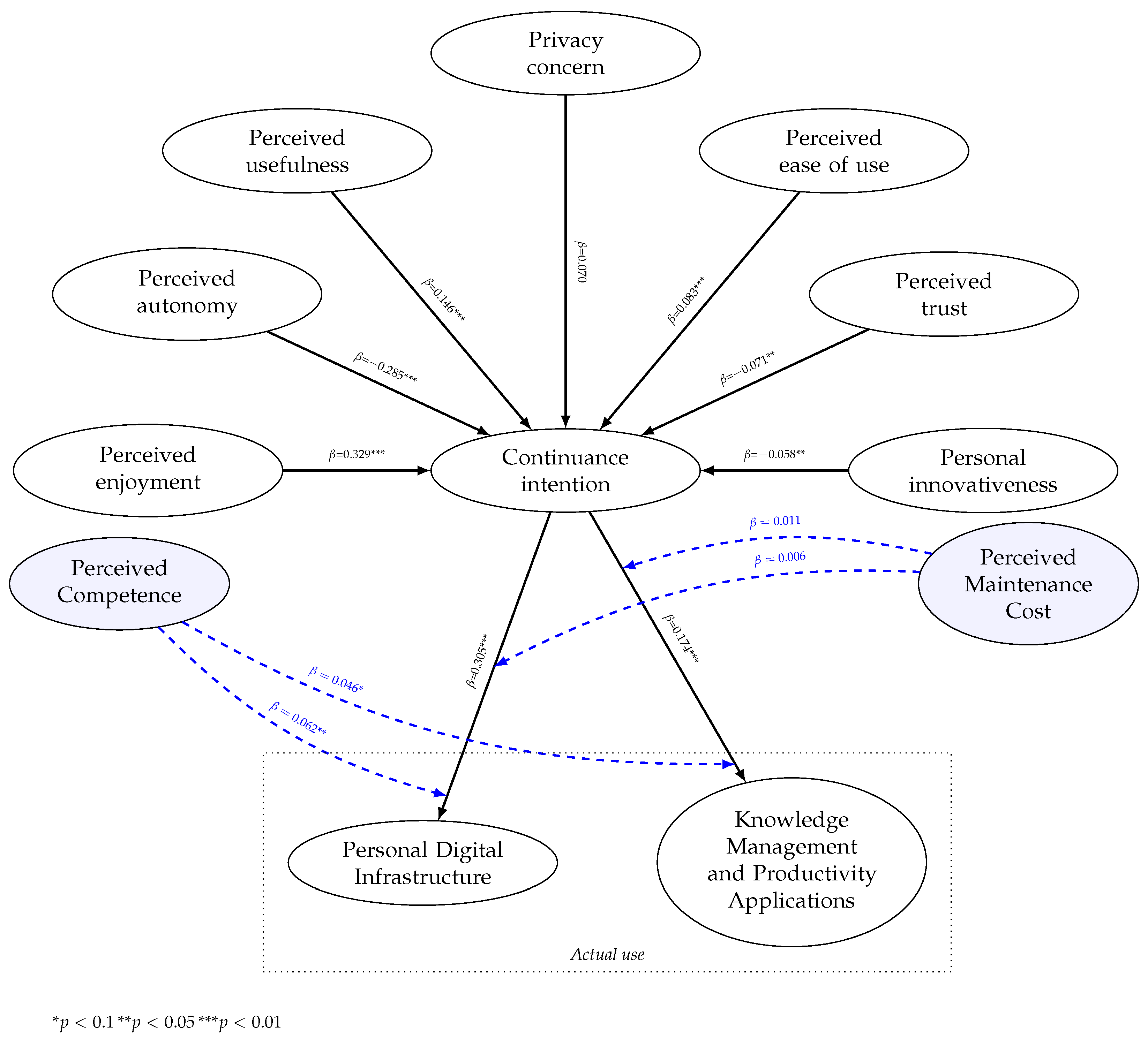
| 1 | ✓ |  Privacy concern Privacy concern | 0.070 | 1.720 | 0.014 | |
| 2 | ✓ | Perceived autonomy | −0.285 *** | 1.472 | 0.070 | |
| 3 | ✓ | Perceived trust | −0.071 ** | 1.323 | 0.006 | |
| 4 | × | Personal innovativeness | −0.058 ** | 1.269 | 0.004 | |
| 5 | ✓ | Perceived enjoyment | 0.329 *** | 1.515 | 0.091 | |
| 6 | ✓ | Perceived usefulness | 0.146 *** | 1.323 | 0.022 | |
| 7 | ✓ | Perceived ease of use | 0.083 *** | 1.427 | 0.007 | |
| Personal Digital Infrastructure (AU1) | 0.184 | |||||
| 8.1 | ✓ | Continuance Intention | 0.305 *** | 1.026 | 0.078 | |
| Knowledge Management and Productivity Applications (AU2) | 0.099 | |||||
| 8.2 | ✓ | Continuance Intention | 0.174 *** | 1.026 | 0.030 | |
| Relationship | Min p-Value | Significant Categories (p < 0.05) | Total Categories (Excl. Reference) |
|---|---|---|---|
| Continuance Intention | |||
| Age | 0.158 | 0 | 1 |
| Country Income (2-category) | 0.009 | 1 | 1 |
| Education Level (3-category) | 0.026 | 1 | 2 |
| Education Type | 0.430 | 0 | 9 |
| Employment Status | 0.115 | 0 | 4 |
| Gender | 0.706 | 0 | 2 |
| Self-Hosted Experience | 0.076 | 0 | 4 |
| Work related to IT | 0.743 | 0 | 1 |
| Personal Digital Infrastructure (AU1) | |||
| Age | 0.041 | 1 | 1 |
| Country Income (2-category) | 0.100 | 0 | 1 |
| Education Level (3-category) | 0.192 | 0 | 2 |
| Education Type | 0.283 | 0 | 9 |
| Employment Status | 0.061 | 0 | 4 |
| Gender | 0.298 | 0 | 2 |
| Self-Hosted Experience | 0.000 | 3 | 4 |
| Work related to IT | 0.305 | 0 | 1 |
| Knowledge Management and Productivity Applications (AU2) | |||
| Age | 0.000 | 1 | 1 |
| Country Income (2-category) | 0.053 | 0 | 1 |
| Education Level (3-category) | 0.032 | 1 | 2 |
| Education Type | 0.297 | 0 | 9 |
| Employment Status | 0.101 | 0 | 4 |
| Gender | 0.050 | 0 | 2 |
| Self-Hosted Experience | 0.000 | 4 | 4 |
| Work related to IT | 0.004 | 1 | 1 |
| H | Moderating Relationship | (Path Coefficient) | p | Adj. Original | Adj. Moderated |
|---|---|---|---|---|---|
| Personal Digital Infrastructure (AU1) | 0.184 | 0.279 | |||
| 9.1 | Continuance Intention*Perceived Competence | 0.062 | 0.023 | ||
| 10.1 | Continuance Intention*Perceived Maintenance Cost | 0.006 | 0.824 | ||
| Knowledge Management and Productivity Applications (AU2) | 0.099 | 0.152 | |||
| 9.2 | Continuance Intention*Perceived Competence | 0.046 | 0.067 | ||
| 10.2 | Continuance Intention*Perceived Maintenance Cost | 0.011 | 0.621 | ||
Disclaimer/Publisher’s Note: The statements, opinions and data contained in all publications are solely those of the individual author(s) and contributor(s) and not of MDPI and/or the editor(s). MDPI and/or the editor(s) disclaim responsibility for any injury to people or property resulting from any ideas, methods, instructions or products referred to in the content. |
© 2025 by the authors. Licensee MDPI, Basel, Switzerland. This article is an open access article distributed under the terms and conditions of the Creative Commons Attribution (CC BY) license (https://creativecommons.org/licenses/by/4.0/).
Share and Cite
Hrgarek, L.; Nemec Zlatolas, L. A Model of Factors Influencing Continuance Intention and Actual Usage of Self-Hosted Software Solutions. Sustainability 2025, 17, 10009. https://doi.org/10.3390/su172210009
Hrgarek L, Nemec Zlatolas L. A Model of Factors Influencing Continuance Intention and Actual Usage of Self-Hosted Software Solutions. Sustainability. 2025; 17(22):10009. https://doi.org/10.3390/su172210009
Chicago/Turabian StyleHrgarek, Luka, and Lili Nemec Zlatolas. 2025. "A Model of Factors Influencing Continuance Intention and Actual Usage of Self-Hosted Software Solutions" Sustainability 17, no. 22: 10009. https://doi.org/10.3390/su172210009
APA StyleHrgarek, L., & Nemec Zlatolas, L. (2025). A Model of Factors Influencing Continuance Intention and Actual Usage of Self-Hosted Software Solutions. Sustainability, 17(22), 10009. https://doi.org/10.3390/su172210009