Article

A Model of Factors Influencing Continuance Intention and Actual Usage of Self-Hosted Software Solutions


Faculty of Electrical Engineering and Computer Science, University of Maribor, SI-2000 Maribor, Slovenia
*
Author to whom correspondence should be addressed.
Sustainability 2025, 17(22), 10009; https://doi.org/10.3390/su172210009
Submission received: 6 October 2025 / Revised: 4 November 2025 / Accepted: 5 November 2025 / Published: 9 November 2025

Abstract

In an increasingly centralized digital society, the widespread reliance on third-party cloud services has heightened user concerns about data privacy and control, driving a significant movement toward self-hosted solutions. This study investigates factors influencing continued use of self-hosting, proposing an extended research model that combines classic TAM constructs with domain-specific factors like perceived autonomy, privacy concerns, perceived trust, personal innovativeness and perceived enjoyment. A quantitative survey was conducted with n = 2158 active self-hosting users, and the data was analyzed using PLS-SEM. The findings reveal that perceived enjoyment, perceived autonomy and perceived usefulness are the most significant positive drivers of continuance intention, confirming that intrinsic satisfaction and the desire for control are powerful motivators for sustained engagement. The study also found that the relationship between intention and usage is significantly moderated by perceived competence, highlighting that a user’s technical skill strengthens the link between their intent and actual use. The research offers key insights for developers and policymakers and contributes to academic discourse on sustained technology use by providing a validated measurement scale for self-hosted software usage and underscoring the importance of user empowerment and an enjoyable experience to foster the sustained engagement of decentralized digital solutions essential for the socio-technical sustainability of the digital society.

1. Introduction

1.1. Background and Motivation

As digital infrastructures become increasingly embedded in both personal and organizational contexts, concerns about privacy, data security, and user autonomy are becoming more pronounced. The ubiquitous reliance on third-party platforms, particularly Software-as-a-Service (SaaS) and various cloud-based solutions, raises critical questions regarding control over data, transparency of processing, and the trustworthiness of service providers. This dependency creates complex dilemmas of digital autonomy and introduces systemic risks like vendor lock-in and service discontinuation, which fundamentally threaten the long-term socio-technical sustainability and resilience of digital services and the ecosystems that rely upon them.
Despite the increasing popularity of cloud computing [1], which began to proliferate in the mid-2000s with the rise of services like Amazon Web Services (AWS), Google Cloud Platform, and Microsoft Azure [2,3], its use is accompanied by significant concerns related to privacy and trust [4,5,6,7,8,9,10]. A core issue stems from its foundation on the use of resources managed by third parties, which raises complex dilemmas regarding trust in the digital society alongside security questions [11,12,13]. The centralization of data and computational resources can also heighten vulnerability, making them more attractive targets for attackers [14], and raises fundamental questions about social control and the concentration of power in the hands of a few major platform providers. Furthermore, the automated data processing inherent in SaaS services presents a privacy threat to users [15]. Although cloud computing and its associated challenges have been a central focus of academic inquiry for over a decade, with a rich body of literature exploring various facets, many of which are referenced here as foundational to understanding the broader context of digital autonomy, research into the motivations and use of self-hosted solutions remains sparse.
Nevertheless, cloud computing has expanded rapidly. Its growth was fueled by the rapid development of communication channels and a rising demand for improved information systems [16]. Organizations have increasingly turned to remote servers instead of on-premise hardware due to the benefits of rapid scalability, reliability, and cost-efficiency [2]. While early studies, such as the work by Tak et al. [17], suggested that a complete transition was only appealing to small or stagnant businesses, subsequent research highlights its widespread adoption [18,19,20,21]. More recent research continues to explore its impact, including the structural transformation of IT roles [22], underscoring the ongoing evolution of the field and the development of both legislation (e.g., GDPR) [23,24] and risk mitigation methods [25,26,27].
Among the most common challenges faced by cloud service users, especially with SaaS, is vendor lock-in [28,29,30]. This refers to a situation where users become dependent on a single service provider, making it difficult to transition to another provider or change services without significant hurdles, costs, or losses. In the context of cloud services, once an entity selects a specific cloud provider, it becomes challenging or highly expensive to migrate data and applications to an alternative. For end-users of SaaS and cloud applications, this means becoming “trapped” within a single provider’s ecosystem, as their data and applications may be stored in proprietary formats incompatible with other systems.
In response to these pervasive challenges and the growing awareness of potential risks, a significant movement towards self-hosting software solutions has emerged [31,32], representing a crucial shift toward decentralization and a more empowered digital society. Self-hosting, in this context, refers to individuals or organizations hosting their software applications and services on personal or private infrastructure. This approach enables users to take explicit control over their infrastructure and services, thereby eliminating many of the limitations imposed by third-party cloud providers and fostering greater digital autonomy. This decentralization is not only a matter of technical control but also one of socio-technical sustainability [33]. By enabling users to manage their own infrastructure, self-hosting mitigates vendor lock-in, a critical issue for the digital sovereignty and long-term independence of digital services. Furthermore, by distributing control and encouraging transparency through the use of open-source software (often favored in self-hosting), this movement supports the creation of more equitable and resilient digital ecosystems. In addition to empowering users with technical control, self-hosting also fosters the development and solidification of digital competencies, thereby opening up new professional and career opportunities in the IT sector for individuals. Therefore, understanding self-hosting through the lens of the socio-technical sustainability is crucial for fostering digital resilience in society.

1.2. Research Problem and Objectives

The aim of this study is to examine the significance of factors that influence the continuance intention of self-hosting and the impact of this intention on the actual use of these solutions.
Self-hosting is the practice of running and managing software solutions or services on one’s own servers or infrastructure, rather than relying on third-party providers [31]. Typically, this means services are installed on the service owner’s hardware, often located on their property [31,34]. However, it can also refer to setting up servers in a third-party data center (colocation) or leasing physical or virtual servers within such a facility [35,36]. Beyond safeguarding personal data, self-hosting empowers users to gain control over their digital information and reduce dependence on external entities, often driven by a quest for digital sovereignty and a rejection of the limitations imposed by proprietary systems. The decision to invest time, effort, and money in decentralized approaches [37] and self-hosting, rather than using often free (for end-users) cloud services, can be driven by various motivations. This approach frequently seeks to ensure the autonomy and sovereignty of one’s own data [38]. The categories of self-hosted software are diverse, including communication tools, backup tools, document management tools, and various solutions for managing and reproducing media content, most of which are open-source but not exclusively so [39].
The growing popularity of this approach is evident in online communities and open-source projects, indicating increasing interest in decentralized models for managing digital infrastructure. Users who opt for self-hosting represent a hybrid group between end-users and system administration professionals, forming a unique culture that combines technical innovation with ethical principles of autonomy and transparency [31]. It is therefore pivotal to understand the psychosocial effects and motivations behind their decision to invest time, effort, and money in these decentralized approaches. By doing so, we can gain valuable insights into the evolving notions of privacy, security, and data sovereignty, all of which contribute to the broader narrative of an informed and empowered digital society.
The primary objective of this study is to develop a comprehensive research model that explores the complex interrelationships among variables influencing the decision to self-host software solutions. Furthermore, this research aims to use Structural Equation Modeling (SEM) to analyze the multidimensional impact of these factors on the intention for continued use. We will also examine how this intention influences the actual usage of self-hosted solutions.

1.3. Contribution and Significance of the Study

This research makes several novel contributions to the academic literature on technology adoption and the study of the digital society. While the adoption and continued use of cloud computing have been a central focus of academic inquiry [40,41,42,43,44,45,46], there is a significant gap in the literature concerning the motivations and sustained use of self- hosted solutions.
Our study addresses this oversight by being the first to empirically investigate continuance intention within a large-scale population of self-hosting users. A major theoretical contribution of our work is the development and empirical validation of a research model uniquely suited to understanding decentralized technology sustained use. By extending the Technology Acceptance Model (TAM) with factors such as perceived autonomy and perceived competence, our model provides a more nuanced framework for explaining user behavior in this context.
The specific nature of our sample, which consists exclusively of currently active self-hosting users, guides the clear delineation of our research scope. Consequently, this study is primarily focused on investigating the dynamics of continuance intention and sustainable use, thereby distinguishing our contribution from research centered on the initial technology adoption phase. This approach ensures a high degree of consistency between our conceptual framework and the empirical survey object.
Furthermore, we offer a key methodological contribution by developing and validating a new measurement scale for assessing the actual use of self-hosted software, a tool previously unavailable to researchers. The study thus provides foundational insights for both academic discourse and for developers of decentralized technologies, offering a new perspective on how user motivation, particularly the desire for control and enjoyment, drives sustained engagement in a rapidly evolving digital landscape.

1.4. Structure of the Paper

The remainder of this paper is structured as follows: Section 2 reviews theoretical and empirical foundations relevant to technology adoption and self-hosting. Section 3 details the research methodology, covering the data collection procedures, the formulation of the conceptual model, and the approaches employed for data analysis. Section 4 presents the results of the structural equation modeling analysis. Section 5 interprets the findings in relation to existing research and discusses practical implications. Finally, Section 6 summarizes the main conclusions and proposes directions for future research.

2. Theoretical Background and Hypothesis Development

The core theoretical contribution of this study is its novel approach to modeling the continuance intention for self-hosting by framing the self-hosting decision as a comparative behavioral choice in direct opposition to the established commercial cloud ecosystem. Self-hosting, unlike standard technology adoption, represents a deliberate, often reactive, decision to reject the dominant commercial solution (the cloud) in pursuit of intrinsic goals such as autonomy and privacy. Therefore, the central logic of our research model is built on the premise that a user’s willingness to sustain self-hosting is critically shaped by their attitudes and perceptions towards their current or prior commercial cloud service usage. The theoretical justification for incorporating cloud-related constructs (such as Perceived Autonomy and Privacy Concerns) into a self-hosting model is rooted in the Push–Pull–Mooring (PPM) framework [47]. The deficiencies or merits of the cloud service (acting as the Push factor, pushing users away from the current service) significantly determine the user’s motivation to adopt and continue the alternative self-hosted solution. This design allows us to capture the comparative motivation inherent in the self-hosting decision and enhance the theoretical coherence of the entire model by explaining why the dissatisfaction with an existing solution fuels the continuance of the alternative.
Following this comparative framework, the core behavioral component of the model, which studies the continued use of self-hosted solutions, is primarily grounded in the Technology Continuance Theory (TCT) [48,49]. TCT is considered a suitable foundation for studying users’ continued use of self-hosted solutions, as it is designed for post-adoption technology use behavior. TCT posits that users’ satisfaction and usefulness perception after initial use are critical for shaping their continuance intention. The model is further extended by incorporating domain-specific constructs, which are crucial for the self-hosting ecosystem, such as Perceived Autonomy, Privacy Concerns, and Perceived Trust (as Push factors), along with moderating variables that address the intention–behavior gap.

2.1. Factors Influencing Intention to Use Self-Hosting

Understanding the factors that influence the decision to continue using self-hosting solutions offers insight into the multifaceted dimensions of this phenomenon. This includes a comprehensive investigation into associated challenges, benefits, and underlying technological aspects. Such an approach contributes to the development of theoretical knowledge in technology acceptance, which has practical implications for improving these solutions. Self-hosting is fundamentally understood as managing one’s own infrastructure, even if it is not physically on premises [31,34,35,36]. This concept primarily falls within the domain of autonomy and responsibility. The use of cloud services is often perceived as a “default” option, where general societal acceptance influences an individual’s willingness to use them [50]. While self-hosting can complement cloud service usage, the concept itself often stands in opposition to cloud services. Therefore, the relationship of potential self-hosting users to cloud service usage is crucial for analyzing motivational factors. Constructs such as Privacy Concern, Perceived Autonomy, and Perceived Trust directly pertain to users’ attitudes toward cloud services, while other constructs focus on their attitudes toward self-hosting.

2.1.1. Privacy Concerns

Privacy concerns refer to an individual’s apprehension about the collection, unauthorized access, errors, use, control, and awareness related to sensitive or private data [51]. It reflects users’ feelings regarding the collection and storage of personal information [52,53]. In the context of online services, privacy concern specifically relates to the management and utilization of personal data [54]. Multiple studies on the security of commercial cloud services have addressed potential privacy breaches [7,8,9]. Furthermore, Gröber et al. [31] identify privacy and autonomy as core motivational factors driving individuals toward self-hosting.
The importance of this construct lies in its crucial role in fostering user trust [46] and, consequently, influencing the decision to adopt or continue using a service. This mechanism is effectively explained by the Push–Pull–Mooring (PPM) framework, where high dissatisfaction with an existing technology acts as a ‘push factor’ motivating switching behavior. In this context, empirical studies explicitly identify privacy concern as a key push factor: dissatisfaction with personal privacy protection is a strong predictor of switching [55], and high privacy concern acts as a direct ‘push effect’ nudging consumers away from centralized services toward alternatives [56]. Gashami et al. [57] argue that users who do not trust cloud services (SaaS) will not use them, which suggests a negative impact of privacy concern on intention to use. In developing their research model, they also refer to the Privacy–Trust–Intention model [58], where privacy indirectly affects intention to use through trust [59], while also maintaining a direct link between privacy concern and intention to use. Chang and Hsu [60] similarly investigate a direct link between privacy concern and (switching) intention. For active self-hosting users, the continuous existence of privacy risks in the alternative market is not merely an initial motivator but acts as a constant reinforcement mechanism for sustained use. Based on existing research and the focus group results by Gröber et al. [61], which indicate a positive relationship between privacy concern and an individual’s intention to self-host, we can hypothesize that privacy concern will have a positive influence on continuance intention for using self-hosting.
Hypothesis 1.
Privacy concern related to cloud service usage positively influences the continuance intention for self-hosting software solutions.

2.1.2. Perceived Autonomy

Perceived Autonomy refers to an individual’s perception of being the origin or source of their own behavior [62]. It encompasses a sense of initiative and freedom in acting according to one’s own volition, effectively serving as a form of self-governance or the extent to which an individual believes their actions are voluntary [63]. Even when an individual depends on others or follows instructions, they can still feel autonomous if there is a meaningful justification for such behavior [64]. Perceived autonomy does not denote independence, self-reliance, or selfishness, but rather the feeling of voluntariness that can accompany any action [45]. The scope of autonomy can be assessed based on the set of functions offered by a particular technology or service [65]. In the context of cloud service usage, autonomy is a crucial factor significantly influencing the decision for potential adoption [66].
Gagné and Deci [67] argue that autonomy impacts the level of intrinsic motivation by fostering the integration and internalization of extrinsic motivation, which can lead to genuine intrinsic motivation. This principle is formalized in the Self-Determination Theory (SDT), which posits that the satisfaction of the basic psychological need for autonomy is a powerful driver of sustained, voluntary behavior. Based on existing research and the focus group results by Gröber et al. [61], we can also identify autonomy as a relevant factor in the context of self-hosting. Self-hosting is fundamentally an alternative choice driven by the desire to maximize control and autonomy over data and infrastructure, contrasting with the inherent constraints of cloud services.
Multiple studies cited by Teck Soon and Kadir [68] have verified the influence of perceived autonomy on intention to use. Furthermore, perceived autonomy is included in various research models, such as those presented by Li et al. [66]. However, to address the negative impact, we apply the inverse logic: studies confirm that satisfying the need for autonomy and control (Perceived Information Control) positively influences the Continuance Intention for cloud services [63]. If the user already perceives a high level of autonomy and control within cloud services (the incumbent), this satisfaction substantially diminishes the motivational gap that self-hosting (the substitute) attempts to fill. In essence, the satisfaction of the need for autonomy in the cloud weakens the user’s demand for the extreme autonomy of self-hosting, leading to a reduction in their intention to continue using the self-hosted solution. Similar to Hew and Kadir [69], we can therefore hypothesize that perceived autonomy in the realm of cloud services negatively influences the intention to use self-hosting.
Hypothesis 2.
Perceived autonomy in cloud service usage negatively influences the continuance intention for self-hosted software solutions.

2.1.3. Perceived Trust

Perceived Trust can be understood as a willingness to be vulnerable, reflecting the volition or intention to take a risk [70]. Trust is a multidimensional concept [71], encompassing a rational assessment of competence and integrity, alongside feelings of care and efforts for the well-being of others. Mayer et al. [72] defined benevolence as the extent to which a trustor believes the trustee intends to do good for the trustor, beyond the trustee’s own profitable interest. They defined integrity as the perception that the trusted party will adhere to a set of principles or rules of exchange acceptable to the trustor during and after the exchange. Numerous studies have examined trust in cloud services [13,73,74], often employing an extended TAM approach [46,75].
The influence of perceived trust on intention to use has been extensively researched, generally in the context of online technologies [76] and specifically in the adoption of cloud systems [46,59,69]. Research models in this area are most often proposed as extensions of TAM. Arpaci [59] argues that if cloud service providers strictly adhere to security and privacy guidelines, user trust can increase, thereby positively influencing the attitude toward or intention to use these services. To elaborate on the inverse relationship, we frame the continuance intention of self-hosting usage as a reaction to the risks associated with the cloud ecosystem. Qualitative research explicitly identifies lack of trust in third parties and the need for greater transparency and control over data as a core motivational factor for adopting self-hosting [31]. This inherent distrust in cloud services acts as a powerful Push factor that propels users toward the self-hosted solution. Therefore, greater user trust in cloud services directly mitigates this fundamental Push force. If a user’s trust in the cloud service provider’s competence and integrity increases, the perceived risk and dissatisfaction that initially drove them toward self-hosting diminish. This weakening of the Push factor reduces the user’s demand for the self-hosted solution, as the primary benefit of the alternative is rendered less necessary, thereby negatively impacting the continuance intention for self-hosting. We therefore hypothesize an inverse relationship here: greater user trust in cloud services can negatively influence the intention to use self-hosting.
Hypothesis 3.
Perceived trust in cloud service usage negatively influences the continuance intention for self-hosted software solutions.

2.1.4. Personal Innovativeness

Personal Innovativeness was defined by Agarwal and Prasad [77] as “the willingness of an individual to try out any new information technology.” In the context of information technology, personal innovativeness can also refer to an individual’s personal attitudes, reflecting their propensity for independent experimentation and the use of new technological advancements [78]. He and Zhu [79] demonstrated that personal innovativeness is a key personal factor influencing digital informal learning. Similarly, Xu and Gupta [80] found that more innovative individuals tend to adopt new technology faster than others. For this reason, Alkawsi et al. [81] suggest that this confirms an innovative person’s greater ability to cultivate an optimistic attitude toward expectations of innovation use, highlighting a more pronounced effect of performance expectancy on behavioral intention to use among innovative individuals.
Agarwal and Prasad [77] propose that personal innovativeness positively influences the intention to use new information technology. This relationship has been investigated both in the general field of information technology adoption [82] and specifically in the adoption of cloud technologies [83,84]. Gröber et al. [61] also explored the influence of personal innovativeness in the context of self-hosting, hypothesizing a positive impact on initial adoption. Crucially, research confirms that personal innovativeness remains a strong determinant even in the post-adoption phase and significantly influences user continuance intention [85]. This finding is especially pertinent for self-hosting, which is inherently characterized by technical complexity, ongoing maintenance, and the need for continual self-education. The self-hosted environment demands a sustained willingness for independent experimentation and a comfort with complexity [77,80] to successfully manage updates, troubleshoot issues, and integrate new solutions. Therefore, the intrinsic motivation of highly innovative users to explore and master technology provides the necessary intrinsic motivation to overcome the complexity barriers of long-term self-hosting engagement, thereby positively influencing continuance intention.
Hypothesis 4.
Personal innovativeness in information technology positively influences the continuance intention for self-hosted software solutions.

2.1.5. Perceived Enjoyment

Perceived Enjoyment refers to the perception that a particular system is pleasant, without negative performance impacts caused by its use [86]. It can also be defined as an individual’s perception of “fun or pleasure derived from using a technology” [87]. Based on expectancy-value theory, users exhibit intrinsic motivation to use technology when they have a personal and internal incentive to do so [88,89]. Although perceived enjoyment is not part of the original TAM model [90], Davis et al. [91] considered it a predictive complement to perceived usefulness, thereby incorporating intrinsic motivation alongside extrinsic factors. Furthermore, it is included in TAM 3 [88] and various other TAM extensions [92,93,94].
The enjoyment and positive feelings triggered by the hedonic qualities of technologies intrinsically motivate users to adopt them or continue their use [93]. Regardless of utilitarian outcomes and benefits, the intrinsic belief in perceived enjoyment can lead to overall user satisfaction [95] and further encourage continued use of a particular technology [96]. Davis et al. [91] demonstrated that perceived enjoyment influences intention to use and, indirectly, actual use. This mechanism is particularly pronounced in non-mandatory and effort-intensive contexts: Perceived Enjoyment has been empirically confirmed as a strong and significant predictor of continuance intention in both hedonic systems like Social Networking Services [97] and engaging, skill-based activities like programming games [98]. This intrinsic motivation is vital for self-hosting, as the activity is largely voluntary, often resembling a leisure pursuit, and requires significant, sustained effort for maintenance and troubleshooting. The “fun or pleasure” associated with configuring complex systems, experimenting with new software, and mastering one’s own infrastructure serves as the essential internal reward that justifies the required time investment and overcomes potential frustration, thus strongly driving continuance intention.
Hypothesis 5.
Perceived enjoyment positively influences the continuance intention for self-hosted software solutions.

2.1.6. Perceived Usefulness and Perceived Ease of Use

Perceived Usefulness is defined as the degree to ¸ch an individual believes that using a particular system would enhance their job performance [90,91]. In TAM, it is hypothesized as a direct predictor of behavioral intention to use the technology of interest [99]. It refers to the user’s subjective perception of how using a specific technology or service contributes to improving their efficiency, productivity, and performance in task execution.
Perceived Ease of Use is defined as the degree to which a person believes that using a technology would be free of effort [90]. It explains the user’s perception of the effort required to use a system, or the extent to which the user believes that using the technology will be effortless [100]. According to TAM, perceived ease of use helps determine an individual’s perception of the ease of using a technological innovation [101] and drives the adoption of technological innovations by consumers [102]. Ratten [103] explains that certain technological innovations are difficult to use due to the presumed knowledge required; however, if an individual perceives easy access to them, their interaction is likely to be better. If users are trained to use technological solutions, they will have a more positive acceptance of the technology [104]. In the case of cloud computing, which can be analogously applied to self-hosting, it holds true that the easier the user perceives it to be, the greater the likelihood that they will adopt its technological innovations [103].
Multiple studies [73,105,106,107,108] in the field of cloud computing adoption have shown a positive influence of perceived usefulness and perceived ease of use on intention to use or continuance intention. For sustained engagement, the transition from initial adoption to prolonged use is best explained by the fundamental Technology Continuance Theory (TCT) [48]. TCT suggests that initial perceptions must be converted into Confirmed Usefulness and Confirmed Ease of Use, factors consistently confirmed as critical antecedents for user satisfaction, which, in turn, drives continuance intention [49,109]. In the self-hosting context, Perceived Usefulness must be interpreted beyond job performance to encompass achieving crucial personal outcomes, such as enhancing digital autonomy, data privacy, and operational efficiency. Sustained use is contingent upon the self-hosted solution reliably delivering these specific benefits. Furthermore, given the inherent technical complexity of self-hosting, Perceived Ease of Use is a critical inhibitor: if the system is perceived as too difficult to maintain, the required effort will likely outweigh the usefulness, leading to discontinuation [103]. Therefore, a favorable perception of both the system’s ability to achieve personal goals (Usefulness) and the minimal effort required to do so (Ease of Use) is essential for reinforcing the long-term decision to continue using self-hosted solutions.
Hypothesis 6.
Perceived usefulness positively influences the continuance intention for self-hosted software solutions.
Hypothesis 7.
Perceived ease of use positively influences the continuance intention for self-hosted software solutions.

2.1.7. Exclusion of “Attitude Towards Use”

Although Davis’s original Technology Acceptance Model (TAM) [90] included the construct of “Attitude towards Use,” its exclusion from TAM was soon proposed by Thompson et al. [110], who found no significant link between attitude and technology use. Similarly, Teo [111] concluded that attitude is not a necessary condition in TAM. Consistent with other research, such as that by Pai et al. [112], we have not included this construct in our research model.

2.2. Continuance Intention and Its Moderated Influence on Actual Usage

The Technology Acceptance Model (TAM) and its extensions consistently posit that a user’s intention to use a system is the most direct predictor of their actual usage [90]. This fundamental relationship forms the core of many technology adoption theories, suggesting that when individuals form a strong intent to use a particular technology, they are highly likely to translate that intention into action. In the context of self-hosted software solutions, a clear intention to adopt or continue using such systems is therefore expected to lead to their actual implementation and ongoing use.
Hypothesis 8.
Continuance intention for self-hosted software solutions positively influences actual usage.
However, the strength of this intention–behavior link isn’t always uniform and can be influenced by various contextual or individual factors. Such moderators can either strengthen or weaken the relationship between intention and actual usage. The following sections will discuss two significant moderators relevant to the adoption of self-hosted solutions.

2.2.1. Perceived Competence

Perceived Competence, as proposed in self-determination theory [113], is the belief that an individual is capable of effectively interacting with their environment to achieve desirable outcomes [114]. Goldhammer et al. [115], within the ICT engagement model, also define ICT perceived competence as a specific type of perceived competence, presenting it as “an individual’s perception of their own ICT knowledge and how to use it”. Perceived competence appears in research as both an explanatory variable [63,116,117] and a moderating variable [118]. It can also represent a motivation for action, or a predisposition that encourages an individual to explore and master a particular environment. Competence allows individuals to adapt to complex and changing environments, while frustration due to a lack of competence can lead to a lack of motivation to perform activities [63]. Perceived competence is not equivalent to acquired skills or abilities; rather, it is the subjective perception of self-confidence and capacity for effective interaction with the environment, which may or may not align with an individual’s actual abilities [62].
The perception of competence is considered important because it enables individuals to more easily achieve goals and satisfy needs for satisfaction when engaging in activities where they experience a sense of success. The higher an individual’s perceived competence, the more likely they are to continue with an activity. Therefore, Oduor and Oinas-Kukkonen [119] propose that perceived competence influences continuance intention. Lee et al. [120] suggest that competence indirectly affects intention to use via satisfaction, while Chan et al. [121], on the other hand, treat perceived competence as a moderating variable, moderating the relationship between system use and performance. We propose using perceived competence as a moderator of the influence of continuance intention on actual usage. This approach directly addresses the critical intention behavior gap (the discordance between stated intent and realized behavior) prevalent across behavioral domains [122] and established in technology adoption literature [123]. Specifically, research confirms the moderating role of self efficacy (a key perceptual ability) in closing the intention behavior gap [124]. Drawing upon the core tenets of Self-Determination Theory (SDT) [62,113], the fulfillment of the need for competence provides the psychological energy necessary to successfully translate intention into sustained behavior. The self-hosting context can be technically demanding and presents significant operational challenges to users [61]. Individuals with high perceived competence possess the self confidence to successfully realize their continuance intention and perform tasks such as server configuration, maintenance, and security settings, while those with lower competence may fail to perform these demanding tasks, leading to unrealized intention or discontinuation [63].
Hypothesis 9.
Perceived competence positively moderates the relationship between Continuance intention and Actual usage.

2.2.2. Perceived Maintenance Cost

Self-hosted solutions often can be seen as High Maintenance Information Systems (HMIS), defined by their requirement for ongoing user effort to maintain operational status and continuously derive benefits [125]. For such systems, the critical factor for sustained usage is not merely the initial investment or the cost of external switching, but the continuous, internal maintenance burden. We therefore introduce the construct Perceived Maintenance Cost (PMC), which captures the user’s perception of the total load associated with system upkeep, operation, and necessary internal changes [126]. PMC explicitly encompasses the effort, time, and financial resources needed to actively maintain the system [125,126].
PMC is conceptually related to, yet distinct from, general Switching Costs. Switching Costs are expenses perceived by consumers when transitioning from one product or service to another [76]. The concept of these costs should not be understood solely in a material sense; rather, it also includes non-monetary elements like time, effort, psychological risks, and disruption to routines [76,127,128]. While PMC draws on these established dimensions of cost (effort, time, resources), its focus is directed internally at the upkeep demands of the HMIS, not the external barrier of changing providers.
These cost-related constructs have a well-established history in IS research, particularly in explaining sustained usage and behavioral changes. Switching Cost, for example, has been used in research in connection with TAM, both as an explanatory variable [129] and as a moderating variable [130,131]. Based on the Pull-Push-Mooring theoretical framework, which explains behavioral changes [47], switching costs can “moor” users to their current applications or services [132,133]. Al-Jabali and Ahmad [134] propose a model in which switching costs simultaneously play the role of both an explanatory and a moderating variable, where in their case, the direct influence on continuance intention proves to be insignificant.
We propose that Perceived Maintenance Cost (PMC) negatively moderates the relationship between Continuance Intention and Actual Usage. In this HMIS environment, a high PMC acts as a practical behavioral barrier that significantly weakens the translation of a user’s mental intention into long-term actual activity [61,76]. Even with a strong Continuance Intention, the high perceived maintenance load, such as the effort required for necessary upgrades or complex configuration changes inherent to HMIS [125,126], introduces friction. This friction prevents the intention from fully translating into the physical, sustained act of Actual Usage [76,135]. Therefore, high Perceived Maintenance Costs are expected to weaken the positive link between the user’s desire to continue (Intention) and the actual long-term activity (Actual Usage).
Hypothesis 10.
Perceived Maintenance Cost negatively moderates the relationship between Continuance intention and Actual usage.

3. Methodology

This chapter explains the research design, data collection procedures, and measurement instruments employed in this study. It outlines the methodological framework that guided the investigation, ensuring transparency and reproducibility of the research findings.

3.1. Research Design and Approach

This study primarily adopted a quantitative research approach, employing survey methodology to explore factors influencing the adoption and continued use of self-hosted software solutions. The research design was structured as a cross-sectional study. This design was specifically chosen to facilitate the empirical testing of the proposed theoretical model and its associated hypotheses, which were derived from the Technology Acceptance Model (TAM) and its extensions.

3.2. Population and Sampling

The target population for this study consisted of individuals who were current users of self-hosted software solutions. Respondents were first screened with a qualifying question to ensure they fell into this specific user group. This highly targeted sampling approach was necessary due to the low prevalence of self-hosting users within the general population; for instance, a quantitative study by Gröber et al. [61] identified only 8.4% of self-hosting users in a representative U.S. sample. Consequently, the research was exclusively conducted with this segment of the population.
Consequently, a non-probability sampling approach, specifically combining convenience and snowball sampling, was employed to access this niche demographic. Data were primarily collected through active online communities, which proved to be the most effective channels for reaching the intended participants given their thematic focus and high engagement levels among the target population.
The survey was disseminated across online platforms and communities known for their focus on self-hosting. The primary focus of this dissemination strategy was on two key posts: one in the Lemmy.World community c/selfhosted, which has approximately 115,000 members (and the post was made on 26 May 2025), and another in the Reddit community r/selfhosted, which has roughly 557,000 members (and the post was made on 28 May 2025). This highly targeted approach was used to effectively reach the core user group. It is important to note that larger, thematically related communities, such as r/Technology on Reddit, do not permit survey postings, which influenced the selection of dissemination channels.

3.3. Data Collection Procedures

The survey was administered using the open-source LimeSurvey platform, which was self-hosted to ensure data control and privacy. Prior to commencing the survey, all potential respondents were presented with an informed consent statement. This statement clearly outlined the study’s purpose, guaranteed the anonymity and confidentiality of their responses, emphasized the voluntary nature of participation, and informed them of their right to withdraw from the survey at any point without penalty.
Prior to the main data collection, a pilot study was conducted with a small sample ( n = 32 ) of participants to assess the clarity, comprehensibility, and preliminary suitability of the questionnaire items. Based on the feedback received, minor linguistic and structural revisions were made to ensure the instrument’s quality and effectiveness.
Data collection commenced on 26 May 2025, with the initial dissemination on Lemmy.World, and concluded on 13 July 2025. The survey was structured across three distinct pages, with conditional logic guiding participants through the relevant sections.
For a more precise analysis, respondents were categorized into three groups at the beginning of the questionnaire based on their answer to an initial screening question. This question defined self-hosting and then inquired whether participants used self-hosting services. The three distinct response options allowed respondents to indicate: (1) their active use of self-hosting; (2) their awareness of the term without current usage; (3) or neither current usage nor familiarity with the concept. Based on these responses, the first group consisted of individuals who actively use self-hosting. The second group comprised respondents who were aware of the concept but did not use such solutions themselves. The third group included those who neither used self-hosting nor were familiar with the concept.
The structure of the questionnaire was adapted to each group, ensuring greater relevance of the collected data and increased respondent engagement. Members of the first group were invited to complete the entire questionnaire. The second group was enabled to answer questions focusing on their reasons for potential future use of such solutions. Respondents in the third group, however, only answered a set of questions related to their attitude towards using cloud services, their concerns regarding privacy, and their understanding and views on data ownership and digital autonomy.

3.4. Measurement Instruments

This study employed several constructs to test the proposed research model. Each construct, with the exception of ‘Actual Usage’, was measured using survey statements adapted from existing literature with minor linguistic adjustments to adequately reflect the content of self-hosting, on a 5-point Likert scale, ranging from “Strongly Disagree” (1) to “Strongly Agree” (5). The ‘Actual Usage’ construct, developed independently for this study, was compiled based on 21 categories from the widely accepted (with over 239,000 GitHub stars) categorization found on the GitHub page awesome-selfhosted (https://github.com/awesome-selfhosted/awesome-selfhosted, accessed on 5 February 2025) and a minor refined addition from the awesome-sysadmin GitHub page (https://github.com/awesome-foss/awesome-sysadmin, accessed on 5 February 2025). Its ranking was further informed by the results of four community surveys: Self-Hosted Survey 2024 (deployn.de) (https://selfhosted-survey-2024.deployn.de/, accessed on 5 February 2025), Self-Hosted Survey 2023 (deployn.de) (https://selfhosted-survey-2023.deployn.de/, accessed on 5 February 2025), selfh.st Survey 2023 (https://selfh.st/survey/2023-results/, accessed on 5 February 2025), and selfh.st Survey 2024 (https://selfh.st/survey/2024-results/, accessed on 5 February 2025), and is presented in Appendix Table A2.
The constructs measured in this study include: Privacy Concerns [136,137], Perceived Autonomy [63,138,139], Personal Innovativeness [140], Perceived Trust [138,141], Perceived Ease of Use [90,142], Perceived Competence [143], Perceived Usefulness [90,144], Perceived Enjoyment [90,142], Perceived Maintenance Cost [145,146], Intention to Use [147], Continuance Intention [148] and Actual Usage. A detailed description of these constructs, their operational definitions, primary academic sources, and the 52 specific survey items for each construct are provided in Appendix Table A1.
Finally, the questionnaire included several control variables collected on the third page to account for potential confounding factors. These variables comprised the respondent’s year of birth, gender, country of residence (based on ISO 3166 [149] ), education type (based on ISCED-F 2013), highest level of education (based on ISCED 2011), whether their work has ever been related to Information Technology (IT) (true/false), and employment status [140]. Subsequently, countries of residence were aggregated into income groups based on the classification system established by the World Bank [150].

3.5. Data Analysis Method

A preliminary review of the literature [151] shows that research on self-hosting is diverse, drawing on qualitative and quantitative approaches from various, often indirect, perspectives. While dedicated research on the specific relationships and constructs central to this study remains limited, studies in related fields, such as technology adoption and user behavior, have successfully used advanced statistical techniques to address similar complex, interconnected phenomena. For example, the use of Structural Equation Modeling (SEM) is well-established in this domain [145,152,153,154]. Notably, the most thematically similar studies by Gröber et al. [31,61] also examine user motivation, practices, and characteristics in self-hosting contexts, but rely on a combination of descriptive analysis, interviews, and logistic regression. Unlike these studies, our research adopts a SEM approach to develop a comprehensive theoretical model that allows for a deeper understanding of the complex interrelationships between multiple factors.
This study employed Partial Least Squares Structural Equation Modeling (PLS-SEM) because this method is well suited for analyzing research models that include formative constructs, which are a part of our research. Unlike Covariance-Based Structural Equation Modeling (CB-SEM), PLS-SEM does not require the assumption of normally distributed data. Additionally, PLS-SEM is a more appropriate method for analyzing complex models, such as the one used in this study [155]. We conducted the analysis in R 4.5.1, an open-source software environment for statistical computing, by employing the SEMinR 2.3.6 package, a domain-specific language designed to build and estimate SEM models.

4. Results

4.1. Demographic Profile of Survey Respondents

The data collection process provided a total of 2367 completed responses, of which 2295 were from current self-hosting users. Since the analysis for this research was focused exclusively on this specific user group, all other responses were excluded. To ensure a complete dataset for analysis, responses with missing values were also removed, resulting in a final sample of 2158 complete responses used for all subsequent analyses.
The demographic analysis of the survey respondents, derived from the data presented in Table 1, reveals a highly specific and homogeneous sample. The majority of participants, approximately 99%, were sourced from the online platforms Reddit r/selfhosted and Lemmy.World c/selfhosted, indicating a strong bias towards individuals active within these particular communities. This expected self-selection bias, given the survey’s distribution method, is a crucial factor in interpreting the results. A notable finding is the experience level of the participants, with a significant concentration of individuals who have been engaged in self-hosting for over nine years (25.58%), followed by a sharp decline in the 6–9 year experience bracket (16.36%). Geographically, the sample is heavily concentrated in high-income countries, accounting for 95.41% of all respondents, with a dominant representation from Europe and North America.
A closer examination of the professional and educational backgrounds of the respondents further clarifies the sample’s characteristics. The average age of the respondents is 34 years. The age range is from 13 to 85 years, but the majority (63%) of them aged between 25 and 40, indicating a predominantly adult and experienced demographic. Over three-quarters of the participants (78.36%) are currently employed, with a substantial majority (55.79%) working in the Information and Communication Technologies (ICT) sector. This suggests a sample population deeply and professionally integrated into the field of their hobby, which may influence their technical expertise and perspectives. Academically, the participants show a high level of educational attainment, with Bachelor’s degrees, Master’s degrees, and Doctoral degrees collectively representing a significant majority of the sample. Bachelor’s degrees are the most common at 44.86%, followed by Master’s degrees at 21.83%, and Doctoral degrees at 5.47%. This high level of formal education, combined with their professional roles in ICT, points to a technically skilled and specialized group of individuals.
The most represented countries were the United States and Germany, highlighting the specific geographic origins of the sample. Furthermore, the high percentage of respondents with a professional background in IT (81.42% are directly IT-related) underscores the sample’s professional bias. This self-selection may limit the generalizability of the findings to the broader, non-professional self-hosting community. The data, therefore, reflects a professional, educated, and geographically concentrated group of self-hosting enthusiasts.

4.2. Measurement Model

4.2.1. Internal Consistency and Convergent Validity

We assessed measures of internal consistency, convergent validity, and discriminant validity. The internal consistency of the measurement models was verified using composite reliability (CR), rho A, and Cronbach’s α [156] to demonstrate sufficient detail in the variability of the variables included in each factor. For adequate reliability, the values for all three measures should be above the threshold of 0.70, while values between 0.60 and 0.70 are considered acceptable [157].
Cronbach’s α often provides a conservative estimate of reliability in PLS-SEM due to its underlying assumptions, such as tau-equivalence and normally distributed data, which this methodology does not require [157,158]. Another measure, composite reliability, which uses standardized factor loadings as weights, is considered a more appropriate measure of internal consistency for PLS-SEM. However, it assumes the accuracy of parameter estimates, which is often not met in PLS-SEM, as the method tends to overestimate indicator weights [157]. Rho A is another alternative that is based on indicator weights, thereby avoiding the weaknesses of the previously described statistics. Internal reliability is assessed only for reflective constructs, whose goal is to combine similar variables that must be internally consistent. As shown in Table 2, all reflective constructs are significantly internally consistent, as the value of all three described statistics exceeds 0.7.
Convergent validity was evaluated using the Average Variance Extracted (AVE), which measures the average variance explained by the construct, or whether the indicators correlate strongly enough with the factor [157]. Convergent validity is considered adequate if the AVE value is 0.50 or higher, which indicates that the construct explains at least 50% of the variance of its indicators [157]. Based on the data in Table 2, all reflective constructs met this criterion, with the exception of Perceived Autonomy and Perceived Trust.

4.2.2. Discriminant Validity

We also assessed discriminant validity, which aims to confirm that the factors are sufficiently distinct from each other to reliably measure different constructs. To check this, we used two statistics: AVE and the heterotrait–monotrait ratio of correlations (HTMT). The former indicates the existence of discriminant validity when the square root of the AVE for an individual latent variable is greater than its correlations with any other latent variable. The latter indicates validity when the values are lower than 0.90 [159]. Discriminant validity is assessed only for reflective constructs. As shown in Table 3, all HTMT values between constructs are below the 0.90 threshold. At the same time, the square root of the AVE, as presented in Table 4, in all cases, exceeds the correlations of the selected construct with the others.

4.2.3. Factor Loadings and Weights

The evaluation of factor loadings for reflective and formative measurement models revealed important insights into their validity. All presented loadings in the Table 2 are statistically significant at p < 0.001 . For reflective models, the general guideline is that loadings should exceed 0.702, although lower values may be acceptable if the construct’s average variance extracted (AVE) is greater than 0.50. However, the substantive importance of the individual variables comprising the construct should also be considered [157].
Most of our reflective indicators meet the described criterion, as the AVE for all but two exceeds 0.5, while loadings below 0.702 appear only exceptionally. The exceptions are the constructs of Perceived Autonomy and Perceived Trust, which have a lower AVE, consequently reflected in a greater number of loadings with values below 0.702, yet still exceeding 0.55.
For formative models, the emphasis is not on maximizing loading values but on ensuring that the indicator is a statistically significant and theoretically relevant component of the construct [160]. Indicators with a correlation below 0.50 may be retained only if they are statistically significant and theoretically important. Based on our data for formative constructs, we find that all loadings are statistically significant at p < 0.001 and greater than 0.4, which means they meet the described criterion.

4.2.4. Collinearity Assessment

Collinearity among indicators in the formative measurement model was assessed using the Variance Inflation Factor (VIF). High collinearity can increase the standard errors of indicator weights, reduce t-statistics, and potentially lead to insignificant indicators or even a change in the sign of an indicator’s effect [155]. The VIF value ideally should not exceed 5, although values above 3 can already be a cause for concern [161]. If the VIF is less than 5, but the sign of the factor weight differs from the correlation between the indicator and the factor, this also indicates excessive collinearity [155]. VIF data show that all values are lower than 3.
We measured the construct of actual use in the survey using 21 variables. During the model development phase, we found that a single, unidimensional ’Use’ construct had significant psychometric weaknesses. Specifically, when aggregating all 21 variables into one construct, 10 out of 21 variables exhibited factor loadings below the 0.5 threshold (Table 5). Consequently, we evaluated several different configurations, including one-, two-, and three-factor solutions, prioritizing the theoretical justification for each combination over purely statistical optimization.
The two-factor solution proved to be the most statistically and theoretically appropriate. This solution divided the 21 variables into two separate constructs, which we labeled Personal Digital Infrastructure (AU1) and Knowledge Management and Productivity Applications (AU2). This split reflects the underlying functional distinctions between the grouped applications. AU1 comprises variables (USE1–USE11) primarily associated with infrastructural, system-level, and automation-oriented tools that support the user’s digital environment (e.g., home automation, VPNs, media streaming). In contrast, AU2 includes variables (USE12–USE21) centered on cognitive, communicative, and organizational tasks (e.g., note-taking, wikis, task management). This nomenclature provides conceptual clarity by distinguishing between foundational digital services (AU1) and tools that facilitate individual information management and productivity (AU2).
This conceptual restructuring was also supported by empirical evidence. The number of variables with low factor loadings (below 0.5) decreased from 10 (in the one-factor model) to 5. Furthermore, information criteria (BIC and AIC) indicated that the two-factor model had a better fit than the one-factor model (Table 6), suggesting a more appropriate representation of the data.
Based on the factor loadings and their statistical significance, we also excluded several variables from the measurement model (PA3, PT4, PEU4, PMC1, PMC2, and CI4).
Given these results, the vast majority of constructs meet all criteria to be considered adequate and suitable for inclusion in the structural model. The only exceptions are the Perceived Autonomy and Perceived Trust constructs, which have an AVE lower than 0.5 and, consequently, most loadings below the desired level. However, Fornell and Larcker [162] argue that a construct is acceptable despite a lower AVE if its composite reliability is sufficiently high. This rule was further substantiated by Huang et al. [163], who determined that if the AVE is greater than 0.4, the construct is adequate provided that composite reliability exceeds 0.6. In our analysis, the composite reliability for both of these constructs exceeds 0.7, so we therefore justify both constructs as suitable for inclusion in the structural model.

4.3. Structural Model

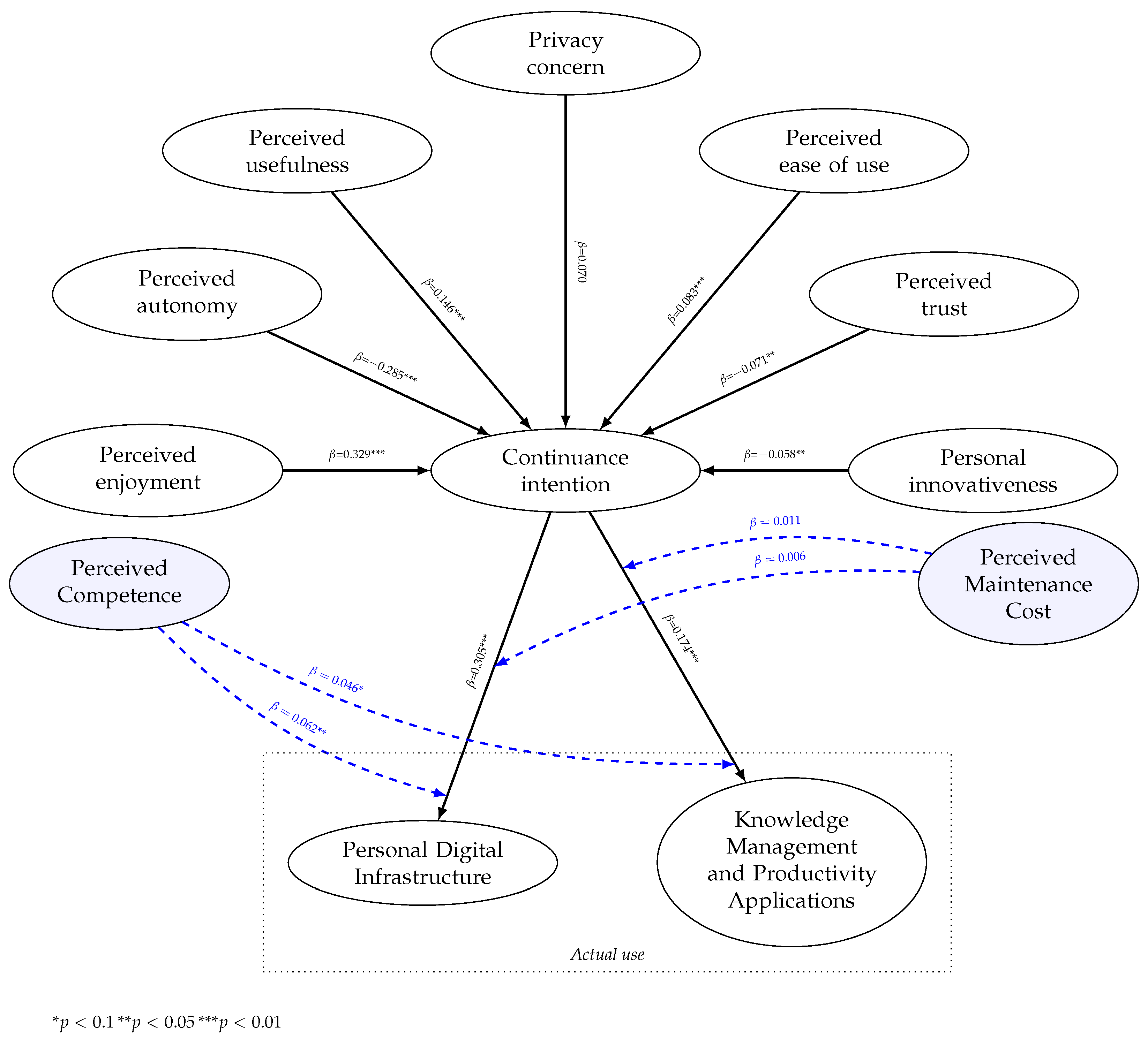
The structural model was tested to evaluate hypotheses H1–H8. The paths are interpreted as standardised beta weights in a regression analysis. To determine the statistical significance of these path coefficients, a bootstrapping procedure was employed to estimate the critical ratios [164]. In line with recommendations from Chin [165] and Hair et al. [166], a large number of re-samples, specifically 5000 bootstrap samples, were used. The model’s iterative estimation process converged in 10 iterations, ensuring a stable solution. The results of the PLS coefficient analysis are presented in Table 7, providing a quantitative overview of the relationships shown in the complete model in Figure 1.

4.3.1. Assessment of Collinearity

To ensure the reliability of the structural model’s coefficient estimates, which are derived using the least squares method, collinearity among the predictor variables was assessed. This is a critical step, as the presence of collinearity can lead to biased estimates [155]. Following the same procedure as for formative models, the Variance Inflation Factor (VIF) was calculated. The VIF should not exceed a value of 5, but researchers note that values above 3 may already indicate excessive collinearity [161].
An initial assessment of collinearity among the predictor variables confirmed that all VIF values are well below the recommended threshold of 5. The highest VIF value recorded was 1.720, suggesting that multicollinearity is not an issue and does not compromise the reliability of the coefficient estimates.
The obtained VIF values also indicate the absence of CMB, since Kock [167] explains that this bias may be present when an individual VIF exceeds 3.3. In our case, the largest VIF value is 1.720, strongly suggesting that CMB is not an issue. We acknowledge that Kock’s method is considered conservative, as it was tested on simple models where VIF values are generally lower, while our model is considerably more complex. To further limit CMB, we also ensured that individual sets of questions in the survey were displayed randomly and were visually separated from each other, which reduces the incidence of response consistency. Furthermore, the anonymity of the survey is an important factor in mitigating social desirability bias.

4.3.2. Assessment of Path Coefficients and Their Significance

The results are presented in Table 7. All examined antecedents of Continuance Intention, with the exception of Privacy Concern, exhibit a statistically significant effect on Continuance Intention. The strongest positive effect on Continuance Intention is observed for Perceived Enjoyment ( β = 0.329 ). Among the statistically significant predictors, Perceived Autonomy ( β = 0.285 ), Perceived Trust ( β = 0.071 ), and Personal Innovativeness ( β = 0.058 ) all exhibit a negative impact on Continuance Intention, with Perceived Autonomy showing the strongest magnitude among all negative coefficients. Furthermore, the results demonstrate a statistically significant positive impact of Continuance Intention on both actual use constructs. Individuals with higher levels of Continuance Intention engage more extensively with Personal Digital Infrastructure (AU1) ( β = 0.305 ) compared to Knowledge Management and Productivity Applications (AU2) ( β = 0.174 ).

4.3.3. Explanatory Power of the Model

To evaluate the explanatory power of each individual predictor variable, the effect size ( f 2 ) is used. This measure assesses a predictor’s importance in explaining the variance of a dependent variable [157]. As outlined by Cohen [168], f 2 values greater than 0.02, 0.15, and 0.35 are interpreted as small, medium, and large effects, respectively. The magnitude of f 2 generally corresponds to the size of the estimated path coefficients. However, deviations can occur, especially in models with mediational relationships, where computing f 2 is still a meaningful step [157].
The explanatory power of the model is typically measured by the coefficient of determination ( R 2 ), which represents the proportion of variance in each endogenous construct explained by the predictors [155,169]. However, as noted by Hair et al. [155], a limitation of this metric is that it will tend to increase as more explanatory variables are introduced to a model. To address this, the adjusted R 2 is used, which accounts for the number of explanatory variables in relation to the data size and is therefore seen as a more conservative estimate [170]. Hankins et al. [171] suggest that the adjusted R 2 is the best measure of explained variance as it corrects for this bias, yielding an estimate that is closer to the population value.
The results indicate that Perceived Enjoyment ( f 2 = 0.091 ), Perceived Autonomy ( f 2 = 0.070 ), and Perceived Usefulness ( f 2 = 0.022 ) exert a small but relevant impact. All predictors of Continuance Intention collectively explain 41% of the variance in Continuance Intention.
The data analysis further demonstrates that Continuance Intention constitutes a relevant factor for both actual use constructs, as the effect size ( f 2 ) exceeds 0.02 for both factors. However, it explains the Personal Digital Infrastructure construct (AU1) ( f 2 = 0.078 ) more effectively. Continuance Intention accounts for 18.4% of the variance in AU1 and 9.9% of the variance in AU2. The adjusted R 2 values are predictably low, given that the model includes only a single explanatory factor for actual use.
Based on the main path analysis results, it was confirmed that Perceived Enjoyment, Perceived Usefulness, and Perceived Ease of Use all positively influence Continuance Intention. Conversely, Perceived Autonomy, Perceived Trust, and Personal Innovativeness all showed a significant negative impact on Continuance Intention. The influence of Privacy Concerns on Continuance Intention was not statistically significant. Finally, Continuance Intention was validated as a strong positive predictor of Actual Usage.

4.3.4. Analysis of Control Variables

The analysis of the control variables, as presented in Table 8, reveals that their influence is not uniform across all endogenous constructs.
For Continuance Intention, the analysis reveals that the influence of most control variables is not statistically significant. The only variables where individual categories were found to differ from the reference with regard to intention to continue using self-hosting solutions were country income and education level. Specifically, respondents from high-income countries exhibit a greater continuance intention compared to those from middle- and low-income countries. Furthermore, the results indicate that respondents with at least a Master’s degree have a greater continuance intention than those whose highest achieved education is a secondary school degree.
Interestingly, the Actual Use constructs (AU1 and AU2) differ considerably in terms of the control variables that influence them. For example, the relevant factors for AU1 are only age and self-hosting experience, whereas for AU2, the relevant factors are age, education level, self-hosting experience, and work related to IT. Higher age increases the actual use for both constructs, as does self-hosting experience. In contrast to the effect of education level on continuance intention, which is higher for Master’s and Doctoral degrees compared to a secondary or lower education, the actual use in the AU2 category is more frequent among respondents with short-cycle tertiary and Bachelor’s degrees compared to those with a secondary or lower education. It is also interesting that respondents whose work is related to IT use AU2 solutions more extensively, whereas this is not a relevant factor for the use of AU1 solutions.

4.4. Moderating Effect of Perceived Competence and Perceived Maintenance Cost

Moderation describes a situation in which the relationship between two constructs is not constant but depends on the values of a third variable, referred to as a moderator variable [155]. To operationalize the interactive moderator constructs, we adopted the two-stage approach, as recommended by Hair et al. [155]. This method was selected because simulation studies have shown that the two-stage approach by Chin et al. [172] demonstrates superior performance in terms of parameter recovery and statistical power [173,174]. Furthermore, this method offers a key advantage of flexibility, as it is the only approach applicable when either the exogenous construct or the moderator is specified formatively, which is the case in our model. The effectiveness of the two-stage approach is rooted in its ability to leverage PLS-SEM’s capacity to estimate latent variable scores [173,175].
As shown in Table 9, the findings concerning the moderating effects revealed significant insights into the relationship between a user’s intention and their actual usage. Perceived Competence emerged as a statistically significant positive moderator for Personal Digital Infrastructure (AU1) ( β = 0.062 , p = 0.023 ). This indicates that for respondents who rated their competence higher, the positive effect of Continuance Intention on the use of AU1 is amplified.
The results for the moderating effect of Perceived Competence on the relationship between Continuance Intention and AU2 are only marginally statistically significant ( p = 0.067 ), but they also suggest a positive effect of Perceived Competence on the aforementioned relationship. In contrast, Perceived Maintenance Cost did not have a statistically significant moderating influence in any of the contexts examined.
The inclusion of these moderating variables, however, enhanced the overall predictive power of the model. The inclusion of the moderators increased the adjusted R 2 for AU1 by approximately 52% (from 0.184 to 0.279), and for AU2 by about 54% (from 0.099 to 0.152).
We used the Johnson–Neyman technique to determine the value of PCOMP at which the moderating effect becomes statistically significant at p < 0.05 . The analysis results show that PCOMP positively moderates the relationship between CI and AU1, where the effect is significant when PCOMP values are greater than −2.29. The estimated PCOMP values in our sample ranged between −4.42 and 1.46. A similar finding applies to the relationship between CI and AU2, where a statistically significant moderating effect of PCOMP appears at values greater than −1.15.

5. Discussion

The primary objective of this study was to comprehensively investigate the motivations behind the continued use of self-hosting software solutions. By integrating constructs from the Technology Acceptance Model (TAM) and extending it with factors specific to the self-hosting domain, such as Privacy concerns, Perceived autonomy, Personal innovativeness and Perceived trust, which is a common practice in modern technology adoption research [46,75], we developed a novel research model. This model was designed to provide a deeper understanding of the factors that drive individuals to invest significant time and effort in technically demanding solutions in exchange for greater data control and digital sovereignty.
The research was conducted using an online survey distributed to self-hosting communities between May and July 2025. This targeted distribution yielded a sample of n = 2158 responses from active self-hosting users, allowing for a detailed quantitative analysis. The data were analyzed using Partial Least Squares Structural Equation Modeling (PLS-SEM) via the SEMinR package in R. This methodological choice was strategic, enabling the examination of complex, multi-layered relationships within the proposed model. The demographic profile of the respondents indicates a highly specific sample, predominantly comprising experienced, educated, and IT-savvy individuals from high-income countries in Europe and North America. This self-selected sample is crucial for interpreting the findings, as it reflects the characteristics of a population deeply engaged in the self-hosting phenomenon.

5.1. Factors Influencing Continuance Intention

To fully understand a user’s intention to continue using a self-hosted solution, it is essential to consider both the factors directly related to the self-hosting process and the user’s perception of the alternative mainstream cloud services. The constructs related to the user’s direct experience with self-hosting capture the practical and intrinsic motivations behind their decision to continue. We included Personal Innovativeness (PI), which measures an individual’s willingness to experiment with new technologies [61,80], and Perceived Enjoyment (PE), which reflects the satisfaction of building and maintaining one’s own system [91]. Additionally, the foundational constructs of the Technology Acceptance Model (TAM), Perceived Usefulness (PU) and Perceived Ease of Use (PEOU), address the user’s perception of the practical benefits and effort involved in self-hosting [90].
A key distinction of our model, complementing the self-hosting constructs, is the inclusion of factors measuring the user’s perception of cloud-based services, as we believe this perspective is crucial for understanding the intention to continue using self-hosting solutions. Based on this premise, we operationalized 4 antecedent constructs to measure attitudes toward cloud services, since a user’s disposition toward mainstream cloud technologies heavily influences their decision to adopt or continue with an alternative, self-hosting. These constructs included privacy concerns (PC) [51], perceived autonomy (PA) [63], and perceived trust (PT) [70]. By integrating these factors, our theoretical structure allowed us to test how perceptions of both the self-hosting process and the cloud alternative collectively shape the intentions for sustained self-hosting.
Our analysis began by examining the first level of the structural model, which explores the antecedents of Continuance Intention. The most relevant factor influencing Continuance Intention was Perceived Enjoyment. This finding confirms our hypothesis H5, as well as supporting and expanding on previous research that highlights the role of intrinsic motivation in technology adoption [93]. Unlike traditional, utilitarian-focused technologies, self-hosting is often a hobby for our demographic of technically skilled and innovative users [31]. The process of building, configuring, and managing one’s own infrastructure can be a source of pleasure and satisfaction, sometimes independent of its functional benefits [176]. Our results suggest that this intrinsic motivation, or the “fun” derived from the process itself, is a powerful predictor of Continuance Intention, which is also supported by self-determination theory, stating that autonomy and intrinsic motivation foster continuance and persistence [177]. Similarly, studies on mobile learning applications have also confirmed that intrinsic motivations, such as enjoyment, have a significant impact on Continuance intention [178].
Our findings also confirm that Perceived Autonomy has a significant effect on Continuance Intention. This result confirms our hypothesis H2 and aligns with prior studies that identify autonomy as a core motivational factor for self-hosting [31,61]. The desire for control and digital sovereignty is a powerful driver for individuals who are concerned about the handling of their data by third-party providers. By self-hosting, users regain explicit control over their digital infrastructure and data [34]. This sense of independence and self-governance is not merely a fringe benefit but a fundamental reason for continued engagement in self-hosting activities, confirming the crucial role of autonomy in this domain [31]. Self-hosting is a direct expression of the broader pursuit of Digital Sovereignty, the capacity of individuals to make self-determined decisions regarding their digital technologies, especially concerning security and privacy [179,180]. This is consistent with findings in the context of mobile banking, where Perceived autonomy, alongside service quality and perceived usefulness, was shown to significantly influence users’ Continuance intention through the lens of self-determination theory [181]. From a socio-technical sustainability perspective, this pursuit of autonomy translates into enhanced digital resilience for the individual, reducing dependency on proprietary ecosystems and mitigating the risks associated with systemic failure of centralized platforms. This move toward decentralized control thus supports the long-term viability and self-determination of digital practice, aligning the user’s intrinsic motivation with the wider goals of sustainable digital development.
Furthermore, Perceived Usefulness also has a significant effect on Continuance Intention. This result confirms our hypothesis H6 and is consistent with the core premise of TAM, which posits that a technology’s perceived utility is a key determinant of its acceptance and continued use [90]. For self-hosting users, usefulness is tied to the ability to customize solutions, achieve specific functional goals, and replace commercial cloud services with a more controlled, private alternative. This suggests that while intrinsic and autonomy-related motivations are central, the utilitarian benefits of self-hosting are still an important part of the user’s decision-making process. Similar findings were reported in the context of cloud storage services, where Perceived Usefulness, shaped by service support, task characteristics, and self-efficacy, was shown to significantly influence users’ Continuance intention to use the technology [154].
In addition to these highly relevant factors, our analysis identified several other statistically significant predictors of Continuance Intention that had negligible effect sizes. Privacy Concerns conditionally positively influenced Continuance Intention, confirming the hypothesis H1 that worries about data privacy concerns in the cloud drive users toward self-hosting; however, this effect is not entirely consistent. Similarly, Chen et al. [182] empirically demonstrate that Privacy Concern exerts a negative influence on Continuance Use in the context of cloud storage service adoption, which is consistent with our findings. Conversely, Perceived Trust negatively influenced continuance intention. These results confirm hypothesis H3, providing evidence that greater trust in cloud providers decreases the likelihood of self-hosting. We also confirmed hypothesis H7, finding that Perceived Ease of Use had a significant but negligible positive effect, suggesting that while it plays a role, it is less central for this particular user group. This finding challenges a core tenet of the TAM model in the context of this specific technology and user group. For experienced users, the challenge and complexity of the process may even be a source of the aforementioned Perceived Enjoyment.
The finding that the negative effect of Personal Innovativeness (PI) on Continuance Intention (H4) was statistically significant, but negligible in effect size, warrants a deeper theoretical discussion. This result contradicts our initial hypothesis and prior research [61]. However, it is consistent with related findings in the cloud computing context, where innovativeness was likewise found to have no significant effect on continuance intention, leading the authors to reject their corresponding hypothesis [183]. While PI is a core construct within Diffusion of Innovations (DOI) Theory, centrally theorized as a defining characteristic that primarily drives the initial adoption decision for new or complex technology solutions [184], its role as a direct predictor diminishes significantly in the post-adoption phase. The shift in focus from technology acceptance to technology sustainability or continuance highlights a fundamental change in the critical mechanism of influence [185]. Our sample, composed exclusively of active self-hosting users, represents a population that has already passed the initial adoption hurdle; consequently, PI has already performed its primary role as the “gatekeeper” to initial use and becomes a background constant in the continuance phase.
Following this logic, models of sustained usage which integrate acceptance models like TAM with continuance models like the Expectation-Confirmation Model (ECM) demonstrate that post-adoption behavior is driven by experiential factors (e.g., satisfaction and confirmation), rather than antecedent personality traits like innovativeness [186]. We therefore posit that the influence of Personal Innovativeness is no longer direct, but is instead fully mediated by these more proximal, experience-based variables, such as Perceived Enjoyment and Perceived Usefulness, which are significant predictors in our model. The innovative trait may predispose users to find greater satisfaction and utility in the complexity and challenge of self-managed systems, effectively channeling its predictive power through these subsequent positive experiences. Thus, the lack of a strong direct relationship between PI and Continuance Intention should be interpreted not as an irrelevance of innovativeness, but as evidence of a shift in the mechanism of influence from a direct effect in the adoption phase to an indirect effect in the continuance phase, a dynamic that is particularly relevant for the study of technology sustainability [185].

5.2. Continuance Intention and Its Impact on Actual Usage

In this study, the Personal Digital Infrastructure (AU1) and Knowledge Management and Productivity Applications (AU2) constructs were meticulously developed to accurately capture the multifaceted landscape of self-hosting activities. This development was not merely an arbitrary division but a deliberate process grounded in empirical data and conceptual alignment, stemming from a comprehensive review of prevalent self-hosted applications and community usage patterns.
The AU1 construct encompasses applications that form the fundamental, often unseen, digital backbone of a user’s personal network. This category comprises tools that provide essential, systemic services rather than directly facilitating content creation or knowledge work. The applications within AU1 function as the foundational layer, automating processes, managing data, and securing the user’s digital environment. For instance, Home Automation & IoT tools like Home Assistant and Node-RED manage and orchestrate the physical devices within a home, creating an integrated smart ecosystem. Similarly, applications for Media Streaming (Video, Audio) such as Jellyfin or Audiobookshelf and for File Transfer & Synchronization like Syncthing are crucial for data accessibility and management across multiple devices. The construct also includes network-level services such as DNS and VPN solutions (Pi-hole, AdGuard Home, WireGuard) that enhance security and privacy. These technologies are foundational because they establish the underlying conditions necessary for other digital activities, providing the infrastructure upon which more specialized applications can operate. By grouping these variables, AU1 represents a cohesive set of applications that collectively form the operational core of a self-hosted digital environment, focusing on system-level functionality and data management.
In contrast, the AU2 construct aggregates applications directly involved in cognitive tasks, personal organization, and collaborative work. While AU1 provides the system-level foundation, AU2 tools are the ones that users interact with most directly to create, organize, and manage information and tasks. The variables in this construct include applications for Note-taking & Editors (Joplin, Trilium Notes), Task Management & To-do Lists (Focalboard, Wekan), and Wikis (Wiki.js, BookStack). These applications are central to personal and professional productivity, enabling users to capture ideas, structure knowledge, and coordinate activities. The construct also includes specialized tools for Software Project Management (Gitea, GitLab), Recipe Management (Mealie), and E-books Management (Calibre). These applications facilitate intellectual work and personal organization, shifting the focus from the underlying digital infrastructure to the direct management of information and productive output. Thus, AU2 represents the user-facing layer of a self-hosted setup, where data is actively processed and transformed into actionable knowledge.
Our analysis of the relationship between Continuance Intention and these two usage categories revealed a significant positive influence on both. However, the strength of this relationship varied, suggesting that a user’s intent to continue is a differentiated predictor of their specific usage behavior.
A potential explanation for the stronger influence of Personal Digital Infrastructure (AU1) on a user’s intent to continue self-hosting, compared to Knowledge Management and Productivity Applications (AU2), lies in the differing nature of these two categories. AU1 applications represent a more significant initial investment in setting up core infrastructure and managing sensitive data. This creates a high degree of dependence and substantial switching costs, as abandoning these services would disrupt a user’s entire digital ecosystem. In contrast, AU2 applications, while valuable, are often less integrated and can be more easily substituted with alternatives. Therefore, the decision to continue with self-hosting is more deeply tied to the foundational services that address the core motivations of data autonomy and control, making AU1 a more powerful driver of long-term engagement.
These results confirm our hypothesis H8 that Continuance Intention for self-hosted software solutions positively influences actual usage, as demonstrated in both of the derived usage categories.

5.3. The Moderating Role of Perceived Competence and Perceived Maintenance Cost

Our analysis revealed that the relationship between Continuance Intention and Actual usage (AU1/AU2) is moderated by Perceived Competence. The moderating effect is particularly strong for AU1, while it is only conditionally statistically significant for AU2.
This discrepancy may be attributed to the differing nature of the two constructs. The applications within the Personal Digital Infrastructure (AU1) category are often more technically demanding, as they operate at a lower level and are more deeply embedded within core infrastructure elements, such as file systems, operating systems, and especially networking. Their foundational role requires users to possess a higher degree of Perceived Competence to navigate complex setups and troubleshooting. In contrast, Knowledge Management and Productivity Applications (AU2), while also requiring some technical skill for initial setup, are generally more focused on user-facing tasks and do not significantly interfere with the underlying infrastructure. Consequently, a user’s perceived competence plays a less critical role in mediating their engagement with these tools, resulting in a weaker moderating effect. This highlights that for foundational, more complex self-hosted services, a user’s self-efficacy is a key determinant of long-term usage.
We also found that the moderating effect is not present across all values of the moderator, as the statistically significant effect appears only for individuals who rate their Perceived Competence at a higher level. For individuals with lower levels of competence, the moderating effect of PCOMP on the relationship between CI and both AU1 and AU2 is not present.
In contrast to Perceived Competence, Perceived Maintenance Cost did not act as a significant moderator in any of the relationships examined. This result is unexpected, as one might assume that the high effort required to migrate data and workflows from commercial cloud services would significantly strengthen a user’s commitment to self-hosting. However, our findings suggest that once the decision to self-host is made, the subsequent usage behavior is driven more by intrinsic motivations and a sense of autonomy rather than a fear of the costs of switching back. This aligns with the central role of Perceived Enjoyment and Perceived Autonomy as primary drivers of Continuance Intention in our model.
The results of our moderation analysis provide support for hypothesis H9 but not for H10. The inclusion of these moderating variables, despite the non-significant effect of Perceived Maintenance Cost, collectively improved the explanatory power of our model.

6. Conclusions

This study aimed to contribute to the academic discourse on the future of the digital society by comprehensively investigating the motivations behind the adoption and continued use of self-hosting software solutions. By exploring this growing movement, we address a key societal response to concerns regarding privacy, security, and digital sovereignty in the age of ubiquitous cloud computing. By employing a quantitative research approach with a targeted survey, we successfully reached a niche and highly engaged population of self-hosting users. Our methodological choice of Partial Least Squares Structural Equation Modeling (PLS-SEM) allowed us to empirically test a comprehensive research model and explore the complex interrelationships between various factors, a methodological advantage over prior studies that relied on simpler analytical techniques.
Our analysis confirmed that a complex blend of intrinsic and utilitarian factors drives the sustained use of self-hosted solutions. We found that Perceived Enjoyment, Perceived Autonomy and Perceived Usefulness were the most powerful predictors of Continuance Intention, underscoring that for this specific demographic, self-hosting is deeply rooted in the intrinsic satisfaction of building and managing one’s own infrastructure and the ideological commitment to digital sovereignty. While utilitarian factors such as Perceived Usefulness also play a role, their influence is less pronounced, challenging a core tenet of the traditional Technology Acceptance Model (TAM) and highlighting the ideological and psychosocial motivations of this unique user group. The findings underscore a fundamental shift in user values, where the pursuit of autonomy and intrinsic satisfaction can outweigh the convenience and ease of use offered by centralized platforms.
Furthermore, we found a clear and positive relationship between Continuance Intention and both of our actual usage categories. The strongest link was observed for Personal Digital Infrastructure (AU1), suggesting that users’ intent to continue self-hosting is most effectively translated into actions that directly address privacy and control concerns over personal data. The relationship with Knowledge Management and Productivity Applications (AU2) was also significant but weaker, indicating that users may still rely on commercial alternatives for these services. This finding highlights the need for developers of self-hosted solutions to further address ease of use and interoperability to better compete with the network effects of commercial cloud providers. The study’s contributions extend beyond these direct relationships by clarifying the moderating roles of Perceived Competence and Perceived Maintenance Cost on the relationship between usage intention and actual behavior.
Our findings show that Perceived Competence positively moderates the relationship between their intention to continue using self-hosted solutions and their actual usage. This confirms that self-efficacy is a key factor in long-term engagement, especially with more technically demanding applications. Conversely, Perceived Maintenance Cost was not a significant moderator.

6.1. Theoretical and Practical Implications

Our findings offer several important implications. Theoretically, the study extends the Technology Acceptance Model (TAM) by demonstrating that for self-hosting, intrinsic factors like Perceived Enjoyment and Perceived Autonomy are more powerful predictors of continuance intention than traditional utilitarian factors. This highlights the need for technology adoption models to be context-sensitive, especially for niche, hobby-driven technologies. Our research also provides a novel, validated measurement scale for self-hosted software usage, offering a valuable tool for future studies in this underexplored domain.
Practically, these results are highly relevant for developers and communities within the self-hosting ecosystem. To foster sustained usage, the focus should not solely be on technical functionality but also on the user experience. Developers should prioritize making the self-hosting process enjoyable and empowering, reinforcing the user’s sense of digital sovereignty and control. By improving the setup experience and highlighting opportunities for customization, the community can strengthen intrinsic motivation and reduce reliance on ease of use as the primary driver for adoption.
The powerful influence of Perceived Enjoyment and Perceived Autonomy has direct implications for the broader technology domain. In an age of growing mistrust toward centralized digital platforms, providing users with technology that is both fun to use and gives them a sense of control can be a powerful strategy for driving sustained engagement in decentralized digital solutions. This principle extends beyond self-hosting to other open-source and privacy-focused technologies. Crucially, this research highlights self-hosting as a critical socio-technical practice that fosters digital resilience by diversifying digital infrastructure and mitigating the systemic risks associated with centralized single points of failure. From a sustainability perspective, this shift represents a fundamental move toward greater autonomy over digital resources, contributing to the long-term economic and social viability of digital services and aligning with the global imperative for sustainable digital transformation.

6.2. Limitations and Future Research

This study has limitations that should be considered. First, due to the low prevalence of self-hosting users in the general population, as evidenced by studies like Gröber et al. [61], a non-probability sampling approach (convenience and snowball sampling) was employed to access this specific and highly niche demographic. Our targeted sampling strategy successfully reached an engaged population of users within specialized online communities. However, this methodological choice, while necessary for the research, inherently limits the generalizability of our findings. The results are representative of a highly specific, self-selected sample, individuals who are already active in self-hosting communities, are technically proficient, and are motivated to participate in a survey on this topic. Therefore, our conclusions should not be extrapolated to the general population. Furthermore, it is important to acknowledge the subjective nature of the data. All measured constructs reflect the self-perceptions and opinions of the respondents, which may not always align with objective reality. Finally, we note that the constructs of Perceived Autonomy and Perceived Trust exhibited marginally insufficient convergent validity, suggesting a potential inadequacy in the measurement scales used.
Our findings present several opportunities for future research. A longitudinal study is recommended to better understand how motivations and usage patterns evolve over time, as our cross-sectional data could not capture this. Additionally, a qualitative investigation would be highly beneficial to gain a deeper, more nuanced understanding of the underlying reasons for our findings. Building on this, a dedicated study on the influence of social communities would be valuable, as these groups often play a key role in knowledge sharing and support, shaping user behavior and adoption. Crucially, future research should develop or refine the measurement scales for Perceived Autonomy and Perceived Trust in the context of self-hosting solutions, given that the scales adapted from non-self-hosting prior research did not achieve adequate convergent validity in this study. Additionally, future research should utilize Multi-Group Analysis (MGA) to test the generalizability of effects across user segments (e.g., experience and profession) and integrate broader theoretical frameworks, such as Expectation-Confirmation, Habit, and community factors, to better model competitive evaluation and social support dynamics. Furthermore, future research should explicitly investigate the impact of domain-specific operational challenges, such as the time burden of maintenance, security incident management, and update fatigue, on the continuance use of self-hosted solutions to enhance practical prescriptiveness. Finally, future research could compare self-hosting users with non-users based on their perceptions of the analyzed constructs to identify the key factors that lead individuals to adopt these solutions in the first place, thus building upon our understanding of continuance intention to explore the initial adoption process.

Author Contributions

Conceptualization, L.H. and L.N.Z.; methodology, L.H. and L.N.Z.; formal analysis, L.H.; investigation, L.H.; data curation, L.H.; writing—original draft preparation, L.H.; writing—review and editing, L.H. and L.N.Z.; visualization, L.H.; supervision, L.N.Z. All authors have read and agreed to the published version of the manuscript.

Funding

The authors acknowledge the receipt of financial support from the Slovenian Research and Innovation Agency (Research Core Funding No. P2-0057).

Institutional Review Board Statement

The study was conducted in accordance with the Declaration of Helsinki and approved by the Commission for Research Ethics of Faculty of Arts, University of Maribor (038-06-208/2025/5/FF/UM, 24 March 2025) and Research Ethics Commitee at the Institute of Informatics, Faculty of Electrical Engineering and Computer Science, University of Maribor (3/163-GŠ/2025 0401-ENG, 15 April 2025).

Informed Consent Statement

Informed consent was obtained from all subjects involved in the study.

Data Availability Statement

The results/data/figures in this manuscript have not been published elsewhere, nor are they under consideration by another publisher. The original contributions of this study are included in the article, and further inquiries can be directed to the corresponding author.

Conflicts of Interest

The authors declare no conflicts of interest.

Appendix A. Questionnaire Constructs and Items

Table A1. Constructs and items evaluated by respondents.
ConstructAdapted fromItemDescription
Privacy Concerns[136,137]PC1I hesitate before keeping my data on a cloud service.
PC2I feel uneasy about keeping my data on a cloud service.
PC3I get concerned when I keep my data on a cloud service.
PC4I am concerned that my data on a cloud service will be accessed and used by other people without my consent.
PC5I am concerned that using cloud services will reveal my privacy information.
Perceived
Autonomy
[63,138,139]PA1I am bothered when I do not have control over data that I provide to cloud services. [reversed-coded]
PA2I am bothered when I do not have control or autonomy over decisions about how my data is collected, used, and shared by cloud services. [reversed-coded]
PA3I am concerned when data sovereignty and control is lost or unwillingly reduced as a result of a Vendor Lock-In (hard to switch provider) with cloud services. [reversed-coded]
PA4It’s important to me that I can manage my data the way I want. [reversed-coded]
PA5I do not feel a sense of choice and freedom while using cloud services. [reversed-coded]
Personal
Innovativeness
[140]PI1If I hear about a new information technology, I look for ways to experiment with it.
PI2Among my peers, I am usually the first to try out new information technologies.
PI3In general, I am hesitant to try out new new information technologies. [reversed-coded]
PI4I like to experiment with new information technologies.
Perceived Trust[138,141]PT1Cloud services are trustworthy.
PT2Cloud services providers keep my best interests in mind.
PT3Cloud services providers keep promises and commitments.
PT4I believe that the services provided by cloud services providers are done in a reliable way.
PT5Cloud services providers handle my data in a competent manner.
Perceived Ease
of Use
[90,142]PEOU1Learning to use self-hosted services is easy for me.
PEOU2I find it easy to get self-hosted services to do what I want it to do.
PEOU3Using self-hosted services is clear and understandable for me.
PEOU4I find self-hosted services to be flexible to interact with.
PEOU5It is easy for me to become skillful at managing and using using self-hosted services.
PEOU6I find self-hosted services easy to use.
Perceived
Competence
[143]PCOMP1I think I am pretty good at self-hosting.
PCOMP2I am satisfied with my outcomes at self-hosting.
PCOMP3After managing self-hosting services for a while, I feel pretty skilful.
PCOMP4I am pretty skilled at managing self-hosted services.
PCOMP5I cannot manage self-hosting services very well. [reversed-coded]
Perceived
Usefulness
[90,144]PU1Using self-hosting services enables me to accomplish tasks more quickly.
PU2Using self-hosting services enhances my performance.
PU3Using self-hosting services enhances my productivity.
PU4Using self-hosting services enhances my effectiveness.
PU5I find self-hosting services useful.
Perceived
Enjoyment
[90,142]PE1Using self-hosting services is enjoyable.
PE2I have fun using self-hosting services.
PE3I like using self-hosting services.
PE4I am interested in educating myself on self-hosting topics.
PE5In my free time, I like to set up self-host services.
PE6I enjoy solving self-hosting related technical challenges.
Perceived
Maintenance
Cost
[145,146]PMC1It takes a lot of time to set up self-hosted services.
PMC2It takes a lot of effort to set up self-hosted services.
PMC3I am willing to pay a substantial amount for hardware required for self-hosting. [reversed-coded]
PMC4I am willing to devote a considerable amount of my time to maintain self-hosted services. [reversed-coded]
Continuance
Intention
[148]CI1I intend to continue using self-hosting services in the future if possible.
CI2I will use self-hosting services regularly in the future if possible.
CI3I will frequently use self-hosting services in the future if possible.
CI4I will recommend self-hosting services to others.
CI5I intend to continue using self-hosted services rather than using any cloud alternatives if possible.
Table A2. Self-Hosting Use Cases and Examples.
ItemCategoryExamples Provided
USE1Home Automation & IoTHome Assistant, Node RED, openHAB, Domoticz…
USE2Media Streaming (Video, Audio)Jellyfin, Stash, PeerTube, Audiobookshelf, Navidrome, Snapcast…
USE3Automation*arr Stack (Radarr, Sonarr, Lidarr…), n8n, changedetection.io, OliveTin…
USE4Password ManagersVaultwarden, Passbolt, Passky…
USE5Photo GalleriesImmich, PhotoPrism, Lychee…
USE6Document ManagementPaperless-ngx, Stirling-PD, Docspell…
USE7File Transfer & SynchronizationSyncthing, Nextcloud, Seafile…
USE8DNSPi-hole, AdGuard Home, Technitium…
USE9VPNWireGuard, Headscale, Nebula…
USE10Feed ReadersFreshRSS, Miniflux, RSSHub…
USE11Personal DashboardsHeimdall, Dashy, Homarr, Homer…
USE12Note-taking & EditorsJoplin, Memos, Standard Notes, Trilium Notes…
USE13Money, Budgeting & ManagementFirefly III, Actual, Invoice Ninja…
USE14Software Project ManagementGitea, Forgejo, GitLab…
USE15Recipe ManagementMealie, Bar Assistant, RecipeSage…
USE16E-books ManagementCalibre, Kavita, Komga…
USE17WikisWiki.js, Dokuwiki, BookStack…
USE18Communication, Messaging & NotificationsMatrix, Mumble, Rocket.Chat, ntfy, Gotify…
USE19Bookmarks and Link SharingLinkWarden, linkding, Buku…
USE20Task Management & To-do ListsFocalboard, Planka, Wekan…
USE21Metrics, Status and Uptime pagesGrafana, Uptime Kuma, Gatus, cState…

References

  1. Changchit, C.; Chuchuen, C. Cloud computing: An examination of factors impacting users’ adoption. J. Comput. Inf. Syst. 2018, 58, 1–9. [Google Scholar] [CrossRef]
  2. Bairagi, S.I.; Bang, A.O. Cloud computing: History, architecture, security issues. Int. J. Advent Res. Comput. Electron. (IJARCE) 2015, 2015, 28. [Google Scholar]
  3. Surbiryala, J.; Rong, C. Cloud computing: History and overview. In Proceedings of the 2019 IEEE Cloud Summit, Washington, DC, USA, 8–10 August 2019; IEEE: New York, NY, USA, 2019; pp. 1–7. [Google Scholar]
  4. Ryan, M.D. Cloud computing privacy concerns on our doorstep. Commun. ACM 2011, 54, 36–38. [Google Scholar] [CrossRef]
  5. Chen, D.; Zhao, H. Data security and privacy protection issues in cloud computing. In Proceedings of the 2012 International Conference on Computer Science and Electronics Engineering, Hangzhou, China, 23–25 March 2012; IEEE: New York, NY, USA, 2012; Volume 1, pp. 647–651. [Google Scholar]
  6. Sen, J. Security and privacy issues in cloud computing. In Cloud Technology: Concepts, Methodologies, Tools, and Applications; IGI Global: Hershey, PA, USA, 2015; pp. 1585–1630. [Google Scholar]
  7. Hu, W.; Yang, T.; Matthews, J.N. The good, the bad and the ugly of consumer cloud storage. ACM SIGOPS Oper. Syst. Rev. 2010, 44, 110–115. [Google Scholar] [CrossRef]
  8. Svantesson, D.; Clarke, R. Privacy and consumer risks in cloud computing. Comput. Law Secur. Rev. 2010, 26, 391–397. [Google Scholar] [CrossRef]
  9. Syynimaa, N.; Viitanen, T. Is My Office 365 GDPR Compliant?: Security Issues in Authentication and Administration. In Proceedings of the 20th International Conference on Enterprise Information Systems, Madeira, Portugal, 21–24 March 2018. [Google Scholar]
  10. Pearson, S.; Benameur, A. Privacy, security and trust issues arising from cloud computing. In Proceedings of the 2010 IEEE Second International Conference on Cloud Computing Technology and Science, Indianapolis, IN, USA, 30 November–3 December 2010; IEEE: New York, NY, USA, 2010; pp. 693–702. [Google Scholar]
  11. Khan, K.M.; Malluhi, Q. Establishing trust in cloud computing. IT Prof. 2010, 12, 20–27. [Google Scholar] [CrossRef]
  12. Habib, S.M.; Hauke, S.; Ries, S.; Mühlhäuser, M. Trust as a facilitator in cloud computing: A survey. J. Cloud Comput. Adv. Syst. Appl. 2012, 1, 19. [Google Scholar] [CrossRef]
  13. Adjei, J.K. Explaining the role of trust in cloud computing services. Info 2015, 17, 54–67. [Google Scholar] [CrossRef]
  14. Dong, S.; Abbas, K.; Jain, R. A survey on distributed denial of service (DDoS) attacks in SDN and cloud computing environments. IEEE Access 2019, 7, 80813–80828. [Google Scholar] [CrossRef]
  15. Birch, K.; Cochrane, D.; Ward, C. Data as asset? The measurement, governance, and valuation of digital personal data by Big Tech. Big Data Soc. 2021, 8, 20539517211017308. [Google Scholar] [CrossRef]
  16. Arutyunov, V. Cloud computing: Its history of development, modern state, and future considerations. Sci. Tech. Inf. Process. 2012, 39, 173–178. [Google Scholar] [CrossRef]
  17. Tak, B.C.; Urgaonkar, B.; Sivasubramaniam, A. To move or not to move: The economics of cloud computing. In Proceedings of the 3rd USENIX Workshop on Hot Topics in Cloud Computing (HotCloud 11), Portland, OR, USA, 14–15 June 2011. [Google Scholar]
  18. Hashem, I.A.T.; Yaqoob, I.; Anuar, N.B.; Mokhtar, S.; Gani, A.; Khan, S.U. The rise of “big data” on cloud computing: Review and open research issues. Inf. Syst. 2015, 47, 98–115. [Google Scholar] [CrossRef]
  19. Rimal, B.P.; Lumb, I. The rise of cloud computing in the era of emerging networked society. In Cloud Computing: Principles, Systems and Applications; Springer: Cham, Switzerland, 2017; pp. 3–25. [Google Scholar]
  20. Islam, M.; Reza, S. The rise of big data and cloud computing. Internet Things Cloud Comput. 2019, 7, 45. [Google Scholar] [CrossRef]
  21. Byrne, D.; Corrado, C.; Sichel, D.E. The Rise of Cloud Computing: Minding Your P’s, Q’s and K’s; Technical Report; National Bureau of Economic Research: Cambridge, MA, USA, 2018. [Google Scholar]
  22. George, A.S.; Sagayarajan, S.; AlMatroudi, Y.; George, A.H. The Impact of Cloud Hosting Solutions on IT Jobs: Winners and Losers in the Cloud Era. Partners Univers. Int. Res. J. 2023, 2, 1–19. [Google Scholar]
  23. Duncan, B. Can eu general data protection regulation compliance be achieved when using cloud computing? Cloud Comput. 2018, 2018, 11. [Google Scholar]
  24. Škrinjar Vidović, M. EU data protection reform: Challenges for cloud computing. Croat. Yearb. Eur. Law Policy 2016, 12, 171–206. [Google Scholar] [CrossRef][Green Version]
  25. Karthiban, K.; Smys, S. Privacy preserving approaches in cloud computing. In Proceedings of the 2018 2nd International Conference on Inventive Systems and Control (ICISC), Coimbatore, India, 19–20 January 2018; IEEE: New York, NY, USA, 2018; pp. 462–467. [Google Scholar][Green Version]
  26. Domingo-Ferrer, J.; Farras, O.; Ribes-González, J.; Sánchez, D. Privacy-preserving cloud computing on sensitive data: A survey of methods, products and challenges. Comput. Commun. 2019, 140, 38–60. [Google Scholar] [CrossRef]
  27. Chenthara, S.; Ahmed, K.; Wang, H.; Whittaker, F. Security and privacy-preserving challenges of e-health solutions in cloud computing. IEEE Access 2019, 7, 74361–74382. [Google Scholar] [CrossRef]
  28. Gholami, M.F.; Daneshgar, F.; Low, G.; Beydoun, G. Cloud migration process—A survey, evaluation framework, and open challenges. J. Syst. Softw. 2016, 120, 31–69. [Google Scholar] [CrossRef]
  29. Silva, G.C.; Rose, L.M.; Calinescu, R. A systematic review of cloud lock-in solutions. In Proceedings of the 2013 IEEE 5th International Conference on Cloud Computing Technology and Science, Bristol, UK, 2–5 December 2013; IEEE: New York, NY, USA, 2013; Volume 2, pp. 363–368. [Google Scholar]
  30. Razavian, S.M.; Khani, H.; Yazdani, N.; Ghassemi, F. An analysis of vendor lock-in problem in cloud storage. In Proceedings of the ICCKE 2013, Mashhad, Iran, 31 October–1 November 2013; IEEE: New York, NY, USA, 2013; pp. 331–335. [Google Scholar]
  31. Gröber, L.; Mrowczynski, R.; Vijay, N.; Muller, D.A.; Dabrowski, A.; Krombholz, K. To Cloud or not to Cloud: A Qualitative Study on Self-Hosters’ Motivation, Operation, and Security Mindset. In Proceedings of the 32nd USENIX Security Symposium (USENIX Security 23), Anaheim, CA, USA, 9–11 August 2023; pp. 2491–2508. [Google Scholar]
  32. Ion, I.; Sachdeva, N.; Kumaraguru, P.; Čapkun, S. Home is safer than the cloud! Privacy concerns for consumer cloud storage. In Proceedings of the Seventh Symposium on Usable Privacy and Security, Pittsburgh, PA, USA, 20–22 July 2011; pp. 1–20. [Google Scholar]
  33. Stuermer, M.; Abu-Tayeh, G.; Myrach, T. Digital sustainability: Basic conditions for sustainable digital artifacts and their ecosystems. Sustain. Sci. 2017, 12, 247–262. [Google Scholar] [CrossRef]
  34. Molnar, D.; Schechter, S.E. Self Hosting vs. Cloud Hosting: Accounting for the Security Impact of Hosting in the Cloud; Citeseer: Princeton, NJ, USA, 2010; Volume 2010, pp. 1–18. [Google Scholar]
  35. Kong, J. A practical approach to improve the data privacy of virtual machines. In Proceedings of the 2010 10th IEEE International Conference on Computer and Information Technology, Bradford, UK, 29 June–1 July 2010; IEEE: New York, NY, USA, 2010; pp. 936–941. [Google Scholar]
  36. Yacob, T. Securing Sensitive Data in the Cloud: A New Era of Security Through Zero Trust Principles; KTH: Huddinge, Sweden, 2023. [Google Scholar]
  37. Verborgh, R. Re-decentralizing the Web, for good this time. In Linking the World’s Information: Essays on Tim Berners-Lee’s Invention of the World Wide Web; Association for Computing Machinery: New York, NY, USA, 2023; pp. 215–230. [Google Scholar]
  38. Asgarinia, H.; Chomczyk Penedo, A.; Esteves, B.; Lewis, D. “Who Should I Trust with My Data?” Ethical and Legal Challenges for Innovation in New Decentralized Data Management Technologies. Information 2023, 14, 351. [Google Scholar] [CrossRef]
  39. GitHub—Awesome-Selfhosted/Awesome-Selfhosted: A List of Free Software Network Services and Web Applications Which Can Be Hosted on Your Own Servers—github.com. 2025. Available online: https://github.com/awesome-selfhosted/awesome-selfhosted (accessed on 11 July 2025).
  40. Qasem, Y.A.M.; Abdullah, R.; Jusoh, Y.Y.; Atan, R.; Asadi, S. Analyzing Continuance of Cloud Computing in Higher Education Institutions: Should We Stay, or Should We Go? Sustainability 2021, 13, 4664. [Google Scholar] [CrossRef]
  41. Pańkowska, M.; Pyszny, K.; Strzelecki, A. Users’ Adoption of Sustainable Cloud Computing Solutions. Sustainability 2020, 12, 9930. [Google Scholar] [CrossRef]
  42. Goode, S. Keeping the user in the cloud: A cognitive social capital antecedent to use continuance and trust-commitment in personal cloud storage services. Behav. Inf. Technol. 2019, 38, 701–725. [Google Scholar] [CrossRef]
  43. Behrend, T.S.; Wiebe, E.N.; London, J.E.; Johnson, E.C. Cloud computing adoption and usage in community colleges. Behav. Inf. Technol. 2011, 30, 231–240. [Google Scholar] [CrossRef]
  44. Ho, S.M.; Ocasio-Velázquez, M.; Booth, C. Trust or consequences? Causal effects of perceived risk and subjective norms on cloud technology adoption. Comput. Secur. 2017, 70, 581–595. [Google Scholar] [CrossRef]
  45. Chang, K.C.; Seow, Y.M. Adoption Intention on Cloud Storage Services: The Role of Technology Trust, Privacy and Security Concerns. In Proceedings of the PACIS, Chiayi, Taiwan, 27 June–1 July 2016; p. 79. [Google Scholar]
  46. Utomo, R.G.; Yasirandi, R. Exploring trust, privacy, and security in cloud storage adoption among generation Z: An extended TAM approach. Kinet. Game Technol. Inf. Syst. Comput. Netw. Comput. Electron. Control 2024, 9. [Google Scholar] [CrossRef]
  47. Marx, T. The push-pull-mooring model of consumer service switching: A meta-analytical review to guide future research. J. Serv. Theory Pract. 2025, 35, 1–29. [Google Scholar] [CrossRef]
  48. Liao, C.; Palvia, P.; Chen, J.L. Information technology adoption behavior life cycle: Toward a Technology Continuance Theory (TCT). Int. J. Inf. Manag. 2009, 29, 309–320. [Google Scholar] [CrossRef]
  49. Rahi, S.; Khan, M.M.; Alghizzawi, M. Extension of technology continuance theory (TCT) with task technology fit (TTF) in the context of Internet banking user continuance intention. Int. J. Qual. Reliab. Manag. 2021, 38, 986–1004. [Google Scholar] [CrossRef]
  50. Tatić, K.; Haračić, M.; Činjarević, M.; Haračić, M. Let’s cloud with me! users’ willingness to use cloud computing services as a function of social norms. Ekon. Vjesn./Econviews-Rev. Contemp. Bus. Entrep. Econ. Issues 2022, 35, 275–285. [Google Scholar] [CrossRef]
  51. Malhotra, N.K.; Kim, S.S.; Agarwal, J. Internet users’ information privacy concerns (IUIPC): The construct, the scale, and a causal model. Inf. Syst. Res. 2004, 15, 336–355. [Google Scholar] [CrossRef]
  52. Chang, S.E.; Liu, A.Y.; Lin, S. Exploring privacy and trust for employee monitoring. Ind. Manag. Data Syst. 2015, 115, 88–106. [Google Scholar] [CrossRef]
  53. Nofer, M.; Hinz, O.; Muntermann, J.; Roßnagel, H. The economic impact of privacy violations and security breaches: A laboratory experiment. Bus. Inf. Syst. Eng. 2014, 6, 339–348. [Google Scholar] [CrossRef]
  54. Sridhar, V. What Are the Privacy Issues Over Data Collected by the Internet and Telecom Firms? In Emerging ICT Policies and Regulations: Roadmap to Digital Economies; Springer: Singapore, 2019; pp. 233–264. [Google Scholar]
  55. Xu, H.; Wang, J.; Tai, Z.; Lin, H.C. Empirical study on the factors affecting user switching behavior of online learning platform based on push-pull-mooring theory. Sustainability 2021, 13, 7087. [Google Scholar] [CrossRef]
  56. Chen, Y.; Li, X.; Li, Q.; Li, W. Exploring customers’ switching from native to lightweight apps: A push–pull–mooring framework perspective. Ind. Manag. Data Syst. 2022, 122, 2633–2656. [Google Scholar] [CrossRef]
  57. Gashami, J.P.G.; Chang, Y.; Rho, J.J.; Park, M.C. Privacy concerns and benefits in SaaS adoption by individual users: A trade-off approach. Inf. Dev. 2016, 32, 837–852. [Google Scholar] [CrossRef]
  58. Liu, C.; Marchewka, J.T.; Lu, J.; Yu, C.S. Beyond concern—A privacy-trust-behavioral intention model of electronic commerce. Inf. Manag. 2005, 42, 289–304. [Google Scholar] [CrossRef]
  59. Arpaci, I. Understanding and predicting students’ intention to use mobile cloud storage services. Comput. Hum. Behav. 2016, 58, 150–157. [Google Scholar] [CrossRef]
  60. Chang, Y.W.; Hsu, P.Y. An empirical investigation of organizations’ switching intention to cloud enterprise resource planning: A cost-benefit perspective. Inf. Dev. 2019, 35, 290–302. [Google Scholar] [CrossRef]
  61. Gröber, L.; Lenau, S.; Weil, R.; Groben, E.; Schilling, M.; Krombholz, K. Towards Privacy and Security in Private Clouds: A Representative Survey on the Prevalence of Private Hosting and Administrator Characteristics. In Proceedings of the 33rd USENIX Security Symposium (USENIX Security 24), Philadelphia, PA, USA, 14–16August 2024; pp. 6057–6074. [Google Scholar]
  62. Ryan, R.M.; Deci, E.L. Overview of self-determination theory: An organismic dialectical perspective. Handb. Self-Determ. Res. 2002, 2, 36. [Google Scholar]
  63. Li, Y.; Chang, K.C.; Wang, J. Self-determination and perceived information control in cloud storage service. J. Comput. Inf. Syst. 2020, 60, 113–123. [Google Scholar] [CrossRef]
  64. Wang, X.; Li, Y. Users’ satisfaction with social network sites: A self-determination perspective. J. Comput. Inf. Syst. 2016, 56, 48–54. [Google Scholar] [CrossRef]
  65. John, W.; Charag, A.H.; Bashir, I. Indian Millennials’ continued usage intentions toward online dating apps: The interplay between trust and perceived autonomy. Young Consum. 2025, 26, 207–226. [Google Scholar] [CrossRef]
  66. Li, Y.; Chang, K.-C.; Wang, J. How User Information Assurance Influences Perceived Information Control in Cloud Storage Service: A Self-Determination Perspective. J. Comput. Inf. Syst. 2017, 60, 1–11. [Google Scholar]
  67. Gagné, M.; Deci, E.L. Self-determination theory and work motivation. J. Organ. Behav. 2005, 26, 331–362. [Google Scholar] [CrossRef]
  68. Teck Soon, H.; Syed, A.; Kadir, S.L. The drivers for cloud-based virtual learning environment: Examining the moderating effect of school category. Internet Res. 2017, 27, 942–973. [Google Scholar] [CrossRef]
  69. Hew, T.S.; Kadir, S.L.S.A. Predicting the acceptance of cloud-based virtual learning environment: The roles of Self Determination and Channel Expansion Theory. Telemat. Inform. 2016, 33, 990–1013. [Google Scholar] [CrossRef]
  70. McEvily, B.; Perrone, V.; Zaheer, A. Trust as an organizing principle. Organ. Sci. 2003, 14, 91–103. [Google Scholar] [CrossRef]
  71. Roca, J.C.; García, J.J.; De La Vega, J.J. The importance of perceived trust, security and privacy in online trading systems. Inf. Manag. Comput. Secur. 2009, 17, 96–113. [Google Scholar] [CrossRef]
  72. Mayer, R.C.; Davis, J.H.; Schoorman, F.D. An integrative model of organizational trust. Acad. Manag. Rev. 1995, 20, 709–734. [Google Scholar] [CrossRef]
  73. Chen, L.Y. Perceived risk and trust in the adoption of cloud computing services and their effects on organizational performance. Int. J. Adv. Stud. Comput. Sci. Eng. 2017, 6, 24. [Google Scholar]
  74. Lynn, T.; van der Werff, L.; Fox, G. Understanding trust and cloud computing: An integrated framework for assurance and accountability in the cloud. In Data Privacy and Trust in Cloud Computing: Building Trust in the Cloud Through Assurance and Accountability; Palgrave Macmillan: Cham, Switzerland, 2021; pp. 1–20. [Google Scholar]
  75. Forster, K. Impact of Institutional Trust And Trust In Cloud Service Provider on the Adoption of Cloud Computing: A Quantitative Study. Ph.D. Thesis, Capella University, Minneapolis, MN, USA, 2021. [Google Scholar]
  76. Jones, M.A.; Mothersbaugh, D.L.; Beatty, S.E. Why customers stay: Measuring the underlying dimensions of services switching costs and managing their differential strategic outcomes. J. Bus. Res. 2002, 55, 441–450. [Google Scholar] [CrossRef]
  77. Agarwal, R.; Prasad, J. A conceptual and operational definition of personal innovativeness in the domain of information technology. Inf. Syst. Res. 1998, 9, 204–215. [Google Scholar] [CrossRef]
  78. Van Raaij, E.M.; Schepers, J.J. The acceptance and use of a virtual learning environment in China. Comput. Educ. 2008, 50, 838–852. [Google Scholar] [CrossRef]
  79. He, T.; Zhu, C. Digital informal learning among Chinese university students: The effects of digital competence and personal factors. Int. J. Educ. Technol. High. Educ. 2017, 14, 1–19. [Google Scholar] [CrossRef]
  80. Xu, H.; Gupta, S. The effects of privacy concerns and personal innovativeness on potential and experienced customers’ adoption of location-based services. Electron. Mark. 2009, 19, 137–149. [Google Scholar] [CrossRef]
  81. Alkawsi, G.; Ali, N.; Baashar, Y. The moderating role of personal innovativeness and users experience in accepting the smart meter technology. Appl. Sci. 2021, 11, 3297. [Google Scholar] [CrossRef]
  82. Simarmata, M.T.; Hia, I.J. The role of personal innovativeness on behavioral intention of Information Technology. J. Econ. Bus. 2020, 1, 18–29. [Google Scholar] [CrossRef]
  83. Prasanna Balasooriya, L.; Wibowo, S.; Grandhi, S.; Wells, M. The Impact of Security Concerns on Personal Innovativeness, Behavioural and Adoption Intentions of Cloud Technology. J. Softw. Netw. 2017, 1, 265–290. [Google Scholar]
  84. Arpaci, I.; Kilicer, K.; Bardakci, S. Effects of security and privacy concerns on educational use of cloud services. Comput. Hum. Behav. 2015, 45, 93–98. [Google Scholar] [CrossRef]
  85. Lu, J. Are personal innovativeness and social influence critical to continue with mobile commerce? Internet Res. 2014, 24, 134–159. [Google Scholar] [CrossRef]
  86. Venkatesh, V. Determinants of perceived ease of use: Integrating control, intrinsic motivation, and emotion into the technology acceptance model. Inf. Syst. Res. 2000, 11, 342–365. [Google Scholar] [CrossRef]
  87. Venkatesh, V.; Thong, J.Y.; Xu, X. Consumer acceptance and use of information technology: Extending the unified theory of acceptance and use of technology. MIS Q. 2012, 36, 157–178. [Google Scholar] [CrossRef]
  88. Venkatesh, V.; Bala, H. Technology acceptance model 3 and a research agenda on interventions. Decis. Sci. 2008, 39, 273–315. [Google Scholar] [CrossRef]
  89. Lin, C.Y.; Huang, C.K.; Ko, C.J. The impact of perceived enjoyment on team effectiveness and individual learning in a blended learning business course: The mediating effect of knowledge sharing. Australas. J. Educ. Technol. 2020, 36, 126–141. [Google Scholar] [CrossRef]
  90. Davis, F.D. Perceived usefulness, perceived ease of use, and user acceptance of information technology. MIS Q. 1989, 13, 319–340. [Google Scholar] [CrossRef]
  91. Davis, F.D.; Bagozzi, R.P.; Warshaw, P.R. Extrinsic and intrinsic motivation to use computers in the workplace 1. J. Appl. Soc. Psychol. 1992, 22, 1111–1132. [Google Scholar] [CrossRef]
  92. Abdalla, R.A. Examining awareness, social influence, and perceived enjoyment in the TAM framework as determinants of ChatGPT. Personalization as a moderator. J. Open Innov. Technol. Mark. Complex. 2024, 10, 100327. [Google Scholar] [CrossRef]
  93. Won, D.; Chiu, W.; Byun, H. Factors influencing consumer use of a sport-branded app: The technology acceptance model integrating app quality and perceived enjoyment. Asia Pac. J. Mark. Logist. 2023, 35, 1112–1133. [Google Scholar] [CrossRef]
  94. Holdack, E.; Lurie-Stoyanov, K.; Fromme, H.F. The role of perceived enjoyment and perceived informativeness in assessing the acceptance of AR wearables. J. Retail. Consum. Serv. 2022, 65, 102259. [Google Scholar] [CrossRef]
  95. Varghese, B.; Leitner, P.; Ray, S.; Chard, K.; Barker, A.; Elkhatib, Y.; Herry, H.; Hong, C.H.; Singer, J.; Tso, F.P.; et al. Cloud futurology. Computer 2019, 52, 68–77. [Google Scholar] [CrossRef]
  96. Sithipolvanichgul, J.; Chen, C.; Land, J.; Ractham, P. Enhancing user experiences with cloud computing via improving utilitarian and hedonic factors. Energies 2021, 14, 1822. [Google Scholar] [CrossRef]
  97. Jo, H. Antecedents of continuance intention of social networking services (SNS): Utilitarian, hedonic, and social contexts. Mob. Inf. Syst. 2022, 2022, 7904124. [Google Scholar] [CrossRef]
  98. Huang, Y.M. Students’ continuance intention toward programming games: Hedonic and utilitarian aspects. Int. J. Hum.-Comput. Interact. 2020, 36, 393–402. [Google Scholar] [CrossRef]
  99. Park, N.; Rhoads, M.; Hou, J.; Lee, K.M. Understanding the acceptance of teleconferencing systems among employees: An extension of the technology acceptance model. Comput. Hum. Behav. 2014, 39, 118–127. [Google Scholar] [CrossRef]
  100. Davis, F.D.; Bagozzi, R.P.; Warshaw, P.R. User acceptance of computer technology: A comparison of two theoretical models. Manag. Sci. 1989, 35, 982–1003. [Google Scholar] [CrossRef]
  101. Venkatesh, V.; Davis, F.D. A theoretical extension of the technology acceptance model: Four longitudinal field studies. Manag. Sci. 2000, 46, 186–204. [Google Scholar] [CrossRef]
  102. Featherman, M.S.; Pavlou, P.A. Predicting e-services adoption: A perceived risk facets perspective. Int. J. Hum.-Comput. Stud. 2003, 59, 451–474. [Google Scholar] [CrossRef]
  103. Ratten, V. A US-China comparative study of cloud computing adoption behavior: The role of consumer innovativeness, performance expectations and social influence. J. Entrep. Emerg. Econ. 2014, 6, 53–71. [Google Scholar] [CrossRef]
  104. Taylor, S.; Todd, P.A. Understanding information technology usage: A test of competing models. Inf. Syst. Res. 1995, 6, 144–176. [Google Scholar] [CrossRef]
  105. Tripathi, S. Understanding the determinants affecting the continuance intention to use cloud computing. J. Int. Technol. Inf. Manag. 2017, 26, 124–152. [Google Scholar] [CrossRef]
  106. Palos-Sanchez, P.R.; Arenas-Marquez, F.J.; Aguayo-Camacho, M. Cloud computing (SaaS) adoption as a strategic technology: Results of an empirical study. Mob. Inf. Syst. 2017, 2017, 2536040. [Google Scholar] [CrossRef]
  107. Gangwar, H.; Date, H. Critical factors of cloud computing adoption in organizations: An empirical study. Glob. Bus. Rev. 2016, 17, 886–904. [Google Scholar] [CrossRef]
  108. Sharma, S.K.; Al-Badi, A.H.; Govindaluri, S.M.; Al-Kharusi, M.H. Predicting motivators of cloud computing adoption: A developing country perspective. Comput. Hum. Behav. 2016, 62, 61–69. [Google Scholar] [CrossRef]
  109. Nurdin, N.; Pettalongi, S.S.; Mangasing, M. Understanding digital skill use from the technology continuance theory (TCT). In Proceedings of the 2019 6th International Conference on Information Technology, Computer and Electrical Engineering (ICITACEE), Semarang, Indonesi, 26–27 September 2019; IEEE: New York, NY, USA, 2019; pp. 1–6. [Google Scholar]
  110. Thompson, R.L.; Higgins, C.A.; Howell, J.M. Personal computing: Toward a conceptual model of utilization. MIS Q. 1991, 15, 125–143. [Google Scholar] [CrossRef]
  111. Teo, T. Modelling technology acceptance in education: A study of pre-service teachers. Comput. Educ. 2009, 52, 302–312. [Google Scholar] [CrossRef]
  112. Pai, C.K.; Wang, T.W.; Chen, S.H.; Cai, K.Y. Empirical study on Chinese tourists’ perceived trust and intention to use biometric technology. Asia Pac. J. Tour. Res. 2018, 23, 880–895. [Google Scholar] [CrossRef]
  113. Deci, E.L.; Ryan, R.M. The “what” and “why” of goal pursuits: Human needs and the self-determination of behavior. Psychol. Inq. 2000, 11, 227–268. [Google Scholar] [CrossRef]
  114. Marshik, T.; Ashton, P.T.; Algina, J. Teachers’ and students’ needs for autonomy, competence, and relatedness as predictors of students’ achievement. Soc. Psychol. Educ. 2017, 20, 39–67. [Google Scholar] [CrossRef]
  115. Goldhammer, F.; Gniewosz, G.; Zylka, J. ICT engagement in learning environments. In Assessing Contexts of Learning: An International Perspective; Springer: Cham, Switzerland, 2016; pp. 331–351. [Google Scholar]
  116. Fathali, S.; Okada, T. Technology acceptance model in technology-enhanced OCLL contexts: A self-determination theory approach. Australas. J. Educ. Technol. 2018, 34. [Google Scholar] [CrossRef]
  117. Aldraiweesh, A.; Alturki, U. Exploring factors influencing the acceptance of e-learning and students’ cooperation skills in higher education. Sustainability 2023, 15, 9363. [Google Scholar] [CrossRef]
  118. Zhao, Y.; Zhao, K.; Chen, I.H.; Wang, X.; Wei, S. Peer support and novice teachers’ willingness to participate in teaching reflection in online workshops: The mediating role of perceived competence and sense of belonging. Curr. Psychol. 2024, 43, 32324–32335. [Google Scholar] [CrossRef]
  119. Oduor, M.; Oinas-Kukkonen, H. Commitment devices as behavior change support systems: A study of users’ perceived competence and continuance intention. In Proceedings of the Persuasive Technology: Development and Implementation of Personalized Technologies to Change Attitudes and Behaviors: 12th International Conference, PERSUASIVE 2017, Amsterdam, The Netherlands, 4–6 April 2017; Proceedings 12. Springer: Berlin/Heidelberg, Germany, 2017; pp. 201–213. [Google Scholar]
  120. Lee, B.K.; Lee, E.H.; Lee, T. The effect of E-Government website evaluation on user satisfaction and intention to use: The mediating role of warmth and competence judgment on government. Inf. Commun. Soc. 2023, 26, 1868–1889. [Google Scholar] [CrossRef]
  121. Chan, S.H.; Song, Q.; Hays, L.E.; Trongmateeru, P. The roles of intrinsic and extrinsic motivation and perceived competence in enhancing system use and performance. In Proceedings of the Pacific Asia Conference on Information Systems, Chengdu, China, 24–28 June 2014. [Google Scholar]
  122. Rhodes, R.E.; Cox, A.; Sayar, R. What predicts the physical activity intention–behavior gap? A systematic review. Ann. Behav. Med. 2022, 56, 1–20. [Google Scholar] [CrossRef]
  123. Maier, C.; Laumer, S.; Eckhardt, A.; Weitzel, T. Using user personality to explain the intention-behavior gap and changes in beliefs: A longitudinal analysis. In Proceedings of the Thirty Third International Conference on Information Systems (ICIS 2012), Orlando, FL, USA, 16–19 December 2012. [Google Scholar]
  124. Divine, A.; Berry, T.; Rodgers, W.; Hall, C. The relationship of self-efficacy and explicit and implicit associations on the intention–behavior gap. J. Phys. Act. Health 2020, 18, 29–36. [Google Scholar] [CrossRef] [PubMed]
  125. Assadi, V.; Hassanein, K. Continuance intention to use high maintenance information systems: The role of perceived maintenance effort. In Proceedings of the European Conference on Information Systems (ECIS), Pretoria, South Africa, 7–9 June 2010; p. 88. [Google Scholar]
  126. Akbiyik, A.; Hassanein, K.; Head, M. Perceived maintenance load of high maintenance information systems: Conceptualization and development. In Proceedings of the Pacific Asia Conference on Information Systems, Singapore, 6–9 July 2015; p. 163. [Google Scholar]
  127. Jones, M.A.; Reynolds, K.E.; Mothersbaugh, D.L.; Beatty, S.E. The positive and negative effects of switching costs on relational outcomes. J. Serv. Res. 2007, 9, 335–355. [Google Scholar] [CrossRef]
  128. Dick, A.S.; Basu, K. Customer loyalty: Toward an integrated conceptual framework. J. Acad. Mark. Sci. 1994, 22, 99–113. [Google Scholar] [CrossRef]
  129. Li, J.; He, Y. Switching costs and users’ intentions of an app-enabled cross-border e-commerce platform: Examples of Amazon and Tmall Global. Asia Pac. J. Mark. Logist. 2024, 37, 556–572. [Google Scholar] [CrossRef]
  130. Krishnan, G.; Raghuram, J.N.V. Exploring diabetic patients’ intention to switch POCT self-monitoring glucose devices: Investigating influence of perceived usefulness and perceived ease of use. Int. J. Pharm. Healthc. Mark. 2024, 19, 160–178. [Google Scholar] [CrossRef]
  131. Chulkov, D.V. On the role of switching costs and decision reversibility in information technology adoption and investment. JISTEM-J. Inf. Syst. Technol. Manag. 2017, 14, 309–321. [Google Scholar] [CrossRef]
  132. Bansal, H.S.; Taylor, S.F.; St. James, Y. “Migrating” to new service providers: Toward a unifying framework of consumers’ switching behaviors. J. Acad. Mark. Sci. 2005, 33, 96–115. [Google Scholar] [CrossRef]
  133. Hong, H.; Xu, D. An empirical study of mobile social app continuance intention: Integrating flow experience and switching costs. Int. J. Netw. Virtual Organ. 2017, 17, 410–424. [Google Scholar] [CrossRef]
  134. Al-Jabali, R.N.; Ahmad, N.; Chiu, W. Continuance intention to use mobile fitness applications: The role of switching costs, guilt and neutralization techniques. Int. J. Sport. Mark. Spons. 2025, 26, 599–618. [Google Scholar] [CrossRef]
  135. Wu, K.; Vassileva, J.; Zhao, Y. Understanding users’ intention to switch personal cloud storage services: Evidence from the Chinese market. Comput. Hum. Behav. 2017, 68, 300–314. [Google Scholar] [CrossRef]
  136. Moqbel, M.; Bartelt, V.; Al-Suqri, M.; Al-Maskari, A. Does privacy matter to millennials? The case for personal cloud. J. Inf. Priv. Secur. 2017, 13, 17–33. [Google Scholar] [CrossRef]
  137. Chang, S.E.; Shen, W.C.; Liu, A.Y. Why mobile users trust smartphone social networking services? A PLS-SEM approach. J. Bus. Res. 2016, 69, 4890–4895. [Google Scholar] [CrossRef]
  138. Pal, D.; Arpnikanondt, C.; Razzaque, M.A. Personal information disclosure via voice assistants: The personalization–privacy paradox. SN Comput. Sci. 2020, 1, 280. [Google Scholar] [CrossRef]
  139. Guo, J.; Shan, S.; Ali Khan, Y. What are the impetuses Behind E-health applications’ self-management services’ ongoing adoption by health community participants? Health Inform. J. 2023, 29, 14604582231152801. [Google Scholar] [CrossRef] [PubMed]
  140. Koivisto, K.; Makkonen, M.; Frank, L.; Riekkinen, J. Extending the technology acceptance model with personal innovativeness and technology readiness: A comparison of three models. In Proceedings of the BLED 2016, Bled, Slovenia, 11–19 July 2016. [Google Scholar]
  141. Jarvenpaa, S.L.; Tractinsky, N.; Vitale, M. Consumer trust in an Internet store. Inf. Technol. Manag. 2000, 1, 45–71. [Google Scholar] [CrossRef]
  142. Teo, T.; Noyes, J. An assessment of the influence of perceived enjoyment and attitude on the intention to use technology among pre-service teachers: A structural equation modeling approach. Comput. Educ. 2011, 57, 1645–1653. [Google Scholar] [CrossRef]
  143. Ntoumanis, N. A self-determination approach to the understanding of motivation in physical education. Br. J. Educ. Psychol. 2001, 71, 225–242. [Google Scholar] [CrossRef]
  144. Sagnier, C.; Loup-Escande, E.; Lourdeaux, D.; Thouvenin, I.; Valléry, G. User acceptance of virtual reality: An extended technology acceptance model. Int. J. Hum.-Comput. Interact. 2020, 36, 993–1007. [Google Scholar] [CrossRef]
  145. Visinescu, L.L.; Azogu, O.; Ryan, S.D.; Wu, Y.A.; Kim, D.J. Better safe than sorry: A study of investigating individuals’ protection of privacy in the use of storage as a cloud computing service. Int. J. Hum.-Comput. Interact. 2016, 32, 885–900. [Google Scholar] [CrossRef]
  146. Jones, M.A.; Mothersbaugh, D.L.; Beatty, S.E. Switching barriers and repurchase intentions in services. J. Retail. 2000, 76, 259–274. [Google Scholar] [CrossRef]
  147. Gao, L.; Bai, X. A unified perspective on the factors influencing consumer acceptance of internet of things technology. Asia Pac. J. Mark. Logist. 2014, 26, 211–231. [Google Scholar] [CrossRef]
  148. Ayyoub, A.A.M.; Eidah, B.A.A.; Khlaif, Z.N.; El-Shamali, M.A.; Sulaiman, M.R. Understanding online assessment continuance intention and individual performance by integrating task technology fit and expectancy confirmation theory. Heliyon 2023, 9, e22068. [Google Scholar] [CrossRef] [PubMed]
  149. ISO 3166; Country Codes. ISO: Geneva, Switzerland, 2020.
  150. World Bank. World Bank Country and Lending Groups. 2025. Available online: https://datahelpdesk.worldbank.org/knowledgebase/articles/906519-world-bank-country-and-lending-groups (accessed on 31 July 2025).
  151. Hrgarek, L.; Nemec Zlatolas, L. Software Self-hosting: A systematic review of quantitative research. J. Syst. Softw. 2025, 112443. [Google Scholar] [CrossRef]
  152. Widjaja, A.E.; Chen, J.V.; Sukoco, B.M.; Ha, Q.A. Understanding users’ willingness to put their personal information on the personal cloud-based storage applications: An empirical study. Comput. Hum. Behav. 2019, 91, 167–185. [Google Scholar] [CrossRef]
  153. Hsu, C.L.; Lin, J.C.C. An empirical examination of consumer adoption of Internet of Things services: Network externalities and concern for information privacy perspectives. Comput. Hum. Behav. 2016, 62, 516–527. [Google Scholar] [CrossRef]
  154. Yang, H.L.; Lin, S.L. User continuance intention to use cloud storage service. Comput. Hum. Behav. 2015, 52, 219–232. [Google Scholar] [CrossRef]
  155. Hair, J.F., Jr.; Hult, G.T.M.; Ringle, C.M.; Sarstedt, M.; Danks, N.P.; Ray, S. Partial Least Squares Structural Equation Modeling (PLS-SEM) Using R: A Workbook; Springer Nature: Berlin, Germany, 2021. [Google Scholar]
  156. Henseler, J.; Hubona, G.; Ray, P.A. Using PLS path modeling in new technology research: Updated guidelines. Ind. Manag. Data Syst. 2016, 116, 2–20. [Google Scholar] [CrossRef]
  157. Hair, J.F.; Risher, J.J.; Sarstedt, M.; Ringle, C.M. When to use and how to report the results of PLS-SEM. Eur. Bus. Rev. 2019, 31, 2–24. [Google Scholar] [CrossRef]
  158. Dijkstra, T.K.; Henseler, J. Consistent partial least squares path modeling. MIS Q. 2015, 39, 297–316. [Google Scholar] [CrossRef]
  159. Henseler, J.; Ringle, C.M.; Sarstedt, M. A new criterion for assessing discriminant validity in variance-based structural equation modeling. J. Acad. Mark. Sci. 2015, 43, 115–135. [Google Scholar] [CrossRef]
  160. Hair, J.F. A Primer on Partial Least Squares Structural Equation Modeling (PLS-SEM); Sage: London, UK, 2014. [Google Scholar]
  161. Mason, C.H.; Perreault, W.D., Jr. Collinearity, power, and interpretation of multiple regression analysis. J. Mark. Res. 1991, 28, 268–280. [Google Scholar] [CrossRef]
  162. Fornell, C.; Larcker, D.F. Evaluating structural equation models with unobservable variables and measurement error. J. Mark. Res. 1981, 18, 39–50. [Google Scholar] [CrossRef]
  163. Huang, C.C.; Wang, Y.M.; Wu, T.W.; Wang, P.A. An empirical analysis of the antecedents and performance consequences of using the moodle platform. Int. J. Inf. Educ. Technol. 2013, 3, 217. [Google Scholar] [CrossRef]
  164. Efron, B.; Tibshirani, R.J. An Introduction to the Bootstrap; Chapman and Hall/CRC: London, UK, 1994. [Google Scholar]
  165. Chin, W.W. Commentary: Issues and opinion on structural equation modeling. MIS Q. 1998, 22, vii–xvi. [Google Scholar]
  166. Hair, J.F.; Ringle, C.M.; Sarstedt, M. PLS-SEM: Indeed a silver bullet. J. Mark. Theory Pract. 2011, 19, 139–152. [Google Scholar] [CrossRef]
  167. Kock, N. Common method bias in PLS-SEM: A full collinearity assessment approach. Int. J. e-Collab. (IJeC) 2015, 11, 1–10. [Google Scholar] [CrossRef]
  168. Cohen, J. Statistical Power Analysis for the Behavioral Sciences; Routledge: London, UK, 2013. [Google Scholar]
  169. Gujarati, D.N. Basic Econometrics; McGraw Hill Inc.: New York, NY, USA, 2009. [Google Scholar]
  170. Theil, H. Economic Forecasts and Policy; North-Holland Publishing Company: Amsterdam, The Netherland, 1961. [Google Scholar]
  171. Hankins, M.; French, D.; Horne, R. Statistical guidelines for studies of the theory of reasoned action and the theory of planned behaviour. Psychol. Health 2000, 15, 151–161. [Google Scholar] [CrossRef]
  172. Chin, W.W.; Marcolin, B.L.; Newsted, P.R. A partial least squares latent variable modeling approach for measuring interaction effects: Results from a Monte Carlo simulation study and an electronic-mail emotion/adoption study. Inf. Syst. Res. 2003, 14, 189–217. [Google Scholar] [CrossRef]
  173. Becker, J.M.; Ringle, C.M.; Sarstedt, M. Estimating Moterating effects in PLS-SEM andPLSc-SEM: Interaction term gerneration* data treatment. J. Appl. Struct. Equ. Model. 2018, 2, 1–21. [Google Scholar]
  174. Henseler, J.; Chin, W.W. A comparison of approaches for the analysis of interaction effects between latent variables using partial least squares path modeling. Struct. Equ. Model. 2010, 17, 82–109. [Google Scholar] [CrossRef]
  175. Rigdon, E.E.; Ringle, C.M.; Sarstedt, M. Structural modeling of heterogeneous data with partial least squares. Rev. Mark. Res. 2010, 7, 255–296. [Google Scholar]
  176. Chen, S.C.; Li, S.H.; Liu, S.C.; Yen, D.C.; Ruangkanjanases, A. Assessing determinants of continuance intention towards personal cloud services: Extending utaut2 with technology readiness. Symmetry 2021, 13, 467. [Google Scholar] [CrossRef]
  177. Pelletier, L.G.; Fortier, M.S.; Vallerand, R.J.; Briere, N.M. Associations among perceived autonomy support, forms of self-regulation, and persistence: A prospective study. Motiv. Emot. 2001, 25, 279–306. [Google Scholar] [CrossRef]
  178. Chang, C.C.; Liang, C.; Yan, C.F.; Tseng, J.S. The impact of college students’ intrinsic and extrinsic motivation on continuance intention to use English mobile learning systems. Asia-Pac. Educ. Res. 2013, 22, 181–192. [Google Scholar] [CrossRef]
  179. Tan, K.L.; Chi, C.H.; Lam, K.Y. Survey on digital sovereignty and identity: From digitization to digitalization. ACM Comput. Surv. 2023, 56, 1–36. [Google Scholar] [CrossRef]
  180. Fratini, S.; Hine, E.; Novelli, C.; Roberts, H.; Floridi, L. Digital sovereignty: A descriptive analysis and a critical evaluation of existing models. Digit. Soc. 2024, 3, 59. [Google Scholar] [CrossRef]
  181. Inan, D.I.; Hidayanto, A.N.; Juita, R.; Soemawilaga, F.F.; Melinda, F.; Puspacinantya, P.; Amalia, Y. Service quality and self-determination theory towards continuance usage intention of mobile banking. J. Sci. Technol. Policy Manag. 2023, 14, 303–328. [Google Scholar] [CrossRef]
  182. Chen, J.V.; Chung, H.Y.; Widjaja, A.E.; Ha, Q.A. An empirical investigation of users’ continuance intention to use cloud storage service for organisational uses. Int. J. Bus. Inf. Syst. 2024, 45, 254–277. [Google Scholar] [CrossRef]
  183. Ratten, V. Continuance use intention of cloud computing: Innovativeness and creativity perspectives. J. Bus. Res. 2016, 69, 1737–1740. [Google Scholar] [CrossRef]
  184. Sayginer, C.; Ercan, T. Understanding determinants of cloud computing adoption using an integrated diffusion of innovation (doi)-technological, organizational and environmental (toe) model. Humanit. Soc. Sci. Rev. 2020, 8, 91–102. [Google Scholar] [CrossRef]
  185. Aizstrauta, D.; Ginters, E.; Eroles, M.A.P. Applying theory of diffusion of innovations to evaluate technology acceptance and sustainability. Procedia Comput. Sci. 2015, 43, 69–77. [Google Scholar] [CrossRef]
  186. Wandira, R.; Fauzi, A.; Nurahim, F. Analysis of factors influencing behavioral Intention to use cloud-based academic information system using extended technology acceptance model (TAM) and expectation-confirmation model (ECM). J. Inf. Syst. Eng. Bus. Intell. 2024, 10, 179–190. [Google Scholar] [CrossRef]
Figure 1. PLS path analysis.
Sustainability 17 10009 g001
Table 1. Demographic Characteristics of the Sample.
Number of AnswersPercentage
SourceReddit r/selfhosted123457.18%
Lemmy.World c/selfhosted90441.89%
Other200.93%
Self-Hosting ExperienceLess than 1 year1838.48%
Between 1 and 3 years52224.19%
Between 3 and 6 years54825.39%
Between 6 and 9 years35316.36%
More than 9 years55225.58%
GenderMale202893.98%
Female753.48%
Other552.55%
RegionEurope and Central Asia101446.99%
North America91342.31%
East Asia and Pacific1366.30%
Latin America and Caribbean331.53%
Middle East, North Africa, Afghanistan and Pakistan281.30%
South Asia231.07%
Sub-Saharan Africa110.51%
Country’s income levelHigh income205995.41%
Upper middle income693.20%
Lower middle income281.30%
Low income20.09%
Employment statusEmployed169178.36%
Student24811.99%
Unemployed1024.73%
Retired281.30%
Other894.12%
Education TypeInformation and Communication Technologies120455.79%
Engineering, manufacturing and construction28413.16%
Other1557.18%
Natural sciences, mathematics and statistics1506.95%
Business, administration and law894.12%
Arts and humanities773.57%
Generic programmes and qualifications632.92%
Social sciences, journalism and information502.32%
Health and welfare442.04%
Education301.39%
Services70.32%
Agriculture, forestry, fisheries and veterinary50.23%
Education levelEarly childhood education20.09%
Primary Education391.81%
Lower Secondary Education431.99%
Upper Secondary Education22510.43%
Post-secondary non-Tertiary Education1617.46%
Short-cycle tertiary education1316.07%
Bachelors degree or equivalent tertiary education level96844.86%
Masters degree or equivalent tertiary education level47121.83%
Doctoral degree or equivalent tertiary education level1185.47%
Work related to ITYes175781.42%
No40118.58%
Table 2. Psychometric properties of the instrument.
MeanSDLoadingsVIFCronbach’s α CRRho AAVE
Privacy Concerns (PC)0.8770.8780.8860.593
PC14.0290.9740.837
PC23.9720.9810.825
PC33.8161.0130.833
PC44.0361.0790.685
PC54.1460.9600.650
Perceived Autonomy (PA)0.7170.7150.7200.457
PA14.4080.7470.706
PA24.6200.6670.597
PA44.6460.5500.717
Personal Innovativeness (PI)0.8100.8100.8670.533
PI13.9720.8250.783
PI23.9640.9650.555
PI33.9690.9430.526
PI44.2160.7310.966
Perceived Trust (PT)0.7560.7570.7710.441
PT12.3960.9150.802
PT21.6040.7170.629
PT32.1580.9160.576
PT52.7281.0280.628
Perceived Ease of Use (PEOU)0.8650.8610.8680.555
PEOU13.9190.8410.683
PEOU23.7460.8390.623
PEOU33.9390.7830.778
PEOU53.9280.8360.823
PEOU63.7920.8210.800
Perceived Usefulness (PU)0.8590.8270.8850.506
PU13.3051.0490.539
PU23.5690.9540.592
PU33.4970.9810.606
PU43.6010.9250.661
PU54.6050.5201.041
Perceived Enjoyment (PE)0.8740.8720.8960.540
PE14.3840.6880.776
PE24.4400.7110.706
PE34.5480.5720.977
PE44.5240.6270.688
PE54.1940.8650.668
PE64.0151.0190.515
Perceived Competence (PCOMP)0.8690.8740.8850.585
PCOMP13.8700.8850.832
PCOMP24.2040.7040.576
PCOMP34.0490.8180.792
PCOMP43.8470.8820.891
PCOMP54.1070.8330.701
Perceived Maintenance Cost (PMC) (Formative)
PMC33.3061.1320.8651.139
PMC43.7040.9700.7731.139
Continuance Intention (CI)0.8340.8230.8290.540
CI14.8080.4100.663
CI24.7770.4470.713
CI34.7250.5130.728
CI54.4210.7930.826
Personal Digital Infrastructure (AU1) (Formative)
USE13.4911.5850.4881.158
USE24.3411.0900.4281.205
USE33.7081.4840.5281.388
USE43.2761.5850.5121.150
USE53.6651.4480.5281.320
USE63.3701.4950.5851.414
USE74.0371.2740.4811.241
USE84.0071.3350.5701.278
USE93.9621.3330.5751.299
USE102.5631.4910.4521.175
USE113.1821.5390.4161.207
Knowledge Management and Productivity Applications (AU2) (Formative)
USE123.0801.5190.6511.457
USE132.5351.4560.5531.348
USE143.0071.5530.6301.327
USE152.6091.4830.5441.345
USE163.1551.5510.5021.231
USE172.6621.4970.6911.466
USE182.7091.4800.5951.309
USE192.5761.4650.6891.593
USE202.5911.4680.7371.750
USE213.3531.4890.5581.229
Table 3. Intercorrelations of the HTMT variables.
PCPAPIPTPEOUPUPECIPCOMP
PC
PA0.681
PI0.0810.060
PT0.5710.3910.080
PEOU0.0820.1060.3300.056
PU0.1960.2330.2320.1650.411
PE0.0450.1620.4680.0320.4420.413
CI0.3340.4460.1450.2530.3010.3760.450
PCOMP0.1070.1210.4290.0670.7390.4120.4480.336
Table 4. Discriminant Validity Assessment Using the Fornell–Larcker Criterion (AVE).
PCPAPIPTPEOUPUPECIPCOMP
PC0.770
PA0.5360.676
PI−0.0580.0230.730
PT−0.471−0.2900.0580.664
PEOU0.0740.0870.281−0.0450.745
PU0.1740.2010.201−0.1370.3540.711
PE0.0290.1400.392−0.0140.3800.3810.735
CI0.3030.3570.121−0.2120.2590.3500.3920.736
PCOMP0.0950.0960.369−0.0450.6430.3550.3770.2780.766
Table 5. Factor loadings for Actual Use with single factor and dual factor.
USE1USE2USE3USE4USE5USE6USE7USE8USE9USE10USE11
1-factor0.4140.2660.4260.4690.4690.6030.4570.4480.4730.5450.451
2-factor0.4880.4280.5280.5120.5280.5850.4810.5700.5750.4520.416
USE12USE13USE14USE15USE16USE17USE18USE19USE20USE21
1-factor0.5970.5180.5530.5270.4780.6120.5440.6300.6510.547
2-factor0.6510.5530.6300.5440.5020.6910.5950.6890.7370.558
Table 6. Information criteria comparison for single factor and dual factor Actual Use.
1-Factor2-Factor
CIAUCIAU1AU2
AIC−740.269−224.176−743.037−237.770−143.025
BIC−558.786−76.721−561.554−90.3144.431
Table 7. Hypothesized relationships and effect size (main path).
HConfirmedRelationship β (Path Coefficient)VIF f 2 Adjusted R 2
Continuance intention 0.407
1Sustainability 17 10009 i001 Privacy concern0.070      1.7200.014
2Sustainability 17 10009 i001 Perceived autonomy−0.285 ***1.4720.070
3Sustainability 17 10009 i001 Perceived trust−0.071 ** 1.3230.006
4×Sustainability 17 10009 i001 Personal innovativeness−0.058 ** 1.2690.004
5Sustainability 17 10009 i001 Perceived enjoyment0.329 ***1.5150.091
6Sustainability 17 10009 i001 Perceived usefulness0.146 ***1.3230.022
7Sustainability 17 10009 i001 Perceived ease of use0.083 ***1.4270.007
Personal Digital Infrastructure (AU1)0.184
8.1Sustainability 17 10009 i001 Continuance Intention0.305 ***1.0260.078
Knowledge Management and Productivity Applications (AU2)0.099
8.2Sustainability 17 10009 i001 Continuance Intention0.174 ***1.0260.030
** p < 0.05 *** p < 0.01 .
Table 8. Relationships of Control Variables with Endogenous Constructs.
RelationshipMin p-ValueSignificant Categories
(p < 0.05)
Total Categories (Excl. Reference)
Continuance Intention
Sustainability 17 10009 i001 Age0.15801
Sustainability 17 10009 i001 Country Income (2-category)0.00911
Sustainability 17 10009 i001 Education Level (3-category)0.02612
Sustainability 17 10009 i001 Education Type0.43009
Sustainability 17 10009 i001 Employment Status0.11504
Sustainability 17 10009 i001 Gender0.70602
Sustainability 17 10009 i001 Self-Hosted Experience0.07604
Sustainability 17 10009 i001 Work related to IT0.74301
Personal Digital Infrastructure (AU1)
Sustainability 17 10009 i001 Age0.04111
Sustainability 17 10009 i001 Country Income (2-category)0.10001
Sustainability 17 10009 i001 Education Level (3-category)0.19202
Sustainability 17 10009 i001 Education Type0.28309
Sustainability 17 10009 i001 Employment Status0.06104
Sustainability 17 10009 i001 Gender0.29802
Sustainability 17 10009 i001 Self-Hosted Experience0.00034
Sustainability 17 10009 i001 Work related to IT0.30501
Knowledge Management and Productivity Applications (AU2)
Sustainability 17 10009 i001 Age0.00011
Sustainability 17 10009 i001 Country Income (2-category)0.05301
Sustainability 17 10009 i001 Education Level (3-category)0.03212
Sustainability 17 10009 i001 Education Type0.29709
Sustainability 17 10009 i001 Employment Status0.10104
Sustainability 17 10009 i001 Gender0.05002
Sustainability 17 10009 i001 Self-Hosted Experience0.00044
Sustainability 17 10009 i001 Work related to IT0.00411
Table 9. Moderating effects.
HModerating Relationship β (Path Coefficient)pAdj. R 2 OriginalAdj. R 2 Moderated
Personal Digital Infrastructure (AU1)0.1840.279
9.1Sustainability 17 10009 i001 Continuance Intention*Perceived Competence0.0620.023
10.1Sustainability 17 10009 i001 Continuance Intention*Perceived Maintenance Cost0.0060.824
Knowledge Management and Productivity Applications (AU2)0.0990.152
9.2Sustainability 17 10009 i001 Continuance Intention*Perceived Competence0.0460.067
10.2Sustainability 17 10009 i001 Continuance Intention*Perceived Maintenance Cost0.0110.621
Disclaimer/Publisher’s Note: The statements, opinions and data contained in all publications are solely those of the individual author(s) and contributor(s) and not of MDPI and/or the editor(s). MDPI and/or the editor(s) disclaim responsibility for any injury to people or property resulting from any ideas, methods, instructions or products referred to in the content.