You are currently viewing a new version of our website. To view the old version click .
Sustainability
  • Article
  • Open Access

6 November 2025

Ecological Outcomes and Societal Transformation: Multiple Visions for Adaptation in the Great Barrier Reef

,
,
,
and
1
The Cairns Institute, James Cook University (JCU), Cairns, QLD 4878, Australia
2
School of Sociology, The Australian National University, Canberra, ACT 2601, Australia
3
School of Project Management, Faculty of Engineering, The University of Sydney, Sydney, NSW 2050, Australia
4
Commonwealth Scientific and Industrial Research Organisation, Brisbane, QLD 4102, Australia
This article belongs to the Special Issue New Science and Management Approaches to Support Coral Reefs in a Time of Rapid Climate Change

Abstract

Fears regarding the future of coral reefs are reflected in a growing scientific effort, worldwide, to help corals survive and adapt to the impacts of climate change through new management strategies. To be viable, these strategies must not only be ecologically beneficial and technically feasible; they must be developed in partnership with Indigenous peoples and sensitive to the needs and aspirations of local communities, stakeholders and broader publics. This paper synthesizes insights from a comprehensive program of qualitative and quantitative social research, conducted through Australia’s Reef Restoration and Adaptation Program, exploring local community and public perspectives on the Great Barrier Reef (GBR) and the prospect of assisted adaptation. While the results of this research indicate strong support for prospective interventions to help the GBR, they also demonstrate that local communities and the broader Australian public hold multiple visions for the GBR’s future and engage in careful processes to imagine and evaluate assisted adaptation. We discuss the implications of this complexity for the development of technically robust and socially responsible adaptation intervention in the GBR, emphasizing the opportunities it presents for robust and inclusive dialogue, knowledge building, and governance around these strategies. Community and public support, we conclude, is contingent on moving beyond the seemingly straightforward question of whether or not people support intervention and towards forms of engagement that allow space for social and cultural diversity and the co-creation of ethically grounded adaptation pathways.

1. Introduction

Repeated global bleaching events and forecasts of continued decline in coral reefs as a consequence of climate change have provoked widespread concern about the future of coral reefs worldwide [1]. Amidst calls for a greater emphasis on resilience-based approaches to coral reef management [2,3], there has been increased interest in novel scientific and technological interventions to help corals resist, survive, recover from, and adapt to the impacts of rising temperatures [4,5,6]. One such initiative, Australia’s Reef Restoration and Adaptation Program (RRAP), is a multi-institutional research and development program aiming to develop safe, acceptable, and cost-effective strategies that can be deployed at scale to help maintain the critical functions and values of the Great Barrier Reef (GBR), an iconic coral reef ecology stretching 2300 km along the north-eastern coast of Australia [7,8]. These comprise the following: (1) protective interventions, including marine cloud brightening and seawater fogging, to reduce solar gain during heatwave events [9,10]; (2) restoration interventions, including methods to stabilize reef substrates for enhanced coral growth, promote recruitment of juvenile corals to degraded reefs, and improve the effectiveness of coral aquaculture and outplanting [11,12,13,14]; and (3) adaptation interventions, such as identifying corals with natural heat resilience traits, selective breeding for heat tolerance, pre-conditioning juvenile corals to heat stress, and introducing heat-evolved strains of the symbiotic algae on which corals rely for photosynthetic energy production [15,16,17].
The ultimate effectiveness of these strategies will depend on timely actions to reduce global greenhouse gas emissions and address other environmental pressures, such as invasive species and land-based runoff [4]. Effectiveness will also depend on the extent to which novel interventions are developed and deployed in ways that are sensitive to the needs and expectations of Indigenous peoples, local communities and broader publics [18,19,20].
To this end, RRAP’s Stakeholder and Traditional Owner Engagement Subprogram (hereafter, the RRAP Engagement Subprogram) has worked with Reef Traditional Owners, stakeholders and communities to build a robust understanding of community aspirations for the Reef and to provide meaningful opportunities for involvement in the design and implementation of RRAP strategies [19]. The importance of such engagement is reflected in a substantial literature addressing techniques to effectively involve rightsholders, communities and stakeholders, to embed their perspectives in environmental governance and decision-making, and to co-create outcomes and negotiate ‘social license’ for project or program implementation [21,22,23,24,25]. A subset of this literature highlights the unique challenges of engagement with respect to ‘future-oriented’ [26,27] initiatives, such as ecosystem adaptation, which seek to develop and implement strategic actions in anticipation of predicted change and escalating ecological precarity. Involving stakeholders and communities in deliberation and decision-making about future-oriented initiatives demands they engage with matters likely to be characterized by uncertainty, high levels of concern, competing claims regarding what should be done, and proposals for unfamiliar technologies [28,29,30]. As it is unreasonable to expect communities and publics to hold ready-formed views and firm positions in these circumstances, engagement must provide opportunities to imagine the worlds made possible through anticipatory responses to climate change and to deliberate over, and grapple with, their potential ecological, societal and ethical implications [31,32,33].
This paper synthesizes key insights for science and management drawn from qualitative and quantitative social research conducted through the RRAP Engagement Subprogram. In the sections below we outline our methods, then present a summary, with updates, of research largely reported elsewhere [34,35,36,37]. In the final sections, we elaborate on the implications of these findings for new approaches to science and management—in particular, new approaches to science and management focused on building the resilience of coral reefs and other ecosystems in relation to climate change and other stressors. We discuss how an important part of this work has been gaining a thorough understanding of the perspectives and expectations of rights-holders, local communities and the broader Australian public. We argue that the overall goal is not to identify a singular or majority view but to inform meaningful engagement over the full range of ecological, social, and ethical questions raised by the prospect of novel restoration and adaptation interventions.

2. Materials and Methods

This manuscript draws on two research activities—regional ‘Deep Dive’ interviews and a biennial national survey—focused on understanding how Reef Traditional Owners, local communities, livelihood, civil society and institutional stakeholders and the broader Australian public imagine the future of the Great Barrier Reef and the prospect of scientific strategies to help it adapt to the impacts of climate change.

2.1. Deep Dive Interviews

One hundred and seventeen semi-structured interviews were conducted with 140 people living and/or working in close connection to the GBR. Participants were drawn from four groups: Reef Traditional Owners, Livelihood Users (e.g., tourism operators and other reef industries), Institutional stakeholders (e.g., governments and research organizations) and Civil society stakeholders (e.g., recreational users, community groups, conservationists), but typically held multiple and overlapping interests in the GBR. Interviews were conducted face-to-face and questions were designed to encourage candid dialogue about the GBR, participants’ expectations and aspirations for its future, their views on its management and initial responses to the prospect of technologically assisted adaptation and the strategies explored under RRAP. Methodological detail, including the interview process, is provided in Appendix A.1.

2.2. Biennial National Surveys

Large-scale surveys were conducted in 2018, 2022 and 2024. Sampling was stratified to include: (1) a national sample of Australian residents across all states and territories; and (2) a regional sample of residents living within 50 km of the GBR coastline. Questions were used to assess knowledge, perceptions and attitudes towards the GBR, its management, and novel strategies to accelerate coral adaptation to climate change and/or recovery from disturbance in the GBR. The surveys included a quasi experimental component in which each respondent was presented with a plain-English description followed by more detailed questions about one from a set of prospective interventions—five of which are subject to active research and development through RRAP (marine cloud brightening, seawater fogging, rubble stabilization, coral seeding, and natural breeding for heat tolerance) and one that is not subject to active research or development through RRAP (genetic engineering for heat tolerance). Methodological detail, including key variables, is provided in Appendix A.2.

3. Results

Through this combination of in-depth community interviews and broadscale public surveys, we developed a substantial body of qualitative and quantitative data relating to the perspectives and positions that communities and the public hold in respect to the Great Barrier Reef, and their emergent responses to the prospect of novel assisted adaptation strategies. In analyzing these data, it became evident that communities and the public hold complex expectations and aspirations for the GBR’s future. In the sections below, we outline the multiple futures respondents imagined for the GBR and how these affected the responses they articulated to the prospect of assisted adaptation.

3.1. Anticipated Futures

3.1.1. Co-Existing Community Expectations

Evident in Deep Dive interview accounts were two key storylines formed in response to public and scientific narratives about the GBR’s growing precarity and imminent loss. These storylines are detailed in [35]. The first, observed in only a small number of interviews, was formed in open resistance to these narratives. Its proponents were skeptical about the predicted loss in the GBR and drew instead on their own experiences to emphasize their confidence (1) in the ability of coral reefs to adapt and recover and (2) in local forms of management to protect them.
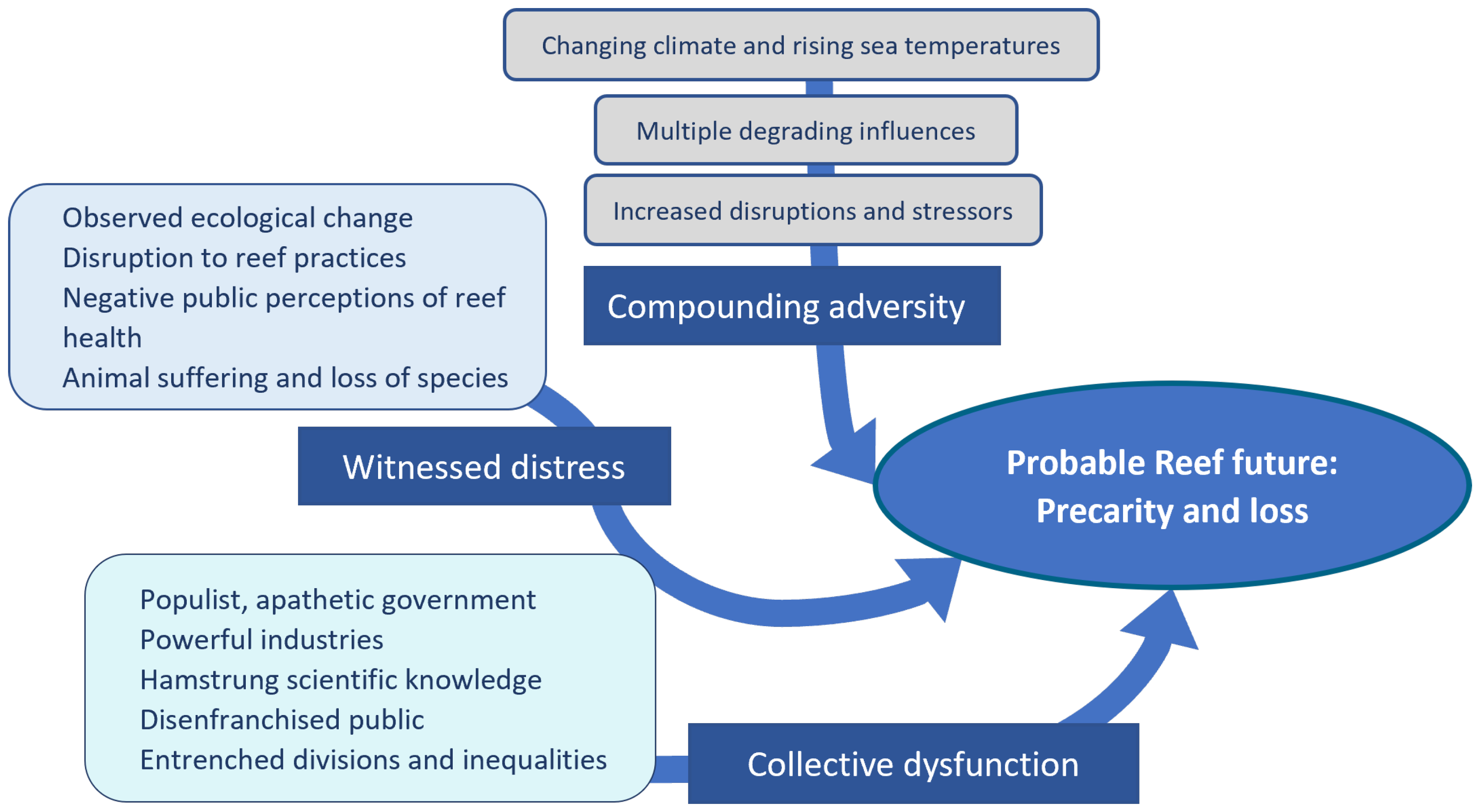
The second storyline, which was far more dominant in the interviews, aligned with public and scientific narratives. This storyline used three strategies (see Figure 1) to articulate a probable future for the GBR of escalating loss and precarity. With the first, participants emphasized the anthropogenic factors compounding adversity in the GBR. Climate change was framed as incontrovertible, with official climate reports and other forms of scientific authority used as a rhetorical shorthand for the overwhelming consensus about its negative influence on the GBR’s future. Degrading influences and disruptions, such as cyclones, crown-of-thorns starfish outbreaks, and pollution, were carefully elaborated to further emphasize the multi-layered nature of the GBR’s precarity.
Figure 1. Three initial narrative strategies (blue rectangles) used to frame a probable future of precarity and loss in the GBR [35].
With the second, participants grounded their expectations of future decline in evocative descriptions of adversity and distress they had already witnessed in the GBR. This included firsthand accounts of greater marine animal strandings, lowered numbers of fish and other marine animals, encounters with bleached coral, dwindling tourist revenue, and increasingly negative public perceptions of the health of the GBR.
With the third, participants expressed sorrow and frustration regarding the collective dysfunction of human society to alter the GBR’s trajectory despite its responsibility for, and knowledge of, its decline. This was attributed to growing economic and political self-interest, which had eroded collective respect, and care for the GBR and the ability to effectively respond to scientific authority and the ‘facts’ of the GBR’s imminent decline. Fossil fuel industries, populist governments, and the legacy of colonial dispossession were identified as key factors in this dysfunction.
Upon initiating this storyline, however, participants expressed immediate discomfort with it, often described as feeling of being ‘torn’ or ‘split’ and not wanting to resign to the future they considered most likely:
I don’t really have much hope for the future, but it’s almost like you can’t stop trying. I definitely have my days where I’m like ‘this is pointless because people aren’t going to change fast enough’… And that frustrates me because I don’t want to get to that point where it’s too late … but at the same time you can’t give up, because if you give up, then what do we do now? What do we do?
Institutional stakeholder
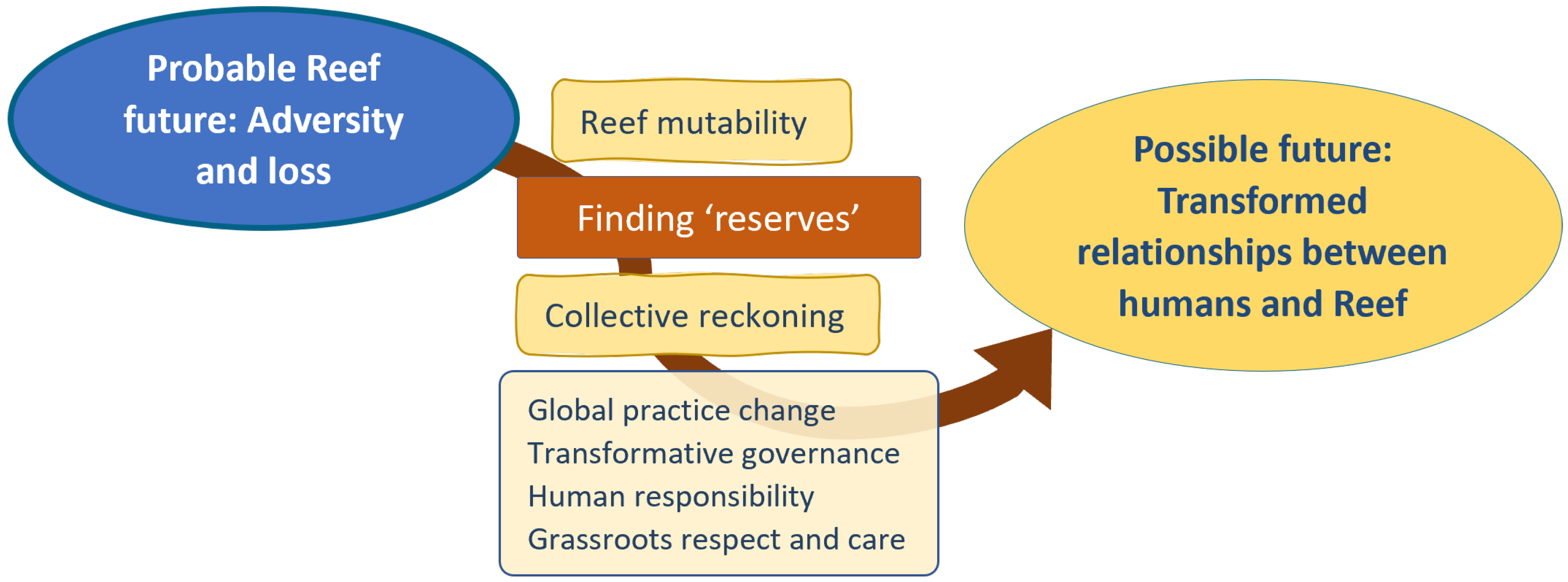
In response to this discomfort, participants then shifted their storyline in a new direction. The narrative strategy used here was concerned, not with resignation to inevitable decline, but with finding the ‘reserves’ needed to actively imagine a future in which alternative scenarios for the GBR would become possible (see Figure 2). Participants speculated on the possibility that the GBR might be mutable, responding to anthropogenic threats in unexpected ways. This included imagining the impacts of climate change as unevenly distributed across the GBR, with opportunities left for species and ecologies to survive and adapt, and drawing on existing examples of impressive ecological resilience and recovery in the aftermath of seemingly catastrophic disturbance.
Figure 2. Finding the reserves to narratively shift the GBR’s storyline from probable loss to transformed human-Reef relationships [35].
Participants also speculated on the possibility that the GBR’s rapidly deteriorating circumstances might catalyze a collective reckoning, or what Beck refers to as ‘social catharsis’ [38], whereby human interests and behaviors would be radically recalibrated. Some imagined how the prospect of loss might galvanize a change in global practices to align, rather than conflict, with the GBR’s ecological well-being. Others imagined how the GBR’s imminent loss might catalyze political transformation, broader human responsibility, and shifts towards more respectful and caring human-environment relationships:
There is this increasing community concern around that issue, and that’s really all that is going to ever change politics. As ordinary people in Australia, we don’t have the huge resources that the fossil fuel billionaires have … but we do have morality and the ability to reach people and be trusted by people. So I think that that is what in the end will win.
Civil society community
Others imagined the development of more coherent, coordinated governance in the GBR to address its escalating threats and precarity:
I’d like to see continuing small improvements, or some really wide scale, large improvements, but keep moving forward with small improvements in areas like fisheries management of these really important ecosystems, and ways that we can help restore them. If we can maintain 27 more years of small improvements, I would like to think that by 2050 the Reef won’t be cataclysmically degraded at that point. And then past 2050, if we can make it to that point with the Reef in its relatively current state, then it does have a chance to improve beyond that point.
Civil society community

3.1.2. Australian Public Expectations

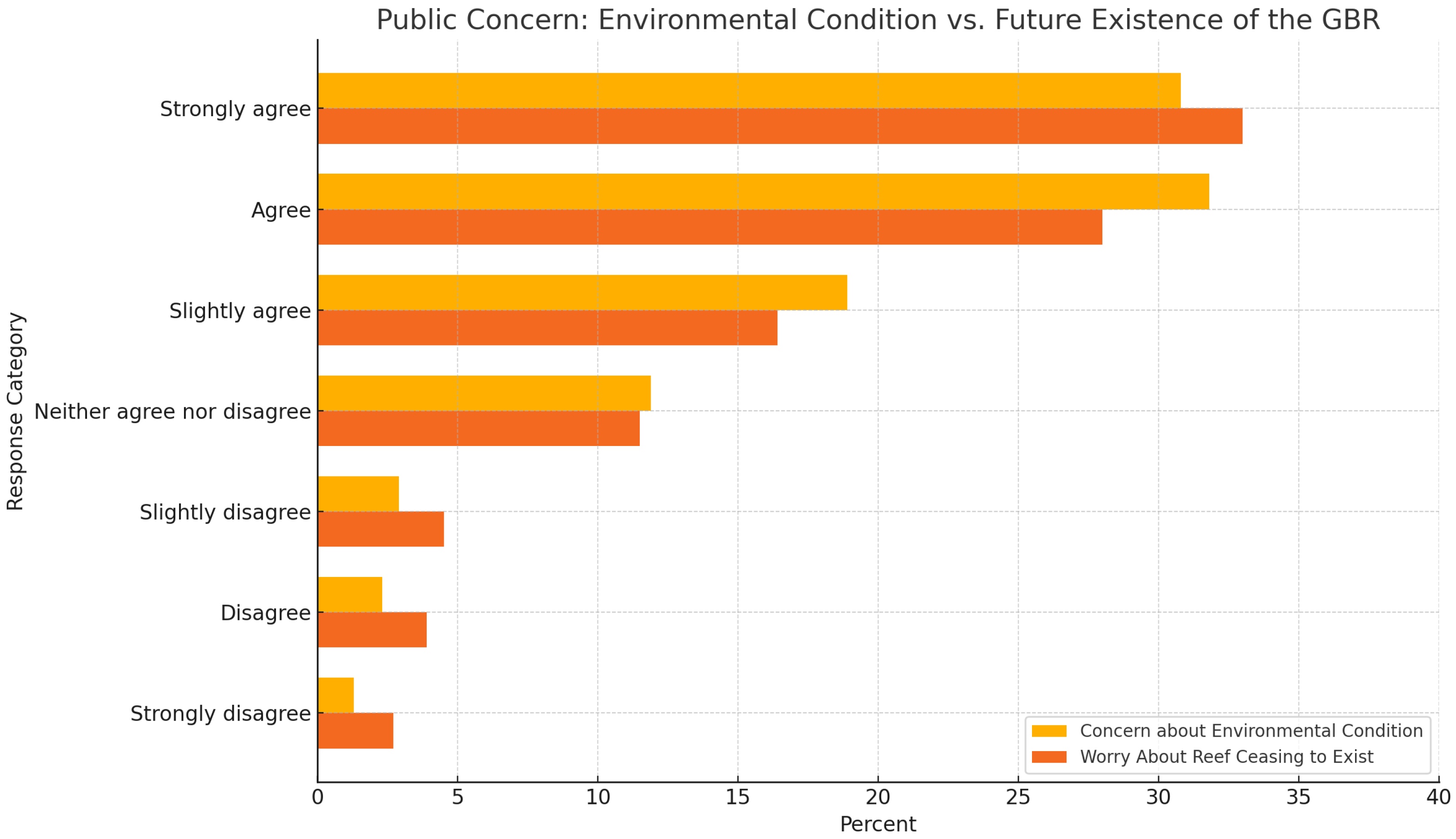
Like the dominant storylines observed in the Deep Dive interviews, large-scale surveys indicate that local and Australian residents hold profound concern regarding both the present ecological condition and long-term survival of the GBR [37]. As shown in Figure 3, a substantial majority of survey respondents (over 80%) indicated agreement with the statement “I am concerned about the environmental condition of the GBR”, while 11.9% maintained a neutral stance and only 6.6% of participants indicated any level of disagreement. Similarly, a substantial majority (over 75%) agreed with the statement “I worry that the GBR will cease to exist for future generations” while only 11.0% expressed any level of disagreement and 11.5% remained neutral. On a 7-point scale, there was a strong tilt toward agreement (skewness = −1.108) with these statements. Central tendency statistics confirm that the mean response was 5.51, the median 6, and the modal was 7 (the highest agreement rating).
Figure 3. Agreement with two statements about the Great Barrier Reef—(1) concern about its current environmental condition and (2) concern about its future existence—based on aggregated survey data from 2018, 2022, and 2024.
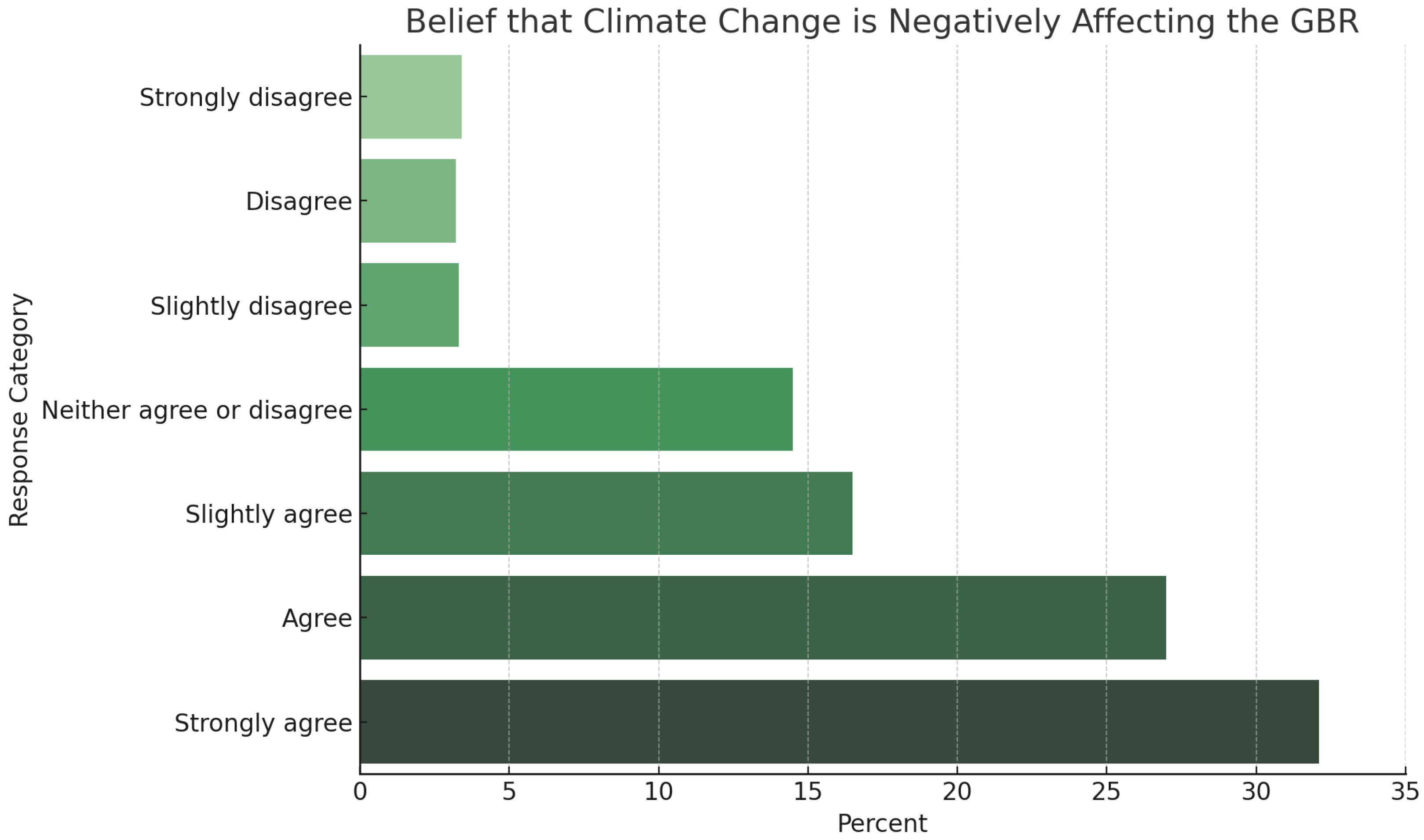
Consistent again with the Deep Dive storylines, perceptions of climate change sat at the forefront of respondents’ concerns about the present and future condition of the GBR. As shown in Figure 4, the majority (75.6%) of survey respondents agreed with the statement “Climate change is negatively affecting the health of the GBR” with nearly two-thirds (62.6%) indicating moderate to strong agreement, 16.5% slight agreement, and only 9.9% expressing any form of disagreement and 14.5% remaining neutral. Spearman’s rank-order correlation indicates a strong, positive correlation (ρ = 0.649, p < 0.001 two-tailed) between respondents’ anxieties regarding the GBR’s condition and their perceptions of climate change as a threat and negative influence on the health of the GBR, indicating that individuals who express greater concern about the GBR’s condition are significantly more likely to perceive climate change as a key threat to the GBR.
Figure 4. Agreement that climate change is having a negative effect on the GBR. Based on aggregated survey data from 2018, 2022, and 2024.
Alongside the effects of climate change, survey results also indicated agreement that other pressures, such as pests, agriculture, mining and tourism were having negative impacts on the condition of the GBR and only tentative agreement that enough was being done to protect it [37].

3.1.3. Changing GBR Futures Through Assisted Recovery and Adaptation

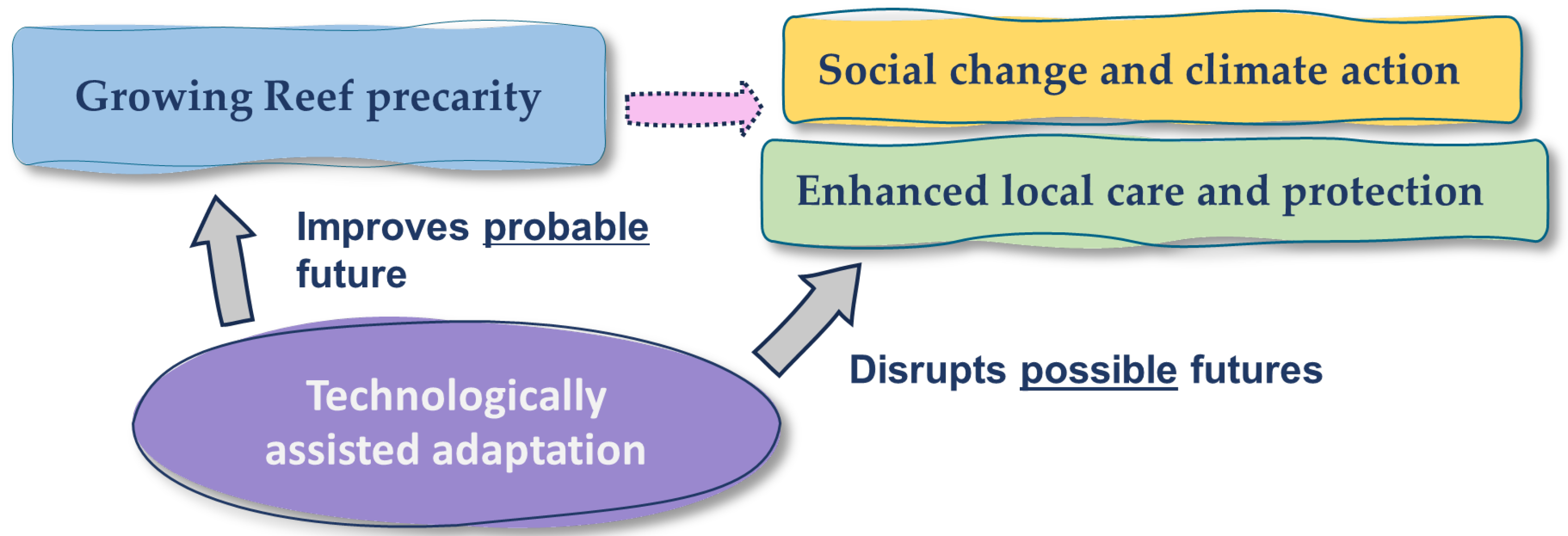
As outlined above, most Deep Dive interview participants imagined both probable futures of increased reef precarity, and possible futures in which fears for ecosystem decline would mobilize the social, political and economic transformation needed to address climate change. The implications of these imagined futures became evident as participants responded to the prospect of novel restoration and adaptation interventions. On the one hand, participants saw pragmatic merit in ‘buying time’ for the GBR until anthropogenic climate change was brought under control, and in developing tools for the protection and care of the GBR. Some expressed an ethical obligation to explore every available option to help the GBR, including assisted recovery and adaptation. At the same time, many worried that the availability of tools to upscale assisted reef recovery and adaptation would disrupt the more hopeful possibilities they imagined in broader social change. As Figure 5 summarizes, the support that participants expressed for research into novel reef interventions did not reflect positions of resolution or certainty but processes whereby they ‘weighed up’ its implications for probable and possible futures.
Figure 5. Assisted adaptation imagined as a choice between probable and probable futures.
Asked to share their initial thoughts on assisted recovery and adaptation technologies subject to research and development on the GBR, participants articulated a range of potential impacts, both positive and negative, from widespread deployment across the GBR. As detailed in [34] these responses were categorized into six broad themes: reef outcomes, Indigenous partnerships, distributional equity, community engagement, program sustainability, and unintended consequences:
Reef outcomes: the possibility was imagined of assisted adaptation achieving clear benefits for reef ecologies, whether by reducing pressures on reef systems, slowing or reversing degradation of coral and associated reef ecosystems, building human stewardship, and/or complementing broader societal momentum toward climate action. The possibility was also imagined, however, of assisted adaptation proving ineffective against ecological degradation at the scale and rate experienced on the GBR and/or against entrenched political apathy about climate change.
Indigenous partnerships: participants described scenarios in which the authority of Reef Traditional Owners would be respected while social, economic and political opportunities open up through participation in assisted adaptation interventions in the GBR. Participants also imagined scenarios, however, in which Reef Traditional Owner authority was undermined. Mitigating against these, participants believed, required effective engagement, formalized collaboration, deep respect for traditional knowledge, and effective processes for seeking Traditional Owner consent for projects on Sea Country.
Distributional equity: participants imagined that the benefits and opportunities created by assisted adaptation—such as enhanced economic security, political influence and social participation—would flow to Reef Traditional Owners and local and regional communities and work to address existing social and regional disparities. However, they could also imagine scenarios in which existing inequities became amplified, with GBR expertise and decision-making becoming concentrated in large, urban institutions, Traditional Owner authority and knowledge becoming further devalued, and investment in GBR management favoring international interests and global markets over grass-roots stewardship and local knowledge.
Community engagement: participants foresaw the development and deployment of assisted adaptation in the GBR as highly collaborative and participatory, providing opportunities to establish partnerships, foster communities of practice (through citizen science, knowledge sharing hubs, vocational qualifications, for example) and to develop a collective sense of efficacy in securing the future of the GBR. However, participants also foresaw the possibility of superficial and alienating community engagement, devaluation of local knowledge, and privileging of institutional interests.
Program sustainability: participants imagined scenarios in which interventions could be developed and deployed in the GBR at a scale that attracted ongoing investment and political commitment, delivering tangible ecological, economic, and social benefits, with the support of well-established industrial, commercial, and regulatory frameworks. Others expressed skepticism about the feasibility and cost-effectiveness of assisted adaptation, highlighting uncertainties around funding arrangements, approval processes, political commitment, and the as yet unproven status of interventions.
Unintended consequences: the potential for large-scale restoration and adaptation programs to catalyze broad action on climate change was one of several unintended, but positive, outcomes imagined by participants. Other positive consequences imagined included changes to environmental practices, a greater sense of responsibility and care for the GBR (see also [35]), the development of transferable adaptive technologies, and the dissemination of enhanced ecological knowledge and stewardship practices. Conversely, the possibility that assisted adaptation might disrupt momentum towards addressing anthropogenic climate change and reinforce political complacency and inaction was also imagined. Other negative consequences included the introduction of pests, biotic homogenization and biocultural impacts.

3.1.4. Public Outcome Perceptions

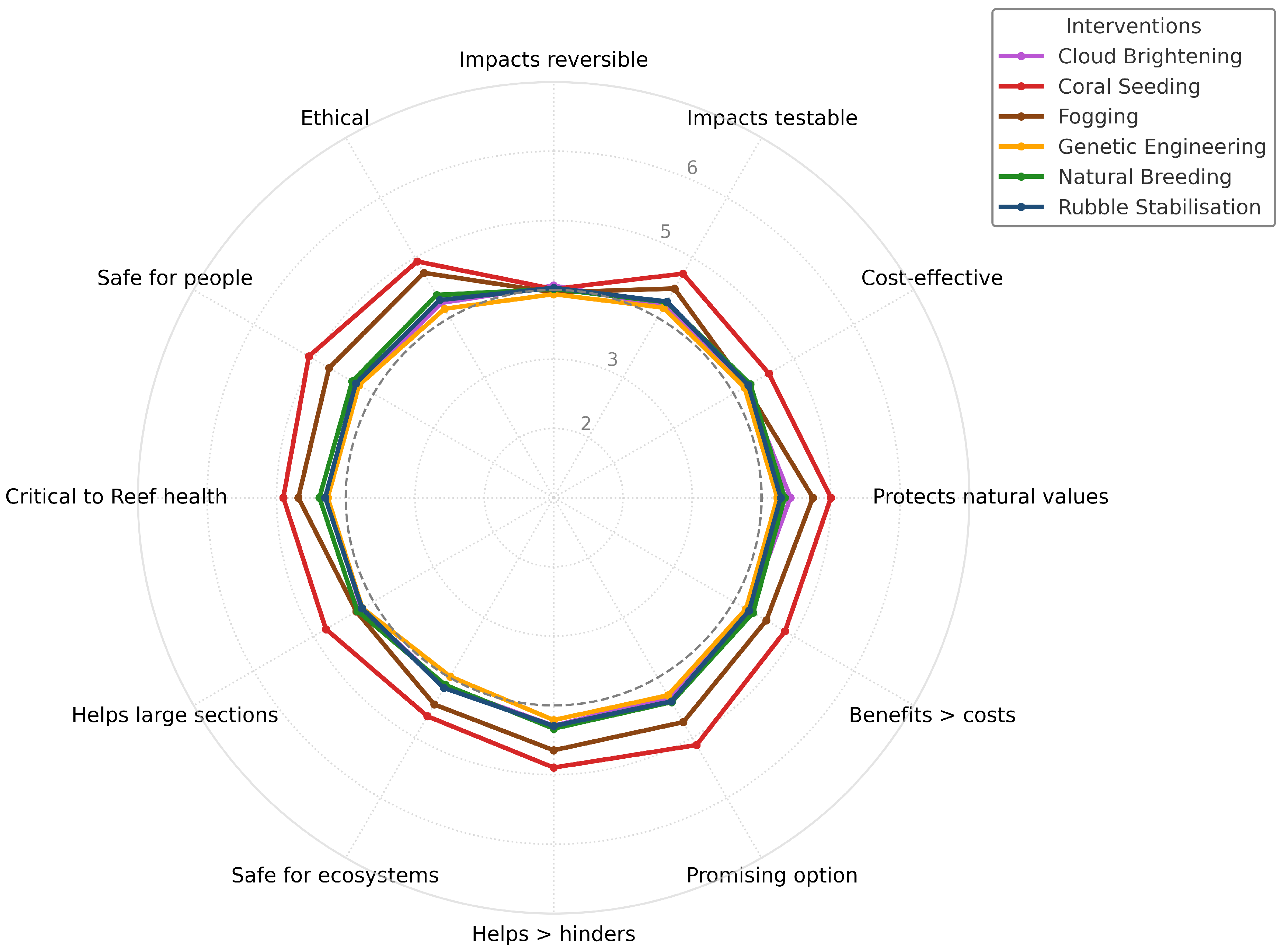
Each survey respondent was randomly assigned to evaluate one of six prospective interventions—marine cloud brightening, seawater fogging, rubble stabilization, coral seeding, natural breeding, and genetic engineering. This required the respondents to indicate their level of agreement with a series of bipolar semantic-differential items on 7-point scales. (see Figure 6). Each item consisted of a pair of plain-English opposing evaluative anchors (e.g., ‘unlikely to work’ vs. ‘promising’, ‘unsafe for people’ vs. ‘safe for people’), allowing respondents to position their judgments along a continuum of perceived risk and benefit across ecological, social, cultural, and ethical domains. For interpretive clarity we reverse-coded all items so higher scores indicate stronger agreement with the positive anchor (1–7; 4 = neutral).
Figure 6. Profiles of six interventions across the 12 semantic-differential items, pooled over 2018, 2022, and 2024 (N = 8457 and per-intervention ns > 1000). Scale is 1–7, with higher = more positive; the dashed ring marks 4 = neutral. Lines depict reverse-coded means (respondents rated one intervention only). Welch ANOVAs and Games–Howell post hoc comparisons are provided in the main results; the radar visualizes relative strengths/weaknesses across items.
Figure 6 shows mean responses above the mid-point of four—meaning positive outcomes were perceived as more likely than negative outcomes for every intervention on all but one of the outcome statements. Although above-midpoint scores indicate a general leaning toward positive expectations, their proximity to neutrality reflects calibrated optimism potentially shaped by ongoing uncertainty. If the interventions are compared, it is apparent that coral seeding and rubble stabilization were perceived as more feasible, beneficial, and ethical than other interventions, followed by natural breeding and sea fogging, with marine cloud brightening and genetic engineering perceived as the least feasible, beneficial, and ethical. However, it would be misleading to infer from this that large numbers of people perceived marine cloud brightening and genetic engineering as dangerous or unlikely to work. Scores for each intervention were compared on each item with Welch’s one-way ANOVA (robust to unequal variances and group sizes) and Games–Howell post hoc tests; ω2 quantified effect magnitude given the large N, confirming that while most differences between the interventions were statistically significant the effect sizes are small and cell means lie just above neutral (~4.1–5.1).
The one outcome statement that elicited mean responses below the midpoint addressed the potential irreversibility of environmental impacts. On average, respondents believed that the environmental impacts of breeding corals for heat tolerance (whether through natural breeding or genetic engineering) were likely to be irreversible. Responses for other interventions clustered very close to the midpoint suggesting most respondents were either uncertain or believed each outcome to be equally likely.

3.2. Scaled Support for Intervention Approaches

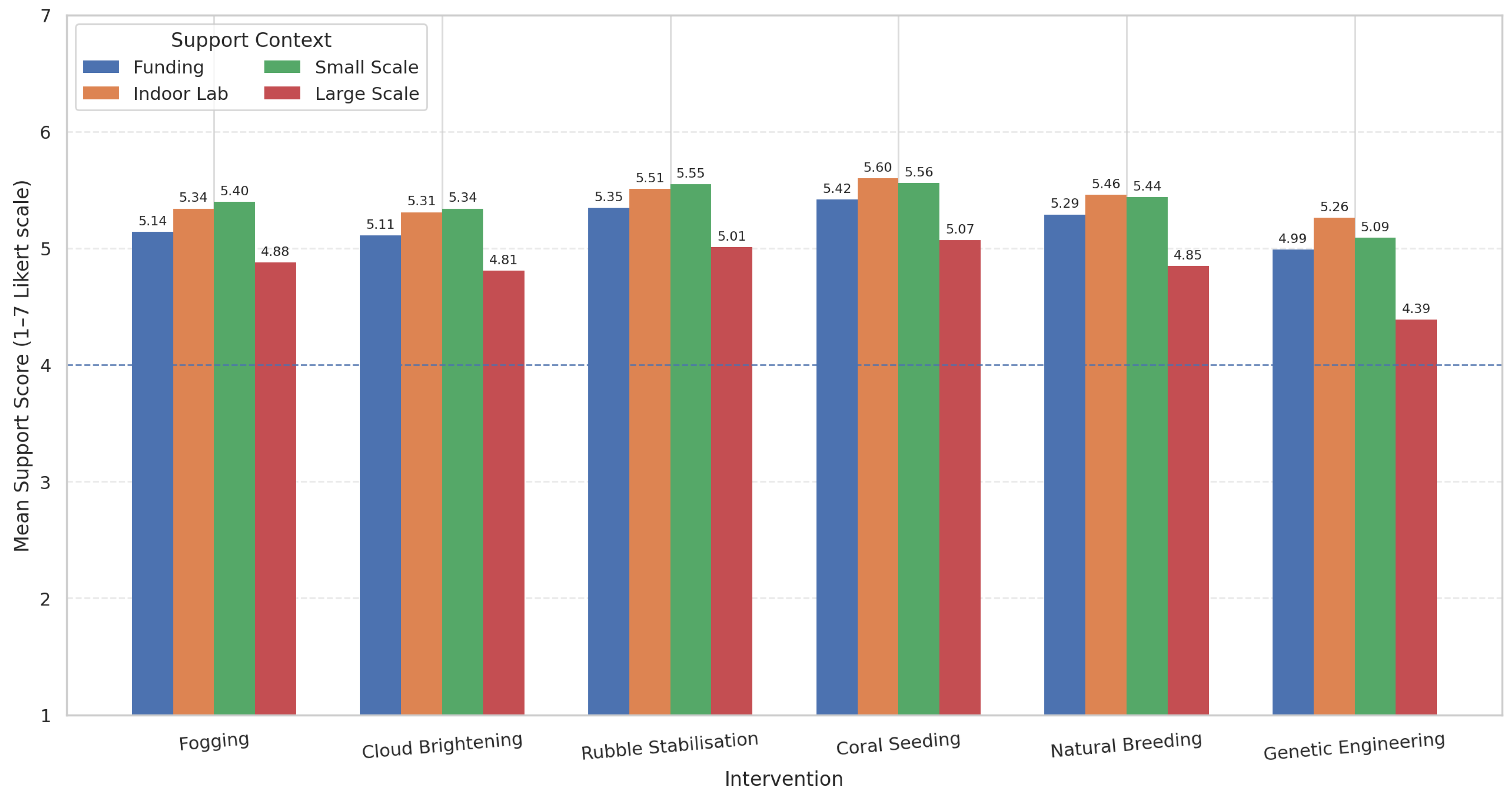
Respondents to the three biennial surveys were asked whether they supported research funding, laboratory research, small-scale trials, and large-scale deployment of the six prospective interventions included in the survey. These indicated strong public support for research funding, laboratory research, and small-scale trials of all six interventions under development through RRAP with mean support consistently above 5.3 on the 7-point scale on which the midpoint of four indicates neither opposition nor support (see Figure 7 below). Support for genetic engineering was slightly lower but still high at almost 5.3 on the 7-point scale for laboratory research.
Figure 7. Mean public support for research funding, laboratory research, small-scale trials, and large-scale deployment of novel restoration and adaptation interventions in the Great Barrier Reef —based on aggregated survey data from 2018, 2022, and 2024.
Across all interventions, support for large-scale deployment was slightly lower than support for research or small-scale trials, but again, it remained high. Levels of trust in science to deliver solutions was a consistently strong predictor of support for both research into interventions (β = 0.463, p < 0.001, 95% CI [0.281, 0.304]) and large-scale deployment of interventions (β = 0.347, p < 0.001, 95% CI [0.233, 0.258]). Perceived climate threat (β = 0.369, p < 0.001, 95% CI [0.309, 0.345]); β = 0.274, p < 0.001, 95% CI [0.253, 0.292]), trust in the GBR’s management authority (β = 0.072, p < 0.001, 95% CI [0.050, 0.087]; β = 0.168, p < 0.001, 95% CI [0.156, 0.195]), and ethics (β = 0.146, p < 0.001, 95% CI [0.105, 0.139]; β = 0.139, p < 0.001, 95% CI [0.148, 0.112]) were also consistently associated with support for intervention R&D and implementation.

4. Discussion

The value proposition for investment in R&D articulated by RRAP is based on scale; that is, on developing interventions that can be deployed in the right places, and at the right times, to support key ecological and biocultural functions across the entire GBR. Implicit in this is the mobilization of scientific capacity to investigate new intervention options as soon as practicably possible—not waiting until climate impacts undermine the capacity of reef ecosystems to withstand, recover from, and adapt to disturbance. Our results show strong public support for investment in intervention research and a general belief that interventions, when implemented, will be more likely to provide benefits than to cause harm. Reef community members expressed concern, in fact, about the government not continuing its investment in R&D and/or in failing to invest in implementing the results.
It is important to note that, across all interventions, support for large-scale deployment was only slightly lower among survey respondents than support for research or small-scale trials. This may not be considered surprising, given that respondents were advised that further research is required to understand the effects of each intervention (Appendix A.2). However, that support for large-scale deployment was strong despite this advice suggests members of the public perceive a degree of urgency and do not want action to support the adaptation of reef ecosystems to climate change to be delayed until deep reductions in greenhouse gas emissions are achieved.
It is similarly important to note that while support for the development and deployment of corals genetically engineered for heat tolerance was lower than support for other interventions, it was still, nonetheless, positive. Although a preliminary assessment of over 160 intervention options by RRAP recommended consideration of genetic engineering as a biodiversity conservation tool for reef corals [39], genetic engineering and other synthetic biology techniques are not subject to active research through RRAP, nor, to the best of our knowledge, any other research teams active in the GBR. Scientists and managers may have many reasons for not prioritizing interventions based on genetic engineering. However, if fears that genetic engineering research might provoke social conflict as seen in the food and agriculture sector are among those reasons these results suggest that fear may be misplaced; not because conflict is unforeseeable but because the governance and engagement processes needed to reduce the risk of conflict in relation to genetic engineering are, in many ways, the same governance and engagement processes needed to support effective intervention research and resilience-based ecosystem management more generally.
Interviews with GBR community members show that responses to the prospect of scaled restoration and assisted adaptation are not typically unequivocal or fixed, but provisional and cautious. Many Reef community members interviewed through this research were uneasy about the potential for adaptation to derail meaningful social change or displace other Reef stewardship activities. Participants believed that while assisted adaptation interventions may offer practical options for helping the GBR, it was important to continue hoping and working for broader societal change in order to reduce the need for adaptation.
While noting that the predominant aim of the RRAP is to develop intervention technologies to support ecosystem adaptation, our analyses also point to the need to improve actors’ capability to respond (or adapt) organizationally and institutionally. The two narratives in the second storyline from the interviews (see Figure 1 and Figure 2) identify ‘collective reckoning’ and ‘collective dysfunction’ as influential in hopeful visions for transformational change in human relations with the GBR and their absence, conversely, in its likely precarity and loss. These narratives position social coordination and institutional responsiveness as key conditions of success, while survey responses show strong levels of concern and worry about condition of the GBR and its future and indicate the public are trusting of scientists and managing agencies to act in response but cautious about the step from smaller to larger field trials of technologies on the Reef.
These perspectives together point to a need not only for technological innovation, but genuine organizational and institutional innovation that supports a collective response and adopts inclusive strategies to achieve scale. Such a response would embed reef adaptation efforts in broader governance and development trajectories, and enhance the capacity of government, science organizations and civil society to work together, and work differently. The Reef Authority’s Reef Blueprint 2030 [40] for instance highlights the nexus between helping the reef to adapt, and a deliberate shift to organizational postures and capabilities that drive transformational, collective and adaptive management. Reef managers and stakeholders are embarking on several significant planning, and plan review processes at the whole of Reef level (e.g., the current 5-yearly review of the Reef 2050 Long-term Sustainability Plan) and regional levels (e.g., the design and consultation stage of the Plan of Management for the Southern Great Barrier Reef). Processes such as these provide critical windows of opportunity to revisit existing management paradigms and steer towards more inclusive, action-oriented and adaptive ways of working.
In short, the results reported here and elsewhere [36,37] suggest that while the vast majority of Australian residents support strong action to protect and restore coral reefs, building strong relationships with Reef Traditional Owners and Reef communities and maintaining public trust in scientists and scientific institutions will also be critical to support the implementation of novel interventions at scale. The visions and aspirations that communities and the public articulate for the GBR also contain clear indications of practical actions to build and maintain support, including:
  • Strong parallel action both by Australian governments and by GBR management and research institutions to reduce greenhouse gas emissions and other anthropogenic pressures on the GBR.
  • Similarly, strong parallel action to support stewardship activities in the GBR at multiple scales.
  • Long-term funding commitment to restoration and adaptation R&D and implementation.
  • Rigorous risk assessment (including assessment of social, cultural, and economic risks) and monitoring of restoration and adaptation interventions.
  • Recognition of the multiple values—social, cultural, economic, and ecological—that inhere in the Reef and which require nurturing, both through and in addition to, measures focused on coral restoration and adaptation.
  • Transparent communication of research outcomes and intervention risks to Reef Traditional Owners, Reef communities and stakeholders, and the broader public.
  • Continuing dialogue with Reef Traditional Owners, Reef communities, stakeholders, and the broader public over how best to support the resilience of the GBR and the communities and industries that are a part of it.
  • The development of personal and institutional capacities to work relationally, respond effectively and create multiple possibilities and outcomes for the GBR.
The richness of these practical implications illustrates the value of flexible and anticipatory research and engagement when seeking to gain an early understanding of community and public responses to novel management strategies and technologies such as those being considered in the GBR [26,28,32,41]. Our methods have facilitated dialogue around assisted adaptation in close connection with communities’ lived experiences of the GBR, highlighting the deep care and aspirations that local communities and the broader public hold for its future. Beyond simply benchmarking levels of existing support and/or concern regarding assisted adaptation interventions, this approach has brought more voices to the table, and new understandings, challenges and narratives into the science and policy making underpinning the GBR [30,32,33]. When dealing with global environmental change, approaches like this foster collective capacity to work relationally, breaking down unhelpful dichotomies (such as those between the local and the regional, community and institutional, traditional and innovative) and offering insights that can be built upon in other collaborative contexts [23,29,41,42]. This provides the basis for ongoing engagement with communities and the public as different interventions and deployment models are tested in the GBR, helping to identify common concerns and areas of consensus as we negotiate the uncertainties that will inevitably arise even after rigorous risk assessment processes take place [19,28,43,44].

5. Conclusions

Support for research into assisted ecosystem adaptation in the Great Barrier Reef is high. However, far from suggesting this provides researchers and managers license to investigate or deploy any intervention wherever, and whenever, they like, our results point to the need for continuing efforts to build trust and partnerships for ecosystem care. Assisted adaptation in the Great Barrier Reef cannot be reduced to a technical exercise in ecological restoration. It is a deeply relational practice, demanding governance processes capable of respectfully engaging the multiple, often competing, visions held by communities. The clear conditions articulated by community members—ranging from authentic Indigenous authority to fair distribution of ecological benefits—highlight the need for adaptive frameworks that genuinely respond to these ethical and social dimensions. Rather than seeking consensus, successful reef adaptation relies on sustaining open, meaningful dialogue where differences are not flattened, but woven together, into a richer, more resilient governance fabric.

Author Contributions

Conceptualization, G.P., S.L. and R.D.; methodology, G.P., S.L. and H.A.B.; formal analysis, G.P., R.D. and H.A.B.; investigation, G.P.; data curation, G.P., R.D. and H.A.B.; writing—original draft preparation, G.P., S.L., B.T. and R.D.; writing—review and editing, H.A.B.; visualization, G.P., S.L. and R.D.; supervision, S.L.; project administration, G.P., R.D. and H.A.B.; funding acquisition, S.L. All authors have read and agreed to the published version of the manuscript.

Funding

This research was conducted through the Reef Restoration and Adaptation Program (grant number RRAP-ENG-01), funded by a partnership between the Australian Government’s Reef Trust and the Great Barrier Reef Foundation.

Institutional Review Board Statement

The study was conducted in accordance with the Declaration of Helsinki and the Australian Code for the Responsible Conduct of Research. Deep Dive interviews were approved by the Human Research Ethics Committee at James Cook University (Approval No. H8435, dated 10 June 2021). The National Survey was approved by the Human Research Ethics Committee at the University of Queensland (Approval No. HE001183 dated 9 July 2018, HE002586 dated 16 November 2021 and HE001869 dated 13 November 2023) and reciprocal approval was granted by the Human Research Ethics Committee at James Cook University (Approval No. H9172 dated 16 November 2021 and re-acknowledged 28 July 2023).

Data Availability Statement

The datasets presented in this article are not readily available due to confidentiality requirements stipulated in Institutional Research Board approvals for the research.

Acknowledgments

RRAP’s Traditional Owner and Stakeholder Engagement subprogram brings together social scientists from James Cook University, Queensland University of Technology, the Commonwealth Scientific and Industrial Research Organisation and the University of Queensland. The authors are particularly grateful to John Lokes Brooksbank, Brent Ritchie, Csilla Demeter, Lintje Siehoyono Sie for their contributions to the interview and survey research, and Karen Vella for her subprogram leadership.

Conflicts of Interest

The authors declare no conflicts of interest. The funders had no role in the design of the study; in the collection, analyses, or interpretation of data; in the writing of the manuscript; or in the decision to publish the results.

Abbreviations

The following abbreviations are used in this manuscript:
GBRGreat Barrier Reef
RRAPReef Restoration and Adaptation Program

Appendix A

Appendix A.1. Detailed Deep Dive Methodology

  • Recruitment
Participants were recruited from four broad stakeholder categories identified by social scientists in the RRAP feasibility stages:
  • Traditional Owners with ongoing traditional connections to and rights over the Reef (10 interviews)
  • Livelihood communities including individuals and businesses that gain income, profit or other financial benefits from the Reef (22 interviews)
  • Institutional stakeholders, including representatives from scientific, government and community institutions (28 interviews)
  • Civil society communities including reef NGOs, wildlife advocates, conservationists and recreational users (57 interviews)
Participants were mostly located in coastal regions adjacent to the GBR (which extends 2300 km along the coast of Queensland, Australia). 51 interviews were conducted in and around the city of Cairns in the northern section of the GBR, 31 were conducted in and around the cities of Townsville and Mackay, and 31 in and around the cities of Gladstone, Rockhampton and Bundaberg at the most southern end of the GBR. 4 interviews were conducted in Brisbane.
  • Interview protocol
The interview format was kept flexible to allow participants to raise issues that were important to them. The interview protocol included the following topics and questions:
  • Background and relationships to the Reef
    • 1: Can you please tell me a bit about yourself and your history with the Great Barrier Reef?
  • Perceptions of the Reef’s future;
    • 2a: Thinking about the Reef, what do you think its most likely future will be? What do you think the Reef will look like in 2050 and beyond? Including prompts for discussion of causes and drivers, existing management, implications/opportunities, uncertainties.
    • 2b: What would a better future for the Reef look like? What does the best possible future look like? Prompts regarding who/what would change and how, how participants and communities would be involved, personal and collective implications/opportunities/uncertainties
  • Responses to the prospect of technological interventions to support the GBR
    • Preamble: I’d like to focus on the interventions being explored through RRAP which are:
    -
    Enhancing the settlement of coral larvae on degraded reefs to speed up their recovery (also known as coral IVF).
    -
    Selecting and breeding coral for heat-tolerance.
    -
    Reproducing and growing coral in land-based aquaculture facilities for use in restoration projects.
    -
    Reducing the exposure of reefs to solar radiation during extreme heat events using cloud brightening or fogging.
    • 3a: When I talk about these interventions, what thoughts come to mind? Prompts regarding uncertainties/assumptions/tacit knowledge, imagined effect (positive and negative) on self and others, different responses to the different interventions
    • 3b: What (if anything) would you need to know or see to feel confident that these interventions were being carried out for the right reasons and in the right way?
    • 3c: Other technological options we haven’t foreseen yet might become available. In your view, is technological intervention a viable option for the Reef? Why/Why not?
  • Analysis
Interviews were transcribed verbatim using a professional transcription service. Analysis was conducted using NVivo (Version 14). Researchers followed a combination of thematic and narrative approaches to the data, using processes of open and hierarchical coding to identify key themes and narrative mapping to identify common patterns in the ways participants expressed early responses to the prospect of adaptive interventions in the GBR.

Appendix A.2. Detailed Survey Methodology

  • Sampling and Recruitment
  • The study employed a stratified sampling design to capture both national and Reef-adjacent perspectives. For the national sample, quotas based on Australian Bureau of Statistics (ABS) census benchmarks (gender, age, and state/territory of residence) were applied to maintain representativeness. For the regional Queensland sample, defined as residents living within 50 km of the GBR coastline, soft quotas were applied to balance urban and rural perspectives. Postcodes were collected to validate respondents’ location and to allow sub-regional analyses.
  • Participation was voluntary and anonymous aligned with the obtained ethics approval. Participants were recruited through online research panels managed by a professional market research provider. Multiple panels were utilized to reduce the likelihood of over-representing affluent or highly survey-active populations. Incentives, managed and distributed directly by the provider, were either monetary or points-based and were designed to appeal to a wide audience, thereby increasing participation across socio-economic strata.
  • Survey Instrument
  • The questionnaire (average completion time 20–25 min) comprised five core sections and an experimental component:
    a.
    Background and demographics—residency, Reef visitation, self-rated knowledge, factual knowledge quiz, gender, age, education, employment, and (for regional respondents) economic dependence on the Reef.
    b.
    Values and benefits of the GBR—items on national, intrinsic, and personal significance.
    c.
    Perceived threats and risks—concern about environmental condition, climate change, industries (agriculture, mining, tourism, shipping), and ecological pressures (e.g., Crown-of-thorns starfish).
    d.
    Attitudes to management—confidence in Reef management, optimism, sufficiency of current measures, trust in organizations (federal/state government, NGOs, international agencies, scientific institutions), and perceived regulatory efficacy.
    e.
    Restoration and adaptation—general views on intervention (e.g., prevention vs. restoration vs. resilience-building), fairness (procedural, distributional), and acceptance of broad options.
  • Quasi-experimental design: Each respondent was randomly assigned one detailed description of a potential intervention, written in plain English with a balanced discussion of benefits, risks, and uncertainties.
  • For their assigned intervention, respondents were asked about:
    • Perceived neutrality and clarity of the description.
    • Emotional responses (10 discrete emotions: cautious, worried, sadness, powerless, scared, proud, hopeful, happy, confident, relieved).
    • Knowledge and information needs (past awareness, desired future knowledge, preferred communication channels).
    • Perceptions of risks, benefits, safety, cost-effectiveness, cultural impacts, and ethical considerations.
    • Fairness and trust (procedural, distributional, trust in regulators and institutions).
    • Acceptance and support (willingness to support research, trials, and large-scale deployment; willingness to donate or participate in engagement processes).
  • Data Quality Procedures
    • Forced responses: The platform required completion of all questions to minimize missing data.
    • Completion checks: Surveys not finished in full were excluded.
    • Speeding checks: Surveys completed in implausibly short times were removed.
    • Attention checks: Embedded items assessed attentiveness, with failures excluded.
    • Quota monitoring: Sample composition was monitored in real time to align with ABS benchmarks.

References

  1. Hoegh-Guldberg, O.; Jacob, D.; Taylor, M.; Bindi, M.; Brown, S.; Camilloni, I.; Diedhiou, A.; Djalante, R.; Ebi, K.L.; Engelbrecht, F.; et al. Impacts of 1.5 °C Global Warming on Natural and Human Systems. In Global Warming of 1.5 °C. An IPCC Special Report on the Impacts of Global Warming of 1.5 °C Above Pre-Industrial Levels and Related Global Greenhouse Gas Emission Pathways; IPCC: Geneva, Switzerland, 2018. [Google Scholar]
  2. Shaver, E.C.; McLeod, E.; Hein, M.Y.; Palumbi, S.R.; Quigley, K.; Vardi, T.; Mumby, P.J.; Smith, D.; Montoya-Maya, P.; Muller, E.M.; et al. A Roadmap to Integrating Resilience into the Practice of Coral Reef Restoration. Glob. Change Biol. 2022, 28, 4751–4764. [Google Scholar] [CrossRef]
  3. Bay, L.K.; Howells, E.J. Mapping the Future for Coral Reefs. eLife 2021, 10, e72978. [Google Scholar] [CrossRef]
  4. McLeod, I.M.; Hein, M.Y.; Babcock, R.; Bay, L.; Bourne, D.G.; Cook, N.; Doropoulos, C.; Gibbs, M.; Harrison, P.; Lockie, S.; et al. Coral Restoration and Adaptation in Australia: The First Five Years. PLoS ONE 2022, 17, e0273325. [Google Scholar] [CrossRef]
  5. Hein, M.Y.; Vardi, T.; Shaver, E.C.; Pioch, S.; Boström-Einarsson, L.; Ahmed, M.; Grimsditch, G.; McLeod, I.M. Perspectives on the Use of Coral Reef Restoration as a Strategy to Support and Improve Reef Ecosystem Services. Front. Mar. Sci. 2021, 8, 618303. [Google Scholar] [CrossRef]
  6. Boström-Einarsson, L.; Babcock, R.C.; Bayraktarov, E.; Ceccarelli, D.; Cook, N.; Ferse, S.C.A.; Hancock, B.; Harrison, P.; Hein, M.; Shaver, E.; et al. Coral Restoration—A Systematic Review of Current Methods, Successes, Failures and Future Directions. PLoS ONE 2020, 15, e0226631. [Google Scholar] [CrossRef]
  7. Condie, S.A.; Anthony, K.R.N.; Babcock, R.C.; Baird, M.E.; Beeden, R.; Fletcher, C.S.; Gorton, R.; Harrison, D.; Hobday, A.J.; Plagányi, É.E.; et al. Large-Scale Interventions May Delay Decline of the Great Barrier Reef. R. Soc. Open Sci. 2021, 8, 201296. [Google Scholar] [CrossRef]
  8. Anthony, K.R.N.; Helmstedt, K.J.; Bay, L.K.; Fidelman, P.; Hussey, K.E.; Lundgren, P.; Mead, D.; McLeod, I.M.; Mumby, P.J.; Newlands, M.; et al. Interventions to Help Coral Reefs under Global Change—A Complex Decision Challenge. PLoS ONE 2020, 15, e0236399. [Google Scholar] [CrossRef]
  9. Butcherine, P.; Tagliafico, A.; Ellis, S.L.; Kelaher, B.P.; Hendrickson, C.; Harrison, D. Intermittent Shading Can Moderate Coral Bleaching on Shallow Reefs. Front. Mar. Sci. 2023, 10, 1162896. [Google Scholar] [CrossRef]
  10. Harrison, D. An Overview of Environmental Engineering Methods for Reducing Coral Bleaching Stress. In Oceanographic Processes of Coral Reefs: Physical and Biological Links in the Great Barrier Reef; CRC Press: Boca Raton, FL, USA, 2024; ISBN 978-1-003-32042-5. [Google Scholar]
  11. Ceccarelli, D.M.; McLeod, I.M.; Boström-Einarsson, L.; Bryan, S.E.; Chartrand, K.M.; Emslie, M.J.; Gibbs, M.T.; Gonzalez Rivero, M.; Hein, M.Y.; Heyward, A.; et al. Substrate Stabilisation and Small Structures in Coral Restoration: State of Knowledge, and Considerations for Management and Implementation. PLoS ONE 2020, 15, e0240846. [Google Scholar] [CrossRef]
  12. Randall, C.J.; Giuliano, C.; Heyward, A.J.; Negri, A.P. Enhancing Coral Survival on Deployment Devices with Microrefugia. Front. Mar. Sci. 2021, 8, 662263. [Google Scholar] [CrossRef]
  13. Neil, R.C.; Barton, J.A.; Heyward, A.; Francis, D.S.; Nankervis, L.; Mock, T.S.; Bourne, D.G.; Humphrey, C. Improving Coral Grow-Out Through an Integrated Aquaculture Approach. Aquac. Nutr. 2025, 2025, 1446195. [Google Scholar] [CrossRef]
  14. Randall, C.J.; Giuliano, C.; Allen, K.; Bickel, A.; Miller, M.; Negri, A.P. Site Mediates Performance in a Coral-seeding Trial. Restor. Ecol. 2023, 31, e13745. [Google Scholar] [CrossRef]
  15. Scharfenstein, H.J.; Alvarez-Roa, C.; Peplow, L.M.; Buerger, P.; Chan, W.Y.; Van Oppen, M.J.H. Chemical Mutagenesis and Thermal Selection of Coral Photosymbionts Induce Adaptation to Heat Stress with Trait Trade-offs. Evol. Appl. 2023, 16, 1549–1567. [Google Scholar] [CrossRef]
  16. Selmoni, O.; Bay, L.K.; Exposito-Alonso, M.; Cleves, P.A. Finding Genes and Pathways That Underlie Coral Adaptation. Trends Genet. 2024, 40, 213–227. [Google Scholar] [CrossRef]
  17. Naugle, M.S.; Denis, H.; Mocellin, V.J.L.; Laffy, P.W.; Popovic, I.; Bay, L.K.; Howells, E.J. Heat Tolerance Varies Considerably within a Reef-Building Coral Species on the Great Barrier Reef. Commun. Earth Environ. 2024, 5, 525. [Google Scholar] [CrossRef]
  18. Camp, E.F.; Braverman, I.; Wilkinson, G.; Voolstra, C.R. Coral Reef Protection Is Fundamental to Human Rights. Glob. Change Biol. 2024, 30, e17512. [Google Scholar] [CrossRef]
  19. Baresi, U.; Eberhard, R.; Vella, K.; Gooch, M.; Piggott-McKellar, A.; Calibeo, D.L.; Lockie, S.; Taylor, B.; Bohensky, E.; Brooksbank, L.; et al. Community Engagement for Novel Ecosystem Restoration and Assisted Adaptation Interventions: Observations and Lessons from the Australian Reef Restoration and Adaptation Program. Soc. Nat. Resour. 2025, 38, 626–645. [Google Scholar] [CrossRef]
  20. Gibbs, M.T.; Gibbs, B.L.; Newlands, M.; Ivey, J. Scaling up the Global Reef Restoration Activity: Avoiding Ecological Imperialism and Ongoing Colonialism. PLoS ONE 2021, 16, e0250870. [Google Scholar] [CrossRef]
  21. Dare, M.; Schirmer, J.; Vanclay, F. Community Engagement and Social Licence to Operate. Impact Assess. Proj. Apprais. 2014, 32, 188–197. [Google Scholar] [CrossRef]
  22. Cullen-Knox, C.; Eccleston, R.; Haward, M.; Lester, E.; Vince, J. Contemporary Challenges in Environmental Governance: Technology, Governance and the Social Licence. Environ. Policy Gov. 2017, 27, 3–13. [Google Scholar] [CrossRef]
  23. Font Barnet, A.; Boqué Ciurana, A.; Olano Pozo, J.X.; Russo, A.; Coscarelli, R.; Antronico, L.; De Pascale, F.; Saladié, Ò.; Anton-Clavé, S.; Aguilar, E. Climate Services for Tourism: An Applied Methodology for User Engagement and Co-Creation in European Destinations. Clim. Serv. 2021, 23, 100249. [Google Scholar] [CrossRef]
  24. Le, D.; Becken, S.; Curnock, M. Gaining Public Engagement to Restore Coral Reef Ecosystems in the Face of Acute Crisis. Glob. Environ. Change 2022, 74, 102513. [Google Scholar] [CrossRef]
  25. Kelly, R.; Fleming, A.; Mackay, M.; García, C.; Pecl, G.T. Social Licence for Marine Protected Areas. Mar. Policy 2020, 115, 103782. [Google Scholar] [CrossRef]
  26. Wyborn, C.; Van Kerkhoff, L.; Dunlop, M.; Dudley, N.; Guevara, O. Future Oriented Conservation: Knowledge Governance, Uncertainty and Learning. Biodivers. Conserv. 2016, 25, 1401–1408. [Google Scholar] [CrossRef]
  27. Datta, A.W.; Wyborn, C.; Chaffin, B.C.; Barnes, M.L. Imagining Reef Futures after Mass Coral Bleaching Events. Environ. Sci. Policy 2024, 151, 103625. [Google Scholar] [CrossRef]
  28. Vella, K.; Baresi, U.; Lockie, S.; Taylor, B. Challenges and Opportunities for Assisted Regional Ecosystem Adaptation: International Experience and Implications for Adaptation Research. PLoS ONE 2021, 16, e0257868. [Google Scholar] [CrossRef]
  29. Blue, G.; Davidson, D. Co-Producing Uncertainty in Public Science: The Case of Genomic Selection in Forestry. Public Underst. Sci. 2021, 30, 455–469. [Google Scholar] [CrossRef]
  30. Stilgoe, J.; Owen, R.; Macnaghten, P. Developing a Framework for Responsible Innovation. Res. Policy 2013, 42, 1568–1580. [Google Scholar] [CrossRef]
  31. Macnaghten, P.; Davies, S.R.; Kearnes, M. Understanding Public Responses to Emerging Technologies: A Narrative Approach. J. Environ. Policy Plan. 2019, 21, 504–518. [Google Scholar] [CrossRef]
  32. Macnaghten, P. Towards an Anticipatory Public Engagement Methodology: Deliberative Experiments in the Assembly of Possible Worlds Using Focus Groups. Qual. Res. 2021, 21, 3–19. [Google Scholar] [CrossRef]
  33. Macnaghten, P. Researching Technoscientific Concerns in the Making: Narrative Structures, Public Responses, and Emerging Nanotechnologies. Environ. Plan. Econ. Space 2010, 42, 23–37. [Google Scholar] [CrossRef]
  34. Lockie, S.; Paxton, G.; Bartelet, H.A.; Draaisma, L.; Brooksbank, J.L. Imagining Outcomes of Coral Restoration and Adaptation Intervention in the Great Barrier Reef. Restor. Ecol. 2025, e70173. [Google Scholar] [CrossRef]
  35. Paxton, G.; Lockie, S.; Backhaus, V. Articulating Futures: Community Storylines and Assisted Ecosystem Adaptation in the Great Barrier Reef. Environ. Sci. Policy 2024, 162, 103944. [Google Scholar] [CrossRef]
  36. Bartelet, H.A.; Lockie, S.; Demeter, C.; Sie, L.; Taylor, B. Public Support for Novel Interventions to Protect, Restore, and Accelerate Adaptation to Climate Change in the Great Barrier Reef. Ocean Coast. Manag. 2025, 260, 107489. [Google Scholar] [CrossRef]
  37. Lockie, S.; Bartelet, H.A.; Ritchie, B.W.; Demeter, C.; Taylor, B.; Sie, L. Australians Support Multi-Pronged Action to Build Ecosystem Resilience in the Great Barrier Reef. Biol. Conserv. 2024, 299, 110789. [Google Scholar] [CrossRef]
  38. Beck, U. Emancipatory Catastrophism: What Does It Mean to Climate Change and Risk Society? Curr. Sociol. 2015, 63, 75–88. [Google Scholar] [CrossRef]
  39. Bay, L.; Rocker, M.; Boström-Einarsson, L.; Babcock, R.; Buerger, P.; Harrison, D.; Quigley, K.; Randall, C.; van Oppen, M.J.H.; Webster, N. Reef Restoration and Adaptation Program: Intervention Technical Summary. A Report Provided to the Australian Government by the Reef Restoration and Adaptation Program; Australian Institute of Marine Science: Townsville, Australia, 2019; p. 89. [Google Scholar]
  40. Great Barrier Reef Marine Park Authority. Great Barrier Reef Blueprint for Climate Resilience and Adaptation; Great Barrier Reef Marine Park Authority: Townsville, Australia, 2024.
  41. Blue, G.; Davidson, D.; Myles, K. Expectations of Genomic Selection for Forestry: Expert Narratives of Anticipation and Legitimation. Sci. Cult. 2022, 31, 256–275. [Google Scholar] [CrossRef]
  42. Hartley, S.; Smith, R.D.J. Anticipatory Stakeholder Engagement Provides Insights for Gene Drive in Invasive Species through the Case of Gene Drive Grey Squirrels. Environ. Sci. Policy 2024, 162, 103939. [Google Scholar] [CrossRef]
  43. Lockie, S.; Graham, V.; Taylor, B.; Baresi, U.; Maclean, K.; Paxton, G.; Vella, K. Conceptualizing Social Risk in Relation to Climate Change and Assisted Ecosystem Adaptation. Risk Anal. 2025, 45, 668–681. [Google Scholar] [CrossRef]
  44. Shumway, N.; Foster, R.; Fidelman, P. The Governance of Marine and Coral Reef Restoration, Lessons and Paths Forward for Novel Interventions. Environ. Sci. Policy 2025, 164, 103999. [Google Scholar] [CrossRef]
Disclaimer/Publisher’s Note: The statements, opinions and data contained in all publications are solely those of the individual author(s) and contributor(s) and not of MDPI and/or the editor(s). MDPI and/or the editor(s) disclaim responsibility for any injury to people or property resulting from any ideas, methods, instructions or products referred to in the content.

Article Metrics

Citations

Article Access Statistics

Multiple requests from the same IP address are counted as one view.