1. Introduction
The digital transition in the economy is closely linked to the behavior of companies in adopting digital products and services [
1]. Their degree of preparation or maturity from the perspective of the company’s digital transition, both in the production technology component and in the e-management component [
2,
3], for monitoring the flows of resource transformation, communication and efficient management of results, depends on their consumers’ behavior with IT products and services [
4,
5].
Moreover, considering the increasing attention given to all dimensions of sustainability, companies should be able to adapt to the dynamics of sustainable business models [
6] in the conditions of multiple transitions and changes from the climate, energy, and digital, financial and social inclusion [
7], as engines for achieving a sustainable quality of life through sustainable consumption [
8,
9].
Although great efforts to achieve sustainable development goals are undertaken globally by public and private entities, there is a significant gap between the resources available to big corporations and those available in the case of small and medium-sized enterprises (SMEs), including in digital transformation [
10]. As SMEs represent an important pillar of economies, especially in developing countries [
11], with a high contribution in achieving overall sustainable goals [
12,
13], it is necessary to identify and understand their digital transformation pathways to ensure policy relevance.
Nowadays, SMEs are under increasing pressure to identify and implement digital strategies and use digital technologies so as to remain competitive in the market. This pressured landscape is even more pronounced in emerging economies [
14,
15,
16], as companies (especially SMEs) have limited access to financial and digital resources, lower levels of digital maturity, an underdeveloped infrastructure and a less digitally high-skilled population.
Thus, the transition to technology-enabled sustainable practices is hindered by multiple challenging factors [
10] that need to be further analyzed, as few studies focus on studying the digital transformation of SMEs in emerging economies. Also, there are limited empirical findings that demonstrate how SMEs adopt IT services to ensure digital transformation.
The purpose of this exploratory study is to shed light on the organizational culture regarding the digital transformation of SMEs in the heart of an internationally recognized emerging economy—Transylvania. Thus, we aim to identify the most frequent patterns that build the dimensions of the digital organizational climate, in order to highlight the associations that lead to a digital transformation-oriented leadership in the case of SMEs in central Romania. By applying association rules mining (ARM), we explore a novel perspective regarding the convergence relationships between essential factors in the digital transformation process of companies, such as the use of IT products and services, the digital skills of staff and the adaptation of managerial tasks to a dynamic and digitized environment. Therefore, we formulated three research questions to address the objective of our paper:
Is the adoption of digital technologies associated with sustainable business model transformation among SMEs?
Is the implementation of digital strategy associated with the need for digitally skilled employees in SMEs?
Are leadership and people linked to cultural change in SMEs, ensuring sustainability?
As far as we know, this is the first paper that contributes to a deeper understanding of how organizational dimensions, as defined by Rossmann [
17], are associated with achieving the digital transformation of SMEs in an emerging economy. Our results can offer insightful support for internal and external decision makers in identifying important factors that trigger digital transformation.
2. Background
Digitalization, as a catalyst for innovation, exerts a well-substantiated impact on both the economy and society by fostering productivity, enhancing quality of life, and broadening access to knowledge and public services. Moreover, considering sustainable development, firms need to rethink and reshape their strategies and actions in order to promptly respond to global environmental issues. Therefore, by efficiently implementing digital technologies, firms can respond not only to the constant dynamics of the market [
18,
19], but also to sustainable development goals [
20,
21]. So, through digitalization, firms can pave the groundwork for digital transformation which requires strategic changes within organizations [
22].
During the last few years, the digital transformation of firms has had two important objectives. On the one hand, according to Bharadwaj et al. [
23] and Piccinini et al. [
24], it became an important component of Information Systems (IS) and of Information Technology (IT). On the other hand, digital transformation is an important phenomenon for researchers Fitzgerald et al. [
25] and Strutynska et al. [
26], as it can facilitate their activities. In this context, as many studies highlight, the digital transformation of companies means not only the acquisition of IT products/services for the activities and processes associated with the company’s activity [
27,
28,
29], but also the customization of some of the services [
29,
30,
31], depending on the specifics of the company’s field of activity and the degree of digital maturity.
Permanent upgrading of digital infrastructure and the use of digital tools adapted to the needs of the companies are the foundations of the development of a managerial model based on IT assistance, including through AI support [
32,
33].
The beginning of the pandemic accelerated the creation of new business models in order to ensure employment and sustainable businesses in difficult times [
34,
35]. Innovation through the consumption of digital technology products and services has become essential to businesses to increase their competitiveness [
36].
As participants in the market of digital products/services, various studies show that firms developed high adaptability regarding the use of digital technologies. For instance, the authors Li, Li & Wang [
30] consider that companies develop a specific consumer behavior, dependent on their own strategy for developing the digital component of the business, the level of digitalization of the business and the level of digital training of employees/managers. Other authors prove that the dynamics of a firm’s degree of digital maturity play a crucial role in their behavior related to implementation of digital technology [
37,
38,
39].
Over time, many researchers have focused on determining a digital maturity index to assess the level of digital technology adoption. For example, a study conducted by Thordsen, Murawski & Bick [
40] identified and assessed 17 existing digital maturity models and showed that these models do not define digital maturity, leaving room for interpretation. These models are created based on different dimensions, such as operational processes, business models, customer experience and digital capabilities, and aim at assessing the level of adoption and integration of digital technology across a business’s strategy, culture, processes and operations [
41]. Moreover, these instruments serve as benchmarks for comparison between different firms, industries, countries, etc.
Barriers to the digital transformation of SMEs in less developed countries adjust the dynamics of digital transformation and develop specific models for approaching the digital transition. Despite recent progress, SMEs in the EU still do not appear to fully capitalize on the benefits of digitalization compared to larger enterprises, with the level of digital adoption among European SMEs remaining “highly uneven across countries, sectors, and firm sizes” (Eurostat, accessed May 2025). [
42]
The most recent Eurostat report shows that SMEs in developed countries within the EU have a much higher digital intensity than less developed countries. For instance, in 2023, SMEs’ basic level of digital intensity in Finland was over 85%, while in Romania the same indicator was less than 27%. Moreover, the same report shows that developing countries are far below the EU average (mostly the last countries considering all the measures presented in the report).
Romania generally ranks last in the European rankings regarding cloud computing services acquisition, AI technology adoption, ICT technology training, ICT specialists, basic or above-basic digital skills among people, etc. [
42].
Romania has recently gained attention in the academic world, as it was declared an emerging market in 2020 [
43]. Since this significant announcement, many researchers have analyzed the digital transformation of SMEs in different regions of Romania [
44,
45,
46], as SMEs are strong supporters of the national economy. In 2022, more than 75% of the labor market works within SMEs, ensuring over 64% of the total profit recorded by companies in Romania [
47].
Since the national business climate is dominated by SMEs, which significantly contributes to the economic structure, the research focused on this segment is both justified and relevant. Also, by considering the fact that they are in the last position in the EU rankings regarding digital intensity levels, the digital transformation of SMEs in different regions of Romania should be further studied in order to create perspectives and practical frameworks that can support the advancement of digital capabilities.
3. Materials and Methods
Using Rossmann’s digital maturity assessment model [
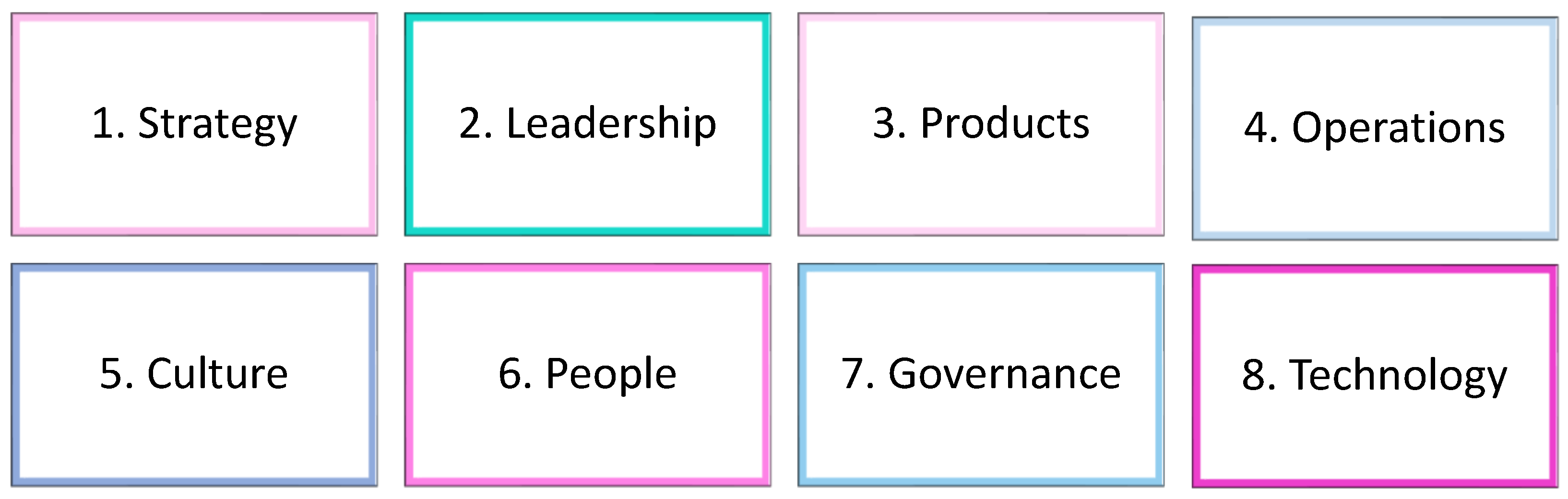
17], we have ranked the eight dimensions of the Digital Transformation Maturity Index (
Figure 1). We used ARM to uncover latent co-occurrence patterns between digital maturity dimensions without assuming causality.
This study is based on a database built following the application of a questionnaire to 112 SMEs in the central area of Romania, Transylvania that participated in a cross-border Interreg project financed by European funds, aiming to assess their digital readiness. In the case of Romania, the project addressed only the Transylvania region, which ranks first in Romania on the Digital Economy and Society Index (DESI), as it is recognized for its advanced technological infrastructure, prominent academic hubs and skilled workforce. Thus, our study focuses on this region as a benchmark for effective business models that include digital transformation and that can be adapted to other regions in Romania or other regions from emerging economies with similar characteristics.
The assessment considered the analysis method proposed by Rossmann [
17] which is formed of the eight strategic dimensions presented in
Figure 1. Each dimension includes an equal number of questions (four questions) with five possible answers, where the first answer implies no digital integration and the fifth answer implies full digital integration. Through these answers, we can measure the level of digital integration in their strategy, processes, resources and behavior.
The responses of all 112 firms participating in the project are the subject of the database analyzed. The answers given to each question from each dimension were transformed into binary variables and further analyzed using the ARM method.
The classical methodology introduced by Agrawal, Imielinski and Swami in [
48] for the problem of association rules mining (ARM) from binary transaction data is as follows: if
is a set of
items with binary attributes, and a database
has a set of
transactions, with
records, we call rules an implication of the form
, where
, and
. To make the measures comparable in our questionnaire, all measures are also defined not only in terms of item set support (see support, confidence, lift) below [
49].
The probability
of the event
that all items in item set
are contained in an arbitrarily chosen transaction can be estimated from a database
using Maximum Likelihood Estimation (MLE) by Equation (1):
where
is the count number of transactions that contain the item set
, and
is the number of tuples in transactions of the database
.
Support was defined in [
48] on item sets and gives the proportion of transactions which contain
.
with range.
Theorem 1 (
Support). The support of an association rule is the percentage of item sets that contain all the items listed in that association rule.
Confidence, as defined in [
48], represents the probability of observing the consequent of a rule, given that the corresponding transactions also contain the antecedent, as expressed in Equation (3):
with .
Theorem 2 (Confidence). If and
are two item sets then Equation (4): So, the conf operator is not commutative, because .
The higher the value, the more likely the head items occur in an item set if it is known that all body items are contained in that item set.
Originally called interest, lift was defined by Brin, Motwani, Ullman and Tsur in [
49]
as Equation (5): Theorem 3 (Lift). If the rule had a , the probability of occurrence of the antecedent and that of the consequent are independent of each other. If the , we measure the degree to which those two occurrences are dependent on one another, otherwise, if the , that lets us know the items are substituted to each other.
Theorem 4 (Association rules). Operators that are commutative will generate double the number of association rules. By pruning, we try to identify the association rules that bring new knowledge from the questionnaires.
Introduced by Agrawal and Srikant in 1994 [
50], the
Apriori Algorithm (AA) “operates on the principle that all non-empty subsets of a frequent itemset must also be frequent”. This property enables the algorithm to efficiently prune the search space by eliminating candidate item sets that contain infrequent subsets. The algorithm proceeds iteratively, beginning with the identification of frequent 1-item sets and expanding to larger item sets by joining frequent (k − 1)-item sets and applying the pruning step to remove those with infrequent subsets. We use Weka software and the Apriori Algorithm to analyze our data. Visualization was achieved using Anaconda Navigator 2.6.5.
4. Results
Following the application of the Apriori Algorithm, the resulting associations encompass all eight dimensions proposed by Rossmann [
17] for evaluating the digital maturity of companies: strategy, leadership, products, operations, culture, people, governance and technology. Each dimension comprised four questions targeting specific aspects of that dimension, with each question offering five possible response options.
We aimed to identify the most frequent association rules between responses from various dimensions, and so we filtered the results considering the confidence criterion. The closer the confidence is to 1, the stronger the relationship of association between the answers given within the various dimensions. Further on, with the help of
Table 1, we present ten of the most frequent association rules found.
To check if the frequency of these answers creates strong and relevant association rules that generate some peculiarities to highlight and consider for policy proposals, we also included a lift indicator for further analysis [
48,
51]. Lift is generally used to determine if an association rule is particularly of interest to consider for further behavior predictions [
52].
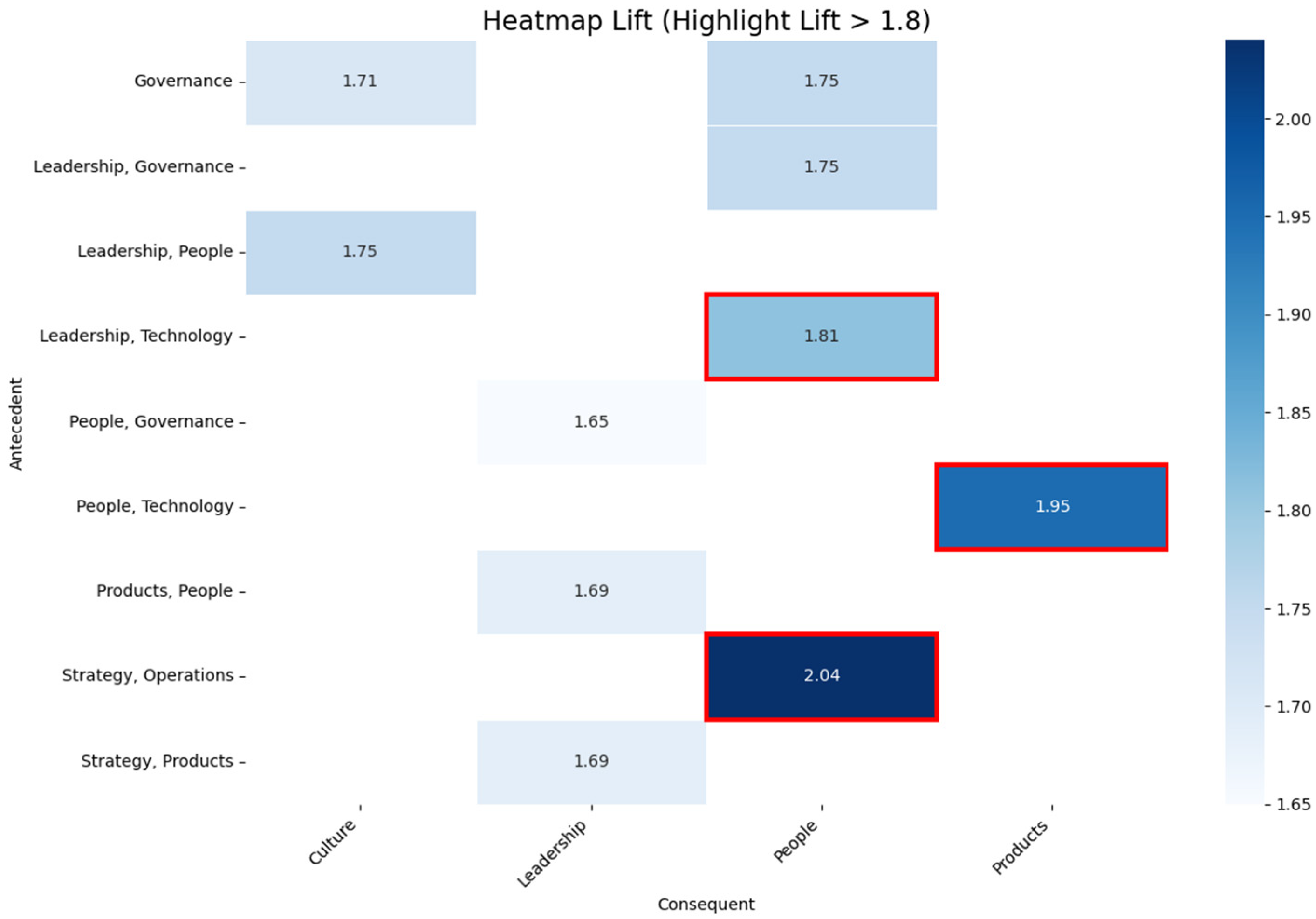
Figure 2 highlights the heatmap for the first ten association rules that occur between the eight dimensions by lift.
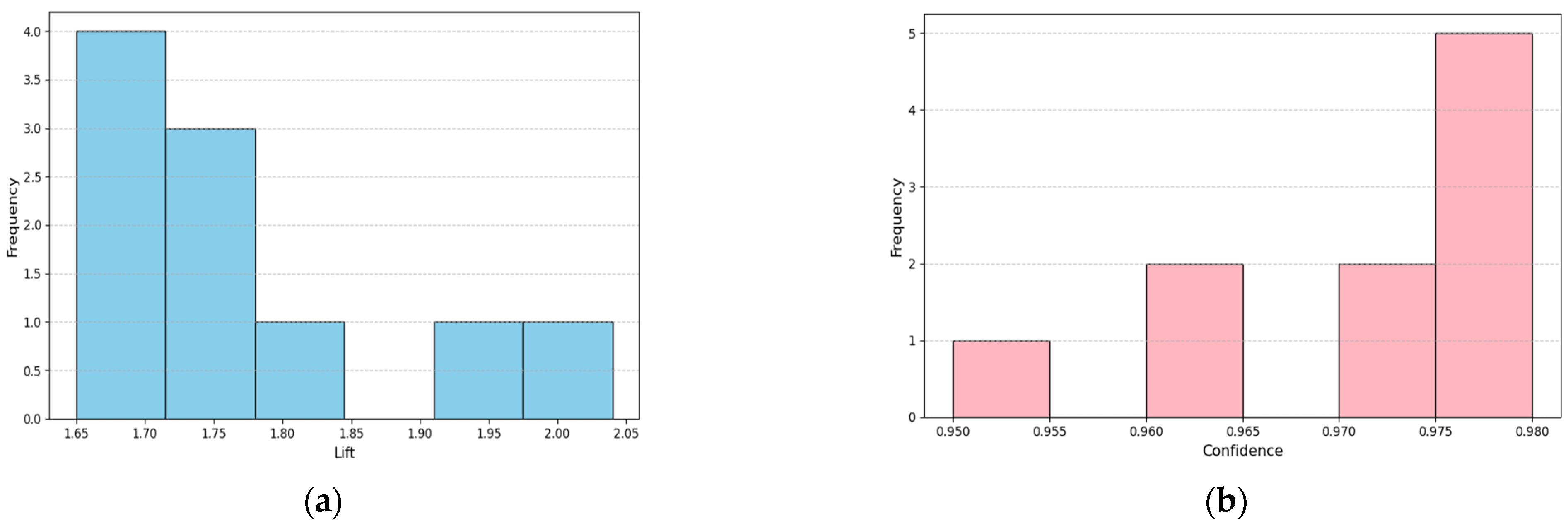
Furthermore, according to the histogram shown in
Figure 3a, we note that all the association rules have a lift between 1.65 and 2.04. These results suggest a moderate or strong association between the responses given by the companies that are encountered in the antecedent and the consequent. The high confidence values (close to 1), which are shown in
Figure 3b, reinforce our beliefs about the resulting associations.
Figure 2 suggests that, out of the ten, three association rules have a lift that exceeds the threshold of 1.8. As many previous studies show [
53,
54,
55,
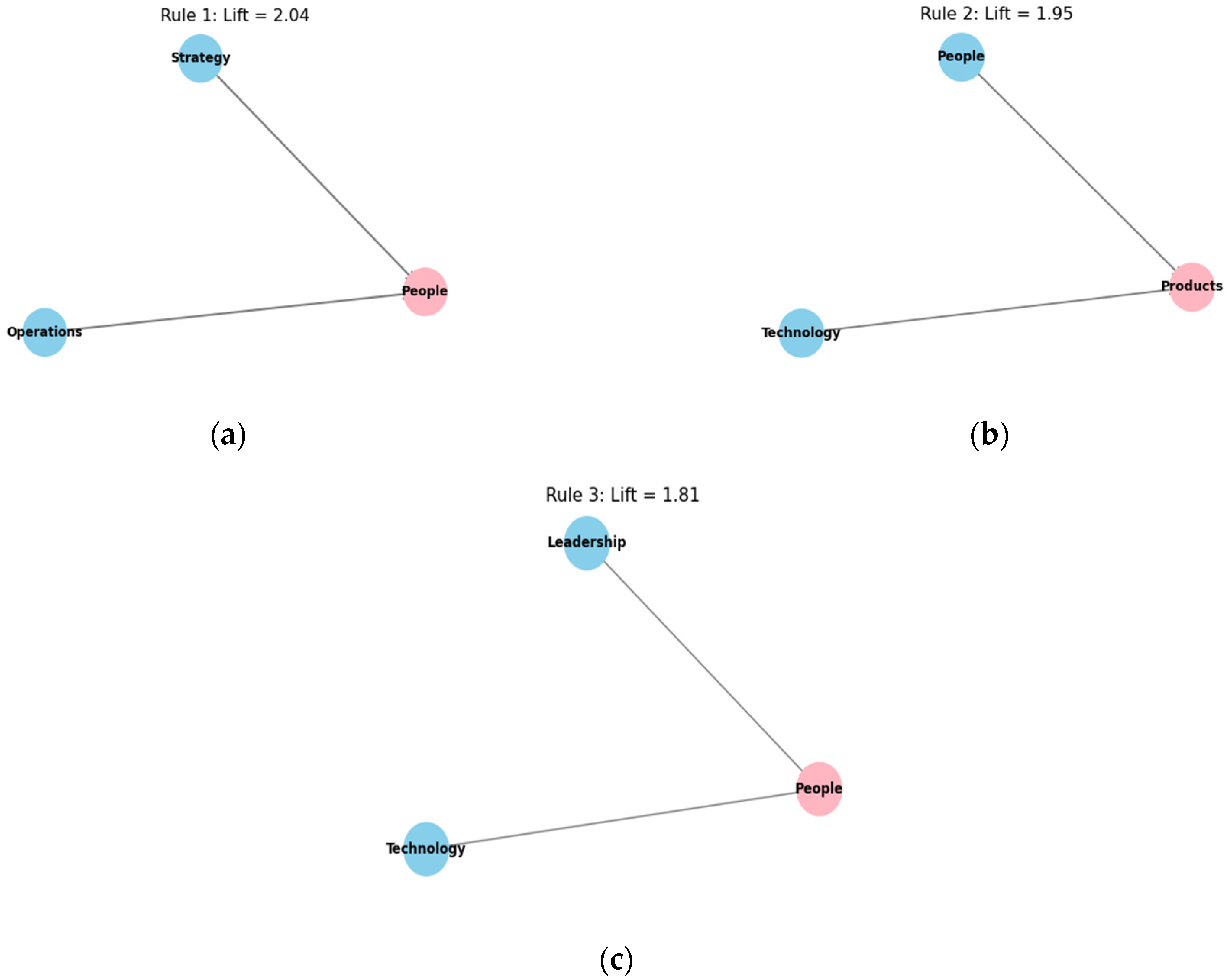
56], a lift over 1.8 is considered relevant for identifying a statistically significant and strong association rule between the antecedent and the consequent. Thus, we presented the most important findings of our research, which are represented by the first three rules ordered by lift (
Figure 4).
5. Discussion
We identified 10 associations between the responses of Romanian entrepreneurs in the Transylvania area, which are very frequently encountered in their answers. The frequency with which these answers are found (between 95% and 98%) demonstrates the reliability of these rules. Various answers within some dimensions seem to generate well-argued predictive responses from another dimension of the questionnaire. For example, as shown in
Table 1, the first association rule includes as an antecedent a response from the Products dimension and one from the People dimension, which generates a response (consequent) from the Leadership dimension.
Specifically, respondents who affirm that they have low revenues (less than 5%) from online sales (response from the Products dimension) and who also affirm that they have few digitization experts employed (response from the People dimension) in 98% of cases also affirm that their first concepts for advanced management tasks and roles are recognizable based on digital strategy.
Although this association rule has a high confidence level, we can only assume that the relationship between the antecedent and the consequent is a near-deterministic relationship. To check some particularities of the responses, we have to consider lift indicators. In the case of the first association rule (
Table 1) we identify that its lift is 1.69, which suggests a moderate association between the answers given by the respondents. This result, although supporting a reliable inference, is not strong enough to consider this rule as offering substantial new insights. Further on, we will continue discussion over the three association rules we identified that have a light lift (over 1.8) and a high confidence (over 90%) level, as these rules can bring us particularities that can enforce the consumption of digital technologies and services behavior of SMEs in Transylvania.
In an effort to respond to our first research question (c) we have to consider the association rules’ results.
The second association rule by lift (
Table 2) is generated by responses from People, Technology (antecedents) and Products (consequent), and suggests a connection between specialized human resources, incipient technology initiatives and digital transformation processes. Thus, qualified human resources and technological initiatives trigger innovation at the product level and at the business model level. Although the responses highlight the incipient stage of digital technology use, this result suggests the ascendent trajectory that SMEs in Transylvania are following on their path toward digital transformation, confirming that the consumption of digital technology triggers the business model transformation of SMEs in this region. Furthermore, the digitalization of products and services marks the starting point for sustainable business model development. Thus, our results highlight the fact that the analyzed SMEs are interested in creating business models that are oriented toward long-term value creation, ensuring economic sustainability.
Considering our second research question (Is the implementation of digital strategy associated with the need for digitally skilled employees in SMEs?), we found that the strongest association refers to the following dimensions: Strategy, Operations and People. When there are visible changes in the operating model at a functional level and when there are limited resources allocated for the digital strategy, companies have dedicated people for digital transformation being partially implemented in the organizational structure.
Thus, even if the digital strategy has few resources and only local changes occur in the operating model, firms hire staff and delegates clear tasks for digital transformation to them. With a lift over 2, this association rule suggests that this consequent (from the People dimension) is highly likely to appear when this antecedent (from the Strategy and Operations dimensions) is present.
Furthermore, the third identified association rule (
Table 2) brings into discussion three key dimensions of the digitization process: Leadership, Technology and People. From this, if the leadership roles are not influenced by the digital strategy adopted, and digital technologies exist only in an incipient form, there is a high probability that no jobs specific to the digital strategy are assigned. Overall, these results suggest that SMEs in the central area of Romania are in a transition stage in terms of digital transformation. Thus, although digital initiatives are considered at the firm level, they are not fully integrated into leadership and human resources. In this matter, we identified the need for human capital training and being actively involved in the digital transformation process.
Regarding our third research question (Are leadership and people linked to cultural change in SMEs, ensuring sustainability?), from rules 7 and 8 presented in
Table 1 we can observe that the Leadership, People and Governance dimensions associate with the Culture dimension. From association rule number 7, we can emphasize the fact that in SMEs where executives support digital strategy implementation but lack dedicated expertise, organizational culture change is discussed only in small groups and implemented when absolutely necessary. With a lift of 1.75 and a confidence of 0.97, we can argue that sustainable transformation may be hindered due to the lack of skilled human capital, a characteristic often found in the context of SMEs, especially in emerging economies. Furthermore, association rule number 8 shows that the lack of key performance indicators measuring for digital progress is associated with a lack of continuous change in organizational culture. This moderate association rule (lift 1.71) suggests that a lack of efficient governance and leadership may encourage resistance to change, thus endangering sustainability.
Therefore, digital transformation is a continuous process at the company level, which is associated with the dynamics of the specific market of IT products/services, requiring permanent additions or significant changes.
6. Conclusions
Our results confirm the pathways that SMEs follow to align with European expectations regarding digitalization and digital transformation. The applied questionnaire assessed the level of digital maturity of firms at the beginning of an EU-funded project whose main purpose is to aid in the digital transformation process of SMEs. Thus, we observe a high interest in increasing the level of digital maturity of firms.
From our results, we can conclude that Transylvanian SMEs face a business model that is in the transition stage, from a classic model to one oriented towards the consumption of digital products and services. Moreover, our findings suggest that the analyzed SMEs are adapting their strategies to digital transformation and aim to remain resilient in the long term, considering sustainability.
Following the ARM method applied to the dimensions that reflect the level of digital maturity in the case of SMEs in Transylvania, Romania, our study reveals some important implications, both theoretical and practical.
Our research contributes to the expansion of literature by developing understanding of how components of digital transformation interact in an insufficiently explored context—SMEs in emerging economies. Through an alternative approach to traditional models—the ARM method—we have highlighted some important systemic relationships between the dimensions of digital maturity, on the model proposed by Rossmann. Our study contributes to understanding how SMEs in an important region of an emerging economy act to achieve their digital transformation goals, demonstrating the usefulness of the method in organizational analysis. Furthermore, our approach to this study is based on association rules which shed light on patterns found after a digital maturity assessment of SMEs. These associations can mark a valuable starting point for future research hypothesis development oriented towards causal relationships testing.
This rule-based approach provides practical insights into designing effective digital transformation strategies. We identified recurrent patterns of co-emergence that can serve decision makers as support for the development of policies and measures aimed at facilitating the digital transformation process. Moreover, the results of our study can be used in managerial decision making within SMEs during the digital transformation process. The strongest association identified combinations of digital maturity dimensions that involve critical organizational structures for digital transformation (digital strategy, digital leadership, organizational culture, digitized operations, digital technology or specialized people). The results of our study suggest that SMEs should prioritize their efforts in human capital formation and in digital technology investments in order to cope with the digital transformation process, ensuring sustainability. Moreover, we found patterns that show that a lack in digital performance measurement led to a stagnation of organizational culture, suggesting that clear measures of digital governance are essential in the sustainable transition to digital transformation.
As future research, we aim to re-evaluate the digital maturity index after the project end date (end of 2026) and to re-evaluate the business models among these SMEs.
Author Contributions
All authors have contributed equally to this work. Conceptualization, D.Ș. and L.C.-R.; methodology, C.-A.C. and M.-A.P.; software, M.-A.P. and M.T.; validation, V.V., L.C.-R. and D.Ș.; formal analysis, V.V., P.P.-N., A.-B.Ș. and E.B.; investigation, M.-A.P., M.T. and P.P.-N.; resources, L.C.-R. and V.V.; data curation, E.B., C.-A.C., A.-B.Ș. and P.P.-N.; writing—original draft preparation, V.V., M.T. and M.-A.P.; writing—review and editing, D.Ș. and C.-A.C.; visualization, P.P.-N., E.B. and M.T.; supervision, E.B. and A.-B.Ș.; project administration, C.-A.C. and A.-B.Ș.; funding acquisition, D.Ș. and L.C.-R. All authors have read and agreed to the published version of the manuscript.
Funding
This research was developed within the framework of the project: Futures of Innovation Technologies EDIH—Centru Region, RO European Digital Innovation Hubs, contract 101083915-FIT EDIH-DIGITAL-2021-EDIH-01, Digital Europe Programme (DIGITAL).
Institutional Review Board Statement
Ethical review and approval were waived for this study. The Scientific Research Ethics Committee within the George Emil Palade University of Medicine, Pharmacy, Science, and Technology of Târgu Mureş evaluated the study proposal from the perspective of observing the ethical norms of scientific research, and decided to grant approval waiver for the study, due to the study’s meeting the criteria from the Regulation of the Research Ethics Committee, UMFST-REG-74 Edition 04.
Informed Consent Statement
Informed consent was obtained from all subjects involved in the study.
Data Availability Statement
Data may be available upon reasonable request.
Conflicts of Interest
The authors declare no conflicts of interest.
References
- Apostu, S.A.; Mukli, L.; Panait, M.; Gigauri, I.; Hysa, E. Economic Growth through the Lenses of Education, Entrepreneurship, and Innovation. Adm. Sci. 2022, 12, 74. [Google Scholar] [CrossRef] [Scilit]
- Horváth, Á.B. Different Approach of the Digital Transformation at SME. Acta Polytech. Hung. 2023, 20, 145–164. [Google Scholar] [CrossRef] [Scilit]
- Bin, M.; Hui, G.; Qifeng, W.; Ke, Y. A systematic review of factors influencing digital transformation of SMEs. Turk. J. Comput. Math. Educ. 2021, 12, 1673–1686. [Google Scholar] [CrossRef] [Scilit]
- Ovodenko, A.A.; Peshkova, G.Y.; Zlobina, O.V. Digital evolution of consumer behavior and its impact on digital transformation of small and medium business sustained development strategy. In Proceedings of the 2nd International Scientific and Practical Conference on Digital Economy (ISCDE 2020), Yekaterinburg, Russia, 5–6 November 2020; Atlantis Press: Dordrecht, The Netherlands; pp. 424–428. [Google Scholar] [CrossRef] [Scilit]
- Castagna, F.; Centobelli, P.; Cerchione, R.; Esposito, E.; Oropallo, E.; Passaro, R. Customer Knowledge Management in SMEs Facing Digital Transformation. Sustainability 2020, 12, 3899. [Google Scholar] [CrossRef] [Scilit]
- Surugiu, M.R.; Surugiu, C. International trade, globalization and economic interdependence between European countries: Implications for businesses and marketing framework. Procedia Econ. Financ. 2015, 32, 131–138. [Google Scholar] [CrossRef] [Scilit]
- Jibril, A.B.; Amoah, J.; Panigrahi, R.R.; Gochhait, S. Digital transformation in emerging markets: The role of technology adoption and innovative marketing strategies among SMEs in the post–pandemic era. Int. J. Organ. Anal. 2024. [Google Scholar] [CrossRef] [Scilit]
- Tunn, V.S.; Bocken, N.M.; van den Hende, E.A.; Schoormans, J.P. Business models for sustainable consumption in the circular economy: An expert study. J. Clean. Prod. 2019, 212, 324–333. [Google Scholar] [CrossRef] [Scilit]
- Bocken, N.; Boons, F.; Baldassarre, B. Sustainable business model experimentation by understanding ecologies of business models. J. Clean. Prod. 2019, 208, 1498–1512. [Google Scholar] [CrossRef] [Scilit]
- Melo, I.C.; Queiroz, G.A.; Junior, P.N.A.; de Sousa, T.B.; Yushimito, W.F.; Pereira, J. Sustainable digital transformation in small and medium enterprises (SMEs): A review on performance. Heliyon 2023, 9, e13908. [Google Scholar] [CrossRef] [Scilit]
- Chege, S.M.; Wang, D. Information technology innovation and its impact on job creation by SMEs in developing countries: An analysis of the literature review. Technol. Anal. Strateg. Manag. 2020, 32, 256–271. [Google Scholar] [CrossRef] [Scilit]
- Epede, M.B.; Wang, D. Global value chain linkages: An integrative review of the opportunities and challenges for SMEs in developing countries. Int. Bus. Rev. 2022, 31, 101993. [Google Scholar] [CrossRef] [Scilit]
- Amoah, J.; Belas, J.; Dziwornu, R.; Khan, K.A. Enhancing SMEs contribution to economic development: A perspective from an emerging economy. J. Int. Stud. 2022, 15, 63–76. [Google Scholar] [CrossRef] [Scilit]
- Díaz-Arancibia, J.; Hochstetter-Diez, J.; Bustamante-Mora, A.; Sepúlveda-Cuevas, S.; Albayay, I.; Arango-López, J. Navigating Digital Transformation and Technology Adoption: A Literature Review from Small and Medium-Sized Enterprises in Developing Countries. Sustainability 2024, 16, 5946. [Google Scholar] [CrossRef] [Scilit]
- Egala, S.B.; Amoah, J.; Bashiru Jibril, A.; Opoku, R.; Bruce, E. Digital transformation in an emerging economy: Exploring organizational drivers. Cogent Soc. Sci. 2024, 10, 2302217. [Google Scholar] [CrossRef] [Scilit]
- Hai, T.N.; Van, Q.N.; Thi Tuyet, M.N. Digital transformation: Opportunities and challenges for leaders in the emerging countries in response to COVID-19 pandemic. Emerg. Sci. J. 2021, 5, 21–36. [Google Scholar] [CrossRef] [Scilit]
- Rossmann, A. Digital Maturity: Conceptualization and Measurement Model. In Proceedings of the 39th International Conference on Information Systems (ICIS 2018): Bridging the Internet of People, Data, and Things, San Francisco, CA, USA, 13–16 December 2018. [Google Scholar]
- Tavana, M.; Shaabani, A.; Raeesi Vanani, I.; Kumar Gangadhari, R. A Review of Digital Transformation on Supply Chain Process Management Using Text Mining. Processes 2022, 10, 842. [Google Scholar] [CrossRef] [Scilit]
- Papathanasiou-Zuhrt, D.; Kutsikos, K. The state of the cultural heritage industry in Europe: A growth transformation perspective. In New Media, Entrepreneurship and Sustainable Tourism Development; Francoangeli: Milan, Italy, 2016; Volume 126, pp. 134–141. [Google Scholar]
- Lulaj, E.; Hysa, E.; Panait, M. Does digitalization drive sustainable transformation in finance and accounting? Kybernetes 2024. [Google Scholar] [CrossRef] [Scilit]
- Rusu, B.; Sandu, C.B.; Avasilcai, S.; David, I. Acceptance of Digital Transformation: Evidence from Romania. Sustainability 2023, 15, 15268. [Google Scholar] [CrossRef] [Scilit]
- Vrana, J.; Singh, R. Digitization, digitalization, and digital transformation. In Handbook of Nondestructive Evaluation 4.0; Springer International Publishing: Cham, Switzerland, 2021; pp. 107–123. [Google Scholar] [CrossRef] [Scilit]
- Bharadwaj, A.; El Sawy, O.A.; Pavlou, P.A.; Venkatraman, N. Visions and Voices on Emerging Challenges in Digital Business Strategy. MIS Q. 2013, 37, 471–482. [Google Scholar] [CrossRef] [Scilit]
- Piccinini, E.; Gregory, R.W.; Kolbe, L.M. Changes in the producer-consumer relationship-towards digital transformation. In Proceedings of the 12th International Conference on Wirtschaftsinformatik, Osnabrück, Germany, 4–6 March 2015; AIS Electronic Library: Osnabrück, Germany, 2015; pp. 1634–1648. Available online: https://aisel.aisnet.org/icis2015/proceedings/GeneralIS/5/ (accessed on 20 May 2025).
- Fitzgerald, E.; Landfeldt, B. The failure of CSMA in emerging wireless network scenarios. In Proceedings of the 2014 IFIP Wireless Days (WD), Rio de Janeiro, Brazil, 12–14 November 2014; IEEE Explore: New York, NY, USA, 2014; pp. 1–4. [Google Scholar] [CrossRef] [Scilit]
- Strutynska, I.; Dmytrotsa, L.; Kozbur, H.; Hlado, O.; Dudkin, P.; Dudkina, O. Development of Digital Platform to Identify and Monitor the Digital Business Transformation Index. In Proceedings of the 2020 IEEE 15th International Conference on Computer Sciences and Information Technologies (CSIT), Zbarazh, Ukraine, 23–26 September 2020; Volume 2, pp. 171–175. [Google Scholar]
- Căpușneanu, S.; Mateș, D.; Tűrkeș, M.C.; Barbu, C.-M.; Staraș, A.-I.; Topor, D.I.; Stoenică, L.; Fűlöp, M.T. The Impact of Force Factors on the Benefits of Digital Transformation in Romania. Appl. Sci. 2021, 11, 2365. [Google Scholar] [CrossRef] [Scilit]
- Matt, D.T.; Rauch, E. SME 4.0: The role of small-and medium-sized enterprises in the digital transformation. In Industry 4.0 for SMEs: Challenges, Opportunities and Requirements; Springer International Publishing: Cham, Switzerland, 2020; pp. 3–36. [Google Scholar] [CrossRef] [Scilit]
- Omrani, N.; Rejeb, N.; Maalaoui, A.; Dabić, M.; Kraus, S. Drivers of digital transformation in SMEs. IEEE Trans. Eng. Manag. 2022, 71, 5030–5043. [Google Scholar] [CrossRef] [Scilit]
- Ulas, D. Digital transformation process and SMEs. Procedia Comput. Sci. 2019, 158, 662–671. [Google Scholar] [CrossRef] [Scilit]
- Li, Z.; Li, H.; Wang, S. How Multidimensional Digital Empowerment Affects Technology Innovation Performance: The Moderating Effect of Adaptability to Technology Embedding. Sustainability 2022, 14, 15916. [Google Scholar] [CrossRef] [Scilit]
- Aldoseri, A.; Al-Khalifa, K.; Hamouda, A. A roadmap for integrating automation with process optimization for AI-powered digital transformation. Preprints 2023, 1055. [Google Scholar] [CrossRef] [Scilit]
- Wang, S.; Zhang, H. Digital Transformation and Innovation Performance in Small- and Medium-Sized Enterprises: A Systems Perspective on the Interplay of Digital Adoption, Digital Drive, and Digital Culture. Systems 2025, 13, 43. [Google Scholar] [CrossRef] [Scilit]
- Boboc, C.; Ghita, S. The Impact of the Pandemic on the Participation in the Labour Market of Vulnerable Groups: Women, Young People, the Elderly and Self-Employed Workers. In The Economic and Social Impact of the COVID-19 Pandemic: Romania in a European Context; Springer Nature: Cham, Switzerland, 2024; pp. 183–235. [Google Scholar] [CrossRef] [Scilit]
- Rupeika-Apoga, R.; Petrovska, K.; Bule, L. The Effect of Digital Orientation and Digital Capability on Digital Transformation of SMEs during the COVID-19 Pandemic. J. Theor. Appl. Electron. Commer. Res. 2022, 17, 669–685. [Google Scholar] [CrossRef] [Scilit]
- Holl, A.; Rama, R. SME digital transformation and the COVID-19 pandemic: A case study of a hard-hit metropolitan area. Sci. Public Policy 2024, 51, 1212–1226. [Google Scholar] [CrossRef] [Scilit]
- Teichert, R. Digital transformation maturity: A systematic review of literature. Acta Univ. Agric. Silvic. Mendel. Brun. 2019, 67, 1673–1687. [Google Scholar] [CrossRef] [Scilit]
- Hu, Y.; Che, D.; Wu, F.; Chang, X. Corporate maturity mismatch and enterprise digital transformation: Evidence from China. Financ. Res. Lett. 2023, 53, 103677. [Google Scholar] [CrossRef] [Scilit]
- Aras, A.; Büyüközkan, G. Digital Transformation Journey Guidance: A Holistic Digital Maturity Model Based on a Systematic Literature Review. Systems 2023, 11, 213. [Google Scholar] [CrossRef] [Scilit]
- Thordsen, T.; Murawski, M.; Bick, M. How to Measure Digitalization? A Critical Evaluation of Digital Maturity Models. In Responsible Design, Implementation and Use of Information and Communication Technology; I3E 2020. Lecture Notes in Computer Science; Hattingh, M., Matthee, M., Smuts, H., Pappas, I., Dwivedi, Y., Mäntymäki, M., Eds.; Springer: Cham, Switzerland, 2020; Volume 12066. [Google Scholar] [CrossRef] [Scilit]
- Ochoa-Urrego, R.L.; Peña-Reyes, J.I. Digital maturity models: A systematic literature review. Digitalization: Approaches, Case Studies, and Tools for Strategy, Transformation and Implementation. In Digitalization; Management for Professionals; Schallmo, D.R.A., Tidd, J., Eds.; Springer: Cham, Switzerland, 2021; pp. 71–85. [Google Scholar] [CrossRef] [Scilit]
- Digitalisation in Europe—2024 Edition. Available online: https://ec.europa.eu/eurostat/web/interactive-publications/digitalisation-2024#about-this-publication (accessed on 27 May 2025).
- Bucharest Stock Exchange. Available online: https://www.bvb.ro/forcompanies/mainmarket/issuingshares#l3 (accessed on 20 May 2025).
- Ogrean, C.; Herciu, M. Digital transformation of Centru region–Romania. Needs assessment. Stud. Bus. Econ. 2020, 15, 270–281. [Google Scholar] [CrossRef] [Scilit]
- Vuță, D.R.; Nichifor, E.; Chițu, I.B.; Brătucu, G. Digital Transformation—Top Priority in Difficult Times: The Case Study of Romanian Micro-Enterprises and SMEs. Sustainability 2022, 14, 10741. [Google Scholar] [CrossRef] [Scilit]
- Mihu, C.; Herciu, M. Digital transformation: A quantitative analysis of romanian SMEs. Stud. Bus. Econ. 2024, 19, 137–166. [Google Scholar] [CrossRef] [Scilit]
- European Bank of Investments. Digitalizarea IMM-Urilor din România Report, June 2023. Available online: https://www.eib.org/attachments/lucalli/20230198_digitalisation_of_smes_in_romania_ro.pdf? (accessed on 20 May 2025).
- Agrawal, R.; Imielinski, T.; Swam, A. Mining Association Rules between Sets of Items in Large Databases. In Proceedings of the 1993 ACM SIGMOD International Conference on Management of Data, Washington, DC, USA, 26–28 May 1993; ACM Press: New York, NY, USA, 1993; pp. 207–216. [Google Scholar] [CrossRef] [Scilit]
- Piatetsky-Shapiro, G. Discovery, analysis, and presentation of strong rules. In Knowledge Discovery in Databases; Piatetsky-Shapiro, G., Frawley, W.J., Eds.; AAAI/MIT Press: Cambridge, MA, USA, 1991. [Google Scholar]
- Agrawal, R.; Srikant, R. Fast Algorithms for Mining Association Rules. In Proceedings of the 20th VLDB Conference, Santiago, Chile, 12–15 September 1994; pp. 487–499. Available online: https://www.vldb.org/conf/1994/P487.PDF (accessed on 20 May 2025).
- Brin, S.; Motwani, R.; Ullman, J.D.; Tsur, S. Dynamic itemset counting and implication rules for market basket data. In Proceedings of the 1997 ACM SIGMOD International Conference on Management of Data, Tucson, AZ, USA, 13–15 May 1997; pp. 255–264. [Google Scholar]
- Xu, J. Research on the cultivation of innovative entrepreneurial talents for digital transformation of enterprises based on association rule algorithm. Int. J. Knowl.-Based Dev. 2023, 13, 113–130. [Google Scholar] [CrossRef] [Scilit]
- Özsürünç, R. The role of data mining in digital transformation. In Multidimensional and Strategic Outlook in Digital Business Transformation; Contributions to Management Science; Vardarlıer, P., Ed.; Springer: Cham, Switzerland, 2023. [Google Scholar] [CrossRef] [Scilit]
- Jiang, Y. The Synergetic Effect of Association Rule Mining Algorithm between E-Commerce and Digital Economy. In Proceedings of the 2023 International Conference on Distributed Computing and Electrical Circuits and Electronics (ICDCECE), Ballar, India, 29–30 April 2023; pp. 1–6. [Google Scholar] [CrossRef] [Scilit]
- Pinheiro, C.; Guerreiro, S.; Mamede, H.S. A Survey on Association Rule Mining for Enterprise Architecture Model Discovery. Bus. Inf. Syst. Eng. 2024, 66, 777–798. [Google Scholar] [CrossRef] [Scilit]
- Mydyti, H.; Kadriu, A. Data Mining Approach Improving Decision-Making Competency Along the Business Digital Transformation Journey: A Literature Review. In Emerging Technologies in Computing. iCETiC 2021; Lecture Notes of the Institute for Computer Sciences, Social Informatics and Telecommunications Engineering; Miraz, M.H., Southall, G., Ali, M., Ware, A., Soomro, S., Eds.; Springer: Cham, Switzerland, 2021; Volume 395. [Google Scholar] [CrossRef] [Scilit]
| Disclaimer/Publisher’s Note: The statements, opinions and data contained in all publications are solely those of the individual author(s) and contributor(s) and not of MDPI and/or the editor(s). MDPI and/or the editor(s) disclaim responsibility for any injury to people or property resulting from any ideas, methods, instructions or products referred to in the content. |
© 2025 by the authors. Licensee MDPI, Basel, Switzerland. This article is an open access article distributed under the terms and conditions of the Creative Commons Attribution (CC BY) license (https://creativecommons.org/licenses/by/4.0/).




 ,
,