You are currently viewing a new version of our website. To view the old version click .
Sustainability
  • Article
  • Open Access

31 October 2025

Assessment of Mechanized Rice Farming in Northwestern Nigeria: Socio-Economic Insights and Predictive Modeling


and
Department of Business Administration, Graduate School of Social Science, Near East University, Northern Cyprus, Mersin 10, 99138 Nicosia, Turkey
*
Author to whom correspondence should be addressed.
This article belongs to the Special Issue Smart Cities with Innovative Solutions in Sustainable Urban Future

Abstract

In Nigeria’s northwestern states of Kano, Katsina, and Kaduna, mechanized rice production is an important contributor to household income and rural economic activity, especially amid a rapidly growing population projected to exceed 400 million by 2050. This study investigates the socio-economic insights of mechanized rice farmers and assesses the impact of mechanization on income, seasonal production, government support, and rural poverty alleviation. Data were collected from 125 respondents across 14 local government areas by using structured questionnaires and analyzed through descriptive statistics and hybrid machine learning models. The findings show that revenue generation significantly influences the adoption of mechanized rice farming, while government involvement is limited and largely ineffective. Advanced predictive modeling revealed that hybrid approaches, particularly those combining regression and Artificial Neural Networks with Bayesian Optimization, outperformed traditional models in forecasting rice yield. Key challenges identified include the high cost of equipment and restricted access to subsidized inputs. This study concludes that income from rice sales drives mechanization and that targeted policy interventions are necessary to overcome socio-economic barriers and improve productivity. These findings highlight the dual importance of economic empowerment and technological innovation in advancing sustainable rice production and improving livelihoods in Nigeria’s rice-growing regions.

1. Introduction

Despite the presence of abundant oil resources, agriculture continues to serve as a cornerstone of Nigeria’s economy, particularly for rural populations that depend on it for their livelihoods. In Nigeria, however, mechanization adoption is still low, impeded by affordability, lack of access to machinery, and weak government support systems [1]. However, the sector remains hampered by systemic challenges such as an outdated land tenure system, low irrigation levels (less than 1% of cropped land), limited adoption of modern technologies, and inadequate infrastructure, all contributing to low productivity and significant post-harvest losses [2,3,4]. These structural issues have suppressed agricultural output, compelling Nigeria to spend over USD 10 billion annually on imports of crops like rice, groundnut, and palm oil. Meanwhile, rice has become the most widely consumed staple in Nigerian households, with per capita daily consumption reaching 3.2 kg and national consumption estimated at 7 million tons annually [5]. In response, the Nigerian government launched the Green Alternative in 2016 and enforced a rice import ban to stimulate local production. Though output has increased, reaching 3.7 million tons in 2017 and expanding across states like Kaduna, Kano, and Katsina, the sector remains largely dependent on traditional farming tools [6,7]. Reducing the cost of production directly leads to lower product prices. Government intervention through subsidies on essential agricultural inputs such as fertilizers, machinery, and pesticides can significantly decrease production expenses, making farming more affordable for the average individual. Since most of the machinery used for rice cultivation in Nigeria is imported, government efforts to make these tools accessible and affordable for local farmers would boost productivity and reduce overall production costs. Consequently, this would make the final products more affordable for consumers. Essentially, when production costs rise, product prices also increase, and when costs are reduced, the end products become more affordable [8].
Recent studies, such as that by the authors of [9], who evaluated the efficiency of China’s agricultural circular economy using the DEA–Malmquist–Tobit model, emphasize the importance of optimizing resource use to enhance productivity, a strategy increasingly relevant to mechanized farming systems in sub-Saharan Africa. Similarly, [10] highlight significant regional agricultural disparities in China, offering a framework to analyze productivity variations across Nigeria’s northwestern states and guide region-specific mechanization interventions.
Given that rice generates more income for Nigerian farmers than any other crop, there is a growing need to scale mechanized rice farming to meet rising demand and improve rural livelihoods. Mechanization involves using modern equipment to enhance labor productivity and agricultural output [8,11]. The resulting yield stagnation, averaging just 2 tons per hectare, half of Asia’s benchmark, highlights the urgent need for innovation [12]. This study addresses these challenges by analyzing the socio-economic characteristics of mechanized rice farmers in three key Nigerian states using a multi-season, machine learning, enhanced framework. It contributes to the understanding of how mechanization influences revenue generation, job creation, and rural poverty alleviation while also providing empirical insights for policy and investment in Nigeria’s rice sector.
The nation’s oil revenues can be strategically redirected to support agricultural development by investing in irrigation infrastructure, advancing research on drought-resistant crop varieties, and constructing storage facilities for agricultural produce. Enhancing domestic rice production would help reduce dependence on imports and strengthen food security. Economic diversification shifting away from reliance on a mono-economy through greater investment in agriculture can also mitigate the risks associated with volatility in the oil sector. Additionally, petrochemical companies can repurpose their by-products to manufacture fertilizers, pesticides, and other essential agricultural inputs [13].
Agricultural practices have undergone transformative changes driven by advancements in science and technology. Traditionally, farming relied on human and animal labor with minimal mechanization or input application. However, modern agriculture emphasizes the use of machines like high-powered tractors to increase productivity and profitability [14]. This shift, which gained momentum during the Industrial Revolution, now includes a wide range of technologies across crop and livestock farming, extending to aquaculture and apiculture. Mechanization now spans from hand tools to advanced mechatronics, integrating sensors, automation, and computing for precision agriculture [15]. It not only reduces physical labor but also enhances sustainability by improving resource use, expanding market access, and managing environmental risk.
In the Nigerian context, the authors of [1] provide compelling evidence that mechanized rice production significantly improves yields and incomes compared with non-mechanized methods. Their findings align with the broader global literature that recognizes the efficiency gains and labor savings mechanization offers. Moreover, modern mechanization includes post-harvest systems, water management, erosion control, and farm structures [16,17], thereby contributing to competitive pricing and reduced post-harvest losses. Despite these benefits, Nigeria’s adoption is limited due to challenges like small land holdings, restricted credit access, and inadequate support systems. Nevertheless, studies such as the authors of [18] highlight how integrated technologies, like robotics, UAVs, and sensor networks, can revolutionize productivity, especially in developing regions facing labor shortages and environmental pressures.
Mechanization is also linked to broader development goals. According to [1,19], mechanization directly enhances economic growth by expanding cultivated land and boosting national revenue. Regression-based studies [20,21], further validate that mechanization positively influences yield and income, albeit dependent on variables like land size, policy environment, and demographic factors. In addressing food security, sustainability challenges, and environmental impacts, the Sustainable Rice Platform (SRP) framework is increasingly relevant. With rising rice demand [2,5], environmental concerns from chemical overuse, and projected population growth [5], Nigeria must prioritize scalable, mechanized, and sustainable rice production. A fragmented rice value chain and inconsistent quality standards remain barriers, but coordinated policies, targeted incentives, and land expansion [22] can support optimal output in key producing states like Kaduna, Katsina, and Kano. Therefore, this study provides a multi-state comparative analysis of mechanized rice farming in Kaduna, Kano, and Katsina, unlike most previous single-state studies.

2. Materials and Methods

To predict the effect of modern equipment on rice yield improvement, this study employs both single and hybrid predictive models. The single models include Artificial Neural Network (ANN), Gaussian Process Regression (GPR), and Linear Regression (LR). To enhance predictive accuracy, this study further adopts hybrid combinations, such as ANN-BO (Bayesian Optimization), GPR-BO, LR-ANN, LR-GPR, LR-ANN-BO, and LR-GPR-BO. We chose Linear Regression (LR), Artificial Neural Network (ANN), and Gaussian Process Regression (GPR), along with their hybrid combinations and Bayesian Optimization (BO), based on their complementary strengths, suitability for both small- and medium-sized datasets, and prior success in similar agricultural modeling applications [1,18]. These models enable the exploration of both linear and non-linear relationships in the dataset, improving the robustness of yield prediction. Primary data were collected using a structured questionnaire administered through Computer-Assisted Personal Interviews (CAPIs), leveraging tablets and Android devices. Enumerators collected data across local government areas in the Kaduna, Kano, and Katsina states, targeting socio-economic and demographic variables, as well as dry and wet season rice farming practices and income levels from mechanized rice production.
The questionnaire was developed using Microsoft Excel 2016 and deployed via Ona Server to Open Data Kit (ODK) Collect v2022.4.0, facilitating seamless digital data collection. Enumerators received training to ensure data quality and were guided to identify inconsistencies during daily field reviews. The instrument, adopted from [20,21], was chosen for its ability to enhance validity and minimize personal bias. For data analysis, the study adopted regression modeling, using SPSS V23 to assess measurement and structural models. SPSS was first used for data screening, followed by model validation through item reliability, internal consistency, and discriminant validity. Bootstrapping with 5000 samples was conducted to test path coefficients and predictive power. Moderator analyses, regression, and t-tests were used to evaluate specific inferences, while descriptive statistics supported secondary objectives. Mechanized rice production was measured using a mechanization index based on standard metrics such as power per hectare and tractor density.

2.1. Data Processing and Management

The raw dataset collected from 125 mechanized rice farmers underwent a rigorous preprocessing phase to ensure data quality and suitability for machine learning algorithms. Missing values, which affected less than 5% of the dataset, primarily in income- and mechanization-related variables, were addressed using mean imputation for continuous variables (e.g., income and land size) and mode imputation for categorical variables (e.g., cooperative membership and machinery ownership). Systematic missing data, such as for non-users of machinery, were logically inferred (e.g., coded as “0” or “No”), in line with recommended practices for small datasets [23]. Outliers were identified using boxplots and Z-score thresholds (|Z| > 3.0), and only suspected erroneous outliers beyond 10 standard deviations were winsorized to the 95th percentile, as per [24]. To ensure consistency across models like ANN and GPR, all numerical variables were standardized using Z-score normalization, while categorical variables were label or one-hot encoded. Feature selection was driven by a combination of domain knowledge and statistical techniques. Initially, theoretically relevant variables such as farm size, access to machinery, fertilizer use, household labor, education level, irrigation access, mechanization index, and extension visits were included based on prior research [8,18]. A Pearson correlation matrix and Variance Inflation Factor (VIF < 5) were used to manage multicollinearity, and variables with near-zero variance were excluded. Finally, Recursive Feature Elimination (RFE) with cross-validation was applied using Python’s 3.7 sklearn v1.2.2 to select the most predictive features for ANN and hybrid models, enhancing model accuracy while reducing the risk of overfitting.

2.2. Sustainability of Rice Mechanization Effect on Environment

Mechanization, while instrumental in improving yield and labor efficiency, poses both benefits and risks to environmental sustainability. When properly implemented, mechanization optimizes the application of water, seeds, and fertilizers, thereby enhancing resource use efficiency and reducing waste [18,25]. However, excessive or unregulated use, such as repeated tillage, can lead to soil compaction, degradation, and increased greenhouse gas emissions. In northwestern Nigeria, mechanized rice farming remains in a transitional phase, where smallholders are increasingly adopting tools like power tillers and threshers but have yet to widely embrace precision agriculture or conservation practices. To support sustainable scaling, there is a need for policy incentives and farmer training on practices such as reduced tillage, use of cleaner fuel technologies, and water-saving techniques like Alternate Wetting and Drying (AWD). Importantly, the predictive models developed in this study, particularly hybrid models like LR-ANN-BO and LR-GPR-BO, can support data-driven sustainability by forecasting yield outcomes for varying input levels, helping to optimize machinery and input use to avoid ecological overshoot. To align with global sustainability goals, the manuscript explicitly references the Sustainable Rice Platform (SRP) framework, whose indicators (e.g., water use efficiency, GHG emissions, and nutrient and soil management) offer a guiding structure for evaluating the long-term sustainability of mechanized rice systems. These models, when applied alongside SRP principles, can guide adaptive, environmentally responsible mechanization strategies tailored to regional conditions.

2.3. Environmental Sustainability Considerations in Mechanized Rice Farming

Although mechanization is widely recognized for enhancing labor productivity and increasing agricultural output, its environmental implications must be critically assessed to align with long-term sustainability goals. While mechanized rice farming can support sustainability by reducing manual labor, improving planting precision, and minimizing harvest losses, it also carries potential environmental trade-offs, such as increased fuel consumption, soil compaction, and greenhouse gas (GHG) emissions, due to reliance on fossil fuel-powered machinery [26]. For instance, the repeated use of heavy equipment on poorly drained soils can degrade soil structure, lower fertility, and raise erosion risk [27]. Additionally, in irrigated rice fields, mechanization without efficient water management can worsen water waste and methane emissions, especially under traditional flooding practices [28]. To address these concerns, targeted strategies should be adopted, including the use of fuel-efficient or solar-powered machinery, the integration of precision agriculture technologies like GPS-guided tractors and smart seeders to reduce input waste [18], and the implementation of Controlled Traffic Farming (CTF) to prevent soil degradation [27]. Practices like Alternate Wetting and Drying (AWD) can further reduce water use and emissions, while farmer training and improved extension services can promote responsible machinery use [29]. Embedding these sustainability-focused practices into Nigeria’s mechanization policy framework can help balance productivity with environmental stewardship, enhancing the ecological resilience of rice production systems.

2.4. Hypotheses Development

Building on the literature and preliminary findings, this study explores how revenue generation, a central driver of mechanization, influences farmers’ perceptions of the performance of mechanized rice farming. Additionally, we examine whether socio-economic characteristics namely, education level and farm size moderate this relationship. The proposed hypotheses are stated as follows:
Hypothesis 1 (H1).
Revenue generation has a significant positive influence on farmers’ perceptions of the performance of mechanized rice farming in northwestern Nigeria.
Hypothesis 2 (H2).
Education level moderates the relationship between revenue generation and the perceived performance of mechanized rice farming.
Hypothesis 3 (H3).
Farm size moderates the relationship between revenue generation and the perceived performance of mechanized rice farming.
These hypotheses are tested using multiple regression and moderated regression analysis with bootstrapped confidence intervals, in line with prior studies emphasizing the role of income and demographic factors in mechanization adoption and performance perception [1,20,21].

3. Results

3.1. Characteristics of Respondents and Reliability Test of Respondents’ Opinions

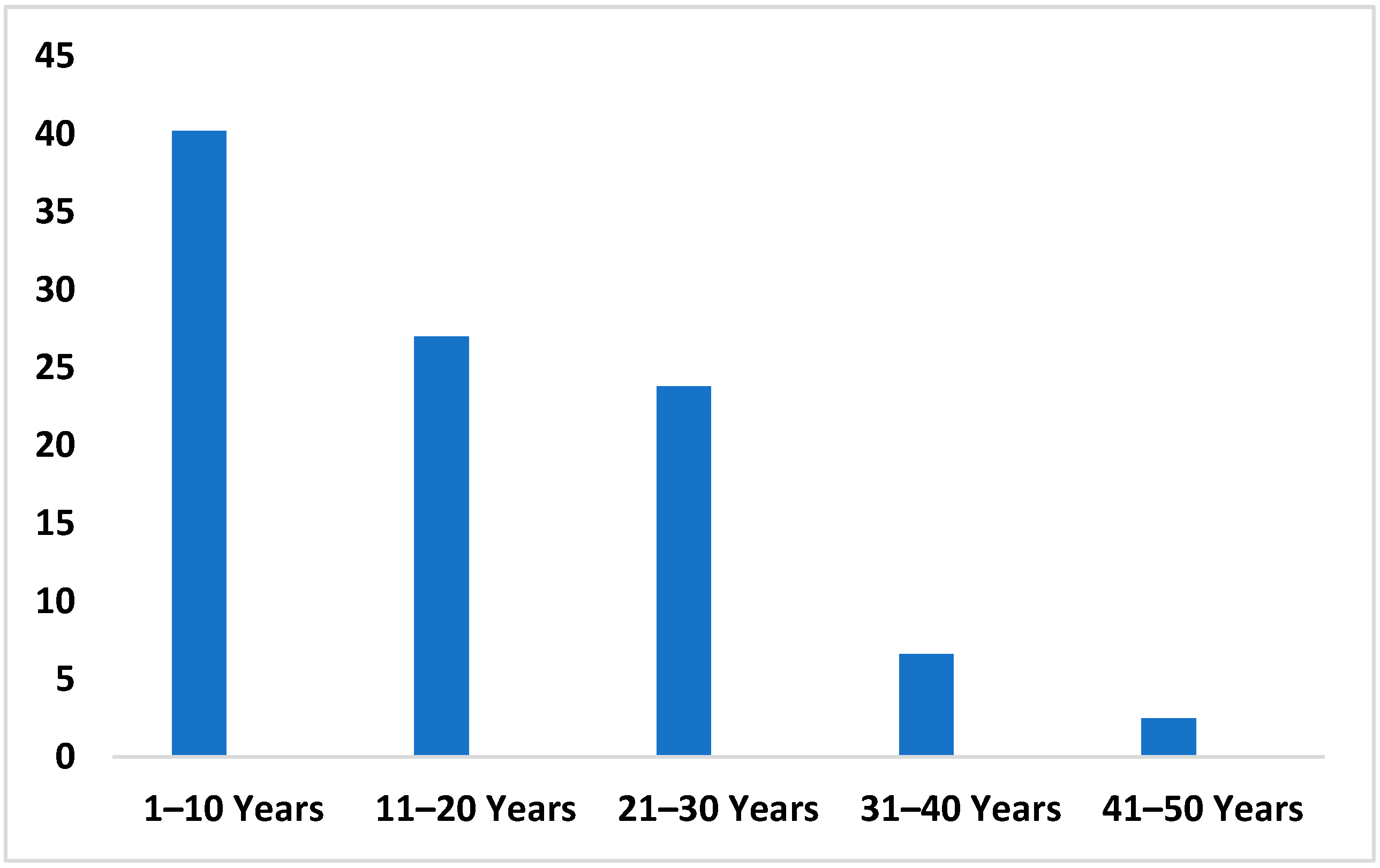
In presenting the results, the findings from respondents provide valuable insights into the status of rice cultivation and mechanization in northwestern Nigeria. The finding (Figure 1) outlines the experience levels of rice farmers, revealing that a majority of farmers (40.2%) have between 1 and 10 years of experience, with another 27% having 11 to 20 years of experience. This suggests that the majority of rice farmers are relatively young in their practice, which may indicate an emerging group of farmers eager to engage in rice cultivation. However, as experience increases, the proportion of farmers decreases significantly, with only 6.6% having 31 to 40 years of experience and a minimal 2.5% with 41 to 50 years of experience. This could imply challenges in sustaining highly experienced farmers in the region, potentially due to various socio-economic factors, such as access to land, resources, and support systems.
Figure 1. Farmer’s experience in rice cultivation.
While it is true that longer experience is theoretically associated with greater expertise, in practice, the presence of a larger proportion of young, less experienced farmers is encouraging. It suggests growing interest among the younger generation in agriculture, particularly with access to modern tools and mechanized practices. This shift has important implications for the sustainability and digital transformation of agriculture, as younger farmers are typically more open to innovation, digital tools, and mechanization.
Table 1 offers insights into the respondents’ opinions on the effectiveness of mechanized rice farming in the region. The high reliability statistics across the sections, ranging from 0.830 to 0.901, demonstrate the consistency of the responses. Mechanized rice production and job creation were highly regarded, with mean scores of 3.5982 and 3.6639, respectively, suggesting that mechanization is seen as a significant contributor to income generation and employment. However, government involvement scored lower, with a mean of 2.7509, indicating that respondents felt that there was insufficient governmental support for mechanized rice farming. These findings point to a strong belief in the economic benefits of mechanization but also highlight a critical need for greater government intervention to fully leverage these benefits, especially in supporting new and less experienced farmers. Thus, a combination of fostering greater governmental support and enhancing knowledge sharing among more experienced farmers could lead to a more robust rice farming industry in the region.
Table 1. Reliability statistics and mean rank of respondent’s opinions on mechanized rice farmers in Nigeria.

3.2. Model Prediction Performance in Yield of Rice Using Modern Equipment

The hybrid models demonstrate significant improvements over the single models, as combining techniques allows for better optimization and accuracy. The LR-ANN and LR-GPR hybrids show a drastic reduction in RMSE and MSE, while their R2 values increase notably, indicating stronger predictive performance. The incorporation of Bayesian Optimization [BO; a method that fine-tunes models for the most accurate predictions] further enhances these models, with LR-ANN-BO achieving the best results overall. During training, it has the lowest RMSE (0.117), the lowest MSE (0.014), and the highest R2 (0.919), reflecting its ability to fit the data effectively. This trend continues in testing, where LR-ANN-BO maintains the highest predictive accuracy (R2 = 0.906), proving its robustness in generalizing to unseen data. Similarly, LR-GPR-BO also performs well, with an R2 of 0.856, further supporting the advantage of hybrid modeling approaches.
Table 2 presents the performance of both single and hybrid models in predicting rice yield using modern equipment. The models are evaluated based on three key metrics, Root Mean Square Error (RMSE), Mean Square Error (MSE), and the coefficient of determination (R2), on both the training and test datasets. Among the single models, Gaussian Process Regression (GPR) outperforms Artificial Neural Network (ANN) and Linear Regression (LR) with the lowest RMSE (0.416) and MSE (0.173) during training, as well as a higher R2 value (0.320). ANN follows closely, while LR performs the worst, with the highest RMSE (0.575) and the lowest R2 (0.170), indicating its limited predictive capability for this application. These results suggest that machine learning-based models like ANN and GPR are better suited than traditional regression for capturing complex patterns in yield prediction.
Table 2. Results of both single and hybrid models on modeling yield of rice using modern equipment.
The results emphasize the importance of combining regression-based methods with advanced machine learning techniques and optimization strategies for accurate yield prediction. While single models provide a baseline, hybrid models, especially those incorporating Bayesian Optimization, demonstrate superior performance by reducing error and improving predictive power. This suggests that modern rice yield prediction should leverage hybrid methodologies, particularly those involving Artificial Neural Networks and Bayesian Optimization, to achieve the most reliable and accurate results. The findings also highlight the potential of integrating different computational techniques to enhance agricultural decision making and maximize yield efficiency using modern equipment.
In addition, in the context of this study, rice yield is measured in tons per hectare (t/ha). An RMSE of 0.575 t/ha using Linear Regression (LR) indicates that on average, the predicted yield deviates from the actual yield by approximately 575 kg per hectare. For smallholder farmers managing 1–2 hectares, this translates into potential misestimations of 0.5 to 1.2 tons, significantly affecting income forecasts, input usage, and harvesting logistics.
In contrast, the hybrid model LR-ANN-BO achieves an RMSE of 0.117 t/ha, reducing prediction error to approximately 117 kg per hectare. This fivefold improvement in accuracy is highly meaningful in operational terms.
Economic Planning: Farmers can better forecast their output and plan marketing, storage, and pricing strategies more confidently. Mechanization and Input Optimization: More accurate yield predictions help determine the appropriate levels of inputs such as fertilizer, water, and labor. This reduces waste and improves cost efficiency. Policy and Insurance Decisions: Government agencies and insurers can use high-precision yield forecasts to assess risk, allocate subsidies, and trigger crop insurance payments. Lower prediction error strengthens the reliability of these decisions.
Therefore, the transition from an RMSE of 0.575 to 0.117 and an R2 increase from 0.78 to 0.97 are not merely statistical improvements; they represents a paradigm shift in prediction reliability. Accurate yield forecasts underpin nearly every critical decision in the agricultural value chain. The hybrid models developed in this study enable more precise, actionable insights that can lead to improved food security, increased farmer incomes, and more efficient policy execution in rice-producing regions.
A multiple Linear Regression analysis was conducted using SPSS to examine how job creation, government involvement, and revenue generation influence farmers perceptions of the performance of mechanized rice farming. The results show that revenue generation is the only statistically significant predictor (B = 0.527, p < 0.001), indicating a strong positive influence, while job creation and government involvement were not significant (p = 0.712 and p = 0.271, respectively), suggesting that these factors were not perceived as key contributors by the respondents (Table 3). The model met all Linear Regression assumptions, with collinearity statistics (Tolerance > 0.85, VIF < 1.15) indicating no multicollinearity concerns. Additionally, a moderator analysis using bootstrapped samples (5000 iterations) tested the role of education level and farm size in moderating the revenue performance relationship. While revenue generation was confirmed as a significant predictor (H1 supported), no moderating effects were found for education nor farm size (H2 and H3 not supported; p > 0.10). These findings reinforce the central conclusion that income generation is the primary motivator for adopting mechanized rice farming, whereas perceived government support and employment impact remain weak influences.
Table 3. Coefficients.
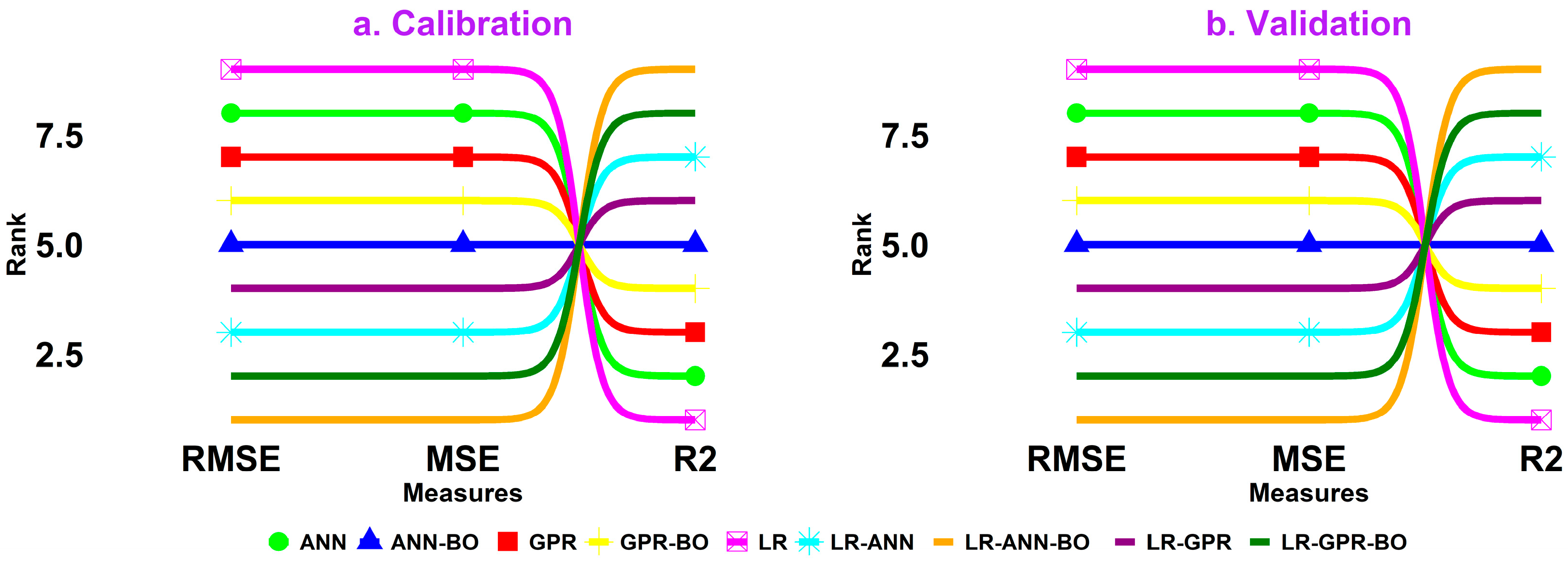
Figure 2 compares the ranking performance of different models for rice yield prediction based on RMSE, MSE, and R2 during calibration (Figure 2a) and validation (Figure 2b). The rankings indicate that hybrid models, particularly LR-ANN-BO and LR-GPR-BO, consistently outperform the single models by achieving lower RMSE and MSE while maximizing R2, as seen from their positions at the top ranks. Single models such as LR and ANN rank lower, demonstrating their comparatively weaker predictive capability. The consistency of rankings across both the calibration and validation phases highlights the robustness of hybrid models, especially those incorporating Bayesian Optimization, in improving predictive accuracy. This further confirms that combining regression with advanced machine learning techniques significantly enhances model performance in yield prediction using modern equipment.
Figure 2. Comparison plots. (a) Calibration. (b) Validation.
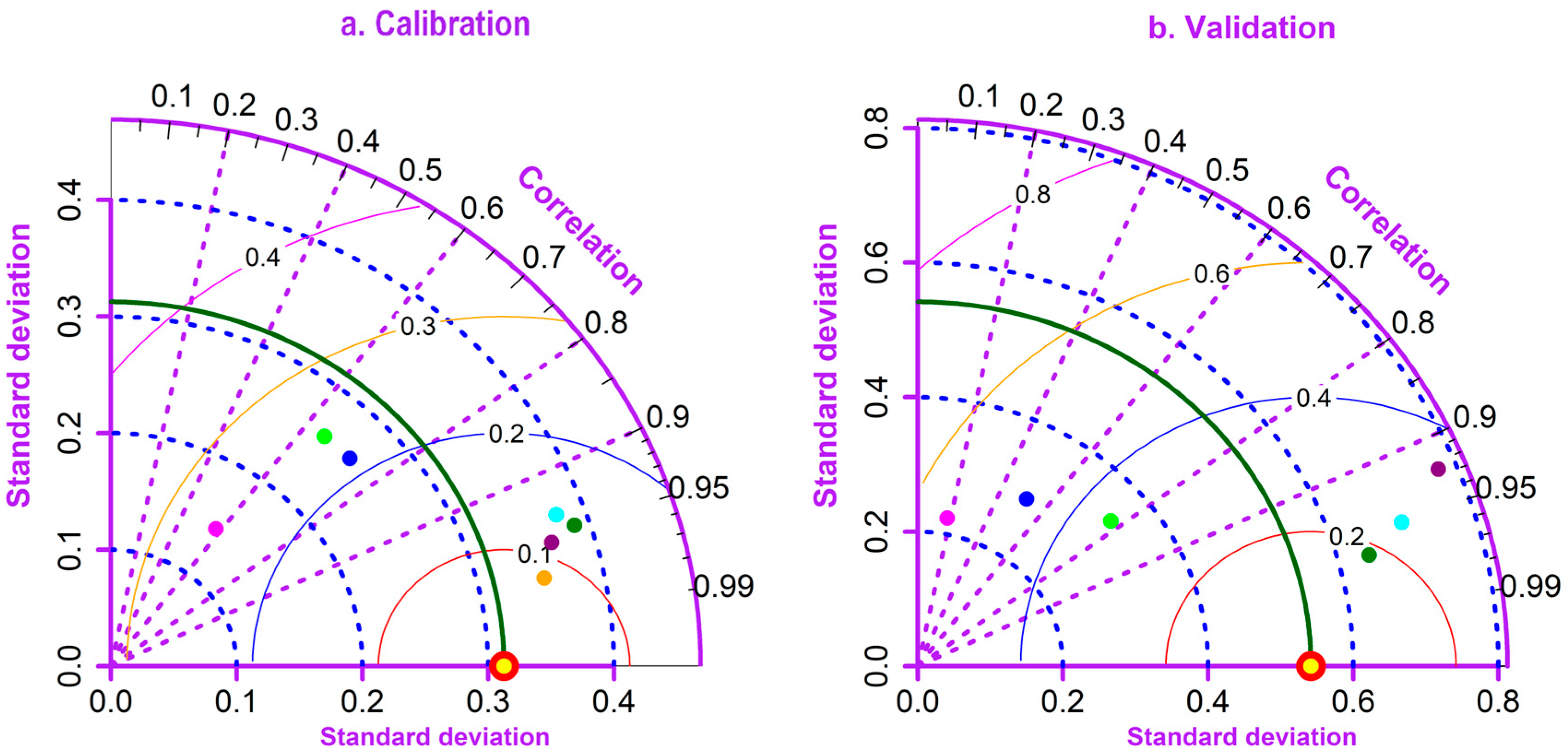
The Taylor plot provides a visual comparison of the predictive performance of different models in terms of correlation, standard deviation, and centered Root Mean Square Error (RMSE) (Figure 3). In both the calibration (Figure 3a) and validation (Figure 3b) plots, models with points closer to the reference arc (correlation of 1) indicate stronger predictive performance. The hybrid models, particularly LR-ANN-BO and LR-GPR-BO, exhibit high correlation and low standard deviation, suggesting their superior accuracy and reliability. Conversely, single models like LR and ANN display relatively higher standard deviations and lower correlations, reflecting weaker performance.
Figure 3. Taylor plot. (a) Calibration. (b) Validation.
The validation plot further confirms the trends observed in calibration, where the hybrid models continue to demonstrate better predictive capability, as indicated by their closer proximity to the ideal reference point. The color-coded legend highlights how Bayesian Optimization enhances predictive accuracy, as models incorporating BO tend to cluster in regions of higher correlation and lower error. Overall, the Taylor plot reaffirms that hybrid approaches significantly outperform single models in predicting rice yield with modern equipment.
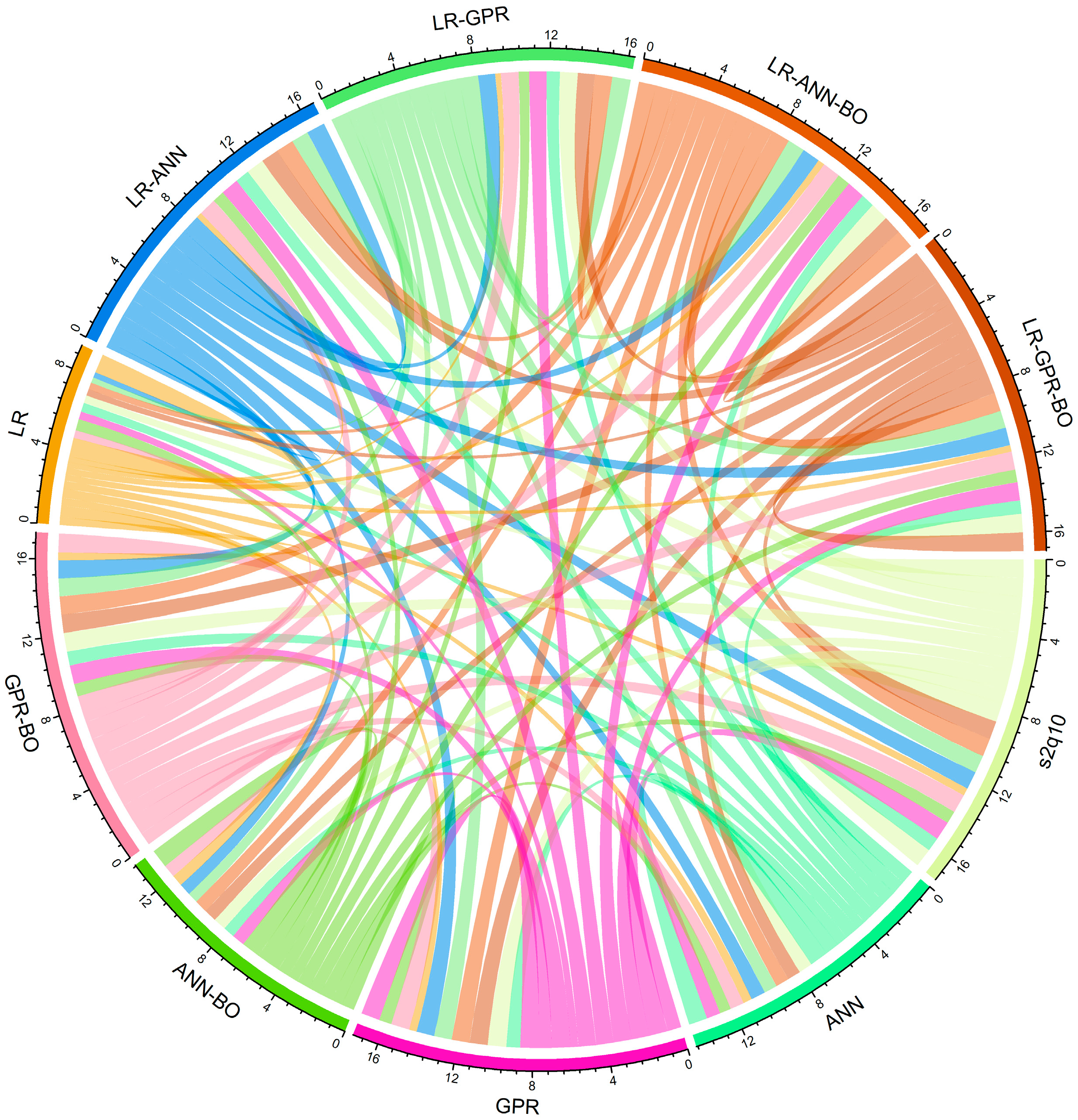
The chord plot presents an intricate visualization of the relationships among different models used for predicting rice yield (Figure 4). Each segment around the circular layout represents a specific model, ranging from single models like ANN, GPR, and LR to more complex hybrid models such as LR-ANN-BO and LR-GPR-BO. The colored connections between these segments indicate the degree of interaction or similarity between the models. Thicker and more vibrant connections suggest a stronger correlation, meaning that these models exhibit similar predictive performances, error metrics, or underlying computational mechanisms. The widespread interconnections highlight the interplay between traditional regression models, neural networks, and Bayesian Optimization techniques.
Figure 4. Chord plot.
A noticeable pattern in the plot is the prominence of hybrid models, particularly LR-ANN-BO and LR-GPR-BO, which show multiple strong links with other models. This suggests that these advanced hybrid models not only integrate the benefits of their component algorithms but also significantly outperform individual models in terms of predictive accuracy and error minimization. The presence of interconnected pathways reinforces the notion that hybrid approaches, particularly those incorporating Bayesian Optimization, enhance the learning process by refining weight adjustments, reducing errors, and improving adaptability to complex datasets. The interaction patterns further reveal that simple Linear Regression (LR) models have weaker connections, indicating that they may not perform as well as more sophisticated machine learning approaches.
Overall, the chord plot emphasizes the effectiveness of combining different modeling techniques in improving prediction accuracy in rice yield estimation. The strong interconnections between hybrid models reflect the added value of integrating machine learning approaches, neural networks, and optimization methods. The visualization suggests that while individual models have their strengths, leveraging hybrid strategies leads to better generalization and performance, making them a more reliable choice for predictive tasks in agricultural yield forecasting. The plot ultimately reinforces the superiority of hybrid models over single models, demonstrating the importance of combining multiple learning paradigms for robust predictive modeling.
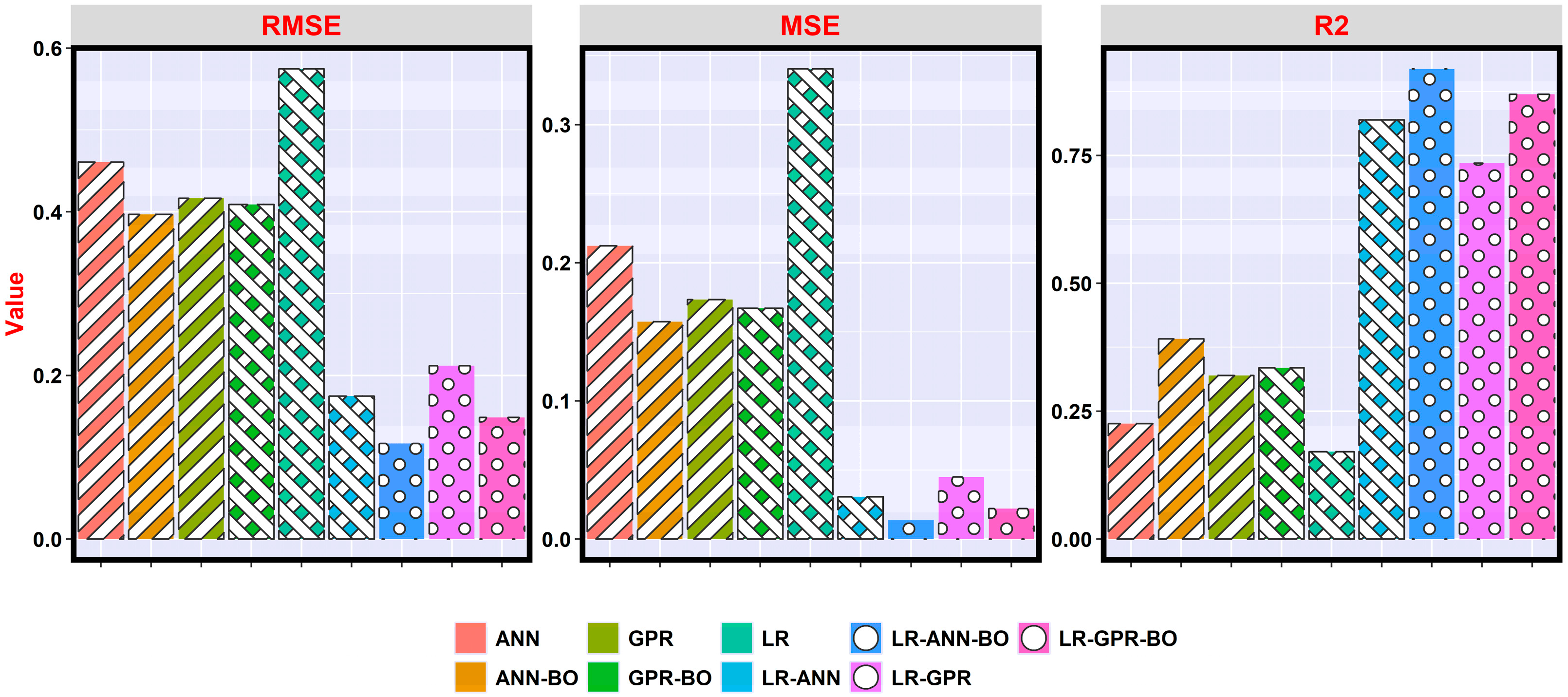
The bar chart compares the performance of different models in predicting rice yield using three key evaluation metrics: RMSE (Root Mean Square Error), MSE (Mean Square Error), and R2 (coefficient of determination) (Figure 5). Lower RMSE and MSE values indicate better model performance, while a higher R2 suggests stronger predictive accuracy. From the chart, single models such as ANN, GPR, and LR show higher RMSE and MSE values, indicating lower prediction accuracy. In contrast, hybrid models, particularly LR-ANN-BO and LR-GPR-BO, achieve the lowest RMSE and MSE, confirming their superior performance.
Figure 5. Comparison of models’ performance.
Looking at the R2 values, hybrid models significantly outperform single models, with LR-ANN-BO and LR-GPR-BO achieving the highest values, indicating strong predictive power. This suggests that combining multiple techniques, especially incorporating Bayesian Optimization, enhances the model’s ability to capture complex relationships in the data. Overall, the results reaffirm that hybrid models, particularly those optimized with Bayesian techniques, are more reliable and accurate for yield prediction using modern equipment.

3.3. Socio-Economic and Demographic Factors Influencing Mechanization Adoption

Gender: A statistically significant difference was observed (p = 0.001) between male and female respondents. Male farmers were significantly more likely to adopt mechanized equipment, likely due to greater access to capital and traditional land ownership privileges [30]. Age: Mechanization use peaked among farmers aged 31–45, reflecting the productivity and innovation openness of this demographic. Younger farmers (18–30) also showed strong adoption rates, suggesting promising engagement trends. Education: Farmers with secondary or tertiary education were substantially more likely to utilize mechanized methods (p = 0.006). Education appears to enhance understanding of machine operations, access to information, and participation in support programs. Access to Credit: A strong and significant association was found (p = 0.002) between credit access and mechanization, indicating that financial inclusion is a key enabler of mechanization investment. Household Size: Although not statistically significant, households with fewer members tended to adopt mechanization more, likely due to limited availability of family labor. Land Ownership: Farmers with formal ownership or secure tenure were significantly more likely to invest in mechanization (p = 0.018, ANOVA), highlighting the importance of land rights in enabling capital-intensive agricultural investment (Table 4).
Table 4. Socio-Economic and Demographic Factors Influencing Mechanization Adoption.

4. Discussion

This study reveals key insights into both the socio-economic perceptions of mechanized rice farming and the technological effectiveness of predictive modeling for rice yield. Respondents in the northwestern states of Nigeria expressed generally positive opinions about the impact of mechanization, with high mean scores for mechanized rice production (3.5982) and job creation (3.6639), indicating its perceived role in improving income and employment opportunities. These opinions are supported by the strong internal consistency of responses, as reflected by Cronbach’s Alpha values above 0.89 across all sections. However, government involvement received a noticeably lower mean score (2.7509), suggesting a perceived lack of adequate policy support, subsidies, or infrastructure development needed to fully support mechanized farming. This finding underlines a critical policy gap: while mechanization is embraced by farmers and seen as beneficial, the enabling environment required for its full impact, especially for less experienced farmers, is lacking. Bridging this gap through increased governmental participation and targeted interventions could significantly strengthen the rice value chain in the region.
The findings from this study align with global evidence on the role of mechanization in improving agricultural efficiency. For instance, Guo et al. [9] demonstrated how circular economy practices in China, assessed via DEA–Malmquist models, can boost resource efficiency, highlighting the potential for mechanization, if sustainably implemented, to serve as a catalyst for agricultural transformation in Nigeria. Furthermore, Li et al. [10] showed that regional disparities in agricultural productivity can be systematically analyzed using Data Envelopment Analysis (DEA), a method that could be applied to better understand mechanization gaps among the Kaduna, Kano, and Katsina states. These insights support the need for localized, data-driven mechanization policies in Nigeria that address both productivity enhancement and regional equity.
In parallel, this study examined the predictive performance of both single and hybrid models for rice yield forecasting using modern equipment. Among single models, Gaussian Process Regression (GPR) outperformed Artificial Neural Network (ANN) and Linear Regression (LR), indicating its superior ability to capture non-linear patterns in the data. However, the most significant improvement in prediction accuracy was observed with hybrid models, particularly those incorporating Bayesian Optimization (BO). The LR-ANN-BO model, for instance, recorded the best results with the lowest RMSE (0.117), the lowest MSE (0.014), and the highest R2 (0.919) during training and maintained strong generalization during testing (R2 = 0.906). Furthermore, these findings were validated by showing that the hybrid models consistently rank higher across the calibration and validation phases. These results demonstrate that integrating regression techniques with advanced machine learning and optimization algorithms significantly enhances model performance. Thus, while socio-economic data highlight the need for improved institutional support for mechanized farming, the technological findings point to the value of adopting advanced hybrid predictive models to support precision agriculture and informed decision making. Together, these insights reinforce the case for a dual approach: policy-level reinforcement and data-driven innovation to achieve sustainable growth in rice production [44].
However, to ensure a comprehensive assessment of model performance and robustness, this study employed a rigorous evaluation strategy that goes beyond standard metrics. While Root Mean Square Error (RMSE), Mean Square Error (MSE), and coefficient of determination (R2) were used initially, these were complemented with additional metrics and validation techniques to enhance reliability and prevent overfitting, particularly for complex models such as Artificial Neural Networks (ANNs) and hybrid models optimized using Bayesian Optimization. These metrics were reported for each model to provide a holistic view of accuracy, reliability, and bias. Moreover, to avoid the risks associated with relying on a single train–test split and improve the generalizability of the models, 10-fold cross-validation was implemented. This method ensures that performance is not overly dependent on a specific data partition and reduces the risk of overfitting, particularly for flexible models like ANN.

Predictive Modeling Guidance for Resource Allocation, Optimized Input Use, and Varying Yield Conditions

The predictive modeling results, particularly the outstanding performance of hybrid models such as Linear Regression–Artificial Neural Network–Bayesian Optimization (LR-ANN-BO), demonstrate the practical potential of data-driven tools to support agricultural decision making in Nigeria, especially within the context of mechanized rice farming. These models can be embedded into digital decision-support systems (DSSs) to deliver real-time recommendations on optimal input combinations, planting or harvesting windows, and adaptive strategies under varying environmental conditions by leveraging variables such as soil quality, fertilizer use, machinery access, and seasonal rainfall. They can also simulate production scenarios under constraints like drought or fertilizer shortages, aiding farmers and extension officers in risk management and contingency planning. For policymakers, model outputs can guide strategic resource allocation by identifying high-potential zones for mechanization investment and informing food security and infrastructure strategies. To enhance accessibility for non-expert users, technical concepts have been simplified in the Results Section, for instance, defining Bayesian Optimization as a method that fine-tunes models for the most accurate predictions. Additionally, through collaboration with ICT platforms and farmer cooperatives, the models can be deployed via mobile applications or advisory portals, enabling farmers to input basic data and receive personalized, predictive insights. Ultimately, these hybrid models serve as scalable and inclusive tools that promote precision agriculture, efficient input use, and informed policy interventions in Nigeria’s rice sector [18].
Despite moderate engagement efforts, the farmers in the study reported a relatively low perception of government involvement in mechanized rice farming, with an average score of 2.7509. This finding reflects widespread dissatisfaction and highlights key policy and structural gaps. Many farmers cited inadequate access to government-subsidized inputs and machinery, noting that existing subsidies are inconsistently delivered and often benefit larger-scale or politically connected producers [1,14]. Access to agricultural extension services also remains limited, especially in rural areas, undermining farmers’ capacity to effectively adopt and maintain mechanized tools [7]. Additionally, bureaucratic barriers such as unclear program guidelines and delays in equipment disbursement were frequently mentioned as obstacles to participating in government-led initiatives like the Agricultural Equipment Hiring Services (AEHS) [12]. Qualitative insights from field enumerators reinforce these findings, with several farmers expressing sentiments such as “Only the big farmers benefit, not smallholders like us,” and “We hear of tractors coming, but we never see them.” Addressing these challenges requires actionable reforms, including the establishment of decentralized equipment hubs managed by farmer cooperatives, the expansion of public–private partnerships to support subsidized machinery leasing, and the implementation of smart subsidy delivery platforms using digital targeting systems [22,27]. Strengthening and professionalizing agricultural extension services—with a focus on mechanization support—will also be essential. These policy interventions can help close the gap between government intentions and farmer realities, fostering a more inclusive and efficient mechanization ecosystem in Nigeria [45].

5. Conclusions

Thus, the fluctuating performance in mechanized farming in northwestern Nigeria mirrors the pattern observed in the other geopolitical zones of the country. Over the years, artificial intelligence (AI) has offered solutions that help farm and produce more with fewer resources, increasing crop quality and production rates. It is also responsible for different objectives, including vision, learning, and decision making in rice production.
This study also suggests that a higher income level may directly influence the performance of mechanized farming, as revenue generation plays a critical role in enhancing farm productivity. We anticipate that the increasing adoption of mechanized farming techniques and improvement in agricultural practices will drive an improvement in the performance of mechanized farming in Nigeria over time.
Furthermore, this study provides valuable insights into the dynamics of mechanized rice production in northwestern Nigeria, with implications for the broader agricultural sector in the country. While mechanized farming has the potential to significantly boast income and improve farmer livelihood, the findings suggest that ongoing efforts are necessary to stabilize and sustain performance and address the challenges that have contributed to the observed variables over time.

Author Contributions

Conceptualization, A.G.K.; Methodology, N.U.H.; Software, N.U.H.; Validation, A.G.K.; Formal analysis, N.U.H.; Investigation, A.G.K.; Resources, N.U.H.; Data curation, N.U.H.; Writing—original draft, N.U.H.; Writing—review & editing, A.G.K.; Supervision, A.G.K. All authors have read and agreed to the published version of the manuscript.

Funding

This research received no external funding.

Institutional Review Board Statement

The study was conducted in accordance with the Declaration of Helsinki, and approved by the Institutional Review Board (or Ethics Committee) of Near East University (protocol code NEU/SS/2021/1128 and date of approval: 18 November 2021).

Data Availability Statement

All data and other relevant materials used in conducting this research study are available upon request.

Conflicts of Interest

The authors declare no conflicts of interest.

Abbreviations

The following abbreviations are used in this manuscript:
The single models
ANNArtificial Neural Network
GPRGaussian Process Regression
LRLinear Regression
Hybrid models
ANN-BOArtificial Neural Network-Bayesian Optimization
GPR-BOGaussian Process Regression-Bayesian Optimization
LR-ANNLinear Regression–Artificial Neural Network
LR-GPRLinear Regression–Gaussian Process Regression
LR-ANN-BOLinear Regression–Artificial Neural Network–Bayesian Optimization
LR-GPR-BOLinear Regression–Gaussian Process Regression–Bayesian Optimization
WARDAWest African Rice Development Association
NBSNational Bureau for Statistics
NAERLSNational Agricultural Extension & Research Liaison Services
UAVUnmanned Aerial Vehicle
SRPSustainable Rice Platform
CAPIComputer-Assisted Personal Interview
ODKOpen Data Kit
SPSSStatistical Package for the Social Sciences
RFERecursive Feature Elimination
GHGGreenhouse Gas

References

  1. Biam, C.K.; Onah, P.; Aye, G.C. A Comparative Analysis of Mechanized and Non-Mechanized Rice Production in Benue State, Nigeria. J. Agric. Econ. Ext. Sci. 2020, 6, 95–108. [Google Scholar]
  2. WARDA. Rice Trends in Sub-Saharan Africa: A Synthesis of Statistics on Rice Production, Trade and Consumption; SAYCE Publishing: Exeter, UK, 1996. [Google Scholar]
  3. Singh, B.N.; Fagade, S.; Ukwungwu, M.N.; William, C.; Jagtap, S.S.; Oladimeji, O.; Effisue, A.; Okhidievbie, O. Rice Growing Environments and Biophysical Constraints in Different Agro-Ecological Zones of Nigeria. Met. J. 1997, 2, 35–44. [Google Scholar]
  4. Williams, C.T.; Ukwungwu, M.N.; Singh, B.N.; Okhidievbie, O.; Nnabo, J. Farmer-Managed Trials in South-East Nigeria to Evaluate the Rice Variety CISADANE and Estimate Yield Losses Caused by the African Rice Gall Midge, Orseolia oryzivora Harris & Gagne. Int. J. Pest Manag. 1999, 45, 117–124. [Google Scholar]
  5. National Bureau of Statistics. 2019 Poverty and Inequality in Nigeria: Executive Summary; National Bureau of Statistics: Abuja, Nigeria, 2020. [Google Scholar]
  6. NAERLS. 2020 Wet Season Agricultural Performance in Nigeria; National Agricultural Extension and Research Liaison Services (NAERLS); Ahmadu Bello University: Zaria, Nigeria, 2020. [Google Scholar]
  7. NAERLS. National Report of Wet Season Agricultural Performance in Nigeria 2021; National Agricultural Extension and Research Liaison Services (NAERLS); Ahmadu Bello University: Zaria, Nigeria, 2021. [Google Scholar]
  8. Ulusoy, P.A. Agricultural Productivity and Enhancing Income. In Proceedings of the Ahmadu Bello University Lecture Symposium, Zaria, Nigeria, July 2013. [Google Scholar]
  9. Guo, C.; Zhang, R.; Zou, Y. Efficiency Analysis of Agricultural Circular Economy in China Based on DEA–Malmquist–Tobit Model. Agriculture 2023, 13, 1454. [Google Scholar] [CrossRef]
  10. Li, X.; Yang, P.; Zou, Y. Regional Disparities and Agricultural Development Efficiency in China: A DEA Approach. Agriculture 2023, 13, 1806. [Google Scholar] [CrossRef]
  11. Ulger, M.; Tetteh, G.; Mahama, A. Mechanization of Agriculture in Sub-Saharan Africa. In Proceedings of the Agricultural Development Conference, Accra, Ghana; 2011. [Google Scholar]
  12. World Bank. World Bank Development Indicators Online Database; FAOSTAT: Rome, Italy, 2023; Available online: http://www.fao.org/faostat/en/#data/QC/metadata (accessed on 3 May 2025).
  13. Aloko, S.M.A. An Analysis of the Impact of Oil Boom on Agriculture and Agricultural Research in Northern Nigeria, 1970–1987. Wukari Int. J. 2023, 7, 14. [Google Scholar]
  14. Adesina, A.T. Agricultural Transformation Agenda: Repositioning Agriculture to Drive Nigeria’s Economy; Agricultural Transformation Policy Paper; Federal Ministry of Agriculture and Rural Development: Abuja, Nigeria, 2017. [Google Scholar]
  15. Akinbile, L.A. Determinants of Productivity Level among Rice Farmers in Nigeria. In Proceedings of the 8th African Crop Science Conference, El-Minia, Egypt, 27–31 October 2007; pp. 1339–1344. [Google Scholar]
  16. Asoegwu, S.N.; Asoegwu, A.O. Hybrid Rice Seed Evaluation on Enhancing Rice Production. UNN Agric. Econ. J. 2006, 6, 274–279. [Google Scholar]
  17. Morrison, A.; Raju, D.; Sinha, N. Gender Equality, Poverty and Economic Growth. In World Bank Policy Research Working Paper; World Bank: Washington, DC, USA, 2012; p. 4349. [Google Scholar] [CrossRef]
  18. Shamshiri, R.R.; Weltzien, C.; Hameed, I.A.; Yule, I.J.; Grift, T.E.; Balasundram, S.K.; Ahmad, D.; Chowdhary, G. Research and Development in Agricultural Robotics: A Perspective of Digital Farming. Int. J. Agric. Biol. Eng. 2018, 11, 1–14. [Google Scholar] [CrossRef]
  19. Nwanze, K.F.; Mohapatra, S.; Kormawa, P. Rice Development in Sub-Saharan Africa. J. Food Sci. Agric. 2012, 86, 675–677. [Google Scholar] [CrossRef]
  20. Emodi, I.A.; Madukwe, M.C. Instrumental Development to Agricultural Data Collection and Analysis. Univ. Lagos J. Agric. 2012, 2, 15–24. [Google Scholar]
  21. Osuala, Z.I. Regression Analysis on Digital Agricultural Data Collection and Processing. UNN J. Agric. Econ. 2005, 10, 212–215. [Google Scholar]
  22. RIFAN. Annual Report on Productivity and Challenges; Rice Farmers Association of Nigeria (RIFAN): Abuja, Nigeria, 2019. [Google Scholar]
  23. Little, R.J.A.; Rubin, D.B. Statistical Analysis with Missing Data, 2nd ed.; Wiley: Hoboken, NJ, USA, 2002. [Google Scholar] [CrossRef]
  24. Osborne, J.W.; Overbay, A. The Power of Outliers (and Why Researchers Should Always Check for Them). Pract. Assess. Res. Eval. 2004, 9, 6. [Google Scholar]
  25. FAO. Rice Market Monitor; Food and Agriculture Organization of the United Nations: Rome, Italy, 2018; Volume XXI. [Google Scholar]
  26. Zhang, Y.; Yang, X.; Chen, Y.; Zhou, H. Sustainable Mechanization for Agriculture in Sub-Saharan Africa. Agric. Syst. 2016, 148, 111–121. [Google Scholar] [CrossRef]
  27. FAO. Sustainable Rice Production: Contribution to the 2030 Agenda; Food and Agriculture Organization of the United Nations: Rome, Italy, 2018; Available online: https://openknowledge.fao.org/server/api/core/bitstreams/7a7413e6-39e0-4651-a17c-27a23312d39b/content? (accessed on 3 May 2025).
  28. Sustainable Rice Platform (SRP). SRP Performance Indicators for Sustainable Rice Cultivation; Sustainable Rice Platform: Bangkok, Thailand, 2020; Available online: https://www.sustainablerice.org (accessed on 3 May 2025).
  29. Rózewicz, M. Review of Current Knowledge on Strip-Till Cultivation and Possibilities of Its Popularization in Poland. Pol. J. Agron. 2022, 49, 20–30. [Google Scholar] [CrossRef]
  30. Baba, D.; Lawal, I.A. Determinants of Women Participation in Empowerment Program: A Case of Rice Parboilers in KRIP, Kano State, Nigeria. Niger. J. Agric. Ext. 2020, 21, 28–36. [Google Scholar]
  31. Baba, D.; Damisa, M.A.; Mohammed, A.B.; Yakubu, L.L. Impact of Adoption of Quality Protein Maize on Poverty Status of Rural Farming Households in Northwest Nigeria. J. Agri-Preneursh. Sustain. Dev. 2020, 3, 135–156. [Google Scholar] [CrossRef]
  32. Mani, J.R.; Suleiman, N.J.; Baba, D.; Hudu, M.I. Assessing the Capabilities of Maize Production in Kaduna State, Nigeria: A Path. In Proceedings of the Farm Managers Association of Nigeria Conference, Bauchi, Nigeria, 7–10 April 2019; pp. 1–11. [Google Scholar]
  33. USDA Foreign Agricultural Service. Grain Report: Nigeria; United States Department of Agriculture: Washington, DC, USA, 2010. [Google Scholar]
  34. Africa Rice Center (ARC). Africa-Wide Rice Agronomy Taskforce: Annual Report; ARC: Cotonou, Benin, 2018. [Google Scholar]
  35. Ajah, J.; Nmadu, J.N. Socio-Economic Factors Influencing Output of Small-Scale Maize Farmers in Abuja, Nigeria. Kasetsart J. Soc. Sci. 2012, 33, 333–341. [Google Scholar]
  36. Raufu, M.O. Cost and Return Analysis of Rice Production in Kwara State, Nigeria under Sawah Technology. Adv. Agric. 2014, 1, 79–83. [Google Scholar]
  37. FAO. Agriculture Towards 2015/30: Technical Interim Report; Food and Agriculture Organization: Rome, Italy, 2008. [Google Scholar]
  38. Omuonye, E.D.; Bashir, A. The Geography of Taraba State: Nature’s Gift to the Nation; Taraba State Economic Summit Report; LAP LAMBERT Academic Publishing: Saarbrücken, Germany, 2011. [Google Scholar]
  39. Okeh, C.; Nwosi, C.O.; Fredrick, J.O.C. Biogas Production from Rice Husk Generated from Various Rice Mills in Ebonyi State, Nigeria. Renew. Energy Pap. 2014, 62, 204–208. [Google Scholar] [CrossRef]
  40. Johnson, M.; Takashima, H.; Gyimah-Brempong, K. Assessing the Potential and Policy Alternatives for Achieving Rice Competitiveness and Growth in Nigeria; International Food Policy Research Institute (IFPRI): Washington, DC, USA, 2013; p. 01301. [Google Scholar]
  41. Ulusoy, P.A.; Ajayi, M. Agricultural Productivity and Resource Enhancing. In Proceedings of the Ahmadu Bello University Lecture Symposium, Zaria, Nigeria, 7–9 August 2023. [Google Scholar]
  42. Kotsiantis, S.B. Supervised Machine Learning: A Review of Classification Techniques. Informatica 2007, 31, 249–268. [Google Scholar]
  43. Hair, J.F.; Black, W.C.; Babin, B.J.; Anderson, R.E. Multivariate Data Analysis, 7th ed.; Pearson: Upper Saddle River, NJ, USA, 2010. [Google Scholar]
  44. Osborne, J.W. Best Practices in Data Cleaning: A Complete Guide to Everything You Need to Do Before and After Collecting Your Data; Sage Publications: Thousand Oaks, CA, USA, 2015. [Google Scholar]
  45. Świecicki, W.K.; Surma, M. The Big Five in the World of Plants—The Species That Have Changed the Course of History. Pol. J. Agron. 2021, 47, 68–78. [Google Scholar] [CrossRef]
Disclaimer/Publisher’s Note: The statements, opinions and data contained in all publications are solely those of the individual author(s) and contributor(s) and not of MDPI and/or the editor(s). MDPI and/or the editor(s) disclaim responsibility for any injury to people or property resulting from any ideas, methods, instructions or products referred to in the content.

Article Metrics

Citations

Article Access Statistics

Multiple requests from the same IP address are counted as one view.