Calculation and Sustainability Evaluation of Grain Virtual Water Flow Among Provinces in China


Abstract
1. Introduction
2. Materials and Methods
2.1. Definition of Terms and Modeling Process
2.1.1. Definition of Terms
- (1)
- Local Water Resources
- (2)
- Water Withdrawal
- (3)
- Net Virtual Water
- (4)
- Return Flow
- (5)
- Environmental Flow Requirement
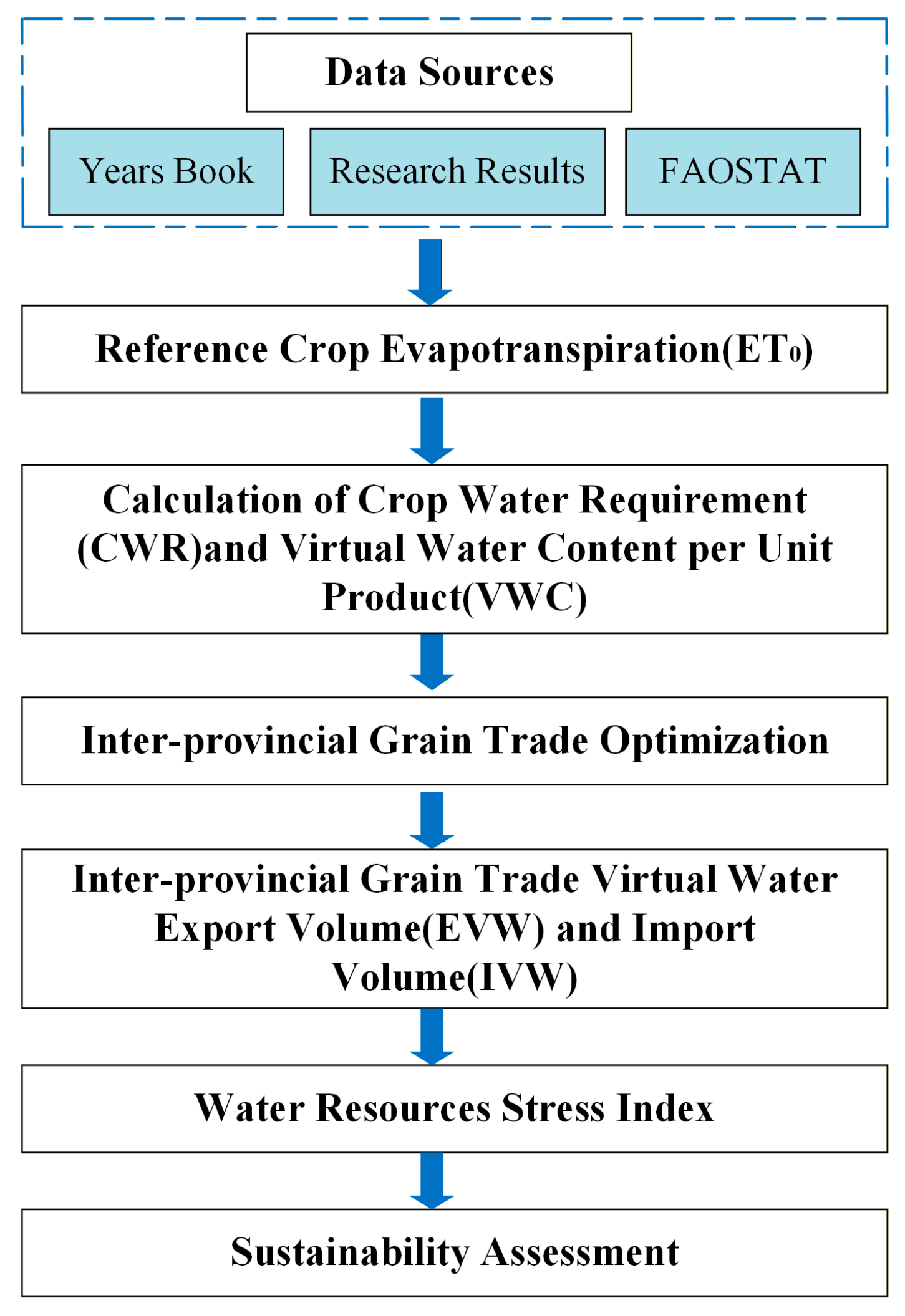
2.1.2. Modeling Process
2.2. Measurement Model of Inter-Provincial Grain Product Trade
2.3. Measurement Model of Virtual Water Flow Volume in Inter-Provincial Grain Product Trade
2.4. Sustainability Assessment of Virtual Water Flow in Inter-Provincial Grain Product Trade
2.5. Data Sources
3. Results
3.1. Measurement Results and Analysis of Virtual Water Flow in Inter-Provincial Grain Product Trade
3.1.1. Measurement Results and Analysis of Product-Specific Inter-Provincial Virtual Water Flow
3.1.2. Measurement Results and Analysis of Virtual Water Flow Volume in Inter-Provincial Grain Product Trade
3.2. Sustainability Evaluation and Analysis of Virtual Water Flow in Inter-Provincial Grain Product Trade
4. Conclusions and Recommendations
4.1. Conclusions
- (1)
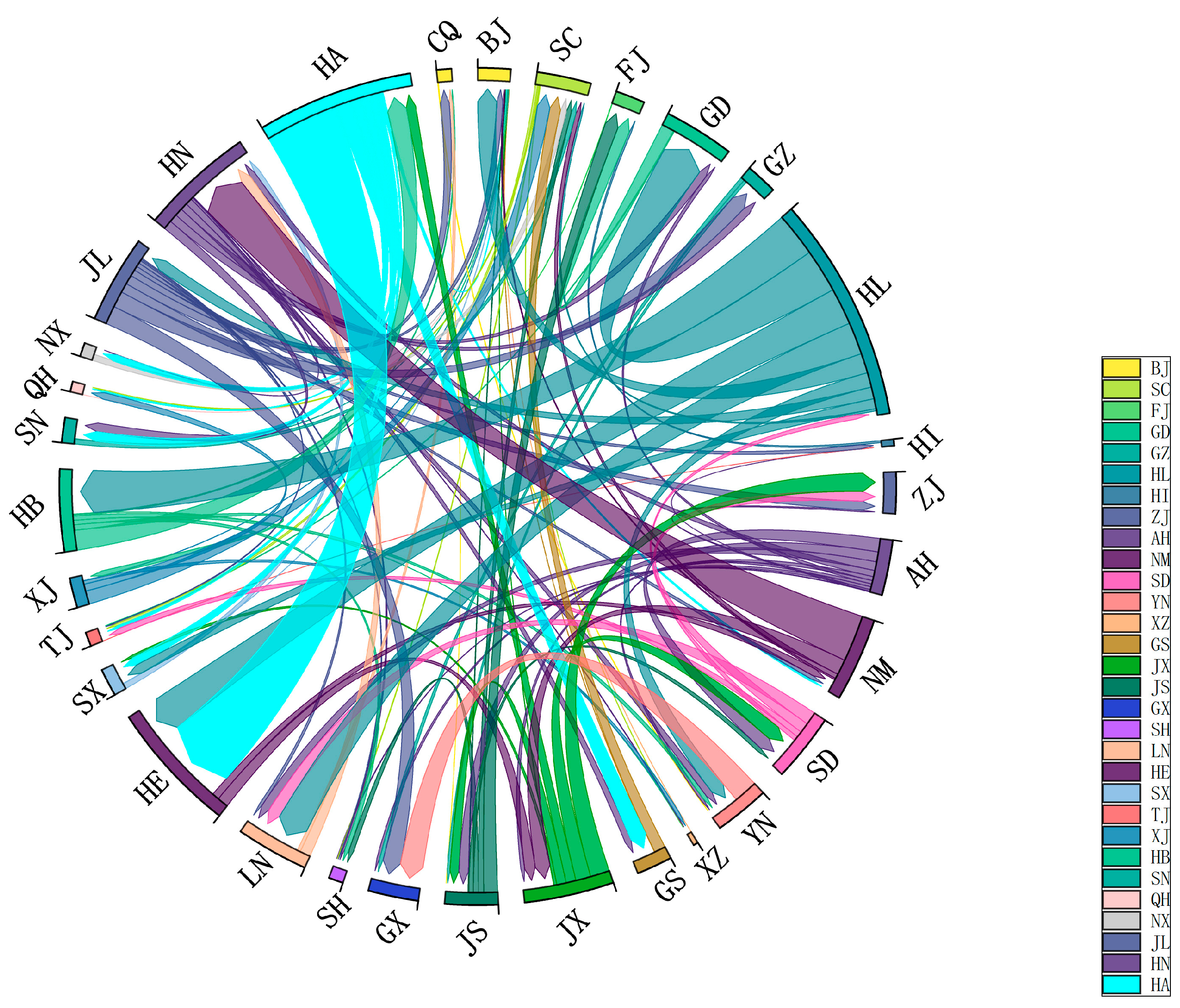
- In 2021, the inter-provincial virtual water flow in China’s grain product trade exhibited the characteristic of “virtual water transportation from north to south”. The three provinces with the largest virtual water net outflow volume in inter-provincial grain product trade were Heilongjiang (43.166 billion m3), Henan (18.974 billion m3), and Anhui (13.089 billion m3); while the three provinces with the largest virtual water net inflow volume in inter-provincial grain product trade were Hebei (18.875 billion m3), Guangxi (10.076 billion m3), and Liaoning (8.795 billion m3).
- (2)
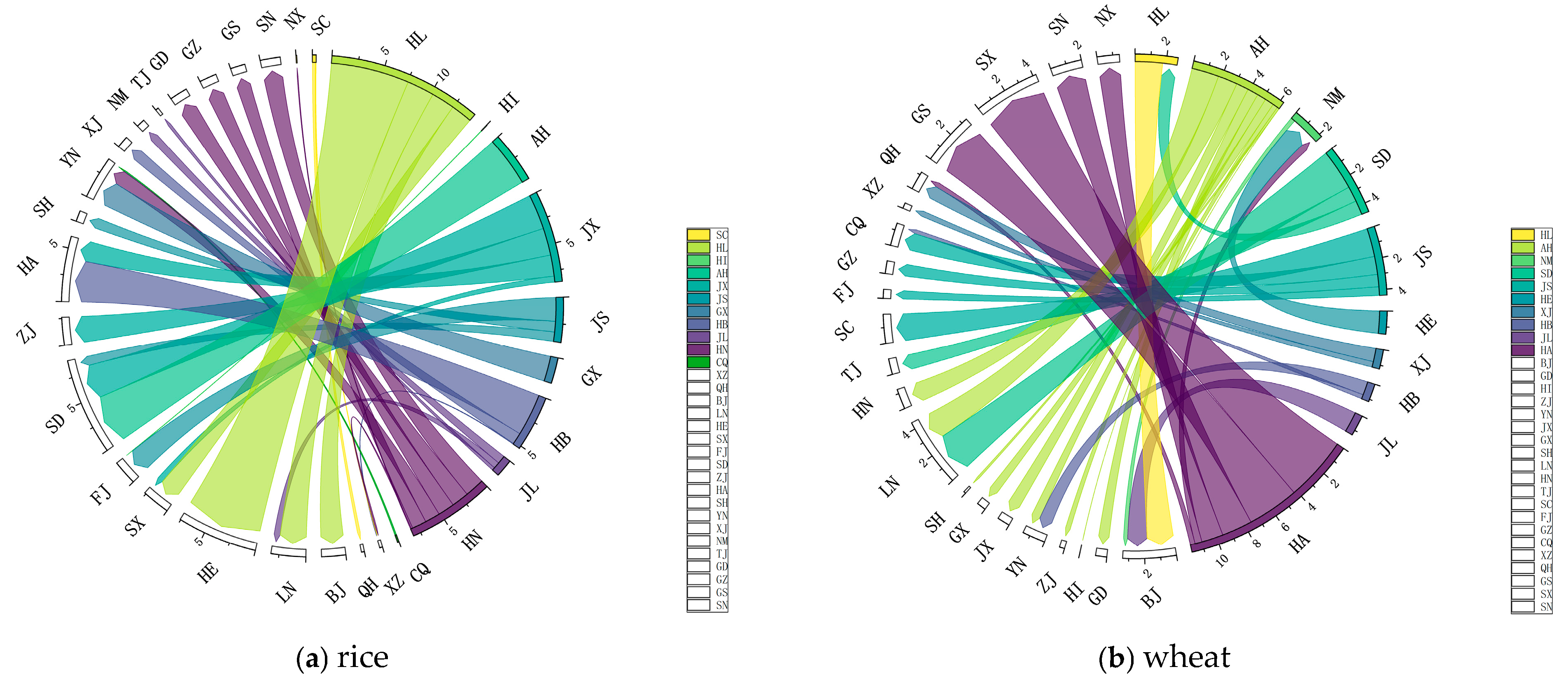
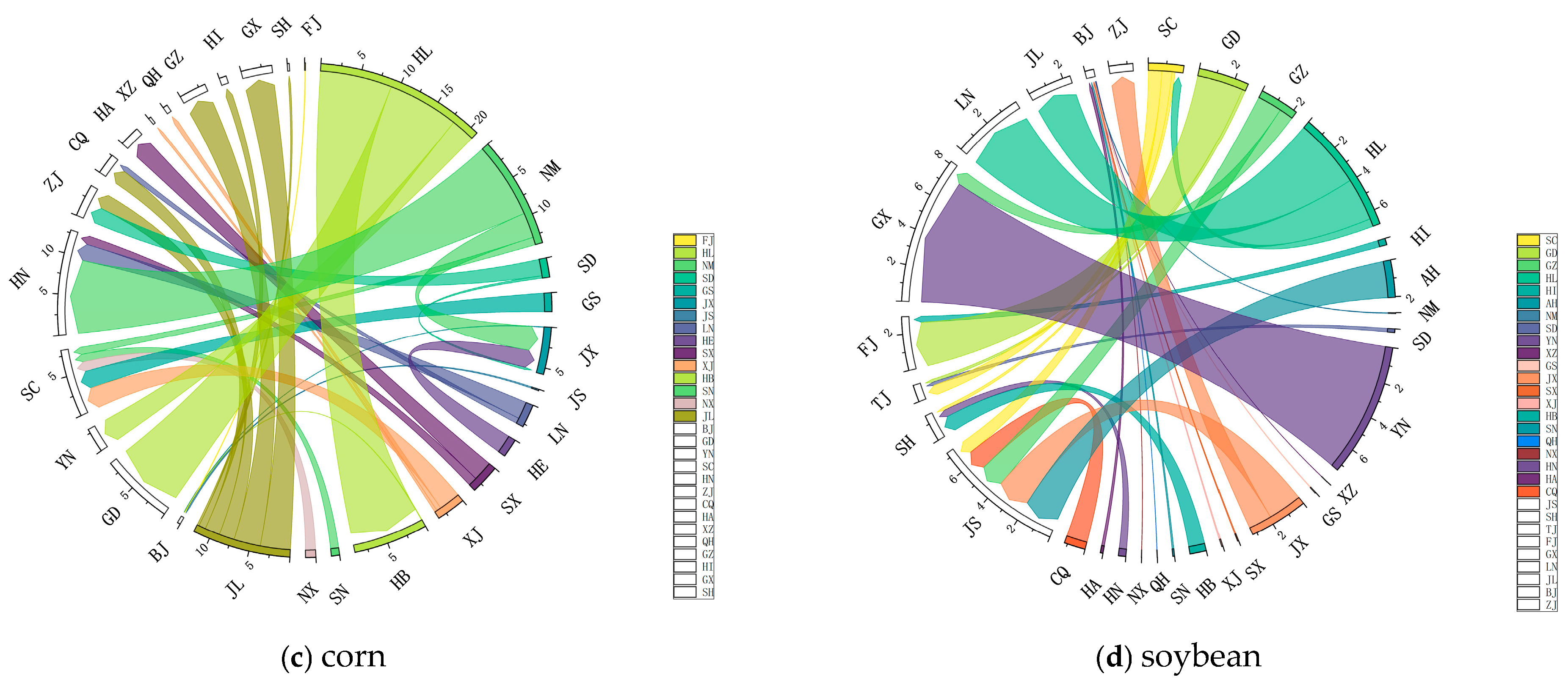
- Among the pairwise inter-provincial virtual water flows in China’s grain product trade, the flow from Henan to Hebei was the largest (15.062 billion m3), followed by the flow from Inner Mongolia to Hunan (9.568 billion m3) and the flow from Heilongjiang to Hubei (9.040 billion m3). By grain product type: among the pairwise inter-provincial virtual water flows of rice, the flow from Heilongjiang to Hebei was the largest (7.567 billion m3), followed by the flow from Anhui to Shandong (4.817 billion m3); among the inter-provincial virtual water net flows of wheat, the flow from Henan to Shanxi was the largest (4.196 billion m3), followed by the flow from Henan to Gansu (3.372 billion m3); among the inter-provincial virtual water flows of corn, the flow from Inner Mongolia to Hunan was the largest (9.568 billion m3), followed by the flow from Heilongjiang to Hubei (9.040 billion m3); among the inter-provincial virtual water flows of soybeans, the flow from Yunnan to Guangxi was the largest (7.355 billion m3), followed by the flow from Heilongjiang to Liaoning (3.948 billion m3).
- (3)
- In 2021, the provinces with the largest increase in water resource pressure index due to inter-provincial grain product trade were Heilongjiang, Jilin, and Inner Mongolia, with increases of 94.74%, 73.68%, and 48%, respectively; the top three regions with the largest decrease in water resource pressure index were Beijing, Shanghai, and Qinghai, with decreases of 94.64%, 79.41%, and 66.67%, respectively. Under the scenario with inter-provincial grain product trade, the national average water resource pressure index decreased by 17.31% compared with that under the scenario without inter-provincial grain product trade. Overall, China’s current virtual water flow pattern of grain is sustainable.
4.2. Recommendations
- (1)
- Guide the flow of virtual water through the optimization and adjustment of grain production and circulation. The government should strengthen macro-level regulation over grain production and circulation to adjust the main channels of virtual water flows and enhance policy support for major exporting provinces. The results reveal a distinct “north-to-south water transfer” pattern in China’s virtual water flows embedded in interprovincial grain product trade. The top three provinces in terms of net virtual water outflow are Heilongjiang (43.166 billion m3), Henan (18.974 billion m3), and Jilin (12.675 billion m3). These major grain-exporting provinces export substantial volumes of virtual water through grain product trade, which significantly increases local water stress. For example, Heilongjiang’s water stress index rises by 94.74% due to grain exports. Although interprovincial grain product trade reduces the national average water stress index from 0.52 to 0.43 (a decrease of about 17.31%), indicating an overall mitigation effect and a relatively sustainable pattern, it simultaneously leads to spatial imbalance—some major exporting provinces experience aggravated water stress. Therefore, the government should fully exercise its regulatory capacity to rationally guide the main channels of virtual water transfer. For the largest interprovincial virtual water flows (e.g., Henan→Hebei, Inner Mongolia→Hunan, Heilongjiang→Hubei), targeted policy measures should be implemented to standardize grain circulation, lower logistics costs, and ensure the efficiency of major grain transportation routes. Meanwhile, stronger policy support—through direct subsidies, tax reductions, and low-interest loans—should be provided to key net-exporting provinces such as Henan and Inner Mongolia. By ensuring both food and water security, such measures would incentivize stable and increased grain production while alleviating local water stress, thereby enhancing the sustainability of interprovincial virtual water flows.
- (2)
- Optimization of Cropping Structures in Major Producing Areas and Land-Use Control in Major Consuming Areas. Heilongjiang, Henan, and Jilin, the three provinces with the highest net virtual water outflows (43.166 billion, 18.974 billion, and 12.675 billion m3, respectively), export enormous quantities of virtual water through grain product trade, causing notable increases in their local water stress indices (by 94.74%, 73.68%, and 48%, respectively). Accordingly, these major grain-producing regions should adjust their cropping structures by expanding the share of drought- and cold-tolerant, high-yield, and high-quality varieties while reducing the planting area of water-intensive crops. The adoption of water-saving irrigation technologies should be promoted to improve on-farm water-use efficiency [43]. Conversely, major grain-consuming areas should rationally control urbanization and strictly safeguard arable land to maintain a basic level of grain self-sufficiency. Provinces such as Hebei, Guangxi, and Liaoning are currently major net recipients of virtual water (with net inflows of 18.875 billion, 10.076 billion, and 8.795 billion m3, respectively). Moreover, highly urbanized cities like Beijing and Shanghai have reduced their local water stress indices by 94.64% and 79.41%, respectively, through substantial grain imports. Hence, these net-importing regions should curb excessive urban expansion, preserve farmland and local production capacity, and thereby reduce over-dependence on external virtual water inputs.
- (3)
- Expanding Grain Production in Water-Abundant Regions and Promoting Water-Saving Lifestyles. Empirical results indicate that southern provinces such as Zhejiang and Fujian possess abundant water resources, and grain production imposes minimal water stress (e.g., Zhejiang’s water stress index is only ≈0.03). These water-abundant regions could leverage their resource advantages by moderately expanding grain cultivation to help relieve water stress in major producing areas. Meanwhile, populous provinces such as Sichuan and Guangdong should encourage residents to adjust their dietary structures—shifting toward food items with lower virtual water content and reducing consumption of water-intensive grains—to lower demand for high-virtual-water agricultural products. Some grain-importing regions, such as Qinghai, have already alleviated local water stress through virtual water inflows (its water stress index decreased by 66.67% due to imported grain). However, excessive dependence on external water resources is unsustainable. It is thus crucial to enhance public awareness of water conservation and foster a culture of sustainable consumption. At the national level, large-scale inter-basin water transfer projects should be accelerated to strengthen coordination between physical water redistribution and virtual water flows, thereby enhancing overall regional water and food security.
4.3. Limitations
Author Contributions
Funding
Institutional Review Board Statement
Informed Consent Statement
Data Availability Statement
Conflicts of Interest
References
- Deng, H.Y.; Li, C.M.; Cao, J.; Song, Y.L.; Liu, J. Spatial-temporal Pattern and Distribution Evolution of Grain Production in China. J. Agric. Sci. Technol. China 2024, 26, 1–11. [Google Scholar] [CrossRef]
- Liu, J.; Wang, Y.; Yu, Z.; Cao, X.; Tian, L.; Sun, S.; Wu, P. A comprehensive analysis of blue water scarcity from the production, consumption, and water transfer perspectives. Ecol. Indic. 2017, 72, 870–880. [Google Scholar] [CrossRef] [Scilit]
- Sun, S.K.; Wu, P.T.; Wang, Y.B.; Zhao, X.N. The virtual water content of major grain crops and virtual water flows between regions in China. J. Sci. Food Agric. 2013, 93, 1427–1437. [Google Scholar] [CrossRef] [Scilit]
- Allan, J.A. Fortunately there are substitutes for water otherwise our hydro-political futures would be impossible. Priorities Water Resour. Alloc. Manag. 1993, 13, 26. [Google Scholar]
- Wang, Y.B.; Wu, P.T.; Zhao, X.N.; Engel, B.A. Virtual water flows of grain within China and its impact on water resource and grain security in 2010. Ecol. Eng. 2014, 69, 255–264. [Google Scholar] [CrossRef] [Scilit]
- Tong, J.J.; Sun, S.K.; Ma, J.L.; Yin, Y.L.; Wang, Y.B.; Shen, X.; Xu, J.Y. Analysis of Socio-economic Driving Effect of Regional Grain Virtual Water Flow. Trans. Chin. Soc. Agric. Mach. 2024, 27, 1–26. [Google Scholar] [CrossRef]
- Wang, X. Study on Grain Virtual Water Flow Between Regions in China and Its Impact on Water Resources. Master’s Thesis, Northwest A&F University, Xianyang, China, 2016. [Google Scholar]
- Jing, M.; Hoekstra, A.Y.; Hao, W.; Chapagain, A.K.; Dangxian, W. Virtual versus real water transfers within China. Philos. Trans. R. Soc. London Ser. B Biol. Sci. 2006, 361, 835–842. [Google Scholar] [CrossRef] [Scilit]
- Zhao, Y.; Huang, K.J.; Gao, X.R.; An, T.L.; He, G.H.; Jiang, S. Evaluation of grain production water footprint and influence of grain virtual water flow in the Yellow River Basin. Water Resour. Prot. 2022, 38, 39–47. [Google Scholar] [CrossRef]
- Qian, H.; Engel, B.A.; Tian, X.; Sun, S.; Wu, P.; Wang, Y. Evaluating drivers and flow patterns of inter-provincial grain virtual water trade in China. Sci. Total. Environ. 2020, 732, 139251. [Google Scholar] [CrossRef] [Scilit]
- Qian, H.Y. Quantitative Method of Inter-Provincial Grain Trade and Evaluation of Virtual Water Flow Pattern in China. Master’s Thesis, Northwest A&F University, Xianyang, China, 2020. [Google Scholar] [CrossRef]
- Yang, T.T.; Zhang, X.N.; Gao, X.; Hu, Q.Y.; Wang, Q.H.; Lun, F.; Chen, X.L. Study on inter-provincial grain trade and its impacts on virtual water and soil resources in China. Pratacultural Sci. 2022, 39, 1686–1697. [Google Scholar]
- Chapagain, A.K.; Hoekstra, A.Y.; Savenije, H.H.G. Water saving through international trade of agricultural products. Hydrol. Earth Syst. Sci. 2006, 10, 455–468. [Google Scholar] [CrossRef] [Scilit]
- Masud, M.B.; Wada, Y.; Goss, G.; Faramarzi, M. Global implications of regional grain production through virtual water trade. Sci. Total. Environ. 2019, 659, 807–820. [Google Scholar] [CrossRef] [Scilit]
- Martina, S.; Stefano, S.; Andrea, F.; Massimo, R. Modeling the future evolution of the virtual water trade network: A combination of network and gravity models. Adv. Water Resour. 2017, 110, 538–548. [Google Scholar] [CrossRef] [Scilit]
- Dalin, C.; Konar, M.; Hanasaki, N.; Rinaldo, A.; Rodriguez-Iturbe, I. Evolution of the global virtual water trade network. Proc. Natl. Acad. Sci. USA 2012, 109, 5989–5994. [Google Scholar] [CrossRef] [Scilit]
- Hoekstra, A.Y.; Hung, P.Q. Globalisation of water resources: International virtual water flows in relation to crop trade. Glob. Environ. Chang. 2005, 15, 45–56. [Google Scholar] [CrossRef] [Scilit]
- Zhuo, L.; Mekonnen, M.M.; Hoekstra, A.Y. Consumptive water footprint and virtual water trade scenarios for China—With a focus on crop production, consumption and trade. Environ. Int. 2016, 94, 211–223. [Google Scholar] [CrossRef] [Scilit] [PubMed]
- Zhang, G.J. Study on the Calculation Method of Water Resource Savings in Inter-Provincial Grain Trade in China. Master’s Thesis, Hunan Normal University, Changsha, China, 2021. [Google Scholar] [CrossRef]
- Rathore, L.S.; Aziz, D.; Demeke, B.W.; Mekonnen, M.M. Sustainability assessment of virtual water flows through cereal and milled grain trade among US counties. Environ. Res. Infrastruct. Sustain. 2023, 3, 025001. [Google Scholar] [CrossRef] [Scilit]
- Tian, G.L.; Li, S.W.; Chen, S.F.; Wu, Z.; Xia, Q. The impact of virtual water flow on regional food security under the new development pattern. J. Econ. Water Resour. 2023, 41, 11–17. [Google Scholar] [CrossRef]
- Li, X.S. Study on Coordination Degree and Regulation of Agricultural Water Footprint in Beijing-Tianjin-Hebei Region. Master’s Thesis, North China University of Water Resources and Electric Power, Zhengzhou, China, 2020. [Google Scholar] [CrossRef]
- An, T.; Wang, L.; Gao, X.; Han, X.; Zhao, Y.; Lin, L.; Wu, P. Simulation of the virtual water flow pattern associated with interprovincial grain trade and its impact on water resources stress in China. J. Clean. Prod. 2021, 288, 125670. [Google Scholar] [CrossRef] [Scilit]
- Zhao, Y.D.; Chen, H. Impact of China’s Staple Food Trade on Water Resource Pressure from the Perspective of Virtual Water. J. Anhui Agric. Sci. 2022, 50, 69–73+78. [Google Scholar] [CrossRef]
- Jia, Z.F.; Liu, P.C.; Ma, Y.; Zheng, F.M. Analysis of the Current Situation and Trends of Water Resources Development and Utilization in China. Water Resour. Power 2023, 41, 27–30. [Google Scholar] [CrossRef]
- Mu, Y.Y. Research on the Path and Mechanism Toward Effective Utilization of Water Resources to Ensure Food Security. Theory J. 2022, 304, 110–118. [Google Scholar] [CrossRef]
- Wu, Z.D.; Ding, X.Q.; Chen, Q.Y.; Li, T. Influence of grain virtual water flow on the spatial equilibrium of water resources in the Yellow River Basin. J. Econ. Water Resour. 2023, 41, 62–71+102+105. [Google Scholar] [CrossRef]
- Chen, Y.F. Food Supply and Demand and Forecast in China; China Agricultural Press: Beijing, China, 2004. [Google Scholar]
- Wu, F.; Wang, H.; Yang, C.; Cui, X.F.; Meng, X.Y. Study on spatial-temporal change and flow pattern of agricultural water footprint in China. Yangtze River 2019, 50, 104–110+218. [Google Scholar] [CrossRef]
- Zhang, Z.X.; Wang, D.; Tang, H.Y. China’s Grain Security Guarantee: An Analysis Based on the Change of Grain Consumption Structure. Consum. Econ. 2022, 38, 38–49. [Google Scholar]
- Gao, S.J.; Guo, G.Y.; Dai, X.B. Research of Inter-provincial Grain Transport Costs Based on GIS Network Analyst. Logist. Sci-Tech. 2014, 37, 135–139. [Google Scholar] [CrossRef]
- Wang, N.N.; Zhou, X.B.; Li, X.H.; Liu, Y.Z.; Li, J.L. Analysis on Willingness of Urban Residents Consuming Shandong Rice Based on 1 936 Survey Data of 16 Cities in Shandong Province for Three Years. Shandong Agric. Sci. 2022, 54, 161–165. [Google Scholar] [CrossRef]
- Wang, S.Y.; Gu, Y.N.; Wang, J.Y.; Qi, X.Y. Development Situation and Strategic Countermeasures of Rice Industry in Heilongjiang Province. Agric. Outlook 2024, 20, 98–104. [Google Scholar] [CrossRef]
- Zhang, Q.Q.; Jin, H. Causes and Countermeasures of Wheat Foreign Trade Deficit in Liaoning Province. Coop. Econ. Sci. 2018, 577, 42–44. [Google Scholar] [CrossRef]
- Sun, B.Y. Exploration on the High-Quality Development Path of Corn Industry in Heilongjiang Province. South China Agric. 2022, 16, 160–162. [Google Scholar] [CrossRef]
- Deng, W.J.; Huang, S.; Zou, P.; Zhan, T.Y.; Song, B.B. Brief Discussion on the Path to Achieve Carbon Neutrality in Agriculture in Major Grain-Producing Areas of China—Taking Hunan Province as an Example. China Eng. Consult. 2023, 10, 93–96. [Google Scholar]
- Wang, Y.L. Present situation and developing potentiality of soybean product and scientific research of Yun nan province. Soybean Bull. 2003, 2, 3–4. [Google Scholar] [CrossRef]
- Zhou, J. Maintenance and management strategies of irrigation channels for farmland water conservancy in Ningxia. South China Agric. 2023, 17, 242–244. [Google Scholar] [CrossRef]
- Huang, F.; Yang, X.L.; Fang, Y.; Wang, S.F.; Kang, S.Z. Exploring Water-and-Land-Adapted Spatial Layout of Crop Planting in North China. Eng. Sci. 2022, 24, 89–96. [Google Scholar] [CrossRef] [Scilit]
- Liu, J.; Wang, J.N. Analysis of Tibet’s Agricultural Industrial Structure Based on Shift-Share Analysis Method. Shanxi Agric. Econ. 2024, 12, 40–42. [Google Scholar] [CrossRef]
- Zhou, B.; Li, Y.; Ali, T. Sector-level inter-provincial virtual water trade in China: Implications for regional water stress. Sustain. 2024, 16, 3666. [Google Scholar] [CrossRef] [Scilit]
- Li, F.Z.; Zhang, X.J. Analysis of China’s Regional Transportation of Corn and Its Direction of Flow. China Bus. Mark. 2005, 5, 50–53. [Google Scholar] [CrossRef]
- Hassan, T.; Khan, Y.; Safi, A.; Chaolin, H.; Wahab, S.; Daud, A.; Tufail, M. Green financing strategy for low-carbon economy: The role of high-technology imports and institutional strengths in China. J. Clean. Prod. 2023, 415, 137859. [Google Scholar] [CrossRef] [Scilit]



| Provinces with Net Inflow of Virtual Water from Inter-Provincial Grain Product Trade | Net Inflow Volume (Billion m3) | Provinces with Net Outflow of Virtual Water from Inter-Provincial Grain Product Trade | Net Outflow Volume (Billion m3) | Inter-Provincial Bilateral Flow Path | Flow Volume (Billion m3) |
|---|---|---|---|---|---|
| Hebei | 18.875 | Heilongjiang | 43.166 | Henan→Hebei | 15.062 |
| Guangxi | 10.075 | Henan | 18.974 | Inner Mongolia→Hunan | 9.568 |
| Liaoning | 8.795 | Anhui | 13.089 | Heilongjiang→Hubei | 9.040 |
| Sichuan | 8.665 | Jilin | 12.675 | Heilongjiang→Guangdong | 8.939 |
| Guangdong | 8.555 | Inner Mongolia | 11.270 | Heilongjiang→Hebei | 7.567 |
| Beijing | 6.501 | Jiangxi | 5.360 | Heilongjiang→Liaoning | 6.596 |
| Zhejiang | 6.196 | Xinjiang | 3.772 | Yunnan→Guangxi | 4.915 |
| Fujian | 5.758 | Jiangsu | 1.478 | Anhui→Shandong | 4.817 |
| Hunan | 5.492 | Ningxia | −0.225 | Hubei→Henan | 4.075 |
| Guizhou | 3.557 | Hainan | −0.484 | Heilongjiang→Beijing | 4.033 |
| Province | Water Resource Pressure Index Under the Scenario of Trade Existence | Water Resource Pressure Index Under the Scenario of No Trade | Change Range (%) |
|---|---|---|---|
| BJ | 0.06 | 1.12 | −94.64 |
| SC | 0.07 | 0.10 | −30.00 |
| FJ | 0.05 | 0.12 | −58.33 |
| GD | 0.09 | 0.16 | −43.75 |
| GZ | 0.07 | 0.10 | −30.00 |
| HL | 0.74 | 0.38 | 94.74 |
| HI | 0.05 | 0.06 | −16.67 |
| ZJ | 0.03 | 0.08 | −62.50 |
| AH | 0.48 | 0.40 | 20.00 |
| NM | 0.37 | 0.25 | 48.00 |
| SD | 0.90 | 0.93 | −3.23 |
| YN | 0.10 | 0.10 | 0.00 |
| XZ | 0.00 | 0.00 | 0.00 |
| GS | 0.40 | 0.49 | −18.37 |
| JX | 0.15 | 0.11 | 36.36 |
| JS | 0.59 | 0.57 | 3.51 |
| GX | 0.10 | 0.17 | −41.18 |
| SH | 0.14 | 0.68 | −79.41 |
| LN | 0.39 | 0.56 | −30.36 |
| HE | 0.91 | 1.41 | −35.46 |
| SX | 0.77 | 0.92 | −16.30 |
| TJ | 0.51 | 1.21 | −57.85 |
| XJ | 0.23 | 0.18 | 27.78 |
| HB | 0.24 | 0.26 | −7.69 |
| SN | 0.18 | 0.21 | −14.29 |
| QH | 0.01 | 0.03 | −66.67 |
| NX | 3.67 | 3.92 | −6.38 |
| JL | 0.66 | 0.38 | 73.68 |
| HN | 0.14 | 0.17 | −17.65 |
| HA | 1.12 | 0.84 | 33.33 |
| CQ | 0.08 | 0.12 | −33.33 |
| National | 0.43 | 0.52 | −17.31 |
Disclaimer/Publisher’s Note: The statements, opinions and data contained in all publications are solely those of the individual author(s) and contributor(s) and not of MDPI and/or the editor(s). MDPI and/or the editor(s) disclaim responsibility for any injury to people or property resulting from any ideas, methods, instructions or products referred to in the content. |
© 2025 by the authors. Licensee MDPI, Basel, Switzerland. This article is an open access article distributed under the terms and conditions of the Creative Commons Attribution (CC BY) license (https://creativecommons.org/licenses/by/4.0/).
Share and Cite
Wu, Z.; Zhao, L.; Deng, L. Calculation and Sustainability Evaluation of Grain Virtual Water Flow Among Provinces in China. Sustainability 2025, 17, 9680. https://doi.org/10.3390/su17219680
Wu Z, Zhao L, Deng L. Calculation and Sustainability Evaluation of Grain Virtual Water Flow Among Provinces in China. Sustainability. 2025; 17(21):9680. https://doi.org/10.3390/su17219680
Chicago/Turabian StyleWu, Zhaodan, Le Zhao, and Leqian Deng. 2025. "Calculation and Sustainability Evaluation of Grain Virtual Water Flow Among Provinces in China" Sustainability 17, no. 21: 9680. https://doi.org/10.3390/su17219680
APA StyleWu, Z., Zhao, L., & Deng, L. (2025). Calculation and Sustainability Evaluation of Grain Virtual Water Flow Among Provinces in China. Sustainability, 17(21), 9680. https://doi.org/10.3390/su17219680