6.1. Conclusions
This study yields several key findings.
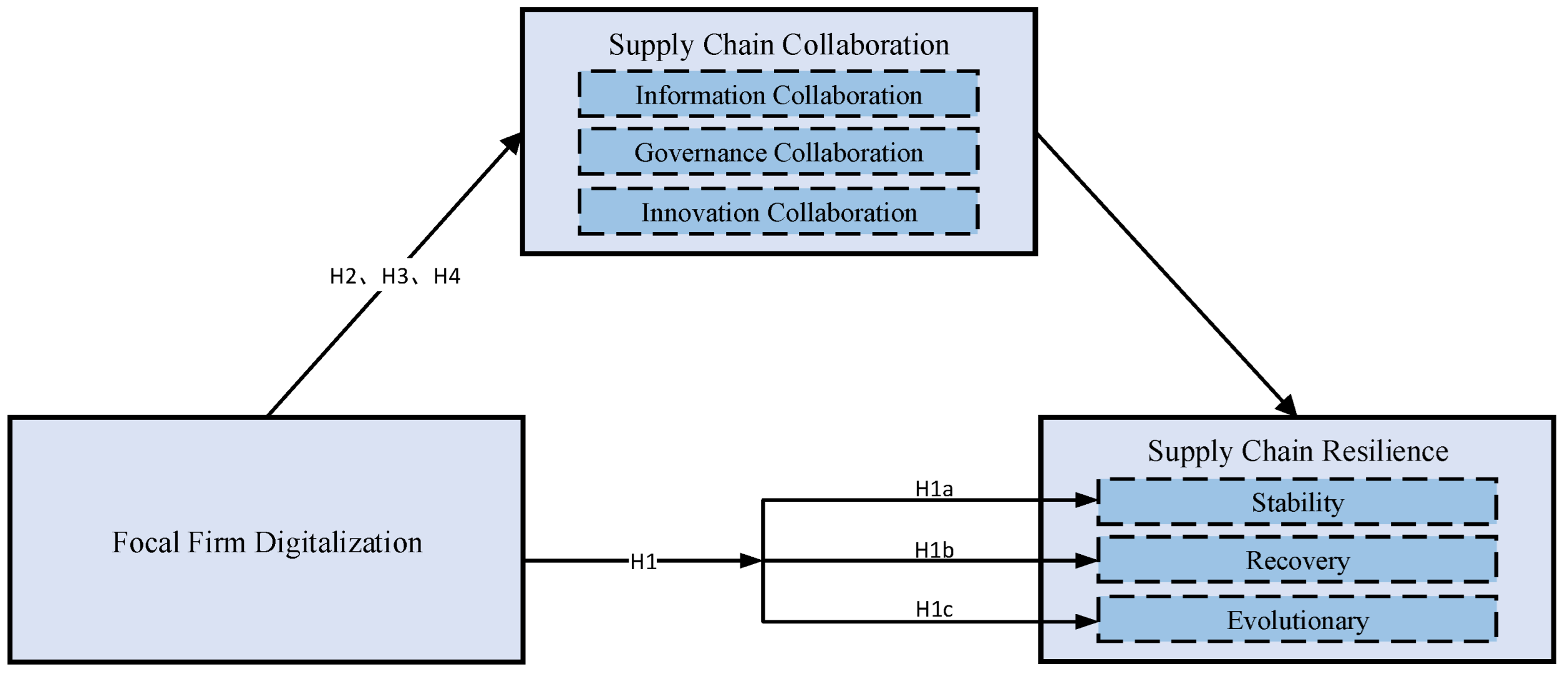
Focal firm digitalization enhances supply chain resilience through backward spillover empowerment effects. At the dimensional level, its positive impact on supply chain stability is not statistically significant (mainly constrained by contradictions between digitalization and data governance, as well as external economic turbulence). However, it significantly improves both recovery and evolutionary capabilities of the supply chain.
The heterogeneity analysis reveals that the positive effect of focal firm digitalization on supply chain resilience is more pronounced in contexts characterized by lower industry competition, closer upstream–downstream relationships, and weaker regional resource endowments of suppliers.
The underlying mechanisms through which focal firm digitalization affects supply chain resilience can be summarized into three major pathways: information empowerment, governance empowerment, and innovation spillover. Specifically, information empowerment facilitates information collaboration by reducing asymmetry, improving the quality of information integration, and enhancing traceability and monitoring efficiency, thereby driving upstream suppliers to improve operational performance. Governance empowerment strengthens supply chain resilience by optimizing network structure, improving resource allocation, and fostering collaborative business and risk management. Innovation spillover promotes resilience by broadening the scope and efficiency of knowledge flows, enabling open innovation models, and cultivating a collaborative innovation ecosystem.
It should be noted that the conclusions of this study are primarily derived from analyses based on manufacturing supply chain samples. Manufacturing supply chains are typically characterized by tighter vertical linkages among firms and a relatively mature process of digital integration, which provides a specific contextual foundation for the formation of the study’s findings. Nevertheless, the backward spillover empowerment effect identified in this research may also offer theoretical implications for service-oriented or hybrid supply chains. However, the applicability and boundary conditions of this mechanism in non-manufacturing contexts warrant further empirical examination and clarification in future studies.
6.2. Practical Implication
Based on these findings, the study provides the following managerial implications.
For focal firms, it is crucial to play a leading role in the process of digital transformation by deeply integrating digital technologies into the core of supply chain strategy. Specifically, firms should develop IoT- and big data–based monitoring systems to achieve supply chain visualization and dynamic management. By deploying sensors, RFID devices, and intelligent gateways across key stages such as production, warehousing, and transportation, firms can collect real-time data on logistics, equipment, and inventory. Leveraging cloud computing and edge computing enables data integration and intelligent analysis, thereby enhancing supply chain transparency, strengthening predictive and early warning capabilities, and effectively mitigating the “bullwhip effect.”
At the same time, firms should establish a digital governance platform to optimize resource allocation and risk management within the supply chain. This platform should encompass core functions such as data governance, intelligent decision-making, risk early warning, and performance evaluation. It should enhance system compatibility and information efficiency through data standardization, apply artificial intelligence and algorithmic models to dynamically optimize procurement, production, and logistics, build real-time monitoring–based mechanisms for risk identification and emergency response, and establish a feedback system for continuous improvement and strategic adjustment.
Moreover, firms need to strengthen data security and privacy protection to ensure compliance and operational stability. Through the integration of these systems, focal firms can achieve intelligent decision-making and collaborative governance across the entire supply chain, thereby significantly enhancing operational efficiency, risk resilience, and sustainable competitiveness. Under different contextual conditions, focal firms should balance data security with coordination efficiency in highly competitive industries, deepen data interconnectivity and process integration in tightly coupled supply chains, and overcome path dependence through digital-driven innovation in resource-abundant regions.
For upstream suppliers, maintaining strategic alignment with focal firms in the digital era is essential for enhancing overall supply chain resilience and competitiveness. Specifically, suppliers should advance digital transformation through three key dimensions: information sharing, process collaboration, and innovation co-creation.
First, in terms of information sharing, suppliers should actively integrate into the digital supply chain platforms established by focal firms to achieve real-time interconnectivity of key data such as production plans, inventory levels, and order demands. By leveraging ERP systems and cloud-based data platforms, suppliers can realize multi-node information visualization and predictive analysis, thereby optimizing capacity allocation and inventory structures while reducing mismatches and resource waste. Improved information transparency also strengthens mutual trust and coordination efficiency between upstream and downstream partners.
Second, regarding process collaboration, suppliers should adopt digital tools and technological standards provided by focal firms to promote the standardization and intelligent upgrading of production processes. Through the implementation of industrial internet platforms and manufacturing execution systems (MES), suppliers can monitor equipment status, optimize production rhythms, and ensure quality traceability, thereby enhancing process stability and controllability. Additionally, digital twin technology can be applied to simulate production scenarios, enabling early risk identification and improving adaptive responses to supply chain disruptions.
Finally, in the dimension of innovation co-creation, suppliers should shift from passive response to active engagement by integrating into the digital innovation ecosystem led by focal firms. Through joint R&D participation, co-establishment of innovation platforms, and shared data resources, suppliers can collaboratively advance innovation in new materials, energy-efficient technologies, and intelligent manufacturing solutions. Such collaboration not only enhances suppliers’ own innovation capabilities but also promotes knowledge flow and evolutionary learning within the entire supply chain, thereby fostering long-term synergistic competitiveness.
Overall, digital collaboration among upstream suppliers is not only a necessary response to focal firms’ digital strategies but also a critical pathway for improving their own adaptability and innovation capacity. By strengthening information sharing, process collaboration, and innovation co-creation, suppliers can transform from passive participants into active enablers, thereby reinforcing overall supply chain resilience.
For government policymakers, establishing an institutional and ecosystem framework that enables digitally driven supply chain resilience is essential for achieving high-quality economic development and ensuring industrial chain security and stability.
First, governments should strengthen investment in digital infrastructure by promoting the application of industrial internet, 5G, and related technologies in manufacturing clusters and critical supply chain nodes. They should also develop open and shared industrial internet platforms and national-level supply chain data-sharing systems, standardize data formats and interfaces to ensure security and interoperability, and address “information silos”. In addition, fiscal subsidies and tax incentives should be used to reduce the digital transformation costs of small and medium-sized enterprises, particularly upstream suppliers.
Second, governments should improve collaborative governance mechanisms along industrial chains by establishing a Digital Supply Chain Coordination Committee composed of government agencies, focal firms, and industry associations. This committee should guide focal firms in leveraging blockchain and other trusted technologies to break down data barriers, enhance transparency, and promote deep integration of upstream and downstream partners.
Furthermore, under heterogeneous conditions, regulatory authorities should implement differentiated policy measures tailored to industry and regional characteristics: strengthening antitrust enforcement and data-sharing oversight in highly competitive industries; promoting industrial upgrading in resource-abundant regions to prevent overreliance on single resources; and using fiscal incentives and talent development programs to stimulate digital innovation. Collectively, these initiatives can provide long-term institutional support for enhancing supply chain resilience and sustaining industrial competitiveness in the digital era.
6.3. Limitations and Future Research
Although this study provides valuable theoretical and practical implications for the continuous improvement of supply chain resilience, it still has several limitations that warrant further exploration in future research. Moreover, since supply chain resilience is a key influencing factor in achieving sustainable supply chain development, the two are inherently interdependent and cannot be meaningfully separated in future theoretical and empirical investigations.
First, this study focuses on examining how enterprise digitalization enhances supply chain resilience through three collaborative mechanisms—information empowerment, governance empowerment, and innovation spillover. Although the empirical results validate the effectiveness of these mechanisms, other potential pathways—such as differences in firms’ dynamic capabilities and the proactive accountability behavior of supply chain members—may also play critical roles and merit further exploration. Specifically, enterprise digitalization can strengthen information processing and resource integration capabilities, thereby enhancing firms’ abilities to sense, seize, and reconfigure in response to environmental changes. Consequently, heterogeneity in firms’ dynamic capabilities may serve as an important conduit through which digitalization affects supply chain adaptability and recovery. At the same time, the digital practices of focal firms often promote high transparency and traceability within collaborative governance systems, encouraging supply chain members to exhibit proactive accountability behavior, such as actively participating in joint risk management and collaborative innovation. Variations in such behavior may influence the transmission efficiency of digital empowerment and the overall resilience of the supply chain. These potential mechanisms provide new theoretical insights into the multifaceted pathways through which digitalization fosters supply chain resilience.
Second, this study examines the relationship between enterprise digitalization and supply chain resilience from a linear perspective. This approach reflects the current stage of digital development in China, where the positive effects of digitalization remain dominant, and more complex nonlinear relationships have not yet fully emerged. However, from a theoretical standpoint, the relationship between enterprise digitalization and supply chain resilience may exhibit complex nonlinear characteristics. Such nonlinearity primarily arises from the progressive maturation of digital ecosystems and the accelerating pace of technological iteration, which cause the direction and intensity of digitalization’s impact on supply chain resilience to vary across different stages of development. In the early stages of digitalization, enterprises enhance information transparency, coordination efficiency, and risk response capabilities through the adoption of digital technologies, thereby significantly improving supply chain adaptability and recovery capacity. As digitalization deepens, however, the complexity of technological investment, system integration, and data governance increases substantially. Enterprises may face diminishing marginal returns, resource misallocation, and heightened system dependence, which collectively raise operational risks and maintenance costs while potentially weakening supply chain flexibility and responsiveness. Therefore, as digital ecosystems evolve and technologies continue to advance, the effect of enterprise digitalization on supply chain resilience is likely to be stage-dependent and nonlinear, potentially taking J-shaped, N-shaped, or inverted U-shaped forms. Future research exploring these underlying nonlinear dynamics would provide deeper theoretical insights and more practical implications for understanding and enhancing supply chain resilience in the digital era.
Third, the empirical analysis is limited by sample scope. By focusing on Chinese A-share listed firms and simplifying the supply chain network into first-tier structures, the study does not account for firms in other institutional and regional contexts. Future studies could expand the sample to include enterprises from other countries or regions, thereby enhancing the generalizability and applicability of the findings on how digitalization influences supply chain resilience.