Carbon–Water Coupling in Forest Ecosystems Under Climate Change: Advances in Water Use Efficiency and Sustainability Perspectives

Abstract
1. Introduction
2. Mechanisms of Carbon–Water Coupling in Forests
2.1. Stomatal Regulation: The Nexus of Photosynthesis and Transpiration
2.2. Leaf-to-Ecosystem Scaling of Gas Exchange Processes
2.3. Impacts of Key Climate Drivers (Elevated CO2, Temperature, VPD) on Physiological Coupling
2.4. Decoupling Phenomena Under Climatic Extremes
3. Advances in Understanding Forest Water Use Efficiency
3.1. Defining and Measuring WUE Across Scales
3.2. Global and Regional Trends in Forest WUE: Evidence from Multi-Proxy Records
- Boreal Forests: In the vast boreal forests of Canada and Siberia, studies consistently show a strong increase in iWUE [44]. This suggests that other factors, such as nutrient limitations or increasing temperature-induced drought stress, are constraining productivity, preventing trees from capitalizing on the potential benefits of higher CO2 [44]. In Siberia, the net effect of climate change on productivity is complex, with warming potentially increasing growth in some cold-limited northern regions while increasing fire risk and drought stress in southern regions [45].
- Temperate Forests: In Europe, tree-ring studies also show a sustained increase in iWUE, with little evidence of the response plateauing at higher CO2 concentrations as had been previously hypothesized [46]. In the diverse forests of Northeast China, WUE trends are highly variable, depending on the specific forest type (e.g., coniferous vs. broad-leaved) and the local climatic gradient. For example, in the Daxing’anling mountains, a key driver of WUE patterns is the latitudinal gradient, which influences temperature and moisture availability, leading to distinct local adaptations to drought [47].
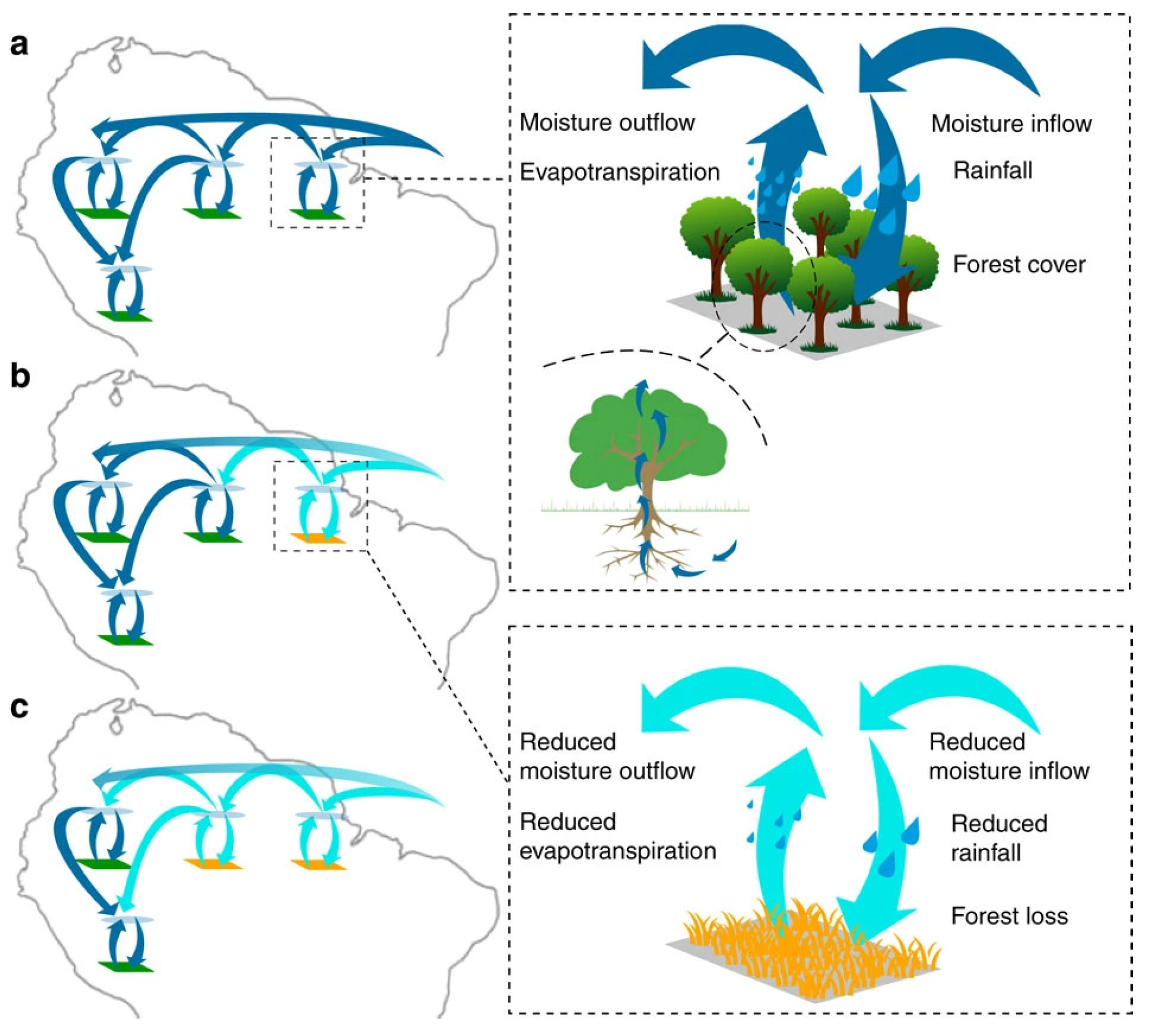
- Tropical Forests: As a global carbon–water hotspot, tropical forests remain data-poor relative to their importance. These highly productive ecosystems are characterized by large carbon and water fluxes but remain relatively under-studied. Available data suggest that drought events can lead to enhanced WUE, but this is often an adaptive response to water stress rather than a sign of increased productivity and may be accompanied by reduced growth [48].
3.3. Biotic and Abiotic Drivers of WUE Variability: Forest Type, Age, and Environmental Stress
3.4. Tropical Forests and Carbon–Water Coupling
4. Methodological Frontiers in Quantifying Carbon-Water Dynamics
4.1. In Situ Observations: Advances in Eddy Covariance, Stable Isotope Analysis, and Dendrochronology
4.2. Remote Sensing Applications: From MODIS and Landsat to Next-Generation Sensors
4.3. Modeling Approaches: Process-Based Models vs. Data-Driven Machine Learning
4.4. The Power of Integration: Multi-Scale Data Fusion for Comprehensive Monitoring

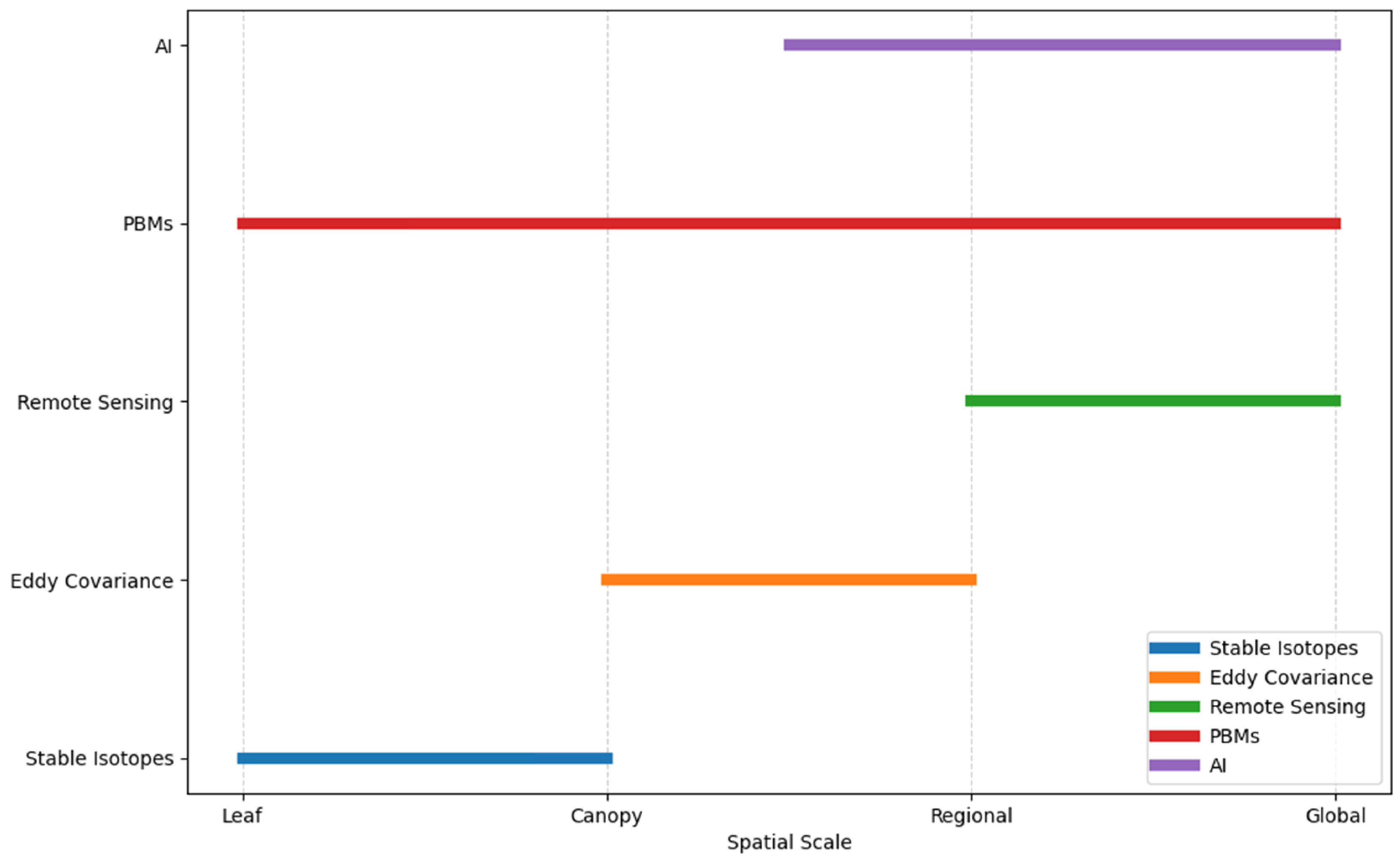
| Methodology | Principle | Key Variables Measured/Derived | Spatiotemporal Scale | Advantages | Limitations and Uncertainties |
|---|---|---|---|---|---|
| Eddy Covariance | Micrometeorological measurement of turbulent fluxes | NEE, ET, GPP | Ecosystem (~1 km2), continuous (sub-hourly to decadal) | Direct ecosystem-scale flux measurement; high temporal resolution; non-destructive. | High cost; limited spatial; data gaps; energy balance closure issues; assumptions in flux partitioning [60]. |
| Stable Isotopes | Isotopic fractionation during gas exchange and water transport | iWUE, gs | Leaf to tree, integrated over tissue formation (annual to centennial) | Provides long-term historical records; Integrates physiological responses over time; can separate drivers of iWUE change. | Indirect measurement; destructive sampling; uncertainties from mesophyll conductance and post-photosynthetic fractionation [62]. |
| Remote Sensing | Spectral reflectance/emittance related to vegetation properties | GPP, ET, LAI, NDVI | Stand to Global (>10 m to >1 km), daily to bi-weekly | Broad spatial coverage; Cost-effective for large areas; Repeated observations for monitoring. | Indirect estimation via models; cloud contamination; algorithm uncertainties; scale mismatch with ground validation [84]. |
| Process-Based Models | Mathematical simulation of biophysical and ecological processes | All C & H2O fluxes and stocks | Plot to Global, any temporal resolution | Predictive capability for future scenarios; mechanistic understanding; integration of multiple drivers. | High complexity and parameter uncertainty; can misrepresent key processes; requires extensive calibration/validation [85]. |
| Machine Learning/AI | Data-driven statistical pattern recognition | Any predictable variable | Any scale (dependent on training data) | Excellent at capturing complex nonlinear patterns; can integrate diverse data types. | “Black box” nature lacks interpretability; poor extrapolation beyond training data; requires large datasets [75]. |
4.5. Critical Comparison of Methodological Reliability
4.6. Evidence Integration: Cross-Method Consistency Under Extreme Events
- Case 1—Central/Northern Europe, summer 2018 (“hot drought”). Independent lines of evidence indicate widespread photosynthetic depression and a weakened land CO2 sink. OCO-2 SIF showed pronounced negative anomalies during the heat–drought episode across vegetation types, consistent with reduced light-use efficiency [91]. At the carbon-budget scale, atmospheric inversions estimated temperate Europe’s annual NEE in 2018 to be less negative by about 0.09 ± 0.06 Pg C yr−1 relative to the previous decade [92]. Multi-sensor analyses further documented productivity losses with legacy effects extending into autumn [93]. Concurrent dendro- and isotope-based studies show increases in iWUE during extreme drought while growth remains constrained, consistent with stomatal conservatism under high VPD and low soil moisture [94,95]. Together, these lines of evidence imply that GPP declined more than ET in many forests, yielding lower WUEe at the ecosystem scale while iWUE increased at the tree/leaf scale. We juxtapose these observations with data-driven flux products and DGVM ensembles; the ensembles capture regional anomaly signs but can underestimate GPP deficits in hotspots (ensemble mean ± 1σ) [89].
- Case 2—California, 2012–2015 (“multi-year hot drought”). Remote sensing and field campaigns revealed progressive loss of canopy water content and widespread mortality across California forests, providing structural evidence of physiological strain [96,97]. In parallel, recent evaluations show that satellite SIF closely tracks seasonal and interannual GPP variability, supporting its use as a drought indicator in water-limited regions of the western United States [98,99]. At the ecosystem scale, satellite-based assessments report episodes where WUEe increases under supply-limited conditions because ET reductions outpace GPP declines—an effect also found in global analyses of WUE response to drought [100]. As in Europe 2018, we benchmark observations against machine-learning flux products and model ensembles to display anomaly trajectories with ensemble mean ± 1σ envelopes [89].
5. Sustainability Perspectives: Implications for Ecosystem Services and Management
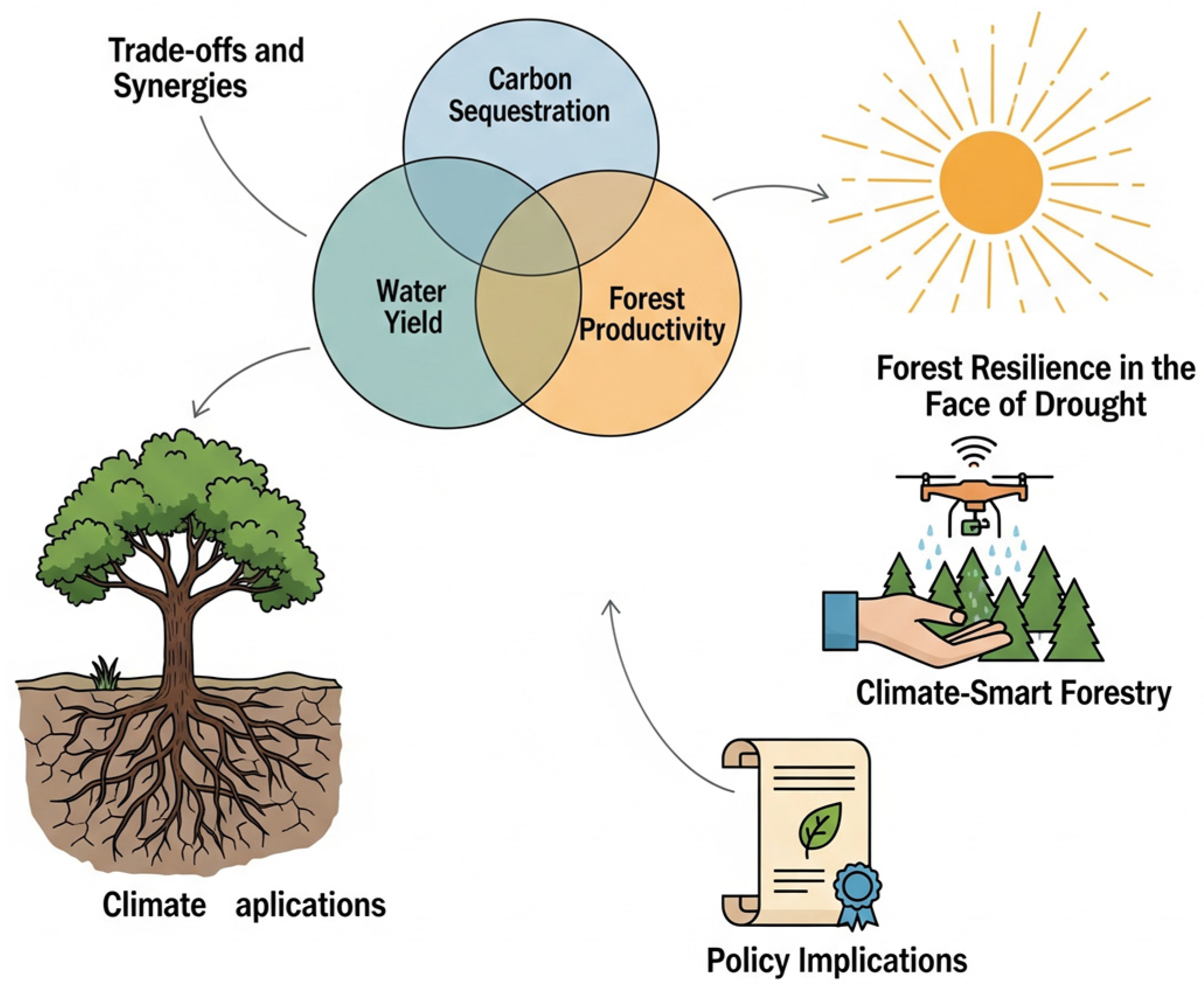
5.1. Trade-Offs and Synergies: Carbon Sequestration, Water Yield, and Forest Productivity
5.2. Forest Resilience in the Face of Drought: The Role of Adaptive Water Use Strategies
5.3. Climate-Smart Forestry: Adaptive Management for Enhancing Carbon-Water Co-Benefits
- Silvicultural Thinning: Proactively reducing stand density to lessen competition for water among remaining trees, thereby increasing their individual drought resilience and potentially increasing water yield from the watershed [121].
- Species and Genotype Selection: In reforestation and afforestation efforts, prioritizing the selection of tree species and provenances that are better adapted to projected future climate conditions, particularly those exhibiting greater drought tolerance and higher intrinsic WUE [122].
- Promoting Mixed-Species Forests: Moving away from monocultures toward planting and managing for mixed-species stands. This increases structural and functional diversity, which can enhance overall ecosystem resilience to disturbances and optimize the use of resources like water and nutrients [123].
- Modifying Rotation Lengths and Harvesting Regimes: Adjusting the timing and intensity of harvesting can influence long-term water use. For instance, shorter rotation cycles may reduce the period during which a stand is at maximum water consumption, while selective harvesting can maintain continuous canopy cover, which helps protect soil and water resources [124].
5.4. Policy Implications for Conservation and Sustainable Resource Management
5.5. Governance, Equity, and Policy Frameworks
6. Synthesis, Grand Challenges, and Future Research Directions
6.1. Synthesizing the Current State of Knowledge on Forest Carbon-Water Coupling
6.2. Identifying Critical Knowledge Gaps and Methodological Uncertainties
- Belowground Processes: The role of root systems, including competition for soil water, hydraulic redistribution, and carbon allocation belowground, represents a major frontier in ecohydrology that is inadequately represented in most ecosystem models.
- Interacting Disturbances: Forests are increasingly subject to multiple, interacting disturbances (e.g., drought weakening trees, making them more susceptible to insect attack and fire). Quantifying the synergistic effects of these compound disturbances on carbon-water coupling and post-disturbance recovery trajectories is a major uncertainty.
- Model Deficiencies: Process-based models often lack robust representations of key physiological mechanisms, such as hydraulic failure, plant-level optimization of water use, and the decoupling of photosynthesis and transpiration under extreme stress.
- Remote Sensing Uncertainties: While powerful for spatial monitoring, remote sensing products for GPP and ET—the core components of ecosystem WUE—contain significant uncertainties related to algorithm assumptions, sensor limitations, and validation challenges. These errors propagate directly into our large-scale assessments of carbon-water dynamics.
6.3. Proposing a Research Agenda for the Next Decade
- Develop a new generation of integrated monitoring systems that fuse remote sensing with in situ networks.
- Improve the predictive capacity of ecosystem models by incorporating more realistic plant hydraulics and hybridizing them with machine learning.
- Quantify the resilience and tipping points of forest ecosystems under combined stressors [136].
- Translate science into actionable, adaptive management and policy through co-developed decision-support tools [137].
7. Conclusions and Outlook
Author Contributions
Funding
Institutional Review Board Statement
Informed Consent Statement
Data Availability Statement
Acknowledgments
Conflicts of Interest
References
- Obal, G.; Mosphere, A.; Tch, W. WMO air quality and climate bulletin. Europe 2023, 45, 35. [Google Scholar]
- Richardson, K.; Steffen, W.; Lucht, W.; Bendtsen, J.; Cornell, S.E.; Donges, J.F.; Drüke, M.; Fetzer, I.; Bala, G.; von Bloh, W.; et al. Earth beyond six of nine planetary boundaries. Sci. Adv. 2023, 9, eadh2458. [Google Scholar] [CrossRef]
- Campbell, J.L.; Driscoll, C.T.; Jones, J.A.; Boose, E.R.; Dugan, H.A.; Groffman, P.M.; Jackson, C.R.; Jones, J.B.; Juday, G.P.; Lottig, N.R.; et al. Forest and Freshwater Ecosystem Responses to Climate Change and Variability at US LTER Sites. BioScience 2022, 72, 851–870. [Google Scholar] [CrossRef]
- Hubau, W.; Lewis, S.L.; Phillips, O.L.; Affum-Baffoe, K.; Beeckman, H.; Cuní-Sanchez, A.; Daniels, A.K.; Ewango, C.E.; Fauset, S.; Mukinzi, J.M. Asynchronous carbon sink saturation in African and Amazonian tropical forests. Nature 2020, 579, 80–87. [Google Scholar] [CrossRef]
- Feng, Q.; Yang, H.; Liu, Y.; Liu, Z.; Xia, S.; Wu, Z.; Zhang, Y. Interdisciplinary perspectives on forest ecosystems and climate interplay: A review. Environ. Rev. 2025, 33, 1–21. [Google Scholar] [CrossRef]
- Pan, Y.; Birdsey, R.; Fang, J.; Houghton, R.; Kauppi, P.; Kurz, W.; Phillips, O.; Shvidenko, A.; Lewis, S.; Canadell, J.; et al. A Large and Persistent Carbon Sink in the World’s Forests. Science 2011, 333, 988–993. [Google Scholar] [CrossRef]
- Hui, D.; Deng, Q.; Tian, H. Climate Change and Carbon Sequestration in Forest Ecosystems; Springer: Berlin/Heidelberg, Germany, 2015; pp. 1–40. [Google Scholar]
- Pugh, T.A.M.; Rademacher, T.; Shafer, S.L.; Steinkamp, J.; Barichivich, J.; Beckage, B.; Haverd, V.; Harper, A.; Heinke, J.; Nishina, K.; et al. Understanding the uncertainty in global forest carbon turnover. Biogeosciences 2020, 17, 3961–3989. [Google Scholar] [CrossRef]
- Pereira, H.M.; Martins, I.S.; Rosa, I.M.D.; Kim, H.; Leadley, P.; Popp, A.; van Vuuren, D.P.; Hurtt, G.; Quoss, L.; Arneth, A.; et al. Global trends and scenarios for terrestrial biodiversity and ecosystem services from 1900 to 2050. Science 2024, 384, 458–465. [Google Scholar] [CrossRef]
- Anderegg, W.R.L.; Trugman, A.T.; Badgley, G.; Anderson, C.M.; Bartuska, A.; Ciais, P.; Cullenward, D.; Field, C.B.; Freeman, J.; Goetz, S.J.; et al. Climate-driven risks to the climate mitigation potential of forests. Science 2020, 368, eaaz7005. [Google Scholar] [CrossRef]
- Lü, F.; Song, Y.; Yan, X. Evaluating Carbon Sink Potential of Forest Ecosystems under Different Climate Change Scenarios in Yunnan, Southwest China. Remote Sens. 2023, 15, 1442. [Google Scholar] [CrossRef]
- Anderegg, W.R.L.; Chegwidden, O.S.; Badgley, G.; Trugman, A.T.; Cullenward, D.; Abatzoglou, J.T.; Hicke, J.A.; Freeman, J.; Hamman, J.J. Future climate risks from stress, insects and fire across US forests. Ecol. Lett. 2022, 25, 1510–1520. [Google Scholar] [CrossRef]
- Brodribb, T.J.; Powers, J.; Cochard, H.; Choat, B. Hanging by a thread? Forests and drought. Science 2020, 368, 261–266. [Google Scholar] [CrossRef]
- Padrón, R.S.; Gudmundsson, L.; Decharme, B.; Ducharne, A.; Lawrence, D.M.; Mao, J.; Peano, D.; Krinner, G.; Kim, H.; Seneviratne, S.I. Observed changes in dry-season water availability attributed to human-induced climate change. Nat. Geosci. 2020, 13, 477–481. [Google Scholar] [CrossRef]
- Dye, A.W.; Houtman, R.M.; Gao, P.; Anderegg, W.R.L.; Fettig, C.J.; Hicke, J.A.; Kim, J.B.; Still, C.J.; Young, K.; Riley, K.L. Carbon, climate, and natural disturbance: A review of mechanisms, challenges, and tools for understanding forest carbon stability in an uncertain future. Carbon Balance Manag. 2024, 19, 35. [Google Scholar] [CrossRef]
- Gatti, L.V.; Basso, L.S.; Miller, J.B.; Gloor, M.; Gatti Domingues, L.; Cassol, H.L.G.; Tejada, G.; Aragão, L.E.O.C.; Nobre, C.; Peters, W.; et al. Amazonia as a carbon source linked to deforestation and climate change. Nature 2021, 595, 388–393. [Google Scholar] [CrossRef]
- Giles-Hansen, K.; Wei, X.; Hou, Y. Dramatic increase in water use efficiency with cumulative forest disturbance at the large forested watershed scale. Carbon Balance Manag. 2021, 16, 6. [Google Scholar] [CrossRef]
- Xu, Z.; Jiang, Y.; Jia, B.; Zhou, G. Elevated-CO2 Response of Stomata and Its Dependence on Environmental Factors. Front. Plant Sci. 2016, 7, 657. [Google Scholar] [CrossRef] [PubMed]
- McDowell, N.G.; Allen, C.D.; Anderson-Teixeira, K.; Aukema, B.H.; Bond-Lamberty, B.; Chini, L.; Clark, J.S.; Dietze, M.; Grossiord, C.; Hanbury-Brown, A. Pervasive shifts in forest dynamics in a changing world. Science 2020, 368, eaaz9463. [Google Scholar] [CrossRef] [PubMed]
- Li, Q.; Gao, Y.; Hamani, A.K.M.; Fu, Y.; Liu, J.; Wang, H.; Wang, X. Effects of Warming and Drought Stress on the Coupling of Photosynthesis and Transpiration in Winter Wheat (Triticum aestivum L.). Appl. Sci. 2023, 13, 2759. [Google Scholar] [CrossRef]
- Zhao, F.; Shi, W.; Xiao, J.; Zhao, M.; Li, X.; Wu, Y. Recent weakening of carbon-water coupling in northern ecosystems. Npj Clim. Atmos. Sci. 2025, 8, 161. [Google Scholar] [CrossRef]
- Zemp, D.C.; Schleussner, C.F.; Barbosa, H.M.; Hirota, M.; Montade, V.; Sampaio, G.; Staal, A.; Wang-Erlandsson, L.; Rammig, A. Self-amplified Amazon forest loss due to vegetation-atmosphere feedbacks. Nat. Commun. 2017, 8, 14681. [Google Scholar] [CrossRef] [PubMed]
- Zhang, Z.; Zhang, L.; Xu, H.; Creed, I.F.; Blanco, J.A.; Wei, X.; Sun, G.; Asbjornsen, H.; Bishop, K. Forest water-use efficiency: Effects of climate change and management on the coupling of carbon and water processes. For. Ecol. Manag. 2023, 534, 120853. [Google Scholar] [CrossRef]
- Montibeller, B.; Marshall, M.; Mander, Ü.; Uuemaa, E. Increased carbon assimilation and efficient water usage may not compensate for carbon loss in European forests. Commun. Earth Environ. 2022, 3, 194. [Google Scholar] [CrossRef]
- Lei, S.; Zhou, P.; Lin, J.; Tan, Z.; Huang, J.; Yan, P.; Chen, H. Spatiotemporal Variation in Carbon and Water Use Efficiency and Their Influencing Variables Based on Remote Sensing Data in the Nanling Mountains Region. Remote Sens. 2025, 17, 648. [Google Scholar] [CrossRef]
- Ainsworth, E.A.; Rogers, A. The response of photosynthesis and stomatal conductance to rising [CO2]: Mechanisms and environmental interactions. Plant Cell Environ. 2007, 30, 258–270. [Google Scholar] [CrossRef] [PubMed]
- Engineer, C.B.; Hashimoto-Sugimoto, M.; Negi, J.; Israelsson-Nordström, M.; Azoulay-Shemer, T.; Rappel, W.J.; Iba, K.; Schroeder, J.I. CO2 Sensing and CO2 Regulation of Stomatal Conductance: Advances and Open Questions. Trends Plant Sci. 2016, 21, 16–30. [Google Scholar] [CrossRef] [PubMed]
- Medlyn, B.E.; Barton, C.V.M.; Broadmeadow, M.S.J.; Ceulemans, R.; De Angelis, P.; Forstreuter, M.; Freeman, M.; Jackson, S.B.; Kellomäki, S.; Laitat, E.; et al. Stomatal conductance of forest species after long-term exposure to elevated CO2 concentration: A synthesis. New Phytol. 2001, 149, 247–264. [Google Scholar] [CrossRef]
- Flexas, J.; Ribas-Carbo, M.; Diaz-Espejo, A.; Galmés, J.; Medrano, H. Mesophyll conductance to CO2: Current knowledge and future prospects. Plant Cell Environ. 2008, 31, 602–621. [Google Scholar] [CrossRef]
- Lavergne, A.; Graven, H.; De Kauwe, M.; Medlyn, B.; Prentice, I. Observed and modelled historical trends in the water-use efficiency of plants and ecosystems. Glob. Change Biol. 2019, 25, 2242–2257. [Google Scholar] [CrossRef]
- Li, X.; Xiao, J.; He, B.; Altaf Arain, M.; Beringer, J.; Desai, A.R.; Emmel, C.; Hollinger, D.Y.; Krasnova, A.; Mammarella, I. Solar-induced chlorophyll fluorescence is strongly correlated with terrestrial photosynthesis for a wide variety of biomes: First global analysis based on OCO-2 and flux tower observations. Glob. Change Biol. 2018, 24, 3990–4008. [Google Scholar] [CrossRef]
- Bunce, J.A. Carbon dioxide effects on stomatal responses to the environment and water use by crops under field conditions. Oecologia 2004, 140, 1–10. [Google Scholar] [CrossRef] [PubMed]
- Deva, C.R.; Urban, M.O.; Challinor, A.J.; Falloon, P.; Svitákova, L. Enhanced Leaf Cooling Is a Pathway to Heat Tolerance in Common Bean. Front. Plant Sci. 2020, 11, 19. [Google Scholar] [CrossRef]
- De Kauwe, M.G.; Medlyn, B.E.; Pitman, A.J.; Drake, J.E.; Ukkola, A.; Griebel, A.; Pendall, E.; Prober, S.; Roderick, M. Examining the evidence for decoupling between photosynthesis and transpiration during heat extremes. Biogeosciences 2019, 16, 903–916. [Google Scholar] [CrossRef]
- Slot, M.; Rifai, S.W.; Eze, C.E.; Winter, K. The stomatal response to vapor pressure deficit drives the apparent temperature response of photosynthesis in tropical forests. New Phytol. 2024, 244, 1238–1249. [Google Scholar] [CrossRef]
- Sghir, A.; Iroshan, A. Machine Learning Integrated Climate-Agriculture Forecasting: A Transformer-Based Approach to Predict Precipitation and Wheat Production Amidst Climate Change. SSRN 2025, 5137941. [Google Scholar] [CrossRef]
- Kannenberg, S.A.; Maxwell, J.T.; Pederson, N.; D’Orangeville, L.; Ficklin, D.L.; Phillips, R.P. Drought legacies are dependent on water table depth, wood anatomy and drought timing across the eastern US. Ecol. Lett. 2019, 22, 119–127. [Google Scholar] [CrossRef]
- Kannenberg, S.A.; Cabon, A.; Babst, F.; Belmecheri, S.; Delpierre, N.; Guerrieri, R.; Maxwell, J.T.; Meinzer, F.C.; Moore, D.J.P.; Pappas, C.; et al. Drought-induced decoupling between carbon uptake and tree growth impacts forest carbon turnover time. Agric. For. Meteorol. 2022, 322, 108996. [Google Scholar] [CrossRef]
- Purcell, C.; Batke, S.; Yiotis, C.; Caballero, R.; Soh, W.; Murray, M.; McElwain, J.C. Increasing stomatal conductance in response to rising atmospheric CO2. Ann. Bot. 2018, 121, 1137–1149. [Google Scholar] [CrossRef]
- Niu, S.; Xing, X.; Zhang, Z.; Xia, J.; Zhou, X.; Song, B.; Li, L.; Wan, S. Water-use efficiency in response to climate change: From leaf to ecosystem in a temperate steppe. Glob. Change Biol. 2011, 17, 1073–1082. [Google Scholar] [CrossRef]
- Farooqi, T.J.A.; Irfan, M.; Zhou, X.; Pan, S.; Atta, A.; Li, J. Advancing Knowledge in Forest Water Use Efficiency Under Global Climate Change Through Scientometric Analysis. Forests 2024, 15, 1893. [Google Scholar] [CrossRef]
- Mathias, J.M.; Thomas, R.B. Global tree intrinsic water use efficiency is enhanced by increased atmospheric CO2 and modulated by climate and plant functional types. Proc. Natl. Acad. Sci. USA 2021, 118, e2014286118. [Google Scholar] [CrossRef]
- Gong, X.Y.; Ma, W.T.; Yu, Y.Z.; Fang, K.; Yang, Y.; Tcherkez, G.; Adams, M.A. Overestimated gains in water-use efficiency by global forests. Glob. Change Biol. 2022, 28, 4923–4934. [Google Scholar] [CrossRef]
- Giguère-Croteau, C.; Boucher, É.; Bergeron, Y.; Girardin, M.P.; Drobyshev, I.; Silva, L.C.R.; Hélie, J.-F.; Garneau, M. North America’s oldest boreal trees are more efficient water users due to increased [CO2], but do not grow faster. Proc. Natl. Acad. Sci. USA 2019, 116, 2749–2754. [Google Scholar] [CrossRef]
- Lucash, M.A.; Melissa, E.D.; INSF Arctic Data Center. Modeling Changes in Siberian Forests Under Climate Change, 2020–2024; NSF Arctic Data Center: Santa Barbara, CA, USA. Available online: https://par.nsf.gov/biblio/10584918-modeling-changes-siberian-forests-under-climate-change (accessed on 20 October 2025).
- Loader, N.J.; Walsh, R.P.D.; Robertson, I.; Bidin, K.; Ong, R.C.; Reynolds, G.; McCarroll, D.; Gagen, M.; Young, G.H.F. Recent trends in the intrinsic water-use efficiency of ringless rainforest trees in Borneo. Philos. Trans. R. Soc. B Biol. Sci. 2011, 366, 3330–3339. [Google Scholar] [CrossRef]
- Du, S.; Xie, D.; Liu, S.; Liu, L.; Jiang, J. Dynamics of Water Use Efficiency of Coniferous and Broad-Leaved Mixed Forest in East China. Forests 2024, 15, 901. [Google Scholar] [CrossRef]
- Bonal, D.; Burban, B.; Stahl, C.; Wagner, F.; Hérault, B. The response of tropical rainforests to drought—Lessons from recent research and future prospects. Ann. For. Sci. 2016, 73, 27–44. [Google Scholar] [CrossRef]
- Wang, M.; Chen, Y.; Wu, X.; Bai, Y. Forest-Type-Dependent Water Use Efficiency Trends Across the Northern Hemisphere. Geophys. Res. Lett. 2018, 45, 8283–8293. [Google Scholar] [CrossRef]
- Laffitte, B.; Seyler, B.C.; Wang, W.; Li, P.; Du, J.; Tang, Y. Declining tree growth rates despite increasing water-use efficiency under elevated CO(2) reveals a possible global overestimation of CO(2) fertilization effect. Heliyon 2022, 8, e11219. [Google Scholar] [CrossRef] [PubMed]
- Du, J.; Kimball, J.S.; Guo, J.S.; Kannenberg, S.A.; Smith, W.K.; Feldman, A.; Endsley, A. Enhanced Satellite Monitoring of Dryland Vegetation Water Potential Through Multi-Source Sensor Fusion. Geophys. Res. Lett. 2024, 51, e2024GL110385. [Google Scholar] [CrossRef]
- Yu, K.; Smith, W.K.; Trugman, A.T.; Condit, R.; Hubbell, S.P.; Sardans, J.; Peng, C.; Zhu, K.; Peñuelas, J.; Cailleret, M.; et al. Pervasive decreases in living vegetation carbon turnover time across forest climate zones. Proc. Natl. Acad. Sci. USA 2019, 116, 24662–24667. [Google Scholar] [CrossRef]
- Bennett, A.C.; Rodrigues de Sousa, T.; Monteagudo-Mendoza, A.; Esquivel-Muelbert, A.; Morandi, P.S.; Coelho de Souza, F.; Castro, W.; Duque, L.F.; Flores Llampazo, G.; Manoel dos Santos, R.; et al. Sensitivity of South American tropical forests to an extreme climate anomaly. Nat. Clim. Change 2023, 13, 967–974. [Google Scholar] [CrossRef]
- Botía, S.; Munassar, S.; Koch, T.; Custodio, D.; Basso, L.S.; Komiya, S.; Lavric, J.V.; Walter, D.; Gloor, M.; Martins, G. Combined CO2 measurement record indicates Amazon forest carbon uptake is offset by savanna carbon release. Atmos. Chem. Phys. 2025, 25, 6219–6255. [Google Scholar] [CrossRef]
- Botía, S.; Dias-Junior, C.Q.; Komiya, S.; van der Woude, A.; Terristi, M.; de Kok, R.; Koren, G.; van Asperen, H.; Jones, S.P.; D’Oliveira, F.A.F. Reduced vegetation uptake during the extreme 2023 drought turns the Amazon into a weak carbon source. ESS Open Arch. 2025. [Google Scholar] [CrossRef]
- Robbins, Z.; Chambers, J.; Chitra-Tarak, R.; Christoffersen, B.; Dickman, L.T.; Fisher, R.; Jonko, A.; Knox, R.; Koven, C.; Kueppers, L.; et al. Future climate doubles the risk of hydraulic failure in a wet tropical forest. New Phytol. 2024, 244, 2239–2250. [Google Scholar] [CrossRef]
- Yao, Y.; Joetzjer, E.; Ciais, P.; Viovy, N.; Cresto Aleina, F.; Chave, J.; Sack, L.; Bartlett, M.; Meir, P.; Fisher, R. Forest fluxes and mortality response to drought: Model description (ORCHIDEE-CAN-NHA, r7236) and evaluation at the Caxiuanã drought experiment. Geosci. Model Dev. Discuss. 2021, 2021, 7809–7833. [Google Scholar] [CrossRef]
- Gagen, M.; Battipaglia, G.; Daux, V.; Duffy, J.; Dorado-Liñán, I.; Hayles, L.A.; Martínez-Sancho, E.; McCarroll, D.; Shestakova, T.A.; Treydte, K. Climate Signals in Stable Isotope Tree-Ring Records. In Stable Isotopes in Tree Rings: Inferring Physiological, Climatic and Environmental Responses; Siegwolf, R.T.W., Brooks, J.R., Roden, J., Saurer, M., Eds.; Springer International Publishing: Cham, Switzerland, 2022; pp. 537–579. [Google Scholar]
- Sullivan, M.J.P.; Lewis, S.L.; Affum-Baffoe, K.; Castilho, C.; Costa, F.; Sanchez, A.C.; Ewango, C.E.N.; Hubau, W.; Marimon, B.; Monteagudo-Mendoza, A.; et al. Long-term thermal sensitivity of Earth’s tropical forests. Science 2020, 368, 869–874. [Google Scholar] [CrossRef]
- Gu, X.; Yao, L.; Wu, L. Prediction of Water Carbon Fluxes and Emission Causes in Rice Paddies Using Two Tree-Based Ensemble Algorithms. Sustainability 2023, 15, 12333. [Google Scholar] [CrossRef]
- Papale, D. Ideas and perspectives: Enhancing the impact of the FLUXNET network of eddy covariance sites. Biogeosciences 2020, 17, 5587–5598. [Google Scholar] [CrossRef]
- Ma, W.T.; Yu, Y.Z.; Wang, X.; Gong, X.Y. Estimation of intrinsic water-use efficiency from δ(13)C signature of C(3) leaves: Assumptions and uncertainty. Front. Plant Sci. 2022, 13, 1037972. [Google Scholar] [CrossRef]
- Dean, J.F.; Coxon, G.; Zheng, Y.; Bishop, J.; Garnett, M.H.; Bastviken, D.; Galy, V.; Spencer, R.G.M.; Tank, S.E.; Tipper, E.T.; et al. Old carbon routed from land to the atmosphere by global river systems. Nature 2025, 642, 105–111. [Google Scholar] [CrossRef] [PubMed]
- Liang, X.; Wang, Y. Old CO2 released from rivers complicates evaluations of fossil-fuel emissions. Nature 2025, 643, 336. [Google Scholar] [CrossRef]
- Lukač, L.; Mikac, S.; Urban, O.; Kolář, T.; Rybníček, M.; Ač, A.; Trnka, M.; Marek, M.V. Stable Isotopes in Tree Rings of Pinus heldreichii Can Indicate Climate Variability over the Eastern Mediterranean Region. Forests 2021, 12, 350. [Google Scholar] [CrossRef]
- Cai, W.; Ullah, S.; Yan, L.; Lin, Y. Remote Sensing of Ecosystem Water Use Efficiency: A Review of Direct and Indirect Estimation Methods. Remote Sens. 2021, 13, 2393. [Google Scholar] [CrossRef]
- Yang, Y.; Anderson, M.C.; Gao, F.; Hain, C.R.; Semmens, K.A.; Kustas, W.P.; Noormets, A.; Wynne, R.H.; Thomas, V.A.; Sun, G. Daily Landsat-scale evapotranspiration estimation over a forested landscape in North Carolina, USA, using multi-satellite data fusion. Hydrol. Earth Syst. Sci. 2017, 21, 1017–1037. [Google Scholar] [CrossRef]
- Phiri, D.; Simwanda, M.; Salekin, S.; Nyirenda, V.R.; Murayama, Y.; Ranagalage, M. Sentinel-2 Data for Land Cover/Use Mapping: A Review. Remote Sens. 2020, 12, 2291. [Google Scholar] [CrossRef]
- Borghi, C.; Francini, S.; D’Amico, G.; Valbuena, R.; Chirici, G. Advancements in Forest Monitoring: Applications and Perspectives of Airborne Laser Scanning and Complementarity with Satellite Optical Data. Land 2025, 14, 567. [Google Scholar] [CrossRef]
- Zhang, L.; Mao, J.; Shi, X.; Ricciuto, D.; He, H.; Thornton, P.; Yu, G.; Li, P.; Liu, M.; Ren, X.; et al. Evaluation of the Community Land Model simulated carbon and water fluxes against observations over ChinaFLUX sites. Agric. For. Meteorol. 2016, 226–227, 174–185. [Google Scholar] [CrossRef]
- Poppe Terán, C.; Naz, B.S.; Vereecken, H.; Baatz, R.; Fisher, R.A.; Hendricks Franssen, H.J. Systematic underestimation of type-specific ecosystem process variability in the Community Land Model v5 over Europe. Geosci. Model Dev. 2025, 18, 287–317. [Google Scholar] [CrossRef]
- Cuddington, K.; Fortin, M.-J.; Gerber, L.; Hastings, A.; Liebhold, A.; O’Connor, M.; Ray, C. Process-based models are required to manage ecological systems in a changing world. Ecosphere 2013, 4, art20. [Google Scholar] [CrossRef]
- Jafarov, E.E.; Genet, H.; Vesselinov, V.V.; Briones, V.; Kabeer, A.; Mullen, A.L.; Maglio, B.; Carman, T.; Rutter, R.; Clein, J. Estimation of above-and below-ground ecosystem parameters for the DVM-DOS-TEM v0. 7.0 model using MADS v1. 7.3: A synthetic case study. Geosci. Model Dev. Discuss. 2024, 2024, 1–27. [Google Scholar]
- Luo, Y.; Weng, E.; Wu, X.; Gao, C.; Zhou, X.; Zhang, L. Parameter identifiability, constraint, and equifinality in data assimilation with ecosystem models. Ecol. Appl. 2009, 19, 571–574. [Google Scholar] [CrossRef]
- Xu, Z.; Jiang, D. AI-Powered Plant Science: Transforming Forestry Monitoring, Disease Prediction, and Climate Adaptation. Plants 2025, 14, 1626. [Google Scholar] [CrossRef] [PubMed]
- Rana, P.; Varshney, L.R. Trustworthy Predictive Algorithms for Complex Forest System Decision-Making. Front. For. Glob. Change 2021, 3, 587178. [Google Scholar] [CrossRef]
- Meng, C.; Griesemer, S.; Cao, D.; Seo, S.; Liu, Y. When physics meets machine learning: A survey of physics-informed machine learning. Mach. Learn. Comput. Sci. Eng. 2025, 1, 20. [Google Scholar] [CrossRef]
- Wang, Y.; Trudinger, C.; Enting, I. A review of applications of model–data fusion to studies of terrestrial carbon fluxes at different scales. Agric. For. Meteorol. 2009, 149, 1829–1842. [Google Scholar] [CrossRef]
- Marcilio-Silva, V.; Donovan, S.; Hobbie, S.E.; Guzmán, Q.J.; Knight, J.F.; Cavender-Bares, J. Integrating remote sensing and field inventories to understand determinants of urban forest diversity and structure. Ecology 2025, 106, e70020. [Google Scholar] [CrossRef]
- Yuan, Q.; Wang, X.; Che, T.; Li, J. Global carbon flux dataset generated by fusing remote sensing and multiple flux networks observation. Sci. Data 2025, 12, 1359. [Google Scholar] [CrossRef]
- Zhang, Z.; Fan, M.; Tao, M.; Tan, Y.; Wang, Q. Large Divergence of Satellite Monitoring of Diffuse Radiation Effect on Ecosystem Water-Use Efficiency. Geophys. Res. Lett. 2023, 50, e2023GL106086. [Google Scholar] [CrossRef]
- Meason, D.; Salekin, S.; Lad, P.; Owens, J.; Zhang, Y.; Wade, A.; Dudley, B.; Griffins, J.; Yang, J.; Dempster, A.; et al. Forest Flows-Data Fusion of Remote Sensing and Real Time Terrestrial Data for Identifying and Quantifying the Drivers of Forest Hydrological Processes across Different Scales. In Proceedings of the AGU Fall Meeting Abstracts, Chicago, IL, USA, 1 December 2022; p. H25K-1241. [Google Scholar]
- Westfall, J.A.; Radtke, P.J.; Walker, D.M.; Coulston, J.W. Model error propagation in a compatible tree volume, biomass, and carbon prediction system. Carbon Balance Manag. 2025, 20, 14. [Google Scholar] [CrossRef]
- Zou, J.; Ding, J.; Welp, M.; Huang, S.; Liu, B. Assessing the Response of Ecosystem Water Use Efficiency to Drought During and after Drought Events across Central Asia. Sensors 2020, 20, 581. [Google Scholar] [CrossRef]
- Wang, W.; Ichii, K.; Hashimoto, H.; Michaelis, A.R.; Thornton, P.E.; Law, B.E.; Nemani, R.R. A hierarchical analysis of terrestrial ecosystem model Biome-BGC: Equilibrium analysis and model calibration. Ecol. Model. 2009, 220, 2009–2023. [Google Scholar] [CrossRef]
- Leng, J.; Chen, J.M.; Li, W.; Luo, X.; Xu, M.; Liu, J.; Wang, R.; Rogers, C.; Li, B.; Yan, Y. Global datasets of hourly carbon and water fluxes simulated using a satellite-based process model with dynamic parameterizations. Earth Syst. Sci. Data 2024, 16, 1283–1300. [Google Scholar] [CrossRef]
- Wang, Y.-Q.; Song, H.-Q.; Chen, Y.-J.; Fu, P.-L.; Zhang, J.-L.; Cao, K.-F.; Zhu, S.-D. Hydraulic determinants of drought-induced tree mortality and changes in tree abundance between two tropical forests with different water availability. Agric. For. Meteorol. 2023, 331, 109329. [Google Scholar] [CrossRef]
- Lucarini, A.; Cascio, M.L.; Marras, S.; Sirca, C.; Spano, D. Artificial intelligence and Eddy covariance: A review. Sci. Total Environ. 2024, 950, 175406. [Google Scholar] [CrossRef]
- Nelson, J.A.; Walther, S.; Gans, F.; Kraft, B.; Weber, U.; Novick, K.; Buchmann, N.; Migliavacca, M.; Wohlfahrt, G.; Šigut, L.; et al. X-BASE: The first terrestrial carbon and water flux products from an extended data-driven scaling framework, FLUXCOM-X. Biogeosciences 2024, 21, 5079–5115. [Google Scholar] [CrossRef]
- Friedlingstein, P.; O’Sullivan, M.; Jones, M.W.; Andrew, R.M.; Bakker, D.C.E.; Hauck, J.; Landschützer, P.; Le Quéré, C.; Luijkx, I.T.; Peters, G.P.; et al. Global Carbon Budget 2023. Earth Syst. Sci. Data 2023, 15, 5301–5369. [Google Scholar] [CrossRef]
- Shekhar, A.; Chen, J.; Bhattacharjee, S.; Buras, A.; Castro, A.O.; Zang, C.S.; Rammig, A. Capturing the Impact of the 2018 European Drought and Heat across Different Vegetation Types Using OCO-2 Solar-Induced Fluorescence. Remote Sens. 2020, 12, 3249. [Google Scholar] [CrossRef]
- Thompson, R.L.; Broquet, G.; Gerbig, C.; Koch, T.; Lang, M.; Monteil, G.; Munassar, S.; Nickless, A.; Scholze, M.; Ramonet, M.; et al. Changes in net ecosystem exchange over Europe during the 2018 drought based on atmospheric observations. Philos. Trans. R. Soc. B Biol. Sci. 2020, 375, 20190512. [Google Scholar] [CrossRef] [PubMed]
- Bastos, A.; Ciais, P.; Friedlingstein, P.; Sitch, S.; Pongratz, J.; Fan, L.; Wigneron, J.P.; Weber, U.; Reichstein, M.; Fu, Z.; et al. Direct and seasonal legacy effects of the 2018 heat wave and drought on European ecosystem productivity. Sci. Adv. 2020, 6, eaba2724. [Google Scholar] [CrossRef]
- Martínez-Sancho, E.; Treydte, K.; Lehmann, M.M.; Rigling, A.; Fonti, P. Drought impacts on tree carbon sequestration and water use–evidence from intra-annual tree-ring characteristics. New Phytol. 2022, 236, 58–70. [Google Scholar] [CrossRef]
- Fu, Z.; Ciais, P.; Prentice, I.C.; Gentine, P.; Makowski, D.; Bastos, A.; Luo, X.; Green, J.K.; Stoy, P.C.; Yang, H.; et al. Atmospheric dryness reduces photosynthesis along a large range of soil water deficits. Nat. Commun. 2022, 13, 989. [Google Scholar] [CrossRef]
- Lyons, D.S.; Dobrowski, S.Z.; Holden, Z.A.; Maneta, M.P.; Sala, A. Soil moisture variation drives canopy water content dynamics across the western U.S. Remote Sens. Environ. 2021, 253, 112233. [Google Scholar] [CrossRef]
- Cheng, Y.; Oehmcke, S.; Brandt, M.; Rosenthal, L.; Das, A.; Vrieling, A.; Saatchi, S.; Wagner, F.; Mugabowindekwe, M.; Verbruggen, W.; et al. Scattered tree death contributes to substantial forest loss in California. Nat. Commun. 2024, 15, 641. [Google Scholar] [CrossRef]
- Butterfield, Z.; Magney, T.; Grossmann, K.; Bohrer, G.; Vogel, C.; Barr, S.; Keppel-Aleks, G. Accounting for Changes in Radiation Improves the Ability of SIF to Track Water Stress-Induced Losses in Summer GPP in a Temperate Deciduous Forest. J. Geophys. Res. Biogeosci. 2023, 128, e2022JG007352. [Google Scholar] [CrossRef]
- Dannenberg, M.P.; Yan, D.; Barnes, M.L.; Smith, W.K.; Johnston, M.R.; Scott, R.L.; Biederman, J.A.; Knowles, J.F.; Wang, X.; Duman, T.; et al. Exceptional heat and atmospheric dryness amplified losses of primary production during the 2020 U.S. Southwest hot drought. Glob. Change Biol. 2022, 28, 4794–4806. [Google Scholar] [CrossRef]
- Hu, Z.Y.; Dai, Q.H.; Yan, Y.J.; Zhang, Y.; Li, H.Y.; Zhou, H.; Yao, Y.W. Dissecting the Characteristics and Driver Factors on Global Water Use Efficiency Using GLASS Data Sets. Earth’s Future 2024, 12, e2024EF004630. [Google Scholar] [CrossRef]
- Fatecha, B.V.; Martínez-Vilalta, J.; Mencuccini, M.; Poyatos, R. Multi-biome assessment of tree water use resilience to drought. Agric. For. Meteorol. 2025, 372, 110666. [Google Scholar] [CrossRef]
- Chen, L.; Guo, H.; He, S.; Chen, Z.; Lou, Z.; Lu, R.; Zhou, L.; Shi, Z.; Ye, S. Human Activities Accelerate Recovery of Gross Ecosystem Product Following Vegetation Disturbances. Earth Crit. Zone 2025, 100048. [Google Scholar] [CrossRef]
- Feng, X.; Fu, B.; Piao, S.; Wang, S.; Ciais, P.; Zeng, Z.; Lü, Y.; Zeng, Y.; Li, Y.; Jiang, X. Revegetation in China’s Loess Plateau is approaching sustainable water resource limits. Nat. Clim. Change 2016, 6, 1019–1022. [Google Scholar] [CrossRef]
- Liu, Y.; Xiao, J.; Ju, W.; Zhou, Y.; Wang, S.; Wu, X. Water use efficiency of China’s terrestrial ecosystems and responses to drought. Sci. Rep. 2015, 5, 13799. [Google Scholar] [CrossRef]
- Spracklen, D.; Garcia-Carreras, L. The impact of Amazonian deforestation on Amazon basin rainfall. Geophys. Res. Lett. 2015, 42, 9546–9552. [Google Scholar] [CrossRef]
- Reinhardt, K.; Germino, M.J.; Kueppers, L.M.; Domec, J.-C.; Mitton, J. Linking carbon and water relations to drought-induced mortality in Pinus flexilis seedlings. Tree Physiol. 2015, 35, 771–782. [Google Scholar] [CrossRef]
- Pretzsch, H.; Forrester, D.I.; Bauhus, J. Mixed-species forests. In Ecology and Management; Springer: Berlin/Heidelberg, Germany, 2017; Volume 653. [Google Scholar]
- Zhao, J.; Yu, Y.; Hu, Y.; Beyer, M.; Zhang, J. Measurement and modeling of canopy interception loss of evergreen, deciduous and mixed forests in a subhumid watershed on the Loess Plateau, China. J. Hydrol. 2025, 654, 132820. [Google Scholar] [CrossRef]
- Hu, Y.-L.; Zheng, Z.-H.; Qin, C.-Q.; Leuzinger, S. Effects of litter input on soil aggregation and aggregate carbon turnover differ among three subtropical forests in southeastern China. Front. Plant Sci. 2025, 16, 1516775. [Google Scholar] [CrossRef]
- Bai, Y.; Ochuodho, T.; Yang, J. Impact of land use and climate change on water-related ecosystem services in Kentucky, USA. Ecol. Indic. 2019, 102, 51–64. [Google Scholar] [CrossRef]
- Wang, Y.; Zhang, Z.; Chen, X. Impact of Land Use Change on Water-Related Ecosystem Services under Multiple Ecological Restoration Scenarios in the Ganjiang River Basin, China. Forests 2024, 15, 1225. [Google Scholar] [CrossRef]
- Wang, H.; Wang, W.J.; Wang, L.; Ma, S.; Liu, Z.; Zhang, W.; Zou, Y.; Jiang, M. Impacts of Future Climate and Land Use/Cover Changes on Water-Related Ecosystem Services in Changbai Mountains, Northeast China. Front. Ecol. Evol. 2022, 10, 854497. [Google Scholar] [CrossRef]
- Haritika; Negi, A.K. The underestimated role of understory vegetation dynamics for forest ecosystem resilience: A review. Plant Ecol. 2025, 226, 763–787. [Google Scholar] [CrossRef]
- Ma, X.; Zhang, P.; Yang, L.; Qi, Y.; Liu, J.; Liu, L.; Fan, X.; Hou, K. Assessing the relative contributions, combined effects and multiscale uncertainty of future land use and climate change on water-related ecosystem services in Southwest China using a novel integrated modelling framework. Sustain. Cities Soc. 2024, 106, 105400. [Google Scholar] [CrossRef]
- Stan, K.; Sanchez-Azofeifa, G.; Durán, S.; Guzmán, Q.J.A.; Hesketh, M.; Laakso, K.; Portillo-Quintero, C.; Rankine, C.; Doetterl, S. Tropical Dry Forest resilience and Water Use Efficiency: An analysis of productivity under climate change. Environ. Res. Lett. 2021, 16, 054027. [Google Scholar] [CrossRef]
- Mei, L.; Tong, S.; Yin, S.; Bao, Y.; Wang, Y.; Guo, E.; Li, F.; Huang, X.; Alateng, T.; Liu, D.; et al. Assessing water use efficiency reactivity to meteorological, hydrological, and agricultural droughts on the Mongolian Plateau. Int. J. Digit. Earth 2024, 17, 2398056. [Google Scholar] [CrossRef]
- Requena-Mullor, J.M.; Steiner, A.; Keppel-Aleks, G.; Ibáñez, I. Tradeoffs in forest resilience to satellite-based estimates of water and productivity losses. Remote Sens. Environ. 2023, 285, 113414. [Google Scholar] [CrossRef]
- Werner, C.; Meredith, L.K.; Ladd, S.N.; Ingrisch, J.; Kübert, A.; van Haren, J.; Bahn, M.; Bailey, K.; Bamberger, I.; Beyer, M.; et al. Ecosystem fluxes during drought and recovery in an experimental forest. Science 2021, 374, 1514–1518. [Google Scholar] [CrossRef]
- Gregor, K.; Knoke, T.; Krause, A.; Reyer, C.P.O.; Lindeskog, M.; Papastefanou, P.; Smith, B.; Lansø, S.-F.; Rammig, A. Trade-offs for climate-smart forestry in Europe under uncertain future climate. Earth’s Future 2022, 10, e2022EF002796. [Google Scholar] [CrossRef]
- Spittlehouse, D.L.; Stewart, R.B. Adaptation to climate change in forest management. J. Ecosyst. Manag. 2004, 4, 1–11. [Google Scholar] [CrossRef]
- Young, D.J.N.; Estes, B.L.; Gross, S.; Wuenschel, A.; Restaino, C.; Meyer, M.D. Effectiveness of forest density reduction treatments for increasing drought resistance of ponderosa pine growth. Ecol. Appl. 2023, 33, e2854. [Google Scholar] [CrossRef]
- Gazol, A.; Fajardo, A.; Camarero, J.J. Contributions of Intraspecific Variation to Drought Tolerance in Trees. Curr. For. Rep. 2023, 9, 461–472. [Google Scholar] [CrossRef]
- Jankowski, P.A.; Calama, R.; Madrigal, G.; Pardos, M. Enhanced interannual drought resilience in mixed stands: Unveiling possible complementarity effects between tree species of the Spanish Northern Plateau. Eur. J. For. Res. 2025, 144, 755–774. [Google Scholar] [CrossRef]
- Stelling, J.M.; Slesak, R.A.; Windmuller-Campione, M.A.; Grinde, A. Effects of stand age, tree species, and climate on water table fluctuations and estimated evapotranspiration in managed peatland forests. J. Environ. Manag. 2023, 339, 117783. [Google Scholar] [CrossRef] [PubMed]
- Sun, S.; Xiang, W.; Ouyang, S.; Hu, Y.; Peng, C. Balancing Water Yield and Water Use Efficiency Between Planted and Natural Forests: A Global Analysis. Glob. Change Biol. 2024, 30, e17561. [Google Scholar] [CrossRef]
- Kuyper, J.; Schroeder, H.; Linnér, B.-O. The Evolution of the UNFCCC. Annu. Rev. Environ. Resour. 2018, 43, 343–368. [Google Scholar] [CrossRef]
- Lieffers, V.J.; Pinno, B.D.; Beverly, J.L.; Thomas, B.R.; Nock, C. Reforestation policy has constrained options for managing risks on public forests. Can. J. For. Res. 2020, 50, 855–861. [Google Scholar] [CrossRef]
- Virtanen, P.K.; Gonzaga Roa, A.; Fernández-Llamazares, Á.; Apurinã, F.; Facundes, S. Indigenous governance and relationality have effectively avoided forest loss in the Southwest Amazon. Commun. Earth Environ. 2025, 6, 289. [Google Scholar] [CrossRef]
- Furumo, P.R.; Lambin, E.F. Policy sequencing to reduce tropical deforestation. Glob. Sustain. 2021, 4, e24. [Google Scholar] [CrossRef]
- Mooren, C.E.; Munaretto, S.; La Jeunesse, I.; Sievers, E.; Hegger, D.L.T.; Driessen, P.P.J.; Hüesker, F.; Cirelli, C.; Canovas, I.; Mounir, K.; et al. Water–energy–food–ecosystem nexus: How to frame and how to govern. Sustain. Sci. 2025. [Google Scholar] [CrossRef]
- Mooren, C.E.; Papadopoulou, C.-A.; Munaretto, S.; Levedi, K.; Papadopoulou, M.P. A methodological framework for assessing the coherence of Water-Energy-Food-Ecosystem nexus policies: Illustration and application at the river basin level. Environ. Sci. Policy 2025, 170, 104113. [Google Scholar] [CrossRef]
- Wu, Q.; Wang, X.; Chen, S.; Wang, L.; Jiang, J. Land Surface Greening and CO2 Fertilization More than Offset the Gross Carbon Sequestration Decline Caused by Land Cover Change and the Enhanced Vapour Pressure Deficit in Europe. Remote Sens. 2023, 15, 1372. [Google Scholar] [CrossRef]
- Davis, E.C.; Sohngen, B.; Lewis, D.J. The effect of carbon fertilization on naturally regenerated and planted US forests. Nat. Commun. 2022, 13, 5490. [Google Scholar] [CrossRef] [PubMed]
- Forzieri, G.; Dakos, V.; McDowell, N.G.; Ramdane, A.; Cescatti, A. Emerging signals of declining forest resilience under climate change. Nature 2022, 608, 534–539. [Google Scholar] [CrossRef]
- Trumbore, S.; Brando, P.; Hartmann, H. Forest health and global change. Science 2015, 349, 814–818. [Google Scholar] [CrossRef] [PubMed]
- Seidl, R.; Spies, T.A.; Peterson, D.L.; Stephens, S.L.; Hicke, J.A. Searching for resilience: Addressing the impacts of changing disturbance regimes on forest ecosystem services. J. Appl. Ecol. 2016, 53, 120–129. [Google Scholar] [CrossRef] [PubMed]
- Adams, M.; Pfautsch, S. Grand Challenges: Forests and Global Change. Front. For. Glob. Change 2018, 1, 1. [Google Scholar] [CrossRef]


| Study/Review | Scope | Scale Emphasis | Treatment of Climate Extremes | Policy/Management Implications | Distinct Contribution |
|---|---|---|---|---|---|
| Zhang et al. (2023) [23] | WUE responses to climate change and management | Mainly physiological and ecosystem | Limited | Discussed management but not water–carbon trade-offs | Valuable synthesis of WUE drivers |
| Montibeller et al. (2022) [24] | Carbon assimilation vs. water use in European forests | Regional focus (Europe) | Minimal | Policy implications indirect | Highlights European case studies |
| This Review (2025) | Carbon–water coupling under climate change, with WUE as core metric | Multi-scale (leaf → ecosystem → global) | Explicit focus on droughts, heatwaves, and compound extremes | Strong emphasis on trade-offs between carbon sequestration and water yield; climate-smart forestry strategies | Provides integrative, cross-scale and policy-relevant perspective |
| Climate Extreme | Empirical Evidence (FACE, FLUXNET, Isotopes) | Model Representation (PBMs, ESMs) | Key Gap and References |
|---|---|---|---|
| Drought | Stomatal closure increases iWUE but tree growth declines; evidence of GPP–growth decoupling | Many PBMs assume tight coupling of GPP and growth; allocation dynamics simplified | Models fail to represent drought legacies and allocation trade-offs [37,38]. |
| Heatwaves | Photosynthesis shuts down while transpiration continues for evaporative cooling [34] | Models typically assume proportional reduction in transpiration with reduced photosynthesis | Emergency-mode thermoregulation missing [15,34]. |
| High VPD | Eddy covariance: stomata close, GPP decreases, but transpiration decline weaker than expected | PBMs use fixed stomatal conductance functions; lack flexibility under high VPD | WUE gains overestimated, water loss underestimated [30,39]. |
| Compound Stress (drought + heat) | Observed synergistic effects: mortality risk sharply increases, decoupling amplified | Models often simulate stress additively, rarely include nonlinear interactions | Missing thresholds and tipping points [21]. |
| Metric | Abbreviation | Formula | Numerator Represents | Denominator Represents | Typical Scale |
|---|---|---|---|---|---|
| Intrinsic Water Use Efficiency | iWUE | A/gs | Net CO2 Assimilation | Stomatal Conductance | Leaf [23] |
| Instantaneous Water Use Efficiency | WUEi | A/T | Net CO2 Assimilation | Transpiration | Leaf [23] |
| Canopy Water Use Efficiency | WUEc | GPP/Tc | Gross Primary Productivity | Canopy Transpiration | Canopy/Stand [40] |
| Ecosystem Water Use Efficiency | WUEe | GPP/ET | Gross Primary Productivity | Evapotranspiration | Ecosystem [41] |
| Net Ecosystem Water Use Efficiency | WUE_nee | NEE/ET | Net Ecosystem Exchange | Evapotranspiration | Ecosystem [23] |
| Underlying Water Use Efficiency | uWUE | (GPP × VPD)/gs | GPP weighted by VPD | Canopy Conductance | Ecosystem [23] |
Disclaimer/Publisher’s Note: The statements, opinions and data contained in all publications are solely those of the individual author(s) and contributor(s) and not of MDPI and/or the editor(s). MDPI and/or the editor(s) disclaim responsibility for any injury to people or property resulting from any ideas, methods, instructions or products referred to in the content. |
© 2025 by the authors. Licensee MDPI, Basel, Switzerland. This article is an open access article distributed under the terms and conditions of the Creative Commons Attribution (CC BY) license (https://creativecommons.org/licenses/by/4.0/).
Share and Cite
Liang, X.; Cong, X.; Du, B.; Ju, Y.; Wang, Y.; Li, D. Carbon–Water Coupling in Forest Ecosystems Under Climate Change: Advances in Water Use Efficiency and Sustainability Perspectives. Sustainability 2025, 17, 9501. https://doi.org/10.3390/su17219501
Liang X, Cong X, Du B, Ju Y, Wang Y, Li D. Carbon–Water Coupling in Forest Ecosystems Under Climate Change: Advances in Water Use Efficiency and Sustainability Perspectives. Sustainability. 2025; 17(21):9501. https://doi.org/10.3390/su17219501
Chicago/Turabian StyleLiang, Xiongwei, Xue Cong, Baolong Du, Yongfu Ju, Yingning Wang, and Dan Li. 2025. "Carbon–Water Coupling in Forest Ecosystems Under Climate Change: Advances in Water Use Efficiency and Sustainability Perspectives" Sustainability 17, no. 21: 9501. https://doi.org/10.3390/su17219501
APA StyleLiang, X., Cong, X., Du, B., Ju, Y., Wang, Y., & Li, D. (2025). Carbon–Water Coupling in Forest Ecosystems Under Climate Change: Advances in Water Use Efficiency and Sustainability Perspectives. Sustainability, 17(21), 9501. https://doi.org/10.3390/su17219501